Title: Wild Women: Seekers, Protagonists and Goddesses in Sacred Indian Poetry
Editor: Arundhathi Subramaniam
Publisher: Penguin Random House
“The path of the heart is at times discredited as a soft option. It is seen as a path of neurotic excess and greasy sentimentality. Yet, what we hear in these songs isn’t prissy obedience but open-throated longing. […] Such longing is not born of an infantile need for a divine paterfamilias. Nor is it the resort of those who lack the intellect to craft their own destinies. This is the way of the razor’s edge. The path of those who have nothing left to protect or prove. This is one of the most courageous journeys back home,” writes Arundhathi Subramaniam in some of the most powerful lines of a very evocative Introduction to this book.
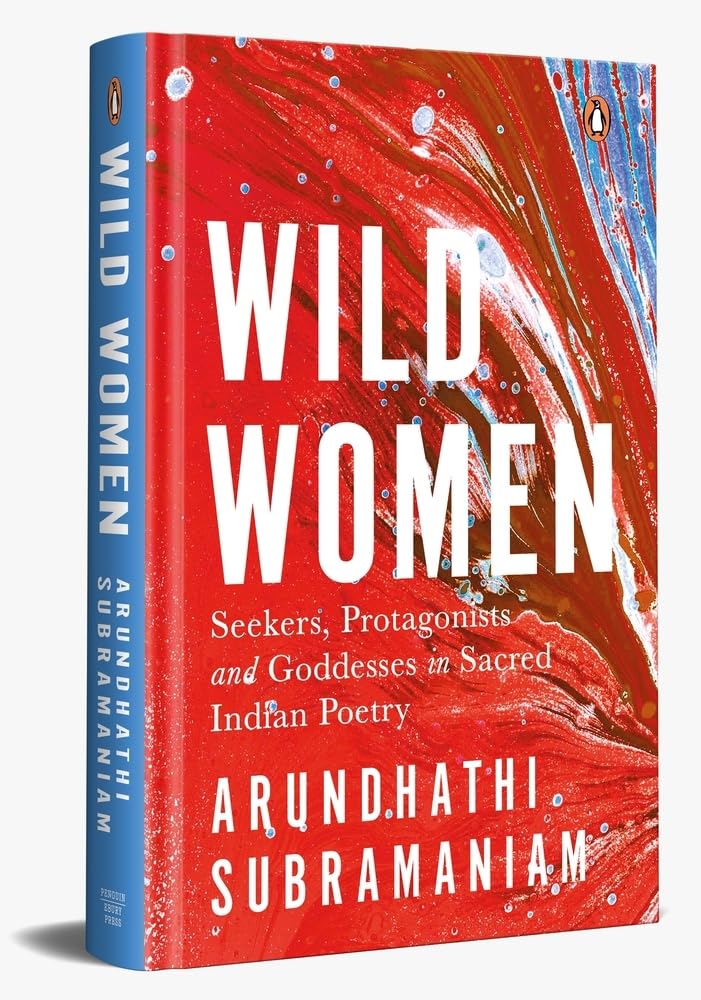
Wild Women: Seekers, Protagonists and Goddesses in Sacred Indian Poetry is a comprehensive anthology of sacred poems that brings together three of Subramaniam’s most cherished interests–spirituality, poetry, and women’s creative lives. Seen within the tradition of Arundhathi’s own consistent and remarkable oeuvre as woman, poet and spiritual traveller, this anthology containing poems by women seekers as well as poems by men and women dedicated to women protagonists and goddesses, is a deep historical and existential search for legacy, for connection, for the otherness of selfhood and the self-ness of the other. The cover of the book, richly symbolic as it is, is also highly attractive, and one that readers will not forget in a hurry. Here is a birth, both cosmic and cataclysmic, a falling and a rebounding, calm and turmoil.
As an anthology of poems, Wild Woman attempts an undertaking not envisaged before – the bringing together of the voices of women within the spiritual fold from across the length and breadth of the country’s geography and history. Here are women from varied historical ages, diverse places, languages, social classes, traditions, and religious cults; women who are both well-known and relatively anonymous; women who choose to live within the family as well as those who seek to renounce it altogether; women who speak in their own voices as well as those who are spoken for by male poets, lovers and devotees; women who stand between history, myth, and divinity; in short, women who have been beckoned by and have responded, in various ways, to the persistent call of the wilderness within their wide, vibrant souls.
Given the intensity of its subject and intention, the book is aptly titled. ‘Wild women’, apart from being alliterative, marks distinct metaphorical connections with the cultural terrain of women’s lives. As the poems in this book powerfully assert, ‘wilderness’ is a location these women existentially inhabit. It is a space that is beyond the governance and influence of society, and though women are native to it, this is where they are forever exiled from. To return to the self is to reclaim this wilderness within, to dismiss societal constructs and make an institution out of faith and intuition. This wilderness, as Subramaniam insists, “is not a cosy hearth. It is a place of peril, a smithy of surprises.”
It is also a space that has the potential to envision a new ontological, epistemological, and social order. Every voice in this anthology is, thus, disruptive in its envisioning of a form of existence that militates against the one offered by contemporary society. In ‘Get Ready to Live like a Pauper’, Gangasati [1]whose songs are an important part of the oral tradition of poetry in Gujarati even today, says:
The world of the divine has no place
For caste, gender or race
Shed this phantom chain,
Be cool and take it easy, man.
Similarly, Amuge Rayamma of the twelfth century CE, says:
If you know the self
why have truck with those who gossip?
If you can move in ways unimagined,
why depend on women?
In every poem, the route taken into this wilderness is that of the spiritual, revealing a desire to merge the self with the essential light of the universe—the formless Divine or the God, loved deeply in some human form. Here is a total rejection of every established commandment, and a faithful obedience only to the experience of the self – the physical and the spiritual. The Lord is conceived as responding to every form of desire and arrives to the woman seeker in plural shapes of parent, lover, mentor or guide. To Kanhopatra of the fifteenth century CE, the Lord appears as “Mother Krishna” while to Vidya who wrote in Sanskrit sometime between the seventh and ninth century CE, he comes as a lover:
Why expose a lone woman
to such pageant
               o season of rain
the torment
the sweet bitter need to be
                       touched
The poems in this anthology evince a strong dissatisfaction with prescribed moulds of identity and an urgency to experience life and thought first-hand. The constant pull between society and the individual, dogma and will, subjection and agency, and incarceration and liberation constitute the essential conflict in these poems, only to be resolved by the fierce choices of the spirit. Dissatisfaction with caste, gender, family, materialism and injustice lead the poets in this book to experiment with a language that legitimises the use of women’s experiences as yardstick and metaphor for the exploration and exposition of new truths. Keeping the feminine body of woman and nature at the centre of experience and discourse, the syntax of these poems is framed by an irresistible desire to overwhelm the old with the new. In every poem, thus, language becomes a sharp and dextrous tool, both argumentative and aesthetic, to establish new knowledges and new points of view. In ‘A Manifesto for New Poetry’, Muddupalani (eighteenth century CE) writes:
Can your poems stand in the field, girl,
alongside all the great poems of all the great
poets? Absolutely.
Doesn’t the bee gorged on honey
from the great lotus still savour
the humble flower’s nectar?
“The journey of a book, not unlike the journey of the heart, has its own logic—precise but not always schematic,” writes Subramaniam. Operating on its own logic, this book vitally performs for our times four extraordinary tasks—historical, activist, poetic, and feminist. Historically, it liberates women from stereotypes of oppression within patriarchy and domesticity, and by reinstating their positions as thinkers, philosophers, agents, leaders, and role-players within active religious and community life, it lays down empowered annals of womanhood for us to contemplate on. In terms of literary activism, such an extensive attempt at documenting and compiling voices of and for women within the spiritual domain, is largely unprecedented. “The essential impetus behind this project was to invoke the names of women. To turn cameos into protagonists. To invite backstage workers into the spotlight,” remarks Subramaniam. By highlighting women’s names and contributions to Indian spiritual traditions, this book will not only protect these names from oblivion and erasure but also encourage further explorations and deliberations in this field.
“A poem can offer us respite from too much meaning,” states Subramaniam. As poetry, this volume is a distilled collection of some of the finest spiritual doubts, agonies, and ecstasies of the human self in its journey towards the divine. Additionally, by bringing poems in translation from a wide corpus of vernacular languages into English, this anthology opens up Indian English poetry to the most intimate linguistic and creative recesses of the Indian mind. Finally, as a feminist work, this book highlights an ontology of the wild which becomes here, a praxis rather than an anomaly, and helps to establish a shared bond of courageous and self-conscious womanhood. Through each of the three sections of the book where women appear as seekers, protagonists and goddesses, Wild Women steadily performs an ecriture feminine, and sculpts a spiritual biography of Indian womanhood.
There is an elemental power that radiates from Subramaniam’s language, the power of words that have been painstakingly lived through before utterance. Subramaniam is, as much, a disciple of language as she is of the spirit. “This is poetry as power—the power of conscious utterance and the raging power of all that must be left unsaid,” she remarks of the poems in this book. Her own words evince that power to create and to procreate an understanding of womanhood that is steadily expanding to include new experiences and worldviews. She writes, “Since these poets lived lives profoundly wedded to mystery, that mystery is an integral part of this project.” Constantly aware of this mystery, Wild Women is a passionate and compelling thesis for reclaiming women’s essential wilderness and the place of wild women within history, spirituality and poetry.
Basudhara Roy teaches English at Karim City College affiliated to Kolhan University, Chaibasa. Author of three collections of poems, her latest works have been featured in EPW, The Pine Cone Review, Live Wire, Lucy Writers Platform, Setu and The Aleph Review among others.
.
PLEASE NOTE: ARTICLES CAN ONLY BE REPRODUCED IN OTHER SITES WITH DUE ACKNOWLEDGEMENT TO BORDERLESS JOURNAL
It is clear that English is employed here not as a language on loan, but as the rich, spluttering resource of the marrow and the bloodstream.-- Arundhathi Subramaniam.
At the outset, let me make a candid statement. I am a very prosaic person, someone who in her long teaching career and academic writing as well as translation, has never ventured to write poetry myself. I might seem like the odd woman out, but somehow, I have been closely following the recent trends in which Indian Poetry in English has been rapidly spreading its wings and with new volumes being published every other day, it is now a force to be reckoned with.
Tomb of Henry Louis Vivian Derozio at the South Park Street Cemetery, Kolkata.
Recapitulating literary history briefly, it is well known that Indian English Poetry (or often called Anglophone poetry in India) is the oldest form of Indian English literature. Beginning roughly from 1850 to 1900, it went through the ‘imitative’ phase when Indian poets were primarily ‘romantic’ and tried to imitate the British masters. Beginning with Derozio[1], many poets of the time — namely Rabindranath Tagore, Sri Aurobindo, Sarojini Naidu, Michael Madhusudan Dutt, Toru Dutt — were also Bengalis by birth. The poetry written between 1900 to 1947 belonged to the ‘assimilative’ period and often questions were asked why the poets didn’t write in their ‘own’ languages. Post-independence poetry was primarily experimental, and when we come to contemporary Indian English poetry, we find it becoming wholly urban and middle-class. The poets are realistic and intellectually critical in the expression of their individualised experience. They go in for precision at all levels and do not stick to one genre but experiment with multiple poetic forms.
Interestingly, I realised that a whole host of Indian English poets writing at present (some have several volumes of poetry published already, whereas others have just given birth to one or two), but coincidentally many of them happen to be Bengalis — Bashabi Fraser, Sudeep Sen, Kiriti Sengupta, Sanjukta Dasgupta, Mitali Chakravarty, Angshuman Kar, Shyamasri Maji, Basudhara Roy,Radha Chakravarty, and others. It is not a complete list at all, and what makes this study more interesting is that except for a couple of them, all these poets come from an English literature background. It is also not a coincidence that most of them teach English as their profession. So, whether it be personal lyrics, free verse, memories, experiences, observations, or even translation, the English muse therefore gives them the impetus to experiment with all forms, and at the same time helps them to move away from themes like nationalism, nature, Indian culture, love etc. that dominated Indian English Poetry in earlier times.
Bashabi Fraser receiving her CBE (2021 The Queen’s New Year Honours) from Prince Charles, now King Charles III.
Bashabi Fraser is an Indian-born Bengali and a Scottish academic, editor, translator, and writer. She is a Professor Emerita of English and Creative Writing at Edinburgh Napier University. Fraser’s work traverse continents in bridge-building literary projects. She was appointed a Commander of the Order of the British Empire (CBE) in the 2021 New Year Honours for services to education, culture and cultural integration in Scotland, in particular for her projects linking Scotland and India. Among her several volumes of poetry the Bengal and Bengali connection comes out in volumes like From the Ganga to the Tay: a poetic conversation between the Ganges and the Tay (2009), Letters to My Mother and Other Mothers (2015), My Mum’s Sari (2019), and Lakshmi’s Footprints and Paisely Patterns: Perspectives on Scoto-Indian Literary and Cultural Interrelations (2023). Fraser has worked extensively on a project about the Bengal Partition and the angst resulting from this divide expresses itself in the following poem.
This Border
Can shadow lines on the earth’s surface divide language and literature, rituals and customs, rivers…and memories?

There was a time when you and I
Chased the same butterfly
Climbed the same stolid trees
With the fearless expertise
That children take for granted
Before their faith is daunted
Do you remember how we balanced a wheel
Down dusty paths with childish zeal
Do you remember the ripples that shivered
As we ducked and dived in our river
Do you remember what we shared
Of love and meals, and all we dared
Together – without fears
Because we were one
In all those years
Before we knew that butterflies
Were free to share our separate skies
That they could cross with graceful ease
To alight on stationary trees
On either side of this strange line
That separates yours from mine
For whose existence we rely
Entirely on our inward eye
This border by whose callous side
Our inert wheel lies stultified
This border that cuts like a knife
Through the waters of our life
Slicing fluid rivers with
The absurdity of a new myth
That denies centuries
Of friendships and families
This border that now decrees
One shared past with two histories
This border that now decides
The sky between us as two skies
This border born of blood spilt free
Makes you my friend, my enemy.
Another well-established poet is Sudeep Sen who studied in New Delhi and in the United States and is a global citizen, so to say. Sudeep’s literary output is enormous and some of the titles of his volumes of poetry have subtle references to Indianness and Bengaliness embedded in them as well. Mention may be made of volumes like Leaning Against the Lamp-Post (1983), The Man in the Hut (1986), Kali in Ottava Rima (1992), Postmarked India: New & Selected Poems (1997), and several others. Though he might not do it consciously, his Bengaliness remains embedded in his psyche.
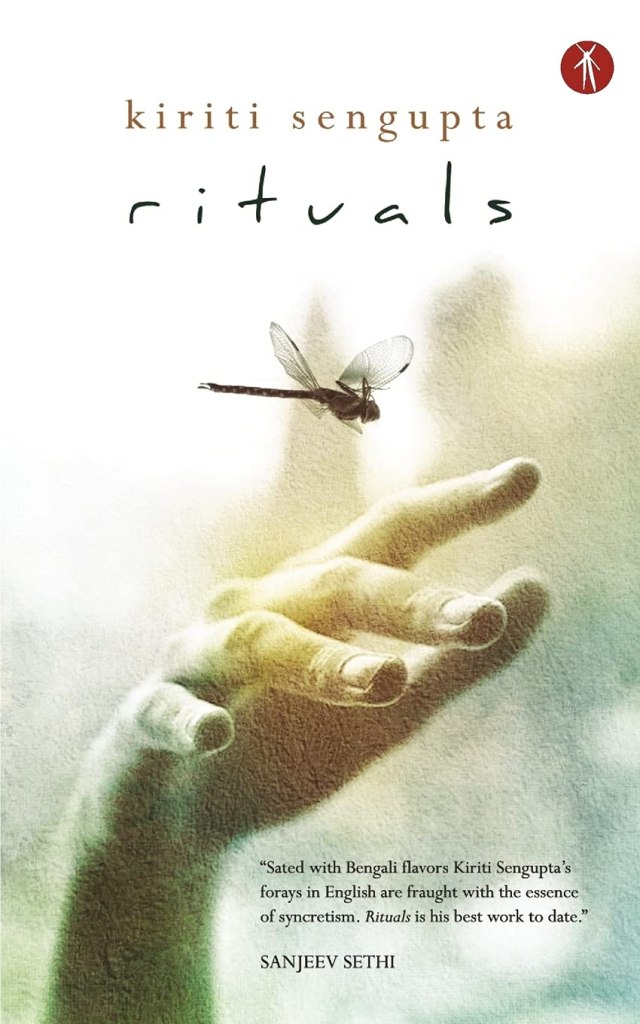
Kiriti Sengupta who has been awarded the Rabindranath Tagore Literary Prize (2018) for his contribution to literature, is a poet, editor, translator, and publisher. What is more significant is that along with Bitan Chakraborty, he mans the publishing house Hawakal, which has already carved a niche for itself as the largest publisher of Indian Poetry in English. Several poets mentioned in this essay have seen their creations see the light of the day through Hawakal Publishers and they have done yeomen service in this regard. As an established poet, Sengupta has several volumes of poetry to his credit. His collection from 2019, called Rituals, is very different from the work readers usually read in that there is a narrative thread in many poems that is not there simply to tell a story but to ultimately present a meditation on an aspect of life and the modern world that they haven’t considered before. “Fleeing the house and leaving the doors ajar. Is it perversion or fallacy?”
In an earlier volume entitled Solitary Stillness (2018), Sengupta does not give away the traits that have pervaded his poetry, he has not forgotten his Bengali roots, and has once again drawn his poetry on the canvas of the time that has been rooted in Calcutta. As he elaborates upon this point in his professional website, here, he makes a reference to Lapierre, and indeed, the ‘city of joy’ tag sounds fake just as we read that particular poem, which is so natural, that it almost appears to have been spoken by a resident of a city, one who is not a poet. According to him, that person who complains about water logging or that person for whom any tag of romanticism about the city is bourgeois, it is nothing but a label that’s needed to promote consumerism.
Mitali Chakravarty, the indefatigable editor of Borderless Journal, wrote to me saying that she is happy I feel she belongs to Bengal, “I call myself a Bengali and a human”. Though a non-resident Bengali, her perception of her own work and Bengali cultural identity is clearly revealed in a poem published in The Daily Star (Bangladesh)[2].
Confused

I am mixed up – cannot help
English and Bengali under my belt

I can read a bit of Hindi
Cannot understand much of French
A little Chinese …low class, they said…
I am mixed up – cannot help
English and Bengali under my belt

I grew up thinking I will find a way
But now pidgin is all that I can say
I write in English – the language borrowed from the West
The language that taught us or brought us unrest
The language that through The Raj spread
Importing Nationalism in its tread
I am mixed-up – cannot help
English and Bengali under my belt

But my life is that of the non-English
A probashi Bengali at best

People say I am not typical, not quite the right type
A mixed-up Bengali – I said
Culture is something I dread at every tread
Because what Culture I have is mine
- Not of a Race, a Country or Religion –
Human Being is the only race to which I belong

Help protect my home, the Earth – its every drop, its every stone

In a world of 7.7 billion, can I be alone?
I am mixed up – cannot help
English and Bengali under my belt
Though she has been writing poetry for a long time, Mitali’s first poetry collection, Flight of the Angsana Oriole: Poemswas published by Hawakal only in October 2023. In the ‘Introduction’ to this volume, she states that her random collection of poems “are sometimes of the past” as she knew it and “sometimes of the present. And sometimes in quest of a future or a dream that she hopes will go to create a more hopeful future than the world presents to us currently.” The poems in this volume are personal; some talk of her journey through life, the world as she sees it, some even influenced by her travels across the world. She further states: “Inherent in each line is not just the influence of my experiences in many countries but the nurturing I had in India, where I was born, educated and spent the first two decades of my earthly existence.” So, poems like ‘Death of Lalon’, ‘Shivratri’, ‘Kali Rise’, ‘Shraddha‘ [last respects] and a few others do convey the subconscious Bengaliness embedded in her psyche, irrespective of where she physically resides now.
Radha Chakravarty, a prolific writer and translator, Former Professor of Comparative Literature and Translation Studies at Ambedkar University, Delhi, has recently joined the bandwagon of Indian Poetry in English with her debut collection of poems Subliminal published by Hawakal Publishers in 2023. In a detailed interview given to Mitali Chakravarty for the March issue of Borderless Journal[3], she tells us about her aims and ambitions as a poet and how most of the poems in Subliminal are independent compositions, not planned for pre-conceived anthology.
My poetry actually delves beneath surfaces to tease out the hidden stories and submerged realities that drive our lives. And very often, those concealed
truths are startlingly different from outward appearances. I think much of my poetry derives its energy from the tensions between our illusory outer lives and the realities that lurk within.
Many of Radha Chakravarty’s poems express the feeling of Bengaliness in different perspectives. We read about the typically soft quilt called kantha in Bengali in the poem ‘Designs in Kantha‘ thus:
Sewn into soft, worn layers,
forgotten fabric of grandmother tales –
patterns of the past,
secret memories, hidden designs,
intriguing patterns in silk strands
dyed in delicate dreamy shades—
embroidered storylines
in exquisite, dainty kantha-stitch.
When Mitali Chakravarty asks her why she writes in English though it isn’t her mother tongue, she answers:
Having grown up outside Bengal, I have no formal training in Bengali. I was taught advanced Bengali at home by my grandfather and acquired my deep love for the language through my wide exposure to books, music, and performances in Bengali, from a very early age. I was educated in an English medium school. At University too, I studied English Literature. Hence, like many others who have grown up in Indian cities, I am habituated to writing in English. I translate from Bengali, but write and publish in English, the language of my education and professional experience. Bengali belongs more to my personal, more intimate domain, less to my field of public interactions….
Both Bengali and English are integral to my consciousness, and I guess this bilingual sensibility often surfaces in my poetry. In many poems, such as ‘The Casket of Secret Stories,’ ‘The Homecoming’ or ‘In Search of Shantiniketan’, Bengali words come in naturally because of the cultural matrix in which such poems are embedded.
Of course, the poet also mentions that all her poetry is not steeped in Bengali. In fact, in most of her poems, Bengali expressions don’t feature at all, because the subjects have a much wider range of reference. As a globe trotter, Radha has written about different places and journeys between places.
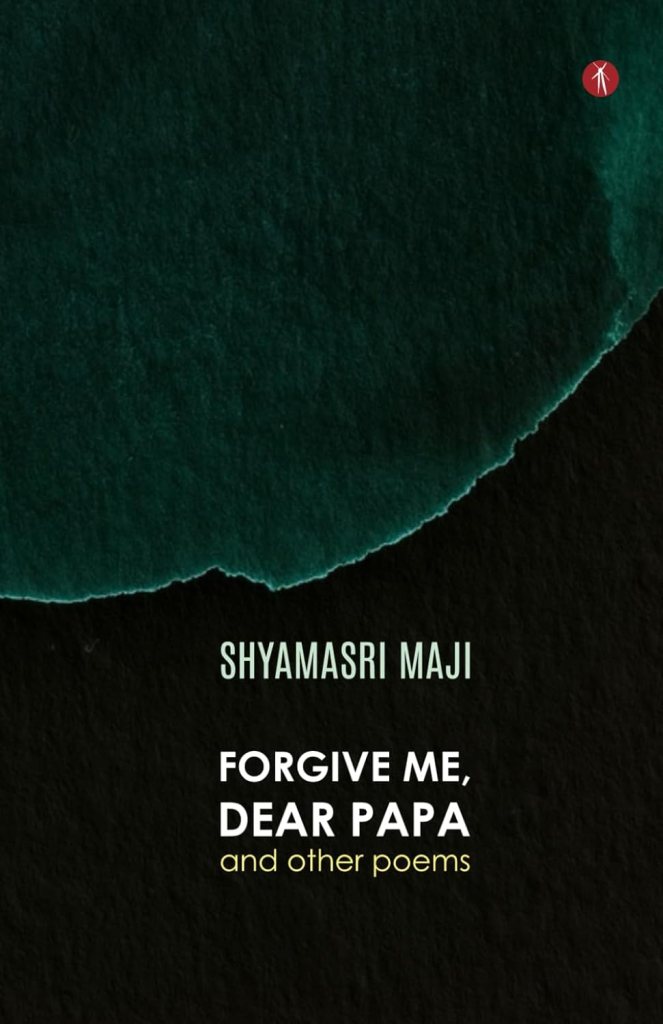
Another debut book of poems that Hawakal Publishers brought to light in December 2023 entitled Forgive Me, Dear Papa and other poems is written by Shyamasri Maji, an Assistant Professor of English teaching at Durgapur Women’s College, West Bengal. Dedicating this collection of poems to her “incurably romantic self,” Maji feels that “being ‘romantic’ in this context is being imaginative, reflective, puerile, rebellious and emotional.” The poems are a mixed bag, belonging to different thematic issues. Some focus on a woman’s radical views on the gender hierarchies in our society, in some nature plays the role of mediator between the narrator and the world, the idea of loss of love, which is closely linked with thoughts of death, while a few poems also represent an interpersonal dialogue between the self and the other. Some of Maji’s poems focus on the role of memory whereas some are experimental in the sense that they portray a woman’s comprehension of a man’s thoughts. Stressing upon the fluidity of identities, she shows how love, pain, pandemic, separation and grief affect all human beings irrespective of an individual’s gender and sexual orientation.
Six books of published poems and twenty-five years of creative journey has been a consistent exploration by the poet Sanjukta Dasgupta as she tries to find the path of freedom from among the misleading mesmeric mazes that threaten and stifle both sense and sensibility. As a woman poet with a strong feminist stance, Dasgupta admits in an online interview given to Basudhara Roy[4]:
Though I read Bangla poetry since my schooldays, I wrote my poems in English. It was an unconscious choice. Much later I learnt that I should have been embarrassed about writing in English rather than in my home language, my mother tongue Bangla. The poems written in English kept on being born on the page with embarrassing regularity.
Writing poetry is an irrepressible urge for me. It is, in a way, far more intense than the biological labour pain. This labour pain of creativity leaves me restless till the words are born on the page. But the creative process allows endless revisions; a biological production is largely about acceptance, neither revision nor deletion are considered ethical practices. In the case of poetry, it is not about choice, it is a compulsion which is intense and gratifying and multiple revisions often lead to the emergence of the perfect product.
The title of Dasgupta’s poetry book Lakshmi Unbound (Chitrangi, 2017) is very significant. Lakshmi being an intrinsic part of the fabric of Bengali culture, the radicality and dissidence of the idea of ‘Alakshmi[6]’ will require no explanation to a Bengali reader.
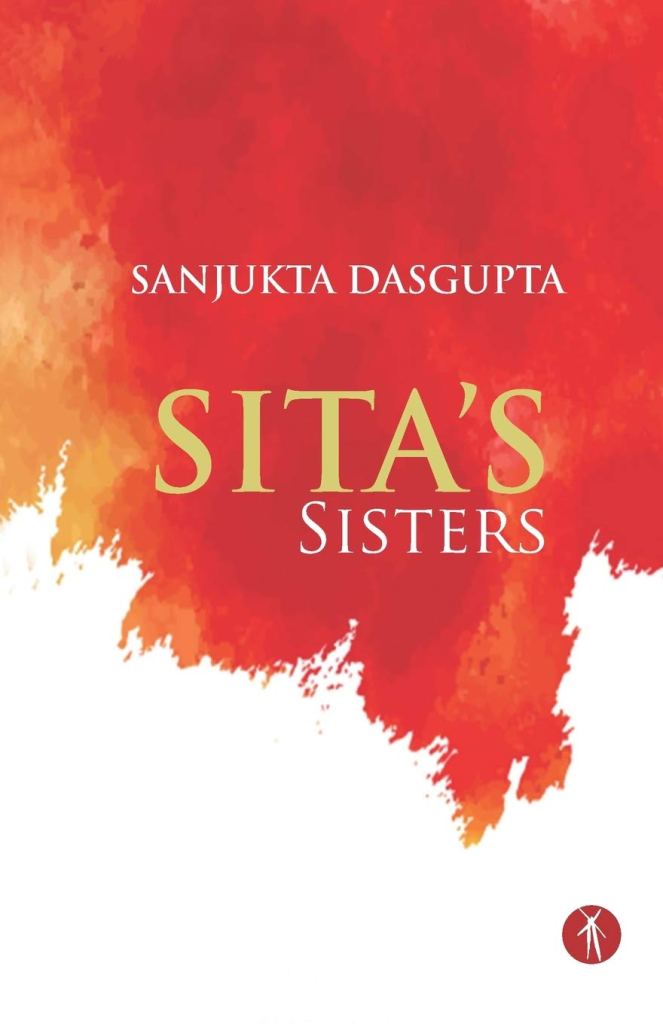
She thinks the core agenda in Lakshmi Unbound is a defiant, determined search for freedom. So, it is not just deconstruction, it is an endeavour to call attention to the need to destabilize the deep-rooted stereotypes that have controlled the minds and mobility of women. In Sita’s Sisters (Hawakal, 2019), she crafts a revisionist feminist mythology by taking up familiar figures like Sita, Lakshmi, Kali, Mira and attempts to free these mythic figures from their claustrophobic space so that they can be re-invented in sync with the contemporary times.
Residing in Jamshedpur, in the state of Jharkhand, Basudhara Roy is an established poet and has several books and publications to her credit. In her own website, is stated: “Committed to an undying affair with words, Basudhara finds in poetry an epistemological and existential skylight. She writes because she feels she must test words on her tongue, pulse, moods, agitation, abstraction and satire. She is convinced that words can change the world and hence, she works at them in her own culinary way – washing, peeling, grating, pounding, baking, sautéing, kneading, roasting, often flaming them for what they might yield.”
The following poem from Stitching a Home (Red River, 2021) considers the eternal problem of a woman that plagues women writers a lot.
The Right Kind of Woman

The right kind of woman will
inspire affection, regard, trust.
Not promiscuity, never lust.

Bred by a mother equally right,
she knows to avert her eyes to
innuendoes, telling smiles.

In crowded buses, shops, streets,
she knows to shut tight, bud-like,
relinquish space, circumscribe limbs.

Above all, she knows the prudence
of holding her tongue, of choosing
silence’s worth over wordy rebellion.

Schooled to surrender in dark
rooms, she knows, unasked, to
feign desire, moan, stifle, sigh on cue.

On her forehead, she had a
third eye to emit fire, take sides,
rake storms. Last night, its lid rusted

with disuse fell out, and the right kind
of woman laughed herself to death
over all she had left undone, unsaid.
“Writing poetry is an isolation exercise” says Angshuman Kar, an established Bengali poet who by profession is also an English Professor at a university in West Bengal. His book of poems Wound is the Shelter (Hawakal, June 2023) is unique and different from the other volumes discussed here because the poems are all translated by the poet himself from his original Bengali poems. In the ‘Introduction’, Kar tells us that authors who translate themselves often seem to be unhappy about the task of translating their own works. The Marathi poet Arun Kolkatkar likens it to incest, — “like making love to your own daughters.” Critics of translation studies have both supported and criticised self-translation. Those who support it argue that the author knows their work the best and hence s/he is the best translator of their own work. Those who oppose self-translation argue that the author-translator takes too much liberty while translating his/her own work; thus, the translation hardly remains faithful to the original. In such a situation Kar says, “Without being critical, I must say that I love self-translation. I enjoy translating my own work, I love committing incest. It makes me a better poet…. As a self-translator, I find incest healthy. It makes me a better poet – il miglior fabbro.“
Coming to the individual poems in Wound is the Shelter, it need not be reiterated that most of them portray universal feelings but at the same time are seeped in Bengali culture as well. In “My Poems” Kar talks about Jungle Mahal, the three districts of West Bengal that are full of jungles; in “World,” he writes about blooms of a sal tree and shiuli flowers; in “Memory Card” he talks about a bus ride to reach his maternal uncle’s house in Bankura from where he went to the studio to take a family photograph — “Grandma in the middle/On either side we – three brothers, two sisters and a cousin”. In “Father” he mentions how his father’s bereavement fades with time and how his portrait adorns the wooden throne in which gods and goddesses are kept and he stands with Kali, Shiva and Durga. In “Neelkantha” he refers to Shiva; in “Park” he states how man forgets grief when he comes to a park, “That is why in a city as sad and lonely as Kolkata the number of parks is always high.” The five-part poem “Tiger” is also very powerful, “there is a tiger inside every human being” he states. Kar also mentions about the mask of a demon of Chhou dance of Purulia, the aal path in paddy fields, the Chandi mandap[7] of a small village, the man called Bhagaban Das who labours in a factory, and the man called Shubhasis Babu who rents him cars, whose voice he hears but has not seen him. Thus, even in his transcreated poems, Kar’s Bengaliness expresses itself overtly.
It is not possible to analyse the poems of each of the Bengali poets that I have mentioned above within the purview of this single essay, and so I have just selected a few of them (especially the poets who have one or two volumes to their credit at present). As mentioned earlier, though Bengali by birth, all the poets rendering their emotions in English, do often consciously or unconsciously express multicultural elements, Bengali cultural nuances, and idiomatic force in their poems. As the trend for providing glossary is passe now, much is left to the readers’ imagination, but still certain occasional Bengali words and phrases make their poems even more appealing.
After sharing my random thoughts about Indian Poetry in English in general and selectively mentioning a few Indian English poets who also happen to be Bengali and often unconsciously exude a sort of Bengaliness in some of their poems, without attempting to sound rather parochial, I wholeheartedly wish to see more volumes of their poetry being published in future. I conclude by quoting a very salient observation made by Arundhathi Subramaniam who is not wholly optimistic about the situation, but believes that despite hurdles in publishing, the voices of Indian poets writing in English would be heard [8]:
Despite the clunky discourse that continues to hover around it, however, Indian poetry in English endures, even flourishes, seventy years after Independence. Publishers may be few and far between, the royalties meagre, the critical climate thick with indifference or theoretical bluster, and the poets themselves bewildered by disputes over their identity, even their existence. But poetry, in its mysteriously resilient fashion, continues to be written, shared and discussed (if sometimes with more passion than discernment). … I am not ecstatic about the state of Indian poetry in English. (But then I am not ecstatic about poetry; only, at times, about poems.) What I do know is that Indian poetry in English is alive. And like all things alive, it engages, it annoys, it provokes, it excites. On several occasions, it has given me the jolt of wonder for which I turn to poetry in the first place.
Considering the slightly mellow tone in Subramaniam’s observation, I personally feel Indian English Poetry has become a significant force in the literary arena at present and will grow stronger with time. Seasoned poets who have several volumes of poetry published already, as well as the fresher ones whose debut volumes promise a lot more to come in future, can all look forward to seeing their ‘spontaneous overflow of powerful emotions’ in print and carry on the legacy of Indian Poetry in English to newer heights. And sure enough, the sub-genre of Bengali Indian English poetry can be researched in greater details in future.
.
[1] Henry Louis Vivian Derozio (1809–1831), poet and assistant headmaster of Hindu College, Calcutta, a radical thinker and started the Young Bengal Movement.
Figments caught straying in whispers of a dream,
Weave together till they form a visible stream,
Filling a void with voices that sing,
With freedom and impunity ring,
Giving credence to a distant, imagined realm.

— Introduction, Monalisa No Longer Smiles: An Anthology of Writings from across the World
As we complete three years of our virtual existence in clouds, connecting, collecting and curating words of ideators, we step into our fourth year with the pleasurable experience of being in bookshops in hardcopy too. Monalisa No Longer Smiles: An Anthology of Writings from across the World, our first hardcopy anthology, takes us into the realm of real books which have evolved over eons in history. This anthology connects us to those who hesitate to step into the virtual world created by technology. And there are many such people – as ingrained in the human heritage is a love for rustling paper and the smell of books. We have had some excellent reviews, praising not just the content but also the production of the book – the cover, the print and the feel. The collection bonds traditional greats with upcoming modern voices. We are grateful to our publisher, Om Books International, Shantanu Ray Chaudhuri, Jyotsna Mehta and their team for giving our book a chance. We do look forward to more anthologies hopefully in the future.
The writings we have collected over the last three years are reflective of diverse voices— some in concurrence with our thought processes and some in discussion or even in divergence. We have a variety of forms — poetry, conversations, fiction and non-fiction. Some are humorous and some serious. We try to move towards creating new trends as reflected in our anthology and our journal. For instance, Monalisa No Longer Smiles starts with an experiment — a limerick was adapted to express the intent of our book and journal; whereas normally this form is used to express light, or even bawdy sentiments. Perhaps, as the limerick says, we will find credence towards a new world, a new thought, a restructuring of jaded systems that cry out for a change.
Borderless Journaldid not exist before 2020. Within three years of its existence, our published pieces have found voices in this anthology, in other books, journals and even have been translated to a number of languages. Our own translation section grows stronger by the day supported by translators like Aruna Chakravarti, Fakrul Alam, Radha Chakravarty and Somdatta Mandal. Our interviews and conversations probe to find similarities and divergences in viewpoints. Our stories tell a good tale rather than indulge in stylistic interplay and our poetry is meant to touch hearts, creating a bond between the writers and anglophone readers. What we hope to do is to expose our readers to writing that they can understand. Writers get lost at times with the joy of creating something new or unique and construct an abstraction that can be intimidating for readers. We hope to host writing that is comprehensible, lucid and clear to the lay person.
What we look forward to homing in the coming months is a mingling of different art forms to birth new ideas that will help our species move progressively towards a world in harmony, filled with peace and love, giving credence to voices like that of Tagore, Nazrul or Lennon. “Imagine there’s no heaven…Imagine there’s no countries…no religion, too…Imagine all the people/ Livin’ life in peace…Imagine all the people/ Sharing all the world…” The need to redefine has been felt and as Lennon says in his last paragraph: “You may say I’m a dreamer/ But I’m not the only one/ I hope someday you’ll join us/ And the world will live as one.” With this hope, we continue our journey into another year – a new adventure that will take us to a universe where heaven can be found on Earth, grounded and real, within the human reach and can be shared without war, greed, hatred and anger.
Here, we share with you a few iconic pieces that have found their way to our pages within the last three years.
Professor Anvita Abbi, a Padma Shri, discusses her experience among the indigenous Andamanese and her new book on them, Voices from the Lost Horizon. Click here to read.
In Conversation with Akbar Barakzai, a ‘Part-time Poet’ in Exile: The last interview of Akbar Barakzai where he says, ‘The East and the West are slowly but steadily inching towards each other. Despite enormous odds “the twain” are destined to “meet” and be united to get rid of the geographical lines…’ Click hereto read more.
Half-Sisters: Sohana Manzoor explores the darker regions of human thought with a haunting psychological narrative about familial structures. Click hereto read.
Rituals in the Garden: Marcelo Medone discusses motherhood, aging and loss in this poignant flash fiction from Argentina. Click here to read.
Navigational Error: Luke P.G. Draper explores the impact of pollution with a short compelling narrative. Click here to read.
Pandies’ Corner: These narratives highlight the ongoing struggle against debilitating rigid boundaries drawn by societal norms, with the support from organisations like Shaktishalini and Pandies. Click here to read.
Dilip Kumar: Kohinoor-e-Hind: Ratnottama Sengupta recollects the days the great actor sprinted about on the sets of Bombay’s studios …spiced up with fragments from the autobiography of Sengupta’s father, Nabendu Ghosh. Click here to read.
Farewell Keri Hulme: A tribute by Keith Lyons to the first New Zealand Booker Prize winner, Keri Hulme, recalling his non-literary encounters with the sequestered author. Click here to read.
Tagore Translations, including translations by Aruna Chakravarti, Fakrul Alam, Somdatta Mandal and Radha Chakravarty. Click here to read.
Nazrul Translations, including Professor Fakrul Alam and Sohana Manzoor. Click here to read.
Gandhi & Robot by Thangjam Ibopishak, translated from the Manipuri by Robin S Ngangom. Click here to read.
Songs of Freedom by Akbar Barakzai, poems translated from Balochi by Fazal Baloch. Clickhere to read.
Give Me A Rag, Please:A short story by Nabendu Ghosh, translated by Ratnottama Sengupta, set in the 1943 Bengal Famine, which reflects on man’s basic needs. Click here to read.
Thanks to our team, contributors and readers for being a part of our journey. Let’s sail onwards…
In Conversation with Akbar Barakzai, a Balochi poet in exile who rejected an award from Pakistan Academy of Letters for his principles. Click here to read.
In Conversation with Somdatta Mandal, a translator, scholar and writer who has much to say on the state of Santiniketan, Tagore, women’s writing on travel and more. Click here to read.
Ratnottama Sengupta recalls her experiences of the Egyptian unrest while covering the 35th Cairo International Film Festival in 2012. Click here to read.
Devi (The Goddess) is a 1960 Satyajit Ray film, based on a story by a writer called Prabhat Kumar Mukhopadhyay, that showcases nineteenth century India, where the silence of a young girl who is deified, wreaks havoc in her home, village and life. In an interview, Satyajit Ray contended that the film was to make people rethink ‘messiahdom’. The exact words he used to state this was that the film was against ‘religious dogmatism’ as the film and story literally dealt with the deification of a young bride. Tagore had similarly questioned blind deification in a number of his poems and plays. These (as Ray spelt out in his interview) did not address religion per se but malpractices, among them, the tendency to worship an idol to a point where flaws are justified, accepted and emulated. Satyajit Ray and Tagore were both Brahmos — which can be seen as a reform movement. These two were not criticising religion but talking of rising above gawky hero worship to think logically and arrive at logical conclusions. When we talk of characters from the Ramayana, the Mahabharata, other mythologies or substitute the adulated with stars, writers, politicians and businessmen who run huge concerns, we tend to idolise them. But these were and are all characters with flaws, whether fictitious or real. We can well learn from their mistakes, rather than deify and worship them to justify bad behaviour by quoting instances from lives of past legends or prominent persons in the current world.
Akbar Barakzai, a poet exiled from Balochistan, talks in a similar vein in his interview. You can see it in his poetry too — some of which can be found translated by Fazal Baloch in our pages. Barakzai talks of transcending barriers we draw for ourselves in the real world, of writing with honesty and sincerity. He has shared vignettes of his life as he changed countries to continue his work. Baloch has also brought to us another excellent poet in translation, Munir Momin. A major poem by Nazrul (the ‘bidrohi kobi’), ‘Bidrohi or Rebel’ has wound its way to our pages translated by Professor Fakrul Alam. We are honoured and grateful that Prof Alam chose to share this excellent translation with us. We have more translations: Jibonananda’s ‘Motorcar’(1934) by Rakibul Hasan Khan, a Korean translation by Ihlwha Choi, another short story from Nepal and Tagore’s powerful poem, ‘Morichika or Mirage’, which is a wake-up call for the inert affluent who hold themselves aloof from common masses. We have also interviewed a major prose translator of Tagore, Professor Somdatta Mandal. With much to share on Santiniketan, Nabanita Deb Sen and many interesting anecdotes, Mandal talks of her extensive work with her translations spanning many more writers from the past.
We have a colourful ensemble this time almost as vibrant as the autumnal colours that have invaded nature in some parts of the Northern Hemisphere. Michael R Burch has given us beautiful poems on autumn, including the autumn of life. We have a poem in a similar vein by George Freek whose work continues influenced by Liu Yong (1719-1805), an influential minister and calligrapher in the Qing Dynasty. Ryan Quinn Flanagan touches on Leonardo Da Vinci’s Mona Lisa in his poetry. Rhys Hughes has given us humour in both his poetry and his column. Our other humorist, Devraj Singh Kalsi has given us darker, more caustic black humour in his narrative. We have lovely photographs from Penny Wilkes with her verses in Nature’s Musings. It is amazing the way she photographs birds in flight. Stories from Malaysia, Bangladesh, India and America add to the richness of our oeuvre. Sunil Sharma has given us an avant-garde telling of Odysseus’s voyage in the modern world, transcending the borders of time and ethnicity.
A well-known senior journalist, Ratnottama Sengupta, has also travelled through time to give us a recall of her experience at the 35th Cairo Film Festival one November, nine years ago. Her narrative about the time that the Shariat law was adopted by Egypt reminds me of the way things moved in Afghanistan few months ago and what is even more stunning is the way in which organisations dubbed extremists earlier are allowed to run countries now. Is it really not yet time to get rid of messiahs and look for one world?
Do pause by and find many more authors who dot our November edition. As usual, naming each one will keep you away from our delectable reads for longer. We thank all our readers for their continued patronage, and I would like to thank my fabulous team who are now even providing visuals to brighten our pages. A huge thanks to Sohana Manzoor and Sybil Pretious, who write as well as they paint. Thanks to all our wonderful contributors for making Borderless a reality.
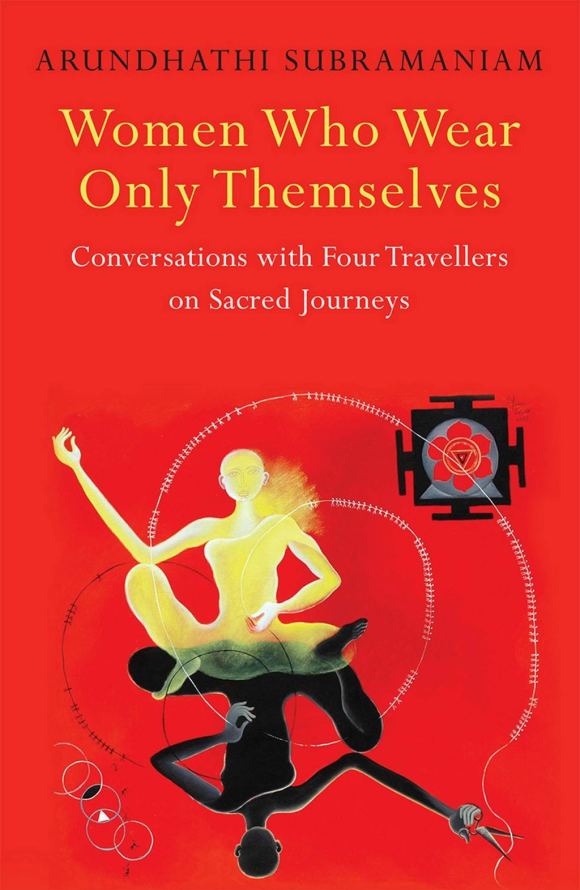
Title: Women Who Wear Only Themselves: Conversations with Four Travellers on Sacred Journeys
Author: Arundhathi Subramaniam
Publisher: Speaking Tiger Books, 2021
What It Takes to Be a Redwood Tree
Lata Mani
When Lata Mani was driving to her office at the University of California, Davis, one morning in 1993, her life turned turtle. Quite literally. A stolen Pepsi Cola truck collided headlong with her on the freeway. As her car flew up into the air and spun several times before landing, much else plunged into a dizzying spin-cycle from which it would take years to emerge. Her career, her health, her worldview, her life as she knew it.
It had to be one of the rudest and most catastrophic spiritual initiations in the book. A rebirth that turned things upside down, inside out. The most radical lesson in de-hierarchizing the world. The ground beneath her feet vanished, the mind was stunned into silence, the body shocked out of its illusion of solidity into a state of uncongealed pain and seismic uncertainty. And with that brain injury, everything changed. It has never quite been the same again.
And so, sceptic turned spiritual apprentice. Marxist turned meditator. Scholar turned bhakta.
I knew the old Lata Mani somewhat. She happens to be a second cousin. She also happened to live in Mumbai in her growing years. She was a remote figure, older by some years, inspiring as an articulate feminist of her generation, glamorous in the life of self-determination that she represented. She left for California to study, proceeding to author a major work of feminist scholarship on the debate around sati in colonial India. I lost touch with her after she left my city.
But it is the new Lata Mani that I have got to know better. I had my first real conversation with her in 2010. Our connect was immediate, spontaneous, cutting through social natter and nicety with a directness and definitiveness that surprised me. I had known the ‘outer’ Lata somewhat sketchily. I now encountered what one might call the ‘inner’ Lata: contemplative writer, unabashed Devi devotee, a woman of clarity and unselfconscious poise. It was like meeting her for the very first time.
And yet, there were connections with the Lata of old. The lucidity and incisiveness of mind was very much in evidence. The commitment to social justice remained, even if its textures were altered. And she was still blazing her own trail—interior, perhaps, but with no loss of self-reliance or intensity.
‘“Falling upward” into the world of spirit is usually a metaphor. But in your case, it was absurdly literal!’ I tell her.
‘I think some of us are hard nuts to crack, so it had to happen this way!’ Lata grins.
My conversations with Lata have been largely telephonic, punctuated by fleeting meetings when I happen to be passing through her city. But I have a vivid recollection of a long evening I spent with her in her Bengaluru flat in 2011—an oasis of luminous quiet amidst the mayhem of metropolitan India. We talked a great deal that day, late into the evening, and again the next morning. We talked of family, books, the Goddess, love, as well as the spiritual ‘crash course’ that redefined her life. She had moved back to India in 2004—a major transition, but perhaps not as disruptive as the inner shift that had already occurred.
I remember her saying her injury had dropped her into ‘a new neighbourhood’—a quietly laconic phrase with which she summed up this descent into horrifying and unrelenting pain. In her writing, she describes it even more vividly as a state of being ‘in pre-op for cosmic surgery’. The description reminded me of some calamitous rite of shamanic initiation. The experience compelled her to inhabit the body in a way she never had before. Was this a direct insight that happened as a consequence of the trauma, I ask her.
‘Yes, it all changed when that desperate young man driving at hundred miles per hour sought to end his life by ploughing into my car. We both survived! But while I survived the collision, my brain was no longer intact. Gradually, I began to experience states of consciousness for which I had no language. I first began to sense the connectedness of everything. I had encountered the notion of a unifying substratum before, but only as an idea. Experiencing it was an altogether different matter.’
The injury catapulted Lata into a land for which she had no name. When I think of the ways in which some saint poets have invoked it (Ravidas’ ‘Begumpura’, the utopian land without sorrows, taxes, travails and hierarchies, for instance, or Kabir’s ‘wondrous city’, the land where ‘fruit shines without a tree’), the descriptions are lyrical. They do not suggest the ordeal, the baptism by fire that can precede it. Lata’s term for the land in which she crash-landed is, by contrast, unsentimental. She describes it simply as abiding ‘isness’. She did not discover it as a lofty philosophical idea. There was no flight into the empyrean. No ‘top of the world looking down on creation’ brand of ecstatic high. No out-of-body experience. Instead, Lata Mani discovered isness in and through her body.
‘As you know many spiritual experiences or insights are first experienced as spontaneous gifts for which we have no prior frame of reference,’ she says. ‘Isness was gradually revealed to me in the depths of a brain injury which had made thought and communication difficult. Everything was stripped to its bare essentials. And yet there was a certain vibrancy and richness that I was experiencing alongside the very real trauma of the injury. It was not a state in which I “transcended” my circumstances, but one in which I was breathed more deeply into it.’
And this is the most fascinating part about Lata’s journey: the upside-downness of it at every level. Her training thus far had prepared her to look at social structures ‘ground up’, but this was about a ‘ground up’ darshan of existence itself—orchestrated by a cellular intelligence rather than a cerebral one. The intellect was no longer in charge. As the reins were handed over to a more grassroots wisdom of marrow and viscera, the mind emerged, redefined—a democratic collaborator on the life journey, rather than dictator of it.
I imagine this as the state of gob-smacked awe in which Yudhishtira might have found himself at the top of Mount Meru: a terrifying confrontation with reversal of every kind. But then other questions begin to surface. It is wonderful to think of some reversals, but not others. The Biblical image of lions eating with lambs, for instance, gives me consolation. But what of all our divisions of the world into good guys and bad, the forces of light and darkness, or even our political allegiances to left wing or right? What about our longing for poetic justice? How ready am I for a vision of utter and absolute equality, I ask myself?
(Excerpted from Women Who Wear Only Themselves: Conversations with Four Travellers on Sacred Journeys by Arundhathi Subramaniam. Published by Speaking Tiger Books, 2021.)
ABOUT THE BOOK
Sri Annapurani Amma left the safety of home and family to follow the summons of a long-dead saint. Like Akka Mahadevi and Lal Ded before her, she chooses to live naked, and sometimes delivers prophecies, but what shines through is her humour and crazily one-pointed devotion to her path.
Soon after her tenth birthday, Balarishi Vishwashirasini was predicting futures—in no time she was transformed into a guru. Now in her thirties, this gifted teacher of nada yoga admits to sometimes feeling she’s missed out on a real childhood.
Lata Mani, a respected academician in the US, was plunged into the path of tantra after a major accident left her with a brain injury. Today, she talks of how the spiritual life is deeply anchored in the wisdom of the body—not unlike the soaring yet rooted redwood trees of her adopted home.
Maa Karpoori, a feisty young woman, found her calling when she joined a local yoga class. Through a rollercoaster ride that catapulted her from marriage to monkhood, she retains her fierce independence and contagious joy of living.
In this extraordinary book, poet and seeker Arundhathi Subramaniam gives us a glimpse into the lives of four self-contained, unapologetic female spiritual travellers. Sensitive, insightful and spare, Women Who Wear Only Themselves is a revelation and a celebration.
ABOUT THE AUTHOR
Arundhathi Subramaniam is the award-winning author of twelve books of poetry and prose. As poet, her most recent book is Love Without a Story. As anthologist, her books include an anthology of bhakti poetry, Eating God, and a book of essays, Pilgrim’s India. As prose writer, her work includes The Book of Buddha and the bestselling biography of a contemporary mystic, Sadhguru: More Than a Life. She has worked over the years as poetry editor, curator and critic.
Her book, When God Is a Traveller, won the Sahitya Akademi Award 2020; was the Season Choice of the Poetry Book Society, UK; and was shortlisted for the TS Eliot Prize in 2015. Her awards include the inaugural Khushwant Singh Poetry Prize, the Raza Award for Poetry, the Il Ceppo Prize in Italy, the Zee Indian Women’s Award for Literature, the Mystic Kalinga Award, among others.
Publisher: Speaking Tiger Books
.
PLEASE NOTE: ARTICLES CAN ONLY BE REPRODUCED IN OTHER SITES WITH DUE ACKNOWLEDGEMENT TO BORDERLESS JOURNAL.
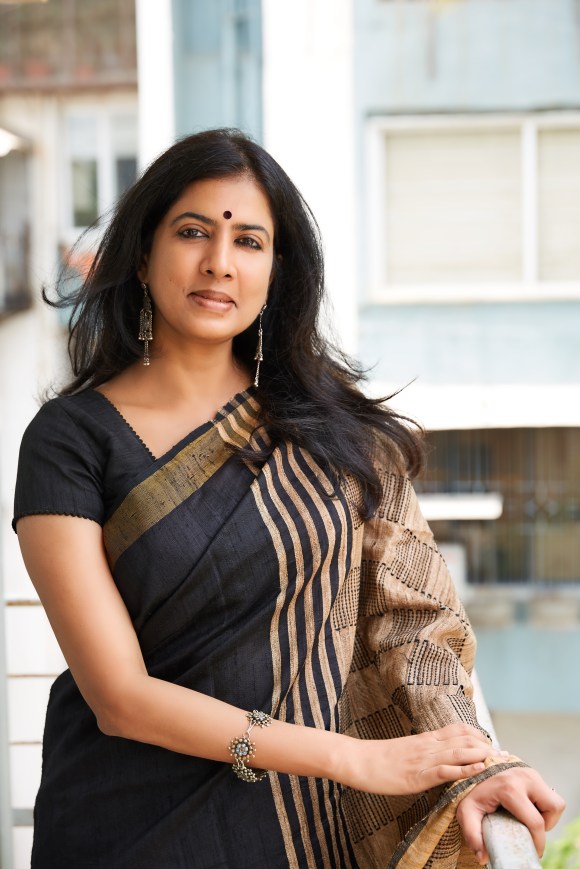
Arundhathi Subramaniamis a poet who has recently won the Sahitya Akademi Award, 2020, for her book When God is A traveller (2014). She has authored a number of books and won multiple awards and fellowships. She has been part of numerous anthologies and journals.
Professor Anvita Abbi, a Padma Shri, discusses her experience among the indigenous Andamanese and her new book on them, Voices from the Lost Horizon. Click here to read.
Keith Lyons talks to Jessica Muddittabout her memoir, Our Home in Myanmar, and the current events. Click here to read.
Geetha Ravichnadran explores additions to our vocabulary in a tongue-in-cheek article. Clickhere to read.
Musings of a Copywriter
In When I Almost Became a Professor, Devraj Singh Kalsi gives humour tinged reasons on why he detached himself from being an academician. Click here to read.
We are living in strange times that seem to be filled with events to challenge the innovativeness of man. As if the pandemic were not enough, concepts that had come out of the best in our civilisation to unite mankind have been convoluted by a minority to manipulate and hurt the majority into submission. Life is not about surviving with faint-hearted compliance but about having the courage to live it as you want, facing it full up front, to voice out in unison against injustices, wrongs, and most of all to loan strength to help and care for each other. Often to understand this, we need to hinge on to our past, to learn from our heritage. But do we do that? In the hectic drive to be successful, we tend to ignore important lessons that could have been imbibed from the past. Like, did you know that the tribes in the Andaman can save themselves from a tsunami?
Padma Shri Anvita Abbi tells us all about the Andamanese and her attempts to revive their moribund language in her interview and book, Voices from the Lost Horizon, reviewed by Rakhi Dalal. While the review focusses on the uniqueness of Abbi’s work and the publication with its embedded recordings of the tribe fast dissolving into the morass of mainstream civilisation, her interview highlights the need to revive their lores that evolved out of a 70,000-year-old culture. On the other hand, Jessica Mudditt, interviewed by Keith Lyons, dwells on the ongoing crisis in Myanmar, which has been clearly the focus of her book, Our Home in Yangon. This interview focusses on the here and now of the crisis. But most crises have their roots deep and perhaps an exploration of these could help. There are 135 ethnicities in Myanmar but how many are actually integrated into the mainstream? Are they in the process of getting ‘lost’ like the voices of the speakers of Greater Andamanese?
That is why we tried to showcase a few such strains that are going unheard in the loudness of the ‘civilised’ mainstream. We have translations in poetry from Santhali and Adivasi, touching on the concerns of those who are often considered underdeveloped. And, perhaps, as Abbi said in her interview about the Andamanese, we can say much the same for these tribes too.
“These tribes are neither poor, nor uneducated (their knowledge of environment comprising birds, fishes, medicinal plants and their … weather predictions, and the Earth they walk on is amazing) …”
Distinctions have been created by a ‘civilisation’ entrenched in mono-cognitive enforcements leading to the loss of trust, confidence, languages, cultures and valuable knowledge about basic survival. Perhaps we can attempt to heal such wounds by imbibing the openness, love, devotion and compassion shown by the Buddhist monk, Upagupta (who is still revered in Myanmar as Shin Upagutta), in the translation of Tagore’s story poem, ‘Abhisar’ or ‘The Tryst’. Somdatta Mandal’s translation of Tagore’s letters introduce similar humanitarian concerns when the maestro mentions a German anthropologist and his wife who for the betterment of mankind were journeying to study tribals in India. Tagore remarks, “The people for whom they are willingly prepared to undergo hardship and to overlook all sorts of danger are not their relatives, nor are they civilised.” And yet even a century ago to fathom more about mankind, attempts were being made to integrate with our ancient lore. The concept of being ‘civilised’ is of course now much under the microscope. What is being ‘civilised’?
Is it about having power? We have Akbar Barakzai’s poem translated by Fazal Baloch on creation looking at the divide between a ‘civilised’ God and man. The theme stresses the two sides of the divide. More translations from Odiya, Dutch and Korean further mingle different flavours of the world into our journal — each questioning the accepted norm in different ways.
In an edition focussed on myths and stories from which we evolved, Rhys Hughes has created an unusual legend around elephants. His poetry also deals with animals — cats. One wonders if the T S Eliot’s famed ‘Macavity, the Mystery Cat’ could have to do something with his choices? We were fortunate to have Arundhathi Subramaniam share her poetry on myths around Indian figures like Shakuntala and Avvaiyar and the titular poem from When God is a Traveller that won her the 2020 Sahitya Akademi Award. Michael R Burch continues on the theme dwelling on Circe, Mary Magdalene and Helen. Sekhar Banerjee has a more iconoclastic approach to myths in his poetry. Jared Carter talks of modern myths perpetuated through art and cultural studies as does Mike Smith in his musings with his glance back at the last century through a photograph.
We have poetry by a Filipino writer Gigi Baldovino Gosnell from South Africa, looking for a new world, a new legend, perhaps a world without borders. Tohm Bakelas has given us a few lines of powerful poetry. Could these poems be a reaction to world events? Smitha Vishwanath has responded to the situation in Afghanistan with a poem. In this edition, photographs and verses in Penny Wilkes’ ‘Nature’s Musings‘ draw from the universe. She writes, “The sun never asks for applause” — a powerful thought and perhaps one mankind can learn from.
Ghost stories by Niles Reddick and Sunil Sharma perpetuate the theme, especially the latter has a ghost that questions myths of ‘isms’ created in the modern-day world. We also have a writer from Malaysia, P Ravi Shankar, with a futuristic legend set in a far-off time where man has embraced the reality of climate change and artificial intelligence. An interesting and fun read as is Devraj Singh Kalsi’s professions about why he did not become a professor, Geetha Ravichandran’s light musing on word play and a young writer Saurabh Nagpal’s musing, ‘Leo Messi’s Magic Realism‘ — a footballer viewed from a literary perspective!
While our musings make us laugh, our essays this time take us around the world with the myth of happiness deconstructed by Candice Louisa Daquin, to Burma and deep into Kolkata’s iconic history of the detective department started in the nineteenth century. There is an essay by Bhaskar Parichha that explores politics and media and mentions ‘gatekeepers’ of the media who need to be responsible for influencing public opinion. Guess who would be the gatekeepers?
Bhaskar Parichha’s review of Wendy Donniger’s non-fiction exploring myths around horses, Winged Stallion and Wicked Mares,and Basudhara Roy’s review of Bina Sarkar Ellias’ Song of a Rebel and Other Selected Poems perpetuate the theme of the importance of the past on the one hand and question it on the other. But that is what Borderless is about — exploring the dialectics of opposing streams to re-invent myths towards a better future.
We have a bumper issue again this time with nearly fifty posts. I invite our wonderful readers on a magical journey to unfold the hidden, unmentioned gems scattered on the pages of the September Issue of Borderless. Thank you again to an outstanding team, all our global contributors who make every edition an adventure and a reality and our wonderful readers. Thank you all.











 Borderless