Categories
Review

The Birth Lottery and Other Surprises

Book Review by Somdatta Mandal

Title: The Birth Lottery and Other Surprises

Author: Shehan Karunatilaka

Publisher: Hatchette India

When Hatchette India sent the reviewer’s copy of Sri Lankan author Shehan Karunatilaka’s collection of short stories, The Birth Lottery and Other Surprises, it had two eulogies on the cover, namely “From the Commonwealth Book Prize Winner” and “Booker-Shortlisted author,” assuming both would add to the USP[1] of the volume. Karunatilaka’s debut novel Chinaman: The Legend of Pradeep Mathew had received a lot of critical acclaim when it was first published in 2010 and received the Commonwealth Prize. In the meantime, on 17 October 2022, the author did manage to win this year’s Booker Prize for his third novel, The Seven Moons of Maali Almeida, set against the backdrop of the civil war in Sri Lanka. This award definitely garners more attention to read this new book of short stories. According to the publishers, The Birth Lottery and Other Surprises offers a pointed conversation “about religious fanaticism, social prejudices, and the devolving state of democratic order in the Indian subcontinent”. Replete with unexpected twists, it is a “vivid and engaging commentary on privilege, class, and societal ills” and offers a collection of fantastic short stories that serves up fantasies for both doomsday and everyday, marking the return of one of South Asia’s most compelling storytellers.

As a writer with an English literature background and having studied in Sri Lanka and Australia and lived and worked in London, Amsterdam, and Singapore, Karunatilaka’s style of writing is unique. He has not only written about the Tamil-Sinhala conflict plaguing the island nation both from an insider and an outsider’s point of view but has, at the same time, experimented with the postmodern literary form where many entries resemble the magic realistic mode of narration. Ranging from short entries of half a page to stories covering several pages, it seems that the author has put together all his assorted unpublished writing within the two covers of this volume. In an interesting entry at the beginning titled ‘How to Read This Collection’ the author with all his blessings to the readers prescribes seven different categories in which to read his work and clearly tells us not to read them in sequence – “I don’t with other people’s work. Why should anyone with mine?” He then tells us, “If you like stories with twists, try …. If you prefer tales where things happen, go for …. If you enjoy fiction, where nothing happens, start with …. If you’re okay with tales that force the author’s worldview down your throat, read …. If you prefer stories that hope there’s a God, try …. For ones that allow you to accept godlessness, read ….and if you like stories that everyone hates, start with ….”

With such a prescription, it becomes clear that the author himself is at a loss to classify the multifarious nature of the thirty stories of differing length under specific categories.  There is the story of unpleasant truths that await a Sri Lankan president in the back of a London cab. In ‘Small Miracles’, an advertising agency must come to terms with a blown-up collection of pictures of the employees’ penises. ‘If you’re Sad and You Know It’ talks about suicidal tendencies in poetry form. A man presumed missing, quietly journals by the sea – “while he sat alone, free of noise, on an island not far from here, writing his story in a yellowing journal…Staring at sunsets through large binoculars, surrounded by books and fruit and no one.”

Written in an interesting format in the nature of mobile text messages, ‘Easy Tiger’ has a husband and wife cheating each other while attending a movie show on Sylvester Stallone with someone else. With the background firing in the movie, the man pretends he is in the war front where the shooting has started and his phone would die soon; he knows adultery is a crime but doesn’t want a divorce, but his story of being in the warfront in the east is busted by his wife who came to watch the same movie with her paramour and a special camera and films her husband with another woman and asks, “Who’s the hag next to you?” Looks like everyone texts at the movies these days.” In ‘The Colonials’, an Englishman, a Dutchman and a Portuguese walk into a Ceylon bar and profess their grand narcotic designs and counter proposals–“Let us plant our poppies while we can.”

Karunalilaka experiments with the narrative mode once again in the title story ‘The Birth Lottery’ where he tries to depict the historical past and present condition of Sri Lanka through the point of view of forty-two different men and animals each written in the first person. For example, in entry number 27, we read:

“It is the first alliance between the Tamils, Cholas, Moors, Malays and Sinhalese, and I, the Great Arasaratnam, am charged with leading it. With an army of four thousand, we rout the Portuguese and hold the Sithawaka kingdom for three hundred moons. Then they return with bigger cannons, eviscerate us all, and erase our names from history.”

Entry number 29 states:

“I am the justice who signs as a witness the agreement between Wimaladharmasuriya and Joris Van Spillbergen. The one that hands the coast to the Dutch and the kingdom to Ceylon. A treaty that both parties break. I never marry, never amass wealth, never create. Never do anything aside from putting my name on a document that will outlast anything you have ever touched.”

The plight of indentured labourers becomes clear once again in entry number 32:

“I am brought to the hill country as a slave and made to pluck the sweet leaf. I am imprisoned with coolies from South India, even though my family has lived here for centuries. I bear children for five different masters, and each are taken from me. I take my life before my ovaries dry up. I am not unhappy to go.”

Wry humour is also revealed in entry number 37:

“I am an elephant in the Kandyan kingdom, and every few months, to celebrate being conquered by foreign invaders, they parade me in chains and walk me miles carrying burning objects that scald. I don’t mind, because I get to go home to Ravani, who lives with me all my life and bears me many calves.”

It is not possible to point out further details of other stories within the short span of this review. But one needs to mention two excellent long entries, ‘Time Machine. I have Built A (Part One)’ and ‘Time Machine. I Have Built A (Part Deux)’. In the first part the author speaks about stealing the time machine though he was not the one who built it. That credit belongs to Professor Cyril Ponnambalam, Dr Kumar Thiruchelvam and Chancellor Sivaram Duraiappah. Though some would say not. …All three resigned from their posts in 2004 to return to Sri Lanka, though not with their families. Two were executed by the Tiger leadership a week before the end of the war, five years later. One was reported missing in action.

“They weren’t the only scientists, engineers, financiers and logisticians from the diaspora to return to Sri Lanka following the 2002 ceasefire. Many came on humanitarian missions or for peace conferences, most to assist with reconstructing the north and the east, fractured from decades of war and about to be pounded by a tsunami. A majority were recruited by the LTTE, some by force, some by extortion, some by the memory of wrongs.”

The author’s political allegiances become clear in several places in the narrative. He says he “pondered whether this government would want to share examples of Tamil brilliance, when they were trying to convince the world of the enemy’s savagery.” Again, in another place he writes, “The Sinhala bullies had over the decades chased some of the brightest Tamil minds from the island and Prabhakaran had electoral rolls in 75 countries and conscripts to track down long names ending in consonants.”

Karunatilaka  ends the story by saying that he does not have any clue how time or history moves. If he assassinates a Milosevic, a Pinochet or a Cheney, how sure would he be that another butcher would not rise in their stead? Maybe certain destinies are made to play out as written and it is not their place to meddle. So he concludes, “Maybe the only thing I can affect and take responsibility for is my own could-have-been-better life.”

Karunatilaka begins the second part of the story with a more personal and direct statement:

“The history of Sri Lanka since 1945 is a catalogue of me missing out on sex. In 1958, when SWRD was sprouting the vitriol that would divide a nation, I was going to Aunty Sumana’s piano class. She used to put her hand on my shoulder as I played Chopin…. When the 1962 military coup was taken down with whimper and without bang, I was also whimpering and not getting banged in my first year of cadetting…. When the 1971 insurrection happened, I had a girlfriend in Polonnaruwa who only let me touch them under the umbrella. When the island changed from Ceylon to Sri Lanka in ’72, I fell into a whorehouse in Nikaweratiya along with nine other cadets and even though I ended up with the prettiest I was unable to spark the flame. By the time the ’83 riots came along, I was married with three, transformed into my wife’s peon and unable to raise a flag nor fire a gun.”

In an interview Karunatilaka had admitted that he took almost two decades to finish the entries in this book. The oldest story was written during the millennium bug and the newest during a global pandemic. These were stories that he wrote while procrastinating on things he never finished, or to win prizes that he never entered, or to try out ideas that wouldn’t leave him alone. All in all, Karunatilaka’s love and concern for his homeland comes out in different ways through these multifarious vignettes and he can certainly be labelled as a current spokesperson of this small, beleaguered nation of Sri Lanka, a strong and concerned South Asian voice indeed. Reading the book is surely recommended.

[1] Unique Selling Proposition

Somdatta Mandal, critic, reviewer, and translator, is a former Professor of English at Visva-Bharati, Santiniketan, India.

.

PLEASE NOTE: ARTICLES CAN ONLY BE REPRODUCED IN OTHER SITES WITH DUE ACKNOWLEDGEMENT TO BORDERLESS JOURNAL.

Categories
Contents

Borderless, October 2022

Art by Sohana Manzoor

Editorial

The Sky … Click here to read.

Conversations

Anthony Sattin, an award winning journalist and travel writer in conversation about Nomads: The Wanderers Who Shaped our World, his recent book published by Hachette, India. Click here to read.

VR Devika talks of the dynamic Muthulakshmi Reddy, the first woman in the world to preside over a Legislative Assembly who sought justice for Devadsis and prostitutes and discusses her book, Muthulakshmi Reddy: A Trailblazer in Surgery and Women’s Rights published by Niyogi Books. Click here to read.

Translations

Daridro or Poverty by Nazrul has been translated from Bengali by Professor Fakrul Alam. Click here to read.

The Browless Dolls by S.Ramakrishnan, has been translated from Tamil by B Chandramouli. Click here to read.

Two poems from Italy by Rosy Gallace have been translated from Italian by Irma Kurti. Click here to read.

Flowers of Love Bloom Everywhere, a poem for peace, written by and translated from Korean by Ihlwha Choi. Click here to read.

Aalo Amar Aalo (Light, My Light) a song by Tagore, has been translated by Mitali Chakravarty from Bengali. Click here to read.

Pandies Corner

Songs of Freedom: Moh-Reen is an autobiographical story by Amreen, translated from Hindustani by Janees. These stories highlight the ongoing struggle against debilitating rigid boundaries drawn by societal norms, with the support from organisations like Shaktishalini and Pandies. Click here to read.

Poetry

Click on the names to read

Michael R Burch, Kirpal Singh, Ryan Quinn Flanagan, Jonathan Chan, Ron Pickett, Saranyan BV, George Freek, Pramod Rastogi, Mike Smith, Gayatri Majumdar, John Grey, Vandana Kumar, Ahmad Al-Khatat, Rhys Hughes

Poets, Poetry & Rhys Hughes

In Crossing the Date Line, Rhys talks of his fascination with this imagined construct. Click here to read.

Essays

Epaar Bangla, Opaar Bangla:  Bengals of the Mind

Asad Latif explores if homeland is defined by birth. Click here to read.

The Wabi-Sabi of Making a Living

Aditi Yadav calls for taking a break from hectic work schedules. Click here to read.

Just a Face on Currency Notes?

Debraj Mookerjee writes of Gandhi’s relevance and evolution. Click here to read.

A Mother, a Daughter & a Demon Slayer?

Meenakshi Malhotra checks out the festival of Durga Puja, declared the a heritage festival by UNESCO. Click here to read.

The Observant Immigrant

Candice Lousia Daquin explores festivals and the God gene in We had Joy, We Had Fun…. Click here to read.

Musings/Slices from Life

KL Twin Towers near Kolkata?

Devraj Singh Kalsi visits the colours of a marquee hosting the Durga Puja season with its spirit of inclusivity. Click here to read.

A Five Hundred Nautical Mile Voyage to Tasmania

Meredith Stephens writes of sailing to Tasmania when the pandemic had just started loosening its grip. Click here to read.

Keep Walking…

Ravi Shankar recommends walking as a panacea to multiple issues, health and climate change and takes us on a tour of walks around the world. Click here to read.

The Matriarch of Hirronk

Ali Jan Maqsood introduces us to a strong matriarch from a Balochi village. Click here to read.

Musings of a Copywriter

In Drill, Fill, Just Chill, Devraj Singh Kalsi gives us humour while under a dentist’s drill. Click here to read.

Notes from Japan

Suzanne Kamata writes of her A Ramble on Bizan, focussing on a writer, also by the surname of Moraes, who lived on Mount Bizan more than century ago, moving to Japan from Portugal having fallen violently in love. Click here to read.

Short Stories

Half-Sisters

Sohana Manzoor explores the darker regions of human thought with a haunting psychological narrative about familial structures. Click here to read.

Homecoming

Rituparna Mukherjee gives a poignant story about missing home. Click here to read.

The Phosphorescent Sea

Paul Mirabile journeys with his protagonist into the depths of the ocean. Click here to read.

The Literary Fictionist

In Deathless are the Words, Sunil Sharma explores madness and ideators who believe in the power of words. Click here to read.

Book Excerpts

An excerpt from Taranath Tantrik and Other Tales from the Supernatural by Bibhutibhushan, translated from Bengali by Devalina Mookerjee. Click here to read.

An excerpt from A Handful of Sesame by Shrinivas Vaidya, translated from Kannada by Maithreyi Karnoor. Click here to read.

Book Reviews

Somdatta Mandal has reviewed BM Zuhara’s The Dreams of a Mappila Girl: A Memoir, translated from Malayalam by Fehmida Zakir. Click here to read.

Basudhara Roy has reviewed Taranath Tantrik: And Other Tales from the Supernatural by Bibhutibhushan, translated from Bengali by Devalina Mookerjee. Click here to read.

Bhaskar Parichha has reviewed Satyajit Ray Miscellany: On Life, Cinema, People & Much More, a collection of the maestro’s writings and illustrations. Click here to read.

Categories
Editorial

The Sky

The sky is, was and will be.

It stretches without borders, without interruptions, without contentions, unifying all under its life-giving ambience. We live nurtured by the sky, the water and the Earth. If we think back to times before humans made constructs and built walls to guard their own, to times when their ancestors roamed the Earth and moved to meet their needs, the population was not huge, and resources were abundant. Our species lived in consonance with nature. People revered natural forces and found trends that evolved into traditions and constructs which eventually made their progeny forget that the sky, water and Earth did not belong to them. These belong or perhaps exist for some reason that we do not comprehend despite the explanations given by science and religions. Being merely transient passers-by through these, humanity, unlike dinosaurs, has an urge to survive and be like the sky — with a past, present and future and a sense of the eternal. Though we all have short lives compared to the sky, Earth or universe, we continue to find ourselves in a homo centric world that considers all else to be made to meet their aspirations. But there was a time, when humans lacked this arrogance. They just tried to survive. And move with shifting rivers in an unbordered world.

Exploring such times, is Anthony Sattin’s profound book, Nomads: The Wanderers Who Shaped our World. He converses to reinforce reviving the concept of asabiyya or bonding between humans so that they find it in their hearts to move forward with necessary changes to avoid following in the footsteps of mammoths. A change maker who redefined constructs for humankind, a devdasi’s[1] daughter who rose to become a pioneering doctor and activist a hundred years ago, is Dr Muthulakshmi Reddy. We have an interview with her recent biographer, R Devika, who authored Muthulakshmi Reddy: A Trailblazer in Surgery and Women’s Rights.

The books reviewed this time include one featuring the writings by the greatest change maker in cinema — Satyajit Ray. Bhaskar Parichha has reviewed Satyajit Ray Miscellany: On Life, Cinema, People & Much More while Professor Somdatta Mandal has given us a candid opinion on BM Zuhara’s The Dreams of a Mappila Girl: A Memoir, translated from Malayalam by Fehmida Zakir. Taranath Tantrik and Other Tales from the  Supernatural by Bibhutibhushan, translated from Bengali by Devalina Mookerjee brings unexplored dark mysterious forces into play and has been reviewed by Basudhara Roy. We have an excerpt from the titular stories of Tarantath Tantrik. Bibhutibhushan Bandopadhyay(1894-1950) was a legendary writer from Bengal. He wrote stories and novels, some of which were immortalised in cinema, such as the Apu triology by Satyajit Ray. The other book excerpt is from a translation from Kannada by an upcoming voice that needs to be heard, Maithreyi Karnoor. She has brought to the anglophone world Shrinivas Vaidya’s Handful of Sesame.

In our section on translations, we are privileged to carry voices that remain relevant to date, Tagore and Nazrul. Nazrul’s poem on poverty, Daridro, has been translated by Professor Fakrul Alam and we have a transcreation of Tagore’s inspiring lyrics (Aalo Amar Aalo) to energise one’s life with the refulgence of light. Rosy Gallace’s poetry has been translated from Italian by Albanian writer, Irma Kurti. Korean poet, Ihlwha Choi, has translated his own poem on peace for us. And a Tamil short story by S Ramakrishnan, has been rendered into English by B Chandramouli. It is an interesting potpourri as is our poetry section, which even features poetry from Iraq by Ahmad Al-Khatat. We also feature poems by Michael Burch, Kirpal Singh, Ryan Quinn Flanagan, Jonathan Chan, Ron Pickett, George Freek, Gayatri Majumdar, Vandana Kumar, Mike Smith and many more along with the inimitable witty ditties of Rhys Hughes which not only make us laugh but also wonder…

Evoking humour is not easy, but we do have a few such writers who manage it very well. Hughes has given us a tongue-in-cheek piece on the dateline, which has more than humour. And Devraj Singh Kalsi has shared his discovery that laughter is the best medicine to shrug off a dentist’s drill. He has also visited the colours of Durga Puja which, with its spirit of inclusivity, transported visitors in one marquee near Kolkata to the iconic Malaysian Twin Towers. Thus, bringing festivals in October into our purview. Candice Lousia Daquin has actually explored why we celebrate festivals and the God gene… Did you know we have a biological need for spirituality?

Suzanne Kamata has introduced us to Mount Bizan, which houses a writer by the surname of Moraes – Wenceslau José de Souza de Moraes, an expat writer who lived in Japan at the turn of the twentieth century. Wonder if he could have been related to the Anglo Indian writer, Dom Moraes? Aditi Yadav has also given us an essay on the Japanese philosophy of Wabi-sabi with its world view centred on imperfections and transience. Ravi Shankar has suggested walks for all of us, sharing his experiences in the Himalayas, the Caribbean island of Aruba and in many more places. Meredith Stephens has written of sailing to Tasmania.

The essay that brought back a flavour of home for me is one by Asad Latif, now a journalist in Singapore but long ago, he was an icon in India. We are very privileged to have his writing on what borders do for us… a piece exploring the idea on which we base our journal, also perhaps with a touch of Anthony Sattin’ s asabiyya. ‘Pandies’ Corner‘ starts another run, showcasing women’s tryst for freedom. Amreen’s ‘Moh-Reen’, her own story, translated from Hindustani by Janees, is a brave start to the series. The voices ring out asking for a change, to heal social norms to accommodate love and kindness with the backing of Shaktishalini and Pandies as does the unsupported solo voice of an older woman from Balochistan, Ganji Baloch, brought to our notice by Ali Jaan Maqsood.

We have fiction from Sohana Manzoor – again bringing to fore strange stories of women rebelling against social norms. Paul Mirabile explores death and the sea in a horrific story. Sunil Sharma’s fiction explores madness and ideators, making a social comment on recent happenings. As the sky stretches out to accommodate all kinds of writings, all creatures great and small, we try our best to give voice to a fair cross section from around the world as we have done this time too.

There are as usual pieces that we have not mentioned in this note but they are all worth a read. Do drop in to check out our contents in this October issue. We are truly grateful to our contributors who continue to connect with words and thoughts that waft along with clouds. We would like to thank Sohana Manzoor especially for her wonderful artwork. The journal would not be a possibility without the support of the whole team and our valuable readers who make writing worth the effort. It is lovely to be read and remembered for the words we write.

Wish you all a wonderful October.

Mitali Chakravarty

borderlessjournal.com


[1] A woman ‘married’ to Gods and forced to live as a mistress to mortal men.

Categories
Review

Is it a Story, a Novel, or a Memoir?

Book Review by Somdatta Mandal

Title: The Dreams of a Mappilla Girl: A Memoir

Author: B.M. Zuhara

Translator: Fehmida Zakeer

Publisher: Yoda Press & Sage

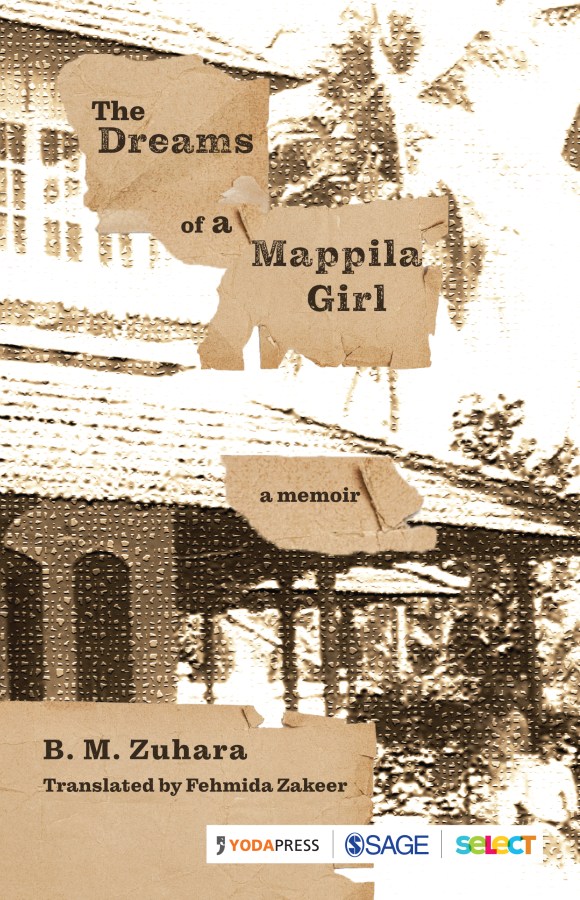
 The terms ‘autobiography’ and ‘memoir’ are sometimes used interchangeably but the former is more fact-based and tends to be historical, whereas a ‘memoir,’ derived from the Latin word ‘memorandum’, is chiefly a personal, minute recollection of events, not necessarily intending to cover a person’s entire life, but often written from an epiphanic perspective, a significant event, or a particular aspect of the memoirist’s life. Thus, memoirs are essentially subjective and can never claim to be bio-bibliographical narrations. B.M. Zuhara, the writer and columnist from Kerala and a Sahitya Akademi awardee who writes in Malayalam, had penned The Dreams of a Mappila Girl: A Memoir (2015), which was recently translated by Fehmida Zakeer to English. It traces the childhood years of the writer, growing up in the village of Tikkodi in rural Kerala as a young Mappila girl from the Muslim community in post-Independence India.

For Zuhara, the things she remembers from her childhood act as vignettes which we readers string together to form a wholesome picture of the feudal system and social issues that were significant in her mind as she was growing up in the Malabar Muslim community in the 1950s. The tenth and youngest child of her parents living in a huge ancestral house called Kizhekke Maliakkal, Soora’s narrative gives us details of the things she remembered about the place till the point where at the age of thirteen she moves with her family to live in a rented house at Kohzikode to be admitted in a high school and begin a new chapter in her life. But even after she gets admitted into a prestigious school at Kozhikode, uncertainty looms large over Soora’s life as her mother stays adamant about not allowing her daughter to wear a skirt as a uniform as mandated by the school. In the ‘Preface’, Zuhara mentions that her childhood ancestral home does not exist anymore, but its memory is so strong that it appears as a character in many of her writings.

From the very beginning of the memoir, we form a clear picture in our minds about the location of the house, its detailed set-up filled with characters of the extended family including servants and cooks who lent a helping hand to run it smoothly. Like many other narratives, food plays a significant role in developing the ambience of Soora’s household. We get details of the elaborate tea ritual every evening, the eating of pathiris soaked in coconut milk, the aroma of fried plantains and coconut residue that filled the air, the details of the betel leaf chewed by her mother and grandmother with their decorative boxes and copper spittoons, the attempts to hatch chickens from eggs that were undertaken in the storeroom, the rearing of hens and ducks and goats by her brothers, the midday meals offered in their village school which their mother did not allow them to partake considering that it was solely meant for underprivileged children, and so on fill up a considerable portion of the narrative. Apart from visiting the village fair, Zuhara recounts the social mores of the society she lived in and offers glimpses into the secluded lives of Muslim girls and women who, despite obstacles, made the best of their circumstances and contributed positively to their communities.

One significant point about the memoir is the presence of Soora’s mother throughout the narrative and the strong influence that she had over her. While growing up, Soora often accused her of not looking after her well because she was an unwanted child. A religious woman who prayed five times a day, she not only tried to apply the teachings of the Quran to her life, but also shared her newly acquired knowledge with the people around her. Any deviation from the traditional lifestyle was, according to her, punishable as an offence by Allah. A pampered cry baby who would often burst into tears for the slightest reason, Soora from the very beginning was a sensitive child, who was often admonished for her interest in playing with boys and learn Kalari Payattu like her brothers, play with them in the rice fields, stand on the bridge and listen to the songs sung by the farmhands as they worked. She was also scolded for eavesdropping into conversations made by adults and like all traditional Muslim women, her mother wanted to get her married at a very young age. The real and perceived slights that Soora was subjected to, were primarily targeted at her physical appearance, specifically her dark complexion and her tendency to cling to her mother. But paradoxically for a seemingly timid child, Soora’s propensity to constantly question what is established as normative behaviour for a girl earns her the nickname of ‘Tarkakozhi’ – one who argues. What these contradictory impulses perhaps reveal was a girl who was overwhelmed by the big and small battles she must constantly fight, a life burdened by gendered expectations, yet a girl whose deepest desire was to be like Unniarcha, a mythological woman celebrated for her fearlessness whose ballads Soora grew up listening to.

But soon Soora realised that some of her dreams would never materialise because of her gender. Certain details, such as that of Soora’s grandmother passing away at the age of thirty when Soora’s mother was fifteen; or that two of Soora’s sisters were married even before she was born, reveal the dark reality of women’s lives in those times. In the ‘Preface’ Zuhara categorically states:

“I grew up at a time when Muslim girls did not have the freedom to dream. When I started writing, I had to face a lot of criticism and threats, and I found many limitations imposed on me. Until then, only men had recorded the inner lives of Muslim women. Even though I could not comfort my sisters physically, I have tried through my writings to give them a voice by speaking about their dreams, chronicling the obstacles and difficulties faced by them, and providing a perspective from the point of view of women. In the process, I have tried to define a space for myself in the literary landscape.”

In her ‘Preface’, the author also wonders if her work is a “story, or a novel, or a memoir.” Her words became the wings upon which forgotten, and deeply bruised memories travelled out into the world. She recreated the stories of her dear and near ones around whom she had spent her childhood. She coloured her childhood experiences with her imagination and penned them all down. Even though all the names are of actual people, if she is asked if the stories are real or imagined, she can only say that they are both. So, she leaves it to her readers who have encouraged and supported her writing journey to decide.

Here one needs to add a few words about the translation. The translator Fehmida Zakeer also hails from Kerala and being a Muslim herself, her effort to make this book read as smoothly as the original Malayalam text is laudable. There is no italicisation of non-English words throughout the text and the list of kinship terms at the beginning, along with the elaborate glossary at the end, makes the book as reader friendly as possible while trying to retain the flavour of the original. The only occasional problem this reviewer faced while reading the text was that too many authentic words and salutary terms for relationships of even a single individual often turned confusing for a lay reader like her who had to pause and recollect who the actual person referred to was. For the protagonist, mention of Sora, Soora, Sooramol, and Zuhura is understandable, but addressing members of the extended family and others residing in the neigbhourhood in different salutations sometimes becomes difficult for people not acquainted with the South Indian Malayali culture. However, despite such a minor lapse, the book is engrossing and offers a wonderful slice of life of the rural and semi-urban Muslim community in Kerala, of its customs and lifestyle which otherwise would remain unknown to us in a muti-cultural and multilingual country like India.

.

Click here to read an excerpt from The Dreams of Mappila Girl: A Memoir

.

Somdatta Mandal, critic, translator, and reviewer, is a former Professor of English at Visva-Bharati, Santiniketan.

.

PLEASE NOTE: ARTICLES CAN ONLY BE REPRODUCED IN OTHER SITES WITH DUE ACKNOWLEDGEMENT TO BORDERLESS JOURNAL

Categories
Editorial

The Stars were Shining There for You & Me, for Liberty…

Painting by Sohana Manzoor

“It just so happens that their[1] universes were different from ours: because why would their imaginations be constrained by a nation-state that would not exist for another thousand years?”

Anirudh Kansetti, the print.in

These lines from a recent article on conquests carried out by the Indian subcontinent in ancient times brings to focus that earlier countries or nation-states as we know of them today did not exist till the industrial revolution set the concept in motion. In the month many countries in Asia celebrate their independent existence or rather the drawing of borders based on colonial mapmakers’ whims, we should perhaps relook at the way the world stands divided.

Is this what we want as humans? Where are we headed? While conquerors write the history, we tend to gloss over what is left unsaid. The millions who died crossing borders, in race riots and of hunger, starvation and disease in refugee camps is overlooked, or worse, used to justify the divisions that still hurt the residents of the sub-continent and try to destroy any sense of oneness among the human species. We tend not to forget the atrocities of the colonials but we overlook the violence of the mobs that incensed with hatred instilled by politics annihilated and murdered. Their story is reduced to “us” and “them”. In our mood of jubilation, the recent bombings in the Middle East and the Ukraine-Russia war have already been delegated to the newsreels. But these are all people who are killed and displaced without any justification for the need to do so. One of the things that George Orwell had depicted in 1984 was an acceptance of a constant state of war. Are we stepping into that frame of mind with our cold acceptance of the situation worldwide?

In the last century, many united against the atrocities of the empire builders. They wanted to rise above the divides. At least greats like Nazrul vociferously objected to the basis of divides that were used to draw the borders. Translations brought to us by Professor Fakrul Alam showcase such poetry as does much of Tagore’s own writing and actions. Tagore organised a protest march against the colonial proposal of Partition of Bengal in 1905 by taking a procession in which he encouraged Hindu and Muslim women to tie rakhis[2] on men from the other community and make them their brothers. Tagore put the welfare of humanity above nationalism as can be seen in his writings and speeches. Reflecting on humanity, we have Munshi Premchand’s powerful story, Pus Ki Raat or A Frigid Winter’s Night, translated from Hindi by C Christine Fair, dwelling on the sad state of peasantry under the Raj. In a bid to rouse people like the protagonist of Premchand’s story, Tagore wrote inspirational songs, one of which, Hobe Joye (Victory will be Ours) has been translated on our pages. We also continue sharing Rabindranath’s humour with a skit translated by Somdatta Mandal from Bengali.

Humour is also stirred into Borderless by Rhys Hughes with a series of mini sagas in his column and a trip around the world in eighty couplets. These couplets actually are more in number — I tried counting them — and are guaranteed to make you laugh. We have travel stories in plenty too. Ravi Shankar again treks to the Himalayas and brings us wonderful photographs of his journey and G Venkatesh stops over at Istanbul airport to find a friend from across the border. Meredith Stephens travels to a French colony called Lifou Island — sounds unbelievable as in the month we celebrate the independence of so many countries across Asia, there is still a country in the Pacific that owes allegiance to a democratic European power! But other than writing about the beaches, Stephens talks of a temporary pet dog while Suzanne Kamata gives us cat talk in her notes from Japan in a lighter vein — a very pleasant glimpse of life. Devraj Singh Kalsi brings a grin when he talks of his stint at trying to run a restaurant.

Interesting non-fictions from a book lover, Sindhu Shivprasad, and from PG Thomas who talks of King Lear performed a la classical Indian dance mode, Kathakali, by an international caste add to narratives that focus on bringing the pleasanter side of life to our readers. Such stories are a welcome relief in dark times when people find themselves caught between price hikes due to the pandemic and wars. An essay by Candice Louisa Daquin looks for a way out of the stresses of these times. Erwin Coombs gives us a funny, poignant and tragic classroom encounter which reminds me of the 1967 Sidney Poiter movie, To Sir, with Love. We have darker tones brought into our journal also with Aysha Baqir’s story on child exploitation, a sad but hopeful narrative from Nepal by Santosh Kalwar about the rejection of a girl-child by her mother and a horrific murder brought to us by Paul Mirabile.

Our poetry section this time flows over with poems from Michael R Burch, Ryan Quinn Flanagan, George Freek, Mike Smith, Gigi Baldvino Gosnell and even Ratnottama Sengupta, who has also given us a powerful essay on an acclaimed dancer called Zohra Sehgal whose life was changed by the Partition of the Indian subcontinent in 1947, basing her essay on Ritu Menon’s Zohra: A Biography in Four Acts and her own personal encounters with the irrepressible artiste. Michael Burch has also shared an excerpt of his book dedicated to his wife, O, Terrible Angel.

An excerpt from B. M. Zuhara’s The Dreams of a Mappila Girl: A Memoir, translated from Malayalam by Fehmida Zakeer, brings us close to a community we know very less about in the Southern part of India. Meenakshi Malhotra has reviewed Tagore’s Four Chapters translated from Bengali and introduced by Radha Chakravarty, a book that is a powerful voice against violence in the name of nationalism touching on the independence of women, a theme that is reiterated in another book that has been visited by Rakhi Dalal. While exploring Neelum Saran Gour’s Requiem in Raga Janki, Dalal contends that the book familiarises us with a singer “who carved her own destiny and lived life on her own terms, in times when women were generally subjugated and confined to roles given by society”. Gracy Samjetsabam has visited Mamang Dai’s Escaping the Land, a novel that tries to weave issues faced in the Northeast of India and integrate it with the mainstream by stirring human emotions.  Bhaskar Parichha has reviewed Rakesh Batabyal’s Building a Free India, a collection of powerful speeches from the past.

Within the confines of the Raj, there was a long court case where a prince who had been declared dead resurfaced as a Naga sadhu[3], a claimant to the throne, this time not to abuse his power as of past but to be a sympathiser of the people in their tryst to fight the Raj. Aruna Chakravarti has woven a historical fiction around this controversy centring around the prince of Bhawal. In an exclusive interview, she tells us the story behind the making of The Mendicant Prince — her novel that was published just last month. Her responses could well teach us how to write a historical novel.

We have much more than the fare that has been mentioned here. Pause by on our contents page to take a look. My heartfelt thanks to the whole team at Borderless for helping with this issue, which we managed to get out in a shorter time than usual and Sohana Manzoor for her wonderful artwork. I am grateful to all our contributors as well as our readers. We could not have made it this far without all of you.

In the spirit of uniting under a borderless sky, let us look forward to cooler climes and happier times.

Cheers!

Mitali Chakravarty

borderlessjournal.com


[1] Guptas (4-6 century CE), Cholas (300 BCE -1279 CE) and other ancient rulers in the Indian sub-continent

[2] A festival held in August where sisters of all ages tie a talisman or amulet called the rakhi around the wrists of their brothers, who promise to protect them.

[3] Mendicant

Categories
Tagore Translations

Skit by Rabindranath: The Treatment of an Ailment

Translated from Bengali by Somdatta Mandal, this satirical skit was part of Hasyakoutuk[1] (1914) or ‘Humour’ by Tagore

Courtesy: Creative Commons

Scene One

Enter Haradhan panting and limping.

Haradhan: God! Today I’ve really been heckled in trying to steal duck’s eggs from the English doctor’s stable. I thought I’ll die in the way he chased me. Scared, I tried to escape and fell inside a ditch. My leg is fractured but I’m not sad about it. I’m satisfied in being able to run away alive. The doctor kills all his patients as soon as he gets the opportunity; he wants to finish me off though I don’t have an ailment. From now on, I will not steal duck’s eggs everyday. I will steal the duck once and for all and it will lay eggs in our house.

From inside: Haru!

Haradhan: (fearfully) Oh, father has come. If he finds me limping in one foot, he will beat me so much that the other one will also become lame.

Enter Father.

Haradhan: (advancing) Yes, father.

Father: Why are you limping?

Haradhan scratches his head.

Father: (annoyingly) How did you break your leg?

Haradhan: I didn’t break it deliberately.

Father: I know that. But tell me how you broke it.

Haradhan: I don’t know, father.

Father: You don’t know how you broke your leg? Will the oilman Gobra from the other locality know?

Haradhan: I did not realise when it got broken.

Father: Is it so? If I break your head with this stick, will you know then?

Haradhan: (quickly shielding his head with his hand) No, father. I broke the leg in trying to save this head.

Father: I’ve understood. Like the other day, did you go to the English doctor’s house to steal duck’s eggs and they have broken your leg?

Haradhan: (rubbing his eyes) Yes, father. I am not to be blamed. I did not break my own leg, they broke it.

Father: Shameless boy! Will you never be conscious?

Haradhan: What is consciousness, father?

Father: You want to know what consciousness is? (Hits him on the back) This is called consciousness.

Haradhan: I get that every day.

Father: I can see that you will die in jail.

Haradhan: No, father. If I get consciousness everyday, then I will die at home.

Father: Oh, I cannot cope with you.

Haradhan: (looking at the basket) Father, for whom have you brought that palm fruit? Can I eat it?

Father: (whacking his back) Here, have it.

Haradhan: (rubbing his back) I did not like it.

From inside: Haru!

Haradhan: Yes, mother?

Mother (from inside): I’ve made palm fruit fries for you. Come and have it.

                                               [Haradhan goes out limping]

Scene Two

Haradhan is about to steal the duck in the doctor’s stable.

Father: (from afar) Haru!

Haradhan: Oh my god! Father is coming. What should I do?

Haradhan has a long bag dangling from his neck to his stomach. He puts the duck quickly inside the bag.

Father: Haru! (silence) Hara! (silence) Hero!

Haradhan: Yes, sir.

Father: Why has your tummy swollen up like that?

Haradhan: After eating the palm fruit fries yesterday, father.

Father: Why is there a quacking sound?

Haradhan: The intestines inside are making that noise.

Father: Well, let me feel it with my hand.

Haradhan: (quickly) No, no. Don’t touch it. It’s too painful.

Quacking sound heard from the tummy again.

Father: (to himself) I’ve understood everything. I’ll have to teach this naughty boy a lesson. (To Haru) Your ailment is not very simple. Come son, let me take you to the hospital.

Haradhan: No, father. This happens sometimes but gets cured on its own.

Quack, quack, quack.

Father: What happened? This is gradually increasing. Come, no more waiting.

Drags him and goes out.

Scene Three

Haradhan, Father and Mother.

Mother: (crying) What has happened to my poor boy?

Father: Listen, don’t create so much trouble. He will be cured once he’s taken to the hospital.

Mother: Am I creating too much trouble or is your son’s stomach creating too much trouble? (scared) He’s quacking like a duck. My dear Haru, I’ll never give you duck’s eggs to eat – there’s a duck quacking in your tummy. What will happen?

Haradhan: (quickly) No, mother. It’s not a duck but the palm fruit fries. Who told you it was a duck? It can’t ever be a duck. OK, let’s have a bet whether it is the palm fruit fries or not.

Mother: Do palm fruit fries call in that manner?

Haradhan: Mother, please keep quiet. My stomach is calling even more because you are creating such a commotion.

Father: I have some work in the Bose household. I’ll take Haru to the hospital after that.

Quack, quack, quack.

Mother: Oh my god, this is gradually increasing. Oh Mukherjee Babu!      

Enter Mr.Mukherjee.

Mukherjee: What’s the matter?

Mother: My poor son’s pain is increasing gradually. Please take him quickly to – what you call it – your hospital.

Mukherjee: I’ve been saying that right from the beginning. Haru’s father has been delaying the whole thing. (To Haru) Come, get up. Let’s go.

Haradhan: No, grandpa. I won’t go to the hospital. Nothing has happened to me.

Mukherjee: What do you mean nothing has happened? The whole locality is upset by the call of your tummy. It seems that the three elements – rheumatism, cough and bile – have all combined together to create a war in your stomach.

                                                                 [Takes him out by force.]

Scene Four

In the hospital. The English doctor and Haradhan.

Doctor: What has happened to your stomach?

Haradhan: Nothing, Sahib. You forgive me this time sahib, nothing has happened to me.

Doctor: If nothing has happened, then what is this?

Pokes his tummy and the quacking sound doubles.

(laughing) I have completely understood your ailment.

Haradhan: I am touching your body and promising you sahib. I do not have any ailment. I’ll never do such a thing again.

Doctor:  You have a serious ailment.

Haradhan: Don’t I know my ailment? You know?

Quack, quack.

(He beats the bag with anger). Oh god! This quacking never stops.

Doctor: (brandishing a huge knife) You have a stealing ailment and it will not be cured without this knife.

He tries to cut open his stomach.

Haradhan:(cries and takes out the duck) Sahib, here’s your duck. My stomach could not tolerate your duck in any way. The eggs were better instead.

The doctor beats Haradhan.

Sahib, there is no need for it. My ailment is completely cured.


[1] Translated from “Rog-er Chikitsya” (Jaisthya 1292 B.S.) by Somdatta Mandal

Somdatta Mandal is a former Professor of English and ex-Chairperson, Department of English, Visva-Bharati, Santiniketan, India. A recipient of several prestigious fellowships like the Fulbright Research and Teaching Fellowships, British Council Charles Wallace Trust Fellowship, Rockefeller Residency at Bellagio, Italy, Salzburg Seminar and Shastri Indo-Canadian Faculty Enrichment Fellowship, she has been published widely both nationally and internationally. She has also an award from Sahitya Akademi for the All India Indian Literature Golden Jubilee (1957-2007) Literary Translation Competition in the Fiction category for translating short stories series ‘Lalu’ by Sarat Chandra Chattopadhyaya.

.

PLEASE NOTE: ARTICLES CAN ONLY BE REPRODUCED IN OTHER SITES WITH DUE ACKNOWLEDGEMENT TO BORDERLESS JOURNAL

Categories
Contents

Borderless, July 2022

Art by Sohana Manzoor

Editorial

Whispers of Stones… Click here to read.

Translations

Tagore’s Mono Mor Megher Shongi (‘The Clouds, My Friends‘)has been translated by Professor Fakrul Alam. Click here to read.

The Welcome, a skit by Tagore, has been translated by Somdatta Mandal. Click here to read.

The Bus Conductor, a short story by Dalip Kaur Tiwana has been translated from Punjabi by C. Christine Fair. Click here to read.

Hasan Sol: A Balochi Folktale from Geedi Kessah-4(Folktales Vol: 4) compiled and retold by Gulzar Khan Mari, has been translated by Fazal Baloch from Balochi. Click here to read.

Cry of the Sunflower written in Korean and translated to English by Ihlwha Choi, a poem for Ukraine. Click here to read.

Tagore’s Nobobarsha (or ‘New Rains’) has been translated by Mitali Chakravarty. Click here to read.

Pandies’ Corner

This narrative is written by a youngster from the Nithari village who transcended childhood trauma and deprivation. Lockdown had been written in Hindustani by Jishan and translated to English by Grace M Sukanya. Click here to read.

Poetry

Click on the names to read

Michael R Burch, Supatra Sen, Jenny Middleton, Pramod Rastogi, Ron Pickett, George Freek, Devangshu Dutta, Candice Louisa Daquin, David Francis, Raja Chakraborty, Michael Lee Johnson, Ashok Suri, Ryan Quinn Flanagan, Sutputra Radheye, Maid Corbic, Rhys Hughes

Poets, Poetry & Rhys Hughes

In The Anthology in my Mind, Rhys Hughes talks of a make believe anthology. Click here to read and find out what he imagines.

Conversations

Eminent film journalist, Ratnottama Sengupta, converses with legendary actress, Deepti Naval, on her literary aspirations at the Simla Literary festival, Unmesh, in June 2022. Click here to read.

Keith Lyons interviews Steve Carr, a writer who has written 500 short stories and has founded the Sweetycat Press. Click here to read.

Stories

A Cat Story

Sohana Manzoor leaves one wondering if the story is about felines or… Click here to read.

My Christmas Eve “Alone”

Erwin Coomb has a strange encounter at night. Is it real? Click here to read.

Bus Stop

The story by Rinu Antony focusses on chance encounter at a bus stop. Click here to read.

Murder at the ‘Pozzo di San Patriza’

Paul Mirabile travels to 1970s Italy to experience a crime inside a sixteenth century well. Click here to read.

Musings/ Slices from Life

Grune Point and an Inkling of Eternity

A poetic account by Mike Smith as he explores the area that hovers between England and Scotland. Click here to read.

Olympic Game Farm: Meeting and Greeting Animals from Disney Movies

Hema Ravi visits a farm that houses animals that had a past in Disney. Click here to read.

Notes from Japan

In A Visit to the Isamu Noguchi Garden Museum, Suzanne Kamata visits a Museum dedicated to an American Japanese artist. Click here to read.

Musings of a Copywriter

In Shopping for my Funeral, Devraj Singh Kalsi goes on a bizarre spree. Click here to read.

Mission Earth

In On a Bamboo Bicycle from Thailand to Indonesia, Kenny Peavy revisits his trip across Asia exploring the biodiversity and conservation efforts. Click here to read.

Essays

Discovering Books and Places: The Voyage from Eden

Meredith Stephens sails the Australian coastline, recording her experiences with words and her camera. Click here to read.

Trekking to Tilicho Lake

Ravi Shankar treks up to Tilicho Tal at 4940 m. Click here to read his trekking adventures.

A Modern-day Animal Fable with Twists

Dan Meloche visits a contemporary Canadian novel written as an animal fable to draw an unexpected inference. Click here to read.

The Observant Immigrant

Is it okay to be ordinary? by Candice Louisa Daquin explores the responses of people to being accepted as ordinary. Click here to read.

Book Excerpts

An excerpt from The Mendicant Prince (based on the Bhawal sannyasi case) by Aruna Chakravarty. Click here to read.

An excerpt from Nabendu Ghosh’s Dadamoni: The Life and Times of Ashok Kumar. Click here to read.

Book Reviews

Meenakshi Malhotra reviews Tagore’s Gleanings of the Road translated by Somdatta Mandal. Click here to read.

Rakhi Dalal reviews Geetanjali Shree’s Mai, Silently Mother, a Sahitya Akademi winning translation of the Hindi novel by Nita Kumar. Click here to read.

Indrashish Banerjee reviews Nabendu Ghosh’s Dadamoni: The Life and Times of Ashok Kumar. Click here to read.

Bhaskar Parichha reviews Prosanta Chakrabarty’s Explaining Life Through Evolution. Click here to read.

Categories
Editorial

Whispers of Stones

When the mountains and grass
had life, stones whispered
how the world came to be…

'Stonehenge', Daily Star

And as the world came to be, there was war — war that seems to rage in some part of the world or other. The British Museum has an exhibit which states the first battle was staged 13,000 years ago… in what is now Sudan, long before the advent of written history. This was even before the advent of people who built the ancient Stonehenge which was constructed around 3000-2000 BCE. And battles still continue to rage. The Jebel Sahaba casualties in Sudan 13000 years ago were less than 100. But the current conflicts claim in terms of tens of thousands which prolonged could stretch to millions. The last world war (1939-1945) which lasted for six years had a total of  75-80 million persons who perished. Ukraine-Russia conflict has within five months had a casualty count of more than 14000. And yet weapons and nuclear arms continue to proliferate decimating humanity, nature and towns, destroying homes, erasing ruthlessly and creating more refugees. The only need for such battles seem to be to satiate the hunger of the warlords secure in their impenetrable fortresses while tens of thousands are annihilated and natural or nurtured landscapes lie emaciated, mutilated and polluted.

What would be a good way of ending such wars?

Tagore sought the development of better instincts in humankind as an antidote. He wrote in the last century: “Any teaching concerning man must have human nature for its chief element. How far it will harmonise with human nature is a matter of time.”

With wars getting deadlier and more horrific, we can only try to awaken, as Tagore suggests, the better nature in man to move towards a peaceful world. What would be a more effective way of doing it than writing with the hope of a kinder and accepting future?

For that let us start with translations of the maestro Tagore himself. We have a song about the season — monsoon, ‘Monomor Megher Songi (My Friends, the Clouds)’, translated by Professor Fakrul Alam, a painting by Sohana Manzoor interpreting the lyrics and a transcreation of Nababarsha or New Rains’ was shrunken into a popular Rabindra Sangeet and reduced to twenty lines in English by Tagore himself. The connect with nature is an important aspect that enables humans to transcend petty concerns leading to dissensions of different kinds as evidenced in the maestro’s humorous feline skit, translated by Somdatta Mandal. A translation of Dalip Kaur Tiwana’s ‘The Bus Conductor’ from Punjabi by C. Christine Fair adds zest to this section. Fazal Baloch has translated a folktale from Balochistan involving the supernatural and Ihlwha Choi has taken on the cry for peace on behalf of Ukraine while translating his own poem in Korean. The Nithari column has a story by Jishan in Hindustani, translated to English by Grace M Sukanya, showcasing the struggle of a youngster during the pandemic – rather a sad narrative, which though fictitious has its roots in reality. 

Our poetry section touches upon the timelessness of dissensions and darkness with Michael R Burch’s poem on Stonehenge and Supatra Sen’s poem on Ukraine. This has been allayed by love poetry by Maid Corbic from Bosnia. George Freek’s poem ruffles with its reflective lines. And in the midst of it all, is poetry by Ryan Quinn Flanagan reflecting on the seven stages of man. Will the process of aging or human nature ever change? I wonder if Rhys Hughes can find an answer for that in humorous verses as he has shared in this issue. In his column, Hughes has written about an imagined anthology of short stories.

Our short story section has echoes of humour around felines by Manzoor, somewhat in tune with the mind frame seen in Tagore’s skit on this issue. Humour rings tinged with an apparition in Erwin Coombs’s narrative – should one call it dark humour or is it just his style? Paul Mirabile goes for gothic darkness in his meanderings around Italy.

Strangely, we seem to have a focus on short stories this time. Keith Lyons has interviewed Steve Carr, a journalist, a publisher and writer of 500 short stories who is questing to create a ‘perfect short story’. Reading out excerpts from her short story at a literary festival in Simla, Bollywood celebrity, Deepti Naval, was in conversation with eminent film journalist, Ratnottama Sengupta. She spoke of her literary aspirations while unveiling her autobiography in verse, A Country Called Childhood. This conversation has been shared by Sengupta with Borderless. It is interesting to see how Naval’s reactions to social malaise contrasts with that of the film director, cinematographer and actor, Goutam Ghose, who was present during the unveiling of her book. He had responded to communal violence by making a film on Lalan Fakir extolling virtues of love and kindness, called Moner Manush (2010) and then made a book on the film called, The Quest (2013) which has beautiful translations of Lalan Fakir’s lyrics by Sankar Sen.  

Our non-fiction sections seem to be hosting multiple travel stories across UK by Mike Smith, along the Australian coastline by Meredith Stephens, on the Himalayas with Ravi Shankar and an unusual visit by Hema Ravi to a farm in US where animals that had been used in Disney films in the past are homed. Our environmental columnist, Kenny Peavy, actually wrote about his cycling trip from Thailand to Indonesia on a bamboo cycle made by a Singaporean! And from Japan, Suzanne Kamata explored a museum in the neighbouring town of Mure. The museum on a hill hosts the art of American Japanese Artists, Isamu Noguchi.

We do have non-fiction that moves away from travel: noir humour by Devraj Singh Kalsi and an essay by Candice Louisa Daquin on a very interesting subject – ‘Is it Okay to be Ordinary?’ Is it?  Dan Meloche has written a literary essay on Canadian novelist Andre Alexis’s award-winning novel, Fifteen Dogs: An Apologue (2015). While Meloche spoke of how the novel departed from Orwell’s Animal Farm, his narrative brought to my mind a novel closer to our times set in England by Jasper Fforde called Constant Rabbit (2020) – this a science fiction while Alexis’s was an apologue or an animal fable. Fforde did use the rabbits rather well to highlight the current times.

We have book excerpts of two recent books that I would call really outstanding. One of them is Aruna Chakravarti’s The Mendicant Prince, which is being released this week, and is based on the evergreen contentious case of the prince of Bhawal that has even been explored even in cinema. The other, Dadamoni: The Life and Times of Ashok Kumar by Nabendu Ghosh, has been published posthumously and is not a translation from Bengali but written in English originally by this trilingual writer.  

Called ‘Dadamoni’ affectionately, iconic actor Ashok Kumar is regarded as “the one personality who symbolises Indian cinema’s journey from Bombay Talkies to Bollywood”.  This book has been reviewed by Indrashish Banerjee, who calls it ‘a reflection on the Hindi film industry’ as well as a biography. Rakhi Dalal has reviewed Booker winner Geetanjali Shree’s Mai, Silently Mother, a Sahitya Akademi winning translation of her Hindi novel by Nita Kumar, reiterating the dialogue that had been kindled on motherhood last month by Rinki Roy Bhattacharya and Maithili Rao’s The Oldest Love Story (2022). Bhaskar Parichha has reviewed Prosanta Chakrabarty’s Explaining Life Through Evolution plotting how life evolved on earth. Parichha tells us: “Meaningful, wide-ranging and argumentative, this is a must-read book. It will propel us to imagine and reimagine life around us.” Another book that sounds like a must-read has been reviewed by Meenakshi Malhotra, Tagore’s Gleanings of the Road, translated by Mandal. She tells us: “ ‘Gleanings’ represents the quintessential Tagore…Ably introduced and translated by Somdatta Mandal, a renowned Tagore scholar, the translation captures the iridescent and luminous quality of Tagore’s prose and its chiaroscuro effects.”

There is more to tempt. Please stop by on our contents page and take a look.

We would like to hugely thank all our contributors and readers for being with us and helping us grow. I would like to thank my team, who despite hurdles they face, always lend a helping hand and wonderful words from their pens or computers to get Borderless on its feet. I apologise for the delay and thank you all for your patience. Special thanks to Sohana Manzoor for her fabulous artwork.

I wish you all a wonderful July and peace in a war-torn world. We are all affected by the ongoing conflicts. Let us hope for peaceful and just resolutions.

Thanks.

Mitali Chakravarty

borderlessjournal.com

Categories
Review

Tagore’s Cartography of the Imagination

Book review by Meenakshi Malhotra

Title: Gleanings of the Road

Author: Rabindranath Tagore Translator: Somdatta Mandal

Publisher: Niyogi Books

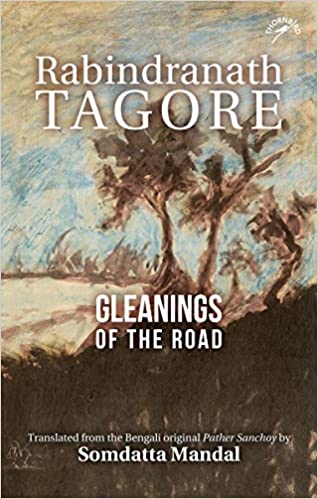
Travels formed an integral part of the personae and creative artist that was Rabindranath Tagore. During his travels to England and the America (1912-13 and 1920) Tagore wrote essays for publication in various Bengali journals. Rabindranath Tagore was an inveterate traveller who travelled to the furthest corners of the globe. Detailing his travels in the  colloquial everyday language (also referred to as ‘chalit’ bhasha or language)  during his tour of England and USA in 1912-13, he used to publish regularly in journals like Prabasi, Bharati and Tattwabodhini Patrika. As the translator-editor Somdatta Mandal  informs us, Vishwa Bharati Publication Department in 1946 decided to discard Rabindranath’s own selection. They went back to the earlier formal register and included writings of the 1912 tour, irrespective of whether they were related to his travel.  

 The book blurb says: “In 1939, Tagore selected fourteen of these essays and an appendix containing seven letters he had written to some of the teachers in the Santiniketan ashram while he was on these trips, for publication as a volume. It was at this point that he rewrote the original essays then using the colloquial instead of the formal language; he also revised the texts substantially. Later editions altered the number of essays, sometimes digressing from Tagore’s own selection, sometimes going back to Tagore’s original formal language.”

The travelogue, if it can be called that, provides an insight into Tagore’s perception of the different facets of western life and the diverse philosophical issues that cross his mind as he journeys from one continent to another. Thus perhaps it is more appropriate that the collection is named “gleanings’’ rather than a travel account or narrative. They are philosophical ruminations where Tagore holds forth on various aspects of civilizations and cultures.

In the very first segment, Tagore’s critical observations about Indian society comes to the fore. Thus he comments on what he sees as  cultural differences and civilizational clashes, in “Prelude to the Journey”: “We always comfort ourselves by saying that we are a religious and spiritual race”. He sees this as a compensatory move by Indians to cover up our own sense of inadequacy, about our “weakness”  in the external world.(Tagore was acutely conscious of India’s status as a colonised country). “Many of us boast that poverty is our asset”, dwelling perhaps in a haze of pseudo-spiritualism which balks at admitting that this attitude is merely a kind of bravado.

Tagore’s essay here unpacks the notion of the binary that the West is materialistic while the East is spiritual by lauding certain aspects of Western and European culture. Thus he writes that “if we go to Europe with the aim of a pilgrimage, our journey will not be in vain”. He further explains that  this is not only because of the material developments achieved by Western culture, but their spirit and attitude.

Power, according to Tagore, is more than an external manifestation; rather, it has to do with a sense of real inner strength. He goes on to cite the instance of the Titanic and people’s altruism and self-sacrifice that was in evidence at that time, to interrogate the view, held by many Indians, that the average European is self-centred and self-serving. On the other hand, Tagore also gives plenty of instances where the spiritual poverty of Indians was in evidence. Thus he writes, “I know there has been a clash between our welfare and that of Europe and because of that we are suffering deep anguish and pain. We do not trust their religion and we criticise their culture as being too materialistic.” However, he continues that there are aspects of European culture which are worthy of emulation, which we would do well to follow, without feeling that it threatens our culture. He strongly commends that the path to seek the truth is a pilgrimage on which we should proceed without being blinded by ego, prejudice and false pride.

Coupled with this contrast of cultures, are observations about people and places. Thus he talks about the women of Bombay who are visible on the beaches of Bombay and contrasts it with the city of Calcutta, which according to him, is bereft of women in public places. Tagore also muses on the vast and limitless ocean which to him offers a cornucopia of literal and symbolic meanings. The sea and the ocean signify  vastness, depth, boundlessness and infinitude, as well as the lure of the unknown. In contrast, he bemoans  the loss of man’s ties with nature signified to him by the colonial appropriation of the river. He reflects that the river “Ganges was once one of Calcutta’s ties with nature…It was the one window of the city from where you could look out and realize that the world was not confined to this settlement.” He bemoans the fact that the once natural strength of the Ganga had been dissipated, “it has been dressed up in such tight clothes on both its banks and its waist band has been tightened so that the Ganges seems to be the image of a liveried footman of the city”. In contrast, the “special glory of the sea is that it serves man but does so without wearing the yoke of slavery on its neck.” His evocative description brings to life the various aspects of the landscape in full measure.

Tagore’s ‘travel’ writing is not just a mapping of people and places, but shows him as the supreme cartographer of the imagination. Witness his contrast of the earth and the ocean. The earth is compared to an excessively doting mother who binds her children to her and does not allow them to venture far away; the ocean by contrast “constantly allures him to venture towards the unattainable”. He adds, “Those who responded to that call and moved out are the ones who conquered the world.” Moreover, “that race of people on this earth who have specially welcomed this ocean have also found the unceasing effort of the ocean in their character.” Travelling on the Arabian sea, glimpsing distant shores, he stresses that the union of the two — the land and the ocean — signifying stability and movement are vital to an understanding of the truth.

The urge to travel, to move forward continuously, is forever present in man. In a philosophical vein , the poet muses that the soul “always wants to travel” and that it dies if it does not do so.In a series of similes and metaphors drawn from nature, he reflects: “Let us keep moving on, like the waterfall, the waves of the ocean, the birds at dawn, the light at sunrise.” He even transcends to the next plane when he says that “even the call of death is nothing but just a call to change the dwelling place”. In almost the same breath, he compares himself to a fairy princess who is fast asleep and who cannot be woken from her slumber, except with a golden wand.

Part anthropological study– at one point, the poet reflects that the vastness of the surrounding sea would have elicited devotion among many Indians, unlike the European traveller who is intent on enjoying the comforts and varieties of entertainment on the ship-part philosophic meditation, “Gleanings” represents the quintessential Tagore. His interrogation of Indian claims to spirituality is made in the tone of a concerned father warning his children not to fall prey to false pride and vanity. Deeply patriotic as well as an internationalist, he straddled two contrasting worlds of materiality and spirituality, without succumbing to limiting binaries and stereotypes.

Ably introduced and translated by Somdatta Mandal, a renowned Tagore scholar, the translation captures the iridescent and luminous quality of Tagore’s prose and its chiaroscuro effects.  

CLICK HERE TO READ THE BOOK EXCERPT

  Dr Meenakshi Malhotra is Associate Professor of English Literature at Hansraj College, University of Delhi, and has been involved in teaching and curriculum development in several universities. She has edited two books on Women and Lifewriting, Representing the Self and Claiming the I, in addition  to numerous published articles on gender, literature and feminist theory.       

.

PLEASE NOTE: ARTICLES CAN ONLY BE REPRODUCED IN OTHER SITES WITH DUE ACKNOWLEDGEMENT TO BORDERLESS JOURNAL

Categories
Tagore Translations

The Welcome: A Skit by Rabindranath

Translated from Bengali by Somdatta Mandal, this satirical skit[1]was part of Hasyakoutuk (1914) or Humour by Tagore


Courtesy: Creative Commons

Scene One

A village road

Chaturbhuj Babu has come to his village after passing his M.A. exams. He had expected the entire village to be exuberant. He has a stout Kabul cat with him.

Enter Nilratan

Nilratan: So here is Chatubabu. When did you come?

Chaturbhuj: After appearing for my M.A. examination in college –

Nilratan: Oh! This cat is very exquisite.

Chaturbhuj: The examination this time was –

Nilratan: Sir, where did you get this cat?

Chaturbhuj: Bought it. The subject I had elected this year –

Nilratan: How much did you pay for it, sir?

Chaturbhuj: Can’t remember. Nilratanbabu, has anyone graduated from our village?

Nilratan: Plenty. But there is no such cat in the vicinity.

Chaturbhuj: (to himself) Oh God! He only speaks about cats. He does not talk about my success in the exams.

Enter the Zamindar

Zamindar: Oh, here is Chaturbhuj! What did you do all this while in Kolkata, son?

Chaturbhuj: Sir, just came after my M.A. exams.

Zamindar: What did you say? Meye[2]? Given a girl to somebody? To whom have you given?

Chaturbhuj: No, not that. After B.A.—

Zamindar: You have got your daughter married? Her biye[3]? But we did not get to know about it.

Chaturbhuj: Not marriage, but B.A. –

Zamindar: Oh, it’s the same thing. In the city you call it B.A., in our village we call it biye. Ok. Let that be. This cat is very beautiful.

Chaturbhuj: You are mistaken. My –

Zamindar: What mistake? Go and find a similar cat in this whole district.

Chaturbhuj: No, sir. I am not talking about cats –

Zamindar: Yes, we are talking about cats. I am saying that we can’t get such cats.

Chaturbhuj: (to himself) Goodness gracious!

Zamindar: Come with your cat to our locality in the afternoon. The children will be very happy to see it.

Chaturbhuj: Yes, they will surely be happy. They haven’t seen me for a long time.

Zamindar: Yes, that’s true. But I am saying that if you cannot come, then send it through Beni. I want to show it to the children.

[Exit]


Uncle Satu enters

Uncle Satu: Here you are. Seeing you after a long time.

Chaturbhuj: Won’t it take long? So many examinations –

Uncle Satu: This cat –

Chaturbhuj: (annoyed) I am going home.

[About to leave]

Uncle Satu: Here, listen to me. This cat –

Chaturbhuj: No sir, I have work at home.

Uncle Satu: Here, at least answer one question. This cat –

[Chaturbhuj does not reply but walks out hurriedly]

Uncle Satu: Oh God! These children have become very clever after being educated. They have many attributes but too much pride.

[Exit]

Scene Two

The inner domain of Chaturbhuj’s house

Maid: Mistress. Dada has come home very angry.

Mother: Why?

Maid: How do I know?

Enter Chaturbhuj

Small boy: Brother, I want this cat –

Chaturbhuj: (slapping him) Day in and day out only cat, cat, cat!

Mother: Poor son. Is he annoyed for nothing? He has come home after such a long time and the children are pestering him too much. Go! All of you go from here. [To Chaturbhuj] Give it to me, son. I have kept rice and milk for it. I’ll go feed your cat.

Chaturbhuj: (angrily) Take it, mother. All of you only feed the cat. I will not have food. I’m leaving.

Mother: (earnestly) What sort of statement is that? Son, your meal is ready. Just go and take your bath.

Chaturbhuj:    I am leaving. In your country only cats are admired. There is no place for geniuses. (He kicks the cat)

Aunt: Oh, don’t beat it. It has done no harm.

Chaturbhuj: All your affection is for the cat. You don’t have any pity for the human being. (Exit)

Small girl: (pointing offstage) Uncle Hari, come and see. Its tail is so thick and bushy.

Hari: Who’s tail?

Girl: There, his.

Hari: Is it Chaturbhuj’s?

Girl: No, the cat’s.

Scene Three

The road. Chaturbhuj with a bag in hand. No cat with him.

Sadhucharan: Sir, where is your cat?

Chaturbhuj: It’s dead.

Sadhucharan: Oh! How did it die?

Chaturbhuj: (Disgusted) I don’t know, sir.

Enter Paranbabu.

Paran: Sir, what happened to your cat?

Chaturbhuj: It is dead.

Paran: Really? How did it die?

Chaturbhuj: Just as you all will die. With a rope around your neck.

Paran: Oh my god, He is too angry.

A group of boys follow Chaturbhuj. Clapping themselves they tease him shouting

“Kabuli Cat,” “Kabuli Cat.”


[1] [Translated from “Abhyarthana” (Bhadra 1292 B.S.) by Somdatta Mandal]

[2] Daughter in Bengali

[3] Wedding in Bengali

Somdatta Mandal is a former Professor of English and ex-Chairperson, Department of English, Visva-Bharati, Santiniketan, India. A recipient of several prestigious fellowships like the Fulbright Research and Teaching Fellowships, British Council Charles Wallace Trust Fellowship, Rockefeller Residency at Bellagio, Italy, Salzburg Seminar and Shastri Indo-Canadian Faculty Enrichment Fellowship, she has been published widely both nationally and internationally. She has also an award from Sahitya Akademi for the All India Indian Literature Golden Jubilee (1957-2007) Literary Translation Competition in the Fiction category for translating short stories series ‘Lalu’ by Sarat Chandra Chattopadhyaya.

.

PLEASE NOTE: ARTICLES CAN ONLY BE REPRODUCED IN OTHER SITES WITH DUE ACKNOWLEDGEMENT TO BORDERLESS JOURNAL