Categories
Stories

Driving with Murad

By Sohana Manzoor

“Go, go, go, go, go! What are you waiting for?” yelled the man sitting in the passenger’s seat. I was at the wheel wondering if it was my turn, or if I should allow the car coming from my left to go forward. At his urging, I plunged forward and turned left. Murad shook his head in frustration and spoke with his thick Russian accent, “You are thoo afraid. Why are you so afraid? What dho you think will happen, huh? If you dhrive like that, you will never go anywhere.”

Murad was my driving instructor. He was a great fellow, full of fun and humour. He was quite motivating and without a doubt, an excellent driver too. Unfortunately, I am an awful learner and possibly also the worst pupil he had ever had to teach driving. I busted one of the front tires of my best friend’s car the very first day I dared to be out in the streets. I sat behind the wheel for the first time in my life in August 2015. I was as nervous and frisky as a kitten and the instructor from the Driving School in Newton made me drive around a parking lot. He suggested that I practice at the parking lot with a friend, and preferably in some streets with less traffic before signing up for my next session.

I did as he had suggested, but only in the parking lot. My best friend and housemate, Nausheen, was terrified of my driving skills, and naturally, did not dare to accompany me in the streets!

My second session was with Murad. He was a little late, and came cursing under his breath. Apparently, he got the wrong address from the driving school, and realised the mistake only after calling me. I still remember him not only as a great instructor, but a great entertainer as well. He was in his mid-fifties, good looking and in very good shape. He also talked incessantly. Every time I made some blunder, he yelled in a good-natured way.

“Next time, I will bring my shoth gun,” he told me once, after I made a frantic turn ignoring all other drivers on the road amidst a jumble of hooting and honking. “I can shoot all those people down, and you won’t have to worry about running them down, you know,” he said grinning.

“You have a shot gun!” I gasped. “What do you do with a shot gun?”

He was nonchalant. “I’m a licensed fire arms instructor.”

“Fire arms instructor?” I blanched and stepped on the gas paddle instead of the brake. Murad quickly pressed on his safety brake and tsked, “Don’t do that. Take it easy. You have to learn to converse while driving.”

He guided me to a rather quiet area in West Newton. I was driving very slowly, and cautiously. Murad suddenly coughed and asked, “What’s the speed limit?”

“Er…thirty-five.”

“What’s your speed?”

“Twenty,” I replied sheepishly.

“It’s like riding a donkey, you know,” he held out both his hands in front of him as if he held the reins of a donkey. Something told me that he had ridden on donkeys too.

*

After two successive sessions with Murad, I found myself with Arthur, a veteran from the Vietnam War. Retired and in his early sixties, he had the airs of a consummate playboy. He was not bad, I suppose. I would probably have fallen for him if I was a teenager. Arthur would flirt and praise how pretty I was. So, at one point I said a little too sweetly, “But I’m an awful driver, don’t you think?”

Poor Arthur looked flabbergasted. He belched, and then admitted that I was not the best driver in the world. Satisfied, I switched the topic to Murad, saying that I really liked his techniques. As you can probably guess, Arthur immediately turned around in his seat. “Yeah?” he peered over his sunglasses and asked, “And why is that? What’s so great about Murad? He’s shell shocked; I hope you knew that?”

“Is that so?” I glanced sideways, as I was driving through an intricate intersection. The drivers of Massachusetts are awful; little wonder that the people of the neighboring states were terrified of them. Perhaps, just because of that reason I would get my driving license in the long run, I tried to convince myself.

“Murad had worked with the Talibans at one point of his career,” said Arthur.

 I gulped and exclaimed, “Talibans! You are not serious, are you?”

“I wouldn’t joke about something like that,” replied Arthur very casually. “He used to work as a spy for the American Government. He is originally from Turkmenistan, you know. And he is fluent in six languages. So, yes, he was the perfect man to be recruited.” He paused dramatically and added, “I guess at some point they suspected his secret and hence tried to cut his throat and left him for dead.”

I gulped again.

*

When I told Nausheen and the rest of our housemates about Murad, they were all shaking uncontrollably. Nausheen was noncommittal, “No! This is unheard of! He was really with the Taliban? I have to see this guy!”

So, there she was standing with me the next day as I waited for Murad to show up. He looked at Nausheen carefully and he asked, “Have you seen her drive? Do you trust her with your life?”

Nausheen laughed, “I don’t trust her. But I trust you! Surely you won’t let her do anything so drastic?”

Nausheen can be absolutely adorable, and Murad melted. “Hop in,” he yelled. “It will be fun.”

After passing through the busy traffic of Newton I asked him, “Hey, I heard that you worked with the Taliban. Is it true?”

He turned his bright eyes on me and lifted his left hand drawing my attention to his middle finger.

“You see this moonstone?” he asked, displaying a ring with a yellowish stone. “The Taliban gave it to me. I stayed and prayed with them for three entire years. Crazy fanatics. I almost died.”

“It’s true then, that they tried to slit your throat?” I asked horrified.

Murad shrugged. “Nah, I was not referring to that. I almost died because there was no woman.” And then he shouted, “Look where you’re going. Eeks, you’re something out of this world! But yes, if I have you driving with me, I won’t need to go for parachute jumping any more. I have already given up my morning coffee!”

“You go for parachute jumping?” I asked wide-eyed. What an interesting fellow indeed! Nausheen exclaimed “Wow!” And we both asked at once, “Why do you go for parachute jumping?”

He nodded. “Life has become so boring! I need adrenaline rush. But yes, with you, it almost seems like I am in the middle of a battle field. God knows when and where you’ll turn next. . .  Look where you’re going! That’s a grandmamma! She will kill you if you scratch her car.”

I blushed. And at the back seat I could hear Nausheen laughing her head off. He was so blunt, and yet he was great company. He kept on shaking his head, “Please don’t make that kind of a turn. I’m not so young any more. I might break my neck. My wife is 25 years younger than me. Do you know what will happen, if I break my neck?”

I just stared at him. Why in the world would he have a wife who is 25 years younger than him?

“I will have to divorce her,” Murad confided. I wondered why. Then I hit the brakes again. Hell, this man was outrageous!

*

In the evening, Elizabeth, our favorite housemate asked, “So, this Murad—is he as amazing as Sohana made him sound?”

We were all in the kitchen and I had tilapia and asparagus baking in the oven. Nausheen said gleefully, “One hundred percent and more. I think I will go with them on the next session too. I have never met anyone like him. My driving instructor was great, but this guy is just CRAZY! All Sohana’s karma,” she winked at me. “I don’t know how she comes to meet all the crazy and entertaining people.”

Elizabeth shook her head and smiled, “So what did Murad do today?”

I listened half-smiling as Nausheen went on regaling our friends with Murad and his outrageous comments.

“You know, now I know why Gary never listens to us,” she said laughing. Gary was another housemate, loud and raucous. During our house meetings his behavior was irritating and sometimes disruptive.

“And why is that?” Asked Lizzy.

“Because he is an arborist. He works with those noisy instruments, and has lost his hearing. His ear-pipes are jammed and he can’t hear anybody else.”

By now my tilapia fillets were ready. I pulled the baked fish and veggies out and announced, “Dinner is ready. And yes, that’s what Murad said: ‘keep away from those guys with big machines in hand. They never listen to your honking because they are making too much noise themselves.’” I paused and added with a mischievous wink, “He also advised to keep away from grandmamas. Apparently, they are the worst drivers.”

Donna, another sweet lady who lived on the second floor, was chopping her root vegetables on a table at one corner of the kitchen. Both Elizabeth and Donna were in their mid to late sixties. Both replied hastily, “well, we are not grandmas yet.”

Nausheen and I grinned. It seemed everybody wanted to be in Murad’s good books.

*

The day of the road-test was approaching. I was nervous. To make things worse, Murad was gone. He had left for home in Turkmenistan to visit his elderly mother and children from a previous marriage. I was working with another instructor. To be honest, he was not bad at all; did the usual drilling and practices. But as I got down from the car one day, I felt sad and down. I realized that I missed Murad. Being away from home and country was taking its toll. He was supposed to be back two days before the test. But he wasn’t.

On the morning of the driving test, I suddenly realised that even if I failed the test, it did not matter. Murad had taught me something vital, much more important than driving a car. He has actually shown me how to go on with life, to enjoy it to the fullest, regardless of all that is negative. Driving an automobile is only one little particle in this vast line called life.

I looked at the mirror, at the surprised face staring back at me. I smiled. Finally, I was ready.

.

Sohana Manzoor teaches English in the Department of English, ULAB. She is also the literary editor at The Daily Star. This is a revised version of another publication in the Dhaka Tribune in 2017.

.

PLEASE NOTE: ARTICLES CAN ONLY BE REPRODUCED IN OTHER SITES WITH DUE ACKNOWLEDGEMENT TO BORDERLESS JOURNAL

Categories
Seasonal Outpourings

Auf Wiedersehen Autumn

Autumn by Sohana Manzoor

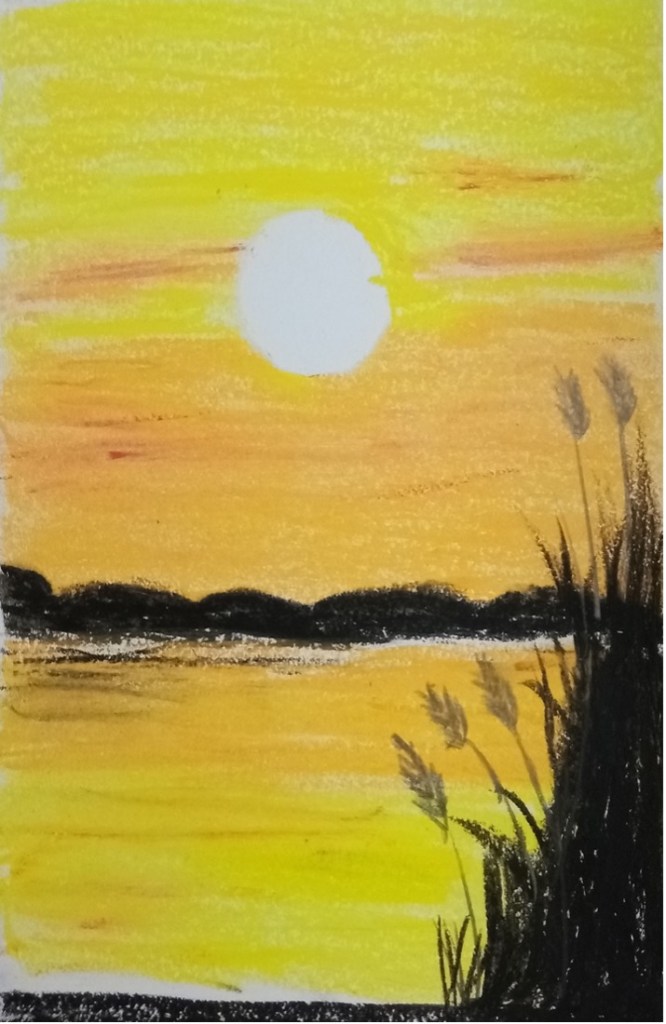
As autumn gives way to winter, here are explorations that give us a glimpse of the season, its colours, its feel across different parts of the world and their varied interpretations. We have the vibrancy captured in colours by Sohana Manzoor and Sybil Pretious. There are reactions to events that happened at this time in different parts of the globe from Ratnottama Sengupta and Sutputra Radheye — have we healed after these events? Have things got better?

As Europe starts a new wave of pandemic lockdowns, Mike Smith takes us for a trip to Trieste, rich with the heritage of James Joyce, Umberto Saba and Baron Von Trapp of Sound of Music. Prose from Tagore(1861-1941) translated by Somdatta Mandal showcases some of his reactions while traveling in Japan, America and Europe in the autumn of his life. We can vicariously travel to different parts of the planet! While verses by Michael Burch and George Freek explore the season and the autumn of life, poetry by Rhys Hughes and Sekhar Banerjee add zest to the fall with humour. Revathi Ganeshsundram brings us a poignant narrative of new friendships. A short story from maestro storyteller from Holland, Louis Couperus(1863-1923), translated by Chaitali Sengupta, paints a darker hue of autumn while Tagore’s poetry gives us a festive feel generated by the season in Bengal. Enjoy our melange of autumnal lores!

Poetry

Autumn & Me: Poetry by Michael Burch. Click here to read.

Algae Masks: Poetry by Sekhar Banerjee. Click here to read.

Autumnal Dirge: Poetry by Sutputra Radheye. Click here to read.

The Night Music: Poetry by George Freek. Click here to read.

A story poem by Rhys Hughes about The Clock Tower of Sir Ticktock Bongg, who spends his autumn of life in the most peculiar way. Click here to read.

Translation of Amaar Nayano Bhulano Ele or The Advent Song by Tagore describes autumn in Bengal. Click here to read. 

Prose

Yesterday Once More?: Ratnottama Sengupta revisits an autumn in Egypt. Click here to read.

Me & James Joyce in Trieste: Mike Smith travels in autumn to Trieste, an autumn in a pre-pandemic world. Click here to read.

Of Days & Seasons: A parable by Louis Couperus, translated from Dutch by Chaitali Sengupta. Click here to read

The Cockatoo: A short story about new friendships in the autumn of life by Revathi Ganeshsundaram. Click here to read.

 Letters from Japan, Europe & America: An excerpt from letters written by Tagore in the autumn of his life, translated from Bengali by Somdatta Mandal. Click hereto read.

Painting by Sybil Pretious
Categories
Editorial

Colours of the Sky

A riot of colours starts the day
with happiness, vibrancy and hope,
dispelling the winter of discontent
with whispers of new lores…
Courtesy: Sohana Manzoor

Devi (The Goddess) is a 1960 Satyajit Ray film, based on a story by a writer called Prabhat Kumar Mukhopadhyay, that showcases nineteenth century India, where the silence of a young girl who is deified, wreaks havoc in her home, village and life. In an interview, Satyajit Ray contended that the film was to make people rethink ‘messiahdom’. The exact words he used to state this was that the film was against ‘religious dogmatism’ as the film and story literally dealt with the deification of a young bride. Tagore had similarly questioned blind deification in a number of his poems and plays. These (as Ray spelt out in his interview) did not address religion per se but malpractices, among them, the tendency to worship an idol to a point where flaws are justified, accepted and emulated. Satyajit Ray and Tagore were both Brahmos — which can be seen as a reform movement. These two were not criticising religion but talking of rising above gawky hero worship to think logically and arrive at logical conclusions. When we talk of characters from the Ramayana, the Mahabharata, other mythologies or substitute the adulated with stars, writers, politicians and businessmen who run huge concerns, we tend to idolise them. But these were and are all characters with flaws, whether fictitious or real. We can well learn from their mistakes, rather than deify and worship them to justify bad behaviour by quoting instances from lives of past legends or prominent persons in the current world.

Akbar Barakzai, a poet exiled from Balochistan, talks in a similar vein in his interview. You can see it in his poetry too — some of which can be found translated by Fazal Baloch in our pages. Barakzai talks of transcending barriers we draw for ourselves in the real world, of writing with honesty and sincerity. He has shared vignettes of his life as he changed countries to continue his work. Baloch has also brought to us another excellent poet in translation, Munir Momin. A major poem by Nazrul (the ‘bidrohi kobi’), ‘Bidrohi or Rebel’ has wound its way to our pages translated by Professor Fakrul Alam. We are honoured and grateful that Prof Alam chose to share this excellent translation with us. We have more translations: Jibonananda’s ‘Motorcar’(1934) by Rakibul Hasan Khan, a Korean translation by Ihlwha Choi, another short story from Nepal and Tagore’s powerful poem,Morichika or Mirage’, which is a wake-up call for the inert affluent who hold themselves aloof from common masses. We have also interviewed a major prose translator of Tagore, Professor Somdatta Mandal. With much to share on Santiniketan, Nabanita Deb Sen and many interesting anecdotes, Mandal talks of her extensive work with her translations spanning many more writers from the past.

We have a colourful ensemble this time almost as vibrant as the autumnal colours that have invaded nature in some parts of the Northern Hemisphere. Michael R Burch has given us beautiful poems on autumn, including the autumn of life. We have a poem in a similar vein by George Freek whose work continues influenced by Liu Yong (1719-1805), an influential minister and calligrapher in the Qing Dynasty. Ryan Quinn Flanagan touches on Leonardo Da Vinci’s Mona Lisa in his poetry. Rhys Hughes has given us humour in both his poetry and his column. Our other humorist, Devraj Singh Kalsi has given us darker, more caustic black humour in his narrative. We have lovely photographs from Penny Wilkes with her verses in Nature’s Musings. It is amazing the way she photographs birds in flight. Stories from Malaysia, Bangladesh, India and America add to the richness of our oeuvre. Sunil Sharma has given us an avant-garde telling of Odysseus’s voyage in the modern world, transcending the borders of time and ethnicity.

A well-known senior journalist, Ratnottama Sengupta, has also travelled through time to give us a recall of her experience at the 35th Cairo Film Festival one November, nine years ago. Her narrative about the time that the Shariat law was adopted by Egypt reminds me of the way things moved in Afghanistan few months ago and what is even more stunning is the way in which organisations dubbed extremists earlier are allowed to run countries now. Is it really not yet time to get rid of messiahs and look for one world?

We conclude our travels in Burma with John Herlihy and his friend, Peter, this month. And start a column with Candice Louisa Daquin, The Observant Immigrant. Her essays always draw much discussion. An experienced psychotherapist, she has looked into our value systems. We have books excerpts from Arundhathi Subramaniam’s Women Who Wear Only Themselves and CJ Fentiman’s award winning book, The Cat with Three Passports. Himadri Lahiri has done an in-depth review of Somdatta Mandal’s ‘Kobi’ and ‘Rani’: Memoirs and Correspondences of Nirmalkumari Mahalanobis and Rabindranath Tagore. It is amazing how much we can learn about a person from their letters. Suzanne Kamata has shared her review of Iain Maloney’s Life is Elsewhere/ Burn Your Flags. Reviewed by Meenakshi Malhotra, Shylashri Shankar’s Turmeric Nation: A Passage Through India’s Tastes, sounds like an erudite read that spans thousands of years of history. Anita Agnihotri’s Mahanadi –The Tale of a River, translated from Bengali by Nivedita Sen, has been reviewed by Bhaskar Parichha. The narrative sounds like a powerful voice weaving together the lores around the river.

Do pause by and find many more authors who dot our November edition. As usual, naming each one will keep you away from our delectable reads for longer. We thank all our readers for their continued patronage, and I would like to thank my fabulous team who are now even providing visuals to brighten our pages. A huge thanks to Sohana Manzoor and Sybil Pretious, who write as well as they paint. Thanks to all our wonderful contributors for making Borderless a reality.

Wish you all sunshine and laughter!

Best,

Mitali Chakravarty

Borderless Journal

Categories
Contents

Borderless, October 2021

An Ode to Autumn: Painting by Sohana Manzoor.

Editorial

Making a Grecian Urn… Click here to read.

Interviews

Unveiling Afghanistan: In Conversation with Nazes Afroz, former editor of BBC and translator of a book on Afghanistan which reflects on the present day crisis. Click here to read.

The Traveller in Time: An interview with Sybil Pretious who has lived through history in six countries and travelled to forty — she has participated in the first democratic elections in an apartheid-worn South Africa and is from a time when Rhodesia was the name for Zimbabwe. Click here to read.

Translations

Travels & Holidays: Humour from Rabindranath

Translated from the original Bengali by Somdatta Mandal, these are Tagore’s essays and letters laced with humour. Click here to read.

The Quest for Home

Nazrul’s Kon Kule Aaj Bhirlo Tori translated from Bengali by Professor Fakrul Alam. Click here to read.

Mysteries of the Universe

Akbar Barakzai’s poetry in Balochi, translated by Fazal Baloch. Click here to read.

Gandhi & Robot

A poem reflecting the state of Gandhi’s ideology written in Manipuri by Thangjam Ibopishak and translated from the Manipuri by Robin S Ngangom. Click here to read.

Sorrows Left Alone

A poem in Korean, written & translated by Ihlwha Choi. Click here to read.

The Song of Advent by Tagore

Written by Tagore in 1908, Amaar Nayano Bhulano Ele describes early autumn when the festival of Durga Puja is celebrated. It has been translated from Bengali by Mitali Chakravarty. Click here to read.

Poetry

Click on the names to read

Michael R Burch, A Jessie Michael, John Grey, Rupali Gupta Mukherjee, Mike Smith, Saranyan BV, Tony Brewer, Baisali Chatterjee Dutt, Jay Nicholls, Beni S Yanthan, Luis Cuauhtémoc Berriozábal, Pramod Rastogi, Jason Ryberg, Michael Lee Johnson, Oormila Vijayakrishnan Prahlad, Rhys Hughes

Animal Limericks by Michael R Burch. Click here to read.

Nature’s Musings

In The Lords of Lights, with photographs and a story, Penny Wilkes makes an interesting new legend. Click here to read.

Poets, Poetry & Rhys Hughes

In Pessoa and Cavafy: What’s in a Name?, Rhys Hughes comically plays with the identity of these two poets. Click here to read.

Musings/ Slices From Life

At the Doctor’s

In this lighthearted narration, Farouk Gulsara uses humour to comment on darker themes. Click here to read.

Taking an unexpected turn

Nitya Pandey talks of a virtual friendship that bloomed across borders of countries during the pandemic. Click here to read.

Travel in the Time of Pandemics: Select Diary Entries of an Urban Nomad

Sunil Sharma gives us a slice from his travels with vibrant photographs, changing continents and homes during the pandemic. Click here to read.

Musings of a Copywriter

In Surviving to Tell a Pony-taleDevraj Singh Kalsi journeys up a hill on a pony and gives a sedately hilarious account. Click here to read.

Essays

A Season of Magical Mellow Wistfulness

Meenakshi Malhotra through folk songs that are associated with Durga Puja explores the theme of homecoming. Click here to read.

What Gandhi Teaches Me

Candice Louisa Daquin applies Gandhiism to her own lived experiences. Click here to read.

How Women’s Education Flourished in Aligarh Muslim University

Sameer Arshad Khatlani dwells on the tradition of education among Muslim women from early twentieth century, naming notables like Ismat Chughtai and Rashid Jahan. Click here to read.

Once Upon a Time in Burma: Of Friendships & Farewells

John Herlihy takes us through more of Myanmar with his companion, Peter, in the third part of his travelogue through this land of mystic pagodas. Click here to read.

When Needles Became Canons…

Ratnottama Sengupta, who has edited an encyclopaedia on culture and is a renowned arts journalist, gives us the role ‘kanthas’ (hand-embroidered mats, made of old rags) played in India’s freedom struggle. Click here to read.

Stories

Lunch with Baba Rinpoche in Kathmandu

Steve Davidson takes us for a fictitious interview with a Tibetan guru in Nepal. Click here to read.

The Tree of Life

An unusual flash fiction by Parnil Yodha about a Tibetan monk. Click here to read.

Odysseus & Me: A Quest for Home

A short fiction from Bangladesh by Marzia Rahman on immigrants. Click here to read.

Dawn in Calicut

Krishna Sruthi Srivalsan writes of a past that created the present. Click here to read.

I am a Coward with Priorities

Tejaswinee Roychowdhury tells a story from a soldier’s perspective. Click here to read.

The Literary Fictionist

In Bapu, Denied, Sunil Sharma explores the fate of Gandhiism in a world where his values have been forgotten. Click here to read.

Book Excerpts

An excerpt of In a Land Far From Home: A Bengali in Afghanistan by Syed Mujtaba Ali, translated by Nazes Afroz. Click here to read.

An excerpt from letters written by Tagore from Kobi & Rani, translated by Somdatta Mandal. Click here to read.

Book Reviews

Aruna Chakravarti reviews Golden Bangladesh at 50: Contemporary Stories & Poems edited by Shazia Omar. Click here to read.

Somdatta Mandal reviews Wooden Cow by T. Janakiraman, translated from Tamil by Lakshmi Kannan. Click here to read.

Gracy Samjetsabam reviews Suzanne Kamata’s The Baseball Widow. Click here to read.

Bhaskar Parichha reviews Mohona Kanjilal’s A Taste of Time: A Food History of Calcutta. Click here to read.


Categories
Tagore Translations

Abhisar by Rabindranath Tagore

Abhisar, translated as ‘The Tryst’, was written by Rabindranath in 1899. It is a story poem based on Upagupta, a Buddhist monk who lived in the 300 BCE and was revered by Emperor Ashoka and is still said to have a following in Myanmar.

THE Tryst

Sanyasi Upagupta
Was asleep under the shade of 
       The city ramparts of Mathura —
A breeze had blown off the lamps and flares.
The palace doors were shut. 
The stars of the night 
          Had disappeared behind clouds.

Whose foot adorned with anklets
          Suddenly rang on his chest? 
Startled, the sanyasi woke up.
His dreams fled. 
A dim light shone 
       on his forgiving eyes. 

The court dancer was going for a tryst with her lover,
        Intoxicated with her own vernal bloom. 
Dressed in a deep blue saree,
Her ornaments tinkled — 
As her foot fell on the monk, 
         Basabdatta halted.

With her lantern, she examined 
      his young radiant form —
A calm enduring tender face, 
A glance gleaming with compassion,
A white moon-like forehead 
       aglow with gracious peace.

The woman spoke in a gentle voice,
        Her eyes drooping with embarrassment, 
“Pardon me, O youthful one, 
I will be grateful if you come to my home. 
The ground here is hard and rough.
        This is not the right place to sleep.”

The sanyasi responded with kind words,
           “It is not yet time for me 
To visit O graceful one, 
Please go your way in prosperity. 
When the time is right, I will myself
            Come to your bower.”
                      
Eventually, a fiery spark thundered,
          Opened a monstrous mouth.
The young woman shivered with alarm.
As a terrifying destructive wind howled,
A lightning ripped a cruel smile
            Across the sky.

                 *

The year was not out. 
     It was an evening in Chaitra. 
The breeze fluttered with restlessness
The trees along the path were laden with buds. 
The King’s garden was flush with blooms of bakul,
       Parul and rajanigandha. 

From afar, wafting with the draft
      Was the mesmerising timbre of a flute.
The city was empty as everyone had left for
The festival of flowers in the honeyed woods. 
The full moon smiled at the town
      Emptied of people and protectors. 

On the lonely moonlit path, 
        The sanyasi walked alone
Under leafy branches, from where
Cuckoos cooed repeatedly —
After so many days, was it time for him
      To fulfil his tryst with the beloved? 

Crossing the town, the wise one 
        Went beyond the city walls. 
He stood beside the moat —
In the shade of the mango grove,
Who was that young woman 
         Lying near his foot? 

Her body was blistered with sores
         From a deadly disease —
As she darkened with the blight,
The citizens threw her out 
Beyond the city moat, fearing the
             Poison within her.

The sanyasi sat down by her. 
        And put her stiff head on his lap —
He poured water into her chapped lips,
He chanted a mantra on her head,
Covered her body with a soothing
       Cool sandal paste. 

Bakul blooms were falling, the cuckoos were calling, 
       The night was filled with moonlight. 
“Who are you, o compassionate soul?”
The woman asked. The sanyasi replied,
“Tonight is that time. O Basabdatta,
         I have come for our tryst.”


Sanyasi-- a monk or mendicant, in this case a Buddhist Bhikshu

Chaitra -- spring when the old year ends and new starts in the Bengali Calendar. 

Tagore had translated this poem in English for a collection called Fruit-Gathering, brought out in 1916 by Macmillan. The eighty-six translated poems by Tagore in this edition were from a few selected collections in Bengali: Gitimala, Gitali, Utsarga, Kheya, Naivedya, Gitanjali, Katha and Balaka.

1916 edition of Macmillans’ Fruit-Gathering

(This poem has been translated for Borderless Journal by Mitali Chakravarty and edited by Sohana Manzoor and Anasuya Bhar.)

.

PLEASE NOTE: ARTICLES CAN ONLY BE REPRODUCED IN OTHER SITES WITH DUE ACKNOWLEDGEMENT TO BORDERLESS JOURNAL

Categories
Contents

Borderless August 2021

Editorial

Triumph of the Human Spirit… Click here to read.

Interviews

Goutam Ghose, multiple award-winning filmmaker, writer, actor discusses his films, film-books and journey as a humanitarian artiste. Click here to read.

Dr Kirpal Singh, a well-known poet and academic from Singapore, talks of his life and times through colonial rule, as part of independent Malaya, and the current Singapore. Click here to read.

Translations

Bundu, Consoler of the Rich

A story based on memories of Partition by Nadir Ali, translated from Punjabi by Amna Ali. Click here to read.

Akbar Barakzai’s Songs of Freedom

Akbar Barakzai’s poetry translated from Balochi by Fazal Baloch. Click here to read.

An August Account of ‘Quit India’ Movement

Ratnottama Sengupta translates from Bengali the excerpts recorded by Sandhya Sinha (1928-2016), who witnessed an upsurge in the wake of the Quit India Movement, part of India’s struggle against colonial rule. Click here to read.

Froth

A short story by Dev Kumari Thapa, translated from Nepali by Mahesh Paudyal. Click here to read.

Mother’s Birthday Dinner Table

Ihlwha Choi translates his own poem set in Santiniketan from Korean to English. Click here to read.

Deliverance by Tagore

Tran’ by Tagore translated from Bengali to English by Mitali Chakravarty, art and editing by Sohana Manzoor for Borderless Journal. Click here to read.

Essays

The Idea of India: Bharata Bhagya Bidhata – The Making of a Motherland

Anasuya Bhar explores the history of the National Anthem of India, composed by Tagore in Bengali and translated only by the poet himself and by Aruna Chakravarti. Click here to read.

A Life Well-Lived

Candice Louisa Daquin discusses the concepts of a life well-lived. Click here to read.

Once Upon a Time in Burma: Land of a Thousand Pagodas

John Herlihy explores the magnificent sites of Mandalay in company of a Slovenian friend in the first episode of his quartet on his Myanmar. Click here to read.

Bhaskar’s Corner

In Tagore & Odisha, Bhaskar Parichha explores Tagore’s interactions with Odisha, his impact on their culture and the impact of their culture on him. Click here to read

Poetry

Click on the names to read the poems

Jaydeep Sarangi, Joan McNerney, Vandana Sharma Michael Lee Johnson, Priyanka Panwar, Mihaela Melnic, Ryan Quinn FlanaganKirpal Singh, Sutputra Radheye, John Linwood Grant, Julian Matthews, Malachi Edwin Vethamani, Rhys Hughes, Rachel Jayan, Jay Nicholls, Jared Carter

Nature’s Musings

Becoming Marco Polo: Poetry and photography by Penny Wilkes

Poets, Poetry & Rhys Huges

In Dinosaurs in France, Rhys Hughes explores more than tall tales; perhaps, the passage of sense of humour in our lives. Click here to read.

Musings/Slices from Life

Me and Mr Lowry’s Clown

Mike Smith’s nostalgia about artist Pat Cooke (1935-2000) takes us back to England in the last century. Click here to read.

Seventy-four Years After Independence…

“Mil ke rahe gi Azadi” (We will get our Freedom) by Aysha Baqir muses on Pakistani women’s role in the independence movement and their current state. Click here to read.

The Road to Freedom

Kanchan Dhar explores personal freedom. Click here to read.

The Coupon

Niles Reddick tells us how Covid and supermarkets combined into a discount coupon for him. Click here to read.

Musings of a copywriter

 In 2147 without Borders, Devraj Singh Kalsi meanders over Partitions, borders and love stories. Click here to read.

Stories

Rituals in the Garden

Marcelo Medone discusses motherhood, aging and loss in this poignant flash fiction from Argentina. Click here to read.

The Best Word

Maliha Iqbal explores the impact of wars in a spine chilling narrative, journeying through a range of emotions. Click here to read.

Do Not Go!

Moazzam Sheikh explores dementia, giving us a glimpse of the lives of Asian immigrants in America. Click here to read.

The Protests Outside

Steve Ogah talks of trauma faced by riot victims in Nigeria. Click here to read.

Brother Felix’s Ward

Malachi Edwin Vethamani takes us to an exploration of faiths and borders. Click here to read.

The Literary Fictionist

In The Chained Man Who Wished to be Free, Sunil Sharma explores freedom and democracy versus conventions. Click here to read.

Book Excerpts

Beyond The Himalayas by Goutam Ghose, based on a five-part documentary taking us on a journey along the silk route exploring parts of Pakistan and China. Click here to read.

Our Home in Myanmar – Four years in Yangon by Jessica Muddit, a first hand account of a journalist in Burma. Click here to read.

Book Reviews

A review by Meenakshi Malhotra of Somdatta Mandal’s The Last Days of Rabindranath Tagore in Memoirs, a translation from a conglomeration of writings from all the Maestro’s caregivers. Click here to read.

A review by Keith Lyons of Jessica Muddit’s Our Home in Myanmar – Four years in Yangon. Click here to read.

A review by Rakhi Dalal of Maithreyi Karnoor’s Sylvia: Distant Avuncular Ends. Click here to read.

A review by Bhaskar Parichha of Arundhathi Subramaniam’s Women Who Wear Only Themselves. Click here to read.

Categories
Tagore Translations

Deliverance by Tagore

Tran (Deliverance)’ was first published in 1901 in a collection known as Naibedya (Offering to God). Here we present a translation from the Bengali poem as found in Sanchayita (Collection), a compilation of poems published by Visva-Bharati to mark the Tagore septuagenarian celebrations in 1931.

Art by Sohana Manzoor
Deliverance

From this hapless country, oh Benevolent One, 
Efface all petty fears —
Fears of society, governance and death. 
The rock-like burden borne by the impoverished and the weak,
This pain of being ground under dust, 
This endless abuse, reinforced each second,
This self-debasement, within and without,
This yoke of enslavement, terror, subjugation,
Is trod on again and again by many marching feet.
Beaten out of self-worth, pride —
Break this enormous pile of shame
With your foot. On this auspicious dawn,
Let us hold our heads high in the infinite sky 
Amidst the light of bounteousness and the heady breeze of freedom.

Subsequently, it was translated by Rabindranath Tagore himself as ‘Freedom from Fear’ and published in the Vishwa Bharati Journal in 1933; then, in Modern Review in 1934 according to Bichitra, an online Tagore valorium. It was first anthologised in Collected Poems and Plays of Rabindranath Tagore (Macmillan, London). The translation varies from the original Bengali poem with the last two lines missing completely.

(Translated by Mitali Chakravarty, edited by Sohana Manzoor on behalf of Borderless Journal. Thanks to Anasuya Bhar, Associate Professor of English and Dean of Postgraduate Studies, at St. Paul’s Cathedral Mission College Kolkata University, for helping with the research. Also thanks to Fakrul Alam and Aruna Chakravarti for their feedback.)

.

PLEASE NOTE: ARTICLES CAN ONLY BE REPRODUCED IN OTHER SITES WITH DUE ACKNOWLEDGEMENT TO BORDERLESS JOURNAL

Categories
Tagore Translations

A Poem of Hope by Tagore

A translation of Dushomoy (bad times), written originally by the poet as Swarga Patthe (On the path to Heaven) in the Bengali month of Boisakh 1304, roughly April 1897 of the Gregorian Calendar.

Courtesy: Creative Commons
A Journey of Hope


Though dusk sets in slowly,
    The songs of the spheres have been silenced.
Though you fly companionless in the endless sky,
     Though exhaustion seeps into your body,
A terrifying dread prays in mute chants, 
    All horizons across the orb are covered by a veil --
Yet bird, o lone bird of mine, 
     Despite the blinding darkness, do not stop beating your wings.

This is not the murmur of woods, 
     This is the python-like ocean swelling.
This is not a bower of flowers, 
      This is the undulating hood swaying to the music of waves.
Where is that shore full of blossoms and foliage,
     Where is the nest, where is the branch to rest?
Yet bird, o lone bird of mine,
     Despite the blinding darkness, do not stop beating your wings.

The long night stretches ahead,
     The sun sleeps stilled after sunset.
The universe is breathless under restraint. 
     In this stunned stance, time meanders.
Swimming across the shades of the limitless night,
     A crescent moon appears in the distant skyline. 
Yet bird, o lone bird of mine,
     Despite the blinding darkness, do not stop beating your wings.

High up in the skies, the stars point their fingers
     Towards your path while gazing at you.
Deep below lies restless death in rising crests
      Of hundreds of waves that beckon. 
In distant shores, some call out with an offering,
    “Come, come,” they entreat, they plead. 
Yet bird, o lone bird of mine,
    Despite the blinding darkness, do not stop beating your wings.
 
There is no fear, no tie of affection, no attraction,
      There is no expectation, expectation is only a mirage.
There is no language, no futile weeping,
      There is no home, no floral bed to rest on.
There are only these wings, there is the celestial quadrangle,
     The dawn is led astray by the drawing of the sequestered night —
Yet bird, o lone bird of mine,
    Despite the blinding darkness, do not stop beating your wings.

(Translated by Mitali Chakravarty, edited by Sohana Manzoor on behalf of Borderless Journal. Thanks to Dr Aruna Chakravarti for the discussion and feedback which helped improve the translation.)

Tagore’s draft of the poem, ‘Swarga Patthe’, with the signature and date. This is the poem that has come down to us as ‘Dushomoy’, now translated as ‘Journey of Hope’.
Click here to listen to Tagore recite the poem about a lone bird in his own voice in Bengali.

.

PLEASE NOTE: ARTICLES CAN ONLY BE REPRODUCED IN OTHER SITES WITH DUE ACKNOWLEDGEMENT TO BORDERLESS JOURNAL

Categories
Index

Carnival of Animals

Carnival of animals other than being reminiscent of a circus, brings to the mind a humorous piece of music composed in 1886 by  Camille Saint-Saëns. In the short composition of less than half-an-hour, the range of animals start with lions and capers on to kangaroos, elephants, donkeys, fishes, swans and even fossils! Peeking into our treasure trove, we found gems frolicking with animal-based humour from creatures addressed in the composition of Saint Saëns to frogs, pandas and even cockroaches. So, we decided to do a special dedicated to Carnival of Animals on the Animal’s Rights Awareness Week, June 20-25. May we live in harmony with all animals and see ourselves as part of the same kingdom!

Let us begin with poetry in the lighter vein.

Poetry

Carnival of Animals by Rhys Hughes. Click here to read.

Katsridaphobia by Aditya Shankar. Click here to read.

Kissing Frogs by Rhys Hughes. Click here to read.

Avian Stories , photo-poems by Penny Wilkes. Click here to read.

We conclude our poetry ensemble by dedicating a few lines to the most learned and privileged of animals — the human — and his other friends.

PhD thesis
By Mitali Chakravarty

The elephant with its pink nose, 
Flung up his trunk and with outstretched toes,
Danced a little  stutitu
In a violet pink tutu.

The lion stood on its tail
And did a jig on the rail.

The giraffe twirled its forked tongue
And sang a song with a guitar strummed
By an Orangutan in purple pyjamas
With a gold tooth from Bahamas.

The music pranced. 
The animals danced.

The future PhD stood entranced
And did a thesis on the hippo's glance.
The lissome 'potamus batted its lid
And solved problems by Euclid.
The future PhD stood entranced
And did a thesis on the hippo's glance.

Prose

Our next movement is prose. We have much starting with humorous retellings of cats — I wonder why these felines were left out of the musical composition of Saint Saëns! Our stories make up for it with multiple humorous telling of cats.

A Day at Katabon Pet Shop , a short story set amidst the crowded streets of Dhaka, by Sohana Manzoor. Click here to read.

Peregrine, a flash fiction about a cat who is named after a bird by Brindley Hallam Dennis. Click here to read.

Of Cats, Classes, Work and Rest, a musing by Nishi Pulugurtha. Click here to read.

Bugs of Life, a slice of life by Sohana Manzoor, highlighting her ‘affection’ or the lack of it for bugs. Click here to read.

As we come to the end of our ensemble, listen to the grand finale of the Carnival of Animals and tell us if you could trace resonances of the frolicsome spirit of the composition of Saint Saëns in this selection.

Courtesy: Shourjo

.

PLEASE NOTE: ARTICLES CAN ONLY BE REPRODUCED IN OTHER SITES WITH DUE ACKNOWLEDGEMENT TO BORDERLESS JOURNAL

Categories
Contents

Borderless, June 2021

Editorial

Restless Stirrings… Click here to read.

Interviews

In conversation with Fakrul Alam, an eminent translator, critic and academic from Bangladesh who has lived through the inception of Bangladesh from East Bengal, translated not just the three greats of Bengal (Tagore, Nazrul, Jibanananda) but also multiple political leaders. Click here to read.

In conversation with Arindam Roy, the Founder and Editor-in-cheif of Different Truths, an online portal for social journalism with forty years of experience in media and major Indian newspapers. Click here to read

Poetry

Click on the names to read

Jared Carter, Geetha Ravichandran, Heena Chauhan, Michael R. Burch, Ruchi Acharya, Jim Bellamy, Bibek Adhikari, Rhys Hughes, Ihlwha Choi, Sutputra Radheye, Jay Nicholls, Geethu V Nandakumar, John Grey, Ana Marija Meshkova

Limericks by Michael R. Burch

Nature’s Musings

Changing Seasons, a photo-poem by Penny Wilkes.

Poets, Poetry & Rhys Hughes

In Never Knowingly Understood : The Sublime Daftness of Ivor Cutler, Rhys Hughes takes us to the world of a poet who wrote much about our times with a sense of humour. Click here to read.

Translations

Akbar Barakzai’s poem, The Law of Nature, translated by Fazal Baloch. Click here to read.

Kazi Nazrul Islam’s poem, Shammobadi (The Equaliser) translated by Shahriyer Hossain Shetu. Click here to read.

Tagore’s Amar Shonar Horin Chai (I want the Golden Deer) translated by Mitali Chakravarty, edited and interpreted in pastel by Sohana Manzoor. Click here to read.

To mark the birth centenary of Satyajit Ray, Ratnottama Sengupta translates from Nabendu Ghosh’s autobiography experience of Pather Panchali ( Song of the Road) — between covers and on screen. Click here to read.

Musings

An Immigrant’s Story

Candice Louisa Daquin tells us what it means to be an American immigrant in today’s world. Click here to read.

Navigating Borders

Wendy Jones Nakanishi, an academic who started her life in a small town called Rolling Prairie in midwestern US, talks of her journey as a globe trotter — through Europe and Asia — and her response to Covid while living in UK. Click here to read.

I am a Jalebi

Arjan Batth tells us why he identifies with an Indian sweetmeat. Click here to read why.

The Significance of the Roll Number

Shahriyer Hossain Shetu writes of ironing out identity at the altar of modern mass education. Click here to read.

Musings of a Copywriter

In Creative on Campus, Devraj Singh Kalsi with a soupcon of humour, explores young romances and their impact. Click here to read.

Adventures of a Backpacking Granny

Sybil Pretious visits volcanoes and lakes in Frenetic Philippines. Click here to read.

Essays

Here, There, Nowhere, Everywhere

‘Did life change or did I change from the events of the last year,’ ponders New Zealander Keith Lyons who was in the southern state of Kerala when the first cases of Covid-19 were detected in India last January. Click here to read.

The Story of a Bald Eagle & a Turkey

A photo essay by Penny and Michael B Wilkes on the American bald eagle to commemorate their Independence Day. Click here to read.

The Day Michael Jackson Died

A tribute  by Julian Matthews to the great talented star who died amidst ignominy and controversy. Click here to read.

Remembering Shiv Kumar Batalvi

Amrita Sharma has written a memorablia on the Punjabi poet, Shiv Kumar Batalvi, who wrote in the 1960s. Click here to read.

Tagore and Guru Nanak’s Vision

Parneet Jaggi talks of the influence Guru Nanak on Tagore, his ideology and poetry. Click here to read.

Bhaskar’s Corner

In Amrita Sher-Gil: An Avant-Garde Blender of the East & West, Bhaskar Parichha shows how Amrita Sher-Gil’s art absorbed the best of the East and the West. Click here to read.

Stories

Flash Fiction: Peregrine

Brindley Hallam Dennis tells us the story of a cat and a human. Click here to read.

The Crystal Ball

Saeed Ibrahim gives us a lighthearted story of a young man in quest of a good future. Click here to read

The Arangetram or The Debut

Sheefa V. Mathews weaves lockdown and parenting into a story of a debuting dancer. Click here to read.

Ghumi Stories: The Other Side of the Curtain

Nabanita Sengupta explores childhood and its experiences. Click here to read.

The Literary Fictionist

Sunil Sharma explores facets of terrorism and its deadly impact on mankind in Truth Cannot Die. Click here to read.

Book Reviews

Neelima Dalmia Adhar’s The Secret Diary Of Kasturba reviewed by Meenakshi Malhotra. Click here to read.

Shrilal Shukla’s Fragments of Happiness translated by Niyati Bafna and reviewed by Rakhi Dalal. Click here to read

Bhaskar Parichha reviews Transformational Leadership in Banking edited by Anil K. Khandelwal. Click here to read.

Book Excerpt

An excerpt from Enter Stage Right by Feisal Alkazi with a visual of young Alkazi dancing in one of the earliest discos of New Delhi. Click here to read.