There is a chest in the cellar
with a broken lock
and a ticking comes from inside it
like a working clock.

So I throw it open
to find out what might be within,
but the noise is made
by little bells
on the caps and slippers
of men who look like elves
with pointed chins
and pointy ears, who have no fear
of me at all but laugh
and jump up like lines on a graph
that charts a sudden
interest in the arts
of the anonymous
populace in a highly cultured town.

They come back down,
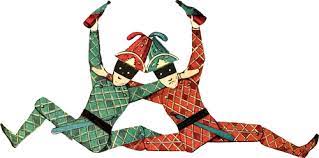
those mediaeval clowns,
and land on the floor,
descend the stairs and prance
throughout the expanse
of my living room. What should I do?
My wife is coming home soon
and she has jester-phobia.
I don’t think she can cope
with parti-coloured harlequins
who caper, cavort and grin like loons.
     I don’t blame her!

I must capture them one by one,
I’ll use a butterfly net
and drag them kicking back upstairs,
deposit them in what was
their secret lair for untold generations,
slam the lid, ignore the lock,
weigh down the chest with a heavy rock
and keep them safe forevermore
in that hiding place.

The fact they escaped is a disgrace,
the chest in the attic is an heirloom,
passed down through my family
from father to son for centuries.
And knowing this, it occurs to me
that I can work out the identities
of these pesky pestering fellows.
Yes, it’s true, I’m forced to confess–
those jesters are my ancestors.
Rhys Hughes has lived in many countries. He graduated as an engineer but currently works as a tutor of mathematics. Since his first book was published in 1995 he has had fifty other books published and his work has been translated into ten languages.
.
PLEASE NOTE: ARTICLES CAN ONLY BE REPRODUCED IN OTHER SITES WITH DUE ACKNOWLEDGEMENT TO BORDERLESS JOURNAL
A translation from Nabendu Ghosh’s autobiography, Eka Naukar Jatri(Journey of a Lonesome Boat), translated by Dipankar Ghosh, from Bengali post scripted by Ratnottama Sengupta. Clickhereto read.
Ueharaby Kamaleswar Barua has been translated from Assamese and introduced by Bikash K. Bhattacharya. Clickhere to read.
Kurigram by Masud Khan has been translated by Professor Fakrul Alam from Bangla. Clickhere to read.
Bonfire by Ihlwha Choi has been translated from Korean by the poet himself. Clickhere to read.
In Indian Pale Ale, Rhys Hughes experiments with words and brews. Click here to read.
Conversation
Being fascinated with the human condition and being vulnerable on the page are the two key elements in the writing of fiction, author and poet Heidi Northtells Keith Lyons in a candid conversation. Clickhere to read.
In Multicultural Curry, Suzanne Kamata reflects on mingling of various cultures in her home in Japan and the acceptance it finds in young hearts. Clickhere to read.
Ratnottama Sengupta explores the poetry in lyrics of Bollywood songs, discussing the Sahityotsav (Literary Festival) hosted by the Sahitya Akademi. Clickhere to read.
Imagine a world without wars, without divisions, where art forms flow into each other and we live by the African concept of Ubuntu — I am because you are’ — sounds idyllic. But this is the month of March, of poetry, of getting in touch with the Dionysian elements in ourselves. And as we have said earlier in the introduction of Monalisa No Longer Smiles: An Anthology of Writings from across the World, what could be a better spot to let loose this insanity of utopian dreams than Borderless Journal!
Having completed three years of our Earthly existence on the 14th of March, we celebrate this month with poetry and writing that crosses boundaries — about films, literature and more. This month in the Festival of Letters or Sahityaotsav 2023, organised by the Sahitya Akademi, films were discussed in conjunction with literature. Ratnottama Sengupta, who attended and participated in a number of these sessions, has given us an essay to show how deep run the lyrics of Bollywood films, where her father, Nabendu Ghosh, scripted legends. It is Ghosh’s birth month too and we carry a translation from his Bengali autobiography which reflects how businessmen drew borders on what sells… After reading the excerpt from Nabendu’s narrative translated by Dipankar Ghosh and post-scripted by Sengupta, one wonders if such lines should ever have been drawn?
Questioning borders of a different kind, we have another piece of a real-life narrative on a Japanese Soldier, Uehara. Written by an Assamese writer called Kamaleswar Barua, it has been translated and introduced by Bikash K. Bhattacharya. The story focusses on a soldier’s narrative at his death bed in an alien land. We are left wondering how his need for love and a home is any different from that of any one of ours? Who are the enemies — the soldiers who die away from their homes? What are wars about? Can people live in peace? They seemed to do so in Kurigram, a land that has faded as suggests the poem by Masud Khan, brought to us in translation from Bangla by Professor Fakrul Alam, though in reality, the area exists. Perhaps, it has changed… as does wood exposed to a bonfire, which has been the subject of a self-translated Korean poem by Ihlwha Choi. Tagore’s poem, Borondalatranslated as ‘Basket of Offerings’, has the last say: “Just as the stars glimmer / With light in the dark night, / A spark awakens within/ My body. / This luminosity illuminates / All my work.” And perhaps, it is this luminosity that will also help us find our ideal world and move towards it, at least with words.
We have a book review by Aruna Chakravarti of Bornali Datta’sIn A Better Place: A Doctor’s Journey, a book that is set amidst immigrants and takes up certain social issues. Baba Padmanji’s Yamuna’s Journey, translated from Marathi by Deepra Dandekar, one of the oldest Indian novels has been discussed by Somdatta Mandal. Bhaskar Parichha has told us about S.Irfan Habib’s Maulana Azad – A Life. Basudhara Roy has brought out the simplicity and elegance of Robin Ngangom’sMy Invented Land: New and Selected Poems. He writes in the title poem that his home “has no boundaries. / At cockcrow one day it found itself/ inside a country to its west,/ (on rainy days it dreams looking east/ when its seditionists fight to liberate it from truth.)”. We also carry an excerpt from his book. Stories by Jessie Michael, Brindley Hallam Dennis, Sangeetha G and Shubhangi bring flavours of diversity in this issue.
Our journey has been a short one — three years is a short span. But, with goodwill from all our readers and contributors, we are starting to crawl towards adulthood. I thank you all as caregivers of Borderless Journal as I do my fabulous team and the artists who leave me astounded at their ability to paint and write — Sohana Manzoor, Gita Vishwanath and Pragya Bajpai.
Thank you all.
Looking forward to the next year, I invite you to savourBorderless Journal, March 2023, where more than the treasures mentioned here lie concealed.
I thought that I didn’t like India Pale Ale until I came to India. I wasn’t pale at the time but I was certainly ale (and arty)[1] because I had just spent three months in Sri Lanka and had acquired something of a tan. Maithreyi, my companion, took me to a place that sold ‘craft’ beers and I changed my mind about the merits of India Pale Ale and my mind has been changed ever since.
The notion of a ‘craft’ beer is one that intrigues and baffles me. I think of a craft as something involving working with wood, chiselling it, shaving it like an orthogonal chin with a plane, drilling it, fitting it together into a chair, table, ark for animals, or something beautiful but useless that looks like furniture but also might conceivably be a petrified tree stump.
Therefore, how can one ‘craft’ a beer? The foam on the surface of the brew once it has been poured into a glass can be removed with a flat tool, the blade of a knife or a metre long ruler or even a credit card. Yes, that is plausible and once or twice I have seen it done. But what other crafty actions remain to be taken in regard to the beer in order that it should be regarded as ‘crafted’? Drilling a beer is a futile exercise. We have all done that with our noses and understand the lack of permanent effect. Who among us has never surrendered to the temptation to dip our noses into the meniscus of our beers?
Let me adjust that hasty statement. Many or at least some of us have done that with our noses, at one time or another, probably long ago when we were the callowest of youths, students at some college or other and fairly new to the rite of drinking beer. The dipping of the nose might even have been accidental. Who can be a harsh judge in such circumstances?
So, it is settled that beer can’t be drilled, nor can it be sawn in half. We have all heard the wise saying that the optimist regards the glass as ‘half full’ and the pessimist regards it as ‘half empty’ and we instinctively know that the liquid in those philosophical glasses is beer. What kind of beer is less clear. If it is totally unclear then it must be a dark beer, but I suspect it is only unclear with a foggy opaqueness, which tends to lead me to conclude it is India Pale Ale. It becomes easier now to picture the scene in the drinking den, whether that den is posh and plush or crude and rude. We see the optimist and the pessimist, good friends but mismatched, holding up their depleted glasses.
Both are drinking India Pale Ale and have consumed exactly fifty percent of the contents of what once were brimming vessels. The optimist looks down at his glass with a large smile, “Ah, it is still half full. What excellent luck!” while the pessimist looks at his own glass with a deep frown, “It’s half empty already, what a blasted nuisance the world is!” But something strange has happened, and we have only just noticed it. We suppose that a ‘half empty’ glass contains beer in the bottom half and air in the top half.
Because this is a vision we are having, and visions aren’t subject to all the laws of physics, especially not gravity, we are amazed to peer closer and see the beer in the pessimist’s glass is confounding our (unreasonable) expectations. It contains the air at the bottom and the beer at the top. The optimist is impressed and cries, “What marvellous luck! You don’t need to tilt your glass at a steeper angle anymore in order to receive the India Pale Ale into your mouth. You can slurp it up from the summit of the glass.”
I am sure the pessimist will object to this positive interpretation of a beery situation and find some convoluted reason why this defiance of gravity is a bad outcome. But I am weary of these two fellows now. Let us leave them in peace to get drunk together, the optimist thinking that being drunk is good, his friend concluding that it’s not as good as he was led to believe it is, and head to a quite different location for a drink of our own.
The place Maithreyi took me to that sells ‘craft’ beers, including the India Pale Ale that is the subject of this small essay, was somewhere in Bangalore not far from Blossom Book House. We had bought books in that house, as we often do, a decent haul, and went to celebrate with beer and nibbles, and later, when we were just a little tipsy, we hurried back to Blossom Book House and bought more books. But this isn’t an article about books. It’s an article, or what passes in my mind for an article, about beer, specifically about the type of beer that is known as India Pale Ale. Where was I?
Oh yes, I was in that place that sold craft beers, and I have decided at this point to stop writing the word ‘craft’ in inverted commas. There were too many craft beers on offer for an easy selection to be made, so we ordered a sampler of many kinds, and they came on a big tray. They were in small glasses, dark beers and golden, reddish beers and greenish, fizzy beers and still beers, and perched on the end of the rectangular tray, two glasses of the mythic India Pale Ale. My reluctance to try these hangers-on is comprehensible when one considers how dreadful a non-craft India Pale Ale can be.
Back in Britain, decades ago, when first I allowed beer to pass the gates of my lips without turning it back, IPA was fairly popular among those unfortunate drinkers who lacked taste buds. Why they lacked taste buds was never explained to anyone’s satisfaction. Presumably they had lost them overboard while sailing from the Far East on packet steamers. It was a long time before I knew that IPA was an acronym for India Pale Ale. I assumed it was a word in its own right and that its own right was wrong. I would say that most beers sold in pubs in Britain in the 1970s were abominable, but this suggests that the Abominable Snowman would like them, and I doubt that he would.
I have done a little research (a very little, almost too little to be regarded as anything other than mildly faffing around) and I learn that India Pale Ales were once a noble style of beer, invented in the 18th Century for export by the sneaky imperialists of the East India Company. It was flavoured with hops, lots and lots of hops, more hops than a kangaroo would do, if it had a chance, and the adding of these extra hops had some effect that meant the ale would mature or whatever the word is during the difficult sea voyage.
I don’t really understand the chemistry of it, and I don’t really want to, I am merely repeating what I found out just now. IPA was an EIC product, proving to my own satisfaction that acronyms aren’t relatively modern inventions but have been around for a very long time. The decline in the quality of IPA, and all beers for that matter, during the 20th Century, is perhaps a mysterious one or maybe it has something to do with the big breweries rapaciously wanting to increase their profits by using less lovely ingredients and processes. I don’t especially like the taste of hops at the best of times. At the worst of times hops make me wince and frown like some kind of wincing frowner, a very lazy comparison, true, but my powers of simile and metaphor are temporarily on hold, for I haven’t recovered from a rather severe bout of acutely remembering the IPA and other beers of my early days on this gracious planet of ours.
A strongly hopped beer tastes, to me, like mouldy bread. The IPA of those long-gone days tasted like a sack of mouldy loaves swung around the head of a gorilla and used to bash one on the bonce. My powers of simile and metaphor, such as they are, seem to have returned. And yet when I took a cautious gulp of the IPA in the place that Maithreyi had guided me to, my preconceptions and established prejudices melted with the delightfulness of the taste that confronted me. What a magnificent India Pale Ale! I tried the other IPA on offer. Golly, this was even more wondrous! Let’s order more!
I say, my dear, we have bought books in our favourite bookshop. Isn’t it an astonishingly beneficial way to pass the time, obtaining books? And it’s not as if we buy them but never read them. We read them! Wouldn’t it be a jolly romp to return to the bookshop, once we have consumed more beers here, and engage in the act of purchasing more books? Indeed!
A final observation from an unobservant chap (myself). Any British fellow who guzzles IPA with gusto and ends up with a sodden moustache and beard as a consequence can be regarded as a ‘Pale Ale Face’ which is what ‘Indians’ in old Westerns almost called cowboys on occasion. Anyway, this essay appears to be over now, and the page on which this final paragraph has been written is an empty glass at last, the brew of its words fully consumed by your eyes, leaving only the dregs of a footnote at the bottom.
[1] Hale and hearty, a description used frequently in my youth, but which seems to have fallen out of favour. Falling out of favour is easily done if the speeding favour brakes to a sudden halt and the thing that was in favour isn’t strapped in properly. When it falls out of favour it often lands with a painful bump and favour drives off with a monstrous laugh. Even flavours can fall out of favour or back into it.
Rhys Hughes has lived in many countries. He graduated as an engineer but currently works as a tutor of mathematics. Since his first book was published in 1995 he has had fifty other books published and his work has been translated into ten languages.
.
PLEASE NOTE: ARTICLES CAN ONLY BE REPRODUCED IN OTHER SITES WITH DUE ACKNOWLEDGEMENT TO BORDERLESS JOURNAL.
IF I SAW A MONKEY

If I saw a monkey
sailing on the sea
I might feel inclined to laugh –
but not with
     a tee hee hee.
It seems to me
that a ho ho ho
would better fit the rhythm
of the oars
     in his paws
     as he rows
     with his toes while the juice
     flows below
his banana canoe as he paddles
across the ocean
with a regular motion
all the way to say
               hello to you.

Wait!
Do monkeys
actually have paws?


A FAN OF HANDS

I’m a fan of hands,
I am.
Tentacles
are all well and good
under the sea
and I don’t agree
that they never suit
the environmental mood
but when it’s time
for a cup of tea
on the beach,
hands are handy
and although it’s sandy
we can reach
for the plate of biscuits
with more ease
and alacrity.
And when it’s too hot
there’s not
a lot we can do
to cool our brows
if we don’t have a fan
of hands.
Rhys Hughes has lived in many countries. He graduated as an engineer but currently works as a tutor of mathematics. Since his first book was published in 1995 he has had fifty other books published and his work has been translated into ten languages.
.
PLEASE NOTE: ARTICLES CAN ONLY BE REPRODUCED IN OTHER SITES WITH DUE ACKNOWLEDGEMENT TO BORDERLESS JOURNAL
Let’s dream of a new world with laughter and move towards a vision we treasure — of a world that we can build together with poetry, peopled with strange imaginary creatures who bring a smile to our lips or perhaps evoke laughter…
Figments caught straying in whispers of a dream,
Weave together till they form a visible stream,
Filling a void with voices that sing,
With freedom and impunity ring,
Giving credence to a distant, imagined realm.

— Introduction, Monalisa No Longer Smiles: An Anthology of Writings from across the World
As we complete three years of our virtual existence in clouds, connecting, collecting and curating words of ideators, we step into our fourth year with the pleasurable experience of being in bookshops in hardcopy too. Monalisa No Longer Smiles: An Anthology of Writings from across the World, our first hardcopy anthology, takes us into the realm of real books which have evolved over eons in history. This anthology connects us to those who hesitate to step into the virtual world created by technology. And there are many such people – as ingrained in the human heritage is a love for rustling paper and the smell of books. We have had some excellent reviews, praising not just the content but also the production of the book – the cover, the print and the feel. The collection bonds traditional greats with upcoming modern voices. We are grateful to our publisher, Om Books International, Shantanu Ray Chaudhuri, Jyotsna Mehta and their team for giving our book a chance. We do look forward to more anthologies hopefully in the future.
The writings we have collected over the last three years are reflective of diverse voices— some in concurrence with our thought processes and some in discussion or even in divergence. We have a variety of forms — poetry, conversations, fiction and non-fiction. Some are humorous and some serious. We try to move towards creating new trends as reflected in our anthology and our journal. For instance, Monalisa No Longer Smiles starts with an experiment — a limerick was adapted to express the intent of our book and journal; whereas normally this form is used to express light, or even bawdy sentiments. Perhaps, as the limerick says, we will find credence towards a new world, a new thought, a restructuring of jaded systems that cry out for a change.
Borderless Journaldid not exist before 2020. Within three years of its existence, our published pieces have found voices in this anthology, in other books, journals and even have been translated to a number of languages. Our own translation section grows stronger by the day supported by translators like Aruna Chakravarti, Fakrul Alam, Radha Chakravarty and Somdatta Mandal. Our interviews and conversations probe to find similarities and divergences in viewpoints. Our stories tell a good tale rather than indulge in stylistic interplay and our poetry is meant to touch hearts, creating a bond between the writers and anglophone readers. What we hope to do is to expose our readers to writing that they can understand. Writers get lost at times with the joy of creating something new or unique and construct an abstraction that can be intimidating for readers. We hope to host writing that is comprehensible, lucid and clear to the lay person.
What we look forward to homing in the coming months is a mingling of different art forms to birth new ideas that will help our species move progressively towards a world in harmony, filled with peace and love, giving credence to voices like that of Tagore, Nazrul or Lennon. “Imagine there’s no heaven…Imagine there’s no countries…no religion, too…Imagine all the people/ Livin’ life in peace…Imagine all the people/ Sharing all the world…” The need to redefine has been felt and as Lennon says in his last paragraph: “You may say I’m a dreamer/ But I’m not the only one/ I hope someday you’ll join us/ And the world will live as one.” With this hope, we continue our journey into another year – a new adventure that will take us to a universe where heaven can be found on Earth, grounded and real, within the human reach and can be shared without war, greed, hatred and anger.
Here, we share with you a few iconic pieces that have found their way to our pages within the last three years.
Professor Anvita Abbi, a Padma Shri, discusses her experience among the indigenous Andamanese and her new book on them, Voices from the Lost Horizon. Click here to read.
In Conversation with Akbar Barakzai, a ‘Part-time Poet’ in Exile: The last interview of Akbar Barakzai where he says, ‘The East and the West are slowly but steadily inching towards each other. Despite enormous odds “the twain” are destined to “meet” and be united to get rid of the geographical lines…’ Click hereto read more.
Half-Sisters: Sohana Manzoor explores the darker regions of human thought with a haunting psychological narrative about familial structures. Click hereto read.
Rituals in the Garden: Marcelo Medone discusses motherhood, aging and loss in this poignant flash fiction from Argentina. Click here to read.
Navigational Error: Luke P.G. Draper explores the impact of pollution with a short compelling narrative. Click here to read.
Pandies’ Corner: These narratives highlight the ongoing struggle against debilitating rigid boundaries drawn by societal norms, with the support from organisations like Shaktishalini and Pandies. Click here to read.
Dilip Kumar: Kohinoor-e-Hind: Ratnottama Sengupta recollects the days the great actor sprinted about on the sets of Bombay’s studios …spiced up with fragments from the autobiography of Sengupta’s father, Nabendu Ghosh. Click here to read.
Farewell Keri Hulme: A tribute by Keith Lyons to the first New Zealand Booker Prize winner, Keri Hulme, recalling his non-literary encounters with the sequestered author. Click here to read.
Tagore Translations, including translations by Aruna Chakravarti, Fakrul Alam, Somdatta Mandal and Radha Chakravarty. Click here to read.
Nazrul Translations, including Professor Fakrul Alam and Sohana Manzoor. Click here to read.
Gandhi & Robot by Thangjam Ibopishak, translated from the Manipuri by Robin S Ngangom. Click here to read.
Songs of Freedom by Akbar Barakzai, poems translated from Balochi by Fazal Baloch. Clickhere to read.
Give Me A Rag, Please:A short story by Nabendu Ghosh, translated by Ratnottama Sengupta, set in the 1943 Bengal Famine, which reflects on man’s basic needs. Click here to read.
Thanks to our team, contributors and readers for being a part of our journey. Let’s sail onwards…
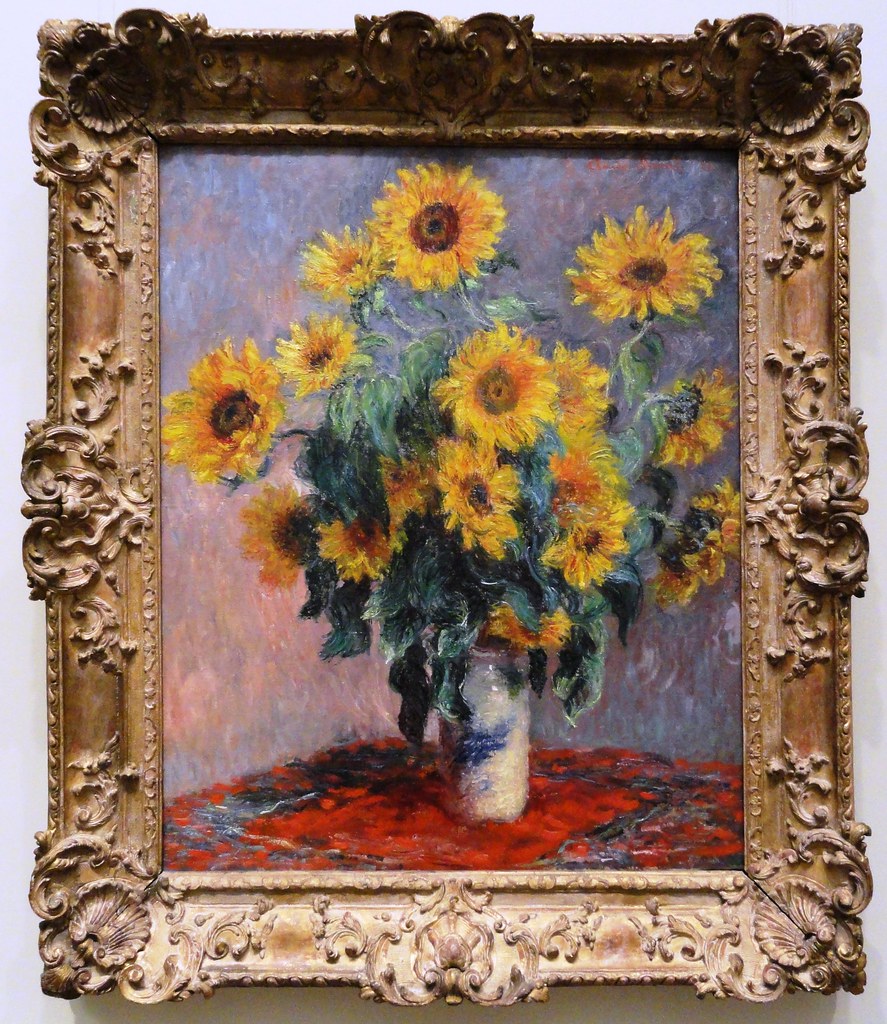
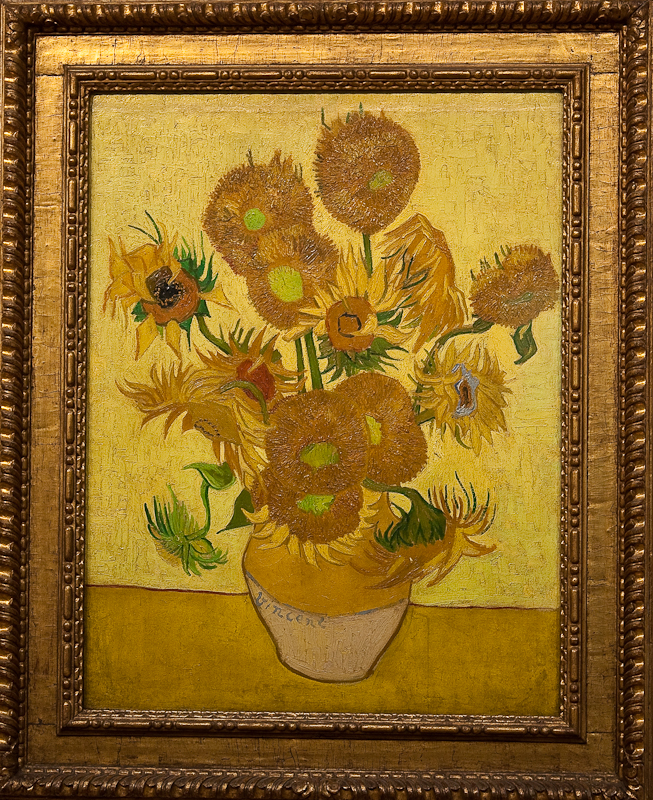
Sunflowers by Calude MonetSunflowers by Vincent VangoghCourtesy: Creative Commons
With resilience, they have withstood what could have become an international disaster for all humankind — an outbreak of a Third World War. The spirit that has resisted the ongoing invasion of Ukraine is admirable. They have stayed strong without bowing, crumbling or annihilating themselves in the wake of an onslaught that hurts humanity across all borders in different degrees and creates a huge population of refugees. We gave voice to one such refugee, Lesya Bakun — not just in our site but also in our first anthology — Monalisa No Longer Smiles: An Anthology of Writings from across the World.
This year, we quest for hope towards peace, a better, more accepting world with poetry on Ukraine. One of the poems here is accompanied by art from Ukrainian artist, Maria Kirichenko. We feature some of the poems gathered on Ukraine over the year.
“How Many Times Must the Cannonballs Fly…?” Featuring poetry by Lesya Bakun, Rhys Hughes, Ron Pickett, Michael R Burch, Kirpal Singh, Suzanne Kamata, Mini Babu, Malachi Edwin Vethamani, Sybil Pretious and Mitali Chakravarty. Click here to read.
“Here with a Loaf of Bread beneath the Bough,
A Flask of Wine, a Book of Verse -- and Thou
Beside me singing in the Wilderness --
And Wilderness is Paradise enow.”

― Omar Khayyám (1048-1131); translation from Persian by Edward Fitzgerald (Rubaiyat, 1859)
I wonder why Khayyam wrote these lines — was it to redefine paradise or just to woo his beloved? I like to imagine it was a bit of both. The need not to look for a paradise after death but to create one on Earth might well make an impact on humankind. Maybe, they would stop warring over an invisible force that they call God or by some other given name, some ‘ism’. Other than tens of thousands dying in natural disasters like the recent earthquake at the border of Turkiye and Syria, many have been killed by wars that continue to perpetrate divides created by human constructs. This month houses the second anniversary of the military junta rule in Myanmar and the first anniversary of the Ukrainian-Russian war that continues to decimate people, towns, natural reserves, humanity, economics relentlessly, polluting the environment with weapons of mass destruction, be it bombs or missiles. The more weapons we use, the more we destroy the environment of our own home planet.
Sometimes, the world cries for a change. It asks to be upended.
We rethink, reinvent to move forward as a species or a single race. We relook at concepts like life and death and the way we run our lives. Redefining paradise or finding paradise on Earth, redefining ‘isms’ we have been living with for the past few hundred years — ‘isms’ that are being used to hurt others of our own species, to create exclusivity and divisions where none should exist — might well be a requisite for the continuance of our race.
Voices of change-pleaders rang out in the last century with visionaries like Tagore, Gandhi, Nazrul, Satyajit Ray urging for a more accepting and less war-bound world. This month, Ratnottama Sengupta has written on Ray’s legendary 1969 film, Goopy Gyne, Bagha Byne: “The message he sent out loud and with laughter: ‘When people have palatable food to fill their belly and music to fill their soul, the world will bid goodbye to wars.’” Shantanu Ray Chaudhuri has given an essay on one of the greatest pacifists, Gandhi, and his attitudes to films as well as his depiction in movies. What was amazing is Gandhi condemned films and never saw their worth as a mass media influencer! The other interesting thing is his repeated depiction as an ethereal spirit in recent movies which ask for changes in modern day perceptions and reforms. In fact, both these essays deal with ghosts who come back from the past to urge for changes towards a better future.
Delving deeper into the supernatural is our interviewee, Abhirup Dhar, an upcoming writer whose ghost stories are being adapted by Bollywood. While he does investigative stories linked to supernatural lore, our other interviewee, Andrew Quilty, a renowned journalist who has won encomiums for his coverage on Afghanistan where he spent eight years, shows in his book, August in Kabul:America’s Last Days in Afghanistan and the Return of the Taliban, what clinging to past lores can do to a people, especially women. Where does one strike the balance? We also have an excerpt from his book to give a flavour of his exclusive journalistic coverage on the plight of Afghans as an eyewitness who flew back to the country not only to report but to be with his friends — Afghans and foreigners — as others fled out of Kabul on August 14 th 2021. While culturally, Afghans should have been closer to Khayyam, does their repressive outlook really embrace the past, especially with the Taliban dating back to about only three decades?
This intermingling of life and death and the past is brought to life in our fiction section by Sreelekha Chatterjee and Anjana Krishnan. Aditi Yadav creates a link between the past and our need to travel in her musing, which is reminiscent of Anthony Sattin’s description of asabiyya, a concept of brotherhood that thrived in medieval times. In consonance with wanderlust expressed in Yadav’s essay, we have a number of stories that explore travel highlighting various issues. Meredith Stephens travels to explore the need to have nature undisturbed by external interferences in pockets like Kangaroo Island in a semi-humorous undertone. While Ravi Shankar travels to the land’s end of India to voice candid concerns on conditions within Kerala, a place that both Keith Lyons and Rhys Hughes had written on with love and a sense of fun. It is interesting to see the contrasting perspectives on Southern India.
Professor Fakrul Alam has also translated poetry where a contemporary Bengali writer, Masud Khan, cogitates on history while Ihlwha Choi has translated his own poem from Korean. A translation of Tagore’s poem on the ocean tries to capture the vastness and the eternal restlessness that can be interpreted as whispers carried through eons of history. Fazal Baloch has also shared a poem by one of the most revered modern Balochi voices, that of Atta Shad. Our pièce de resistance is a translation of Premchand’s Balak or the Child by Anurag Sharma.
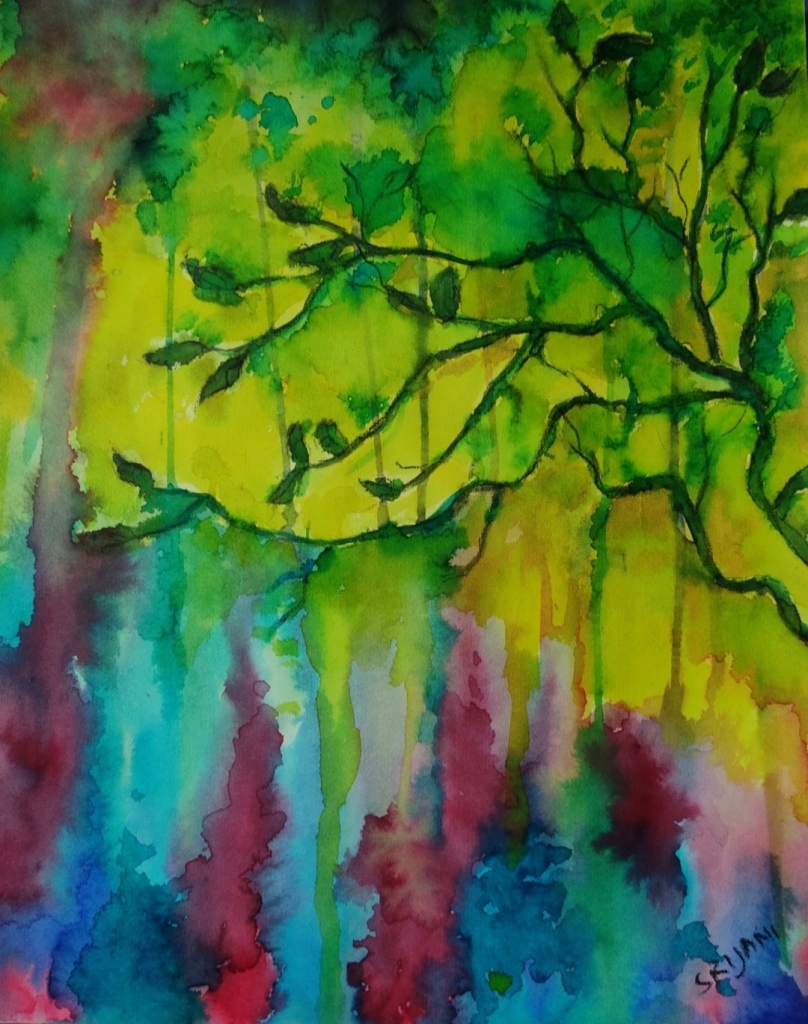
This vibrant edition would not have been possible without all the wonderful translators, writers, photographers and artists who trust us with their work. My heartfelt thanks to all of you, especially, Srijani Dutta for her beautiful painting, ‘Hope in Winter’, and Sohana for her amazing artwork. My heartfelt thanks to the team at Borderless Journal, to our loyal readers some of whom have evolved into fabulous contributors. Thank you.
Do write in telling us what you think of the journal. We look forward to feedback from all of you as we head for the completion of our third year this March.
I climbed Sri Pada on the 10th of January of the year 2023. I was still calling the mountain Adam’s Peak when I went up it, but on the way down I decided that it was more respectful to call it by the name the locals use. I had first glimpsed the mountain during my first visit to Sri Lanka, a year earlier. I saw it through a car window in the distance. “One day I will return and climb it,” I told myself, but I never imagined that I would do so just twelve months later. I often create lists of ‘things to do’ and items on those lists tend to remain on those lists for decades. I can be slow at compiling these lists and I found myself in the position of having to scratch out the words ‘Climb Sri Pada’ before I had even added them. Life is full of such ironies, luckily or unluckily.
Climbing mountains is one of the greatest delights of my existence, but the number of mountains I climb per year is low, on average just one, and I attribute my lack of drive to the typical mountaineer’s ‘peak lassitude’, which isn’t like the ‘peak performance’ of other kinds of athletes. You go up a mountain, stand on the summit and take a good look, then you climb down and look up, to see where you have been, and it is the theory of the climb, which has just been done in practice, that seems to be so exhausting. That’s my theory, anyway, or maybe it’s not quite deserving of the name ‘theory’. Perhaps it’s just a speculation or an excuse. But as I’ve always said, an excuse is as good a reason as any. I climbed Sri Pada and am still enjoying my fatigue.
Having arrived in Colombo by modern jet aeroplane, as one usually does, I caught a bus to the village of Maskeliya in the Central Province of the island, or rather a series of buses, as I couldn’t work out how to catch a direct bus there.
In fact, I first went to Kandy, a city on the way, or almost on the way, and stayed in a pleasant and cheap hotel for one night. I went to the Royal Bar for a meal and a drink, one of my favourite pubs in the world, and a place with strong nostalgic overtones for me. It’s a restored colonial building and I often feel like a restored colonial man, so it matches me perfectly. What I mean by this is that I’m getting old and cranky, but my foundations are solid, and my façade can be regarded as a noble one. There was a power cut while I was sitting at a chair on a balcony that overlooks an inner courtyard and the chef wasn’t able to prepare hummus in the dark, so I made do with chips and ketchup.
Sri Lanka was still reeling from the effects of economic mismanagement. I was expecting food and fuel shortages and disruption of public transport, as well as frequent power cuts, but I experienced little inconvenience, and I wouldn’t complain even if I had. Stiff upper lip and all that. A few days later, my British legs were stiffer than any lip has any right to be. But now I am jumping ahead. I couldn’t jump anywhere when my legs were stiff. I could hardly walk. But now I am drifting off the point, just as I drifted off the route when I was hiking to the base of the mountain. I am jumping ahead again. Let me go back a little and let me explain that all the inconvenience I didn’t experience because of economic mismanagement is still there, adversely affecting the people of the island, even if visitors don’t notice it. It’s important to be aware, even if the only thing we’re aware of is that we aren’t really aware.
From Kandy I caught a bus to Hatton. Every seat of this bus was occupied, and I had to stand. I wasn’t alone in standing, many other passengers were doing the same thing, and it was only the pressure from all these other standing bodies that prevented me from falling over on the winding road to the town of Hatton. I say ‘road’ but in fact it was just a series of bends that climb higher into the hills, an impressive drop on one side, no barriers, and a driver who liked to accelerate on those bends, presumably to teach them a lesson, or to teach us a lesson, about inertia and maybe some other laws of physics. It is cheaper than paying to use a rollercoaster and rather more sociable.
But the landscapes are beautiful. Tea plantations on undulating slopes with mountains in the background, and plenty of lakes. We reached Hatton and I tried to find another bus that would carry me the remaining distance to Maskeliya but I failed in this endeavour and caught a tuk-tuk with a talkative driver who acted as a tour guide on the way. “That’s a mountain over there, don’t know its name, and down there you can see a lake, not sure what it’s called, and reflected in the water is that very mountain. Imagine!”
At the time I had no idea that Hatton was the birthplace of one of my mightiest heroes, the explorer Eric Shipton, a man who climbed for real all the mountains I just gape at in picture books, and who probably found genuine evidence of the yeti, unless he was playing a prank and made the footprints himself. Who knows?
The tuk-tuk arrived in Maskeliya, which turned out to be a small place in which all the restaurants were closed, and it was impossible to secure a cup of tea or coffee. The fact we were surrounded by tea plantations and innumerable coffee bushes meant little, for all the tea and coffee was exported to Britain. I should have had a cup before I left my own country, I was informed. I replied that I had come from India where tea and coffee are daily occurrences, or even hourly occurrences, if necessary. There are numerous similarities between India and Sri Lanka, but also some differences. No snow-covered mountains on the island, for instance, therefore no yetis.
My tuk-tuk driver dropped me off on a dusty street full of holes over which his vehicle had been bouncing like a distorted rubber ball, and I found the place where I was staying. I was warmly greeted by my hosts and their two dogs. My room was above a garage and this building was the very last one in the village. I was given a pot of tea and a plate of biscuits to celebrate my arrival in such an obscure location. So, there was tea to be had in Maskeliya after all! I found it to have a pleasant but unorthodox flavour.
After I had drunk half a pot of the stuff, I was told it was coffee. So, there was coffee to be had in Maskeliya after all! Coffee that tastes like tea. Or rather, coffee that tastes like tea that doesn’t taste quite like tea. I learn something new every day, or nearly every day, even if it’s only that I don’t learn something new every day but only once a week. Does that make sense? I won’t say the altitude had affected my mind, because although we were quite high, we weren’t really very high. Maskeliya has an elevation of approximately 1205 metres. Nothing to write home about. But I only have an elevation of 1.74 metres, so who am I to pass judgement? I drank more of the tea.
For a few days, I prepared myself mentally and physically for the coming climb. I played with the dogs and read some books. One of the dogs had a habit of sunning himself on the roof of the house and I couldn’t work out how he got up there, onto the corrugated iron. Maybe he turned into a monkey by the light of the moon and turned back to a dog once he reached the roof. Magic is always a useful explanation for such mysteries.
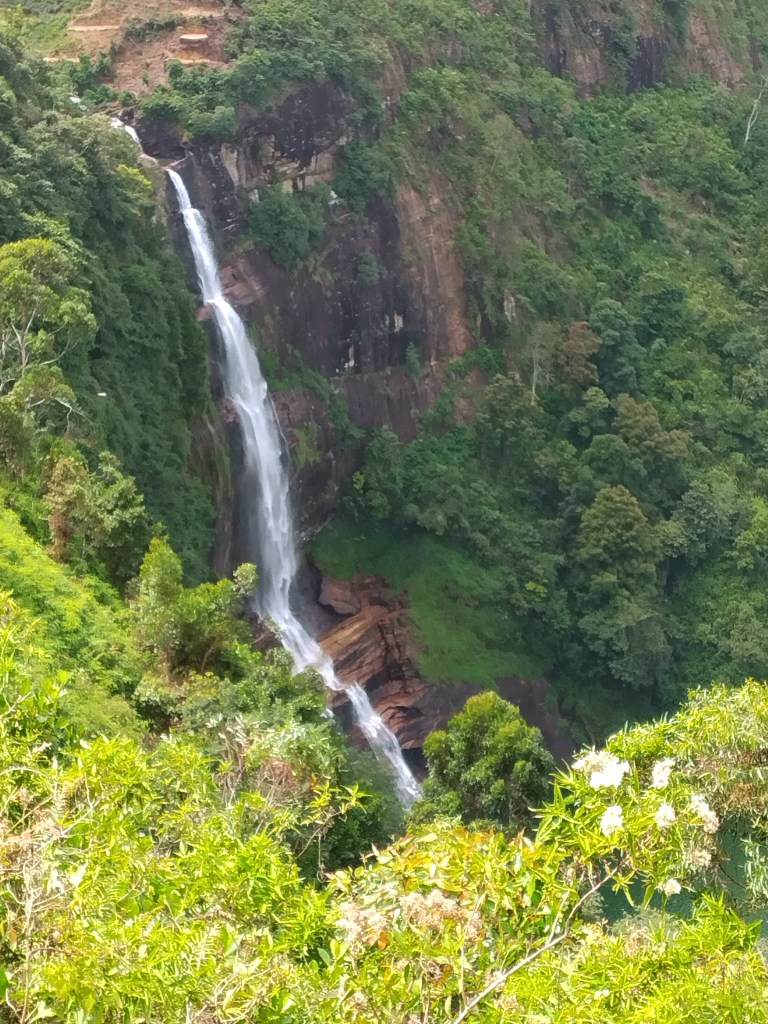
At least it is useful until we know better. And often that ‘better’ turns out to be worse. Whatever the solution to the mystery, he was a nice dog and that’s what ultimately counts. An abacus also counts, but rarely ultimately, because it is limited by the number of beads on its wires. I went for a walk at a waterfall on the far side of the enormous lake that dominates the region horizontally, in the same way that Sri Pada dominates the region vertically. That was also part of my preparation. I drank more coffee.
During my walk to the waterfall, it began raining and I ran for shelter. It’s a terrible thing to get wet on the way to a plummeting column of water that fills the air with spray and wets the onlookers. Almost as if the sky is trying to spoil the surprise. I found shelter too, in a lookout point with a roof. Two young men were sheltering there and they had a drum with them and they invited me to play it, which I did, while they did a peculiar dance. Perhaps it was the opposite of a rain dance? I didn’t think to ask, but I should have. The rain stopped. We left the shelter and went our separate ways. I ambled along a narrow path to the top of the waterfall and looked down.
Lots of gushing water making a roar. The world is God’s bathroom and he had left the tap on. That’s what it was like, a little anyway. I ambled back the way I had come and caught a bus to Maskeliya. An old man waiting at the stop thanked me for being British. It was the British, he told me, who brought tea to Sri Lanka. Before we came along, they only had mango juice and coconut water to drink. Appalling! I am uncomfortable when I am thanked for being British, and it does happen, more often than one might suppose. When the bus arrived, he was too emotional to board it and decided to wait for the next one. Personally, I like mango and coconut.
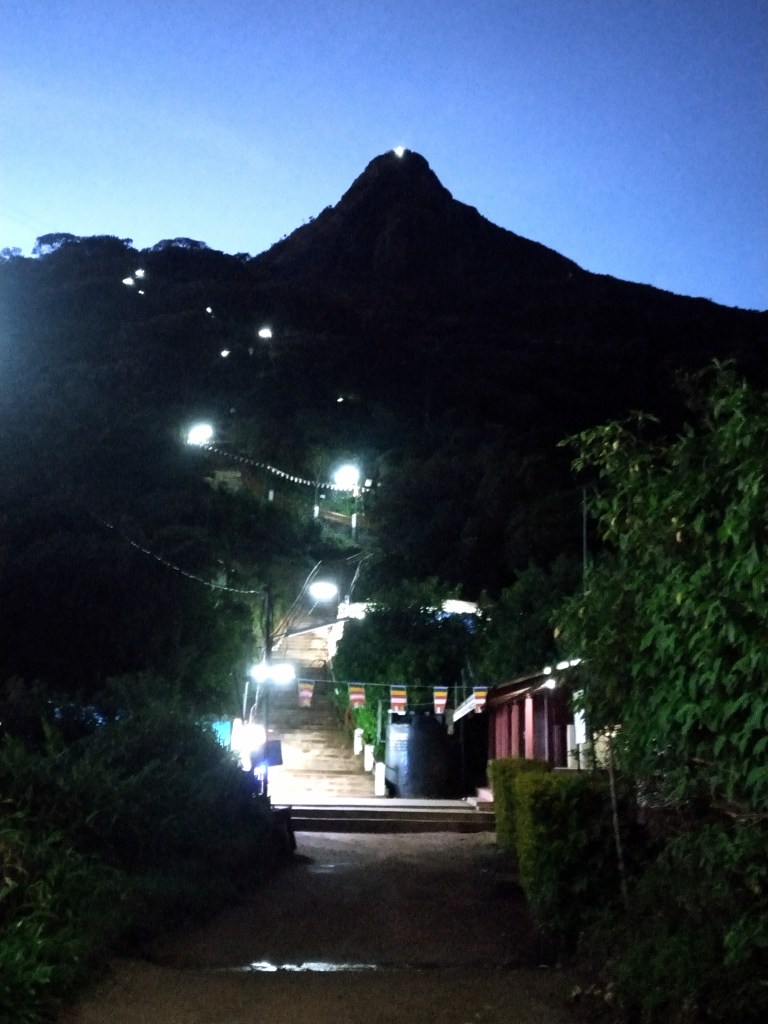
The day of the big climb arrived, or rather the night, for I had to depart my comfortable room at 2:30 in the morning and sit in a less comfortable tuk-tuk for an even less comfortable ride to a mountain that I could very uncomfortably climb to the top. I later wrote a poem about my climb which asked the question, why do I climb mountains at night in order to see the sunrise? The punchline of my poem was that I didn’t know the answer until I reached the top and then it dawned on me. Many or most poems don’t have punchlines, mine do. But this doesn’t mean mine are in the right. Sometimes I imagine they are punch drunk and that’s surely wrong. Punch can be made with mango and coconut as added ingredients, but probably not with tea.
The tuk-tuk stopped and I dismounted and began my hike to the base of the mountain. There are several routes to the base of Sri Pada. Some are easier than others, and some of the easier ones are much longer than the harder ones, making them harder in some ways. That’s mountains for you. I walked up a stony path and into a forest. I began to suspect that this was the dry bed of a stream rather than a proper path and I thought of my own dry bed in my room in Maskeliya. Too late, I was committed to the climb. It was a forest where leopards and elephants roam, but I didn’t know that until later, for there was no sign of them as I trudged up the inclines.
After a few hours I wondered if I had taken a wrong turn. The mountain should have loomed above me, but it wasn’t to be seen. That was weird, but I am used to getting lost on hikes and climbs. I even get lost in cities when I have maps. I’m not saying that I am a terrible navigator, but I would be very unlikely to employ myself as a guide to anywhere. I decided to push on in order to see how lost I actually was. The only way of doing this efficiently is to become even more lost and then compare the degrees of lostness, if lostness is a real word, which probably it isn’t. Ah well! I noticed a light far ahead that was a beacon of hope, and I increased my speed.
The light belonged to the isolated hut of a tea picker. At least I assumed the hut was a worker’s shelter, but it might have been something else, of course. I had hiked out of the forest and into a tea plantation. Yes, I had taken a wrong turn somewhere, and now I needed to go back and find that somewhere. But if I looked for it, I probably wouldn’t find it. Best not to look for it and stumble on it by pure chance. That was my strategy.
And it worked. I wandered off the path again, the wrong path, and luckily managed to end up by accident on the right path. The Buddha told us to follow the middle path, but there were only two paths here. I would worry about this at the top of Sri Pada, where there is a shrine to him. Incidentally I am extremely interested in Buddhism, it’s a religion I find most compelling, the one with the most reasonable ideas, but what do I know?
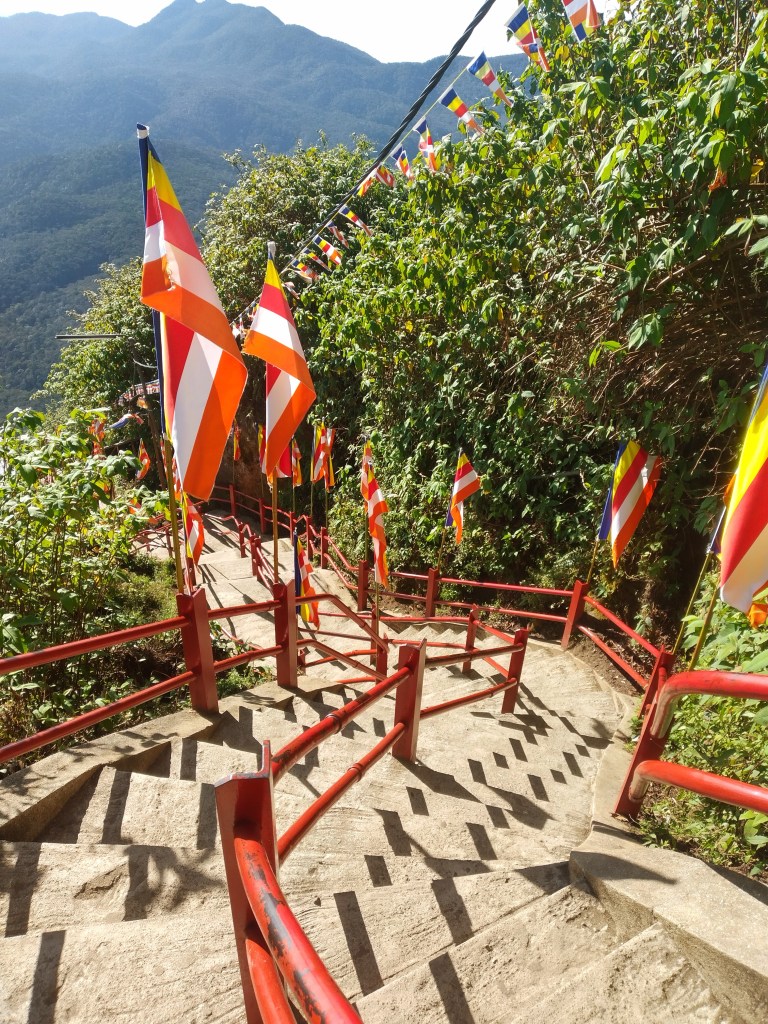
I can’t honestly say that my attempt to climb Sri Pada was a pilgrimage as well as a minor adventure. It would be nice to make that claim, but it would be dishonest. Maybe one day I will return in a more spiritual frame of mind and try again. I finally reached the 5500 steps that led up the side of the mountain and I climbed them and was rather astonished to find tea shops on the way, tea shops open all night. So, this is where the tea really went! Then I asked myself, how are these shops supplied? The tea must be carried up on foot, step by step, as there’s no other way of doing it, unless it is dropped by parachute, which is so improbable an option we can disregard it.
Five thousand five hundred steps up and five thousand five hundred steps down makes eleven thousand in total, and that’s a lot of steps. At first it seemed easy, because it was easy, then it began to seem more difficult, because it was more difficult. When things are exactly the way they seem, I find that it focuses my mind acutely. My legs were tired halfway to the top, but I told them to take heart and not let down the other parts of my body, which still wanted to get to the summit and were relying on them. I also told my heart to take heart. It didn’t really require that advice, as it happens.
Finally, I reached the top. The sun came up. It came up effortlessly, without the need for steps. The sun is five billion years old but acts like a youth, setting a good example to us all. Funny how it sets this example when it is rising. But I am wandering off the point, and the point is not a path. I took off my boots and approached the shrine, which stands on a small area at the very apex of Sri Pada and overlooks the other mountains and hills in every direction. Inside this shrine is the footprint, but it has been covered over with a golden seal in the shape of a foot and I can’t report on what it actually looks like. I also rang the bell that has been provided for the use of summiteers.
I don’t know if ‘summiteers’ is a real word. I could check but I worry that it might not exist in the lexicons and then I would feel obliged to change it, and I don’t want to do that. Musketeers is a real word, so I don’t see why lexicons should feel a need to pick on summiteers. If they picked on musketeers, they’d soon be sorry! The bell at the summit of Sri Pada should be rung the number of times the ringer has climbed the mountain. I rang it once. Then I began the long descent. I found this harder than the climb because my knees were sore, and my legs were shaky. They wibbled and wobbled like jellies in the shape of limbs, a very cunning pair of jellies no doubt, but a feeble set of legs. Nonetheless, down I managed to go, slowly, surely, puffingly.
On the descent, two boars crossed my path. They were very casual, a more nonchalant couple of wild pigs can hardly be imagined. They trotted out of the undergrowth on one side, stopped to admire the view, then carried on into dense undergrowth on the other side. I noticed that their legs didn’t wibble or wobble. It’s true that I might not be able to tell a wibble from a wobble when it comes to a pig because I’m not a trained vet. I’m not even a wild vet. I am no kind of vet. That goes without saying. I went without saying too, downwards again, until at long last I reached the bottom, exhausted.
All the photographs have been provided by Rhys Hughes
Rhys Hughes has lived in many countries. He graduated as an engineer but currently works as a tutor of mathematics. Since his first book was published in 1995 he has had fifty other books published and his work has been translated into ten languages.
.
PLEASE NOTE: ARTICLES CAN ONLY BE REPRODUCED IN OTHER SITES WITH DUE ACKNOWLEDGEMENT TO BORDERLESS JOURNAL.








 Borderless