SHADOWLANDS
(Inspired by the global solar eclipse on April 8th, 2024)

Tomorrow
the shadowlands
will
have their edict
up
in the sky
with
the whole world's prior knowledge.

The Sun
and The Moon --
those two fastidious
and ever at loggerheads
to mark their showy turns --
will indulge
in their sibling rivalry
of ages.

It will be a sight.

The earth will be omnipresent,
pooling resources
for this compromise
between two
arch-rivals,
pulling
in a tie
as the final verdict.

It will all be over
before we know it.

EXPEDITION

There is a halt in
the expedition.

From not so far
away,
a decaying skeleton
shrieks,
its bones
gradually
ground to a paste.

Sordidly,
the remnants
of privation
now feebly
agitate
for all of us.

A blood-soaked spray
emerges
from a songwriter's
torso.

The day has commenced.
Rain clouds
cry
tears of blood
today.
Prithvijeet Sinha, is a resident of the cultural epicenter of Lucknow. He has published poetry, musings on the city, cinema in anthologies and journals of national and international repertoire as well as a blog. His life-force resides in writing, in the art of self-expression.
.
PLEASE NOTE: ARTICLES CAN ONLY BE REPRODUCED IN OTHER SITES WITH DUE ACKNOWLEDGEMENT TO BORDERLESS JOURNAL
A conversation with the author,Afsar Mohammed, and a brief introduction to his latest book, Remaking History: 1948 Police Action and the Muslims of Hyderabad. Click hereto read.
A conversation with Meenakshi Malhotra over The Gendered Body: Negotiation, Resistance, Struggle, edited by Meenakshi Malhotra, Krishna Menon and Rachana Johri and a brief introduction to the book. Click hereto read.
In His Unstable Shape, Rhys Hughes explores the narratives around a favourite nursery rhyme character with a pinch of pedantic(?) humour. Click here to read.
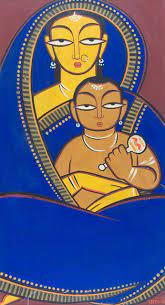
Mother & Child by Jamini Roy (1887-1972)Mother and Child by Picasso (1881-1973)
‘Victory to Man, the newborn, the ever-living.’ They kneel down, the king and the beggar, the saint and the sinner, the wise and the fool, and cry: ‘Victory to Man, the newborn, the ever-living.’
This is the month— the last of a conflict-ridden year— when we celebrate the birth of a messiah who spoke of divine love, kindness, forgiveness and values that make for a better world. The child, Jesus, has even been celebrated by Tagore in one of his rarer poems in English. While we all gather amidst our loved ones to celebrate the joy generated by the divine birth, perhaps, we will pause to shed a tear over the children who lost their lives in wars this year. Reportedly, it’s a larger number than ever before. And the wars don’t end. Nor the killing. Children who survive in war-torn zones lose their homes or families or both. For all the countries at war, refugees escape to look for refuge in lands that are often hostile to foreigners. And yet, this is the season of loving and giving, of helping one’s neighbours, of sharing goodwill, love and peace. On Christmas this year, will the wars cease? Will there be a respite from bombardments and annihilation?
We dedicate this bumper year-end issue to children around the world. We start with special tributes to love and peace with an excerpt from Tagore’s long poem, ‘The Child‘, written originally in English in 1930 and a rendition of the life of the philosopher and change-maker, Vivekananda, by none other than well-known historical fiction writer, Aruna Chakravarti. The poem has been excerpted from Indian Christmas: Essays, Memoirs, Hymns, an anthology edited by Jerry Pinto and Madhulika Liddle, a book that has been reviewed by Somdatta Mandal and praised for its portrayal of the myriad colours and flavours of Christmas in India. Christ suffered for the sins of humankind and then was resurrected, goes the legend. Healing is a part of our humanness. Suffering and healing from trauma has been brought to the fore by Christopher Marks’ perspective on Veronica Eley’s The Blue Dragonfly: healing through poetry. Basudhara Roy has also written about healing in her take of Kuhu Joshi’s My Body Didn’t Come Before Me.Bhaskar Parichha has reviewed a book that talks of healing a larger issue — the crises that humanity is facing now, Permacrisis: A Plan to Fix a Fractured World, by ex-British Prime Minister Gordon Brown, Nobel Laureate Michael Spence, Mohamed El-Erian and Reid Lidow. Parichha tells us that it suggests solutions to resolve the chaos the world is facing — perhaps a book that the world leadership would do well to read. After all, the authors are of their ilk! Our book excerpts from Dr Ratna Magotra’s Whispers of the Heart – Not Just A Surgeon: An Autobiographyand Manjima Misra’s The Ocean is Her Titleare tinged with healing and growth too, though in a different sense.
The theme of the need for acceptance, love and synchronicity flows into our conversations with Afsar Mohammad, who has recently authored Remaking History: 1948 Police Action and the Muslims of Hyderabad. He shows us that Hyderabadi tehzeeb or culture ascends the narrow bounds set by caged concepts of faith and nationalism, reaffirming his premise with voices of common people through extensive interviews. In search of a better world, Meenakshi Malhotra talks to us about how feminism in its recent manifestation includes masculinities and gender studies while discussing The Gendered Body: Negotiation, Resistance, Struggle, edited by her, Krishna Menon and Rachana Johri. Here too, one sees a trend to blend academia with non-academic writers to bring focus on the commonalities of suffering and healing while transcending national boundaries to cover more of South Asia.
That like Hyderabadi tehzeeb, Bengali culture in the times of Tagore and Nazrul dwelled in commonality of lore is brought to the fore when in response to the Nobel laureate’s futuristic ‘1400 Saal’ (‘The year 1993’), his younger friend responds with a poem that bears not only the same title but acknowledges the older man as an “emperor” among versifiers. Professor Fakrul Alam has not only translated Nazrul’s response, named ‘1400Saal’ aswell, but also brought to us the voice of another modern poet, Quazi Johirul Islam. We have a self-translation of a poem by Ihlwha Choi from Korean and a short story by S Ramakrishnan in Tamil translated by T Santhanam.
Our short stories travel with migrant lore by Farouk Gulsara to Malaysia, from UK to Thailand with Paul Mirabile while chasing an errant son into the mysterious reaches of wilderness, with Neeman Sobhan to Rome, UK and Bangladesh, reflecting on the Birangonas (rape victims) of the 1971 Bangladesh Liberation war, an issue that has been taken up in Malhotra’s book too. Sobhan’s story is set against the backdrop of a war which was fought against linguistic hegemony and from which we see victims heal. Sohana Manzoor this time has not only given us fabulous artwork but also a fantasy hovering between light and dark, life and death — an imaginative fiction that makes a compelling read and questions the concept of paradise, a construct that perhaps needs to be found on Earth, rather than after death.
The unusual paradigms of life and choices made by all of us is brought into play in an interesting non-fiction by Nitya Amlean, a young Sri Lankan who lives in UK. We travel to Kyoto with Suzanne Kamata, to Beijing with Keith Lyons, to Wayanad with Mohul Bhowmick and to Langkawi with Ravi Shankar. Wendy Jones Nakanishi argues in favour of borders with benevolent leadership. Tongue-in-cheek humour is exuded by Devraj Singh Kalsi as he writes of his attempts at using visiting cards as it is by Rhys Hughes in his exploration of the truth about the origins of the creature called Humpty Dumpty of nursery rhyme fame.
Poetry again has humour from Hughes. A migrant himself, Jee Leong Koh, brings in migrant stories from Singaporeans in US. We have poems of myriad colours from Ryan Quinn Flanagan, Patricia Walsh, John Grey, Kumar Bhatt, Ron Pickett, Prithvijeet Sinha, Sutputra Radheye, George Freek and many more. Papia Sengupta ends her poem with lines that look for laughter among children and a ‘life without borders’ drawn by human constructs in contrast to Jones Nakanishi’s need for walls with sound leadership. The conversation and dialogues continue as we look for a way forward, perhaps with Gordon Brown’s visionary book or with Tagore’s world view of lighting the inner flame in each human. We can hope that a way will be found. Is it that tough to influence the world using words? We can wish — may there be no need for any more Greta Thunbergs to rise in protest for a world fragmented and destroyed by greed and lack of vision. We hope for peace and love that will create a better world for our children.
As usual, we have more content than mentioned here. All our pieces can be accessed on the contents’ page. Do pause by and take a look. This bumper issue would not have been possible without the contribution of all the writers and our fabulous team from Borderless. Huge thanks to them all and to our wonderful readers who continue to encourage us with their comments and input.
Here’s wishing you all wonderful new adventures in the New Year that will be born as this month ends!
Wildfires, how they rage
as if pronouncing the unholy trail of human irony and hate.
Waters of the Mediterranean,
how they toss and turn,
to render children's lives ashen and subsumed in colourless urns.

State of the world,
torched by a disrobed tendril in the snow
and a single drop of blood above fields meant to be plowed;

Washed asunder by demolished idols and the scarred face of Art,
a son pleads to the mother
to be taken to another part.
Graffiti bombarded walls and measured inches of slam poems,
these confront the enemies and agents of bad omens.

State of the world,
sealed in the infected mouths of bunkers,
voices of agony down South where Sunday masses are alighted by a handful of flickers.

Wild is the wind,
that old messenger of incidences,
a time to rise above courtesies, obituaries and condolences.

*

Ceasefires aloft
Taking a hold on the prized message of sisterhoods,
capes, veils, raiment, all given to the smog for an imminent selfhood.

Wild is the wind that carries the current of rivers,
a poet's jilted heart in the rear end of heated discussions and a civilisation's tremors.
Blow, blow ye wild wind,
blowing upon the fate of the nation,
impaired by speeches of a midnight hour, promises and ancient consolations.
Prithvijeet Sinha has prolific published credits that encompass poetry, musings on the city, cinema, anthologies, journals of national and international repertoire, as well as a blog, An Awadh Boy’s Panorama, from which these poems have been republished. His life-force resides in writing, in the art of self-expression.
.
PLEASE NOTE: ARTICLES CAN ONLY BE REPRODUCED IN OTHER SITES WITH DUE ACKNOWLEDGEMENT TO BORDERLESS JOURNAL.
Banjara author Ramesh Karthik Nayakdiscusses his new book, Chakmak (flintsone), giving us a glimpse of his world. We also have a brief introduction to his work. Clickhere to read.
Translations
Demanding Longevityby Quazi Johirul Islam has been translated from Bengali by Fakrul Alam. Clickhere to read.
Moonlight, a poem by Bashir Baidar, has been translated from Balochi by Fazal Baloch. Clickhere to read.
Maithili Poetryby Vidyanand Jha has been translated from Maithili by the poet himself. Click hereto read.
Look around you and expand your heart.
Petty sorrows are insignificant.
Fill your vacant life with love for humanity.
The Universe reverberates with celestial ecstasy.
— Anondodhhara Bohichche Bhubone(The Universe reverberates with celestial ecstasy), Tagore, 1894
Some of the most beautiful colours in this universe are blended shades— colours that are born out of unusual combinations. Perhaps that is why we love auroras, sunrises and sunsets. Yet, we espouse clear cut structures for comprehension. As we define constructs created by our kind, we tend to overlook the myriads of colours that hover in the gloaming, the brilliant play of lights and the vibrancy of tints that could bring joy if acknowledged. That ignoring the new-born shades or half-shades and creating absolute structures or constructs lead to wars, hatred, unhappiness and intolerance has been borne true not only historically but also by the current turn of events around the globe. While battles are never fought by the colours or beliefs themselves, they can harm — sometimes annihilate — rigid believers who are victimised for being led to accept their way as the only one and hate another. Perhaps, this has echoes of the battle between the Big Endians and Little Endians over the right way to break eggs in Jonathan Swift’s Gulliver’s Travels (1726). As the book is mere fiction, we can admire, agree and laugh at the content. However, in real life, watching newsreels has become a torture with destruction and violence being the main highlights. These detract from life as we knew it.
Writing or literary inputs seem to have become a luxury. But is it really hedonistic to play with words? Words used effectively over a period of time can impact readers to think peace, acceptance and love and also help people heal from the ensuing violence. That can be a possibility only if we self-reflect. While we look for peace, love and acceptance in others, we could start by being the change-makers and bridge builders ourselves. That is the kind of writing we have managed to gather for our November issue.
Building such bridges across humanity, we have poems on the latest Middle Eastern conflict by Stuart McFarlane and David Mellor, which explore the pain of the victims and not the politics of constructs that encourage wars, destruction of humanity, the flora, the fauna and our home, the Earth. Michael Burch writes against wars. Prithvijeet Sinha and Ahana Bhattacharjee write about refugees and the underprivileged. Reflecting colours of the world are poems from Ryan Quinn Flanagan, Suzayn AH, Radhika Soni, Ron Pickett, George Freek and many more. Rhys Hughes has brought lighter shades into his poetry by trying a new technique while reflecting on yetis and mermaids. His column tries to make a parody of a non-existing parody, using TS Eliot’s century old poem, ‘Wasteland’, with amazing results!
Our translations are all poetry too this time. Professor Fakrul Alam has translated a poem discussing human aspirations by Quazi Johirul Islam from Bengali. Another Balochi poem of hope by Bashir Baidar has been brought to us in English by Fazal Baloch bringing into play the moonlight.
For the first time, we are privileged to carry poetry from a language that has almost till now has eluded majority of Anglophone readers, Maithili. Vidyanand Jha, a Maithili poet, has translated his poetry for all of us as has Korean poet, Ihlwha Choi. Winding up translations are Tagore’s ultimate words for us to introspect and find the flame within ourselves in the darkest of times – echoing perhaps, in an uncanny way, the needs of our times.
Our conversation this month brings to us a poet who comes from a minority group in India, Banjara or gypsies, Ramesh Karthik Nayak. In his attempt to reach out to the larger world, he worries that he will lose his past. But does the past not flow into the future and is it not better for traditions to evolve? Otherwise, we could all well be living in caves… But what Nayak has done — and in a major way — is that he has brought his culture closer to our hearts. His debut poetry book in English, Chakmak (flintstones), brings to us Banjara traditions, lives and culture, which are fast getting eroded and he also visits the judgemental attitude of the majoritarian world. To give you a flavour of his poetry, we bring to you an excerpt from his book, livened beautifully with Banjara art and an essay by Surya Dhananjay that contextualises the poetry for us. Our excerpts also have a focus on poetry for we are privileged to have a few poems from Mamang Dai’s The White Shirts of Summer: New and Selected Poems. Mamang Dai is a well-known name from the North-eastern state of Arunachal Pradesh for both her journalistic and poetic prowess.
We are happy to host Ranu Uniyal’s beautiful review of I am Not the Gardener: Selected Poems by Raj Bisaria. Bisaria among other his distinctions, was named “Father of the modern theatre in North India” by the Press Trust of India. The other reviews are all of prose. Somdatta Mandal has written of Ali Akbar Natiq’s Naulakhi Kothi, a fictional saga of gigantic proportions. Anita Balakrishnan has reviewed Lakshmi Kannan’s short story collection, Guilt Trip. The book that gives hope for a green future, Akshat Rathi’s Climate Capitalism: Winning the Global Race to Zero Emissionshas been reviewed by Bhaskar Parichha. Parichha contends: “Through stories that bring people, policy and technology together, Rathi reveals how the green economy is possible, but profitable. This inspiring blend of business, science, and history provides the framework for ensuring that future generations can live in prosperity.”
The anti-thesis to the theme for a welfarist approach towards Earth can be found in Koushiki Dasgupta Chaudhari’s poignant musing titled, “The Theft of a River”. Meredith Stephen’s travel to California and Sai Abhinay Penna’s narrative about Chikmagalur have overtones of climate friendliness. Ravi Shankar writes further of his travels in Peru and Peruvian coffee. Keith Lyons takes us peeking at Beijing and the Great Wall. Gayatri Devi adds to the variety by introducing us to the starry universe of South Indian cinema while Devraj Singh Kalsi brings in the much-needed humour with his narrative about his “Crush on Bottles“. Suzanne Kamata has also given a tongue-in-cheek narrative about the mystique of addresses and finding homes in Japan. We have fiction from Paul Mirabile located in England and Kalsi’s located in India. Pause by our contents page to view more gems that have not been mentioned here.
Huge thanks to our team at Borderless Journal, especially Sohana Manzoor for her fabulous artwork. This journal would not have been as it is of now without each and every one of them and our wonderful contributors and readers. Thank you all.
Wish you all a wonderful month as we head towards the end of a rather tumultuous year.
A solitary Om circled her ablutions,
holding the pain of those post war years in her ribs,
when she was young and on her way to the bed chamber,
praying for lesser contractions of torment,
consummating a war-torn union with her eyes to the ceiling.

Broken bangles, shattered pots,
leaking vessels of the Shergill women,
severed heads of cows and crows
and approaching stilts of vultures upon the river's bank --
She escaped all that with her wedding procession,
for the countryside's doomsday was two weeks later.

Telegraphs of the carnage reach her,
from those zigzagging pole wires and squinting birds in the balcony,
her memory drawing palms towards the heads of brides and grooms,
now asking for eternal peace and her elderly wisdom.
Another marital procession seeking her ancient presence,
in the arterial vista of generations.

**

She was young once,
when her tongue limned the outline of his shoulders
and his fingers caressed the very essence of her body.
The idea of existence,
of sandalwood aromas reeling with sweat and smells of new beginnings,
all garnered few towns away from her own,
where intimacy took beastly garbs to snap hymens
and midnight guards broke their sacred words,
to ransack humanity.

"Blessed be the union of these two souls,
prosper and progress as pilgrims on this eternal road,
in faith and in fidelity,
draw strength and make amends the first time around in brewing conflict's way, "
Her words comforting a small town that always lay outside the epicenter of her heyday.

**

Her town burned,
looted and pillaged,
sacked to become refuge of wandering ghosts
and a blot on nostalgia's subtle arc.

She remembers swings swaying past the rainbow,
the fairs bedecked with children's hoots
and parental vigils of joy
and the day before a prognosis of bloodshed doused the fire of youth.

She remembers.
The lament of her 'long ago' gone
with the last smoke of the past,
her failing memory
and the joy of the town congregating for a couple's future.

She remembers.
Prithvijeet Sinha has prolific published credits that encompass poetry, musings on the city, cinema, anthologies, journals of national and international repertoire, as well as a blog, An Awadh Boy’s Panorama, from which these poems have been republished. His life-force resides in writing, in the art of self-expression.
.
PLEASE NOTE: ARTICLES CAN ONLY BE REPRODUCED IN OTHER SITES WITH DUE ACKNOWLEDGEMENT TO BORDERLESS JOURNAL.
A translation from Nabendu Ghosh’s autobiography, Eka Naukar Jatri(Journey of a Lonesome Boat), translated by Dipankar Ghosh, from Bengali post scripted by Ratnottama Sengupta. Clickhereto read.
Ueharaby Kamaleswar Barua has been translated from Assamese and introduced by Bikash K. Bhattacharya. Clickhere to read.
Kurigram by Masud Khan has been translated by Professor Fakrul Alam from Bangla. Clickhere to read.
Bonfire by Ihlwha Choi has been translated from Korean by the poet himself. Clickhere to read.
In Indian Pale Ale, Rhys Hughes experiments with words and brews. Click here to read.
Conversation
Being fascinated with the human condition and being vulnerable on the page are the two key elements in the writing of fiction, author and poet Heidi Northtells Keith Lyons in a candid conversation. Clickhere to read.
In Multicultural Curry, Suzanne Kamata reflects on mingling of various cultures in her home in Japan and the acceptance it finds in young hearts. Clickhere to read.
Ratnottama Sengupta explores the poetry in lyrics of Bollywood songs, discussing the Sahityotsav (Literary Festival) hosted by the Sahitya Akademi. Clickhere to read.
Imagine a world without wars, without divisions, where art forms flow into each other and we live by the African concept of Ubuntu — I am because you are’ — sounds idyllic. But this is the month of March, of poetry, of getting in touch with the Dionysian elements in ourselves. And as we have said earlier in the introduction of Monalisa No Longer Smiles: An Anthology of Writings from across the World, what could be a better spot to let loose this insanity of utopian dreams than Borderless Journal!
Having completed three years of our Earthly existence on the 14th of March, we celebrate this month with poetry and writing that crosses boundaries — about films, literature and more. This month in the Festival of Letters or Sahityaotsav 2023, organised by the Sahitya Akademi, films were discussed in conjunction with literature. Ratnottama Sengupta, who attended and participated in a number of these sessions, has given us an essay to show how deep run the lyrics of Bollywood films, where her father, Nabendu Ghosh, scripted legends. It is Ghosh’s birth month too and we carry a translation from his Bengali autobiography which reflects how businessmen drew borders on what sells… After reading the excerpt from Nabendu’s narrative translated by Dipankar Ghosh and post-scripted by Sengupta, one wonders if such lines should ever have been drawn?
Questioning borders of a different kind, we have another piece of a real-life narrative on a Japanese Soldier, Uehara. Written by an Assamese writer called Kamaleswar Barua, it has been translated and introduced by Bikash K. Bhattacharya. The story focusses on a soldier’s narrative at his death bed in an alien land. We are left wondering how his need for love and a home is any different from that of any one of ours? Who are the enemies — the soldiers who die away from their homes? What are wars about? Can people live in peace? They seemed to do so in Kurigram, a land that has faded as suggests the poem by Masud Khan, brought to us in translation from Bangla by Professor Fakrul Alam, though in reality, the area exists. Perhaps, it has changed… as does wood exposed to a bonfire, which has been the subject of a self-translated Korean poem by Ihlwha Choi. Tagore’s poem, Borondalatranslated as ‘Basket of Offerings’, has the last say: “Just as the stars glimmer / With light in the dark night, / A spark awakens within/ My body. / This luminosity illuminates / All my work.” And perhaps, it is this luminosity that will also help us find our ideal world and move towards it, at least with words.
We have a book review by Aruna Chakravarti of Bornali Datta’sIn A Better Place: A Doctor’s Journey, a book that is set amidst immigrants and takes up certain social issues. Baba Padmanji’s Yamuna’s Journey, translated from Marathi by Deepra Dandekar, one of the oldest Indian novels has been discussed by Somdatta Mandal. Bhaskar Parichha has told us about S.Irfan Habib’s Maulana Azad – A Life. Basudhara Roy has brought out the simplicity and elegance of Robin Ngangom’sMy Invented Land: New and Selected Poems. He writes in the title poem that his home “has no boundaries. / At cockcrow one day it found itself/ inside a country to its west,/ (on rainy days it dreams looking east/ when its seditionists fight to liberate it from truth.)”. We also carry an excerpt from his book. Stories by Jessie Michael, Brindley Hallam Dennis, Sangeetha G and Shubhangi bring flavours of diversity in this issue.
Our journey has been a short one — three years is a short span. But, with goodwill from all our readers and contributors, we are starting to crawl towards adulthood. I thank you all as caregivers of Borderless Journal as I do my fabulous team and the artists who leave me astounded at their ability to paint and write — Sohana Manzoor, Gita Vishwanath and Pragya Bajpai.
Thank you all.
Looking forward to the next year, I invite you to savourBorderless Journal, March 2023, where more than the treasures mentioned here lie concealed.
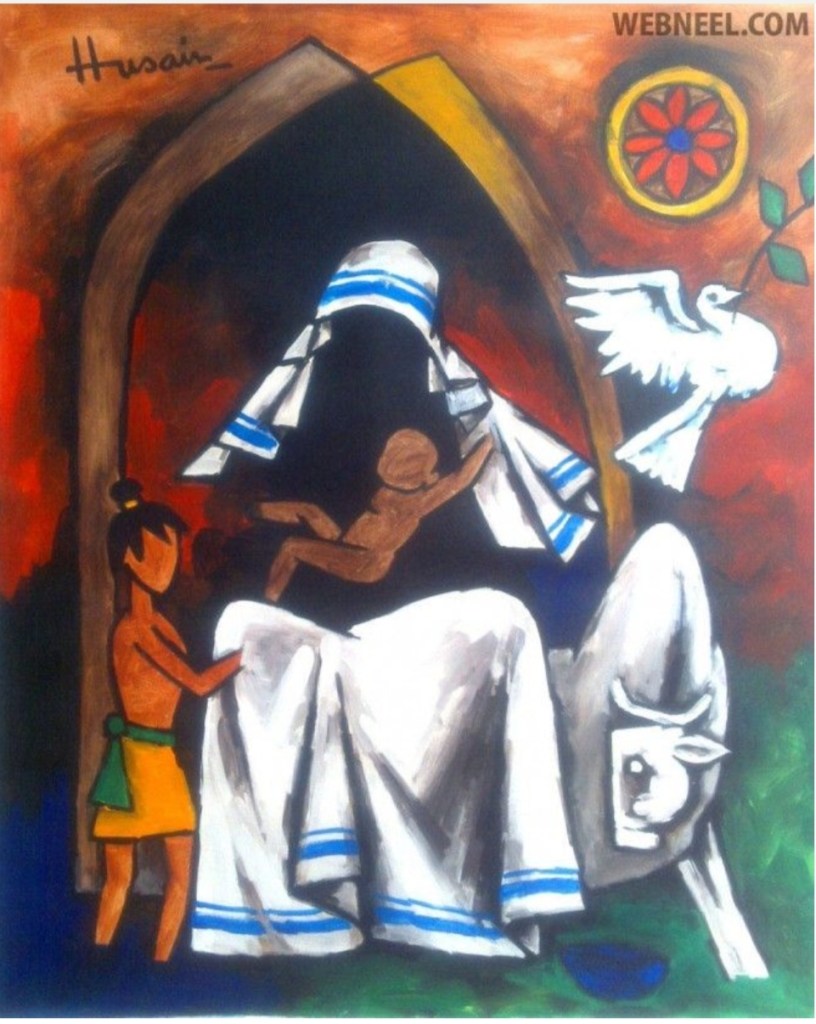
Mother Teresa–Goddess Of Peace by MF Husain. Photo provided by Prithvijeet Sinha
Art is often made out to be something unattainable, acquired strictly by virtue of good taste. To me that supposition has a very myopic idea of what actually constitutes art.
Art is spontaneous, sensual and immediately attractive to the naked eye simply because it is all around us in diverse forms, beginning with the canvas of nature.
From the first rays of sunlight to the final nocturnal lull of the moon, waxing and waning with our existence, a landscape is the first index of the omnipotent power of the hands that create. The stakes are just as natural when an influential figure who has provoked meaningful thoughts has her portrait occupy a space which we commit to our memory. Memory is to art, after all, what the intermingling of colours and shapes is to the structure of an artistic creation – even more than its form. Hence, beholding an artwork that inspires is a moment of personal reckoning with the feelings it evokes.
An artwork that has greatly impacted my artistic consciousness is ‘Mother Teresa–Goddess Of Peace’ by the indefatigable Maqbool Fida Husain. Mr. Husain is entrenched in the fabric of popular culture for his unmistakable, humbling style and use of colours eschewing any hint of beautification that sometimes becomes an accursed necessity in art.
His portrait of the benevolent social messiah is no different. Mother Teresa is someone who has graced his canvas in many iterations and the Goddess of Peace is one among the many he painted around the 1980s. As founder of Missionaries of Charity, Mother Teresa occupies a unique space in our cultural consciousness as we know it, caring for the neediest masses that society is quick to eliminate from the mainstream. That she was painted by another unassuming individual who was austerity personified made them equals. Mr. Hussain, on his part, dissociated his oeuvre from the elitist pretensions of galleries and terminologies of the ‘art world’, making art that touched hearts.
The artwork has Mother Teresa in the middle, in her trademark white sari with a blue border, faceless — an individual whose attire spelled a divorce from pretensions of the world. It is in perfect consonance with the painter who mostly walked bare feet and had not even a single iota of self-recognition about his position as an icon. He was an everyman. To him, it was a vocation but also a necessity to survive.
For others it is the 9 to 5 rule. For him, it was his art.
For Ms. Teresa too, it was personal duty that called for sacrifice of the ego. So, they were doing what they thought was essential in maintaining the order of who they were, in direct relation with an often imperfect world.
The central figure in the painting is surrounded by a young girl, a cow and a dove in flight holding olive tree leaves in its beak. The cow symbolises innate innocence and spiritual purity in concordance with the child while the bird signifies the efforts of people to uphold peace and effect constructive change, never shying away from the reality of poverty that millions endure.
The way her attire is spread out is as if she is holding the beleaguered world in her empathetic care (a baby in this case is on her lap) signals a last hope. She rises above the maternal role of primary caregiver alone. She is a universal figurehead, a genderless representative. That’s why her motives and actions translate so well through the brushstrokes of another. That’s the reason her faceless presence isn’t about fear but as a blank space meant to be filled with the image of any face that could set the same compassionate precedence as her.
Today, my evolution as a writer and poet owes its debts to that day when this artwork became wholly animated for me, creating a blueprint that continues to inspire and provoke thought. That’s the power of art– to create a space in memory and nudge us forward towards change, whether it’s a painter for the cause of artistic integrity and no monetary considerations, a messianic voice for the spiritual upliftment of the downtrodden or a writer preserving their collective legacies through his contemporary words.
The passion in these two people’s efforts to always strive in achieving integrity in service of the truth is soul-stirring. It is so easy to be swayed by conformity, even if it’s within the confines of an educated middle-class structure. The painting is a gateway to that natural state of mind which only creates and never jostles for accolades. I see that in myself.
Sincerity is a prized attribute which is often splayed wide open, to be attacked by a modern world where propagandas and muddled agendas defeat our simplicity of being. But people like Mother Teresa and Mr. Hussain show us the path where one walks the line, forging a map of individuality where materialism just cannot make a dent because the intent is to look at the truth of millions who cannot raise themselves from a cycle of grinding dispossession and exploitative tempers.
Art takes its imprints from the unvarnished truth. This artwork achieves that, illuminating all who dare to effect constructive actions and challenge conformity.
.
Prithvijeet Sinhahas been prolifically publishing works of various hues in journals and magazines like Cafe Dissensus, Confluence, The Medley, Borderless, Wilda Morris’ Poetry Blog, Screen Queens, Rhetorica Quarterly, Lothlorien, Chamber Magazine, Livewire among others. He believes writing to be the true music of the soul.
.
PLEASE NOTE: ARTICLES CAN ONLY BE REPRODUCED IN OTHER SITES WITH DUE ACKNOWLEDGEMENT TO BORDERLESS JOURNAL.




 Borderless