Keith Lyons interviews Asian Australian poet Adam Aitken about cross-cultural identity, and the challenges of travel, writing, and belonging. Click here to read.
Translations
Gandhiji, a short story by Nabendu Ghosh, has been translated from Bengali by Ratnottama Sengupta. Click here to read.
Khaira, the Blind, a story by Nadir Ali, has been translated from Punjabi by Amna Ali. Click here to read.
Clothes of Spirits, a folktale, has been translated from Balochi by Fazal Baloch. Click here to read.
Many Splendored Love, four poems by Masud Khan, have been translated from Bengali by Fakrul Alam. Click hereto read.
Birds are Alive, has been written and translated from Korean by Ihlwha Choi. Clickhere to read.
Nobo Borshe or on New Year, Tagore’s poem on the Bengali New Year, has been translated from Bengali by Mitali Chakravarty for the occasion this April. Click here to read.
Ratnottama Sengupta shows the impact of Gandhi and his call for non-violence on Nabendu Ghosh as she continues to emote over his message of Ahimsa and call for peace amidst rioting. Click here to read.
The night has nearly come to an end.
The old year is almost past.
Under this dust, it will lay down
Its worn-out life at last.
Whether friend or foe,      wherever you go,
Old wrongs cast
Away. On this auspicious day,
Old grievances shed as the old year parts.

— Nobo Borshe or on New Year by Tagore
Art by Sohana Manzoor
Mid-April, Thailand celebrates Songkran and Cambodia, Thingyan — water festivals like Holi. These coincide with the celebration of multiple New Years across Asia. Sikhs celebrate Baisakhi. Kerala celebrates Bishu and Tamil Nadu, Puthandu. Nepal celebrates Nava Varsha and Bengal Nobo Borsho or Poila Boisakh. A translation of Tagore’s poem on the Bengali New Year in spirit asks us to dispense with our past angst and open our hearts to the new day — perhaps an attitude that might bring in changes that are so needed in a world torn with conflicts, hatred and anger. The poet goes on to say, “I want to tie all lives with love” but do we do that in our lives? Can we? Masud Khan’s poems on love translated by Professor Fakrul Alam explore this from a modern context. From Korea, Ihlwha Choi tells us in his translation, “Loving birds is like loving stars”. But the translation that really dwells on love bringing in changes is Nabendu Ghosh’s ‘Gandhiji’, translated by Ratnottama Sengupta, his daughter. The short story by Ghosh highlights the transformation of a murderous villain to a defender of a victim of communal violence, towering above divides drawn by politics of religion.
Another daughter who has been translating her father’s works is Amna Ali, daughter of award-winning Punjabi writer, Nadir Ali. In ‘Khaira, the Blind‘, the father-daughter duo have brought to Anglophone readers a lighter narrative highlighting the erasure of divides and inclusivity. A folktale from Balochistan, translated by Fazal Baloch, echoes in the footsteps of ‘Emperor’s New Clothes’ — a story that can found in the Andersen’s Fairy Tales published in the nineteenth century. I wonder which narrative had come first? And how did it cross cultures retaining the original ideas and yet giving it a local colour? Was it with traders or immigrants?
That such narratives or thoughts are a global phenomenon is brought to the fore by a conversation between Keith Lyons and Asian Australian poet Adam Aitken. Aitken has discussed his cross-cultural identity, the challenges of travel, writing, and belonging. Belonging is perhaps also associated with acceptance. How much do we accept a person, a writer or his works? How much do we empathise with it — is that what makes for popularity?
Cross cultural interactions are always interesting as Rhys Hughes tells us in his essay titled ‘My Love for RK Narayan’. He writes: “Narayan is able to do two contradictory things simultaneously, namely (1) show that we are all the same throughout the world, and (2) show how cultures and people around the world differ from each other.” The underlying emotions that tie us together in a bond of empathy and commonality are compassion and love, something that many great writers have found it necessary to emphasise.
Mitra Phukan’sWhat Will People say?: A Novel is built around such feelings of love, compassion and patience that can gently change narrow norms which draw terrifying borders of hate and unacceptance. We carry an excerpt this time from her ‘Prologue’. Somdatta Mandal has reviewed Chitra Banerjee Divakurni’s latest , Independence. Starting from around the time of the Indian Independence too is Song of the Golden Sparrow – A Novel History of Free India by Nilanjan P. Choudhary, which has been discussed by Rakhi Dalal. The Partition seems to colour narratives often as does the Holocaust. Sometimes, one wonders if humanity will ever get over the negative emotions set into play in the last century.
Closer to our times, when mingling of diverse cultures is becoming more acceptable in arts, Basudhara Roy introduces us to Bina Sarkar Ellias’s Ukiyo-e Days…Haiku Moments, a book that links poetry to a Japanese art-form. While a non-fiction that highlights the suffering of workers by enforcing unacceptable work ethics, Japanese Management, Indian Resistance: The Struggles of the Maruti Suzuki Workersby Anjali Deshpande and Nandita Haksar has been reviewed by Bhaskar Parichha. The narrative, he writes, “tells the story of the biggest car manufacturer in India through the voices of the workers, interviewed over three years. They give us an understanding that the Maruti Suzuki revolution wasn’t the unmitigated success it was touted to be when they tell us about their resistance to being turned into robots by uncompromising management.” That lack of human touch creates distress in people’s hearts, even if we have an efficient system of management and mass production is well elucidated in the review.
These changes are reflected in our musings too. Sengupta has written on how change is wrought on a murderous villain by the charisma of Gandhi in her father’s fiction, as well as this world leader’s impact on Ghosh and her. Devraj Singh Kalsi addresses food fads with a pinch of sarcasm. From Japan, Suzanne Kamata has written of a little island with Greek influences, a result of cultural ties brought in by the emperor Hirohito. Ravi Shankar takes us to Pokhara, Nepal, and Meredith Stephen expresses surprise on meeting a shipload of people from Colorado in the far reaches of the Southern Hemisphere while on her sailing adventures with beautiful photographs. Stories by moderns reflect diverse nuances depicting change. While Brindley Hallam Dennis writes of the passing of an era, PG Thomas integrates the past into the present to reflect how they have a symbiotic structure in the scheme of creating or recreating natural movements through changes wrought over time in his story. Paul Mirabile explores the darker recesses of the human existence in his fiction. As if in continuation, the excerpt from Rhys Hughes’ The Wistful Wanderings of Perceval Pitthelmseems to step out of darker facets of humanity with a soupçon of wit at its best.
To create a world that endures, one looks for values that create inclusivity as reflected in these lines from Charles Chaplin’s My Autobiography, “Mother illuminated to me the kindliest light this world has ever known, which has endowed literature and the theatre with their greatest themes: love, pity and humanity.” This quote starts off a wonderful essay from film-buff Nirupama Kotru. Her narrative carries the tenor of Chaplin’s ‘themes’ to highlight not only her visit to the actor’s last home in Switzerland but also glances at his philosophy and his contributions to cinema across borders.
Our issue rotates around changes and the need for love and compassion to rise in a choral crescendo whirling with the voices of Tagore, Charles Chaplin as well as that of twenty-first century writers. Perhaps this new year, we can move towards a world – at least an imagined world — where love will wipe away weapons and war, where love will take us towards a future filled with the acceptance of myriad colours, where events like the Partition and the Holocaust will be history, just like dinosaurs.
Huge thanks to all our readers and contributors, some of whom may not have been mentioned here but are an integral and necessary part of the issue. Do pause by our April edition. I would also like to give my thanks to our indefatigable team whose efforts breathe life into our journal every month. Sohana Manzoor needs a special mention for her lovely artwork.
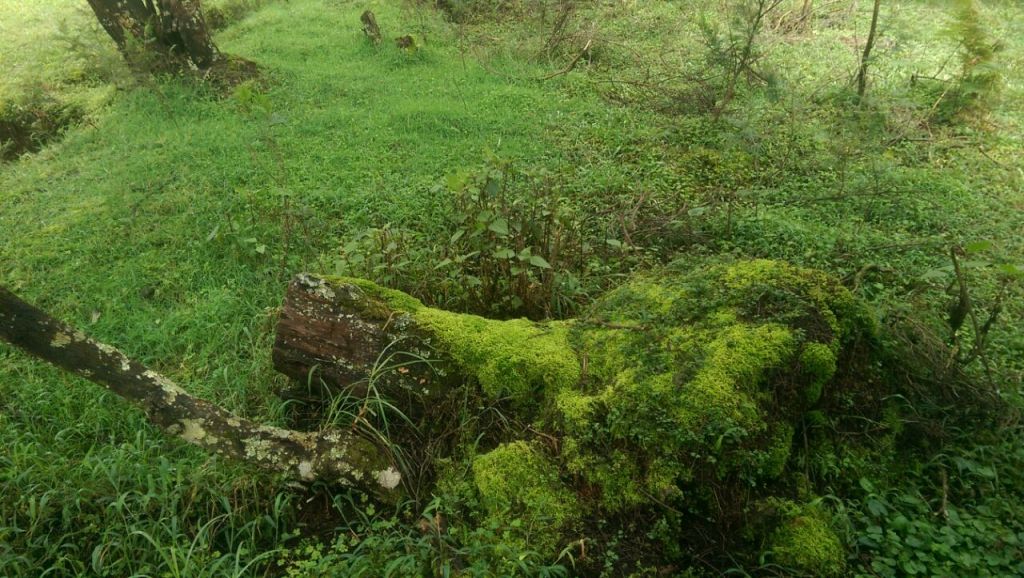
A moss-grown tree stump. Photo courtesy: PG Thomas
Ouseph’s gloom was accentuated by the rustling of dry leaves in the yard of his ancestral home. It was twilight and a movement near his feet made him glance down. He froze as he saw a little chameleon, climb up onto his designer shoe. It climbed up to his right toe, and tilting its head, looked at Ouseph with one bulging eye. Ouseph kicked wildly to dislodge the creature, and panting with fright, he found his gloom had been replaced by a series of shivers down his body.
“What am I doing here?” he wondered. He had last visited his ancestral house more than ten years ago, dragged there from Bombay by his father, who was keen on his child connecting with his roots. As a young boy, he had detested the countryside and his relatives; with their rustic stories and weird humour. Now a quirk of fate and the unexpected death of his bachelor uncle, had found the ancestral property bequeathed to him.
Ouseph lived ensconced in his techie world in Bangalore, where he spent his free time playing music and reading from his surprisingly large collection of books. His inheritance had come to him with the jarring notes of a thunderclap. But his now widowed mother had been firm, “Just go down, see the place and complete the legal formalities to make the property yours. Your father was attached to it and its worth quite a lot. Be practical and we can decide what to do with it later.”
He had travelled down from Bangalore to reach the remote countryside in Kerala at dusk. Pulling himself together from the reptilian shock, he knocked on the thick wooden weather beaten front door of his ancestral home. The door had creaked open into a dimly lit room, to reveal servants seemingly as old as the house itself. They had expected their new master to be young, but their incredulity at the sight of this gangly young man with tousled hair showed in their eyes. One obligingly took his suitcase from his hands but was surprised when he refused to part with his knapsack containing his laptop. He had been led to a musty smelling room, which did nothing to improve his mood.
The next morning, the sound of a broom swishing over the yard floor woke him up. Yawning and scratching his head, he stumbled into the smoky kitchen. A wood fire was burning, and Mariamma the elderly cook gave him a kind smile, and asked if he would like tea. With mug in hand, he stepped out of the house into the still misty morning. He wandered around the compound and looked anew at his inheritance. Noises unfamiliar to a city dweller assaulted his ears. The cow’s lowing seemed like a long drawn complaint, amidst which a rooster crowed, only for it to be picked up and repeated by another some distance away.
A sudden flurry of flapping wings drew his attention to the roof. He saw a startled covey of pigeons rise from the terracotta tiled roof. His eye then caught a single short piece of wire, suspended from a rafter under the eaves of the roof. He wondered if it was the remnant of an aerial wire from the bygone days of the wireless radio. He paused as he noticed a shabby looking ball attached to the end of the wire.
“It’s a sunbird’s nest,” whispered a voice from behind. He turned to see a sweeper women looking at him with laughing eyes.
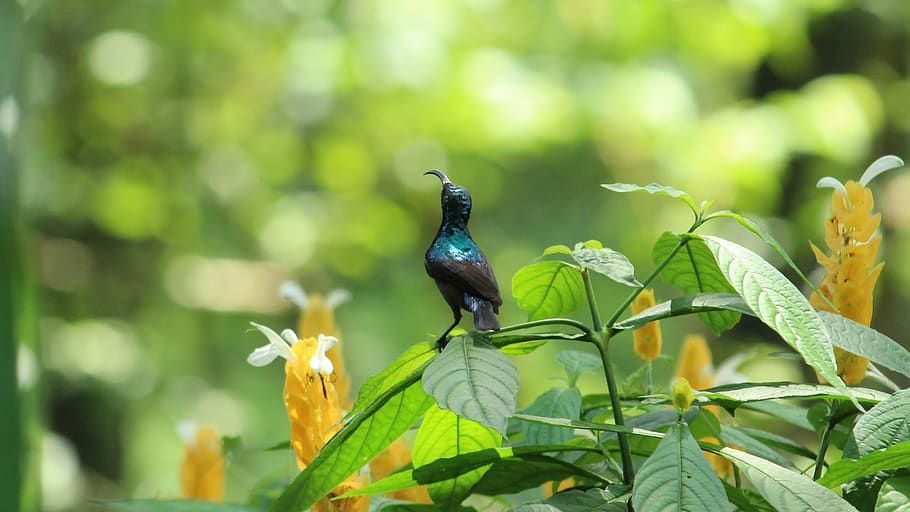
“Oh!” was all Ouseph could muster. But as he gazed up again, he was rewarded by the sight of a little purple bird with a curved beak pop out of the opening in the nest. It sat there an instant; shimmering in the morning sunlight, and then with a whirr of its wings it flew away. “Oh!” said he again.
The sweeper smiled and said, “This pair has been nesting here for years, and has raised so many chicks in it.”
“Oh.”
He had wrangled leave from his software company on the condition of continuing to work online. But he now felt so befuddled with his bizarre inheritance in the countryside. He struggled to handle its finances and could not figure out how the place worked. “I might as well have landed on Mars,” he grumbled.
Rummaging through a list of relatives, Ouseph reached his cousin Anish, who readily offered to introduce him to his lawyer. The lawyer, a frail elderly man with an old world charm in his manners, took the proffered will and asked, “You’re Jacob’s son, aren’t you?”
“You knew my father?”
The lawyer’s eyes twinkled, and he said, “Your father and I were schoolmates here.”
This little exchange was inexplicably comforting to Ouseph. The lawyer asked for two days time to offer his legal opinion. Anish and Ouseph walked back along the narrow country road. Noting Ouseph’s anxiety, Anish said, “We’re glad you are here and the property has come to you.” They walked on under the canopy of trees over the road; Ouseph in his designer clothes and Anish in his home tailored short sleeved shirt and a cotton dhoti (a wrap-around lower garment).
They parted at the gate to Ouseph’s place. As Ouseph walked through the tree shrouded compound to the house, his phone rang. It was his mother from Bombay.
“Yes Amma, I met the lawyer. It looks like it will take a few days.”
A lunch of steaming rice, a coconut milk based chicken curry and a clutter of home grown vegetables done, Ouseph wandered out into the compound. He found a quiet place under the wood apple tree. The tall tree threw a filigreed crown of gnarled branches and tiny leaves against the blue sky. Ouseph sat down on a moss covered uprooted tree stump. The floor was thick with layers of shed leaves. Its soft cushiony feel reminded him of his boss’s carpeted office in Bangalore. But here the similarity ended. The cry of cicadas filled this place, and a crow pheasant’s ‘oopoopoop’ sounded through the thick greenery. He let the events of the past few days run through his mind.
The days following were consumed by visits to sleepy government offices. His cousin guided the process and taught Ouseph the art of greasing the wheels of the government machinery. But strangely, Ouseph found himself looking forward to returning to his ancestral house, and to his evening walks through the quiet of the verdant house compound. He did attend to his work online, but his metabolism seemed to have synchronised itself to the pulse of this ancient house.
For Mariamma the cook, with her plump face and grey streaked hair, her new geek master had roused all her latent mothering instincts. But she now observed him with concern. Ever pragmatic, she decided he needed tethering, and began by suggesting he visit his neighbours.
The first was the Ayurvedic apothecary and doctor. There was no response to Ouseph’s knock on the front door. But the noise of grinding and thumping drew him to the side of the house. He walked into a drying yard, where medicinal herbs of various colours and aromas were drying in the bright sunlight. He saw an old man on the side verandah, bent over a mortar and pestle. He worked at a steady pace and seemed totally absorbed in his work. Fairly certain that the old man was his neighbour Krishna Vaidyan (an Ayurvedic doctor), he volunteered a hello, and was waved to a seat on the verandah. The grinding and pounding continued for a few more minutes. The Vaidyan then stopped his work and looked up. A pair of keen eyes from between an aquiline nose and bushy white eyebrows scrutinised Ouseph, “Well?”
“Oh, I’m Ouseph, your new neighbour.”
An expression of confusion was soon replaced by a smile of comprehension and a friendly laugh, “Yes, yes, I heard you had come.” And after a pause he added, “This is your home, this is your land. I am happy you are back.”
.
The phone vibrated irritatingly, “Ouseph, this is your uncle Scaria. I’ll be there by eleven tomorrow. I am coming to help sell the property.” Scaria was his mother’s brother, for whom Ouseph had evinced a distaste when just an infant. He was the last person he had wanted to meet. Politeness prevented him raising any objections to his uncle’s visit.
The next day a car drew up, and his uncle Scaria stepped out in an orb of strong perfume. Furtive eyes from below a sweat speckled bald dome crawled over Ouseph, and then Scaria patted his shoulder patronisingly. Drawing himself up, Scaria looked around the compound, and nodded in approval at what he saw, “How many acres did you say this was?”
The two of them spent an hour walking around the compound. Ouseph was impressed by his uncle’s detailed scrutiny of the place. “You have quite a bit of valuable timber here,” and then he indicated he would like to see the house.
Over steamed tapioca, red fish curry and fierier chutney, Scaria delivered his seemingly implacable verdict, “You will not be able to manage this house and property. It will be a white elephant to you. Sell it at the best offer you get, and go back to your computer world, Ouseph.”
The last sentence was tinged with scorn, but Ouseph ignored it with, “The paper work is not yet complete.” He did not feel the need to elaborate. His uncle left him with a foul taste in his mouth, and Mariamma who overheard the conversation, looked anxiously at Ouseph’s face.
.
Ouseph began to get unsolicited enquiries for the property. He called his uncle and told him that he had not consented to sell the property. It had ended unpleasantly with implied threats and ingratiating offers from his uncle of a good price. Ouseph had complained to his mother, she merely replied, “You know your uncle. I can do nothing from Bombay. Think about It.”
His uncle’s perfidy had stunned him, and he began to feel bullied and pressured. He met and poured out the story to Anish and the lawyer. The lawyer couldn’t hide his amusement at the predicament of his innocent young client, “Your uncle is an artful crook. We will have to watch him.”
As they walked back, Anish, far more experienced in the ways of the world, threw his arm over the shoulders of his young despondent cousin, “Don’t worry, we are all here with you.”
Dusk was approaching as the two of them walked past the temple compound. There was an unusual buzz around the temple. Anish mentioned that a temple festival was on that night. Ouseph gazed at the temple with its age old banyan and peepul trees, now silhouetted against a red evening sky. The raucous cry of flocks of mynas roosting in the trees filled the air. Hundreds of lit oil lamps lined the walls and the walkway to the temple. It was all doubly lit up in the reflection of the temple pond.
“Looks like a big do Anish!”
“Yes and there will be night long performances too.”
That night, as the lights in his house were doused one after another, Ouseph lay back in his bed and listened to the night noises emanating from his compound. The drone of cicadas had become therapeutic to him now. There were screeches from the mango tree, as fruit bats squabbled over the ripe fruit, and a great Indian horned owl kept up its forlorn hooting above it all. And then, a ripple of drums carried over to him from the temple. “Must be the Kathakali dance ensemble warming up,” thought Ouseph.
And in a while, the distinctive percussion music of the Kathakali dance began to pulsate through the night. It was mesmerising. Ouseph knew only a little about this traditional dance of Kerala. But he knew that it portrayed archetypal characters and situations from Indian mythology and folk lore. The stories were told through the medium of dance and music. The archetypal characters portrayed were always dressed typically, to make identification easy for the audience. A green painted face signified divinity, shining makeup purity, and black demonic and so on.
Ouseph wondered at the enduring appeal of this art form among the local populace. He thought of his own problem with his uncle Scaria, and fantasised dressing him up as a Kathakali artiste, “Maybe I’ll give him the demon’s black face. Or maybe the red beard of a villain would be more suitable.” Ouseph in his fantasy finally picked the black bearded villain, for that signified a scheming villain.
He put his hands behind his head and listened to the distant drum beats. He fancied his uncle Scaria gyrating and dancing with theatrical gestures of a slimy schemer. Ouseph had to admit his phantasm danced well; and at this he began to giggle. Ouseph’s giggling increased and he thought he was becoming hysterical. His giggles became guffaws and he rolled over and buried his face in his pillow to smother them. His paroxysm abated and he drifted into a peaceful slumber. His pillow was wet with the tears of his laughter.
.
Ouseph leapt out of bed in the morning with the thought that Benji and Maya would be there that day. They arrived to voluble greetings and back thumping. In the lazy afternoon, the three of them sat on the tree stump under the shade of the wood apple tree. Ouseph took his friends through the details of his difficulties with his conniving uncle, and of how he struggled with his unexpected inheritance. He said his mother too, was not sure he could manage the property.
Benji said, “Ouseph, this place is most unusual. Think well before you do anything.”
Maya agreed too, “This place has great bones for a resort.”
Ouseph knew he too was falling under the spell of the place. But he needed to make a pragmatic decision. As they walked back to the house, he showed them the sunbird’s nest. He got them to be silent long enough to hear the cry of chicks from within the nest.
Ouseph had come prepared to handle the legal aspects of his unexpected inheritance. But as he stayed on, the house and its world, began to appeal subtly to his imagination and emotions in ways unexpected. The old house, with its moss grown tiled roof sat amidst the trees. The smell of some blossom or other invariably lingered in the air. The cry of birds and farm noises seeped through the rich vegetation. An irresistible, palpable primal energy seemed to flow from the compound. And all of this seemed to exist within an intense quietness; like the brooding silence of a sacred grove. And within this nestled the ancient house, an inseparable part of it all.
The place whispered to any that cared to listen. The house built in the distinctive wood architecture style of Kerala, nevertheless showed Chinese and Arabic influences too; influences that had permeated because of the ancient maritime spice routes. Inside, paintings and fading photos of ancestors stared from their frozen frames.
The compound also had traces of the more recent past. A curious seeker would find here, growing cheek by jowl with indigenous trees, breadfruit from the Pacific islands, nutmeg and mangosteen from Southeast Asia, clove trees from the Molaccas[1] and so on. It was a reminder of colonialism’s great botanical transplants of the past centuries. The heritage of his ancestral house was etched on it in myriad ways.
“Gosh!” exclaimed Maya, “it’s as if the house will always be here, and we are just passing through.”
It was then that Ouseph had this surrealistic feeling; the inkling that in the end, the decision would not be his. It seemed to have already been made in some strange way. This ancestral house seemed to be claiming him as one of its own, and every circumstance seemed to prod him to stake his claim and fight for things that he had earlier been indifferent to.
.
If some power grew this new symbiotic relationship between Ouseph and his heritage, then it seemed that events came cascading down to rivet it firmly together. It came on a morning as Ouseph was on the front verandah speaking with one of the servants. A white car drove up. The rapid opening of all its doors and the climbing out of several men set off alarm bells in Ouseph’s head. But he waited quietly for the people to approach him.
The leader smirked, “We have come to see a certain Ouseph.”
“I’m Ouseph; and what do you want?”
They climbed onto the verandah uninvited and sat down. “Scaria, your uncle sent us to look at the timber here. We understand it is for sale.”
Ouseph flushed and his voice rose, “Uncle Scaria has nothing to do with this property, and I have no timber to sell.”
The leader chuckled, rolled his eyes and tugging at the ends of his long mustache said, “We were warned that you would play games.”
“Games?”
Benji and Maya heard the altercation. Benji wondered if he should intervene, but Maya was out in a flash. She walked up to the chair besides Ouseph, sat down, crossed her legs and looked the apparent hoodlum in the face. Benji joined them too, and the sudden appearance of strangers, particularly of a determined young woman momentarily threw the visitors off balance. The leader began to say something, and then thought the better of it.
Ouseph saw one of his servants make a dash for the gate, but was too preoccupied to wonder why. He heard a shuffle behind him and turned to see the wide girth of Mariamma his cook behind him. She carried a wooden ladle in her hand.
“Who are you?” asked Ouseph.
“I am Chellapan.” The speaker then leaned back, as if awaiting a reaction. The name didn’t mean anything to Ouseph, but he heard Mariamma behind him draw in a sharp breath.
By ones and twos the servants and neighbours began to congregate. They stood quietly listening, but their faces glowered. Ouseph saw Krishna Vaidyan approach slowly. He was using a walking stick. Without a word, he climbed the steps to the verandah, and seated himself on Ouseph’s side. There was no mistaking his intention.
Chellapan made another attempt, “I know that you have made a commitment to Scaria, and I have paid him an advance for the timber here.”
Ouseph was surprised by the change in the tone of his own voice as he answered, “For the last time I tell you, Scaria has nothing to do with this property. If you have given him money, then take up the matter with him.” Then Ouseph heard himself distinctly say, “This property came to me through my ancestors, and I will not sell it during my lifetime. I will not violate it. I will pass it on as it is, to those that follow me.”
The visitors rose threateningly, but seemed unsure for the first time.
“And what is going on here?” It was a voice that was used to being obeyed. It was Lakshmiamma, the matriarch of the nearby Nair household. She was accompanied by two young men and she was sweating profusely from her barefooted walk to the house. All rose as she climbed the steps with difficulty. She lumbered across the verandah to the chair that Benji had vacated for her. She reached out and took hold of Ouseph’s wrist, and drawing him close to her asked the visitors, “Who are you?”
Mariamma sidled up to Lakshmiamma and whispered, “Its Chellapan.”
Lakshmiamma let out a short derisive laugh. Her snow white hair and the large vermillion dot on her forehead, set off her blazing mascara lined jet black eyes. She pointed at Chellapan and said, “I have heard of you. But before we drive you out, I want you to know something. We are here not just for our Ouseph. We are here because your conduct is a threat to us all. We will not permit such lawlessness in our area. So, when you go back to your rat hole, tell your bandicoot friends there, that we will break the legs of anyone attempting any such thing in future here… Now get out.”
Chellapan was quivering with rage and humiliation. But he looked around at the gathering of neighbours and servants. They reminded him of a wild elephant herd gathering around a vulnerable elephant calf. He was smart enough to know the game was up. Lakshmiamma had been explicit. But it was the unexpressed, simmering outrage of the gathering that really unnerved him. He turned his ire elsewhere and spat out, “We were set up by Scaria. Come on,” he roared, “Let’s go see Scaria.”
He strode out muttering obscenities under his breath. The crowd silently parted to let him and his lackeys through. And as Ouseph watched the retreat, somewhere in his own fevered imaginings; a Kathakali chant began. The accompanying drums and cymbals rose in throbbing waves to a crescendo. It was building up for the climax of Uncle Scaria’s final dance.
.
The storm broke at midnight with a crackle of thunder. It was followed by a wind that whistled through the many chinks in the old house and lashed at the trees in the compound; ruffling and driving their dry leaves in a stream. And then the rain came in as a steady downpour; and it lulled the household back to sleep.
Ouseph awoke to a pristine rain washed morning. He found his friends awaiting their morning cuppa in the dining room. Mariamma fondly served the kids, and just as Ouseph lifted his cup to his lips; Maya tremulously asked, “Would the sunbird’s nest have survived the storm?”
Leaving their tea steaming on the table, the trio scrambled out. They reached the nest and looked up anxiously. The nest, tucked under the eaves of the roof showed no damage. Amidst relieved laughter, Benji murmured, “Well, it seems that millions of years of evolution have taught the sunbird to build its nest in safe places.” Shining faces and gleaming eyes concurred.
Ouseph gave a little gasp and pointed up to a nearby windowsill. On it sat the brown and yellow mother sunbird, and next to her sat a chick. The chick was a male, and white downy feathers stuck out irregularly through his purple plumage. He was moulting. The mother bird signalled some anxiety at the chick’s first outing with little flutters of her wings. But the chick sat there calmly, as if he knew, that all he needed to do was to be true to that instinct within him; and then he would grow to be a perfect little purple sunbird.
Ratnottama Senguptagives a glimpse of the life of Zohra Sehgal, based on the book Zohra: A Biography in Four ActsbyRitu Menon, and her own personal interactions with the aging Zohra Sehgal. Click here to read.
“It just so happens that their[1] universes were different from ours: because why would their imaginations be constrained by a nation-state that would not exist for another thousand years?”
These lines from a recent article on conquests carried out by the Indian subcontinent in ancient times brings to focus that earlier countries or nation-states as we know of them today did not exist till the industrial revolution set the concept in motion. In the month many countries in Asia celebrate their independent existence or rather the drawing of borders based on colonial mapmakers’ whims, we should perhaps relook at the way the world stands divided.
Is this what we want as humans? Where are we headed? While conquerors write the history, we tend to gloss over what is left unsaid. The millions who died crossing borders, in race riots and of hunger, starvation and disease in refugee camps is overlooked, or worse, used to justify the divisions that still hurt the residents of the sub-continent and try to destroy any sense of oneness among the human species. We tend not to forget the atrocities of the colonials but we overlook the violence of the mobs that incensed with hatred instilled by politics annihilated and murdered. Their story is reduced to “us” and “them”. In our mood of jubilation, the recent bombings in the Middle East and the Ukraine-Russia war have already been delegated to the newsreels. But these are all people who are killed and displaced without any justification for the need to do so. One of the things that George Orwell had depicted in 1984 was an acceptance of a constant state of war. Are we stepping into that frame of mind with our cold acceptance of the situation worldwide?
In the last century, many united against the atrocities of the empire builders. They wanted to rise above the divides. At least greats like Nazrul vociferously objected to the basis of divides that were used to draw the borders. Translations brought to us by Professor Fakrul Alam showcase such poetry as does much of Tagore’s own writing and actions. Tagore organised a protest march against the colonial proposal of Partition of Bengal in 1905 by taking a procession in which he encouraged Hindu and Muslim women to tie rakhis[2] on men from the other community and make them their brothers. Tagore put the welfare of humanity above nationalism as can be seen in his writings and speeches. Reflecting on humanity, we have Munshi Premchand’s powerful story,Pus Ki Raat or A Frigid Winter’s Night, translated from Hindi by C Christine Fair, dwelling on the sad state of peasantry under the Raj. In a bid to rouse people like the protagonist of Premchand’s story, Tagore wrote inspirational songs, one of which, Hobe Joye(Victory will be Ours) has been translated on our pages. We also continue sharing Rabindranath’s humour with a skit translated by Somdatta Mandal from Bengali.
Humour is also stirred into Borderless by Rhys Hughes with a series of mini sagas in his column and a trip around the world in eighty couplets. These couplets actually are more in number — I tried counting them — and are guaranteed to make you laugh. We have travel stories in plenty too. Ravi Shankar again treks to the Himalayas and brings us wonderful photographs of his journey and G Venkatesh stops over at Istanbul airport to find a friend from across the border. Meredith Stephens travels to a French colony called Lifou Island — sounds unbelievable as in the month we celebrate the independence of so many countries across Asia, there is still a country in the Pacific that owes allegiance to a democratic European power! But other than writing about the beaches, Stephens talks of a temporary pet dog while Suzanne Kamata gives us cat talk in her notes from Japan in a lighter vein — a very pleasant glimpse of life. Devraj Singh Kalsi brings a grin when he talks of his stint at trying to run a restaurant.
Interesting non-fictions from a book lover, Sindhu Shivprasad, and from PG Thomas who talks of King Lear performed a la classical Indian dance mode, Kathakali, by an international caste add to narratives that focus on bringing the pleasanter side of life to our readers. Such stories are a welcome relief in dark times when people find themselves caught between price hikes due to the pandemic and wars. An essay by Candice Louisa Daquin looks for a way out of the stresses of these times. Erwin Coombs gives us a funny, poignant and tragic classroom encounter which reminds me of the 1967 Sidney Poiter movie, To Sir, with Love. We have darker tones brought into our journal also with Aysha Baqir’s story on child exploitation, a sad but hopeful narrative from Nepal by Santosh Kalwar about the rejection of a girl-child by her mother and a horrific murder brought to us by Paul Mirabile.
An excerpt from B. M. Zuhara’sThe Dreams of a Mappila Girl: A Memoir, translated from Malayalam by Fehmida Zakeer, brings us close to a community we know very less about in the Southern part of India. Meenakshi Malhotra has reviewed Tagore’s Four Chapters translated from Bengali and introduced by Radha Chakravarty, a book that is a powerful voice against violence in the name of nationalism touching on the independence of women, a theme that is reiterated in another book that has been visited by Rakhi Dalal. While exploring Neelum Saran Gour’s Requiem in Raga Janki, Dalal contends that the book familiarises us with a singer “who carved her own destiny and lived life on her own terms, in times when women were generally subjugated and confined to roles given by society”. Gracy Samjetsabam has visited Mamang Dai’s Escaping the Land, a novel that tries to weave issues faced in the Northeast of India and integrate it with the mainstream by stirring human emotions. Bhaskar Parichha has reviewed Rakesh Batabyal’s Building a Free India, a collection of powerful speeches from the past.
Within the confines of the Raj, there was a long court case where a prince who had been declared dead resurfaced as a Naga sadhu[3], a claimant to the throne, this time not to abuse his power as of past but to be a sympathiser of the people in their tryst to fight the Raj. Aruna Chakravarti has woven a historical fiction around this controversy centring around the prince of Bhawal. In an exclusive interview, she tells us the story behind the making of The Mendicant Prince— her novel that was published just last month. Her responses could well teach us how to write a historical novel.
We have much more than the fare that has been mentioned here. Pause by on our contents page to take a look. My heartfelt thanks to the whole team at Borderless for helping with this issue, which we managed to get out in a shorter time than usual and Sohana Manzoor for her wonderful artwork. I am grateful to all our contributors as well as our readers. We could not have made it this far without all of you.
In the spirit of uniting under a borderless sky, let us look forward to cooler climes and happier times.
[1] Guptas (4-6 century CE), Cholas (300 BCE -1279 CE) and other ancient rulers in the Indian sub-continent
[2] A festival held in August where sisters of all ages tie a talisman or amulet called the rakhi around the wrists of their brothers, who promise to protect them.
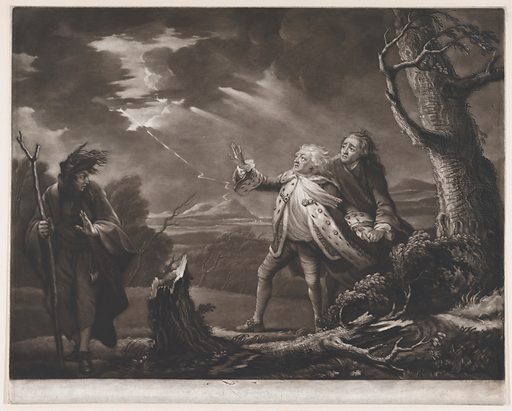
A Kathakali dancerDavid Garrick as King Lear (Shakespeare, King Lear, Act 3, Scene 1) (1761). Courtesy: Creative Commons
With guttural grunts as from an alpha male on a testosterone high, King Lear in the opening scene strutted and swaggered as the drums and cymbals emphasised his every gesture and expression, in an act of supreme braggadocio. His fool’s theatrical gestures of servility only enhanced King Lear’s demonstration of his character and of his mindset, which wonderfully set the stage for his actions and eventual downfall.
This was long ago in another time, in 2018 when the performance finally came home to India. It was being staged in Trivandrum, Kerala, finally. Interesting and controversial, this opera had done its rounds in Europe, including the Globe Theatre in the 1970s, and had now come home to the land that had given birth to the dance form.
I was watching an unusual intercultural presentation of Shakespeare’s King Lear, choreographed by French dancer Annette Leday and adapted for the occasion by Australian playwright David McRuvie. It was being presented through the medium of Kathakali, the classical dance of Kerala. The production seemed to have run the gauntlet of risks such intercultural attempts are prone to. Besides much appreciation, the word ‘baffling’ had been used to describe it in the UK, and it was reported that informed Kathakali enthusiasts were left unmoved, for it seemed to be neither here nor there. But for me it was a worthwhile experience, and I feel that if a viewer were to approach this opera without preconceived expectations, his would enjoy it better.
Annette Leday, a Kathakali dancer herself, has choreographed this opera with aplomb. David McRuvie has made the play suitable for Kathakali by drastically thinning the text and retaining only the story of King Lear and his daughters. Much would have been lost here, but its suitability for this performance cannot be denied. The role of King Lear is performed well by the Kathakali exponent Peesappilly Rajiv and the endearing fool brilliantly portrayed by Manoj Kumar.
A young tradition in comparison to other Kerala dance forms, Kathakali has retained a greater degree of innovation and improvisation, and this malleability has been tapped well by Annette. Kathakali performances traditionally draw their subject from Hindu mythology, and portray archetypal characters and situations. And King Lear’s story of kingship, inheritance, family disputes and dowry are all themes that an Indian audience would understand.
The elaborate costumes and face makeup are typical to characters portrayed. And thus Goneril and Regan are presented with the black faces of demons, the radiant goodness of Cordelia is conveyed through minukku (shining) face makeup, and King Lear wears the garb of the anti hero. But it is when the opera starts that one realises Kathakali’s gift for sheer theatre. As the rippling drums and cymbals enliven the dance, the chanting tells the story, emotions flow from structured facial expressions and demonstrative gestures, and meaning flows from hand gestures called mudras. It is a very structured art form, but with a wonderful ability to convey — through lively choreography and vibrant rhythmic percussion music — archetypal human situations and emotions.
Whatever the purists may say, this performance was hugely enjoyable and made unique with the intermingling of different cultural lores.
.
P.G.Thomas, hailing from Kerala, India; has been intrigued by the changing phases of his land, its people and their way of life. He draws on a lifetime of actual experience to write about it.
PLEASE NOTE: ARTICLES CAN ONLY BE REPRODUCED IN OTHER SITES WITH DUE ACKNOWLEDGEMENT TO BORDERLESS JOURNAL
It all came back to Pappan in spurts; the rasp of his own laboured breathing, the sound of the runners’ bare feet slapping the wet mud pathway, and the choking sensation of fear welling up within him. The flaming torches had streamed acrid smoke and sparks, and had lit their way through their flight that night. They threw distorted shadows of the runners along the dense foliage rimming the pathway. It had been in the late 1940s, and Pappan and his communist comrades had fled the sure retribution for their uprising in Kerala.
Pappan wished he could suppress the memories of the shrieks of the landlord he had hamstrung that night. It had all gone terribly wrong, and they had fled the scene as the wails of the women of the landlord’s household reverberated into the night. The wails had stubbornly clung to him throughout his life, and had lost none of their horror.
Pappan looked up from his reverie to the visitors who sat outside his home on a wooden bench. They had come from the local communist party office to invite this old legend of a comrade to participate in the golden jubilee celebrations of the communist uprising. Pappan’s reluctance had baffled his visitors.
The group leader persisted, “Comrade Pappan, we so need your presence at the golden jubilee celebrations. You were the foundation on which this movement was built in this area.”
Pappan demurred, “All that was a very long time back. I have not been involved for some time now.”
“Many will be disappointed by your absence.”
Pappan grunted an understanding of the matter; but said nothing more. From the wooden stool he sat on, he glanced at his daughter who squatted on the riverside. With a soot-blackened clay pot next to her, she was gutting and cleaning fish for the next meal. The unwanted parts of the fish that she tossed into the flowing river were snapped up by schools of river fish. Cawing crows circled overhead and attempted to pick up the floating offal with their beaks, only to be outdone by the fish eagles gliding in to precisely grapple it up with their talons from the river’s surface. This frenzied feeding was a daily ritual, and the wheeling birds and their aerobatics never failed to hold Pappan’s attention. He wished a man’s sins could as easily be discarded as his daughter did the fish offal. His grandson played around his mother, a cat skulked nearby in the tall grass as his daughter cleaned the fish. She looked over her shoulders at her father, with eyes that understood his dilemma.
Over seventy years ago; in the very same hut, his mother had delivered him on a reed mat spread across the mud floor. His inheritance had been grinding poverty and caste discrimination. He was flung into a life of wildness and petty theft that finally drove him from home at the age of twelve. Thereafter, he had begged, pilfered and done menial work with a bunch of similar youngsters on the streets of the nearby town. The communist movement had found in these urchins the ideal storm troopers. When he turned twenty, Pappan had returned to his native hamlet; his earlier rebelliousness and acrimony now nicely shaped and directed to achieving the goals of the communist party. Pappan had come home to transform his own little world!
He had visited his parent’s hut on returning. His father’s unease with his grown son was evident. His mother smothered her mouth with her work gnarled hands, and her tears flowed freely down her wrinkled cheeks. Pappan murmured, ‘Amma,’ and then squeezed into her hands some grubby notes and coins. Nothing more was said, and Pappan after a long look at the Meenachil river flowing near the hut, had walked away.
And then subtly things began to change in the sleepy hamlet. Polite but incessant demands for higher wages came to the ears of the landlords. The customary deference to their betters suddenly seemed to be given with reluctance. And then it had all come boiling out at the time of the rice harvest, carefully crafted by the communist party to stun the landlords.
A dry wind had been blowing and it had turned the rice fields a golden brown. The paddy had bent over, heavy with ripe rice ears, and there was expectancy in the air. It was the morning of the harvest. Mathai, the landlord, had walked the short distance to his fields along with his supervisors. They were greeted by the sight of their workers lolling on the grassy banks of the field. None rose in respect, nor showed any inclination to begin harvest work. A supervisor whispered into the ear of the landlord, “There seems to be a problem!”
The demands for increased wages and a larger share of the harvested rice were made by the workers. Mathai wasn’t sure what upset him more; the unreasonableness of the demands or the sheer effrontery of the stipulations being made at the nick of harvest time. But he bit down on his irritation and merely said, “There are time-honoured ways of dealing with such matters. This approach is unacceptable.” He was met by a deadening silence from the workers. He turned back towards his home, and the workers quietly disbursed. No harvesting was done that day.
Two days later, Pappan was disturbed at his morning ablutions on the banks of the river with the hushed words; “Mathai has brought in outsiders and begun harvesting his rice.” Pappan and his comrades had walked into Mathai’s rice fields and its welcoming committee. They were outnumbered and they retreated. That night someone broke the dykes along Mathai’s fields; and the river poured in to submerge the yet to be harvested portion of the paddy. The class war was out in the open. Threats and posturing soon degenerated into brawls. The communist cadres disrupted work where they could, and strike breakers began resisting and meting out punishment clandestinely. The countryside waited with bated breath, disoriented by this strange movement that had upended long established customs.
An expedition to Mathai’s to scare and demoralise him had gone horribly wrong. The converging of flaming torches in the night had roused the landlord’s household. But to Pappan’s discomfiture, he met not a cowed downed Mathai, but one brimming with righteous indignation and contempt for Pappan. Something snapped inside Pappan; and in moment he had swung his curved razor sharp sickle to hamstring the landlord. Screams rend the air and blood squirted. The other comrades froze, stunned by Pappan’s impulsive action. Someone grabbed Pappan’s bloody hands, “Enough, enough! Let’s go.” And they left Mathai writhing on the ground and his household wailing into the night.
They ran, they hid and they scrambled from safe haven to safe haven until they reached the forest. Weeks went by. The local magistrate had issued a warrant for Pappan’s arrest. Helped by informers, they were arrested quietly by the police as they slept in their forest dwelling. Pappan disappeared into the labyrinth of the Central Prison; a place staffed with policemen drawn invariably from the upper castes and landowning classes. They needed little instruction on how to deal with communist prisoners.
Years went by, and the communists won the elections and came to power in Kerala; and with that a policy change in dealing with political prisoners would see them released from prison. Following this, a bedraggled, sick and broken Pappan had walked into his hamlet. He quietly made his way to his now dead parents’ dilapidated hut by the river. He was soon joined by a woman and a girl child. No one knew where the two had met. They repaired the hut and Pappan began the long journey to mend his body and mind, both broken by methods of torture carefully nurtured and finessed over generations by the police fraternity.
His wife took jobs where she could find them. The seasons changed. The rains came and the flooded river spread its rich loam over their small patch of land. The bananas and vegetables planted by his wife sprouted and began to grow, and Pappan began to mend too.
His wife’s people once visited and the idea to buy a boat was broached, and some money given for it. It would give Pappan a living; for there was always work for a boat and boatman on the Meenachil River. Somehow the idea trickled out to the other villagers, and their community spirit was tickled. It began to be mentioned at the tea shops, at the bathing ghats on the riverbank and even under the Peepul tree in the temple compound.
“Did you hear that a canoe is to be built for Pappan?”
“Haha! And turn a revolutionary into a boatman?”
Someone slapped his thigh and cackled, “Aiyo!! What a fate for an old communist!”
“Come on. Give a man a chance to live.” And so went the prattle in the village. But the idea of the boat took off. An old, discarded tin, with a cloth stretched over the top and a slit for coins in it began to do the rounds. The tin started to fill. Someone in a fit of impertinence carried it to Mathai the landlord’s house; to buy a boat for the man who had hamstrung him years back. They came back abashed by Mathai’s generosity. It had been the largest donation yet received.
A slipshod committee that argued much, and agreed on little was formed, and the tin with its rattle and clinking was finally carried to Pappan’s house to his embarrassment and to the delight of his wife. Opinions were gathered on how to proceed.
“We need to find a mature Anjillee tree (Wild Jack) to make the canoe from,” quipped someone. A haphazard and desultory search began. Such a tree was soon found. The owner was paid and the tree felled. An elephant was hired to carry the tree trunk to Pappan’s house. And this communal project soon became the most exciting happening in the village in years.
A slightly rowdy crowd, along with the elephant carrying the tree trunk wound its way across the countryside. Someone brought a battered drum and the whole began to take on the look of a procession. Women and children gathered along the way and giggled at the funny procession, and as it passed the village toddy shop, part of the procession melted away for a drink. But they were soon replaced by some from within the toddy shop; tipsy and more suited to the occasion.
By late afternoon they reached Pappan’s house. The mahout shouted and prodded the elephant into dropping the Anjillee tree trunk at an appropriate place to be worked on. Pappan’s wife with folded hands thanked the jubilant crowd, and gave the elephant a parting gift of ripe bananas.
The axe thudded, the wood chips flew and loafers congregated at the site to offer unsolicited advice to the canoe builders. The yellow Anjillee log was hollowed out, and it began to take on the shape of a sleek canoe, and hope began to course through the veins of Pappan and his family. The summer months dried out the canoe wood, and it was finished with layers of stinking fish oil to waterproof it.
And on an auspicious day, when the river flowed low, a crowd gathered to witness the launch of the canoe. A collective holding of breaths accompanied the canoe, as it slid through the mud into the river. Built with no modern measuring instruments, but only on the principles of Thatchu Sastra, the traditional craft of carpentry, the canoe wobbled into the water and then paused; to float perfectly, with no tilt whatsoever. A cheer went up, and even Pappan’s normally stony lips quivered into a smile. Someone slung a marigold garland on the bow of the canoe, and Pappan’s transformation from a revolutionary to a Meenachil river boatman was sanctified.
Pappan often left with the rising sun glinting off the river surface. He paddled swiftly to pick up his boat load. It varied from pilgrims during temple festivals, to bags of rice, hay or mounds of freshly harvested coconut at other times. He rarely argued about the fare; but his quiet demeanour somehow ensured a fair settlement of his dues.
He grew familiar with the changing seasons and moods of the river. His boatman’s skills were often tested by a rapidly flowing flooded Meenachil river, where the swirling waters inundated its mud banks or its silt built up banks anew. The colour of the foliage along the banks changed from lush green during the monsoons, to duller shades of green and yellow during the simmering summer months. He watched the migrating birds visit and disappear; to come calling again as nature’s invisible wand directed them. He too grew sinewy and grizzled, but a sense of purpose and belonging imbued his life.
Work done, he would paddle home in the late hours, through the buzz of night insects and the occasional splash of a fish breaking the river surface. His riverine path was lit by moonlight or starlight, until he reached his bit of the river front. The last bit would be guided in by a lit lantern unfailingly left at the landing by his wife or at other times, by the soft singing of evening prayers by his wife and child in their hut.
Pappan remembered, but his visitors stirred impatiently at Pappan’s inscrutable silence. His grandchild sensing the tension in the air sidled up to Pappan and climbed into his lap. The oldest of the visitors rose and walked deliberately to Pappan’s daughter by the river. He earnestly appealed to her to persuade her father to come to the 50th celebration of the communist uprising. She remained silent for a moment, and then turning to him said: “Has he not done enough for the movement? Please let him be. He’s old and carries a heavy burden.”
The visitor reasoned, “Yes, things were done during the uprising. But it was for a cause, and comrade Pappan need not feel so burdened about those things.”
She sighed and said, “Would that not be for the man carrying the burden to decide?”
The crestfallen communist visitors slowly trooped out. They paused at the gate and looked back at Pappan. He had not stirred. He sat there quietly with his grandchild in his lap, gazing into the dusk that slowly enveloped the river.
P.G.Thomas, hailing from Kerala, India; has been intrigued by the changing phases of his land, its people and their way of life. He draws on a lifetime of actual experience to write about it.
PLEASE NOTE: ARTICLES CAN ONLY BE REPRODUCED IN OTHER SITES WITH DUE ACKNOWLEDGEMENT TO BORDERLESS JOURNAL






 Borderless