Categories
Review

Behind Latticed Marble: Inner Worlds of Women

Book Review by Somdatta Mandal

Title: Behind Latticed Marble: Inner Worlds of Women

Author: Jyotirmoyee Devi Sen, translated from Bengali by Apala G. Egan

New Delhi: Niyogi Books

The very mention of the name of Jyotirmoyee Devi (1894 – 1988) brings to our mind the strong feminist Bengali writer, author of the famous Partition novel, Epar Ganga Opar Ganga (The River Churning), mainly depicted the lives of the women in Bengal who bore the burden of this communal divide, their bodies being inflicted with sexual violence, rape, and social exclusion as a consequence to the former two. Owing to the dearth in the literature that records such gruesome atrocities that were inflicted upon women, till date her work is extremely important. This present anthology however focuses on a totally different perspective of the writer where she tells us interesting stories about the life of the women and little girls of Rajasthan, and the discriminatory gender and caste norms that policed and defined their existence. 

Jyotirmoyee Devi was born in Jaipur in an upper-caste and economically well-off family. Her grandfather, who had emigrated there from Bengal during the British Raj, rose to occupy a high administrative position as the dewan or prime minister to the Maharaja of Jaipur. Thus, Rajasthan had a profound impact on her writings in the later years. Not being given an opportunity for formal education, her sole means to establish a relationship with reading became her grandfather’s library where she, along with her sister, were assigned to arrange newly arrived books and magazines. Therefore, even though she was a little girl, she attempted to make use of her multiple privileges that could help her access books and writing material. Married at the age of ten and widowed at twenty-five, she returned to her parents’ home along with her children and became a prolific writer during her long period of widowhood.

The ten fictional narratives in this anthology are all set in Rajasthan, and they create an elegant tapestry amidst the backdrop of Rajput grandeur and chivalry. Based on an eyewitness account of life in royal harems, these stories describe the very human interaction between men and women in this milieu. They highlight power play, disinheritance, and the threat of assault, which are perennial concerns for women. These include fascinating narration about the machinations that went on inside the royal households, as well as stories which tells us the plight of the veiled women in different strata of society. For instance, in “Beneath the Aravalli Hills,” a young village girl Dhapi disappears in the city where her father sold her for two hundred rupees. She is kept in a harem and punished for entering the festive hall without permission, she ends her life in prison. In “Frame Up” when the king dies, there is a heavy pall of suspicion in the kingdom that the queen had murdered him. Two decades later, when she is on her deathbed, she calls her son to tell him that the harem housekeeper and the chief eunuch had hatched a plot to kill his father but the young king walks away without acknowledging his mother’s innocence. In “The Child Bride” we read about the plight of a young widow Kesar whose jewellery is unlawfully snatched from her by the in-laws and she spends the rest of her life in poverty by serving like other destitute widows in the Govindji temple at Vrindavan.

Women-centric issues also recur in a story called “The Queen and the Concubine” where despite having plenty of riches befitting the Rajput royals, the ladies muse secret sorrows since their husbands, seldom, if ever, visited them. They spent their time in their sumptuous villas by holding pageants, dance dramas, and musical soirees. It tells the story of how the protagonist Kesar moved to the king’s harem upon his desire, metamorphosed from a mere maid to a courtesan, till she was burnt to death in the end. As per the rules of the state, sons of courtesans and concubines also lived luxurious and leisure lives, but somehow there always existed a fine dividing line between these men and the real heir to the throne. “The Taint” tells us of the king’s youngest son Samudra, who after receiving college education decides to take up a simple job in the British Indian army while his father arranges for his marriage with plenty of dowry albeit without his consent.

The human side of man is beautifully expressed in “Ungendered” where the royal eunuch decides not to have an heir and lets two young boys live a normal man’s life. Several other stories reiterate tragic tales of women in purdah and how many of them reach unfortunate ends when they try to escape from the strict socially imposed patriarchal norms that keep them totally voiceless. “The Princess Baby” (Beti ka Baap or Father of a daughter) calls for attention towards the evil of female infanticide by feeding them with an overdose of opium and focus on the limited social interactions allowed to young women. Though sometimes repetitive, the stories overall try and tell us about the miserable plight of women in Rajasthan, whether they were commoners or part of the royalty.

Before concluding, a few words about the translation. This anthology contains ten stories, each of which had been translated and published in different journals abroad (nine in different American journals and one in Turkey) before collating them into this present volume. The translator, residing in the USA, obviously had the western reader in mind and sometimes several complicated and difficult words and phrases are used probably to remain politically correct to the original text. But what this reviewer finds problematic is the introduction by the author. Who are the targeted readers? In her introduction, she mentions at random women’s issues from around the world and in different ages one wonders why the context of the stories translated here is not provided at all — except for giving us a bio-note of Jyotirmoyee Devi which is briefly included in the back flap cover. Also, the page-long bibliography provided at the end of the rather out-of-context introduction seems totally redundant. Apart from this lacuna of course, the volume will interest those readers who marvel at the eyewitness accounts of life of women and men, common and royal alike, in Rajasthan in the first few decades of the twentieth century.

Somdatta Mandal, author, academic and translator, is former Professor of English at Visva-Bharati, Santiniketan, India.

.

PLEASE NOTE: ARTICLES CAN ONLY BE REPRODUCED IN OTHER SITES WITH DUE ACKNOWLEDGEMENT TO BORDERLESS JOURNAL. 

Click here to access the Borderless anthology, Monalisa No Longer Smiles

Click here to access Monalisa No Longer Smiles on Kindle Amazon International

Categories
Editorial

Can Love Change the World?

The night has nearly come to an end.
The old year is almost past.
Under this dust, it will lay down
Its worn-out life at last.
Whether friend or foe,      wherever you go,
Old wrongs cast
Away. On this auspicious day,
Old grievances shed as the old year parts.

— Nobo Borshe or on New Year by Tagore

Art by Sohana Manzoor

Mid-April, Thailand celebrates Songkran and Cambodia, Thingyan — water festivals like Holi. These coincide with the celebration of multiple New Years across Asia. Sikhs celebrate Baisakhi. Kerala celebrates Bishu and Tamil Nadu, Puthandu. Nepal celebrates Nava Varsha and Bengal Nobo Borsho or Poila Boisakh. A translation of Tagore’s poem on the Bengali New Year in spirit asks us to dispense with our past angst and open our hearts to the new day — perhaps an attitude that might bring in changes that are so needed in a world torn with conflicts, hatred and anger. The poet goes on to say, “I want to tie all lives with love” but do we do that in our lives? Can we? Masud Khan’s poems on love translated by Professor Fakrul Alam explore this from a modern context. From Korea, Ihlwha Choi tells us in his translation, “Loving birds is like loving stars”. But the translation that really dwells on love bringing in changes is Nabendu Ghosh’s ‘Gandhiji’, translated by Ratnottama Sengupta, his daughter. The short story by Ghosh highlights the transformation of a murderous villain to a defender of a victim of communal violence, towering above divides drawn by politics of religion.

Another daughter who has been translating her father’s works is Amna Ali, daughter of award-winning Punjabi writer, Nadir Ali. In ‘Khaira, the Blind‘, the father-daughter duo have brought to Anglophone readers a lighter narrative highlighting the erasure of divides and inclusivity. A folktale from Balochistan, translated by Fazal Baloch, echoes in the footsteps of ‘Emperor’s New Clothes’ — a story that can found in the Andersen’s Fairy Tales published in the nineteenth century. I wonder which narrative had come first? And how did it cross cultures retaining the original ideas and yet giving it a local colour? Was it with traders or immigrants?

That such narratives or thoughts are a global phenomenon is brought to the fore by a conversation between Keith Lyons and Asian Australian poet Adam Aitken. Aitken has discussed his cross-cultural identity, the challenges of travel, writing, and belonging. Belonging is perhaps also associated with acceptance. How much do we accept a person, a writer or his works? How much do we empathise with it — is that what makes for popularity?

Cross cultural interactions are always interesting as Rhys Hughes tells us in his essay titled ‘My Love for RK Narayan’. He writes: “Narayan is able to do two contradictory things simultaneously, namely (1) show that we are all the same throughout the world, and (2) show how cultures and people around the world differ from each other.” The underlying emotions that tie us together in a bond of empathy and commonality are compassion and love, something that many great writers have found it necessary to emphasise.

Mitra Phukan’s What Will People say?: A Novel is built around such feelings of love, compassion and patience that can gently change narrow norms which draw terrifying borders of hate and unacceptance. We carry an excerpt this time from her ‘Prologue’. Somdatta Mandal has reviewed Chitra Banerjee Divakurni’s latest , Independence. Starting from around the time of the Indian Independence too is Song of the Golden Sparrow – A Novel History of Free India by Nilanjan P. Choudhary, which has been discussed by Rakhi Dalal. The Partition seems to colour narratives often as does the Holocaust. Sometimes, one wonders if humanity will ever get over the negative emotions set into play in the last century.

Closer to our times, when mingling of diverse cultures is becoming more acceptable in arts, Basudhara Roy introduces us to Bina Sarkar Ellias’s Ukiyo-e Days…Haiku Moments, a book that links poetry to a Japanese art-form. While a non-fiction that highlights the suffering of workers by enforcing unacceptable work ethics, Japanese Management, Indian Resistance: The Struggles of the Maruti Suzuki Workers by Anjali Deshpande and Nandita Haksar has been reviewed by Bhaskar Parichha. The narrative, he writes, “tells the story of the biggest car manufacturer in India through the voices of the workers, interviewed over three years. They give us an understanding that the Maruti Suzuki revolution wasn’t the unmitigated success it was touted to be when they tell us about their resistance to being turned into robots by uncompromising management.” That lack of human touch creates distress in people’s hearts, even if we have an efficient system of management and mass production is well elucidated in the review.

To lighten the mood, we have humour in verses from Rhys Hughes and Richard Stevenson’s tongue-in-cheek dino poems. Michael Burch’s poetry explores nuances of love and, yet, changes wrought in love has become the subject of poetry by Malachi Edwin Vethamani and Anasuya Bhar with more wistful lines by George Freek highlighting evanescence.  Sutputra Radheye and Jim Landwehr bring darker nuances into poetry while Scott Thomas Outlar mingles nature with philosophical meanderings. We have more poetry by Ryan Quinn Flanagan, Abdul Jamil Urfi and many more exploring various facets of changes in our lives.

These changes are reflected in our musings too. Sengupta has written on how change is wrought on a murderous villain by the charisma of Gandhi in her father’s fiction, as well as this world leader’s impact on Ghosh and her. Devraj Singh Kalsi addresses food fads with a pinch of sarcasm. From Japan, Suzanne Kamata has written of a little island with Greek influences, a result of cultural ties brought in by the emperor Hirohito. Ravi Shankar takes us to Pokhara, Nepal, and Meredith Stephen expresses surprise on meeting a shipload of people from Colorado in the far reaches of the Southern Hemisphere while on her sailing adventures with beautiful photographs. Stories by moderns reflect diverse nuances depicting change. While Brindley Hallam Dennis writes of the passing of an era, PG Thomas integrates the past into the present to reflect how they have a symbiotic structure in the scheme of creating or recreating natural movements through changes wrought over time in his story. Paul Mirabile explores the darker recesses of the human existence in his fiction. As if in continuation, the excerpt from Rhys Hughes’ The Wistful Wanderings of Perceval Pitthelm seems to step out of darker facets of humanity with a soupçon of wit at its best.

To create a world that endures, one looks for values that create inclusivity as reflected in these lines from Charles Chaplin’s My Autobiography, “Mother illuminated to me the kindliest light this world has ever known, which has endowed literature and the theatre with their greatest themes: love, pity and humanity.” This quote starts off a wonderful essay from film-buff Nirupama Kotru. Her narrative carries the tenor of Chaplin’s ‘themes’ to highlight not only her visit to the actor’s last home in Switzerland but also glances at his philosophy and his contributions to cinema across borders.

Our issue rotates around changes and the need for love and compassion to rise in a choral crescendo whirling with the voices of Tagore, Charles Chaplin as well as that of twenty-first century writers. Perhaps this new year, we can move towards a world – at least an imagined world — where love will wipe away weapons and war, where love will take us towards a future filled with the acceptance of myriad colours, where events like the Partition and the Holocaust will be history, just like dinosaurs.

Huge thanks to all our readers and contributors, some of whom may not have been mentioned here but are an integral and necessary part of the issue. Do pause by our April edition. I would also like to give my thanks to our indefatigable team whose efforts breathe life into our journal every month. Sohana Manzoor needs a special mention for her lovely artwork.

Thank you all and wish you a wonderful April.

Mitali Chakravarty

borderlessjournal.com

.

Read reviews and learn more about Monalisa No Longer Smiles: An Anthology of Writings from across the World by clicking here

Categories
Poetry

Bringing along their homeland

Poetry by Abdul Jamil Urfi

Delhi in the 1960’s:
Nostalgia about Lahore was high.
Partition displaced refugees spoke of 
misery, mayhem, murder. Deda Ji regretted 
that, at the time of leaving, a pillowcase of house jewels
was misplaced. Bhabhi Ji had similar regrets--
leaving priceless possessions behind in Lahore
and friends.
 
But what struck us-- newcomers to the grand city
were the names of shops.
So many of them were
named after places in Western Punjab,
or those now in Pakistan. For instance, 
A popular eatery called ‘Lahorian di Hatti’
‘Quetta DAV School’.
Small eateries served dishes called ‘Pindi ke Chholey Bhatoorey’. 
A shop with the name ‘New Lyallpur Cloth House’. 
There were ‘Lahorian Jewellers’, ‘Sindh Wood & Ply’, 
Karachi Sweet Shop, Karachi Stationery Mart, Quetta Store, 
Peshawar Sweet Bhandar, Lahore Watch Co., Sialkot Jewellers 
and also ‘Abbott Drycleaner’s’, whose shop, it turned out, 
had not been named after some monastery’s abbot 
but after ‘Abbottabad’ --a town in Pakistan 
(made famous by the capture of Osama Bin Laden by US Navy Seals)
Thus, many places in erstwhile undivided India, 
but no more in India now.
Lahore, Quetta, Rawalpindi, Lyallpur, Sindh, 
Abbottabad, Karachi, Peshawar, Sialkot 
made their presence felt in a walk in any area of Delhi. 
The Partition displaced people had suffered immense tragedies and losses
And had also brought a little bit of their homeland with them.

Abdul Jamil Urfi published ‘Memoirs of the bygone century, Beeswin Sadi- Growing up in Delhi during the 1960’s and 70’s’, which was extracted and reviewed in The Friday Times (Lahore)FirstpostIndia of the PastCaleidescopeNew Asian WritingScroll.in and The Quint. He works in Delhi as a university teacher. His poems have appeared in ‘Skylark’,  NAW and Vayavya.

.

PLEASE NOTE: ARTICLES CAN ONLY BE REPRODUCED IN OTHER SITES WITH DUE ACKNOWLEDGEMENT TO BORDERLESS JOURNAL

Click here to access the Borderless anthology, Monalisa No Longer Smiles

Click here to access Monalisa No Longer Smiles on Kindle Amazon International

Categories
Review

A Thinker who Fought for an Inclusive India

Book Review by Bhaskar Parichha

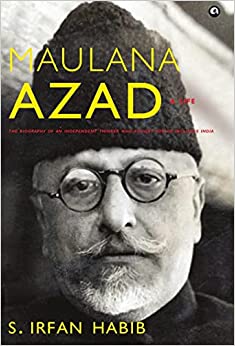
Title: Maulana Azad – A Life

Author: S.Irfan Habib

Publisher: Aleph Book Company

At a time when India is celebrating its 75th anniversary of independence, it is only fitting that Maulana Azad’s contributions to the country should be remembered. He was one of the most prominent Muslim leaders in India’s freedom movement, whose contribution to the establishment of the education foundation in India is recognised by observing his birthday across the country as “National Education Day”.

Azad became the youngest member of Congress to hold a presidential post. Using his position to work to re-unite the Swarajists and the Khilafat leaders under the common banner of the Congress. He opposed the Partition of India because he thought Muslims would be more powerful and dominant in a united India. After independence, he became the first Minister of Education in the Indian government. In 1992, he was posthumously awarded India’s highest civilian award, the Bharat Ratna.

Maulana Azad – A Life by S. Irfan Habib is “the biography of an independent thinker who fought for an inclusive India”. In this in-depth chronicle, historian Habib takes the reader through some of the most decisive moments in Azad’s life.

 A widely published historian of science and modern political history, Habib was the Maulana Azad Chair at the National University of Educational Planning and Administration, New Delhi. He has authored To Make the Deaf Hear: The Ideology and Programme of Bhagat Singh and His Comrades and is the editor of Indian Nationalism: The Essential Writings.

Says the blurb: “Born into an orthodox family of famed Islamic scholars, Azad was deeply influenced by the pan-Islamic philosophies of Sir Syed Ahmad Khan and Jamaluddin Afghani. Azad had no formal education, but he was an autodidact who taught himself about culture, philosophy, languages, and literature. As a teenager, he successfully published several magazines and newspapers and went on to publish the immensely popular Urdu weekly Al-Hilal through which he tried to persuade Indian Muslims to shake off the shackles of British rule. He became inspired by Gandhi’s non-violent civil disobedience movement and was extremely critical of the Muslim League’s communal politics.”

Azad’s unusual upbringing, his illustrious family, upheavals in the Islamic world, and the initial inklings of Azad’s freethinking outlook on life. ‘Maulana Azad and Critical Thinking in Islam’ examines the various schools of thought, ethical questions, and pan-Islamic debates that shaped Azad’s religious attitudes and his approach to the idea of nationalism. ‘Azad, Islam, and Nationalism’ looks at Azad’s political career and his unwavering belief in composite nationalism and staunch opposition to the Muslim League’s sectarian politics. ‘Ghubar-i-Khatir Beyond Faith and Politics’ lays bare Azad’s philosophical moorings and personal likes and dislikes through a collection of epistolary essays written during his imprisonment in the Ahmednagar Fort prison in the 1940s. And, finally, ‘Building a New India’ charts Azad’s efforts to strengthen the country’s weak education system through initiatives aimed at primary and adult education, his efforts towards the scientific and cultural advancement of the country, and his contribution to the arts and culture of a newly independent nation.”

As Habib writes, “justice is all the more relevant to education as a process of harmonious nurture. Indeed, social justice commands a pivotal place in Azad’s general perspective, which influenced his educational outlook quite profoundly. He was conscious of the fact that a class or caste-ridden education system needed to be replaced by a more inclusive and just educational order. In 1948, while addressing the educational conference, Azad again reiterated that education, at any rate, must be pushed forward as rapidly as possible. We must not, for a moment, forget that it is the birthright of every individual to receive at least the basic education, without which he cannot discharge his duties as a citizen.”

Writes Habib : “With a view to gearing education towards the cause of democracy, he, in his very first official statement, referred to Disraeli’s verdict: ‘A democracy has no future unless it educates its masters.’” In independent and democratic India, with universal franchise as the key principle, the voter was truly the master of democracy, and Azad wanted this voter to be educated and aware. He was conscious of the sad inheritance of colonial inequalities, where 85 per cent of the country’s population was illiterate on the eve of Independence. Several classes and caste discriminations were discussed for the first time, and it was necessary to eliminate them immediately.

Azad was convinced, according to the biography, that the state had to play a key role in combating such social afflictions and provide everyone with the means to “the acquisition of knowledge and self-betterment”; however, the most disconcerting factor was the lack of necessary funds to carry forward the state’s responsibilities. Azad conceded with a sense of guilt as minister of education that the central government had allotted only 1 per cent of the funds in the budget for education. He therefore urged the Constituent Assembly to raise expenditure to 10 per cent.

Maulana Azad pursued the issue with passion and was able to raise the allocation from Rs 20 million to around Rs 350 million during his tenure as minister of education. On September 30, 1953, Azad addressed the nation on All India Radio, reiterating that “every individual has a right to an education that will enable him to develop his faculties and live a full human life.”

In about three hundred pages of inexorable text, Habib reconstructs the life of the remarkable man while arguing that Azad is more relevant now than ever before. An essential read for understanding India’s pre-independence history and the significance of a dedicated life.   

Bhaskar Parichha is a journalist and author of UnbiasedNo Strings Attached: Writings on Odisha and Biju Patnaik – A Political Biography. He lives in Bhubaneswar and writes bilingually. Besides writing for newspapers, he also reviews books on various media platforms.

PLEASE NOTE: ARTICLES CAN ONLY BE REPRODUCED IN OTHER SITES WITH DUE ACKNOWLEDGEMENT TO BORDERLESS JOURNAL

Click here to access the Borderless anthology, Monalisa No Longer Smiles

Categories
Editorial

Will Monalisa Smile Again?

The first month of 2023 has been one of the most exciting! Our first book, Monalisa No Longer Smiles: An Anthology of Writings from across the World, is now in multiple bookstores in India (including Midlands and Om Bookstores). It has also had multiple launches in Delhi and been part of a festival.

We, Meenakshi Malhotra and I, were privileged to be together at the physical book events. We met the editor in chief of Om Books International, Shantanu Ray Chaudhuri, the editor of our anthology, Jyotsna Mehta, along with two translators and writers I most admire, Aruna Chakravarti and Radha Chakravarty, who also graced a panel discussion on the anthology during our physical book launch. The earlier e-book launch had been in November 2022. My heartfelt thanks to the two eminent translators and Chaudhuri for being part of the discussions at both these launches. Chaudhuri was also in the panel along with Debraj Mookerjee at a launch organised by Malhotra and the English Literary Society steered by Nabaneeta Choudhury at Hans Raj College, Delhi University. An energising, interactive session with students and faculty where we discussed traditional and online publishing, we are immensely grateful to Malhotra for actively organising the event and to the Pandies’ founder, Sanjay Kumar, for joining us for the discussion. It was wonderful to interact with young minds. On the same day, an online discussion on the poetry in Monalisa No Longer Smiles was released by the Pragati Vichar Literary Festival (PVLF) in Delhi.

At the PVLF session, I met an interesting contemporary diplomat cum poet, Abhay K. He has translated Kalidasa’s Meghaduta and the Ritusamhara from Sanskrit and then written a long poem based on these, called Monsoon. We are hosting a conversation with him and are carrying book excerpts from Monsoon, a poem that is part of the curriculum in Harvard. The other book excerpt is from Sanjay Kumar’s Performing, Teaching and Writing Theatre: Exploring Play, a book that has just been published by the Cambridge University Press.

Perhaps because it is nearing the Republic Day of India, we seem to have a flurry of book reviews that reflect the Sub-continental struggle for Independence from the colonials. Somdatta Mandal has reviewed Priya Hajela’s Ladies Tailor: A novel, a book that takes us back to the trauma of the Partition that killed nearly 200,000 to 2 million people – the counts are uncertain. Bhaskar Parichha has discussed MA Sreenivasan’s Of the Raj, Maharajas and Me, a biography of a long serving official in the Raj era — two different perspectives of the same period. Rakhi Dalal has shared her views on Shrinivas Vaidya’s A Handful of Sesame, translated from Kannada by Maithreyi Karnoor, a book that dwells on an immigrant to the Southern part of India in the same time period. The legendary film writer K.A. Abbas’s Sone Chandi Ke Buth: Writings on Cinema, translated and edited by Syeda Hameed and Sukhpreet Kahlon, has been praised by Gracy Samjetsabam.

We have a piece on mental health in cinema by Chaudhuri, an excellent essay written after interviewing specialists in the field. Ratnottama Sengupta has given us a vibrant piece on Suhas Roy, an artist who overrides the bounds of East and West to create art that touches the heart. Candice Louisa Daquin has written on border controls and migrants in America. High profile immigrants have also been the subject of Farouk Gulsara’s ‘What do Freddy Mercury, Rishi Sunak & Mississipi Masala have in Common?’ Sengupta also writes of her immigrant family, including her father, eminent writer, Nabendu Ghosh, who moved from Bengal during the Partition. There are a number of travel pieces across the world by Ravi Shankar, Meredith Stephens and Mike Smith — each written in distinctively different styles and exploring different areas on our beautiful Earth. Sarpreet Kaur has revisited the devastation of the 2004 tsunami and wonders if it is a backlash from nature. Could it be really that?

Suzanne Kamata gives us a glimpse of the education system in Japan in her column with a humorous overtone. Devraj Singh Kalsi dwells on the need for nostalgia with a tongue-in-cheek approach. Rhys Hughes makes us rollick with laughter when he talks of his trip to Kerala and yet there is no derision, perhaps, even a sense of admiration in the tone. Hughes poetry also revels in humour. We have wonderful poetry from Jared Carter, Ranu Uniyal, Asad Latif, Anaya Sarkar, Michael R Burch, Scott Thomas Outlar, Priyanka Panwar, George Freek and many more.

The flavours of cultures is enhanced by the translation of Nazrul’s inspirational poetry by Professor Fakrul Alam, Korean poetry written and translated by Ihlwha Choi and a transcreation of Tagore’s poem Banshi (or flute) which explores the theme of inspiration and the muse. We have a story by S Ramakrishnan translated from Tamil by R Sathish. The short stories featured at the start of this year startle with their content. Salini Vineeth writes a story set in the future and Paul Mirabile tells the gripping poignant tale of a strange child.

With these and more, we welcome you to savour the January 2023 edition of Borderless, which has been delayed a bit as we were busy with the book events for our first anthology. I am truly grateful to all those who arranged the discussions and hosted us, especially Ruchika Khanna, Om Books International, the English Literary Society of Hans Raj College and to the attendees of the event. My heartfelt thanks to the indefatigable team and our wonderful writers, artists and readers, without who this journey would have remained incomplete. Special thanks to Sohana Manzoor for her artwork. Many thanks to the readers of Borderless Journal and Monalisa No Longer Smiles. I hope you will find the book to your liking. We have made a special page for all comments and reviews.

I wish you a wonderful 2023. Let us make a New Year’s wish —

May all wars and conflicts end so that our iconic Monalisa can start smiling again!

Mitali Chakravarty,

borderlessjournal.com

.

Photographs of events around Monalisa No Longer Smiles: An Anthology of Writings from across the World. Click here to access the Book.

.

Insta Link to an excerpt of the launch at Om Bookstore. Click here to view.

E-Launch of the first anthology of Borderless Journal, November 14th 2022. Click here to view.

Categories
Essay

A Solitary Pursuit: The Art of Suhas Roy

Ratnottama Sengupta journeys with the signature art of Suhas Roy as it transformed in theme, style, and medium

Suhas Roy = Radha.

Correct.

Suhas Roy = Crows.

Right. 

Suhas Roy = Jesus.

So true.

Suhas Roy = Sensuality.

Yes. Witness the Mistress of the Moon.

For each of these Suhas Roy (1936-2016) was chased by galleries and collectors. His works have been widely exhibited and are well documented. Many of them on view at Mumbai’s prestigious Jehangir Art Galley (January 17 to 23, 2023) are not on sale. The intention is to train viewers on the diversity and skilfulness of the much loved artist from Bengal. In short, to hold up the totality of the artist who enriched Contemporary Indian Art with sketches in Western Academic style, graphics, landscapes; with his series on Crow, Jesus, Radha, The Seductress of Khajuraho; with aluminium paint on glass, acrylic on paper, egg tempera on canvas…

So where do we start? Where did he? There’s a story at every turn in the journey, so let’s start at the very beginning.

A little boy in Tejgaon, now in Bangladesh, had lost his father when he was not even two. One Kaji Saheb, who taught geography in the village school and doubled as the art teacher, took the child under his wings. If the boy learnt to outline India on the blackboard, he could also draw papayas and brinjals. And everything he drew scored 10 on 10. His teacher would say, “It seems you’ll grow up to be an artist!”

The boy loved to spend all his hours drawing and fishing. “How will these pleasures serve you in life?” the family elders would admonish him. The youth would smile in reply and go on, eventually to join the Indian Art College, study new methods of printmaking under Somenath Hore and S W Hayter, visit Paris and Florence to study Michelangelo’s David and Pieta…

Suhas Roy

However, Paris post WWII was an eye-opener for artists like Suhas Roy and, a decade before him, for Krishna Reddy, who had graduated from Santiniketan. Both India and Europe had come out of prolonged periods of turmoil. But, poised on the threshold of an independent existence as a sovereign nation, India was looking back to its roots for defining its identity, whereas England and France and Germany – which were eager to get over the bitterness left by their recent history – were looking for a complete break with the past. For Suhas Roy, returning home meant returning to his cultural roots. And Venus emerging from the Water became kin of the image of goddess Lakshmi emerging from the lotus-laden pond closer home.

*

This Indian-ness was reinforced when he joined Santiniketan as a painting teacher. The lush green environs, the ponds and rivulets, the chirping birds and rustic villagers took him back to the childhood haven snatched away by the politics of religion that had culminated in the Partition of the Subcontinent. Suhas Roy, raised in the British Academic mood, with undying admiration for the values of the Italian Renaissance and the visions of the French Classicists, riding the high tide of Modernism, debating whether to go Abstract or Semi-Abstract, started painting landscapes!

Yes, landscapes. Regardless of what the critics said – just as they did for the Bengal Masters – Suhas Roy was not being ‘regressive’. For, he did not paint any particular spot with fidelity to topography – as John Constable did. Instead, his landscapes were an expression of his yearning for a paradise lost: his place of birth. When he moved from Kolkata to Santiniketan, in a reflection of spatial reality the neighbourhood palm trees started putting their heads up in his paintings. His sensitive foliage, the birds and animals and ponds were all in answer to his quest for the luxuriant green he had left behind, across the Radcliffe Line.

“Santiniketan gave me back the opportunity to go fishing as I used to in East Bengal, and I rediscovered the beauty and calming effect of Nature,” he had said to me when I curated the Living Santiniketan exhibition in Delhi of late 1990s. “It came as a relief to me, burdened as I was with the constant thought of ‘What to paint?’ For, Nature constantly changes.” Additionally, he realised that appreciation of beauty is not confined to a class or profession. “Doctors and poets alike love flowers. So, I decided to go back to landscape, taking no note of whether it was in fashion or out of it.”

*

The crow, very much a part of the Bengal landscape, then became his signature in the 1970s. The scavenger was an attraction because of its black feathers. Japanese water-colourist Yokoyama Taikan (1868-1958) — notable for his role in creating the painting technique of Nihonga — had come to Bengal in early 20th century with scholar Okakura Kakuzo (1863-1913) and helped Abanindranath Tagore master the medium. He had done a series of Mount Fuji in black-n-white. Chancing upon that in the Santiniketan library, Suhas was so impressed as to reach for the austere palette. The crow readily lent itself to the scheme. Spraying the canvas with acrylic paint before construing the image in watercolour, Suhas would use a Japanese colour stick to create tones and dimensions. The Far Eastern concept of an object in a wide open space came to be highly appreciated and widely collected – including by philanthropist politician, Karan Singh.

In Indian philosophy and literature, Nature is the Eternal Feminine. That could be why, after ten years of doing landscape, Suhas Roy’s imagination sought out the allied image of tribal girls. It was a natural progression, for women – especially tribal women – have a symbolic if not symbiotic link with trees. Often, he would counterpoise a tree with a woman. Taru[1], he titled one done in an art workshop.

From a woman in a landscape to Radha was just one step away. For an exhibition on Krishna organised by Gallery 88 of Kolkata, Suhas Roy played with the concept of the Blue God being the Ultimate Being. Melding Purush and Prakriti – the Male and the Female forces of the Universe – his canvas sported a nude woman against a dark blue background. The painting, titled ‘Radha’, not only sold for an enviable sum, but it also set in motion an astonishing demand for the image that shows no sign of abating.

Truly he basked in the adulation of resolved collectors, one of whom said, “When I am tossed and tired of problems, I look at your paintings. They act like balms.” Yet, for painting these very ‘balms’ the artist had to hear the criticism that he was feeding the appetite for calendar art. His Radha was a concept no better than the ‘mass produced’ icons ubiquitous in Indian spaces.  But the master was far from apologetic. “It is the very definition of icons,” he had pointed out to me one afternoon. “Images of personalities deified by popular imagination, be they mythical, historical or social, are repeated again and again, generation after generation, in different styles and contexts.” If one age worshipped them as bronze figurines and gold paintings, another flaunted them in oleographs and calendars. It has been so with Radha-Krishna, Ram-Sita, Buddha-Jesus, and even with Gandhi-Tagore-Teresa, I realised.

*

Jesus, though, had entered Suhas Roy’s world long before Radha. Sometime in 1969 he had visited Florence to see David. He found the sculpture epitomising masculine beauty “too proportionate”, and wandered into the church next door preserving Dante’s Divine Comedy in parchment. There, in one corner, he saw the last work of Michelangelo – an unfinished Pieta. Such infinite pathos! The artist could not brush it off his memory even after he returned to Calcutta and one day its picture postcard inspired him to paint a Jesus. When he stopped, the canvas was sporting a contemporary pieta – Jesus without the head, his body descending from the heavens.

As a persona, Suhas Roy had deep regards for Jesus. He was, to the Bengali artist, a symbol of forbearance. Perhaps he also saw the serene visage of the Prophet sporting a Crown of Thorns as a reflection of his own self – or was it of his country, that had been crowned with an Independence bloodied by Partition? Somewhere Suhas, a father who in his own lifetime lost both his children to Eternal Sleep, saw Jesus as a redeemer who showed mankind how to bear every suffering and pain that was a mortal’s lot. That is why such palpable love, even when tinged with sorrow, pain or sadness, flows out of His veins. This must have prompted even Vatican to acquire his Jesus in 2006.

Suhas Roy arrived at ‘Khajuraho’ in the mature years of his well lived life. He was intrigued by the carvings on the walls of the temples in central India that have embarrassed some and outraged some. Considered the descendants of the celestial Moon, the Chandela rulers had celebrated love in every expressed formation. Love, the invincible bonding between man and woman, man and man, indeed between man and all living beings, is made explicit here. Surely Suhas Roy was not equating love with lust. Was there a spiritual pursuit layering the physicality of the actions immortalised in stone?

No doubt there was. For Moon has always been equated with romance, love, passion. The artist was exploring the mysticism that wraps the ascetic deity inside the temple. Much like the sculptors of yore, his ‘Seductress’ is a quest for the sublime. If the ancients believed that you must leave all your worldly longings outside the temple door if you seek moksha, deliverance, the contemporary artist continually sought nirvana, redemption from conflict, in the beauty of peace.

*

Rigidity was unknown to Suhas Roy. The changes in his art came spontaneously, and every good result goaded him to go on. He dwelt on a theme only until another creative urge besieged him, be it Khajuraho, the series he titled Mistress of the Moon, or Cappadocia in Turkey. Never shy of experimenting, his foremost concern – always – was meticulous quality. His temperas would have egg yolk with oil and Japanese porcelain, gelatin with resin and tamarind seed. If it held the promise of a finer texture for details, he would use a watercolour brush for oil paintings. For, he would repeat, “Good art will never lose its demand just as diamond will never lose its market.”

For Suhas Roy, the aesthetic and the spiritual were one and the same. And even the hurly-burly of political turmoil had to adhere to his norms of aesthetics. Did Suhas Roy, then, live in an ivory tower away from social realities? No, he insisted, he “never ran away…” Once, on a fishing trip outside Santiniketan, he witnessed dead bodies being fished out of water following a flash flood in Ilam Bazar. Haunted by that image he had painted the Disaster series, depicting landscapes with shrouded bodies. Indeed, when the Naxalite period gave rise to despondency, he was tossed by the political reality of his land. But he prophesized that “every turmoil, be it social or political – including the ongoing one at Singur – would be short-lived.” So, if contemporary art became mere documentation, then that too would be short-lived!

“Only when it transcends the here-and-now can art have lasting value,” maintained the artist even when disturbed by the dark side of humanity. So, though distressed by cruelty, he chose to decry war by showing not blood-spill but the meditative power of peace and sublimity of love. “I focused on what has lasting appeal. Flowers blossom in the same fields that are crushed by battling soldiers. I speak of the war through the Buddha who transcended war.”

This sublime pursuit of Suhas Roy explains the unending appeal of his Seductress, his Radha, his Jesus.

Bonophul

[1] Translates to tree

*All the photographs have been sourced by Ratnottama Sengupta

Ratnottama Sengupta, formerly Arts Editor of The Times of India, teaches mass communication and film appreciation, curates film festivals and art exhibitions, and translates and write books. She has been a member of CBFC, served on the National Film Awards jury and has herself won a National Award. Ratnottama Sengupta has the rights to translate her father, Nabendu Ghosh.

.

PLEASE NOTE: ARTICLES CAN ONLY BE REPRODUCED IN OTHER SITES WITH DUE ACKNOWLEDGEMENT TO BORDERLESS JOURNAL

Click here to access the Borderless anthology, Monalisa No Longer Smiles

Categories
Review

Ladies Tailor

Book Review by Somdatta Mandal

Title: Ladies Tailor: A Novel

Author: Priya Hajela

 Publisher: HarperCollins

Seventy-five years after the Partition of India took place, the cataclysmic event on both sides of the country — in Bengal in the East and in Punjab in the West — has fuelled research on the trauma of migration, loss, and resettlement, and the interest in the theme is still proliferating today. It is interesting to note that apart from documentation through innumerable non-fiction and memoirs, stories of grim reality of the Partition as documented in stories by earlier writers like Sadat Hasan Manto or Khushwant Singh’s Train to Pakistan, the interest on the theme remains unabated even today. The only difference now is that with the passage of time, writers are often relying on memory of the Partition as narrated by their ancestors firsthand, or through books, films and documentaries in a new sort of writing that blends fact and fiction and try to use the background events of migration and displacement into stories of resilience, grit, and people rebuilding their lives anew after crossing borders as refugees with even more stamina.

Priya Hajela’s debut novel Ladies’ Tailor is an attempt to recreate the story of the actual Sikh migration of her paternal grandparents Bakshi Pritam Singh (Papaji) and Beant Kaur (Biji) who left their home in Harial Gujarkhan (Pakistan) and made a new life in Ludhiana, Punjab. Dedicating the book to them, she mentions in the foreword how the places she has written about in the novel – Delhi, (Nizamuddin, Patel Nagar, Khan Market, Shahdara, Kingsway Camp), Lahore, Amritsar and Sukho are all real, but many elements are fictional. All these places provide the setting needed to tell the story, many details imagined and manipulated based on the needs of her characters. Ladies’ Tailor is a story that captures a setting and a group of characters that represent the immigrant and the refugee spirit, the optimistic spirit of never giving up on what you want and a spirit of adventure and entrepreneurship that to this day is the driving force in Delhi and Punjab.

The novel begins primarily with the protagonist Gurdev, a Sikh farmer who had deliberately moved from his parent’s house in Lahore to settle and work in a remote village called Sukho for ten years where all the religious communities lived in harmony and led peaceful lives. It took a lot of time for people to realize the Muslim-Sikh violence in the village that began around 1946 and that resulted in fear, hatred, insecurities as real and when large-scale massacres, butcheries, annihilation of entire clans, that was beyond Gurdev’s imagination happened, and he participated like everyone else. He made a brief visit to Delhi where he judiciously deposited cash with different people so that he could use it later. When he finally decided to migrate to India along with his wife Simrat and their two children, he could not convince his parents in Lahore to join them as they were determined never to leave Pakistan, the birthplace of their gurus.

After braving the horrific massacres and ordeals along the way, Gurdev landed up at Kingsway Camp in Delhi only to reach safety and find new problems ahead of him. Not only is he determined to make a fresh start for himself, his wife and sons, but he proves to be quite a meticulous, strategic planner and motivator for fellow refugees in the camp. Simran, the all-enduring and never complaining type of wife, turns sick and is admitted to the hospital and by the end of the ninth chapter, she silently disappears after that when Gurdev hands her some ornaments that his mother had given her. We don’t hear from her again as well as the two sons who accompany their mother.

Though taken aback, the indomitable Gurdev takes it all in his stride and tries to concentrate on his business and survival instincts. He befriends two sardars, Nirmal Singh, a Ladies’ Tailor, and Sangat Singh, and convinces them to start a business venture for readymade and customised garments of Khadi, an affordable hand-woven fabric preferred by women in the refugee camp and for those who wouldn’t like to wear British fabrics and wanted only ‘Made in India’ clothing. He sets up shop in the upcoming Khan Market, provided by the government in lieu of his land in Pakistan, forms a partnership with a trader in Shahadra to supply superior quality Khadi exclusively to them, and together the four of them start attracting a steady clientele, with Noor, a Muslim war widow from nearby Nizamuddin, as their brand ambassador. Hajela focuses on interfaith camaraderie with intricate details about how survival strategies result in Hindu-Muslim marriages and how names are changed to remain safe in the community.

The next move in the plot comes when Nirmal, the tailor, is somehow dissatisfied with the output because his clothes lack ornate embroidery work, a very important embellishment that used to make his outfits stand out across the border in Lahore. He wants a special sort of embroidery on their garments that was the kind crafted by two orphaned boys in Lahore, who he had nurtured like his own sons. Gurdev, the mastermind, plans a daring trip to Pakistan with Noor as his partner, to bring the two boys to Delhi for Nirmal and for their business to succeed. A complicated procedure begins with Gurdev cutting off his hair and shaving his beard to take on a new Muslim identity, and procuring a false passport, plans to visit Lahore along with Noor posing as his wife. This is where Hajela finds ample opportunity to implant a sort of interfaith romance and love relationship between the two of them. Once they arrive in Lahore, they take shelter in a Hindu man’s house and both of them feel trapped because Shakeela Begum, the mistress, seemed suspicious of their visit and itch to see them in jail. More complications arise with the driver Akbar and actual agents who keep on shadowing them.  

Hajela’s narrative is full of intricate details, be it in the furniture, clothing, food, social mores, and other material objects that prevailed in the Indian subcontinent in the 1940’s and 1950s. She fills the novel with little details like how the cut of the ladies’ salwar could determine which side of the border you belonged to, differences between the taste of the same food in Delhi and Lahore, and how people on both sides believed that one day, when things settled down, they could go back to their homes. Noor’s shopping for glass bangles, jootis, and dupattas with Phulkari[1]work in the tiny stalls of Liberty Market and Anarkali acts as a camouflage for their real mission to trace the two young boys who excel in embroidery. The novelist describes things here in great details, especially with new problems arising each day. But with his survival instincts, Gurdev takes each stride adapting to the situation and his determination to overcome all odds and thrive with new beginnings remains praiseworthy.

Despite crowding the plot towards the end with too many ramifications, like suspicion, counter espionage, breach of trust, car chases, bribing people with American dollars, the protagonists are constantly shadowed by unknown people. Strange twists to the story occur where Gurdev manages to locate his aged parents forcibly living in the outhouse of their grand home in Lahore when they were assumed to have been burnt alive during the riots. The way Gurdev plans to cross over to India once again through a remote and lesser-known spot along the border by bribing people left and right with dollars sounds a bit contrived no doubt and it seems that Hajela wanted to put in too many imagined situations to make her book a page-turner till the end with ample amount of suspense like a mystery thriller. It celebrates the unvanquished spirit of the Punjabi refugees, who, using their skills and energy, made a success of their business. Fairly linear in narration, a lot is left to the imagination at the end and therefore the novel is a feel-good read that celebrates the human spirit’s victory in the face of terrible odds. Apart from narrating the lingering afterlife of the Partition, Hajela’s statement clarifies the mission of her writing quite clear — “It’s not what sets us apart but what brings us together that’s important. How we resist the forces that are intent on separating us is what defines us. How we recover from past transgressions is what carries us forward. Ladies’ Tailor takes a resolute look at stumbling and making amends, at holding close and letting go and at turning back in order to move on.”

[1] A type of folk embroidery of Punjab

Somdatta Mandal, critic and translator, is former Professor of English at Visva-Bharati, Santiniketan, India.

PLEASE NOTE: ARTICLES CAN ONLY BE REPRODUCED IN OTHER SITES WITH DUE ACKNOWLEDGEMENT TO BORDERLESS JOURNAL

Click here to access the Borderless anthology, Monalisa No Longer Smiles

Categories
Nostalgia

Ghosh & Company


Ratnottama Sengupta travels down the path of nostalgia with her ancestors, her parents, eminent writer,  Nabendu Ghosh and his wife, Kanaklata

Nabendu with his children. From right to left: Ratnottama Sengupta, Nabendu Ghosh & Shubhankar Ghosh. Photo provided by Ratnottama Sengupta

Nabadwip Chandra Ghosh of Dhaka was an advocate who had mastered in both, Sanskrit and History. And he was a kirtan[1] singer par excellence. Both these traits have familial roots: His father was a court clerk, his cousin a doctor of those times. And all the males in the Vaishnav family — devotees of Prabhu Jagadbandhu Sundar of Faridpur — were good singers, a talent that was to continue with his sons and grandsons. 

It was for his kirtans in particular that P R Das, brother of freedom fighter Chittaranjan Das (1870-1925), asked Nabadwip Chandra to join him as his junior in Patna High Court. The year was 1920. Bihar which was a part of the Bengal Presidency, was steeped in casteism. The Ahirs — Yadavs who tended cattle and sold milk — were exploited by the Bhoomihars, who were Brahmins, and if they retaliated, they were arrested and put in jails. By 1920s, the freedom movement too had gained steam but the  political prisoners were also clubbed with the ‘hooligan’ Yadavs. Nabadwip Chandra fought courtroom battles to win this deprived section their political right, and came to be highly respected – a father figure for a large section of people in Bihar. 

In fighting those battles Nabadwip realised one thing: the acute need for education among the so called Backward Classes. “Unless a person has education, he or she is not respected and remains vulnerable to exploitation, economic or otherwise,” he maintained. And education is best spread through mothers. Consequently he sought marriage alliances for his sons with daughters of teachers, sisters of lawyers and doctors, and — later — with undergraduates and graduates. 

His elder son was married to Kalyani, the daughter of a school teacher. His third son’s wife, IA passed Sundara, was the daughter of a BA-BL – a lawyer in Bhagalpur. His fourth son’s wife, Namita was again the daughter of a teacher from Ranchi — and she was a graduate who was already teaching before she married, and did her MA after her wedding. So had Nabadwip Chandra’s daughter Rani who, after her tying the knot with Mahesh Chandra of Jorhat, completed her schooling and mastered in Economics. Further she taught in JB College, Jorhat and went on to become the vice principal whose students included Tarun Gogoi who rose to hold the high office of the Chief Minister of Assam.

In fact, Nabadwip Chandra’s own wife, Suniti Bala, was the daughter of a minister in the minor royalty of Jessore — a man who won a gold medal as one of the first matriculates of British India. His entire family was keen on education — and Suniti was not only literate, she received formal education at home before she was married at the age of 15 — which was pretty advanced for the first decade of 1900s. All her life, after child bearing, rearing kids, attending to household chores in the kitchen, she would spend her ration of leisure hours reading books and in her  later years, telling stories to her grandchildren.

*

Nabadwip and Suniti’s second son Nabendu inherited his parents’ love for letters. And he took it to a much higher level as a writer who carved a place for himself in the history of Bengali literature and of Hindi Cinema. He started writing early, when still in middle school, as he wrote for and co-edited a handwritten magazine. Even as a teenager he would attend Sahitya Sammelans and while in College he got published in sought-after literary magazines. 

But Nabendu did not stop with words alone. Along with singing kirtans, a talent he inherited from his father, he trained himself to dance in the mould of Uday Shankar. He would regularly dance and act on stage, in Patna and elsewhere in the state, and subsequently played memorable cameos in Bombay films too. Before he passed away at the full age of 91, he had penned 16 novels, 28 collections of stories, and nearly a hundred screenplays for Bollywood classics.

On January 31, 1944 he married Kanaklata. Sister of advocate Bhupendranath Ghosh from Malda. She turned out to be an architect of human lives. Kanak was born to Chandrakanta Ghosh, a landed gentry who was forward looking enough to will large tracts of agricultural land to his daughters at a time when all they were entitled to was Streedhan — jewellery given at the time of marriage. Still, his wife Dakshayani, who was ‘Karta’ — head of the Hindu joint family — after his death, decided to live a part of her sunset years in Vrindavan, the holy land of Vaishnavs.

Kanaklata had not completed her school years when she was married to Nabendu. But being a doughty soul, the 16-year-old not only read Nayak O Lekhak — Nabendu’s first published novel; she got it critiqued by an academic cousin (who later became a professor) before she consented to the marriage with a man older to her by ten years.

Kanaklata’s own education had to be shelved as she became a mother twice over; lost her first born; faced an uncertain future as Nabendu lost two successive government jobs because of his ‘seditious’ – anti-imperialist — writings; and then Partition uprooted the family that had to leave Bengal and seek livelihood in Bombay’s tinsel town. But, despite her young years, it was she who instilled in her husband the spirit to soldier on with his pen and not succumb to any compromise in his literary efforts. 

Kanaklata: Photo Courtesy: Monobina Roy

She herself did not surrender her appetite for formal education to circumstances. Years after her sons and daughter had graduated from universities and she had become a grandmother thrice over, she enrolled in Open Classrooms and got her Master’s certificate in Bengali language. 

In the intervening years? Her home provided a platform to umpteen writers, country cousins, sisters, nephews, nieces, even to nobodies. She was there at 2 Pushpa Colony when they wanted to pursue higher education in Bombay, or make a career in the country’s financial capital,  or shine in the tinsel town. She helped to negotiate marriage proposals, and she supported in every way she could, those who sought medical intervention by specialists. Simultaneously she secured the financial future of her nuclear family by judiciously building houses and investing in government bonds. 

Most of all, Kanaklata was the architect of the lives of her three offspring. Her eldest son Dipankar who, as a child, was legendary in family gatherings for his mischiefs and pranks, was groomed in Shivaji Military Preparatory School. Thereafter she ensured that he trained in Medicine at the Nil Ratan Sarkar Medical College in Kolkata. Once he became a doctor he served with Oxfam during the Bangladesh Liberation War. 

This education stood him in good stead when he went to UK and joined the Royal Army Medical Corp that swung into action during skirmishes in Belize, the Carribian country in Central American land, in 1986, and again in Desert Storm, the first Gulf War of 1991. When the Berlin Wall fell in 1990, he was serving in Belsen, where the Nazis had set up a concentration camp sometime in 1943. He went to the minefields of Bosnia, which Princess Diana visited in 1997. In mid-1990s he was stationed in Brunei, where the British Military protects the Sultan; at the turn of the millennium, he was in Cyprus, which the British forces use as base for both military and humanitarian operations in the region that often saw dissonance. What a rich life of experiences in helping the injured and ailing! 

At her insistence, Kanaklata’s second son Subhankar was trained in direction at the Film and Television Institute of India. He came out to be Associate Director of Damul (1984). He rose to  partner his father in the making of the classic, Trishagni (1989), to direct the National award winning Woh Chhokri (1993). With teleserials like YugantarNishkriti and Dances of India showing on Doordarshan he was a name to reckon with on the National network in its heyday. Then he went on to teach filmmaking in Mumbai’s Whistling Woods and to set up the wing of Filmmaking Studies in the National University of distant Fiji. 

*

And Kanaklata raised the youngest of her brood, their only daughter Ratnottama, to cultivate the inheritance from her father, in literature, cinema and the arts. Even before the word global environment gained currency, by demonstrating how not to chuck everything in the bin, she drove home to her daughter the concepts of ‘re-use and re-cycle’. Blessed with green fingers, she shared with neighbours and friends the fruits of her ‘farming’ in the patch of green surrounding their Goan-style bungalow in the Mumbai suburb of Malad – and inculcated in her children the importance of green environs. Cooking, she taught me, was as significant in our everyday life as banking or management of money. And she drilled into me when I was still in school, that “you must earn, even if it’s only a hundred rupees every month. Else, even your own children will not respect you.”

I am always delighted to give this one example of her practical thinking. Soon as her daughter joined college, the home-maker booked a Life Insurance policy for her and directed her to pay the annual premiums. And how could she do it without compromising on her studies? “Simple. Clean the house, sell the waste to the raddiwala; put the ‘income’ in the bank.” At the end of the year, she had the money for the insurance premium and also the experience of banking. This, at a time, when majority of account holders in the bank were men.

Through all this, long before the world started celebrating International Women’s Day, Kanaklata had taught her daughter to be “no less than a son.” For, she ingrained in her, “there is nothing you cannot do if it spells well-being for people in your care…”

Nabendu and his wife, Kanaklata. Photo provided by Ratnottama Sengupta

[1] Religious songs

Ratnottama Sengupta, formerly Arts Editor of The Times of India, teaches mass communication and film appreciation, curates film festivals and art exhibitions, and translates and write books. She has been a member of CBFC, served on the National Film Awards jury and has herself won a National Award. 

.

PLEASE NOTE: ARTICLES CAN ONLY BE REPRODUCED IN OTHER SITES WITH DUE ACKNOWLEDGEMENT TO BORDERLESS JOURNAL

Click here to access the Borderless anthology, Monalisa No Longer Smiles

Categories
Poetry

Poems by Sukrita Paul Kumar

Sukrita Paul Kumar
TEDDY BEAR ON THE WAR FRONT
(News Report from Irpin, Ukraine, 2022) 
					
The teddy bear sits benumbed
presiding over the rubble
Of civilisation
Of compassion
Of humanity
A debris of fun and play

Teddy sits smirking over the  
Skeleton of the cat, her
Bones, a curled cadaver 
Her couch and cushions 
in smithereens

The house shredded by the missile 
Walls cracking and crumbling with the  
Child’s screams as shards
From the tiny throat

Teddy bear, the dumb survivor,
No arms to melt his frozen heart
Watching the carnage with
Big round buttons 
gyrated into unseeing eyes

Wrapped in grief
The gentle wool on Teddy spikes
The bristles stand stiff and sharp
Rivers of tears flow 
Into the turbulent ocean 

And a tsunami of teddy bears 
Marches into the war zone
Looking for children to comfort


TELLING VIGNETTES 
			
It’s dementia…

For grandmother
It’s a staccato war

Ends each day and
Starts the next morning again

            it is a re-wind
                     to World War II 

        the wake of bombing
        kills people seventy years later

*

Pregnant with deadly nightmares 
Moskva the missile cruiser sank

The Black Sea swallowed all her bombs 
Stuffed with a thousand deaths


*

Bullet marks on the walls
        remnants of war
people in homes behind
	unhealed  

*

Ghosts born of bombs
are stripped of death
        Sans the mortal attire 

        They live on to haunt

*


The web of nerves on
      the inert dog’s neck
             pulsates
                     with lifelessness
It’s wartime


*

More live than the forlorn dog
are the shadows of bullets on 
the walls of Irpin

Deep craters on the earth
hold silence
born of the boom

*

They are not moon craters 

       These on the earth mark 
       technology of warfare

       Massive progress
       in hunting and
       getting the big kill

Sukrita Paul Kumar, former Fellow of Indian Institute of Advanced Study, Shimla, held the prestigious Aruna Asaf Ali Chair at Delhi University. An honorary faculty at Corfu, Greece, she was an invited resident poet at the prestigious International Writing Programme at Iowa, USA. Her most recent collections of poems, are Vanishing Words, Country Drive and Dream Catcher. Her critical books include Narrating Partition, The New Story and Conversations on Modernism. She has co-edited many books, including Speaking for Herself: Asian Women’s Writings (Penguin). An Honorary Fellow at HK Baptist University, Hong Kong, she has published many translations and has held exhibitions of her paintings. Currently she is series co-editor of “Writer in Context” volumes being published by Routledge UK and South Asia.

PLEASE NOTE: ARTICLES CAN ONLY BE REPRODUCED IN OTHER SITES WITH DUE ACKNOWLEDGEMENT TO BORDERLESS JOURNAL

Click here to access the Borderless anthology, Monalisa No Longer Smiles