Categories
Editorial

Though I Sang in my Chains like the Sea…

      Time held me green and dying
Though I sang in my chains like the sea.

Fern Hill by Dylan Thomas (1914-1953)

Perhaps when Dylan Thomas wrote these lines, he did not know how relevant they would sound in context of the world as it is with so many young dying in wars, more than seven decades after he passed on. No poet does. Neither did he. As the world observes Dylan Thomas Day today — the day his play, Under the Milkwood, was read on stage in New York a few months before he died in 1953 — we have a part humorous poem as tribute to the poet and his play by Stuart McFarlane and a tribute from our own Welsh poet, Rhys Hughes, describing a fey incident around Thomas in prose leading up to a poem.

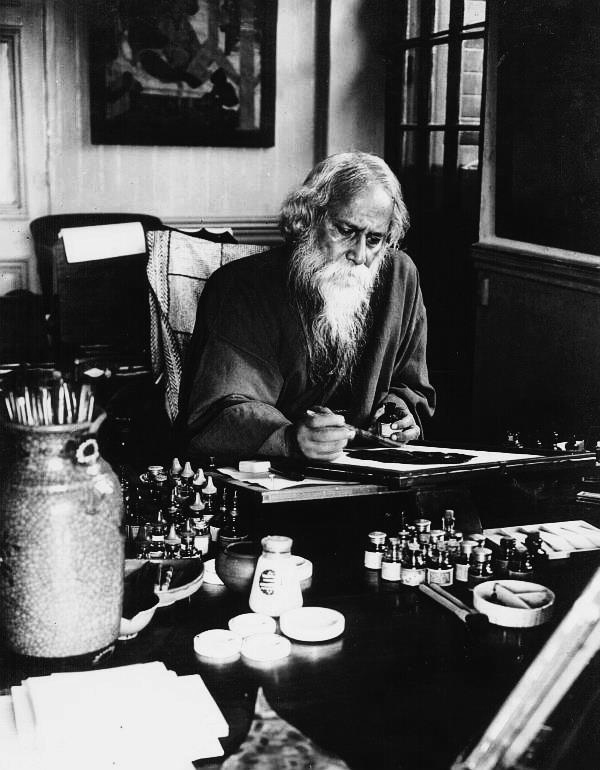
May seems to be a month when we celebrate birthdays of many writers, Tagore, Nazrul and Ruskin Bond. Tagore’s birthday was in the early part of May in 1861 and we celebrated with a special edition on him. Bond, who turns a grand ninety this year, continues to dazzle his readers with fantastic writings from the hills, narratives which reflect the joie de vivre of existence, of compassion and of love for humanity and most importantly his own world view. His books have the rare quality of being infused with an incredible sense of humour and his unique ability to make fun of himself and laugh with all of us. 

Nazrul, on the other hand, dreamt, hoped and wrote for an ideal world in the last century. The commonality among all these writers, seemingly so diverse in their outlooks and styles, is the affection they express for humanity. Celebrating the writings of Nazrul, we have one of his fiery speeches translated from Bengali by Radha Chakravarty and a review of her Selected Essays: Kazi Nazrul Islam by Somdatta Mandal. An essay from Niaz Zaman dwells on the feminist side of Nazrul while bringing in Begum Roquiah. Zaman has also shared translations of his poetry. Professor Fakrul Alam, who had earlier translated Nazrul’s iconic ‘Bidrohi or Rebel‘, has given us a beautiful rendition of his song ‘Projapoti or Butterfly’ in English.  Also in translation, is a poem by Tagore on the process of writing poetry. Balochi poetry by Manzur Bismil on human nature has been rendered into English by Fazal Baloch and yet another poem from Korean to English by Ilwha Choi.

Reflecting on the concept of a paradise is poetry from Michael Burch. Issues like climate, women, humanity, mourning, aging and more have been addressed in poetry by Shamik Banerjee, Ryan Quinn Flanagan, Milan Mondal, Kirpal Singh, Craig Kirchner, George Freek, Michael Lee Johnson and many more. Hughes brings in a dollop of humour with his response to a signpost in verse. Irony is woven into our non-fiction section by Devraj Singh Kalsi’s musing on writers and assailants. Ravi Shankar explores his passion for computers in a light vein. Snigdha Agrawal gives us a poignant story about a young child from the less privileged classes in India. Suzanne Kamata writes to tell us about the environment friendly Green Day in Japan.

Ratnottama Sengupta this month converses with a dancer who tries to build bridges with the tinkling of her bells, Sohini Roychowdhury. Gita Viswanthan travels to Khiva in Uzbekistan, historically located on the Silk Route, with words and camera.  An essay on Akbar Barakzai by Hazran Rahim Dad and another looking into literature around maladies by Satyarth Pandita add zest to our non-fiction section. Though these seem to be a heterogeneous collection of themes, they are all tied together with the underlying idea of creating links to build towards a better future.

Our stories travel from Malaysia to France and India. Farouk Gulsara sets his in futuristic Malaysia, again exploring the theme of utopia as did his earlier musing. Paul Mirabile creates a story where a child tries to create his own idyllic paradise while Kalsi writes of fiction centring around a property tussle. The book reviews feature a couple of non-fiction. Other than Kazi Nazrul Islam’s essays, Bhaskar Parichha reviews Will Cockrell’s Everest, Inc. The Renegades and Rogues Who Built an Industry at the Top of the World. Ajanta Paul discusses Bitan Chakraborty’s The Blight and Seven Short Stories, translated from Bengali by Malati Mukherjee. Malashri Lal has written on Lakshmi Kannan’s Nadistuti: Poems, poems dedicated to Jayanta Mahapatra who the poet reflects lives on with his verses. And that is so true, considering this issue is full of poets who continue in our lives eternally because of their words. That is why perhaps, we recreate their lives as has Aruna Chakravarti in Jorasanko.

In focus this time is a writer whose prose is almost akin to poetry, Rajat Chaudhuri. A proponent of solarpunk, his novel, Spellcasters, takes us to fictitious cities modelled on Delhi and Kolkata. In his interview, Chaudhuri tells us: “The path to utopia is not necessarily through dystopia. We can start hoping and acting today before things get really bad. Which is the locus of the whole solarpunk movement with which I am closely associated as an editor and creator…”

On that note, I would like to end with a couple of lines from Nazrul, who reiterates how the old gives way to new in Proloyullash (The Frenzy of Destruction, translated by Alam): “Why fear destruction? / It’s the gateway to creation!” Will destruction be the turning point for creation of a new world? And should the destruction be of human constructs that hurt humanity (like wars and weapons) or of humanity and the planet Earth? As the solarpunk movement emphasises, we need to act to move towards a better world. And how would one act? Perhaps, by getting in touch with the best in themselves and using it to act for the betterment of humankind? These are all points to ponder… if you have any ideas that need a forum on such themes, do share with us.

We have more content which has not been woven into this piece for the sheer variety of themes they encompass. Do pause by our content’s page and browse on all our pieces.

With warm thanks to our wonderful team at Borderless — especially Sohana Manzoor for her fabulous art — I would like to express gratitude to all our contributors, without who we could not create this journal. We would also like to thank our readers for making it worth our while to write — for all of our words look to be read, savoured and mulled, and maybe, some will evolve into treasured wines.

Thank you all.

Mitali Chakravarty

borderlessjournal.com

Click here to access the content’s page for the May, 2024 Issue

.

READ THE LATEST UPDATES ON THE FIRST BORDERLESS ANTHOLOGY, MONALISA NO LONGER SMILES, BY CLICKING ON THIS LINK.

Categories
Nazrul Translations

Projapoti or Butterfly by Nazrul

Projapoti or Butterfly by Nazrul, translated by Professor Fakrul Alam

Projapoti! Projapoti! 

Butterfly, dear butterfly,
From where did you get such colourful wings?
Wings flaming red and blue,
Such sparkling, wavy wings!
I see you getting drunk sipping the honey of wildflowers.
Be my friend; share some of the liquor with me.
Lend me your pollen-tinted golden-silvery wings as well.
My mind doesn’t like the idea of going to school anymore.
Butterfly, dear butterfly—please, please take me along
As your companion. You dance in the wind as you go…
This day, why not share your delight with me too?
I don’t want to wear the dress I have on anymore.
Let me wear your flaming, sparkling dress from now on!
A rendition of the song in Bengali by a legendary singer, Feroza Begum (1930-2014)

Born in united Bengal, long before the Partition, Kazi Nazrul Islam (1899-1976) was known as the  Bidrohi Kobi, or “rebel poet”. Nazrul is now regarded as the national poet of Bangladesh though he continues a revered name in the Indian subcontinent. In addition to his prose and poetry, Nazrul wrote about 4000 songs.

.

Fakrul Alam is an academic, translator and writer from Bangladesh. He has translated works of Jibonananda Das and Rabindranath Tagore into English and is the recipient of Bangla Academy Literary Award (2012) for translation and SAARC Literary Award (2012).

.

PLEASE NOTE: ARTICLES CAN ONLY BE REPRODUCED IN OTHER SITES WITH DUE ACKNOWLEDGEMENT TO BORDERLESS JOURNAL

Click here to access the Borderless anthology, Monalisa No Longer Smiles

Click here to access Monalisa No Longer Smiles on Amazon International

Categories
A Special Tribute

 Reminiscing on Tagore… 

Rabindranath Tagore (1861-1941) has a unique place in many lives. His works continue to impact us. His songs continue to feel relevant. It is not easy to grasp him in totality, to comprehend how he towered over divisive constructs created by humans with his work at Sriniketan and Santiniketan, funded eventually by his Nobel Prize money that poured in with his writings. We all unite not just under the umbrella of his writings and wisdom, but also seek solutions from his life and times — a period of dynamic changes, a renaissance. Can we find these answers? Is it to be found in the breeze that wafts across boundaries at war… or in an eternity where he continues to touch hearts… 

For many of us who have not grown up listening to Tagore songs and know of him as a distant figure, here is an attempt to bring his life to you starting with the naming of the infant Rabindranath —  reimagined by Aruna Chakravarti, to his first trip out of his cloistered home in Jorsanko and his first experience of snow as he went to study in England — both translated from his writings by Somdatta Mandal. We have a transcreation of a poem he wrote celebrating his birthday on pochishhe boisakh where he shares the joy of his birth with all of us. We wind up translations with Ratnottama Sengupta’s rendition of a song where he offers his lyrics to all those who are willing to listen. 

Showcasing the current relevance of Tagore is a brief musing from Sengupta. To relate the wonder of Tagore’s lyrics, we have writings from professor Fakrul Alam and Asad Latif, who contend how Tagore continues evergreen… 

Birth

The Naming of Rabindranath: Aruna Chakravarti shares how he chanced upon the name Rabindranath in this excerpt from Jorasanko. Click here to read. 

Joys of Living 

Himalaya Jatra ( A trip to Himalayas) by Tagore, has been translated from his Jibon Smriti (1911, Reminiscenses) by Somdatta Mandal from Bengali. This records his first trip out of Jorasanko as a teenager. Click here to read.

Baraf Pora (Snowfall) by Rabindranath Tagore, gives a glimpse of his first experience of snowfall in Brighton and published in the Tagore family journal, Balak (Children), has been translated from Bengali by Somdatta Mandal. Click here to read.

Pochishe Boisakh (25th of Baisakh), a birthday poem by Tagore(1922), has been translated from Bengali by Mitali Chakravarty. Click here to read.

Bhumika (Introduction) by Tagore has been translated from Bengali by Ratnottama Sengupta. Click here to read.

Rhapsodies 

Heatwave & Tagore

Ratnottama Sengupta relates songs of Tagore to the recent heatwave scorching Kolkata. Click here to read.

The Older I get, the More Youthful Feels Tagore

Asad Latif gives a paean in prose to the evergreen lyrics of Tagore. Click here to read.

Discovering Rabindranath and My Own Self

Professor Fakrul Alam muses on the impact of Tagore in his life. Click here to read.

Celebrate Tagore’s legacy not only with translations but with a unique discussion on Tagore between Aruna Chakravarty and the late Sunil Gangopadhyay (1934-2012). The discussion took place under the auspices of Sahitya Akademi during the celebration of 150 years of Tagore. The book is available online on Amazon, in Om and more bookstores in India and in Bookworm, Bangladesh.

Categories
Contents

Borderless April, 2024

Art by Sohana Manzoor

Editorial

April Showers… Click here to read.

Translations

Baraf Pora (Snowfall) by Rabindranath Tagore, gives a glimpse of his first experience of snowfall in Brighton and published in the Tagore family journal, Balak (Children), has been translated from Bengali by Somdatta Mandal. Click here to read.

Himalaya Jatra ( A trip to Himalayas) by Tagore, has been translated from his Jibon Smriti (1911, Reminiscenses) by Somdatta Mandal from Bengali. Click here to read.

Bhumika (Introduction) by Tagore has been translated from Bengali by Ratnottama Sengupta. Click here to read.

The Fire-grinding Quern by Manzur Bismil has been translated from Balochi by Fazal Baloch. Click here to read.

The Tobacco Lover by Ihlwha Choi has been translated from Korean by the poet himself. Click here to read.

Pochishe Boisakh (25th of Baisakh) by Tagore(1922), has been translated from Bengali by Mitali Chakravarty. Click here to read.

Pandies Corner

Songs of Freedom: Dear Me… is an autobiographical narrative by Ilma Khan, translated from Hindustani by Janees. These narrations highlight the ongoing struggle against debilitating rigid boundaries drawn by societal norms, with the support from organisations like Shaktishalini and pandies’. Click here to read.

Poetry

Click on the names to read the poems

Michael Burch, Kirpal Singh, Scott Thomas Outlar, Nusrat Jahan Esa, George Freek, Snigdha Agrawal, Phil Wood, Pramod Rastogi, Stuart McFarlane, Ahmad Al-Khatat, Shamik Banerjee, Ryan Quinn Flanagan, Lisa Sultani, Jenny Middleton, Kumar Bhatt, Rhys Hughes

Poets, Poetry & Rhys Hughes

In The Desk, Rhys Hughes writes of his writerly needs with a speck of humour. Click here to read.

Musings/Slices from Life

Heatwave & Tagore

Ratnottama Sengupta relates songs of Tagore to the recent heatwave scorching Kolkata. Click here to read.

The Older I get, the More Youthful Feels Tagore

Asad Latif gives a paean in prose to the evergreen lyrics of Tagore. Click here to read.

No Film? No Problem

Ravi Shankar takes us through a journey of cameras and photography, starting with black and white films. Click here to read.

Musings of a Copywriter

In Witches and Crafts: A Spook’s Tale, Devraj Singh Kalsi finds a ghostly witch in his library. Click here to read.

Notes from Japan

In Of Peace and Cheese, Suzanne Kamata gives us a tongue in cheek glimpse of photo-modelling mores. Click here to read.

Essays

Discovering Rabindranath and My Own Self

Professor Fakrul Alam muses on the impact of Tagore in his life. Click here to read.

The Lyric Temper

Jared Carter explores the creative soul of poets through varied times and cultures. Click here to read.

Bengaliness and Recent Trends in Indian English Poetry: Some Random Thoughts

Somdatta Mandal browses over multiple Bengali poets who write in English. Click here to read.

Stories

Hope is the Waking Dream of a Man

Shevlin Sebastian gives a vignette of life of an artist in Mumbai. Click here to read.

Viceregal Lodge

Lakshmi Kannan explores patriarchal mindsets. Click here to read.

The Thirteen-Year Old Pyromaniac

Paul Mirabile gives a gripping tale about a young pyromaniac. Click here to read.

Conversation

Ratnottama Sengupta in conversation about Kitareba, a contemporary dance performance on immigrants, with Sudarshan Chakravorty, a choreographer, and founder of the Sapphire Dance Company. Click here to read.

Book Excerpts

An excerpt from Jessica Mudditt’s Once Around the Sun – From Cambodia to Tibet. Click here to read.

An excerpt from Bhaskar Parichha’s Biju Patnaik: The Rainmaker of Opposition Politics. Click here to read.

Book Reviews

Meenakshi Malhotra reviews Mahasweta Devi: Writer, Activist, Visionary, edited by Radha Chakravarty. Click here to read.

Basudhara Roy reviews Out of Sri Lanka: Tamil, Sinhala and English Poetry from Sri Lanka and its Diasporas, edited by Vidyan Ravinthiran, Seni Seneviratne, Shash Trevett. Click here to read.

Swagata Chatterjee reviews Sanjukta Dasgupta’s Ekalavya Speaks. Click here to read.

Bhaskar Parichha reviews Bhang Journeys: Stories, Histories, Trips and Travels by Akshaya Bahibala. Click here to read.

.

Click here to access the Borderless anthology, Monalisa No Longer Smiles

Click here to access Monalisa No Longer Smiles on Amazon International

Categories
Essay

Discovering Rabindranath and My Own Self

Musings by Professor Fakrul Alam

Apnake jana amar phurabe na/Ei Janare shongo tomai chena/

There will be no end to my discovery of myself/And this discovery keeps coming with my discovery of you

On the one hand, Rabindranath Tagore [1861-1941] has been with me almost all my life. On the other, I only began to discover that I had Rabindranath so centrally in me relatively late in my life. In fact, I have now realised that the process of discovering the way he has been embedded in me is part of the process of discovering my own self in the course of the life that I have been leading till now.  Indeed, at this stage of my life, it seems to me that there will be no end to my discovery of the way Rabindranath has become part of my consciousness since I feel that there will be no end to discovering myself till I lose consciousness once and for all. The one thing I can say with certainty, using his words but in my translation is “There will be no end to my discovery of myself.”  For sure, this process of discovering myself endlessly keeps happening with my continuing discovery of Rabindranath.

Surely, the process through which Rabindranath had become embedded in me began in childhood. However, I did not encounter his work in my (English medium) textbooks since I did not learn Bengali in school for a while. How then did I come to remember poems such as “Tal gach ek paye dariye/shob gach chareea/ Uki mare akaashe” (Palmrya tree, Standing on one foot/Exceeding all other trees/Winking at the sky”) or “Amader Choto Nadi chole bnake bnake” (“Our little river keeps winding its way”). How do I remember these opening lines even now? And why do I still associate such palm trees and winding little rivers with these lines even now whenever I am in the Bangladeshi countryside? Surely, it must have been my mother who planted Rabindranath in me in my seed time so that he would become embedded in my unconscious, only to surface in my consciousness decades later. It is surely no coincidence that she taught me Bengali and made me learn Rabindranath’s poems indirectly.

 As a boy growing up at a time when the radio was the main source of entertainment in middle-class Bengali houses, my siblings and I were made to listen to Rabindra Sangeet in our house by my father, who felt that he had to share his favourite songs and singers in the musical genre with us, whether we wanted to listen to them or not. Of course, at that age I would have much rather not listen to those solemn-sounding, soulful songs, and whenever I could put my hands on the radio dials, I would listen to English popular music on Radio Ceylon. My favourite singers were Pat Boone, Elvis Presley, Cliff Richards and—a little later—the Beatles. In school, when we were not playing or talking about sports or girls, we boys would be discussing the pop music we heard on Radio Ceylon. By the end of the 60s, we would be talking about the English thrillers and comedies we saw on Dhaka television. What place could Rabindranath have in one’s life then? If Rabindranath had been placed in my innermost self by my mother through her reading of his poems to us children or my father through his addiction to Rabindra Sangeet, for the moment he was getting occluded deep inside me and, it would now seem, all but forgotten!

But from the middle of the 1960s, our lives in Dhaka began to change as the claims of Pakistan on us East Pakistanis started to loosen, little by little. It was a time when in neighbourhoods and on streets, processions would come out singing gonosangeet—literally songs of the people, but in effect music of protest and patriotism.  First, the Six Points Movement and then the Agartala Conspriacy case were on everyone’s lips and East Pakistanis everywhere were becoming activists in one way or the other. There was no escaping songs like “Shonar Bangla” (“Golden Bengal”) or “Banglar mati, banglar jol, banglar baiuo, banglar phol/Punno houk”” ( “Let the land, the waters, the air and fruits of Bengal be blessed…) and “Bartho Praner Aborjona Purea Phele Agun Jalo” (“Burn the frustrated soul’s detritus and light up a flame”). In my school where we boys now studied “Advanced English” and “Easy Bengali”. There was no way we could have learned enough Bengali to read Rabindranath or Nazrul in the original in any sustained attempt, but how could we escape the call from such songs and poems like Nazrul’s “Bidrohi” (“The Rebel”) or the call from the streets to protest and even burn for our emancipation?  At home, three of my four sisters would be practicing Rabindra Sangeet regularly, since this was what my parents wanted them to do, and so there would be no evading Rabindranath’s songs at home for this reason as well, but I was more interested in friends and sports than staying home and so I would hear the songs only in snatches at this time.

By the end of the decade though, Rabindranath was everywhere in our lives since becoming Bengali became first and being a Pakistani only came later. Even on Dhaka Television, Rabindranath’s songs and dance numbers were being aired fairly regularly then. Outside, one could get to see his plays and dance dramas being performed every now and then in functions and cultural events all over the city. He would soon become an important part of Pohela Boisakh, which itself would become instantly popular amongst us all almost as soon as Chhayanaut[1] organised the first event in Balda Garden as the decade came to a close.  But while Rabindranath was everywhere around me all of a sudden, I was still not reading him at all, preferring English thrillers and westerns initially, and later, when I became a “serious” reader from college onwards, contemporary classics of English and European literature available in English editions.

In the early seventies, however, you could not be in Bangladesh without imbibing Rabindranath at least a little, for there was a process of osmosis at work at this time. Glued as we were to Swadhin Bangla Betar Kendro[2] during our Liberation War[3], we kept listening to his patriotic songs on our radios; the promise of Shonar Bangla seemed alive and possible then. The years after liberation, my generation was exposed to Rabindranath in new ways; we would get to hear and view singers like Kanika, Debobroto and Suchitra Mitra on stage in Dhaka; their songs became freely available in tapes in our shops; and Satyajit Ray’s film version of Rabindranath’s fiction and Ray’s documentary on him became staples of Dhaka’s film societies. I was finally growing up intellectually and was hungry for culture, and so how could I have escaped the poet’s works totally at this time?

But the Rabindranath that I was imbibing thus was almost entirely coming to me aurally and visually. Because he was becoming embedded in my consciousness through songs and the silver screen as well as television, he still inhabited the surface of my consciousness. And I was certainly not making any conscious bid to savor him. The seventies and the eighties were, in fact, decades when I was becoming an even more “serious” student of English literature than before and getting “advanced” degrees in my subject and acquiring expertise for my teaching career; where would I get the time to read Rabindranath then? As an expatriate student for six years in Canada and as a visiting faculty member for two years in the USA, I would be getting small doses of Rabindranath in those countries through the songs I kept hearing in the cassettes I had brought along of my favorite singers and in the occasional film versions of his work that I would get to see because of campus film societies, and I suppose nostalgia played a part in my yearning for him then, but I had no time to spare for him and not enough exposure to his works to let his ideas and his achievement resonate in me in any way.

To sum up my encounters with Rabindranath till then, I was discovering Rabindranath in small doses all the time and experiencing him directly here and there, but my knowledge was all very superficial and my understanding of him too limited. And nothing much had happened that would allow me to tap into the unconscious where all the memories of poems and songs by him I had first come across through my parents’ enthusiasm for his works were hidden.

“Dekha hoi nai chokkhu melia/Ghor hoite shudhu dui pa felia”/

“I haven’t seen with my eyes wide open/what was there only a stride or two away from my house”

In the 1980s, I became smitten by theory, especially the works of Edward Said, and suddenly questions of postcoloniality, ideology, power and location became all-important for my understanding of literature. I was coming around to the belief that I could not be a good and truly advanced student of English literature in Bangladesh, let alone a good teacher of the subject here, unless I sensitised myself to my roots and look at the world around me. And now I remembered some lines I had been hearing since childhood without realising their relevance for me and everyone else around us then: “Dekha hoi nai chokkhu melia/Ghor hoite shudhu dui pa felia” (“I haven’t seen with my eyes wide open/What was there only a stride or two away from my house”). Rabindranath had been all around me and yet I had not opened my eyes wide enough to learn from him. I had not read his works with any kind of sensitised attention at all and I had not been able to arrive at any kind of appreciation of his achievements except the smug sense of self-satisfaction at the thought that this Bengali had once won the Nobel Prize.

Towards the end of the 1990s, for the first time really, I plunged into Rabindranath and found—to quote Dryden on Chaucer— “here was God’s plenty”. Having opened my eyes to him I realized that there was so much to him than one could take in at any one time. He had once said in a song about the infinite contained in the finite and I now thought, “How appropriate of him!” He had said in one of his most famous poems, “Balaka[4]” about how one must not succumb to stasis and how the essence of life is motion and I thought, “how inspirational!” He had written in a song about viewing the Ultimate Truth through music and I thought “Exactly!” He had looked on in amazement in a starry night at how humans have a place in the cosmos (Akaash Bhora Surjo Tara[5]) and I thrilled at the idea now. He made me see the monsoonal kadam flower that I had passed every year without blinking an eye as immensely lovely. Every poem that I read enlightened me, every song lent my soul harmony, every short story or novel took me to eternal truths about human relationships. Who would not learn from a man who had been given some of the highest honors the world has offered any human being, when he says with such unambiguous humility, “Mor nam ei bole khati houk/Aami tomaderi lok…” Let this be my claim to fame/I am all yours/This is how I would like to be introduced.” And so I kept reading him in between teaching and writing, finding him an endless source of inspiration, creativity and wisdom. I strove to learn about nature, the universe, people, relationships, beauty and the dark side of humans through his works.  And soon I felt compelled to translate some of them.  

Rabindranath, then, opened my eyes not only to the world I lived in but also helped me discover my own self as a product of forces that had taken our nation past 1947 to true liberation. He helped root me in Bengali and Bangladesh as never before, making me discover myself not merely as a Bengali but as a citizen of the world, a product of a certain history but also of the history of mankind. My discovery of him and my place in the world was furthered by the work I did in co-authoring The Essential Tagore and authoring a collection of essays on diverse aspects of his work.

But Rabindranath truly contains multitudes. What I now realise is that it is impossible to discover him fully in one life, especially when one embarks on the process of discovery so late in life. By now, therefore, I have despaired of knowing the whole man and feel I will get to know only parts of him. But I also know whatever I read of him will enlighten me and make me know myself better in every way than before. And so I’ll keep reading him and translating him, if only to know him and myself better in the days left for me!  

[1] Centre for promotion of Bengali Culture established in 1961

[2] Free Bengal Radio Centre

[3] 1971 Bangladesh was liberated from Pakistan.

[4] Swans

[5] The Star-Studded Sky

.

Fakrul Alam is an academic, translator and writer from Bangladesh. He has translated works of Jibonananda Das and Rabindranath Tagore into English and is the recipient of Bangla Academy Literary Award (2012) for translation and SAARC Literary Award (2012).

PLEASE NOTE: ARTICLES CAN ONLY BE REPRODUCED IN OTHER SITES WITH DUE ACKNOWLEDGEMENT TO BORDERLESS JOURNAL

Click here to access the Borderless anthology, Monalisa No Longer Smiles

Click here to access Monalisa No Longer Smiles on Amazon International

Categories
World Poetry Day

What is Home?

Celebrating poetry around the world, our focus this year is on refugees, immigrants or poetry by migrants… In a way, we are all migrants on this Earth and yet immigration for both climate and war has created dissatisfaction in the hearts of many. Can mankind unify under the single blue dome which covers all our home?


“The Journey” by Alwy Fadhel, an asylum seeker to Australia. The piece is included in the Exile collection of the Refugee Art Project. Art from Public Domain.

We start by welcoming migrants from Jupiter but how do we react to human migrants within Earth… ?

All the Way from Jupiter

By Rhys Hughes

All the way
from Jupiter came the refugees,
their heads
made of hydrogen,
and helium, their knees.
No one cried:
depravity!
for we were pleased
to help them
relocate to Earth: we offered
them homes
inside plastic domes
uncrowded but
full of swirling clouds
blown by the music of
fierce trombones
to mimic the crushing gravity.

All the way
from one of our homegrown
war zones
came refugees on their knees
and we said:
no, no, no, and no again!
Go back home right now,
be killed,
assaulted,
it’s all your own fault
for being born here on Earth.
The newcomers
from Jupiter are tubular
like cucumbers,
but men, women and children
like yourselves
aren’t welcome.

And what do refugees from war-torn zones on Earth have to add?These are poems by those who had to escape to safety or move homes for the sake of conflict.

I am Ukraine brought to us by Lesya Bakun, while she was on the run from her home to a place of refuge outside her homeland. Click here to read.

Immigrant’s dream brought to us by Ahmad Al-Khatat, who migrated from Iraq to the West to find sustenance. Click here to read.

In some cases, the wounds lingered and the progeny of those who escaped earlier conflicts give voice to past injuries as well as some immigrants who wandered to find a better life share their experiences.

In 1947, Masha Hassan writes of her grandmother’s plight during the Partition of the Indian Subcontinent. Click here to read.

Bringing along their homeland by Abdul Jamil Urfi talks of immigrants from Lahore in Delhi in the 1960s. Click here to read.

Stories Left Unspoken: Auschwitz & Partition Survivors by Cinna give us stories of people who moved for wars and politics. Click here to read.

A Hunger for Stories by Quazi Johirul Islam, translated from Bengali by Professor Fakrul Alam, gives a migrant’s saga. Click here to read.

Reminiscence by Mitra Samal reflects on an immigrant’s longing for her home. Click here to read.

Finding the Self in Rooted Routes by Isha Sharma explores at an individual level the impact of immigration. Click here to red.

Birth of an Ally reflects Tamoha Siddiqui’s wonder with new flavours she experiences away from her original homeland. Click here to read.

Two Languages by Luis Cuauhtémoc Berriozabal explores linguistic diversity in immigrants. Click here to read.

These could be listed as turns of history that made people relocate.

Red Shirt Hung from a Pine Tree by Ryan Quinn Flanagan takes two issues into account — violence against humanity and colonial displacement of indigenous people — is that migration? Click here to read.

Products of War by Mini Babu talks of the displacement of humanity for war. Click here to read.

This Island of Mine by Rhys Hughes reflects on climate disaster. Click here to read.

Some empathise with those who had to move and write of the trauma faced by refugees.

Migrant Poems by Malachi Edwin Vethamani reflect on migrants and how accepted they feel. Click here to read.

Birds in Flight by A Jessie Michael empathises with the plight of refugees. Click here to read.

The Ceramicist by Jee Leong Koh records the story of a migrant. Click here to read.

And some wonder about the spiritual quest for a homeland… Is it a universal need to be associated with a homeland or can we find a home anywhere on Earth? If we stretch the definition of homeland to all the planet, do we remain refugees or migrants?

Anywhere Particular by Wendy Jean MacLean reflects on the universality of homes — perhaps to an extent on nomadism. Click here to read.

Where is Home? by Shivani Shrivastav meditates on the concept of home. Click here to read.

Sparrows, a poem translated from Korean by the poet — Ihlwha Choi — questions the borders drawn by human laws. Click here to read.

 Journey of Hope  by Tagore has been translated from Bengali by Mitali Chakravarty. It explores the spiritual quest for a home. Click here to read the poem in English and listen to Tagore’s voice recite his poem in Bengali. 

Some look forward to a future — perhaps in another galaxy — post apocalypse.

In Another Galaxy by Masud Khan translated from Bengali by Fakrul Alam wonders at the future of mankind. Click here to read.

And yet others believe in the future of humankind.

We are all Human by Akabar Barakzai, translated from Balochi by Fazal Baloch, is a paean to humanity. Click here to read.

We are all Human 

By Akbar Barakzai...

Russia, China and India,
Arabs and the New World*,
Africa and Europe,
The land of the Baloch and Kurds --
Indeed, the whole world is ours.
We are all human.
We are all human...

Click here to read the full poem.

.

PLEASE NOTE: ARTICLES CAN ONLY BE REPRODUCED IN OTHER SITES WITH DUE ACKNOWLEDGEMENT TO BORDERLESS JOURNAL. 

Categories
Contents

Borderless, March 2024

Art by Sohana Manzoor

Editorial

‘If Winter Comes, Can Spring be Far Behind…’ Click here to read.

Translations

Travels of Debendranath Tagore are narratives translated from Bengali by Somdatta Mandal. Click here to read.

The Yellow Flower, a narrative by Haneef Sharif, has been translated by Fazal Baloch from Balochi. Click here to read.

Ye Shao-weng’s poetry ( 1100-1150) has been translated from Mandarin by Rex Tan. Click here to read.

Nazrul’s Amamai Nahi Go Bhalobashleo (Even if you don’t love me) has been translated by Professor Fakrul Alam from Bengali. Click here to read.

Rough Stone by Ihlwha Choi has been translated from Korean to English by the poet himself. Click here to read.

Phalgun or Spring by Rabindranath Tagore has been translated from Bengali by Mitali Chakravarty. Click here to read.

Conversations

A discussion with Radha Chakravarty on her new book, Subliminal, and a brief review of the book. Click here to read.

Jagari Mukherjee interviews Rajorshi Patranabis, discussing his new book, Checklist Anomaly and Wiccan philosophy. Click here to read.

Poetry

Click on the names to read the poems

Rhys Hughes, Alpana, Ron Pickett, Shamik Banerjee, Stuart McFarlean, Baisali Chatterjee Dutt, John Grey, Shahalam Tariq, Jim Murdoch, Kumar Ghimire, Peter Magliocco, Saranyan BV, Rex Tan, Samina Tahreem, Luis Cuauhtémoc Berriozábal

Poets, Poetry & Rhys Hughes

In Lines for Loons, Loonies and Such-like, Rhys Hughes shares a rare treat. Click here to read.

Musings/Slices from Life

The Elusive Utopia?

Farouk Gulsara discusses the ideal of a perfect world. Click here to read.

Serenading Sri Lanka

Mohul Bhowmick backpacks in Sri Lanka with a camera. Click here to read.

Musings of a Copywriter

In A Conversation with God, Devraj Singh Kalsi has a bargaining chip. Click here to read.

Notes from Japan

In Cherry Blossom Forecast, Suzanne Kamata brings the Japanese ritual of cherry blossom viewing to our pages with her camera and words. Click here to read.

Stories

Prison Break

C.J.Anderson-Wu gives a poignant flash fiction. Click here to read.

Terrace

Rakhi Pande relates a strange tale from Goa. Click here to read.

The Temple-going Snake

Devraj Singh Kalsi almost creates a fable but not quite. Click here to read.

Monsoon Arc

K.S. Subramaniam shows the human spirit pitched against the harshness of monsoon storms. Click here to read.

Felipe Jimenez’s Quest of the Unheard

Paul Mirabile travels to Spain of Goya’s times with an imaginary friend who takes after perhaps, Don Quixote? Click here to read.

Essays

Where the Rice is Blue and Dinosaurs Roar…

Ravi Shankar takes us on a tour of a Malaysian town. Click here to read.

Conquering Fears: Bowing to the Mountains 

Keith Lyons tells us of his challenging hike in New Zealand. Click here to read.

Book Excerpts

An excerpt from Out of Sri Lanka: Tamil, Sinhala and English Poetry from Sri Lanka and its Diasporas edited by Vidyan Ravinthiran, Seni Seneviratne and Shash Trevett. Click here to read.

An excerpt from Rajat Chaudhuri’s Spellcasters. Click here to read.

Book Reviews

Somdatta Mandal reviews Ilse Kohler-Rollefson’s Camel Karma: Twenty Years Among India’s Camel Nomads. Click here to read.

Rakhi Dalal reviews Anuradha Kumar’s The Kidnapping of Mark Twain: A Bombay Mystery. Click here to read.

Bhaskar Parichha reviews Mafia Raj: The Rule of Bosses in South Asia by Lucia Michelutti, Ashraf Hoque, Nicolas Martin, David Picherit, Paul Rollier, Clarinda Still. Click here to read.

.

Click here to access the Borderless anthology, Monalisa No Longer Smiles

Click here to access Monalisa No Longer Smiles on Amazon International

Categories
Editorial

‘If Winter Comes, Can Spring be Far Behind…’

Where the mind is without fear

Where the world has not been broken up into fragments

Where the clear stream of reason has not lost its way

Where the mind is led forward by thee
Into ever-widening thought and action…

— ‘Where the Mind is without Fear’ (1910), by Rabindranath Tagore

As we complete the fourth year of our virtual existence in the clouds and across borders, the world has undergone many changes around us, and it’s not only climate change (which is a huge challenge) but much more. We started around the time of the pandemic — in March 2020 — as human interactions moved from face-to-face non-virtual interactions to virtual communication. When the pandemic ended, we had thought humanity would enter a new age where new etiquettes redefining our social norms would make human existence as pandemic proof as possible. But before we could define new norms in the global context, takeovers and conflicts seem to have reft countries, regions and communities apart. Perhaps, this is a time when Borderless Journal can give a voice to all those who want to continue living as part of a single species in this world — where we can rise above our differences to find commonalities that make us human and part of the larger stream of humanity, that has been visualised by visionaries like Tagore or John Lennon — widely different cultural milieus but looking for the same things — humankind living together in harmony and moving towards a world without violence, without hate, without rancour and steeped in goodwill and love.  

Talking of positive values does not make sense in a world that seems to be veering towards darkness… Many say that humankind is intrinsically given to feelings of anger, hate, division, lust, shame and violence. But then we are just as much inclined towards happiness, fun, love, being respectful and peaceful. Otherwise, would we be writing about these? These are inherited values that have also come down to us from our forefathers and some have been evolving towards embalming or healing with resilience, with kindness and with an open mind.  

If you wake up before sunrise, you will notice the sky is really an unredeemable dark. Then, it turns a soft grey till the vibrant colours of the sun paint the horizon and beyond, dousing with not just lively shades but also with a variety of sounds announcing the start of a new day. The darkest hours give way to light. Light is as much a truth as darkness. Both exist. They come in phases in the natural world, and we cannot choose but live with the choices that have been pre-made for us. But there are things we can choose — we can choose to love or hate. We can choose resilience or weakness. We can choose our friends. We can choose our thoughts, our ideas. In Borderless, we have a forum which invites you to choose to be part of a world that has the courage to dream, to imagine. We hope to ignite the torch to carry on this conversation which is probably as old as humanity. We look forward to finding new voices that are willing to move in quest of an impractical world, a utopia, a vision — from which perhaps will emerge systems that will give way to a better future for our progeny.

In the last four years, we are happy to say we have hosted writers from more than forty different nationalities and our readers stretch across almost the whole map of the world. We had our first anthology published less than one and a half years ago, focussing more on writing from established pens. Discussions are afoot to bring out more anthologies in hardcopy with more variety of writers.

In our fourth anniversary issue, we not only host translations by Professor Fakrul Alam of Nazrul, by Somdatta Mandal of Tagore’s father, Debendranath Tagore, but also our first Mandarin translation of a twelfth century Southern Song Dynasty poet, Ye Shao-weng, by Rex Tan, a journalist and writer from Malaysia. From other parts of Asia, Dr Haneef Sharif’s Balochi writing has been rendered into English by Fazal Baloch and Ihlwha Choi has transcreated his own poetry from Korean to English. Tagore’s Phalgun or Spring, describing the current season in Bengal, adds to the variety in our translated oeuvre.

An eminent translator who has brought out her debut poetry book, Radha Chakravarty, has conversed about her poetry and told us among other things, how translating to English varies from writing for oneself. A brief overview of her book, Subliminal, has been provided. Our other interviewee, Rajorshi Patranabis — interviewed by Jagari Mukherjee — has written poetry from a Wiccan perspective — poetry on love — for he is a Wiccan. We have poetry by Luis Cuauhtémoc Berriozábal, Jim Murdoch, Alpana, Baisali Chatterjee Dutt, John Grey, Shahalam Tariq, Saranyan BV, Rex Tan, Ron Pickett with poetry on the season and many more. Humour is brought into poetry with verses woven around a funny sign by Rhys Hughes . His column this month hosts a series of shorter poems — typically in Hughes’ own unique style.

Devraj Singh Kalsi has explored darker shades of humour in his conversation with God while Suzanne Kamata has ushered in the Japanese spring ritual of gazing at cherry blossoms in her column with photographs and narrative. Keith Lyons takes us to the beautiful Fiordlands of New Zealand, Ravi Shankar to Malaysia and Mohul Bhowmick trapezes from place to place in Sri Lanka. Farouk Gulsara has discussed the elusiveness of utopia — an interesting perspective given that we look upto ideals like these in Borderless. I would urge more of you to join this conversation and tell us what you think. We did have Wendy Jones Nakashini start a discussion along these lines in an earlier issue.

We have stories from around the world: C.J.Anderson-Wu from Taiwan, Paul Mirabile from France, Rakhi Pande, Kalsi and K.S. Subramaniam from India. Our book excerpts are from Out of Sri Lanka: Tamil, Sinhala and English Poetry from Sri Lanka and its Diasporas edited by Vidyan Ravinthiran, Seni Seneviratne and Shash Trevett and a Cli-fi book that is making waves, Rajat Chaudhauri’s Spellcasters. Mandal has also reviewed for us Ilse Kohler-Rollefson’s Camel Karma: Twenty Years Among India’s Camel Nomads. Bhaskar Parichha has discussed Mafia Raj: The Rule of Bosses in South Asia by Lucia Michelutti, Ashraf Hoque, Nicolas Martin, David Picherit, Paul Rollier, Clarinda Still — a book written jointly by multiple academics. Rakhi Dalal in her review of Anuradha Kumar’s The Kidnapping of Mark Twain: A Bombay Mystery has compared the novel to an Agatha Christie mystery!

I would want to thank our dedicated team from the bottom of my heart. Without them, we could not have brought out two issues within three weeks for we were late with our February issue. A huge thanks to them for their writing and to Sohana Manzoor for her art too. Thanks to our wonderful reviewers who have been with us for a number of years, to all our mentors and contributors without who this journal could not exist. Huge thanks to all our fabulous loyal readers. Devoid of their patronage these words would dangle meaninglessly and unread. Thank you all.

Wish you a wonderful spring as Borderless Journal starts out on the fifth year of its virtual existence! We hope you will be part of our journey throughout…

Enjoy the reads in this special anniversary issue with more content than highlighted here, and each piece is a wonderful addition to our oeuvre!

Mitali Chakravarty

borderlessjournal.com

Click here to access the content page for the March 2024 Issue.

.

READ THE LATEST UPDATES ON THE FIRST BORDERLESS ANTHOLOGY, MONALISA NO LONGER SMILES, BY CLICKING ON THIS LINK.

Categories
Nazrul Translations

Do Love My Songs

Nazrul’s lyrics translated by Professor Fakrul Alam

Painting by Jamini Ray (1887-1972)

DO LOVE MY SONGS


Dearest, even if you won’t love me,
Do love my songs.
Who remembers forest birds
When they cease singing and fly out of sight?
Whoever wants the moon by itself?
Everyone enthuses only about moonlight!
No one ever notices how wicks get burnt
When lamps emit their light!
Cut stems drip tear drops
But in time blossom as flowers.
But when plucking flowers and taking them away,
Do you ever think of helping the plant in any way?
All quench their thirsts with river water
But the act parches the riverbed so!
Seek, seek the river’s water in an ocean of sorrow…
But dearest, even if you won’t love me
Do love my songs!
A rendition of the original song in Bengali by the legendary singer, Feroza Begum(1930-2014)

Born in united Bengal, long before the Partition, Kazi Nazrul Islam (1899-1976) was known as the  Bidrohi Kobi, or “rebel poet”. Nazrul is now regarded as the national poet of Bangladesh though he continues a revered name in the Indian subcontinent. In addition to his prose and poetry, Nazrul wrote about 4000 songs.

Fakrul Alam is an academic, translator and writer from Bangladesh. He has translated works of Jibonananda Das and Rabindranath Tagore into English and is the recipient of Bangla Academy Literary Award (2012) for translation and SAARC Literary Award (2012). 

PLEASE NOTE: ARTICLES CAN ONLY BE REPRODUCED IN OTHER SITES WITH DUE ACKNOWLEDGEMENT TO BORDERLESS JOURNAL

Click here to access the Borderless anthology, Monalisa No Longer Smiles

Click here to access Monalisa No Longer Smiles on Amazon International

Categories
Editorial

Finding Godot?

Discard all prayers,
Meditation, hymns and rituals.
Why do you hide behind
Closed doors of temples?
....
There is no God in this house.

He has gone to visit the
Farmers who plough the hard ground,
The workers who break rocks ...


— Tagore, Dhoola Mandir or Temple of Dust (1910)

Love is a many splendoured thing and takes many forms — that stretches beyond bodily chemistry to a need to love all humankind. There is the love for one’s parents, family, practices one believes in and most of all nurtured among those who write, a love for words. For some, like Tagore, words became akin to breathing. He wrote from a young age. Eventually, an urge to bridge social gaps led him to write poetry that bleeds from the heart for the wellbeing of all humanity.  Tagore told a group of writers, musicians, and artists, who were visiting Sriniketan in 1936: “The picture of the helpless village which I saw each day as I sailed past on the river has remained with me and so I have come to make the great initiation here. It is not the work for one, it must involve all. I have invited you today not to discuss my literature nor listen to my poetry. I want you to see for yourself where our society’s real work lies. That is the reason why I am pointing to it over and over again. My reward will be if you can feel for yourself the value of this work.”

And it was perhaps to express this great love of humanity that he had written earlier in his life a poem called Dhoola Mandir that urges us to rise beyond our differences of faith and find love in serving humankind. In this month, which celebrates love with Valentine’s Day, we have a translation of this poem that is born of his love for all people, Dhoola Mandir.  Another poet who writes of his love for humanity and questions religion is Nazrul, two of whose poems have been translated by Niaz Zaman. Exploring love between a parent and children is poetry by Masood Khan translated from Bengali by Fakrul Alam. From the distant frontiers of Balochistan, we have a poem by Atta Shad, translated from Balochi by Fazal Baloch, for a fair lady — this time it is admiration. Ihlwha Choi translates poetry from Korean to express his love for a borderless world through the flight of sparrows.

Love has been taken up in poetry by Michael Burch. Borne of love is a concern for the world around us. We have powerful poetry by Maithreyi Karnoor that expresses her concern for humanity with a dash of irony or is it sarcasm? Luis Cuauhtémoc Berriozábal expresses his admiration for the poetry of Italian Poet Antonia Pozzi (1912-1938) in poetry. We have poems by Stuart McFarlane, Pramod Rastogi, Afrida Lubaba Khan, George Freek, Saranyan BV, Ryan Quinn Flanagan and many more. Rhys Hughes brings humour into poetry and voices out in his column taking on the persona of two cities he had lived in recently. There is truth and poignancy in the voices of the cities.

Suzanne Kamata writes a light-hearted yet meaningful column on the recent Taylor Swift concert in Tokyo.  Aditi Yadav takes up the Japanese book on which was based a movie that won the 2024 Golden Globe Best Animated Feature Film Award. Sohana Manzoor journeys to London as Devraj Singh Kalsi with tongue in cheek humour comments on extracurriculars that have so become a necessity for youngsters to get to the right schools. Snigdha Agrawal gives us a slice of nostalgia while recounting the story of a Santhali lady and Keith Lyons expresses his love for peace as he writes in memory of a man who cycled for peace.

Ratnottama Sengupta also travels down the memory lane to recall her encounters with film maker Mrinal Sen as he interacted with her father, Nabendu Ghosh. She has translated an excerpt from his autobiography to highlight his interactions with Ghosh. The other excerpt is from Upamanyu Chatterjee’s latest novel, Lorenzo Searches for the Meaning of Life.

In reviews, Somdatta Mandal has explored Tahira Naqvi’s The History Teacher of Lahore: A Novel. Srijato’s A House of Rain and Snow, translated from Bengali by Maharghya Chakraborty, has been discussed by Basudhara Roy and Bhaskar Parichha has reviewed Toby Walsh’s Faking It: Artificial Intelligence in a Human World. News and Documentary Emmy Award winner (1996) Ruchira Gupta’s daring novel born of her work among human traffickers, I Kick and I Fly, has been brought to our notice by Sengupta and she converses about the book and beyond with this socially conscious activist, filmmaker and writer. Another humanist, a doctor who served by bridging gaps between patients from underprivileged backgrounds, Dr Ratna Magotra, also conversed about her autobiography, Whispers of the HeartNot Just a Surgeon: An Autobiography , where she charts her journey which led her to find solutions to take cardiac care to those who did not have the money to afford it,

We have fiction this time from Neeman Sobhan reflecting on how far people will go for the love of their mother tongue to highlight the movement that started on 21st February in 1952 and created Bangladesh in 1971. Our stories are from around the world — Paul Mirabile from France, Ravi Shankar from Malaysia, Sobhan from Bangladesh and Ravi Prakash and Apurba Biswas from India — weaving local flavours and immigrant narratives. Most poignant of all the stories is a real-life narrative under the ‘Songs of Freedom’ series by a young girl, Jyoti Kaur, translated from Hindustani by Lourdes M Supriya. These stories are brought to us in coordination with pandies’ and Shaktishalini, a women’s organisation to enable the abused. Sanjay Kumar, the founder of pandies’ and the author of a most poignant book about healing suffering of children through theatre, Performing, Teaching and Writing Theatre: Exploring Play, writes, “‘Songs of Freedom’ bring stories from women — certainly not victims, not even survivors but fighters against the patriarchal status quo with support from the organisation Shaktishalini.”

While looking forward in hope of finding a world coloured with love and kindness under the blue dome, I would like to thank our fabulous team who always support Borderless Journal with their wonderful work. A huge thanks to all of you from the bottom of my heart. I thank all the writers who make our issues come alive with their creations and readers who savour it to make it worth our while to bring out more issues. I would urge our readers to visit our contents’ page as we have more than mentioned here.

Enjoy our February fare.

Mitali Chakravarty

borderlessjournal.com

Click here to access the content’s page for the February 2024 Issue.

.

READ THE LATEST UPDATES ON THE FIRST BORDERLESS ANTHOLOGY, MONALISA NO LONGER SMILES, BY CLICKING ON THIS LINK.