Categories
Contents

Borderless, January 2024

Art by Sohana Manzoor

Editorial

Imagine all the People, Sharing All the World’Click here to read

Conversations

Interviewing Bulbul: Remembering Mrinal SenRatnottama Sengupta introduces Bulbul Sharma to converse with her on Mrinal Sen, the legendary filmmaker, reflecting on Bulbul Sharma’s experience as an actress in his film, Interview. Click here to read.

In conversation with Gajra Kottary, eminent screenplay writer, and a brief introduction to her recent book of short stories, Autumn Blossoms. Click here to read.

Translations

Nazrul’s poem, Samya or Equality, has been translated from Bengali by Niaz Zaman. Click here to read.

Masud Khan’s Fire Engine has been translated from Bengali by Fakrul Alam. Click here to read.

Short Poems by Mulla Fazul have been translated from Balochi by Fazal Baloch. Click here to read.

Disaster Alert by Ihlwha Choi has been translated from Korean by the poet himself. Click here to read.

Prarthona or Prayer by Rabindranath Tagore has been translated from Bengali by Mitali Chakravarty. Click here to read.

Poetry

Click on the names to read the poems

Radha Chakravarty, David Skelly Langen, Urmi Chakravorty, Avantika Vijay Singh, JM Huck, Isha Sharma, Stuart McFarlane, Saranyan BV, Ron Pickett, Mereena Eappen, Ahmad Al-Khatat, Ganesh Puthur, George Freek, Rhys Hughes

Poets, Poetry & Rhys Hughes

In Some Differences Between India and Sri Lanka, Rhys Hughes relates his perceptions of the two countries with a pinch of humour. Click here to read.

Musings/Slices from Life

When the Cobra Came Home

Antara Mukherjee nostalgically recalls her past and weaves it into the present. Click here to read.

The Old Man

Munaj Gul Muhammad describes his encounter with an old Balochi man. Click here to read.

Corner

Anita Sudhakaran muses on the need for a quiet corner. Click here to read.

Musings of a Copywriter

In Taking Stock…Finally, Devraj Singh Kalsi writes of stocks that defy the laws of gravity. Click here to read.

Notes from Japan

In A Sombre Start, Suzanne Kamata talks of the twin disasters in Japan. Click here to read.

Essays

Abol Tabol: No Nonsense Verses of Sukumar Ray

Ratnottama Sengupta relives the fascination of Sukumar Ray’s Abol Tabol, which has  just completed its centenary. Click here to read.

Peeking at Beijing: Fringe-dwellers and Getting Centred

Keith Lyons shares the concluding episode of his trip to Beijing. Click here to read.

Stories

The Gift

Rebecca Klassen shares a sensitive story about a child and an oak tree. Click here to read.

Healing in the Land of the Free

Ravi Shankar gives the story of a Nepali migrant. Click here to read.

Pigeons & People

Srinivasan R explores human nature. Click here to read.

Phôs and Ombra

Paul Mirabile weaves a dark tale about two people lost in a void. Click here to read.

Book Excerpts

An excerpt from Srijato’s A House of Rain and Snow, translated from Bengali by Maharghya Chakraborty. Click here to read.

An excerpt from The Kidnapping of Mark Twain: A Bombay Mystery by Anuradha Kumar. Click here to read.

Book Reviews

Somdatta Mandal reviews Sudha Murty’s Common Yet Uncommon: 14 Memorable Stories from Daily Life. Click here to read.

Meenakshi Malhotra reviews Rhys Hughes’ The Coffee Rubaiyat. Click here to read.

Rakhi Dalal reviews Ajit Cour’s Life Was Here Somewhere, translated by Ajeet Cour and Minoo Minocha. Click here to read.

Bhaskar Parichha reviews Scott Ezell’s Journey to the End of the Empire: In China Along the Edge of Tibet. Click here to read.

.

Click here to access the Borderless anthology, Monalisa No Longer Smiles

Click here to access Monalisa No Longer Smiles on Kindle Amazon International

Categories
Editorial

‘Imagine all the People, Sharing All the World’

Art by Sohana Manzoor

Let’s look forward to things getting better this New Year with wars tapering off to peace— a peace where weapons and violence are only to be found in history. Can that ever happen…?

Perhaps, all of us need to imagine it together. Feeling the need for peace, if we could dwell on the idea and come up with solutions, we could move towards making it a reality. To start with, every single human being has to believe firmly in the need for such a society instead of blaming wars on natural instincts. Human nature too needs to evolve. Right now, this kind of a world view may seem utopian. But from being hunter-gatherers, we did move towards complex civilisations that in times of peace, built structures and created art, things that would have seemed magical to a cave dweller in the Palaeolithic times. Will we destroy all that we built by warring – desecrating, decimating our own constructs and life to go on witch-hunts that lead to the destruction of our own species? Will human nature not evolve out of the darkness and chaos that leads to such large-scale annihilation?

Sometimes, darkness seems to rise in a crescendo only to be drowned by light emanating from an unknown source. This New Year — which started with an earthquake followed the next day by a deadly plane collision — was a test of human resilience from which we emerged as survivors, showing humanity can overcome hurdles if we do not decimate each other in wars. Bringing this to focus and wringing with the pain of loss, Suzanne Kamata, in her column tells us: “Earthquakes and other natural disasters are unavoidable, but I admire the effort that the Japanese people put into mitigating their effects. My hope is that more and more people here will begin to understand that it is okay to cry, to mourn, to grieve, and to talk about our suffering. My wish for the Japanese people in the new year is happiness and the achievement of dreams.”

And may this ring true for all humanity.

Often it is our creative urges that help bring to focus darker aspects of our nature. Laughter could help heal this darkness within us. Making light of our foibles, critiquing our own tendencies with a sense of humour could help us identify, creating a cathartic outcome which will ultimately lead to healing. An expert at doing that was a man who was as much a master of nonsense verses in Bengal as Edward Lear was in the West. Ratnottama Sengupta has brought into focus one such book by the legendary Sukumar Ray, Abol Tabol (or mumbo jumbo), a book that remains read, loved and relevant even hundred years later. We have more non-fiction from Keith Lyons who reflects on humanity as he loses himself in China. Antara Mukherjee talks of evolving and accepting a past woven with rituals that might seem effete nowadays and yet, these festivities did evoke a sense of joie de vivre and built bridges that stretch beyond the hectic pace of the current world. Devraj Singh Kalsi weaves in humour and variety with his funny take on stocks and shares. Rhys Hughes does much the same with his fun-filled recount on the differences between Sri Lanka and India, with crispy dosas leaning in favour of the latter.

Humour is also sprinkled into poetry by Hughes as Radha Chakravarty’s poetry brings in more sombre notes. An eminent translator from Bengali to English, she has now tuned her pen to explore the subliminal world. While trying to explore the darker aspects of the subliminal, David Skelly Langen, a young poet lost his life in December 2023. We carry some of his poems in memoriam. Ahmad Al-Khatat, an Iraqi immigrant, brings us close to the Middle East crisis with his heart-rending scenarios painted with words. Variety is added to the oeuvre with more poetry from George Freek, Ganesh Puthur, Ron Pickett, Stuart McFarlane, Urmi Chakravorty, Saranyan BV, JM Huck and many more.

Our stories take us around the world with Paul Mirabile from France, Ravi Shankar from Malaysia, Srinivasan R from India and Rebecca Klassen from England, weaving in the flavours of their own cultures yet touching hearts with the commonality of emotions.

In conversations, Ratnottama Sengupta introduces us to the multifaceted Bulbul Sharma and discusses with her the celebrated filmmaker Mrinal Sen, in one of whose films Sharma ( known for her art and writing) had acted. We also have a discussion with eminent screenplay writer Gajra Kottary on her latest book, Autumn Blossoms and an introduction to it.

Somdatta Mandal has reviewed Sudha Murty’s Common Yet Uncommon: 14 Memorable Stories from Daily Life, which she says, “speaks a universal language of what it means to be human”. Bhaskar Parichha takes us to Scott Ezell’s Journey to the End of the Empire: In China Along the Edge of Tibet. Parichha opines: “The book evokes the majesty of Tibetan landscapes, the unique dignity of the Tibetan people, and the sensory extremity of navigating nearly pre-industrial communities at the edge of the map, while also encompassing the erosion of cultures and ecosystems. Journey to the End of the Empire is both a love song and a protest against environmental destruction, centralised national narratives and marginalised minorities.” Meenakshi Malhotra provides a respite from the serious and emotional by giving us a lively review of Rhys Hughes’ The Coffee Rubaiyat, putting it in context of literature on coffee, weaving in poetry by Alexander Pope and TS Eliot. Rakhi Dalal has reviewed a translation from Punjabi by Ajeet Cour and Minoo Minocha of Cour’s Life Was Here Somewhere. Our book excerpts from Anuradha Kumar’s The Kidnapping of Mark Twain: A Bombay Mystery introduces a lighter note as opposed to the intense prose of Srijato’s A House of Rain and Snow, translated from Bengali by Maharghya Chakraborty.

Translations this time take us to the realm of poetry again with Fazal Baloch introducing us to a classical poet from Balochistan, the late Mulla Fazul. Ihlwha Choi has self-translated his poetry from Korean. Niaz Zaman brings us Nazrul’s Samya or Equality – a visionary poem for the chaotic times we live in — and Fakrul Alam transcribes Masud Khan’s Bengali verses for Anglophone readers. Our translations are wound up with Tagore’s Prarthona or Prayer, a poem in which the poet talks of keeping his integrity and concludes saying ‘May the wellbeing of others fill my heart/ With contentment”.

May we all like Tagore find contentment in others’ wellbeing and move towards a world impacted by love and peace! The grand polymath always has had the last say…

I would like to thank our contributors, the Borderless team for this vibrant beginning of the year issue, Sohana Manzoor for her fabulous art, and all our readers for continuing to patronise us.

With hope of moving towards a utopian future, I invite you to savour our fare, some of which is not covered by this note. Do pause by our contents page to check out all our fare.

Mitali Chakravarty

borderlessjournal.com

Click here to access the contents page for the January 2024 issue

.

READ THE LATEST UPDATES ON THE FIRST BORDERLESS ANTHOLOGY, MONALISA NO LONGER SMILES, BY CLICKING ON THIS LINK.

Categories
Poetry

Poems by Ahmad Al-Khatat

GATES OF GRIEF WARMED


At thirty-four years old, I'm still experiencing psychic illness.
Why are my grief warmed gates sealed, I wonder?
Who made me miserable because I missed you, brother?
I weep thirsty, but the clouds and the rain do not seem to be satisfied.

From my depressed expression, the candle learns to cry.
Your perfume teaches my depressed face to read poetry.  
Your fragrance learns to fade without getting in my way.
My habits of smoking and consuming alcohol have caused
damage to my throat.

Using brutal chains of no mercy, accept me for who I am.
I don't have the right to wish for dreams like the previous
children that passed away. They passed away without leaving a
name, having learned the meaning of both love and war.
As though angels of God.


GRADUATION PARTY

Moses, Jesus, and Muhammad
were three of my most powerful pals.
They each had a flower in the vase and
our enemy destroyed all the vases and
stole all their flowers.

I recall their parents having inscribed.
their names on their two arms and legs.
Just to be able to track them down after
graduation party. We often forget about
our assignments because of armed troops.

"Evacuate, damn it!" they yelled at our door.
Ignoring the agony of an empty stomach,
Ignoring the stillness, Ignoring the absence
of our grandfathers, who taught us to live
and die for the soil and air of free Palestine.

We buried our hopes behind the fig and olive.
trees because we wanted to live, to love,
and to be free of the vocabulary of callous
conflicts that neglected mankind.
Nonetheless, we are still magnificent bare trees.

Together in the moonless night,
we prayed then slept in peace until the graduation
began to draw closer and closer with
daggers in our hearts, bullets screeching towards
our chests, missiles burst at the conclusion
of the party.

We were picked up by one of our parents.
many hours later. Whether you believe it or not!
We're all in the same bloody coffin. We wonder.
whether when the people of the globe cease turning
our reality the other way, they want to deafen both ears
and blind both eyes.


UNTOLD HABITS

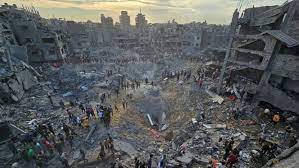
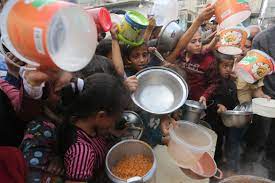
During the present genocide,
we learn of untold habits.
My father comes home sad with
an empty grocery bag,
which is more than a routine.

My mother often tells us to
wash our hands and occasionally our bodies.
She pretends to prepare,
places our empty and shattered dishes,
and then sobs alongside my father.

Then we all say bismillah
before we eat and Alhamdulillah's after
we’ve finished licking our empty fingers.
We then listen to my parents' prayers as
we elevate to the skies.

Ahmad Al-Khatat is an Iraqi Canadian poet and writer. His poetry has been translated into other languages and his work has been published in print and online magazines abroad. He resides in Montreal, Canada, now with his spouse. 

PLEASE NOTE: ARTICLES CAN ONLY BE REPRODUCED IN OTHER SITES WITH DUE ACKNOWLEDGEMENT TO BORDERLESS JOURNAL

Click here to access the Borderless anthology, Monalisa No Longer Smiles

Click here to access Monalisa No Longer Smiles on Kindle Amazon International

Categories
Contents

Borderless, October 2022

Art by Sohana Manzoor

Editorial

The Sky … Click here to read.

Conversations

Anthony Sattin, an award winning journalist and travel writer in conversation about Nomads: The Wanderers Who Shaped our World, his recent book published by Hachette, India. Click here to read.

VR Devika talks of the dynamic Muthulakshmi Reddy, the first woman in the world to preside over a Legislative Assembly who sought justice for Devadsis and prostitutes and discusses her book, Muthulakshmi Reddy: A Trailblazer in Surgery and Women’s Rights published by Niyogi Books. Click here to read.

Translations

Daridro or Poverty by Nazrul has been translated from Bengali by Professor Fakrul Alam. Click here to read.

The Browless Dolls by S.Ramakrishnan, has been translated from Tamil by B Chandramouli. Click here to read.

Two poems from Italy by Rosy Gallace have been translated from Italian by Irma Kurti. Click here to read.

Flowers of Love Bloom Everywhere, a poem for peace, written by and translated from Korean by Ihlwha Choi. Click here to read.

Aalo Amar Aalo (Light, My Light) a song by Tagore, has been translated by Mitali Chakravarty from Bengali. Click here to read.

Pandies Corner

Songs of Freedom: Moh-Reen is an autobiographical story by Amreen, translated from Hindustani by Janees. These stories highlight the ongoing struggle against debilitating rigid boundaries drawn by societal norms, with the support from organisations like Shaktishalini and Pandies. Click here to read.

Poetry

Click on the names to read

Michael R Burch, Kirpal Singh, Ryan Quinn Flanagan, Jonathan Chan, Ron Pickett, Saranyan BV, George Freek, Pramod Rastogi, Mike Smith, Gayatri Majumdar, John Grey, Vandana Kumar, Ahmad Al-Khatat, Rhys Hughes

Poets, Poetry & Rhys Hughes

In Crossing the Date Line, Rhys talks of his fascination with this imagined construct. Click here to read.

Essays

Epaar Bangla, Opaar Bangla:  Bengals of the Mind

Asad Latif explores if homeland is defined by birth. Click here to read.

The Wabi-Sabi of Making a Living

Aditi Yadav calls for taking a break from hectic work schedules. Click here to read.

Just a Face on Currency Notes?

Debraj Mookerjee writes of Gandhi’s relevance and evolution. Click here to read.

A Mother, a Daughter & a Demon Slayer?

Meenakshi Malhotra checks out the festival of Durga Puja, declared the a heritage festival by UNESCO. Click here to read.

The Observant Immigrant

Candice Lousia Daquin explores festivals and the God gene in We had Joy, We Had Fun…. Click here to read.

Musings/Slices from Life

KL Twin Towers near Kolkata?

Devraj Singh Kalsi visits the colours of a marquee hosting the Durga Puja season with its spirit of inclusivity. Click here to read.

A Five Hundred Nautical Mile Voyage to Tasmania

Meredith Stephens writes of sailing to Tasmania when the pandemic had just started loosening its grip. Click here to read.

Keep Walking…

Ravi Shankar recommends walking as a panacea to multiple issues, health and climate change and takes us on a tour of walks around the world. Click here to read.

The Matriarch of Hirronk

Ali Jan Maqsood introduces us to a strong matriarch from a Balochi village. Click here to read.

Musings of a Copywriter

In Drill, Fill, Just Chill, Devraj Singh Kalsi gives us humour while under a dentist’s drill. Click here to read.

Notes from Japan

Suzanne Kamata writes of her A Ramble on Bizan, focussing on a writer, also by the surname of Moraes, who lived on Mount Bizan more than century ago, moving to Japan from Portugal having fallen violently in love. Click here to read.

Short Stories

Half-Sisters

Sohana Manzoor explores the darker regions of human thought with a haunting psychological narrative about familial structures. Click here to read.

Homecoming

Rituparna Mukherjee gives a poignant story about missing home. Click here to read.

The Phosphorescent Sea

Paul Mirabile journeys with his protagonist into the depths of the ocean. Click here to read.

The Literary Fictionist

In Deathless are the Words, Sunil Sharma explores madness and ideators who believe in the power of words. Click here to read.

Book Excerpts

An excerpt from Taranath Tantrik and Other Tales from the Supernatural by Bibhutibhushan, translated from Bengali by Devalina Mookerjee. Click here to read.

An excerpt from A Handful of Sesame by Shrinivas Vaidya, translated from Kannada by Maithreyi Karnoor. Click here to read.

Book Reviews

Somdatta Mandal has reviewed BM Zuhara’s The Dreams of a Mappila Girl: A Memoir, translated from Malayalam by Fehmida Zakir. Click here to read.

Basudhara Roy has reviewed Taranath Tantrik: And Other Tales from the Supernatural by Bibhutibhushan, translated from Bengali by Devalina Mookerjee. Click here to read.

Bhaskar Parichha has reviewed Satyajit Ray Miscellany: On Life, Cinema, People & Much More, a collection of the maestro’s writings and illustrations. Click here to read.

Categories
Poetry

Poetry from Iraq

By Ahmad Al-Khatat

IMMIGRANT DREAM

My father was once an 
immigrant dream,
he often struggled 
to buy bottled water for us.

He taught me not to be a 
slave to privileged people,
he trained me to be fierce 
and speak about our country.

I attempted to whisper 
through his deafness, 
“O father some people 
are racists in exile.”

“O father some people 
are the reason for the 
misery of immigrants
and ply humans with a curse.”

I closed my eyes and my father 
faded away, went missing, and
absent for a lifetime. After they 
pulled on their trigger mercilessly.


DISTANCE BURNT

After the drab rain, the 
taste of honey dims into 
a midnight cigarette. Like the 
money we earn from distance burnt.

She says that she loves me, yet 
she asks what’s my death date? As 
if my heart is a forsaken bullet, above 
the lifeless flower in the lighthouse.

Let’s face my depression, or whatever 
your noisy educated brain desires to call it. 
I drank because I can't strangle my crying-soul
inside the leaking roofs of mental issues.


SIMPLE ORDER

For me to be confident
I must adopt to my heart’s strength.

For me to admire the blue sky,
I must displace the warplanes from 
the dove’s wings of peace.

For me to smile to your face, 
I must open my lyrical mouth and 
kiss your rhyming lips.

Ahmad Al-Khatat was born in Baghdad, Iraq. His work has appeared in print and online journals globally. He has poems translated into several languages such as Farsi, Chinese, Spanish, Albanian, Romanian. He has published some poetry chapbooks, and a collection of short stories.

.

PLEASE NOTE: ARTICLES CAN ONLY BE REPRODUCED IN OTHER SITES WITH DUE ACKNOWLEDGEMENT TO BORDERLESS JOURNAL