Meenakshi Malhotra writes of the diverse ways histories can be viewed, reflecting on the perspective from the point of view of water, climate, migrations or women. Click here to read.
Sometimes, we have an idea, a thought and then it takes form and becomes a reality. That is how the Borderless Journal came to be six years ago while the pandemic raged. The pandemic got over and takeovers and wars started. We continued to exist because all of you continue to pitch in, ignoring the differences created by certain human constructs. We meet with the commonality of felt emotions and aesthetics to create a space for all those who believe in looking beyond margins. We try to erase margins or borders that lead to hatred, anger, violence and war. Learning from the natural world, we believe we can be like the colours of the rainbow that seem to grow out of each other or the grass that is allowed to grow freely beyond manmade borders. If nature gives us lessons through its processes, is it not to our advantage to conserve what nurtures us, and in the process, we save our home planet, the Earth? We could all be together in peace, enjoying nature and nurture, living in harmony in the Universe if only we could overlook differences and revel in similarities.
A young poet Nma Dhahir says it all in her poem that is a part of our journal this month —
This is how we stay human together: by refusing the easy damage, by carrying each other without calling it sacrifice, by believing that what we protect in one another eventually protects the world.
Translations has more poetry with Professor Fakrul Alam bringing us Nazrul’s Bengali lyrics in English and Fazal Baloch familiarising us with beautiful Balochi poetry of the late Majeed Ajez, a young poet who left us too soon. Isa Kamari translates his own poems from Malay, capturing the colours of the community in Singapore to blend it with a larger whole. And of course, we have a Tagore poem rendered into English from Bengali. This time it’s a poem called ‘Jatra (Journey)’ which reflects not only on social gaps but also on politics through aeons.
Christine C Fair has translated a story from Punjabi by Lakhvinder Virk, a story that reflects resilience in women who face the dark end of social trends, a theme that reverberates in Flanagan’s poetry and Meenakshi Malhotra’s essay, which while reflecting on the need of different perspectives in histories – like water and nomads — peeks into the need to recall women’s history aswell. This is important not just because March hosts the International Women’s Day (IWD) but because one wonders if women in Afghanistan are better off now than the suffragettes who initiated the idea of such a day more than a century ago?
This time our non-fiction froths over with scrumptious writings from across continents. Tamara-Lee Brereton-Karabetsos muses on looking at numbers and beyond to enjoy the essence of nature. Farouk Gulsara ideates about living on in posterity through deeds and ideas. Gower Bhat shares how he learns story writing skills from watching movies. Meredith Stephens talks of her experience of a fire in the Australian summer. Bhaskar Parichha writes with passion about his region, Odisha. We have a heartfelt tribute to Mark Tully, who transcended borders, from Bhowmick. And an essay on Arundhati Roy’s memoir, Mother Mary Comes to Me, from Somdatta Mandal, which explores not just the book but also the covers which change with continents. Prithvijeet Sinha travels beyond Lucknow and Suzanne Kamata brings to us stories about her trip to Phnom Penh.
Keith Lyons draws from the current crises and writes about changing times, suggesting: “Changes aren’t endings, but thresholds.” Perhaps, if we see them as ‘thresholds of change’, the current events are emphasising the need to accept that human constructs can be redefined. I am sure a Neolithic or an Australopithecus would have been equally scared of evolving out of their system to one we would deem ‘superior’. Life in certain ways can only evolve towards the future, even if currently certain changes seem to be retrogressive. We can never correctly predict the future… but can only imagine it. And Devraj Singh Kalsi imagines it with a dollop of humour where tails become a trend among humans again!
Humour and absurdity are woven into a series of short fables by Hughes while Naramsetti Umamaheswarao weaves a fable around acceptanceof differences. In fiction, we have stories of resilience from Jonathon B Ferrini and Terry Sanville. Bhat gives us a story set in Kashmir and Sohana Manzoor gives us one set in Dhaka, a narrative that reminds one of Jane Austen… and perhaps even an abbreviated version of the 2001 film, Monsoon Wedding.
In reviews we have, Mohammad Asim Siddiqui discussing Anisur Rahman’s The Essential Ghalib. Rituparna Khan has written on Malashri Lal’s poetry collection reflecting on women, Signing in the Air. And Bhaskar Parichha has reviewed Deepta Roy Chakraverti’s Daktarin Jamini Sen: The Life of British India’s First Woman Doctor, a book that reflects on the resilience that makes great women. Thus, weaving in flavours of the IWD, which applauds women who are resilient while urging humans for equal rights for one half of the world population.
While we ponder on larger realities, Borderless Journal looks forward to a future with more writings centred around humanity, climate change, our planet and all creatures great and small. This year has not only seen a rise in readership and contributors — and the numbers rose further after our unsolicited Duotrope listing in October 2025 — but has also attracted writers from more challenged parts of the world, like Ukraine, Iran, Tunisia and Kurdistan. We are delighted to home writing from all those who attempt to transcend borders and be a part of the larger race of humanity. I would like to quote Margaret Atwood to explain what I mean. “I hope that people will finally come to realize that there is only one ‘race’—the human race—and that we are all members of it.” And I would like to extend her view to find solidarity with all living beings. I hope that there will be a point in time when we will realise there’s not much difference between, a lizard, a fly, a human or a tree… All these lifeforms are necessary for our existence.
I would want to hugely thank all our team for stretching out and making this a special issue for our sixth anniversary and Manzoor for her fabulous artwork. Huge thanks to all our contributors and readers for being with us through our journey. Let’s change the world with peace, love and friendship!
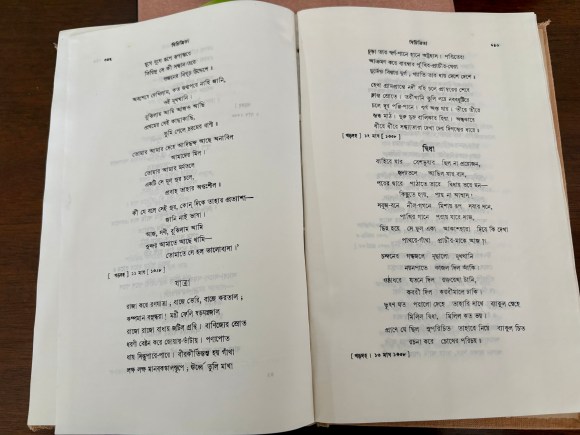
Written in 1932 by RabindranathTagore, Jatra (Journey) is a part of Rabindra Rachnabali (Writings of Ranbindranath) and Sanchayita (Compilation — in this case of poems).
The poem, Jatra (Journey) in Sanchayita
                JOURNEY

The emperor journeys to battle. The earth trembles
With the clash of drums and cymbals. The minister
Conspires, spreads web of deceit through realms.
Trading streams encircle the world with ebb and flow.
Cargo ships travel to distant shores. Monuments of
Heroism grow out of piles of human skeletons raising
Their heads heavenward to laugh with disregard.
The learned repeatedly attack impenetrable fortresses
Of knowledge, walled by books. The king’s fame spreads far and wide.

Here, in the village, the river flows sluggishly
In the distance. The ferry picks up the new bride
Sailing to a far colony. The sun sets. The shores
Are lined with silent fields. The girl’s heart shivers.
In the darkness, slowly, the evening star rises on the horizon.
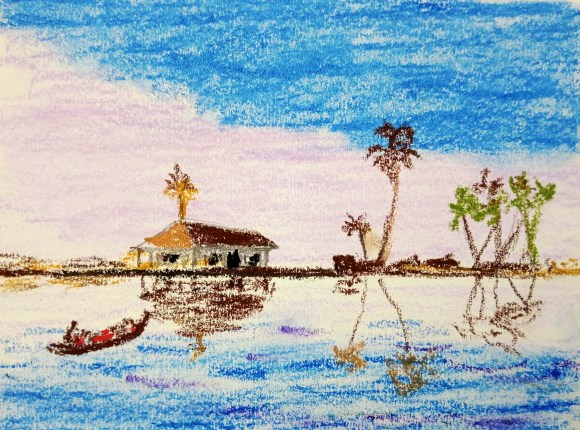
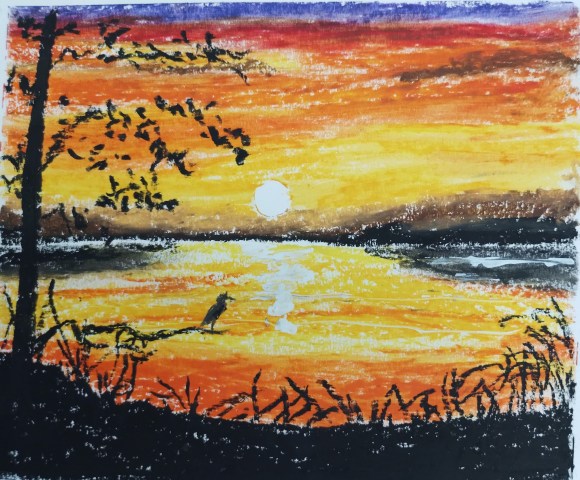
Art by Sohana Manzoor
.
This poem has been translated from Bengali by Mitali Chakravarty with editorial input by Sohana Manzoor
.
PLEASE NOTE: ARTICLES CAN ONLY BE REPRODUCED IN OTHER SITES WITH DUE ACKNOWLEDGEMENT TO BORDERLESS JOURNAL
Ishrat looked at the girl staring at her from the computer screen. Smooth and silky dark hair framed a face with wide eyes and lips that curved into a tender smile. According to her bio-data, Raihana Mimi finished her Bachelor’s from Stony Brook three years earlier. Then she did a Master’s in Social Work from UMASS Boston before going back to Bangladesh. Ishrat wondered why the girl liked Asif. At first glance, Asif seemed like an ordinary young man, even if pursuing a PhD in Computer Science. He was not handsome and he carried himself like a bear with a perpetual frown on his forehead. So why this lovely girl took a liking to Asif seemed a mystery to Ishrat. She hoped it wouldn’t end like the affair two years ago. It had broken Asif’s heart, and until very recently he would not hear of marriage.
“She’s very pretty,” Ishrat finally said. “But marriage is a life-long commitment, Asif. Do not marry for the wrong reasons. Do you love her?”
Asif looked at the somber face gazing upon him and smiled sadly. “Love? I thought I was in love the last time I went home. You know the rest.” Both of them went silent reminiscing about the unprecedented series of events that occurred about two years ago when Asif had gone back to Bangladesh to marry the girl he had been planning to wed for years. He came back alone a month later as the girl’s family had refused to allow their youngest daughter to marry him, and his sweetheart accepted the decision made by her family without protest.
Ishrat still remembered the bleak look on Asif’s face when he had asked her after returning from home, “What’s wrong with being fatherless, Apa[1]? And is an American passport essential for marriage? Tania’s uncle told me to get a US passport and then ask for their daughter’s hand in marriage.”
Ishrat couldn’t tell him that the marriage mart in Dhaka was a fish market. Most people with assets in the capital city would turn up their noses at someone like Asif whose father had died leaving his children still struggling to make a place for themselves. Instead, she had said, “It’s better that this match didn’t work out, Asif. Obviously, the girl didn’t care enough to stand up for you. I’m sure that you have a better person waiting for you in the future.”
“I told you Apa, she got married last year, didn’t I?” asked Asif.
“Who? Tania? Yes, you did. But Asif, I hope you are not planning to get married just because you want to show off that you’ve got a better wife,” said Ishrat with a frown. “Raihana is surely prettier than Tania and more accomplished. But just that would be a wrong reason for getting married.”
Asif shook his head. “That’s not why I want to marry Mimi. I’ve been talking to her for a few months now. She seems. . . how to put it. . . very mature, level-headed and practical. Has a lot of good sense,” he paused and then added, “something Tania never had.”
Ishrat asked again, “So, how does your family take it? I thought your mother had somebody in mind?
“That was years ago,” Asif said. To him, Kakon was just a next-door girl, the daughter of her mother’s best friend. It was a plan hatched by the mothers. He and Kakon never discussed this. There was never an occasion. “My sisters have already paid Mimi’s family a visit. And Mimi’s eldest brother and one of her sisters went to my elder sister’s house to meet my mother. Anju Apa is complaining even though Laiju is quite taken in.”
Ishrat nodded, “What does Laiju say?” Laiju was Asif’s younger sister, and not sentimental like Anjuman.
Asif smiled. “She says that Mimi seems friendly and sensible. Even though Anju Apa pulled a long face in front of everybody, she didn’t take offense. When Laiju apologised on her behalf to Mimi she said that she didn’t mind. People say a lot of things during such negotiations. It’s not wise to hold on to them.”
Ishrat nodded approvingly. “That sounds like uncommonly good sense to me. Marriage is a complex business though. Since you two like each other, you must keep a level head.”
*
Hamida Khatun looked helpless as her eldest daughter ranted about her brother’s marriage. “You’ll see that it will come to no good. That girl’s family is way better off than ours. Two of her sisters are settled in the US. And you still want him to marry her?”
“And how do you propose that I stop it, Anju?” asked Hamida. “You heard him. He is determined to have her.”
“I still don’t understand what was wrong with Kakon,” grumbled Anjuman. Kakon was their neighbour from their hometown in Khulna. They had known her since childhood. Kakon’s mother, Nahar, and Hamida once made plans to get their children married. But Asif was always busy with other things and once he went off to Dhak to study at BUET[2], he changed altogether. He fell in love with a girl named Tania who practically abandoned him at the altar. After that Hamida had tried to incline him toward Kakon once more. But Asif did not budge. At one point he told his mother, “If you nag like this, I will marry an American girl and never return home.” That sealed her mouth as Asif knew it would.
Hamida heaved a sigh and said, “Look, daughter, I don’t have a choice in this. If he can’t marry this girl, I’m afraid he will marry an American Christian girl. Do you want that?” Anju looked up at her mother, horrified. “You must be mad! What will our relatives say? American! And Christian too!”
“What do I care about our relatives?” asked an irritated Hamida. “Their tongues have been wagging since your father died. I just want my son to marry well and be happy.”
Anjuman grimaced. She was sure that this rich girl will only bring trouble for their family.
At this point, Laiju entered the room with a bundle of shopping bags in hand. She was buoyed up by the upcoming wedding of her only brother. Many of their close relatives had already arrived in Dhaka. She and her mother were staying in Rampura where Anjuman lived with her husband and two children.
Laiju looked at her elder sister keenly and said, “I don’t understand why you’re making such a big deal. I like Mimi Bhabi already. She is not like those typically snobbish rich girls. On the contrary, she seems very nice and sensible.” She paused and then added, “The kind of scene you made at their house! ‘I know our brother will be taken away from us after his marriage’—That was poor taste, Apa. I would have been mad if I was in her place.”
Anju shuffled uneasily and Hamida nodded gravely. “Yes, that was really bad.”
Laiju was about to say something more when they heard a commotion outside. Several voices were shouting, and one gruff voice most of all.
“I need to talk to Bhabi[3]. Where is she? This is insufferable and totally unacceptable. . .”
“Oh no, that’s Chhoto Chacha[4]!” groaned Laiju. As soon as she uttered the name, a dark burly man entered the room.
Without preamble he said, “Did you buy a saree for my wife? The eldest son of our family is getting married—where is the saree for his Chhoto Chachi?”
“We got sarees for everyone,” said Laiju. “And of course, Chhoto Chachi has got one too.”
“You call that a saree?” sneered their uncle. “That’s a gamchha[5]! If my brother was alive…”
“Unfortunately, he is not,” Laiju interrupted. “And his son is still a student. If you don’t like the saree we got for your wife, go and buy one yourself. Do you ever get anything for her?”
“You have such a foul mouth! No respect for elders at all!” growled Chhoto Chacha. He turned to his sister-in-law and bellowed, “I won’t come to the wedding, Bhabi. And I won’t allow my family to attend either.” He stormed out of the room. They heard him slam the front door shut.
Hamida Khatun heaved another sigh. “When will Asif come? I can’t take all this any longer. My poor boy! Nobody to give him peace of mind.”
Anjuman dried her eyes and said, “I won’t give you any more trouble. I, too, will keep away from the ceremony. . .” she stopped as her mother’s eyes started gleaming ominously. Laiju said, “For once, Apa, please act your age. How long will you behave like a 15-year-old?”
“What did I say?” asked a nervous Anjuman.
“You will act like a proper, respectable elder sister,” said Hamida quietly. “If I hear you babbling like a fool, I will leave your house. Just because we’re staying in your flat, don’t assume that you can do and say whatever you want. If necessary, I will rent a place and conduct the marriage ceremony from there. Understood?”
Anjuman eyed her mother with a newly found apprehension. Laiju gaped at her mother too. Then recovering herself she said half-laughing, “O dear! I didn’t know you could talk like that! You should take on that tone more often, Amma[6]. Chhoto Chacha will never dare to say anything again.”
*
“I still don’t understand why she has chosen that guy,” Gulshan Ara grumbled. “He looks more like an ape than a human being.”
Her fourth daughter Moni shook her head. “Ma, you’ve said that at least ten times.”
“So?” asked Gulshan Ara. “Your headstrong little sister doesn’t pay heed to anything I say. She has her heart set on that ape.” She stopped and lowered her voice. “You and I are the only two with good sense. Even Muhib and Moin are taken in.”
“I’m more worried about his family,” said Moni. “Remember how the elder sister spoke?”
“I can’t understand why you’re so worried about the family,” said a third voice. Moin had entered the room silently like a cat. “Mimi will be living abroad with her husband. She may have to visit Khulna only once or twice in her lifetime. Honestly, how much trouble can her in-laws cause?”
In the next room of the plush apartment in Dhanmondi, the subject of their conversation was busy wrapping up the gifts for her wedding. She had already brought several sarees for herself. She meant to save at least some money for Asif. She understood that he was still a graduate student and could not be expected to spend a fortune on his bride. He also had nobody to support him with expenses. She insisted that there should be only one ceremony and the expenses should be borne by her family. She used to be indifferent when her family members rejected one suitor after another. But something about Asif made her stand up for him and maneuver her siblings, especially her brothers and eldest sister, into accepting him as a prospective candidate. Asif also went out of his way and visited her two elder sisters in New York. Whatever initial reservations they had about his appearance vanished after meeting him face to face. Both spoke approvingly of him, and Mimi’s parents also gave in reluctantly.
When her sister Moni had asked her what she liked so much about Asif, Mimi avoided a direct answer and asked, “What’s wrong with him? He is a good guy, pursuing higher studies. That’s what you wanted too.” She paused, then added, “Okay, so he is not very handsome. But Mishu Apu’s husband was. Did that help?” Mishu was her second sister who had died a few years ago. Her husband was the most handsome and obnoxious man imaginable. Mishu’s untimely death had cast a perpetual gloom on their family.
Moni wrung her hands, “No, but…”
“If you people continue like this, I may never get married, you know,” Mimi had said, half-teasingly. “I’ll be thirty in November.”
Mimi counted the boxes and eyed the suitcase carefully. These were mostly things for her in-laws. They still had not got anything for Asif who was arriving in Dhaka that very afternoon. The two of them had planned to do the shopping for their wedding clothes themselves. Asif’s mother already had the jewelry. Apparently, she had them made three years ago, which proved to be an excellent decision.
Asif’s elder sister Anjuman and Mimi’s mother had been raising a hue and cry over every little thing. Anjuman took it to her head that her brother’s wife should have her nose pierced, and Asif should give her a diamond studded nose-pin. Mimi let Asif handle that. Both of them had discussed the situation and decided to largely ignore their comments and avoid unreasonable suggestions without being directly offensive. Asif seemed to rely a lot on her judgment, which Mimi appreciated.
She remembered when her eldest brother’s wife had shown her Asif’s Facebook page. “He’s so funny, Mimi. Just take a look! Says he has all A’s in everything except in his love life. There he has an F!” Mimi had smiled, but somehow it didn’t appear funny to her. She still thought Asif shouldn’t have put such personal information on Facebook, but it pulled a string at her heart. She knew exactly how it felt to get an F in love. She wondered where Dipak was, and if he was still looking for a pretty face with a ton of money. Mimi’s family was very affluent and that turned out to be his main reason for pursuing her. Dipak was gone from her life forever, and Mimi had no intention of bringing him back.
Once upon a time she held Dipak dear, but now she shuddered to think what might have happened if they had been married. He was making advances on three girls at the same time, and Mimi was one of them. The incident taught Mimi a number of things. She promised herself that she would only marry someone she could trust and would look beyond physical appearance. She may never have love, but she would also never feel humiliated or pitied.
*
When Asif and Mimi finally met in person, it was the most unromantic situation possible. His flight was delayed, and he arrived three hours late. After assuring his nervous mother, a pouting elder sister, and an over-enthusiastic younger one, he reached his future in-laws’ house around 9 p.m. along with two uncles and a cousin. He looked tired and harassed, in a crumpled purple shirt and khaki pants. Mimi’s parents were a bit awkward, but her brothers were very cordial as they had heard glowing reports about Asif from their sisters in New York.
While the others were talking, Mimi observed her intended husband surreptitiously. She almost smiled at his attire—he was so unpretentious. Obviously, he was more worried about keeping his engagement than his appearance. She noticed that he also looked at her once in a while, and realized with a jolt that he wished, just as she did, to talk to her, to be away from this crowd, just to be by themselves. Mimi was surprised at her own reaction—she had known this man for only a few months, and yet she longed to be with him. She tried to concentrate on the conversation and heard that they were discussing her Kabin. Asif was saying, “Whatever you decide is fine with me. I won’t be able to pay it right away, though, as I am still pursuing higher studies.”
Her eldest brother Muhib said, “Of course, we understand as much. Will 10 lakhs be too much for you?”
At this point, her mother spoke up. “I won’t allow my daughter’s Kabin[7] to be less than fifteen.”
“Fifteen!” someone in Asif’s party gasped. “Fifteen lakhs is too much! Even ten is a lot.”
Everyone in the room shifted uncomfortably while Gulshan Ara sat straight and glared at Asif with animosity. Mimi was about to pinch her brother Moin when Asif said in a quiet voice, “Whatever you say, I will accept. It’s your daughter we are discussing, after all.”
Even Mimi gaped at Asif. As everybody in the room started talking once again, Mimi realised that Asif’s move was the best possible strategy. Gulshan Ara would not complain any more. And Asif was not in serious trouble because he did not have to pay the amount right away. She didn’t know how Asif’s family would take it, though. She promised herself that she would always try to make things easier for him. He didn’t have any idea how rich her family was. He wanted to marry her.
*
The wedding reception was held at a posh restaurant in Dhanmondi. Asif sat on the stage and watched his bride smile and greet the guests who approached them. She was as beautiful as a fairy, thought Asif. Wise and kind too.
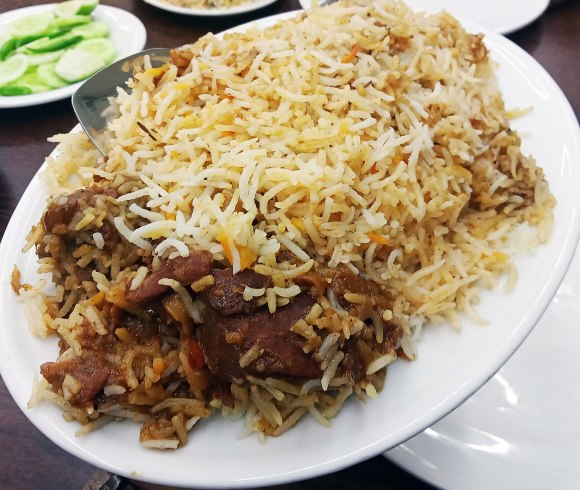
Then Asif saw his Chhoto Chacha approaching the stage and he said a swift prayer so that nothing disastrous happened. His uncle addressed Mimi, “The others are saying that the food is good. But I felt it was aida.” He looked triumphantly at Asif, as if saying, “You can’t fool me!” Mimi also looked at Asif, not knowing what aida meant. Asif hastily said, “That was kachchi biriyani, Chacha. It is the standard food for weddings in Dhaka. But we will have a reception in Khulna too. You can have your menu there with your favourite fish.” Chhoto Chacha nodded, looking pleased. “You have a pretty wife,” he said approvingly, “much prettier than your mother ever was.” He walked away. Asif heaved a sigh of relief.
Kachchi Biriyani. From Public Domain
Mimi whispered, “What’s aida?”
“I’ll explain later,” mumbled an embarrassed Asif. How could he say that aida meant food that has been half-eaten by somebody else? Basically, it suggested that the guests had not been properly treated.
Then came Asif’s friends. They were all laughing and joking. Asif was quite popular among his friends, and they seemed happy about Asif’s marriage and his choice of bride. Mimi had very few friends present—understandable, since she did her bachelor’s in the US. Someone mentioned that they had attended Tania’s wedding the previous year whose husband was a bald man in his forties and held an American passport.
A heavily bejeweled, fat lady appeared before them, and Mimi introduced her to Asif. “This is my Chhoto Mami. Mama[8] couldn’t come as he is in Singapore right now.”
Asif smiled and greeted her. “I’ve heard a lot about you,” the lady said with a broad smile like a crocodile. “You are not very handsome, are you? But then, Rahat was very handsome, and it didn’t help us at all.” She sighed, then added, “Hopefully, you’ll take good care of Mimi.”
Mimi made a face as she walked away. “Sorry about that.”
“Who is Rahat?” asked a puzzled Asif.
“My ex-brother-in-law,” replied Mimi briefly. “I’ll tell you later.”
“You and I both seem to have a fine lot of relatives,” observed Asif. Mimi smiled. “It seems so, doesn’t it?” They smiled at each other, and Asif knew that they would be working as a team. Their relatives wouldn’t be able to make a rift like they did in his parents’ case. He thoughts turned to Tania probably for one last time, and he wished he had never met her. Then he realised that it did not really matter. She was already a distant memory. Asif started to comprehend what Ishrat had meant by marriage being a life-long commitment.
Mimi sat contentedly. She liked her husband, she thought. Fair enough. He was sometimes a little rash, but good-natured. He had also shown himself to be sensitive to her needs. She remembered the scuffle over her wedding saree. They got it from Mansha. It was quite expensive and Mimi did not want to buy it even though she liked it very much. Asif, however, insisted that at least the main wedding saree should be costly, so that everybody was content.
*
Anjuman sat in one corner, still resentful at the turn of events. She looked at her children on stage with their uncle, nodding and smiling at their new aunt. Anjuman wondered how nobody could see what she saw—her only brother slowly moving away from them. She remembered what Laiju had said a few days ago: “He is not the same guy who left Bangladesh 4 years ago. He has changed. He has been leading a different life, his friends and peers are of a different sort. His world has changed, Apa. He couldn’t be happy with someone like Kakon. Don’t you see?”
No, Anjuman did not see. All she saw was a rich and beautiful girl taking her only brother away from them. Her resentment rose higher. She had tried to derail her own husband—to move him away from the influence of his nagging mother. But she had failed. The old woman had died only recently, and her husband still cried like a baby over the loss. And here was this girl, a mere chit of a girl, accomplishing what she could not in nine years. “If only it was Kakon!” thought Anjuman wistfully, their brother would have always been theirs. She did not see why he would be unhappy. What was the duty of a wife? To cook, bear children and maintain the house. Their mother did all this, she herself was doing the same; what more could Asif want? And in spite of all her good looks, what could Mimi give him that Kakon could not? Did he have to sell himself to money?
Somewhere at the back of her mind, Anjuman felt cheated. She felt that her brother got something she never even dreamt of. She saw the light of a different life on Laiju’s face, or even on their mother’s, a light she could not share. She thought of the flat in Rampura where she had so far lived with her husband and children. The 1200 square feet she had been so proud of owning suddenly seemed to have diminished into nothing. Owning a flat in Dhaka did not seem so great anymore as she wondered what kind of a house Asif and his wife would have in the US.
Hamida Khatun noticed the tear-stained face of her elder daughter from a distance and heaved a sigh of relief. “Thank God she realises that they are happy, and she is praying for them,” she thought, and smiled with misty eyes. Her thoughts then flew to the future where she saw herself surrounded by grandchildren. She did not see even the flicker of any dark shadow on the bright stage where her son gazed lovingly at his bride.
[7] Marriage registration fees determined by the dowry
[8]Mami is wife to mother’s brother referred to as Mama
.
Sohana Manzoor is a writer and academic from Bangladesh, with a PhD in English from Southern Illinois University Carbondale. Her works have appeared in Bellingham Review, Eclectica, Litro, Singapore Unbound, Borderless Journal, and elsewhere. She was the Literary Editor of The Daily Star from 2018- 22. Currently, she is pursuing an MFA in Creative Writing at UBC, Vancouver.
.
PLEASE NOTE: ARTICLES CAN ONLY BE REPRODUCED IN OTHER SITES WITH DUE ACKNOWLEDGEMENT TO BORDERLESS JOURNAL.
Six years ago, a few of us got together to bring out the first issue of Borderless Journal. We started as a daily blog and then congealed into a monthly journal offering content that transcends artificial borders to meet with the commonality of felt emotions, celebrating humanity and the Universe. Today as we complete six years of our existence in the clouds, we would like to celebrate with all writers and readers who made our existence a reality. We invite you to savour writings collected over the years that reflect and revel in transcending borders, touching hearts and some even make us laugh while exploring norms.
In this special issue. we can only offer a small sample of writings but you can access many more like these ones at our site…Without further ado, let us harmonise with words. We invite you to lose yourselves in a borderless world in these trying times.
Rebel or ‘Bidrohi’, Nazrul’s signature poem, ‘Bidrohi‘, translated by Professor Fakrul Alam. Click here to read.
Manish Ghatak’s Aagun taader Praan (Fire is their Life) has been translated from Bengali by Indrayudh Sinha. Click here to read.
Tagore’s poem, Tomar Shonkho Dhulay Porey (your conch lies in the dust), has been translated from Bengali by Mitali Chakravarty as ‘The Conch Calls’. Click here to read.
Ihlwha Choi spent some time in Santiniketan and here are poems he wrote in reaction to his observations near the ‘home of R.Tagore’, as he names Santiniketan and the Kobiguru. Click here to read Nandini.
Rituals in the Garden: Marcelo Medone discusses motherhood, aging and loss in this poignant flash fiction from Argentina. Click here to read.
Navigational Error: Luke P.G. Draper explores the impact of pollution with a short compelling narrative. Click here to read.
Henrik’s Journey: Farah Ghuznavi follows a conglomerate of people on board a flight to address issues ranging from Rohingyas to race bias. Click hereto read.
The Magic Staff , a poignant short story about a Rohingya child by Shaheen Akhtar, translated from Bengali by Arifa Ghani Rahman. Click here to read.
A Cat Story : Sohana Manzoor leaves one wondering if the story is about felines or… Clickhere to read.
When West Meets East & Greatness Blooms: Debraj Mookerjee reflects on how syncretism impacts greats like Tagore,Tolstoy, Emerson, Martin Luther King Jr, Gandhi and many more. Click here to read.
The Day Michael Jackson Died: A tribute by Julian Matthews to the great talented star who died amidst ignominy and controversy. Click here to read.
Potable Water Crisis & the Sunderbans: Camellia Biswas, a visitor to Sunderbans during the cyclone Alia, turns environmentalist and writes about the potable water issue faced by locals. Click here to read.
My Love for RK Narayan, Rhys Hughes discusses the novels by ths legendary writer from India. Click here to read.
Travels ofDebendranath Tagore: These are travel narratives by Debendranath Tagore, father of Rabindranath Tagore, translated from Bengali by Somdatta Mandal. Click here to read.
Baraf Pora (Snowfall): This narrative gives a glimpse of Tagore’s first experience of snowfall in Brighton and published in the Tagore family journal, Balak (Children), has been translated by Somdatta Mandal . Clickhere to read.
The Day of Annihilation: An essay on climate change by Kazi Nazrul Islam has been translated from Bengali by Radha Chakravarty. Clickhereto read.
Reminiscences from a Gallery: The Other Ray: Dolly Narang muses on Satyajit Ray’s world beyond films and shares a note by the maestro and an essay on his art by the eminent artist, Paritosh Sen. Click here to read.
The Bauls of Bengal: Aruna Chakravarti writes of wandering minstrels called bauls and the impact they had on Tagore. Click here to read.
Most people like you and me connect with the commonality of felt emotions and needs. We feel hungry, happy, sad, loved or unloved and express a larger plethora of feelings through art, theatre, music, painting, photography and words… With these, we tend to connect. And yet, larger structures created over time to offer security and governance to the masses—of which you and I are a part — have grown divisive, and, by the looks of it, the fences nurtured over time seem insurmountable. To retain these structures that were meant to keep us safe, wars are being fought and many are getting killed, losing homes and going hungry. We showcase such stories, poems and non-fiction to create an awareness among those who are lucky enough to remain untouched. But is there a way out, so that all of us can live peacefully, without war, without hunger and with love and a vision towards surviving climate change which (like it or not) is upon us?
Creating an awareness of hunger and destruction wreaked by war is a heartrending story set in Gaza by JK Miller. While Snigdha Agrawal’s narrative gives a sense of hope, recounting a small kindness by a common person, Sayan Sarkar shares a more personal saga of friendship and disillusionment — where people have choice. But does war leave us a choice as it annihilates friendships, cities, homes and families? Naramsetti Umamaheswararao’s story reiterates the belief in the family – peace being an accepted unit. Vela Noble’s fantastical fiction and art comes like a respite– though there is a darker side to it — with a touch of fun. Perhaps, a bit of fantasy and humour opens the mind to deal with the more sombre notes of existence.
The translation section hosts a story by Hamiruddin Middya, who grew up as a farmer’s son in Bengal. Steeped in local colours, it has been rendered into English by V Ramaswamy. Nazrul’s song revelling in the colours of spring has been translated from Bengali by Professor Fakrul Alam. Atta Shad’s pensive Balochi lines have been brought to us in English by Fazal Baloch. Isa Kamari continues to bring the flavours of an older, more laid-back Singapore with translations of his own Malay poems. A couple of Persian verses have been rendered into English by the poet, Akram Yazdani, herself. Questing for harmony, Tagore’s translated poem while reflecting on a child’s life, urges us to have the courage to be like a child — open, innocent and willing to imagine a world laced with trust and hope. If we were all to do that, do you think we’d still have wars, violence and walls built on hate and intolerance?
Mario Fenech takes a look at the idea of time. Amir Zadnemat writes of how memory is impacted by both science and humanities while Andriy Nivchuk brings to us snippets from Herodotus’s and Pericles’s lives that still read relevant. Ravi Varmman K Kanniappan gives the journey of chickpeas across space and time, asserting: “The chickpea does not care about your ideology, your portfolio, or your meticulously curated identity. It will grow, fix nitrogen, feed someone, and move on without a press release.” It has survived over aeons in a borderless state!
In book excerpts, we have a book that transcends borders as it’s a translation from Assamese by Ranjita Biswas of Arupa Kalita Patangia’s Moonlight Saga. Any translation is an attempt to integrate the margins into the mainstream of literature, and this is no less. The other excerpt is from Natalie Turner’s The Red Silk Dress. Keith Lyons has interviewed Turner about her novel which crosses multiple cultures too while on a personal quest.
Holding on to that idea, we invite you to savour the contents of our February issue.
Huge thanks to all our contributors and readers for making this issue possible. Heartfelt thanks to our wonderful team, especially Sohana Manzoor for her fabulous artwork.
Enjoy the reads!
Let’s look forward to the spring… May it bring new ideas to help us all move towards more amicable times.
Shishur Jibon (The Child’s Life) is a part of Tagore’s 1922 collection of poems, Shishu Bholanath (Child Bholanath).
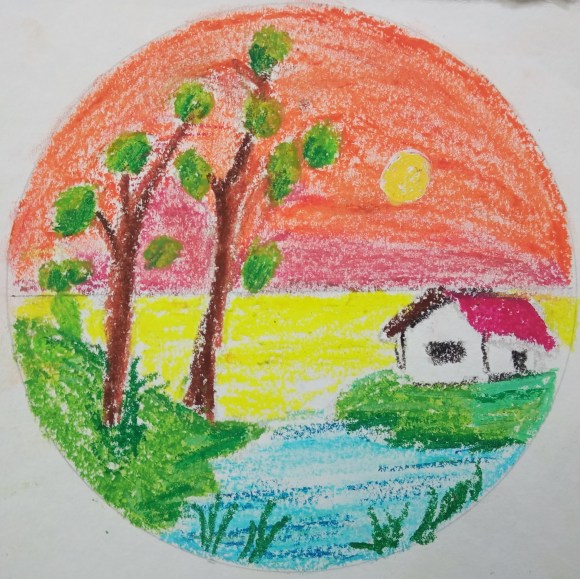
Art by Sohana Manzoor
THE CHILD’S LIFE

Do we have the
     courage to be a child?
         That’s why we die old.
We store every little thing,
         Hoard over time in trunks,
                   Stash in piles.
Today is ruined with thoughts
Of tomorrow. Tomorrow, we’ll stock
         For the burdens of the next day.
We get objects of desire,
And realise we have no need for them.
        We quest for things gone astray.
Fearing for the unknown future,
We lose sight of the path,
     And plan for the day after.
The future will always
          Be shrouded in mystery.
Then, will we have no reprieve?
As we ignite the lamp of intellect,
The flame flickers in the breeze —
         We calculate each step.
Numerous people advise
With subtle judgement
 Hair-splitting details before every quest.
Let my heart again be filled
      With the desire to be a trustful child.
         Let me flow freely like the breeze,
Swiftly unmask fears
   Hovering about the future.
      I will confront them as they are seen.
By the pond or on the rooftop,
     Mingling the known and unknown,
        The common and uncommon,
I will roll a ball of mud.
 This will be my toy.
      Happiness doesn’t need to be bought.
Taking on the onus of adulthood,
     I come to this huge market,
            Where grownups push and jostle.
Selling my world, when I
        Head home, I take
           With me only verbosity.
I have wasted away my time
    looking for bargains.
          The hours passed swiftly.
As dusk turns to twilight,
I suddenly feel, I do not like
        The deals I made deftly.
Our lives start
     With childhood.
          Let childhood prevail again.
Let us find companionship
     Like land and water,
        Let us play again in the dusty glen.
Breaking the boundaries of possibilities,
Let us sail on waves of impossibilities,
        Navigating on a ferry of dreams.
Again, let’s abandon logic
And create our world of magic,
        Forgetting the practical realms.
The first day when I arrived
           In this new world,
              Sunlight bathed my life.
 That period was filled with
     Childish imaginings —
       Where did it come from?
Who secretly beads
Dewdrops each night?
        Crickets chirp in unison.
 At dawn, I notice,
The interplay
        Of glittering lights.
There was a time
     When holidays blew in
       With breezy blue skies.
We looked for partners
     While playing games
       As childhood flew by.
Trees in play bloom flowers.
Flowers in play fruit fruits.
           Fruits sprout new buds.
Lands play with the lapping water.
Waters play with the swaying breeze.
         The breeze plays in its own tune.
With the youth,
     You remain young
              Despite your baggage.
You fly paper lanterns
Of many colours,
       Paint the skies with vibrant shades.
That day I fantasied
Being back by your side.
        We played together holding hands.
We floated many dreams,
 Conversed on sad and happy themes,
          And together, we relaxed.
The flowers burdened
       By the colours of seasons,
         Flow away in the stream of time.
Again, they come to shore
        As the breeze blows,
                Drifting to the waterside.
In the wicker basket of the world,
Your flowers with my garland twirled,
      Decorating the ferry of seasons.
I have hope in my heart,
The bokul ferry’ll return to the earth,
      Listening to the shiuli’s reasons.
When I hummed a song
That day on my own,
         It drifted by unoccupied.
That day, I saw a flicker
      In your eyes of laughter,
            You recognised me by your side.
Seeing your dusty play, your light,
My heart was filled with delight,
         Despite the sad notes on the flute.
I understood that spring,
You heard me sing.
          I too love to hear your tune.
The day passed in fields and paths.
            Dusk settled in.
                If you bid me farewell,
Then in your twilight
   Raise the sail of the boat,
     I will cross the river aswell.
Again, O friend of the child,
Let’s play on our own to abide
         In a youthful Universe.
Gazing at your face,
Your world I’ll embrace,
      I’ll view it in a simple light.
Colourful paper lanterns in the skyA child making a mud ballFrom Public Domain BokulShiuliFrom Public Domain
.
This poem has been translated from Bengali by Mitali Chakravarty with editorial input by Sohana Manzoor
.
PLEASE NOTE: ARTICLES CAN ONLY BE REPRODUCED IN OTHER SITES WITH DUE ACKNOWLEDGEMENT TO BORDERLESS JOURNAL
Five poems by Pravasini Mahakudahave been translated to English from Odia by Snehaprava Das. Click here to read.
A Poet in Exileby Dmitry Blizniuk has been translated from Ukranian by Sergey Gerasimov. Click hereto read.
Kalponik or Imaginedby Tagore has been translated from Bengali by Mitali Chakravarty. Click hereto read.
Pandies Corner
Songs of Freedom: The Seven Mysteries of Sumona’s Life is an autobiographical narrative by Sumona (pseudonym), translated from Hindustani by Grace M Sukanya. These stories highlight the ongoing struggle against debilitating rigid boundaries drawn by societal norms, with the support from organisations like Shaktishalini and Pandies. Click here to read.
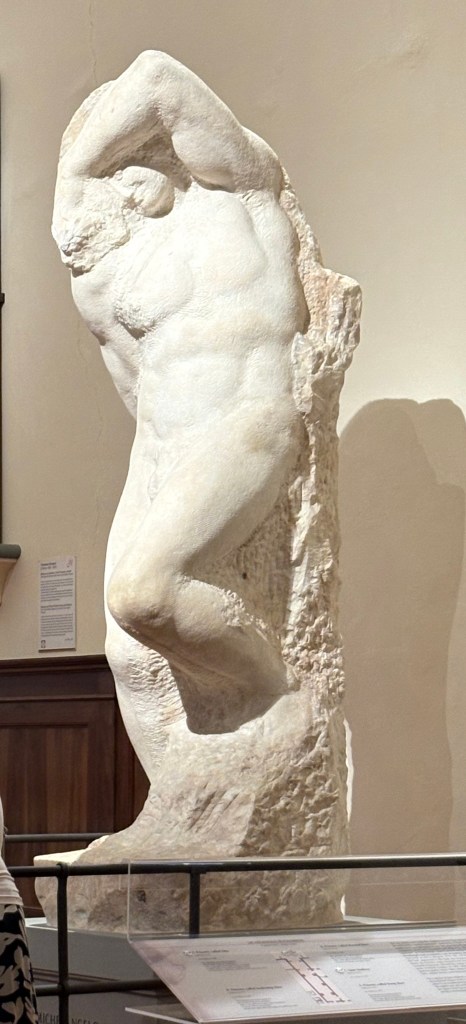
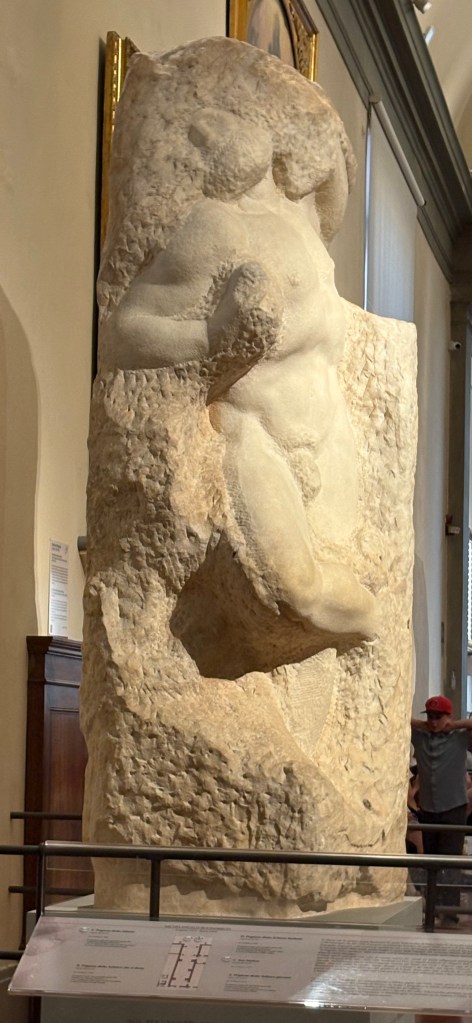
Incomplete statues of Michelangelo in Accademia Gallery, Florence
In the Accademia Gallery, Florence, are housed incomplete statues by Michelangelo that were supposed to accompany his sculpture of Moses on the grand tomb of Pope Julius II. The sculptures despite being unfinished, incomplete and therefore imperfect, evoke a sense of power. They seem to be wresting forcefully with the uncarved marble to free their own forms — much like humanity struggling to lead their own lives. Life now is comparable to atonal notes of modern compositions that refuse to fall in line with more formal, conventional melodies. The new year continues with residues of unending wars, violence, hate and chaos. Yet amidst all this darkness, we still live, laugh and enjoy small successes. The smaller things in our imperfect existence bring us hope, the necessary ingredient that helps us survive under all circumstances.
Imperfections, like Michelangelo’s Non-finito statues in Florence, or modern atonal notes, go on to create vibrant, relatable art. There is also a belief that when suffering is greatest, arts flourish. Beauty and hope are born of pain. Will great art or literature rise out of the chaos we are living in now? One wonders if ancient art too was born of humanity’s struggle to survive in a comparatively younger world where they did not understand natural forces and whose history we try to piece together with objects from posterity. Starting on a journey of bringing ancient art from her part of the world, Ratnottama Sengupta shares a new column with us from this January.
Drenched in struggles of the past is also Showkat Ali’s The Struggle: A Novel, translated from Bengali by V. Ramaswamy and Mohiuddin Jahangir. It has been reviewed by Somdatta Mandal who sees it a socio-economic presentation of the times. We also carry an excerpt from the book as we do for Anuradha Marwah’s The Higher Education of Geetika Mehendiratta. Marwha’s novel has been reviewed by Meenakshi Malhotra who sees it as a bildungsroman and a daring book. Bhaskar Parichha has brought to us a discussion on colonial history about Rakesh Dwivedi’s Colonization Crusade and Freedom of India: A Saga of Monstrous British Barbarianism around the Globe. Udita Banerjee has also delved into history with her exploration of Angshuman Kar’s The Lost Pendant, a collection of poems written by poets who lived through the horrors of Partition and translated from Bengali by multiple poets. One of the translators, Rajorshi Patranabis, has also discussed his own book of supernatural encounters, Whereabouts of the Anonymous: Exploration of the Invisible. A Wiccan by choice, Patranbis claims to have met with residual energies or what we in common parlance call ghosts and spoken to many of them. He not only clicked these ethereal beings — and has kindly shared his photos in this feature — but also has written a whole book about his encounters, including with the malevolent spirits of India’s most haunted monument, the Bhangarh Fort.
Bringing us an essay on a book that had spooky encounters is Farouk Gulsara, showing how Dickens’ A Christmas Carolrevived a festival that might have got written off. We have a narrative revoking the past from Larry Su, who writes of his childhood in the China of the 1970s and beyond. He dwells on resilience — one of the themes we love in Borderless Journal. Karen Beatty also invokes ghosts from her past while sharing her memoir. Rick Bailey brings in a feeling of mortality in his musing while Keith Lyons, writes in quest of his friend who mysteriously went missing in Bali. Let’s hope he finds out more about him.
Charudutta Panigrahi writes a lighthearted piece on barbers of yore, some of whom can still be found plying their trade under trees in India. Randriamamonjisoa Sylvie Valencia dwells on her favourite place which continues to rejuvenate and excite while Prithvijeet Sinha writes about haunts he is passionate about, the ancient monuments of Lucknow. Gulsara has woven contemporary lores into his satirical piece, involving Messi, the footballer. Bringing compassionate humour with his animal interactions is Devraj Singh Kalsi, who is visited daily by not just a bovine visitor, but cats, monkeys, birds and more — and he feeds them all. Suzanne Kamata takes us to Kishi, brought to us by both her narrative and pictures, including one of a feline stationmaster!
We've run away from the simmering house
like milk that is boiling over. Now I'm single again.
The sun hangs behind a ruffled up shed,
like a bloody yolk on a cold frying pan
until the nightfall dumps it in the garbage…

('A Poet in Exile', by Dmitry Blizniuk, translated from Ukranian by Sergey Gerasimov)
In translations, we have Professor Fakrul Alam’s rendition of Nazrul’s mellifluous lyrics from Bengali. Isa Kamari has shared four more of his Malay poems in English bringing us flavours of his culture. Snehaparava Das has similarly given us flavours of Odisha with her translation of Pravasini Mahakuda’s Odia poetry. A taste of Balochistan comes to us from Fazal Baloch’s rendition of Sayad Hashumi’s Balochi quatrains in English. Tagore’s poem ‘Kalponik’ (Imagined) has been rendered in English. This was a poem that was set to music by his niece, Sarala Devi.
After a long hiatus, we are delighted to finally revive Pandies Corner with a story by Sumona translated from Hindustani by Grace M Sukanya. Her story highlights the ongoing struggle against debilitating rigid boundaries drawn by societal norms. Sumana has assumed a pen name as her story is true and could be a security risk for her. She is eager to narrate her story — do pause by and take a look.
In fiction, we have a poignant narrative about befriending a tramp by Ross Salvage, and macabre and dark one by Mary Ellen Campagna, written with a light touch. It almost makes one think of Eugene Ionesco. Jonathan B. Ferrini shares a heartfelt story about used Steinway pianos and growing up in Latino Los Angeles. Rajendra Kumar Roul weaves a narrative around compassion and expectations. Naramsetti Umamaheswararao gives a beautiful fable around roses and bees.
With that, we come to the end of a bumper issue with more than fifty peices. Huge thanks to all our fabulous contributors, some of whom have not just written but shared photographs to illustrate the content. Do pause by our contents page and take a look. My heartfelt thanks to our fabulous team for their output and support, especially Sohana Manzoor who does our cover art. And most of all huge thanks to readers whose numbers keep growing, making it worth our while to offer our fare. Thank you all.
Here’s wishing all of you better prospects for the newborn year and may we move towards peace and sanity in a world that seems to have gone amuck!








 Borderless