Categories
Contents

Borderless, August 2022

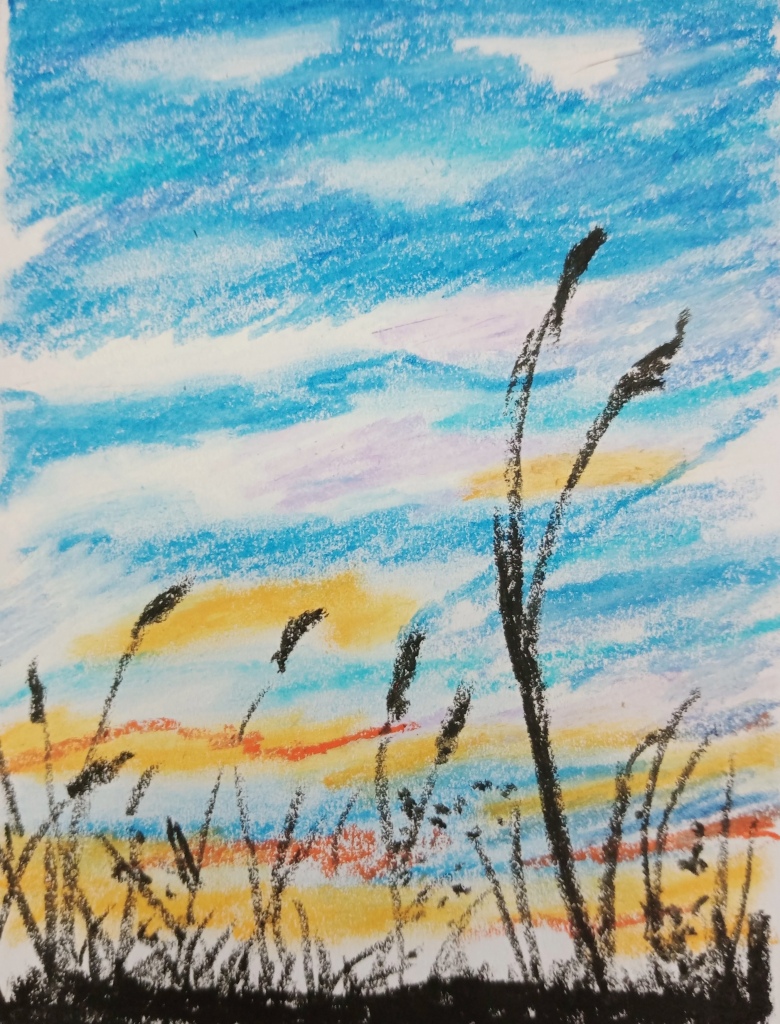
Art by Sohana Manzoor

Editorial

The Stars were Shining There for You & Me, for Liberty… Click here to read.

Conversation

The Making of Historical Fiction: A Conversation with Aruna Chakravarti unfolds the creation of her latest novel, The Mendicant Prince, based on the prince of Bhawal controversy in the first part of the last century. Click here to read.

Translations

Tagore’s humorous skit, The Treatment of an Ailment, has been translated by Somdatta Mandal. Click here to read.

Arise, Arise O Patriot! and Helmsman Attention! by Kazi Nazrul Islam have been translated from Bengali by Professor Fakrul Alam. Click here to read.

Pus Ki Raat or A Frigid Winter Night by Munshi Premchand has been translated from Hindi by C Christine Fair. Click here to read.

Tagore’s Song of Hope or ‘Hobe Joye‘ has been translated from Bengali by Mitali Chakravarty. Click here to read.

Poetry

Click on the names to read

Rhys Hughes, Ratnottama Sengupta, Mike Smith, Rituparna Mukherjee, Tony Brewer, Ahmed Rayees, Ron Pickett, Ramesh Dohan, Sister Lou Ella Hickman, Sambhu Nath Banerjee, Candice Louisa Daquin, Oindri Sengupta, Gigi Baldovino Gosnell, Ryan Quinn Flanagan, Tanvi Jeph, George Freek, Michael R Burch

Poets, Poetry & Rhys Hughes

In Mini-Sagas: A Dozen Examples, Rhys Hughes talks of a new genre with dollops of humour. Click here to read.

Musings/Slices from Life

Istanbul

G Venkatesh has a stopover in the airport to make a discovery. Click here to read.

The Loyal Dog in Loyalty Island

Meredith Stephens makes friends with a dog in the township of Wé on the Lifou island, an ‘overseas territory’ of France. Click here to read.

The ‘New Kid on the Block’ Celebrates…

Dr Kirpal Singh ruminates over what led to the making of an island state, Singapore. Click here to read.

Remnants of Time Once Spent Together

Sayali Korgaonkar ruminates over loss and grieving. Click here to read.

Moonland

Rupali Gupta Mukherjee journeys through the moonlike landscape housing a monastery with her camera and a narrative. Click here to read.

King Lear & Kathakali?

PG Thomas revisits a performance that mesmerised him in a pre-covid world. Click here to read.

Musings of a Copywriter

In A Bone in My Platter, Devraj Singh Kalsi shares a taste of running a restaurant. Click here to read.

Notes from Japan

Suzanne Kamata writes a light slice from life in The Boy & The Cats: A Love Story. Click here to read.

Stories

Does this Make Me a Psychic?

Erwin Coombs tells a suspenseful, funny, poignant and sad story, based on his real life experiences. Click here to read.

Hard Choices

Santosh Kalwar gives a glimpse of hope for an abandoned girl-child in Nepal. Click here to read.

No Rain on the Parade

Tan Kaiyi goes on a hunt for the National Day Killer. Click here to read.

Until We Meet Again

Shivani Shrivastav transports us to Manali for a misty union. Click here to read.

The Hatchet Man

Paul Mirabile tells a story of murder and horror. Click here to read.

I am Not the End

Aysha Baqir takes on the persona of a computer to unleash a poignant and chilling story. Click here to read.

Essays

How Many Ways To Love a Book

Sindhu Shivprasad describes passion for books. Click here to read.

Hiking in the Himalayas with Nabinji

Ravi Shankar explores more of Himalayas in Nepal. Click here to read.

Freedom is another word for… Zohra Sehgal

Ratnottama Sengupta gives a glimpse of the life of Zohra Sehgal, based on the book Zohra: A Biography in Four Acts by Ritu Menon, and her own personal interactions with the aging Zohra Sehgal. Click here to read.

The Observant Immigrant

In Can We Create a Better World by Just Wishing for it, Candice Louisa Daquin dwells on the question to locate answers. Click here to read.

Book Excerpts

An excerpt from The Dreams of a Mappila Girl: A Memoir by B. M. Zuhara translated by Fehmida Zakeer. Click here to read.

An excerpt from Michael R Burch’s poetry book, O, Terrible Angel. Click here to read.

Book Reviews

Meenakshi Malhotra reviews Tagore’s Four Chapters translated and introduced by Radha Chakravarty. Click here to read.

Gracy Samjatsabam visits Mamang Dai’s Escaping the Land. Click here to read.

Aditi Yadav reviews Pallavi Aiyar’s Orienting : An Indian in Japan. Click here to read.

Rakhi Dalal visits Neelum Saran Gour’s Requiem in Raga Janki. Click here to read.

Bhaskar Parichha reviews Rakesh Batabyal’s Building a Free India. Click here to read.

Categories
Editorial

The Stars were Shining There for You & Me, for Liberty…

Painting by Sohana Manzoor

“It just so happens that their[1] universes were different from ours: because why would their imaginations be constrained by a nation-state that would not exist for another thousand years?”

Anirudh Kansetti, the print.in

These lines from a recent article on conquests carried out by the Indian subcontinent in ancient times brings to focus that earlier countries or nation-states as we know of them today did not exist till the industrial revolution set the concept in motion. In the month many countries in Asia celebrate their independent existence or rather the drawing of borders based on colonial mapmakers’ whims, we should perhaps relook at the way the world stands divided.

Is this what we want as humans? Where are we headed? While conquerors write the history, we tend to gloss over what is left unsaid. The millions who died crossing borders, in race riots and of hunger, starvation and disease in refugee camps is overlooked, or worse, used to justify the divisions that still hurt the residents of the sub-continent and try to destroy any sense of oneness among the human species. We tend not to forget the atrocities of the colonials but we overlook the violence of the mobs that incensed with hatred instilled by politics annihilated and murdered. Their story is reduced to “us” and “them”. In our mood of jubilation, the recent bombings in the Middle East and the Ukraine-Russia war have already been delegated to the newsreels. But these are all people who are killed and displaced without any justification for the need to do so. One of the things that George Orwell had depicted in 1984 was an acceptance of a constant state of war. Are we stepping into that frame of mind with our cold acceptance of the situation worldwide?

In the last century, many united against the atrocities of the empire builders. They wanted to rise above the divides. At least greats like Nazrul vociferously objected to the basis of divides that were used to draw the borders. Translations brought to us by Professor Fakrul Alam showcase such poetry as does much of Tagore’s own writing and actions. Tagore organised a protest march against the colonial proposal of Partition of Bengal in 1905 by taking a procession in which he encouraged Hindu and Muslim women to tie rakhis[2] on men from the other community and make them their brothers. Tagore put the welfare of humanity above nationalism as can be seen in his writings and speeches. Reflecting on humanity, we have Munshi Premchand’s powerful story, Pus Ki Raat or A Frigid Winter’s Night, translated from Hindi by C Christine Fair, dwelling on the sad state of peasantry under the Raj. In a bid to rouse people like the protagonist of Premchand’s story, Tagore wrote inspirational songs, one of which, Hobe Joye (Victory will be Ours) has been translated on our pages. We also continue sharing Rabindranath’s humour with a skit translated by Somdatta Mandal from Bengali.

Humour is also stirred into Borderless by Rhys Hughes with a series of mini sagas in his column and a trip around the world in eighty couplets. These couplets actually are more in number — I tried counting them — and are guaranteed to make you laugh. We have travel stories in plenty too. Ravi Shankar again treks to the Himalayas and brings us wonderful photographs of his journey and G Venkatesh stops over at Istanbul airport to find a friend from across the border. Meredith Stephens travels to a French colony called Lifou Island — sounds unbelievable as in the month we celebrate the independence of so many countries across Asia, there is still a country in the Pacific that owes allegiance to a democratic European power! But other than writing about the beaches, Stephens talks of a temporary pet dog while Suzanne Kamata gives us cat talk in her notes from Japan in a lighter vein — a very pleasant glimpse of life. Devraj Singh Kalsi brings a grin when he talks of his stint at trying to run a restaurant.

Interesting non-fictions from a book lover, Sindhu Shivprasad, and from PG Thomas who talks of King Lear performed a la classical Indian dance mode, Kathakali, by an international caste add to narratives that focus on bringing the pleasanter side of life to our readers. Such stories are a welcome relief in dark times when people find themselves caught between price hikes due to the pandemic and wars. An essay by Candice Louisa Daquin looks for a way out of the stresses of these times. Erwin Coombs gives us a funny, poignant and tragic classroom encounter which reminds me of the 1967 Sidney Poiter movie, To Sir, with Love. We have darker tones brought into our journal also with Aysha Baqir’s story on child exploitation, a sad but hopeful narrative from Nepal by Santosh Kalwar about the rejection of a girl-child by her mother and a horrific murder brought to us by Paul Mirabile.

Our poetry section this time flows over with poems from Michael R Burch, Ryan Quinn Flanagan, George Freek, Mike Smith, Gigi Baldvino Gosnell and even Ratnottama Sengupta, who has also given us a powerful essay on an acclaimed dancer called Zohra Sehgal whose life was changed by the Partition of the Indian subcontinent in 1947, basing her essay on Ritu Menon’s Zohra: A Biography in Four Acts and her own personal encounters with the irrepressible artiste. Michael Burch has also shared an excerpt of his book dedicated to his wife, O, Terrible Angel.

An excerpt from B. M. Zuhara’s The Dreams of a Mappila Girl: A Memoir, translated from Malayalam by Fehmida Zakeer, brings us close to a community we know very less about in the Southern part of India. Meenakshi Malhotra has reviewed Tagore’s Four Chapters translated from Bengali and introduced by Radha Chakravarty, a book that is a powerful voice against violence in the name of nationalism touching on the independence of women, a theme that is reiterated in another book that has been visited by Rakhi Dalal. While exploring Neelum Saran Gour’s Requiem in Raga Janki, Dalal contends that the book familiarises us with a singer “who carved her own destiny and lived life on her own terms, in times when women were generally subjugated and confined to roles given by society”. Gracy Samjetsabam has visited Mamang Dai’s Escaping the Land, a novel that tries to weave issues faced in the Northeast of India and integrate it with the mainstream by stirring human emotions.  Bhaskar Parichha has reviewed Rakesh Batabyal’s Building a Free India, a collection of powerful speeches from the past.

Within the confines of the Raj, there was a long court case where a prince who had been declared dead resurfaced as a Naga sadhu[3], a claimant to the throne, this time not to abuse his power as of past but to be a sympathiser of the people in their tryst to fight the Raj. Aruna Chakravarti has woven a historical fiction around this controversy centring around the prince of Bhawal. In an exclusive interview, she tells us the story behind the making of The Mendicant Prince — her novel that was published just last month. Her responses could well teach us how to write a historical novel.

We have much more than the fare that has been mentioned here. Pause by on our contents page to take a look. My heartfelt thanks to the whole team at Borderless for helping with this issue, which we managed to get out in a shorter time than usual and Sohana Manzoor for her wonderful artwork. I am grateful to all our contributors as well as our readers. We could not have made it this far without all of you.

In the spirit of uniting under a borderless sky, let us look forward to cooler climes and happier times.

Cheers!

Mitali Chakravarty

borderlessjournal.com


[1] Guptas (4-6 century CE), Cholas (300 BCE -1279 CE) and other ancient rulers in the Indian sub-continent

[2] A festival held in August where sisters of all ages tie a talisman or amulet called the rakhi around the wrists of their brothers, who promise to protect them.

[3] Mendicant

Categories
Stories

The Hatchet Man

By Paul Mirabile

Courtesy: Creative Commons

Tonight, in accordance with what I generally find necessary to record, I have mustered the courage to give full account of the singular events that have befallen friends and neighbours. These nightly entries have drained me of energy and patience, produced unusual sounds in my home, like those caused by nests of bees or wasps. Unusual too, the grotesque belief that loneliness and long periods of silence and speaking to one’s self, will give rise to hallucinations or other such aural phenomena. Be that as it may.

In the edition of the May ninth 1973 Daily Mirror, I came across an article which reported a most daring escape made from the Mental Hospital not far from our quiet neighbourhood. In 1968, the escapee had been accused of excoriating the flesh of a sixty-year old widow, so it read. What inflamed the imagination of the good people of our village was the way in which he had let himself in. Knocking at the door he introduced himself as a salesman for an encyclopaedia publishing house. The unsuspecting woman let the killer in and even offered him a cup of coffee. Her husband had died a very long ago, so it was supposed that she must have had an urgent longing to speak to someone. After conversing with her at some length, he casually revealed his hideous companion, an axe, and buried it deep within her brain, so the autopsy showed. He then proceeded to excoriate the poor woman. This odious account he willingly, and I add here, with over-excessive enthusiasm, declared to the authorities shortly after his capture. Owing to the savage and cynical nature of the crime, the monster was committed to the mental institution, and there interred for life …

Quite understandably his flight created a disturbance in our village neighbourhood. The twisted-minded beast was no doubt lurking about the wood surrounding our tranquil homes. The police stated that they had discovered fresh footprints leading from pockets of underbrush in our general direction. They have identified these footprints as his ! He had found an asylum during the hunt, and now was in search for new prey. His bloody doings would not stop at one …

Some time passed before the police gave up hope of locating the mad murderer. No one had seen him nor had my neighbours made any attempt to form a squad of vigilantes to ferret him out of his lair. I, as usual, sat behind my desk as I am doing at present, gazing half dreamily upon my scribbled notes, regarding the affair rather apathetically.

Five nights ago whilst lethargically reading through my writings as was my wont, a scream tore through the stillness of an unusually still night. Looking up from my writings, I imagined a sulking figure dragging itself over a rooftop just opposite my home through the parted serge curtains of my bay window. I state emphatically that the hour was late, and that perhaps my eyes had grown weary. Thinking it was merely my imagination, I returned to my work at hand.

The following morning to my astonishment, the papers reported a grotesque killing during the late hours of the night only six houses from that of my own ! In fact, it was someone with whom I was acquainted. My blood ran cold. He had been found beheaded. Chunks of flesh had been hacked out of his neck and torso. A hatchet undoubtedly was used for this gruesome purpose. What proved singularly frightful was that the unfortunate victim had been having coffee with his killer. Two cups of half-drunk coffee were discovered unmolested on a small, sitting-room settee. As to how the murderer entered, it can only be assumed that his victim let him in. The state of the house was in ruin. Nothing, however, had been stolen. A clear case of premeditated murder, so the police concluded.

This of course brought myriads of police to our quiet street where investigations were carried out with much fanfare and discomfiture. I was visited several times, the police sniffing about my home like a pack of retrievers. The chief inspector questioned me as if I were the criminal.

Did he think I was deflecting his attention from something important to their investigation ? Did he suspect me of foul play ? Of complicity ? He had those shifty pink rabbit’s eyes of a police inspector ! In spite of this ferreting and harassment, I said nothing. He casually flickered the ashes of his pipe in a seashell which I kept on my writing-table, thinking it, no doubt, an ash-tray, then left without a word, a master mustering his hounds. You may ask why I divulged not a word about that phantom on the rooftop. This I have asked myself, and even now at my desk writing this entry, I have no rational answer …

That evening (of the murder), I uneasily noted that my mind had been wandering from its normal systematic chain of thoughts. I was continually straining my eyes to envisage that evil phantom dancing on the roof opposite my home. Suddenly, and I assert my eyes did not deceive me, there it pranced again, sweeping haphazardly from shingle to shingle … from chimney to chimney, brandishing something metallic which glittered in the blue moonlight high overhead. And in one emblazoned second, I believe he gaped at me, mouth open, eyes ablaze! Yes, I am sure of it! And in that one terrible moment I noted that he possessed the same facial features as me: flattened head, black, beady eyes, pug nosed, curled lips. He vanished, darting out of the moonbeams … Throwing down my pen, I clutched at my hair ; my head churned out a series of chilling, bizarre scenes. The uncanny resemblance unsettled me, even alarmed me.  I finally lay on my canopy falling into a troubled, dreamless sleep.

How stunned I was the next morning when I read in the morning papers that my next door neighbour had been brutally butchered, ostensibly by the workings of the same maniac. The killing was identical, as was the means by which the killer entered the house. The police searched frantically. House to house inspections had been ordered and carried out. Again the hounds rummaged through my household belongings in the most disrespectful manner; had they snickered at the scones and boiled eggs I failed to remove from the kitchen table, crushing the shells that lay scattered on the floor under their muddy boots ? They had some cheek. And as they went about their sordid ‘duty’, the chief inspector eyed me with a strange mixture of pomposity and wariness, twitching his pipe inside his mouth from left to right and right to left, his nostrils quivering.

I felt my knees stiffen under that glare. Yet, I dared not return his pinkish rabbit stare, nor divulge my visions of the fleeing phantom. They finally left, then scoured the wooded area with dogs. I heard the howls and barks and yells of the chase. If I’m not mistaken they searched the surrounding woods and glens for days ; alas, the escapee was nowhere to be found. Many of my neighbours began to leave. To tell the truth, I felt no immediate danger, although I was quite naturally disturbed. Dull depictions flooded my thoughts of a hatchet-wielding man breaking down my door. And evening after evening, as darkness mantled the clusters of woods and lonely streets and lanes, icy droplets of fear gripped my heart ; I had seen this maniac, yet said nothing. Knocks rattled my door. Upon answering it, there was no one. Hornet-like droning and bee-like buzzing rattled the drums of my ears. Was it my imagination ? Could fear stir the mind to such heights of fancy ?

And so it was as four or five more nights passed. Two more murders had been reported in an adjacent neighbourhood, notched on the helve of the maniac’s gory weapon. I was in a quandary. Why did this evanescent shadow haunt my nocturnal solitude ? Why did he pertinaciously dance before my window ? Why hadn’t he knocked casually at my front door ? God if I knew. And why hadn’t I been to the police to notify them of this moonlit macabre rite ? Did the killer mock my terror … my  timid reluctance to act ? Did he embrace me as his tacit witness … his accomplice ?

Yes, why hadn’t I gone to the police ? The words are so difficult to express ; they wretch themselves from my pen. How then would they sound, sputtered to the police, or to that pipe-wielding inspector ? Oddly enough, though, I always remained calm. And even as his crazed figure  sauntered under the silver moonlight, I sat stoic, placid, squeezing my pen until my fingers and knuckles turned pale white …

The night of the double murder occurred a week ago. Since then the killer appears to have ceased his bloody onslaught. Perhaps he has been apprehended, or cornered in some distant wooded recluse like a wild animal. I haven’t seen him, and I must confess, on several occasions I’ve actually stepped out my door on to the porch to listen more attentively ; to see him more clearly ; to call out to him, discharging my savage, commingled phantasies and fears …

That night, as I toyed pointlessly with my writing tool, I fixed my bloodshot eyes to that hellish cornice of the roof opposite my house, a roof long since abandoned by its two or three occupants. Nothing. No one. I’ve wondered from time to time if the lunatic had really caught sight of me glaring at him in his frantic flights, my eyes pinned on his as he glided from rooftop to rooftop as if floating puppet-like in mid-air. All this had me chilled. It was unusually damp. My study felt damp and mildewy from insufficient heating. I hear footsteps coming up the street, hollow in the thick night. They halted.

I detect a slight rustling sound outside on my porch, like crispy leaves cracking under a booted foot. Why I write all this down just now is indeed troubling. A faint dizziness has sharpened my aural perceptions. And as I continue to write, in spite of myself, the porch door was opening, slowly … patiently as if the creaking wished not to intrude upon those sleeping at this late hour. And still I scribbled line after line.

There was someone knocking at my front door. I was chuckling as only a deranged man would when sensing foul play afoot, yet patiently waiting for it to strike ! And again, my pen continued to dictate to me. I was completely taken up by my writing. Is it because it mirrored the indelible mark of my solitude … my banal existence ?

There it was again that knocking. Should I answer it ? Perhaps it’s the old codger wanting a cup of hot coffee ! What a shuddering, stupid thought. No, probably some drunkard who noticed my light … or a neighbour in distress, no, better yet, the pipe-twitching inspector hoping to catch me off guard. Yes, I’m sure it’s that snooping blighter. God how my nerves were at an edge! And that tapping and rapping at my chamber door … Some late visitor entreating an entry? Ha ! Who could it be for Heaven’s sake ? Him ? Yes, him ? Rotten luck mate, I hadn’t a grain of coffee to offer him. That blasted door … If only I had a pistol … No, in the kitchen … the cleaver ! I fetched it and decided to see who fared better ! Hatchet against cleaver … I was sorry for the old sod — no coffee that night but a taste of my cleaver. To the kitchen. That hammering was driving me daft ; he’d wake up the whole damn neighbourhood … or what was left of it … First my cleaver, then the door … then to the rooftops … to the rooftops …

Paul Mirabile is a retired professor of philology now living in France. He has published mostly academic works centred on philology, history, pedagogy and religion. He has also published stories of his travels throughout Asia, where he spent thirty years.

.

PLEASE NOTE: ARTICLES CAN ONLY BE REPRODUCED IN OTHER SITES WITH DUE ACKNOWLEDGEMENT TO BORDERLESS JOURNAL
Categories
Contents

Borderless, July 2022

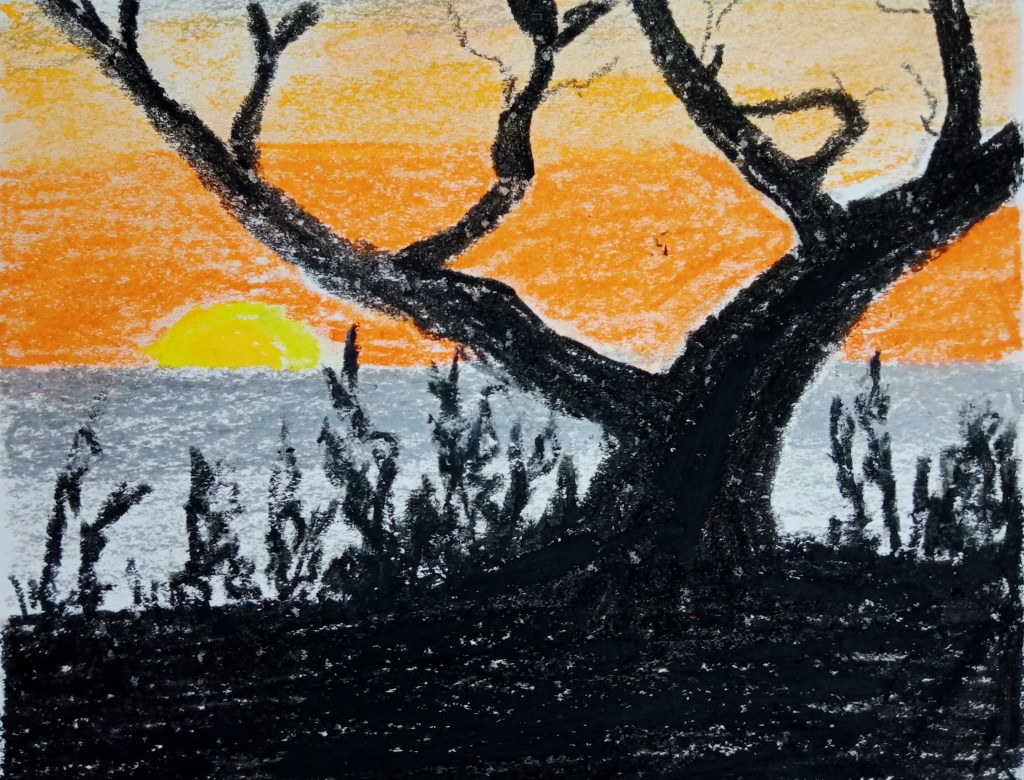
Art by Sohana Manzoor

Editorial

Whispers of Stones… Click here to read.

Translations

Tagore’s Mono Mor Megher Shongi (‘The Clouds, My Friends‘)has been translated by Professor Fakrul Alam. Click here to read.

The Welcome, a skit by Tagore, has been translated by Somdatta Mandal. Click here to read.

The Bus Conductor, a short story by Dalip Kaur Tiwana has been translated from Punjabi by C. Christine Fair. Click here to read.

Hasan Sol: A Balochi Folktale from Geedi Kessah-4(Folktales Vol: 4) compiled and retold by Gulzar Khan Mari, has been translated by Fazal Baloch from Balochi. Click here to read.

Cry of the Sunflower written in Korean and translated to English by Ihlwha Choi, a poem for Ukraine. Click here to read.

Tagore’s Nobobarsha (or ‘New Rains’) has been translated by Mitali Chakravarty. Click here to read.

Pandies’ Corner

This narrative is written by a youngster from the Nithari village who transcended childhood trauma and deprivation. Lockdown had been written in Hindustani by Jishan and translated to English by Grace M Sukanya. Click here to read.

Poetry

Click on the names to read

Michael R Burch, Supatra Sen, Jenny Middleton, Pramod Rastogi, Ron Pickett, George Freek, Devangshu Dutta, Candice Louisa Daquin, David Francis, Raja Chakraborty, Michael Lee Johnson, Ashok Suri, Ryan Quinn Flanagan, Sutputra Radheye, Maid Corbic, Rhys Hughes

Poets, Poetry & Rhys Hughes

In The Anthology in my Mind, Rhys Hughes talks of a make believe anthology. Click here to read and find out what he imagines.

Conversations

Eminent film journalist, Ratnottama Sengupta, converses with legendary actress, Deepti Naval, on her literary aspirations at the Simla Literary festival, Unmesh, in June 2022. Click here to read.

Keith Lyons interviews Steve Carr, a writer who has written 500 short stories and has founded the Sweetycat Press. Click here to read.

Stories

A Cat Story

Sohana Manzoor leaves one wondering if the story is about felines or… Click here to read.

My Christmas Eve “Alone”

Erwin Coomb has a strange encounter at night. Is it real? Click here to read.

Bus Stop

The story by Rinu Antony focusses on chance encounter at a bus stop. Click here to read.

Murder at the ‘Pozzo di San Patriza’

Paul Mirabile travels to 1970s Italy to experience a crime inside a sixteenth century well. Click here to read.

Musings/ Slices from Life

Grune Point and an Inkling of Eternity

A poetic account by Mike Smith as he explores the area that hovers between England and Scotland. Click here to read.

Olympic Game Farm: Meeting and Greeting Animals from Disney Movies

Hema Ravi visits a farm that houses animals that had a past in Disney. Click here to read.

Notes from Japan

In A Visit to the Isamu Noguchi Garden Museum, Suzanne Kamata visits a Museum dedicated to an American Japanese artist. Click here to read.

Musings of a Copywriter

In Shopping for my Funeral, Devraj Singh Kalsi goes on a bizarre spree. Click here to read.

Mission Earth

In On a Bamboo Bicycle from Thailand to Indonesia, Kenny Peavy revisits his trip across Asia exploring the biodiversity and conservation efforts. Click here to read.

Essays

Discovering Books and Places: The Voyage from Eden

Meredith Stephens sails the Australian coastline, recording her experiences with words and her camera. Click here to read.

Trekking to Tilicho Lake

Ravi Shankar treks up to Tilicho Tal at 4940 m. Click here to read his trekking adventures.

A Modern-day Animal Fable with Twists

Dan Meloche visits a contemporary Canadian novel written as an animal fable to draw an unexpected inference. Click here to read.

The Observant Immigrant

Is it okay to be ordinary? by Candice Louisa Daquin explores the responses of people to being accepted as ordinary. Click here to read.

Book Excerpts

An excerpt from The Mendicant Prince (based on the Bhawal sannyasi case) by Aruna Chakravarty. Click here to read.

An excerpt from Nabendu Ghosh’s Dadamoni: The Life and Times of Ashok Kumar. Click here to read.

Book Reviews

Meenakshi Malhotra reviews Tagore’s Gleanings of the Road translated by Somdatta Mandal. Click here to read.

Rakhi Dalal reviews Geetanjali Shree’s Mai, Silently Mother, a Sahitya Akademi winning translation of the Hindi novel by Nita Kumar. Click here to read.

Indrashish Banerjee reviews Nabendu Ghosh’s Dadamoni: The Life and Times of Ashok Kumar. Click here to read.

Bhaskar Parichha reviews Prosanta Chakrabarty’s Explaining Life Through Evolution. Click here to read.

Categories
Editorial

Whispers of Stones

When the mountains and grass
had life, stones whispered
how the world came to be…

'Stonehenge', Daily Star

And as the world came to be, there was war — war that seems to rage in some part of the world or other. The British Museum has an exhibit which states the first battle was staged 13,000 years ago… in what is now Sudan, long before the advent of written history. This was even before the advent of people who built the ancient Stonehenge which was constructed around 3000-2000 BCE. And battles still continue to rage. The Jebel Sahaba casualties in Sudan 13000 years ago were less than 100. But the current conflicts claim in terms of tens of thousands which prolonged could stretch to millions. The last world war (1939-1945) which lasted for six years had a total of  75-80 million persons who perished. Ukraine-Russia conflict has within five months had a casualty count of more than 14000. And yet weapons and nuclear arms continue to proliferate decimating humanity, nature and towns, destroying homes, erasing ruthlessly and creating more refugees. The only need for such battles seem to be to satiate the hunger of the warlords secure in their impenetrable fortresses while tens of thousands are annihilated and natural or nurtured landscapes lie emaciated, mutilated and polluted.

What would be a good way of ending such wars?

Tagore sought the development of better instincts in humankind as an antidote. He wrote in the last century: “Any teaching concerning man must have human nature for its chief element. How far it will harmonise with human nature is a matter of time.”

With wars getting deadlier and more horrific, we can only try to awaken, as Tagore suggests, the better nature in man to move towards a peaceful world. What would be a more effective way of doing it than writing with the hope of a kinder and accepting future?

For that let us start with translations of the maestro Tagore himself. We have a song about the season — monsoon, ‘Monomor Megher Songi (My Friends, the Clouds)’, translated by Professor Fakrul Alam, a painting by Sohana Manzoor interpreting the lyrics and a transcreation of Nababarsha or New Rains’ was shrunken into a popular Rabindra Sangeet and reduced to twenty lines in English by Tagore himself. The connect with nature is an important aspect that enables humans to transcend petty concerns leading to dissensions of different kinds as evidenced in the maestro’s humorous feline skit, translated by Somdatta Mandal. A translation of Dalip Kaur Tiwana’s ‘The Bus Conductor’ from Punjabi by C. Christine Fair adds zest to this section. Fazal Baloch has translated a folktale from Balochistan involving the supernatural and Ihlwha Choi has taken on the cry for peace on behalf of Ukraine while translating his own poem in Korean. The Nithari column has a story by Jishan in Hindustani, translated to English by Grace M Sukanya, showcasing the struggle of a youngster during the pandemic – rather a sad narrative, which though fictitious has its roots in reality. 

Our poetry section touches upon the timelessness of dissensions and darkness with Michael R Burch’s poem on Stonehenge and Supatra Sen’s poem on Ukraine. This has been allayed by love poetry by Maid Corbic from Bosnia. George Freek’s poem ruffles with its reflective lines. And in the midst of it all, is poetry by Ryan Quinn Flanagan reflecting on the seven stages of man. Will the process of aging or human nature ever change? I wonder if Rhys Hughes can find an answer for that in humorous verses as he has shared in this issue. In his column, Hughes has written about an imagined anthology of short stories.

Our short story section has echoes of humour around felines by Manzoor, somewhat in tune with the mind frame seen in Tagore’s skit on this issue. Humour rings tinged with an apparition in Erwin Coombs’s narrative – should one call it dark humour or is it just his style? Paul Mirabile goes for gothic darkness in his meanderings around Italy.

Strangely, we seem to have a focus on short stories this time. Keith Lyons has interviewed Steve Carr, a journalist, a publisher and writer of 500 short stories who is questing to create a ‘perfect short story’. Reading out excerpts from her short story at a literary festival in Simla, Bollywood celebrity, Deepti Naval, was in conversation with eminent film journalist, Ratnottama Sengupta. She spoke of her literary aspirations while unveiling her autobiography in verse, A Country Called Childhood. This conversation has been shared by Sengupta with Borderless. It is interesting to see how Naval’s reactions to social malaise contrasts with that of the film director, cinematographer and actor, Goutam Ghose, who was present during the unveiling of her book. He had responded to communal violence by making a film on Lalan Fakir extolling virtues of love and kindness, called Moner Manush (2010) and then made a book on the film called, The Quest (2013) which has beautiful translations of Lalan Fakir’s lyrics by Sankar Sen.  

Our non-fiction sections seem to be hosting multiple travel stories across UK by Mike Smith, along the Australian coastline by Meredith Stephens, on the Himalayas with Ravi Shankar and an unusual visit by Hema Ravi to a farm in US where animals that had been used in Disney films in the past are homed. Our environmental columnist, Kenny Peavy, actually wrote about his cycling trip from Thailand to Indonesia on a bamboo cycle made by a Singaporean! And from Japan, Suzanne Kamata explored a museum in the neighbouring town of Mure. The museum on a hill hosts the art of American Japanese Artists, Isamu Noguchi.

We do have non-fiction that moves away from travel: noir humour by Devraj Singh Kalsi and an essay by Candice Louisa Daquin on a very interesting subject – ‘Is it Okay to be Ordinary?’ Is it?  Dan Meloche has written a literary essay on Canadian novelist Andre Alexis’s award-winning novel, Fifteen Dogs: An Apologue (2015). While Meloche spoke of how the novel departed from Orwell’s Animal Farm, his narrative brought to my mind a novel closer to our times set in England by Jasper Fforde called Constant Rabbit (2020) – this a science fiction while Alexis’s was an apologue or an animal fable. Fforde did use the rabbits rather well to highlight the current times.

We have book excerpts of two recent books that I would call really outstanding. One of them is Aruna Chakravarti’s The Mendicant Prince, which is being released this week, and is based on the evergreen contentious case of the prince of Bhawal that has even been explored even in cinema. The other, Dadamoni: The Life and Times of Ashok Kumar by Nabendu Ghosh, has been published posthumously and is not a translation from Bengali but written in English originally by this trilingual writer.  

Called ‘Dadamoni’ affectionately, iconic actor Ashok Kumar is regarded as “the one personality who symbolises Indian cinema’s journey from Bombay Talkies to Bollywood”.  This book has been reviewed by Indrashish Banerjee, who calls it ‘a reflection on the Hindi film industry’ as well as a biography. Rakhi Dalal has reviewed Booker winner Geetanjali Shree’s Mai, Silently Mother, a Sahitya Akademi winning translation of her Hindi novel by Nita Kumar, reiterating the dialogue that had been kindled on motherhood last month by Rinki Roy Bhattacharya and Maithili Rao’s The Oldest Love Story (2022). Bhaskar Parichha has reviewed Prosanta Chakrabarty’s Explaining Life Through Evolution plotting how life evolved on earth. Parichha tells us: “Meaningful, wide-ranging and argumentative, this is a must-read book. It will propel us to imagine and reimagine life around us.” Another book that sounds like a must-read has been reviewed by Meenakshi Malhotra, Tagore’s Gleanings of the Road, translated by Mandal. She tells us: “ ‘Gleanings’ represents the quintessential Tagore…Ably introduced and translated by Somdatta Mandal, a renowned Tagore scholar, the translation captures the iridescent and luminous quality of Tagore’s prose and its chiaroscuro effects.”

There is more to tempt. Please stop by on our contents page and take a look.

We would like to hugely thank all our contributors and readers for being with us and helping us grow. I would like to thank my team, who despite hurdles they face, always lend a helping hand and wonderful words from their pens or computers to get Borderless on its feet. I apologise for the delay and thank you all for your patience. Special thanks to Sohana Manzoor for her fabulous artwork.

I wish you all a wonderful July and peace in a war-torn world. We are all affected by the ongoing conflicts. Let us hope for peaceful and just resolutions.

Thanks.

Mitali Chakravarty

borderlessjournal.com

Categories
Stories

Murder at the ‘Pozzo di San Patrizo’

Paul Mirabile travels to 1970s Italy to a crime inside a sixteenth century well

A visit to Italy would certainly do me wonders; I hoped my migraines and other aches and pains would disappear, and my academic life regain its habitual vitality and éclat. Yet, in spite of my joyous resolution, I couldn’t see myself going alone to a country so different from my own. I thus decided to bring along a girlfriend of mine, a colleague from the university who had been working with me on various projects both at the university and at my summer home. She would be an excellent companion for such an excursion; the long distances by bus and train would be spent in ardent conversation, the sites and experiences could be discussed with a sympathetic companion. Also, if my health would fail at any given moment, she could surely offer her fine qualities as a physical and spiritual healer.

We left at the end of June, taking a night train through sunny France then directly to Rome. After spending a stimulating week there, bathing in the glory and debauchery of the Roman Empire, exalting the works of the great Renaissance artists, strolling through the still present Pasolinian streets of proletarian squalor, we took a bus to Orvieto, a mediaeval town located in the lush green hills of Umbria, noted especially for its white wine. I like a good white wine, and I was sure this ancient Etruscan town would revive and rejuvenate my spirits. Rome had plunged me in a numbing, cultural lethargy ; it was much too theatrical for my tastes, too saturated in enormous works of art for me to assimilate. I needed a stimulus less exacting, less pompous, more submissive. Orvieto was just that submissiveness …

The cathedral drew me towards her like a lascivious hussy. The queenly black and white columns and the lightly faded frescoes depicting scenes from the ‘Apocalypse’ painted at both ends of the transept[1] heightened my appetite for the imaginative and the unknown. The ceiling towered ever so high above me. At times the long and lofty naves appeared like soaring prehistoric animals, zebra-coloured, ready to devour their squealing prey below. At these awesome moments, I forgot that my colleague was close at hand, a hand so tender, fresh. Her presence became unreal, fading away beyond the muslin ramparts of my intimate sanctuary.

When I returned to the real world, I took my girlfriend by the hand and pressed it firmly. She appreciated those penetrating instances, although I will confess they were few and far between.

After our visit to the Duomo, we stopped for lunch, and had some lovely Orvieto wine. I ate and drank like I never had before, gobbling down plates of pasta that I never dared touch at home. I felt like I was in a reverie, drinking, eating, laughing … even joking ! I had never joked in my life: Was I possessed by some spirit, or simply by the trellis of polychromatic vines creeping up the trattoria[2]walls that emitted the most sensuous perfumes?

We stopped off at our hotel to change after lunch. I threw around my neck my favourite silk scarf stained a violent red. As to my companion, she too dressed very smartly for the occasion, draped in a long, milky white muslin skirt, a resplendent black satin blouse and sporting a large hat with crape rose. Yes, it would to be a most rewarding plunge into the underworld, I thought cheerfully.

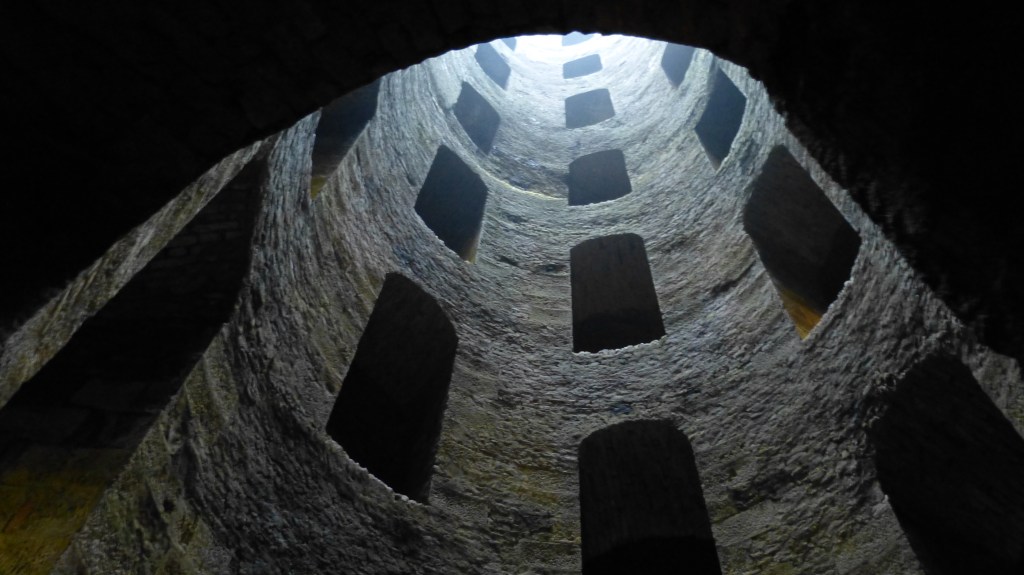
We left the hotel. Arm in arm we strolled like two young lovers towards the famous Pozzo di San Patrizio, a curiosity that attracted me for its absolute banality: a well dug out of volcanic tuft, hellishly profound, spiralling down and down into the bowels of the earth, where the coolness of its universe preserves and petrifies all that stumble into and within its dark, dank apertures. Are all wells similar ?

We descended the cool, glistening, humid steps, smoothed over by moss. Oddly enough, we were the only visitors. My colleague, startled by our chilly surroundings, grasped my arm tightly in an almost man-like grip. She slipped, nearly sliding over the low stone wall that separated the steps from the brackish waters far below. I peered down into them ; a diminutive bridge connected the two spiralling stairways on each side of the darkened waters. The bridge seemed so far away, so distant from our weary lives spent on the surface of the earth, working like slaves to earn a meagre living. I had been toiling so much, trying to gather new ideas for a book or short-story. But nothing emerged, no matter how deep I sounded ; only a spittle of words drooled on paper without meaning, and oftentimes, without form.

My mind wandered nervously from the moist walls to the lightless, stagnant waters … A story would surely form out of those dank elements, a murder committed on the spur of the moment as the killer descended ever deeper into the bowels of Hell … Yes, Saint Theresa’s Hell as she so vividly depicted it in her autobiographical writings; a depiction that I had memorised to comfort me during long sleepless nights, twisting and turning in moist, smelly sheets :

 “…Whilst she knelt in prayer, she suddenly found herself amongst demons in a place which appeared to her like the entrance of a long, narrow small street, a sort of low furnace, obscure and anguishing. The floor seemed to be of a very foul-smelling muddy water, swarming with terrible vermin or worms. At the end of this road appeared a cavity with a sort of closet, cabinet or store-room where the saintly nun felt cramped. Here she felt as if she were imprisoned. Hence, I reiterate that the descent into Hell was one of the greatest boons that the Lord granted me because I gained greatly from it, losing thus my fears of the trials and contradictions of this life, so as to strengthen myself to endure them ; and I thank the Lord who delivered me from what appears to me to be such terrible and perpetual evils …” 

How comforting did those words ring in my tortured ears under the weighty silence of starless nights. A murder, yes a murder … without premeditation, without vindictiveness … without meaning ! A murder pure in act, taintless of any scrupulous criminality to which mankind has been accustomed. A murder to be executed in this very well, in its unholy, hellish, malodorous enveloping coil. Its slimy aureole would indeed produce a horror-filled effect.

 As I turned to my colleague to expound my budding thoughts, a hard, clanking noise disturbed us from above. It sounded like a rotating, iron machine, grinding, pounding, droning … droning like a million wasps or hornets. A torturing engine, perhaps, twisting and tearing the limbs of its hysterical victims. The weird cranking sounds made my head spin. I felt a pang of involuntary emotion for its victims, his or her sorrows and misfortunes, trials and tribulations. My girlfriend stared at me out of empty orbits. Above the cranking din, the droning wasps and hornets, now receded now grew louder. I poured out my soul to her about the imagined murder. My animation caused her to laugh meekly, albeit I sensed in her voice an anguish that if magnified would have echoed off the well walls. She noted my need to expurgate this relevant project, the desire to couch it on paper, the need to fulfil its account. She realised this tale could only be discussed in whispers, here in the bowels of Hell. Yet, how delighted, how encouraged, how spellbound even was I to enlist her sympathy.

Our footfalls were endless. The sun’s rays had long since left us to grope our way along the smooth, rounded walls. The clanking and droning had ceased for an instant, but again took up its place amongst the horrors of my imagination, in rhythm with the melodious words of Saint Theresa, still drumming inside my temples. And my tale thickened with obsolete details amongst those uncanny rhythms. The cranking lent it beauty and balance, the drake-like light, ruddy and rutilant, form and volume. But the tiny bridge still appeared so remote, so aloof, far below us. Would we ever reach the damn thing ? Its razor-sharp crossing? The descent … the razor-sharp bridge : “ ..it was the bridge over cold water … it was strong and stiff like a sword … and it had the length of two lances..…” murmured creepily into my ear a fey voice from some remote, unearthly Time and Space; one that I could not fathom for the life of me. I shook my head, ridding it of that vexing nuisance …

The story that poured out from my entrails would surely please my future readers. But did it have to occur at the bridge ? Could it not, for example, happen elsewhere, along the slimy passage downwards, high above the stinking waters ? Could the killer, anxious to carry out his crime, impatient of the countless steps, not throw his victim to a watery death from the smooth, slimy, low, protecting, stone wall ?

I submitted these new image-filled details to my colleague who merrily agreed to the novel developments. She deemed it amusing, and even cautioned a detail or two, apropos the way in which the murder was to be effected. Was the victim to be strangled or merely thrown over the stone wall ? I shook my head fiercely, no violence would be condoned, a simple push over the side. The killer would observe the frightened face of his defenceless prey as she plunged over the stone wall. Yes ! It had to be a woman ! One who was easily terrified, especially of well deaths ! I laughed so loud that its echo clanged above the clanging, iron clamour … the droning hordes of wasps and hornets. My girlfriend stepped back against the low wall, noticing that the laugh resounded far greater than the gyrating engines. She turned a ghastly white, her eyes frozen in their sockets. Her sudden soft smile eased my inner tensions, soothed my painful need to perform a physical achievement. Yet, I had to do something to alleviate the mounting tension in my chest and temples : that spiralling Theresian plummet into Hell …

I touched her arm, absorbed by the intensity of her presence. She suddenly slapped me away as if the torturous pounding had been impounded in the palm of my hand. Her face transformed into a mutilated horror, her lips stretched bloodlessly across her already livid, pallid face. Those lips curled into a snarl and sneered at me. Those hollow eyes tunnelled out two fiery rays in the inky darkness. Her slow and steady transformation, along with the droning machines drove me back a few steps. The well seemed so much deeper ; and where was that bridge ? The iron clanking and wasp-like droning came to a sudden halt … The silence grew unworldly, and as it did, all the terrors of the subterranean world began to jump at me in tainted colours. Indeed, the Luciferian world would soon gain on my own. I wanted to run back up those long steps, back to light and hope.

She caught my shoulder. I lashed out to protect myself. Who’s side would she be on ? There would be no turning back now, my mind was running amok. My story was not evolving any further, and there I was trapped within the entrails of Hell in company not with Saint Theresa but with a witch-like demon. A strong impulse grew terribly painful and seized my heart, a killer’s impulse that shot adrenalin through my arm as it involuntarily stretched out to grasp the witch’s leathery neck … to wring it to death. But ever so gently, as not to leave any ungainly marks on that creamy, pasty, ashen skin. Those marks never attracted me in the least ; they were done in the most barbaric fashion, passionately and without reflexion.

We are not savages, are we not ? We are children of mild words and sober acts. And here I was forced to perform such undistinguished rituals … I deemed it repugnant to prostrate before these base and besmirching deeds. Her lips touched mine. They were dry, wilting like the dying petals of a black tulip, no longer tempting, but welcoming infectious lust. My strength, however, did not yield, and lifting up this mindless, mirthless creature, I threw it over the wall, its screams in perfect harmony with the churning machines, the droning hornets. The screams vanished with a distant thud … and splash … I peered over the low stone wall : the body floated listlessly upon the calm, clammy waters. Suddenly it disappeared, and only the large hat with crape rose lay stiff on the oily surface waters like some dead gelatinous marine creature …

I continued to peer into those waters, so still, so tranquil, like my nerves, still and tranquil. A decomposing odour soon filled the air. Already ? It made me think of a slaughter-house on the edge of a polluted river-bank. Perhaps even of a burial vault. I searched for my colleague but she was nowhere to be found. Had she returned to the surface? She did seem so distraught at the stillness and profoundness of that Hell-hole. Someone did caution me about her oftentimes awkward, even odd, unpredictable behaviour.

Apparently she was capable of standing you up at any time for any given reason. I now believed it. She had left me to wane alone in Saint Theresa’s realm. But I was undaunted, unafraid of what others would say if they should find me amongst the dead. Their words could never pierce my brazen heart. I had been there before and knew how to handle poisonous platitudes. And besides, I could at last write my story… my beloved story that would earn me a grand reputation amongst my so called peers, they who, to tell the truth, were no more than the lackeys of market-targeting editors and courtiers of government officials. Perhaps they would all laugh at my naivety, at my indefatigable efforts. But I feared not their calloused mockery. I would not lock myself up like some raving maniac and let them tear me to pieces. Let them come ! The dark walls of Hell had welcomed Saint Theresa … They shall welcome me ! They shall be my lichened ramparts, my spiralling stairway to fame and fortune ! Hell will transform the cranking machine and droning nests of wasps and hornets into a deadly weapon of defence … cranking and droning my enemies to atoning tears. Had the goodly saint not whispered to me the bitter but bountiful benefits of Lucifer’s diabolical gardens ?

There on the diminutive bridge, razor-sharp (I finally gained the bridge), I waited for them, my indistinguishable peers, cranking my neck high up to the creamy waxing rays of a lunar light ; waited at that precipitous bridge for the great Crossing. Ô Theresa ! Ô Theresa ! Will my story rise to the dawn of rosy day, expurgated of its entombed overweening bondage ?


[1] Either of the two sides of a cross-shaped church that are at a perpendicular angle to the main part

[2] Italian eatery

Paul Mirabile is a retired professor of philology now living in France. He has published mostly academic works centred on philology, history, pedagogy and religion. He has also published stories of his travels throughout Asia, where he spent thirty years.

.

PLEASE NOTE: ARTICLES CAN ONLY BE REPRODUCED IN OTHER SITES WITH DUE ACKNOWLEDGEMENT TO BORDERLESS JOURNAL

Categories
Contents

Borderless, June 2022

Art by Sohana Manzoor

Editorial

We are All Going on a Summer HolidayClick here to read.

Interviews

In Conversation with Rinki Roy (daughter of legendary director Bimal Roy) about The Oldest Love Story, an anthology on motherhood, edited and curated by journalist and authors, Rinki Roy and Maithili Rao. Click here to read.

Achingliu Kamei in conversation with Veio Pou, author of Waiting for the Dust to Settle, a novel based on the ongoing conflicts in North-east India. Click here to read.

Translations

The Funeral, a satirical skit by Tagore, translated by Somdatta Mandal. Click here to read.

Three Shorter Poems of Jibananda Das have been translated from Bengali by Professor Fakrul Alam. Click here to read.

The Magic Staff , a poignant short story about a Rohingya child by Shaheen Akhtar, translated from Bengali by Arifa Ghani Rahman. Click here to read.

Fakir Khizmil & the Missing Princess, a Balochi Folktale has been translated by Fazal Baloch. Click here to read.

Pie in the Sky is a poem written and translated from Korean by Ihlwha Choi. Click here to read.

Taal Gaachh or The Palmyra Tree, a lilting light poem by Tagore, has been translated from Bengali by Mitali Chakravarty. Click here to read.

Pandies’ Corner

This narrative is written by a youngster from the Nithari village who transcended childhood trauma and deprivation. Dhaani has been written in Hindi and translated to English by Kiran Mishra. Click here to read.

Poetry

Click on the names to read

Jared Carter, Sutputra Radheye, Ryan Quinn Flanagan, Antara Mukherjee, David Francis, Alpana, George Freek, Prashanti Chunduri, John Grey, Ashok Suri, Heather Sager, G Venkatesh, Candice Louisa Daquin, Elizabeth Ip, Rhys Hughes, Michael R Burch

Poets, Poetry & Rhys Hughes

In From a Kafkaesque Dream to the Penguin Cafe Orchestra, Rhys Hughes brings out a new strain of tunes that grew out of Jeff Simon’s unusual journey and it continues to persist beyond his life. Click here to read.

Stories

Oliver’s Soul

Paul Mirabile weaves a story of murder and madness in Madrid of 1970s. Click here to read.

The Wallet

Atreyo Chowdhury spins a tale set in Kolkata. Click here to read.

Flowers on the Doorstep

Shivani Shrivastav writes of an encounter with a mysterious child in Almora. Click here to read.

A Riverine Healing 

PG Thomas’s narrative set in Kerala, explores a leader’s old age. Click here to read.

Pagol Daries

Indrashish Banerjee creates a humanoid scenario where robots take on human roles. Click here to read.

Musings/ Slices from Life

In Memoriam: Star of the Stage Shines on Screen

Ratnottama Sengupta pays a tribute to famed actress, Swatilekha Sengupta (May 1950- June 2021). Click here to read.

Pizzas En Route to Paradise

Keith Lyons discovers the import and export of desires in Varanasi, one of the oldest cities in the world, beside one of the most revered rivers. Click here to read.

Notes from Japan

In Marathon Blues, Suzanne Kamata talks of pandemic outcomes in Japan in a lighter tone. Click here to read.

Musings of a Copywriter

In Journey of an Ant, Devraj Singh Kalsi explores life from an insect’s perspective. Click here to read.

Mission Earth

In Tuning in to Nature, Kenny Peavy tells us how to interact with nature. Click here to read.

Essays

Kabir & His Impact on Tagore

Mozid Mahmud explores Kabir and his impact on Tagore, which ultimately led to a translation of the great medieval poet. Click here to read.

A view of Mt Everest

Ravi Shankar travels in the freezing cold of Himalayan splendour and shares magnificent photographs of Mt Everest. Click here to read.

The Good, the Bad, and the Benign: Back across Bass Strait

Meredith Stephens shares a photographic and narrative treat from Tasmania. Click here to read.

The Observant Immigrant

In Season’s in the Sun, Candice Louisa Daquin explores what intense positivity can do to people. Click here to read.

Book Excerpts

Excerpt from Tagore’s Gleanings of the Road, translated by Somdatta Mandal. Click here to read.

Excerpt from Waiting by Suzanne Kamata. Click here to read.

Book Reviews

Meenakshi Malhotra revisits Harsh Mander’s Locking down the Poor: The Pandemic and India’s Moral Centre. Click here to read.

Indrashish Banerjee reviews Keki N Daruwalla’s Going:Stories of Kinship. Click here to read.

Gracy Samjetsabam reviews Pronoti Datta’s Half-Blood. Click here to read.

Bhaskar Parichha reviews Deepti Priya Mehrotra’s Her Stories –Indian Women Down the Ages — Thinkers, Workers, Rebels, Queens. Click here to read.

Categories
Editorial

We are All Going on a Summer Holiday…

Yes! It is vacation time, and we are all able to travel at last. Though the pandemic which had closed borders for us seems to be evolving as an endemic, another huge human crisis, a war which cannot be justified in any way, stares us in the face. Loss of lives, homes, towns, cities and threats of global recession follow in the footsteps of refugees wandering into our lives. Lesya Bakun, the Ukrainian refugee whose story we have been following, told me four of her relatives’ homes in Mariupol have been erased out of existence and her extended family has scattered where they found safety as her cousin continues a prisoner of war, captured while defending the iron and steel factory at Azovstal. While majority of the world expresses solidarity with the Ukrainians, another set of refugees remain in shadows. They have completely lost their country in which they had lived from ancient times. I am referring to the Rohingya of Arakan. CNN world states:

“The Rohingya are a stateless Muslim minority in Myanmar’s Rakhine State, thought to number about 1 million people.

“Myanmar does not recognize them as citizens or one of the 135 recognized ethnic groups in the country.”

 We are privileged to host a powerful poignant translation by Arifa Ghani Rahman of Shaheen Akhtar’s short story about such a voiceless Rohingya child in a refugee camp. Though this is a fiction inspired by Akhtar’s visits to such shelters, we hope at some point these children will be able to build new lives to create a world free of violence, intolerance, hatred and greed.

One of the questions that springs to one’s mind, watching such atrocities destroy innocent lives is that should one accept bullies and give in to their pressure tactics? Bullies can be found among world leaders as well as perpetrators of decadent societal norms which are often critiqued by satires. Somdatta Mandal has translated one such satirical playlet where social conventions are targeted in a lighter vein by Tagore. In the same spirit, the maestro’s iconic poem about a palmyra tree called Taal Gaachh has been transcreated to bring the joy of innocent wanderings back into the narrative, creating an island of healing thoughts. We continue with our translations of Jibananada Das by Professor Fakrul Alam, a Korean poem by Ihlwha Choi and a magical Balochi folktale by Fazal Baloch. Let us read such translations to connect with varied cultures so that compassion and acceptance of diverse perspectives end horrors like wars, starvation and hunger.  

Tagore’s writings translated to English by Mandal in Gleanings of the Road, a collection covering the maestro’s travel to the West, is part one of our book excerpts and highlights Rabindranath’s perspectives on the need to connect with the larger world. The other book excerpt, from Waiting, poetry by Suzanne Kamata, takes up the theme of victimisation, crime and murder. Dwelling on no less horrific narratives, though justified as non-criminal, is a review by Meenakshi Malhotra of Harsh Mander’s Locking down the Poor: The Pandemic and India’s Moral Centre. Gracy Samjetsabam’s assessment of Half-Blood by Pronoti Datta informs about the greyer areas of a whole community in Mumbai. Indrashish Banerjee reviewed Keki Daruwalla’s stories on human relationships anthologised in a collection called Going: Stories of Kinship while Bhaskar Parichha has acquainted us with Deepti Priya Mehrotra’s Her Stories –Indian Women Down the Ages — Thinkers, Workers, Rebels, Queens, a non-fiction that visits inspiring women.

Inspiration can also be drawn from Rinki Roy Bhattacharya’s and Maithili Rao’s The Oldest Love Story, featuring a medley of men and women writing on the theme of motherhood along with some narratives about their mothers or on the experience of being one. The medley includes well-known names from films and literature like Shabana Azmi, Saeed Mirza, Shashi Deshpande, Nabanita Dev Sen and more. We interviewed Roy Bhattacharya to find out more about this impactful book. Achingliu Kamei, an academic and writer, has conversed with Naga writer, Veio Pou, whose award-winning book, Waiting for the Dust to Settle, was reviewed earlier — a book that gives a glimpse of conflicts in the Northeast of India.

Taking on the theme of conflicts at a personal level, Atreyo Chowdhury’s and Banerjee’s stories create a sense of disquiet as Paul Mirabile’s explores crime, madness and its impact on humans. G Thomas takes a relook at heroism and bravery as a concept. His story set in Kerala shakes our complacency, upending traditional concepts of heroism and bravery just as Candice Louisa Daquin has upended the cult of positivity in her essay. Notes of discord and accord seem to ring through this edition and the undertones of greys spread out towards an exploration of life and death. We have multiple ghost stories this time, even from the Nithari column written by Kiran Mishra, a youngster who got over the trauma of violence in the community and discovered her place as a bilingual writer and educator.

Our poetry section is honoured to host Walt Whitman Award winner, Jared Carter, again with his poetry on a Japanese artefact as George Freek’s continues to be inspired by the style of Song dynasty poets. Michael Burch writes beautiful love poems. We have a vibrant poetry section with Daquin, Sutputra Radheye, Ryan Quinn Flanagan, Antara Mukherjee, Rhys Hughes, who has also revisited ‘The Penguin Café Orchestra‘. This band started a new kind of musical trend with nothing but passion and conviction. Hughes of course cannot escape the bonds of his tongue-in-cheek style, also adopted by Devraj Singh Kalsi while he pretends to be an ant.

Keith Lyons has got the bug of tongue-in-cheek too as he gives us a piece on his travels in Varanasi that well captures the dichotomies we find in India. Dwelling on social dichotomies also is Ratnottama Sengupta’s powerful tribute to Swatilekha Sengupta, a film and theatre doyenne who brought to life Tagore’s novel, Ghare Baire (Home and the World, 1985). An essay by Mozid Mahmud exploring both the syncretic elements in Tagore’s and Kabir’s works, the medieval poet’s impact on the Nobel laureate and a dispute over Rabindranath’s own translation blends with the tone of greys in this edition.

Travel narratives and photographs by Meredith Stephens sailing the seas in Tasmania and Ravi Shankar trekking on the slopes of the Himalayas to get a view of Mt Everest make for perfect holiday adventures. From Japan, Kamata has given us a narrative set in the pandemic. And environmentalist Kenny Peavy dwells on reconnecting with nature in Mission Earth.

We have a fair deal from across the globe in the June issue. But, as usual, some of the treats in the content have not been mentioned though they are wonderful pieces of writing too. We look forward to your continued support as you delve into our treasure trove of gems from across the oceans. A huge thanks to our fabulous team, to the contributors and readers. I especially want to thank Sohana Manzoor for sharing her lovely artwork and wish you all a wonderful read!

I hope you have a fabulous summer.

Thank you.

Mitali Chakravarty

borderlessjournal.com

Categories
Stories

         Oliver’s Soul

Paul Mirabile weaves a yarn of murder and madness in Madrid of the 1970s         


Madrid: Courtesy: Creative Commons

I am jotting this down while it is still fresh in my mind, hoping that the police will not jump to hasty conclusions and accuse me falsely of the killing. The murderess, after relating the incident to me, left that very evening ; that is to say, the evening I found her at home standing over the corpse of my dear friend Oliver. Since her departure, the entire affair has shaken me up, given the terrible fact that I am the only person available, and I shall add, sound of mind, to offer an explanation. Here let me give you an account of what actually took place before anything injudicious happens to me.

She was a religious fanatic, the murderess, that I am certain, and although I had these impressions of her, I could never pin-point the source of material she utilised in her indefatigable tirades apropos the necessity of man to humiliate himself before God, who, as she insisted, created man in order that he may serve Him, and suffer the cross as He did. Apparently she was well read in mediaeval Christian dogma, and especially in the works of Fray Luis de Granada, Saint Thomas of Aquinas and Abelard. She had been a student of theology and philosophy, albeit a poor one, but did have an entertaining command of the subtle teachings and techniques of Meister Eckhart and Jacob Boehme.

Our conversations were weighty, yet erratic. The evening of the murder, for example, she picked up a book and tossed it out of the window. We had been talking about the physical attributes of the soul, and it seemed I had upset her over something. I asked her why she loved Oliver instead of me, and without a word she promptly threw out three more, one of which one was the Bible ! I heard them sailing through the still, night air and land on the small plaza below with a soft thump. Her eyes wandered off to stare at the empty space just below the low-ceiling of her flat. A crooked smile stretched on her bloodless lips. A fly had sailed in on the waves of the interminable Madrilenian heat from the open window, buzzing annoyingly about the wrought iron chandelier. She seemed to enjoy that buzzing.

When she had snapped out of her mesmerised state, she placed her hands upon my head and drew me towards her. She kissed me full on the lips. It was the first time we had kissed in many months. In the same distracted vein, she whispered that a sickness had befriended her, and a revelation had swollen her eyes with vivid scenes of lurid pleasure. At first she laughed, or rather giggled. A short time later, she said Oliver was coming to kill her, and that we must protect ourselves from him. I sat up staring at her in disbelief. She remained calm, disclosing her love for him, but added, that alas pure love could not be a defence against external, mundane effects. Love, she felt, could be overcome and defeated when the hour arrived for his meditated act. She continued saying that his soul could not forfeit this unleashed wave of energy, for he lacked in guided spiritual strength. I listened to her, not believing that Oliver was what she said he was. She continued to whisper in fey tones, her cold, blanched lips sometimes touching mine, whilst the wretched heat and that irritating buzzing were driving me insane.

The evening passed without any other incident, although her tone and breathing touched strange chords in my heart. She was obviously ill, but I refrained from asking her if she needed anything, or if I could be of any help. No, I take that back, I am lying to you : the thought never occurred to ask her ! Instead, my thoughts reached out in search of Oliver’s face. She made some more tea, we chatted a while then I left without a kiss.

The following morning, the air was less oppressive when I visited her; perhaps I had regrets about leaving so abruptly. She wasn’t in, but on the broken tiles, slipped halfway under the door was a note. It was Oliver’s handwriting, who apparently in great haste, had scrawled something about coming over that evening at around seven. Slipping the note back in its place, I elected that it would be better if I divulged to Oliver the scope of his lover’s uncanny behaviour and affected revelations. Rescinding the idea however, I walked the streets until nightfall.

The torrid dampness of late autumn in Madrid painted a dismal picture at that empty hour. The baroqueness of the city took on a ponderous, eerie, melancholic aura. I felt plunged in some Edgar Poe intrigue, sensed the triviality of my gestures and acts. My nerves were on edge: could hours be so onerous ? I continued my dreary pacing without pangs of hunger or weariness of stride. Suddenly, I found myself at the small plaza just below my sick friend’s flat, and where, from her window, she had a full view of the statue at the centre of the square, a commemorative homage to a fallen hero whose name I no longer recall. He held a huge white cross in his clenched fists, his eyes gaping feverishly ahead of him. Checking my watch, I read two. Looking up at her window, I saw the lights flash. Her head popped out, and I asked myself if she had, for some enigmatic reason, sensed my presence. What an absurd thought! I, nevertheless, slipped behind the statue, and kept perfectly still.

Thank heavens the hour was late and no one was in the street. Otherwise, some sober or insomniac portero[1] would have certainly run to the police. I must have cut a ridiculous figure, skulking behind that wild-eyed, cross-bearing zealot. I chanced another glance at her window. She had vanished. Recalling our conversation last evening, and Oliver’s note in the morning, I debated whether it were wise to go straight up or call the police. I decided to go up. In any case, the police would have thought me drunk, and perhaps would even have thrown me in jail.

I darted across the plaza into the shadows of the adjacent building. I can assure you that I felt like a thief sneaking through those bleak, heated hours of the night. A hussy with brazen bangles clinking in sad obscurity happened to discover me in the shadows of the doorway. Throwing up her arms, she let out a shriek and ran off across the plaza, her high-heels rapping, tapping and clacking a monotonous dirge upon the crooked stones. I speedily entered the building of Oliver’s lover. Happily the portero was either asleep or decidedly drunk. The stairway lay quiet.

My imagination was racing. Would she actually kill him ? How could she have ever conjured up such an extravagant idea ? Was she turning her destructive forces against Oliver because he had so oftentimes agreed to our platonic triad as the very proof of her incapacity to love just one man … or love any man ? Or was it her untamed inner drive set against society’s cruel hypocrisy of condemning a human being’s marginal existence as it played out in the complexity of an ever-shifting triangle ? It is true, however, that within the spheres of every man’s mind, dark moments instigate arrogance and envy to chase out reason and replace it with the urge to turn to crime and passion. I made haste, almost tripping on the last carpeted step.

I was startled to find her door ajar. I hesitated before I entered, apprehending what the consequences could be if my intrusion proved untimely … In one way or another. Oliver mustn’t know I suspected foul play. As for his lover, at this point I could not care a fig. It was merely a friendly visit. At two in the morning?

I strode boldly into the nondescript sitting room, stealing a glance at her. She stood there, gaping at me in bewilderment. Then a silly grin played across those thin, ghastly lips. She pointed to the mahogany table where the bloodstained corpse of Oliver lay, a kitchen knife thrust deep within his breast. I quickly shut the door then raced back to Oliver’s still warm body. She remained standing with that same plastic grin spread over a face of grotesque scorn.

Oliver was stone dead, his heavy body losing blood fast. A huge crimson pool formed under the mahogany table. Not a word passed between us. She scrutinised me, though, with a sort of curious air. Finally I stood, took hold of her shoulders, and signalled with a nod of my head to Oliver’s corpse. She pushed me away roughly, asked me to put aside my air of feigned mystery, then turned to make some coffee. I couldn’t believe the whole scene. Oliver lay murdered in the most despicable fashion and she sails off to the kitchen to make coffee! And that same damned fly kept buzzing about above me, flustering further my already knotted thoughts. I suddenly realised that I had walked into a terrible predicament. For all I knew she could have called the police, pinning the crime on me. Had I touched the knife ? No, thank God …

I glanced down at Oliver, my last thoughts finding their way into his, into our close, confidential past. We had so much in common, so much had been shared, and … and then she entered our manly nobleness, disrupting our toilsomely constructed dialectics. Had we not planned a long voyage to the East to spend a few years studying Eastern philosophy? The murderess returned with the utmost aplomb and placed the silver tray on the mahogany table round which the odour of thick, oozing blood wavered in wisps of despair.

I observed her carefully. She didn’t seem to be waiting for the police. Yet, she held her cup of coffee so delicately, as if that were the very cup with which she would scoop up Oliver’s blood and drink with it! I shuddered at this ridiculous image, again glancing at the Oliver’s frozen-white face. It was a mask of incomprehension … of unabashed innocence ! She asked me to sit, and soon began her morbid tale :

Oliver came as expected, carrying with him his usual pile of books. I interrupted to ask her which ones but she gritted her teeth and told me to keep my mouth shut. She didn’t like his books, they were foul, blasphemous and degrading to a pleading soul. But she loved him dearly, and that was enough for her to disregard these heinous felonies. This was the very reason for his death, she panted, her breath odious, nostrils wide. She loved him so much, but his books were soiling his pure, inborn thoughts. Those books were the external elements hacking away at his candid soul, squeezing him dry of his instinctive, natural energies derived from the inner depths, a gift from the Almighty. His poor, poor soul was incapable of overcoming these assailing evil elements from without. Oliver was a coward ! He dared not face extremities in fear of direct confrontation. She understood his dilemma, pitied him, sought to salvage him. He came to her explicitly for redemption. Oliver’s soul had to be soothed, then redeemed. She read it on his face, not in his vile books. His eyes had gone wild, the world blotting out his innate goodness. Weakening from these destructive powers, she tried to save him with her tenderness and love. This he took as mockery, throwing her savagely to the floor. She fully understood now that he had been ensnared by his own constructed cage of bookish death-traps.

She asked him if he wanted to die. The cage of death imprisoned him. He couldn’t break the iron bars, preferring to grapple with his gnomic books, boding his own plunge into the pits of slime and filth. He went berserk — tearing out her books from their shelves, stamping on them like some lunatic. And while he did so, she went ever so quietly into the kitchen to retrieve the salutary knife. He stopped, and eyed her funnily; what was the need of a knife? In that instant she went up to him, holding the life-saving helve firmly in hand. Oliver put out both hands but the blade was already deep inside his chest. She sighed as his big body slumped peacefully at her feet. He had been finally liberated from ignominy. Nothing again would ever harm him …

I listened in awe, and during those minutes (hours?) of madness a cold sensation slithered up my spine: she could kill me, too! The deadly killer was not strong, but her terrible tale left me hollow, defenceless. Her eyes searched mine, studying me, reading me. Are not the eyes the windows of the soul ? She walked towards the corpse, then burst into peels of harrowing laughter. I jumped up. She wrenched the knife out of Oliver’s chest and brandished it high overhead.

Dashing to the door, I heard footsteps and great gasps of breath right behind me. They resounded eerily as they followed mine down the stairway, my gait diminishing at each footfall downward. Into the street I charged, and hied to the statue. Only once had I gained the statue, I chanced a glance behind me. There was no one …

At home I resolved to run to the police, though, I couldn’t summon the nerve to make the move, much less the strength to descend back into the streets. I was frightened of the ill-lit, lonely lanes of cobblestone. And that insufferable heat and mugginess … Perhaps she was looking for me. She did have my address, I was sure of that. Unable to sleep, I sat at the window, scanning the narrow lanes below. The night was calm, not a soul passed, not a sound to disturb the hollow darkness. A light drizzle began to fall, the tiny drops flickering like silvery tinsel under the sallow, mournful street lamps.

The next morning, after a sleepless night, mooning confusedly in my flat, and before going to the police, I resolved to make a bee-line to her place to see if anything might have happened to her after my flight. With the new day, albeit a sunless one, all my feelings of insecurity had left me, and I felt strong enough to climb those wooden stairs and knock at her door. She didn’t answered … I turned the knob. Her door had been left unlocked.

Stealthily I inched my way into the sitting room, she apparently had gone out. But that infernal fly still hovered round the chandelier as if it had been sent by some Higher Spirit to hound me, to testify and vouch to the gruesome events of the evening before. And the loathing stench of blood ? And Oliver’s corpse ? Then I espied a note on the mahogany table, set beside the silver tray and empty coffee cups. In her customary scribble, the murderess had written that she would take the night train to an unspecified destination.

I looked around in a panic. Where had she hidden the body? I shuddered at the idea that my fingerprints were smudged on almost every item of that flat. She had completely gone mad, and I … yes I … what could I do ? Her friends (for I’m sure she must have had some lady friends) would definitely visit her, and when they found her gone, would believe something was amiss and go to the police station. Mine and Oliver’s names would be noted in all her address and notebooks, and there is no doubt that she had often spoken of us to those lady friends of hers. I could very well be suspected, even accused. Oliver and I were so close, so intimate. One need not be a Sherlock Holmes to put two and two together. And what did I care if she loved Oliver more than me ? Could the police possibly think that I would have murdered him for such a silly motive ? If so, then why hadn’t I murdered her ?

I dragged my feet out of the building and back to my dismal dwellings, where I am presently finishing this deposition for the police. I expect them very shortly now, I think it has been three days since the murder. At the same time, I feel as if I’m writing out a confession, or a death warrant for her, who, perhaps with very good reason, has put much distance between the scene of the crime and myself. As to Oliver, well, his soul now must lie somewhere far beyond the uncertainty of love, hatred and zealous misfortune … Did it not comprehend that our earthly existence was but a fleeting souvenir of timeless Eternity ?


[1] porter

Paul Mirabile is a retired professor of philology now living in France. He has published mostly academic works centred on philology, history, pedagogy and religion. He has also published stories of his travels throughout Asia, where he spent thirty years.

.

PLEASE NOTE: ARTICLES CAN ONLY BE REPRODUCED IN OTHER SITES WITH DUE ACKNOWLEDGEMENT TO BORDERLESS JOURNAL

Categories
Editorial

Catch a Falling Star…

Art by Sohana Manzoor
For when your troubles starting multiplying
And they just might
It's easy to forget them without trying
With just a pocketful of starlight

Catch a falling star and put it in your pocket
Never let it fade away (never let it fade away)
Catch a falling star and put it in your pocket
Save it for a rainy day

'Catch a Falling Star' by Paul Vance and Lee Pockriss

Perhaps, it is time to find that fallen star popularised by pop singer Perry Como is 1957. Optimism glimmers faintly, sometimes even conceals itself, in a world passing through a dark phase in history. For instance, few of us would know that we might find more answers to tackle  climate change as dinosaur fossils (from the time an asteroid hit the planet) have been unearthed recently. That sounds like solutions can be had to what was perceived as inevitable doom.

Another bit of news that perhaps will cheer some is the first anthology of Borderless Journal will soon be available in market. It has been accepted by a publisher, an old, trusted and reputed name from India, Om Books International. They have bookshops splattered all over — should make it easy for buyers to access the book. Hopefully, you can target the anthology for your Diwali or Christmas gift hampers. Om Books has one of the most iconic editors-in chief, Shantanu Ray Chaudhuri. A multiple award-winning editor, he has worked in Penguin and Harper Collins and is currently churning out wonderful books from Om with a fabulous production team, working with whom has been a pleasure. Ray Chaudhuri is an outstanding film writer and poet. He is part of a group that is creating a film archive online. To know more about him or his views on publishing, you can read our online conversation with him.

The energy one gets from optimism like starlight from a fallen star, lightens the darker shadows that create gloom with the war leading to rise in prices and threats of recession in a post pandemic scenario. Lesya Bakun, the refugee from Ukraine whose story we carried last month, finds her starlight by sharing updates of her story.  She added to her narrative with the news that her cousin has been taken as a prisoner of war by Russia from the besieged factory in Ukraine. Though sharing does not alleviate suffering, Bakun’s ability to cling to hope and imagine a future where she gets her dream highlights the strength of her convictions. The other thing that is revealed by her narrative and media coverage is exclusivity and boxes of ideology split humankind, erase families, cities, countries, lives and sanity. The war can appease only the lust of warlords. Against this desolation caused by the devastation, what could be the starlight that would lead to a happier future?

Laughter. Unleashing the ability to laugh at oneself is as potent as laughter that generates relief and lightens our mood, so that we can view differences as whimsical, treat them with tolerance and compassion and not destroy the diversities that add colours to the world. Perhaps, that is why Tagore took to humour too. Somdatta Mandal has translated a series of humorous skits by Tagore. We are featuring one of these called the ‘Ordeal of Fame’. Yet another translation or transcreation of a poem called ‘Lukochuri’ or ‘Hide and Seek’ reflects the playful in Tagore’s oeuvre. These, along with Rhys Hughes humour on the pandemic in poetry and prose, bring good cheer into our journal. Hughes has also used his column to tell us why he curated a new humorous anthology of verses by seventeen poets called Wuxing Lyrical. I wonder if he is serious or joking!

We were fortunate to have a tongue-in-cheek online discussion with an academic with a witty sense of humour who started a book based on his PhD research with a limerick, Amit Ranjan, author of John Lang the Wanderer of Hindoostan, Slanderer in Hindoostan, Lawyer for the Ranee. While Ranjan brought to us a narrative of an Australian who challenged the colonial mindset, went to court representing the Rani of Jhansi, wrote for Charles Dickens in Household Words and moved around the world just like one of us, hopping jobs and looking for a life, we have diverse cultural streams woven into the journal with translations of a Balochi folktale from Fazal Baloch, a Korean poem by Ihlwha Choi and Professor Fakrul Alam’s translation of Jibananda’s poetry, an ongoing project in Borderless.

The Nithari column has yielded us a story that was written in a mix of Hindi and English by Yogesh Uniyal and translated fully to English by Nirbhay Bhogal. We have strange stories this time. Nileena Sunil’s short narrative and Paul Mirabile’s longer one set in Madrid explore the unusual. More stories delve into the intricacies of the human mind.

As we trot around the globe, Suzanne Kamata tells us about a Monet museum in Japan where she ate madeleines made with the artist’s recipe! Meredith Stephens sails to Tasmania with her camera and gives us a glimpse of nature’s plenty. Ravi Shankar relates his trekking adventures among the Himalayas in Nepal, with awesome photographs of these mountains, while Kenny Peavy who lives in Indonesia dwells on the value of falling down and getting up in a light humorous vein against the backdrop of nature – though metaphorically perhaps the world needs to do that. We have G Venkatesh’s story about his stay in Johannesburg where he discovers that skin tones do not matter.

Ratnottama Sengupta makes the whole world look like a home with the story of a legendary screenwriter, Jean Claude Carriere, who wrote the script of Mahabharata for Peter Brook’s play (1985) of the same name and the subsequent film (1989) — with characters drawn from all over the world. Candice gives us an overview of the pandemic, with more focus on US where she lives.

Mike Smith travels back to another time when an ailment called World War II raged and has revived a writer from the past, HE Bates (1905-1974). We have another essay by Dan Meloche on a legendary book which turned 100 this year — Herman Hesse’s Siddhartha. Rakhi Dalal revisits more than a century old translation by Devabrata Mukherjee of Tagore’s The Post Office which bears relevance to the present day as it shows how the human spirit endures over even the darkness of death.

Bhaskar Parichha has reviewed Radhika Gupta’s Limitless: The Power of Unlocking Your True Potential, by his assessment a book that inspires youngsters to take charge of their future. On the other hand, there are books that explore the darkest in humans. Basudhara Roy has reviewed a collection short stories by Sunil Sharma called Burn the Library & Other Fiction. Indrashish Banerjee reviews Upamanyu Chatterjee’s latest novel based on modern day crimes, Villainy, from which we are carrying a book excerpt too. The other excerpt is from a narrative written from a refugee’s perspective, Ramy Al-Asheq’s Ever Since I Did Not Die, translated by Isis Nusair from Arabic. Born in a refugee camp in Damascus, this Syrian-Palestinian poet defies all genres to touch hearts with brutal honesty. No less sincere is Michael Burch’s poetry on summer that ushers in the season as much as Sohana’s beautiful painting that we are using as our cover photo. We have poetry from not just Shantanu Ray Chaudhuri but also by George Freek, S. Srinivas, Tohm Bakelas, Abin Chakraborty, Marianne Tefft and many more. As usual, I have not mentioned all the treats in store for you. Delve into our contents page and browse to find out more.

Before winding up, I would want to extend my thanks not only to our team and contributors, but also to our publisher who is willing to republish our content with some tweaking. Thanks to our readers who, I hope, will be excited to have selected content between their palms as a hardcopy anthology with 49 of our most iconic pieces. We have more than a thousand published works. This anthology will be an iconic sample that you can carry anywhere with you even if there is no internet – that would include Mars and Moon!

I wish you happy reading, happy dreaming and hope… plenty of it.

Best wishes,

Mitali Chakravarty

borderlessjournal.com