Categories
Slices from Life

A Tale of Two Flags in the South Pacific

Meredith Stephens visits an island that opted to adopt the ways of foreign settlers with her camera and narrates her experiences…
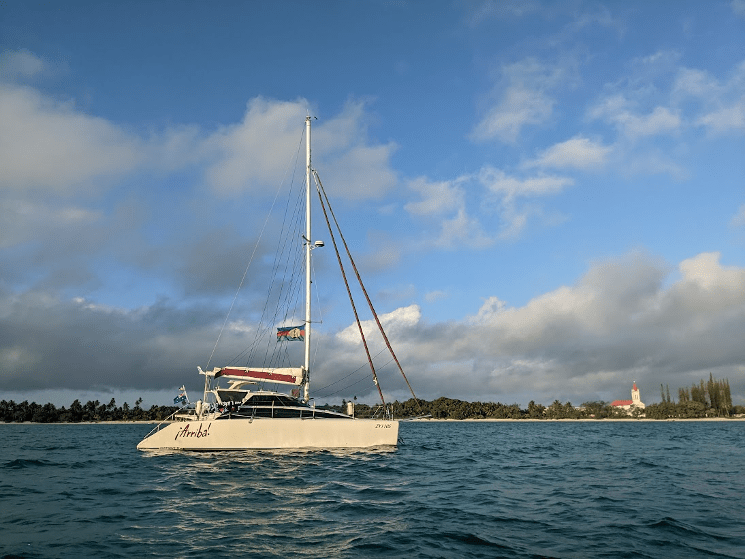
It was the fifth week of our New Caledonia sailing trip from Australia. We had just returned to the Noumea marina from the Loyalty Islands and were flying one of the flags of our host country, the indigenous Kanak flag. We were sitting down to a boat lunch of a baguette with delectable French cheeses, when we heard a gentle knock, so gentle that we thought it must have been for someone else. Then we heard the knock again. Alex went out onto the pontoon to see an immaculately dressed Caledoche[1]. He had something urgent to tell us.

“It’s absolutely fine to fly the Kanak flag, but we have had three referenda about independence from France, and we have decided to remain with France,” he said in impeccable English. “There was an American here recently who was flying a Kanak flag. I told him that was fine, but then I asked him why he didn’t fly the flags of native Americans as his home flag. As for you, you should consider flying the First Nations Australian flag on your boat,” he continued. “But as I said, it’s absolutely fine. It’s your choice.”

I could see that it was not fine. As they walked away back along the pontoon I called out.

“We love France!”

It was true. As guests in New Caledonia the last thing we wanted to do was to make political commentary. We had no idea how high feelings were running on this issue. Alex immediately restored a large French flag above the Kanak one.
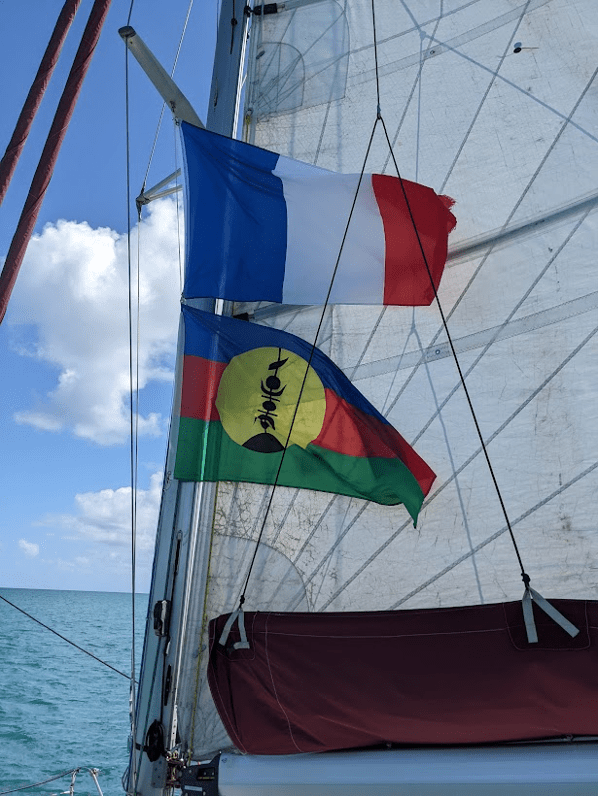
The visitor didn’t appear to be from the marina so he must have found his way through the locked gates and walked along the pontoon, especially to speak to us. Only then did we realise how prominent our flag had been. We were berthed at the end of the pontoon and were visible from any point in the busy harbour.

The next morning a Caledoche skipper greeted me as they walked along the pontoon. Then they said to me in English, “It looks better with the French flag on top, doesn’t it?” Not wanting to draw attention to ourselves again, I clapped my hands in applause in their direction as they retreated down the pontoon. “You’ve won!” was my intended meaning, but they looked at me quizzically.

On our last day before the long voyage back to the east coast of Australia we provisioned the boat. Before going to the supermarket, I persuaded Alex to take me to my favorite boulangerie. I looked at the breakfast menu and ordered two cappuccinos and two pain au chocolat. This would be one of the last conversations I would have in French, and I was happy not to have attracted any strange looks in response to my accented French. I was also happy to start the long week of sailing with a pain au chocolat.

Once back at the marina, my final duty was to empty our rubbish in the bins beyond the gates to the pontoon. As I was emptying the last of the rubbish, I noticed two Kanak gentlemen outside the gates, calling to one of the boaties inside the gates in French.

“Do you speak English? I want to get a message to the boaties at the end of the pontoon.”

The boatie shrugged his shoulders and retreated to his boat.

I realised he was referring to us. Our flying of the flags must have identified us as outsiders. I addressed the Kanak gentlemen in French.

“I’m on that boat.”

One of them put his hand on his heart.

“We are so touched that you are flying our flag. Can we exchange contact details?”

I looked at them, silently taking in what had happened. They were not boaties. They must have seen the flag flying from the harbour and sought us out.

I saw Alex heading towards me along the pontoon. He must have been wondering what had become of me because we were about to depart. I hastily introduced the Kanak gentlemen to him, and we received their email address. I asked Alex to retrieve some of our coutume[2] gifts from the boat.

“We received wonderful hospitality in the Loyalty Islands. We enjoyed drinking fresh coconut juice, cakes, and yams.”

“Did you stay in one of the traditional homes?”

“No. Some locals invited us to share their picnic rugs and we enjoyed their local specialties.”

Alex returned with the coutume gift, and then we parted ways.

We left our berth and headed for the fuel dock. We needed diesel because we could not necessarily rely on wind to get us all the way back to Australia. Once at the fuel dock we threw out the fenders and tied the cleats to the dock. A young man put the diesel in for us.

“Why don’t you ask him about the flag?” urged Alex.

“Is our flag a problem?” I asked in French.

Oui ……. et non. C’est compliqué[3].”

I explained our predicament, “We are foreigners. We had no idea that our flag would elicit such strong reactions. We came here not for the politics but rather because Alex loves the sea.”

He nodded enthusiastically.

In fact, Alex had come here because the coral is world heritage.
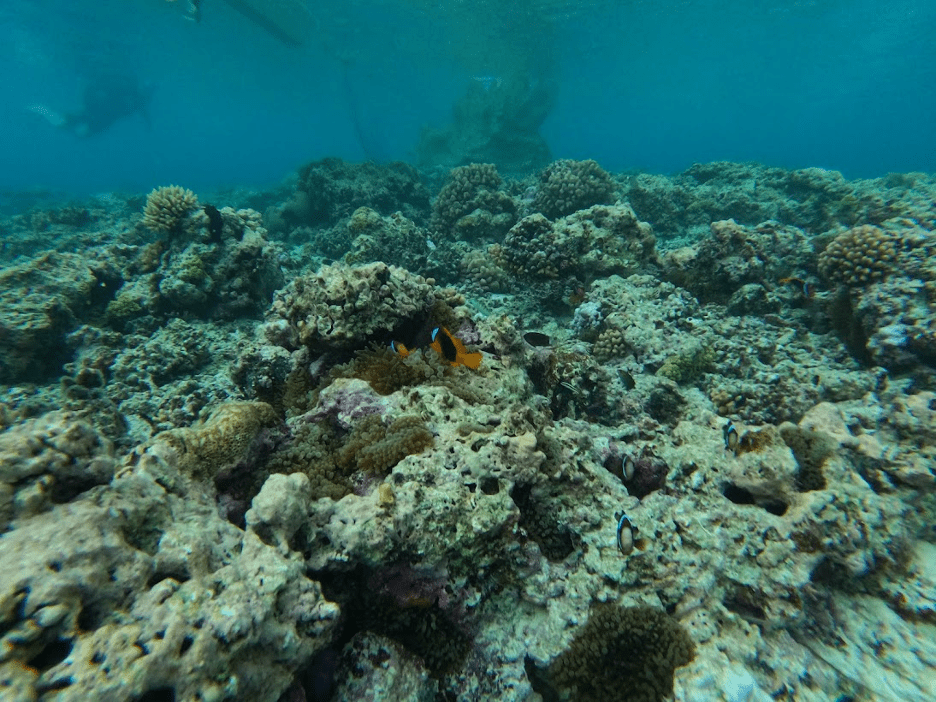
“He loves the sea, and I love the language and culture.”

Of course, Alex likes speaking the language too, even if not exactly fluently. He settled the bill and was chuffed that the attendant had spoken to him in French, unlike most others, who switched to English as soon as they detected our accent.

Then we noticed that the Kanak gentlemen had walked over to join us at the fuel dock. They asked if they could take a photo with us. We stood on the boat, and they stood on the dock. A passerby took the photo for us. Then they took their leave.

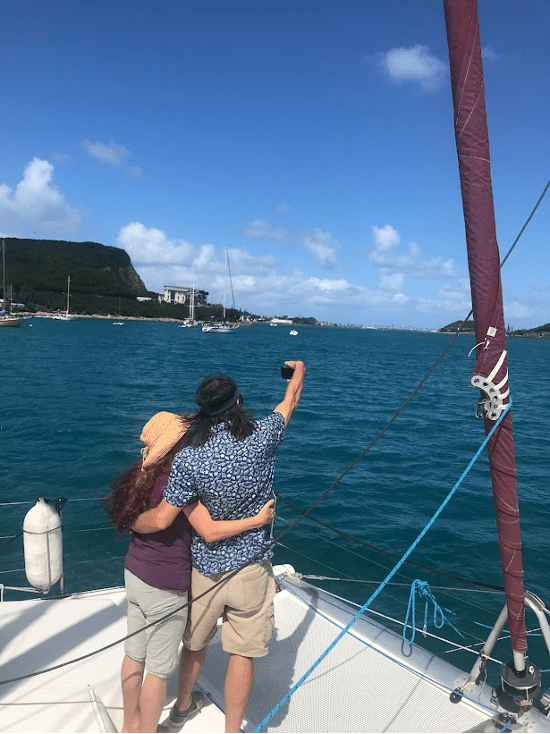
We started to exit the marina. I stood at the stern, as always when leaving a harbour, taking in the unique scenery as it receded. The attendant gave us a hearty wave, which we returned. As we rounded the seawall, we looked back we noticed the Kanak gentlemen positioned at the end of the breakwater. They waved at us with their arms extended above their heads, and we did the same, until the marina faded into the distance, and we could no longer see them.

[1] A New Caledonian person of European origin.

[2] Customary gifts

[3] “Yes… and no. It is complicated.”

Meredith Stephens is an applied linguist from South Australia. Her work has appeared in Transnational Literature, The Muse, The Font – A Literary Journal for Language Teachers, The Journal of Literature in Language Teaching, The Writers’ and Readers’ Magazine, Reading in a Foreign Language, and in chapters in anthologies published by Demeter Press, Canada.

PLEASE NOTE: ARTICLES CAN ONLY BE REPRODUCED IN OTHER SITES WITH DUE ACKNOWLEDGEMENT TO BORDERLESS JOURNAL
Categories
Contents

Borderless, August 2022

Art by Sohana Manzoor

Editorial

The Stars were Shining There for You & Me, for Liberty… Click here to read.

Conversation

The Making of Historical Fiction: A Conversation with Aruna Chakravarti unfolds the creation of her latest novel, The Mendicant Prince, based on the prince of Bhawal controversy in the first part of the last century. Click here to read.

Translations

Tagore’s humorous skit, The Treatment of an Ailment, has been translated by Somdatta Mandal. Click here to read.

Arise, Arise O Patriot! and Helmsman Attention! by Kazi Nazrul Islam have been translated from Bengali by Professor Fakrul Alam. Click here to read.

Pus Ki Raat or A Frigid Winter Night by Munshi Premchand has been translated from Hindi by C Christine Fair. Click here to read.

Tagore’s Song of Hope or ‘Hobe Joye‘ has been translated from Bengali by Mitali Chakravarty. Click here to read.

Poetry

Click on the names to read

Rhys Hughes, Ratnottama Sengupta, Mike Smith, Rituparna Mukherjee, Tony Brewer, Ahmed Rayees, Ron Pickett, Ramesh Dohan, Sister Lou Ella Hickman, Sambhu Nath Banerjee, Candice Louisa Daquin, Oindri Sengupta, Gigi Baldovino Gosnell, Ryan Quinn Flanagan, Tanvi Jeph, George Freek, Michael R Burch

Poets, Poetry & Rhys Hughes

In Mini-Sagas: A Dozen Examples, Rhys Hughes talks of a new genre with dollops of humour. Click here to read.

Musings/Slices from Life

Istanbul

G Venkatesh has a stopover in the airport to make a discovery. Click here to read.

The Loyal Dog in Loyalty Island

Meredith Stephens makes friends with a dog in the township of Wé on the Lifou island, an ‘overseas territory’ of France. Click here to read.

The ‘New Kid on the Block’ Celebrates…

Dr Kirpal Singh ruminates over what led to the making of an island state, Singapore. Click here to read.

Remnants of Time Once Spent Together

Sayali Korgaonkar ruminates over loss and grieving. Click here to read.

Moonland

Rupali Gupta Mukherjee journeys through the moonlike landscape housing a monastery with her camera and a narrative. Click here to read.

King Lear & Kathakali?

PG Thomas revisits a performance that mesmerised him in a pre-covid world. Click here to read.

Musings of a Copywriter

In A Bone in My Platter, Devraj Singh Kalsi shares a taste of running a restaurant. Click here to read.

Notes from Japan

Suzanne Kamata writes a light slice from life in The Boy & The Cats: A Love Story. Click here to read.

Stories

Does this Make Me a Psychic?

Erwin Coombs tells a suspenseful, funny, poignant and sad story, based on his real life experiences. Click here to read.

Hard Choices

Santosh Kalwar gives a glimpse of hope for an abandoned girl-child in Nepal. Click here to read.

No Rain on the Parade

Tan Kaiyi goes on a hunt for the National Day Killer. Click here to read.

Until We Meet Again

Shivani Shrivastav transports us to Manali for a misty union. Click here to read.

The Hatchet Man

Paul Mirabile tells a story of murder and horror. Click here to read.

I am Not the End

Aysha Baqir takes on the persona of a computer to unleash a poignant and chilling story. Click here to read.

Essays

How Many Ways To Love a Book

Sindhu Shivprasad describes passion for books. Click here to read.

Hiking in the Himalayas with Nabinji

Ravi Shankar explores more of Himalayas in Nepal. Click here to read.

Freedom is another word for… Zohra Sehgal

Ratnottama Sengupta gives a glimpse of the life of Zohra Sehgal, based on the book Zohra: A Biography in Four Acts by Ritu Menon, and her own personal interactions with the aging Zohra Sehgal. Click here to read.

The Observant Immigrant

In Can We Create a Better World by Just Wishing for it, Candice Louisa Daquin dwells on the question to locate answers. Click here to read.

Book Excerpts

An excerpt from The Dreams of a Mappila Girl: A Memoir by B. M. Zuhara translated by Fehmida Zakeer. Click here to read.

An excerpt from Michael R Burch’s poetry book, O, Terrible Angel. Click here to read.

Book Reviews

Meenakshi Malhotra reviews Tagore’s Four Chapters translated and introduced by Radha Chakravarty. Click here to read.

Gracy Samjatsabam visits Mamang Dai’s Escaping the Land. Click here to read.

Aditi Yadav reviews Pallavi Aiyar’s Orienting : An Indian in Japan. Click here to read.

Rakhi Dalal visits Neelum Saran Gour’s Requiem in Raga Janki. Click here to read.

Bhaskar Parichha reviews Rakesh Batabyal’s Building a Free India. Click here to read.

Categories
Editorial

Whispers of Stones

When the mountains and grass
had life, stones whispered
how the world came to be…

'Stonehenge', Daily Star

And as the world came to be, there was war — war that seems to rage in some part of the world or other. The British Museum has an exhibit which states the first battle was staged 13,000 years ago… in what is now Sudan, long before the advent of written history. This was even before the advent of people who built the ancient Stonehenge which was constructed around 3000-2000 BCE. And battles still continue to rage. The Jebel Sahaba casualties in Sudan 13000 years ago were less than 100. But the current conflicts claim in terms of tens of thousands which prolonged could stretch to millions. The last world war (1939-1945) which lasted for six years had a total of  75-80 million persons who perished. Ukraine-Russia conflict has within five months had a casualty count of more than 14000. And yet weapons and nuclear arms continue to proliferate decimating humanity, nature and towns, destroying homes, erasing ruthlessly and creating more refugees. The only need for such battles seem to be to satiate the hunger of the warlords secure in their impenetrable fortresses while tens of thousands are annihilated and natural or nurtured landscapes lie emaciated, mutilated and polluted.

What would be a good way of ending such wars?

Tagore sought the development of better instincts in humankind as an antidote. He wrote in the last century: “Any teaching concerning man must have human nature for its chief element. How far it will harmonise with human nature is a matter of time.”

With wars getting deadlier and more horrific, we can only try to awaken, as Tagore suggests, the better nature in man to move towards a peaceful world. What would be a more effective way of doing it than writing with the hope of a kinder and accepting future?

For that let us start with translations of the maestro Tagore himself. We have a song about the season — monsoon, ‘Monomor Megher Songi (My Friends, the Clouds)’, translated by Professor Fakrul Alam, a painting by Sohana Manzoor interpreting the lyrics and a transcreation of Nababarsha or New Rains’ was shrunken into a popular Rabindra Sangeet and reduced to twenty lines in English by Tagore himself. The connect with nature is an important aspect that enables humans to transcend petty concerns leading to dissensions of different kinds as evidenced in the maestro’s humorous feline skit, translated by Somdatta Mandal. A translation of Dalip Kaur Tiwana’s ‘The Bus Conductor’ from Punjabi by C. Christine Fair adds zest to this section. Fazal Baloch has translated a folktale from Balochistan involving the supernatural and Ihlwha Choi has taken on the cry for peace on behalf of Ukraine while translating his own poem in Korean. The Nithari column has a story by Jishan in Hindustani, translated to English by Grace M Sukanya, showcasing the struggle of a youngster during the pandemic – rather a sad narrative, which though fictitious has its roots in reality. 

Our poetry section touches upon the timelessness of dissensions and darkness with Michael R Burch’s poem on Stonehenge and Supatra Sen’s poem on Ukraine. This has been allayed by love poetry by Maid Corbic from Bosnia. George Freek’s poem ruffles with its reflective lines. And in the midst of it all, is poetry by Ryan Quinn Flanagan reflecting on the seven stages of man. Will the process of aging or human nature ever change? I wonder if Rhys Hughes can find an answer for that in humorous verses as he has shared in this issue. In his column, Hughes has written about an imagined anthology of short stories.

Our short story section has echoes of humour around felines by Manzoor, somewhat in tune with the mind frame seen in Tagore’s skit on this issue. Humour rings tinged with an apparition in Erwin Coombs’s narrative – should one call it dark humour or is it just his style? Paul Mirabile goes for gothic darkness in his meanderings around Italy.

Strangely, we seem to have a focus on short stories this time. Keith Lyons has interviewed Steve Carr, a journalist, a publisher and writer of 500 short stories who is questing to create a ‘perfect short story’. Reading out excerpts from her short story at a literary festival in Simla, Bollywood celebrity, Deepti Naval, was in conversation with eminent film journalist, Ratnottama Sengupta. She spoke of her literary aspirations while unveiling her autobiography in verse, A Country Called Childhood. This conversation has been shared by Sengupta with Borderless. It is interesting to see how Naval’s reactions to social malaise contrasts with that of the film director, cinematographer and actor, Goutam Ghose, who was present during the unveiling of her book. He had responded to communal violence by making a film on Lalan Fakir extolling virtues of love and kindness, called Moner Manush (2010) and then made a book on the film called, The Quest (2013) which has beautiful translations of Lalan Fakir’s lyrics by Sankar Sen.  

Our non-fiction sections seem to be hosting multiple travel stories across UK by Mike Smith, along the Australian coastline by Meredith Stephens, on the Himalayas with Ravi Shankar and an unusual visit by Hema Ravi to a farm in US where animals that had been used in Disney films in the past are homed. Our environmental columnist, Kenny Peavy, actually wrote about his cycling trip from Thailand to Indonesia on a bamboo cycle made by a Singaporean! And from Japan, Suzanne Kamata explored a museum in the neighbouring town of Mure. The museum on a hill hosts the art of American Japanese Artists, Isamu Noguchi.

We do have non-fiction that moves away from travel: noir humour by Devraj Singh Kalsi and an essay by Candice Louisa Daquin on a very interesting subject – ‘Is it Okay to be Ordinary?’ Is it?  Dan Meloche has written a literary essay on Canadian novelist Andre Alexis’s award-winning novel, Fifteen Dogs: An Apologue (2015). While Meloche spoke of how the novel departed from Orwell’s Animal Farm, his narrative brought to my mind a novel closer to our times set in England by Jasper Fforde called Constant Rabbit (2020) – this a science fiction while Alexis’s was an apologue or an animal fable. Fforde did use the rabbits rather well to highlight the current times.

We have book excerpts of two recent books that I would call really outstanding. One of them is Aruna Chakravarti’s The Mendicant Prince, which is being released this week, and is based on the evergreen contentious case of the prince of Bhawal that has even been explored even in cinema. The other, Dadamoni: The Life and Times of Ashok Kumar by Nabendu Ghosh, has been published posthumously and is not a translation from Bengali but written in English originally by this trilingual writer.  

Called ‘Dadamoni’ affectionately, iconic actor Ashok Kumar is regarded as “the one personality who symbolises Indian cinema’s journey from Bombay Talkies to Bollywood”.  This book has been reviewed by Indrashish Banerjee, who calls it ‘a reflection on the Hindi film industry’ as well as a biography. Rakhi Dalal has reviewed Booker winner Geetanjali Shree’s Mai, Silently Mother, a Sahitya Akademi winning translation of her Hindi novel by Nita Kumar, reiterating the dialogue that had been kindled on motherhood last month by Rinki Roy Bhattacharya and Maithili Rao’s The Oldest Love Story (2022). Bhaskar Parichha has reviewed Prosanta Chakrabarty’s Explaining Life Through Evolution plotting how life evolved on earth. Parichha tells us: “Meaningful, wide-ranging and argumentative, this is a must-read book. It will propel us to imagine and reimagine life around us.” Another book that sounds like a must-read has been reviewed by Meenakshi Malhotra, Tagore’s Gleanings of the Road, translated by Mandal. She tells us: “ ‘Gleanings’ represents the quintessential Tagore…Ably introduced and translated by Somdatta Mandal, a renowned Tagore scholar, the translation captures the iridescent and luminous quality of Tagore’s prose and its chiaroscuro effects.”

There is more to tempt. Please stop by on our contents page and take a look.

We would like to hugely thank all our contributors and readers for being with us and helping us grow. I would like to thank my team, who despite hurdles they face, always lend a helping hand and wonderful words from their pens or computers to get Borderless on its feet. I apologise for the delay and thank you all for your patience. Special thanks to Sohana Manzoor for her fabulous artwork.

I wish you all a wonderful July and peace in a war-torn world. We are all affected by the ongoing conflicts. Let us hope for peaceful and just resolutions.

Thanks.

Mitali Chakravarty

borderlessjournal.com

Categories
Essay

Discovering Books and Places: The Voyage from Eden

Meredith Stephens sails the Australian coastline, recording her experiences with words and her camera.

Maybe because I am an applied linguist, one of the pleasures of travel is the novelty of learning unfamiliar place names. Sailing north from Eden in southern New South Wales towards Wollongong, south of Sydney, provided ample opportunity to indulge this pastime.

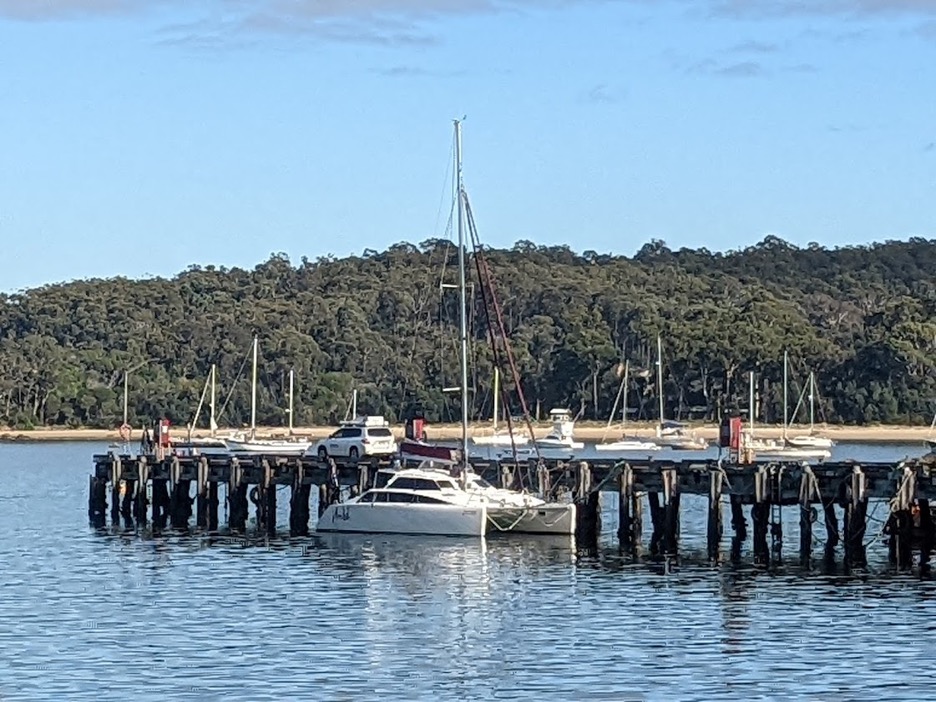
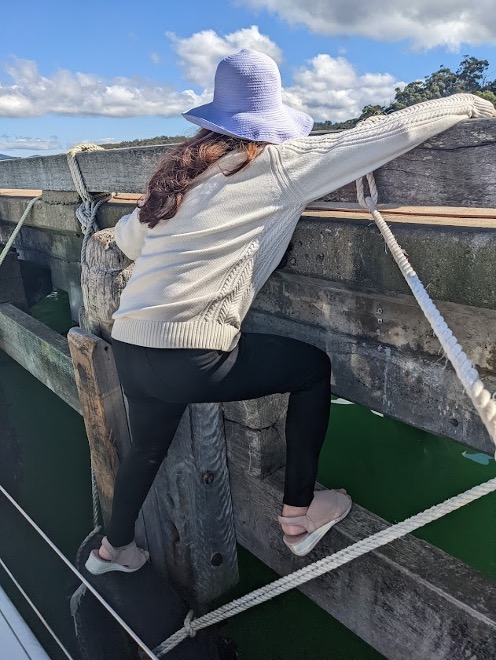
We were relieved to arrive at the township of Eden after the long crossing of Bass Strait from Tasmania to the mainland. Too tired to disembark, we spent the evening recovering on the boat after availing ourselves of a public mooring. The next morning, we rose afresh and resolved to explore Eden. We made our way to the wharf but found that it was formidably higher than our vessel. As much as I was looking forward to Eden, I suddenly realised that climbing onto the wharf looked impossible.

“I can’t do it!” I complained, as I often did, to my sailing companions Alex, Katie and Verity. They were all taller than me and leapt up to the wharf.

“I don’t mind staying here and reading a book. You all go off and enjoy the town,” I urged, as I looked down at the green water in between the boat and the wharf. It wasn’t the first time. Whether climbing a mountain, or hiking, I just couldn’t keep up with the others. Rather than holding everyone up I would prefer to stay back and read.

“No, you have to come with us,” Alex insisted, as always.

I lifted my left foot onto the tyre and my right onto the beam, grabbed hold of the side of the wharf and somehow made it to safety, as the others encouraged me on.

We climbed up the hill and walked along the coastal road to the centre of Eden, taking in shops and the Eden Killer Whale Museum. Then we wound our way downhill back to the boat, ready to sail across the bay to the Sea Horse Inn, where we planned to dine later.

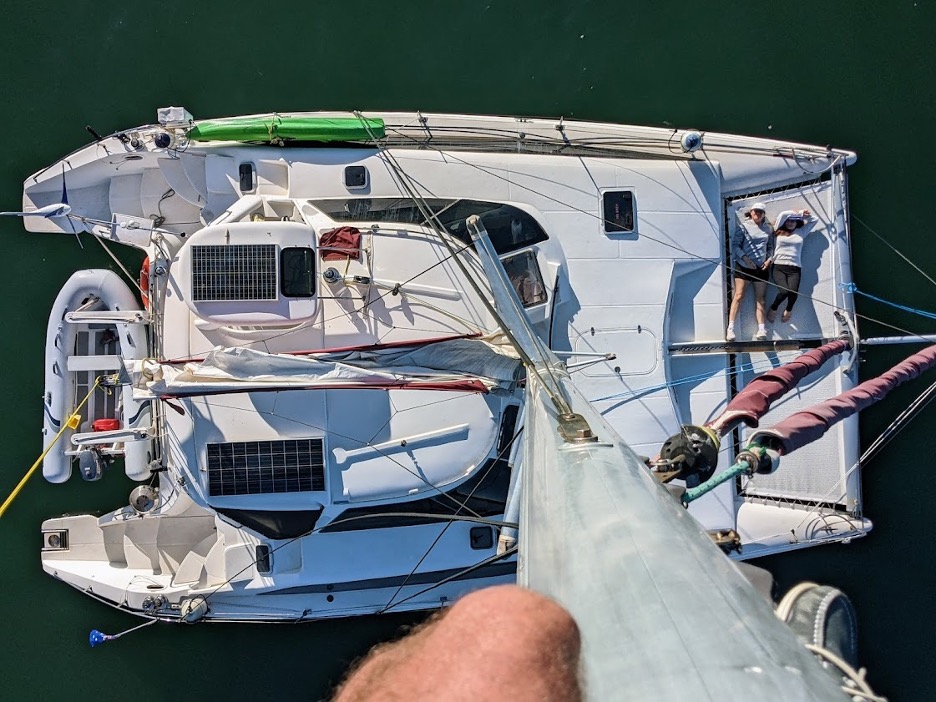
After anchoring Alex decided to attend to boat maintenance before heading across the water to the inn. Alex always attended to business before pleasure, but I was hungry and couldn’t wait for the inn to open at 6 pm. I had to be patient because Alex wanted to fix his anchor light. He climbed into his bosun’s chair. Katie and I winched him up the mast with the electronic winch. Katie released the rope steadily. We had to watch carefully because he would give a hand signal when he wanted to pause. As he moved higher and higher up the mast it became harder to crank our necks backwards to keep him in view. The only way we could keep our eyes on him without bending over backwards was to lie on the deck facing upwards. It might appear that we were lounging around but in fact we were doing our best to keep him in sight. Alex repaired the anchor light and then Katie and I slowly and carefully winched him back to the deck.

Having performed the essential maintenance, we were ready to hop into the dinghy and motor to shore.

After disembarking we dragged the dinghy as far onto the sand as we could and secured it to a branch with a rope. We walked up to the restaurant and wiped the sand off our bare feet before putting on our shoes. We were greeted by a smiling Maitre d’. His expressions changed to concern when he saw Verity.

“I need to see your ID. You can only come into the bar if you are over 18.”

We tried to suppress our giggles. Verity was 28.

“Don’t worry, She’s an adult,” I reassured him.

“We have to check. Until we don’t. Some people get upset when we stop asking them,” he quipped.

After presenting her ID we sat outside and basked in the sunset sitting on the outdoor furniture facing the bay. Then we made our way into the dining room. Although our first choice on the menu had been sold out, my second choice of smoked salmon proved to be the most delicious of the trip. Alex was just as impressed by his serving of sole.

Our destination was Shellharbour, near Wollongong and we were due to sail north along the New South Wales Coast. After having sailed through the fierce Southern Ocean to circumnavigate Tasmania, and the notorious Bass Strait, I was relieved that land would be in sight for the rest of the voyage.

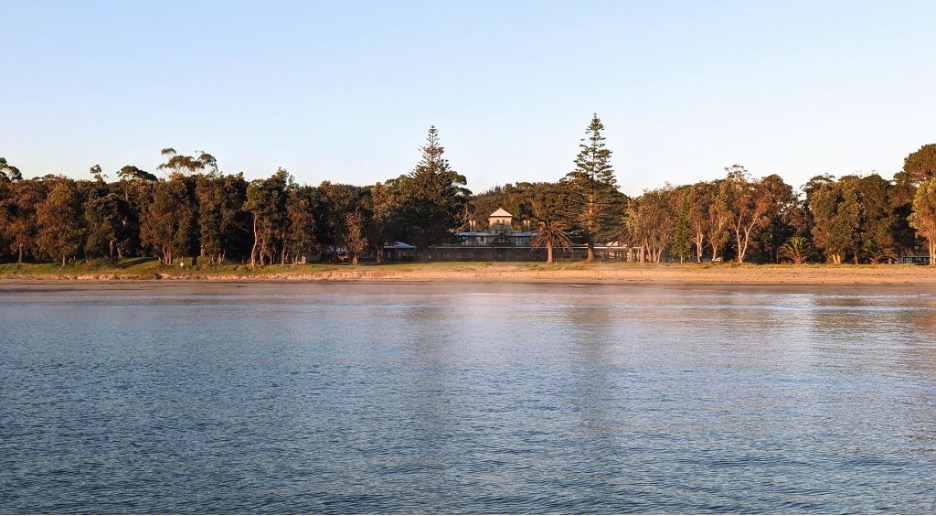
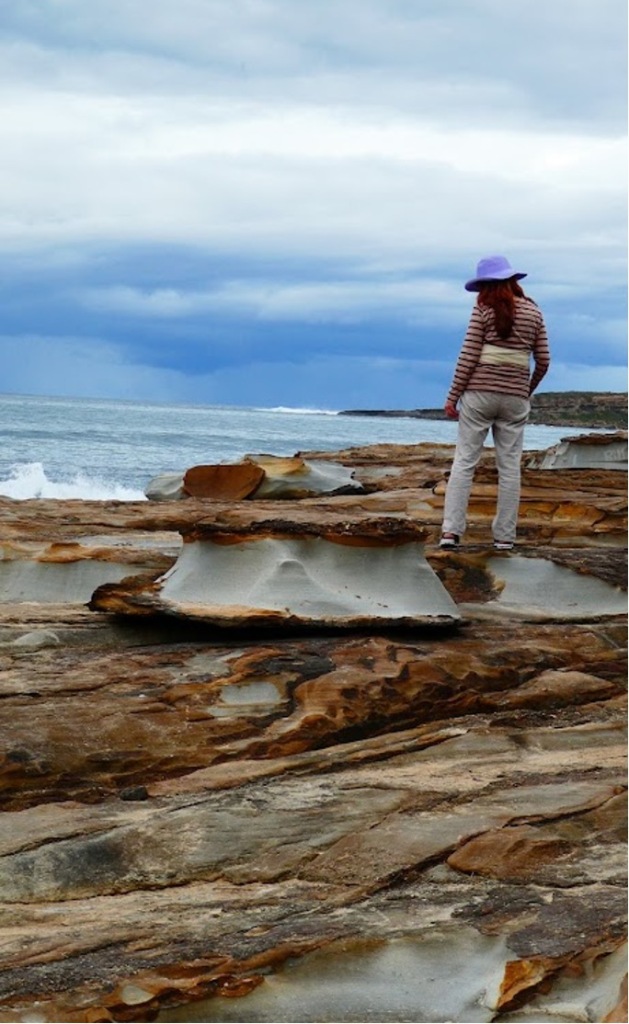
The most memorable stop was South Durras, because as soon as we arrived on the shore we were greeted by a kangaroo grazing and scratching her belly with her forearm.  We walked through the caravan park to a rainforest lined with ferns underfoot which led to the shore. We circled back to the shore, treading over rock pools on our way to the beach leading back to the boat.

The next stop had an enchanting name – Ulladulla. If somewhere was named Ulladulla, I simply had to stop there. I kept practising the pronunciation as we sailed into the bay. We anchored, and as usual, took the dinghy to a wharf. As we approached the wharf, we noticed barnacles. The sharp barnacles could easily cause a puncture and it was too late to turn it around.

“Push back as hard as you can!” urged Alex.

We pushed the dinghy away from the barnacles. Then we motored to the wharf on the other side of the bay and disembarked. We walked up the hill into Ulladulla, and unexpectedly Alex announced, “Let’s visit the secondhand bookstore. There’s a sign over there.”

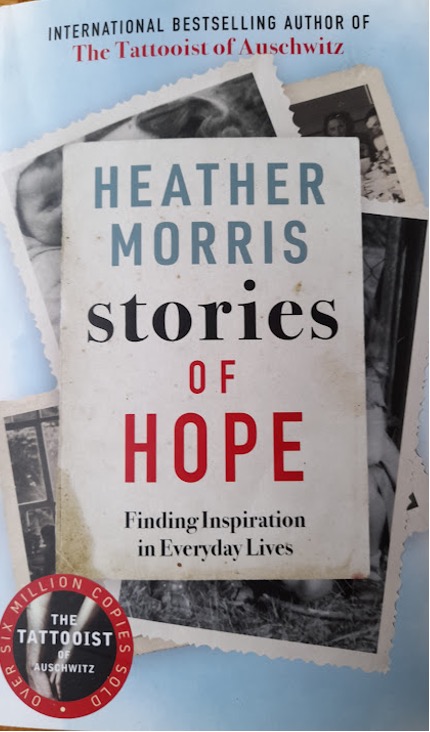
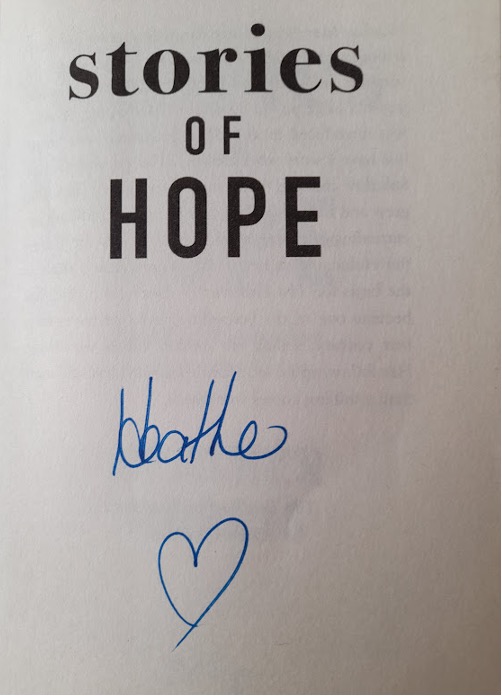
We followed a narrow arcade to the end and spotted the bookstore. My attention was immediately drawn to a signed copy by Heather Morris, a bestselling author.

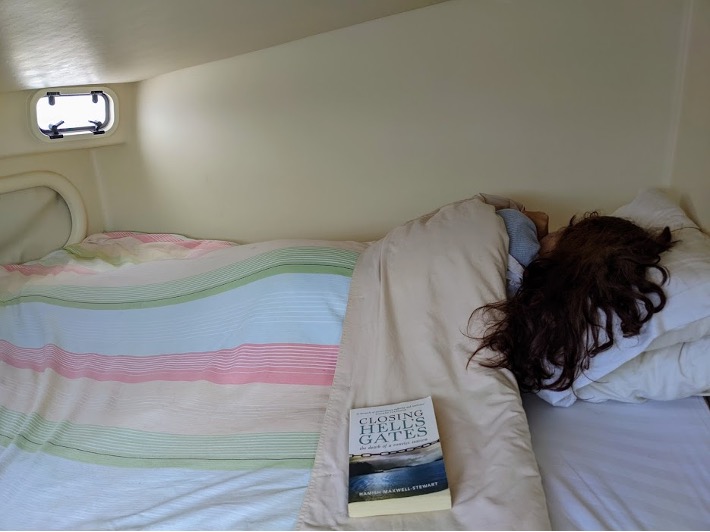
Sailing often entails many hours of crossing vast distances at the slow rate of 6 knots. When the seas are rough there is nothing for me to do but take an anti-seasickness pill and sleep in the cabin while Alex, who doesn’t suffer from seasickness, takes the helm.

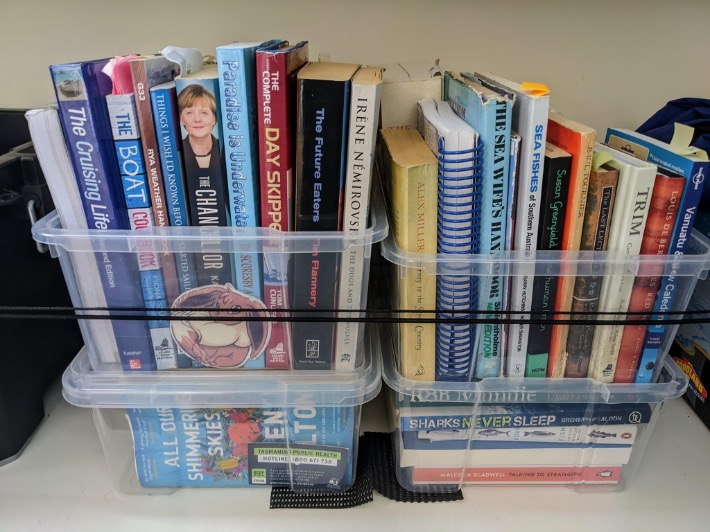
But when the seas are calm there is ample time for reading, if you have enough crew to take turns at the helm. Thankfully Alex’s boat library takes pride of place. Even so, the addition of Heather Morris’ book was welcome and the long hours at sea passed quickly as I read this.

The seas were calm as we headed to Shellharbour, a new marina south of Wollongong, another city with a mellifluous name. We sailed through the many empty berths to the heart of the marina and located our assigned berth. Katie put out the fenders, and then we leapt onto the dock to tie the boat to the cleats. Relieved to have made this long sail to Wollongong, Alex cracked open some of our sparkling Tasmanian wine, with which we celebrate the completion of each leg.

Next, we had to clean up the boat before our flight back to Adelaide. We still had plenty of unopened food in the fridge, so Alex went to offer it to our friendly French Canadian boat neighbours, Gerard and Heloise. They happily received it. Then we asked them the easiest way to get to Sydney airport, after which they offered to drive us to Wollongong station. It was our first time to see Wollongong, and we were astounded to see the lush vegetation so unlike our home state of South Australia. We caught the train from Wollongong to the airport, passing all too quickly through the temperate rainforest. We then flew back to Adelaide to unlimited hot water and clean sheets, as we slowly discarded our sea legs. Not least, I was proud to have learnt beautiful place names such as Ulladulla and Shellharbour, although I still couldn’t manage to spell Wollongong without a spellchecker.

* All the photographs are courtesy Meredith Stephens.

Meredith Stephens is an applied linguist from South Australia. Her work has appeared in Transnational Literature, The Muse, The Font – A Literary Journal for Language Teachers, The Journal of Literature in Language Teaching, The Writers’ and Readers’ Magazine, Reading in a Foreign Language, and in chapters in anthologies published by Demeter Press, Canada.

PLEASE NOTE: ARTICLES CAN ONLY BE REPRODUCED IN OTHER SITES WITH DUE ACKNOWLEDGEMENT TO BORDERLESS JOURNAL

Categories
Contents

Borderless, June 2022

Art by Sohana Manzoor

Editorial

We are All Going on a Summer HolidayClick here to read.

Interviews

In Conversation with Rinki Roy (daughter of legendary director Bimal Roy) about The Oldest Love Story, an anthology on motherhood, edited and curated by journalist and authors, Rinki Roy and Maithili Rao. Click here to read.

Achingliu Kamei in conversation with Veio Pou, author of Waiting for the Dust to Settle, a novel based on the ongoing conflicts in North-east India. Click here to read.

Translations

The Funeral, a satirical skit by Tagore, translated by Somdatta Mandal. Click here to read.

Three Shorter Poems of Jibananda Das have been translated from Bengali by Professor Fakrul Alam. Click here to read.

The Magic Staff , a poignant short story about a Rohingya child by Shaheen Akhtar, translated from Bengali by Arifa Ghani Rahman. Click here to read.

Fakir Khizmil & the Missing Princess, a Balochi Folktale has been translated by Fazal Baloch. Click here to read.

Pie in the Sky is a poem written and translated from Korean by Ihlwha Choi. Click here to read.

Taal Gaachh or The Palmyra Tree, a lilting light poem by Tagore, has been translated from Bengali by Mitali Chakravarty. Click here to read.

Pandies’ Corner

This narrative is written by a youngster from the Nithari village who transcended childhood trauma and deprivation. Dhaani has been written in Hindi and translated to English by Kiran Mishra. Click here to read.

Poetry

Click on the names to read

Jared Carter, Sutputra Radheye, Ryan Quinn Flanagan, Antara Mukherjee, David Francis, Alpana, George Freek, Prashanti Chunduri, John Grey, Ashok Suri, Heather Sager, G Venkatesh, Candice Louisa Daquin, Elizabeth Ip, Rhys Hughes, Michael R Burch

Poets, Poetry & Rhys Hughes

In From a Kafkaesque Dream to the Penguin Cafe Orchestra, Rhys Hughes brings out a new strain of tunes that grew out of Jeff Simon’s unusual journey and it continues to persist beyond his life. Click here to read.

Stories

Oliver’s Soul

Paul Mirabile weaves a story of murder and madness in Madrid of 1970s. Click here to read.

The Wallet

Atreyo Chowdhury spins a tale set in Kolkata. Click here to read.

Flowers on the Doorstep

Shivani Shrivastav writes of an encounter with a mysterious child in Almora. Click here to read.

A Riverine Healing 

PG Thomas’s narrative set in Kerala, explores a leader’s old age. Click here to read.

Pagol Daries

Indrashish Banerjee creates a humanoid scenario where robots take on human roles. Click here to read.

Musings/ Slices from Life

In Memoriam: Star of the Stage Shines on Screen

Ratnottama Sengupta pays a tribute to famed actress, Swatilekha Sengupta (May 1950- June 2021). Click here to read.

Pizzas En Route to Paradise

Keith Lyons discovers the import and export of desires in Varanasi, one of the oldest cities in the world, beside one of the most revered rivers. Click here to read.

Notes from Japan

In Marathon Blues, Suzanne Kamata talks of pandemic outcomes in Japan in a lighter tone. Click here to read.

Musings of a Copywriter

In Journey of an Ant, Devraj Singh Kalsi explores life from an insect’s perspective. Click here to read.

Mission Earth

In Tuning in to Nature, Kenny Peavy tells us how to interact with nature. Click here to read.

Essays

Kabir & His Impact on Tagore

Mozid Mahmud explores Kabir and his impact on Tagore, which ultimately led to a translation of the great medieval poet. Click here to read.

A view of Mt Everest

Ravi Shankar travels in the freezing cold of Himalayan splendour and shares magnificent photographs of Mt Everest. Click here to read.

The Good, the Bad, and the Benign: Back across Bass Strait

Meredith Stephens shares a photographic and narrative treat from Tasmania. Click here to read.

The Observant Immigrant

In Season’s in the Sun, Candice Louisa Daquin explores what intense positivity can do to people. Click here to read.

Book Excerpts

Excerpt from Tagore’s Gleanings of the Road, translated by Somdatta Mandal. Click here to read.

Excerpt from Waiting by Suzanne Kamata. Click here to read.

Book Reviews

Meenakshi Malhotra revisits Harsh Mander’s Locking down the Poor: The Pandemic and India’s Moral Centre. Click here to read.

Indrashish Banerjee reviews Keki N Daruwalla’s Going:Stories of Kinship. Click here to read.

Gracy Samjetsabam reviews Pronoti Datta’s Half-Blood. Click here to read.

Bhaskar Parichha reviews Deepti Priya Mehrotra’s Her Stories –Indian Women Down the Ages — Thinkers, Workers, Rebels, Queens. Click here to read.

Categories
Editorial

We are All Going on a Summer Holiday…

Yes! It is vacation time, and we are all able to travel at last. Though the pandemic which had closed borders for us seems to be evolving as an endemic, another huge human crisis, a war which cannot be justified in any way, stares us in the face. Loss of lives, homes, towns, cities and threats of global recession follow in the footsteps of refugees wandering into our lives. Lesya Bakun, the Ukrainian refugee whose story we have been following, told me four of her relatives’ homes in Mariupol have been erased out of existence and her extended family has scattered where they found safety as her cousin continues a prisoner of war, captured while defending the iron and steel factory at Azovstal. While majority of the world expresses solidarity with the Ukrainians, another set of refugees remain in shadows. They have completely lost their country in which they had lived from ancient times. I am referring to the Rohingya of Arakan. CNN world states:

“The Rohingya are a stateless Muslim minority in Myanmar’s Rakhine State, thought to number about 1 million people.

“Myanmar does not recognize them as citizens or one of the 135 recognized ethnic groups in the country.”

 We are privileged to host a powerful poignant translation by Arifa Ghani Rahman of Shaheen Akhtar’s short story about such a voiceless Rohingya child in a refugee camp. Though this is a fiction inspired by Akhtar’s visits to such shelters, we hope at some point these children will be able to build new lives to create a world free of violence, intolerance, hatred and greed.

One of the questions that springs to one’s mind, watching such atrocities destroy innocent lives is that should one accept bullies and give in to their pressure tactics? Bullies can be found among world leaders as well as perpetrators of decadent societal norms which are often critiqued by satires. Somdatta Mandal has translated one such satirical playlet where social conventions are targeted in a lighter vein by Tagore. In the same spirit, the maestro’s iconic poem about a palmyra tree called Taal Gaachh has been transcreated to bring the joy of innocent wanderings back into the narrative, creating an island of healing thoughts. We continue with our translations of Jibananada Das by Professor Fakrul Alam, a Korean poem by Ihlwha Choi and a magical Balochi folktale by Fazal Baloch. Let us read such translations to connect with varied cultures so that compassion and acceptance of diverse perspectives end horrors like wars, starvation and hunger.  

Tagore’s writings translated to English by Mandal in Gleanings of the Road, a collection covering the maestro’s travel to the West, is part one of our book excerpts and highlights Rabindranath’s perspectives on the need to connect with the larger world. The other book excerpt, from Waiting, poetry by Suzanne Kamata, takes up the theme of victimisation, crime and murder. Dwelling on no less horrific narratives, though justified as non-criminal, is a review by Meenakshi Malhotra of Harsh Mander’s Locking down the Poor: The Pandemic and India’s Moral Centre. Gracy Samjetsabam’s assessment of Half-Blood by Pronoti Datta informs about the greyer areas of a whole community in Mumbai. Indrashish Banerjee reviewed Keki Daruwalla’s stories on human relationships anthologised in a collection called Going: Stories of Kinship while Bhaskar Parichha has acquainted us with Deepti Priya Mehrotra’s Her Stories –Indian Women Down the Ages — Thinkers, Workers, Rebels, Queens, a non-fiction that visits inspiring women.

Inspiration can also be drawn from Rinki Roy Bhattacharya’s and Maithili Rao’s The Oldest Love Story, featuring a medley of men and women writing on the theme of motherhood along with some narratives about their mothers or on the experience of being one. The medley includes well-known names from films and literature like Shabana Azmi, Saeed Mirza, Shashi Deshpande, Nabanita Dev Sen and more. We interviewed Roy Bhattacharya to find out more about this impactful book. Achingliu Kamei, an academic and writer, has conversed with Naga writer, Veio Pou, whose award-winning book, Waiting for the Dust to Settle, was reviewed earlier — a book that gives a glimpse of conflicts in the Northeast of India.

Taking on the theme of conflicts at a personal level, Atreyo Chowdhury’s and Banerjee’s stories create a sense of disquiet as Paul Mirabile’s explores crime, madness and its impact on humans. G Thomas takes a relook at heroism and bravery as a concept. His story set in Kerala shakes our complacency, upending traditional concepts of heroism and bravery just as Candice Louisa Daquin has upended the cult of positivity in her essay. Notes of discord and accord seem to ring through this edition and the undertones of greys spread out towards an exploration of life and death. We have multiple ghost stories this time, even from the Nithari column written by Kiran Mishra, a youngster who got over the trauma of violence in the community and discovered her place as a bilingual writer and educator.

Our poetry section is honoured to host Walt Whitman Award winner, Jared Carter, again with his poetry on a Japanese artefact as George Freek’s continues to be inspired by the style of Song dynasty poets. Michael Burch writes beautiful love poems. We have a vibrant poetry section with Daquin, Sutputra Radheye, Ryan Quinn Flanagan, Antara Mukherjee, Rhys Hughes, who has also revisited ‘The Penguin Café Orchestra‘. This band started a new kind of musical trend with nothing but passion and conviction. Hughes of course cannot escape the bonds of his tongue-in-cheek style, also adopted by Devraj Singh Kalsi while he pretends to be an ant.

Keith Lyons has got the bug of tongue-in-cheek too as he gives us a piece on his travels in Varanasi that well captures the dichotomies we find in India. Dwelling on social dichotomies also is Ratnottama Sengupta’s powerful tribute to Swatilekha Sengupta, a film and theatre doyenne who brought to life Tagore’s novel, Ghare Baire (Home and the World, 1985). An essay by Mozid Mahmud exploring both the syncretic elements in Tagore’s and Kabir’s works, the medieval poet’s impact on the Nobel laureate and a dispute over Rabindranath’s own translation blends with the tone of greys in this edition.

Travel narratives and photographs by Meredith Stephens sailing the seas in Tasmania and Ravi Shankar trekking on the slopes of the Himalayas to get a view of Mt Everest make for perfect holiday adventures. From Japan, Kamata has given us a narrative set in the pandemic. And environmentalist Kenny Peavy dwells on reconnecting with nature in Mission Earth.

We have a fair deal from across the globe in the June issue. But, as usual, some of the treats in the content have not been mentioned though they are wonderful pieces of writing too. We look forward to your continued support as you delve into our treasure trove of gems from across the oceans. A huge thanks to our fabulous team, to the contributors and readers. I especially want to thank Sohana Manzoor for sharing her lovely artwork and wish you all a wonderful read!

I hope you have a fabulous summer.

Thank you.

Mitali Chakravarty

borderlessjournal.com

Categories
Essay

The Good, the Bad, and the Benign: Back across Bass Strait

Photography and Narrative by Meredith Stephens

“What! A text message at this hour,” exclaimed Alex, reluctantly looking at his phone.

Then his expression turned to concern.

“Gregory, our boat neighbour in George Town, says the boat hatch is open.”

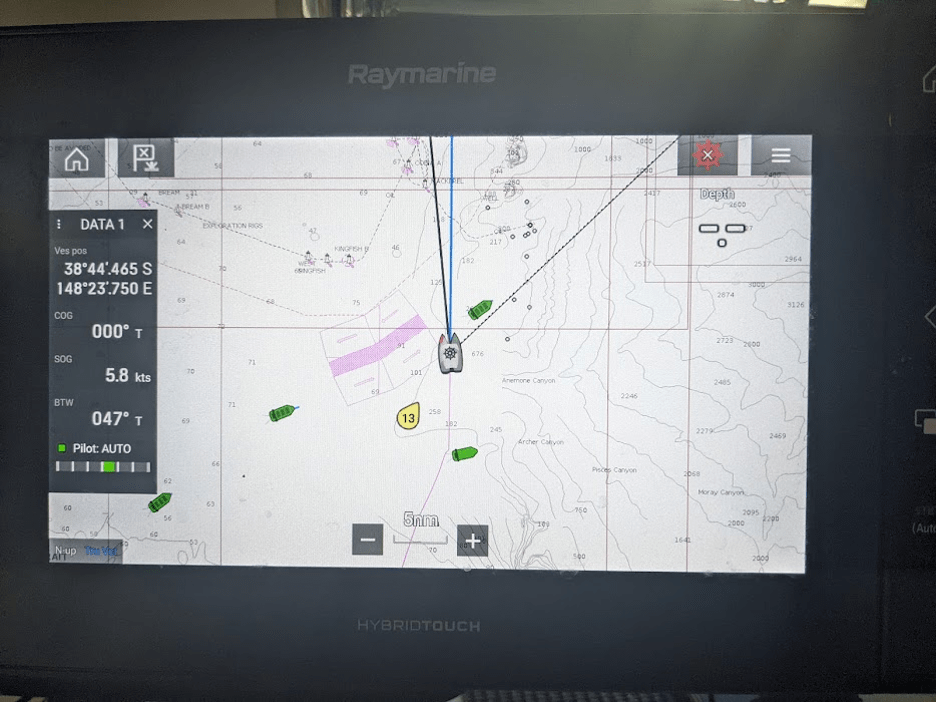
George Town, Tasmania, was a two-hour flight and a one-hour bus ride away from Adelaide. Who could have entered the boat from the hatch? They would have to be both slim and lithe. What could they have taken? Could they have taken the chartplotter – used to navigate, the Emergency Position Indicating Radio Beacon (EPIRB) – used to aid search and rescue or the Automatic Identification System (AIS) – used to track other vessels? We couldn’t sail without them.

“I can’t really bring our flight to Hobart forward because all the seats are gone during the Easter break. We’ll just have to hope for the best.”

Meanwhile, Alex decided to text Gregory back and ask him to take a look through the hatch to determine what might have been stolen. Gregory kindly obliged, and sent Alex a photo of the interior of the boat. The equipment appeared to be in place.

Alex checked the location of the boat on the AIS. It should have been updated daily, but it had been inactive for a few days. That did not bode well.

We spent the next day packing our bags as carefully as possible to avoid excess charges. On Friday Alex, Verity, Katie and I caught the plane from Adelaide to Hobart, and then picked up our rental car. We drove north through the centre of the island to the lush agricultural lands of the Tamar River, passing through towns lined with Georgian buildings constructed with convict labour.

Sculpture at Evandale

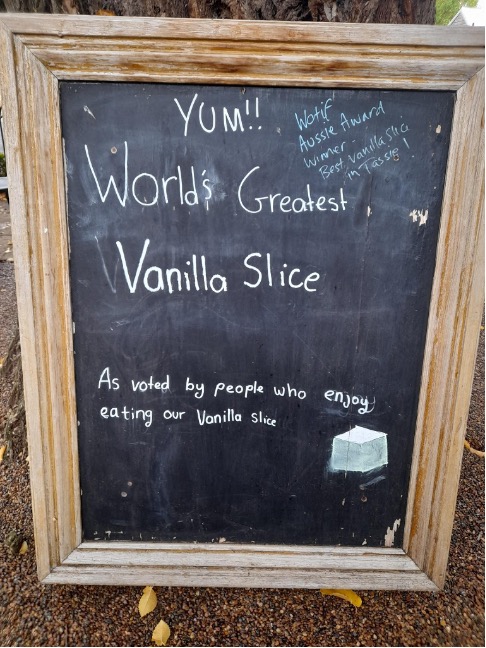
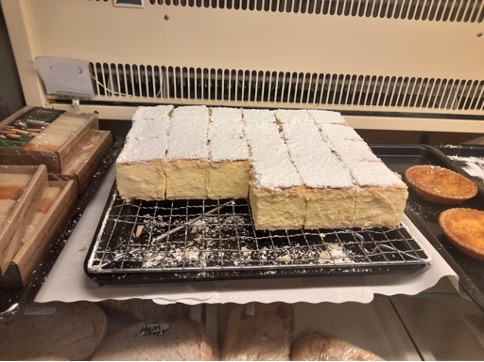
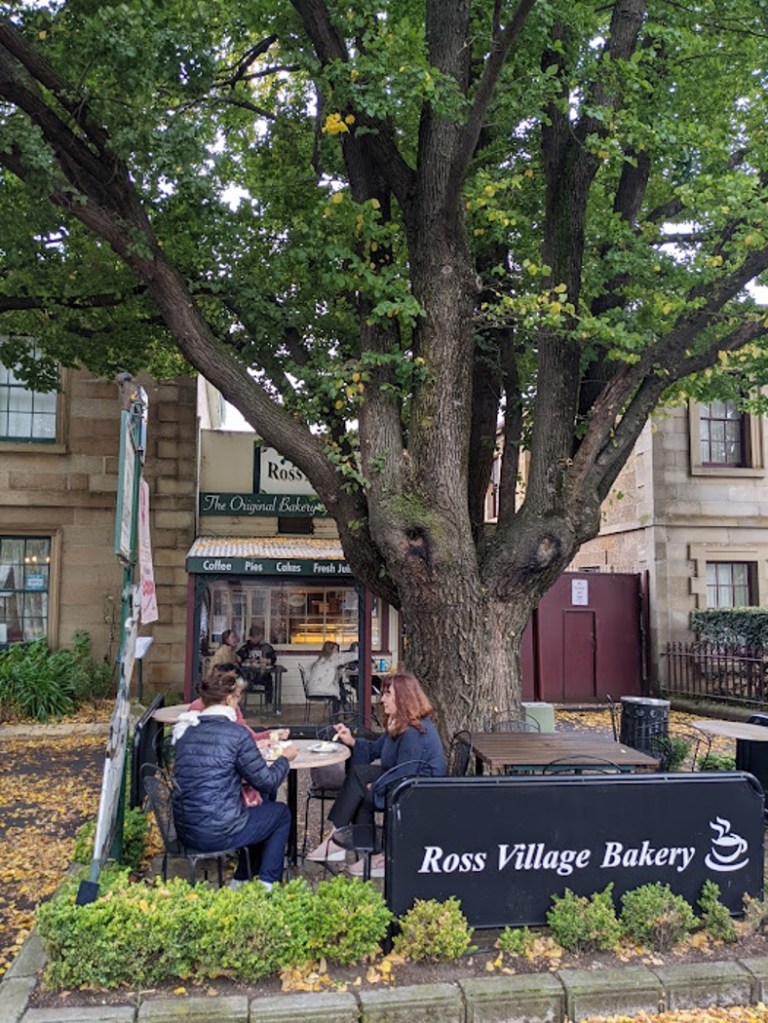
We were particularly looking forward to partaking of the best vanilla slices in the world, located in the township of Ross, and I confess that this distracted us from our concern for the safety of the boat equipment.

We sat outside the bakery savouring the vanilla slices as slowly as possible. Who knew whether we would ever be able to come back to Ross?

Then we continued our drive northward to George Town, Australia’s third-oldest settlement, meandering through other towns lined with Georgian buildings. As night fell, we arrived at George Town to our boat home. My fellow crew members were able to climb on the boat from the wharf unaided but I wasn’t tall enough to do this. Alex positioned an upside-down bucket on the wharf so that I could clamber on board. With trepidation we opened the door, now unlocked, and ventured inside. The equipment was still there but it had been unplugged. The lid of the clear plastic box under the monitor was open.

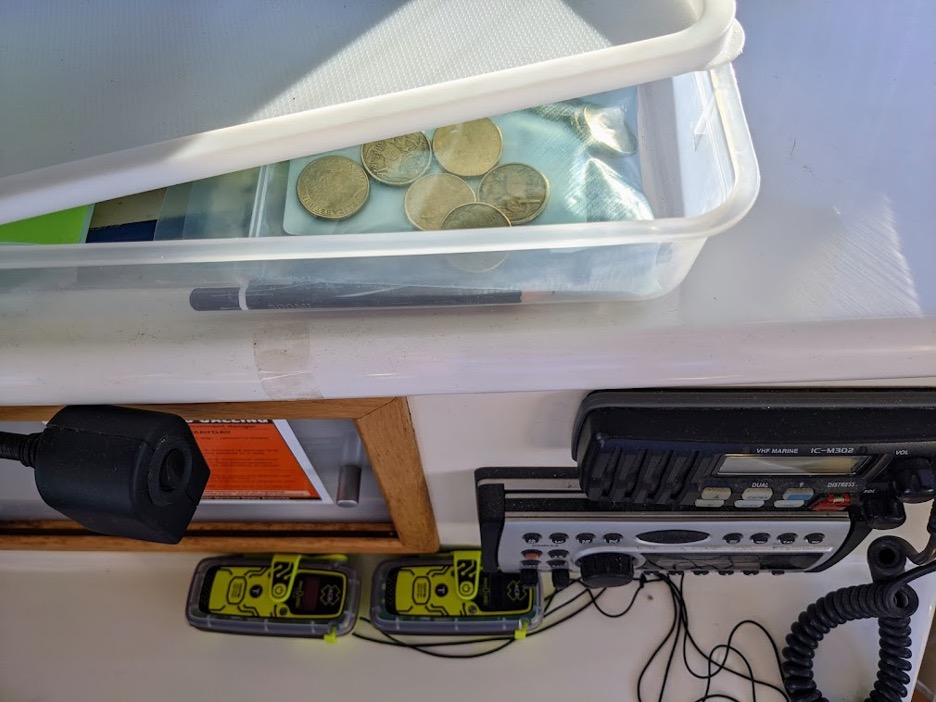
“They’ve taken the spare keys. The gold coins have gone too!” Alex observed.

Alex had prepared a collection of one and two dollar coins in a plastic bag in the clear box to be used for laundromats on shore. So this is what the thieves had been after!

Next Alex checked his wine collection in one of the bilges, “the boat cellar”. This was untouched. The thieves must have entered through the hatch and left through the door. Other than the keys, the only goods that had been stolen were the gold coins for the laundromat – or so we thought. Perhaps they were planning to return, next time through the door.

The theft of gold coins reminded me of advice I had received at the beginning of my teaching career in the 1980s in the city of Whyalla in South Australia. I had been assigned teacher housing by the education department. I was advised by a colleague that when I was away from home, I should leave gold coins in obvious places for youngsters who might break in.

Alex was relieved that they had not taken any navigational or safety equipment, and I was relieved that they had not taken my boat slippers. We were well into autumn and it was cold underfoot.

Despite the break-in we were very fond of George Town, not least due to the camaraderie of our boat neighbours.

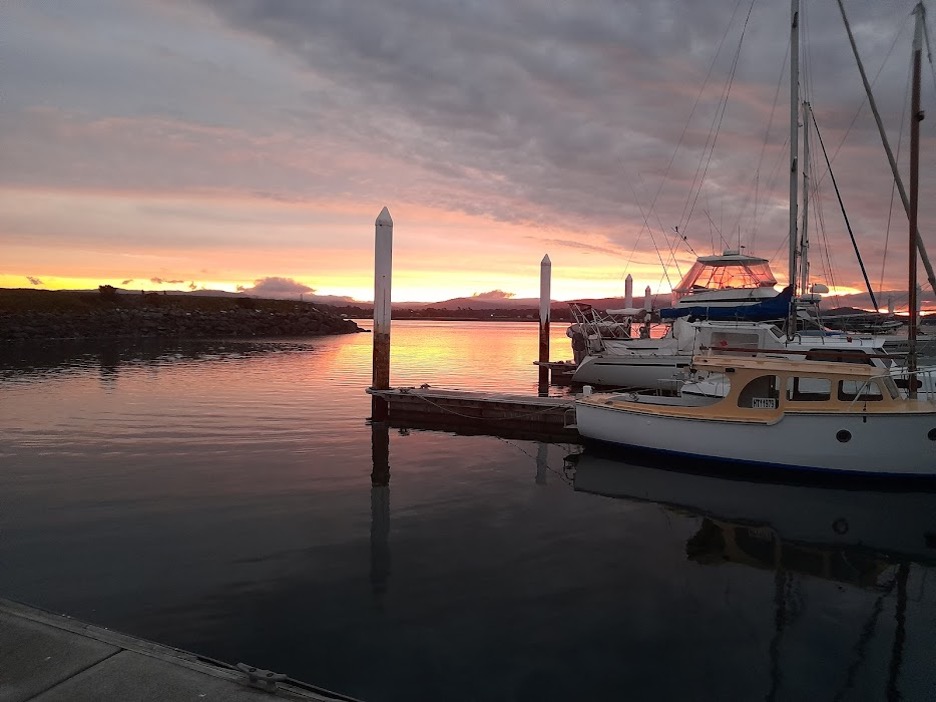
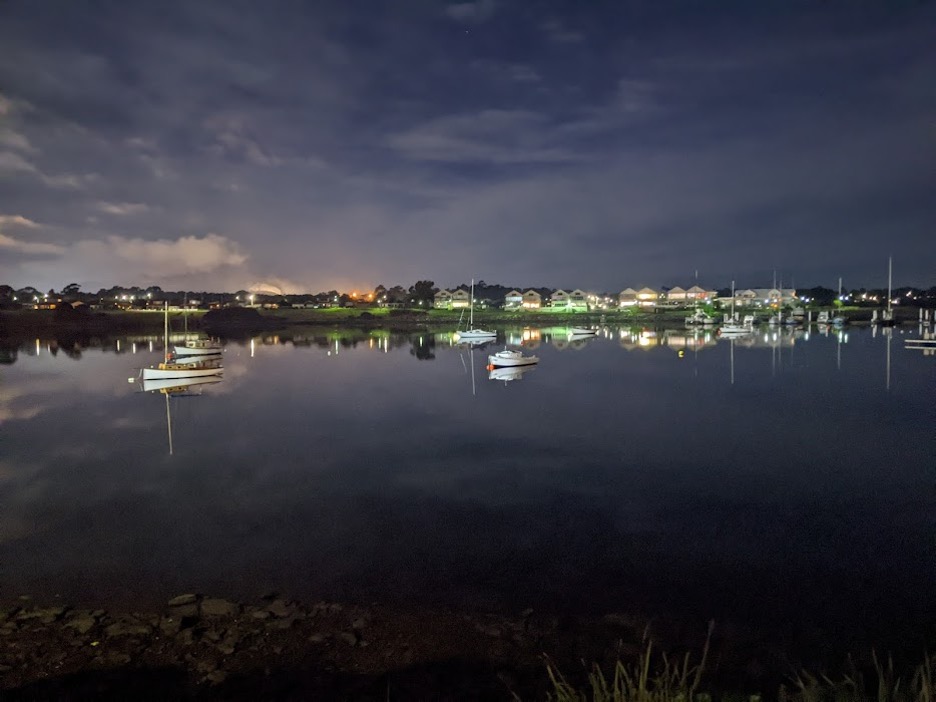
On the day of departure, as always, Alex got up before the rest of us to commence the day’s sailing. We were due to head north across Bass Strait towards the mainland. The harbour was generously lit up by the lights in the supermarket carpark on the other side, facilitating the safe exit to the Tamar River.

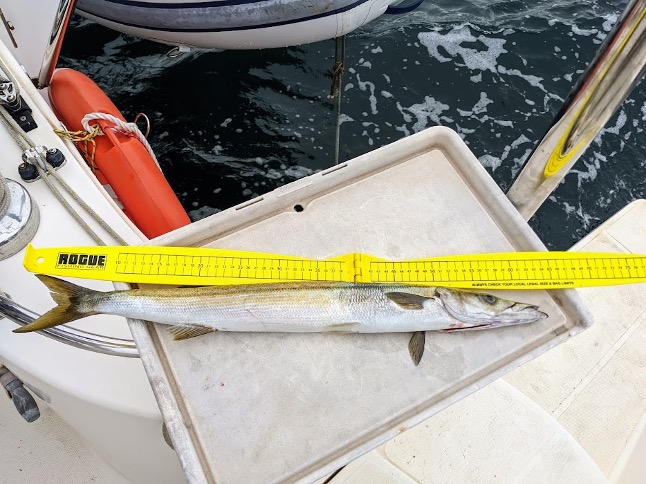
One of our favourite boat meals was freshly caught fish. Only when looking for a rod one evening did we discover yet another item had been stolen — a heavy-duty tuna fishing rod. This time, rather than using the rod we trolled with a hand reel, and had no trouble catching smaller fish.

Meanwhile someone in George Town was enjoying spending our gold coins and fishing with Alex’s special rod. At least we had our technology to guide our decisions as we crossed Bass Strait, where identifying marine traffic and the right weather conditions was critical. We followed the course Alex had plotted, stopping at the offshore island of Badger Island overnight, East Kangaroo Island and Whitemark for a few hours the following day, then anchoring at Settlement Point for our second night. Based on the Predict Wind forecast, we decided to tuck in for shelter at Outer Sister Island for two nights to wait out a front bringing strong winds. The shore looked tantalisingly close. I asked Alex if we could take the dinghy ashore but, pointing to the shore break, he told me that if we did we would likely capsize. We stayed indoors for the day, reading, writing and longingly looking at the forbidden shore. My preferred pastime is writing, but every now and then I had to force myself to stop and fix my eyes on the horizon as the boat danced over the anchor, to recover from bouts of seasickness.

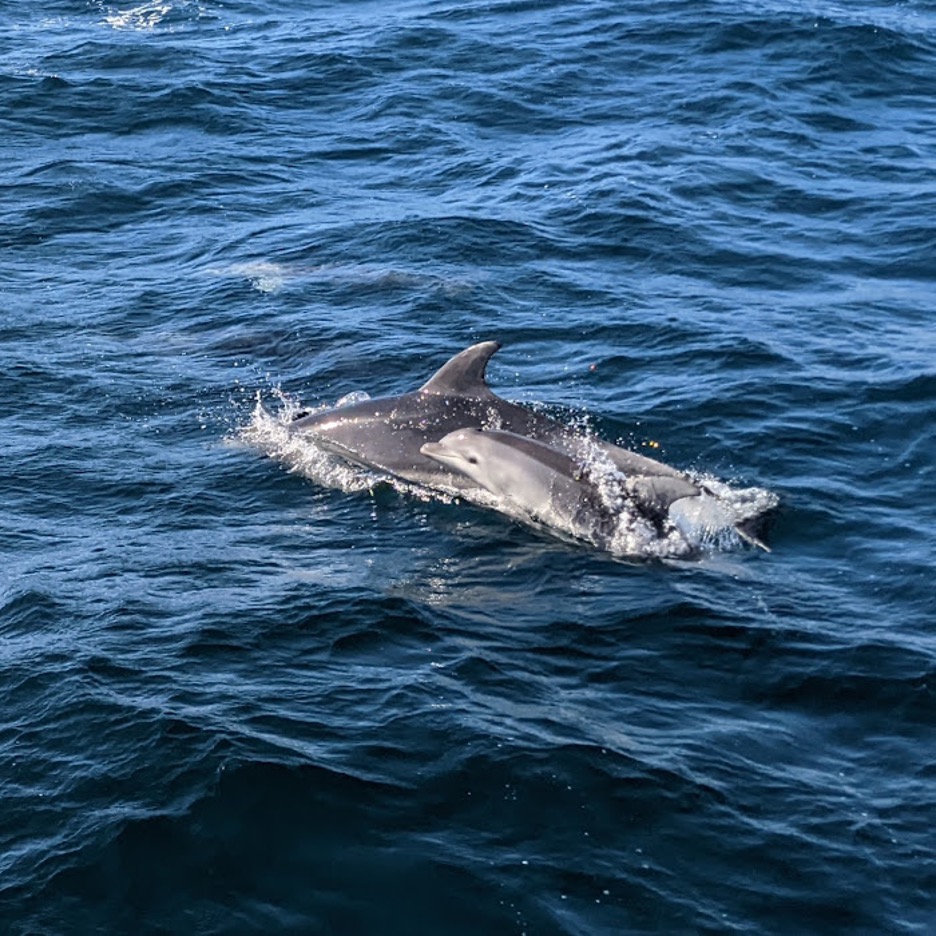
The forecast was for calmer conditions the following morning. We were ready for the long stint to the mainland, during which there would be no more coves in which to shelter. Alex got up first and departed Outer Sister Island at 6.38 am. We persevered sailing through both day and night. During the day we were rewarded by dolphin sightings as they played alongside and in front of us for about ten minutes a time, before suddenly veering away. During the night Alex and I roused ourselves at midnight to take our turn on the three hour shift until 3 am. Well, to be fair, Alex did the night watch while I forced myself to keep my eyes open.

We arrived at Eden, New South Wales, at 4.20 pm, and secured the boat on a public mooring. Too tired to venture ashore that evening, we relaxed on the boat, ready to explore Eden the following morning.

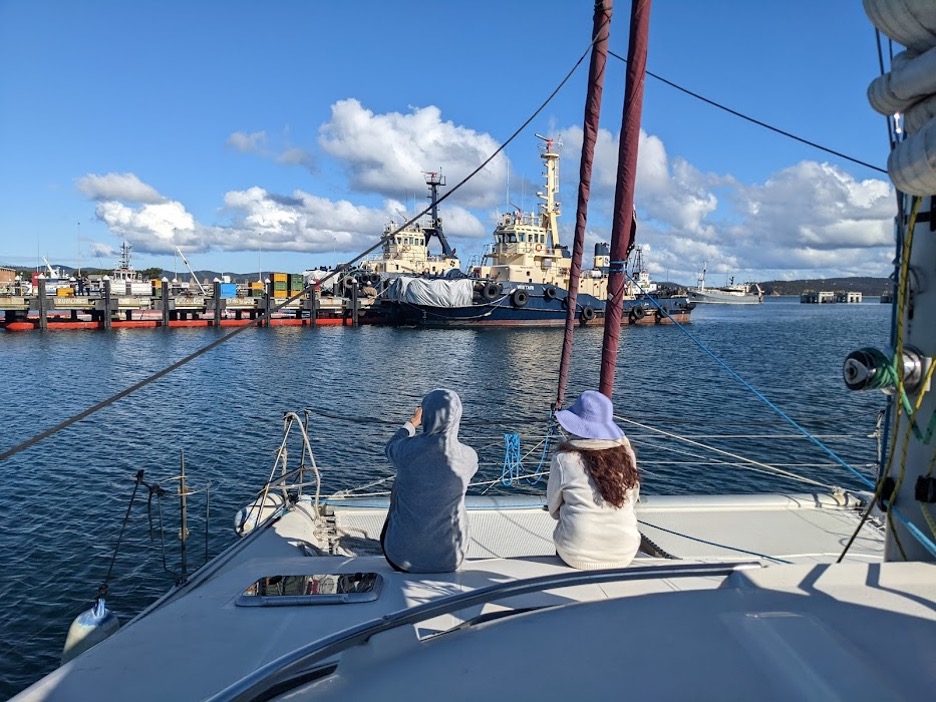
We had crossed Bass Strait availing ourselves of the technological support of the chartplotter and the AIS. Although the equipment did not spare us the trials of the night watch, it did help us avoid commercial trawlers and container ships in the shipping lanes. If it weren’t for our boat neighbour Gregory back in George Town, the thieves may have returned to steal the crucial equipment which made our crossing of Bass Strait safer. No less importantly, the notorious Bass Strait had been kind to us.

Meredith Stephens is an applied linguist from South Australia. Her work has appeared in Transnational Literature, The Muse, The Font – A Literary Journal for Language Teachers, The Journal of Literature in Language Teaching, The Writers’ and Readers’ Magazine, Reading in a Foreign Language, and in chapters in anthologies published by Demeter Press, Canada.

PLEASE NOTE: ARTICLES CAN ONLY BE REPRODUCED IN OTHER SITES WITH DUE ACKNOWLEDGEMENT TO BORDERLESS JOURNAL

Categories
Contents

Borderless May 2022

Painting by Sohana Manzoor

Editorial

Catch a Falling StarClick here to read

Interviews

Shantanu Ray Chaudhuri: In Search of Serendipity: Shantanu Ray Chaudhuri, an iconic editor and film writer from India, converses on his own journey and traditional publishing. Click here to read.

A Wonderer Who Wanders Between Waves and Graveyards and Digs Up Ancient Tales: In Conversation with Amit Ranjan, a writer-academic, who is trying to redefine academic writing, starting with his book, John Lang the Wanderer of Hindoostan, Slanderer in Hindoostan, Lawyer for the Ranee. Click here to read.

Translations

Jibananda Das’s All Afternoon Long, translated from Bengali by Fakrul Alam. Click here to read.

The Colour of Time, Korean poetry composed and translated by Ihlwha Choi. Click here to read.

The Ordeal of Fame, a humorous skit by Rabindranath, translated by Somdatta Mandal. Click here to read.

Fazal Baloch translates a retold folktale from Balochi, The Precious Pearl. Click here to read.

Tagores’ Lukochuri has been translated from Bengali as Hide and Seek by Mitali Chakravarty. Click here to read.

Pandies’ Corner

These narratives are written by youngsters from the Nithari village who transcended childhood trauma and deprivation. The Story of Rajesh has been written by Yogesh Uniyal in a mix of English and Hindi, and translated fully to Hindi by Nirbhay Bhogal. Click here to read.

Poetry

Click on the names to read

Michael R Burch, Shantanu Ray Chaudhuri, Ron Pickett, Abin Chakraborty, Tohm Bakelas, Mini Babu, Sudakshina Kashyap, George Freek, Shailja Sharma, Allison Grayhurst, Amritendu Ghosal, Marianne Tefft, S Srinivas, Rhys Hughes

Poets, Poetry & Rhys Hughes

Rhys Hughes shares why he put together an anthology of humorous poetry with seventeen writers, Wuxing Lyrical. Is his logic funny or sane? Click here to find out.

Stories

Intersleep

Nileena Sunil gives us a flash fiction. Click here to read.

Ants

Paul Mirabile tells a strange tale set in Madrid. Click here to read.

Mausoleum

Hridi gives us a poignant story on the banks of the river Seine. Click here to read.

The Persistence of Memory

Vedant Srinivas reflects on a childhood lost and a career found. Click here to read.

Viral Wisdom

Rhys Hughes finds humour within pandemic sagas. Is it dark or light? Click here to read.

Musings/Slices from Life

Sea Days, Sea Flowers

Mike Smith uncovers the wonders of British writer, H.E Bates. Click here to read.

Ruleman Ngwenya and Johannesburg

G Venkatesh shares the experience of his first trip out of India long, long ago. Click here to read.

“You don’t have to understand life. You just have to live”

Shubha Apte muses on a book that taught her life lessons. Click here to read.

Mission Earth

In Falling Down and Getting Up, Kenny Peavy explores how to raise resilient children. Click here to read.

Notes from Japan

In An Encounter with the Monet on Naoshima, Suzanne Kamata writes of snacking on Claude Monet’s hundred year old recipes while savouring his art and that of the famed artist who makes bold art with polka-dots, Yayoi Kusama. Click here to read.

A Special Tribute

In Jean Claude Carriere: A Writer for all Directors, Ratnottama Sengupta pays homage to Jean Claude Carriere (1931-2021), the legendary screenwriter of Peter Brook’s Mahabharata. Click here to read.

Essays

Hesse’s Siddhartha: Towards a Shadowless Present

Dan Meloche revisits a hundred-year-old classic by Herman Hesse that is based on Buddhist lore. Click here to read.

Himalayan Stories: Evenings with Nuru at Pheriche

P Ravi Shankar takes us to a trekkers’ life in the Himalayas. Click here to read.

Living up to my Seafaring Name in Tasmania

Meredith Stephens explores Tasmania on a boat and with hikes with a gripping narrative and her camera.Click here to read.

The Observant Immigrant

In A Post Pandemic Future …?, Candice Louisa Daquin takes a look at our future. Click here to read.

Book Excerpts

An excerpt from Upamanyu Chatterjee’s Villainy. Click here to read.

An excerpt from Ramy Al-Asheq’s Ever Since I Did Not Die, translated from Arabic by Isis Nusair, edited by Levi Thompson. The author was born in a refugee camp. Click here to read.

Book Reviews

Rakhi Dalal revisits Tagore’s The Post Office, translated from Bengali in 1912 by Devabrata Mukherjee. Click here to read.

Indrashish Banerjee reviews Upamanyu Chatterjee’s Villainy. Click here to read.

Basudhara Roy reviews Sunil Sharma’s Burn The Library & Other Fiction. Click here to read.

Bhaskar Parichha reviews Radhika Gupta’s Limitless: The Power of Unlocking Your True Potential. Click here to read.

Categories
Editorial

Catch a Falling Star…

Art by Sohana Manzoor
For when your troubles starting multiplying
And they just might
It's easy to forget them without trying
With just a pocketful of starlight

Catch a falling star and put it in your pocket
Never let it fade away (never let it fade away)
Catch a falling star and put it in your pocket
Save it for a rainy day

'Catch a Falling Star' by Paul Vance and Lee Pockriss

Perhaps, it is time to find that fallen star popularised by pop singer Perry Como is 1957. Optimism glimmers faintly, sometimes even conceals itself, in a world passing through a dark phase in history. For instance, few of us would know that we might find more answers to tackle  climate change as dinosaur fossils (from the time an asteroid hit the planet) have been unearthed recently. That sounds like solutions can be had to what was perceived as inevitable doom.

Another bit of news that perhaps will cheer some is the first anthology of Borderless Journal will soon be available in market. It has been accepted by a publisher, an old, trusted and reputed name from India, Om Books International. They have bookshops splattered all over — should make it easy for buyers to access the book. Hopefully, you can target the anthology for your Diwali or Christmas gift hampers. Om Books has one of the most iconic editors-in chief, Shantanu Ray Chaudhuri. A multiple award-winning editor, he has worked in Penguin and Harper Collins and is currently churning out wonderful books from Om with a fabulous production team, working with whom has been a pleasure. Ray Chaudhuri is an outstanding film writer and poet. He is part of a group that is creating a film archive online. To know more about him or his views on publishing, you can read our online conversation with him.

The energy one gets from optimism like starlight from a fallen star, lightens the darker shadows that create gloom with the war leading to rise in prices and threats of recession in a post pandemic scenario. Lesya Bakun, the refugee from Ukraine whose story we carried last month, finds her starlight by sharing updates of her story.  She added to her narrative with the news that her cousin has been taken as a prisoner of war by Russia from the besieged factory in Ukraine. Though sharing does not alleviate suffering, Bakun’s ability to cling to hope and imagine a future where she gets her dream highlights the strength of her convictions. The other thing that is revealed by her narrative and media coverage is exclusivity and boxes of ideology split humankind, erase families, cities, countries, lives and sanity. The war can appease only the lust of warlords. Against this desolation caused by the devastation, what could be the starlight that would lead to a happier future?

Laughter. Unleashing the ability to laugh at oneself is as potent as laughter that generates relief and lightens our mood, so that we can view differences as whimsical, treat them with tolerance and compassion and not destroy the diversities that add colours to the world. Perhaps, that is why Tagore took to humour too. Somdatta Mandal has translated a series of humorous skits by Tagore. We are featuring one of these called the ‘Ordeal of Fame’. Yet another translation or transcreation of a poem called ‘Lukochuri’ or ‘Hide and Seek’ reflects the playful in Tagore’s oeuvre. These, along with Rhys Hughes humour on the pandemic in poetry and prose, bring good cheer into our journal. Hughes has also used his column to tell us why he curated a new humorous anthology of verses by seventeen poets called Wuxing Lyrical. I wonder if he is serious or joking!

We were fortunate to have a tongue-in-cheek online discussion with an academic with a witty sense of humour who started a book based on his PhD research with a limerick, Amit Ranjan, author of John Lang the Wanderer of Hindoostan, Slanderer in Hindoostan, Lawyer for the Ranee. While Ranjan brought to us a narrative of an Australian who challenged the colonial mindset, went to court representing the Rani of Jhansi, wrote for Charles Dickens in Household Words and moved around the world just like one of us, hopping jobs and looking for a life, we have diverse cultural streams woven into the journal with translations of a Balochi folktale from Fazal Baloch, a Korean poem by Ihlwha Choi and Professor Fakrul Alam’s translation of Jibananda’s poetry, an ongoing project in Borderless.

The Nithari column has yielded us a story that was written in a mix of Hindi and English by Yogesh Uniyal and translated fully to English by Nirbhay Bhogal. We have strange stories this time. Nileena Sunil’s short narrative and Paul Mirabile’s longer one set in Madrid explore the unusual. More stories delve into the intricacies of the human mind.

As we trot around the globe, Suzanne Kamata tells us about a Monet museum in Japan where she ate madeleines made with the artist’s recipe! Meredith Stephens sails to Tasmania with her camera and gives us a glimpse of nature’s plenty. Ravi Shankar relates his trekking adventures among the Himalayas in Nepal, with awesome photographs of these mountains, while Kenny Peavy who lives in Indonesia dwells on the value of falling down and getting up in a light humorous vein against the backdrop of nature – though metaphorically perhaps the world needs to do that. We have G Venkatesh’s story about his stay in Johannesburg where he discovers that skin tones do not matter.

Ratnottama Sengupta makes the whole world look like a home with the story of a legendary screenwriter, Jean Claude Carriere, who wrote the script of Mahabharata for Peter Brook’s play (1985) of the same name and the subsequent film (1989) — with characters drawn from all over the world. Candice gives us an overview of the pandemic, with more focus on US where she lives.

Mike Smith travels back to another time when an ailment called World War II raged and has revived a writer from the past, HE Bates (1905-1974). We have another essay by Dan Meloche on a legendary book which turned 100 this year — Herman Hesse’s Siddhartha. Rakhi Dalal revisits more than a century old translation by Devabrata Mukherjee of Tagore’s The Post Office which bears relevance to the present day as it shows how the human spirit endures over even the darkness of death.

Bhaskar Parichha has reviewed Radhika Gupta’s Limitless: The Power of Unlocking Your True Potential, by his assessment a book that inspires youngsters to take charge of their future. On the other hand, there are books that explore the darkest in humans. Basudhara Roy has reviewed a collection short stories by Sunil Sharma called Burn the Library & Other Fiction. Indrashish Banerjee reviews Upamanyu Chatterjee’s latest novel based on modern day crimes, Villainy, from which we are carrying a book excerpt too. The other excerpt is from a narrative written from a refugee’s perspective, Ramy Al-Asheq’s Ever Since I Did Not Die, translated by Isis Nusair from Arabic. Born in a refugee camp in Damascus, this Syrian-Palestinian poet defies all genres to touch hearts with brutal honesty. No less sincere is Michael Burch’s poetry on summer that ushers in the season as much as Sohana’s beautiful painting that we are using as our cover photo. We have poetry from not just Shantanu Ray Chaudhuri but also by George Freek, S. Srinivas, Tohm Bakelas, Abin Chakraborty, Marianne Tefft and many more. As usual, I have not mentioned all the treats in store for you. Delve into our contents page and browse to find out more.

Before winding up, I would want to extend my thanks not only to our team and contributors, but also to our publisher who is willing to republish our content with some tweaking. Thanks to our readers who, I hope, will be excited to have selected content between their palms as a hardcopy anthology with 49 of our most iconic pieces. We have more than a thousand published works. This anthology will be an iconic sample that you can carry anywhere with you even if there is no internet – that would include Mars and Moon!

I wish you happy reading, happy dreaming and hope… plenty of it.

Best wishes,

Mitali Chakravarty

borderlessjournal.com

Categories
Essay

Living up to my Seafaring Name in Tasmania

Narrative and photographs by Meredith Stephens

When I asked my mother why she called me ‘Meredith’, she told me that she had named me after one of the children in the class she had been teaching before she got married. Still curious, I looked up the meaning of my name and found that it meant ‘leader of the sea’. But it wasn’t until my seventh decade that I left the cloistered world of academia and became a seafarer. Then I was finally able to live up to my name, at least partially. Not only did I become a sailor, I also became a serious hiker, and learnt how to replace my daily shower for sporadic dunks in the ocean.

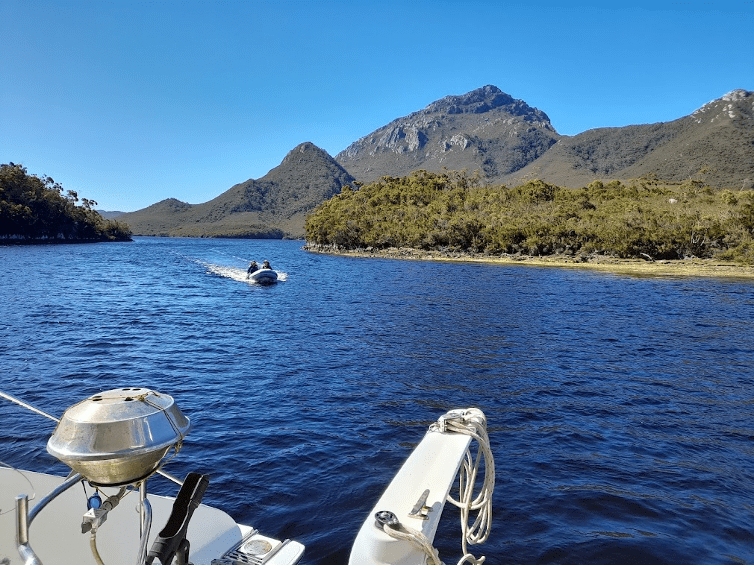
Alex, Luke, Verity and I were sailing south along the rugged western coast of Tasmania to Port Davey. The morning we arrived I ventured onto the deck and noticed that there was no beach, and the foliage was scrub rather than forests. As we entered Port Davey, we noticed still waters and jagged mountains. Several other yachts were anchored in the cove. Kayakers wove their way hugging the coast. I sat on the stern of the deck taking in the scenery that few people have the chance to observe. Port Davey is only accessible by small plane or boat, not by road.

Once anchored we decided to climb Balmoral Hill. Luke chose this because it promised the best rewards for the least effort; it would be a relatively easy climb with spectacular views. We made our way in the dinghy to the shore. We followed the wombat tracks, pushing our way through the bushes and native flowers, and reached the summit in under an hour. Balmoral Hill lived up to its promise. Views of Port Davey extended in all directions. The climb down was more challenging than the climb up, and I found myself lagging behind the others as usual.

We returned to the boat and it was still only 3 pm. We hadn’t been able to take regular showers because of the limited supply of fresh water on the boat. Luke and Alex decided to have a swim. Alex begged me to go in too.

“If you go in, I’ll give you a gin and tonic,” promised Alex.

He knew that was a sure-fire way to entice me in. I donned my swimsuit and secured my hair on the top of my head. I poked my feet into the water. Alex kept encouraging me to go in and finally I braved the cold brackish waters. I willed myself to stay in for a minute or two before climbing back up the ladder. Then Alex offered me a brief but hot shower on deck. True to his word, he brought me a gin and tonic with my favourite snack of hummous and seaweed crackers.

It was still early afternoon.

“Do you want to go ashore again?” Alex offered.

A narrow strip of white shore was enticing us. We made the 100metres trip to the shore in the dinghy. The shore consisted of white granite pebbles. We walked up and down the pebbles so that they could massage the soles of our feet, providing a shiatsu-like treatment.

The next morning Alex and Luke were looking forward to climbing Mt Rugby.

“How long does it take to climb?” I asked Luke.

“About six or seven hours.”

Alex had always encouraged me to go on daily hikes with him, and I was worried that I would have to undertake a six hour hike up Mt Rugby. Alex read my mind, and I realised that he was not expecting me to accompany them. He reminded me how to use the VHF [Very High Frequency] radio in case we needed to summon help. Verity and I stayed on the boat, working on our laptops in the saloon, gazing through a window at Mt Rugby, as the boat gently swayed back and forth. I went onto the deck periodically to scan Mt Rugby to try and sight Alex and Luke, but couldn’t find them. Before I knew it they had returned.

That evening, while positioning the dinghy, the rope became intertwined in the propellor. Alex donned his swimmers and dived quickly into the cold water to cut the rope. Every now and then he emerged from the water with his mask. His legs and feet were visible beneath the surface of the tannin filled water every time he dived back in. Eventually he cut the rope and returned to the boat.

The next morning we continued to Joe Page Bay to see the swans. After anchoring we hopped into the dinghy and headed for the lagoon. We noticed flocks of swans in the distance but as soon as they heard the engines of the dinghy they took off. The water was too shallow because it was low tide. We were at risk of hitting the river bottom, so we eventually turned around and returned to the boat.

It was another two days before we exited Port Davey. We headed back in the direction of the open ocean to anchor for the night, ready to leave the next day. Alex and Luke carefully chose the calmest spot in the north-west corner of Brambell Cove. Mt Millner was beckoning so we took the dinghy ashore and headed up the mountain.

“What if I can’t do it?” I asked Alex.

“You can rest on the beach if you like,” came the reply.

We entered a shady grove and found the path. Verity and Luke took the lead and Alex the rear, so I wouldn’t get left behind. The wombat track was studded in deep holes and it was hard to enjoy the view of the islands while being careful where I placed my feet. I thought we had nearly reached the summit, but it kept stretching ahead.

“You go ahead. I don’t need to get to the summit. I’ll rest here.” I pleaded.

Alex was having none of it.

“Look! We have reached the saddle. You can even go downhill for a bit before we ascend again. Not much further to go!” he encouraged me.

How could I disagree when Alex had so much confidence in me? I continued to clamber up the mountain. The bare surroundings turned to dense scrub and I had to push the branches away from my face to clear the way. Then in my haste I found myself falling backwards. My landing was cushioned by some thick undergrowth. My feet, bound up in my heavy hiking boots, stretched before me and I was tempted to rest a bit longer, but I worried about holding the others up, so I took a deep breath and summoned the effort to get up. No sooner had I reached the summit than I realised that it was another false summit. Rising before me was a steep incline to the sky.

“I can’t do it Alex!” I called behind me.

“You’re very nearly there. Then you can say that you climbed to the summit.”

I didn’t really care about being able to boast that I had reached the summit. Would anyone be impressed by that? But again, Alex’s enthusiasm pressed me on. With such encouragement it would be surly to refuse.

After climbing the steep incline I really did reach the summit. I caught a glimpse of the seascape below and the conical islands dotted in the bay. The fierce sun was oppressive and so I turned away, gratefully sat down on some heather, and pulled my hair away from my neck. Alex gave me some water.

“Do you want to walk to the other end of the summit?” Alex invited me.

If you walked to the other side you could look down on an ocean bay, but I could view it from my seated position and this time I really did decline.

After sitting there for twenty minutes I was cool enough to brave the descent. Luke and Verity climbed down quickly and waited on the shore. Alex took the rear and we trod along the wombat path trying to avoid the holes. Finally we reached Luke and Verity. We removed our hiking boots, hopped into the dinghy and motored back to the boat.

We had to ration fresh water and did not want to waste it taking a shower. I didn’t relish bathing in the ocean but I was both hot and perspiring so I felt I didn’t have a choice. I popped on my swimsuit, asked Alex to pull down the ladder, climbed down and immersed myself in the water. Finally, I was cool and clean. I couldn’t imagine being any more tired after the strain of the climb, the punishing sun and immersion in cold water. I am surprised I managed to mount the false summits and reach the real summit. It shows how encouragement can push you beyond the goal you set for yourself.

Alex prepared dinner. Behind the boat the sunset over the sea turned from an intense orange to purple. That night the boat was so still that we could have been excused for thinking we were on land. I was finally beginning to embrace my seafaring name.

Now that I had some sense of having earnt my first name, Meredith, I was ready to explore territory featuring the second part of my name, Stephens. My Great Aunt May, born around 1906, used to explain how her forebears had run a ‘Stephens’ shipping line in London in the late 1800s. Even my surname had a seafaring connection.

The next day we headed out to the open ocean past Bramwell Bay on our left and Breaksea Islands on our right. We anchored at Spain Bay, took the dinghy to shore, and then hiked to the other side of the peninsula. First the vegetation was low, and gradually gave way to bracken. We had to push the branches aside as we trudged through the mud. Then the path entered a forest with a canopy above the trail. Wooden stairs gave way to Stephens Bay. We sat on a rock to rest, and nibbled on some of the dry seaweed washed up on the beach, wondering what it would taste like if rehydrated in a misoshiru soup. I pondered whether I had an ancestral connection to this place as ships on their way from England to the east coast of Australia would have passed by this bay.

Back on board, despite the cold, I thought I would brave the waters again to refresh myself. I donned my swimsuit and tentatively climbed down the ladder into the sea. Alex dived in before me and I could tell from his expression that it was colder than we expected, as we were closer to the ocean. I held onto the ladder and vigorously moved my legs to warm myself up. I could only manage thirty seconds in the water despite resolving to last two minutes.

The next morning Alex entreated me to get up so as not to miss out on the spectacular scenery as we rounded southern Tasmania. The seas were as calm as they could possibly be. The boat was gently cantering in slow motion across the swell. South West Cape loomed in the distance, about an hour away. Luke was at the helm and Alex, Verity and I climbed carefully to the front of the boat holding onto the rails, and sat on the foredeck while we passed the cape, as the sun forced its way into view. Five hours later we rounded South East Cape, one of the five southernmost capes in the world, the others being West Cape Howe (Western Australia), South Cape (New Zealand), Cape Horn and the Cape of Good Hope.

Heading to the South West Cape, south western Tasmania

After so many decades spent in libraries and classrooms, my life had taken a turn and I suddenly found myself surrounded by ocean. Of course, living on a boat did not mean I would abandon reading and writing. In fact, the long hours at sea afforded even more time for these pursuits. This was especially the case when at anchor waiting for rough seas to subside, out of internet range, when there was little else to do. Nevertheless, I think my mother would have been more than surprised had she known that I would spend weeks at sea in some of Australia’s most remote waters. Neither of us could have imagined how literally I would grow into my name.

Meredith Stephens is an applied linguist from South Australia. Her work has appeared in Transnational Literature, The Muse, The Font – A Literary Journal for Language Teachers, The Journal of Literature in Language Teaching, The Writers’ and Readers’ Magazine, Reading in a Foreign Language, and in chapters in anthologies published by Demeter Press, Canada.

PLEASE NOTE: ARTICLES CAN ONLY BE REPRODUCED IN OTHER SITES WITH DUE ACKNOWLEDGEMENT TO BORDERLESS JOURNAL