Gower Bhat discusses the advent of coaching schools in Kashmir for competitive exams for University exams, which seem to be replacing real schools. Clickhere to read.
In winters, birds migrate. They face no barriers. The sun also shines across fences without any hindrance. Long ago, the late Nirendranath Chakraborty (1924-2018) wrote about a boy, Amalkanti, who wanted to be sunshine. The real world held him back and he became a worker in a dark printing press. Dreams sometimes can come to nought for humanity has enough walls to keep out those who they feel do not ‘belong’ to their way of life or thought. Some even war, kill and violate to secure an exclusive existence. Despite the perpetuation of these fences, people are now forced to emigrate not only to find shelter from the violences of wars but also to find a refuge from climate disasters. These people — the refuge seekers— are referred to as refugees[1]. And yet, there are a few who find it in themselves to waft to new worlds, create with their ideas and redefine norms… for no reason except that they feel a sense of belonging to a culture to which they were not born. These people are often referred to as migrants.
At the close of this year, Keith Lyons brings us one such persona who has found a firm footing in New Zealand. Setting new trends and inspiring others is a writer called Harry Ricketts[2]. He has even shared a poem from his latest collection, Bonfires on the Ice. Ricketts’ poem moves from the personal to the universal as does the poetry of another migrant, Luis Cuauhtémoc Berriozábal, aspiring to a new, more accepting world. While Tulip Chowdhury — who also moved across oceans — prays for peace in a war torn, weather-worn world:
I plant new seeds of dreams for a peaceful world of tomorrow.
Fiction in this issue reverberates across the world with Marc Rosenberg bringing us a poignant telling centred around childhood, innocence and abuse. Sayan Sarkar gives a witty, captivating, climate-friendly narrative centred around trees. Naramsetti Umamaheswararao weaves a fable set in Southern India.
A story by Nasir Rahim Sohrabi from the dusty landscapes of Balochistan has found its way into our translations too with Fazal Baloch rendering it into English from Balochi. Isa Kamari translates his own Malay poems which echo themes of his powerful novels, A Song of the Wind (2007) and Tweet(2017), both centred around the making of Singapore. Snehaprava Das introduces Odia poems by Satrughna Pandab in English. While Professor Fakrul Alam renders one of Nazrul’s best-loved songs from Bengali to English, Tagore’s translated poem Jatri (Passenger) welcomes prospectives onboard a boat —almost an anti-thesis of his earlier poem ‘Sonar Tori’ (The Golden Boat) where the ferry woman rows off robbing her client.
We have plenty of non-fiction this time starting with a tribute to Jane Austen (1775-1817) by Meenakshi Malhotra. Austen turns 250 this year and continues relevant with remakes in not only films but also reimagined with books around her novels — especially Pride and Prejudice (which has even a zombie version). Bhaskar Parichha pays a tribute to writer Bibhuti Patnaik. Ravi Varmman K Kanniappan explores ancient Sangam Literature from Tamil Nadu and Ratnottama Sengupta revisits an art exhibition that draws bridges across time… an exploration she herself curated.
We have a spray of colours from across almost all the continents in our pages this time. A bumper issue again — for which all of the contributors have our heartfelt thanks. Huge thanks to our fabulous team who pitch in to make a vibrant issue for all of us. A special thanks to Sohana Manzoor for the fabulous artwork. And as our readers continue to grow in numbers by leap and bounds, I would want to thank you all for visiting our content! Introduce your friends too if you like what you find and do remember to pause by this issue’s contents page.
Wish all of you happy reading through the holiday season!
Odbayar Dorj writes of celebrating the start of the new school year in Mongolia and of their festivals around teaching and learning. Click here to read.
Naramsetti Umamaheswararao gives a story set in a village in Andhra Pradesh. Clickhere to read.
Feature
A conversation withAmina Rahman, owner of Bookworm Bookshop, Dhaka, about her journey from the corporate world to the making of her bookstore with a focus on community building. Clickhereto read.
The idea of spring heralds hope even when it’s deep winter. The colours of spring bring variety along with an assurance of contentment and peace. While wars and climate disasters rage around the world, peace can be found in places like the cloistered walls of Sistine Chapel where conflicts exist only in art. Sometimes, we get a glimpse of peace within ourselves as we gaze at the snowy splendour of Himalayas and sometimes, in smaller things… like a vernal flower or the smile of a young child. Inner peace can at times lead to great art forms as can conflicts where people react with the power of words or visual art. But perhaps, what is most important is the moment of quietness that helps us get in touch with that inner voice giving out words that can change lives. Can written words inspire change?
Our featured bookstore’s owner from Bangladesh, Amina Rahman, thinks it can. Rahman of Bookworm, has a unique perspective for she claims, “A lot of people mistake success with earning huge profits… I get fulfilment out of other things –- community health and happiness and… just interaction.” She provides books from across the world and more while trying to create an oasis of quietude in the busy city of Dhaka. It was wonderful listening to her views — they sounded almost utopian… and perhaps, therefore, so much more in synch with the ideas we host in these pages.
Our content this month are like the colours of the rainbow — varied and from many countries. They ring out in different colours and tones, capturing the multiplicity of human existence. The translations start with Professor Fakrul Alam’s transcreation of Nazrul’s Bengali lyrics in quest of the intangible. Isa Kamari translates four of his own Malay poems on spiritual quest, while from Balochi, Fazal Baloch bring us Munir Momin’s esoteric verses in English. Snehprava Das’s translation of Rohini K.Mukherjee poetry from Odia and S.Ramakrishnan’s story translated from Tamil by B.Chandramouli also have the same transcendental notes. Tagore’s playful poem on winter (Sheeth) mingles a bit for spring, the season welcomed by all creatures great and small.
We have good news to share —Borderless Journal has had the privilege of being listed on Duotrope – which means more readers and writers for us. We are hugely grateful to all our readers and contributors without who we would not have a journal. Thanks to our wonderful team, especially Sohana Manzoor for her fabulous artwork.
Hope you have a wonderful month as we move towards the end of this year.
I stretched the boat hook as far as I could towards the mooring buoy, but it slid beneath the bow.
“Go back!” I shouted to Alex back at the helm, but my voice was carried away in the wind.
I pointed at the buoy under the net, and Alex reversed. The waves were dancing in front of me and the buoy would not stay in place long enough for me to reach it. On the second attempt, I forced all of my attention on the rope attached to the buoy, and tried to pull it aboard. It was much too heavy so I screamed for Alex to come, and he raced from behind, pulled the buoy up and secured it to the bow.
How would I alight into the dinghy in these waves? Alex lowered it into the water and it lunged towards the stern and back in succession. I doubted I would be able to board in these conditions.
“How about if I move the dinghy to the side of the boat and you enter via a ladder?”
“Worth a try!” I answered.
Alex brought the dinghy to the side of the boat and slung a ladder made of strong fabric overboard. I gingerly stepped down but once I glanced at the water raging beneath me, I lost confidence and gave up.
“I think I had better hop in from the stern after all,” I told Alex.
He moved the dinghy back to the stern. As I walked towards it, I slipped and fell on my thigh. There was no time to feel sorry for myself, so I picked myself up and continued heading for the dinghy. It lunged back and forth in the waves.
“Now!” commanded Alex.
I placed one foot in the centre of the dinghy to centre myself and then sat down on the bench. As hard as it was for me it was not hard for Haru, my border collie. I called her in and tapped the dinghy behind me because I knew she was hard of hearing. She leapt behind me with alacrity. It was so much easier for her to board the dinghy, not least because of her four legs.
Alex was locking the door back on the boat. The dinghy kept lunging toward the stern, and I was scared of getting knocked off when it hit the stern. I screamed as hard as I could.
“Okay!” replied Alex and hopped in behind me. Then he turned on the engine and headed for the shore, except that the shore was unrecognisable. Instead of a sandy beach, there were rocks.
Alex headed for the most promising spot. “Hop out!” commanded Alex, and I disembarked one leg after the other and headed to climb over the rocks. As usual, Haru leapt out and ran ashore.
I thought I was clear of the rocks and the menacing water, when Alex called out to me.
“Take my backpack! The laptops are in here. They can’t get wet. I realised then that we should have put them into the dry bag.”
I walked over the slippery rocks and strained to grasp the shoulder straps of the backpack. Once they were in my hands I returned to shore over the rocks, ready for the trek up to the holiday house.
I was so longing for the warmth of the fireplace and the view of the setting sun over the bay. I walked effortlessly up the hill, with Haru trotting happily beside me. The shelter and glow of the house was just as I had imagined. It was worth the hardship of getting there.
That night the winds continued to build, but it was pleasurable to hear them passing over the house as we enjoyed the safety and warmth of being inside.
Around one in the morning, the whole house shuddered when hit by a particularly strong gust, which was violent enough to briefly wake Alex.
No sooner was it light that I heard Alex enter the room. He must have been out before the wee hours.
“The boat has drifted to shore. I had a bad feeling and got up early to check the position of the boat. From the cliffs I could see that the mast was too close to the shore. Then my fears were confirmed when I saw that it had been blown ashore.”
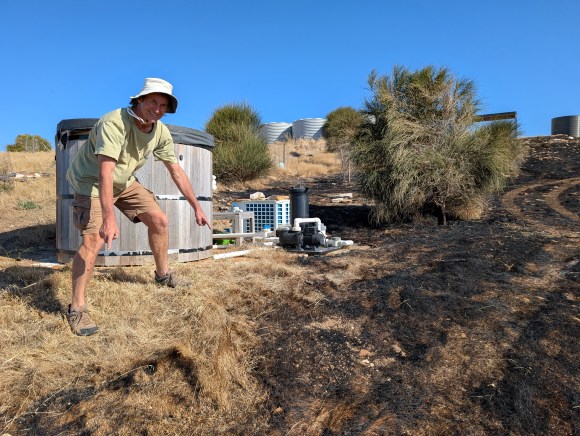
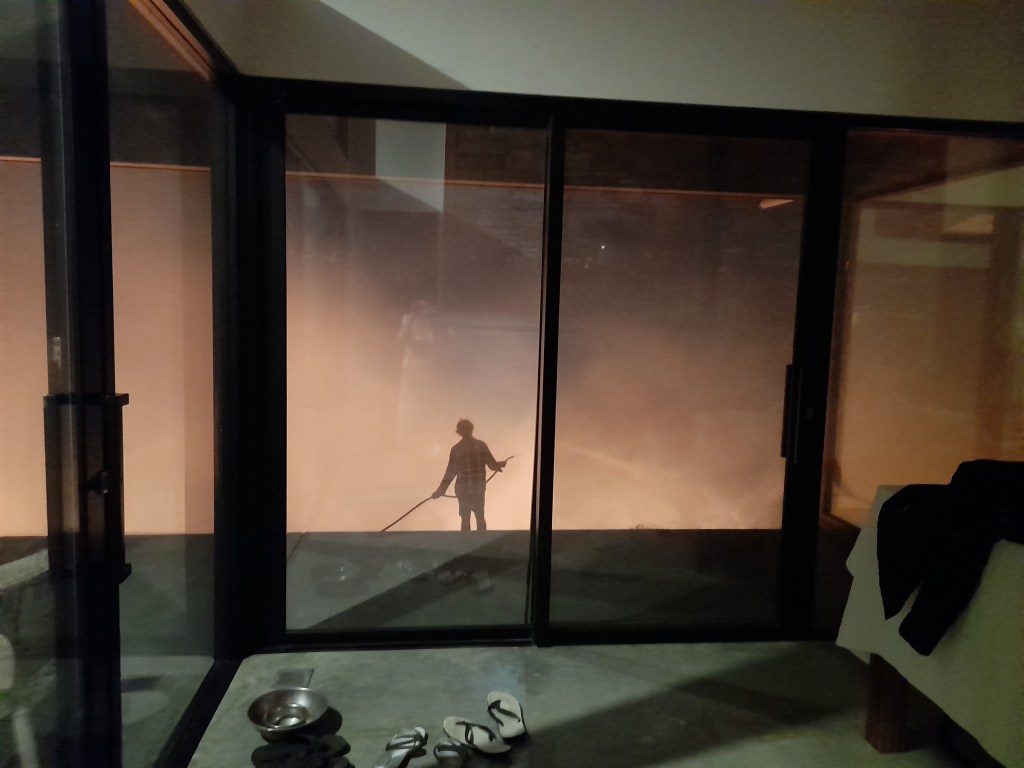
Dragged moorings. Photo Courtesy: Alan Noble
“Didn’t the mooring hold?” I asked.
“Evidently not. I’m going to check it out now. Want to come?”
I agreed, and we drove out to the cliff with Haru in the back seat. Once at the cliff, I remained in the car because I couldn’t face the gale-force winds that were now gusting to forty knots. Meanwhile, Alex, in his wetsuit, walked down the dirt road towards the beach, entered the water, and pulled himself aboard. I kept my eyes focused on him until I saw his figure exit the boat, swim ashore, and walk up the track back toward me.
“It’s finished. There’s nothing we can do, beyond salvage.”
Alex’s boat of sixteen years and our home away from home for the last five years was no more. In years past, we had circumnavigated Tasmania, sailed to New Caledonia and back, and across the Great Australian Bight to sail north on the Indian Ocean. Exiting a marina and heading towards the waves was a symbol of leaving our troubles behind and anticipation of adventure. I could no longer take this adventure for granted.
Alex reached out to Thompson’s Marine Salvage, and they arrived at the bay within two hours. The plan was to attach one end of a heavy rope to a tractor at the top of the cliff, and the other end to the boat, and drag it onto the sand to save it from smashing on the rocks.
Alex again donned his wetsuit, descended the cliffs, and swam to the boat. I sheltered from the wind in the car at the top of the cliffs with Haru. Then I thought that I should walk towards the boat in case there was anything I could do. Just as I reached the shore, a young man in a wetsuit approached me.
Haru observing from inside the car. Photo Courtesy: Meredith Stephens
“Watch out for the rope. We’re ready to begin!”
It was too late. The operation had started, and the rope was heading towards me, as the tractor started to try and haul the boat to the shore.
“Jump!” the young man urged.
I’m glad the young man thought this was a possibility, but I haven’t jumped for years. My days of jumping are decades behind me. Unable to jump, I met the full force of the rope and was knocked on my back. My head hit some rocks. I uttered an expletive “sh..!” which I reserve for extreme situations. I lay there for seconds before slowly getting back to my feet. My head was aching from the blow and my whole being was in shock. I gave up on rendering assistance and walked slowly back to the car. There I sheltered from the wind until Alex eventually returned to the boat.
“The operation has failed. The boat is still stuck on the rocks,” he explained.
Late in the day, a twenty-ton excavator arrived on the scene. I spent the day bent over holding a rubbish bag, picking up rubble from the boat. Haru trotted around me enjoying being freed from the confines of the house. The excavator approached the boat like a giant menacing dinosaur. I grabbed Haru by the collar and removed myself to a distant spot on the other side of the boat. I could not face another industrial accident. The hand of the excavator grappled the mast and moved it to a safe spot on the rocks. I watched the dinosaur make its retreat back to the road while I maintained a hold on Haru’s collar.
The following day a second twenty-ton excavator descended onto the beach. The first excavator lifted the stern while the second lifted the bow. Slowly, the airborne boat was moved off the rocks and onto land. I was invited to view it, but I couldn’t face seeing the destruction of our home. That evening, I ventured out to the paddock where the boat now rested high and dry, like a beached whale. Amongst the devastation, I retrieved the remains of my dressing gown, which had somehow become entangled in the bow.
Over the next few days, I continued to return to the beach to extract boat rubble from the shore and pull up items of clothing and bedding from the sand. Alex drove down to the beach in his off-road vehicle, and we loaded up the tray with bags of rubble. Different items washed ashore each day.
Salvaged shoes. Photo Courtesy: Alan Nobel
The bump on my head continued to heal, only feeling pain when touched. The bruises on my legs changed colour as they too healed. And eventually the bay would heal too. We continued daily beach clean-ups. Seven odd shoes were salvaged, an odd snorkel fin, and odd gloves. Two months later the other fin washed up, but none of the missing shoes ever made an appearance. We continued to fill our off-road vehicle, and rubbish bags, with debris. Our beloved nautical home sat out of place in a paddock awaiting salvage. We came away with a renewed appreciation and respect for the destructive power of the ever-changing sea, but it would take more than a broken boat to diminish our desire to sail again. For now, our sailing adventures were on hold, but once we had the opportunity, we would again return to the sea. This would not be our final voyage.
.
Meredith Stephens is an applied linguist from South Australia. Her recent work has appeared in Syncopation Literary Journal, Continue the Voice, Micking Owl Roost blog, The Font – A Literary Journal for Language Teachers, and Mind, Brain & Education Think Tank. In 2024, her story Safari was chosen as the Editor’s Choice for the June edition of All Your Stories.
PLEASE NOTE: ARTICLES CAN ONLY BE REPRODUCED IN OTHER SITES WITH DUE ACKNOWLEDGEMENT TO BORDERLESS JOURNAL
Art by Henry Tayali(1943-1987). From Public Domain
Let us imagine a world where wars have been outlawed and there is only peace. Is that even possible outside of John Lennon’s song? While John Gray, a modern-day thinker, propounds human nature cannot change despite technological advancements, one has to only imagine how a cave dweller would have told his family flying to the moon was an impossibility. And yet, it has been proven a reality and now, we are thinking living in outer space, though currently it is only the forte of a few elitists and astronomers. Maybe, it will become an accessible reality as shown in books by Isaac Asimov, Arthur C Clarke or shows like Star Trek and Star Wars. Perhaps, it’s only dreamers or ideators pursuing unreal hopes and urges who often become the change makers, the people that make humanity move forward. In Borderless, we merely gather your dreams and present them to the world. That is why we love to celebrate writers from across all languages and cultures with translations and writings that turn current norms topsy turvy. We feature a number of such ideators in this issue.
Nazrul in his times, would have been one such ideator, which is why we carry a song by him translated by Professor Fakrul Alam. And yet before him was Tagore — this time we carry a translation of an unusual poem about happiness. From current times, we present to you a poet — perhaps the greatest Malay writer in Singapore — Isa Kamari. He has translated his longing for changes into his poems. His novels and stories express the same longing as he shares in The Lost Mantras, his self-translated poems that explore adapting old to new. We will be bringing these out over a period of time. We also have poems by Hrushikesh Mallick translated from Odia by Snehprava Das and a poignant story by Sharaf Shad translated from Balochi by Fazal Baloch.
Book reviews homes an indepth introduction by Somdatta Mandal to Banu Mushtaq’s Heart Lamp: Selected Stories, translated from Kannada by Deepa Bhasthi. We have a discussion by Meenakshi Malhotra on Contours of Him: Poems, edited and introduced by Malaysian academic, Malachi Edwin Vethamani, in which she concludes, “that if femininity is a construct, so is masculinity.” Overriding human constructs are journeys made by migrants. Rupak Shreshta has introduced us to immigrant Sangita Swechcha’s Rose’s Odyssey: Tales of Love and Loss, translated from Nepali by Jayant Sharma. Bhaskar Parichha winds up this section with his exploration of Kalpana Karunakaran’s A Woman of No Consequence: Memory, Letters and Resistance in Madras. He tells us: “A Woman of No Consequence restores dignity to what is often dismissed as ordinary. It chronicles the spiritual and intellectual evolution of a woman who sought transcendence within the rhythms of domestic life, turning the everyday into a site of resistance and renewal.” Again, by the sound of it a book that redefines the idea that housework is mundane and gives dignity to women and the task at hand.
We wind up the October issue hoping for changes that will lead to a happier existence, helping us all connect with the commonality of emotions, overriding borders that hurt humanity, other species and the Earth.
Huge thanks to our fabulous team, especially Sohana Manzoor for her inimitable artwork. We would all love to congratulate Hughes for his plays that ran houseful in Swansea. And heartfelt thanks to all our wonderful contributors, without who this issue would not have been possible, and to our readers, who make it worth our while, to write and publish.
Sisters and friends and the author with horses, Whisky and Macka, outside Grandma’s house, in 1972. Photo Courtesy: Judith Stephens.
December 1972, Adelaide
I opened the fridge, pulled out some carrots and put them into the back pocket of my jeans. Then I headed into the backyard shed to retrieve my saddle and bridle. I slung the saddle over the handlebars of my bicycle and placed the bridle in the basket. Then I cycled to the first gateway to the riverbank. I left the bicycle by the fence and walked up the riverbank to find my bay steed, Macka. I couldn’t see him. Then I returned to my bike and cycled to the next entrance to the riverbank and looked for him. Still no Macka. When I entered the third entrance, I spotted him grazing by the river. I pulled out a carrot from my back pocket and held it out to him on my flattened palm. He pricked his ears, looked at me and headed towards me. He picked the carrot up with his soft lips and started crunching it. I slung the reins over his head, placed the bit in his mouth, and bridled him. Then I led him to a spot by the river where I could take advantage of the slope to stand higher than him and jumped on his back. I could never fatten him up, and his backbone pressed into my rear as I sat on him slightly askew. I regularly fed him chaff, and he grazed all day, but like some people, he remained forever thin. I rode him back to where the bicycle was, saddled him up, and trotted and cantered along the riverbank towards the sea.
This was my daily routine after school. Homework was rarely set, so I hardly ever studied in the evenings. Why would you study when you had already been at school all day? Sometimes my black labrador Jason accompanied me. In those days there were no rules about keeping your dog on a leash, so Jason would follow me, even if this meant swimming behind Macka and me to cross the river.
January 1973, Adelaide
“Meredith!” came the voice from my window at 5 am. It was my best friend, Debbie. Debbie owned a 16-hand piebald heavy horse, taller than her, called Whisky. Debbie knew that without pressure from her I would not rise this early. On this occasion, rather than being on the riverbank, Macka was stationed in the corral that Mum and Dad had built in the backyard.
I rose, dressed, and made my way to the corral to bridle Macka. Then I led him to the front yard where Debbie was waiting for me on Whisky. Today we were riding bareback, because our destination was the beach, and we were going to sit astride our horses as they swam. We headed to the riverbank and rode a kilometre to the mouth of the river. Then we rode across the sand and entered the water. When the horses started swimming, we started floating above them, my legs rising above Macka’s sides. I grabbed his mane so as not to part company with him. Then we turned the horses back towards shallow water. Once Whisky had found his feet, Debbie turned around and stood on his rump. From there she dived into the sea, quickly swam back and mounted him again. I wasn’t confident enough to attempt the same feat on Macka. Next, we headed back to shore and dismounted. We lifted the reins over the horses’ heads and held them while they rolled in the sand, thrashing their legs in the air. Then we jumped back on them, and galloped along the sand, before retracing our steps upriver.
August 2025, Monarto, South Australia
We were visiting the largest open-range safari park outside of Africa, Monarto Safari Park, an hour’s drive from Adelaide. Of all the African animals, I was most looking forward to seeing the giraffes and was excited to find myself a place on the giraffe tour. I took a seat on the bus and listened to the guide’s spiel as we made our way to the giraffe feeding station. The guide provided a bucket of carrot sticks for the tourists to feed to the giraffes.
I dipped my hand into the bucket, retrieved a carrot stick and offered it to the giraffe. He inclined his neck towards me, extended his enormous blue tongue to the carrot, gently took it between his lips, and started crunching it. I stood back in order to give the other tourists a chance to do the same, and a few came forward. In the next interval, I retrieved another carrot stick and offered it to the first giraffe. I stood back again for the other tourists, but few were interested. I ended up giving most of the carrot sticks to the giraffes because no-one else seemed to be as engrossed with this as I was. As soon as the bucket was empty the giraffes lost interest and gently loped away. I realised that the reason I was enjoying this so much was that I was reliving the experience of over fifty years earlier of feeding carrots to Macka.
In the years since the 1970s, although I never lost my love of horses, motherhood and working overseas took precedence over riding. My early years of daily caring for Macka felt like a distant dream. And yet in a distant time and space, I sometimes yearned for a simple life where I could care for large herbivores. I cannot return to 1973, and am unlikely to own a horse again, but at least I could re-experience the thrill of feeding carrots to gentle giant herbivores at Monarto Safari Park.
Feeding giraffes at Monarto Safari Park in 2025. Photo Courtesy: Cathie Noble.
Meredith Stephens is an applied linguist from South Australia. Her recent work has appeared in Syncopation Literary Journal, Continue the Voice, Micking Owl Roost blog, The Font – A Literary Journal for Language Teachers, and Mind, Brain & Education Think Tank. In 2024, her story Safari was chosen as the Editor’s Choice for the June edition of All Your Stories.
PLEASE NOTE: ARTICLES CAN ONLY BE REPRODUCED IN OTHER SITES WITH DUE ACKNOWLEDGEMENT TO BORDERLESS JOURNAL
Naramsetti Umamaheswararao makes up a new fable. Click here to read.
Feature
A review of Jaladhar Sen’s The Travels of a Sadhu in the Himalayas, translated from Bengali by Somdatta Mandal, and an online interview with the translator. Click here to read.
Autumn Garden by Vincent Van Gogh (1853-1890). From Public Domain
September heralds the start of year-end festivities around the world. It’s autumn in one part and spring in another – both seasons that herald change. While our planet celebrates changes, dichotomies, opposites and inclusively gazes with wonder at the endless universe in all its splendour, do we? Festivals are times of good cheer and fun with our loved ones. And yet, a large part of the world seems to be in disarray with manmade disasters wrought by our own species on its own home planet. Despite the sufferings experienced by victims of climate and war-related calamities, the majority will continue to observe rituals out of habit while subscribing to exclusivity and shun change in any form. Occasionally, there are those who break all rules to create a new norm.
One such group of people are the bauls or mendicants from Bengal. Aruna Chakravarti has shared an essay about these people who have created a syncretic lore with music and nature, defying the borders that divide humanity into exclusive groups. As if to complement this syncretic flow, we have Professor Fakrul Alam’s piece on a human construct, literary clubs spanning different cultures spread over centuries – no less an area in which we find norms redefined for, the literary, often, are the harbingers of change.
Mandal, herself, has a brilliant translation featured in this issue. We have a review of her book, an interview with her, and an excerpt from the translation of Jaladhar Sen’s The Travels of a Sadhu in the Himalayas. Written and first published in the Tagore family journal, Bharati, the narrative is an outstanding cultural bridge which even translates Bengali humour for an Anglophone readership. That Sen had a strictly secular perspective in the nineteenth century when blind devotion was often a norm is showcased in Mandal’s translation as well as the stupendous descriptions of the Himalayas that haunt with elegant simplicity.
Our fiction this month seems largely focussed on women’s stories from around the world. While Fiona Sinclair and Erin Jamieson reflect on mother-daughter relationships, Anandita Dey looks into a woman’s dilemma as she tries to adjust to the accepted norm of an ‘arranged’ marriage. Rashida Murphy explores deep rooted social biases that create issues faced by a woman with a light touch. Naramsetti Umamaheswararao brings in variety with a fable – a story that reflects human traits transcending gender disparity.
The September issue would not have been possible without contributions of words and photographs by many of you. Huge thanks to all of you, to the fabulous team and to Sohana Manzoor, whose art has become synonymous with our journal. And our heartfelt thanks to our wonderful readers, without who the effort of putting together this journal would be pointless. Thank you all.