Keith Lyons interviews Asian Australian poet Adam Aitken about cross-cultural identity, and the challenges of travel, writing, and belonging. Click here to read.
Translations
Gandhiji, a short story by Nabendu Ghosh, has been translated from Bengali by Ratnottama Sengupta. Click here to read.
Khaira, the Blind, a story by Nadir Ali, has been translated from Punjabi by Amna Ali. Click here to read.
Clothes of Spirits, a folktale, has been translated from Balochi by Fazal Baloch. Click here to read.
Many Splendored Love, four poems by Masud Khan, have been translated from Bengali by Fakrul Alam. Click hereto read.
Birds are Alive, has been written and translated from Korean by Ihlwha Choi. Clickhere to read.
Nobo Borshe or on New Year, Tagore’s poem on the Bengali New Year, has been translated from Bengali by Mitali Chakravarty for the occasion this April. Click here to read.
Ratnottama Sengupta shows the impact of Gandhi and his call for non-violence on Nabendu Ghosh as she continues to emote over his message of Ahimsa and call for peace amidst rioting. Click here to read.
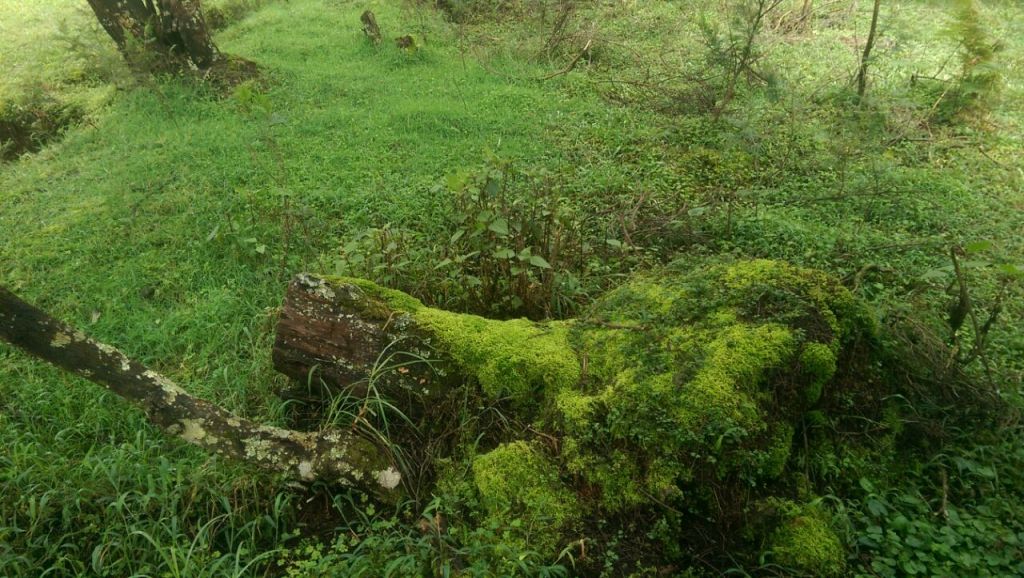
A moss-grown tree stump. Photo courtesy: PG Thomas
Ouseph’s gloom was accentuated by the rustling of dry leaves in the yard of his ancestral home. It was twilight and a movement near his feet made him glance down. He froze as he saw a little chameleon, climb up onto his designer shoe. It climbed up to his right toe, and tilting its head, looked at Ouseph with one bulging eye. Ouseph kicked wildly to dislodge the creature, and panting with fright, he found his gloom had been replaced by a series of shivers down his body.
“What am I doing here?” he wondered. He had last visited his ancestral house more than ten years ago, dragged there from Bombay by his father, who was keen on his child connecting with his roots. As a young boy, he had detested the countryside and his relatives; with their rustic stories and weird humour. Now a quirk of fate and the unexpected death of his bachelor uncle, had found the ancestral property bequeathed to him.
Ouseph lived ensconced in his techie world in Bangalore, where he spent his free time playing music and reading from his surprisingly large collection of books. His inheritance had come to him with the jarring notes of a thunderclap. But his now widowed mother had been firm, “Just go down, see the place and complete the legal formalities to make the property yours. Your father was attached to it and its worth quite a lot. Be practical and we can decide what to do with it later.”
He had travelled down from Bangalore to reach the remote countryside in Kerala at dusk. Pulling himself together from the reptilian shock, he knocked on the thick wooden weather beaten front door of his ancestral home. The door had creaked open into a dimly lit room, to reveal servants seemingly as old as the house itself. They had expected their new master to be young, but their incredulity at the sight of this gangly young man with tousled hair showed in their eyes. One obligingly took his suitcase from his hands but was surprised when he refused to part with his knapsack containing his laptop. He had been led to a musty smelling room, which did nothing to improve his mood.
The next morning, the sound of a broom swishing over the yard floor woke him up. Yawning and scratching his head, he stumbled into the smoky kitchen. A wood fire was burning, and Mariamma the elderly cook gave him a kind smile, and asked if he would like tea. With mug in hand, he stepped out of the house into the still misty morning. He wandered around the compound and looked anew at his inheritance. Noises unfamiliar to a city dweller assaulted his ears. The cow’s lowing seemed like a long drawn complaint, amidst which a rooster crowed, only for it to be picked up and repeated by another some distance away.
A sudden flurry of flapping wings drew his attention to the roof. He saw a startled covey of pigeons rise from the terracotta tiled roof. His eye then caught a single short piece of wire, suspended from a rafter under the eaves of the roof. He wondered if it was the remnant of an aerial wire from the bygone days of the wireless radio. He paused as he noticed a shabby looking ball attached to the end of the wire.
“It’s a sunbird’s nest,” whispered a voice from behind. He turned to see a sweeper women looking at him with laughing eyes.
“Oh!” was all Ouseph could muster. But as he gazed up again, he was rewarded by the sight of a little purple bird with a curved beak pop out of the opening in the nest. It sat there an instant; shimmering in the morning sunlight, and then with a whirr of its wings it flew away. “Oh!” said he again.
The sweeper smiled and said, “This pair has been nesting here for years, and has raised so many chicks in it.”
“Oh.”
He had wrangled leave from his software company on the condition of continuing to work online. But he now felt so befuddled with his bizarre inheritance in the countryside. He struggled to handle its finances and could not figure out how the place worked. “I might as well have landed on Mars,” he grumbled.
Rummaging through a list of relatives, Ouseph reached his cousin Anish, who readily offered to introduce him to his lawyer. The lawyer, a frail elderly man with an old world charm in his manners, took the proffered will and asked, “You’re Jacob’s son, aren’t you?”
“You knew my father?”
The lawyer’s eyes twinkled, and he said, “Your father and I were schoolmates here.”
This little exchange was inexplicably comforting to Ouseph. The lawyer asked for two days time to offer his legal opinion. Anish and Ouseph walked back along the narrow country road. Noting Ouseph’s anxiety, Anish said, “We’re glad you are here and the property has come to you.” They walked on under the canopy of trees over the road; Ouseph in his designer clothes and Anish in his home tailored short sleeved shirt and a cotton dhoti (a wrap-around lower garment).
They parted at the gate to Ouseph’s place. As Ouseph walked through the tree shrouded compound to the house, his phone rang. It was his mother from Bombay.
“Yes Amma, I met the lawyer. It looks like it will take a few days.”
A lunch of steaming rice, a coconut milk based chicken curry and a clutter of home grown vegetables done, Ouseph wandered out into the compound. He found a quiet place under the wood apple tree. The tall tree threw a filigreed crown of gnarled branches and tiny leaves against the blue sky. Ouseph sat down on a moss covered uprooted tree stump. The floor was thick with layers of shed leaves. Its soft cushiony feel reminded him of his boss’s carpeted office in Bangalore. But here the similarity ended. The cry of cicadas filled this place, and a crow pheasant’s ‘oopoopoop’ sounded through the thick greenery. He let the events of the past few days run through his mind.
The days following were consumed by visits to sleepy government offices. His cousin guided the process and taught Ouseph the art of greasing the wheels of the government machinery. But strangely, Ouseph found himself looking forward to returning to his ancestral house, and to his evening walks through the quiet of the verdant house compound. He did attend to his work online, but his metabolism seemed to have synchronised itself to the pulse of this ancient house.
For Mariamma the cook, with her plump face and grey streaked hair, her new geek master had roused all her latent mothering instincts. But she now observed him with concern. Ever pragmatic, she decided he needed tethering, and began by suggesting he visit his neighbours.
The first was the Ayurvedic apothecary and doctor. There was no response to Ouseph’s knock on the front door. But the noise of grinding and thumping drew him to the side of the house. He walked into a drying yard, where medicinal herbs of various colours and aromas were drying in the bright sunlight. He saw an old man on the side verandah, bent over a mortar and pestle. He worked at a steady pace and seemed totally absorbed in his work. Fairly certain that the old man was his neighbour Krishna Vaidyan (an Ayurvedic doctor), he volunteered a hello, and was waved to a seat on the verandah. The grinding and pounding continued for a few more minutes. The Vaidyan then stopped his work and looked up. A pair of keen eyes from between an aquiline nose and bushy white eyebrows scrutinised Ouseph, “Well?”
“Oh, I’m Ouseph, your new neighbour.”
An expression of confusion was soon replaced by a smile of comprehension and a friendly laugh, “Yes, yes, I heard you had come.” And after a pause he added, “This is your home, this is your land. I am happy you are back.”
.
The phone vibrated irritatingly, “Ouseph, this is your uncle Scaria. I’ll be there by eleven tomorrow. I am coming to help sell the property.” Scaria was his mother’s brother, for whom Ouseph had evinced a distaste when just an infant. He was the last person he had wanted to meet. Politeness prevented him raising any objections to his uncle’s visit.
The next day a car drew up, and his uncle Scaria stepped out in an orb of strong perfume. Furtive eyes from below a sweat speckled bald dome crawled over Ouseph, and then Scaria patted his shoulder patronisingly. Drawing himself up, Scaria looked around the compound, and nodded in approval at what he saw, “How many acres did you say this was?”
The two of them spent an hour walking around the compound. Ouseph was impressed by his uncle’s detailed scrutiny of the place. “You have quite a bit of valuable timber here,” and then he indicated he would like to see the house.
Over steamed tapioca, red fish curry and fierier chutney, Scaria delivered his seemingly implacable verdict, “You will not be able to manage this house and property. It will be a white elephant to you. Sell it at the best offer you get, and go back to your computer world, Ouseph.”
The last sentence was tinged with scorn, but Ouseph ignored it with, “The paper work is not yet complete.” He did not feel the need to elaborate. His uncle left him with a foul taste in his mouth, and Mariamma who overheard the conversation, looked anxiously at Ouseph’s face.
.
Ouseph began to get unsolicited enquiries for the property. He called his uncle and told him that he had not consented to sell the property. It had ended unpleasantly with implied threats and ingratiating offers from his uncle of a good price. Ouseph had complained to his mother, she merely replied, “You know your uncle. I can do nothing from Bombay. Think about It.”
His uncle’s perfidy had stunned him, and he began to feel bullied and pressured. He met and poured out the story to Anish and the lawyer. The lawyer couldn’t hide his amusement at the predicament of his innocent young client, “Your uncle is an artful crook. We will have to watch him.”
As they walked back, Anish, far more experienced in the ways of the world, threw his arm over the shoulders of his young despondent cousin, “Don’t worry, we are all here with you.”
Dusk was approaching as the two of them walked past the temple compound. There was an unusual buzz around the temple. Anish mentioned that a temple festival was on that night. Ouseph gazed at the temple with its age old banyan and peepul trees, now silhouetted against a red evening sky. The raucous cry of flocks of mynas roosting in the trees filled the air. Hundreds of lit oil lamps lined the walls and the walkway to the temple. It was all doubly lit up in the reflection of the temple pond.
“Looks like a big do Anish!”
“Yes and there will be night long performances too.”
That night, as the lights in his house were doused one after another, Ouseph lay back in his bed and listened to the night noises emanating from his compound. The drone of cicadas had become therapeutic to him now. There were screeches from the mango tree, as fruit bats squabbled over the ripe fruit, and a great Indian horned owl kept up its forlorn hooting above it all. And then, a ripple of drums carried over to him from the temple. “Must be the Kathakali dance ensemble warming up,” thought Ouseph.
And in a while, the distinctive percussion music of the Kathakali dance began to pulsate through the night. It was mesmerising. Ouseph knew only a little about this traditional dance of Kerala. But he knew that it portrayed archetypal characters and situations from Indian mythology and folk lore. The stories were told through the medium of dance and music. The archetypal characters portrayed were always dressed typically, to make identification easy for the audience. A green painted face signified divinity, shining makeup purity, and black demonic and so on.
Ouseph wondered at the enduring appeal of this art form among the local populace. He thought of his own problem with his uncle Scaria, and fantasised dressing him up as a Kathakali artiste, “Maybe I’ll give him the demon’s black face. Or maybe the red beard of a villain would be more suitable.” Ouseph in his fantasy finally picked the black bearded villain, for that signified a scheming villain.
He put his hands behind his head and listened to the distant drum beats. He fancied his uncle Scaria gyrating and dancing with theatrical gestures of a slimy schemer. Ouseph had to admit his phantasm danced well; and at this he began to giggle. Ouseph’s giggling increased and he thought he was becoming hysterical. His giggles became guffaws and he rolled over and buried his face in his pillow to smother them. His paroxysm abated and he drifted into a peaceful slumber. His pillow was wet with the tears of his laughter.
.
Ouseph leapt out of bed in the morning with the thought that Benji and Maya would be there that day. They arrived to voluble greetings and back thumping. In the lazy afternoon, the three of them sat on the tree stump under the shade of the wood apple tree. Ouseph took his friends through the details of his difficulties with his conniving uncle, and of how he struggled with his unexpected inheritance. He said his mother too, was not sure he could manage the property.
Benji said, “Ouseph, this place is most unusual. Think well before you do anything.”
Maya agreed too, “This place has great bones for a resort.”
Ouseph knew he too was falling under the spell of the place. But he needed to make a pragmatic decision. As they walked back to the house, he showed them the sunbird’s nest. He got them to be silent long enough to hear the cry of chicks from within the nest.
Ouseph had come prepared to handle the legal aspects of his unexpected inheritance. But as he stayed on, the house and its world, began to appeal subtly to his imagination and emotions in ways unexpected. The old house, with its moss grown tiled roof sat amidst the trees. The smell of some blossom or other invariably lingered in the air. The cry of birds and farm noises seeped through the rich vegetation. An irresistible, palpable primal energy seemed to flow from the compound. And all of this seemed to exist within an intense quietness; like the brooding silence of a sacred grove. And within this nestled the ancient house, an inseparable part of it all.
The place whispered to any that cared to listen. The house built in the distinctive wood architecture style of Kerala, nevertheless showed Chinese and Arabic influences too; influences that had permeated because of the ancient maritime spice routes. Inside, paintings and fading photos of ancestors stared from their frozen frames.
The compound also had traces of the more recent past. A curious seeker would find here, growing cheek by jowl with indigenous trees, breadfruit from the Pacific islands, nutmeg and mangosteen from Southeast Asia, clove trees from the Molaccas[1] and so on. It was a reminder of colonialism’s great botanical transplants of the past centuries. The heritage of his ancestral house was etched on it in myriad ways.
“Gosh!” exclaimed Maya, “it’s as if the house will always be here, and we are just passing through.”
It was then that Ouseph had this surrealistic feeling; the inkling that in the end, the decision would not be his. It seemed to have already been made in some strange way. This ancestral house seemed to be claiming him as one of its own, and every circumstance seemed to prod him to stake his claim and fight for things that he had earlier been indifferent to.
.
If some power grew this new symbiotic relationship between Ouseph and his heritage, then it seemed that events came cascading down to rivet it firmly together. It came on a morning as Ouseph was on the front verandah speaking with one of the servants. A white car drove up. The rapid opening of all its doors and the climbing out of several men set off alarm bells in Ouseph’s head. But he waited quietly for the people to approach him.
The leader smirked, “We have come to see a certain Ouseph.”
“I’m Ouseph; and what do you want?”
They climbed onto the verandah uninvited and sat down. “Scaria, your uncle sent us to look at the timber here. We understand it is for sale.”
Ouseph flushed and his voice rose, “Uncle Scaria has nothing to do with this property, and I have no timber to sell.”
The leader chuckled, rolled his eyes and tugging at the ends of his long mustache said, “We were warned that you would play games.”
“Games?”
Benji and Maya heard the altercation. Benji wondered if he should intervene, but Maya was out in a flash. She walked up to the chair besides Ouseph, sat down, crossed her legs and looked the apparent hoodlum in the face. Benji joined them too, and the sudden appearance of strangers, particularly of a determined young woman momentarily threw the visitors off balance. The leader began to say something, and then thought the better of it.
Ouseph saw one of his servants make a dash for the gate, but was too preoccupied to wonder why. He heard a shuffle behind him and turned to see the wide girth of Mariamma his cook behind him. She carried a wooden ladle in her hand.
“Who are you?” asked Ouseph.
“I am Chellapan.” The speaker then leaned back, as if awaiting a reaction. The name didn’t mean anything to Ouseph, but he heard Mariamma behind him draw in a sharp breath.
By ones and twos the servants and neighbours began to congregate. They stood quietly listening, but their faces glowered. Ouseph saw Krishna Vaidyan approach slowly. He was using a walking stick. Without a word, he climbed the steps to the verandah, and seated himself on Ouseph’s side. There was no mistaking his intention.
Chellapan made another attempt, “I know that you have made a commitment to Scaria, and I have paid him an advance for the timber here.”
Ouseph was surprised by the change in the tone of his own voice as he answered, “For the last time I tell you, Scaria has nothing to do with this property. If you have given him money, then take up the matter with him.” Then Ouseph heard himself distinctly say, “This property came to me through my ancestors, and I will not sell it during my lifetime. I will not violate it. I will pass it on as it is, to those that follow me.”
The visitors rose threateningly, but seemed unsure for the first time.
“And what is going on here?” It was a voice that was used to being obeyed. It was Lakshmiamma, the matriarch of the nearby Nair household. She was accompanied by two young men and she was sweating profusely from her barefooted walk to the house. All rose as she climbed the steps with difficulty. She lumbered across the verandah to the chair that Benji had vacated for her. She reached out and took hold of Ouseph’s wrist, and drawing him close to her asked the visitors, “Who are you?”
Mariamma sidled up to Lakshmiamma and whispered, “Its Chellapan.”
Lakshmiamma let out a short derisive laugh. Her snow white hair and the large vermillion dot on her forehead, set off her blazing mascara lined jet black eyes. She pointed at Chellapan and said, “I have heard of you. But before we drive you out, I want you to know something. We are here not just for our Ouseph. We are here because your conduct is a threat to us all. We will not permit such lawlessness in our area. So, when you go back to your rat hole, tell your bandicoot friends there, that we will break the legs of anyone attempting any such thing in future here… Now get out.”
Chellapan was quivering with rage and humiliation. But he looked around at the gathering of neighbours and servants. They reminded him of a wild elephant herd gathering around a vulnerable elephant calf. He was smart enough to know the game was up. Lakshmiamma had been explicit. But it was the unexpressed, simmering outrage of the gathering that really unnerved him. He turned his ire elsewhere and spat out, “We were set up by Scaria. Come on,” he roared, “Let’s go see Scaria.”
He strode out muttering obscenities under his breath. The crowd silently parted to let him and his lackeys through. And as Ouseph watched the retreat, somewhere in his own fevered imaginings; a Kathakali chant began. The accompanying drums and cymbals rose in throbbing waves to a crescendo. It was building up for the climax of Uncle Scaria’s final dance.
.
The storm broke at midnight with a crackle of thunder. It was followed by a wind that whistled through the many chinks in the old house and lashed at the trees in the compound; ruffling and driving their dry leaves in a stream. And then the rain came in as a steady downpour; and it lulled the household back to sleep.
Ouseph awoke to a pristine rain washed morning. He found his friends awaiting their morning cuppa in the dining room. Mariamma fondly served the kids, and just as Ouseph lifted his cup to his lips; Maya tremulously asked, “Would the sunbird’s nest have survived the storm?”
Leaving their tea steaming on the table, the trio scrambled out. They reached the nest and looked up anxiously. The nest, tucked under the eaves of the roof showed no damage. Amidst relieved laughter, Benji murmured, “Well, it seems that millions of years of evolution have taught the sunbird to build its nest in safe places.” Shining faces and gleaming eyes concurred.
Ouseph gave a little gasp and pointed up to a nearby windowsill. On it sat the brown and yellow mother sunbird, and next to her sat a chick. The chick was a male, and white downy feathers stuck out irregularly through his purple plumage. He was moulting. The mother bird signalled some anxiety at the chick’s first outing with little flutters of her wings. But the chick sat there calmly, as if he knew, that all he needed to do was to be true to that instinct within him; and then he would grow to be a perfect little purple sunbird.
Friendship is a perennial river of comfort where we can dive and swim throughout our life. Growing up, I was a silent student at school with not many friends and definitely no close companions. I was neither amicable nor bright and made little effort to change this attitude. I spent my teenage years trying to be inconspicuous to my classmates like they were some predatory animals. I didn’t own a personal phone until my undergrad years hence even if I made friends I couldn’t keep in touch with them, which I rarely did even after acquiring a phone. Communication technology especially mobile phones and social media plays a vital role in connecting people and maintaining friendships. At some point in one’s life, everyone finds someone who knows them better than the rest of the world, with whom they share a bit of everything from their life.
I remember the first time I met her; she was sitting across from me — two seats ahead in the institutional shuttle. I could only see a part of her little face, but I could make out the charming smile she wore. It was the second day at my first job. I was still intimidated by the new place and faces. Later that day, she came into our lab, a short affable girl and had the same charming smile. Apparently, she was also working on the same project as me but in a different team. She spoke to my colleague in English. However, I noticed the Malayalamaccent lingering in her words. I wondered why they spoke in English when they were both Malayalis; given that Malayalis have an inherent tendency to communicate with each other in Malayalam wherever they go. I observed her a little longer; definitely bold and smart, I concluded. Who knew then that this smart young woman was to be my north star?
With few joint project meetings, our acquaintance grew from colleagueship to friendship. She often visited our lab. Whenever she came, the gloomy chemical mood of our lab would transform into a jovial garden of fragrant flowers. She would laugh at almost anything and believe me her laughter was very contagious. The silent lab except for the perfunctorily grumbling instruments would suddenly mimic a rackety town hall. Her laughter made me wonder if it was hidden for a long time and finally finding its freedom made up for the lost time. I could see my stoic and altruistic friend find solace in the smile and laughter of others. After a few field trips together, I found a close companion in her. I didn’t know all of her. One can never know the whole of a person however close they are but I felt proud that I knew more of her each day. She was a popular smart friendly face at our institution and now, my friend. There was a sense of happiness and pride in finally finding someone who could bring warmth to your heart and to whom you were more than just a random person.
We had our differences and similarities, arguments and opinions, mischief and complaint — all as the part and parcel of our friendship. We never shared our deep secrets or fears, yet we knew the existence of such buried inside us. Importantly, we knew, if need be, we had each other’s shoulders to lean on and could confide in each other. She made a continuous effort to make me smile by sharing pictures of beautiful flowers, landscapes, hilarious memes, cute animal videos and such. She had inspired the scared timid mind inside me to come into the light. She encouraged me to discover the unmolded writer in me, inspired me to write and share my silly poems. Moreover, she educated me on certain domains of knowledge I lacked and she continued to inspire me every day. She encouraged me to fly with her into the unfathomable spread of the sky. I owe it to her for all my accomplishments in the past three years while all I could be was a listener. She was and is my laotong, the sister of my heart.
We are not perfect people in the perfect world and yet sometimes, our shortcomings drew us closer together. We are two overthinkers with our disconcerting opinions, who can never put a firm foot on the ground. Sometimes when she consults me for my opinion on certain matter,s all I provide her is obscure suggestions making the matter more ambiguous. But my dear friend is always pleased and content with whatever outlook I provide. Even with the continents separating us now we are still the ‘old sames’ close within our hearts.
I have only countable friends, of which there are very few that I still maintain communication. A strange sense of detachment grows in me when the common grounds of friendship alter and are separated by large physical distance. The connection through electronic devices usually wouldn’t suffice to regain my earlier attachment. Hence, I avoid any communication at all. However, I hold them, dear, within my heart even if I constantly fail to express this in person. Strangely with her, I have been able to communicate freely with no detachment as if no distance separated us, mostly due to her persistent efforts rather than mine. And still, she continues to inspire me, spread joy and bring laughter to my face. Like the two birds that return to the same tree branch to share the stories of their daily adventure, we share our daily bits through the electronic branch connecting us. I hope our friendship grows and travels beyond the grasp of time.
Anjali V Raj is a natural science researcher from Kerala, India. She currently works as a researcher at Azim Premji University. Her poems and short essays based on thoughts cultivated from observation of surrounding, lifestyle and society. She has published few of her works in the Down to Earth, The Wire, Café Dissensus Everyday, Borderless Journal and Times of India Reader’s Blog.
PLEASE NOTE: ARTICLES CAN ONLY BE REPRODUCED IN OTHER SITES WITH DUE ACKNOWLEDGEMENT TO BORDERLESS JOURNAL
“Here with a Loaf of Bread beneath the Bough,
A Flask of Wine, a Book of Verse -- and Thou
Beside me singing in the Wilderness --
And Wilderness is Paradise enow.”

― Omar Khayyám (1048-1131); translation from Persian by Edward Fitzgerald (Rubaiyat, 1859)
I wonder why Khayyam wrote these lines — was it to redefine paradise or just to woo his beloved? I like to imagine it was a bit of both. The need not to look for a paradise after death but to create one on Earth might well make an impact on humankind. Maybe, they would stop warring over an invisible force that they call God or by some other given name, some ‘ism’. Other than tens of thousands dying in natural disasters like the recent earthquake at the border of Turkiye and Syria, many have been killed by wars that continue to perpetrate divides created by human constructs. This month houses the second anniversary of the military junta rule in Myanmar and the first anniversary of the Ukrainian-Russian war that continues to decimate people, towns, natural reserves, humanity, economics relentlessly, polluting the environment with weapons of mass destruction, be it bombs or missiles. The more weapons we use, the more we destroy the environment of our own home planet.
Sometimes, the world cries for a change. It asks to be upended.
We rethink, reinvent to move forward as a species or a single race. We relook at concepts like life and death and the way we run our lives. Redefining paradise or finding paradise on Earth, redefining ‘isms’ we have been living with for the past few hundred years — ‘isms’ that are being used to hurt others of our own species, to create exclusivity and divisions where none should exist — might well be a requisite for the continuance of our race.
Voices of change-pleaders rang out in the last century with visionaries like Tagore, Gandhi, Nazrul, Satyajit Ray urging for a more accepting and less war-bound world. This month, Ratnottama Sengupta has written on Ray’s legendary 1969 film, Goopy Gyne, Bagha Byne: “The message he sent out loud and with laughter: ‘When people have palatable food to fill their belly and music to fill their soul, the world will bid goodbye to wars.’” Shantanu Ray Chaudhuri has given an essay on one of the greatest pacifists, Gandhi, and his attitudes to films as well as his depiction in movies. What was amazing is Gandhi condemned films and never saw their worth as a mass media influencer! The other interesting thing is his repeated depiction as an ethereal spirit in recent movies which ask for changes in modern day perceptions and reforms. In fact, both these essays deal with ghosts who come back from the past to urge for changes towards a better future.
Delving deeper into the supernatural is our interviewee, Abhirup Dhar, an upcoming writer whose ghost stories are being adapted by Bollywood. While he does investigative stories linked to supernatural lore, our other interviewee, Andrew Quilty, a renowned journalist who has won encomiums for his coverage on Afghanistan where he spent eight years, shows in his book, August in Kabul:America’s Last Days in Afghanistan and the Return of the Taliban, what clinging to past lores can do to a people, especially women. Where does one strike the balance? We also have an excerpt from his book to give a flavour of his exclusive journalistic coverage on the plight of Afghans as an eyewitness who flew back to the country not only to report but to be with his friends — Afghans and foreigners — as others fled out of Kabul on August 14 th 2021. While culturally, Afghans should have been closer to Khayyam, does their repressive outlook really embrace the past, especially with the Taliban dating back to about only three decades?
This intermingling of life and death and the past is brought to life in our fiction section by Sreelekha Chatterjee and Anjana Krishnan. Aditi Yadav creates a link between the past and our need to travel in her musing, which is reminiscent of Anthony Sattin’s description of asabiyya, a concept of brotherhood that thrived in medieval times. In consonance with wanderlust expressed in Yadav’s essay, we have a number of stories that explore travel highlighting various issues. Meredith Stephens travels to explore the need to have nature undisturbed by external interferences in pockets like Kangaroo Island in a semi-humorous undertone. While Ravi Shankar travels to the land’s end of India to voice candid concerns on conditions within Kerala, a place that both Keith Lyons and Rhys Hughes had written on with love and a sense of fun. It is interesting to see the contrasting perspectives on Southern India.
Professor Fakrul Alam has also translated poetry where a contemporary Bengali writer, Masud Khan, cogitates on history while Ihlwha Choi has translated his own poem from Korean. A translation of Tagore’s poem on the ocean tries to capture the vastness and the eternal restlessness that can be interpreted as whispers carried through eons of history. Fazal Baloch has also shared a poem by one of the most revered modern Balochi voices, that of Atta Shad. Our pièce de resistance is a translation of Premchand’s Balak or the Child by Anurag Sharma.
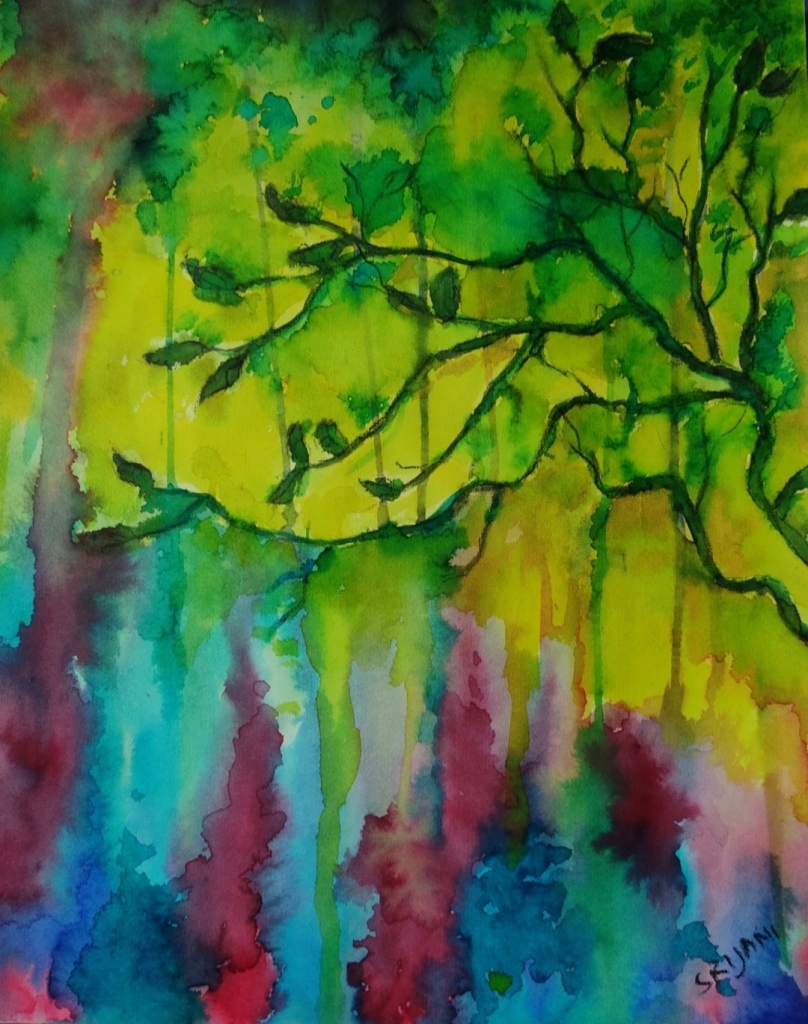
This vibrant edition would not have been possible without all the wonderful translators, writers, photographers and artists who trust us with their work. My heartfelt thanks to all of you, especially, Srijani Dutta for her beautiful painting, ‘Hope in Winter’, and Sohana for her amazing artwork. My heartfelt thanks to the team at Borderless Journal, to our loyal readers some of whom have evolved into fabulous contributors. Thank you.
Do write in telling us what you think of the journal. We look forward to feedback from all of you as we head for the completion of our third year this March.
She stood there with absolutely no movement. She couldn’t move. It felt like her whole body had paralysed. She hoped someone would see her standing like that, so that they could call her and she could wake up from what seemed like a dream. But no one did. She was all alone. It was utter chaos around her. She was standing beneath the streetlight opposite to the place where her house should have been. Now there were only bricks and debris. It was a wasteland, and not her home. She wanted to cry, because everyone had moved on.
But not her…
She could not.
The house stood at the left end of the street. It was different from the other twelve houses in the colony. It had been the oldest one. It was where her grandparents and later her parents had lived. She grew up in that house. When, one by one, her parents and grandparents surrendered to death, the memories and the house were the only things that remained. And when the currents of life made her move to other parts of the world, her heart still longed to return.
What makes every journey unique is having a place to come back to, a final destination: HOME.
Time passed by. The house stayed empty and other members of the family treated it as an asset to sell at the highest price.
After six years, she had finally come back home. In the glory of the setting sun, she saw, to her terror that the colony did not exist anymore. It was just thirteen demolished houses.
The workers had left. The street lights came to life. It was all ruins she could see. Nothing else was left. She stood there, below the street light, opposite the ruins of her home or what was supposed to be her home.
She thought, “It is the end, isn’t it…?”
Anjana Krishnan was born and brought up in Ernakulam, Kerala, and is currently pursuing her undergraduate degree in B.A.(Hons)English from Lady Shri Ram College for Women, Delhi.
PLEASE NOTE: ARTICLES CAN ONLY BE REPRODUCED IN OTHER SITES WITH DUE ACKNOWLEDGEMENT TO BORDERLESS JOURNAL.
It’s drizzling outside
I make a quick cup of steaming black coffee
Having the liberty to enjoy the warmth over the cold
The strong aroma is hanging around me
Just as I begin to take a sip from my coffee
My little nephew mewls from his cradle
I reluctantly run to prevent his deafening screams
I come back; my coffee mimics the weather
I gulp it down along with my unsettled resentments
The bitterness overrides the sweetness on two spoons of sugar
Neither did he have the patience nor did I
Anjali V Raj is a natural science researcher from Kerala, India. She has recently published a few of her works on online platforms like Down to Earth, Café Dissensus Everyday, Borderless Journal and Times of India Reader’s Blog. Most of her poems are published on her WordPress blog (Outburst of Thoughts).
.
PLEASE NOTE: ARTICLES CAN ONLY BE REPRODUCED IN OTHER SITES WITH DUE ACKNOWLEDGEMENT TO BORDERLESS JOURNAL
I went to Kerala for Christmas, travelling from Bangalore on the night bus. It wasn’t the first time I had taken a night bus in India. The first time was when I went to Madikeri, high in the hills of Coorg. That bus was one with berths that one can lie completely flat on. In fact, you have no choice but to lie flat because there are no seats. It should be more comfortable than sitting upright all night, and I am sure many passengers find it so, but the vibrations of the engine made my body vibrate in sympathy and every bend in the road made me slide around the berth uncontrollably and when the bus climbed a slope all the blood rushed to my head, which was oriented towards the rear of the vehicle. I decided never to use this restful method of travel again.
This is why I chose a more old-fashioned style of bus in order to journey to Kerala. I understand seats. Your head is always up and your feet always down, and if this happens not to be the case then it quickly becomes obvious that some disaster has happened. Head up, feet down, seems to me the natural order of the universe when travelling a great distance. It was a twelve-hour journey. In India that might not be so remarkable, but I come from a small country where twelve hours on a bus is sufficient time to drive right across the land and a fair way out to sea. “Captain, there seems to be a bus overtaking us!” “Have you been at the rum again, bosun?” The immensity of India is something I doubt I will ever get used to. It is big even in terms of bigness.
Not that the bus with seats was completely free of problems. The seats had a lever by the side of them, and if this lever was pulled, the seats reclined. I was expecting something of this nature, but I was completely taken by surprise at the extreme angle they adopted. They reclined to an excessive degree. All was fine for the first fifty kilometres or so, then the young lady in the seat in front of me decided it was bedtime. She reclined the seat so precipitously that it whacked on my knees, and I was given no choice but to stare directly at the top of her head which was almost touching my chin. The only solution was to recline my own seat. I did so and heard a yowl from behind. I had taken my turn to crush some other innocent knees. And so I lay in this absurd position, sandwiched between two sleepers as the hours slowly passed.
The bus was soon filled with snorers and all of them were out of time with each other. I am a jazz aficionado, I love music with complex rhythms, and I also love polyrhythms, but the point of such intricate music is that there is resolution at some point along the melody lines. The contrasting rhythms ought to come together at least sometimes, in order to provide structure, but the snoring was far too avant garde for that. It was atonal and without time signatures. A man in a forest of lumberjack gnomes probably feels the same way I did, as the sawing takes place and the trees topple with a crash. There was no crash for me during that night, thank goodness, but plenty of jolting as the bus ran over potholes in the highway or swerved around unseen obstacles or accelerated to overtake rival night buses also full of snoring passengers.
Well, all this is a nuisance but one that is necessary for travellers to endure. I reached my destination safely and that’s what really counts. It was morning in Kerala and the heat was already intense. Bangalore is at altitude and altitude is a restrainer of temperature. The landscape shimmered and the port city of Kochi pulsated under the sun. No matter! Time to find my hotel and rest for a while in order to catch up on all the sleep I had missed on the night bus, whose motto is ‘sleep like a baby’, which turned out to be accurate, for I slept not at all and felt like wailing for hours. I went to the correct address and found that the hotel had been closed for the past two years. Ah well!
We are always advised to expect the unexpected, and we do this well, but I don’t think we are ever prepared for the types of unexpectedness we encounter. I was ready for the bus to break down, or for me to lose my way in the narrow entangled city streets, or for crows to swoop and peck my head. I wasn’t ready for a hotel to not exist. I soon found another and it was a better establishment with two ceiling fans instead of one, a balcony, even a fridge that was on the verge of working. That fridge later held two bottles of beer and cooled them from hot to lukewarm, and I drank them one evening and regretted it because I have no stomach for beer. Because of that warm beery incident, I missed out on sampling the palm wine that Kerala is so famous for.
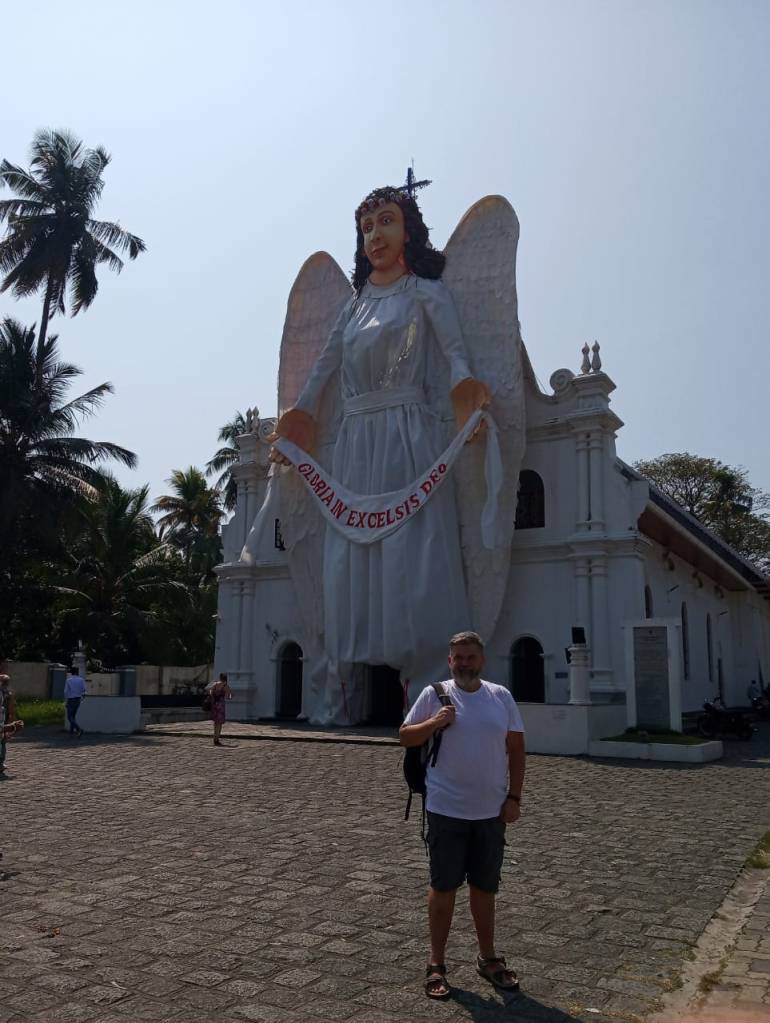
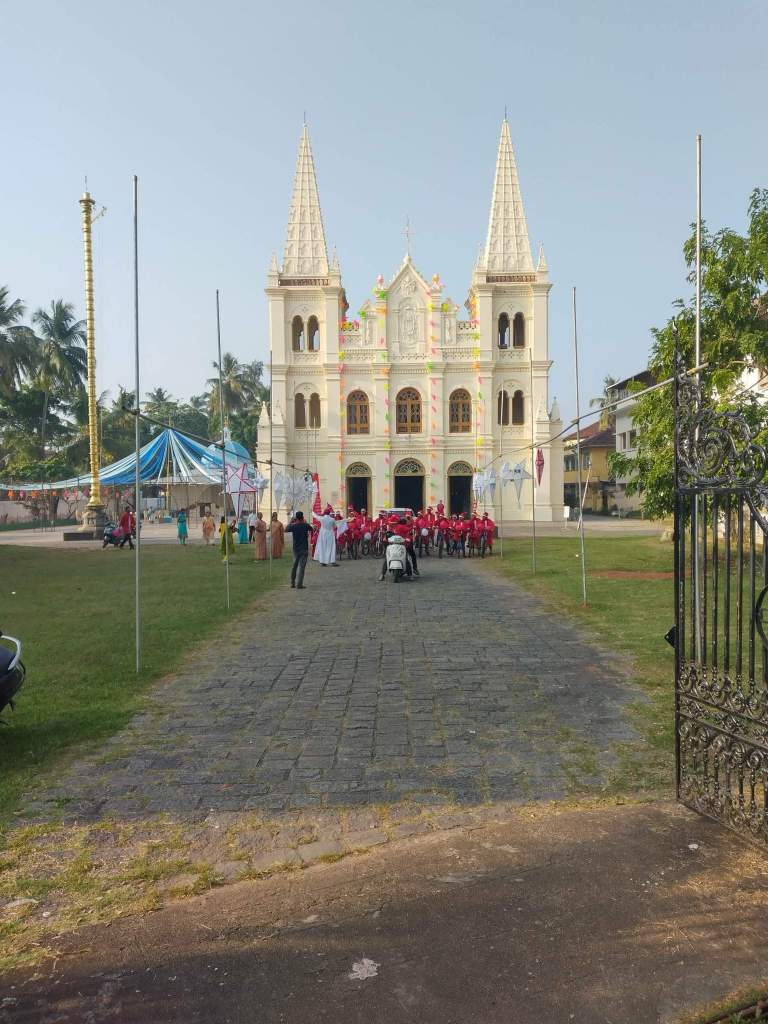
The old part of Kochi is picturesque and labyrinthine. I wandered where I would and ended up somewhere, but I’m still not sure where. Christmas lights were strung between the buildings, large glowing stars had been erected on the summits of walls, on roofs, or dangled from gables. One church I passed had a façade in the form of a gigantic angel. This was really quite surreal. We tend to think of angels as radiant beings with a human form, perfect men and women, but if you read the Bible you will soon see that most angels have an appearance that is not human at all. The highest rank of angels, the Ophanim, resemble sets of interlocking gold wheels with each wheel’s rim covered with eyes. They float through the air without needing wings. A church façade based on one of these angels would be an example of experimental architecture. But the church in the shape of a personable angel was endearing.
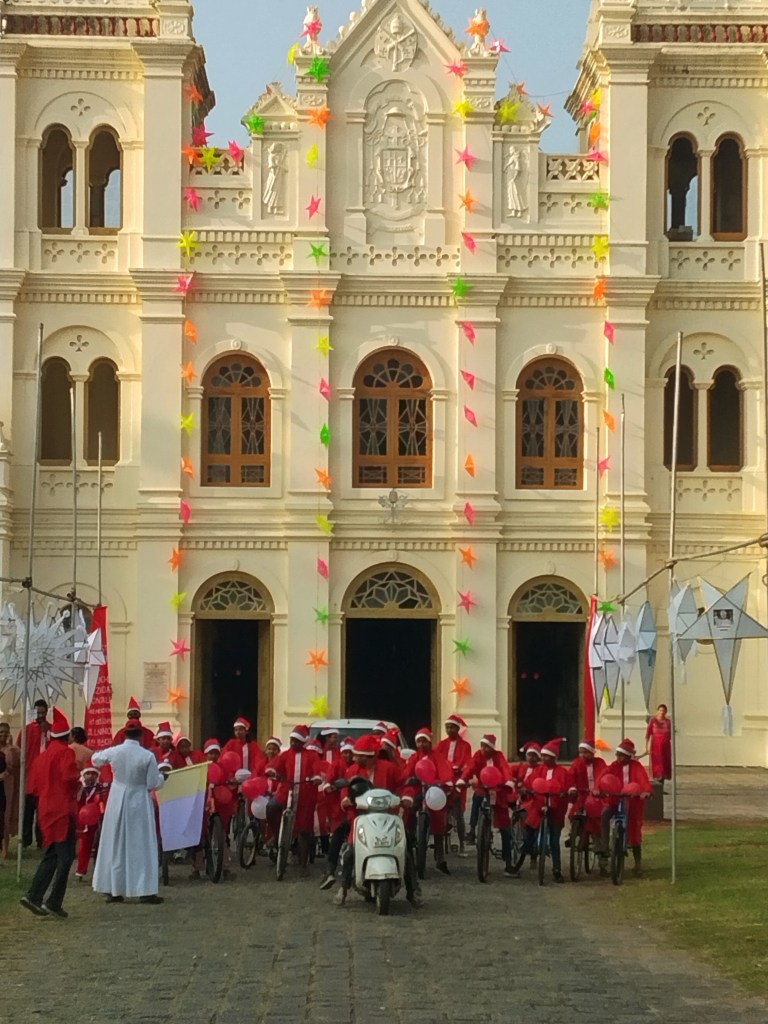
I walked past another church and saw a fleet of Santa Clauses mounted on bicycles about to set off. Is ‘Clauses’ the plural of ‘Claus’? I have no idea, for it has never occurred to me that there might be more than one of them. This fleet consisted of children in costume and I have no notion of where they were going or what they would do when they arrived. I strolled onwards and they rode past me, guided by two men on a scooter, one steering and the other holding in his arms a loudspeaker and facing backwards, like a Pied Piper who has entered the Electronic Age. One by the one, the Santa Clauses pedalled past, laughing, waving, generally enjoying themselves.
Photos provided by Rhys Hughes
This was Christmas at its most gentle, innocent and benevolent, a far cry from the Christmas ritual I witnessed exactly thirty years ago in Prague, where the tradition involves a saint, an angel and a devil chained together who stalk pedestrians in order to give them lumps of coal that represent the sins of the year. Prague was freezing, Kochi was broiling, and I know which I prefer, but the beer in Prague is certainly better. I reached the waterfront and sat under a tree and wondered if the mass migration of Santa Clauses I had seen was truly a fleet. Maybe it was an armada instead, or a division? Is there a collective noun for Father Christmas? A Splurge of Santas?
Kochi is riddled with waterways, and it feels like an excellent location for a port, which it is. No wonder it was established at that spot. I felt a small connection to the ancient mariners who had sailed here from the West long ago, from Europe and around the tip of Africa and across the Indian Ocean. One day I will travel from this very place to the islands of Lakshadweep. This has been a dream of mine for a long time, since I was eight or nine years old. I had entered a competition run by the Twinings tea company and I won. A map of the Indian Ocean was given with the names of islands removed and the entrants had to fill in those missing names. I consulted an atlas to do this, as I imagine every other entrant did, but I had an unknown advantage.
My atlas was very old, a green battered thing, and the Lakshadweep islands were marked by that very name. In other atlases the island chain was apparently named as the Laccadives. The administrators were looking for Lakshadweep and that is how I won a year’s supply of tea. It came regularly via the postman in an endless series of little tubs, Earl Grey, Lapsang Souchong, Peach Oolong. But in the end, this endless series finally ended, and my tea luck turned out only to feel inexhaustible rather than to be so. I have never won a competition since or even come close. But I have had a fondness for tea and Lakshadweep ever since, so it is imperative that I sail to those islands one day.
During my time in Kochi, I travelled on a boat only once, from Fort Kochi to Vypin Island. A battered rusty ferry crammed with foot passengers, cars and motorcycles. Cost of ticket? The equivalent of three British pennies. This is far cheaper than the cost of any ferry I have ever been on, with the exception of the occasional free ferries that I have encountered around the world, such as the one that takes passengers across the Suez Canal from one side of Port Said to the other, or the ferry that travels back and forth between Mombasa, which is on an island, and the African mainland. Sea travel is something special and I have done too little of it in my life. If I could have sailed back to Bangalore, I would have. As it happens, I went back on another night bus, but this time the person in the seat in front of me only reclined their seat to a reasonable angle. My knees were not crushed, and in return I did not crush the knees of the person behind me. I like and admire reasonable angles. They make geometry sweet.
.
Rhys Hughes has lived in many countries. He graduated as an engineer but currently works as a tutor of mathematics. Since his first book was published in 1995 he has had fifty other books published and his work has been translated into ten languages.
.
PLEASE NOTE: ARTICLES CAN ONLY BE REPRODUCED IN OTHER SITES WITH DUE ACKNOWLEDGEMENT TO BORDERLESS JOURNAL.
GARLANDED GUEST

I wish to invite Aphrodite over for chai
Katy Perry will do too
The blue-eyed goddess could arrive
On a dark horse and I shall stand
At the entrance of my brown house
Too unconventional for a twenty first century conversation but perhaps I could greet her
With a tantalising inquiry
“How are enemies made?”
What fluxes out of your fingertips
Webbing and falling over abstinence
Like a silky cage and for heaven’s sake
Enlighten me on
“How do I make them stay?”

I am blind to anachronism so I
Couldn’t tell if it’s an Aphrodite or Katy Perry
Brandishing their wisdom
I would still stop them mid-sentence
To only return with something brewing
In an arabesque teacup

You see, it might be sweltering here
And revenge might be cold
But chai is best served hot
Sharanya B lives in Trivandrum, Kerala and studies English literature. Her poems have been published in several magazines/sites such as Madras Courier, Literary Vibes, Annual anthology by Poetry Society of India and many more.
PLEASE NOTE: ARTICLES CAN ONLY BE REPRODUCED IN OTHER SITES WITH DUE ACKNOWLEDGEMENT TO BORDERLESS JOURNAL
Story by P. F. Mathews, translated from Malayalam by Ram Anantharaman
An appooppan thaadi[1] slowly swaying and dancing along in the wind, drifting gently up and down, entered the bedroom through the window and landed on the waterbed, and is lying flat and squeezed over there, as if it were trying to tell ‘I’m overfatigued’. Actually, it should not be called appooppan thaadi, it should be ammoomma thaadi[2] instead. The white chattaandmundu[3] worn in the ancient Syrian Christian style with fanfold pleats at the back and madisheela[4] at the front remained as is, without even getting wrinkled a bit. As the mekka mothiram[5] had been removed, the large holes in the ears have begun to close. Esther combed and tied the silver hair that lay spread over the pure white pillow. Now she has to bathe by softly wiping the entire body with scented cloth. When the younger son from Canada comes on video call at half past eleven, the ninety-two-year-old grandma has to appear as pretty as Our Lady of Lourdes. Neighbours and the parish people used to call her ‘pretty grandma’ always. Everything around grandma was beautiful and fragrant. Those days, at the end of qurbana, as she rose up from her seat wearing chatta and mundu and a scarf pinned with a butterfly-like brooch and walked towards altar to receive the sacramental bread, the entire church used to swoon over the fragrance of Eau de Cologne. Grandma retained that sense of beauty in every aspect even after getting bed ridden, until her speech was lost.
Grandma used to always celebrate her birthdays by preparing and serving payasam[6]. However, her ninety second birthday passed by without having even a speck of sugar. It was an order from Canada. That innocent son from Canada was afraid that the thought of how old she has become might blow away the ammoomma thaadi to death. Martha Mariam, the grandma, has been bedridden for six years; her tongue stopped functioning six months ago. Even her memory might have failed. The rest of her children and grandchildren who visited once in a while to please her younger son, after entering her room and closing the door, would recollect her lapses and flaws of olden times and deride her. During such occasions, Esther who had been employed to take care of grandma, would not have eyes, ears and tongue. Nevertheless, while listening to the cruel words those wicked gang spoke, she would tell herself: My dear Holy Mother, please open grandma’s ears just for a while so that she could hear all the filth these people are saying.
“What for, my dear?” Mother would ask.
“So that when ammoomma returns to life, she could take revenge on each and every one of them…”
“Oh… why my dear… my son wouldn’t like that…”
“Oh… so all these are games you mother and your son Jesus purposely play, is it? From now on I will never go to the novena church, nor would I light candles…” When Esther expresses her displeasure, Holy mother would smile mischievously. Esther would be reading it from grandma’s face.
When no relatives are there, there was no problem. It will be only grandma and Esther in the room. Even though it is a little village, expensive imported flowers which are meant to adorn huge apartments and offices in the nearby town would arrive every day. As soon as they reach, the old flowers with wilted petals would be removed from the vase and fresh new flowers as soft as babies’ cheeks would be placed there. When the son comes on video call at half past eleven, he has to see them first. Once, when he saw wilted petals around the vase on the table and the floor, he simply disconnected the call! That’s how he showed his anger. One day when Esther woke up in the morning and came in, she saw a withered petal on the white sheet covering grandma’s waterbed, lying near her feet. As she took it wondering how the petal from the flower vase kept on the table near grandma’s head came over here, a numbness spread through her fingers. It was not a petal from the flowers. It was a finger that had dropped off from grandma’s foot! It was her first experience in all these years of care giving. First, she thought of burying it somewhere in the thicket before any relatives or neighbours come. But when she remembered the video call at half past eleven, she realised it would be a big mistake. Then she decided to inform the old doctor from the church hospital who visits and does special check-ups.
“No need to ask or tell anyone… just bury it somewhere in the compound.” Doctor’s reply reminded her of some mischievous children talking. The remaining fingers also would wither away like this. Do the same every time. When she said that Doctor himself should take up the responsibility to explain it to the Canada son, he agreed with a gentle snicker. But Esther felt sad when she thought that she would have to watch the remaining fingers falling off one after the other. Poor grandma… she can’t imagine even one moment that is not beautiful… how will she ever bear this?
She remembered the grandma of eight or nine months ago.
“Esther… even if you don’t care for me, you should look after the man on the other room… OK?”
“Appaappan is fine ammachi… why are you getting worried?”
“Who said he is fine…? He has a lot of problems… as soon as Jerrymon’s attention shifts a little he goes out of the house itself… isn’t that a bigger problem? Jerrymon has no free time at all after his kitchen work…”
Grandma would get very excited while talking about appaappan.
Seven or eight years ago, one of grandma’s front row teeth fell. She was very sad. The tooth had no damage at all. Afterwards she always kept her lips tightly sealed because she was hesitant to show her smile with a hole. She felt that her smile-less face is as good as being dead.
“Nowadays it is possible to fix a good tooth easily, that is why I told him that I want a new tooth… do you know what appaappan said then…?”
After remaining silent for a while, looking at Esther and changing her voice to that of the Fathers in the church, grandma said: “it’s already four o’clock Maria… it will become dark very soon…”
Esther was surprised to hear that: “Appaappan should have been a poet, isn’t it ammaamma?”
“Oh… nowadays if someone is not watching, the poet is busy climbing on top of the building and trees like mischievous kids…”
As she was certain that Esther would not say anything, a sentence descended from grandma’s tongue as if she had thought about it a lot and byhearted: “Once memories are lost, it is better to die… isn’t it dear?”
Don’t say such things… that was how she should have responded… but it was not possible to lie to grandma. Grandma wouldn’t like it at all. That day grandma was silent for a long time. Then she said: “In other countries, there are laws to kill someone who is suffering… isn’t it so?”
Esther didn’t say anything, and she cleverly walked out of the room. Grandma also did not talk for the next four or five days. She wondered what grandma would be thinking and felt sad for the next six days. Would grandma also have started to forget things? But Esther was wrong. On the seventh day, after her eldest daughter’s mischievous daughter who was studying in the twelfth grade came and went. Grandma gave a paper to Esther with a smile and asked her to read it. Grandma watched Esther reading through it silently. It was an agreement which said that when she, named Martha Mariam, got to a stage of extreme pain and suffering but not dying, someone could end her life on her behalf. Her thumb impression along with her signature verified the document.
“What have you done ammoomma… wouldn’t that girl go around singing this to everyone?”
“Not at all. I have promised to give her my gold ring with emerald embedded in it… Even though she is impish, she is greedy for gold, isn’t it so?”
“Whatever it is, this is not right.” Esther was actually a bit sad and she didn’t try to hide her tears.
“Edi penne[7]… even if I die your income would not be stopped… I would make all arrangements for that… and you will get additional remuneration for finishing me off…”
Esther was terribly angry, and all the bad words she had learnt from childhood days came rushing to her tongue. Moving aside all those bad words, Esther said: “Look old lady, I don’t want any damn thing from you. Esther knows how to work hard and earn well. I cannot be your executioner. You can tell your eldest daughter and granddaughter… I am leaving now.”
She uttered those words in a single breath. Having said, she wanted to adhere to her threat. Esther sent a four-line message to the children, packed her belongings and went home. On the fourth day, three of the children came in a car to her home. The Canadian kept on calling. After Esther’s leaving, grandma hadn’t have had anything to eat or drink, she had even stopped talking. Her eldest granddaughter who had been the cause of everything voluntarily confessed her mistake. Thus, after a brief interval, Esther once again came back to grandma. On seeing her, even though the pretty grandma who was lying without much fragrance smiled once, Esther felt that the smile didn’t have soul in it. It was from that day grandma’s tongue slowly started to stop functioning. She would always be lying in a half-asleep state without responding to whatever Esther would say. She wasn’t certain whether grandma was pretending. As days passed, it became a habit for grandma. Her days and nights became devoid of sounds. Earlier, she used to listen to old songs with a smile, but now, even when playing one of her favourite songs she would start frowning. Gradually, her hands also stopped moving, like her tongue. It became impossible to even know whether she had any pain. It was then one day appaappan slipped down from the steps on the veranda and passed away. The fall wasn’t that serious. It was as if for everything else, there had to be a reason for saying goodbye also, that’s all.
“Amma should never ever know about appan passing away…” voice message from Canada arrived to the siblings and Esther.
How can that be possible… they lived together for almost seventy years… how can we not let her even take one last look… before such thoughts could even reach their tongues, all of them wiped it away from the mind itself. Esther didn’t step out of grandma’s room until the funeral was over in the evening. They carefully kept all the wailings of the dead house outside the shut door. However, the scent of frankincense kept spreading across all rooms. In the evening, before the prayers and songs of the priests from the church who came for the funeral function went well out of their control, the elder daughter had sealed her mother’s ears with cotton rolls so that she wouldn’t be able to hear anything. After seeing appaappan off, when the children gathered in the family room and sat around sipping black coffee and chatting, there was a power outage. Apart from that, everything went well.
When Esther came into grandma’s room with a lighted candle to keep the darkness away, she saw something strange that surprised her. Tears had been flowing like streams from both the eyes of grandma who was until then lying like a dead piece of wood. Seeing that Esther became sad beyond words, and she felt a hot burning sensation in-between her neck and chest.
Realising that there was no other way to escape that feeling, she also sat near grandma and cried for some time. Esther considered it as her major lapse that she was unable to recognise grandma being aware of everything even though she was lying like dead body with all her organs shut. They didn’t sleep that night. For the next two weeks too, Esther wouldn’t sleep. As she closed her eyes, pretty grandma would appear in front of her and accusingly point finger at her. She would wake up from the half-sleep with a shudder and gently massage grandma’s twig-like legs with wilting fingers. Then she would sit like that until dawn breaks. She felt as though she did not show mercy to grandma, and moreover what she did was a severe injustice towards her.
Two months after grandpa’s passing away, Esther video-called Canada and showed grandma’s wilting fingers, wax filled ears, abnormally open nose and throbbing veins on the forehead and said: “Looks like there is not much time left now… it would be better if you start today itself.”
The Canadian doesn’t question Esther who knows everything about grandma. He started the next day itself. The other children and grandchildren had already reached by the time he arrived. Without any dramatic incidents necessitating special descriptions, just like a ripened leaf slowly detaches itself in a gentle breeze, grandma passed away. Within hours, she was laid to rest in the same grave where grandpa was buried. There was no need to keep her body in an ice box. Soon after returning from the cemetery, when Esther collected her belongings and started to leave, though the residents magnanimously tried to stop her, she didn’t yield to their requests. The mischievous doctor from the church hospital also took her side. The doctor told them that he would drop her at the railway station in his car.
Even though the doctor was aged above sixty years, he was funny. On the way he stopped the car by the river side and told that he wanted to have a smoke.
Seeing him lighting a cigarette and exhaling the smoke Esther told: “Doctor, you are smoking like kids who have just been initiated into smoking.”
“Then show me how adults smoke…” said Doctor and offered her a cigarette. Looking at her lighting it and exhaling the smoke in a beautiful manner, Doctor laughed. After finishing the cigarette, Doctor asked her where she had kept grandma’s letter. She took it out from her bag and handed it over to him. Doctor read it one more time and lit it with a match. From that paper containing grandma’s signature and fingerprint, smoke as delicate as her soul emerged and drifted in the wind, and began to float up like an appooppan thaadi.
“Why did you burn it? I had kept it for my remembrance.”
“No need… it is better to abandon some remembrances at the same place where they originate…” Doctor threw the burnt sheet of paper into the river. It soaked and dissolved in the water and disappeared.
P. F. Mathews is an Indian author who writes in the Malayalam language. He is a recipient of multiple literary awards including the Kerala Sahitya Akademi Award and a National Film Award for Best Screenplay.
Ram Anantharaman is an engineer by profession. He has done translations from English to Malayalam and Malayalam to English.
Zhi-Khro mandala, a part of the Bardo Thodol’s collection, a text known in the West as The Tibetan Book of the Dead, which comprises part of a group of bardo teachings which originated with guru Padmasambhava in the 8th Century. Courtesy: Creative Commons
My friend, Dr Ramesh Kumaran first shared the shocking news with me on WhatsApp. Along with a recent photo, the caption mentioned ‘Mourning the sudden and untimely of our dear Joseph Francis (6th batch). May his soul rest in peace. 6th October 2022.’ I felt sick in the pit of my stomach. This was the first mortality among our MBBS batch mates. One of our friends died when he was studying for MBBS, but he had left the course and was suffering from a prolonged illness. Some of our batch mates had close encounters with death during the ongoing COVID-19 pandemic.
I was reminded of my own mortality and the fact that we often forget that our time on earth is limited. None of us know when exactly or how we will die. This I believe is a good thing. Movies have explored the sad state of people who knew or supposed they knew when and how they would die. Humans stride through life assuming their immortality. We kill fellow humans indiscriminately. We learn to hate each other. We pursue wealth and power. When we leave our material existence on Earth, we can take none of the accumulated wealth and power with us. The ancient Egyptians believed otherwise and buried their Pharaohs with all they would need in the afterlife. Ordinary people had no such privileges. We do not know much about the afterlife. Here science ends and we enter the realm of religion.
I facilitated a module on Death and Dying for medical and other students and our ignorance about death is profound. Modern medicine has the motto of preserving life regardless of its quality. We have not been trained to let go and make a person’s remaining time on Earth worthwhile. This is slowly changing but change is slow. We do not live life assuming that any moment can be our last on Earth. The Tibetan Book of the Dead (Bardo Thodol) tells us to live each moment in a spiritually fulfilling manner and mentions that we all have the potential to break free from the cycle of reincarnation and become spiritually enlightened beings.
I first met Joseph when I joined the Men’s hostel and the undergraduate medical (MBBS) course at Thrissur, Kerala, India. Our seniors were prowling around our floor abusing us and one of my friends was crying as he had just been forced to take off his moustache. Ragging still exists in India and students who were abused by their seniors wait for the new intake to take revenge. You are not able to take revenge on the powerful, so you take out your anger on the powerless. We see this all around in the modern world.
Joseph stayed in a room near mine, and we became friends though not extremely close. One of the things I still remember about him is that he used to write with a fountain pen and used black ink. Even in those days when writing was still common most of us used ballpoint pens. He had impeccable handwriting. Joseph was always a perfect gentleman and willing to help others. I believe we did a few of our internship postings together. We collaborated on skits and other presentations during the college day celebrations. I still remember our college trip to Trivandrum Medical College for the Intermedicos festival and we stayed and slept in the badminton court inside the Men’s hostel. Life was simpler in those days. We were beginning to see the end of the MBBS doctor and specialisation, and super specialisation was becoming common. I feel this is a sad development and an MBBS doctor is competent to treat most illnesses. In fact, evidence shows that most illnesses can be handled by a trained paramedic. In most European countries, care is mostly delivered by general physicians while in the United States care is mostly provided by specialists. The amount spent and the health status of these countries/regions tell their own story.
During those days, failure in MBBS examinations was common. Anatomy at the end of the first MBBS and Medicine at the end of the Final MBBS had the maximum casualties. Grading was arbitrary and there were no clear rubrics to guide the scoring. I was lucky to have squeaked through the anatomy dissection and the medicine courses. Joseph was unlucky and mentioned this often as due to his failures, he could not appear for the entrance exam of PGIMER[1], Chandigarh, one of the top postgraduate institutes in the country. One could not appear for the entrance exams failing the MBBS. A lot of effort has gone globally into changing the assessment system in MBBS and making it fairer and more objective.
Joseph used to join us for an occasional game of basketball. I next met him at Ollur, near Thrissur, when I was doing my post-graduation. St Vincent de Paul hospital was a multi-specialty hospital. I had come down to Kerala for a few days and stayed with Job and Joseph, both medical officers with who I shared a large apartment.
Over the years I lost touch with Joseph, and I next interacted with him in 2018 when I joined a WhatsApp group of my classmates. Joseph was very active in the group and was working as an anaesthesiologist in the United Kingdom. Many of my batchmates were working in National Health Service (NHS) and they often would mention how the NHS is being steadily starved of funds. The COVID pandemic hit the medical community hard. Doctors in practice seem to be especially vulnerable. We discussed this and postulated that it could be because they are exposed to repeated doses of the virus in high concentrations from multiple patients. Many doctors had lost their lives; many others I know were in the Intensive Care Unit for prolonged periods of time. Two of my classmates in the UK had serious illnesses requiring hospitalisation and prolonged intensive care.
I next interacted with Joseph when I was unable to make a bank transfer to the UK to pay for membership fees of a professional organisation. The transfer was not going through and eventually, I asked Joseph if he could do the transfer from his account in the UK, and I would deposit the money in his account in India. He readily agreed. Joseph was always very helpful. During the last two years, I have lost several friends. Two academic collaborators, one in Malaysia and the other in Yemen passed away. Colleagues I knew in Nepal died due to COVID complications.
Death can be a celebration of a person’s life. An Irish wake is one last party to honour the deceased. Unknown diseases plagued the Irish countryside causing a person to appear dead. Hence a person would be waked in the deceased’s home for at least one night. I had the exact fear while certifying death. What if the person then woke up and disputed my certification? I was very careful and meticulous while writing out a death certificate.
These deaths have underscored my own mortality. As someone once said, death and taxes are inevitable. Accepting one’s own mortality and coming to terms with our eventual demise makes you aware of the folly of chasing power and glory and can contribute toward a gentler, more decent world. Climate change is a testament to human greed and folly. We are still uncertain how liveable Earth will be during the next hundred years. As Mahatma Gandhi said, we can satisfy human needs, but we cannot satisfy human greed!
.
[1] Postgraduate Institute of Medical Education and Research
.
Dr. P Ravi Shankar is a faculty member at the IMU Centre for Education (ICE), International Medical University, Kuala Lumpur, Malaysia. He enjoys traveling and is a creative writer and photographer.
.
PLEASE NOTE: ARTICLES CAN ONLY BE REPRODUCED IN OTHER SITES WITH DUE ACKNOWLEDGEMENT TO BORDERLESS JOURNAL







 Borderless