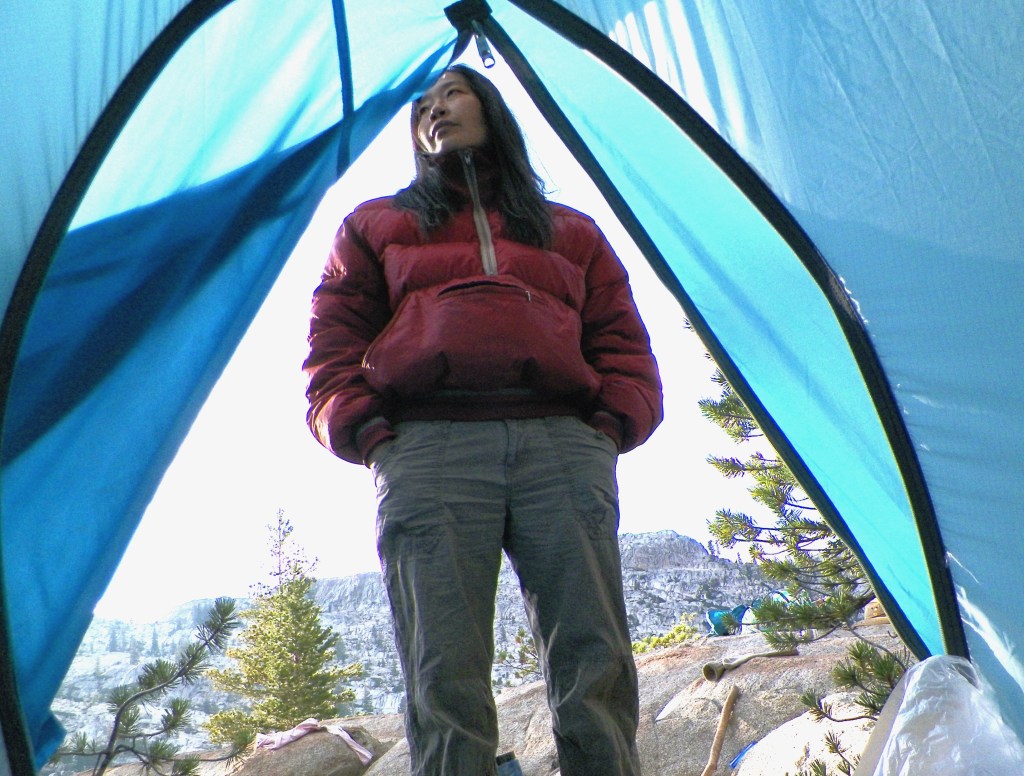
A difficult hiking trail up into the mountains combined with bouts of inner doubt makes for an interesting big day out, as Keith Lyons discovers on an alpine route in New Zealand.
Photo Courtesy: Keith Lyons
The coroner’s reports make sobering reading. Two people had died on the same track within a couple of years – both deaths partly attributed to insufficient signage warning hikers heading down to cross the river at that point rather than continue to where cliffs, waterfalls and slippery rocks could be fatal. Both fatalities were preventable, the reports concluded. The one day, up and down rocky alpine route is recommended to only be attempted by experienced hikers, and in good weather, but when my friend and I set off recently on the Gertrude Saddle hike, in New Zealand’s Fiordland, it seemed ‘experienced’ was not a word I would describe the fellow walkers.
Inspired by photos on Instagram, guidebook recommendations in English, French and German, blogposts with photos, and travellers’ recommendations, the hike is popular and easily accessible. It is only 7km return, but 7km involving some risk and quite a lot of altitude gain and fall – 600m climb to be precise. Already nearly 30 cars, vans and motorhomes were parked in the carpark, close to the divide on the Te Anau-Milford Sound Scenic Highway. If you can’t find the marker signs, just look for the people hiking, one website had quipped.
Peering into the distance, we could make out hikers in waterproof jackets and wind blocking fabrics. In the carpark, I reiterated my expectation that if the trail proved slippery, crumbling or covered in snow or ice, then I wouldn’t want to continue. The start of the trail was picture-perfect, and the weather was fine – something of a rarity for a region that gets 200 days of rainfall in an average year. The first part of the 6-hour hike is along the flats of a valley with a meandering river, giving a chance to admire the alpine grasses and flowers, and look up to the amphitheatre of rugged mountains capped in the previous night’s snow.
Photo Courtesy: Keith Lyons
It was early autumn, but colder than normal, and we wore extra layers of clothing. I counted five layers, plus my gloves. It felt good to be on the move, to be enjoying the day, and the prospect of crowning our week’s trip with a route that neither of us had attempted before. From a previous trip to Fiordland I’d spied the valley, with a hundred waterfalls flowing thanks to the torrential rain, and having heard from friends that this was a great day out, remembered to add it to the possible hike list, when the weather was more favourable.
The first people we encountered were coming down. Maybe they’d started early and were the first back, I thought. As the trio approached, I inquired onto the track conditions. They hadn’t been to the saddle, instead turning around when the going got tough. There were rocks falling down from climbers above, and they didn’t feel safe. It was not the news we were hoping for, but at least I thought this gave us an opt-out.
Photo Courtesy: Keith Lyons
The trail veered left, out of the valley, and up. I felt my breathing become more laboured, and my calves straining. My companion had earlier talked about meeting Edmund Hillary, the first to climb Mt Everest, and being impressed with the size of his strong calves. When I met the New Zealand climber I didn’t get a chance to admire his gastrocnemius and soleus muscles, but when I shook his hand I realised that his hands were also strong, large and powerful.
We reached the river crossing below a waterfall, which was easily crossed with a hop, skip and jump, and then looked again at the route and markers, to ensure imprinted on our memory was the turn off for the river crossing, against the natural inclination to go down, down to where bluffs had claimed weary hikers too keen to get down to the valley below.
Photo Courtesy: Keith Lyons
There were warning signs along the way, as if to reinforce the gravity of the situation. The track from the river crossing on is steep, and not suited to those with limited experience or a dislike for heights, the signs warn. “The track goes up steep rock slabs and is treacherous when wet or frosty — there are steel cables to assist you.” A young woman passed us with just a purse and mobile phone, wearing a spaghetti top. We saw another 20-something walking uphill texting with both thumbs – a feat I was curious about, given that I had no phone reception for my network. Millennials. Seemingly unprepared should the weather turn or they need extra energy for the hike.
We stopped beside Black Lake, and saw a smaller blue lake below, perched above the river crossing waterfall. Other hikers stopped to have snacks or lunch, but we had already tucked into our sandwiches by the river, and I was anxious to keep moving in case the snows ahead melted into slush as the sun finally reached the boulder field. The clamber up with steel cables wasn’t too bad, it was more a case of avoiding damp areas where boots and shoes would slide and attack any confidence.
Photo Courtesy: Keith Lyons
The ridge by the Black Lake has proved to be a false summit, and there was still more climbing to do, on zig-zag tracks which displaced rocks and pebbles with every footfall, along uneven trails covered in pockets of snow, and over granite rocks worn smooth by the elements. Those rocks, where dry, proved to be the most satisfying to walk on, once it was established that the tread of shoes was sufficient to grip the surface.
Looking up, we could make out the silhouette of climbers who had made it to the ridge, which we presumed was the actual saddle. But it was hard to calculate just how far it was up. As more hikers started to come down, we asked, but assessments of the distance and time varied. When someone said ‘probably half an hour’ I realised that rather than turn back, we were probably going to make it to the top for the literally ‘breathtaking’ views. I was feeling good, and my companion was enjoying the rock scrambling.
Photo Courtesy: Keith Lyons
Picking our way among the rocks and boulder, we kept going, the prospect of views, a rest and a second lunch ahead. Eventually the steepness gave way to a more gentle terrain, and a few more steps and we were looking out to different mountains and valleys. We joined the other walkers admiring the view into the Milford Sound and savouring packed lunches. There were folk from the USA, France, Germany, India, China and Belgium, some of them on working visas in New Zealand, or enjoying ‘van life’. People asked others to take their photos, some standing on large boulders very close to drop offs of 700m. We looked around for the spaghetti-top woman. Maybe she had made it, or turned back.
At the top, some 1400m high, ice sat on top of small hollows, with snow melting to make the tracks muddy. My friend found a shelter build with rocks and had his nap, while I climbed a little higher for views both sides of the saddle. The saddle got its name some 140 years ago when the surveyor for the road hiked up with his wife Gertrude Holmes. She was likely wearing a dress, but most probably not a spaghetti top.
As Edmund Hillary once said, to climb a mountain successfully you not only have to hike up it, you have to hike back down too – and survive to tell the tale. With this message taken to heart, we carefully descended to the valley floor, and eventually back to the carpark.
.
Keith Lyons (keithlyons.net) is an award-winning writer and creative writing mentor originally from New Zealand who has spent a quarter of his existence living and working in Asia including southwest China, Myanmar and Bali. His Venn diagram of happiness features the aroma of freshly-roasted coffee, the negative ions of the natural world including moving water, and connecting with others in meaningful ways. A Contributing Editor on Borderless journal’sEditorial Board, his work has appeared in Borderless since its early days, and his writing featured in the anthology Monalisa No Longer Smiles.
.
PLEASE NOTE: ARTICLES CAN ONLY BE REPRODUCED IN OTHER SITES WITH DUE ACKNOWLEDGEMENT TO BORDERLESS JOURNAL.
The Kuala Terengganu Skyline. Photo courtesy: Ravi Shankar
The lighting was subtle but magnificent. The transparent minarets glowed red, green, pink, and blue in turn. We were at the Masjid Kristal on the island of Wan Man at Kuala Terengganu in the state of the same name in northern Malaysia.
Majid Kristal
The mosque is among the most photographed monuments in the Islamic Heritage Park, and we could easily guess why. This is the first intelligent mosque in the country with an IT infrastructure and wi-fi connection. We were glad we came. The reflection of the mosque lights on water was enchanting. Getting around KT — as Kuala Terengganu is lovingly called by the locals — could sometimes be tricky without your own vehicle. Ride hailing services may not work optimally in the peak hours of the evening. We were informed by one of the cab drivers that Maxim is the most popular e-hailing app in the city.
The population in KT loves to eat out and in the evenings the restaurants are usually crowded. We were staying at the Intan Beach Resort at Pantai Batu Burok and the eating places by the beach were always crowded. The beach is popular with locals with several attractions and rides during the evenings. There is a three-kilometre walking path by the side of the beach. As we stayed right by the beach, we could enjoy early morning strolls on the soft sand.
Panti Batu Burok: Photo Courtesy: Ravi Shankar
The Kuala Terengganu state museum was huge and is located on over 23 acres of land. The museum was officially opened in 1996 and was designed by a well-known Malaysian architect, YM Raja Dato’ Kamarul Bahrin Shah, who also happens to be related to the royal family of Terengganu. The building is designed in traditionally Malay style and the outer façade was left undecorated. There are nine different galleries, and these include the Royal gallery, the historical gallery, the textiles gallery, the Islamic gallery, the handicrafts, the natural resources, the shipping and trading and the marine resources galleries.
Tha Batu Bersurat. Photo Courtesy: Ravi Shankar
The ‘Batu Bersurat’ (lettered stone) is the museum centrepiece and of great significance to the state. The stone is estimated to be 700 years old and mentions the position of Islam and the application of Islamic laws in the state. The stone is written in the Jawi script using Arabic characters. Jawi script is still used in Terengganu though in many areas Malay is written mostly in the Roman script. In the museum grounds, there is a good collection of different old cars and other vehicles used by the King and Chief Ministers of the state.
The Islamic Heritage Park is a major attraction located on the island of Wan Man. The park has small scale replicas of famous global Islamic monuments. Among the monuments represented are the mosques at Medina and Mecca in Saudi Arabia, Dome of the rock in Jerusalem, the Taj Mahal in India, and a mosque in Aleppo, Syria. The national mosque of Malaysia and mosques in Singapore, Indonesia, Pakistan, Iran, China, Tatarstan, Uzbekistan, and Iraq are also on display. Replicas of these famous monuments were displayed in the vast gardens of the monument. I liked this concept, and the monuments were well maintained except one or two that may require more attention.
The Floating Mosque. Courtesy: Creative CommonsDetails of the Floating Mosque. Courtesy: Ravi Shankar
The sun was hot, and I had to drink copious amounts of water. In the evening, my friend, Binaya, and I went to the floating mosque situated in Kuala Ibai Lagoon near the estuary of Kuala Ibai River, 4 km from Kuala Terengganu Town. The mosque combines modern and Moorish architecture, and is a white structure situated in five acres of land. There is also a floating mosque in Penang.
The next morning, we went to the Science and Creativity Centre. The centre is housed in a huge, modern building. There are multiple galleries to explore. I was fascinated by the stainless-steel exhibit showing the structure of DNA, the blueprint of life. The encounter with the dinosaurs was the highlight of the trip. The dinosaurs were colour coded in red (dangerous), yellow (exercise caution) and green (safe). Tyrannosaurus Rex was the highlight. Raptors, allosaurus and other dinos filled the hall with their cries and screams. The Stegosaurus had scales on the back. When I was young, I was a big fan of Phantom comics created by Lee Falk and Phantom had a stegosaurus as a pet. The inflatable dome on the top floor had a delightful cosmic show and you can see the universe projected above your head. The museum had plenty of things to see and do and is a big hit with children.
Photo Courtesy: Ravi Shankar
The Masjid Sultan Ismail Chendering has delicate artwork and is built entirely in white. The simple design and the beautiful artwork had me mesmerised. The mosque has a long history. The small Lebai Zainal Mosque which could accomodate150 people was first built near the current location of the mosque before being replaced by the Raja Chendering Mosque and then replaced again by a new mosque which is the Sultan Ismail Mosque.
Photo Courtesy: Ravi Shankar
Soon it was time for lunch. There are plenty of food options near our hotel. I enjoyed nasi kerabu, a Malaysian rice dish, in which blue-coloured rice is eaten with dried fish or fried chicken, crackers, pickles and other salads. The blue colour of the rice comes from the petals of Clitoria ternatea flowers, which are used as a natural food colouring.
In the evening, we went to see the Abidin Mosque which is Terengganu’s old state royal mosque built by Sultan Zainal Abidin II between 1793 and 1808. The Royal mausoleum is located next to the mosque. Istana Maziah, the official palace of the Sultan of Terengganu is located close to the mosque at the foot of the mountain, Bukit Puteri. The palace is the official venue for important functions such as royal birthdays, weddings, conferment of titles and receptions for local and foreign dignitaries. We wanted to climb Bukit Puteri, but the place was under renovation and closed.
We continued along the waterfront to the Shah Bandar jetty. A cool breeze was blowing, and many people were strolling along the promenade. We were moving toward the Kuala Terengganu drawbridge constructed in 2019 inspired by the London drawbridge. We waited for the sky to darken so that we could see the lights on the bridge.
Photo Courtesy: Ravi Shankar
Buses from KL take the highway to Kuantan and then bypass the town. The journey continues to the town of Paka and then takes the coastal highway through Dungun. Some parts of this state reminded me of my home state of Kerala in South India. Plenty of coconut trees were seen. Coconut trees grow so well in Kerala and in many areas along the west coast of India.
The expressways in Malaysia are well-designed and maintained. Traveling on these are usually a smooth experience though they get very crowded during major holidays when people leave Kuala Lumpur for their hometowns and villages. KT is about 400 km from KL and takes around eight hours by bus. Malaysia’s northern state on the East Coast can be a good getaway. The town and the state has culture, history, natural beauty, delicious food, and serene beaches. The islands off the coast were still closed. Redang island was mentioned to be one of the most beautiful islands in the world. Hopefully, we will visit these during our next trip. God willing, we shall!
.
Dr. P Ravi Shankar is a faculty member at the IMU Centre for Education (ICE), International Medical University, Kuala Lumpur, Malaysia. He enjoys traveling and is a creative writer and photographer.
.
PLEASE NOTE: ARTICLES CAN ONLY BE REPRODUCED IN OTHER SITES WITH DUE ACKNOWLEDGEMENT TO BORDERLESS JOURNAL
It’s been five years since the American cyclist ‘Hutch’ died, yet his message of peace remains, as Keith Lyons remembers the global citizen who challenges us all to live life to its fullest
In early 2019, having not heard from an old friend ‘Hutch’ for a few weeks, I learnt that the American I’d first met in China has died of natural causes at his new humble home in the mountains of Greece. He was almost 80 years old.
There’s nothing extraordinary about living until your late 70s. Or relocating to live the last years of your life in a warmer place. But Hutch was not your ordinary septuagenarian retiree. Nor was he a typical American. Though when I first heard about him in 2009, it was when a German friend staying with me in southwest China had come across a sign on the wall of an Italian restaurant in Lijiang, Yunnan, seeking fellow cyclists for day trips around the area. The deal was, go on a ride with Hutch and other cyclists, and he would pay for lunch or dinner. “So how was he?” I asked my friend about the organiser, who had a website promoting world peace. “American, very American,” she replied. I was intrigued by this.
But it wasn’t till another month or so that our paths crossed, and I met him in a café with a gaggle of others: locals, Chinese youngsters who had moved to Yunnan province, and some foreigners.
Hutch was treating them all to drinks and pizza. I found out later, he bought bikes for some ride participants who became his friends. That’s the kind of person he was.
Hutch was not a tall man in stature, and the cycling obviously kept him very fit, I noted on first meeting him. He wore lycra cycling gear, a neck scarf and bandana, and had a gentle face, with a bright eyes and a benign smile. He was polite, and entertaining, and clearly enjoyed the carbo-loading pizza as much as the entourage, made up of English-speaking Chinese who ranged from their 20s to 40s.
He invited me to join them, as after pizza, there was going to be cake and dessert. He got up to shake my hand, and I noticed he was wearing cycling shorts, with spindly yet muscle-toned legs.
Having set up his new China base in the mountain town where I’d been living since the mid-200s, I got to know him over drinks, meals, outings and adventures. Mr F. A. Hutchinson (I never knew what those initials stood for) acquired names in each country where he stayed – Haqi in China, Nima (meaning ‘sun’) in Tibet, Hache in Bolivia. At one stage he was signing off his emails with ’The Magic Dragon’, his serpent name. ‘Or just call me a bum on a bike’, was tagged to the end of his signature. I just knew him as Hutch.
Generous and giving, sometimes overly generous, he also adopted adult children, accumulating a family of daughters and sons in China during his half decade living in Xining and Lijiang. While his trusted bike, Ms.Fetes, was loaded with pannier bags front and back, he didn’t carry much baggage from his past, which had seen him serve in Vietnam, work for decades in TV sports production in the US, and establish a talent development agency in China in 2007.
Over the couple of years I knew him in Lijiang I can only recall a few occasions when he was not sporting padded cycling shorts. More often than not he turned up to cafe, meeting and events on his bicycle, sometimes not bothering to take off his cycling helmet indoors.
That cycle helmet proved its value one day when we were out cycling in the hills to an alpine lake around 2,600 m above sea level not far from LIjiang. Hutch was a cyclist with remarkable stamina, and his slow and steady approach could burn off others 40 years his junior on hill climbs. While Hutch had cycled all over China for a number of years, without major incident or accident — a fact which impressed all who inquired about the safety and sanity of cycling in The Middle Kingdom — while out with me he broke that 100% safety record. Coming down a winding hill late one afternoon the wheels of his bike skidded on icy gravel and he ended up falling off his bike, a large truck behind him putting on its brakes just in time to avoid running him over. Worried he was requiring an ambulance or hospital treatment, I rushed over to Hutch to find him un-fazed by it all. He cycled back to where he was living, and tried to tend to his battered and bloody knees, elbows and hands himself, a wry smile over his beard-stubbled face.
One of Hutch’s most impressive achievements in China was to cycle from Lijiang across Tibet to Lhasa and onto Mt Kailas, a feat made more incredible by the challenges and dynamics of a group ride (participants from several countries included Elvis), and then the breakaway split by some cyclists which jeopardized the whole mission. I helped with some of the logistics during the year-long adventure, but am still in awe of anyone who can cycle for weeks at altitudes over 4,000 metres across the Tibetan plateau. The tale of the 70-year-old American who cycled across China to Tibet made newspaper headlines, and he featured on the front cover of cycling and outdoor magazines. We gave him a hero’s welcome when he returned to Lijiang, his story still told by expats and locals living in north-west Yunnan.
As well as his cycling pilgrimage to the holy mountain of Tibet, we worked on a housing project for small Tibetan-style eco-houses with wind and solar energy made for US$10,000. In Lijiang, he helped his friend Irlin set up a small eatery (possibly to ensure he had a reliable supply of Western food), and he was a regular visitor to my café, ‘Lijiang Millionaire’s Club’, and the crosstown cafe (and tango dance studio), ‘Over the Bridge’, run by fellow New Zealander, Stephen Dalley.
After Hutch’s years in China, he was ready for a change. Increasingly worried about the Chinese government’s clampdowns on freedom of speech, his frustrations spilled over from the anonymous government to the Chinese people. He often carried a green canvas shoulder bag with the words in Mandarin of Chairman Mao ‘Serve the People’ — and found occasion to show that to shopkeepers, bank clerks, ticket sellers or government officers — anyone who was stonewalling him or telling him ‘mei you’ (don’t have).
Perhaps inspired by the practical and easy-going nature of Kiwis, Hutch was looking forward to heading to New Zealand, where he already had a number of contacts. After Lijiang, he went to Australia, New Zealand, and then to South America, before moving to Europe a few years ago to live in Spain, Germany and Greece.
He was on a personal crusade, to promote peace and understanding, and wanted to get more people on bicycles, by holding inclusive, inexpensive cycle tours. “One of our slogans, Burn Fat, Not Oil,” he wrote.
One of Hutch’s key talents was to enlist others to join, and get them working together, even though he admitted he didn’t like groups. However, the laziness or greediness of others sometimes meant that his efforts floundered into anarchy and stagnation.
While often on the move, Hutch wasn’t a ‘rolling stone gathering no moss’ kind of person. Instead, he acquired more friends everywhere he went. I never saw him play the age card, but enjoyed hearing his wisdom acquired from a long and interesting life. He had some strong opinions on various subjects. Once you met Hutch and he got your contact details, it was like being on an email subscription list you could not get off. A few times I got fed up with the email exchanges, not so much from Hutch, but from some of his old American friends, and despite requests to opt out, found myself back on the list a few months later.
Taoist Hutch believed we needed to change the world, and to change ourselves. He quoted Mahatma Gandhi on his site: “You must be the change you wish to see in the world.”
He rallied against capitalism, materialism, money and greed. He complained about how money was god, the world was going mad, and against the failures of democracy with widespread corruption of its leaders. One year his favourite slogan was, “We have met the enemy, and he/she is us.”
Hutch urged ‘women of the world to unite’. He was impressed by former New Zealand prime minister Jacinda Ardern, often sending me links to news articles about her, but he was not so favourable about Myanmar’s leader Aung Sun Suu Kyi and her lack of response to ethnic cleansing, telling me, “I am starting to really dislike this woman.”
He called for urgent measures to address what he saw as the biggest and most unrecognised problem facing the human race: over-population. Each day he posted comments with news articles under the title ‘Pathology in America’, or with his take on issues, written in upper case: SLEAZE-BAG TRUMP’S AMERICA. He cursed wrongdoers, and hoped they would face the consequences. ‘WOE BE UNTO TRUMP FO ALL THIS! MAY ALL THE 7 DEPREDATIONS, FULL UPON HIM AND HIS CHILDREN’S CHILDREN, FOR 7 GENERATIONS’1, he penned recently after a second child died in government custody at the US border.
Sometimes his missives were written as poems or as cryptic riddles. Likewise, he was prepared to consider other views, new information or the different opinions of those better informed, and he would figuratively smoke the peace pipe.
Hutch did occasionally like to smoke a pipe, not with tobacco but with the ‘happy baccy’. (Indeed, today there’s an article in Scientific American suggesting THC in marijuana may boost rather than dull the elderly brain).
“As I get older, I seek peace and tranquillity,” he wrote in one of his emails to me. “What has been important to me is a different life, one seeking answers to the riddle of life.” In another he sent last year, he said he was getting closer. “Closer to what? The peace of mind of having overcome materialism.” In another email he wrote “at this age, we take life one day at a time”.
He wrote latterly that he had wanted to live in Meteora in Greece, having fantasised about it while in Germany, visiting his long-time friend and patron, Rucha. The rock formation in central Greece has a stunning hillside Eastern Orthodox monastery, second in importance only to Mount Athos. Almost prophetically, he said recently, “We never know when our time has come, so better to act Now!”
On Christmas Eve last year, after a good day out cycling around Meteora, the 78-year-old wrote a poem which started:
What a cycling day this has been, What a rare mood I’m in Being the Light Screaming Delight. . . .
It was in the small town of Kalampaka near Meteora where Hutch died, around 2 January 2019 — according to his close friend Xu Tan — after coming down with a bad cold a few days before. He was cremated at the base of the Meteora rocks.
“I’m not much big on ‘goodbyes’,” Hutch posted as he left Australia in late 2011 on his way to New Zealand. “I usually slip out the back, Jack . . . get a new plan, Stan — and basically get myself down the road.”
“There is no reason to be sad when someone dies and sheds their body,” he said. “In fact, we should celebrate such a transition.”
After learning of his death, many candles were lit in memory of Hutch, in China, Australia, New Zealand, South America, in Europe, in the USA — all around the world, a remembrance and celebration of that cranky, freewheeling legend, as he cycled over the hill into the sunset, and into a brand new dawn.
And five years later, we still remember the man and his message.
Photo provided by Keith Lyons
These are authorial comments retained for colour but do not reflect the stand of Borderless Journal ↩︎
Keith Lyons (keithlyons.net) is an award-winning writer and creative writing mentor originally from New Zealand who has spent a quarter of his existence living and working in Asia including southwest China, Myanmar and Bali. His Venn diagram of happiness features the aroma of freshly-roasted coffee, the negative ions of the natural world including moving water, and connecting with others in meaningful ways. A Contributing Editor on Borderless journal’sEditorial Board, his work has appeared in Borderless since its early days, and his writing featured in the anthology Monalisa No Longer Smiles.
.
PLEASE NOTE: ARTICLES CAN ONLY BE REPRODUCED IN OTHER SITES WITH DUE ACKNOWLEDGEMENT TO BORDERLESS JOURNAL.
Ten Thousand Miles along the Yellow River (datable to 1690–1722). Qing dynasty (1644–1911). China.
THE PAINTER CHING HAO*
He brushes in the sky.
He sees it as yellow.
He colours the river
and sees that as yellow, too.
Leaves will not fall on
ground where bones
lie in earthen shrouds.
Where death is not,
it cannot be proud.
The truth is in my mind,
He seems to say. He works
in the cold, in the rain.
When nights are clear,
He sits on a balcony
to stare at the stars,
gleaming like
the eyes of gods,
he hopes are still there.
*Also known as Jing Hao, Chinese landscape painter(855-915CE)
George Freek’s poetry has recently appeared in The Ottawa Arts Review, Acumen, The Lake, The Whimsical Poet, Triggerfish and Torrid Literature.
PLEASE NOTE: ARTICLES CAN ONLY BE REPRODUCED IN OTHER SITES WITH DUE ACKNOWLEDGEMENT TO BORDERLESS JOURNAL
Let’s look forward to things getting better this New Year with wars tapering off to peace— a peace where weapons and violence are only to be found in history. Can that ever happen…?
Perhaps, all of us need to imagine it together. Feeling the need for peace, if we could dwell on the idea and come up with solutions, we could move towards making it a reality. To start with, every single human being has to believe firmly in the need for such a society instead of blaming wars on natural instincts. Human nature too needs to evolve. Right now, this kind of a world view may seem utopian. But from being hunter-gatherers, we did move towards complex civilisations that in times of peace, built structures and created art, things that would have seemed magical to a cave dweller in the Palaeolithic times. Will we destroy all that we built by warring – desecrating, decimating our own constructs and life to go on witch-hunts that lead to the destruction of our own species? Will human nature not evolve out of the darkness and chaos that leads to such large-scale annihilation?
Sometimes, darkness seems to rise in a crescendo only to be drowned by light emanating from an unknown source. This New Year — which started with an earthquake followed the next day by a deadly plane collision — was a test of human resilience from which we emerged as survivors, showing humanity can overcome hurdles if we do not decimate each other in wars. Bringing this to focus and wringing with the pain of loss, Suzanne Kamata, in her column tells us: “Earthquakes and other natural disasters are unavoidable, but I admire the effort that the Japanese people put into mitigating their effects. My hope is that more and more people here will begin to understand that it is okay to cry, to mourn, to grieve, and to talk about our suffering. My wish for the Japanese people in the new year is happiness and the achievement of dreams.”
And may this ring true for all humanity.
Often it is our creative urges that help bring to focus darker aspects of our nature. Laughter could help heal this darkness within us. Making light of our foibles, critiquing our own tendencies with a sense of humour could help us identify, creating a cathartic outcome which will ultimately lead to healing. An expert at doing that was a man who was as much a master of nonsense verses in Bengal as Edward Lear was in the West. Ratnottama Sengupta has brought into focus one such book by the legendary Sukumar Ray, Abol Tabol (or mumbo jumbo), a book that remains read, loved and relevant even hundred years later. We have more non-fiction from Keith Lyons who reflects on humanity as he loses himself in China. Antara Mukherjee talks of evolving and accepting a past woven with rituals that might seem effete nowadays and yet, these festivities did evoke a sense of joie de vivre and built bridges that stretch beyond the hectic pace of the current world. Devraj Singh Kalsi weaves in humour and variety with his funny take on stocks and shares. Rhys Hughes does much the same with his fun-filled recount on the differences between Sri Lanka and India, with crispy dosas leaning in favour of the latter.
Our stories take us around the world with Paul Mirabile from France, Ravi Shankar from Malaysia, Srinivasan R from India and Rebecca Klassen from England, weaving in the flavours of their own cultures yet touching hearts with the commonality of emotions.
In conversations, Ratnottama Sengupta introduces us to the multifaceted Bulbul Sharma and discusses with her the celebrated filmmaker Mrinal Sen, in one of whose films Sharma ( known for her art and writing) had acted. We also have a discussion with eminent screenplay writer Gajra Kottary on her latest book, Autumn Blossoms and an introduction to it.
Somdatta Mandal has reviewed Sudha Murty’s Common Yet Uncommon: 14 Memorable Stories from Daily Life, which she says, “speaks a universal language of what it means to be human”. Bhaskar Parichha takes us to Scott Ezell’s Journey to the End of the Empire: In China Along the Edge of Tibet. Parichha opines: “The book evokes the majesty of Tibetan landscapes, the unique dignity of the Tibetan people, and the sensory extremity of navigating nearly pre-industrial communities at the edge of the map, while also encompassing the erosion of cultures and ecosystems. Journey to the End of the Empire is both a love song and a protest against environmental destruction, centralised national narratives and marginalised minorities.” Meenakshi Malhotra provides a respite from the serious and emotional by giving us a lively review of Rhys Hughes’ The Coffee Rubaiyat, putting it in context of literature on coffee, weaving in poetry by Alexander Pope and TS Eliot. Rakhi Dalal has reviewed a translation from Punjabi by Ajeet Cour and Minoo Minocha of Cour’s Life Was Here Somewhere. Our book excerpts from Anuradha Kumar’s The Kidnapping of Mark Twain: A Bombay Mysteryintroduces a lighter note as opposed to the intense prose of Srijato’s AHouse of Rain and Snow, translated from Bengali by Maharghya Chakraborty.
Translations this time take us to the realm of poetry again with Fazal Baloch introducing us to a classical poet from Balochistan, the late Mulla Fazul. Ihlwha Choi has self-translated his poetry from Korean. Niaz Zaman brings us Nazrul’s Samya or Equality – a visionary poem for the chaotic times we live in — and Fakrul Alam transcribes Masud Khan’s Bengali verses for Anglophone readers. Our translations are wound up with Tagore’s Prarthonaor Prayer, a poem in which the poet talks of keeping his integrity and concludes saying ‘May the wellbeing of others fill my heart/ With contentment”.
May we all like Tagore find contentment in others’ wellbeing and move towards a world impacted by love and peace! The grand polymath always has had the last say…
I would like to thank our contributors, the Borderless team for this vibrant beginning of the year issue, Sohana Manzoor for her fabulous art, and all our readers for continuing to patronise us.
With hope of moving towards a utopian future, I invite you to savour our fare, some of which is not covered by this note. Do pause by our contents page to check out all our fare.
Title: Journey to the End of the Empire: In China Along the Edge of Tibet
Author: Scott Ezell
Publisher: Speaking TigerBooks
This is one of the rare travelogues written by a gifted writer. The topic Scott Ezell covers is equally intriguing- China and Tibet. In about two hundred eighty pages, he takes readers on a tour of the most contentious part of China. Journey to the End of the Empire: In China Along the Edge of Tibet is an essential read.
American musician and poet Scott Ezell has a background in Asia and indigenous cultures. Between 1992 and 2004, he lived in Taiwan and traveled extensively in China, India, and Japan. He has been working on a project since 2009 that documents the impacts of centralised state power, civil conflict, and destructive resource extraction in the China-Southeast Asia border region. A Far Corner is an account of his experiences living and working with an indigenous artist community in Taiwan over a period of three years.
Says the blurb: “On foot, by rattling truck and local bus, by jeep and motorcycle, American poet and musician Scott Ezell explores the Tibetan borderlands in the twenty-first century Chinese empire. The journey starts in Dali, in the foothills of the Himalaya in southwestern China, and extends north a thousand miles through towns and villages along the edge of Tibet, finally arriving at Kekexili, the highest plateau in the world, and crossing the Kunlun Mountains. Ezell takes us through landscapes of blond and gold barley fields, alpine meadows ablaze with wildflowers, silver-blue rivers beneath ‘clouds like burning aluminium’, and snow peaks ‘cracking and shattering into jagged resplendence against the sky’.”
Along the way, Ezell speaks Mandarin with farmers, shopkeepers, lamas, nomads, and police officers. Throughout Ezell’s account, there is also outrage, as he observes the rise of militarization, surveillance, destructive resource extraction, and the destruction of entire river ecosystems by massive dams over the course of many years and numerous trips.
Writes Ezell in the introduction: “In September 2004 I set out on a journey along the edge of Tibet. Starting from the foothills of the Himalayas in southwest China, I traveled north into further, higher landscapes by local bus, hitchhiking, and a motorcycle I bought along the way. I speak Mandarin, which allowed me to communicate all down the road with villagers, Buddhist lamas, nomads with chunks of bone braided in their hair, and police at security checkpoints. After six weeks and 1,200 miles, I reached Kekexili, a wilderness reserve 17,000 feet above sea level. From there I crossed the Kunlun Mountains and descended to Golmud, a city at the crossroads of Tibet, China proper, and Xinjiang. That journey is the basis for the narrative.
“Over the next fifteen years I returned a dozen times to Tibet and southwest China. I witnessed transformations so shocking that I felt I was taking blows to my own bones. Massive dam systems killed rivers and displaced communities, mountains were raked apart to provide gravel for construction projects, and the region was increasingly militarized and surveilled as China tilted toward its grim police state superpower status.”
Ezell strikes a sympathetic note when he says : “Today China holds one million Uyghurs in concentration camps in Xinjiang, democratic freedoms have been smashed in Hong Kong, human rights lawyers are held in black jails, and the government openly surveils its population. But the systematic oppressions of ‘empire’ are not unique to China. The seizure of land and genocide against indigenous peoples in the United States and elsewhere, the legacy of slavery and the present-day wage-slavery of the global economy, and the colonization of Tibet as a means of territorial expansion and resource extraction these are all variations of centralized authority exerting power over minority, marginalized, and disenfranchised peoples.”
The book evokes the majesty of Tibetan landscapes, the unique dignity of the Tibetan people, and the sensory extremity of navigating nearly pre-industrial communities at the edge of the map, while also encompassing the erosion of cultures and ecosystems. Journey to the End of the Empire is both a love song and a protest against environmental destruction, centralised national narratives and marginalised minorities.
.
Bhaskar Parichha is a journalist and author of Unbiased, No Strings Attached: Writings on Odisha and Biju Patnaik – A Political Biography. He lives in Bhubaneswar and writes bilingually. Besides writing for newspapers, he also reviews books on various media platforms.
.
PLEASE NOTE: ARTICLES CAN ONLY BE REPRODUCED IN OTHER SITES WITH DUE ACKNOWLEDGEMENT TO BORDERLESS JOURNAL
How can anybody comprehend Beijing, one of the largest and most ancient cities on Earth? Its origins date back three millennia, but Keith Lyons tries to get a sense of the real Beijing in just full three days.
Photos provided by Keith Lyons
Day Three*
After a series of false starts on the previous day, when I’d thought I would be ticking off Beijing’s main iconic sights, for my third and final day in the city I took a different approach. Instead of heading into the heart of the capital, I sought out enclaves that were more on the periphery of the megacity, both literally and figuratively.
I’d been reading the accounts of Colin Thubron’s visits to China, including his 1987 book Behind the Wall which started in Beijing. Feeling displaced in the impersonal capital, his impression of Beijing was more of a building site than a city. “I tramped its streets in disorientation, looking for a core which was not there.” He found Tiananmen Square arid and couldn’t wait to get out of the city. “The fission of solitary travel — travel in a boyish euphoria of self-sufficiency — tingles in my stomach as I march across Beijing’s railway station,” he writes as he sets off on his travels around the Middle Kingdom as it emerged from decades of Mao and Cultural Revolution oppression.
Looking back on the previous day’s ‘failures’, I tried to reframe the disappointing experiences as learning, rather than ruminating on the rejection I felt after not getting inside the Forbidden City.
One turning point in my journey was coming across a quote from Robin Sharma while thumbing through a bilingual personal growth book that sat among the artsy and anime library at my new accommodation, the hipster co-working space and ‘serviced apartment boutique hotel, ’ Stey 798. Initially when I saw the pull quote in English and Mandarin, I thought to myself, “What a douchebag; it’s fine for the business guru to say, having made millions spouting his stuff to the likes of Microsoft, IBM, General Motors and FedEx.” But then I reflected on the words and realised the truth in them: “There are no mistakes in life, only lessons. There is no such thing as a negative experience, only opportunities to grow, learn and advance along the road of self-mastery.”
I wasn’t exactly on the road to self-mastery when I found myself lost, tired, bothered and despondent on an unnamed minor road on the outskirts of Beijing. However, I realised that some of my preconceptions had been limiting.
For example, the fixed idea that because Beijing was big and busy that it would be dangerous to hire a bike and cycle around. There were rows and rows of identical-looking bicycles for hire at every street corner, wide separate cycle lanes, and lots of visitors navigating successfully around Beijing by bike. If I’d been on a bike the previous day, I could have cycled right through Tiananmen Square rather than circle wide around the massive open space (though security personnel will still make sure you don’t stop to take photos at the best spots).
So, note to self (and to others), try exploring Beijing on bike rather than just using the subway, taxis, or buses. To make bike hire possible, get a Chinese SIM card, install Mobike, and set up payments via WeChat and Alipay, so you can use the lockless sharing bikes provided by Meituan (yellow bikes), Didi Bike (green) and Hello Bike (blue) simply by scanning QR codes, or unlocking bikes with Bluetooth.
I’ve since learnt some bike hire operators can loan high-quality bikes, with English-speaking staff who deliver bikes to your hotel. So even without a smartphone connected with a local SIM and data, you could arrange to discover the city formerly known as Peking by bike.
Beijing was once capital of the ‘kingdom of bicycles’, with the uptake of bikes trebling in the 1980s across China, as the rationing was cut for locally made bikes such as the prestigious Flying Pigeon brand. Cycle lanes were first incorporated into main roads throughout much of Beijing when car ownership was limited to government officials, with more than 3/4 of Beijing’s road space taken by cyclists in 1988. According to one study, some busy intersections saw 20,000 bicycles an hour, and 8 out of 10 Beijing’s used a bike as their primary transport.
While China is the leading exporter of bicycles, bikes dropped from 62% of vehicles on the road in the late 1980s Beijing to just 16% by 2010. However, in the last decade, there has been a boom in bike use, not so much by the proletariat but by middle-class Chinese with an environmental and health consciousness embracing a post-materialist sharing society. Bike schemes featuring special locks, non-deflating tyres, rust-resistant bodies and GPS tracking have proliferated across Beijing and in most cities and towns, though following the boom there was also a bust for some players unable to cope with aggressive competition practices copied from the Uber monopoly playbook.
In tandem with the return of the bike have been some other initiatives to address the problem Beijing was once synonymous with: air pollution. Much has been made of just how bad air pollution is in China, with 16 of the 20 worst air quality cities up to recently located in China. For the nation’s capital, vehicle emissions and burning coal to produce electricity have been the main causes of smog, but a wide range of measures have seen air pollution in Beijing decline by 50%. The air pollution in Beijing is still three times as bad as that in the US’s most polluted city Los Angeles, and some daily measures still exceed the World Health Organisation’s guidelines, but the initiatives which include better urban planning, switching away from coal, extensive public transport, and Low Emission Zones where only e-vehicles are allowed seem to be working.
As an aside, a recent comparison of air pollution readings found Delhi was five times as polluted as Beijing, though the sources, composition and frequency of air pollutants are different for the two cities, with Delhi’s woes from biomass burning, road dust and the burning of agricultural waste. Delhi has been judged the world’s most polluted capital for four years in a row, according to IQAir.
There’s another thing too. Much has been made about how polluted the air is in Beijing, but on the three full days I visited, only one day seemed to be overly hazy with smoggy, dirty air. Admittedly, particles in the air don’t have to be visible to be harmful, as the world is learning with more research into fine particles, but from a check of several air monitoring sites, including the US Embassy’s real-time monitoring which started in 2008, the readings were not too high. Probably no worse than smoking half a packet of cigarettes. Maybe that’s why many people in China wear face masks, not just because of illness or to stop the spread of germs.
So next time — if there is one — I will definitely brave it on a bike. But that’s for next time.
If Colin Thubron’s stomach was tingling with excitement in anticipation of travel, my stomach that morning was rumbling with anticipation of food to enable me to experience different parts of Beijing. Eating local is one of the best ways to experience a new place.
I retraced my steps to the window-in-the-wall vendor I’d got a snack from the previous night, who made one of the specialties of Beijing, a thin savoury crisp-friend crepe stuffed with a selection of fillings. The man recognised me from the previous day, and we went through the process of assembling the ingredients to my liking to go on and in the pancake, which is eventually folded and wrapped like an American breakfast burrito. Unlike other jianbing I’d seen being made by small eateries, roaming food carts, or on the back of tricycles, my man’s crepes were made with buckwheat rather than wheat or mung bean flour, giving them a speckled purple appearance which I said to myself was like choosing a healthy option at McDonalds.
To keep things fresh, jianbing are always made-to-order and cooked under the watchful attention of the mouth-drawling customer. Once the batter has formed small bubbles on the large round hotplate, a series of interventions are enacted, from cracking eggs over the pancake, to flipping it with long chopsticks. With brushes, the chef would smear on spicy and sweet fermented bean pastes (like miso), hoisin and chilli sauces, sprinkle on chopped coriander leaf, scallions and tangy pickled vegetables, and then add crunchy crispy-friend wonton dough strips and lettuce before cutting it in half and folding it into a rectangle.
The pancake is Beijing’s favourite breakfast, but the staple food is little known outside China compared to steamed buns, dumplings and Yum cha dim sum.
Also not well known outside China is the fact that Beijing has a sizeable Muslim population. At least a quarter of a million people who identify as Muslim reside in the capital, with a Muslim presence in the city dating back to the 8th century. As you may know from following the news, China has some issues in its north-western province of Xinjiang where Turkic-speaking Uyghur Muslims account for 12 million of its inhabitants, along with some ethnic Kazakhs. Less well-known and visible are the Hui Muslims, classified as an ethnic group and religious affiliation, who are found all across China. The Huis have adapted to the dominant Han Chinese culture, while maintaining their beliefs and customs.
There’s one feature of Muslim life that is at odds with Chinese living, and that’s the eating of pork. Pork is China’s favourite and default meat, accounting for up to 70% of all meat eaten. With Muslims not eating pork, deemed unclean, impure and forbidden, instead the preferred Islamic meat is beef, with lamb/goat also featuring. This food divide meant that Muslims often lived together in neighbourhoods with not only a mosque, but also Muslim food processing and services. Across China, Muslim beef noodle restaurants are ubiquitous, and considered cheap and cheerful as well as clean, a godsend in a land of food hygiene concerns and stomach upsets.
In Beijing Niujie and Madian are the two main Muslim enclaves, though the latter in the north has declined. Niujie, south of the centre, even has its nearby subway station, and while there is still a mosque (with Chinese-style architectural characteristics) the main attraction for most visitors is the distinctly Muslim food available, with snacks and delicacies on offer.
Of the quarter of a million Muslims who officially reside in Beijing, perhaps half live in the neighbourhood of Niujie. There are halal supermarkets, butchers selling mutton and beef, a Hui hospital and a kindergarten.
For a block, on both sides of the wide street, are stalls and restaurants, and queues. The smoke from sizzling charcoal grills serving fatty lamb skewer kebabs and the aromatic cumin-scented air probably push Niujie’s air pollution readings beyond acceptable World Health Organisation levels, but no one is complaining. Uyghur vendors, wearing round white hats, call out over the grill to whip up even more business, or shout out to younger men to fetch more of the freshly-baked sesame-studded flatbreads that are stacked high beside tandoor ovens, like round naan, but with a thick edge, like a deep dish Pizza Hut crust.
Steam rises from the large bowls of beef noodle soups slurped by families sitting on low stools around a square table, and visitors line up to order from a selection of fruit pastries. The largest amount of tripe you may ever see is cooked in a huge pot, while a rich cake made with dried fruit, nuts, seeds and sugar is sold by weight.
One of the quests for the self-labelled traveller, as opposed to the unaware tourist, is to be less an outsider and a consumer of tourism products. But underlying all this is the enigma of travel. That we go to experience things that are different from back home. And occasionally we wish to be less visible as an outsider, and more like an insider.
I think you can do this to a certain degree, depending on where you are and the acceptance of diversity of that place. But for me, as a visitor of European heritage, to the reasonably homogeneous and definitely differentness of China, I stand out. Not just because of my height at 6 feet. Or that my hair isn’t the standard black.
So what I seek is more of an authentic experience. Which for me often involves shopping local, eating local, random exploration of neighbourhoods rather than ticking off sights, preferring places without tickets or queues.
It is travel with some risks, not mentioned in the insurance fine print. It is travel which is self-deprecating, acutely aware of my ‘otherness’ and awkwardness, and of how I might connect with others. Some of that is transactional. I buy fruit from an old lady at a local market. I hop on a bus. I go to a place, but it is not the place recommended by the receptionist or concierge.
In Niujie, I am both an outsider and the ‘other’. Yet I have more empathy for and connection with the Muslim street vendors than I do with the Han Chinese who have come that afternoon to eat delicious food that is different to their normal diet.
After rubbing shoulders with fellow diners at a cramped eatery in Niujie, having finally located the area that doesn’t feature in most Beijing guidebooks, I still had one mission to complete.
Photo provided by Keith Lyons
So, as you are probably aware, Beijing hosted the Olympics back in 2008, with much fanfare and pomp. It was China showing off to the world just how modern and developed it was. It awed us not just with its impressive pageantry but also its buildings and facilities, many created just for the International sporting event. The Olympics provided the impetus for numerous infrastructure projects, particularly transport networks which were state-of-the-art.
Some facilities remain, and the Bird’s Nest is still an attraction in itself, despite its lack of use following the 16 years. You probably remember the Water Cube, the swimming pool.
Bird’s Nest: Photo provided by Keith Lyons
Often when I travel, I check to see if there are swimming pools near my accommodation, or even inside my hotel (if someone else is picking up the tab). So when I found out that Water Cube is open for casual swimming, I set my sights on swimming a lap or two in the famous pool.
It turns out the pool for public use isn’t the actual one for Olympic races — that’s reserved for competition — but the training pool where swimmers warmed up and down has been open to anyone for more than a decade. But there’s a catch.
First, you have to know that you can swim there. And there’s another level of safeguard. Because the pool is several metres deep, and there’s the danger of non-swimmers drowning, the pool is partitioned into two halves. The accessible half has a raised floor so it is only around a metre deep. You can stand up in it. Kids can stand up.
But the other half, where the depth darkens the water to deep blue, is strictly controlled entry. You need a swipe card to access it. And to get that, as an American working in Beijing described to me, involved a medical test as well as completing various swimming feats, which included swimming two lengths without pausing.
Without the time in the city to complete the rigorous entry requirements, I had to contend myself with the learner’s side, where parents walked alongside their children like chaperons, adults swam on both sides of the lanes, and there were frequent close calls or collisions.
Inside the Water Cube: Photo provided by Keith Lyons
I’m a reasonably tolerant person, and having lived in China for more than a dozen years had got used to behaviours I initially found, to my mind and upbringing, a little disgusting. But when I swam my first length, only having to stop a couple of times to negotiate around erratic swimmers, the first sound I heard was from a fellow swimmer rising up from his lane to loudly clear his throat and spit onto the floor edge. I made a mental note not to rest my goggles up there.
While I had the passive-aggressive stance towards those spitters, during rests at the end of the lane other swimmers struck up conversations. A middle-aged women confided how she had lessons to swim in her 40s, and now tried to swim at the Water Cube a few days each week, even if she could not go a few metres without gasping for air. “Can you give me any tips to improve my swimming,” she asked as she returned to my end. I replied in Chinese the word my blind masseur used to give me when he hit a sore point on my feet. “Fang song” — relax. It was probably the worst word to say, like shouting ‘keep calm’ out repeatedly when something has gone disastrously wrong.
I probably should have taken on board my own words, as I swam into a father shepherding his daughter along. He was blocking my way. I saw him do the same to others. Deliberately blocking the way of oncoming swimmers. You are the symbol of modern China, I thought. Selfish, entitled, arrogant. Because I am a man of peace and goodwill to all, when he next blocked my way, I just carried on swimming, exaggerating my kicking to churn up the water and splash his rotund belly and smug grin.
I switched to another lane, and after a few more lengths, as I waited for a slow swimmer to get a head start, a boy of 12 years decided to strike up a conversation with me. “My mother says I should practice my English, so that’s why I like to come here,” he said, pointing up to the viewing window where a dragon mom waved and then proceeded to turn her phone camera towards us. After exchanging the usual questions about himself and me, he then abruptly turned the conversation around to China and the world. “China is the biggest country in the world. We are the leader.”
Unable to find the right words to express himself, he asked another swimmer, a man who had just moved to Beijing from the north, to articulate.
I wanted to ask him if China was such a great country, why did so many of its people want to escape to a better life in the US, Canada, Australia and New Zealand. But conscious that swimming at the Water Cube gives just two hours in the facility I escaped myself and tried to complete a length unimpeded or uninterrupted.
When I got back, the boy, who was rather overweight, was still there, waiting with another claim about China’s might.
Maybe I’m being nostalgic, about the good old days, but in the 1990s and 2000s, being a foreigner in China meant automatic adulation and attention from Chinese. Foreigners were feted and admired regardless of their behaviour and personality.
Now, in the mid-2020s, things have changed. They started changing a decade ago, when China realised that foreigners were not so great after all. When stories from the government claimed that most of the foreigners were economic spies. When Chinese TV had footage of young Americans drunk and predatory on the Shanghai subway. When my friends said how they’d heard that many foreigners teaching in China were losers in their own country. The tide had turned. The golden days were over. China has regained its swagger. The sleeping giant was waking up. The dragon was turning. And I was getting tired.
Before my number got called and I got requested to leave the pool, I got out, and used my token in the shower, wishing I’d brought my flip-flops to protect my feet from contact with the floor.
Not just being in the water, but being underground, it always takes a little to adjust to being back above ground and at maximum gravity, weightless. One of the things I like about swimming is that afterwards, some of that fluidity, ease of movement, body perception and gentle feeling remains, like a reminder of how you could be in the world. My senses feel renewed, my mind a little lighter, my awareness more centred.
Near the Bird’s Nest, they were having a skateboard class, with over 50 participants, many of them young women. And as I strode along the wide boulevard, groups of newly initiated skaters wove in and out of the family groups and sightseers, a sign to the world of new ways of being, new freedoms, and new leisure. Was this a victory for American culture? Or was China taking this recreation and adding Chinese characteristics to it?
My last swim was both a relaxation exercise at the end of the day, and a future — proofing myself for a long-haul flight home.
The faint linger of chlorine on the webbing of my hands and fingers. The sensation of lying face down and being held by the water. The realisation that the more I know the less I understand about China. These are the things I took with me as I sat in the aisle seat, stretched out my legs, and reminded myself, that I was 30,000 feet above the earth, going from the ancient capital to one of the youngest nations on earth (New Zealand). Much is lost, falling away, lost in time, the memories not so much fade as slip away imperceptibly. I scroll through the photos on my iPhone. So long Beijing.
Keith Lyons (keithlyons.net) is an award-winning writer and creative writing mentor originally from New Zealand who has spent a quarter of his existence living and working in Asia including southwest China, Myanmar and Bali. His Venn diagram of happiness features the aroma of freshly-roasted coffee, the negative ions of the natural world including moving water, and connecting with others in meaningful ways. A Contributing Editor on Borderless journal’sEditorial Board, his work has appeared in Borderless since its early days, and his writing featured in the anthology Monalisa No Longer Smiles.
.
PLEASE NOTE: ARTICLES CAN ONLY BE REPRODUCED IN OTHER SITES WITH DUE ACKNOWLEDGEMENT TO BORDERLESS JOURNAL.
It may seem perverse to submit an article advocating the benefits of borders to a journal entitled Borderless. I hasten to explain that I agree with the guiding principle of this publication – that the human spirit should be encouraged to soar, transcending cultural limitations and national boundaries. But I’m also reminded of the observation made by the American poet Robert Frost that high fences make good neighbours.
Borders! It’s one of those words that has developed an almost completely negative connotation in recent years, having taken on the emotive sense of exclusion and unfairness. A second example of this phenomenon is the term patriotism, which now is denigrated for similar reasons. Borders and patriotism refer to values and beliefs valorized in the past that are currently under vigorous attack. Their stock has plunged dramatically in this modern globalised society.
It’s no wonder. We inhabit the age of EDI – equality, diversity, and inclusion. Few voices are raised to question its tenets. Most people seem, for example, unreservedly to believe in multiculturalism as an undisputed good, and love of one’s own country has become a questionable – often dismissed as a deplorable – sentiment.
The present disdain for borders and patriotism is unsurprising. We are witnessing the mass migration of people from one part of the world to others on a scale unseen since the post-1945 refugee crisis, when an estimated 175 million people were on the move, in part because of the defeat of the Axis powers but also because of new civil wars. Nowadays, the US, the UK and Europe are proving particularly attractive destinations for individuals fleeing countries troubled by violence, corruption, poverty, religious persecution, and social discrimination. I would like here to explain why I believe in the benefits of borders while acknowledging their potential demerits.
I think the propensity to erect borders is an essentially human trait, coexistent with human existence. The world’s first walls originated with its first cities – places like Jericho in the Bible, constructed twelve thousand years ago – where Joshua waged his famous battle to bring them down. The ancient cities had walls for defensive purposes. Walls intended to divide countries came much later, with the first instance originating in Mesopotamia in 2000 BC.
David Frye observes in his book Walls: A History of Civilization in Blood and Brick that the idea of constructing barriers to keep people out is as ancient as human civilisation. It is only the people excluded that has changed. In the past, it was invading hordes of armed warriors. Now barriers are erected to control immigration, to keep out terrorists, and to halt the flow of illegal drugs.
In Frye’s opinion, borders originated as a means of creating a safe space where civilization could develop and flourish. Walls gave people the security to sit and think. Frye links the building of the Great Wall of China in the late third century B.C. with the creation of the ancient Chinese state. In Britain, Hadrian’s Wall was constructed around 112 A.D. by the Romans to keep out the ‘barbaric’ tribes in the north while they ‘civilized’ the inhabitants further south.
Borders seem to be coming back into vogue. Donald Trump’s vow to expand and reinforce the Mexico-United States barrier was a crucial component of his successful 2016 presidential campaign platform. But in January 2021, the newly elected president Joe Biden halted construction of what had become known as ‘Trump’s Wall’. Since that date, the southern border of the States has been swamped with illegal migrants, and in July 2022 Biden backtracked, announcing a plan to fill in four gaps in the barrier in Arizona that had seen some of the busiest illegal crossings. Some might argue it’s too little too late. In July 2022, there were reports of four thousand Mexican family encounters at the border; a year later, that number had quadrupled. And that’s only Mexican immigrants. Economic and political turmoil in such countries as Venezuela, Haiti, Ecuador, and Columbia has seen large numbers of people trying to escape to the States: their near neighbor where they seek not only safety but a place where they can aspire and thrive.
Similarly, the EU is in the process of having to reconsider what it once identified as one of its guiding principles: the unrestricted movement of people (in particular, workers) within its twenty-eight EU member states. Countries such as Austria and Denmark have significant percentages of their populations who are opposed to this policy. It has been argued that citizens in richer member states are more likely to have negative views. Until the 2000s, only one percent of EU citizens lived in a country other than the country of their birth. That situation has changed dramatically in recent years with the EU’s enlargement to central and eastern Europe. Now intra-EU migration involves millions of EU nationals who are, in general, their countries’ best and brightest – their most highly educated or highly skilled workers – moving from poorer to richer EU member states. What some EU nationals see as an opportunity, others regard as a threat.
Borders not only keep people out but also keep people in. That is one of their least attractive features. The barbed wire that was the first manifestation of the structure that came to be known as the Berlin Wall appeared almost overnight in August 1961. But this wall had an unusual purpose. It was erected to prevent immigration from East Germany to West Germany when the economy of the former was on the verge of collapse because of the many people fleeing to the west. The Berlin Wall staunched that flow of emigration, leading President Kennedy to observe that ‘A wall is a hell of a lot better than a war’.
Arguably the Korean Demilitarized Zone constructed after 1953, which is 250 kilometers long and five kilometers wide, separating the north and south of what was once a single country, has similarly acted as a deterrent to armed conflict. It has been described as a ‘comfortable wall’ that ensures an ‘uncomfortable peace’. For the North Korean government, it acts as a barrier to invasion from the far more prosperous and less repressive government of South Korea. But it has also trapped millions of people in a state that increasingly resembles a huge prison camp. North Koreans are among the poorest people in the world as well as the least economically free. It is estimated that a tenth of the population died during a famine that lasted from 1995 to 1998. While a thousand escape the country every year, many are imprisoned, tortured, and even killed while making the attempt. But they are willing to brave the danger, reluctant to remain in a country where they are systematically denied any civil, religious, or political rights.
Borders are not limited to the demarcation of cities and countries. Physical structures indicating property limits are a fact of everyday life for people throughout the world. In my native America, fences are a prominent feature, indicating boundaries for houses and fields. In Japan, where I lived for many years, the traditional family compound – including farmhouse and storehouse and courtyard – is enclosed within clay walls. In the corner of northwest England where I am currently residing, the countryside of rolling green hills is crisscrossed by dry stone walls and hedges. Hedges in Britain have their origins in the Bronze Age (2500-700 BC), when they were used to manage cattle and to keep them separate from crops. There is speculation that some hedges of sufficient age, density and size may even have once served as military defenses. But while their first function was to act as barriers, they now serve an important role in the environment, as the preserve of insects and wildlife, including sixty species of nesting birds.
A house itself represents a kind of delimitation: a declaration of private space as opposed even to the yard or garden, which are semi-public. Americans tend to be house-proud, their dwellings often boasting large picture windows that afford a view to passers-by of the carefully decorated front room. Japanese, on the other hand, are sometimes ashamed of inhabiting a cramped small house sometimes separated only by a matter of inches from their neighbours’ homes on either side, and they tend to use opaque rather than clear windows to preserve their privacy. Even the big traditional Japanese farmhouse is somehow secretive – bearded in heavy shrubbery, stooping under the weight of a heavy tiled roof. Of course, there are many types of houses in Britain, but I happen to live in one of the most common – a terraced house with a tiny garden out front and a cement yard at the back. My bay window looking out onto the street has its lower half shrouded in a thin net curtain. When I stand nearby, I can look out at my domain – my little plot of earth densely planted with bushes, flowers, and shrubs.
Living in the UK, I’m often reminded of the saying ‘An Englishman’s house is his castle’. The typical British home has an emphasis on the cozy and comfortable, and while few still have coal fires, many retain the old fireplaces as a decorative feature. Alas, nowadays, many British people pave over their little front gardens to use the space for parking. But traveling by train affords wonderful views of long strips of narrow gardens backing on to the tracks, and I sometimes think their owners are like public benefactors, entertaining us with the sight of their patios and pergolas, their beds of flowers and rose trellises as we speed to our destinations.
The observant reader may have noticed that I have begun this short essay on borders by examining those surrounding countries and cities, and then continuing with an ever-narrowing perspective. I would like to conclude by looking at the barriers we put up between ourselves and others.
As I noted at the beginning of this piece, the American poet Robert Frost wrote a poem eulogising high fences for ensuring good relations with our neighbors. Because the States is a relatively new country – and one of considerable size – many Americans can enjoy the luxury of living in houses surrounded by a good deal of land. Driving through any suburb you can see large expanses of grassy lawn separating the house, often a ranch-style dwelling, from the road. In that sense, Frost’s high fences aren’t needed. Unlike the Japanese, crammed into close quarters with each other, or Europeans, fond of renting flats, Americans are used to having their own space. The pioneer spirit lingers on with a focus on rugged individualism.
This can be a curse as well as a blessing. There have been shocking instances in recent years of abducted American women and children spending years as captives in houses so remote or so barricaded against the outside world that their kidnappers could act with near impunity.
Such a situation is unimaginable in Japan. Many Japanese, and especially those in Japan’s cities, live in what they call ‘mansions’ – huge buildings with apartments the inhabitants own rather than rent. Few secrets can be kept in such an environment. In towns and rural areas, the strong emphasis on community activities means that there is constant interaction between households.
While many Americans like to preserve a physical distance from others, the Japanese have developed ways to preserve their privacy in public places as a sort of psychic skill. During my long residence in Japan, I often marveled at how the Japanese can make a virtue of necessity, and this is a case in point. On packed trains, the Japanese self-isolate by reading or dozing or using their phones. In dense crowds in cities, they manage to retain personal space by skillfully skirting each other, scarcely touching, as they walk. Whenever I find myself in one of the huge subway stations in Tokyo or Osaka, I occasionally pause to marvel at what looks like a carefully choreographed dance. Throngs of well-dressed people silently rush past me. They are dignified, intent on their own business, and no confusion or chaos is perceptible. Despite the closest proximity imaginable to each other, they somehow manage to preserve their own personal borders.
The situation in the UK is between those two extremes. Despite inhabiting one of the most densely populated countries in Europe, the British can enjoy incomparable scenery preserved as so-called ‘green belt’ areas around cities as well as landscapes protected by their designation as national parks or as areas of outstanding natural beauty. Unsurprisingly, the British are great walkers. As an American, I’ve had to learn that when a friend suggests a stroll, it can easily mean a four or five-mile hike. The British can escape to the great outdoors when they feel a need to be alone.
There are those who dismiss national stereotypes as nonsense, but I’m inclined to credit them with at least a grain of truth. I think, for example, there are affinities between the Japanese and the British that are perhaps attributable to their both inhabiting island nations and being, as a result, insular. They are bad at learning other languages. They are traditionally characterised by a certain reserve – lacking, for example, the American fondness for confessing details of their private lives to complete strangers.
Borders. Patriotism. The two are connected. It is often said that those who do not learn from the mistakes of the past are doomed to repeat them. The lesson we might be tempted to draw from the bloody history of the twentieth century is that nationalism is reprehensible and that borders can lead to wars.
But I prefer to draw another moral. It can be argued that the world was plunged into two world wars because evil, opportunistic leaders like Hitler chose not to respect national borders while also twisting patriotism felt by Germans and Austrians into a perverted version of what is a normal human impulse to love one’s own country. As I write this piece, I can’t help but think of how topical it is, with the tragedy unfolding in the Middle East which concerns borders and contested land. I pray a just settlement can be reached and peace achieved as soon as possible.
Finally, I believe we all resort to a variety of measures to define ourselves. We are individuals; we are residents of a certain neighborhood; we are citizens of a particular country. I believe that it is by respecting each other’s borders – personal and public – that we can achieve the ideal of living together on this crowded globe in harmony. Public borders – such as the political boundaries of our own country – can inspire altruism by leading us to identify with an entity greater than ourselves. Private borders – those parameters for conduct and behavior we draw for ourselves, in our daily lives – can confer peace and a sense of individual self.
Wendy Jones Nakanishi has published widely on English and Japanese literature and, under her pen name of Lea O’Harra, has written four crime fiction novels available on Amazon.
PLEASE NOTE: ARTICLES CAN ONLY BE REPRODUCED IN OTHER SITES WITH DUE ACKNOWLEDGEMENT TO BORDERLESS JOURNAL
How can anybody comprehend one of the largest and most ancient cities in the world? With its origins dating back three millennia, Beijing has been China’s capital for over 1,200 years. Keith Lyons tries to get to the heart of China’s megacity in just three days.
Photo provided by Keith Lyons
Day Two*
As the strong sun beat down on my pale jet-lagged wintered skin, I tried to guess the temperature of the warm Beijing air enveloping me. Over 30 degrees Celsius, my mind computed. Over 30 was possibly outside my body’s operating range. It was certainly outside my comfort zone.
I concluded that it was unseasonably hot and humid for early autumn, drawing on my vast experience of being in Beijing for just over 24 hours. A bead of sweat formed under my right armpit and started to trickle slowly down my side, the perspiration a futile attempt to cool down. My daypack stuck resolutely to a sweat imprint patch it had made on the back of my freshly laundered shirt. I’d just finished my second can of complimentary hotel soda water, and already the back of my throat felt as dry as the trampled brown grass that lay unloved between the uneven paving stone pavement and the stain-weathered concrete housing estate sweltering in the September mid-morning.
I looked down the wide 4-lane road I’d just walked along in the hope of spotting – like a mirage shimmering in the distance – a bus to rescue me from this situation. But all I could see was another batch of oncoming shiny new electric SUVs, unmarked white delivery vans, and angry-faced FAW trucks overloaded with gravel. The noise of their tyres on the asphalt increased to a roar and then faded away, as if to serve to remind me I was going nowhere fast. The buzz of cicadas hidden in a willow tree on the opposite side of the road taunted my already addled brain. Not only was I hot and flustered, but I was also completely lost. So much for my exceptional navigational skills, my Beijing map pre-loaded on my iPhone, and my ability to read a few Chinese characters.
I had set off early that morning with my detailed trip notes, a plan including the day’s itinerary and lists of vital bus numbers, and the intention of getting into the heart and soul of China’s capital: Tiananmen Square and the Forbidden City. I was so chirpy that I whistled to myself the catchy song from the 2008 Beijing Olympics ‘Bei jing huan ying ni’ (Beijing welcomes you). However, instead of catching a couple of buses the 15km from outside the 4th Ring Road into the downtown, I had mistakenly taken a bus that deposited me on the outskirts of Beijing. To make matters worse, rather than cross the road and hop on a bus going back to where I started, I decided to walk around the corner in the hope of getting a bus that would somehow bring me closer to the Forbidden City.
Not wanting this wrong turn to ruin my day’s plans, I decided first to address the essentials in life: shelter and food. The only shade I could find lay behind the bus shelter, so I leant in close to escape the sun’s harsh rays, every so often checking the road for any signs of salvation. I rummaged around my daypack to locate my emergency stash of muesli bars, and ate one, oblivious to the wrapper information which I understood to mean I’d just consumed 2 teaspoons of refined sugar. Today was not going to be my day to give up sugar.
The insulin spike also fuelled my optimism. As if I had manifested it into being, I saw a bus in the distance coming this way. Not caring about the sun or the heat, I strode out across the pavement to be sure to alert the driver to my desire to get on his bus. But as I waited on the curb, I noticed that the bus didn’t switch lanes to execute a passenger pick up or drop off. No, instead, the bus just kept going, onto the roundabout that joined a busy ring road half a kilometre away. I retreated to the shade again.
The same process repeated itself. Another Beijing bus approaching. Another exit, the shade to stand by the roadside by the broken yellow lines. Another speeding past. It was like Groundhog Day, or The Truman Show. I started to wonder if I was invisible, or just trapped in some time warp. Is this how it ends, I pondered.
With no one around, and no one to ask, I figured eventually a bus might stop. I had read in a travel guide that there were 30,000 buses in Beijing, plying over 1,600 bus lines and routes. And, after all, it was a bus stop. And on the other side of the road, the red, green, yellow city buses were stopping.
A rather podgy man in his 30s appeared, seemingly out of nowhere, to wait for a bus on the opposite side. I was about to go over to ask if he could help me, but then he crossed over to try to catch another bus heading along the road on my side. The bus zoomed past. Shading his phone from the sun’s glare, he peered into the device. I realised, that just like me, he was equally lost, like another soul you meet in a labyrinth limbo dream.
With the morning slipping away, and me getting more and more frustrated at being stuck, I resign myself to the day being a complete write-off. I lower my aspirations to just find my way back to my hotel before dark. So, when the next bus neared, I was less invested in it being my rescue. And, you guessed right, that bus slowed down and stopped, and two relieved passengers got on, grateful just for being transported away from there.
I stayed on that bus as it sped around roundabouts, raced on ring roads, stopped at major intersections and turned onto more crowded streets. Even though I still clutched my lucky list of bus numbers, 1-999, I was less inclined to get off it when I saw one of the route buses I was seeking. Given that there was always the chance I take the right bus line (1-140) the wrong way, I figured it was best to locate a subway station, and then make my way to the centre in a more exact way.
When I did finally spy a subway station and get off the bus, I realised that I’d travelled from the north-east of the city to the south-west in a clockwise direction, albeit in a very random fashion. When I started hours before I was 15km from the centre. Now, after quite a lot of travel and much travail, I had reduced the road distance to the centre to a mere 14km. But at least I was somewhere. Even if from a nearby China Telecom store I heard blaring from the speakers that overplayed tune, ‘Take me to your heart, take me to your soul . . . It’s easy, take me to your heart.’
Before I could take the subway train, there was a cursory security check with my daybag put on an X-ray conveyor belt, a security gate to walk through, and a bored officer barely out of high school waving his handheld detector wand over me like he was bestowing a lazy blessing rather than seeking out concealed weapons. A row of ticket machines was my next challenge. Even with the option of English, my money was repeated spat out, and then the monitor said unless you have a Chinese ID card go to the help desk to buy your ticket. There was no one staffing the office, but the most alert of the security kids told me to wait, and the clerk duly returned, changed the window sign, confirmed my destination on the electronic route map, took my money, and issued the ticket.
I went up to the ticket gate and eventually worked out which scanner I had to use for my printed ticket. Locals were negotiating the subway with much more ease. Some whipped out mobile phones to use apps, WeChat or e-cards. Others placed their hands on an electronic palm reader, and there was a poster on the wall which seem to suggest that soon, facial recognition could provide express entry and exit to frequent (and trusted) commuters.
When I finally emerged at Tiananmen West Station, I joined a throng of people also intent on venturing into the great square. We marched along the wide barricaded footpath to a security station, me still humming to myself ‘It’s easy, take me to your heart’. As we reached the gate, and I saw a sign in Chinese with a translated version in English, I realised today was not my day. You needed a ticket to enter the square and its attractions. What’s more, the ticket had to be purchased at least a day in advance. There’s a limit of 80,000 tickets available each day. I retraced my steps back to the subway station, but then decided while I was in the neighbourhood, I might as well look around. And even if I couldn’t get into Tiananmen Square itself, or the Forbidden City, National Museum, Zhongshan Park or the quirky Chairman Mao Memorial Hall, I could at least check out the sights that were accessible.
First, there was the Great Hall of the People, built in the imposing Soviet neoclassical style, and then its opposite, the shiny egg-like National Centre for Performing Arts. Further along, there was the anomaly of a church, still in use, which I later learnt was the Methodist Zhushikou church. And in a modern Japanese hotel, featuring bamboo, recycled bricks and lounge walls lined with shelves of books. The hotel has been designed to reflect ‘an anti-gorgeous, anti-cheap concept’ says the website. Rooms are US$110-500 a night.
Tianamen SquareNational Centre for Performing ArtsPhotos provided by Keith Lyons
At the south entrance to Tiananmen Square, I tried again to slip through a gap in the barricades with some other ticketless visitors, but we were turned back by a guard. At the official entrance, I saw a woman was China’s southwest holding her baby sobbing after she too was refused entry.
Photos provided by Keith Lyons
Having abandoned my pursuit of getting anywhere near the Gate of Heavenly Peace, I took heart from the incursions by others around the periphery of Tiananmen square. The several Starbucks dotted around, including one guarding the entry to Qianmen, the foreboding gate in the Imperial City’s wall, and equally impressive, the first KFC in China which opened in 1987, with over 2,200 buckets of chicken sold from the red and white striped building sporting the Colonel’s smiling face within the first 24 hours. Queues stretched into Tiananmen Square. Mao had died 11 years earlier. He would have turned in his grave . . . however, he’s not buried, but embalmed and on display in a glass case not too far from the smell of Kentucky fast food’s 11 secret herbs and spices, and the burnt, nutty scent of Seattle coffee. A photo I’d taken by the southern entrance, on closer inspection after I’d departed China, included the mausoleum housing Mao Zedong.
Turning my back on Tiananmen, I wandered along the 850m of Qianmen Street, a pedestrian ‘shopping’ street newly restored in the architectural style of old Peking. The Dashilan area has been a place of commerce for nearly six centuries, with medicine, shoes, silk, tea and hats China-famous, but I reckon, most of the buildings date back to 2007, with many away from the main thoroughfare appearing to be under construction.
Photo provided by Keith Lyons
Content with small pleasures and moments, I enjoyed finding a stream running through a neighborhood, with flower gardens, pagodas, and a couple of women taking photos dressed in traditional clothing. I bookmarked it on my map. A reference point was ‘Defeng East Alley No.65 toilet’. I saw an old woman taking a dog and a ginger cat for a walk and was delighted when the cat came up to me, and I chatted with the woman. “Yes, every day the cat goes for a walk with me. The cat and the dog get on. The cat probably thinks it is a dog.”
I finished my day in Beijing’s heart by heading up to the highest point of the central city, with a 10-minute hike up Jingshan Park north of Tiananmen Square for panoramic views of the Forbidden City. The views were expansive, though the visibility wasn’t great due to the air pollution and haze. What was I supposed to be looking at, I wondered. The red walled buildings of the Forbidden City, or the immense void beyond, of Tiananmen Square. So close to the symbolic centre of the Chinese universe, I peered at the scene before me. The dull tones contrasted with the display panel with its brilliant blue skies and landmark buildings. I was thirsty and hungry. The 6pm sun was making for the exit door. It was time to make my way back home to my hotel.
The Forbidden City. Photo provided by Keith Lyons
On my way down, gratitude came through in the last song of my day in my head, “Oh, it’s such a perfect day. I’m glad I spent it with you. Oh, such a perfect day. You just keep me hanging on. You just keep me hanging on.”
Keith Lyons (keithlyons.net) is an award-winning writer and creative writing mentor originally from New Zealand who has spent a quarter of his existence living and working in Asia including southwest China, Myanmar and Bali. His Venn diagram of happiness features the aroma of freshly-roasted coffee, the negative ions of the natural world including moving water, and connecting with others in meaningful ways. A Contributing Editor on Borderless journal’sEditorial Board, his work has appeared in Borderless since its early days, and his writing featured in the anthology Monalisa No Longer Smiles.
.
PLEASE NOTE: ARTICLES CAN ONLY BE REPRODUCED IN OTHER SITES WITH DUE ACKNOWLEDGEMENT TO BORDERLESS JOURNAL.
Is it appropriate to speak of transnational glee as a legitimate audience response to a film? If so, that might be a fitting label for the global spectator reaction to the blockbuster Indian film, Jailer, released worldwide on August 10, 2023. The film whose OTT rights were purchased by Amazon Prime is streaming online while simultaneously playing to packed theatres in India, Sri Lanka, Malaysia, China, the Middle East, Australia, Canada, the US, the UK, France, and other countries. In its first month of theatrical release, Jailer brought in an impressive 300 crores in India alone with over 600 crores and counting (just shy of 22 million US dollars) as its worldwide earnings. Many Indian blockbuster films have had a worldwide high-performance index recently with the likes of Ponniyin Selvan, Pathaan, Bahubali etc. thriving on an exoticised glamour of an India of kings and queens and palaces and freedom fighters and medieval breakdance routines, a sort of mystified enchanting India of the travel brochure version for viewers both inside and outside India. Even a mediocre film like RRR had a localised transnational success in the United States during the academy award season as well.
Unlike these historical and revisionist costume dramas, Jailer is a full-on pop culture phenomenon, a movie of the moment, a tale of its time; it is as au courant as cellphones and police corruption. It is full of attitude, and packed chockful of allusions and homages to both Indian and western movies in what is essentially a fun romp. Shot mostly in sumptuous wide shots and rhythmic cuts, it establishes an onscreen India, dry and dusty, with industrial warehouses running forgery, guns and knives, roadside ice cream vendors, fly-by beheadings, and struggling gardens along with elementary school YouTube influencers. Its real distinction is that people all over the world get it. But it is as Indian, specifically, it is as Tamil as a Tamil can be, and it puts a smile on the face of anyone anywhere who watches it. The international blockbuster with no pretensions to anything other than cinematic entertainment is back, thanks to Jailer and its vibrant young director Nelson Dilipkumar.
Jailer tells the story of two men, a hero and a villain, a retired police officer Tiger Muthuvel Pandian, the eponymous jailer, and a criminal mastermind Varman who runs an art forgery ring. They make counterfeit Indian statuary and sells them in the international market. Their encounter becomes complicated when the jailor’s son, a corrupt police officer, starts working for the villain, the male melodrama of father-son conflict being a favorite trope in Tamil cinema from older films like Thangappathakkam (The Golden Badge,1974) that starred an earlier era’s superstar Shivaji Ganesan. Jailer belongs to the same pedigree of male melodramatic films. The hero is played by the Tamil superstar Rajnikanth and the villain, the psychopathic leader of the forgers by Vinayakan from the nearby Malayalam film industry in Kerala.
Both Rajnikanth and Vinayakan belong to the highly successful world of mainstream, commercial Indian cinema with strong populist reception while also maintaining a certain level of middle-class entertainment sophistication. When compared to Rajnikanth, Vinayakan is relatively a newcomer, but one who has very quickly claimed his own space in Mollywood, Kerala’s film industry that produces Malayalam language-based films.
Vinayakan’s breakout performance as an underworld operative, an executioner and strongman, a complex character who is right, wrong and everything in between in Kammatti Padam[1] (2016) earned him a Kerala State Film Award for Best Actor. Jailer sees him as a criminal psychopath with unpredictable ticks like instructing his lackeys to dance for him, drowning his enemies in big vats of sulphuric acid, delivering his Tamil-Malayalam pidgin with menacing comic timing etc. The overall excesses of his character have the potential to turn him into a stereotypical villain, especially since the sulphuric acid dunking trope has a colourful cinematic legacy in Indian popular culture. (The “sulphuric acid joke” is an instantly recognisable film joke in Indian pop culture attributed to the persona of an outlandish villain played by the erstwhile Bollywood star Ajit who is credited with asking his henchman Raabert (Hindi pronunciation of Robert) the following purely apocryphal lines: “Raabert, is haraami ko liquid oxygen mein dal do; liquid ise jeene nahin dega, oxygen ise marna nahin dega” (Robert, drown him in Liquid Oxygen; the Liquid won’t let him live, and the Oxygen won’t let him die!”). Jailer abounds in many such recognisable “quotation marks” throughout the film, including an ear-slicing scene, an evident homage to Quentin Tarantino’s Reservoir Dogs(1992), and “Stuck in the Middle with You”. These artfully placed allusions create an enjoyable self-reflexive layer in the film where Jailer talks to film materials that have provided evident inspiration. The self-conscious scripting and direction, and the sheer enjoyment and abandonment with which Vinayakan embraces the deranged psyche of Varman makes him a bonafide villain and not a caricature.
Rajnikanth who plays the title role of the jailer is the 72-year-old veteran superstar of Tamil cinema known to his massive adoring fan base as thalaivar (“Leader/Chief” in Tamil). Rajanikanth started his film career with the 1975 romantic drama Apoorva Ragangal (Rare Melodies), a far cry from the action crime thriller genre which would soon become synonymous with his name in the industry. With his trademark moustache, lopsided pursed lips, thick mop of straight black hair swiped across the forehead, lean frame, and long lanky legs, Rajnikanth from the 80s onwards played the righteous underdog on both sides of the law who took on the snobbish elite as well as the violent underworld players and won. He played orphans, rickshaw drivers, underworld consigliere, police officer, milkman, engineer, writer, grandfather, father, son, brother, husband, lover – he played the full spectrum of masculine roles in mainstream Indian cinema.
There is an underacknowledged colour line in Indian films where the relatively whiter-complexioned actors and actresses are considered stardom material. Rajnikanth with his dark-complexion and Midas touch at the box office demolished this industry practice and became the mirror for the ordinary darker Dravidian face on the Indian silver screen. Jailer sees him aged but fuller and lighter than his earlier years, though what has not changed are his instantly recognisable dance moves; underworld or the penthouse, underdog or the aggressor, Rajnikanth’s dance moves set the tone in his films. The standing jogs, the high kicks, the hip shake, the robotic arm movements and hand props like dark glasses and hand towels showed a new definition of “cool” to his fans. His tentative dance performance in Jailer is reminiscent of another accomplished dancer who exhibits a pretend stage fright; John Travolta in Pulp Fiction dancing with Uma Thurman to Chuck Berry’s “You Never Can Tell.”
Other significant performances include Vasanth Ravi as the jailor’s corrupt and clueless son, Ramya Krishnan as the jailer’s visibly irritated wife, along with hilarious cameos by Malayalam superstar, Mohanlal, Bollywood star, Jackie Shroff, and Kannada star, Shiva Rajkumar — all of them act as outlaws who help the jailer in his fight against Varman. An equally hilarious subplot involves a love triangle between the dancing beauty Kamna, her lecherous costar “Blast” Mohan, and her lover, the timid film director.
The film clocks an impressive two hours and fifty minutes on the strength of these men and their vivacious performances, smart, sharp, and funny dialogue, over-the-top violence, and a sizzling cameo dance sequence, popularly known in Indian film lingo as an “item number” by the alluring Bollywood actress Tamannah. The single “Kaavaala[2]” composed by the music director, Anirudh, is a proper earworm turned worldwide viral hit with the young and the old alike shaking their hips to its mood altering percussive rhythm, the latest being a Japanese version of the song. Perhaps as a testament to the song’s instant infectious popularity, the original dance features dancers of multiple ethnicities, a global potpourri as it were, with a set reminiscent of the production design of Raiders of the Lost Ark[3] (1981) as well as a flute intro that calls out to Andean musicians. If any song can bring the world together, “Kaavaala” can.
Indeed, the multiple references to Quentin Tarantino, Reservoir Dogs and Pulp Fiction are unavoidable while watching Jailer. As with Tarantino, director Nelson (as he is popularly known) too operates inside a similar vision of cinematic storytelling.
The proper subject of Jailer is cinema, cinemas of India, cinemas of the world. Tamil melodramas of the 1970s, the middle class Tamil comedies of the eighties and the nineties, Bollywood action flicks, Hollywood adventure films, the black crime comedies of Quentin Tarantino, the epic blood splatter of Robert Rodriguez, the bumbling and menacing sociopathic capers of Guy Ritchie films – Jailer tips its hat to all of these crime-as-entertainment influences through its multilayered dense scripting, the large cast of characters, and the no holds barred display of gory violence. It is a refreshingly confident film without any false notes though some of the repeated explosion scenes could be tightened.
Jailer tells an old story familiar to the Tamil audience, a story as old as Shivaji Ganesan in Thangappathakkam(1974)—the upright police officer father and the fallen corrupt son. The film chugs through its dense thicket of plot and counterplot towards an inevitable moral resolution to this impasse. This is where the power of the star system in Indian cinema, a status equal to that of gods, plays its trump card. With Rajnikanth playing the jailer father there can be only one moral resolution, son, or no son. It is a formula that never fails, and speaks of a justice perhaps unique to cinema.
.
[1]Kammatti Paadam — is the name of a slum in Kochi, Kerala. It is a place name. Kammatti is a proper noun without any traceable etymology. Paadam means “field” in Malayalam. “The Slum Fields” of “The Slum” could be an appropriate translation.
[2]Kaavaalaya — A Telugu phrase, “I Want You, Man”