Narrative by Meredith Stephens: Photographs by Alan Noble
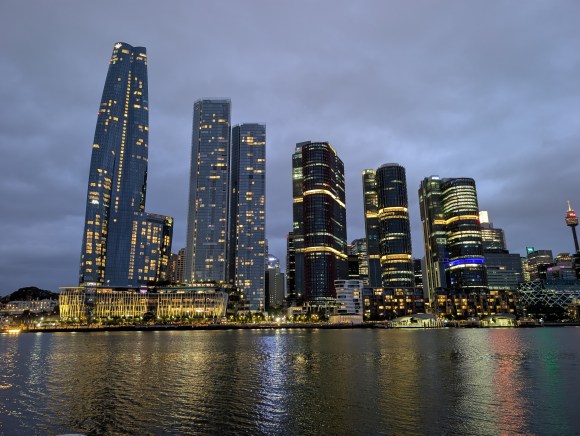
Sydney Skyline
We are not champagne sailors. The only time Alex and I drink champagne aboard a boat is to celebrate the end of a voyage of hundreds of nautical miles. Our sailing expeditions are characterised by breakages, deprivations and isolation. Sometimes the seas are so rough that I cannot move around the boat, let alone change clothes. I can only bathe once a week, and that consists of a dip in the ocean at anchor.
Our meals often consist of fish we have caught and cooked, unless we consume them immediately as sashimi. A single fish might last us days, served in various guises. Other meals are prepared from lentils or canned foods. In contrast to land trips, I usually lose a kilogram or two when at sea. I prefer not to use the term ‘yacht’, because people imagine us sunning ourselves on the deck while sipping champagne. Instead, I use the term ‘sailboat’. I do confess to a tad of reverse snobbery in the deprivations I endure and look down on those I describe as ‘champagne sailors’. But was that about to change?
We had been invited aboard the luxury observer vessel known as The Jackson to watch the start of the annual Sydney to Hobart Yacht Race on Boxing Day. After Christmas lunch, we headed to Adelaide Airport to catch our ninety-minute flight to Sydney. Upon arrival at our hotel, we caught the lift to our room. The lift doors opened on the third floor to let two brothers in, aged around 10 and 12. They met our gaze.
“Would you like us to sing you a Christmas carol?” the younger one asked.
The older one looked a bit embarrassed, but I thought asking strangers to join in singing a carol in a lift on Christmas Day was a nice, if not brave gesture, so I nodded enthusiastically. The younger one started singing ‘We wish you a merry Christmas’, and facing us, moved his hands in the manner of a choir conductor. I joined in. Then the boys noticed that they had arrived at their floor and stopped singing.
“See ya!” said the older one, as they exited.
We continued to the seventh floor and deposited our bags. The light was fading, so we decided to head back outside to take a stroll around the harbour. We returned to the lift. Once we reached the fifth floor the doors opened and the two boys entered again. Three other guests were standing behind us.
“More carols?” asked Alex.
They nodded and smiled. “Yes!”
They launched into another familiar carol, and again I joined in. The tall guest behind me gave a kindly chuckle. Then they reached the third floor, bade us farewell, and exited. We continued to the ground floor and made a tour of Darling Harbour in the remaining light. It had been a wonderful Christmas Day, and what better way to end it than the act of goodwill in being serenaded by children in a hotel lift.
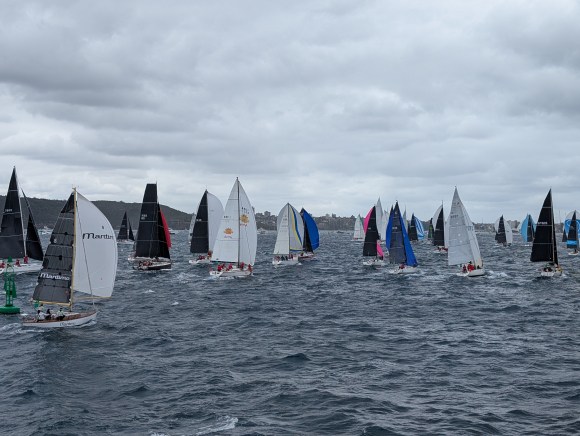
The next day was the yacht race, which has been held annually since 1945 and is one of the world’s great ocean races. The sailors would be competing in a gruelling and treacherous race of 128 boats covering 628 nautical miles (1,200 km), south down the Tasman Sea, across Bass Strait, to Hobart in the south of Tasmania. This race is one of the highlights of Boxing Day and a television staple.
Start of Sydney to Hobart race
We walked to the appointed wharf and noticed a long queue waiting to board. Upon being noticed by our hosts, we were directed to a shorter queue and were ushered up the stairs to the top deck, limited to fewer than sixty people. A ribbon with ‘The Jackson’ written on it was affixed to our wrists. We were greeted by a waiter holding a tray proffering a range of drinks. Alex picked up two glasses of champagne and handed one to me. Was this the beginning of my new career as a champagne sailor?
The Jackson soon departed and we headed out to the deck to view the boats lining up for the race. Even though it was summer the cold penetrated my body and my hands shook. I was determined to brave the cold in order to hold my place to view the start of the race. The lady next to me made some commentary.
“That’s the start line,” she said, pointing to two yellow buoys. The start lines are staggered depending on the the size of the boats to help prevent collisions. It’s a southerly, so that should help.”
I nodded, feigning comprehension. I was not yet a competent enough sailor to pick up the wind direction so quickly. The cannon sounded on the deck below, and a plume of smoke rose. The yachts set off. Soon they had overtaken our observation vessel and most of the guests moved back inside the boat to watch the race on a large screen. Alex and I and a few other hardy souls remained on the outside deck to savour the unique setting of Sydney Harbour. Waiters braved the cold regularly to top up our champagne and offer us canapes. We accepted each time, although I eventually slowed down and shared a glass of champagne with Alex. Had we become the dreaded champagne sailors?
The yachts sailed through the heads until most of them disappeared from view. The Jackson turned around and headed back to King Street Wharf. We remained outside on the deck in the cold, making the most of every minute because Sydney Harbour is so far from home, and we may never have this opportunity again.
I stubbornly refuse to accept the title of champagne sailor though. We are temporarily boatless (which is another story) but once we resume sailing again later this year, we hope to return to the days of self-reliance on the boat and sourcing our meals from the ocean. Maybe not too much deprivation though, because we will continue to uncork a bottle of champagne, as is our tradition, after completing a major ocean passage of several hundred nautical miles.
Sydney to Hobart race
.
Meredith Stephens is an applied linguist from South Australia. Her recent work has appeared in Syncopation Literary Journal, Continue the Voice, Micking Owl Roost blog, The Font – A Literary Journal for Language Teachers, and Mind, Brain & Education Think Tank. In 2024, her story Safari was chosen as the Editor’s Choice for the June edition of All Your Stories.
PLEASE NOTE: ARTICLES CAN ONLY BE REPRODUCED IN OTHER SITES WITH DUE ACKNOWLEDGEMENT TO BORDERLESS JOURNAL
I stretched the boat hook as far as I could towards the mooring buoy, but it slid beneath the bow.
“Go back!” I shouted to Alex back at the helm, but my voice was carried away in the wind.
I pointed at the buoy under the net, and Alex reversed. The waves were dancing in front of me and the buoy would not stay in place long enough for me to reach it. On the second attempt, I forced all of my attention on the rope attached to the buoy, and tried to pull it aboard. It was much too heavy so I screamed for Alex to come, and he raced from behind, pulled the buoy up and secured it to the bow.
How would I alight into the dinghy in these waves? Alex lowered it into the water and it lunged towards the stern and back in succession. I doubted I would be able to board in these conditions.
“How about if I move the dinghy to the side of the boat and you enter via a ladder?”
“Worth a try!” I answered.
Alex brought the dinghy to the side of the boat and slung a ladder made of strong fabric overboard. I gingerly stepped down but once I glanced at the water raging beneath me, I lost confidence and gave up.
“I think I had better hop in from the stern after all,” I told Alex.
He moved the dinghy back to the stern. As I walked towards it, I slipped and fell on my thigh. There was no time to feel sorry for myself, so I picked myself up and continued heading for the dinghy. It lunged back and forth in the waves.
“Now!” commanded Alex.
I placed one foot in the centre of the dinghy to centre myself and then sat down on the bench. As hard as it was for me it was not hard for Haru, my border collie. I called her in and tapped the dinghy behind me because I knew she was hard of hearing. She leapt behind me with alacrity. It was so much easier for her to board the dinghy, not least because of her four legs.
Alex was locking the door back on the boat. The dinghy kept lunging toward the stern, and I was scared of getting knocked off when it hit the stern. I screamed as hard as I could.
“Okay!” replied Alex and hopped in behind me. Then he turned on the engine and headed for the shore, except that the shore was unrecognisable. Instead of a sandy beach, there were rocks.
Alex headed for the most promising spot. “Hop out!” commanded Alex, and I disembarked one leg after the other and headed to climb over the rocks. As usual, Haru leapt out and ran ashore.
I thought I was clear of the rocks and the menacing water, when Alex called out to me.
“Take my backpack! The laptops are in here. They can’t get wet. I realised then that we should have put them into the dry bag.”
I walked over the slippery rocks and strained to grasp the shoulder straps of the backpack. Once they were in my hands I returned to shore over the rocks, ready for the trek up to the holiday house.
I was so longing for the warmth of the fireplace and the view of the setting sun over the bay. I walked effortlessly up the hill, with Haru trotting happily beside me. The shelter and glow of the house was just as I had imagined. It was worth the hardship of getting there.
That night the winds continued to build, but it was pleasurable to hear them passing over the house as we enjoyed the safety and warmth of being inside.
Around one in the morning, the whole house shuddered when hit by a particularly strong gust, which was violent enough to briefly wake Alex.
No sooner was it light that I heard Alex enter the room. He must have been out before the wee hours.
“The boat has drifted to shore. I had a bad feeling and got up early to check the position of the boat. From the cliffs I could see that the mast was too close to the shore. Then my fears were confirmed when I saw that it had been blown ashore.”
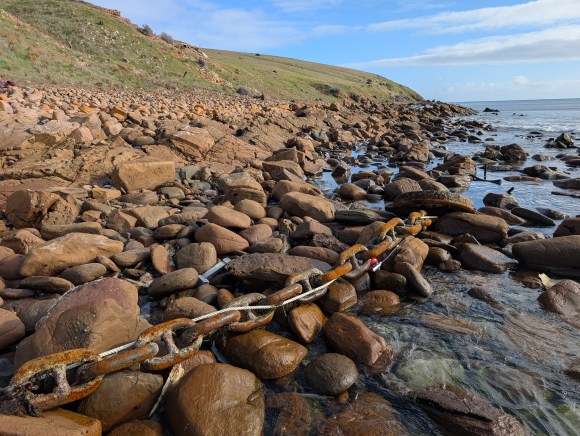
Dragged moorings. Photo Courtesy: Alan Noble
“Didn’t the mooring hold?” I asked.
“Evidently not. I’m going to check it out now. Want to come?”
I agreed, and we drove out to the cliff with Haru in the back seat. Once at the cliff, I remained in the car because I couldn’t face the gale-force winds that were now gusting to forty knots. Meanwhile, Alex, in his wetsuit, walked down the dirt road towards the beach, entered the water, and pulled himself aboard. I kept my eyes focused on him until I saw his figure exit the boat, swim ashore, and walk up the track back toward me.
“It’s finished. There’s nothing we can do, beyond salvage.”
Alex’s boat of sixteen years and our home away from home for the last five years was no more. In years past, we had circumnavigated Tasmania, sailed to New Caledonia and back, and across the Great Australian Bight to sail north on the Indian Ocean. Exiting a marina and heading towards the waves was a symbol of leaving our troubles behind and anticipation of adventure. I could no longer take this adventure for granted.
Alex reached out to Thompson’s Marine Salvage, and they arrived at the bay within two hours. The plan was to attach one end of a heavy rope to a tractor at the top of the cliff, and the other end to the boat, and drag it onto the sand to save it from smashing on the rocks.
Alex again donned his wetsuit, descended the cliffs, and swam to the boat. I sheltered from the wind in the car at the top of the cliffs with Haru. Then I thought that I should walk towards the boat in case there was anything I could do. Just as I reached the shore, a young man in a wetsuit approached me.
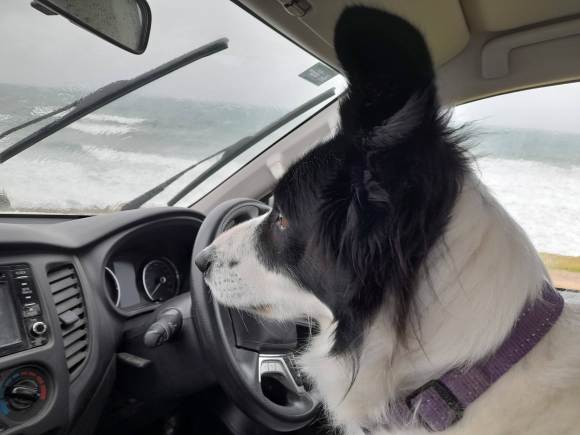
Haru observing from inside the car. Photo Courtesy: Meredith Stephens
“Watch out for the rope. We’re ready to begin!”
It was too late. The operation had started, and the rope was heading towards me, as the tractor started to try and haul the boat to the shore.
“Jump!” the young man urged.
I’m glad the young man thought this was a possibility, but I haven’t jumped for years. My days of jumping are decades behind me. Unable to jump, I met the full force of the rope and was knocked on my back. My head hit some rocks. I uttered an expletive “sh..!” which I reserve for extreme situations. I lay there for seconds before slowly getting back to my feet. My head was aching from the blow and my whole being was in shock. I gave up on rendering assistance and walked slowly back to the car. There I sheltered from the wind until Alex eventually returned to the boat.
“The operation has failed. The boat is still stuck on the rocks,” he explained.
Late in the day, a twenty-ton excavator arrived on the scene. I spent the day bent over holding a rubbish bag, picking up rubble from the boat. Haru trotted around me enjoying being freed from the confines of the house. The excavator approached the boat like a giant menacing dinosaur. I grabbed Haru by the collar and removed myself to a distant spot on the other side of the boat. I could not face another industrial accident. The hand of the excavator grappled the mast and moved it to a safe spot on the rocks. I watched the dinosaur make its retreat back to the road while I maintained a hold on Haru’s collar.
The following day a second twenty-ton excavator descended onto the beach. The first excavator lifted the stern while the second lifted the bow. Slowly, the airborne boat was moved off the rocks and onto land. I was invited to view it, but I couldn’t face seeing the destruction of our home. That evening, I ventured out to the paddock where the boat now rested high and dry, like a beached whale. Amongst the devastation, I retrieved the remains of my dressing gown, which had somehow become entangled in the bow.
Over the next few days, I continued to return to the beach to extract boat rubble from the shore and pull up items of clothing and bedding from the sand. Alex drove down to the beach in his off-road vehicle, and we loaded up the tray with bags of rubble. Different items washed ashore each day.
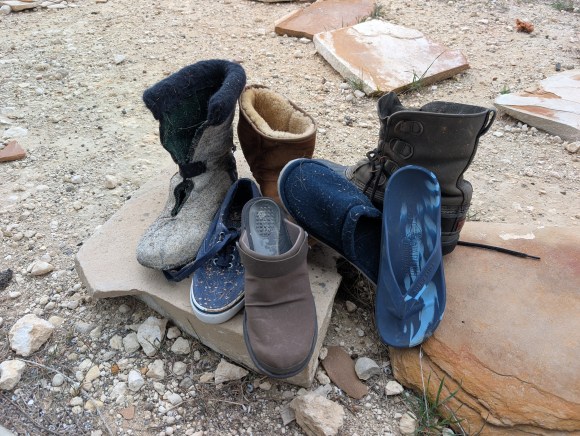
Salvaged shoes. Photo Courtesy: Alan Nobel
The bump on my head continued to heal, only feeling pain when touched. The bruises on my legs changed colour as they too healed. And eventually the bay would heal too. We continued daily beach clean-ups. Seven odd shoes were salvaged, an odd snorkel fin, and odd gloves. Two months later the other fin washed up, but none of the missing shoes ever made an appearance. We continued to fill our off-road vehicle, and rubbish bags, with debris. Our beloved nautical home sat out of place in a paddock awaiting salvage. We came away with a renewed appreciation and respect for the destructive power of the ever-changing sea, but it would take more than a broken boat to diminish our desire to sail again. For now, our sailing adventures were on hold, but once we had the opportunity, we would again return to the sea. This would not be our final voyage.
.
Meredith Stephens is an applied linguist from South Australia. Her recent work has appeared in Syncopation Literary Journal, Continue the Voice, Micking Owl Roost blog, The Font – A Literary Journal for Language Teachers, and Mind, Brain & Education Think Tank. In 2024, her story Safari was chosen as the Editor’s Choice for the June edition of All Your Stories.
PLEASE NOTE: ARTICLES CAN ONLY BE REPRODUCED IN OTHER SITES WITH DUE ACKNOWLEDGEMENT TO BORDERLESS JOURNAL
Such a nice, perhaps one-of-a-kind, planet. Spacious. Water, oxygen, fertile earth. Let’s simply name it after what it is. Look at that waterfall, taste it, take a cold shower. You wouldn’t want to be anyone or anywhere else. Build shelter, pick fruit, grow food then share it with neighbours, invent language so you can compete with birds that make poems and songs to express the wonder of it all and praise Mother Nature and their luck for having survived arrival. You have never seen anywhere else except this generous plain but, surely, this must be a paradise without one flaw.
Allan Lake, originally from Canada, has lived in Saskatoon, Cape Breton Island, Ibiza, Tasmania, and Melbourne, Australia. His latest chapbook of poems, My Photos of Sicily, was published by Ginninderra Press. Such journals as The Hong Kong Review, Tokyo Poetry Journal, New Philosopher and The Fabians Review have published his poems.
.
PLEASE NOTE: ARTICLES CAN ONLY BE REPRODUCED IN OTHER SITES WITH DUE ACKNOWLEDGEMENT TO BORDERLESS JOURNAL
Anthony Sattin, an award winning journalist and travel writer in conversation about Nomads: The Wanderers Who Shaped our World, his recent book published by Hachette, India. Click hereto read.
VR Devika talks of the dynamic Muthulakshmi Reddy, the first woman in the world to preside over a Legislative Assembly who sought justice for Devadsis and prostitutes and discusses her book, Muthulakshmi Reddy: A Trailblazer in Surgery and Women’s Rights published by Niyogi Books. Click hereto read.
Translations
Daridro or Poverty by Nazrul has been translated from Bengali by Professor Fakrul Alam. Click here to read.
The Browless Dolls by S.Ramakrishnan, has been translated from Tamil by B Chandramouli. Click hereto read.
Two poems from Italy by Rosy Gallace have been translated from Italian by Irma Kurti. Click hereto read.
Aalo Amar Aalo (Light, My Light) a song by Tagore, has been translated by Mitali Chakravarty from Bengali. Click hereto read.
Pandies Corner
Songs of Freedom: Moh-Reenis an autobiographical story by Amreen, translated from Hindustani by Janees. These stories highlight the ongoing struggle against debilitating rigid boundaries drawn by societal norms, with the support from organisations like Shaktishalini and Pandies. Click hereto read.
Ravi Shankar recommends walking as a panacea to multiple issues, health and climate change and takes us on a tour of walks around the world. Click here to read.
Ali Jan Maqsood introduces us to a strong matriarch from a Balochi village. Click here to read.
Musings of a Copywriter
In Drill, Fill, Just Chill, Devraj Singh Kalsi gives us humour while under a dentist’s drill. Click here to read.
Notes from Japan
Suzanne Kamata writes of herA Ramble on Bizan, focussing on a writer, also by the surname of Moraes, who lived on Mount Bizan more than century ago, moving to Japan from Portugal having fallen violently in love. Click hereto read.
It stretches without borders, without interruptions, without contentions, unifying all under its life-giving ambience. We live nurtured by the sky, the water and the Earth. If we think back to times before humans made constructs and built walls to guard their own, to times when their ancestors roamed the Earth and moved to meet their needs, the population was not huge, and resources were abundant. Our species lived in consonance with nature. People revered natural forces and found trends that evolved into traditions and constructs which eventually made their progeny forget that the sky, water and Earth did not belong to them. These belong or perhaps exist for some reason that we do not comprehend despite the explanations given by science and religions. Being merely transient passers-by through these, humanity, unlike dinosaurs, has an urge to survive and be like the sky — with a past, present and future and a sense of the eternal. Though we all have short lives compared to the sky, Earth or universe, we continue to find ourselves in a homo centric world that considers all else to be made to meet their aspirations. But there was a time, when humans lacked this arrogance. They just tried to survive. And move with shifting rivers in an unbordered world.
Exploring such times, is Anthony Sattin’s profound book, Nomads: The Wanderers Who Shaped our World. He converses to reinforce reviving the concept of asabiyya or bonding between humans so that they find it in their hearts to move forward with necessary changes to avoid following in the footsteps of mammoths. A change maker who redefined constructs for humankind, a devdasi’s[1] daughter who rose to become a pioneering doctor and activist a hundred years ago, is Dr Muthulakshmi Reddy. We have an interview with her recent biographer, R Devika, who authored Muthulakshmi Reddy: A Trailblazer in Surgery and Women’s Rights.
The books reviewed this time include one featuring the writings by the greatest change maker in cinema — Satyajit Ray. Bhaskar Parichha has reviewed Satyajit Ray Miscellany: On Life, Cinema, People & Much More while Professor Somdatta Mandal has given us a candid opinion on BM Zuhara’s The Dreams of a Mappila Girl: A Memoir, translated from Malayalam by Fehmida Zakir. Taranath Tantrik and Other Tales from the Supernatural by Bibhutibhushan, translated from Bengali by Devalina Mookerjee brings unexplored dark mysterious forces into play and has been reviewed by Basudhara Roy. We have an excerpt from the titular stories of Tarantath Tantrik. Bibhutibhushan Bandopadhyay(1894-1950) was a legendary writer from Bengal. He wrote stories and novels, some of which were immortalised in cinema, such as the Apu triology by Satyajit Ray. The other book excerpt is from a translation from Kannada by an upcoming voice that needs to be heard, Maithreyi Karnoor. She has brought to the anglophone world Shrinivas Vaidya’s Handful of Sesame.
Evoking humour is not easy, but we do have a few such writers who manage it very well. Hughes has given us a tongue-in-cheek piece on the dateline, which has more than humour. And Devraj Singh Kalsi has shared his discovery that laughter is the best medicine to shrug off a dentist’s drill. He has also visited the colours of Durga Puja which, with its spirit of inclusivity, transported visitors in one marquee near Kolkata to the iconic Malaysian Twin Towers. Thus, bringing festivals in October into our purview. Candice Lousia Daquin has actually explored why we celebrate festivals and the God gene… Did you know we have a biological need for spirituality?
Suzanne Kamata has introduced us to Mount Bizan, which houses a writer by the surname of Moraes – Wenceslau José de Souza de Moraes, an expat writer who lived in Japan at the turn of the twentieth century. Wonder if he could have been related to the Anglo Indian writer, Dom Moraes? Aditi Yadav has also given us an essay on the Japanese philosophy of Wabi-sabi with its world view centred on imperfections and transience. Ravi Shankar has suggested walks for all of us, sharing his experiences in the Himalayas, the Caribbean island of Aruba and in many more places. Meredith Stephens has written of sailing to Tasmania.
The essay that brought back a flavour of home for me is one by Asad Latif, now a journalist in Singapore but long ago, he was an icon in India. We are very privileged to have his writing on what borders do for us… a piece exploring the idea on which we base our journal, also perhaps with a touch of Anthony Sattin’ s asabiyya. ‘Pandies’ Corner‘ starts another run, showcasing women’s tryst for freedom. Amreen’s ‘Moh-Reen’, her own story, translated from Hindustani by Janees, is a brave start to the series. The voices ring out asking for a change, to heal social norms to accommodate love and kindness with the backing of Shaktishalini and Pandies as does the unsupported solo voice of an older woman from Balochistan, Ganji Baloch, brought to our notice by Ali Jaan Maqsood.
We have fiction from Sohana Manzoor – again bringing to fore strange stories of women rebelling against social norms. Paul Mirabile explores death and the sea in a horrific story. Sunil Sharma’s fiction explores madness and ideators, making a social comment on recent happenings. As the sky stretches out to accommodate all kinds of writings, all creatures great and small, we try our best to give voice to a fair cross section from around the world as we have done thistime too.
There are as usual pieces that we have not mentioned in this note but they are all worth a read. Do drop in to check out our contents in this October issue. We are truly grateful to our contributors who continue to connect with words and thoughts that waft along with clouds. We would like to thank Sohana Manzoor especially for her wonderful artwork. The journal would not be a possibility without the support of the whole team and our valuable readers who make writing worth the effort. It is lovely to be read and remembered for the words we write.
Meredith Stephenswrites ofsailing to Tasmania when the pandemic had just started loosening its grip
Neither the wind speed nor direction were favourable as we tacked our way upwind. It was my turn to make the soup. I headed into the kitchen, grabbing rails and fixed furniture to steady myself. With each wave the boat lurched violently. I opened the fridge and a bottle of drink torpedoed across the galley. Then, on my hands and knees, I opened a bilge compartment trying to find the root vegetables. As I stood up, another wave surged and I nearly fell into the bilge. As I was trying to find cutlery I heard Luke’s voice offering to help me. I gladly accepted and found refuge after retreating to my bed. Luke’s steady sea legs meant the soup was ready in minutes.
We were sailing from Granite Island to Robe, in South Australia, on our way south-east to Tasmania. A four-hour journey by road would turn out to be thirty-six-hours by sea. Alex and Luke took three hour shifts at the helm overnight. The waves lurched beneath us. The sails were disobedient. Alex attached the tether to his belt and the rails, and headed out to the foredeck to fix it. Luke was at the helm and I held a rope at the rear deck. They shouted directions to me to pull and then release the rope. Alex fixed the sail as the boat accelerated.
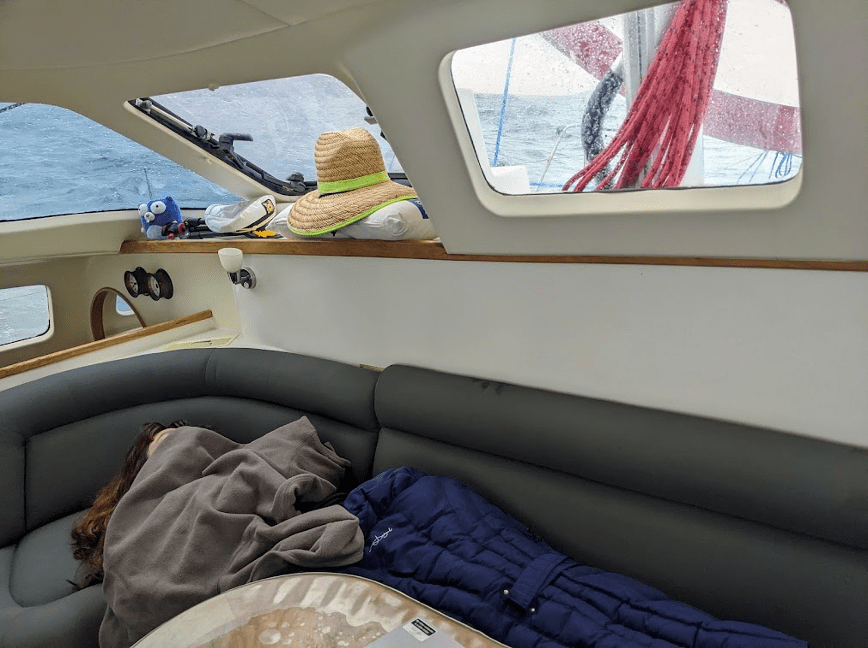
That night the bed in my cabin surged with every crashing wave. There was no relief in the morning when the harsh Australian sunshine pushed its way into the cabin and gave me a resounding migraine. Trying to find relief from the skylight above my bed I staggered up the stairs to the saloon, lay down on the sofa and hid from the sun under a hoodie and coat.
Alex entreated me to lift my gaze to the horizon and so I peeped out and reacquainted myself with the shoreline. My normally healthy appetite disappeared and I had an overwhelming desire to sleep. But Alex was an experienced sailor and never gave up on encouraging me, pushing me beyond what I imagined I could do. Rather than curling up into a ball and giving up, I heeded his encouragement, and my seasickness gradually dissipated. I was well enough by the evening to accompany Alex on the twelve am to three am shift, but noting my tired expression, Alex told me to take leave and go to bed at two thirty am. Luke took over the three to six am shift, and then Alex took over from six am. When I woke at eight the waters were calm. My seasickness had gone and my appetite returned. I enjoyed a hearty breakfast and we calmly motored on to Robe.
We had to sail continuously for two long days and nights on the voyage from Robe to King Island, Tasmania. Alex consulted the app Predict Wind for the weather forecast and assured me that there would be little wind. He, of course, was disappointed because he wanted to sail, but I was quite happy to motor on calm seas if it meant I could be spared from seasickness. He is a climate warrior and wanted to rely on natural sources of energy such as wind. I knew we shouldn’t use fossil fuels, but I decided to tease him, urging, ‘Let’s use diesel!’, knowing full well how it contradicted his principles. He put my needs first, foregoing his love of sailing to motor on calm waters instead.
I only knew about King Island because of its specialty cheese production, and looked forward to some cheese tastings. Alex asked me to do some research on King Island, and soon I learned that it had been the site of around 800 shipwrecks. This was not what I wanted to hear. I knew Bass Strait was notorious, but not that this single island in the strait had been the site of hundreds of shipwrecks. Nevertheless, Alex had equipped himself with state-of-the-art navigational equipment, and had the assistance of sailor Luke who had once sailed across the Atlantic, and he was unperturbed. I trusted Alex, and his confidence was contagious.
“It’s pretty shallow here,” I announced to Luke from the cockpit during my shift. “Only twenty-five metres.”
Luke and Alex guffawed. “That’s only because it’s too deep for the instruments to measure. It’s actually 1500 metres,” Alex explained.
I had a book ready to read for my three-hour shift but I left it unopened. I was enraptured by the milky and glassy surface and the ripples that glistened in the sun. I scanned the horizon for vessels, and tried to discover the ones that appeared in the monitor reported by Automatic Identification System (AIS). Unlike us, the other vessels on the monitor were container ships. Black birds perched on the surface of the water and took off as we approached.
“Where are the dolphins?” I quizzed Alex.
“It’s too deep for them here.”
We repeated the shifts. As Alex’s research had predicted the waters were calm. My seasickness had disappeared altogether.
Two days after leaving Robe, the township of Currie on King Island came into view. Anchoring took a while because of the many submerged rocks. Finally, Alex was satisfied with the anchorage, and we decided to hop into the dinghy and go ashore. First, we had to register online with the Tasmanian e-travel. I completed the documentation on my laptop and finally was required to receive a verification code by SMS on my phone. I kept requesting new codes but none came. It turned out that there was no reception on this remote island for my phone provider. I gave up.
The four of us lowered ourselves into the dinghy with our bags. Alex pulled the cord to start the outboard motor, and we weaved between the other berthed boats to the shore. A police vehicle was parked on the shore facing us. A barrel chested police officer in a fluorescent orange vest motioned where we should land. At the wharf he was accompanied by a biosecurity officer.
The police officer greeted us politely and asked whether we had the necessary paperwork for entry. Luke and Alex had theirs, but Verity and I did not. Despite numerous reminders from Alex I had procrastinated and now I was paying for it. We clambered out of the dinghy to the wharf, and the officers took down Verity’s and my details.
I had not been able to complete my application because my phone would not receive signals in this remote location. Alex tethered me to his phone, because his carrier had coverage. I fumbled around in the sunshine to download various apps to process my application. The phone screen was too small and the glare from the sunshine disturbed my vision even further. Even though I was traveling domestically, it was like trying to enter a foreign country without the right visa.
“I don’t want to hold you all up,” I said to the others. “Let me go back to the boat. I don’t care. I can read a book.”
Alex would have none of it. Then the biosecurity officer briefly disappeared, and reappeared with paper forms.
“You can fill these out instead,” he offered. “Then you will have to take Rapid Antigen Tests back in the boat and wait fifteen minutes for the result. If it is negative you are free to travel. I’m just going to make a detour to the airport to pick up the tests for you.”
The biosecurity officer made the eleven kilometre trip to the airport and back to retrieve the Rapid Antigen Tests. Meanwhile, Luke cleverly engaged the police officer in banter, trying to find out the best places for tourists to visit on the island.
“The races are on this afternoon,” he kindly informed us. “They are held four times a year over summer.”
If it weren’t for the banter with the police officer we could never have learned this. We scrambled back into the dinghy with the Rapid Antigen Tests. Or to be more precise, the others scrambled into the dinghy. I lost my footing on the tires on the way down and collapsed in a heap into the dinghy. The mask had obscured my downward vision and I couldn’t see where I was placing my feet. I was rattled after having been greeted by a police officer and a biosecurity officer on the shore of the quiet fishing cove nestling alongside Currie. The others gasped as I fell and then fussed over me and I soon recovered. We sped back towards the boat.
“What else did the police officer tell you, Luke?” we probed, once in the dinghy.
“He said that the other day another vessel had come here from interstate. They too had had trouble getting internet access on this remote island and did not know that the entry requirements for Tasmania had changed while they were on board. They were so upset at being greeted on the shore by a police officer and a biosecurity officer that they started an altercation and had to be locked up.”
Hearing this I felt grateful that we had been treated with such civility. Again we clambered back on to the boat. Exhausted but relieved that we had been able to go on land in Tasmania, we decided to celebrate with Luke’s bottle of Chardonnay. Then, we proceeded with the tests.
As expected, we all tested negative and we took the dinghy ashore to explore Currie. We followed the police officer’s advice and walked through the town to the races. Alex and I were sitting in the stands, enjoying not only the horses but the spectacle of the local crowd in their finery. Alex abruptly looked up to the end of the aisle.
“Is that the police officer?” he asked me.
I studied him chatting to other racegoers in full regalia of his flack jacket, guns in his holster and fluorescent orange vest.
Alex turned to me and quipped, “Maybe that is why he seemed to be in a hurry to process our entry? He wanted to be at the races.
I had been struck by the story that Luke had heard from the police officer that the other interstate visitors had acted defensively when they heard about the new complicated entry requirements to Tasmania. Why had we been treated so differently? We were simply sent back to the boat and the officers had trusted us to act appropriately on the basis of the results of the COVID test. The officers seemed to be in a bit of a hurry to let us get on our way. Now we had an inkling why.
*All the photographs have been supplied by Meredith Stephens.
Meredith Stephens is an applied linguist from South Australia. Her work has appeared in Transnational Literature, The Muse, The Font – A Literary Journal for Language Teachers, The Journal of Literature in Language Teaching, The Writers’ and Readers’ Magazine, Reading in a Foreign Language, and in chapters in anthologies published by Demeter Press, Canada.
PLEASE NOTE: ARTICLES CAN ONLY BE REPRODUCED IN OTHER SITES WITH DUE ACKNOWLEDGEMENT TO BORDERLESS JOURNAL
Meredith Stephens sails the Australian coastline, recording her experiences with words and her camera.
Maybe because I am an applied linguist, one of the pleasures of travel is the novelty of learning unfamiliar place names. Sailing north from Eden in southern New South Wales towards Wollongong, south of Sydney, provided ample opportunity to indulge this pastime.
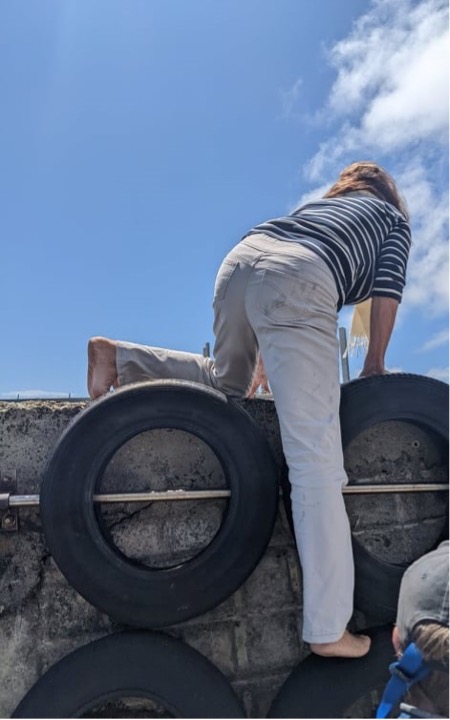
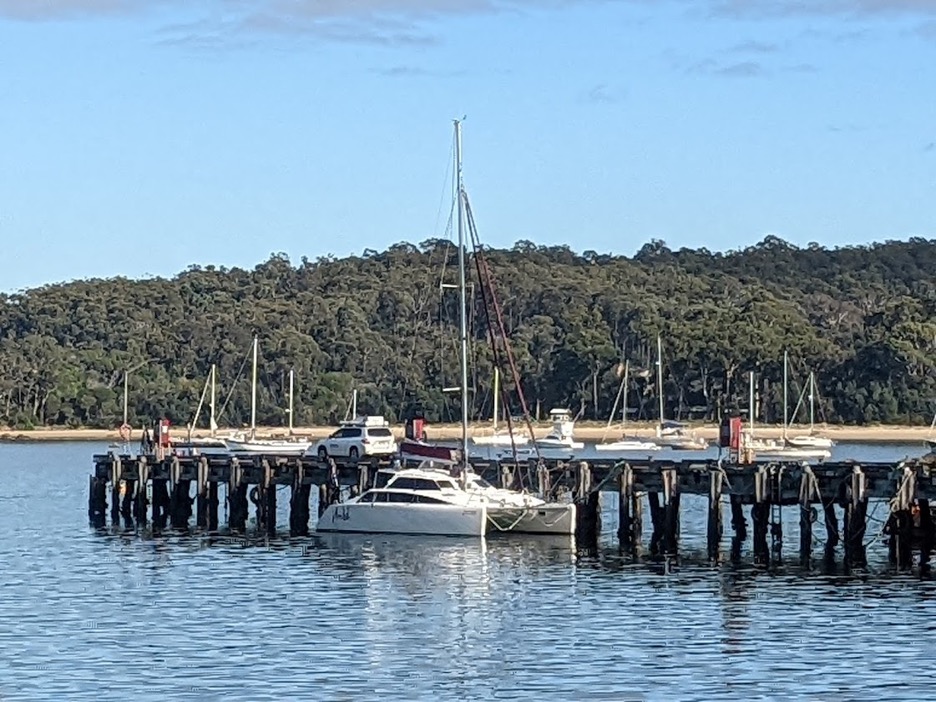
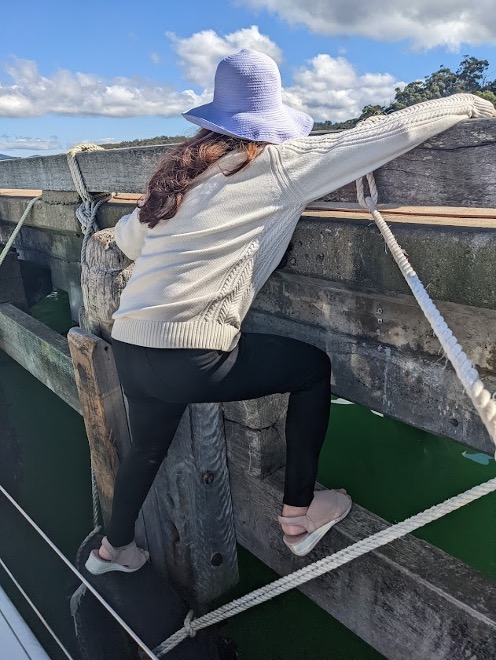
We were relieved to arrive at the township of Eden after the long crossing of Bass Strait from Tasmania to the mainland. Too tired to disembark, we spent the evening recovering on the boat after availing ourselves of a public mooring. The next morning, we rose afresh and resolved to explore Eden. We made our way to the wharf but found that it was formidably higher than our vessel. As much as I was looking forward to Eden, I suddenly realised that climbing onto the wharf looked impossible.
“I can’t do it!” I complained, as I often did, to my sailing companions Alex, Katie and Verity. They were all taller than me and leapt up to the wharf.
“I don’t mind staying here and reading a book. You all go off and enjoy the town,” I urged, as I looked down at the green water in between the boat and the wharf. It wasn’t the first time. Whether climbing a mountain, or hiking, I just couldn’t keep up with the others. Rather than holding everyone up I would prefer to stay back and read.
“No, you have to come with us,” Alex insisted, as always.
I lifted my left foot onto the tyre and my right onto the beam, grabbed hold of the side of the wharf and somehow made it to safety, as the others encouraged me on.
We climbed up the hill and walked along the coastal road to the centre of Eden, taking in shops and the Eden Killer Whale Museum. Then we wound our way downhill back to the boat, ready to sail across the bay to the Sea Horse Inn, where we planned to dine later.
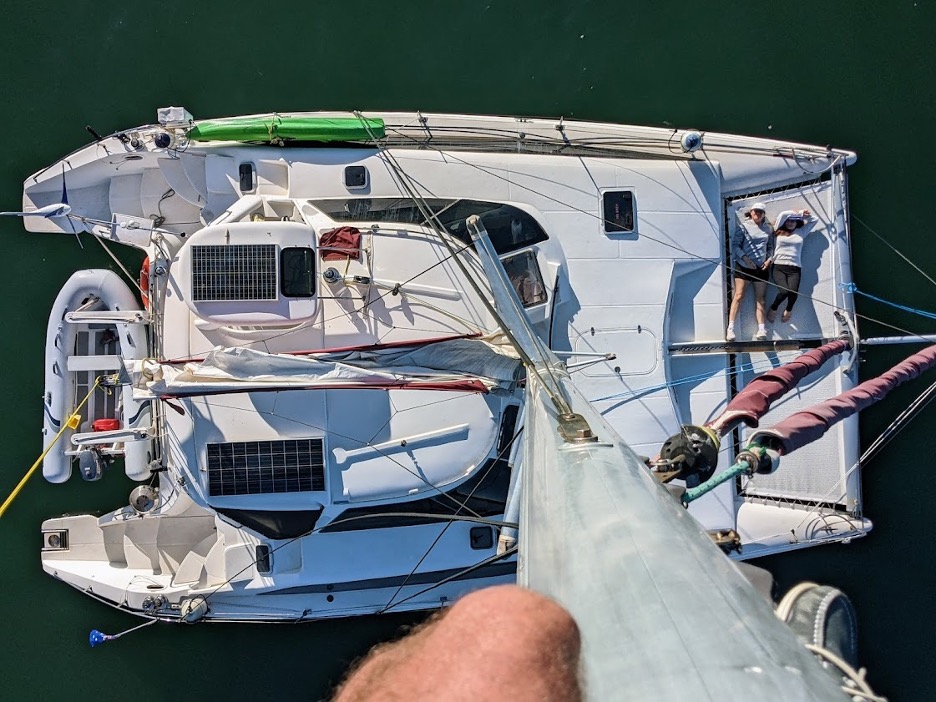
After anchoring Alex decided to attend to boat maintenance before heading across the water to the inn. Alex always attended to business before pleasure, but I was hungry and couldn’t wait for the inn to open at 6 pm. I had to be patient because Alex wanted to fix his anchor light. He climbed into his bosun’s chair. Katie and I winched him up the mast with the electronic winch. Katie released the rope steadily. We had to watch carefully because he would give a hand signal when he wanted to pause. As he moved higher and higher up the mast it became harder to crank our necks backwards to keep him in view. The only way we could keep our eyes on him without bending over backwards was to lie on the deck facing upwards. It might appear that we were lounging around but in fact we were doing our best to keep him in sight. Alex repaired the anchor light and then Katie and I slowly and carefully winched him back to the deck.
Having performed the essential maintenance, we were ready to hop into the dinghy and motor to shore.
After disembarking we dragged the dinghy as far onto the sand as we could and secured it to a branch with a rope. We walked up to the restaurant and wiped the sand off our bare feet before putting on our shoes. We were greeted by a smiling Maitre d’. His expressions changed to concern when he saw Verity.
“I need to see your ID. You can only come into the bar if you are over 18.”
We tried to suppress our giggles. Verity was 28.
“Don’t worry, She’s an adult,” I reassured him.
“We have to check. Until we don’t. Some people get upset when we stop asking them,” he quipped.
After presenting her ID we sat outside and basked in the sunset sitting on the outdoor furniture facing the bay. Then we made our way into the dining room. Although our first choice on the menu had been sold out, my second choice of smoked salmon proved to be the most delicious of the trip. Alex was just as impressed by his serving of sole.
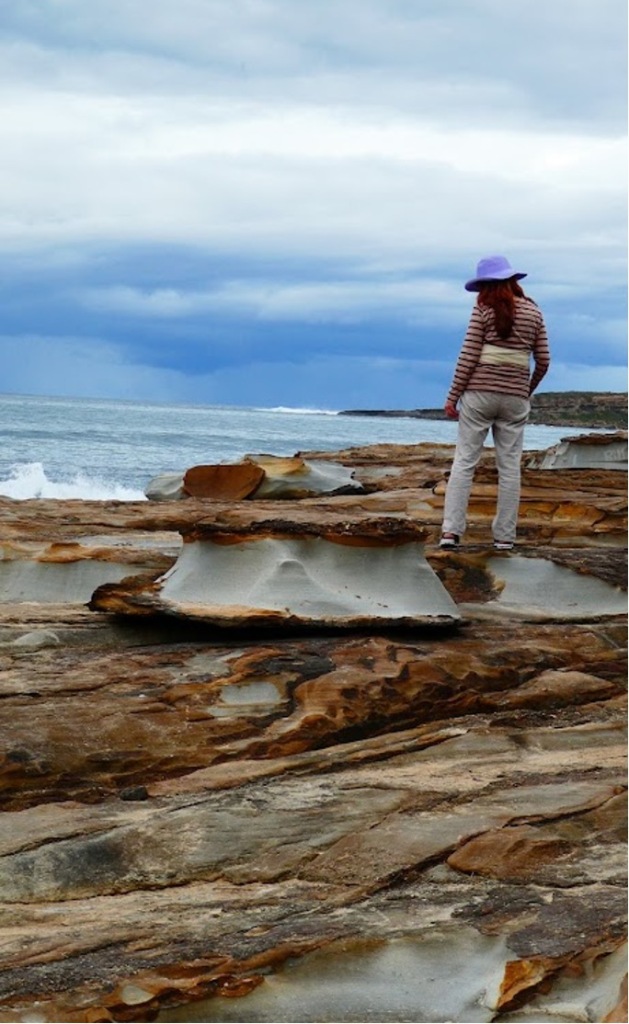
Our destination was Shellharbour, near Wollongong and we were due to sail north along the New South Wales Coast. After having sailed through the fierce Southern Ocean to circumnavigate Tasmania, and the notorious Bass Strait, I was relieved that land would be in sight for the rest of the voyage.
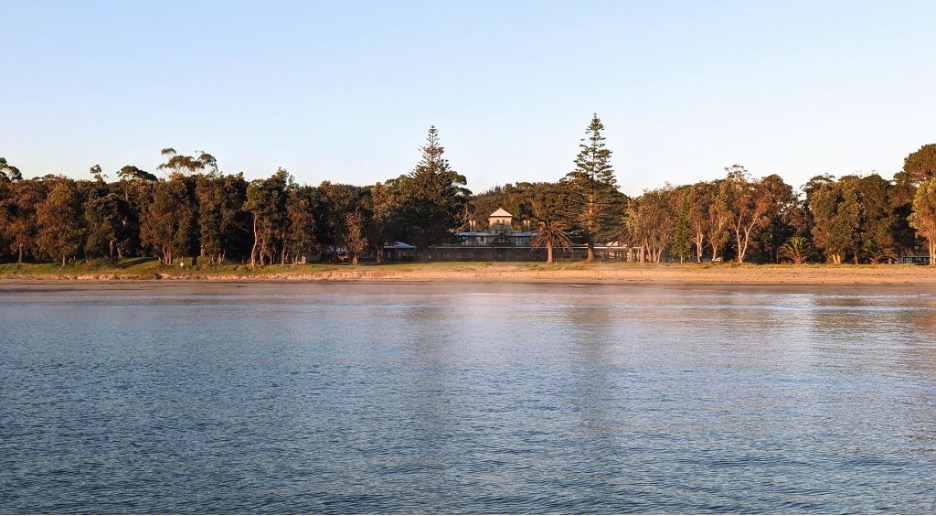
The most memorable stop was South Durras, because as soon as we arrived on the shore we were greeted by a kangaroo grazing and scratching her belly with her forearm. We walked through the caravan park to a rainforest lined with ferns underfoot which led to the shore. We circled back to the shore, treading over rock pools on our way to the beach leading back to the boat.
The next stop had an enchanting name – Ulladulla. If somewhere was named Ulladulla, I simply had to stop there. I kept practising the pronunciation as we sailed into the bay. We anchored, and as usual, took the dinghy to a wharf. As we approached the wharf, we noticed barnacles. The sharp barnacles could easily cause a puncture and it was too late to turn it around.
“Push back as hard as you can!” urged Alex.
We pushed the dinghy away from the barnacles. Then we motored to the wharf on the other side of the bay and disembarked. We walked up the hill into Ulladulla, and unexpectedly Alex announced, “Let’s visit the secondhand bookstore. There’s a sign over there.”
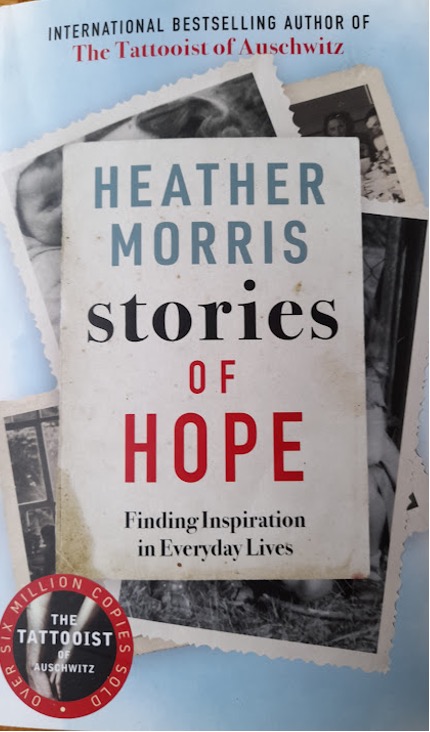
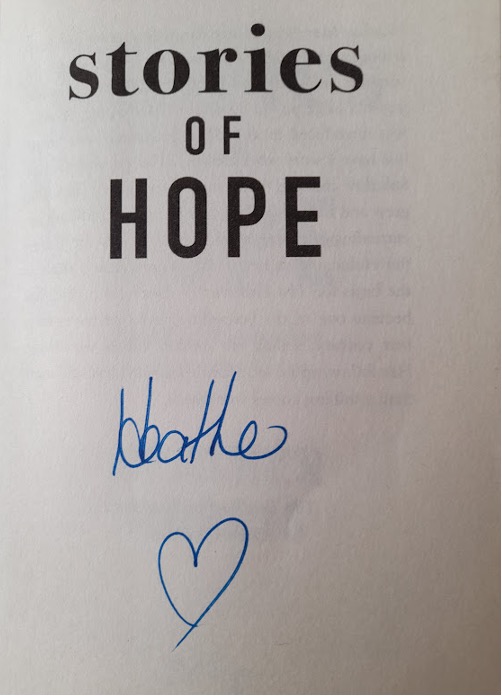
We followed a narrow arcade to the end and spotted the bookstore. My attention was immediately drawn to a signed copy by Heather Morris, a bestselling author.
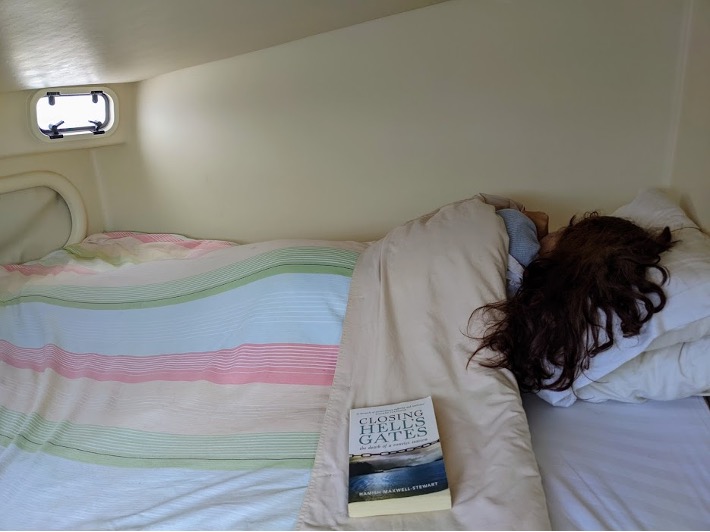
Sailing often entails many hours of crossing vast distances at the slow rate of 6 knots. When the seas are rough there is nothing for me to do but take an anti-seasickness pill and sleep in the cabin while Alex, who doesn’t suffer from seasickness, takes the helm.
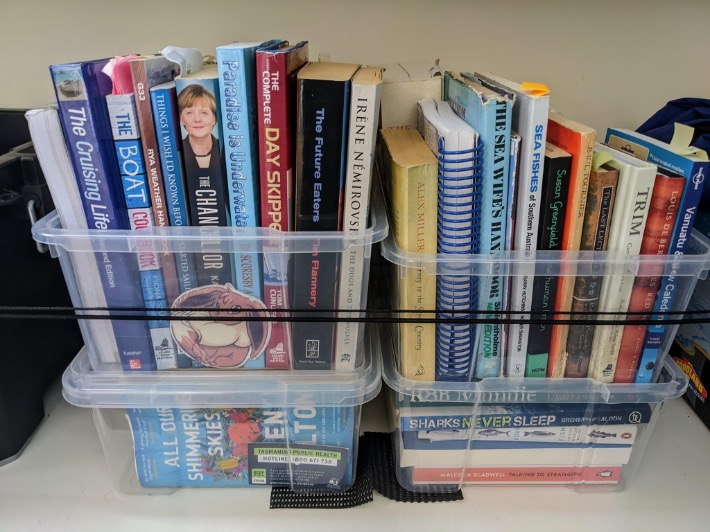
But when the seas are calm there is ample time for reading, if you have enough crew to take turns at the helm. Thankfully Alex’s boat library takes pride of place. Even so, the addition of Heather Morris’ book was welcome and the long hours at sea passed quickly as I read this.
The seas were calm as we headed to Shellharbour, a new marina south of Wollongong, another city with a mellifluous name. We sailed through the many empty berths to the heart of the marina and located our assigned berth. Katie put out the fenders, and then we leapt onto the dock to tie the boat to the cleats. Relieved to have made this long sail to Wollongong, Alex cracked open some of our sparkling Tasmanian wine, with which we celebrate the completion of each leg.
Next, we had to clean up the boat before our flight back to Adelaide. We still had plenty of unopened food in the fridge, so Alex went to offer it to our friendly French Canadian boat neighbours, Gerard and Heloise. They happily received it. Then we asked them the easiest way to get to Sydney airport, after which they offered to drive us to Wollongong station. It was our first time to see Wollongong, and we were astounded to see the lush vegetation so unlike our home state of South Australia. We caught the train from Wollongong to the airport, passing all too quickly through the temperate rainforest. We then flew back to Adelaide to unlimited hot water and clean sheets, as we slowly discarded our sea legs. Not least, I was proud to have learnt beautiful place names such as Ulladulla and Shellharbour, although I still couldn’t manage to spell Wollongong without a spellchecker.
* All the photographs are courtesy Meredith Stephens.
Meredith Stephens is an applied linguist from South Australia. Her work has appeared in Transnational Literature, The Muse, The Font – A Literary Journal for Language Teachers, The Journal of Literature in Language Teaching, The Writers’ and Readers’ Magazine, Reading in a Foreign Language, and in chapters in anthologies published by Demeter Press, Canada.
PLEASE NOTE: ARTICLES CAN ONLY BE REPRODUCED IN OTHER SITES WITH DUE ACKNOWLEDGEMENT TO BORDERLESS JOURNAL
In Conversation withRinki Roy(daughter of legendary director Bimal Roy) about The Oldest Love Story, an anthology on motherhood, edited and curated byjournalist and authors, Rinki Roy and Maithili Rao. Click here to read.
Achingliu Kamei in conversation with Veio Pou, author of Waiting for the Dust to Settle, a novel based on the ongoing conflicts in North-east India. Clickhereto read.
Translations
The Funeral, a satirical skit by Tagore, translated by Somdatta Mandal. Click here to read.
Pie in the Sky is a poem written and translated from Korean by Ihlwha Choi. Click here to read.
Taal Gaachh or The Palmyra Tree, a lilting light poem by Tagore, has been translated from Bengali by Mitali Chakravarty. Click here to read.
Pandies’ Corner
This narrative is written by a youngster from the Nithari village who transcended childhood trauma and deprivation. Dhaani has been written in Hindi and translated to English by Kiran Mishra. Click here to read.
Keith Lyons discovers the import and export of desires in Varanasi, one of the oldest cities in the world, beside one of the most revered rivers. Click here to read.
Notes from Japan
In Marathon Blues, Suzanne Kamata talks of pandemic outcomes in Japan in a lighter tone. Click here to read.
Musings of a Copywriter
In Journey of an Ant, Devraj Singh Kalsi explores life from an insect’s perspective. Click here to read.
Mission Earth
In Tuning in to Nature, Kenny Peavy tells us how to interact with nature. Click here to read.
Yes! It is vacation time, and we are all able to travel at last. Though the pandemic which had closed borders for us seems to be evolving as an endemic, another huge human crisis, a war which cannot be justified in any way, stares us in the face. Loss of lives, homes, towns, cities and threats of global recession follow in the footsteps of refugees wandering into our lives. Lesya Bakun, the Ukrainian refugee whose story we have been following, told me four of her relatives’ homes in Mariupol have been erased out of existence and her extended family has scattered where they found safety as her cousin continues a prisoner of war, captured while defending the iron and steel factory at Azovstal. While majority of the world expresses solidarity with the Ukrainians, another set of refugees remain in shadows. They have completely lost their country in which they had lived from ancient times. I am referring to the Rohingya of Arakan. CNN world states:
“The Rohingya are a stateless Muslim minority in Myanmar’s Rakhine State, thought to number about 1 million people.
“Myanmar does not recognize them as citizens or one of the 135 recognized ethnic groups in the country.”
We are privileged to host a powerful poignant translation by Arifa Ghani Rahman of Shaheen Akhtar’s short story about such a voiceless Rohingya child in a refugee camp. Though this is a fiction inspired by Akhtar’s visits to such shelters, we hope at some point these children will be able to build new lives to create a world free of violence, intolerance, hatred and greed.
One of the questions that springs to one’s mind, watching such atrocities destroy innocent lives is that should one accept bullies and give in to their pressure tactics? Bullies can be found among world leaders as well as perpetrators of decadent societal norms which are often critiqued by satires. Somdatta Mandal has translated one such satirical playlet where social conventions are targeted in a lighter vein by Tagore. In the same spirit, the maestro’s iconic poem about a palmyra tree called Taal Gaachh has been transcreated to bring the joy of innocent wanderings back into the narrative, creating an island of healing thoughts. We continue with our translations of Jibananada Das by Professor Fakrul Alam, a Korean poem by Ihlwha Choi and a magical Balochi folktale by Fazal Baloch. Let us read such translations to connect with varied cultures so that compassion and acceptance of diverse perspectives end horrors like wars, starvation and hunger.
Tagore’s writings translated to English by Mandal in Gleanings of the Road, a collection covering the maestro’s travel to the West, is part one of our book excerpts and highlights Rabindranath’s perspectives on the need to connect with the larger world. The other book excerpt, from Waiting, poetry by Suzanne Kamata, takes up the theme of victimisation, crime and murder. Dwelling on no less horrific narratives, though justified as non-criminal, is a review by Meenakshi Malhotra of Harsh Mander’s Locking down the Poor: The Pandemic and India’s Moral Centre. Gracy Samjetsabam’s assessment of Half-Blood by Pronoti Datta informs about the greyer areas of a whole community in Mumbai. Indrashish Banerjee reviewed Keki Daruwalla’s stories on human relationships anthologised in a collection called Going: Stories of Kinship while Bhaskar Parichha has acquainted us with Deepti Priya Mehrotra’s Her Stories –Indian Women Down the Ages — Thinkers, Workers, Rebels, Queens, a non-fiction that visits inspiring women.
Inspiration can also be drawn from Rinki Roy Bhattacharya’s and Maithili Rao’sThe Oldest Love Story, featuring a medley of men and women writing on the theme of motherhood along with some narratives about their mothers or on the experience of being one. The medley includes well-known names from films and literature like Shabana Azmi, Saeed Mirza, Shashi Deshpande, Nabanita Dev Sen and more. We interviewed Roy Bhattacharya to find out more about this impactful book. Achingliu Kamei, an academic and writer, has conversed with Naga writer, Veio Pou, whose award-winning book, Waiting for the Dust to Settle, was reviewed earlier — a book that gives a glimpse of conflicts in the Northeast of India.
Taking on the theme of conflicts at a personal level, Atreyo Chowdhury’s and Banerjee’s stories create a sense of disquiet as Paul Mirabile’s explores crime, madness and its impact on humans. G Thomas takes a relook at heroism and bravery as a concept. His story set in Kerala shakes our complacency, upending traditional concepts of heroism and bravery just as Candice Louisa Daquin has upended the cult of positivity in her essay. Notes of discord and accord seem to ring through this edition and the undertones of greys spread out towards an exploration of life and death. We have multiple ghost stories this time, even from the Nithari column written by Kiran Mishra, a youngster who got over the trauma of violence in the community and discovered her place as a bilingual writer and educator.
Keith Lyons has got the bug of tongue-in-cheek too as he gives us a piece on his travels in Varanasi that well captures the dichotomies we find in India. Dwelling on social dichotomies also is Ratnottama Sengupta’s powerful tribute to Swatilekha Sengupta, a film and theatre doyenne who brought to life Tagore’s novel, Ghare Baire (Home and the World, 1985). An essay by Mozid Mahmud exploring both the syncretic elements in Tagore’s and Kabir’s works, the medieval poet’s impact on the Nobel laureate and a dispute over Rabindranath’s own translation blends with the tone of greys in this edition.
Travel narratives and photographs by Meredith Stephens sailing the seas in Tasmania and Ravi Shankar trekking on the slopes of the Himalayas to get a view of Mt Everest make for perfect holiday adventures. From Japan, Kamata has given us a narrative set in the pandemic. And environmentalist Kenny Peavy dwells on reconnecting with nature in Mission Earth.
We have a fair deal from across the globe in the June issue. But, as usual, some of the treats in the content have not been mentioned though they are wonderful pieces of writing too. We look forward to your continued support as you delve into our treasure trove of gems from across the oceans. A huge thanks to our fabulous team, to the contributors and readers. I especially want to thank Sohana Manzoor for sharing her lovely artwork and wish you all a wonderful read!







 Borderless