Translations bridge borders — borders drawn by languages. We have showcased translations in multiple languages. Paying a tribute to all the greats, we invite you to savour a small selection of our translations.
Click here to check out our collection of Tagore’s writings translated to English. With translations by Aruna Chakravarty, Fakrul Alam, Radha Chakravarty, Somdatta Mandal and many more.
The witch is Aruna Chakravarti’s translation of a short story by renowned writer, Tarasankar Bandopadhyay . The original story titled, Daini, was first published in 1940 in Probashi magazine in Bengali. Click here to read.
One of the countries often in news nowadays is Myanmar or Burma. George Orwell’s novel,Burmese Days (1934), showcased a society afflicted by racism, exclusivity, nepotism and ignorance. Was his depiction accurate? What has changed from then to now? While the international community looks on, waiting for the country to solve its internal crises, citizens are victimised not only by the pandemic but also by a military coup. Some of them have been stateless for some time now, thrown out altogether for being ‘a threat to Buddhism’. Jessica Mudditt, an author and journalist, who spent four years in Myanmar saw fit to voice her experiences within a country with 135 ethnicities. Her memoir, Our Home in Myanmar – Four Years in Yangon ( 2021), showcases a country where anyone can be displaced at any point like the Rohingyas. With 90% of the populationfollowing Buddhism, how is the religion, born of the compassionate quest of a prince to alleviate human suffering, being interpreted? Recently, in an interview, Muddit said, “Most people outside Myanmar assume that Buddhism is a religion of peace, so they don’t understand why so much violence has taken place, or that Buddhism can turn militant and be infected with extreme nationalism.”
This special showcases Myanmar from various perspectives: from that of an expat journalist, from a travellers’, a local writer’s and it even has a translation of a Tagore poem that reflects on the compassion of a Buddhist sage revered in Myanmar, called Shin Upagutta or Upagupta. Why should Shin Upagutta’s devotees resort to violence? Seeking answers, we present this selection from our treasury.
Content
The Tryst, a story poem about Upagupta’s mercy by Rabindranath Tagore translated from Bengali. Click here to read.
In Once Upon a Time in Burma: Land of a Thousand Pagodas, John Herlihy explores the magnificent sites of Mandalay in company of a Slovenian friend in the first episode of his quartet on his Myanmar, set in the pre-covid world. Click here to read.
Professor Anvita Abbi, a Padma Shri, discusses her experience among the indigenous Andamanese and her new book on them, Voices from the Lost Horizon. Click here to read.
Keith Lyons talks to Jessica Muddittabout her memoir, Our Home in Myanmar, and the current events. Click here to read.
Geetha Ravichnadran explores additions to our vocabulary in a tongue-in-cheek article. Clickhere to read.
Musings of a Copywriter
In When I Almost Became a Professor, Devraj Singh Kalsi gives humour tinged reasons on why he detached himself from being an academician. Click here to read.
We are living in strange times that seem to be filled with events to challenge the innovativeness of man. As if the pandemic were not enough, concepts that had come out of the best in our civilisation to unite mankind have been convoluted by a minority to manipulate and hurt the majority into submission. Life is not about surviving with faint-hearted compliance but about having the courage to live it as you want, facing it full up front, to voice out in unison against injustices, wrongs, and most of all to loan strength to help and care for each other. Often to understand this, we need to hinge on to our past, to learn from our heritage. But do we do that? In the hectic drive to be successful, we tend to ignore important lessons that could have been imbibed from the past. Like, did you know that the tribes in the Andaman can save themselves from a tsunami?
Padma Shri Anvita Abbi tells us all about the Andamanese and her attempts to revive their moribund language in her interview and book, Voices from the Lost Horizon, reviewed by Rakhi Dalal. While the review focusses on the uniqueness of Abbi’s work and the publication with its embedded recordings of the tribe fast dissolving into the morass of mainstream civilisation, her interview highlights the need to revive their lores that evolved out of a 70,000-year-old culture. On the other hand, Jessica Mudditt, interviewed by Keith Lyons, dwells on the ongoing crisis in Myanmar, which has been clearly the focus of her book, Our Home in Yangon. This interview focusses on the here and now of the crisis. But most crises have their roots deep and perhaps an exploration of these could help. There are 135 ethnicities in Myanmar but how many are actually integrated into the mainstream? Are they in the process of getting ‘lost’ like the voices of the speakers of Greater Andamanese?
That is why we tried to showcase a few such strains that are going unheard in the loudness of the ‘civilised’ mainstream. We have translations in poetry from Santhali and Adivasi, touching on the concerns of those who are often considered underdeveloped. And, perhaps, as Abbi said in her interview about the Andamanese, we can say much the same for these tribes too.
“These tribes are neither poor, nor uneducated (their knowledge of environment comprising birds, fishes, medicinal plants and their … weather predictions, and the Earth they walk on is amazing) …”
Distinctions have been created by a ‘civilisation’ entrenched in mono-cognitive enforcements leading to the loss of trust, confidence, languages, cultures and valuable knowledge about basic survival. Perhaps we can attempt to heal such wounds by imbibing the openness, love, devotion and compassion shown by the Buddhist monk, Upagupta (who is still revered in Myanmar as Shin Upagutta), in the translation of Tagore’s story poem, ‘Abhisar’ or ‘The Tryst’. Somdatta Mandal’s translation of Tagore’s letters introduce similar humanitarian concerns when the maestro mentions a German anthropologist and his wife who for the betterment of mankind were journeying to study tribals in India. Tagore remarks, “The people for whom they are willingly prepared to undergo hardship and to overlook all sorts of danger are not their relatives, nor are they civilised.” And yet even a century ago to fathom more about mankind, attempts were being made to integrate with our ancient lore. The concept of being ‘civilised’ is of course now much under the microscope. What is being ‘civilised’?
Is it about having power? We have Akbar Barakzai’s poem translated by Fazal Baloch on creation looking at the divide between a ‘civilised’ God and man. The theme stresses the two sides of the divide. More translations from Odiya, Dutch and Korean further mingle different flavours of the world into our journal — each questioning the accepted norm in different ways.
In an edition focussed on myths and stories from which we evolved, Rhys Hughes has created an unusual legend around elephants. His poetry also deals with animals — cats. One wonders if the T S Eliot’s famed ‘Macavity, the Mystery Cat’ could have to do something with his choices? We were fortunate to have Arundhathi Subramaniam share her poetry on myths around Indian figures like Shakuntala and Avvaiyar and the titular poem from When God is a Traveller that won her the 2020 Sahitya Akademi Award. Michael R Burch continues on the theme dwelling on Circe, Mary Magdalene and Helen. Sekhar Banerjee has a more iconoclastic approach to myths in his poetry. Jared Carter talks of modern myths perpetuated through art and cultural studies as does Mike Smith in his musings with his glance back at the last century through a photograph.
We have poetry by a Filipino writer Gigi Baldovino Gosnell from South Africa, looking for a new world, a new legend, perhaps a world without borders. Tohm Bakelas has given us a few lines of powerful poetry. Could these poems be a reaction to world events? Smitha Vishwanath has responded to the situation in Afghanistan with a poem. In this edition, photographs and verses in Penny Wilkes’ ‘Nature’s Musings‘ draw from the universe. She writes, “The sun never asks for applause” — a powerful thought and perhaps one mankind can learn from.
Ghost stories by Niles Reddick and Sunil Sharma perpetuate the theme, especially the latter has a ghost that questions myths of ‘isms’ created in the modern-day world. We also have a writer from Malaysia, P Ravi Shankar, with a futuristic legend set in a far-off time where man has embraced the reality of climate change and artificial intelligence. An interesting and fun read as is Devraj Singh Kalsi’s professions about why he did not become a professor, Geetha Ravichandran’s light musing on word play and a young writer Saurabh Nagpal’s musing, ‘Leo Messi’s Magic Realism‘ — a footballer viewed from a literary perspective!
While our musings make us laugh, our essays this time take us around the world with the myth of happiness deconstructed by Candice Louisa Daquin, to Burma and deep into Kolkata’s iconic history of the detective department started in the nineteenth century. There is an essay by Bhaskar Parichha that explores politics and media and mentions ‘gatekeepers’ of the media who need to be responsible for influencing public opinion. Guess who would be the gatekeepers?
Bhaskar Parichha’s review of Wendy Donniger’s non-fiction exploring myths around horses, Winged Stallion and Wicked Mares,and Basudhara Roy’s review of Bina Sarkar Ellias’ Song of a Rebel and Other Selected Poems perpetuate the theme of the importance of the past on the one hand and question it on the other. But that is what Borderless is about — exploring the dialectics of opposing streams to re-invent myths towards a better future.
We have a bumper issue again this time with nearly fifty posts. I invite our wonderful readers on a magical journey to unfold the hidden, unmentioned gems scattered on the pages of the September Issue of Borderless. Thank you again to an outstanding team, all our global contributors who make every edition an adventure and a reality and our wonderful readers. Thank you all.
Abhisar, translated as ‘The Tryst’, was written by Rabindranath in 1899. It is a story poem based on Upagupta, a Buddhist monk who lived in the 300 BCE and was revered by Emperor Ashoka and is still said to have a following in Myanmar.
THE Tryst
Sanyasi Upagupta
Was asleep under the shade of
The city ramparts of Mathura —
A breeze had blown off the lamps and flares.
The palace doors were shut.
The stars of the night
Had disappeared behind clouds.
Whose foot adorned with anklets
Suddenly rang on his chest?
Startled, the sanyasi woke up.
His dreams fled.
A dim light shone
on his forgiving eyes.
The court dancer was going for a tryst with her lover,
Intoxicated with her own vernal bloom.
Dressed in a deep blue saree,
Her ornaments tinkled —
As her foot fell on the monk,
Basabdatta halted.
With her lantern, she examined
his young radiant form —
A calm enduring tender face,
A glance gleaming with compassion,
A white moon-like forehead
aglow with gracious peace.
The woman spoke in a gentle voice,
Her eyes drooping with embarrassment,
“Pardon me, O youthful one,
I will be grateful if you come to my home.
The ground here is hard and rough.
This is not the right place to sleep.”
The sanyasi responded with kind words,
“It is not yet time for me
To visit O graceful one,
Please go your way in prosperity.
When the time is right, I will myself
Come to your bower.”
Eventually, a fiery spark thundered,
Opened a monstrous mouth.
The young woman shivered with alarm.
As a terrifying destructive wind howled,
A lightning ripped a cruel smile
Across the sky.
*
The year was not out.
It was an evening in Chaitra.
The breeze fluttered with restlessness
The trees along the path were laden with buds.
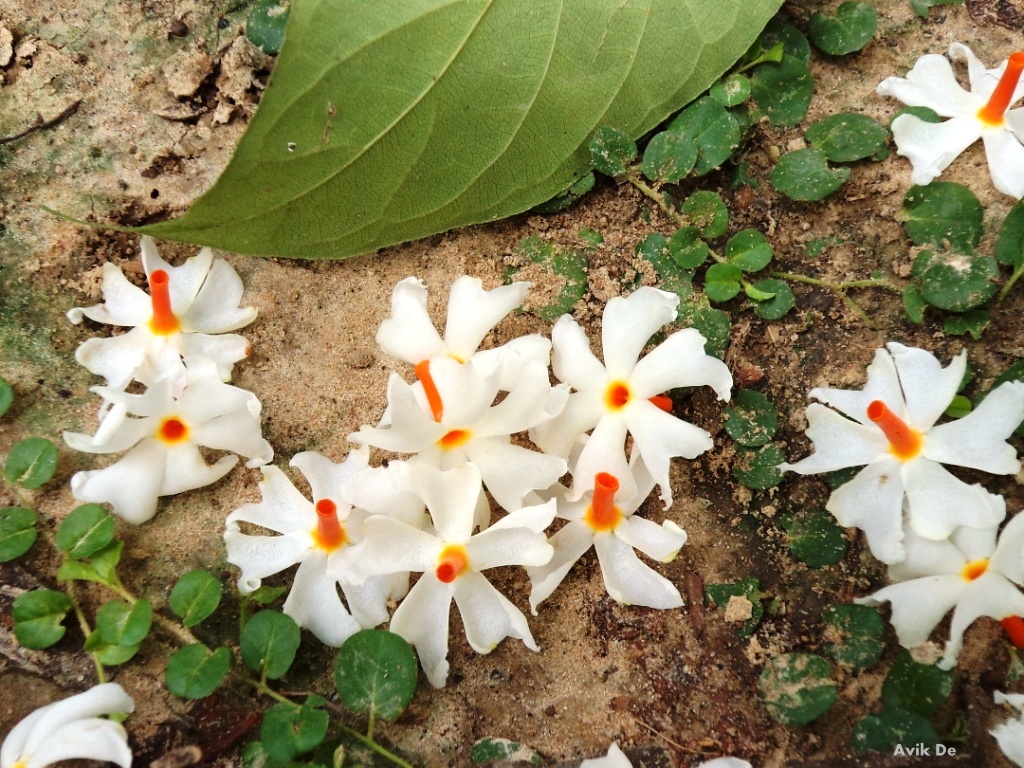
The King’s garden was flush with blooms of bakul,
Parul and rajanigandha.
From afar, wafting with the draft
Was the mesmerising timbre of a flute.
The city was empty as everyone had left for
The festival of flowers in the honeyed woods.
The full moon smiled at the town
Emptied of people and protectors.
On the lonely moonlit path,
The sanyasi walked alone
Under leafy branches, from where
Cuckoos cooed repeatedly —
After so many days, was it time for him
To fulfil his tryst with the beloved?
Crossing the town, the wise one
Went beyond the city walls.
He stood beside the moat —
In the shade of the mango grove,
Who was that young woman
Lying near his foot?
Her body was blistered with sores
From a deadly disease —
As she darkened with the blight,
The citizens threw her out
Beyond the city moat, fearing the
Poison within her.
The sanyasi sat down by her.
And put her stiff head on his lap —
He poured water into her chapped lips,
He chanted a mantra on her head,
Covered her body with a soothing
Cool sandal paste.
Bakul blooms were falling, the cuckoos were calling,
The night was filled with moonlight.
“Who are you, o compassionate soul?”
The woman asked. The sanyasi replied,
“Tonight is that time. O Basabdatta,
I have come for our tryst.”
Sanyasi-- a monk or mendicant, in this case a Buddhist Bhikshu
Chaitra -- spring when the old year ends and new starts in the Bengali Calendar.
Tagore had translated this poem in English for a collection called Fruit-Gathering, brought out in 1916 by Macmillan. The eighty-six translated poems by Tagore in this edition were from a few selected collections in Bengali: Gitimala, Gitali, Utsarga, Kheya, Naivedya, Gitanjali,Katha and Balaka.
1916 edition of Macmillans’ Fruit-Gathering
(This poem has been translated for Borderless Journal by Mitali Chakravarty and edited by Sohana Manzoor and Anasuya Bhar.)
.
PLEASE NOTE: ARTICLES CAN ONLY BE REPRODUCED IN OTHER SITES WITH DUE ACKNOWLEDGEMENT TO BORDERLESS JOURNAL
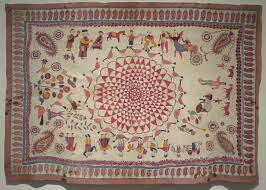
Rabindranath’s introduction to his correspondence with Nirmalkumari Mahalanobis and a few letters dealing with death, his sense of loss on the death of a favourite and about his encounter with a German anthropologist, translated by Somdatta Mandaland included as a part of Kobi &Rani
Title: ‘Kobi’ and ‘Rani’: Memoirs and Correspondences of Nirmalkumari Mahalanobis and Rabindranath Tagore
The earth expresses itself by moving in two ways. One is by rotating by itself, and the other through a larger movement by going around the sun. In the earth’s yearly cycle, we see the change of seasons, and different kinds of fruits and crops fill up the granary of man. Its diurnal course results in the play of light and shade on land and water, the change of nature’s moods in the sky, the play of colours every morning and evening on the horizon; different tones of voices between waking up and going to sleep.
These two different movements can be compared with two kinds of literature – first the ordinary one meant for the general public and the other, more intimate, one, that of letters. Usually ordinary literature draws a huge reading public, and moves far away from the limits of personal life to distant countries. By contrast, the literature of letters reveals the close periphery of a world known to the writer that includes shades of daily experience, its sights and sounds, and along with it, its instantaneous moods and feelings. At least, this is more or less true of the letters published in this series called ‘Patradhara.’
Most of the letters published under the title Chinnapatra in this ‘Patradhara’ series have been selected from the letters I wrote to my niece Indira. At that time, I was wandering around the villages of Bengal; every second different village scenes were startling my wayfaring mind with their new appearances, and these were getting reflected in the letters. Those who have the habit of always speaking quickly open their mouths whenever they find anything funny and interesting. Once we try to package and express within the form of literature, the emotions that arise within and change their nature. We are constantly confronting different things from all parts of the world but it is not worth broadcasting them through loudspeakers. The easiest way to retain them is by confronting known people behind the crowd.
The second set of letters in ‘Patradhara’ was written to a young girl. Most of them were written from Santiniketan so the moving pictures of life there constantly flow through them. In these letters we do not have any grave news; the childishness of that girl, who is innocent about domestic affairs, is reflected through a jovial atmosphere; and along with this is the writer’s jocular benevolence. There is no way in which a mature writer can express permanently all that can be said in an ordinary light-hearted way.
The third section of ‘Patradhara’ has been named Pathe O PatherPrante (On the Road and Beyond It). There is a story behind it. When I went to travel in Europe in 1926, I received invitations from various countries. During that period Rathindranath was sick and confined in a hospital in Berlin. So the responsibility for accompanying me fell on Prasanta Mahalanobis and his wife Rani who was also with him. Sometimes without speaking a single word and sometimes speaking too much, she took the entire responsibility upon her shoulders. She had to rectify all the problems that two inexperienced male travellers created while making proper arrangements for travel. Packing all our things, arranging them, keeping a count of the luggage and moving with them safely during our travels, coping with the sometimes careless and sometimes appropriate demands of the foreign authorities in those few months, Rani handled everything exceptionally well. I had been travelling in new railway coaches, ship’s cabins, living in hotel rooms, and at every step during these repeatedly changing situations, had been interacting with new people. By submitting all the unexpected problems to be resolved by her, I had shamelessly spent my days in peace while receiving a lot of care and nursing from her. At the end, when we completed our European tour and boarded a ship from a Greek port to go home, they kept on staying abroad. As I moved towards my homeland, I continued to keep our companionship alive through letters. Some of those letters, and also those written later, have now been collected here as the third series of ‘Patradhara.’ The constant debates going on all around regarding new experiences have also been expressed through these letters. But the value of narrating our European tour, which has not been published anywhere, is enormous.
All the thoughts that go on within the mind and want to be expressed in our writings remain alive till death. But in our mental life the flow of ideas that are expressed in perpetual motion reach a saturation point at a certain period of time. When the mind is full, then apart from the essential words, a lot is left as excess. Those who love to socialize express those excess words in gatherings, those who are introverted express their feelings in their diaries, and people like me who like to write express their thoughts to someone for whom the road to writing is easily open through letters. In the end as one keeps on moving in time, the excess of emotions reaches its nadir and the mind reaches such a state that the urge to write dies. Today I have reached that point of time in my life when I am silent. I have crossed that stage when I wrote letters voluntarily, with some of them strewn about unnecessarily like multi-coloured shells and snails on a sea beach. I see them from a distance just like the inquisitive vision of external readers. The present mind which rarely speaks now is feeling envious of those times when emotions would rush out incessantly; of course some joyous moments also accompanied them. When grains ripen, it becomes time to gather them and put them inside the barn. Today I could like to gather the harvest from that season which was full of words.
Rabindranath Tagore
May/June 1938
Letter 4
I had thought that I would post your letter when the ship halted at Aden. Now I received the news that the ship will not halt anywhere between Suez and Colombo. So I am thinking of writing a little more.
The thought of death is not leaving my mind. In our world we are somehow connected to one another through our different selves, sometimes deeply and sometimes lightly. All of those are included in my life. I am not reluctant regarding anything in this world; this means I live quite intensively. But the more life is extended, the more happiness and sorrow also occur. The arrows of death find greater space to come and hurt you if your heart is extended. The true worship of life is immortality, which means living in a way that is beyond death. On many occasions the indifference that arises upon the death of someone you love means that the soul is hurt: it then wants to desert everything and live within something that does not erode or dissolve. I find this same message in the first chapter of my father’s life story. When death confronts life, it asks this question: “Is there anything left inside after what I have taken away? If nothing is left, then you are completely befooled.” Life wants life; it does not want to be cheated by death in any way. Once it clearly understands that it has been cheated, in an instant it eagerly states, “Something that cannot fetch me immortality is of no use to me.” Man says this so many times and forgets it so often.
Yours,
7 December 1926.
Letter 6
I cannot forget Santosh[1]. I think of my own life – I have been living for such a long time – how I have experienced sadness and happiness, hopes and desires, trials and pursuits, and how I have passed through so much difficult historical terrain. Compared to this, Santosh’s life was so limited. His life ended just after he had completed his youth. Even then, the picture of his life is clearly expressed. It is without any excitement but not meaningless. There are so many people all around us who are in service, who are running a household, but all of that is meaningless. Their days pass by in a heap – one upon the other. But taken together they don’t form a clear shape. Santosh’s life was not as formless as that. I remember how he came back some time ago after completing his education in America. He came and created his own space at Santiniketan. There are many other teachers working here. They work just as they would do elsewhere and some work maybe a little bit more than that. But with all the respect in his young heart, Santosh established himself with his entire life. Of course there was the necessity of earning his livelihood but his spiritual connection was stronger. The work we do every day for our personal necessities does not have any excess; it gets absorbed within itself and ends there. But Santosh associated his own life with a mission that was beyond his personal needs. I had very clearly seen the results of it because he led a simple, transparent and respectful life without excesses. But if I knew Santosh only from the work he did, then I would be mistaken. I knew him with my entire vision. It is not that the entire vision is sometimes deformed by love: it achieves a wholeness as well. My intelligence does not disregard the proofs, but my strength of vision also respects his direct sense of responsibility. Sometimes there is a conflict between these two and then the mystery becomes very difficult and sad. This dichotomy is present in the idea of death itself – our heart simply does not want to accept it as the extreme. But there is no end to the opposite proofs– the tug of war between the two makes this so extremely painful. My poem “Jete nahi dibo” (“I won’t let you go”) is one of such pain.
Today on behalf of all the middle class passengers of the ship, a white man had come to me with a request. They want to hear something from me this afternoon. I would not have suddenly agreed to this request if they had been first class passengers, but the egos of the second class passengers are much lighter. We can see human beings in them. Now it is almost time to go there.
Letter 7
Today is our fourth day on the ocean. We will reach Colombo on the morning of the 16th. But I will not have the peace of returning home. The long train journey is divided into many sections. Also, what Pupe[2] has now learnt to call “malpatro” (luggage), is great in number. They are large in volume and the containers are in a pitiable condition. There are some boxes which right from the beginning of the journey have permanently lost contact with their keys and there is no way out except to be tied up with strings. There are some boxes which have had their whole bodies damaged by being hit constantly; some other boxes look like patients who have eaten too much and are waiting to vomit and feel relieved. But Rathi is sympathetic towards them – he treats them like patients in a hospital on the battlefield. Whatever it may be, we are still travelling towards our country, and dark and deep greenery seems to be visible on the last leg our journey. Here the sky is full of beneficial sunshine just as it is in our own country. The moon is growing fuller day by day; I can visualize it swinging through the leaves of the sal trees murmuring in the wind. I imagine depositing the entire load of my stay abroad at the entrance of Uttarayan[3] and then quickly resuming the willing sojourns of my mind. But alas, I also know for sure that we do not reside in heaven and that wherever I go, after pushing my way forth after the desires of many other people, I have only a narrow path left for fulfilling my own desires. The only minor advantage is that, in spite of the path being narrow, I have trodden on it for a long time and have become used to it. In spite of the crowd, it is somewhat possible to walk there on your own.
Among our fellow passengers, there is a German anthropologist who is going to India along with his wife.[4] He has heard the name of our professor. He told me, “I have heard that he is a professor of physics. So I understand that he researches the mathematical side of anthropology; we are working on the human side.” What he means by the human side can be understood by his diligence. He is going to collect information about the wild and tribal communities in south and central India. Much of their lifestyle is still unknown and difficult to know; I have not even heard their names. They live discreetly in very difficult terrain. He wants to enter their territory in a latent or concealed manner in case they are afraid and suspect him. He does not want to live in a tent and instead has taken a sack to spend the nights in. There are snakes, wild animals, and the chance of falling sick due to an irregular routine and unhealthy food. In other words, he is taking a risk with his life. They have left their small child under the care of relatives. His wife has accompanied him on this trip in case he falls sick in the jungle. In the meantime, in order to expedite her husband’s work, she is preparing notes throughout the day with the help of maps and books. The people for whom they are willingly prepared to undergo hardship and to overlook all sorts of danger are not their relatives, nor are they civilized. Except for information about the human race there is no precious object to be recovered from them. These people have ventured to open the doors of information of the whole world, and we are rolling ourselves on torn mats by lying down on the mud floor of the earth. It is best to leave this space for them — God has sent many messengers to clear it up.
About the book: Pathe O Pather Prante (On the Road and Beyond It) included in ‘Kobi’ and ‘Rani’: Memoirs and Correspondences of Nirmalkumari Mahalanobis and Rabindranath Tagore.
Rabindranath Tagore was a prolific letter writer and Rani Mahalanobis is the only person to whom he wrote more than five hundred letters, the maximum number written to any individual person. In 1938, in the third volume of the series entitled “Patradhara”[5], Rabindranath selected sixty letters written at different periods of time to her. This he titled Pathe O Pather Prante and it was published from Visva-Bharati Publications Department in Kolkata.
Incidentally, we find the first ten letters of this series as a supplement to the narrative where Rani’s memoir Kobir Shonge Europey ends in 1926. Since it was published much later, Rani has also included some of these letters in her memoir. The rest of the letters selected from those written up to 1938 describe various moods of the Poet for a period of twelve years. They include philosophical musings, his observations on the changing of seasons, news about the incidents and functions taking place in Santiniketan during Rani’s absence, and especially his views on his new-found interest in sketching and painting. In other words, unlike those written to Indira Devi and Ranu Adhikari, these letters are interesting because they cover multifarious topics and issues and reveal the Poet’s tone of intimacy with Rani. As per Prashantakumar Pal’s biography,
Rani Mahalanobis used to suffer from a sort of non-infectious tuberculosis, so for her fever was almost a regular affair. Naturally Rabindranath would get worried – he would suggest different medicines – and write innumerable long letters, which according to him would help Rani forget some of her physical ailments. (Rabijibani, vol.IX, p.297. Translation mine)
The sixty letters included in this volume also vary in length. Some are quite short, while others are lengthy. Again some of the letters are dated with the Bengali month and year, whereas others are dated according to the English calendar. A few of the letters do not have any dates at all. Also some of them seem quite sketchy, and do not have the usual beginning, middle or end. The reason for this becomes clear when we get to know that Tagore had drastically edited several sections of these letters, especially places which revealed his innermost self.
About the Author
Rabindranath Tagore (1861 to 1941) was a brilliant poet, writer, musician, artist, educator – a polymath. He was the first Nobel Laureate from Asia. His writing spanned across genres, across global issues and across the world. His works remains relevant to this day.
About the translator
Somdatta Mandal is Former Professor of English at Visva-Bharati University, Santiniketan, India. A recipient of several prestigious fellowships and awards, her areas of interest are American Literature, contemporary fiction, film and culture studies, Diaspora studies and translation. She has edited three volumes of travel writing —Indian Travel Narratives (2010), Journeys: Indian Travel Writing (2013), and Indian Travel Narratives: New Perspectives (2021) and has translated from Bengali to English different kinds of Indian travelogues, with special focus on men and women in colonial times. Among them are: The Westward Traveller by Durgabati Ghose (2010), Wanderlust: Travels of the Tagore Family (2014), which records vignettes of travel by nineteen members of the Tagore family spanning more than 150 years, A Bengali Lady in England by Krishnabhabini Das, which is the first woman’s travel narrative from Bengal published in 1885(2015), Crossing Many Seas(2018) by Chitrita Devi, Gleanings of the Road (2018) by Rabindranath Tagore, and The Journey of a Bengali Woman to Japan and Other Essays (2019) by Hariprabha Takeda. Two other translated volumes on Rabindranath Tagore have been published recently, ‘Kobi’ and ‘Rani’: Memoirs and Correspondences of Nirmalkumari Mahalanobisand Rabindranath Tagore (2020) and The Last Days of Rabindranath Tagore in Memoirs (2021).
[1] Santosh Chandra Majumdar was the eldest son of Rabindranath Tagore’s friend Shrish Chandra Majumdar. After passing his entrance examination along with Rathindranath, he went to America and upon returning in 1910 joined the Brahmacharyashram in Santiniketan on a monthly salary of two hundred Rupees. He actively took part in teaching, sports arrangements and hospitality of the guests. He served both Tagore and his institution wholeheartedly till his death in October 1926. Rabindranath received the news of Santosh’s untimely death after reaching Aden.
[2]Pupe or Pupu was the pet name of Nandini, the adopted daughter of Rathindranath.
[3]One of the houses in which the poet lived at Santiniketan.
[4]The name of this anthropologist was Christoph Von Furer Heimendorf. He stayed in Hyderabad and South India for a long time to carry out research on remote backward tribes. Later he became famous for it. See Prabhat Kumar Mukhopadhyay, Rabindrajiboni Vol.III, p. 293.
[5]The first volume consisted of selected letters written to his niece Indira Devi when he was wandering around the villages of Bengal and was titled “Chinnapatra”. The second set of letters was written from Santiniketan to a young girl named Ranu Adhikari.
.
PLEASE NOTE: ARTICLES CAN ONLY BE REPRODUCED IN OTHER SITES WITH DUE ACKNOWLEDGEMENT TO BORDERLESS JOURNAL
Romanticised by writers and artists over time, freedom has been variously interpreted. There is the freedom of birds that fly, of the clouds that float across the connecting blue skies, of the grass that grows across manmade borders, of the blood that flows to protect the liberty of confines or constructs drawn by man, the river that gurgles into the ocean, of the breeze that blows.
The many-splendored interpretations of freedom and its antitheses in Borderless journal are presented here for you to ponder … tell us what you think. Can freedom come without responsibility or a tryst with circumstances?
Exploring the freedom from bondages of education social norms and more, this story has been translated by Radha Chakravarty from Bengali. Clickhere to read.
Born free
As free as the wind blows
As free as the grass grows
Born free to follow your heart
-- Born Free by Andy Williams
These are lines from a song by Andy Williams, a pop icon whose song was the theme song in Born Free, a film made in 1966 about a lion cub bred in captivity, who had to be trained to live free even though she was born free. Does that apply to all living creatures, including humans? What is freedom? And who is free? Does political independence mean ultimate freedom?
We celebrate political ‘freedom’ of countries as national or independence days. Sometimes, as in the case of India and Pakistan, independent nationhood can be laced with bloodshed and grief . Two new countries were born of a single colonial India in the August of 1947. Pakistan awoke as a country on the midnight of 14th August and India called the late hour 15th August. Nehru’s speech has become an iconic one: “Long years ago we made a tryst with destiny, and now the time comes when we shall redeem our pledge… At the stroke of the midnight hour, when the world sleeps, India will awake to life and freedom…”
Lord & Lady Mountbatten with Nehru on 15th August 1947
Lord & Lady Mountbatten with Jinnah and his sister, Fatima, 14 August 1947.
Lord Mountbatten was the last Viceroy of colonial India. Courtesy: Creative Commons
Common people while crossing the boundary line between the two new nations lost their lives, homes and lands over the mob violence. The resentment still simmers in a few hearts. In an attempt to find peace and amity, we have put forward a combined selection of writing from across borders, words devoid of angst or hate, words that look for commonality and harmony.
In Conversation with Goutam Ghose, multiple award-winning filmmaker, writer, actor discusses his films, film-books and journey as a humanitarian artiste who makes cross cultural films across all boundaries. Click here to read.
In The Idea of India: Bharata Bhagya Bidhata – The Making of a MotherlandAnasuya Bhar explores the history around the National Anthem of India which started as a song, composed by Tagore. Only the first paragraph of the whole song in Bengali was adapted as the National Anthem. We include the translations of the complete song both by Tagore and by Aruna Chakravarti. Click here to read.
In An August Account of ‘Quit India’ MovementRatnottama Sengupta, translates from Bengali the excerpts recorded by Sandhya Sinha (1928-2016), who witnessed an upsurge in the wake of the Quit India Movement. Click here to read.
In Seventy-four Years After Independence…“Mil ke rahe gi Azadi”(We will get our Freedom), Aysha Baqir muses on Pakistani women’s role in the independence movement and their current state. Click here to read.
In 2147 without Borders, Devraj Singh Kalsi meanders over Partitions, borders and love stories and looks for an amicable solution in a happier future. Click here to read.
Fiction
Bundu, Consoler of the Rich is a story based on memories of Partition by Nadir Ali, translated from Punjabi by Amna Ali. Click here to read.
In The Best Word, Maliha Iqbal explores the impact of wars in a spine chilling narrative, journeying through a range of emotions. Click here to read.
In Do Not Go!, Moazzam Sheikh explores dementia, giving us a glimpse of the lives of Asian immigrants in America. Click here to read.
In The Chained Man Who Wished to be Free, Sunil Sharma explores freedom and democracy versus conventions. We are left wondering is this the freedom we fought for? Click here to read.
Goutam Ghose, multiple award-winning filmmaker, writer, actor discusses his films, film-books and journey as a humanitarian artiste. Click here to read.
DrKirpal Singh, a well-known poet and academic from Singapore, talks of his life and times through colonial rule, as part of independent Malaya, and the current Singapore. Click here to read.
Ratnottama Sengupta translates from Bengali the excerpts recorded by Sandhya Sinha (1928-2016), who witnessed an upsurge in the wake of the Quit India Movement, part of India’s struggle against colonial rule. Click here to read.
‘Tran’by Tagore translated from Bengali to English by Mitali Chakravarty, art and editing by Sohana Manzoor for Borderless Journal. Click here to read.
Anasuya Bhar explores the history of the National Anthem of India, composed by Tagore in Bengali and translated only by the poet himself and by Aruna Chakravarti. Click here to read.
John Herlihy explores the magnificent sites of Mandalay in company of a Slovenian friend in the first episode of his quartet on his Myanmar. Click here to read.
Bhaskar’s Corner
In Tagore & Odisha, Bhaskar Parichha explores Tagore’s interactions with Odisha, his impact on their culture and the impact of their culture on him. Click here to read
“Mil ke rahe gi Azadi”(We will get our Freedom) by Aysha Baqir muses on Pakistani women’s role in the independence movement and their current state. Click here to read.
Beyond The Himalayas by Goutam Ghose, based on a five-part documentary taking us on a journey along the silk route exploring parts of Pakistan and China. Click here to read.
On August 8th 2021, the chief of the International Olympic Committee, Thomas Bach, pointed out during the closing ceremony that these games were “unprecedented” and brought messages of “hope, solidarity and peace” into a world torn with the desolation generated by the pandemic. It was a victory of the human spirit again, a precursor of what is to come. That the Japanese could get over their pandemic wrought hurdles, just as they did post the nuclear disasters wrought by the Second World War and by the 2011 earthquake-tsunami at Fukushimaya, to host something as spectacular and inspiring as these international games reflects, as the commentators contended, a spirit of ‘harmony and humility’. The last song performed by many youngsters seemed to dwell on stars in the sky — not only were the athletes and organisers the stars but this also reminded of unexplored frontiers that beckon mankind, the space.What a wonderful thing it was to see people give their best and unite under the banner of sports to bring messages of survival and glimpses of a future we can all share as human beings! Our way of doing things might have to evolve but we will always move forward as a species to thrive and expand beyond the known frontiers.
One such explorer of yet unknown frontiers who mingles the historic with the contemporary, Goutam Ghose, an award-winning filmmaker and writer, has honoured our pages with an extensive interview showing us how art and harmony can weave lores that can help mankind survive. This is reinforced by the other interview with Singaporean academic, Dr Kirpal Singh, whose poetry reflects his convictions of a better world. With our intelligence, we can redefine processes that hold us back and grind our spirits to dust — be it the conventional ‘isms’ or norms that restrict our movement forward – just as Tagore says in the poem, we have translated this time, ‘Deliverance’.
…On this auspicious dawn,
Let us hold our heads high in the infinite sky
Amidst the light of bounteousness and the heady breeze of freedom.
As the Kobiguru mentioned earlier in the poem, the factors that oppress could be societal, political, or economic. Could they perhaps even be the fetters put on us by the prescribed preconceived definition of manmade concepts like ‘freedom’ itself? Freedom can be interpreted differently by multiple voices.
This month, on our pages, ‘freedom’ has found multiple interpretations in myriad of ways — each voice visualising a different dream; each dream adding value to the idea of human progress. We have discussions and stories on freedom from Nigeria, Argentina, India, Pakistan, Myanmar, Malaysia and more. Strangely enough, August holds multiple independence/ national days that are always for some reason seen as days of being ‘freed’ by many — at least from oppression. But is that true?
From Malaysia, Julian Matthews and Malachi Edwin Vethamani cry out against societal, religious and political bindings – quite a powerful outcry at that with a story and poems. Akbar Barakzai continues his quest with three poems around ideas of freedom translated from Balochi by Fazal Baloch. Jaydeep Sarangi and Joan Mcnerny pick up these reverberations of freedom, each defining it in different ways through poetry.
Jared Carter takes us back to his childhood with nostalgic verses. Ryan Quinn Flanagan, Michael Lee Johnson, Vandana Sharma and many more sing to us with their lines. Rhys Hughes has of course humour in verse that makes us smile as does Jay Nicholls who continues with her story-poems on Pirate Blacktarn – fabulous pieces all of them. The sport of hummingbirds and cats among jacaranda trees is caught in words and photographs by Penny Wilkes in her Nature’s Musings. A poetic tribute to Danish Siddiqui by young Sutputra Radheye rings with admiration for the Pulitzer prize-winning photographer who met his untimely end last month on 16th while at work in Afghanistan, covering a skirmish between Taliban and Afghanistan security forces. John Linwood Grant takes up interesting issues in his poetry which brings me back to ‘freedom’ from colonial regimes, perhaps one of the most popular themes for writers.
Indo-Pak independence, celebrated now on 14th (Pakistan) and 15th August (India), reflects not only the violence of the Partition which dislocated and killed millions historically but also the trauma caused by the event. Capturing this trauma is a short story based on memories of Partition by Nadir Ali, translated from Punjabi by his daughter, Amna Ali. Ratnottama Sengupta translates from the diary of Sandhya Sinha (1928-2016), a woman’s voice from the past that empathises with the subjugated who were subdued yet again after an upsurge of violence during the Quit India Movement (1942) against the colonials. Sinha contends that though the movement frittered away, the colonials were left with an after-taste of people hankering for self-rule. A thought-provoking short story by Sunil Sharma explores the results of self-rule in independent India.
Alluding to Jinnah’s vision for women, Aysha Baqir muses emotionally about the goals that remain yet to be fulfilled 74 years after independence. Moazzam Sheikh’s story of immigrants explores dementia, giving us a glimpse of the lives of Asian immigrants in America, immigrants who had to find a new home despite independence. Was this the freedom they dreamt of — all those who fought against various oppressive regimes or colonialism?
Tagore’s lyrics might procure a few ideas on freedom, especially in the song that India calls its National Anthem. Anasuya Bhar assays around the history that surrounds the National Anthem of India, composed by Tagore in Bengali and translated to English by the poet himself and more recently, only by Aruna Chakravarti. We also carry Dr Chakravarti’s translation of the National Anthem in the essay. Reflecting on the politics of Partition and romance is a lighter piece by Devraj Singh Kalsi which says much. ‘Dinos in France’ by Rhys Hughes and Neil Reddick’s ‘The Coupon’ have tongue-in-cheek humour from two sides of the Atlantic.
A coming-of-age story has been translated from Nepali by Mahesh Paudyal – a story by a popular author, Dev Kumari Thapa – our first Nepali prose piece. We start a four-part travelogue by John Herlihy, a travel writer, on Myanmar, a country which has recently been much in the news with its fight for surviving with democracy taking ascendency over the pandemic and leaving the people bereft of what we take for granted.
Candice Louisa Daquin discusses a life well-lived in a thought provoking essay, in which she draws lessons from her mother as do Korean poet, Ihlwha Choi, and Argentinian writer, Marcelo Medone. Maybe, mothers and freedom draw similar emotions, of blind love and adulation. They seem to be connected in some strange way with terms like motherland and mother tongue used in common parlance.
We have two book excerpts this time: one from Beyond the Himalayas by the multi-faceted, feted and awarded filmmaker we have interviewed, Goutam Ghose, reflecting on how much effort went in to make a trip beyond boundaries drawn by what Tagore called “narrow domestic walls”. We carry a second book excerpt this time, from Jessica Muddit’s Our Home in Myanmar – Four years in Yangon. Keith Lyons has reviewed this book too. If you are interested in freedom and democracy, this sounds like a must read.
Maithreyi Karnoor’sSylvia: Distant Avuncular Ends,is a fiction that seems to redefine norms by what Rakhi Dalal suggests in her review. Bhaskar Parichha has picked a book that many of us have been curious about, Arundhathi Subramaniam’s Women Who Wear Only Themselves. Parichha is of the opinion, “Elevated or chastised, exonerated or condemned, the perturbation unworldly women in India face is that they have never been treated as equal to men as spiritual leaders. This lack of equality finds its roots not only in sociological and cultural systems, but more particularly at the levels of consciousness upon which spirituality and attitudes are finally based.”One wonders if this is conclusive for all ‘unworldly women’ in India only or is it a worldwide phenomenon or is it true only for those who are tied to a particular ethos within the geographical concept of India? The book reviewed by Meenakshi Malhotra, Somdatta Mandal’s The Last Days of Rabindranath Tagore in Memoirs, dwells on the fierce independence of the early twentieth century women caregivers of the maestro from Bengal. These women did not look for approval or acceptance but made their own rules as did Jnadanandini, Tagore’s sister-in-law. Bhaskar Parichha has also added to our Tagore lore with his essay on Tagore in Odisha.
As usual, we have given you a peek into some of our content. There is more, which we leave for our wonderful readers to uncover. We thank all the readers, our fantastic contributors and the outstanding Borderless team that helps the journal thrive drawing in the best of writers.
I wish you all a happy August as many of the countries try to move towards a new normal.