The year 2023 seemed to have been hard on all of us. Wars in the post-pandemic world, weapons and armies that destroy innocent civilian lives have taken the centre stage, vying with climate disasters, refugees, senseless shootings and unrest. Amidst this gloom and doom, we need hope — a gleam of light to help us find solutions towards a peaceful world. Let us give the newborn 2024 a fair chance towards its own wellbeing with cheer and laughter. Let’s laugh away our troubles and find the inner strength to move forward towards a better future where people live in harmony… perhaps to hum and recall Paul Mc Cartney’s wise words in ‘Ebony and Ivory'(1982)…
We all know that people are the same wherever you go
There is good and bad in ev'ryone
We learn to live, when we learn to give
Each other what we need to survive, together alive
....
Amidst this wave of conflict,
In the haze of the games you script,
            I will swing towards my own dream.

            Let the breeze blow off the lamplight,
            Let storms thunder in the sky —
Every moment in my heart,
I can sense your footfall.
             In darkness, I strive to find my stream.
In that spirit, we look inward not just to find our dreams and materialise them, but also into the treasure chests of Borderless Journal to find writings that bring a smile to our lips. Tagore, translated by Fakrul Alam and Somdatta Mandal, leads the way as we start with humour and wonder in poetry and meander into a few prose pieces that evoke laughter, at times upending our current stream of thoughts or values. We move on to our three columnists, Rhys Hughes, Devraj Singh Kalsi and Suzanne Kamata, who bring laughter and uncover the nuances of the world around us on a monthly basis. Included also are the pieces by our travelling granny, Sybil Pretious, whose spirited travels prove that age is just a number. Capturing the spirit of diversity with a tinge of laughter, let us usher in the new year to a more hopeful and sturdy start.
Poetry
Giraffe’s Dad by Tagore: Giraffer Baba (Giraffe’s Dad), a short humorous poem by Tagore, has been translated from Bengali by Professor Fakrul Alam. Click here to read.
Humbled by a Pig: Farouk Gulsara meets a wild pig while out one early morning and muses on the ‘meeting’. Click here to read.
Leo Messi’s Magic Realism: Sports fan Saurabh Nagpal explores the magic realism in famous footballer Messi’s play with a soupçon of humour. Clickhere to read.
I am a Jalebi: Arjan Batth tells us why he identifies with an Indian sweetmeat. Click here to read why.
A Day at Katabon Pet Shop , a short story set amidst the crowded streets of Dhaka, by Sohana Manzoor. Click here to read.
A conversation with the author,Afsar Mohammed, and a brief introduction to his latest book, Remaking History: 1948 Police Action and the Muslims of Hyderabad. Click hereto read.
A conversation with Meenakshi Malhotra over The Gendered Body: Negotiation, Resistance, Struggle, edited by Meenakshi Malhotra, Krishna Menon and Rachana Johri and a brief introduction to the book. Click hereto read.
In His Unstable Shape, Rhys Hughes explores the narratives around a favourite nursery rhyme character with a pinch of pedantic(?) humour. Click here to read.
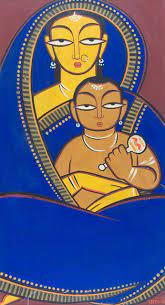
Mother & Child by Jamini Roy (1887-1972)Mother and Child by Picasso (1881-1973)
‘Victory to Man, the newborn, the ever-living.’ They kneel down, the king and the beggar, the saint and the sinner, the wise and the fool, and cry: ‘Victory to Man, the newborn, the ever-living.’
This is the month— the last of a conflict-ridden year— when we celebrate the birth of a messiah who spoke of divine love, kindness, forgiveness and values that make for a better world. The child, Jesus, has even been celebrated by Tagore in one of his rarer poems in English. While we all gather amidst our loved ones to celebrate the joy generated by the divine birth, perhaps, we will pause to shed a tear over the children who lost their lives in wars this year. Reportedly, it’s a larger number than ever before. And the wars don’t end. Nor the killing. Children who survive in war-torn zones lose their homes or families or both. For all the countries at war, refugees escape to look for refuge in lands that are often hostile to foreigners. And yet, this is the season of loving and giving, of helping one’s neighbours, of sharing goodwill, love and peace. On Christmas this year, will the wars cease? Will there be a respite from bombardments and annihilation?
We dedicate this bumper year-end issue to children around the world. We start with special tributes to love and peace with an excerpt from Tagore’s long poem, ‘The Child‘, written originally in English in 1930 and a rendition of the life of the philosopher and change-maker, Vivekananda, by none other than well-known historical fiction writer, Aruna Chakravarti. The poem has been excerpted from Indian Christmas: Essays, Memoirs, Hymns, an anthology edited by Jerry Pinto and Madhulika Liddle, a book that has been reviewed by Somdatta Mandal and praised for its portrayal of the myriad colours and flavours of Christmas in India. Christ suffered for the sins of humankind and then was resurrected, goes the legend. Healing is a part of our humanness. Suffering and healing from trauma has been brought to the fore by Christopher Marks’ perspective on Veronica Eley’s The Blue Dragonfly: healing through poetry. Basudhara Roy has also written about healing in her take of Kuhu Joshi’s My Body Didn’t Come Before Me.Bhaskar Parichha has reviewed a book that talks of healing a larger issue — the crises that humanity is facing now, Permacrisis: A Plan to Fix a Fractured World, by ex-British Prime Minister Gordon Brown, Nobel Laureate Michael Spence, Mohamed El-Erian and Reid Lidow. Parichha tells us that it suggests solutions to resolve the chaos the world is facing — perhaps a book that the world leadership would do well to read. After all, the authors are of their ilk! Our book excerpts from Dr Ratna Magotra’s Whispers of the Heart – Not Just A Surgeon: An Autobiographyand Manjima Misra’s The Ocean is Her Titleare tinged with healing and growth too, though in a different sense.
The theme of the need for acceptance, love and synchronicity flows into our conversations with Afsar Mohammad, who has recently authored Remaking History: 1948 Police Action and the Muslims of Hyderabad. He shows us that Hyderabadi tehzeeb or culture ascends the narrow bounds set by caged concepts of faith and nationalism, reaffirming his premise with voices of common people through extensive interviews. In search of a better world, Meenakshi Malhotra talks to us about how feminism in its recent manifestation includes masculinities and gender studies while discussing The Gendered Body: Negotiation, Resistance, Struggle, edited by her, Krishna Menon and Rachana Johri. Here too, one sees a trend to blend academia with non-academic writers to bring focus on the commonalities of suffering and healing while transcending national boundaries to cover more of South Asia.
That like Hyderabadi tehzeeb, Bengali culture in the times of Tagore and Nazrul dwelled in commonality of lore is brought to the fore when in response to the Nobel laureate’s futuristic ‘1400 Saal’ (‘The year 1993’), his younger friend responds with a poem that bears not only the same title but acknowledges the older man as an “emperor” among versifiers. Professor Fakrul Alam has not only translated Nazrul’s response, named ‘1400Saal’ aswell, but also brought to us the voice of another modern poet, Quazi Johirul Islam. We have a self-translation of a poem by Ihlwha Choi from Korean and a short story by S Ramakrishnan in Tamil translated by T Santhanam.
Our short stories travel with migrant lore by Farouk Gulsara to Malaysia, from UK to Thailand with Paul Mirabile while chasing an errant son into the mysterious reaches of wilderness, with Neeman Sobhan to Rome, UK and Bangladesh, reflecting on the Birangonas (rape victims) of the 1971 Bangladesh Liberation war, an issue that has been taken up in Malhotra’s book too. Sobhan’s story is set against the backdrop of a war which was fought against linguistic hegemony and from which we see victims heal. Sohana Manzoor this time has not only given us fabulous artwork but also a fantasy hovering between light and dark, life and death — an imaginative fiction that makes a compelling read and questions the concept of paradise, a construct that perhaps needs to be found on Earth, rather than after death.
The unusual paradigms of life and choices made by all of us is brought into play in an interesting non-fiction by Nitya Amlean, a young Sri Lankan who lives in UK. We travel to Kyoto with Suzanne Kamata, to Beijing with Keith Lyons, to Wayanad with Mohul Bhowmick and to Langkawi with Ravi Shankar. Wendy Jones Nakanishi argues in favour of borders with benevolent leadership. Tongue-in-cheek humour is exuded by Devraj Singh Kalsi as he writes of his attempts at using visiting cards as it is by Rhys Hughes in his exploration of the truth about the origins of the creature called Humpty Dumpty of nursery rhyme fame.
Poetry again has humour from Hughes. A migrant himself, Jee Leong Koh, brings in migrant stories from Singaporeans in US. We have poems of myriad colours from Ryan Quinn Flanagan, Patricia Walsh, John Grey, Kumar Bhatt, Ron Pickett, Prithvijeet Sinha, Sutputra Radheye, George Freek and many more. Papia Sengupta ends her poem with lines that look for laughter among children and a ‘life without borders’ drawn by human constructs in contrast to Jones Nakanishi’s need for walls with sound leadership. The conversation and dialogues continue as we look for a way forward, perhaps with Gordon Brown’s visionary book or with Tagore’s world view of lighting the inner flame in each human. We can hope that a way will be found. Is it that tough to influence the world using words? We can wish — may there be no need for any more Greta Thunbergs to rise in protest for a world fragmented and destroyed by greed and lack of vision. We hope for peace and love that will create a better world for our children.
As usual, we have more content than mentioned here. All our pieces can be accessed on the contents’ page. Do pause by and take a look. This bumper issue would not have been possible without the contribution of all the writers and our fabulous team from Borderless. Huge thanks to them all and to our wonderful readers who continue to encourage us with their comments and input.
Here’s wishing you all wonderful new adventures in the New Year that will be born as this month ends!
In conversation with Meenakshi Malhotra and a brief introduction to The Gendered Body: Negotiation, Resistance, Struggle (Scopus Index), edited by Meenakshi Malhotra, Krishna Menon and Rachana Johri, published by Routledge
Dr Meenakshi Malhotra
Why would one half of the world population be seen as evolved from the rib of the first man, soulless or as merely subservient to fulfil the needs of the other half? This is a question that has throbbed for centuries in the hearts of that half that suffers indignities to this date, women. While feminism became a formalised idea only in the 18th-19th century and things started improving for certain groups of women around the world, in some regions, like Afghanistan, the situation has deteriorated in recent years. Their government, recognised by world leadership, has ensured that women do not have schooling, cannot work in senior positions, have to be accompanied by men if they go out and remain covered as the feminine body could tempt bringing shame, strangely, to the female but not to the man who has the right to be tempted and hence to violence and violate her body and her mind.
Given this ambience, any literature voicing protest for patriarchal mindsets that accept situations like in current day Afghanistan passively, should be celebrated as an attempt to shard the silence of suffering by one half of the world population. The Gendered Body: Negotiation, Resistance, Struggle, edited by three academics, Meenakshi Malhotra, Krishna Menon and Rachana Johri, does just that. At the start, we are told: “This book situates the discourse on the gendered body within the rapidly transitioning South Asian socio-economic and cultural landscape. It critically analyzes gender politics from different disciplinary perspectives…”
Featuring 22 writers, the narratives take up a range of issues faced by women in Pakistan, India, Bangladesh and Srilanka. The Pakistani implementation of Islamic law, under the Hudood ordinances, has been addressed in a powerful essay by Aysha Baqir, subsequently by Anu Aneja, in her discourse on Urdu poetry. It was interesting to read how the ghazal form started as a male-only art form where women were depicted as mysterious houris or pining with sadness. Birangona — a phrase that was given to rape victims of the 1971 Bangladesh Liberation War — has been explored by Sohana Manzoor through a classic, Rizia Rahman’s novel, Rokter Okshor[1](1978), written about such women driven to prostitution. Women’s voices in the Sri Lankan LTTE have been explored by Simran Chaddha. Nayema Nasir has taken up decadent customs in the progressive Bohra community in Mumbai and shown how things are moving towards a change. Colonial and Dalit voices have found a hearing in Malhotra’s essay on Mahasweta Devi’s short story, ‘Draupadi’, set against the Naxalite movement of 1970s.
Dotted with women’s responses to a variety of current issues, including the Anti-CAA-NRC uprisings (Tamanna Basu), Shaheen Bagh (Meenakshi Gopinath, Krishna Menon, Rukmini Sen and Niharika Banerjea), and the pandemic (Krishna Menon, Deepti Sachdev and Rukmini Sen), there is even a case study by Shalini Masih dealing with psychiatric trauma where both the psychiatrist and the patient, who might have evolved into a stalker or a rapist without the therapy, heal. A certain sense of hope echoes through some of these narratives, a hope to heal from wounds that have sweltered over eons.
The flow of words is smooth and the ideas should be able to rise against the tide of erudition to touch our lives with lived realities. There are responses that transcend the heaviness of academic writing for instance the impassioned start made by Giti Chandra in her narrative: “A woman’s body is a story that men tell each other. When it is full-hipped, it is a tale of their healthy children; when it is fair, it speaks of their wealth; when it is narrow, it proclaims their access to gyms; and when it is tanned, it flaunts their ability to vacation on sunny isles. If its feet are not small enough to convey a leisure that does not require walking, they are bound and made smaller and more childishly submissive; if its legs are not long enough befitting its trophy status, bone-crippling heels are added to them. When it is raped it is an assertion of power, a chest-thumping; when it is raped it is an aggression over its owner; when it is raped its womb is stolen from the enemy…” Chandra points out some things that make one think, like quoting Rahila Gupta, she suggests victims is not the word we should use for women, but we should refer to the sufferers as survivors.
This collection of essays questions social norms and niceties to realise what early woman’s rights activist, Elizabeth Cady Stanton, drafted, that “all men and women [had been] created equal” in July 1848. While the struggle continues through centuries and the discourse of these narratives, the last essay by a man, Brijesh Rana, attempts to give a broader and more inclusive outlook to the whole human body. The book comes across as a tryst — of academic and feminist voices — to speak up for mankind to equalise.
To further understand the intent and scope of this book, we have in conversation one of the editors— Meenakshi Malhotra, who teaches gender studies and literature, has to her credit two Charles Wallace fellowships and a number of books. She reflects on the bridge that is being attempted between scholarship and activism.
How and when did you conceive this book? Tell us a bit about your journey from the conception to the publication of the book.
This book was originally conceived due to the positive response my co-editors and I received after presenting a panel at an American Association of Asian studies (AAS) conference back in 2017. We were approached by an international publisher who encouraged us to take forward the work with a focus on South Asia. We were unable to take it forward at that time, however we revived the project a few months into the lockdown in late 2020 when we felt we had a little more time. Also, along the way, we were able to reach out to fellow travellers, working in and on Pakistan, Bangladesh and Sri Lanka.
Three of you have collaborated to compile and edit this book. Collaborations to bring out books are not easy. Tell us about this collaboration.
As we three had presented on the same panel, the collaboration was a natural corollary since we had a sense of being fellow travellers and sister academics/scholars. That worked well for us because each of us were engaged in research and research guidance and wanted to showcase the recent work in this area. Both the co-editors, Krishna working on gender and its intersections with politics and Rachna on gender and psychology are very well-established scholars in the field of gender. I work on gender and literature, had my own network and I must mention that in the course of writing for Borderless Journal, I was able to access the work of others on that platform.
Explain to us the significance of the title of your book.
I think we arrived at the title through two processes-one was the immediate situation of Covid which left us in a state of precarity. However, we felt that even within the context of the contagion, women — and other genders — were endangered in specific ways. Second is the understanding that the body is always already produced by multiple matrices of gender, race, caste etc. The human body is also always a gendered body.
We had initially suggested that we call it ‘The Gendered Body and its Fragments’ to connote the bundling of several discursive strands on gendered bodies, but the idea was vetoed (by the initial reviewer) since “fragments” had resonances and nuances which we did not have space (or expertise) to go into, at that point.
You have a variety of contributors, some of who are non- academic. What did you look for when you chose your content?
Variety as you point out, is the key term. We were looking for something new, something interesting, flagging the variegated cultures of South Asian societies. The book comprises a mix of experienced researchers and some researchers whose essays are their preliminary forays into publishing.
Your book is divided into different sections ‘Negotiation’, ‘Struggle’, ‘Resistance’, ‘Protest’, ‘Critique’, ‘Representations and New Directions’. Can you tell us the need to compartmentalise the essays into this structural frame?
Just to give it a structure, organisation and coherence. Having said that, there are also frequent overlaps.
Would you call this book feminist? Feminism is as such a human construct. Why would this construct be essential for treating people equally? What is the need for feminism?
It is feminist in its orientation to the research areas as well as its methodologies. The key concept here is collaboration and therefore we have two conversation as an expression of feminist epistemology or knowledge-making.
Feminism, like other modes of affirmative action — like reservations, quotas — are an attempt to create a level playing field for historically disprivileged groups and oppressed minorities.
Having said that, I/we would like to point out that feminism has become inclusive and an umbrella term that also includes the work on masculinities and trans-identities since the 1990s.
Isn’t feminism the forte of only women?
Not at all and that is why we have the term feminisms. We hope to do more work subsequently on masculinities, on trans bodies in the future.
You have 21 women writers who write of women’s issues. Yet the last is an essay by a man — not on feminist issues— but more to create a sense of inclusivity, if I am not wrong. Why did you feel the need for this essay?
It is not so much about women’s issues as much as about gendered bodies in contemporary South Asia, about identities, subjectivities, bodies in motion gearing up for political action(the conversation and the essay on campus movements are instances).
Also, the last essay which articulates a post-humanist perspective, I felt, would take us beyond the materialities of gendered bodies and flag the way recent research/scholarship has looked at the Anthropocene. It was attempting to give a meta perspective, to bring in a way of seeing, which probably will have an impact on how we understand and conceptualise human bodies.
Your book blurb says: “Topical and comprehensive, this book will be useful for scholars and researchers of gender studies, sociology, political sociology, social anthropology, cultural studies, post-colonial studies and South Asian studies.” Why would you limit the scope of your book when you have some essays that should be read by many and are like eye openers, like the ones on Hudood, Birangonas, Bohras, even your own on ‘Draupadi’ and more?
I think Routledge as an academic publisher, probably does this routinely, to highlight the academic terrain any new book covers.
Having said that, we would definitely want the book to be of general interest. Some of the essays discussed issues which were possibly eye-openers for us as well.
What is the difference between academic writing and non-academic writing? You do both, I know.
Academic writing has often a thesis and an argument underpinning it, which is not to say that non-academic writing — especially the essay — cannot have them.
Also, many of the essays were based on student papers/MPhil and even PhD dissertations. The panel we were a part of was an academic conference on South Asian studies.
Would this book be classified as women’s writing as majority of the writers are women and have written on women’s issues… and yet there is a man? Is it necessary to have such classifications? Would it rule out male readers?
Not at all to every question. It just happens that many of our contributors are women, but I would like to dispel the idea that “gender” is about women only. It is about boxes, stereotypes and role-based expectations, which are to be questioned.
Thanks for giving us a powerful book and your time.
Just as George Orwell (1903-1950) envisioned a bleak future in his novel, 1984, Tagore left his optimistic vision filled with hope for posterity – a vision which has also been borne true. Written in the Phalgun or spring of the Bengali year 1302 (1895), ‘1400Saal‘ or ‘The Year 1993’, was first published in Tagore’s collection called Chitra (Picture) in 1895.
Art by Sohana Manzoor
   1400 SAAL or The YEAR 1993

   A hundred years from today…
  Who are you reading my poetry
     With eager curiosity?
   A hundred years from today.
   I won’t be able to give you
   Even a small fragment of the
 Exuberance of this spring morning —
    A blossom or a birdsong,
        The passions that
             Drench us.
    A hundred years from today…

Still, once, open your Southern door,
        Sit by the window,
   Gaze at the distant horizon,
           And imagine —
  One day, a hundred years before,
A lively, euphoric cluster wafted from
Heaven into the heart of the universe,
   Like a new-born Phalgun day —
Free of ties, ecstatic and restless,
  Adrift with the scent of flowers.
      The Southern breeze
    Rushed to colour the Earth
      With a youthful glow,
   One hundred years before you.
On that day, the soul of a poet soared
      With a song-soaked heart —
      To find words which bloom
      With an abundance of love,
       One hundred years ago.

   A hundred years from today
   Which new poet will strum
    Lyrics in your hearths?
 I felicitate the poet with delight
     In your joyous spring —
     But let my vernal songs,
 Find echoes in your hearts for a while,
   Like the buzz of bees,
  Like the murmur of leaves...
  One hundred years from today...
About 32 years down the line, Nazrul responded to this poem of Tagore’s with a rejoinder, which is from the standpoint of a young poet and depicts his adulation for the older one and his poetry. Nazrul’s poem in Bengali is also called 1400 Saal and has been translated by Professor Fakrul Alam. The translation can be read by clicking here.
This poem was also discussed and translations read in 1993, the Gregorian calendar year for 1400 in the Bengali calendar, in a function jointly organised by the Nehru Centre of the High Commission of India in London and the Tagore Centre of London and held in the premises of the Nehru Centre. The translations included a rendition of Tagore’s own rather brief and ‘loosely translated’ version, according to the keynote speaker and scholar, Brian A. Hatcher, published in the poet’s collection called, The Gardener and reprinted in The Collected Poems and Plays of Rabindranath Tagore (New York, 1966).
Tagore’s own vision of his songs being remembered after one hundred years has been not only borne true but also his hope that poets and poetry will continue to impact our lives, stirring hope and love in our hearts. The role of a poet as seen by Tagore, perhaps, is what Uma Dasgupta’s research on Sriniketan reinforces — as that of a visionary and not merely a recorder of events.
Tagore reciting his ‘1400 Saal‘ in Bangla
This poem has been translated by Mitali Chakravarty with editorial input by Sohana Manzoor and research by Sohana and Mitali on behalf of Borderless Journal
.
PLEASE NOTE: ARTICLES CAN ONLY BE REPRODUCED IN OTHER SITES WITH DUE ACKNOWLEDGEMENT TO BORDERLESS JOURNAL
The old woman with disheveled hair squinted her eyes while surveying the barren plain that lay around them. Finally, she looked at the sulking boy and said, “It hardly matters. We’ll just walk till we get there.”
The girl in her late teens looked warily at the singed-brown landscape. She could not spot a single tree or a blade of grass, let alone any other living creature. Finally, she said, “This place looks worse than the Sahara Desert. It’s like we can just die here and nobody would know.”
The woman giggled. “Die? You mean, disappear? You think it will happen anytime soon? That would be such a relief!”
The siblings looked at her with uncertainly.
As they walked, the boy said, “Did mom ever tell you about this place, Rumu Apu[1]? Why… this …” he looked about with distaste and finished the sentence with vehemence, ‘Ditch! Yes, that’s what it is – a ditch!”
His elder sister shook her head, “No, Pappu. I don’t think I ever heard of this area.” She wondered where their parents had disappeared. And where was their elder brother? Why would they just leave them at this God forsaken place in the middle of nowhere?
“We didn’t do anything bad, did we?” Pappu asked. Yes, he and his sister Rumu were having a bit of bickering in the car, but that was nothing new between the two of them.
The old woman walked ahead of them unperturbed.
Rumu said, “So, where are we headed again? Why don’t you just take us to Tilkati Lake? We can find our way from there.”
The woman stopped and looked at them with a big grin. The siblings realised with a shock that she did not have a single tooth in the cave of her mouth. Earlier, they had thought that like other village women, her teeth were plain black from chewing betel leaf with zarda[2]and tobacco leaf. For the first time, they also noticed her strange attire. Instead of a saree, she wore a greyish sack. The two shuffled uneasily and finally Pappu puffed up his chest and asked, “You know Tilkati Lake, right?”
The woman merely stared at them.
“It can’t be far from here,” Pappu persisted. “Our dad was saying that we were only a kilometer away from Tilkati Lake.”
Rumu added, “It’s very close to our grandparents’ house. You know the Chowdhuries? Hisham Chowdhury is our maternal grandfather.”
The woman finally said, “Once you’re here, you can’t go back. I will take you to the Old Man.” She turned around and said, “Follow me.”
Pappu cried, “What are you talking about? And what old man?”
Rumu clasped her brother’s hand and said, “I think she is a bit crazy. But let’s follow her— we need to get out of here.”
Rumu and Pappu trudged along with the strange woman through the parched wildernesses.
Then Pappu yelped, “What’s that?”
“Where?” Rumu looked around perplexedly.
“There, near that large rock on the left,” Pappu pointed to a boulder about twenty yards away from them.
At first, Rumu did not see anything. But as she looked carefully, she thought she saw something bright floating in the air. There was a pair of them, white and shimmering, and suddenly they flickered and disappeared.
Their companion held out her palms in a strange gesture and muttered something under her breath.
“Yes, you’ll see them sometimes,” she said.
“But what the hell are those?” Pappu was on the verge of tears.
The woman looked at them mournfully and said, “Eyes.”
Suddenly, Pappu started to bawl. He was only ten years old after all. He was also the darling of his family, born as a “sweet mistake” on his parents’ part. Used to having his wishes fulfilled all the time, the situation drove him crazy. He wanted his mother. Rumu vaguely recalled that they were driving to their grandparents’ place on the outskirts of Kumilla. Something happened when they were half a mile away from Tilkati Lake, but she could not remember exactly what.
When she woke up, she was sitting on a dirt road and the familiar green fields were replaced by a barren landscape. Pappu was lying near her on the ground and there was no sign of her parents, elder brother, or their car. She never wore a watch herself, and her mobile phone was in her purse, which was probably in the car. She tried the watch on Pappu’s hand, but it was smashed. Rumu looked up at the sky—what kind of a lurid color was that? And where was the sun?
Pappu’s incessant sobs brought her back to the present and she held him close. “There, there, don’t cry, Pappu. We’ll make it, I promise.” She looked at the woman and said sternly, “If you can’t say anything helpful, just keep quiet. Don’t scare my little brother.”
The woman shrugged and said, “But I was trying to help.”
Somewhere in the distance something howled. It was eerie and inhuman. It sounded like the lamentation of many people. Pappu sprang up and Rumu froze. They stood still hugging each other until the sound died down. Then they gritted their teeth and kept on walking.
Finally, however, they were brought to an abrupt halt in front of a tall building with an open door. Rumu looked up and realised it was not a building, but the facade of a mountain. She recalled the story of the Pied Piper of Hamlin who took the children of the town to such a mountain and disappeared through a door. She shivered, but slowly followed the woman and dragged Pappu after her. At least, they would be able to rest. Rest? She realised with a jolt that she was not actually tired. Nor was she thirsty. Yet they had walked for hours without any food or water. She bent down to look at Pappu. Unlike her, he seemed exhausted.
Rumu whispered to the woman, “Can we have some water? Pappu is tired. He needs water. And food too.”
For the first time, the woman was ruffled out of complacency. Her eyes widened as she bent down to examine Pappu. Muttering something to herself she bade them in. On entering the place, Rumu saw a long tunnel diving endlessly into some dark interior. There were small oval shaped openings on both sides of the tunnel. She ushered Rumu and Pappu into one of those holes and hurried off.
The small room was roundish in shape and the floor was smooth. There was, however, no bed or chair. Rumu sat on the floor and put Pappu’s head on her lap. After a while, the woman returned with an earthen jug. She was followed by an old man. He was small and thin and carried a staff in hand. For some reason, he reminded Rumu of Yoda from The Star Wars. The woman sat before them and poured water between Pappu’s lips, Rumu noted detachedly that there was no glass.
As Pappu slowly woke up, the woman brought out a small bowl with some fruits in it. Rumu did not recognise any of the fruits. As Pappu munched on his food, Rumu stared at their hosts who were speaking in low voices.
“Where did you find them?”
“The usual place.”
“Hmm, but the boy is not supposed to be here…”
After that Rumu could not hear anything clearly.
By then Pappu was done with eating, and he wanted to sleep. They brought out some ancient looking bedding and tried to make him comfortable. Then the old man asked Rumu to go with him. Rumu was reluctant to leave Pappu, but the old man said with a smile, “He will be safe here. Don’t worry.”
Unlike the woman, the old man seemed kind and concerned. Rumu turned to look at her brother who had already fallen asleep on the makeshift bed. She felt an acute pain in her chest as she was convinced that she would never see him again. But she had no will to protest. She felt she was living in a dream and she surrendered herself to the inevitable.
Rumu and the old man walked through the endless tunnel which looked dark. However, after a few steps, things seemed tolerably clear. The ground probably was an uneven black surface smoothed by years of usage. The walls emitted a greyish light, and they could see in the dark. But the girl suspected that her companion knew the path well and probably did not even need the light.
After a long, long walk, without any warning they reached an opening. Turning right Rumu found herself out in the open. Her feet touched something soft and she saw that she was standing on a bed of pale blue grass. Rumu realised that though the sky was still lurid, the garish landscape had softened into pastel shades here. Not too far away, there were clusters of people.
For some reason, she felt a strong urge to remember what had happened before she and her brother arrived here, but everything seemed hazy. She shook her head and went closer to the old man. She could see the people more clearly now– one woman was crying for her jewelry, another weeping over a lost child. Suddenly, a young man appeared before them and said, “Hey oldie, can’t you send me back? I just got married. I can hear my wife crying everyday.”
The old man replied, “No going back. Even if you go back, she won’t recognise you.”
The man covered his ears with both hands and howled. Then he sat down on the ground and started to sob. Rumi slowly stepped forward and asked the old man, “Can you please tell me where we are?” Her voice sounded hoarse even to her own ears.
The old man remained silent.
“Am… am I dead?”
The old man turned to look at the girl and said, “We have to wander around till we forget everything about the world we come from. No hunger or thirst. No need to rest or sleep. Here it’s all about waiting.” He raised his staff and pointed to something in the air. As Rumu squinted her eyes to see better, she noticed those strange bright things again. They shone for one last time before vanishing into the air.
“Those are the last remnants of what you call human. Once the eyes disappear, the owner of the eyes will enter the realm of the dead.”
She stared at the bright things mesmerized. “How long does it take?” she whispered.
The old man shrugged. “There’s no way to count time. No watch. No sun. But the sooner you forget the world you left the better.”
“How long have you been here?” the girl asked. “And what’s your name?”
“Time does not matter. Names neither. All those belong to the other world.”
She remembered Pappu. “Pappu…? He’s not dead, is he?”
The old man smiled. “You’re sharp. No, he’ll go back. He’s gone to sleep, and he’ll soon wake up somewhere in the old world with his family.
In the distance, she saw some people who were very small in size, and yet they were not children. Her companion said quietly, “They are closer to getting to the other side. Very soon, their bodies will disappear and only the eyes will remain. Once the eyes are gone, their journey here is over.”
“How long…” then she remembered there was no way to measure time here.
The old man said, “All you can do is wait. That’s why it’s also difficult to forget the world you left behind. But forget you must. Or you will be swirling around in this no man’s land forever.”
“No Man’s Land!” The words sounded like some kind of enchantment.
[2] Dried and boiled tobacco leaves, limes, arecca nut, additives, spices, and tannins – used to flavour paans or betel leaves.
Sohana Manzoor is an Associate Professor at the Department of English and Humanities at ULAB, a short story writer, a translator, an essayist and an artist.
PLEASE NOTE: ARTICLES CAN ONLY BE REPRODUCED IN OTHER SITES WITH DUE ACKNOWLEDGEMENT TO BORDERLESS JOURNAL
It may seem perverse to submit an article advocating the benefits of borders to a journal entitled Borderless. I hasten to explain that I agree with the guiding principle of this publication – that the human spirit should be encouraged to soar, transcending cultural limitations and national boundaries. But I’m also reminded of the observation made by the American poet Robert Frost that high fences make good neighbours.
Borders! It’s one of those words that has developed an almost completely negative connotation in recent years, having taken on the emotive sense of exclusion and unfairness. A second example of this phenomenon is the term patriotism, which now is denigrated for similar reasons. Borders and patriotism refer to values and beliefs valorized in the past that are currently under vigorous attack. Their stock has plunged dramatically in this modern globalised society.
It’s no wonder. We inhabit the age of EDI – equality, diversity, and inclusion. Few voices are raised to question its tenets. Most people seem, for example, unreservedly to believe in multiculturalism as an undisputed good, and love of one’s own country has become a questionable – often dismissed as a deplorable – sentiment.
The present disdain for borders and patriotism is unsurprising. We are witnessing the mass migration of people from one part of the world to others on a scale unseen since the post-1945 refugee crisis, when an estimated 175 million people were on the move, in part because of the defeat of the Axis powers but also because of new civil wars. Nowadays, the US, the UK and Europe are proving particularly attractive destinations for individuals fleeing countries troubled by violence, corruption, poverty, religious persecution, and social discrimination. I would like here to explain why I believe in the benefits of borders while acknowledging their potential demerits.
I think the propensity to erect borders is an essentially human trait, coexistent with human existence. The world’s first walls originated with its first cities – places like Jericho in the Bible, constructed twelve thousand years ago – where Joshua waged his famous battle to bring them down. The ancient cities had walls for defensive purposes. Walls intended to divide countries came much later, with the first instance originating in Mesopotamia in 2000 BC.
David Frye observes in his book Walls: A History of Civilization in Blood and Brick that the idea of constructing barriers to keep people out is as ancient as human civilisation. It is only the people excluded that has changed. In the past, it was invading hordes of armed warriors. Now barriers are erected to control immigration, to keep out terrorists, and to halt the flow of illegal drugs.
In Frye’s opinion, borders originated as a means of creating a safe space where civilization could develop and flourish. Walls gave people the security to sit and think. Frye links the building of the Great Wall of China in the late third century B.C. with the creation of the ancient Chinese state. In Britain, Hadrian’s Wall was constructed around 112 A.D. by the Romans to keep out the ‘barbaric’ tribes in the north while they ‘civilized’ the inhabitants further south.
Borders seem to be coming back into vogue. Donald Trump’s vow to expand and reinforce the Mexico-United States barrier was a crucial component of his successful 2016 presidential campaign platform. But in January 2021, the newly elected president Joe Biden halted construction of what had become known as ‘Trump’s Wall’. Since that date, the southern border of the States has been swamped with illegal migrants, and in July 2022 Biden backtracked, announcing a plan to fill in four gaps in the barrier in Arizona that had seen some of the busiest illegal crossings. Some might argue it’s too little too late. In July 2022, there were reports of four thousand Mexican family encounters at the border; a year later, that number had quadrupled. And that’s only Mexican immigrants. Economic and political turmoil in such countries as Venezuela, Haiti, Ecuador, and Columbia has seen large numbers of people trying to escape to the States: their near neighbor where they seek not only safety but a place where they can aspire and thrive.
Similarly, the EU is in the process of having to reconsider what it once identified as one of its guiding principles: the unrestricted movement of people (in particular, workers) within its twenty-eight EU member states. Countries such as Austria and Denmark have significant percentages of their populations who are opposed to this policy. It has been argued that citizens in richer member states are more likely to have negative views. Until the 2000s, only one percent of EU citizens lived in a country other than the country of their birth. That situation has changed dramatically in recent years with the EU’s enlargement to central and eastern Europe. Now intra-EU migration involves millions of EU nationals who are, in general, their countries’ best and brightest – their most highly educated or highly skilled workers – moving from poorer to richer EU member states. What some EU nationals see as an opportunity, others regard as a threat.
Borders not only keep people out but also keep people in. That is one of their least attractive features. The barbed wire that was the first manifestation of the structure that came to be known as the Berlin Wall appeared almost overnight in August 1961. But this wall had an unusual purpose. It was erected to prevent immigration from East Germany to West Germany when the economy of the former was on the verge of collapse because of the many people fleeing to the west. The Berlin Wall staunched that flow of emigration, leading President Kennedy to observe that ‘A wall is a hell of a lot better than a war’.
Arguably the Korean Demilitarized Zone constructed after 1953, which is 250 kilometers long and five kilometers wide, separating the north and south of what was once a single country, has similarly acted as a deterrent to armed conflict. It has been described as a ‘comfortable wall’ that ensures an ‘uncomfortable peace’. For the North Korean government, it acts as a barrier to invasion from the far more prosperous and less repressive government of South Korea. But it has also trapped millions of people in a state that increasingly resembles a huge prison camp. North Koreans are among the poorest people in the world as well as the least economically free. It is estimated that a tenth of the population died during a famine that lasted from 1995 to 1998. While a thousand escape the country every year, many are imprisoned, tortured, and even killed while making the attempt. But they are willing to brave the danger, reluctant to remain in a country where they are systematically denied any civil, religious, or political rights.
Borders are not limited to the demarcation of cities and countries. Physical structures indicating property limits are a fact of everyday life for people throughout the world. In my native America, fences are a prominent feature, indicating boundaries for houses and fields. In Japan, where I lived for many years, the traditional family compound – including farmhouse and storehouse and courtyard – is enclosed within clay walls. In the corner of northwest England where I am currently residing, the countryside of rolling green hills is crisscrossed by dry stone walls and hedges. Hedges in Britain have their origins in the Bronze Age (2500-700 BC), when they were used to manage cattle and to keep them separate from crops. There is speculation that some hedges of sufficient age, density and size may even have once served as military defenses. But while their first function was to act as barriers, they now serve an important role in the environment, as the preserve of insects and wildlife, including sixty species of nesting birds.
A house itself represents a kind of delimitation: a declaration of private space as opposed even to the yard or garden, which are semi-public. Americans tend to be house-proud, their dwellings often boasting large picture windows that afford a view to passers-by of the carefully decorated front room. Japanese, on the other hand, are sometimes ashamed of inhabiting a cramped small house sometimes separated only by a matter of inches from their neighbours’ homes on either side, and they tend to use opaque rather than clear windows to preserve their privacy. Even the big traditional Japanese farmhouse is somehow secretive – bearded in heavy shrubbery, stooping under the weight of a heavy tiled roof. Of course, there are many types of houses in Britain, but I happen to live in one of the most common – a terraced house with a tiny garden out front and a cement yard at the back. My bay window looking out onto the street has its lower half shrouded in a thin net curtain. When I stand nearby, I can look out at my domain – my little plot of earth densely planted with bushes, flowers, and shrubs.
Living in the UK, I’m often reminded of the saying ‘An Englishman’s house is his castle’. The typical British home has an emphasis on the cozy and comfortable, and while few still have coal fires, many retain the old fireplaces as a decorative feature. Alas, nowadays, many British people pave over their little front gardens to use the space for parking. But traveling by train affords wonderful views of long strips of narrow gardens backing on to the tracks, and I sometimes think their owners are like public benefactors, entertaining us with the sight of their patios and pergolas, their beds of flowers and rose trellises as we speed to our destinations.
The observant reader may have noticed that I have begun this short essay on borders by examining those surrounding countries and cities, and then continuing with an ever-narrowing perspective. I would like to conclude by looking at the barriers we put up between ourselves and others.
As I noted at the beginning of this piece, the American poet Robert Frost wrote a poem eulogising high fences for ensuring good relations with our neighbors. Because the States is a relatively new country – and one of considerable size – many Americans can enjoy the luxury of living in houses surrounded by a good deal of land. Driving through any suburb you can see large expanses of grassy lawn separating the house, often a ranch-style dwelling, from the road. In that sense, Frost’s high fences aren’t needed. Unlike the Japanese, crammed into close quarters with each other, or Europeans, fond of renting flats, Americans are used to having their own space. The pioneer spirit lingers on with a focus on rugged individualism.
This can be a curse as well as a blessing. There have been shocking instances in recent years of abducted American women and children spending years as captives in houses so remote or so barricaded against the outside world that their kidnappers could act with near impunity.
Such a situation is unimaginable in Japan. Many Japanese, and especially those in Japan’s cities, live in what they call ‘mansions’ – huge buildings with apartments the inhabitants own rather than rent. Few secrets can be kept in such an environment. In towns and rural areas, the strong emphasis on community activities means that there is constant interaction between households.
While many Americans like to preserve a physical distance from others, the Japanese have developed ways to preserve their privacy in public places as a sort of psychic skill. During my long residence in Japan, I often marveled at how the Japanese can make a virtue of necessity, and this is a case in point. On packed trains, the Japanese self-isolate by reading or dozing or using their phones. In dense crowds in cities, they manage to retain personal space by skillfully skirting each other, scarcely touching, as they walk. Whenever I find myself in one of the huge subway stations in Tokyo or Osaka, I occasionally pause to marvel at what looks like a carefully choreographed dance. Throngs of well-dressed people silently rush past me. They are dignified, intent on their own business, and no confusion or chaos is perceptible. Despite the closest proximity imaginable to each other, they somehow manage to preserve their own personal borders.
The situation in the UK is between those two extremes. Despite inhabiting one of the most densely populated countries in Europe, the British can enjoy incomparable scenery preserved as so-called ‘green belt’ areas around cities as well as landscapes protected by their designation as national parks or as areas of outstanding natural beauty. Unsurprisingly, the British are great walkers. As an American, I’ve had to learn that when a friend suggests a stroll, it can easily mean a four or five-mile hike. The British can escape to the great outdoors when they feel a need to be alone.
There are those who dismiss national stereotypes as nonsense, but I’m inclined to credit them with at least a grain of truth. I think, for example, there are affinities between the Japanese and the British that are perhaps attributable to their both inhabiting island nations and being, as a result, insular. They are bad at learning other languages. They are traditionally characterised by a certain reserve – lacking, for example, the American fondness for confessing details of their private lives to complete strangers.
Borders. Patriotism. The two are connected. It is often said that those who do not learn from the mistakes of the past are doomed to repeat them. The lesson we might be tempted to draw from the bloody history of the twentieth century is that nationalism is reprehensible and that borders can lead to wars.
But I prefer to draw another moral. It can be argued that the world was plunged into two world wars because evil, opportunistic leaders like Hitler chose not to respect national borders while also twisting patriotism felt by Germans and Austrians into a perverted version of what is a normal human impulse to love one’s own country. As I write this piece, I can’t help but think of how topical it is, with the tragedy unfolding in the Middle East which concerns borders and contested land. I pray a just settlement can be reached and peace achieved as soon as possible.
Finally, I believe we all resort to a variety of measures to define ourselves. We are individuals; we are residents of a certain neighborhood; we are citizens of a particular country. I believe that it is by respecting each other’s borders – personal and public – that we can achieve the ideal of living together on this crowded globe in harmony. Public borders – such as the political boundaries of our own country – can inspire altruism by leading us to identify with an entity greater than ourselves. Private borders – those parameters for conduct and behavior we draw for ourselves, in our daily lives – can confer peace and a sense of individual self.
Wendy Jones Nakanishi has published widely on English and Japanese literature and, under her pen name of Lea O’Harra, has written four crime fiction novels available on Amazon.
PLEASE NOTE: ARTICLES CAN ONLY BE REPRODUCED IN OTHER SITES WITH DUE ACKNOWLEDGEMENT TO BORDERLESS JOURNAL
Banjara author Ramesh Karthik Nayakdiscusses his new book, Chakmak (flintsone), giving us a glimpse of his world. We also have a brief introduction to his work. Clickhere to read.
Translations
Demanding Longevityby Quazi Johirul Islam has been translated from Bengali by Fakrul Alam. Clickhere to read.
Moonlight, a poem by Bashir Baidar, has been translated from Balochi by Fazal Baloch. Clickhere to read.
Maithili Poetryby Vidyanand Jha has been translated from Maithili by the poet himself. Click hereto read.
Look around you and expand your heart.
Petty sorrows are insignificant.
Fill your vacant life with love for humanity.
The Universe reverberates with celestial ecstasy.
— Anondodhhara Bohichche Bhubone(The Universe reverberates with celestial ecstasy), Tagore, 1894
Some of the most beautiful colours in this universe are blended shades— colours that are born out of unusual combinations. Perhaps that is why we love auroras, sunrises and sunsets. Yet, we espouse clear cut structures for comprehension. As we define constructs created by our kind, we tend to overlook the myriads of colours that hover in the gloaming, the brilliant play of lights and the vibrancy of tints that could bring joy if acknowledged. That ignoring the new-born shades or half-shades and creating absolute structures or constructs lead to wars, hatred, unhappiness and intolerance has been borne true not only historically but also by the current turn of events around the globe. While battles are never fought by the colours or beliefs themselves, they can harm — sometimes annihilate — rigid believers who are victimised for being led to accept their way as the only one and hate another. Perhaps, this has echoes of the battle between the Big Endians and Little Endians over the right way to break eggs in Jonathan Swift’s Gulliver’s Travels (1726). As the book is mere fiction, we can admire, agree and laugh at the content. However, in real life, watching newsreels has become a torture with destruction and violence being the main highlights. These detract from life as we knew it.
Writing or literary inputs seem to have become a luxury. But is it really hedonistic to play with words? Words used effectively over a period of time can impact readers to think peace, acceptance and love and also help people heal from the ensuing violence. That can be a possibility only if we self-reflect. While we look for peace, love and acceptance in others, we could start by being the change-makers and bridge builders ourselves. That is the kind of writing we have managed to gather for our November issue.
Building such bridges across humanity, we have poems on the latest Middle Eastern conflict by Stuart McFarlane and David Mellor, which explore the pain of the victims and not the politics of constructs that encourage wars, destruction of humanity, the flora, the fauna and our home, the Earth. Michael Burch writes against wars. Prithvijeet Sinha and Ahana Bhattacharjee write about refugees and the underprivileged. Reflecting colours of the world are poems from Ryan Quinn Flanagan, Suzayn AH, Radhika Soni, Ron Pickett, George Freek and many more. Rhys Hughes has brought lighter shades into his poetry by trying a new technique while reflecting on yetis and mermaids. His column tries to make a parody of a non-existing parody, using TS Eliot’s century old poem, ‘Wasteland’, with amazing results!
Our translations are all poetry too this time. Professor Fakrul Alam has translated a poem discussing human aspirations by Quazi Johirul Islam from Bengali. Another Balochi poem of hope by Bashir Baidar has been brought to us in English by Fazal Baloch bringing into play the moonlight.
For the first time, we are privileged to carry poetry from a language that has almost till now has eluded majority of Anglophone readers, Maithili. Vidyanand Jha, a Maithili poet, has translated his poetry for all of us as has Korean poet, Ihlwha Choi. Winding up translations are Tagore’s ultimate words for us to introspect and find the flame within ourselves in the darkest of times – echoing perhaps, in an uncanny way, the needs of our times.
Our conversation this month brings to us a poet who comes from a minority group in India, Banjara or gypsies, Ramesh Karthik Nayak. In his attempt to reach out to the larger world, he worries that he will lose his past. But does the past not flow into the future and is it not better for traditions to evolve? Otherwise, we could all well be living in caves… But what Nayak has done — and in a major way — is that he has brought his culture closer to our hearts. His debut poetry book in English, Chakmak (flintstones), brings to us Banjara traditions, lives and culture, which are fast getting eroded and he also visits the judgemental attitude of the majoritarian world. To give you a flavour of his poetry, we bring to you an excerpt from his book, livened beautifully with Banjara art and an essay by Surya Dhananjay that contextualises the poetry for us. Our excerpts also have a focus on poetry for we are privileged to have a few poems from Mamang Dai’s The White Shirts of Summer: New and Selected Poems. Mamang Dai is a well-known name from the North-eastern state of Arunachal Pradesh for both her journalistic and poetic prowess.
We are happy to host Ranu Uniyal’s beautiful review of I am Not the Gardener: Selected Poems by Raj Bisaria. Bisaria among other his distinctions, was named “Father of the modern theatre in North India” by the Press Trust of India. The other reviews are all of prose. Somdatta Mandal has written of Ali Akbar Natiq’s Naulakhi Kothi, a fictional saga of gigantic proportions. Anita Balakrishnan has reviewed Lakshmi Kannan’s short story collection, Guilt Trip. The book that gives hope for a green future, Akshat Rathi’s Climate Capitalism: Winning the Global Race to Zero Emissionshas been reviewed by Bhaskar Parichha. Parichha contends: “Through stories that bring people, policy and technology together, Rathi reveals how the green economy is possible, but profitable. This inspiring blend of business, science, and history provides the framework for ensuring that future generations can live in prosperity.”
The anti-thesis to the theme for a welfarist approach towards Earth can be found in Koushiki Dasgupta Chaudhari’s poignant musing titled, “The Theft of a River”. Meredith Stephen’s travel to California and Sai Abhinay Penna’s narrative about Chikmagalur have overtones of climate friendliness. Ravi Shankar writes further of his travels in Peru and Peruvian coffee. Keith Lyons takes us peeking at Beijing and the Great Wall. Gayatri Devi adds to the variety by introducing us to the starry universe of South Indian cinema while Devraj Singh Kalsi brings in the much-needed humour with his narrative about his “Crush on Bottles“. Suzanne Kamata has also given a tongue-in-cheek narrative about the mystique of addresses and finding homes in Japan. We have fiction from Paul Mirabile located in England and Kalsi’s located in India. Pause by our contents page to view more gems that have not been mentioned here.
Huge thanks to our team at Borderless Journal, especially Sohana Manzoor for her fabulous artwork. This journal would not have been as it is of now without each and every one of them and our wonderful contributors and readers. Thank you all.
Wish you all a wonderful month as we head towards the end of a rather tumultuous year.
Tomar Kachhe Shanti Chabo Na(I Will Not Pray to You for Peace) by Tagore is a part Gitimalaya (A Garland of Songs) published in 1914.
           I Will Not Pray to You for Peace

           I will not pray to you for peace.
           Let me stay with my feeling of grief.
Amidst this wave of conflict,
In the haze of the games you script,
            I will swing towards my own dream.

            Let the breeze blow off the lamplight,
            Let storms thunder in the sky —
Every moment in my heart,
I can sense your footfall.
             In darkness, I strive to find my stream.
You can listen to the song performed in Bengali by well-known artiste Swagatalakshmi here.
This poem has been translated by Mitali Chakravarty with editorial input by Sohana Manzoor on behalf of Borderless Journal
.
PLEASE NOTE: ARTICLES CAN ONLY BE REPRODUCED IN OTHER SITES WITH DUE ACKNOWLEDGEMENT TO BORDERLESS JOURNAL







 Borderless