Christmas is coming,
the goose is getting fat,
the moose is getting fatter
(he has eaten all your hats).
Your baldness is appalling
under the midnight sun,
the polar bears are warming
their thumbs around a drum.
Who set the drum on fire?
It wasn’t me or even you,
I think it must have been
that cold mutineering crew
from the good ship Caribou
that sailed to Arctic latitudes
simply to enjoy the view.

Christmas is coming,
the serpent is rather thin,
the stick is getting thinner
(it never poked your dinner).
Your moustache is atrocious
under the northern lights,
the penguins are out of place
after their long-haul flight.
What agent gave them tickets?
It wasn’t me or even you,
I think it must have been
Rubadub Gimp, the limping
chimp or maybe London Zoo.
And as for the walrus: his
bigger moustache appals us.

Christmas is coming,
the rain remains the same,
but now it is frozen hard
(shards bombard the yard).
Your elbows are despicable
under my critical gaze,
the narwhals are practising
seasonal songs of praise.
Who made them so devout?
It wasn’t me or even you,
I think it must have been
Graham Greene in a dream
researching a future theme.
Now regarding the festivities,
I’ll have more pudding, please.
Rhys Hughes has lived in many countries. He graduated as an engineer but currently works as a tutor of mathematics. Since his first book was published in 1995 he has had fifty other books published and his work has been translated into ten languages.
.
PLEASE NOTE: ARTICLES CAN ONLY BE REPRODUCED IN OTHER SITES WITH DUE ACKNOWLEDGEMENT TO BORDERLESS JOURNAL
A young man was visiting the family of his girlfriend over the Christmas period for the first time. “I don’t believe in ghosts,” he said, as she led him into the house. In the parlour they sat down together for dinner.
“Careful you don’t swallow the hidden sixpence!” she warned, when the pudding was served.
“Cough, cough, cough, splutter!” he replied.
When he had recovered, she tenderly touched his arm. “What did I tell you? Puddings can be lethal at this time of year. You were lucky not to choke to death!”
He smiled in return but said nothing.
Concerned, she added, “Go into the kitchen and drink a glass of water. You’ll find it through that door there.”
Standing up and moving stiffly, he nodded and followed her advice, but he took a shortcut through the wall.
Three Friends
The three friends were mountain climbers who had trekked to the roof of the world. They had encountered many dangers on the way and each had taken a turn to plunge down a crevasse. Bound together by ropes as well as friendship, it seemed they had all escaped death by the narrowest of margins. One by one, they had praised their luck and had agreed that teamwork was wonderful.
After the end of one particularly difficult day, as the crimson sun impaled itself on the needle peaks of the horizon, the three friends set up their tent on a narrow ledge. The first friend, who had survived the first crevasse, boiled tea on his portable stove and lit his pipe. Stretching out his legs as far as the ledge would allow, he blew a smoke ring and said:
“Do any of you know what day it is? It is the second day of December. While timid souls are snug indoors, we are out in the cold. The wind whistles past this mountain like the voice of a ghost, shrill as dead leaves. The icy rock feels like the hand of a very aged corpse. Those lonely clouds far away have taken the form of winged demons.”
Then after a pause he added, “Everything reminds me of the region beyond the grave. I therefore suggest that we all tell ghost stories, to pass the time. I shall go first, if you like.”
Huddling closer to the stove, the first friend peered at the other two with eyes like black sequins. “This happened to me a long time ago. I was climbing in Austria and had rented a small hunting lodge high in the mountains. Unfortunately, I managed to break my leg on my very first climb and had to rest in the lodge until a doctor could be summoned. Because of a freak snowstorm that same evening, it turned out that I was stuck for a whole week. The lodge had only one bed. My guide, a local climber, slept on the floor.
“Every night, as my fever grew worse, I would ask my guide to fetch me a drink of water from the well outside the lodge. He always seemed reluctant to do this, but would eventually return with a jug of red wine. I was far too delirious to wonder at this, and always drank the contents right down. At the end of the week, when my fever broke, I asked him why he gave me wine rather than water from the well. Shuddering, he replied that the ‘wine’ had come from the well. I afterwards learned that the original owner of the lodge had cut his wife’s throat and had disposed of her body in the obvious way…”
The first friend shrugged and admitted that his was an inconclusive sort of ghost tale, but insisted that it was true nonetheless. He sucked on his pipe and poured three mugs of tea. Far below, the last avalanche of the day rumbled through the twilight. The second friend, who had survived the second crevasse, accepted a mug and nodded solemnly to himself. He seemed completely wrapped up in his own thoughts. Finally, he said:
“I too have a ghost story, and mine is true as well. It happened when I was a student in London. I lived in a house where another student had bled to death after cutting off his fingers in his heroic attempt to make his very first cucumber sandwich.
“I kept finding the fingers in the most unlikely places. They turned up in the fridge, in the bed, even in the pockets of my trousers. One evening, my girlfriend started giggling. We were sitting on the sofa listening to music and I asked her what was wrong. She replied that I ought to stop tickling her. Needless to say, my hands were on my lap.
“I consulted all sorts of people to help me with the problem. One kindly old priest came to exorcise the house. I set up mousetraps in the kitchen. But nothing seemed to work.
“The fingers kept appearing on the carpet, behind books on the bookshelf, in my soup. I grew more and more despondent and reluctantly considered moving. Suddenly, in a dream, the solution came to me. It was a neat solution, and it worked. It was very simple, actually. I bought a cat…”
The second friend smiled and sipped his tea. Both he and the first friend gazed across at the third friend. The third friend seemed remote and abstracted. He stared out into the limitless dark. In the light from the stove, he appeared pale and unhealthy. He refused the mug that the first friend offered him.
The first two friends urged him to tell a tale, but he shook his head. “Come on,” they said, “you must have at least one ghost story to tell. Everybody has at least one.” With a deep, heavy sigh, the third friend finally confessed that he did. The first two friends rubbed their hands in delight. They insisted, however, that it had to be true.
“Oh, it’s true all right,” replied the third friend, “and it’s easily told. But you might regret hearing it. Especially when you consider that we are stuck on this ledge together for the rest of the night.”
When the first two friends laughed at this, he raised a hand for silence and began to speak. His words should have been as cold and ponderous as a glacier, but instead they were casual and tinged with a trace of irony. He said simply:
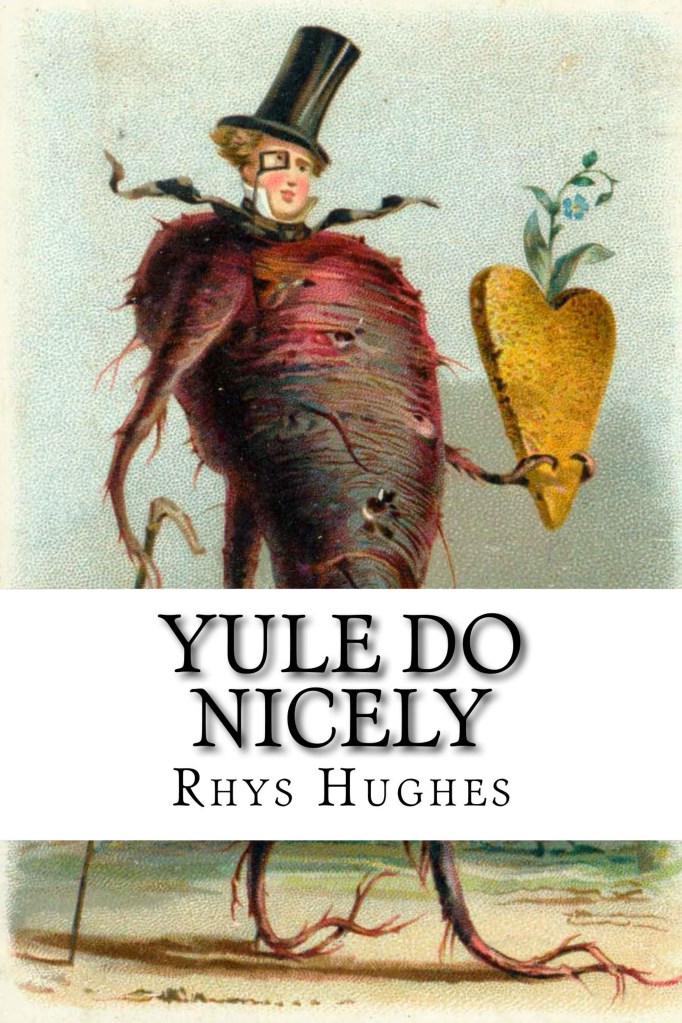
Christmas is coming, the goose is getting fat, please put a penny in the old man’s hat. Yes, but we first require more information about the goose, the penny and the hat. We can’t be too careful these days. How fat is the goose getting and what connection does it have with the old man? Is the goose getting so fat that it is likely to explode with disastrous results for the nation? How will paying the old man a penny prevent this outcome? The situation is unclear. We are on more certain ground when it is explained that the following fictions have been assembled in their present form in order to celebrate the festive season. They include work from the span of the past quarter century. The first twenty-four tales form a weird advent calendar from December 1st to 24th. Then it is Christmas Day and time for the stocking and the twenty-eight little strange tales inside it.
About the Author:
Rhys Hughes has been writing fiction from an early age. His first book was published in 1995 and since that time he has published fifty other books, nine hundred short stories and many articles and poems, and his work has been translated into ten languages. He graduated as an engineer but currently works as a tutor of mathematics. Having lived in Britain, Spain and Kenya, he is now planning to move to India. His poetry tends to be humorous light verse and offbeat lyrical fantasy, influenced mainly by Don Marquis, Ogden Nash, Edward Lear, Richard Brautigan, Ivor Cutler and Spike Milligan.
PLEASE NOTE: ARTICLES CAN ONLY BE REPRODUCED IN OTHER SITES WITH DUE ACKNOWLEDGEMENT TO BORDERLESS JOURNAL
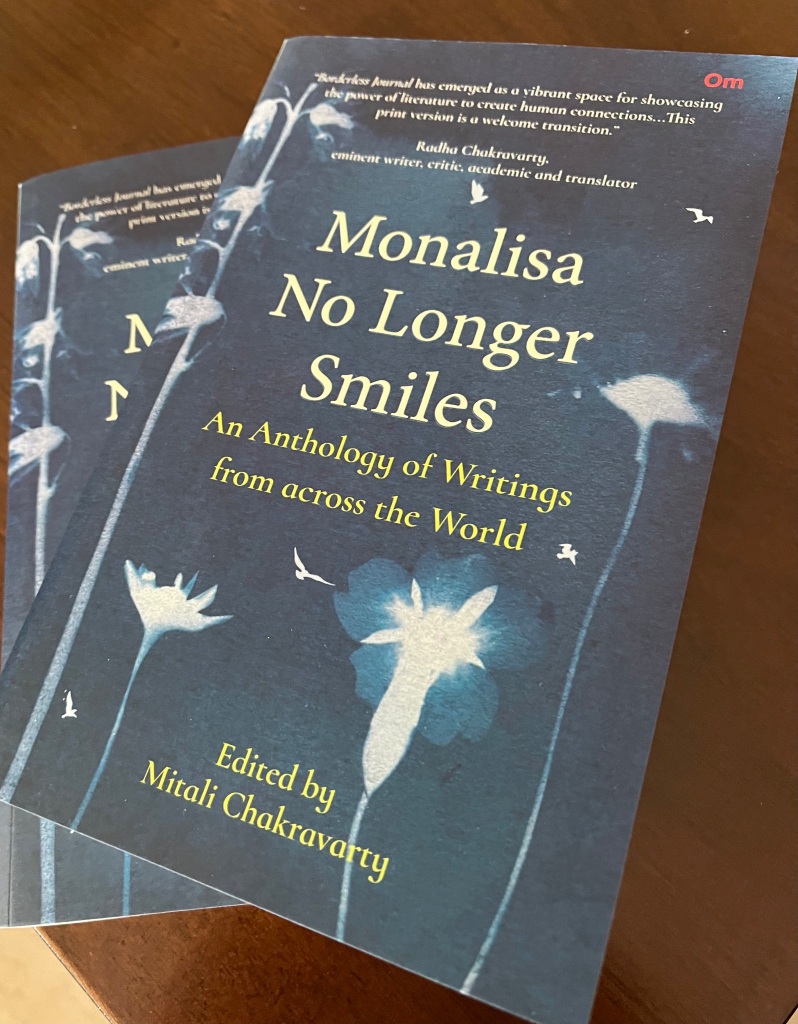
We did it! … Announcing our first anthology … Monalisa No Longer Smiles… Click here to read.
Conversations
Suchen Christine Lim, an iconic writer from Singapore in conversation about her latest book, Dearest Intimate. Click here to read.
Blazing trails, as well as retracing the footsteps of great explorers, Christopher Winnan, a travel writer, delves into the past, and gazes into the future while conversing with Keith Lyons. Click hereto read.
Saturday Afternoon is a poem by Ihlwha Choi, translated from Korean by the poet himself. Click here to read.
Tagore’s poem, Tomar Shonkho Dhulay Porey (your conch lies in the dust), has been translated from Bengali by Mitali Chakravarty as The Conch Calls. Click here to read.
Basudhara Roy has reviewed Afsar Mohammad’s Evening with a Sufi: Selected Poems, translated from Telugu by Afsar Mohammad and Shamala Gallagher. Click hereto read.
That good things happen despite darkness, despite prognostications of doom, that light glimmers hope if you strive to focus on your strength in hard times is borne true both in fiction and in life. Perhaps, we cannot get back the old ways (but is that what we want?) but new paths emerge. Old gives way to new. And while trying to gather pearls of human excellence — borne not of awards or degrees but of bringing out the best, the kindest, the most loving in human hearts — we managed to create with a team an outstanding anthology. Woven with the writings of old and new — we created a tapestry together that the editor in chief of our publishing house said was “classy, literary, engaging and international”. That one of the oldest and most reputed publishing houses in India with bookshops countrywide took it on was also an unusual event! We are truly grateful to Om Books International, Shantanu Ray Chaudhuri and Jyotsna Mehta along with all our writers and readers who made our anthology a reality, and to Radha Chakravarty and Fakrul Alam for the kind words they bestowed on our effort.
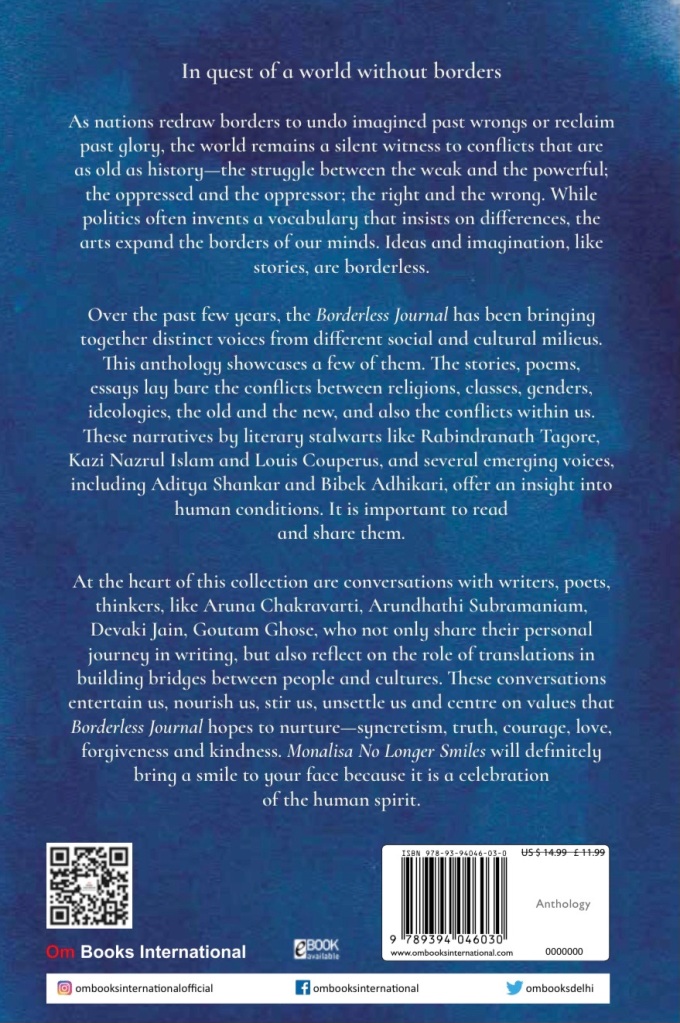
Please greet our first anthology, Monalisa No Longer Smiles, with love and friendship. It could be the perfect Christmas gift in the spirit of the season! And as the blurb says, “it will definitely bring a smile to your face because it is a celebration of the human spirit.”
The anthology is different from our journal in as much as it has a sample of an eclectic collection that has been honed with further editing and has some new features. Most of the writing is from our first year and showcases our ethos, except for Lesya’s poetry and interview. Lesya Bakun from Ukraine is still on the run, looking for a refuge — she cannot return home like you or I can. Her family is scattered across number of countries. Her cousin, who was guarding the factory at Azovstal, was taken prisoner. We included her story in the anthology hoping to create global empathy for refugees as the numbers will increase not only due to war but also due to climate change.
The reason we felt a hardcopy anthology was a good idea was because nothing beats the joy of having a bunch of interesting reads in the warmth of your hands (especially where internet cannot reach or is unavailable). In any case, books with the feel of paper, the rustling whispers which carry voices of leaves can never be replaced as Goutam Ghose had also said in his interview which is now part of our anthology.
And that is why we celebrate more books… this time we feature Singaporean prima donna of literature, Suchen Christine Lim, with her new book Dearest Intimate, a novel that spans more than hundred years including the harrowing Japanese invasion during World War II. She shared sound advice with writers: “Suffering is good for the writer. It will deepen lived experience and expand the heart’s empathy.” And perhaps that is what is echoed through the experiences of the other writer interviewed on our pages by Keith Lyons. This is a writer who not only brought out his own books but was a regular contributor of travel pieces for Frommer’s and National Geographic traveling to unexplored destinations — Christopher Winnan. Another writer Lyon had interviewed recently, Steve Carr, has passed on. We would like to convey our heartfelt condolences to his family and friends.
More translations from Bengali, Balochi and Korean enrich our November edition. Fazal Baloch has translated a story by Haneef Shareef and Rituparna Mukherjee by Shankhadeep Bhattacharya. We have the translation of an inspirational Tagore poem helping us find courage (Shonkho Dhulaye Pore or ‘the conch lies in the dust’). Another such poem by Nazrul has been rendered in English from Bengali by Professor Fakrul Alam. He has also shared an autobiographical musing on how he started translating Tagore’s Gitabitan, which also happens to be his favourite book. More discussion on the literary persona of TS Eliot and the relevance of his hundred year old poem — ‘The Waste Land’ by Dan Meloche adds variety to our essay section.
Evoking the genius of another outstanding artiste, Kishore Kumar, who happened to pen thought provoking dialogues in some films, is Shantanu Ray Chaudhuri’s essay, review of a recent book on the legendary actor-singer and an interview with the authors. Infringing the boundaries of literary with popular culture and art and integrating all forms into a wholistic bundle has been part of our ethos. In that spirit we have a musing by Prithvijeet Sinha on Edvard Munch’s famous painting called Scream. We have non-fiction from Australia spanning Meredith Stephens’s recent brush with Covid, Mike Smith visits a Scottish beach in the footsteps of a novelist, Ravi Shankar has given us a poignant piece for a late friend and Candice Lousia Daquin talks of the existence of bi-racial biases. In contrast, Suzanne Kamata sent a narrative that bridges divides showcasing a German wife of a Japanese scientist that draws us to conclude that biases erode over time to create an acceptance of bi-racial people. Devraj Singh Kalsi brings in humour with his funny narrative about a guitarist. Rhys Hughes writes in a lighter vein on Indian cuisine in his column and spouts more funny poetry bordering on the absurd.
Gathering all of your thoughts in strings of words from all corners of the world, we present to you the bumper November issue of Borderless Journal . Thank you all for sharing your thoughts with us. Thanks to Sohana Manzoor for her fantastic painting and more thanks to the whole Borderless team for seeing this issue through. We would not have been able to do the anthology or these issues without each one of you — writers and readers.
Because Indian food is the best in the world, as everyone knows, a scientist who worked for an educational institute on the outskirts of Bangalore once tried to devise a method of ensuring there was more of it. The more the better, was his motto. His attempts to construct a machine that would multiply chapatis, vadas, dosas, idlis and bowls of curry failed, for it turned out to be impossible to create new matter from nothing — thanks to the physical laws of the universe. But this scientist wasn’t a man to be so easily discouraged. Where there’s a will there’s a way, was his other motto. He had two mottos, just as he had two arms, two legs, two eyes and a pair of spectacles on his nose.
He thought of a way he could get around the particular law of physics that had sabotaged his first plan. Instead of multiplying the food in order to increase the amount available, why not shrink the eaters instead? A man or woman the size of a thumb would be confronted with chapatis that were like islands, vadas like boulders, bowls of curry like the craters of active volcanoes. Yes, that was the best solution. He got to work on it right away and he even stayed late in his makeshift laboratory at the institute and ignored all phone calls from his parents, who wanted to know when he was going to marry a nice girl, or failing that, any girl at all. He was wedded to his experiments.
At last, he chanced on a viable method of shrinking people to a specific size. He celebrated by going home and sleeping for three days. When he awoke, a wide smile on his face, he knew that finding volunteers would be fairly easy. He placed an advertisement in a local newspaper, and it wasn’t long before people began contacting him. He would pay them a small honorarium for taking part in the trial run and they would be allowed to eat as much food as they wanted. So many applicants contacted him that he was overwhelmed, and he had to declare that the offer was over. No more volunteers were required. He had two suitable candidates and wanted to use them immediately.
Pawan Kumar and Shruti Patil were both at loose ends, like pieces of string that knew knot what they had let themselves in for. That’s a pun, but neither one of them cared for wordplay. Pawan was an auto driver and Shruti worked as a maid in a gated community. Neither were gluttons but it must be admitted that they hadn’t had a notable feast for a long time. They jumped at the opportunity that the scientist offered. And in case you are wondering why this scientist has remained nameless so far, it’s because after what happened he preferred to stay anonymous for all time, and we must respect that.
Pawan had found a copy of the newspaper left by a passenger on the back seat of his auto, and Shruti had found one stuffed into the bin that she took out of the apartment she was cleaning. Both had paused for less than one minute in order to read the advertisement. This was a happy chance, if chance can ever be said to be truly happy and isn’t faking it, and then and there they had decided to plunge headlong into this new adventure. They were perfect volunteers, in other words, without a twinge of anxiety between them.
The scientist said, “Are you sure?”
They both nodded in agreement, bemused that he should seem more nervous than they were. All they were risking was their existence, but he was risking his entire career, and success in this unfortunate world is often held to be more important than life itself. He continued, “There might be complications, but I don’t think it is likely. I just want you to be aware.”
They were aware, fully so, and he ought to worry less.
“So be it,” he said dramatically.
It’s still a trade secret as to how he shrank them from ordinary sized people to miniature versions of themselves, so I am unable to describe the machine he used and the green rays it beamed on them from a series of crystal lenses all of which were carved into different shapes that were offset polyhedra, and even the copper coils and capacitors and diodes as big as cucumbers must be passed over in discreet silence, nor can I say how the whole contraption was powered by an array of solar cells on the institute’s roof.
Pawan and Shruti found themselves diminishing rapidly but that’s not how it seemed from their perspective. It appeared to them that the outside world was expanding, rushing to inflate itself, and the effect was so startling and alarming that they clung to each other for comfort, despite the fact they hardly knew each other, and their parents didn’t know each other either. This embrace also helped them to keep their balance as they rushed down the scale until they were almost exactly the size of the scientist’s thumbs.
The scientist spoke and his voice was so deafening that it boomed like the thunderclaps that sometimes echo from the crowded buildings of Bangalore and rumble down the streets before fading. They understood none of his words and it was a minute before they could gather their wits to act on their own initiative. He had simply said, “Please begin eating.”
He had picked them up and was lowering them on a long table that groaned with the amount of food it held. He was careful not to squeeze them too tightly. Then he released them, and they wandered in utter amazement among the plates, bowls, dishes and banana leaves, all heaped with delicious foodstuffs. The idea that they should devour this landscape seemed as absurd to them as any resident of Mysore supposing he can munch his way through the Amba Vilas Palace. It was too overwhelming, far too miraculous.
The scientist now clapped his hands impatiently. “Come, come, tuck in, I don’t have all day. Let’s see what happens!”
But his voice was still too low in pitch for their tiny ears to hear anything more than an incomprehensible booming. That was of no importance because the mission that had been assigned to them was plain. They had to eat as much as they liked in the time available to them.
It never occurred to Pawan or Shruti to ask whether the miniaturisation was permanent, and in fact even the scientist didn’t know if the effects would wear off naturally, or if he might find it necessary to try reversing the polarity of his machine in the hope it would restore them to their former size. But they had full faith in his competence and began nibbling at tasty objects that were in their vicinity. They were only a little cautious.
Soon they grew confident, then became joyous. They bounded between dishes and plates, climbed mounds of sweet and savoury foods, waded through curries, cavorted among the vegetables.
In the meantime, a reporter from the newspaper was on his way to the institute on the outskirts of Bangalore to find out why this scientist needed the volunteers he had asked for. The reporter smelled a story in the making. When he entered the building, after showing his press credentials, and approached the laboratory, he smelled something beyond a story. It was a banquet! He rapped on the door with his knuckles and cried: “Good afternoon, sir.”
To which the scientist replied, “Go away! You are disturbing the future of the human race. The door is locked.”
“I merely wish to interview your volunteers.”
“They are far too small to answer your questions. You must depart now. I will have you ejected from the premises if you refuse to leave of your own free will. The volunteers can’t understand your words, no matter what language you speak. They are cavorting on the table.”
“How so? You mean that they are monkeys?”
The scientist cursed at this.
The reporter struggled to see anything coherent through the frosted glass of the door. All he could make out was the shape of the banqueting table, which at this distance was like an operating table, and parallel rows of foodstuffs, which to him looked like an array of gadgets. The scientist stood with a spoon ready to serve rice onto plates and to the reporter it seemed he was clutching a surgical instrument that could probe brains.
“Is he brainwashing monkeys? Turning them into robots or assassins! I will write an article about this scandal.”
And he dashed out of the institute building as fast as he could run. During this rumpus, Pawan and Shruti had gained even more confidence. They started to eat with gusto and passed from dish to dish like explorers among the ruins of an ancient civilisation, taking morsels from every alluring display. Most of this food was from Karnataka but not all.
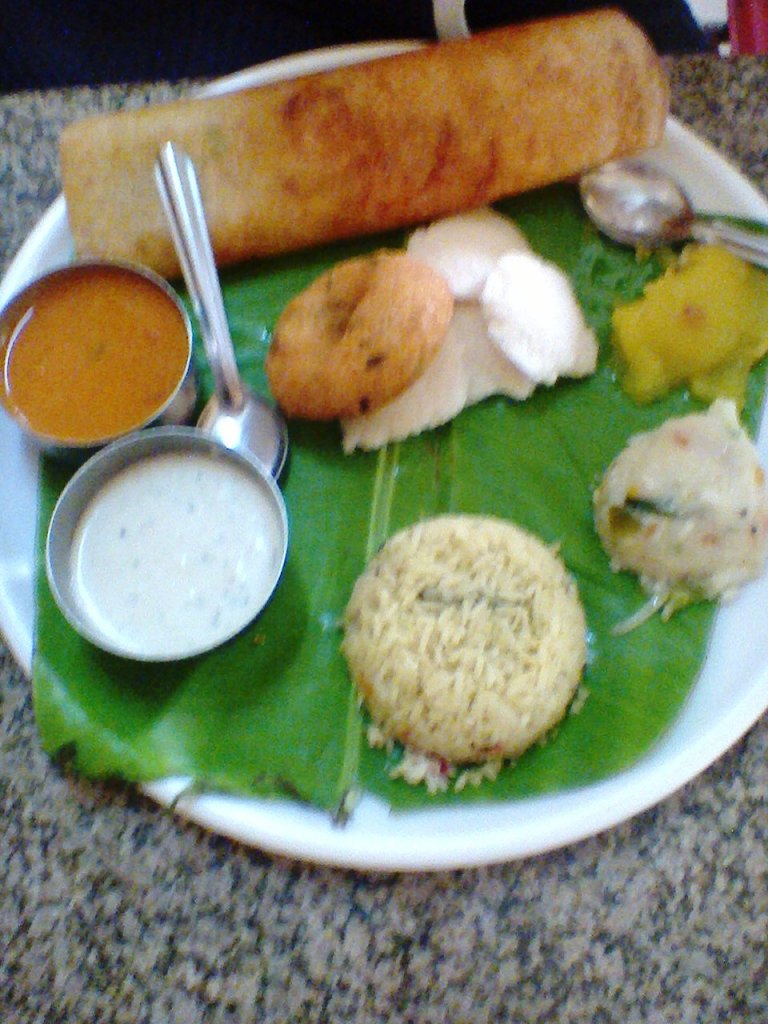
They chewed and swallowed bisi bele bhath, maddur vada, Dharwad peda, akki roti, saagu, upma, ladoos, three variants of idli, namely thatte idli, rava idli and Muday idli, churumuri and many other typical foods. They were soon full, but they continued eating, more on aesthetic grounds than from physical need. It was like a chain reaction. They would keep going until something exploded and that something would be their bellies.
But now something strange happened, and the simple adventure became a much more complex and tricky exploit. Pawan found a paper dosa, a very long and crispy example, and it had been rolled into a tunnel and he peered into the mouth of the tunnel and he was baffled.
“The landscape on the other side of the tunnel looks different,” he said to Shruti with a frown. “Come and see.”
She did so and she was no less astonished.
“There’s a garden there.”
“Yes, there is, and it makes no sense.”
A dosa with a tunnel. Courtesy: Creative Commons
They exchanged meaningful glances, but the exact meaning was unclear to both of them. Nonetheless they tingled with anticipation and Pawan gave into temptation and suggested they walk together through the dosa tunnel in order to see what the far side might actually be like.
Have you ever walked through a dosa yourself? It is surely an odd feeling. They stumbled on the batter, which yielded too readily to their feet, cracking a piece off here and there, but soon enough they emerged from the exit. And what they saw was remarkable. They were no longer on a table in a laboratory in an institute on the outskirts of Bangalore.
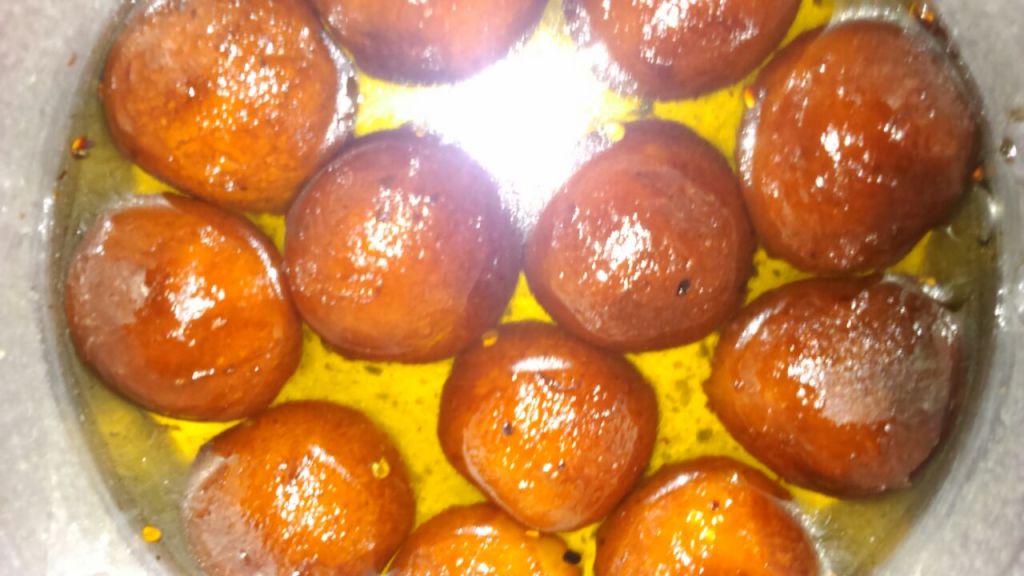
Pawan and Shruti were unworldly people and had never heard of the myth of the Garden of Eden, but that’s what they found on the other side of the magic dosa. There are some special points in our world that are portals to other worlds and if you step through them, you will end up in that new dimension. They saw that the garden was full of trees, but the trees had gulab jamuns hanging from the branches instead of fruits. Gulab jamun trees! Was that even possible? Clearly, yes it was, here in this incredible place.
Gulab Jamuns. Courtesy: Creative Commons
As they strolled deeper into the garden, enchanted by the sights, they took slightly diverging paths and ended up alone. Shruti stopped by a tree and despite the fact she was full, she reached up to pluck a gulab jamun that glistened most invitingly just above her head. And that’s when the snake appeared. It slithered down from the top of the tree and said:
“You are allowed to eat the sweets from any tree in the garden with the one exception of this tree, which is the tree of knowledge. But I think you should be a rebel and eat it anyway. Why not?”
The snake had the voice and face of the scientist.
Shruti pouted at him.
“Because that would be greedy,” she said.
“Don’t be so timid!”
“Knowledge is overrated. You have plenty of knowledge and what has it done for you? Turned you into a snake.”
“Don’t say that. I am an intellectual benefactor.”
“You eat it then.”
And she held out the gulab jamun for him.
He hissed and swayed in annoyance, his forked tongue flicking, but at that very moment Pawan came over to see what the fuss was about, and he shook his fist at the snake and warned him: “I am an auto driver. I often have passengers like you. I will throw you out of the garden if you don’t behave.”
The snake continued hissing angrily but it slid away and they still don’t know where it went because they have never seen it again. Meanwhile, the scientist mysteriously disappeared from the laboratory and the only theory that explained his vanishing was that he had turned the rays of his own machine on himself and shrunk down to a dot and then to an atom.
But why would he do that? Nothing made sense any longer. Pawan and his wife, Shruti, still live in the garden beyond the dosa, and because all the food in the laboratory has been taken away, there is no way for them to return to the real world. They don’t care about that. They are satisfied where they are. They keep the gulab jamun of knowledge safe and maybe one day they will take bites from it. But they are in no rush to do so.
The reporter wrote his story about monkey robots and assassins, but it was never published because his editor thought he had gone mad. He was told to take a week off work and go on holiday. He went but never returned. Searching for him proved futile but rumours persisted of a monkey on the coast who liked to read the newspaper as if he understood the words. Probably some sort of coincidence. The world is stuffed full of them.
.
Rhys Hughes has lived in many countries. He graduated as an engineer but currently works as a tutor of mathematics. Since his first book was published in 1995 he has had fifty other books published and his work has been translated into ten languages.
.
PLEASE NOTE: ARTICLES CAN ONLY BE REPRODUCED IN OTHER SITES WITH DUE ACKNOWLEDGEMENT TO BORDERLESS JOURNAL
She was
a tremendous bowl of soup
with spaghetti
in a loop floating on top.
I don’t know why
this should be but it was.

She was
the elbow of an aardvark
loose in a park
in the dark after teatime.
I don’t know why
this should be but it was.

She was
many things and nothing
and rarely sang
when jumping on trampolines
but in dreams
she wouldn’t stop and the noise
was worse than
the hopping of amplified fleas
but she sustained
no damage at all to her knees.
I don’t know why
this should be but it was.

She was
the square root of minus one
and many buns
were fed to the elephants
of her equations.
I don’t know why
this should be but it was.

And if you like treacle
high up a steeple
but can’t stomach custard
because of the fuss made
in striving to contrive
a rhyme in good time
please make her acquaintance
without any pretence
and give my regards
when she turns into mustard
in the setting sun.

She was
a rapscallion and dandy
with a quaint
modus operandi
who rode on a stallion
named Disco Medallion.
I don’t know why
this should be but it was.

She was
a fruitcake lost in a lake
and I am a boat
with a sail for a coat
but I never intend to fish
her confectionary wish
out of the deeps
and send it for keeps
to the bakery zoo
where you know who
lives in a cage in a rage.
I don’t know why
this should be but it was.

She was
a clash of logical cymbals
festooning the
sides of roomy thimbles.
I don’t know why
this should be but it was.

And
maybe because
I can’t say how or why
anything should be
and neither can she
we are bewildered together
in inclement weather
and only a feather
floats between
scenes.

She was
the last verse of this poem
folded neatly
and kept in a jeroboam.
I think I know why
this should be but it wasn’t.
Rhys Hughes has lived in many countries. He graduated as an engineer but currently works as a tutor of mathematics. Since his first book was published in 1995 he has had fifty other books published and his work has been translated into ten languages.
.
PLEASE NOTE: ARTICLES CAN ONLY BE REPRODUCED IN OTHER SITES WITH DUE ACKNOWLEDGEMENT TO BORDERLESS JOURNAL
Halloween returns, bringing back memories of trick or treating with children collecting candies, celebrating — celebrating perhaps to get over the fear of darkness, the unknown or perhaps, even the experience of global disasters ? The Bengali equivalent of Halloween — Bhoot Chaturdashi — was celebrated a day before Diwali. And as people do up ‘haunted homes and dress as witches, zombies and ghosts, I wonder, why do we celebrate such dark festivals and also enjoy them?
Perhaps, the answer is given in an essay by Candice Louisa Daquin that we have a gene that helps us enjoy such occasions… And then there is always the necessary adjunct of ghost stories and spooky rhymes that makes us feel ooky as our hearts beat and nervous snots of laughter explode from chests beating in anticipation…Wafting on borderless clouds that float mysteriously on Halloween nights, we invite you to visit a few spooks, ghosts, goblins, witches and spirits…
KARMA IS A BOOMERANG

Karma is a boomerang,
Kismet is a net.
The vampire jumped out of the dark
and bit me in the neck.
I picked him up and shook him down
and flung him far away
and that was that, or so I thought,
the end of a dismal day.
But I was wrong, just like this song
he wasn’t finished yet.
Into a bat he turned and flapped
and to my dismay in every way
raced back and slapped my face.
How rude it is to stab with fangs
a person you have just met.
Karma is a boomerang,
Kismet is a net.


    A CEILING FAN

         I am
       what I am.
    I am a ceiling fan.

   Round and round I go
      but why I never
           know.

I have a feeling that I can
be either fast or slow
but the sounds
that I make
are sure to break
the patience of any man
who is no
fan of fans, for I am never
motionless.

And
while I twirl
to cool boys and girls
on torrid summer evenings,
the drunken fools
see the room revolve
and assume I’m still at rest.

Is this the best
       I can expect?


IN THE FACE

I laugh in the face of danger
but not at the legs, arms or body of danger.
Only an insane stranger would do that.
Occasionally I suppose
I might nervously chuckle or even chortle
at the buckle on the belt
that holds up the trousers of peril
because it is shaped
like an awful portal to the immortal world.
Rhys Hughes has lived in many countries. He graduated as an engineer but currently works as a tutor of mathematics. Since his first book was published in 1995 he has had fifty other books published and his work has been translated into ten languages.
.
PLEASE NOTE: ARTICLES CAN ONLY BE REPRODUCED IN OTHER SITES WITH DUE ACKNOWLEDGEMENT TO BORDERLESS JOURNAL
Meet Barun Chanda, an actor who started his career as the lead protagonist of a Satyajit Ray film and now is a bi-lingual writer of fiction and more recently, a non-fiction published by Om Books International,Satyajit Ray:The Man Who Knew Too Much in conversation Click here to read.
Jim Goodman, an American traveler, author, ethnologist and photographer who has spent the last half-century in Asia, converses with Keith Lyons. Click here to read.
Translations
Professor Fakrul Alam has translated three Tagore songs around autumn from Bengali. Click here to read.
Nagmati by Prafulla Roy has been translated from Bengali as Snake Maiden by Aruna Chakravarti. Click here to read.
A Balochi Folksong that is rather flirtatious has been translated by Fazal Baloch. Click here to read.
                     “Where are the songs of Spring? Ay, where are they?
                      Think not of them, thou hast thy music too…”

                                 — John Keats (1795-1851), To Autumn
Art by Sybil Pretious
For long writers have associated autumn with “mellow wistfulness”. That loss of spring, or loss of youth is not bleak or regretful has been captured not just by Keats but also been borne out by historical facts. Anthropocene existence only get better as the human race evolves … If we view our world as moving towards an autumn, we perhaps, as Keats suggests, need to find the new “music” for it. A music that is ripe and matures with the passage of time to the point that it moves more towards perfection. Though sometimes lives fade away after autumn gives way to winter as did those of Queen Elizabeth II (April 21st 1926 – September 8th 2022) after a reign of seventy historic years and Mikhail Gorbachev (2nd March 1931 – 30thAugust 2022) with his admirable efforts to bridge divides. Both of them have left footprints that could be eternalised if voices echo in harmony. Thoughts which create bonds never die – they live on in your hearts and mine.
Imagine… ten thousand years ago, were we better off? Recorded history shows that the first war had already been fought 13,000 years ago. And they have continued to rage – but, at least, unlike the indomitable Gauls in Asterix[1] comics – not all jumped into the fray. They did during the last World Wars — which also led to attempts towards institutionalising humanitarian concerns and non-alignment. Yes, we have not had a perfect world as yet but as we age, the earth matures and we will, hopefully, move towards better times as we evolve. Climate change had happened earlier too. At a point, Sahara was green. Continental shifts split Pangaea into seven continents – that was even earlier. That might have driven the dinosaurs to extinction. But I am sure mankind will find a way out of the terror of climate change and wars over a period of time, as long as we believe in deciphering the sounds of autumn as did Keats in his poem.
Tagore had also sung of the joys of autumn which happens to be a time for festivities. Professor Fakrul Alam has translated three such songs, reflecting the joie de vivre of the season, The translation of a small poem, Eshecche Sarat[2], brings the beauty of the season in Bengal to the fore. We have a celebration of youth and romance in a Balochi folksong, an anti-thesis to autumn and aging, translated for us by Fazal Baloch and also, poetic prose in quest of God and justice by Haneef Sharif, translated from Balochi by Mashreen Hameed. Lost romance recapitulated makes interesting poetry is borne out by Ihlwha Choi’s translation of his own poem from Korean. But the topping in our translation section is a story called ‘Nagmati[3]’ by eminent Bengali writer, Prafulla Roy, translated by no less than a Sahitya Akademi winning translator – Aruna Chakravarti. This story illustrates how terrifying youthful follies can lead to the end of many young lives, a powerful narrative about the snake worshipping community of Bedeynis that highlights destruction due to youthful lusts and an inability to accept diverse cultures.
When this cultural acceptance becomes a part of our being, it creates bonds which transcend manmade borders as did the films of Satyajit Ray. His mingling was so effective that his work made it to the zenith of an international cinematic scenario so much so that Audrey Hepburn, while receiving the Oscar on his behalf, said: “Dear Satyajit Ray. I am proud and privileged to have been allowed to represent our industry in paying tribute to you as an artist and as a man. For everything you represent I send you my gratitude and love.”
This and more has been revealed to us in a book,Satyajit Ray: The Man Who Knew Too Much, authored by a protagonist from Ray’s film, Barun Chanda. This book brought out by Om Books International reflects not just Ray as a person but also how he knitted the world together with his films and took the Indian film industry to an international level. Barun Chanda has been interviewed with a focus on Satyajit Ray. Keith Lyons has also interviewed a man who has defied all norms and, in the autumn of his life, continues his journey while weaving together cultures across, China, India and Thailand by his ethnographic studies on tribes, Jim Goodman. Goodman says he left America when speaking for a war-free world became a cause for censorship. This makes one wonder if war is a game played for supporting a small minority of people who rule the roost? Or are these ramblings of a Coleridge writing ‘Kubla Khan’ under the influence of narcotics?
Poetry also brings the season into our pages with an autumnal interpretation of life from Michael Burch. More poetry from Sunil Sharma, Ryan Quinn Flanagan, Gayatri Majumdar, George Freek, Ron Pickett, Sutputra Radheye, Marianne Tefft brings a wide range of concerns to our pages – from climate to the vagaries of human nature. Poetry by an Albanian writer, Irma Kurti, and photographs by her Italian spouse, Biagio Fortini, blend together the colours of humanity. Rhys Hughes as usual, makes it to the realm of absurd – perhaps voicing much in his poetry, especially about the environment and human nature, though he talks of woodpeckers on Noah’s ark (were there any?) and of cows, yetis, monkeys and cakes… He has also given us a hilarious cat narrative for his column. Can that be called magic realism too? Or are the edges too abstract?
A book excerpt from Hughes’ Comfy RascalsShort Fiction and a review of it by Rakhi Dalal makes us wonder with the reviewer if he is a fan of Kafka or Baudelaire and is his creation a tongue-in-cheek comment on conventions? A book review by Hema Ravi of Mrutyunjay Sarangi’s A Train to Kolkata and Other Stories and another by Bhaskar Parichha of Netaji Subhash Chandra Bose’s Life, Struggle and Politics, authored by Netaji’s nephew’s wife, Krishna Bose, translated and edited by her son, Sumantra Bose, unveils the narratives around his life and death.
A leader who quested for freedom and roamed the world after being passed over by the Congress in favour of Nehru, Netaji raised an army of women who were trained in Singapore – not a small feat in the first half of the twentieth century anywhere in the world. His death in an air crash remained an unsolved mystery — another one of those controversies which raged through the century like the Bhawal case. In his review, Parichha spells out: “Aiming to bring an end to the controversies and conspiracy theories surrounding the freedom fighter, the over 300-page book gives a detailed and evidence-based account of his death in one of its chapters.”
Our non-fiction also hosts humour from Devraj Singh Kalsi about his interactions with birds and, on the other hand, a very poignant poetic-prose by Mike Smith reflecting on the vagaries of autumn. From Japan, Suzanne Kamata takes us to the Rabbit Island – and murmurings of war and weapons. We have the strangest story about a set of people who are happy to be ruled by foreign settlers – we would term them colonials – from Meredith Stephens. G Venkatesh delights with a story of love and discovery in Korea, where he had gone in pre-pandemic times. Paul Mirabile travels to Turkey to rediscover a writer, Sait Faik Abasiyanik (1906-1954). And Ravi Shankar gives us an emotional story about his trek in the Himalayas in Nepal with a friend who has passed on. Candice Louisa Daquin has written of the possibilities towards integrating those who are seen as minorities and marginalised into the mainstream.
The edition this time is like Autumn – multi-coloured. Though I am not able to do justice to all our contributors by mentioning them here, my heartfelt thanks to each as every piece only enriches our journal. I urge you to take a look at the September edition.
I would like to give huge thanks to our readers and our team too, especially Sohana Manzoor and Sybil Pretious for their artwork. We could not have come this far without support from all of you.
[1] The men in the indomitable Gaulish village (which the Romans failed to conquer) in times of Julius Caesar loved to jump into a fight for no reason…Asterix was the protagonist of the comics along with his fat friend Obelix












 Borderless