Categories
Celebrating Translations

We are the World

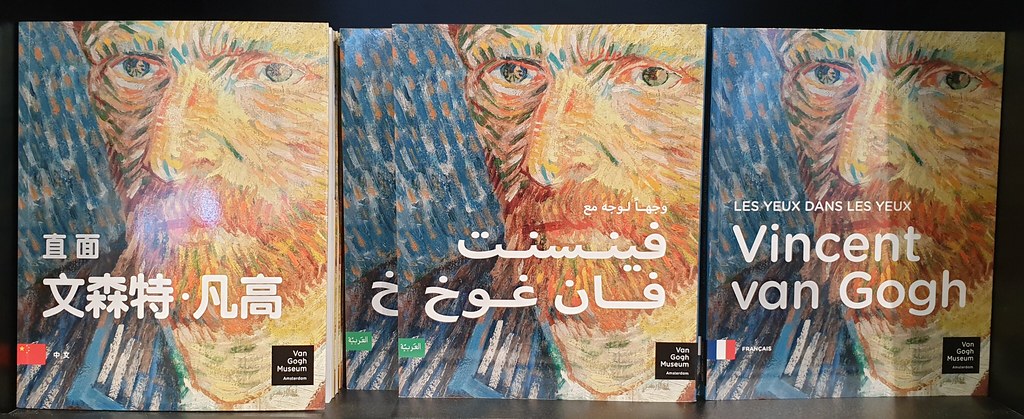
Vincent Van Gogh written is different scripts. Courtesy: Creative Commons

The whole world opens up in the realm of ideas that have existed wafting and bridging across time and space. Sometimes they find conduits to come to the fore, even though they find expression in different languages, under varied cultural milieus. One way of connecting these ideas is to translate them into a single language. And that is what many have started to do. Celebrating writers and translators who have connected us with these ideas across boundaries of time and place, we bring to you translated writings in English from twenty eight languages on the International Translation Day, from some of the most iconic thinkers as well as from contemporary voices. 

Prose

Tagore’s short story, Aparichita, has been translated from Bengali as The Stranger by Aruna Chakravarti. Click here to read. 

Travels & Holidays: Humour from Rabindranath, have been translated from Bengali by Somdatta Mandal. Click here to read.

Hena, a short story by Nazrul, has been translated from Bengali by Sohana Manzoor. Click hereto read.

Munshi Premchand’s Balak or the Child has been translated from Hindi by Anurag Sharma Click here to read.

Munshi Premchand’s Pus Ki Raat or A Frigid Winter Night  has been translated from Hindi by C Christine Fair. Click here to read.

Nadir Ali’s The Kabbadi Player has been translated from Punjabi by Amna Ali. Click here to read.

Kamaleswar Barua’s Uehara by  has been translated from Assamese and introduced by Bikash K. Bhattacharya. Click here to read.

S Ramakrishnan’s Muhammad Ali’s Singnature has been S. Ramakrishnan, translated from Tamil by Dr B. Chandramouli. Click here to read. 

PF Mathews’ Mercy,  has been translated from Malayalam by Ram Anantharaman. Click here to read.

Road to Nowhere, an unusual story about a man who heads for suicide, translated from Odiya by the author, Satya Misra. Click here to read.

An excerpt from A Handful of Sesame by Shrinivas Vaidya, translated from Kannada by Maithreyi Karnoor. Click here to read.

Writings from Pandies’ Corner highlight the ongoing struggle against debilitating rigid boundaries drawn by societal norms. Each piece is written in Hindustani and then translated by a volunteer from Pandies’ in English. Click here to read.

Rakhamaninov’s Sonata, a short story by Sherzod Artikov, translated from Uzbeki by Nigora Mukhammad. Click here to read.

Of Days and Seasons, a parable by the eminent Dutch writer, Louis Couperus (1863-1923), translated by Chaitali Sengupta. Click here to read.

The Faithful Wife, a folktale translated from Balochi by Fazal Baloch. Click here to read.

An excerpt from Ramy Al-Asheq’s Ever Since I Did Not Die, translated from Arabic by Isis Nusair, edited by Levi Thompson. The author was born in a refugee camp. Click here to read.

Poetry

Two songs by Tagore written originally in Brajabuli, a literary language developed essentially for poetry in the sixteenth century, has been translated by Radha Chakravarty. Click here to read. 

Rebel or ‘Bidrohi’, Nazrul’s signature poem,Bidrohi, translated from Bengali by Professor Fakrul Alam. Click here to read.

Banlata Sen, Jibananada Das’s iconic poem, translated from Bengali by Professor Fakrul Alam. Click here to read. 

Poetry of Michael Madhusudan Dutt has been translated from Bengali by Ratnottama Sengupta. Click here to read.

Our Children, a poem by well-known Iranian poet, Bijan Najdi, has been translated from Persian by Davood Jalili. Click here to read.

Akbar Barakzai’s Be and It All Came into Being has been translated from Balochi by Fazal Baloch. Click here to read.

Biju Kanhangad’s The Girl Who Went Fishing has been translated from Malayalam by Aditya Shankar. Click here to read.

Jitendra Vasava’s Adivasi Poetry,  translated from the Dehwali Bhili via Gujarati by Gopika Jadeja. Click here to read.

Sokhen Tudu’s A Poem for The Ol Chiki, translated from the Santhali by Hansda Sowvendra Shekhar. Click here to read.

Thangjam Ibopishak’s Gandhi & Robot translated from the Manipuri by Robin S Ngangom. Click here to read.

 Rayees Ahmad translates his own poem, Ab tak Toofan or The Storm that Rages, from Urdu to English. Click here to read.

Poetry by Sanket Mhatre has been translated by Rochelle Potkar from Marathi to English. Click here to read.

An excerpt from Evening with a Sufi: Selected Poemsby Afsar Mohammad, translated from Telugu by Afsar Mohammad & Shamala Gallagher. Click hereto read.

Ihlwha Choi’s Universal Language written at Santiniktan, translated from Korean by the poet himself. Click here to read.

Sangita Swechha’s Motherhood: A Tiny Life inside Me has been translated from Nepali by Hem Bishwakarma. Click here to read.

Rosy Gallace’s Two poems from Italy  have been translated from Italian by Irma Kurti. Click here to read.

Poetry in Bosnian written and translated from Bosnian by Maid Corbic. Click here to read.

Lesya Bakun translates three of her own poems from Ukranian and Russian to English. Click here to read.

Poems from Armenia by Eduard Harents translated from Armenian by Harout Vartanian. Click here to read.

Categories
Poets, Poetry & Rhys Hughes

An Experiment with Automatic Poetic Translation

Courtesy: Creative Commons

I am intrigued by the whole process of translation, a most remarkable alchemy of words and meanings, and when it comes to the translation of poetry, I find the operation especially bewildering and beguiling. But this is not the place for me to discuss my views on the mechanics of the subject, for in fact I have no such views. I am not a translator. I merely wish to explain that the following poem is the result of a minor experiment I have been planning for a long time, a variant of the ‘Chinese Whispers’ game, performed using an automatic translation program. A poem is written, a poem using fairly obvious imagery, and then the translation game begins. The poem is translated from English into another language, in this case Albanian, then from Albanian into another language, Arabic in fact, and from Arabic into Basque, and so on. Eventually the poem exists in Zulu, and from there it is translated back into English.

Possibly it will no longer sound like a real poem at this stage. But it can be easily adjusted, turned into something resembling a new poem, and presented as a continuation of the original poem. The final poetic work will consist of the original stanza followed by the manipulated stanza. If they enhance each other, so much the better, but if not, nothing much has been lost.

The Transformation

The transformation is lengthy
but painless,
it does not drain us. The way
ahead is clear
as far as the glowing horizon
where the moon
has promised to rise. The eyes
of the night
stare intensely in preparation
for blinking
thanks to the white eyelid of
a belated moon
and we grow wise when at last
it arrives, saying
that the stars belong in sleep
and so they do and so
do we and finally
the change
occurs
rest
ful
ly.

This poem was automatically translated between all the following languages:

English – Albanian – Arabic – Basque – Bengali – Czech – Dutch – French – German – Greek – Hindi -Indonesian – Korean – Latin – Macedonian – Maltese – Nepali – Persian – Portuguese – Romanian – Sanskrit – Slovak – Swahili – Thai – Turkish – Urdu – Vietnamese – Welsh – Zulu – English

And the result, after a very small manual adjustment, is:

After a long time
I’m still crying,
a street name outside of us.
This is obvious at first:
bright horizon.
Where is the moon?
And so ends the contract.
Dinner?
I can’t wait to get ready.
This is not a rumour
of white hair
or months.
Finally we bring you a sage.
They started talking,
you are sleeping,
and so
I continue to do so.
Be careful,
what’s up is silence,
targeted
from where?

Rhys Hughes has lived in many countries. He graduated as an engineer but currently works as a tutor of mathematics. Since his first book was published in 1995 he has had fifty other books published and his work has been translated into ten languages.

.

PLEASE NOTE: ARTICLES CAN ONLY BE REPRODUCED IN OTHER SITES WITH DUE ACKNOWLEDGEMENT TO BORDERLESS JOURNAL

Click here to access the Borderless anthology, Monalisa No Longer Smiles

Click here to access Monalisa No Longer Smiles on Kindle Amazon International

Categories
Contents

Borderless July 2023

Painting by Sohana Manzoor

Editorial

As Imagination Bodies Forth Click here to read.

Translations

Bankim Chandra Chattopadhyay’s Bangalar Nobbyo Lekhokdiger Proti Nibedon (a request to new writers of Bengali), has been translated from Bengali and introduced by Abdullah-Al-Musayeb. Click here to read.

Poetry on Rain by Masud Khan has been translated from Bengali by Professor Fakrul Alam. Click here to read.

Dancer by Bashir Baidar, has been translated from Balochi by Fazal Baloch. Click here to read.

Motherhood: A Tiny Life inside Me, a poem by Sangita Swechcha, has been translated from Nepali by Hem Bishwakarma. Click here to read.

The Wind and the Door, has been written and translated from Korean by Ihlwha Choi. Click here to read.

Megh or Cloud by Tagore has been translated from Bengali by Mitali Chakravarty. Click here to read.

Conversation

In conversation with Afsar Mohammad, a poet, a Sufi and an academic teaching in University of Pennsylvania. Click here to read.

Poetry

Click on the names to read the poems

Afsar Mohammad, Rhys Hughes, Kirpal Singh, Don Webb, Masha Hassan, Vernon Daim, George Freek, Arya KS, Robert Nisbet, Dr Kanwalpreet, John Grey, Nivedita N, Samantha Underhill, Vikas Sehra, Ryan Quinn Falangan, Saranyan BV, Heath Brougher, Carol D’Souza, Michael Burch

Poets, Poetry & Rhys Hughes

In Productivity, Rhys Hughes muses tongue-in-cheek on laziness and its contribution in making a nation more productive. Click here to read.

Musings/ Slices from Life

Should I stay or should I go?

Keith Lyons muses on our attitude towards changes. Click here to read.

Bangal-Ghoti-Bati-Paati or What Anglophilia did to My Palate

Ramona Sen journeys in a lighter vein through her taste buds to uncover part of her identity. Click here to read.

Awesome Arches and Acrophobia

Meredith Stephens takes us for a fabulous treat of Sierra Nevada mountains with her camera and narrative. Click here to read.

Musings of a Copywriter

In The Lost Garden, Devraj Singh Kalsi writes of how his sense of wellbeing mingles with plants. Click here to read.

Notes from Japan

In Better Relations Through Weed-pulling, Suzanne Kamata introduces us to an annual custom in Japan. Click here to read.

Essays

The Story of a Land at War with Itself

Ratnottama Sengupta presents the first hand account of the war in Bosnia-Herzegovina (1992-1995) from a letter from her brother, who was posted there as part of the peace-keeping troops. Click here to read.

‘Wormholes to other Worlds’

Ravi Shankar explores museums in Kuala Lumpur. Click here to read.

Stories

A Troubled Soul

Mahim Hussain explores mental illness. Click here to read.

The Llama Story

Shourjo shares a short fun piece written from a llama’s perspective. Click here to read.

Mister Wilkens

Paul Mirabile gives a strange tale set in Europe of the 1970s. Click here to read.

Book Excerpts

An excerpt from Red Sky Over Kabul: A Memoir of a Father and Son in Afghanistan by Baryalai Popalzai and Kevin McLean. Click here to read.

An excerpt from The Blue Dragonfly – healing through poetry by Veronica Eley. Click here to read.

Book Reviews

Somdatta Mandal reviews The Past is Never Dead: A Novel by Ujjal Dosanjh. Click here to read.

KPP Nambiar reviews The Stolen Necklace: A Small Crime in a Small Town by Shevlin Sebastian and VK Thajudheen. Click here to read.

Rakhi Dalal reviews Drop of the Last Cloud by Sangeetha G. Click here to read.

Bhaskar Parichha reviews Burning Pyres, Mass Graves and A State That Failed Its People : India’s Covid Tragedy by Harsh Mander. Click here to read.

.

Click here to access the Borderless anthology, Monalisa No Longer Smiles

Click here to access Monalisa No Longer Smiles on Kindle Amazon International

Categories
Editorial

As Imagination Bodies Forth…

Painting by Sybil Pretious
And as imagination bodies forth
The forms of things unknown, the poet's pen
Turns them to shapes and gives to airy nothing
A local habitation and a name

 A Midsummer Night's Dream (1595) by William Shakespeare

Famous lines by Shakespeare that reflect on one of the most unique qualities in not only poets — as he states — but also in all humans, imagination, which helps us create our own constructs, build walls, draw boundaries as well as create wonderful paintings, invent planes, fly to the moon and write beautiful poetry. I wonder if animals or plants have the same ability? Then, there are some who, react to the impact of imagined constructs that hurt humanity. They write fabulous poetry or lyrics protesting war as well as dream of a world without war. Could we in times such as these imagine a world at peace, and — even more unusually — filled with consideration, kindness, love and brotherhood as suggested by Lennon’s lyrics in ‘Imagine’ – “Imagine all the people/ Livin’ life in peace…”. These are ideas that have been wafting in the world since times immemorial. And yet, they seem to be drifting in a breeze that caresses but continues to elude our grasp.

Under such circumstances, what can be more alluring than reflective Sufi poetry by an empathetic soul. Featuring an interview and poetry by such a poet, Afsar Mohammad, we bring to you his journey from a “small rural setting” in Telangana to University of Pennsylvania, where he teaches South Asian Studies. He is bilingual and has brought out many books, including one with his translated poetry. Translations this time start with Bankim Chandra Chattopadhyay’s advice to new writers in Bengali, introduced and brought to us by Abdullah-Al-Musayeb. Tagore’s seasonal poem, ‘Megh or Cloud’, has been transcreated to harmonise with the onset of monsoons. However, this year with the El Nino and as the impact of climate change sets in, the monsoons have turned awry and are flooding the world. At a spiritual plane, the maestro’s lines in this poem do reflect on the transience of nature (and life). Professor Fakrul Alam’s translation of Masud Khan’s heartfelt poetry on rain brings to the fore the discontent of the age while conveying the migrant’s dilemma of being divided between two lands. Fazal Baloch has brought us a powerful Balochi poet from the 1960s in translation, Bashir Baidar. His poetry cries out with compassion yet overpowers with its brutality. Sangita Swechcha’s Nepali poem celebrating a girl child has been translated by Hem Bishwakarma while Ihlwha Choi has brought his own Korean poem to readers in English.

An imagined but divided world has been explored by Michael Burch with his powerful poetry. Heath Brougher has shared with us lines that discomfit, convey with vehemence and is deeply reflective of the world we live in. Masha Hassan is a voice that dwells on such an imagined divide that ripped many parts of the world — division that history dubs as the Partition. Don Webb upends Heraclitus’s wisdom: “War is the Father of All, / War is the King of All.” War, as we all know, is entirely a human-made construct and destroys humanity and one cannot but agree with Webb’s conclusion.  We have more from Kirpal Singh, Ryan Quinn Flanagan, Nivedita N, John Grey, Carol D’Souza, Vernon Daim, George Freek, Saranyan BV, Samantha Underhill and among the many others, of course Rhys Hughes, who has given us poetry with a unique alphabetical rhyme scheme invented by him and it’s funny too… much like his perceptions on ‘Productivity’, where laziness accounts for an increase in output!

Keith Lyons has mused on attitudes too, though with a more candid outlook as has Devraj Singh Kalsi with a touch of nostalgia. Ramona Sen has brought in humour to the non-fiction section with her tasteful palate. Meredith Stephens takes us on a picturesque adventure to Sierra Nevada Mountains with her camera and narrative while Ravi Shankar journeys through museums in Kuala Lumpur. We travel to Japan with Suzanne Kamata and, through fiction, to different parts of the Earth as the narratives hail from Bangladesh, France and Singapore.

Ratnottama Sengupta takes us back to how imagined differences can rip humanity by sharing a letter from her brother stationed in Bosnia during the war that broke Yugoslavia (1992-1995). He writes: “It is hard to be surrounded by so much tragedy and not be repulsed by war and the people who lead nations into them.” This tone flows into our book excerpts section with Red Sky Over Kabul: A Memoir of a Father and Son in Afghanistan by Baryalai Popalzai and Kevin McLean. Popalzai was affected by the Russian invasion of Afghanistan in 1980 and had to flee. A different kind of battle can be found in the other excerpt from The Blue Dragonfly – healing through poetry by Veronica Eley – a spiritual battle to heal from experiences that break.

In our reviews section, KPP Nambiar reviews The Stolen Necklace: A Small Crime in a Small Town by Shevlin Sebastian and VK Thajudheen, a book that retells a true story. Sangeetha G’s novel, Drop of the Last Cloud, we are told by Rakhi Dalal, explores the matrilineal heritage of Kerala, that changed to patriarchal over time. Bhaskar Parichha reviews Burning Pyres, Mass Graves and A State That Failed Its People: India’s Covid Tragedy by Harsh Mander. Parichha emphasises the need never to forget the past: “It is a powerful book and sometimes it is even shattering. The narrative is a live remembrance of a national tragedy that too many of us wish to forget when we should, instead, etch it in our minds so that we can prevent another national tragedy like this one from recurring in the future.”  While we need to learn from the past as Parichha suggests, Somdatta Mandal has given a review that makes us want to read Ujjal Dosanjh’s book, The Past is Never Dead: A Novel. She concludes that it “pays tribute to the courage and tenacity of the human spirit and its capacity for hope despite all odds.”

We have more content than mentioned here… all of it enhances the texture of our journal. Do pause by our July issue to savour all the writings. Huge thanks to all our contributors, artists, all our readers and our wonderful team. Without each one of you, this edition would not have been what it is.

Thank you all.

Have a wonderful month!

Mitali Chakravarty

borderlessjournal.com

.

Visit the July edition’s content page by clicking here

READ THE LATEST UPDATES ON THE FIRST BORDERLESS ANTHOLOGY, MONALISA NO LONGER SMILES, BY CLICKING ON THIS LINK.

Categories
Poetry

Motherhood: A Tiny Life inside Me

A poem by Sangita Swechcha, translated from Nepali by Hem Bishwakarma

Painting by Bernardus Johannes Blommers (1845-1914). Courtesy: Creative Commons


A purpose in my life,
A reason to survive,
A flower budding inside me
That impatiently cried,
Begging to understand the meaning of life.

The terrible struggle with life --
Hundreds of questions from
A one-day old
Deluged me, 
Exhausted and distressed.

Though life was not that easy--
The flower that desired to flower
Did not want to wither 
Without a struggle.

The amusement in my life,
Lost in strange thoughts 
With silent, helpless emotions,
Tensed, fell down and cried,
With an abrupt pain of separation.

A life as in a story
And a story of life
With hope dared to live.
She, her courage and I --

The entanglement of 
Struggle and pain,
Perhaps, was a trial of restraint. 
A tiny life to chuckle that learned
Living was a novel mesh of affection.

The life that sprouted inside me,
Has patience to contend her life.
There is a desire, and a trust 
For her whole life is a dream that has yet to unfold!


Dr.Sangita Swechcha
has been an ardent lover of literature from an early age. She has published a novel and co-authored a collection of short stories before the collection GulafsangakoPrem (The Rose: An Unusual Love Story) in Nepali. She has many short stories and poems published in various international journals and online portals. The Himalayan Sunrise: Exploring Nepal’s Literary Horizon and A Glimpse Into My Country are her recent publications, co-edited with Karen Van Drie and Andrée Roby respectively. Email: sangyshrestha@hotmail.com, Website: www.sangitaswechcha.com

Hem Bishwakarma is a translator and poet from Nepal. He is an ELT teacher and educator by profession.

Hem Bishwakarma is a translation enthusiast, he also writes poems and reviews.  Email: swarmadhurya@gmail.com

PLEASE NOTE: ARTICLES CAN ONLY BE REPRODUCED IN OTHER SITES WITH DUE ACKNOWLEDGEMENT TO BORDERLESS JOURNAL

Click here to access the Borderless anthology, Monalisa No Longer Smiles

Click here to access Monalisa No Longer Smiles on Kindle Amazon International

Categories
Conversation

Spanning Continental Narratives

He has translated Kalidasa’s Meghaduta and Ritusamhara from Sanskrit to English and then imbibed them to create Monsoon: A Poem of Love & Longing in a similar vein. Meet the poet, Abhay K, who also juggles multiple hats of diplomat, editor and translator. He tells us how he tries to raise awareness and create bonds through poetry. He is the author of a dozen poetry books and the editor of The Book of Bihari Literature (Harper Collins India). He has received the SAARC Literature Award for 2013. His ‘Earth Anthem’ has been translated into more than 150 languages and performed by Kavita Krishnamurthy, a well-known Indian voice.

Monsoon: A Poem of Love & Longing has 150 quartrains and is split into chapters. A passionate poem that yearns and sends love through the salubrious journey of the monsoon from its point of origin, Madagascar, to Kashmir, the verses caress various fauna, among them some endangered like indri indri, sifaka and more. Spanning the oceans, lands, nature and a large part of India, it reaches his beloved with his message from Madagascar.

Is it eco-poetry? Academia might be moving towards that decision. Monsoon: A Poem of Love & Longing has been chosen by a Harvard University’s assistant professor, Sarah Dimick, for a book project on Climate and Literature. In this exclusive, Abhay K describes not only how his passion for beauty, turned him, a diplomat, into an award-winning poet and translator but his subsequent journey.

Abhay K

What made you opt to translate Kalidasa’s poetry?

It was during the Covid-19 pandemic that I read a poem by the British poet laureate, Simon Armitage, titled ‘Lockdown’ which made a reference to Meghaduta. At that time, I was posted as India’s 21st Ambassador to Madagascar and Comoros and I thought of writing a poem on the lines of Kalidasa’s Meghaduta. This is when I decided to closely read Meghaduta and in the process I got inspired to translate it. However, later, I did write a book length poem titled Monsoon which was published by Sahitya Akademi in 2021. 

Did you translate both, Meghaduta and Ritusamhara, one after another? These are both books that have been translated before. Did you draw from those? Or is it your own original transcreation of the texts?

Yes, first I translated Meghaduta and after its publication, I decided to translate Ritusamhara. There are over 100 translations of Meghaduta available, I have read some of them, but none had been translated by a poet. Therefore, I decided to translate Meghaduta myself to give it a poetic rendition in contemporary English. I had studied Sanskrit in my high school, and it came handy while translating both Meghaduta and Ritusamhara

Your book, Monsoon, is based on Meghduta. Can you tell us a bit about it? Is it part autobiographical?

Monsoon is inspired from both Meghaduta and Ritusamhara. It begins near Madagascar where monsoon originates and travels along its path to Reunion, Mauritius, Seychelles, Comoros, Maldives, Sri Lanka, Andaman, and the Indian subcontinent. It carries a message of love and longing from Madagascar to Kashmir valley. It is purely work of imagination. 

Tell us a bit about Kalidasa’s Ritusamhara, which is supposed to be especially relevant in the current context of climate change.

I have not come across any other poet who describes the lives of diverse plants and animals in such detail and with such empathy. In Ritusamhara, Kalidasa delights us with these vivid descriptions of plants, insects and flowers in the rainy season.

Like jade fragments, the green grass rises
spreading its blades to catch raindrops,
red Indragopaka insects perch on fresh
leaf-buds bursting forth from the Kandali plants
the earth smiles like an elegant lady
draped in nature’s colourful jewels. 2-5

Aroused by the sunrays at sunrise,
Pankaja opens up like glowing face
of a young woman, while the moon
turns pale, smile vanishes from Kumuda
like that of the young women,
after their lovers are gone far away.  3-23

The fields covered with ripened paddy
as far as eyes can see, their boundaries
full of herd of does, midlands filled with
sweet cries of graceful demoiselle cranes.
Ah! What passion they arouse in the heart!   4-8

Kalidasa’s genius lies in bringing together ecological and sensual to create sensual eco-poetry of everlasting relevance. Ritusamhara highlights this fundamental connection between seasons and sensuality. As we face the triple threat of climate change, biodiversity loss and environmental pollution owing to our ever-growing greed and culture of consumerism, we face the challenge of losing what makes us human. It is in these unprecedented times, reading and re-reading Kalidasa’s Ritusamhara becomes essential.

True. Closer to our times Tagore also has written of the trends of which you speak. But there is a controversy about the authorship of Ritusamhara— it is supposed to have been written earlier. What is your opinion?

It is an early work of Kalidasa. There are many words from Ritusamhara that are used in Meghaduta

What were the challenges you faced translating Kalidasa’s poetry, especially in mapping the gaps created by the time span that has passed and their culture and ethos to modern times.

I think Kalidasa’s works bear strong relevance to the modern times. He can easily be our contemporary eco-poet. In fact, Ritusamhara is a fine work of eco-poetry because of the sensitivity shown by Kalidasa in handling the plight of animals in scorching summer, treating rivers, mountains and clouds as personas among other things. 

You have also translated Brazilian poets? Are these contemporary voices? Did these come before Kalidasa’s translation?

I translated poems of 60 contemporary Brazilian poets and compiled them in a poetry collection named New Brazilian Poems which was published in 2018 by Ibis Libris, Rio de Janeiro, Brazil. My translation of Meghaduta and Ritusamhara was published in 2022. 

Your range of translations is wide. How many languages have you translated from? What has been the impact of translating both Kalidasa and other poets from various languages on your poetry?

I have mainly translated from Magahi, Hindi, Sanskrit, Russian, Portuguese, and Nepali. Translating the work of Kalidasa and other poets has enriched my own poetry writing. Translating poets whose works I love and admire, offers me the opportunity to read their work very closely and provided rich insights which in turn inspires my own poetic works. 

How as a diplomat did you get into poetry? Or has this been a passion?

I started writing poetry in Moscow where I started my career as a diplomat. It was the beauty and grandeur of Moscow that turned me into a poet. 

You are a polyglot. What made you pick up this many languages? Do you read poetry in all of them? You have already translated from Portuguese and Sanskrit. Do you want to translate from all these languages? What makes you pick a book for translation?

As a diplomat, I get posted to a new continent every three years and I have to pick up the local language to communicate more effectively. I try to translate from as many languages as possible as it helps in building literary bridges across continents. I translate books I truly love and admire. 

Do you have any more translations or your own work in the offing? What are your future plans as a poet?

I have translated the first Magahi novel Foolbahadur and Magahi short stories, which is likely to come out in the near future.

My new love poem of 100 rhyming couplets titled Celestial, which takes one on a roller coaster ride to all the 88 constellations visible from the Earth, will be published by Mapin India in 2023. My new poetry collection, In Light of Africa, a book of light and learning and unlearning the myths and stereotypes about Africa. The narrative spans the continent of humanity’s birth through time and space—from the ancient Egyptian pharaohs to modern bustling cities…introducing you to Africa’s rich history, culture, cuisine, philosophy, monuments, personalities—and its remarkable contribution in shaping our modern world. This collection is likely to be published this year or in 2024. 

Thank you for giving us your time.

(The interview has been conducted online by emails by Mitali Chakravarty)

Click here to read an excerpt from Monsoon

PLEASE NOTE: ARTICLES CAN ONLY BE REPRODUCED IN OTHER SITES WITH DUE ACKNOWLEDGEMENT TO BORDERLESS JOURNAL

Click here to access the Borderless anthology, Monalisa No Longer Smiles

Categories
Essay

Trekking to Tilicho Lake

Photographs & Narrative by Ravi Shankar

Tilicho Lake

I ran through the dark narrow corridor into the cold night air. I had been having a pounding headache since my arrival and lacked the appetite for my evening meal of spaghetti and eggs. My stomach churned violently, and the bile rose in my throat ejecting the contents into the frozen ground surrounding the lodge. Vomiting always makes me uneasy and brings back unpleasant memories of my early childhood when vomiting accompanied most maladies. Luckily this was the only serious episode of altitude sickness that I had during my high-altitude travels.  

We had broken most rules of acclimatising to the altitude during this trip. We had flown to the Humde/Hongde airport at Manang from the lakeside town of Pokhara, a day before. Pokhara is at around 800 m above sea level while Humde is at around 3400 m. Most flights to Manang are from Kathmandu and many Manangis are rich and sophisticated traders. The pilot did a visual inspection tour walking around the twin otter aircraft. He seemed satisfied and we were soon skyborne. The view of the Annapurna Himal (snow mountain in Nepali) in the morning sunshine was breath taking. We had lunch at the Airport Hotel in Humde and then hiked up to Khangsar at 3800m. We spent a night at a lodge run by a relative of our Humde didi [1] and started walking to the Tilicho Tal[2] after a substantial breakfast of buckwheat bread, late in the morning.

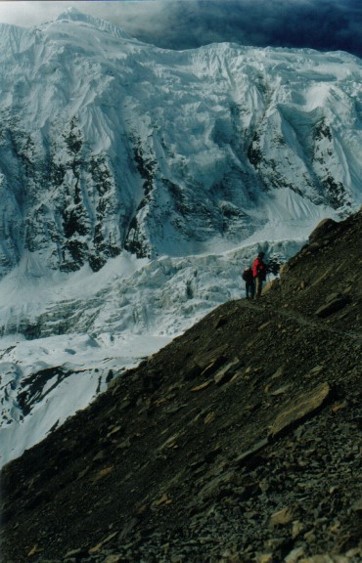
A cold wind was blowing, and the trail wound through scree[3] slopes. The hike was becoming treacherous, and we did some of the worst sections on our hands and knees. The mountain views were becoming spectacular as the Himals closed in on the valley. Our heavy backpacks threatened to unbalance us and push us over the edge to the Khangsar Khola and Marsyangadi river far below. Thorny bushes grew in the arid landscape and snagged our down jackets. We were worried about the condition of these jackets that we had rented in Pokhara. The shop owner was a patient of my fellow trekker, Dr Praveen Partha.    

We could see the Tilicho base camp lodge far below. The descent was along sheer scree slopes. The soil was loose, and the ground could vanish at your feet! Running descents down 45-degree slopes were battering to the knees. Time seemed to stop as we negotiated the vertigo-inducing slopes. Eventually, we reached the valley below and the final stretch was a short level walk. The lodge was dusty and cold. There was some problem with the solar lights and only the dining room was lit.

The next morning dawned cloudy and grey. It had snowed the previous night and I was still feeling nauseous and light-headed. The lodge owner told us about an ultra-marathon race being held that day and that we might meet the runners on our way up. It was a long climb to the lake. The trail initially wound through scree slopes and then climbed more slowly through snowfields. A freezing wind was blowing, and we wore sunglasses with side blinders to protect our eyes from the reflected sunlight and avoid snow blindness. My nose was becoming numb due to the cold. We were struggling at the high altitude (above 4500 m) and in my weakened state, I was finding the going difficult.

The runners were racing through the landscape. Their fitness was astounding. The ones we had met during the early stages of our hike were now returning from the lake. We saw the trail to Yak Kharka[4] and Thorung La[5] in the distance. Our plan was to cross the pass and descend to the holy site of Muktinath and the city of Jomson on the other side.

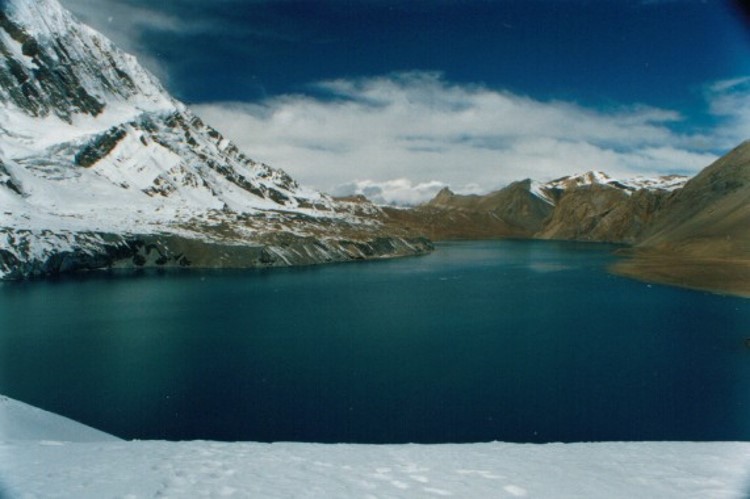
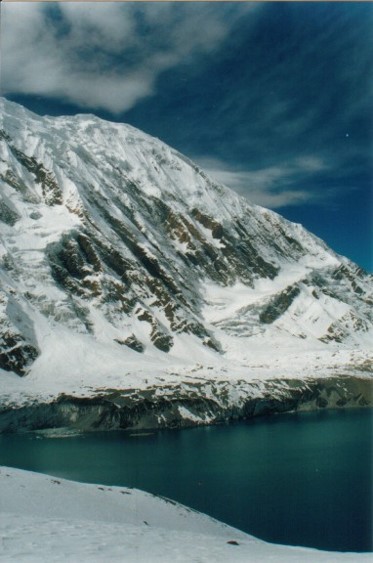
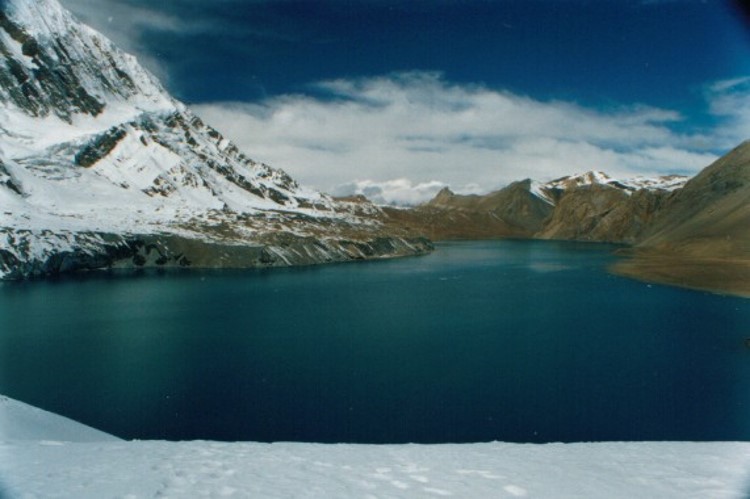
The mountains provided a stark contrast. The north-facing slopes were cloaked in the snow while the south-facing ones were bare. The power of our star, the Sun even at 152 million kilometres was awe-inspiring. We continued climbing. A steep climb along a snow-covered slope and the dark blue waters of the lake could be seen in the distance. The race organizers had set up stations for the runners and race flags and posters were seen on both sides of the trail. The wind was bitterly cold. The snow-cloaked landscape was breathtakingly beautiful. The lake is located at an altitude of 4940 m.  No aquatic organisms have been recorded in the lake.

Snowfields

Tilicho lake is believed by Hindus to be the ancient Kak Bhasundi lake mentioned in the Ramayana. The sage Kak Bhasundi told the epic to Garuda, the king of birds near this lake. The lake was also the location of the highest scuba dive by a Russian team in 2000. A trekking route skirting the lake and reaching Thini Gaon in the Kali Gandaki valley is becoming popular.

This route requires at least a night of camping as there are no lodges (tea houses) after Tilicho Base Camp till you reach Thini Gaon[6]. I have never camped during my travels in the Himalayas. Camping gives you more options but may be more challenging in terms of logistics. Many lodges also have well-maintained camping places.

The trekking lodges in Nepal started as converted tea houses. They were places to have tea, exchange gossip, and eat food. They had been around in the hills for a long time. People hiked the trails for different reasons ranging from trade, visiting family and friends, and pilgrimage. As trekking became more popular many of these started offering travellers a place to sleep. They used to charge only for the food. Later the rooms became more elaborate and private accommodations were created. In big towns and popular locations, some have become hotels.

The cold soon drove us down from the lake and the descent was easier on the lungs. Runners were still running up the slopes. The weather was becoming cloudy, and the sun was soon cloaked by clouds. Light snow started falling. In the mountains, it often snows around noon. I was beginning to feel better but was still weak. It was around four in the afternoon when Dr Partha and I reached the base camp lodge. My appetite was slowly returning.

Climbing to the village of Khangsar

The next morning, we started mid-morning to the settlement of Khangsar and eventually continued to Manang village. The village has some excellent hotels and spectacular views of the Gangapurna glacier. Manang is at 3500 m and the plan was for me to rest here and see how I felt the next morning and then decide whether to continue to do the circuit trek through the pass or return down to the road head of base town of Besishahar.  My bout with altitude sickness had sapped my confidence and we decided discretion was better and slowly headed down. I felt bad for Praveen who was keen to do the circuit before heading off to the greener pastures of the United Kingdom.

The Thorung pass still remains on my bucket list. Hopefully one day I will be able to do it. The Annapurna circuit trek has steadily contracted over the decades as roads have made deeper inroads into the mountains. The trek used to start from Dumre on the Kathmandu-Pokhara highway, then the trailhead shifted to Besishahar, and with the construction of the new road to the district headquarters of Chame. On the other side, there are regular buses from Pokhara and Kathmandu to Muktinath.

Tim Cahill, a travel writer from Montana, wrote, “A journey is best measured in friends rather than miles.” Praveen was perfect company. We gelled well together, we were adaptable and took the rough with the smooth. We did some interesting treks together and I am sure he must be continuing his walks in the cold English air as he thinks about medicine, health, love, happiness, and eternity! 


[1] Elder sister in Nepali

[2] Lake in Nepali

[3] Mountain slopes littered with loose pebbles and rocks

[4] Alpine pasture in Nepali

[5] La is pass in Tibetan

[6] Village in Nepali

Dr. P Ravi Shankar is a faculty member at the IMU Centre for Education (ICE), International Medical University, Kuala Lumpur, Malaysia. He enjoys traveling and is a creative writer and photographer.

.

PLEASE NOTE: ARTICLES CAN ONLY BE REPRODUCED IN OTHER SITES WITH DUE ACKNOWLEDGEMENT TO BORDERLESS JOURNAL