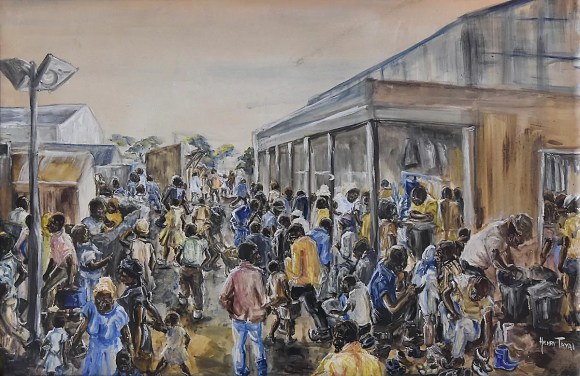
Art by Henry Tayali(1943-1987). From Public Domain
Let us imagine a world where wars have been outlawed and there is only peace. Is that even possible outside of John Lennon’s song? While John Gray, a modern-day thinker, propounds human nature cannot change despite technological advancements, one has to only imagine how a cave dweller would have told his family flying to the moon was an impossibility. And yet, it has been proven a reality and now, we are thinking living in outer space, though currently it is only the forte of a few elitists and astronomers. Maybe, it will become an accessible reality as shown in books by Isaac Asimov, Arthur C Clarke or shows like Star Trek and Star Wars. Perhaps, it’s only dreamers or ideators pursuing unreal hopes and urges who often become the change makers, the people that make humanity move forward. In Borderless, we merely gather your dreams and present them to the world. That is why we love to celebrate writers from across all languages and cultures with translations and writings that turn current norms topsy turvy. We feature a number of such ideators in this issue.
Nazrul in his times, would have been one such ideator, which is why we carry a song by him translated by Professor Fakrul Alam. And yet before him was Tagore — this time we carry a translation of an unusual poem about happiness. From current times, we present to you a poet — perhaps the greatest Malay writer in Singapore — Isa Kamari. He has translated his longing for changes into his poems. His novels and stories express the same longing as he shares in The Lost Mantras, his self-translated poems that explore adapting old to new. We will be bringing these out over a period of time. We also have poems by Hrushikesh Mallick translated from Odia by Snehprava Das and a poignant story by Sharaf Shad translated from Balochi by Fazal Baloch.
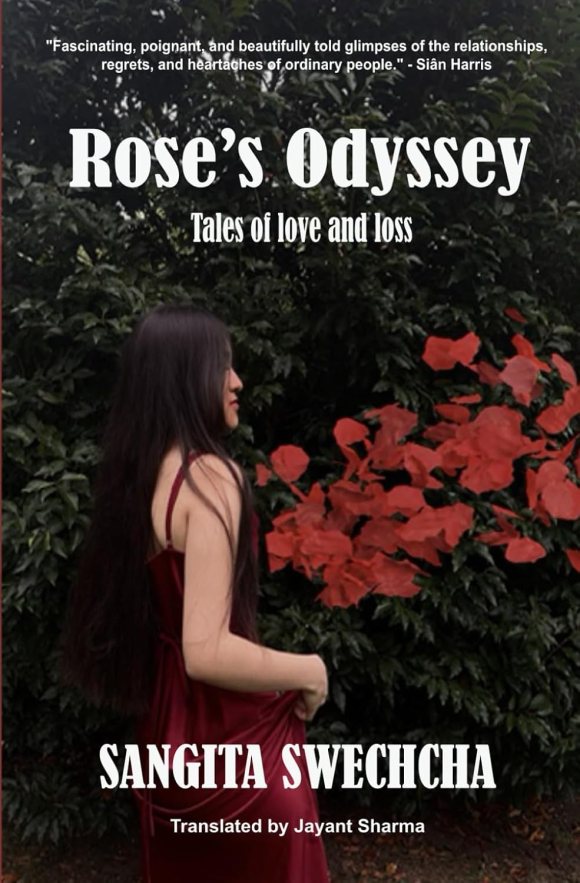
Book reviews homes an indepth introduction by Somdatta Mandal to Banu Mushtaq’s Heart Lamp: Selected Stories, translated from Kannada by Deepa Bhasthi. We have a discussion by Meenakshi Malhotra on Contours of Him: Poems, edited and introduced by Malaysian academic, Malachi Edwin Vethamani, in which she concludes, “that if femininity is a construct, so is masculinity.” Overriding human constructs are journeys made by migrants. Rupak Shreshta has introduced us to immigrant Sangita Swechcha’s Rose’s Odyssey: Tales of Love and Loss, translated from Nepali by Jayant Sharma. Bhaskar Parichha winds up this section with his exploration of Kalpana Karunakaran’s A Woman of No Consequence: Memory, Letters and Resistance in Madras. He tells us: “A Woman of No Consequence restores dignity to what is often dismissed as ordinary. It chronicles the spiritual and intellectual evolution of a woman who sought transcendence within the rhythms of domestic life, turning the everyday into a site of resistance and renewal.” Again, by the sound of it a book that redefines the idea that housework is mundane and gives dignity to women and the task at hand.
We wind up the October issue hoping for changes that will lead to a happier existence, helping us all connect with the commonality of emotions, overriding borders that hurt humanity, other species and the Earth.
Huge thanks to our fabulous team, especially Sohana Manzoor for her inimitable artwork. We would all love to congratulate Hughes for his plays that ran houseful in Swansea. And heartfelt thanks to all our wonderful contributors, without who this issue would not have been possible, and to our readers, who make it worth our while, to write and publish.
Rose’s Odyssey:Tales of Love and Loss is a translation of ‘Gulafsangako Prem1’, a short story collection in Nepali by Sangita Swechcha. Jayant Sharma, the translator, has displayed his incredible skill transmitting the essence and the texture in his translation as they are in the original version.
Swechcha’s writing moves across geographies and emotional landscapes. In Rose’sOdyssey, we see the influence of her own journey: born and raised in Nepal, her time spent in Australia, and her life in the UK. Her experience of multiple cultures gives her work both depth and relatability. She writes not just as a woman, or a feminist, or a diasporic voice, but as a humanist. Her stories resonate because they are grounded in truth and told with generosity.
Several reviewers on Amazon have echoed the sentiments generated by the stories. Dr. Tamer Mikhail describes the experience as “mesmerising,” noting how vividly the characters come to life. Ketan Varia praises Swechcha’s exploration of how life unfolds and the unintended consequences of human choices, while Nirmala Karanjeet highlights the wit, humour, and deep perception of human emotions in every story. These voices of readers moved by the same qualities.
Among the twenty stories, a few stood out with particular force. The titular story, ‘Rose’s Odyssey’, reminded me in scope and ambition of Homer’s Odyssey. Yet this is no imitation. Swechcha’s tale of love, betrayal, vengeance, and repentance transcends a simple love story. It is a story within stories, a tapestry woven with dramatic shifts and psychological insight.
Another memorable piece is the final story, presented in diary format. The narrative offers a poignant glimpse into diasporic life, told in a male voice, which is an unusual and ambitious choice for a female writer. The story’s ability to inhabit male psychology with such authenticity is no small achievement.
The shortest story, ‘Ram Maya’, dealing with the issue of human trafficking, is devastating. In just a few pages, it trembles with urgency. Then there is ‘Shattered Dream’, a story I had previously read in its original Nepali and was eager to revisit in English. The translation, no easy feat, is executed beautifully, preserving cultural nuances while making the narrative accessible to a broader audience. In fact, I was reminded of Toni Morrison’s The Bluest Eye (1970), particularly in how Sweccha addresses themes of bodily autonomy, survival, and the commodification of womanhood.
What ties all these stories together is Swechcha’s ability to write about complex emotional terrain with elegance and restraint. Each story is deeply personal, yet universal. The immigrant experience, cultural duality, gender, longing, and resilience are all present without ever feeling heavy-handed. It is heartening to see readers on Amazon responding so positively. One reviewer calls it “an easy and interesting read,” while another from Holistic World notes how each tale is “captivating and alluring,” connected by “the thread of love.” This feedback is not only encouraging, it also affirms the book’s power to reach readers from all walks of life.
In addition to the warm reader responses and literary features, I also recall Shahd Mahanvi, author of White Shoes, at the launch event aptly described Rose’s Odyssey as “a powerful exploration of human emotions.” She added that it is “a compelling collection that delves into themes of control, mistrust, the impulse to hurt those we love, and the complex intersections of human relationships, provoking deep reflection.”
In the year since its release, Rose’s Odyssey has had a successful run, from warm reader responses to literary features, several book signings in the UK and Nepal, and community events. Its journey is far from over. The success of the book is not just a testament to Swechcha’s literary talent, but to her ability to connect across continents, cultures, and hearts.
Dr. Rupak Shrestha, a London-based Nepali poet from Pokhara, is acclaimed for diverse literary forms and translation. He also serves as Advisor to the International Nepali Literary Society (INLS) UK Chapter.
.
PLEASE NOTE: ARTICLES CAN ONLY BE REPRODUCED IN OTHER SITES WITH DUE ACKNOWLEDGEMENT TO BORDERLESS JOURNAL.
The Great War is over
And yet there is left its vast gloom.
Our skies, light and society’s soul have been overcast…

'The Great War is Over' by Jibanananda Das (1899-1954), translated from Bengali by Professor Fakrul Alam.
Jibanananda Das wrote the above lines in the last century and yet great wars rage even now. As the world struggles to breathe looking for a beam of hope to drag itself out of the darkness induced by natural calamities, accidents, terror attacks and wars that seem to rage endlessly, are we moving towards the dystopian scenario created by George Orwell in 1984, which would be around the same time as Jibanananda Das’s ‘The Great War is Over’?
Describing such a scenario, Ahmed Rayees writes a moving piece from the Kashmiri village of Sheeri, the last refuge of the displaced refugees who were bombarded after peace was declared in their refuge during the clash across Indo-Pak borders. He contends: “People walked back not to homes, but to ruins. Entire communities had been reduced to ash and rubble. Crops were destroyed, livestock gone, schools turned into shelters or craters. How do you rebuild a life when all that remains is dust?”
People could be asking the same questions without finding answers in Gaza or Ukraine, where the cities are reduced to rubble. While we look for a ray of sunshine, amidst the rubble, Farouk Gulsara muses on hope that has its roots in eternity. Vela Noble wanders on nostalgic beaches in Adelaide. And Meredith Stephens travels to the Australian outback. Devraj Singh Kalsi brings in lighter notes writing of driving lessons while Suzanne Kamata creeps back to darker recesses musing on likely ‘criminals’ and crimes in her neighbourhood.
Lopamudra Nayak writes on social media and its impact while Bhaskar Parichha writes of trends that could be brought into Odia literature. What he writes could apply well to all regional literature, where they lose their individual colouring to paint dystopian realities of the present world. Does modernising make us lose our ethnic identity and how important is that? These are questions that sprung to the mind reading his essay. As if in an attempt to hold on to the past ethos, Prithvijeet Sinha wafts around old ruins in Lucknow and sees a cemetery for colonial soldiers and concludes: “Everybody has formidable stakes, and the dead don’t preach the gospel of victory or sombre defeat.”
We have mainly poetry in translation this time. Snehaprava Das has brought to us Soubhagyabanta Maharana’s poems from Odia and Ihlwha Choi has translated his own poem from Korean. Sangita Swechcha’s poem in Nepali has been rendered to English by Saudamini Chalise. From Bengali, other that Jibanananda Das’s poems translated by Professor Fakrul Alam, we have Tagore’s pensive and beautiful poem, Sonar Tori (the golden boat). Yet another Bengali poet, one who died young and yet left his mark, Sukanta Bhattacharya (1926-1947), has been translated by Kiriti Sengupta. Sengupta has also translated the responses of Bitan Chakravarty in a candid conversation about his dream child — the Hawakal Publishers. We also have a feature on this based on a face-to-face conversation, giving the story of how this publishing house grew out of an idea. Now, they publish poetry traditionally, without costs to the poet. Their range of authors are spread across continents.
Our fiction again returns to the darkness of war. Young Leishilembi Terem has given a story set in conflict-ridden Manipur from where she has emerged safely — a story that reiterates the senselessness of violence and politics. While Jeena R. Papaadi writes of modern human relationships that end without commitment, Naramsetti Umamaheswararao relates a value-based story in a small hamlet of southern India.
We have more content. Do pause by our contents page and take a look.
Huge thanks to all our contributors without who this issue would not have materialised. Heartfelt thanks to the team at Borderless for their support, especially Sohana Manzoor for her iconic artwork that has almost become a signature statement for Borderless.
Let’s hope that next month brings better news for the whole world.
Sangita Swechcha’s poem has been translated from Nepali by Saudamini Chalise
Sangita Swechha
ANIMATE DEBRIS

A living dream
smoulders
in the boulevard,
blowing the trumpet of revolution.

Not a dream anymore—
he turned to ash.

In that animate rubble,
dampened eyes
batted lashes.
Someone’s soul
had incinerated.

Some took to the streets,
seeking justice.
Some said he lacked the mettle to survive,
and self-immolated.

Others said he martyred himself
for the revolution.

Tender hearts grew pensive.
The one who dreamed for them
had burned.

And now, they would wonder:
Why even dream
where dreams are doused
before they’re born,
where realities,
before turning to corpses,
were already draped for the cortege?

But for those
who had clung to that burning dream—
who lived off its flickering light—
they are now
reborn from its ashes.
Sangita Swechcha is a Nepali writer, poet, and scholar based in England. She published her debut novel Seto Siundo at 18. Her other works include Rose’s Odyssey, a collection of short stories and co-edited anthologies like The Himalayan Sunrise and A Glimpse Into My Country.
Saudamini Chalise, author of three thrillers, is also a prolific translator and biographer, known for translating works by Khagendra Sangraoula, Dr. Bhagwan Koirala, and Kiran Acharya.
.
PLEASE NOTE: ARTICLES CAN ONLY BE REPRODUCED IN OTHER SITES WITH DUE ACKNOWLEDGEMENT TO BORDERLESS JOURNAL
Centuries ago, April was associated with spring induced travel… just as pilgrims set out on a journey in Chaucer’s Canterbury Tales. Some of the journeys, like to Mecca, become a part of religious lore. And some just add to the joie de vivre of festivities during different festivals that punctuate much of Asia during this time — Pohela Boisakh (Bengali), Songkran (Thai), Navavarsha (Nepali), Ugadi (Indian), Vaisakhi (Indian), Aluth Avurudda (Sri Lankan) and many more.
A hundred years ago, in April 1924, Tagore had also set out to journey across the oceans to China — a trip which, perhaps, led to the setting up of Cheena Bhavan in Vishwa Bharati. Recently, Professor Uma Dasgupta in a presentation stated that Tagore’s Nobel prize winning Gitanjali, and also a collection called The Crescent Moon (1913), had been translated to Chinese in 1923 itself… He was renowned within China even before he ventured there. His work had been critically acclaimed in literary journals within the country. That arts connect in an attempt to override divides drawn by politics is well embodied in Tagore’s work as an NGO and as a writer. He drew from all cultures, Western and Eastern, to try and get the best together to serve humankind, closing gaps borne of human constructs. This spirit throbbed in his work and his words. Both towered beyond politics or any divisive constructs and wept with the pain of human suffering.
This issue features translations of Tagore’s writings from his childhood — both done by professor Somdatta Mandal — his first trip with his father to the Himalayas and his first experience of snow in Brighton. We have a transcreation of some of his lyrics by Ratnottama Sengupta. The translation of his birthday poem to himself — Pochishe Boisakh(his date of birth in the Bengali calendar) along with more renditions in English of Korean poetry by Ihlwha Choi and Manzur Bismil’s powerful poetry from Balochi by Fazal Baloch, add richness to our oeuvre. Bismil’s poetry is an ode to the people — a paean to their struggle. It would seem from all the translations that if poets and writers had their way, the world would be filled with love and kindness.
Yet, the world still thunders with wars, with divides — perhaps, there will come a time when soldiers will down their weapons and embrace with love for, they do not fight for themselves but for causes borne of artificial human divides. It is difficult to greet people on any festival or new year, knowing there are parts of the world where people cannot celebrate for they have no food, no water, no electricity, no homes and no lives… for many have died for a cause that has been created not by them as individuals but by those who are guided solely by their hankering for power and money, which are again human constructs. Beyond these constructs there is a reality that grows out of acceptance and love, the power that creates humanity, the Earth and the skies…
Humour is brought into non-fiction by Devraj Singh Kalsi’s narrative about being haunted by an ancient British ghost in Kolkata! Suzanne Kamata adds to the lightness while dwelling on modelling for photographs in the Japanese way. Ravi Shankar plunges into the history of photography while musing on black and white photographs from the past.
Tagore again seeps into non-fiction with Professor Fakrul Alam and Asad Latif telling us what the visionary means to the Bengali psyche. Starting with precursors of Tagore, like Michael Madhusudan Dutt, and post-him, Sarojini Naidu, Mandal has shared an essay on Bengaliness in contemporary poetry written by those born to the culture. Jared Carter has given discussed ‘the lyric temper’ in poetry — a wonderful empathetic recap of what it takes to write poetry. Exploring perspectives of multiple greats, like Yeats, Keats, George Santyana, Fitzgerald, Carter states, “Genuine lyricism comes only after the self has been quieted.”
Sengupta has conversed with a dance choreographer, Sudershan Chakravorty, who has been composing to create an awareness about the dilemmas faced by migrants. An autobiographical narrative in Hindustani from Ilma Khan, translated by Janees, shows the resilience of the human spirit against oppressive social norms. Our fiction has stories from Lakshmi Kannan and Shevlin Sebastian urging us to take a relook at social norms that install biases and hatred, while Paul Mirabile journeys into the realm of fantasy with his strange story about a boy obsessed with pyromania.
“It is an ironical reflection on our times that a prolific and much awarded Indian writer– perhaps deserving of the Nobel prize — should be excised from the university syllabus of a central university. This move has, perhaps paradoxically, elicited even more interest in Mahasweta Devi’s work and has also consolidated her reputation as a mascot, a symbol of resistance to state violence. A timely intervention, this volume proves yet again that a great writer, in responding to local, regional, environmental ethical concerns sensitively, transcends his/her immediate context to acquire global and universal significance.”
There is more content than I mention here. Do pause by our current issue to take a look.
I would hugely like to thank the Borderless team for their unceasing support, and especially Sohana Manzoor, also for her fantastic art. Heartfelt thanks to all our wonderful writers and our readers. We exist because you all are — ubuntu.
Hope you have a wonderful month. Here’s wishing you all wonderful new years and festivals in March-April — Easter, Eid and the new years that stretch across Asian cultures.
Looking forward and hoping for peace and goodwill.
Perceptions paint the world,
Each with their own
Lens of preconceptions.
Only an infant remains unpainted,
Blind to the art of presupposition.

The white clouds in the blue sky,
Perceived as dark,
When viewed through darkened lenses
In the garden, bloom to unravel secrets;
A revelation for the inquisitive,
Putting on the glasses of inquiry.

If you mask with restricted sight,
And the boundless sky shrinks to confinement,
Life mirrors the chosen spectacles,
Determining the hues of the lens
Through which you peer into the eye called life.
Kumar Ghimire is a poet from Nepal. He writes poems in Nepali and English language. His poems have been published in International Times, Ink Pantry, Synchronized Chaos, Grey Thoughts etc.
PLEASE NOTE: ARTICLES CAN ONLY BE REPRODUCED IN OTHER SITES WITH DUE ACKNOWLEDGEMENT TO BORDERLESS JOURNAL
Interviewing Bulbul: Remembering Mrinal Sen… Ratnottama Sengupta introduces Bulbul Sharma to converse with her on Mrinal Sen, the legendary filmmaker, reflecting on Bulbul Sharma’s experience as an actress in his film, Interview. Click here to read.
In conversation with Gajra Kottary, eminent screenplay writer, and a brief introduction to her recent book of short stories, Autumn Blossoms. Click hereto read.
Translations
Nazrul’s poem, Samya or Equality, has been translated from Bengali by Niaz Zaman. Click here to read.
Masud Khan’s Fire Engine has been translated from Bengali by Fakrul Alam. Click here to read.
The wind blowing across the Long Island Sound chilled his bones. The day was cloudless and the sky blue, but the sun lacked warmth. New York. Dr Ram Bahadur had called the big apple home for over three decades. Winters were cold and snowy. There were cold snaps and the dreaded northeaster brought snow and freezing temperatures. Summers could be surprisingly warm. February in New York was the depth of winter.
Long Island was blanketed in snow. He had spent the morning clearing snow from the driveway of his home. The suburb of Woodbury was quiet and peaceful. The trees had lost their foliage and were waiting for the warmth of spring to put on a new coat of green. He had a large house with floor to ceiling picture windows. The house was two storied with an attic. There were two bedrooms on the ground and three on the first floor. He had done well in life and was now prosperous.
He still recalled his first days in the big apple. He had just come to the United States from Nepal after completing his postgraduation in Internal Medicine. The first years were tough. He had some seniors doing their residency in New York city. The state of New York offered the largest number of residencies in the country. He did his residency again in internal medicine and then a fellowship in endocrinology.
All his training was completed in New York. He worked for over two decades in large hospital systems. But, for the last five years he started his own private practice. Compared to most other countries medicine in the States paid well. Private practice was certainly lucrative, though the cost of living in New York was high.
He did sometimes think about his home country of Nepal. The Kathmandu valley was still a beautiful place. His visits were few and far in between. Unplanned urbanisation had made the valley dusty and dirty. Winters in Kathmandu were cold but milder compared to New York. The Institute of Medicine (IOM) was the first medical school established in the country. The original intention was to create doctors for rural Nepal. The selection was tough and competitive. He still remembered his joy on learning that he had been selected for the medical course. During the closing decades of the twentieth century Nepal was in turmoil. The insurgency was ongoing, and blockades were the order of the day. Violence was rife and a lot of blood was spilled.
Most doctors from IOM migrated in search of greener pastures. The others mostly practiced in the valley, the historic heartland of the country. Ram was originally from Gorkha, in the centre of the country but his family had migrated to the capital when he was a few years old. His father was a civil servant while his mother was a housewife. Civil servants did not make much and money was always in short supply. His father was a man of principle and never accepted bribes or tolerated corruption. He still remembered the argument he had with his father when he put forward the plan to migrate to the United States (US) to pursue his residency.
His parents had both passed away and his siblings were also settled in North America. He rarely visited Nepal these days. The insurgency was followed by the overthrow of the monarchy and then a new constitution was promulgated. A federal structure was set up and while this did have benefits, the expenditures also increased. Each state had to set up an entirely new administrative machinery. He married an American academician who taught Spanish literature at the City University of New York. His wife’s family hailed from the country of Colombia.
New York had a substantial Hispanic population these days. He was now fluent in several languages: Nepali, his mother tongue; English, Spanish and Hindi. He also understood Newari, the language of the Newars, the original inhabitants of the Kathmandu valley. He did think on and off about his motherland. Many Nepali doctors left the country. Working conditions were hard and the pay was poor. To advance, you required political patronage. The frequent changes in government required you to be on good terms with several political parties.
He still missed the food of his childhood. New York was a very cosmopolitan place. There were several Indian restaurants and even a few Nepali ones. He was very fond of bara (a spiced lentil patty) and chatamari (Newari pizza), traditional Newari foods. These had earlier not been available in New York. Luckily for him, two years ago a Newari restaurant had opened in Queens. He was also particular to Thakali food. The Thakalis were an ethnic group who lived in the Kali Gandaki valley north of Pokhara. He particularly fancied green dal, sukuti (dried meat), kanchemba (buckwheat fries) and achar (pickle). Anil was a decent cook and had learned to cook a decent Nepali thali[1]and dhido (thick paste usually made from buckwheat or corn). He also made tasty momos (filled dumplings that are either steamed or fried) and these were much in demand among his companions.
Ram loved the professional opportunities that his adopted homeland provided. He had become a US citizen. Working in the US was more rewarding though the paperwork associated with medical care had steadily increased. Many of his batchmates and seniors lived and worked in New York state and across the state border in New Jersey.
Many of them did miss their homeland and had a vague feeling of guilt for not contributing their share to their original homeland. A few of them were working on a proposal of developing a hospital at the outskirts of Mahendranagar in the far west of Nepal. The Sudurpashchim province had a great need for quality medical care. The details were still being worked out. There were about twenty IOM graduates involved and they decided on an initial contribution of a million dollars each. Despite inflation twenty million dollars was still a substantial sum in Nepal.
This group of friends collaborated on different social projects. They were also active in promoting a more liberal America where each citizen and resident had access to quality healthcare. The hospital would be their first project outside the US. A strong community outreach component was also emphasised in their project.
The US had made him wealthy. He was a proud American. However, he also owed a deep debt to his home country for educating him and creating a doctor. Now was the time for him to repay that debt, not wholly or in full measure but substantially to the best of his abilities!
[1] Plate made of a few courses, completing the meal
.
Dr. P Ravi Shankar is a faculty member at the IMU Centre for Education (ICE), International Medical University, Kuala Lumpur, Malaysia. He enjoys traveling and is a creative writer and photographer.
.
PLEASE NOTE: ARTICLES CAN ONLY BE REPRODUCED IN OTHER SITES WITH DUE ACKNOWLEDGEMENT TO BORDERLESS JOURNAL
Short story by S Ramakrishnan, translated from Tamil by T Santhanam
It was Malavika who sent me the video of the monk who plays guitar. Malavika is my daughter. She is pursuing fashion designing course in Kingston University, England. Her desires and interests are a puzzle to me. Some days ago, she sent a recording of a poem by William Blake in her voice. After that, she sent a photo of her carrying a placard in a demonstration against global warming. As clouds change to forms unimaginable, her interests keep on changing. After watching a butterfly, she had sent her impressions in writing. It seemed as though it was from a seasoned writer.
Children who leave home for far off places, in a sense, leave us. She was no longer the girl she was in Chennai. The new country and new environment have changed her. The changes are reflected in her appearance and deeds. My wife did not like these alterations. Below the video of the monk who played guitar, she had given the caption: “Music is Meditation”. I could not understand her. At the age of twenty-two, I thought she would be fondly giving herself to worldly pleasure. But she was immersed in meditation, agitation and museum visits.
In the video sent by Malavika, the monk must have been about thirty years old. His head was tonsured. He wore a robe coloured orange. His ears were slightly big. He had a sharp nose and small lips where a smile was frozen. It was hard to find out if he was a Nepali or a foreigner. On his left arm, was tattooed the image of Buddha.
It was funny to see a Monk with a guitar. The image we have formed about saints and the looks of current day saints are not alike. Perhaps, we refuse to update that image. Perhaps, the meaning of sainthood has changed.
The musical piece was given the title “Falling flowers”. From the way he was playing, it seemed as real as the blossomed cherry leaves falling gently. The normal rapidity and gush associated with guitar music was not there. Like an insect that moves in the water, his fingers moved on the guitar strings. Music tunes to the past more easily than photographs. A small piece of music is enough to take us back to our school days.
I saw the video once or twice. I felt the urge to listen to it again and again. While listening at night, I felt as if the fragrance of incense was wafting into the vacant spaces of my heart. I found His name was Limang Tolma while searching for his other videos. There were hundreds of musical pieces by him. All of them were only seven minutes long. Evidently, he played the guitar for only seven minutes in a day. That too under the sal tree in Coben Monastery seated on a stool. Hundreds of people from various countries pour in to listen to his performance. All this I gathered while browsing the internet. His music was melodious and sweet. Why did he play for seven minutes only at each stretch was beyond comprehension.
To know more about Limang Dolma, I called Malavika on her mobile. She sent a message that she was observing silence for the past five days. Why this silence? Tongue can be tied down. But the mind?
I told my wife. She responded that she had scolded Malavika and that was why she was doing this.
I could not understand. What was the skirmish between mother and daughter? I sent a message to Malavika asking her how long her silence would continue. “God only knows,” was her reply.
As I am a senior executive in an automobile company, I had to conduct two to three meetings in a day. My blood pressure sometimes would rise after returning from these meetings.Sometimes, I would have a headache too. At times, the meetings would last for ten hours. After the meeting, I would feel as if somebody has placed a pile of iron on my shoulders. I would feel sick, wondering why we could not conduct our work without talking, discussing or fighting.
One day, before the commencement of the meeting, I started to listen to the monk’s guitar music from my cell phone rather impulsively. I closed my eyes for seven minutes as though I was in a deep meditation. It was as pleasant a feeling as a moist breeze caressing my body. There was peace in my heart and an exhilaration I had never known before. On that day, I could sense the change in my voice and the way I was moving towards a solution. Somehow the officials of the sales department seemed to understand this. After the conclusion of the meeting while coming down in the lift, Amarnath said, “There was something new in your speech today. You spoke like a Zen Master.”
“Yes” I nodded approvingly with a smile. I was just wondering how a small piece of music could bring such a tremendous change in me.
I wanted to know more about Limang Dolma. Searching through the internet I was more and more astonished. The real name of Limang Dolma is Christopher Cane. He was born in Milan. He had pursued Anthropology. After coming into contact with a Buddhist monk, he has embraced Buddhism and become a monk in the Buddhist Monastery. He plays the guitar only under the tree of the monastery and nowhere else. Young people throng to him. They listen to his music. Some of them stay there for days together to savour his music. They wear T-shirts bearing his image with the words, “Buddha plays Guitar”. In an interview, a young lady asks him. “All saints in India hold one or other instruments. Why does Buddha not play any instrument nor is seen holding one?”
“He himself is a musical instrument. One who knows how to tune himself finds no need for a musical instrument. In the same way, Nature tunes itself. Is there any tune better than what the water plays?”
“Why do you play only for seven minutes?”
“Seven is the symbol of consciousness in Buddhism.”
“Seven minutes is not enough for us. Can’t you play more?”
“Will you take honey in a gulp? Is a spoonful not enough?” he asks.
I admired Limong Dolma fo his speech, poise and the way he handled guitar. I too felt like wearing a T-shirt bearing his image. I sent the video of Limang Dolma to some of my friends asking them to listen to his music. Only Mohan Muralidharan, a neurologist and my school mate, sent a reply saying that a man from Turkey played better than the monk and shared the video. Why should one musician be compared to another? Can’t this foolishness be avoided?
I called Mohan and blurted out my irritation. He said in a mocking tone, “You’re aging. That is why you listen to a monk playing the guitar. Music should make us feel young. It should twinge our nerves. You have never touched a musical instrument in your entire life. Can you whistle atleast?”
Mohan was right. I haven’t even played the mouth organ which many played during my school days.
I felt like owning a guitar. The same evening, I went to a musical store in Leo mall. I showed the video of Limang Dolma and asked for a guitar like the one in the video. The face of the girl at the counter brightened. “Limang Dolma?” she asked. I felt glad that she too has listened to the music. She brought a guitar from inside. I told her, ” I don’t know how to play guitar. This is for my daughter.”
The girl told with a smile, “Limang Dolma was a thief. He was in prison. After his release, he became a Monk. People say he speaks to Buddha through his music.”
“Really!”
“I overheard two girls talk of it when they came to purchase a guitar.”
“Do you believe that?”
“I believe it partially.”
“Which part?”
“That he speaks to Buddha,” she smiled.
She looked like my daughter when she smiled. Perhaps for young girls Buddha is a different personality. May be, the Buddha known by the ones who have crossed fifty years like me and the Buddha these young girls adore are not the same.
When I brought guitar home, my wife chided me.
“Why have you brought this? Who will play?”
“Just let it be,” I responded.
“Is it a show piece to be kept just like that?” she asked.
I did not reply.
I placed the guitar in Malavika’s room close to her bed. I had a feeling that Malavika had returned. I sent that night the picture of guitar to Malavika by WhatsApp. She sent an emoji of two clapping hands. Also, she sent a message “We are going to visit Limang Dolma.”
Though I felt happy, I was eager to know who was the other in the ‘We’. I did not venture to ask Malavika. Instead, I asked, “When?” She did not respond.
After five days, she sent a picture to me. She was among the hundreds of youngsters before Limang Dolma, as he was playing the guitar. My eyes were cast on a young man with long hair, not on Limang Dolma. The young man hung his arms around Malavika’s shoulder.
Who was this fellow? How long had she known him? I could not see his face properly. I widened the image. An European face. Perhaps was he also a musician? I thought of asking Malaviika. But I curbed that thought and went on to ask about the musical event, as I called her. She was full of cheer. She told me,” Listening to Dolma’s music, one feels like a kite fluttering in the air. I do not know what to say. Flying to heaven.”
“I read somewhere that he was a thief,” I said.
” Oh, that’s a myth constructed by magazines. When asked about this, Dolma says raindrops do not have a past. Jonah and myself were in the Monastery for three days. Wonderful experience!”
A question arose on my mind as to who Jonah was. I was not sure whether to ask her or not. Why wouldn’t she talk about him?
I asked, “Is Jonah a musician?”
“Dad, how do you know? Indeed, he is. He plays the guitar well. It was he who introduced me to Dolma’s music.”
“Is Jonah your classmate?”
“No, he works in a bar where I hold a part time job.”
“You didn’t tell me,” I pretended to be angry.
“Dad, don’t tell Mom about this.”
“About your working in bar?” I asked deliberately.
“About Jonah too?” she laughed. As she was so laughing, she seemed to be some other young girl. After she hung up, I was thinking about Jonah. Was he a good person or bad? Was he also a thief earlier? Or could he be a drug addict? Who were his parents? Was he in love with Malavika? Had I become old? Was Mohan right? I
admired a Monk playing guitar somewhere. But I do not like Jonah who also plays guitar. Why? I was perplexed. Suppose if Limong Dolma put his arm around the shoulder of my daughter, would I dislike him too? I was confused.
Two days later, Malavika forwarded a video of Limang Dolma downloaded in her phone. Limong Dolma walked as though he was floating in the air. He sat under the tree. Peace was on his face as he tuned the guitar — the same music that I savoured earlier. No longer did I feel close to that music. Somehow, instead of Limang, Jonah’s face came before me. I felt as if a bitterness had settled down on my tongue.
The same night, Malavika called me. Before my asking anything, she said, ” After visiting Limang Dolma, I do not feel like listening to his music again”
“Why?” I asked as if I did not know anything.
“I do not like it any more just the way I suddenly liked it before.”
“How is Jonah?” I asked intentionally.
“Do not talk about him. I hate him. I hate whatever he introduced to me.”
Inwardly I was happy.
” Any problem? Shall I talk to Jonah?”
“Why should you talk to him? The days I moved with him, it was a nightmare. Daddy, why do you not rebuke me?”
“You are not a kid, after all.”
“But you think of me as a kid only. You don’t know me as Mom does.”
I was flummoxed. I could hear Malavika sobbing for the first time ever. I did not know how to console her. I hurriedly gave the phone to my wife. She started walking towards the kitchen with her words of consolation. What has transpired between her and Jonah? Why was she weeping? I could not make out. At the same time, I was happy that she disliked the world she created for herself and moved back towards my world. A thought arose that she was coming home. I asked my wife what Malavika had said.
“That boy is not good. I told her from the beginning itself. But she did not pay heed.”
“Did you know about Jonah before?”
“She told me six months back. I scolded her saying that your Dad will not like this. I have spoken to Jonah also.”
“To Jonah? You?”
“Yes, I could not understand a bit of what he spoke.”
“What is the problem now?”
“It’s over. No use talking about it!”
I could not understand what happened. But Malavika had been closer to her mother than to me. She had shared everything with her mother. I was pained at this. Why then did she asked me not to tell her mother? Why this drama? Children after growing up, treat their father as a plaything. The daughter I know is now the girl I do not know. I could not reconcile myself to this.
I heard the guitar music of the monk that night. I was more attracted to the tree than to the music.
Leaves do not stay on the tree for long. When a leaf falls, the tree does not reach out to catch it. When falling leaves sail along the wind, the trees can do nothing but look at them in silence. Somehow, the music stirred a grief in me.
As I prepared to leave for office next morning, I saw my wife keeping the guitar next to dustbin. What was the fault of the guitar after all?
” What are you going to do with this?” I asked.
“Anish told me, he will take it. What do we do with this? Malavika does not want it any more.”
I nodded giving the impression that she was right. But I felt sorry while doing that.
.
S. Ramakrishnan is an eminent Tamil writer who has won the Sahitya Akademi Award in the Tamil Language category in 2018. He has published 10 novels, 20 collections of short stories, 75 collections of essays, 15 books for children, 3 books of translation and 9 plays. He also has a collection of interviews to his credit. His short stories are noted for their modern story-telling style in Tamil and have been translated and published in English, Malayalam, Hindi, Bengali, Telugu, Kannada and French.
T Santhanam is a retired Bank Executive in Bangalore, India. He has a passion for literature with a special affinity for poetry. He writes poetry in Tamil. He is also a blogger.
.
PLEASE NOTE: ARTICLES CAN ONLY BE REPRODUCED IN OTHER SITES WITH DUE ACKNOWLEDGEMENT TO BORDERLESS JOURNAL







 Borderless