Categories
Review

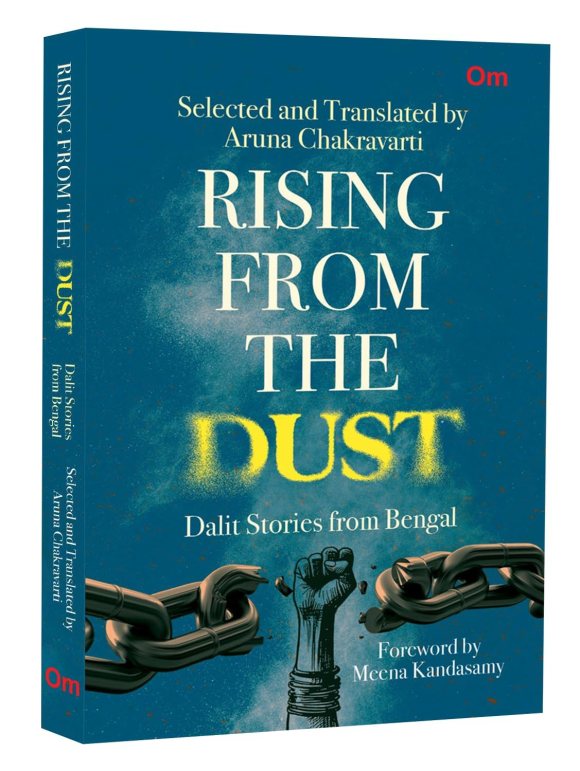
Rising from the Dust

Book Review by Somdatta Mandal

Title: Rising From the Dust: Dalit Stories from Bengal

Selected and Translated by Aruna Charavarti

Publisher: Om Books International

Though Bengali Dalit writing is comparatively newer compared to Dalit writing in Marathi and other Dravidian languages, nevertheless it has already carved a niche for itself in a significant way. The main difference between the Dalit writing emanating from other regions of India and that of Bengal is that whereas the thrust area elsewhere is primarily on the untouchables, the downtrodden and the way the Dalits have been marginalised in society for a long time, in Bengal the problem is further complicated by caste and class issues which is not so significant elsewhere. This collection of twelve Dalit short stories from Bengal, carefully selected and translated by Aruna Chakravarti, spans a long period and what distinguishes it is the gendered lens that explores the Dalit woman’s cause and holds it up to the light.

There is a difference in the style of narrating the Dalit experience from writer to writer and accordingly it can be divided into two groups. In the first category are writers who themselves belong to the Dalit community and their writing stem out of experiential feelings. The second group of writers belong to the upper castes, and their writing stems from a feeling of empathy for the marginalized and the downtrodden. Spanning a long period of almost a century, Aruna Chakravarti has decided to blend both these categories and has meticulously translated the dozen stories from well-known writers to those a little lesser known. While literary stalwarts like Mahasweta Devi, Saratchandra Chattopadhyay, Tarashankar Bandopadhyay and Prafulla Roy share their profound understanding of the Dalit woman’s fears and traumas, hopes, dreams and aspirations, contemporary voices from the Dalit community itself like Manoranjan Byapari, Bimalendu Haldar, Manohar Mouli Biswas, Kalyani Thakur Charal, Anil Ghorai and Nakul Mallik explore aspects of survival and social ostracisation with both sensitivity and angst. On the one hand we have centuries of oppression being still carried upon these subaltern people, and even within that restricted space, we also often find protest and upheaval that the doubly marginalized womenfolk attempt to revolt against.  

In the opening story titled “Fortress” by Manoranjan Byapari, we find Nakul’s widow Sarama, unwillingly forced to sell her body to oppressive menfolk everyday finds her unique way of protest by deliberately copulating with her ex-husband Ratan who is inflicted with venereal disease, thereby driving out all her fear and henceforth would ‘welcome every touch’ and ‘would wait outside her door in delicious anticipation.’ In Bimalendu Haldar’s “Salt” we are shown how a fisherman Madhai who works for his employer Nishay Ghosh, goes missing and his wife Chintay, collecting three other suffering women registers their protest in a unique way. In “Shonkhomala” Manohar Mouli Biswas tells us a relatively contemporary and true story relating to the grabbing of agricultural land in the fertile Singur area by the government for setting up of the Tata Motor Factory. It tells us of how Shonkhomala Dom, a Dalit woman, changes her name to Tapashi Malik and is gangraped and murdered because she was unwilling to give up her land and organized a protest march instead. Incidentally, till date, the court case for identifying the murderer and the rapists of Tapashi Malik is unresolved.

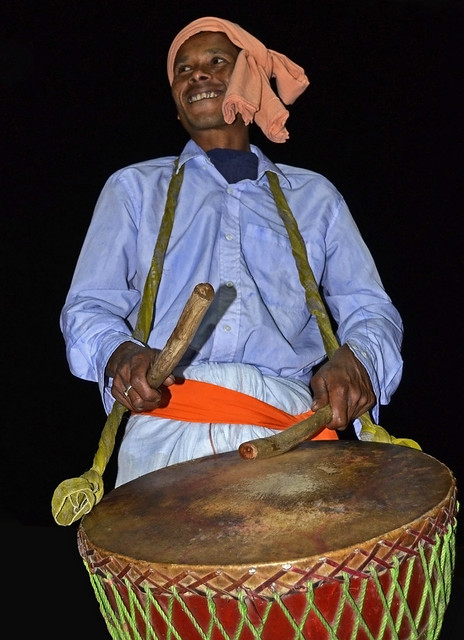
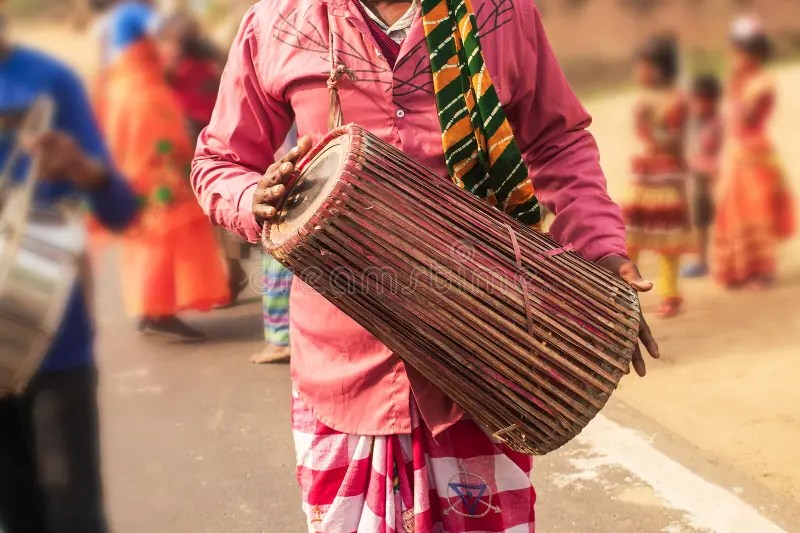
Another very touching story “Illegal Immigrant” by Nakul Mallick brings in the plight of refugees from erstwhile East Bengal coming to India after the partition. It tells us of the plight of an extremely poor jhalmuri seller called Madhav who, along with his wife Shefali, lives in a slum beside the train track and somehow manages to eke out a decent living. When Madhav is picked up as an illegal Bangladeshi immigrant and thrown out of the country, his wife’s life goes haywire as she goes to the Petrapole border looking for her husband in vain. Kalyani Thakur Charal deliberately adds the word ‘Charal’ meaning ‘Chandal’ or ‘untouchable’ to her name in order to take pride of her Dalit identity. In “Motho’s Daughter” she tells the story of one Nishikanta who wants to get his children educated first and foremost and is frustrated in the end because his stray son gets married to a woman who doesn’t encourage education. Anil Ghorai, another powerful Dalit writer, tells an interesting story about Larani, belonging to the tanner caste, her relationship with Hola Burho, a dhol[1] repairer and his son Pabna. The main thrust of the story “The Insect Festival” is of course the attack of locusts in the village and how the majority of the illiterate villagers take resort to superstitious rituals in order to ward off the menace instead of confronting the situation in a scientific manner.

As mentioned earlier, each story by the four empathetic writers goes on emphasizing the pressures of caste and class upon the lower classes of people in different situations. In “The True Life Story of Uli-Buli’s Mother” Mahasweta Devi tells us the story of a helpless woman who becomes a destitute after being thrown away for having four daughters. She lives under the delusion that someone has stolen her young twins Uli and Buli. Again in “Nalini’s Story” she draws a beautiful pen picture of Nalini, who after being abandoned by her husband, lives with her grandson and ekes out her living by working as a maid. Years later, her estranged son along with his wife and her landlord Gobindo all desire to take possession of her house by arranging an elaborate shraddha ceremony for her estranged husband. Nalini understands their ploy and, in the end, she puts her foot down, unwilling to be in eternal debt for the extravagant rituals proposed by them.

Prafulla Kumar Roy’s “Snake Maiden” gives us an inside story of the gypsies or nomads who are known as ‘bedyes’ and who deal with snakes and charms. Here Shankhini is the mistress of a band of bedeys who come and settle in Sonai Bibir Bil for the season and accidentally meets her ex-lover Raja saheb. She is in a quandary because he wants her to renounce the bedeni’s life and settle down in one place and turn into a farmer’s wife. The tug between domesticity and the age-old tradition of this nomadic gypsy tribe’s rituals and customs is elaborated through the rest of this interesting story. The powerful storyteller Tarashankar Bandyopadhyay gives us two stories with totally different locales and characters. In “The Witch” he elaborates upon the idea of a woman who is defined as a witch and is ostracised by society because she is said to cast an evil eye upon everything she sees. She dies an agonising death in the end as her dark and unholy blood oozes out from her veins. Incidentally, even to this day the idea of identifying certain low caste woman as witches and even burning them to death persists in several villages in rural Bengal and such superstitions are not overcome at all.

In the second story “Raikamal”, Tarashankar gives us an in-depth picture of a Vaishnav community, their rituals and their manner of living. The protagonist Kamalini had to abandon her crush on Ranjan because he belongs to another caste, weds Rasik who consumes poison in the end out of jealousy and ultimately Kamalini has to live all alone. Sarat Chandra Chattopadhyay’s eponymous story “Abhagi’s Heaven” is once again a depiction of Bengali society strictly divided according to caste lines. In this story, Kangali’s mother Abhagi, an untouchable, a ‘duley’ by caste, watches the funeral pyre of a Brahmin lady and imagines her going to heaven in a golden chariot. She nourishes the desire to be cremated in a similar fashion when she dies, but after her actual death she is denied the privilege of being burnt and has to be buried near the riverside as per societal norms.    

The stories in this collection capture the essence of a way of life marked by the enduring defiant spirit of the dispossessed and the marginalised. This is a must-read not only for literary enthusiasts, but also for students and scholars of Dalit and caste studies, development studies, Indian literature in translation and gender studies. In her foreword, Meena Kandasamy categorically states that “every short story in this collection holds together a precious, precarious universe – the old order continues with its oppression, the new is struggling to be born; everyday life is a struggle and yet, struggle itself is the terrain, where life, liveliness, and being alive come into their full glory.” This translated volume is therefore strongly recommended for non-Bengali readers who are not aware of the nuances of Bengali Dalit writing at all and it will dispel the notion that all kinds of Dalit writing cannot be brought together under a single umbrella. Kudos to Aruna Chakravarti for her excellent selection and meticulous translation of these one dozen stories.

[1] Musical instrument akin to a drum but hung from the neck

.

Somdatta Mandal, critic and translator, is a former Professor of English at Visva Bharati, Santiniketan.

PLEASE NOTE: ARTICLES CAN ONLY BE REPRODUCED IN OTHER SITES WITH DUE ACKNOWLEDGEMENT TO BORDERLESS JOURNAL

Click here to access the Borderless anthology, Monalisa No Longer Smiles

Click here to access Monalisa No Longer Smiles on Amazon International
Categories
Review

Mahasweta Devi: Writer, Activist, Visionary

Book Review by Meenakshi Malhotra

Title: Mahasweta Devi: Writer, Activist, Visionary

Editor: Radha Chakravarty

Publisher: Routledge

Mahashweta Devi (1916-2016) was a renowned and much awarded writer-activist-translator who was reputed for her close observation and documentation of tribal life and its marginalisation and willed forgetting by dominant power systems. Among the many awards received by her were the Padma Vibhushan, the Ramon Magsaysay, the Jnanpith and the Sahitya Akademi Award. The stated aim of the present volume — in keeping with the overall objectives of the Writer in Context Series — is to present a more rounded, multidimensional image of Mahasweta Devi. This has been admirably accomplished by Prof Radha Chakravarty who is an eminent translator and academic herself.

In the ‘Introduction’, she unpacks the partial truths that underlie the stereotypical image of Mahasweta Devi as an activist. Highlighting the fact that Mahashweta’s representations of different forms of mar­ginality bring together “the aesthetic and the political in ways that demand a more nuanced reading”, she reinforces the need to read Devi’s oeuvre as literature, and not only as “forms of social documentation or ‘wit­nessing’”. She interrogates the stereotype of the activist-writer and opens up the possibility of re-reading Mahasweta Devi’s life and work in “newer, more unsettling ways”. Further, Chakravarty highlights how her (Devi’s) creative writings in particular emerge as “ambivalent texts, simultane­ously imbued with radical potential and a continued reliance on traditional forms of signification”.

Mahasweta Devi’s writings often demonstrate a tenuous divide between fiction and non-fiction. As a matter of fact, she emphasises on “the historical basis for her creative writings”, which is evident in many of her novels like Mother of 1084 (Hazaar Churashir Maa, 1974), and stories like ‘Draupadi’ and many others, which are based on the Naxalite movement.  Simultaneously however, her literary works display a measure of social realism which, Chakravarty contends, is “offset by a visionary quality that enables the imagining of transformative possibilities.” The contents of this volume testify to the varied, diverse and  sometimes “contradictory dimensions of her multifaceted genius”.

The book under consideration aims to set the record straight for readers outside Bengal whose views are based on the “tiny fraction of her Mahashweta Devi’s work available in English translation”. She was an extraordinarily prolific and versatile writer who wrote in multiple genres, including fiction, biography, drama, children’s literature, memoirs, travel writing, and literary criticism. She also occasionally translated her own work into English.

Chakravarty’s introduction and compilations in this volume foregrounds the aspect  of Mahashweta’s political activism and how her writing itself  becomes a form of resistance. Her early  induction into Marxism was also partially attributable to her family background. Her family included Ritwik Ghatak (her father’s brother was a famed film maker) on her father’s side and on her mother’s, Sankha Choudhuri and Sachin Choudhuri, one a well-known sculptor and the other, the founder/editor of India’s foremost social science journal, Economic and Political Weekly, respectively.

Her early contact with Tagore and education at Santiniketan sensitised her to values of “inclusiveness, self-reliance, freedom of thought and expression, social responsibility, and environmental issues”. There, she also imbibed some of the spirit of the freedom struggle. Through her marriage to Bijon Bhattacharya, she grew familiar with IPTA[1] and the left ideologies. Later, she was associated with different radical movements in Bengal, Manipur, Jharkhand, Bihar, and Rajasthan, which find expression in many of her writings (Mother of 1084, ‘Draupadi’).

Her political commitment to these movements is evident in her use of language.  Local vocabularies become central to the style and subject of Mahasweta’s writings. She wrote in 1983: “Since I remain immersed in indigenous myths, oral legends, local beliefs and religious convictions, I find purely indigenous words very potent and expressive.”

She  was critical of writers in the Bangla literary establishment whose experiments with modernist aesthetics led to disengagement with the socio-political context. All the same, her writings evince special “linguistic, textual, and aesthetic strategies that can be compared to the prac­tices of other writers who were experimenting with new approaches”, using non-linear time. Oral traditions fascinated her and she worked closely with Prof G.N.Devy in her later years, to campaign for the recognition of tribal languages.

She also  translated and edited volumes on Indian folklore. In her own writings, she includes elements from the oral traditions, as in the snatches of local lore in Jhansir Rani (The Queen of Jhansi) or the lines from an untranslated Santhal song in ‘Draupadi’. As Chakravarty points out, “Heteroglossia, the use of language as an indicator of social hierarchies in multivocal, polyphonic texts, functions as a potent literary feature in her writings.” Alongside, many of her texts incorporate multilingual elements, as if to indicate the heterogeneities in South Asian societies and cultures.

The book is an comprehensive introduction to and reappraisal of Mahasweta Devi’s life and work. It is imaginatively conceptualised and organised into different sections, each highlighting diverse aspects of her work and the criticism thereon. Section 1 of the book called ‘Spectrum: The Writer’s Oeuvre’, offers the reader in English an overview of the full range of her oeuvre through brief samples of her literary writings across diverse genres to highlight her versatility. These include Jhansir Rani (1956), a fiction­alised biography of Rani Lakshmibai, Queen of Jhansi, which amalgamates historical sources, folklore, and creative characterisation, to show up the contradictions in different ver­sions of the Rani’s life and Hajar Churashir Ma (The Mother of 1084), her powerful novel about the political awakening of a mother after her son is killed by the police during the Naxalite movement of the 1970s, altered the trajectory of the Bengali novel. The extract from the final pages captures, in a style resembling stream-of-consciousness, the dramatic political power struggles in the outer world and the inner drama of the mother’s psyche.

The short story ‘Giribala’ narrates the plight of a girl married off at 14 to a man who sells their own daughters into the flesh trade to pay for the construction of his dream house. The play Bayen uses modern experimental techniques to present the story of a woman from the caste of Doms (cre­mation attendants), who becomes the victim of collective superstition and scapegoating and yet, in a final act of heroic self-sacrifice, saves the very community that has ostracised her. In a complete change of tone and style,’Nyadosh the Incredible Cow’, a delightful piece of writing for children, offers a witty anecdotal account of the devastating exploits of a cow in the author’s home. The extract from Tarasankar Bandyopadhyay, Mahasweta Devi’s English monograph on the iconic Bengali writer, reveals her incisive­ness as a literary historian and critic and also provides a window to her own literary values.

As Chakravarty clarifies, given the vast body of critical readings on Mahasweta’s writings, a comprehensive compilation is beyond the scope of this book. Instead, the selected essays in Section 2 (‘Kaleidoscope: Critical Reception’) offer the reader (in translation) a sense of the paradigm shifts that mark Devi’s critical recep­tion in Bengal, the rest of India, and in the international domain. Ten­sions, debates, and contradictions are highlighted, and overview of her critical reception over four decades –1957 to 1997 in Bengal is discussed by Arup Kumar Das. An essay by Dipendu Chakrabarti analyses the debates and contro­versies around her work. Dilip K. Basu’s account of Hajar Churashir Ma views itas a pathbreaking text that transformed the course of the Bengali novel in the 1970s.

The essays in English by other Indian critics include Sujit Mukherjee’s classic piece on Mahasweta and Spivak, Jaidev’s account of national alle­gory in Douloti, Arunabh Konwar’s comparative analysis of the creative use of fictionalised biography by Mahasweta and Indira Goswami, Shreya Chakravorty’s study of the politics of translation in the work of Spivak and Samik Bandyopadhyay, Anjum Katyal’s account of Mahasweta as a drama­tist, and Benil Biswas’ reading of the transmutations of Mahasweta’s texts via stage and screen adaptations.

International contributions include an important new essay on Pterodactyl by Gayatri Chakravorty Spivak, who interprets the rhetorical pointers in the text to speak of it as an activist mediation for the reader to learn about earn­ing the right to intervene. Shreerekha Subramanian’s essay offers a compara­tive study of the discourse on motherhood in novels by three women writers across different languages, locations, and literary traditions: Mahasweta Devi, Toni Morrison, and Amrita Pritam.

Section 3 (‘Ablaze With Rage: The Writer as Activist’) includes some of Mahasweta’s activist writings, such as ‘Tribal Language and Literature: The Need for Recognition’, a passionate demand for the inclusion of tribal languages in official discourse; ‘Palamau is a Mirror of India’, where she critiques what she perceives the failures of the state to address the plight of the oppressed people in post-Independence India; and ‘Eucalyptus: Why?’, a scathing critique of the nexus between local powers and global market forces that have led to the replacement of natural forests in Bengal with eucalyptus plantations that have destroyed the local ecology that sustained human and animal life there. Alongside, in ‘The Adivasi Mahasweta’, Ganesh N. Devy reminiscences about his first encounter with Mahasweta Devi and their subsequent collaborations in activist campaigns and projects. ‘Haunted Landscapes: Mahasweta Devi and the Anthropocene’, by Mary Louisa Cappelli, connects Mahasweta’s activist writings and fiction on the subject of the Anthropocene to indicate the need to take a composite view of her writing and activism as twin manifestations of the same vision.

Section 4, ‘Personal Glimpses: A Life in Words’, includes extracts from Mahasweta’s memoir Our Santiniketan (2022), along with interviews (with Naveen Kishore and Radha Chakravarty) and reminiscences by her family members (Nabarun Bhattacharya, Soma Mukhopadhyay, Sari Lahiri, Ina Puri), friends (writers ‘Anand’ and Anita Agnihotri), and associates (Ranjit Kumar Das ‘Lodha’, Dakxin Bajrange), which highlight different facets of Mahasweta’s life and personality, bringing to life the woman behind the public image.

The book offers a comprehensive overview of Mahashweta Devi’s writing and will be of immense use to students, researchers and to general readers. As Chakravarty reiterates , “New trends in Mahasweta studies continue to evolve, including emphasis on her environmental concerns, ethics, planetarity and the Anthropocene, intersectionality, the use of incommensurate realities and registers of writ­ing, comparative readings, and an emerging focus on her life”.

This is an ambitious attempt to give us an idea of the immense range of her work. While a full biog­raphy and a full bibliography of Mahasweta’s oeuvre is yet to be published, (encompassing the entire corpus of her work, including letters and other unpublished material) this volume is a vital step in that direction. In her excellent Introduction, Chakravarty charts the long-term impact of Devi’s work which continues to resonate in contemporary forms of activism and theatre. Through the actions of the many groups of people she inspired – the women of Manipur whose public protest imitated her fiction, to the per­formances of the Budhan theatre, and the rise to fame of the Dalit Bengali writer, Manoranjan Byapari— “Mahasweta’s impact and influence can be felt in many ways. She survives through the people she struggled to support all her life,”

It is an ironical reflection on our times that a prolific and much awarded Indian writer-perhaps deserving of the Nobel prize, should be excised from the university syllabus of a central university. This move has, perhaps paradoxically, elicited even more interest in Mahasweta Devi’s work and has also consolidated her reputation as a mascot, a symbol of resistance to state violence. A timely intervention, this volume proves yet again that a great writer, in responding to local , regional, environmental ethical concerns sensitively,  transcends his/her immediate context to acquire global and universal significance.    

[1] Indian People’s Theatre Association founded in 1943

.

Dr Meenakshi Malhotra is Associate Professor of English Literature at Hansraj College, University of Delhi, and has been involved in teaching and curriculum development in several universities. She has edited books on Women and Lifewriting, Representing the Self and Claiming the I, in addition  to numerous published articles on gender, literature and feminist theory.   Recently, she co-edited The Gendered Body: Negotiation, Resistance, Struggle.

.

PLEASE NOTE: ARTICLES CAN ONLY BE REPRODUCED IN OTHER SITES WITH DUE ACKNOWLEDGEMENT TO BORDERLESS JOURNAL

Click here to access the Borderless anthology, Monalisa No Longer Smiles

Click here to access Monalisa No Longer Smiles on Amazon International

Categories
Contents

Borderless, December 2022

Art by Sohana Manzoor

Editorial

It’s Only Hope… Click here to read.

Conversations

Shantanu Ray Chaudhari converses with writer Gajra Kottary, a well-known writer of Indian TV series, novels and stories. Click here to read.

A discussion on Samaresh Bose’s In Search of the Pitcher of Nectar, a book that takes us to the heart of the Kumbh Mela, a festival recognised by the UNESCO as an Intangible Cultural Heritage, with the translator, Nirmal Kanti Bhattacharjee. Click here to read.

Translations

Nazrul’s Why Provide Thorns has been translated by Professor Fakrul Alam. Click here to read.

Mercy, a story be P. F. Mathews, has been translated from Malayalam by Ram Anantharaman. Click here to read.

Even A Simurgh Cannot Change Destiny, a Balochi folktale translated and retold by Fazal Baloch. Click here to read.

Confessions, a poem written by and translated from Korean by Ihlwha Choi. Click here to read.

The Sun on the First Day, a translation of Tagore’s Prothom Diner Shurjo by Mitali Chakravarty. Click here to read.

Pandies’ Corner

Songs of Freedom: Vikalangta or Disability is an autobiographical narrative by Kajal, translated from Hindustani by Janees. These narrations highlight the ongoing struggle against debilitating rigid boundaries drawn by societal norms, with the support from organisations like Shaktishalini and Pandies. Click here to read.

Poetry

Click on the names to read

Jared Carter, Sukrita Paul Kumar, Rhys Hughes, Asad Latif, Luis Cuauhtémoc Berriozábal, Santosh Bakaya, Phil Wood, Sharanya B, George Freek, Saibal Chatterjee, Jonathan Chan, Sutputra Radheye, Shambhu Nath Banerjee, Michael Burch

Poets, Poetry & Rhys Hughes

In Some Differences Between Wales and India, Rhys Hughes makes some hilarious comparisons. Click here to read.

Musings/ Slices from Life

Near-Life Experiences: Hiking in New Zealand

Keith Lyons escapes city life to find his happy place while hiking in New Zealand. Click here to read.

The Seven Grandfather Teachings

Saeed Ibrahim introduces us to Native Indian lore from Canada and shows its relevance in the current times. Click here to read.

Dismasted in Bass Strait

Meredith Stephens takes us for a sailing adventure with photographs in the Southern Hemisphere. Click here to read.

Musings of a Copywriter

In Of Mice & Men, Devraj Singh Kalsi talks of his encounters with rats. Click here to read.

Notes from Japan

In A Clean Start, Suzanne Kamata tells us how the Japanese usher in a new year. Click here to read.

Stories

Annapurna Bhavan

Lakshmi Kannan closes class divides in Chennai over a meal. Click here to read.

Two Faces of a Mirror

Tulip Chowdhury gives us a story set in a Bangladeshi village. Click here to read.

The Slip

Sushma R Doshi takes a look at the pandemic against an Indian middle-class set up. Click here to read.

Till Life Do Us Part

Devraj Singh Kalsi explores a strange new trend. Click here to read.

Essays

Orangutans & a School at Sarawak

Christina Yin, a conservationist, travels to Borneo in an attempt to create awareness for conserving the Orangutan. Click here to read.

Taiping of the Raj Era

Ravi Shankar explores Taiping in Malaysia with a camera and words. Click here to read.

Ivory Ivy & Stephen Dedalus

Paul Mirabile explores James Joyce’s Stephen Dedalus and his passion for words keeping in mind the hundred year old Ulysees & the even older, A Portrait of the Artists as a Young Man. Click here to read.

Book Excerpts

An excerpt from Radha Chakravarty’s translation of Tagore’s Farewell Song. Click here to read.

An excerpt or two short narratives from Rhys Hughes’ Yule Do Nicley. Click here to read.

Book Reviews

Somdatta Mandal reviews The Shaping of Modern Calcutta: The Lottery Committee Years, 1817 – 1830 by Ranabir Ray Chaudhury. Click here to read.

Rakhi Dalal reviews Freny Manecksha’s Flaming Forest, Wounded Valley: Stories from Bastar and Kashmir. Click here to read.

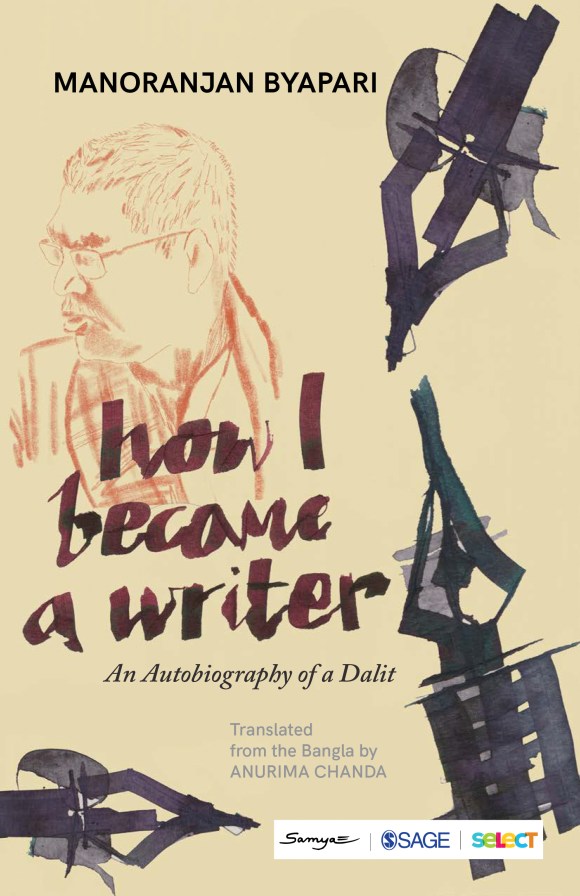
Basudhara Roy reviews Manoranjan Byapari’s How I Became a Writer: An Autobiography of a Dalit. Click here to read.

Bhaskar Parichha reviews In Search of the Divine: Living Histories of Sufism in India by Rana Safvi. Click here to read.

.

Click here to access the Borderless anthology, Monalisa No Longer Smiles

You are all welcome to the book talks of our first anthology

Categories
Editorial

Its Only Hope…

Painting by Sybil Pretious

New year, like a newborn, starts with hope.

The next year will do the same – we will all celebrate with Auld Lang Syne and look forward to a resolution of conflicts that reared a frightening face in 2022 and 2021. Perhaps, this time, if we have learnt from history, there will not be any annihilation but only a movement towards resolution. We have more or less tackled the pandemic and are regaining health despite the setbacks and disputes. There could be more outbreaks but unlike in the past, this time we are geared for it. That a third World War did not break out despite provocation and varied opinions, makes me feel we have really learnt from history.

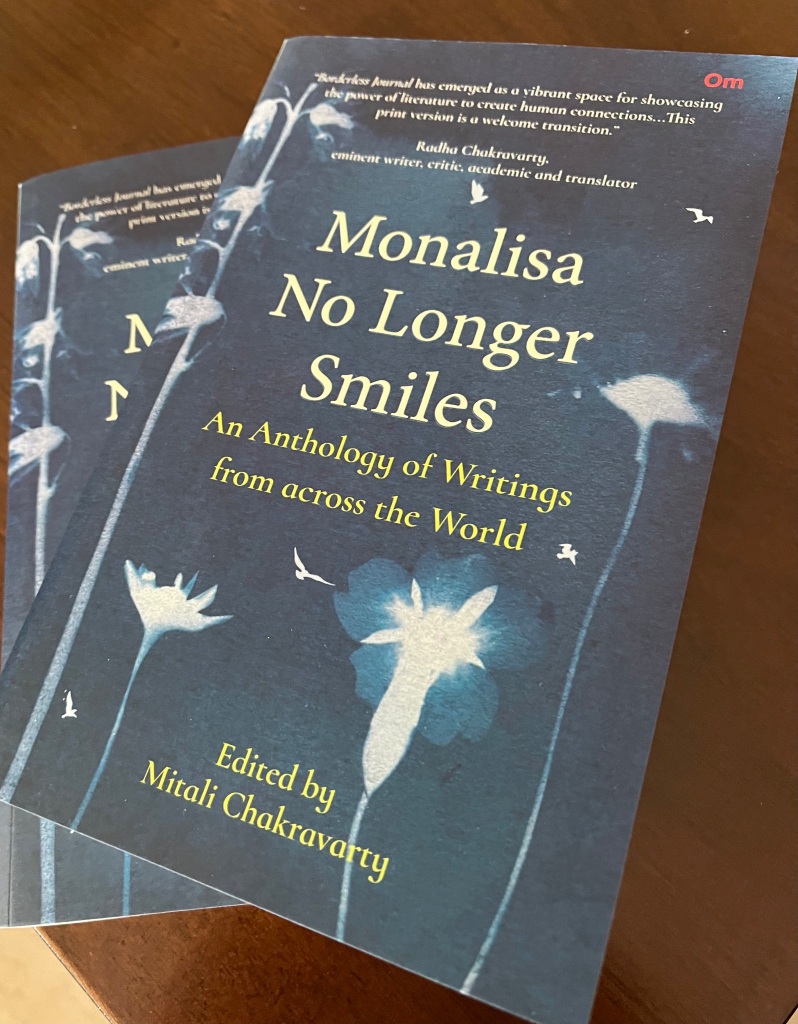
That sounds almost like the voice of hope. This year was a landmark for Borderless Journal. As an online journal, we found a footing in the hardcopy world with our own anthology, Monalisa No Longer Smiles: Writings from Across the World, which had a wonderful e-launch hosted by our very well-established and supportive publisher, Om Books International. And now, it is in Om Book Shops across all of India. It will soon be on Amazon International. We also look forward to more anthologies that will create a dialogue on our values through different themes and maybe, just maybe, some more will agree with the need for a world that unites in clouds of ideas to take us forward to a future filled with love, hope and tolerance.

One of the themes of our journal has been reaching out for voices that speak for people. The eminent film critic and editor, Shantanu Ray Chaudhuri , has shared a conversation with such a person, the famed Gajra Kottary, a well-known writer of Indian TV series, novels and stories. The other conversation is with Nirmal Kanti Bhattajarchee, the translator of Samaresh Bose’s In Search of a Pitcher of Nectar, a book describing the Kumbh-mela, that in 2017 was declared to be an Intangible Cultural Heritage of Humanity by UNESCO. Bhattacharjee tells us how the festival has grown and improved in organisation from the time the author described a stampede that concluded the festivities. Life only gets better moving forward in time, despite events that terrorise with darkness. Facing fear and overcoming it does give a great sense of achievement.

Perhaps, that is what Freny Manecksha felt when she came up with a non-fiction called Flaming Forest, Wounded Valley: Stories from Bastar and Kashmir, which has been reviewed by Rakhi Dalal. Basudhara Roy has also tuned in with a voice that struggled to be heard as she discusses Manoranjan Byapari’s How I Became a Writer: An Autobiography of a Dalit. Somdatta Mandal has reviewed The Shaping of Modern Calcutta: The Lottery Committee Years, 1817 – 1830 by Ranabir Ray Chaudhury, a book that explores how a lottery was used by the colonials to develop the city. Bhaskar Parichha has poured a healing balm on dissensions with his exploration of Rana Safvi’s In Search of the Divine: Living Histories of Sufism in India as he concludes: “Weaving together facts and popular legends, ancient histories and living traditions, this unique treatise running into more than four hundred pages examines core Sufi beliefs and uncovers why they might offer hope for the future.”

In keeping with the festive season is our book excerpt from Rhys Hughes’ funny stories in his Christmas collection, Yule Do Nicely. Radha Chakravarty who brings many greats from Bengal to Anglophone readers shared an excerpt – a discussion on love — from her translation of Tagore’s novel, Farewell Song.

Love for words becomes the subject of Paul Mirabile’s essay on James Joyce’s Stephen Dedalus, where he touches on both A Portrait of the Artist as a young Man and  Ulysees, a novel that completed a century this year. Love for animals, especially orangutans, colours Christina Yin’s essay on conservation efforts in Borneo while Keith Lyons finds peace and an overwhelming sense of well-being during a hike in New Zealand. Ravi Shankar takes us to the historical town of Taiping in Malaysia as Meredith Stephens shares more sailing adventures in the Southern hemisphere, where it is summer. Saeed Ibrahim instils the seasonal goodwill with native Indian lores from Canada and Suzanne Kamata tells us how the Japanese usher in the New Year with a semi-humorous undertone.

Humour in non-fiction is brought in by Devraj Singh Kalsi’s ‘Of Mice and Men’ and in poetry by Santosh Bakaya. Laughter is stretched further by the inimitable Rhys Hughes in his poetry and column, where he reflects on his experiences in India and Wales. We have exquisite poetry by Jared Carter, Sukrita Paul Kumar, Asad Latif, Luis Cuauhtémoc Berriozábal, Michael R Burch, Sutputra Radheye, George Freek, Jonathan Chan and many more. Short stories by Lakshmi Kannan, Devraj Singh Kalsi, Tulip Chowdhury and Sushma R Doshi lace narratives with love, humour and a wry look at life as it is. The most amazing story comes from Kajal who pours out the story of her own battle in ‘Vikalangta or Disability‘ in Pandies’ Corner, translated from Hindustani by Janees.

Also touching and yet almost embracing the school of Absurd is PF Mathew’s story, ‘Mercy‘, translated from Malayalam by Ram Anantharaman. Fazal Baloch has brought us a Balochi folktale and Ihlwha Choi has translated his own poem from Korean to English. One of Tagore’s last poems, Prothom Diner Shurjo, translated as ‘The Sun on the First Day’ is short but philosophical and gives us a glimpse into his inner world. Professor Fakrul Alam shares with us the lyrics of a Nazrul song which is deeply spiritual by translating it into English from Bengali.

A huge thanks to all our contributors and readers, to the fabulous Borderless team without who the journal would be lost. Sohana Manzoor’s wonderful artwork continues to capture the mood of the season. Thanks to Sybil Pretious for her lovely painting. Please pause by our contents’ page to find what has not been covered in this note.

We wish you all a wonderful festive season.

Season’s Greetings from all of us at Borderless Journal.

Cheers!

Mitali Chakravarty

borderlessjournal.com

.

Click here to access the Borderless anthology, Monalisa No Longer Smiles

Categories
Review

Manoranjan Byapari: “ Why did I even write?”

Book Review by Basudhara Roy

Title: How I Became a Writer: An Autobiography of a Dalit

Author: Manoranjan Byapari

Translator: Anurima Chanda

Publisher: SAGE Publications India and Samya under Samya SAGE Select imprint

The autobiography, as a literary genre, has a compound and far-reaching relevance. Among the many ways that it engages in a productive conversation with the world, is its staunch social impact. When and why does a person set out to write his or her life’s story? The answers to this could be numerous. Central, however, to each of them would be the perception of a threat to one’s experienced or imagined identity, the attempt to seize empowerment through the act of narration, and the identification of one’s individuality as having a widely referential social base that could encapsulate some meaning for humanity at large.

In the teeming, diverse and thoroughly spectacular life of writer, Manoranjan Byapari, an impulse towards all the three can be found. An unlettered rickshaw puller-turned indefatigable and award-winning fiction writer, and currently a member of the Legislative Assembly of West Bengal (Balagarh constituency) and the Chairperson of the Dalit Sahitya Akademi, West Bengal, Manoranjan Byapari’s How I Became a Writer: An Autobiography of a Dalit is the translation of the sequel to his Itibritte Chandal Jivan (Interrogating My Chandal Life) published in 2017 and winner of The Hindu Prize 2018 for non-fiction.

“I keenly believed that even though a life might be trivial, inferior or disgusting, there was something to learn from it which could come handy later. […] People who scavenged through dustbins would know that sometimes one might also find delicacies in the garbage,” writes the author (in the context of a particularly obnoxious character in the book), articulating a practical and philosophic doctrine that is hard to beat. If taken as a metaphor for his own life’s tireless trials, these words throw light on Byapari’s literary treatment of every little or mean episode in his life with sincerity, stubbornness and sagacity.

The sequel How I Became a Writer effectively takes off from where the first book ends – Byapari’s return to Calcutta from Dandakaranya and his taking up the job of a cook at the residential Helen Keller School for the Deaf and the Blind. Spanning a journey of around two decades, the book documents the arduous, painstaking, courageous and unrelinquishable labour of nurturing the ambition to write amidst the innumerable hazards-big and small-that threaten a Dalit’s dignified existence in India.

Comprising a series of thirty-four vignettes, the book is divided into two parts – ‘School Shenanigans’ and ‘The Right to Write’. The former section offers a close look at Byapari’s work-life – his workplace, duties, associates, and the systemic social inequities that are intended to steadily impoverish and dehumanize those who inhabit the lowest rungs of the class and caste hierarchies. The latter section focuses almost exclusively on his creative life, his intense literary and activist aspirations, and his relentless growth as a writer in the face of every obstacle to body, mind and spirit. The two sections, however, speak very intimately to one another with the result that they effectively build up one seamless narrative whole, animated, in each of its fibres, by “jijibisha” – the indomitable will to live that has characterised Byapari’s intellectual journey throughout.

In her ‘Foreword’ to the book, Sipra Mukherjee, the translator of Interrogating My Chandal Life, draws attention to the remarkable “non-marginality” of Byapari’s writing that, in the first part of his autobiography, exhibits and establishes itself in his choice of both language and geo-political space of creative exploration. In How I Became a Writer, Byapari’s marginal viewpoint on the history, narratives and psychology of the mainstream impresses further. His knowledge of the world is clearly staggering, his perception sharp, and his intuitive wisdom is matchless in its perspicacity. Alert, critical, and thoroughly versed in his Marxist epistemology, he understands the social dialogue of money and power and that of rights and denial, with deftness and insight. Most importantly, he is constantly aware of being not merely an individual but a representative of a social group – the proletariat who must attempt, by all means, to speak truth to power:

“Muttering furiously, she asked, ‘Royda asked you to make tea and you refused. Is that right?’

“I answered in the affirmative without an iota of tremor in my voice. I did what a representative of the working class would do had it been within the world of one of my own stories. The way Bordi, like one of the overlords, had called me forth to show off her positional power in front of her people, I too, was eager to show her that I was a knowledgeable and brave representative of my class of people.”

Throughout Byapari’s language, there is a quiet and determined authority intended to radically subvert the dense and intricate mainstream texts of injustice and victimization. One of his potent subversive tools is certainly his robust and well-toned satire, the other being his close reading of mythological material, folk tales, and indigenous wisdom located in anecdotes and proverbs. Bringing this local ontology and epistemology to bear on the mainstream knowledge involves a constant interrogation of the latter’s chosen socio-political and cultural texts, thus constituting a bottom-up view on social theory and praxis.

Glowing vividly in these pages is also Byapari’s unvanquished faith in literature as a means of social reform. He reiterates here, often, the necessity to take up the pen as a tool of protest, as a means of emancipation from indignity, and as the only method of scripting oneself into social discourse – “Somebody had said that a writer does not write with a pen, but with the spine.” But the act of writing which is often made to appear autonomous and independent of social interference, may not come as easily to everyone. To someone like himself, as Byapari insists, literacy itself has been a gift and the act of reading and writing, a liberation from his otherwise “insignificant, ugly and hateful life”.

In a society where writing has often been valorised as a private intellectual activity, Byapari strongly points out how privacy is, in itself, a privilege. Contrary to the fashionable notion of the writer as entitled to a ‘writing space’ both physically and temporally, Byapari’s autobiography projects him as accomplishing his writing in the oddest of spaces and hours, under the most threatening of conditions, and with the sole will to keep the fire in his soul alive. Both cathartic and revolutionary, his creative life becomes a valuable agency for him to wield his self-esteem against life’s diminishing forces.

But to be able to write and to, even, write well is not enough. To carve a niche for oneself in the writerly world, and to be heard and responded to is an enormous challenge in itself. There is, firstly, the significant handicap of financial investment in publishing a book; secondly, the apathy of prejudiced and non-discerning readers towards writers of the lower caste; and thirdly the entire nexus of publishers, marketing, reviewers and awards to negotiate with. To someone like Byapari, handicapped severely by both his caste and class, literary recognition has been very slow and unforthcoming.

It has, however, happened over the years, for as Byapari believes, in the world of literature, the way upward lies only through dedication, toil, perseverance, and the presence of an empathetic and like-minded literary community. But though the writer remains inordinately grateful for where he has arrived, there is also, at times in the book, a serious questioning of the practical outcome of meaningful literature in the world. Does it make a difference? Does it help transform the conscience of society? Does it lead to material improvement in a poor writer’s life circumstances? Byapari remains distinctly conscious of having been transformed from a writing person to a literary subject under the harsh glare of literary festivals, media and academics but his greatest fear of failure revolves around the possibility that his writing may have failed to make a dent on the world’s harsh indifference:

“Why did I even write? Would I be able to change this bloodsucking societal system standing atop the rotting thousand-year-old foundation with my pen alone? Would I be able to stop the inhumane religious brutality of the priestly class in the name of caste? The child lying on the footpath, who had curled up in the bitter cold, could I bring him a blanket? That child crying in his mother’s arms in hunger, would I be able to make him sit in front of a plate full of warm freshly made rice?

“I could not! I could not!”

However, as in the case of every true artist, Manoranjan Byapari’s love for writing triumphs over all misgivings. How I Became a Writer is a glowing celebration of his tribulations, grit, antagonisms, friendships and the generous support of many noble souls that helped pave his way to artistic maturity and fame.

For those who cannot read the book in Bengali, this translation by Anurima Chanda, an academic and translator,  arrives as a coveted gift. Organic, fluid, and maintaining the right balance between linguistic and semantic authenticity, this animated rendering of Byapari’s life introduces readers of English to a writer who remains etched in memory as much for his lyricism and humour as for his sheer honesty and brilliantly satirical social criticism.

.

Basudhara Roy teaches English at Karim City College affiliated to Kolhan University, Chaibasa. Drawn to gender and ecological studies, her four published books include a monograph and three poetry collections. Her recent works are available at Outlook India, The Dhaka Tribune, EPW, Madras Courier and Live Wire among others.

.

Click here to read the book excerpt from How I Became a Writer

PLEASE NOTE: ARTICLES CAN ONLY BE REPRODUCED IN OTHER SITES WITH DUE ACKNOWLEDGEMENT TO BORDERLESS JOURNAL

Click here to access the Borderless anthology, Monalisa No Longer Smiles

Categories
Contents

Borderless, November 2022

Art by Sohana Manzoor

Editorial

We did it! … Announcing our first anthology … Monalisa No Longer Smiles… Click here to read.

Conversations

Suchen Christine Lim, an iconic writer from Singapore in conversation about her latest book, Dearest Intimate. Click here to read.

Blazing trails, as well as retracing the footsteps of great explorers, Christopher Winnan, a travel writer, delves into the past, and gazes into the future while conversing with Keith Lyons. Click here to read.

Translations

Rows of Betelnut Trees by My Window by Nazrul has been translated from Bengali by Professor Fakrul Alam. Click here to read.

A Day in the Life of the Pink Man is a story by Shankhadeep Bhattacharya, translated from Bengali by Rituparna Mukherjee. Click here to read.

The Clay Toys and The Two Boys is a story by Haneef Shareef, translated from Balochi by Fazal Baloch. Click here to read.

Saturday Afternoon is a poem by Ihlwha Choi, translated from Korean by the poet himself. Click here to read.

Tagore’s poem, Tomar Shonkho Dhulay Porey (your conch lies in the dust), has been translated from Bengali by Mitali Chakravarty as The Conch Calls. Click here to read.

Poetry

Click on the names to read

Jared Carter, Asad Latif, Rhys Hughes, Alpana, Mimi Bordeaux, Saranyan BV, Luis Cuauhtémoc Berriozábal, Quratulain Qureshi, Jim Bellamy, Sourav Sengupta, Ron Pickett, Davis Varghese, Ryan Quinn Flanagan, Jonathan Chan, Terry Trowbridge, Amrita Sharma, George Freek, Gayatri Majumdar, Michael R Burch

Poets, Poetry and Rhys Hughes

In Infinite Tiffin, Rhys Hughes gives an unusual short story centring around food and hunger. Click here to read.

Musings/Slices from Life

The Scream & Me

Prithvijeet Sinha writes of how Edvard Munch’s painting, The Scream, impacts him. Click here to read.

A Fine Sunset

Mike Smith travels with a book to a Scottish beach and walks in the footsteps of a well-know novelist. Click here to read.

The Death of a Doctor

Ravi Shankar mourns the loss of a friend and muses on mortality in his experience. Click here to read.

My Contagious Birthday Party

Meredith Stephens writes of her experience of Covid. Click here to read.

Dim Memories of the Festival of Lights

Farouk Gulsara takes a nostalgic trip to Deepavali celebrations in Malaysia. Click here to read.

Musings of a Copywriter

In Strumming Me Softly with His Guitar…, Devraj Singh Kalsi talks of his friends’s adventure with the guitar. Click here to read.

Notes from Japan

In Therese Schumacher and Nagayoshi Nagai: A Love Story, Suzanne Kamata introduces us to one of the first German women married to a Japanese scientist and their love story. Click here to read.

Essays

My Favourite Book by Fakrul Alam

The essay is a journey into Fakrul Alam’s evolution as a translator. Click here to read.

The Ultimate Genius of Kishore Kumar

Shantanu Ray Chaudhuri, an eminent film critic, writes on the legend of Kishore Kumar. Click here to read.

T.S Eliot’s The Waste Land: Finding Hope in Darkness

Dan Meloche muses on the century-old poem and its current relevance. Click here to read.

The Observant Immigrant

In Piano Board Keys, Candice Louisa Daquin talks of biracial issues. Click here to read.

Stories

The Funeral Attendee

Ravi Prakash shares the story of the life of a migrant in rural India. Click here to read.

A Letter I can Never Post

Monisha Raman unravels the past in a short narrative using the epistolary technique. Click here to read.

Red Moss at the Abbey of Saint Pons

Paul Mirabile takes us to St Pons Abbey in France in the fifteenth century. Click here to read.

You have lost your son!

Farhanaz Rabbani gives a light story with a twist that shuttles between Dhaka and Noakhali. Click here to read.

Book Excerpts

An Excerpt from Manoranjan Byapari’s How I Became a Writer: An Autobiography of a Dalit, translated from Bengali by Anurima Chanda. Click here to read.

An excerpt from Evening with a Sufi: Selected Poems by Afsar Mohammad, translated from Telugu by Afsar Mohammad & Shamala Gallagher. Click here to read.

Book Reviews

Reba Som has reviewed Aruna Chakravarti’s Through the Looking Glass: Stories. Click here to read.

Somdatta Mandal has reviewed Shehan Karunatilaka’s The Birth Lottery and Other Surprises. Click here to read.

Basudhara Roy has reviewed Afsar Mohammad’s Evening with a Sufi: Selected Poems, translated from Telugu by Afsar Mohammad and Shamala Gallagher. Click here to read.

Bhaskar Parichha has reviewed Rahul Ramagundam’s The Life and Times of George Fernandes. Click here to read.

Borderless Journal Anthology

Click here to access the Borderless anthology, Monalisa No Longer Smiles

Categories
Editorial

We Did It!

That good things happen despite darkness, despite prognostications of doom, that light glimmers hope if you strive to focus on your strength in hard times is borne true both in fiction and in life. Perhaps, we cannot get back the old ways (but is that what we want?) but new paths emerge. Old gives way to new. And while trying to gather pearls of human excellence — borne not of awards or degrees but of bringing out the best, the kindest, the most loving in human hearts — we managed to create with a team an outstanding anthology. Woven with the writings of old and new — we created a tapestry together that the editor in chief of our publishing house said was “classy, literary, engaging and international”. That one of the oldest and most reputed publishing houses in India with bookshops countrywide took it on was also an unusual event! We are truly grateful to Om Books International, Shantanu Ray Chaudhuri and Jyotsna Mehta along with all our writers and readers who made our anthology a reality, and to Radha Chakravarty and Fakrul Alam for the kind words they bestowed on our effort.

Click here to access the Borderless anthology, Monalisa No Longer Smiles

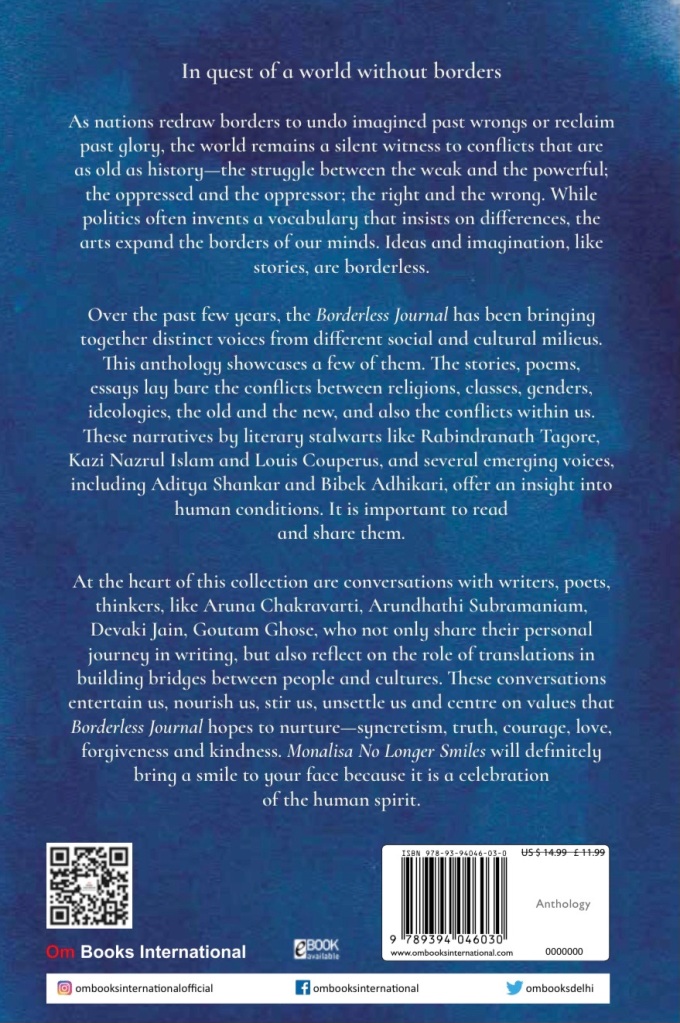
Please greet our first anthology, Monalisa No Longer Smiles, with love and friendship. It could be the perfect Christmas gift in the spirit of the season! And as the blurb says, “it will definitely bring a smile to your face because it is a celebration of the human spirit.”

The anthology is different from our journal in as much as it has a sample of an eclectic collection that has been honed with further editing and has some new features. Most of the writing is from our first year and showcases our ethos, except for Lesya’s poetry and interview. Lesya Bakun from Ukraine is still on the run, looking for a refuge — she cannot return home like you or I can. Her family is scattered across number of countries. Her cousin, who was guarding the factory at Azovstal, was taken prisoner. We included her story in the anthology hoping to create global empathy for refugees as the numbers will increase not only due to war but also due to climate change.

The reason we felt a hardcopy anthology was a good idea was because nothing beats the joy of having a bunch of interesting reads in the warmth of your hands (especially where internet cannot reach or is unavailable). In any case, books with the feel of paper, the rustling whispers which carry voices of leaves can never be replaced as Goutam Ghose had also said in his interview which is now part of our anthology.

And that is why we celebrate more books… this time we feature Singaporean prima donna of literature, Suchen Christine Lim, with her new book Dearest Intimate, a novel that spans more than hundred years including the harrowing Japanese invasion during World War II. She shared sound advice with writers: “Suffering is good for the writer. It will deepen lived experience and expand the heart’s empathy.” And perhaps that is what is echoed through the experiences of the other writer interviewed on our pages by Keith Lyons. This is a writer who not only brought out his own books but was a regular contributor of travel pieces for Frommer’s and National Geographic traveling to unexplored destinations — Christopher Winnan. Another writer Lyon had interviewed recently, Steve Carr, has passed on. We would like to convey our heartfelt condolences to his family and friends.

We have a number of books that have been reviewed. Reba Som reviewed Aruna Chakravarti’s Through the Looking Glass: Stories that span eras spread across time. Somdatta Mandal has reviewed Shehan Karunatilaka’s The Birth Lottery and Other Surprises and Bhaskar Parichha, Rahul Ramagundam’s The Life and Times of George Fernandes. Basudhara Roy has written of Afsar Mohammad’s Evening with a Sufi: Selected Poems, translated from Telugu by the poet and Shamala Gallagher, verses that again transcend borders and divides. We have an excerpt from the same book and another from Manoranjan Byapari’s How I Became a Writer: An Autobiography of a Dalit, translated from Bengali by Anurima Chanda.

More translations from Bengali, Balochi and Korean enrich our November edition. Fazal Baloch has translated a story by Haneef Shareef and Rituparna Mukherjee by Shankhadeep Bhattacharya. We have the translation of an inspirational Tagore poem helping us find courage (Shonkho Dhulaye Pore or ‘the conch lies in the dust’). Another such poem by Nazrul has been rendered in English from Bengali by Professor Fakrul Alam. He has also shared an autobiographical musing on how he started translating Tagore’s Gitabitan, which also happens to be his favourite book. More discussion on the literary persona of TS Eliot and the relevance of his hundred year old poem — ‘The Waste Land’ by Dan Meloche adds variety to our essay section.

Evoking the genius of another outstanding artiste, Kishore Kumar, who happened to pen thought provoking dialogues in some films, is Shantanu Ray Chaudhuri’s essay, review of a recent book on the legendary actor-singer and an interview with the authors. Infringing the boundaries of literary with popular culture and art and integrating all forms into a wholistic bundle has been part of our ethos. In that spirit we have a musing by Prithvijeet Sinha on Edvard Munch’s famous painting called Scream. We have non-fiction from Australia spanning Meredith Stephens’s recent brush with Covid, Mike Smith visits a Scottish beach in the footsteps of a novelist, Ravi Shankar has given us a poignant piece for a late friend and Candice Lousia Daquin talks of the existence of bi-racial biases. In contrast, Suzanne Kamata sent a narrative that bridges divides showcasing a German wife of a Japanese scientist that draws us to conclude that biases erode over time to create an acceptance of bi-racial people. Devraj Singh Kalsi brings in humour with his funny narrative about a guitarist. Rhys Hughes writes in a lighter vein on Indian cuisine in his column and spouts more funny poetry bordering on the absurd.

Jared Carter has shared beautiful poetry on murmuration in birds and we have touching verses from Asad Latif for a little girl he met on a train — reminiscent of Tagore’s poem Hide and Seek (Lukochuri). Michael R Burch has given us poems setting sombre but beautiful notes for the season. We host more poetry by Luis Cuauhtémoc Berriozábal, Quratulain Qureshi, Jim Bellamy, Gayatri Majumdar, Ryan Quinn Flanagan, Alpana, Jonathan Chan, Saranyan BV, George Freek and many more. We have stories from around the world: India, France and Bangladesh.

Gathering all of your thoughts in strings of words from all corners of the world, we present to you the bumper November issue of Borderless Journal . Thank you all for sharing your thoughts with us. Thanks to Sohana Manzoor for her fantastic painting and more thanks to the whole Borderless team for seeing this issue through. We would not have been able to do the anthology or these issues without each one of you — writers and readers.

Thank you all from the bottom of my heart.

There is always hope for a new tomorrow!

Mitali Chakravarty

borderlessjournal.com

Click here to access the Borderless anthology, Monalisa No Longer Smiles

Categories
Excerpt

On the Passing of Mahasweta Devi by Manoranjan Byapari

Title: How I Became a Writer: An Autobiography of a Dalit

Author: Manoranjan Byapari

Translator: Anurima Chanda

Publisher: SAGE Publications India and Samya under Samya SAGE Select imprint

Chapter 34: The End of an Era

The passing away of certain individuals left a huge impact on the human community. The void created by their absence was irreplaceable. This was especially true when it came to Mahasweta Devi. . . . Because of the power of Mahasweta Devi’s writing, there was a huge need for her leadership and protest. Equipped with the fire and anger akin to the sun, she was the one to have kept the fight against injustice alive. She had not given in to any temptation or fear, but spent an entire life battling in the interest of those starving penniless people tottering on empty stomachs. Her roar had raged right from the decade of the seventies to the dangerous days of Singur, Nandigram and Netai. Her fiery raging pen had dealt blow after blow like a cannon on the impenetrable fort of the cannibalistic and violent forces out to destroy human civilization . . .

              It was a painful time for Bengal, Bengalis, intellectuals and civil society. Somebody had said that a writer does not write with a pen, but with the spine . . . In those times, the one and only ‘soldier armed with a pen’, Mahasweta Devi, had protested against that which is unjust, improper and inhumane. Her fight was for the Adivasis, the foresters, the Dalits, the labouring classes and the minority groups…

    . . . With the death of Mahasweta Devi, I lost a mother who had…shown me a new direction. She was the one to explain the meaning of ‘jijibisha’ [the will to live]to me. There were multiple ways to live…But what is the point of that life which gets lost immediately after death? She showed me the direction of such an endless life.

. . . During the long thirty-six years, from 1981 to 2016, she was spread all over my life like a huge tree . . . This tree possessed the powers of the Sanjeevani plant whose mere touch could revive the dead.

              Although I started with Bartika and thereafter had my works find a place as part of course books for the West Bengal State University, within the journal of the Comparative Literature Journal of Jadavpur University, as questions under the Public Service Commission exams, I was still unsure how far I would have to swim to reach the end. According to me, I have been able to reach the ultimate stage. I have achieved as far as I could achieve, from being unlettered to discovering the world of letters which was then followed by receiving  the Bangla Akademi award and the Ananya Somman from 24 Ghonta. After obtaining the biggest two awards in Bangla literature, I could perhaps say with some amount of certainty that I have experienced it all.

. . . Having read so many books, I knew well enough that the world of my experiences were not readily available to many others.Hence, they were not able to write about it. They could not even think of writing about it, as their imaginations also failed. I, on the contrary, could easily write innumerable pages on them.  That’s what I did. I wrote four short stories and took it to Mahasweta Devi who explained, as I have mentioned earlier, that she does not publish fiction. I found the addresses of four magazines and sent them off to be published  . . . all the four stories had been published.  I found a lot of strength and self confidence at this incident. I realized that I could really do it. Even if there were no one backing me, I could fight my own fight.. ..

              I next came in contact with Mahasweta Devi in 2000, three years after my return [from Chhatisgarh]. Around this time, many of my works were published with Bartika. I revived my relations with her, which remained till her last breath . . . my association with her remained for the entire duration of 1981 to 2016. I would visit her place almost every other week. In the huge expanse of time, she wrote for so many newspapers starting with Jugantar to Bartaman, but she never wrote a line about the rickshaw-puller writer Manoranjan Byapari . . .. People might remember that just a few days before her death in 2016 she had written almost an entire-page article for Ei Shomoy about the rising young writers from West Bengal who had a lot of potential.

 . . . Mahasweta Devi loved me like her own child. She had already looked far into my future. She knew that it would cause me a lot of pain, but in her heart she wanted the world to cheer for me. However difficult it might be, she wanted me to make my own path, so that no tag of favouritism could get stuck to my life like a leech which would have compelled me to bow down my head with ‘gratitude’ all my life. She wanted me to become independent and did not desire my heart to grow weak . She had wanted me to become a writer on my own worth, an independent, self-dependent, courageous writer. 

ABOUT THE BOOK

‘Writing was my truth, my god, my everything. I could not leave it for anything.’

With these words, Manoranjan Byapari points to how writing is as important to him as breathing. How I Became a Writer: An Autobiography of a Dalit is the translation of the second volume of his remarkable life story Itibritte Chandal Jivan. In this volume, translated for the first time into English with great sensitivity, the author talks of his life in Kolkata after leaving the Chhattisgarh Mukti Morcha. He takes up the post of a cook at a school, which provides work, albeit gruelling. Part I, School Shenanigans, describes how he carried out his duties, while being treated contemptuously because he is a Dalit, and became more determined to forge a new identity as a writer. Part II, The Right to Write, reveals how his persistence gradually resulted in his works being published in little magazines and, later, by mainstream publishers and how his fame slowly spread with television interviews and prestigious awards.

He discusses Dalit writings, Dalit literary organizations and whether he is a ‘Dalit writer’. His forthright observations on society and governance provide many insights.

ABOUT THE AUTHOR

Manoranjan Byapari never went to school or university. He first wrote for little magazines where his success and popularity found him many publishers. His writing career took place as he worked as a cook for 21 years at the Helen Keller School for the Deaf and the Blind. He is a Trinamul Congress MLA for Balagarh since the 2021 West Bengal Vidhan Sabha elections. He has received many awards such as the Suprabha Majumdar Smarak Puraskar by the Paschim Banga Bangla Akademi in 2014, the television channel 24 Ghonta’s Ananya Samman in 2013 and in 2019 the Hindu Literary Fest’s nonfiction award. He is well known across India as he speaks in Hindi that he learnt in Chhatisgarh when he was with the Mukti Morcha of the late Shankar Guha Neogi.

ABOUT THE TRANSLATOR

Anurima Chanda is Assistant Professor, Department of English, Birsa Munda College, North Bengal University. She has taught English as Second Language (ESL) and students with learning disabilities at the Centre for Writing and Communication, Ashoka University. She received her PhD on Indian English Children’s Literatures from JNU. She was a pre-doctoral fellow at the University of Wüerzburg. She is also a literary translator (translating from Bengali/Hindi-English-Bengali. Among her books for children are Timelines from Indian History: From Ancient Civilizations to a Modern democracy; Tintin in Tibet by Herge: A Critical Companion; The Untouchable and Other Poem; and DK Indian Icons: Bhimrao Ambedkar: An Illustrated Story of a Life.

CREDIT LINE:

Excerpted from How I Became a Writer: An Autobiography of a Dalit by Manoranjan Byapari, translated by Anurima Chanda. Jointly published by SAGE Publications India and Samya. 2022, 376 pages, Paperback, Rs.650, ISBN: (978-93-81345-77-1), Samya SAGE Select.

PLEASE NOTE: ARTICLES CAN ONLY BE REPRODUCED IN OTHER SITES WITH DUE ACKNOWLEDGEMENT TO BORDERLESS JOURNAL

Click here to access the Borderless anthology, Monalisa No Longer Smiles