A grandfather with his young granddaughter boards the train. He pauses briefly in front of the reserved seats, then sits down. As the little girl tries to sit, he explains, "This seat is for grandpas and grandmas."
Beside the seats, there’s a small sign, showing a person with a cane, a person with a round belly, a person on crutches, a person holding a baby.
The subway clanks along, and the child stands in front of the reserved seat section, fiddling with a smartphone.
Sitting on a nearby seat, I almost say, “Sit next to your grandpa,” but hold back— It might sound like encouragement to break the rules. Children should learn to follow public etiquette.
She tries perching on an empty seat, but stands up quickly after a moment, still toying with her phone.
On this sunny spring afternoon, the grandfather, eyes gently closed, sits in the reserved seat, while the spring sunlight shines beside him.
His young granddaughter stands, swaying as she clutches the pole, clanking forward, toward tomorrow.
Ihlwha Choi is a South Korean poet. He has published multiple poetry collections, such as Until the Time When Our Love will Flourish, The Color of Time, His Song and The Last Rehearsal.
.
PLEASE NOTE: ARTICLES CAN ONLY BE REPRODUCED IN OTHER SITES WITH DUE ACKNOWLEDGEMENT TO BORDERLESS JOURNAL.
Fakrul Alam writes nostalgically of his visits to Feni in Noakhali, a small town which now suffers from severe flooding due to climate change. Click here to read.
Rakhi Dalal reviews Swadesh Deepak’s A Bouquet of Dead Flowers translated from Hindi by Jerry Pinto, Pratik Kanjilal, Nirupama Dutt, Sukant Deepak. Click here to read.
Imagine the world envisioned by John Lennon. Imagine the world envisioned and partly materialised by Tagore in his pet twin projects of Santiniketan and Sriniketan, training institutes made with the intent of moving towards creating a work force that would dedicate their lives to human weal, to closing social gaps borne of human constructs and to uplifting the less privileged by educating them and giving them the means to earn a livelihood. You might well call these people visionaries and utopian dreamers, but were they? Tagore had hoped to inspire with his model institutions. In 1939, he wrote in a letter: “My path, as you know, lies in the domain of quiet integral action and thought, my units must be few and small, and I can but face human problems in relation to some basic village or cultural area. So, in the midst of worldwide anguish, and with the problems of over three hundred millions staring us in the face, I stick to my work in Santiniketan and Sriniketan hoping that my efforts will touch the heart of our village neighbours and help them in reasserting themselves in a new social order. If we can give a start to a few villages, they would perhaps be an inspiration to some others—and my life work will have been done.” But did we really have a new social order or try to emulate him?
If we had acted out of compassion and kindness towards redefining with a new social order, as Miriam Bassuk points out in her poem based on Lennon’s lyrics of Imagine, there would be no strangers. We’d all be friends living in harmony and creating a world with compassion, kindness, love and tolerance. We would not have wars or regional geopolitical tensions which act against human weal. Perhaps, we would not have had the issues of war of climate change take on the proportions that are wrecking our own constructs.
Natural disasters, floods, fires, landslides have affected many of our lives. Bringing us close to such a disaster is an essay by Salma A Shafi at ground level in Noakhali. More than 4.5 million were affected and 71 died in this disaster. Another 23 died in the same spate of floods in Tripura with 65,000 affected. We are looking at a single region here, but such disasters seem to be becoming more frequent. And yet. there had been a time when Noakhali was an idyllic vacation spot as reflected in Professor Fakrul Alam’s nostalgic essay, filled with memories of love, green outdoors and kindnesses. Such emotions reverberate in Ravi Shankar’s account of his medical adventures in the highlands of Kerala, a state that suffered a stupendous landslide last month. While Shafi shows how extreme rainfall can cause disasters, Keith Lyons writes of water, whose waves in oceanic form lap landmasses like bridges. He finds a microcosm of the whole world in a swimming pool as migrants find their way to New Zealand too. Farouk Gulsara muses on kindness and caregiving while Priyanka Panwar ponders about ordinary days. Saeed Ibrahim gives a literary twist to our musings. Tongue in cheek humour is woven into our nonfiction section by Suzanne Kamata’s notes from Japan, Devraj Singh Kalsi’s piece on premature greying and Uday Deshwal’s paean to his sunglasses!
In translations, we have Nazrul lyrics transcreated from Bengali by Professor Alam and poetry from Korean by Ihlwha Choi. We pay our respects to an eminent Balochi poet who passed on exactly a year ago, Mubarak Qazi, by carrying a translation by Fazal Baloch. Tagore’s Suprobhat (Good morning) has been rendered in English from Bengali. His descriptions of the morning are layered and amazing — with a hint of the need to reconstruct our world, very relevant even today. A powerful essay by Tagore called Raja O Praja(The King and His Subjects), has been translated by Himadri Lahiri.
Our fiction hosts two narratives that centre around childhood, one by Naramsetti Umamaheswararao and another by G Venkatesh, though with very different approaches. Mahila Iqbal relates a poignant tale about aging, mental health and neglect, the very antithesis of Gulsara’s musing. Paul Mirabile has given a strange story about a ‘useless idler’.
A short story collection has been reviewed by Rakhi Dalal, Swadesh Deepak’s A Bouquet of Dead Flowers, translated from Hindi by Jerry Pinto, Pratik Kanjilal, Nirupama Dutt, Sukant Deepak. Somdatta Mandal has written about a book by a Kashmiri immigrant which is part based on lived experiences and part fictive, Karan Mujoo’s This Our Paradise: A Novel. Bhaskar Parichha has reviewed Ayurveda, Nation and Society: United Provinces, c. 1890–1950by Saurav Kumar Rai, a book which shows how healthcare was even a hundred years ago, politicised. Meenakshi Malhotra has reviewed Anuradha Marwah’s novel, Aunties of Vasant Kunj, of which we also have an excerpt. The other excerpt is from Mineke Schipper’s Widows: A Global History. Ratnottama Sengupta converses with Reba Som, author of Hop, Skip and Jump; Peregrinations of a Diplomat’s Wife.
We have more content that adds to the vibrancy of the issue. Do pause by this issue and take a look. This issue would not have been possible without all your writings. Thank you for that. Huge thanks to our readers and our team, without whose support we could not have come this far. I would especially like to thank Sohana Manzoor for her continued supply of her fabulous and distinctive artwork and Gulsara for his fabulous photographs.
Let us look forward to a festive season which awakens each autumn and stretches to winter. May we in this season find love, compassion and kindness in our hearts towards our whole human family.
I once believed that writing poetry was the expression of noble emotions, the realisation of profound thoughts. But I've come to understand with age that this isn't the case.
I once thought that love was as urgent as matters of life and death, residing in a special, noble realm. But now, in my later years, I realise that this was a mistake born of blind faith.
Looking back from the downstream of life, I see that poetry and love resemble the mundane things of daily life, mixed with the noise and dust of the marketplace.
They emerge like sprouts in the midst of weariness, in anxious toil, during sleepless nights of deep contemplation, and on the exhausting commute to home after work, welling up like a hidden spring
Ihlwha Choi is a South Korean poet. He has published multiple poetry collections, such as Until the Time When Our Love will Flourish, The Color of Time, His Song and The Last Rehearsal.
.
PLEASE NOTE: ARTICLES CAN ONLY BE REPRODUCED IN OTHER SITES WITH DUE ACKNOWLEDGEMENT TO BORDERLESS JOURNAL.
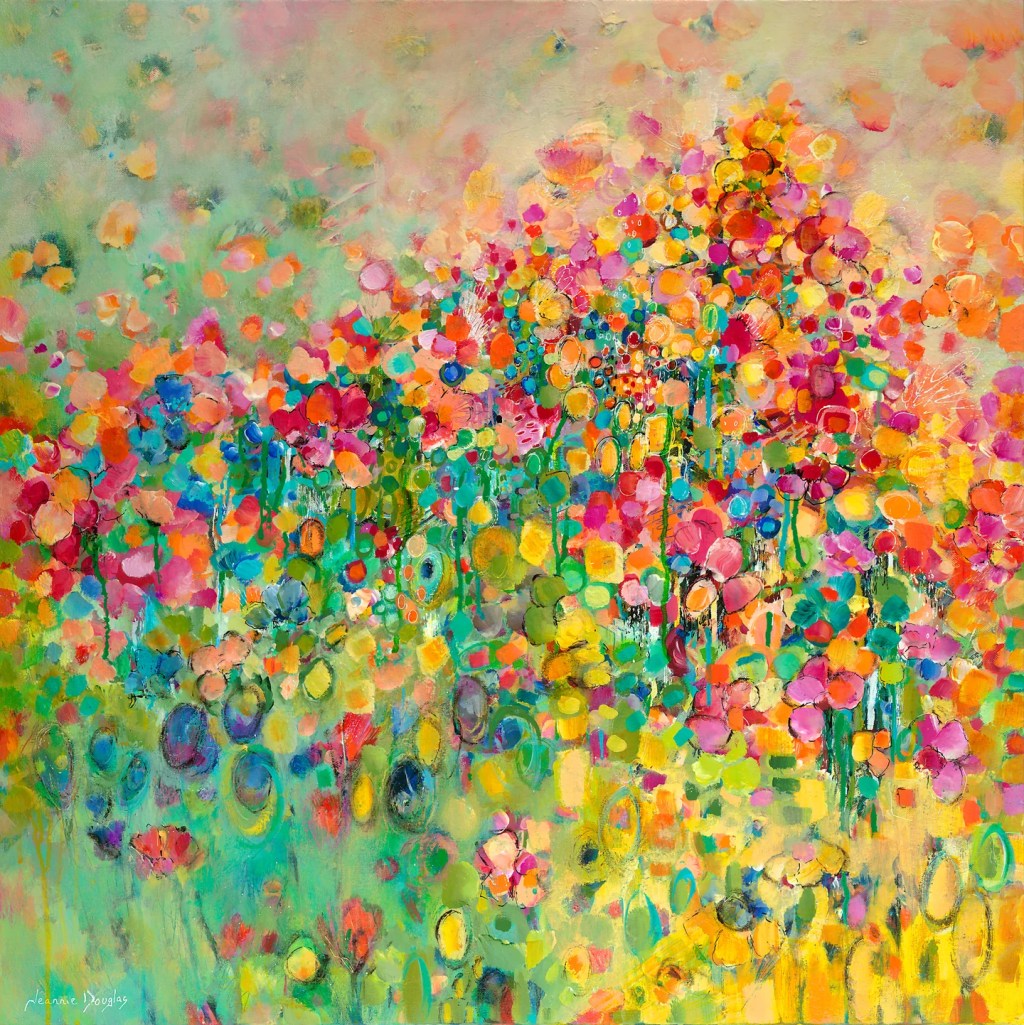
A Pop of Happiness by Jeanie Douglas. From Public Domain
Happiness is a many splendored word. For some it is the first ray of sunshine; for another, it could be a clean bill of health; and yet for another, it would be being with one’s loved ones… there is no clear-cut answer to what makes everyone happy. In Harry Potter and the Half Blood Prince (JK Rowling, 2005), a sunshine yellow elixir induces euphoria with the side effects of excessive singing and nose tweaking. This is of course fantasy but translate it to the real world and you will find that happiness does induce a lightness of being, a luminosity within us that makes it easier to tackle harder situations. Playing around with Rowling’s belief systems, even without the potion, an anticipation of happiness or just plain optimism does generate a sense of hope for better times. Harry tackles his fears and dangers with goodwill, friends and innate optimism. When times are dark with raging wars or climate events that wreck our existence, can one look for a torch to light a sense of hope with the flame of inborn resilience borne of an inner calm, peace or happiness — call it what you will…?
It is hard to gauge the extreme circumstances with which many of us are faced in our current realities, especially when the events spin out of control. In this issue, along with the darker hues that ravage our lives, we have sprinklings of laughter to try to lighten our spirits. In the same vein, externalising our emotions to the point of absurdity that brings a smile to our lips is Rhys Hughes’ The Sunset Suite, a book that survives on tall tales generated by mugs of coffee. In one of the narratives, there is a man who is thrown into a bubbling hot spring, but he survives singing happily because his attacker has also thrown in packs of tea leaves. This man loves tea so much that he does not scald, drown or die but keeps swimming merrily singing a song. While Hughes’ stories are dark, like our times, there is an innate cheer that rings through the whole book… Dare we call it happiness or resilience? Hughes reveals much as he converses about this book, squonks and stranger facts that stretch beyond realism to a fantastical world that has full bearing on our very existence.
A powerful essay by Binu Mathew on the climate disaster at Wayanad, a place that earlier had been written of as an idyllic getaway, tells us how the land in that region has become more prone to landslides. The one on July 30th this year washed away a whole village! Farouk Gulsara has given a narrative about his cycling adventure through the state of Kashmir with his Malaysian friends and finding support in the hearts of locals, people who would be the first to be hit by any disaster even if they have had no hand in creating the catastrophes that could wreck their lives, the flora and the fauna around them. In the wake of such destructions or in anticipation of such calamities, many migrate to other areas — like Ranu Bhattacharya’s ancestors did a bit before the 1947 Partition violence set in. A younger migrant, Chinmayi Goyal, muses under peaceful circumstances as she explores her own need to adapt to her surroundings. G Venkatesh from Sweden writes of his happy encounter with local children in the playground. And Snigdha Agrawal has written of partaking lunch with a bovine companion – it can be intimidating having a cow munching at the next table, I guess! Devraj Singh Kalsi has given a tongue-in-cheek musing on how he might find footing as a godman. Suzanne Kamata has given a lovely summery piece on parasols, which never went out of fashion in Japan!
Radha Chakravarty, known for her fabulous translations, has written about the writer she translated recently, Nazrul. Her essay includes a poem by Tagore for Nazrul. Professor Fakrul Alam has translated two of Nazrul’s songs of parting and Sohana Manzoor has rendered his stunning story Shapuray (Snake Charmer) into English. Fazal Baloch has brought to us poetry in English from the Sulaimani dialect of Balochi by Allah Bashk Buzdar, and a Korean poem has been self-translated by the poet, Ihlwha Choi. The translations wind up with a poem by Tagore, Olosh Shomoy Dhara Beye (Time Flows at an Indolent Pace), showcasing how the common man’s daily life is more rooted in permanence than evanescent regimes and empires.
Fiction brings us into the realm of the common man and uncommon situations, or funny ones. A tongue-in-cheek story set in the Midwest by Joseph Pfister makes us laugh. Farhanaz Rabbani has given us a beautiful narrative about a girl’s awakening. Paul Mirabile delves into the past using the epistolary technique highlighting darker vignettes from Christopher Columbus’s life. We have book excerpts from Maaria Sayed’s From Pashas to Pokemonand Nazes Afroz’s translation of Syed Mujtaba Ali’sShabnamwith both the extracts and Rabbani’s narratives reflecting the spunk of women, albeit in different timescapes…
When migrations are out of choice, with multiple options to explore, they take on happier hues. But when it is out of a compulsion created by manmade disasters — both wars and climate change are that — will the affected people remain unscarred, or like Potter, bear the scar only on their forehead and, with Adlerian calm, find happiness and carpe diem?
Do pause by our current issue which has more content than mentioned here as some of it falls outside the ambit of our discussion. This issue would not have been possible without an all-out effort by each of you… even readers. I would like to thank each and every contributor and our loyal readers. The wonderful team at Borderless deserve much appreciation and gratitude, especially Manzoor for her wonderful artwork. I invite you all to savour this August issue with a drizzle of not monsoon or April showers but laughter.
May we all find our paths towards building a resilient world with a bright future.
The description in ‘Hot Dry Summers’ is not of hell but what is perceived as happening on certain parts of Earth due to global warming or climate change. Forest fires. Nearer the equator, the storms have become harsher with lightning strikes that seem to connect the Earth to the sky. Trees get uprooted as the soil is softened from excessive rain. Sometimes, they fall on passers-by killing or injuring them. There is no rain in some places, forest fires or flooding in others… The highest temperatures touched 55 degrees Celsius this year. Instead of worrying about losing our homes lodged on land masses to the oceans that continue to rise, becoming dark heat absorbers due to loss of white ice cover, we persistently fight wars, egged on by differences highlighting divisive constructs. It feels strange that we are witness to these changes which seem to be apocalyptic to doomsday sayers. Are they right? Our flora, fauna and food will also be impacted by global climate change. How will we survive these? Will we outlive these as a species?
Poetry in our translations’ section travels to Balochistan, from where a Hafeez Rauf translated from Balochi by Fazal Baloch, talks of burning tyres, again conflicts. It takes on a deeper hue as Ihlwha Choi translates his poignant poem from Korean, reflecting on the death of his mother. We have a translation of Tagore’s less popular poem, Mrityu[1], reflecting on the same theme. His reflections on his wife’s death too have been translated by Professor Fakrul Alam who has also shared a song of Nazrul, written and composed on the death of Tagore. Another lesser-known poet but brilliant nonetheless, Nirendranath Chakraborty, has been translated for us by Debali Mookerjea-Leonard. And what a tremendous poem it is when the person called Amalkanti wanted to be sunshine! We have a story too — ‘Speech Matters’ by Naramsetti Umamaheswararao translated by Johny Takkedasila.
Our stories as usual travel around the world — from Holland (by Paul Mirabile) to Hyderabad (by Mohul Bhowmick) and with a quick pause at Bangalore (by Anagha Narasimha). Travels in the real world are part of our non-fiction. Sai Abhinay Penna takes to a the second largest mangrove forest in the world and Ravi Shankar to Colombo. Madhuri Bhattachrya gives us a glimpse of an Indian summer and Snigdha Aggrawal explores the impact of climate change in her part of the world. Farouk Gulsara actually writes his reflections at a traffic junction. And it reads droll…
We have an in memoriam by Keith Lyons on Morgan Spurlock, the documentary maker who ate McDonald fare for a month and then made a film on it. We have two tributes to two legends across time. Wayne F Burke has given a brief piece on the iconic illustrator, Norman Rockwell. And Aruna Chakravarti, the queen of historic fiction who brought the Tagore family alive for us in her two very well researched novels, Jorasanko and Daughters of Jorasanko, has given us a fabulous tribute to Tagore on the not-so common aspects of him.
Suzanne Kamata, the novelist who does a column from Japan for us normally, has spoken to us about her new novel, Cinnamon Beach, which overrides multiple manmade constructs. It’s an interesting read from someone who lives her life across multiple cultures and transcends many boundaries.
This is a bumper issue, and it is difficult to convey the vibrant hues of words that colour this edition. Please do pause by our contents page for a more comprehensive look.
This issue would not have been possible without all our fabulous contributors and a wonderful, dedicated team. We are delighted that Rakhi Dalal — who has done many reviews and shares her poetry with us in this issue — has agreed to be a writer-in-residence with us. A huge thanks to all of you, and especially Sohana Manzoor for her artwork. I am truly grateful to our readers for popularising our efforts to put together an online space with free and vibrant reads.
I would like to end with a few lines that gives me hope despite climate change, wars and doomsday predictions.
There’s more to life, he says to me, than what you choose to see.
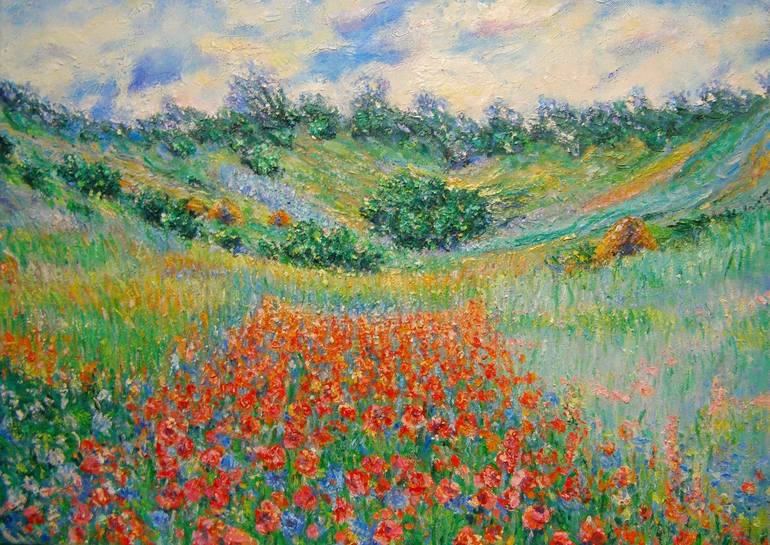
Poppy Field (Monet interpretation) by Kateryna Sabudska (Ukraine), Saatchi Art. FRom Public Domain
THE LONG JOURNEY

A journey no one else can join
A long journey my mother has taken alone

In this place where I lived with my mother
Standing alone in the wind-blown world
I look at the long, distant path
Where my mother has gone

Even if the angels in heaven
Wipe away my mother's tears
And offer her a bouquet of flowers

Without her son, her daughter-in-law
Without her granddaughters,
How lonely must my mother be!
Ihlwha Choi is a South Korean poet. He has published multiple poetry collections, such as Until the Time When Our Love will Flourish, The Color of Time, His Song and The Last Rehearsal.
.
PLEASE NOTE: ARTICLES CAN ONLY BE REPRODUCED IN OTHER SITES WITH DUE ACKNOWLEDGEMENT TO BORDERLESS JOURNAL.
“One night, the mortar launcher awakened superstition from its sleep and dragged it away with an F-16 saying, ‘I cannot exist . . . unless there is a refugee.’”
We celebrate the human spirit in those who surviving war-torn zones or climate disasters reach out for new homes or refuges in safer places. They are referred to as refugees. Yet, many people who are living without the fear of having their homes ransacked, burnt, bombed or annihilated because of reasons we don’t quite understand — for who could fully explain the logic of war, floods or fires — find it hard to allow the dispossessed shelter within the bounds of their safe haven. They get blamed for creating scarcities of resources.
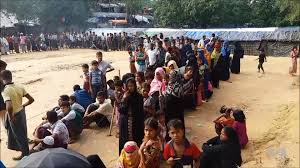
“Is it our instinct to always blame the victim?” asks Ramy Al-Asheq in Ever Since I Did Not Die. We share more such questions from him and others in this special issue. He was born and bred in a refugee camp, eventually incarcerated and suffered till he found a safe haven. An account from Timothy Jay Smith on the plight of refugees who escaped to Lesbos from as far as Afghanistan and Iraq brings to the fore the crises faced by host countries too. Shaheen Akhtar’s short story takes us to a refugee camp for Rohingyas, people who have lived in the region of the Rakhine state from the seventh century but in the last few years have been facing violent displacement. A UN report gives out they are being beheaded, shot and burnt out of their homes.
We have poetry from a refugee from Ukraine who is trying to rebuild her life in Scandinavia, Lesya Bakun, and from Ahmad Al-Khatat of Iraq. Michael Burch brings in the story of Christ while talking of modern day refugees, given that he describes the Child as a ‘Palestinian’. Though did these borders drawn by political needs exist at that time? LaVern Spencer McCarthy questions laws and attitudes that nurture such fences while Ihlwha Choi of Korea talks of love and acceptance being the best balm for refugees — whether North or South Korean or Ukrainian.
The flowers are already in full bloom, In the hearts of the Northern and Southern Koreans, Also in the hearts of the people of Ukraine and Russia.
When will we find a way to get in touch with the same ‘flowers of love’ and acceptance for all humanity living on this beautiful green planet? Do we need to redefine our norms to let our species survive and thrive? Let’s ponder with these writers…
An excerpt from Ramy Al-Asheq’sEver Since I Did Not Die, translated from Arabic by Isis Nusair, edited by Levi Thompson. The author was born in a refugee camp. Click here to read.
Mister, They’re Coming Anyway: Timothy Jay Smith writes on the refugee crisis in Lesbos Island, Greece with photographs by Michael Honegger. Click here to read.
The Magic Staff , a poignant short story about a Rohingya child by Shaheen Akhtar, translated from Bengali by Arifa Ghani Rahman. Click here to read.
There was a time when humans walked the Earth crossing unnamed landmasses to find homes in newer terrains. They migrated without restrictions. Over a period of time, kingdoms evolved, and travellers like Marco Polo talked of needing permissions to cross borders in certain parts of the world. The need for a permit to travel was first mentioned in the Bible, around 450BCE. A safe conduct permit appeared in England in 1414CE. Around the twentieth century, passports and visas came into full force. And yet, humanity had existed hundreds of thousand years ago… Some put the date at 300,000!
While climate contingencies, wars and violence are geared to add to migrants called ‘refugees’, there is always that bit of humanity which regards them as a burden. They forget that at some point, their ancestors too would have migrated from where they evolved. In South Africa, close to Johannesburg is Maropeng with its ‘Cradle of Humanity’, an intense network of caves where our ancestors paved the way to our evolution. The guide welcomes visitors by saying — “Welcome home!” It fills one’s heart to see the acceptance that drips through the whole experience. Does this mean our ancestors all stepped out of Africa many eons ago and that we all belonged originally to the same land?
And yet there are many restrictions that have come upon us creating boxes which do not allow intermingling easily, even if we travel. Overriding these barriers is a discussion with Jessica Mudditt about Once Around the Sun: From Cambodia to Tibet, her book about her backpacking through Asia. Documenting a migration more than a hundred years ago from Jullundur to Malaya, when borders were different and more mobile, we have a conversation with eminent scholar and writer from Singapore, Kirpal Singh. Telling the story of another eminent migrant, a Persian who became a queen in the Mughal Court is a lyric by Nazrul, Nur Jahan, translated by Professor Fakrul Alam from Bangla. Ihlwha Choi has self-translated his own poem from Korean, a poem bridging divides with love. Fazal Baloch has brought to us some exquisite Balochi poems by Munir Momin. Tagore’s poem, Okale or Out of Sync, has been translated from Bengali to reflect the strange uniqueness of each human action which despite departing from the norm, continue to be part of the flow.
We have a tongue in cheek piece from Devraj Singh Kalsi on traveling in a train with a politician. Uday Deshwal writes with a soupçon of humour as he talks of applying for jobs. Snigdha Agrawal brings to us flavours of Bengal from her past while Ratnottama Sengupta muses on the ongoing wars and violence as acts of terror in the same region and looks back at such an incident in the past which resulted in a powerful Bengali poem by Tarik Sujat. Kiriti Sengupta has written of a well-known artist, Jatin Das, a strange encounter where the artist asks them to empty fully even a glass of water! Ravi Shankar weaves in his love for books into our non-fiction section. Recounting her mother’s migration story which leads us to perceive the whole world as home is a narrative by Renee Melchert Thorpe. Urmi Chakravorty takes us to the last Indian village on the borders of Tibet. Taking us to a Dinosaur Museum in Japan is our migrant columnist, Suzanne Kamata. Her latest multicultural novel, Cinnamon Beach, has found its way to our book excerpts as has Flanagan’s poetry collection, These Many Cold Winters of the Heart.
In reviews, Somdatta Mandal has written about an anthology, Maya Nagari: Bombay-Mumbai A City in Storiesedited by Shanta Gokhale and Jerry Pinto. Rakhi Dalal has discussed a translation from Konkani by Jerry Pinto of award-winning writer Damodar Mauzo’sBoy, Unloved. Basudhara Roy has reviewed Trailokyanath Mukhopadhyay’s Tales of Early Magic Realism in Bengali, translated by Sucheta Dasgupta. Bhaskar Parichha has introduced us toThe Dilemma of an Indian Liberal by Gurcharan Das, a book that is truly relevant in the current times in context of the whole world for what he states is a truth: “In the current polarised climate, the liberal perspective is often marginalised or dismissed as being indecisive or weak.” And it is the truth for the whole world now.
Our short stories reflect the colours of the world. A fantasy set in America but crossing borders of time and place byRonald V. Micci, a story critiquing social norms that hurt by Swatee Miittal and Paul Mirabile’s ghost story shuttling from the Irish potato famine (1845-52) to the present day – all address different themes across borders, reflecting the vibrancy of thoughts and cultures. That we all exist in the same place and have the commonality of ideas and felt emotions is reflected in each of these narratives.
We have more which adds to the lustre of the content. So, do pause by our content’s page and enjoy the reads!
I would like to thank all our team without who this journal would be incomplete, especially, Sohana Manzoor, for her fabulous artwork. Huge thanks to all our contributors who bring vibrancy to our pages and our wonderful readers, without who the journal would remain just part of an electronic cloud… We welcome you all to enjoy our June issue.




 Borderless