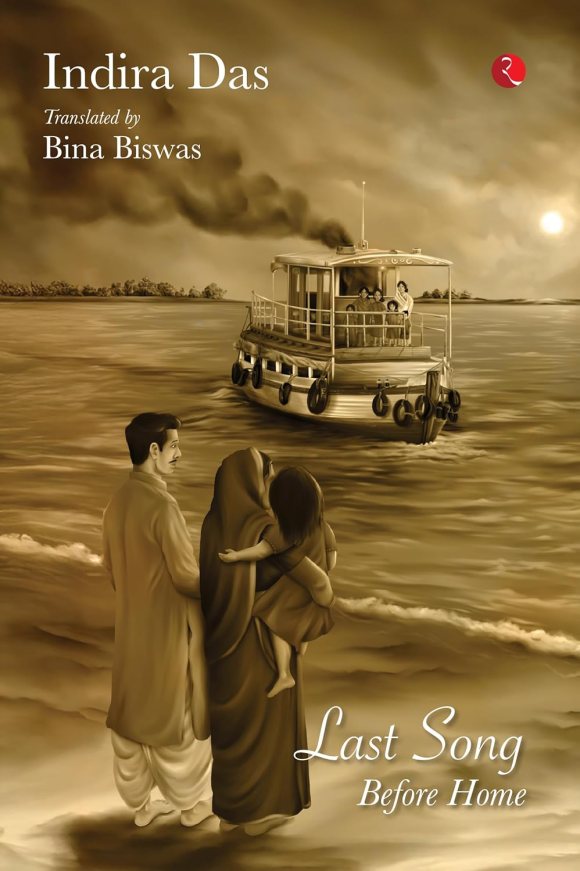
Last Song Before Home, the English translation of Indira Das’s Bengali memoir Shuru Theke Phera – Mayer Smritikatha[1], emerges as a luminous elegy to the fragility of memory and familial bonds. Translated by Bina Biswas, the book chronicles the author’s mother, Gayatri Das, navigating vascular dementia post-stroke. Through an epistolary structure of imagined letters, Das captures the slow erosion of self, where recollections surface like half-remembered melodies amid Bengal’s partitioned landscapes. The thematic depth and stylistic finesse position it as a vital contribution to South Asian memoir literature.
Central themes orbit memory as both lifeline and tormentor. Dementia strips Gayatri of chronology, yet fragments—rain-soaked courtyards, Partition’s unspoken wounds—resurface as anchors of identity. Das reframes loss as resistance, transforming maternal decline into a testament to resilience. Sisterhood underscores this; bonds with siblings weave a tapestry of shared silences, countering isolation’s void.
Partition looms subtly, not as a historical spectacle but an intimate scar—displaced homes echo in Gayatri’s fading queries: “Where is home?” This mirrors postcolonial Bengal’s flux, where personal trauma intersects collective upheaval. Dignity persists through ritual: songs hummed off-key, hands folding faded saris. Das elevates the mundane, critiquing modernity’s erasure of oral legacies. Resilience triumphs, not via triumph, but quiet defiance—memory’s “last song” before oblivion. The memoir critiques gendered aging in India, where women’s stories dissolve unspoken, urging reclamation.
A practicing gynaecologist, Das’s prose, via Biswas’s fluid translation, mimics dementia’s rhythm: elliptical sentences drift, loop, and fracture like synapses firing erratically. “The courtyard bloomed once, or was it twice? Rain came, carrying voices from across the river.” This stream-of-consciousness narrative eschews linear plot for associative flow, evoking Woolfian interiority fused with Bengali lyricism—sensory motifs—jasmine perfume, monsoon mud—ground abstraction, rendering emotion tactile.
In the translator’s note, Biswas, who is a poet and academician, says: “This book is not simply a narrative-it is a mosaic of survival, and the search for belonging. As John Berger once wrote, ‘Never again will a single story be told as though it is the only one.’ The protagonist’s journey is part of a greater collective-a shared history of migration, exile, and emotional displacement. Her voice rises in a chorus of the grieving, each thread woven with shared loss and a fierce resolve to cling to identity.
“She is a figure many will recognize: a woman who, though exiled by circumstance, carries the remnants of home in every gesture and memory. Her story becomes a vessel for inherited struggle, for resilience passed from one generation to the next. As Milan Kundera so memorably stated, ‘The struggle of man against power is the struggle of memory against forgetting.’”
Epistolary form innovates: letters to an absent self-blur authorial voice, fostering intimacy without sentimentality. Repetition (“Remember? No, forget.”) mirrors cognitive loops, building hypnotic cadence. Das avoids melodrama; understatement amplifies pathos— a single, misplaced utensil evokes existential ache. Cultural bilingualism enriches: Bengali idioms, untranslated, preserve authenticity, challenging monolingual readers. Pacing accelerates in crescendo passages, where songs bridge eras, culminating in cathartic release.
Last Song Before Home transcends memoir, becoming a philosophical meditation on impermanence. Its strengths—haunting style, layered themes—outweigh minor translation hiccups, like occasional stiffness. Essential for readers of Partition literature or aging narratives, it earns four stars for profound humanity. Das not only mourns but hymns endurance, leaving echoes that linger.
[1] Translates to: Returning from the Beginning: Memories of Mother
.
Bhaskar Parichha is a journalist and author of Cyclones in Odisha: Landfall, Wreckage and Resilience, Unbiased, No Strings Attached: Writings on Odisha and Biju Patnaik – A Political Biography. He lives in Bhubaneswar and writes bilingually. Besides writing for newspapers, he also reviews books on various media platforms.
PLEASE NOTE: ARTICLES CAN ONLY BE REPRODUCED IN OTHER SITES WITH DUE ACKNOWLEDGEMENT TO BORDERLESS JOURNAL
Festivals are affirmations of joy and love that bind humanity with their sense of hope even in a world torn by violence and climate change. As the end of the year approaches, we invite you to savour flavours of festivals past and, a few, yet to come, before the cycle starts again in the new year. The colours of celebrations are vibrant and varied as shades of nature or the skies.
We have new years spread out over the year, starting with January, moving on to the Chinese New Year around February, the Bengali new year in April to festivals of environment, light, darkness as in Wiccan beliefs, Tagore’s birth, more conventional ones like Deepavali, Eid, Durga Puja and Christmas. People celebrate in different ways and for different reasons. What we have also gathered is not only the joie de vivre but also the sadness people feel when celebrations are muted whether due to the pandemic, wars or for social reasons. In some cases, we indulge in excesses with funny results! And there are of course festivals of humanity … as celebrated by the bauls — the singing mendicants of Bengal — who only recognise the religion of love, compassion and kindness.
Ramakanta Rath’sSri Radha celebrating the love of Radha and Krishna have been translated from Odiya by the late poet himself, have been excerpted from his full length translation. Click here to read.
Bijoya Doushumi, a poem on the last day of Durga Puja, by the famous poet, Michael Madhusudan Dutt, has been translated from Bengali by Ratnottama Sengupta. Click here to read.
A Clean Start: Suzanne Kamata tells us how the Japanese usher in a new year. Click here to read.
Shanghai in Jakarta: Eshana Sarah Singh takes us to Chinese New Year celebrations in Djakarta. Click here to read.
Cherry Blossom Forecast: Suzanne Kamata brings the Japanese ritual of cherry blossom viewing to our pages with her camera and words. Clickhere to read.
Pohela Boisakh: A Cultural Fiesta: Sohana Manzoor shares the Bengali New Year celebrations in Bangladesh with interesting history and traditions that mingle beyond the borders. Clickhere to read.
The New Year’s Boon: Devraj Singh gives a glimpse into the projection of a new normal created by God. Click here to read.
A Musical Soiree: Snigdha Agrawal recalls how their family celebrated Tagore’s birth anniversary. Click here to read.
An Alien on the Altar! Snigdha Agrawal writes of how a dog and lizard add zest to Janmashtami (Krishna’s birthday) festivities with a dollop of humour. Click here to read
Memories of Durga Puja : Fakrul Alam recalls the festivities of Durga Puja in Dhaka during his childhood. Click hereto read.
KL Twin Towers near Kolkata?: Devraj Singh Kalsi visits the colours of a marquee hosting the Durga Puja season with its spirit of inclusivity. Click here to read.
Hold the roast turkey please Santa: Celebrating the festive season off-season with Keith Lyons from New Zealand, where summer solstice and Christmas fall around the same time. Click here to read.
Naramsetti Umamaheswararao makes up a new fable. Click here to read.
Feature
A review of Jaladhar Sen’s The Travels of a Sadhu in the Himalayas, translated from Bengali by Somdatta Mandal, and an online interview with the translator. Click here to read.
Autumn Garden by Vincent Van Gogh (1853-1890). From Public Domain
September heralds the start of year-end festivities around the world. It’s autumn in one part and spring in another – both seasons that herald change. While our planet celebrates changes, dichotomies, opposites and inclusively gazes with wonder at the endless universe in all its splendour, do we? Festivals are times of good cheer and fun with our loved ones. And yet, a large part of the world seems to be in disarray with manmade disasters wrought by our own species on its own home planet. Despite the sufferings experienced by victims of climate and war-related calamities, the majority will continue to observe rituals out of habit while subscribing to exclusivity and shun change in any form. Occasionally, there are those who break all rules to create a new norm.
One such group of people are the bauls or mendicants from Bengal. Aruna Chakravarti has shared an essay about these people who have created a syncretic lore with music and nature, defying the borders that divide humanity into exclusive groups. As if to complement this syncretic flow, we have Professor Fakrul Alam’s piece on a human construct, literary clubs spanning different cultures spread over centuries – no less an area in which we find norms redefined for, the literary, often, are the harbingers of change.
Mandal, herself, has a brilliant translation featured in this issue. We have a review of her book, an interview with her, and an excerpt from the translation of Jaladhar Sen’s The Travels of a Sadhu in the Himalayas. Written and first published in the Tagore family journal, Bharati, the narrative is an outstanding cultural bridge which even translates Bengali humour for an Anglophone readership. That Sen had a strictly secular perspective in the nineteenth century when blind devotion was often a norm is showcased in Mandal’s translation as well as the stupendous descriptions of the Himalayas that haunt with elegant simplicity.
Our fiction this month seems largely focussed on women’s stories from around the world. While Fiona Sinclair and Erin Jamieson reflect on mother-daughter relationships, Anandita Dey looks into a woman’s dilemma as she tries to adjust to the accepted norm of an ‘arranged’ marriage. Rashida Murphy explores deep rooted social biases that create issues faced by a woman with a light touch. Naramsetti Umamaheswararao brings in variety with a fable – a story that reflects human traits transcending gender disparity.
The September issue would not have been possible without contributions of words and photographs by many of you. Huge thanks to all of you, to the fabulous team and to Sohana Manzoor, whose art has become synonymous with our journal. And our heartfelt thanks to our wonderful readers, without who the effort of putting together this journal would be pointless. Thank you all.
A review of Jaladhar Sen’s The Travels of a Sadhu in the Himalayas, translated from Bengali by Somdatta Mandal, published by Speaking Tiger Books, and a conversation with the translator.
Jaladhar Sen (1860–1939) travelled to the Himalayas on foot with two sadhus[1] in quest of something intangible. His memoir makes us wonder if it was resilience, for after all he lost his daughter, wife and mother — all within a few months. He moved to Dehradun from Bengal for a change of scene after his tragic losses before journeying into the hills.
Written in Bengali and first published as a serial in the Tagore family journal, Bharati, in 1893, the book was brought out in 1900 as Himalay. It has been brought to Anglophone readers by Somdatta Mandal, an eminent translator who has extensively translated much of Tagore’s essays and journals. She is a critic and scholar, a former professor of Santiniketan, an excellent translator to bring Jaladhar Sen’s diary to light. Mandal has given a lucid and informative introduction to Sen, his book and her translation — very readable and without the use of scholastic language or words which would confuse readers. Her commentary adds value to the text by contextualising the people, the times and the circumstances.
Her translation is evocative of the journey, creating vivid visual impact with the play of words. Sen is a Bengali who has picked up Hindi during his brief stay in Dehradun. That he uses multiple vernaculars to move around with two more Bengali migrants who have turned to a religious life and meets locals and pilgrims from a variety of places is well-expressed with a smattering of expressions from various languages and dialects. Mandal has integrated the meanings of these words into the text, making it easy for readers unfamiliar with these phrases to read and enjoy the narrative without breaking the continuity.
Sen is secular and educated — not ritualistic but pragmatic. You can see his attitudes illustrated in an incident at the start of the book: “We quickened our pace, but when we caught up to the two sanyasis, I felt a mix of amusement and irritation. One of them turned out to be my former servant, whom I had dismissed twenty or twenty-five days earlier for theft. His transformation was remarkable—dressed in the elaborate robes of a sanyasi, with tangled hair and constant chants of ‘Har Har Bom Bom’, he was barely recognisable as the thief he once was. It was sheer bad luck on his part that our paths crossed that day.”
At the end of the journey too, Sen concludes from his various amusing and a few alarming experiences: “Many imposters masquerading as holy sanyasis brought disgrace to the very essence of renunciation. Most of these so-called sanyasis were addicted to ganja[2], begged for sustenance, and carried the weight of their sins from one pilgrimage site to another.”
Yet, there is compassion in his heart as the trio, of which Sen was a part, help a sick young youth and others in need. He makes observations which touch ones heart as he journeys on the difficult hilly terrain, often victimised by merciless thunderstorms, heavy downpours and slippery ice. He writes very simply on devotion of another: “I felt happy observing how deep faith and belief illuminated his face.” And also observes with regret: “We have lost that simple faith, and with it, we have also lost peace of mind.” He uses tongue-in-cheek humour to make observations on beliefs that seem illogical. “In such matters, credit must be given to the authors of the Puranas. For instance, Hanuman had to be portrayed as colossal, so the sun was described as being subservient to him. However, with the advancement of science, the estimated size of the sun grew larger, and instead of diminishing Hanuman’s glory, his stature had to be exaggerated even further. Similarly, Kumbhakarna’s nostrils had to be depicted as enormous, so that with each breath, twenty to twenty-five demon monkeys could enter his stomach and exit again.”
Mandal has translated beautiful descriptions of the Himalayas from his narrative with lucid simplicity and elegance. When Sen chances to see the first snow peaks, the wonder of it, is captured with skill: “We were amazed to see a huge mountain of snow, its four large peaks encircling us. The sun was already quite high in the sky, and its bright rays fell upon those mountain peaks, radiating hues that cannot simply be described in words. Even the best painter in the world could not replicate the scene with his brush.” And: “Yet the scenery that unfolded before my eyes was simply magical. Standing in front of this pristine beauty, man’s power and pride were humbled. He could recognise his own triviality and weakness very clearly and, to a certain extent, grasp the greatness of the creator within his heart.”
And of course, there is the typical Bengali witty, sardonic banter creeping in to the narrative: “On certain days, when I felt inclined to indulge in minor luxuries, I would purchase a few pedas. However, such bravado was rarely worth the effort, as one might have needed the assistance of archaeological experts to determine the sweets’ actual date of origin—no one could tell how many generations of worms had made their home inside them!”
The translation has retained the simplicity of the narrative which Sen tells us was essentially his style. He had no intention of publishing what he wrote. He had started out in company of a sadhu with a staff, a blanket and a stock of Baul Kangal Harinath’s songs. He writes at the end: “I didn’t intend to write a diary. I had a songbook with me, and when that book was being bound, I had added a few blank pages with the idea of writing down new songs if I came across them.” He scribbled his notes in those blank pages.
The journey makes a wonderful read with its humorous descriptions of errant sadhus, frightening storms, descriptions of geographies and travel arrangements more than a hundred years ago, where the pilgrims live in shop houses and eat meagre meals, the perseverance, the wonder, the love and friendship one meets along the way. Though there is greed, theft and embarrassment too! Some of his narrative brings to my mind Nazes Afroz’s translation of Syed Mujtaba Ali’sIn a Land Far from Home: A Bengali in Afghanistan.
Mandal tells us: “A prolific writer, Sen authored about forty-two books, including novels, travelogues, works with social messages, children’s literature, and biographies.” In real life, she describes Sen as “a writer, poet, editor, philanthropist, traveller, social worker, educationist and littérateur.” That’s a long list to wear. There’s more from Mandal about what the book offers and why she translated this unique travelogue in this exclusive interview.
Traveller-translator Somdatta Mandal
How did you chance upon this book and why did you decide to translate it? How long did the whole process take?
I have been writing and researching on Indian Travel Writing for almost over two decades now and so was familiar with the sub-genre of travel writing about the Himalayas. In Bangla, there exists a great number of books on travel to holy places as part of a pilgrimage from the mid-19th century onwards. But this book was unique because it was written by a secular person who did not go to the Himalayas as part of a pilgrimage but nevertheless got influenced by the other pilgrims with whom he went along. It was in the summer of 1890 when he actually travelled, and later in 1893, his perilous experience was published serially in the Bengali periodical Bharati which was then edited by Rabindranath Tagore’s niece, Sarala Devi Choudhurani.
During that period, with the proliferation of travel narratives being regularly published in several contemporary Bengali periodicals, Jadadhar Sen’s narration became very popular and after 1900 when it was published in book form, it took the Bengali readers of the time by storm. Its popularity led to it being included as part of the syllabus at Calcutta University. Feeling that pan-Indian readers who could not read the original text in Bangla should get to read this interesting text in English, I was inspired to translate this travelogue for a long time and Speaking Tiger Books readily accepted my proposal a couple of years ago.
The places visited by Sen might not seem unique in the present context, but the period during which he undertook the travel and the culture-specificity of it needed special attention. I was busy editing two volumes of travel narratives to Britain then, and after I finished my project, I took up translating this text in full earnest. It took me about three months to complete the translation, and I send the manuscript to the publishers in January this year. After several editorial interventions, it ultimately saw the light of day in July 2025.
Did you need to input much research while doing the translation? How tough was it to translate the text, especially given that it has multiple language and cultural nuances?
I did have to do some biographical research on Jaladhar Sen as his narrative is absolutely silent about why he moved from Bengal to Dehradun and the actual reason for his setting out on this particular journey. Interestingly, I was also researching about Swami Ramananda Bharati, who was the first Bengali traveller to Tibet and Manas Sarovar, and who wrote the famous book Himaranya (The Forest of Snow) whom Sen knew earlier and with whom he actually undertook the journey. With several cross references I could fill in a lot of biographical gaps in the narrative.
Regarding translation, it must be kept in mind that though something is always lost in translation, one must always attempt to strike the right balance between oversimplification and over-explanation. Translation is also a sort of creativity and the challenges it poses are significant. The intricate navigation between the source language and the translated language shows that there are two major meanings of translation in South Asia – bhashantar, altering the language, and anuvad, retelling the story. Without going into major theoretical analyses that crowd translation studies per se, I feel one should have an equal grasp over both translated and source languages to make a translated piece readable.
What are the tools you have used to retain the flavour of the original narrative? Please elaborate.
Readability of this old text Himalay in the present context is of paramount importance and though it is very difficult to replicate the grandiose writing style of late nineteenth-century Bangla, I have attempted to retain as much of the original flavour of the text as possible. Without using glossary or footnotes, the meaning of certain words becomes evident through paraphrasing the text. Thus, in keeping with Jaladhar Sen’s original work, the names of some words have been retained as they are. For example, the words dharamshala and chati—resting places on the pilgrim’s path—are so culture-specific that they are retained in their original forms. Sen also uses other culture-specific words such as panda (the Brahmin middleman who acts as the intermediary for worshipping the deity), the kamandalu (the water jug carried by sanyasis), lota-kambal (the jug and blanket that emphasise one’s identity as a sadhu), the jhola (the typical cloth bag that hangs from the shoulders), and the mahanta, or the head priest of the temple. Again, different terms such as sadhu, sanyasi, and yogi are used at different points to define ascetics and are often employed interchangeably. The term math, denoting seats of authority and doctrinal learning, has also been retained in its original form. As a Bengali gentleman settled in western India— Dehradun—the author often refers to Bengal as his desh, which literally means ‘country’, but in his parlance refers to the region of Bengal, which is as much a part of India as Dehradun. This definition should not create any confusion in the reader’s mind.
You, like the author, never clearly tell us why Sen starts out on such a perilous journey. Why do you think he went to this journey?
From evidential sources we get to know that like any other domestic person Jaladhar Sen began his career as a teacher in a High School in 1883 in Faridpur in Bengal. He got married in 1885 but however, a few years later he endured a great personal tragedy, losing his family members in quick succession. In 1887, his newborn daughter died on the twelfth day after her birth, and his wife passed away another twelve days later. Within three months, his mother also died. Overwhelmed by grief and seeking solace, he moved to Dehradun at the foothills of the Himalayas, where he worked as a teacher.
It is known that Sen did not venture into the Himalayas out of wanderlust. Dejected with domestic life, he apparently went to Kumbh Mela in Haridwar, where he chanced upon Swami Ramananda Bharati, an elderly Bengali sadhu whom he had known previously. He decided to accompany him on a trek all the way to Badrinath on foot. This was the background to his Himalayan travels and how he became a paribrajak sadhu or a traveller saint. The year was 1890.
Even though the memoir spans only a month, the author underwent many changes. Would you regard this book as a bildungsroman of sorts, especially as there is a self-realisation that comes to Sen at the end? Please elaborate.
In his travel account Sen documents his experiences of journeying to various places of religious significance, namely Devaprayag, Rudraprayag, Karnaprayag, Vishnuprayag and Joshimath before reaching the temple town of Badrinath in the upper Himalayas. He undertook this journey as a secular sojourner. But the travel impacted his soul in such a way that at the end of his narrative he admits that he had ventured in the Himalayas with a funeral pyre burning within his heart; and he merely embraced the cool breeze of the mountains with his hands and pressed the hard snow against his chest. He is doubtful whether he had the time or the state of mind to witness the eternal glory of the Lord revealed in the heavenly scenes around him. Could he lift his head and look towards heaven? That sense of wonder was absent within him. But some sort of change had already appeared within him. In this context, I feel the last two sentences of his narrative to be very significant when he states: “If anyone feels inspired to visit the Himalayas after reading this simple travel narrative of mine, then all my writing will have been worthwhile. And if anyone journeys towards the feet of the god of the Himalayas, my life would have been fulfilled.”
What was your favourite part of the book. Did you enjoy translating some things over others? Please elaborate.
There are several sections in the book which I really enjoyed translating. Most of them relate to specific incidents that Sen encountered during his travels and how human nature was the same everywhere. The first one was when they were on their way to Devaprayag and in his diary entry on 11th May, he tells us about the incident when his money pouch along with the Swamiji’s tiger skin was stolen on the way and how with the help of a panda he managed to retrieve it after a lot of effort. Though they were not very much spiritually inclined, they realized that there were crooks on the way to the pilgrimage sites who also dressed up as sadhus and everyone could not be trusted in good faith.
The second memorable incident is when trekking during extremely inclement weather — rain and thunderstorm– and when stones rushed down from the mountain slopes nearly killed them, how Achyutananda or Vaidantik who was accompanying them managed to protect him by shielding from the natural calamities with his own body as a mother hen does to protect her chicks.
The third interesting incident that Sen narrates is dated 3rd June when they got stranded at a chati in Pipul Kuthi. The head constable or jamadar sahib arrived there to enquire about a theft and Sen tells us how even in that remote mountainous region, the police had the reputation for rudeness and stern behaviour as the Bengal police had. He writes, “These officers, tasked with restraining wrongdoers and protecting civil society, displayed the same demeanour no matter where they were stationed. It seemed that the police were the same everywhere.”
Another memorable section is when they chance upon a young boy who probably ran away from his house and was trekking with them for some part of the way. The way in which the sick lad was ultimately deposited under the care of a doctor in the local hospital is extremely moving. Several other sections can also be mentioned here but it will turn my reply excessively long.
Why did you feel the need to bring this book to a wider readership? Are you translating more of his books?
I have already mentioned the importance of Sen’s travelogue in charting the long tradition and rich repertoire of Bengali travel narratives on the Himalayas that focus on travel as pilgrimage. As early as 1853, Jadunath Sarbadhikari embarked on a journey from a small village in Bengal to visit the sacred shrines of Kedarnath and Badrinath. Returning in 1857, he chronicled his travels in Tirtha Bhraman (1865). Two lesser-known pilgrimages to the Himalayas were undertaken by monks of the Ramkrishna Mission order – Swami Akhandananda and Swami Apurvananda—in 1887 and 1939, respectively. Their travelogues were published many years later by Udbodhan Karyalaya, the official mouthpiece of the Mission. In both narratives, we find vivid details of the hardships of travelling during that period, marked by limited financial resources and minimal material comforts.
Jaladhar Sen’s narrative also holds a significant position in this chronological trend of writing about travelling in the Himalayas. From the 1960s onwards we find a proliferation of Himalayan travel writing in Bangla by writers such as Prabodh Kumar Sanyal, Shonku Maharaj, Umaprasad Mukhopadhyay and others, and many of these texts need to be translated provided one finds a responsive publisher for them. I am not translating Jaladhar Sen anymore, though as a prolific writer Sen authored about forty-two books, including novels, travelogues, works with social messages, children’s literature, and biographies.
How do you choose which text to translate? You always seem focussed on writers who lived a couple of centuries ago. Why do you not translate modern writers?
There is no hard and fast rule for selecting which text I want to translate. I have already translated several travel texts by Bengali women beginning from Krishnabhabini Das’s A Bengali Lady in England, 1876, to later ones. But I have not translated any travelogue about the Himalayas before. Here I must be candid about two issues. I pick upon writers usually whose texts are free of copyright as that does not entail a lot of extra work securing permissions etc. The second more practical reason is that I still have a long bucket list of translations I would like to do provided I find an agreeing publisher. But that is very difficult because several of my proposals have been rejected by publishing houses because they feel it will not be marketable in the current scenario.
As for the query about translating modern writers let me narrate a particular incident. As a woman writer and as someone interested in translating travel narratives of all kinds, I had approached Nabanita Dev Sen through a willing publisher to translate her visit to the Kumbh Mela that she wrote about in her book titled Koruna Tomar Kone Poth Diye[3]. After seeking necessary permission and meeting her personally on several occasions to discuss several chapters, I gradually got frustrated because even after three sets of corrections, the translation did not satisfy her.
She consulted several other people, including her own daughter, and ultimately told me that she couldn’t accept my translation because she ‘didn’t find herself in it.’ The colloquial Bangla humour in some places were not sufficiently translated. As far as I got to know from the publisher, she changed editors thrice, and in the end the translated book was published with one of the editors named as the ‘translator’. When I chanced to meet her at my university on a different occasion, Nabaneetadi told me that she had mentioned my name in the acknowledgement section of the book, which of course I didn’t bother to buy or check. From such a bitter experience, I feel staying with writers dead long ago is a safer bet for me.
You are working on a new translation. Will you tell us a bit about your forthcoming book?
As I have already mentioned, I found Swami Ramananda Bharati’s Himaranya (The Forest of Snow) to be a companion piece for translation. Not only is this significant because it was the same Swamiji with whom Jaladhar Sen travelled to the Himalayas, and though his name is not mentioned anywhere by Sen, we get to know a lot about him already through his narrative. As a monk, Bharati travelled to Mount Kailash and Manas Sarovar in Tibet during 1898, the first Bengali to do so. These travels form the basis of Himaranya. It was not entirely ‘spiritual’ or ‘theological’ but rather depended on the traveller’s own temperament. There are presentations of secular interests and considerations, and modern readers can relate to them easily, especially because the route to Kailash and Manas Sarovar has now been opened for Indian pilgrims once again and several groups are going there every other day. The manuscript is already with the publisher and hopefully the book should see the light of day by the end of this year if everything goes well.
You have translated so many voyages by Tagore, by Sen, do you now want to bring out your own travelogues or memoirs?
I have been translating travel narratives of different kinds for a long time now. I still plan to do a few more if I get a proper publisher for the same. I am an avid traveller myself and have actually trekked to Kedarnath, Badrinath, Gangotri and Yamunotri twice. I have also trekked for fourteen days to visit Muktinath in Nepal way back in the early 1980s, and during the pandemic days when I was confined at home, I managed to key in that experience in Bangla from the diary I kept at that time. That narrative was published in the online journal Parabaas which is published from the United States. But I have never taken writing about my own travelogues or memoirs seriously. Of course, last year and also forthcoming this year, a special Puja Festive number of a Bengali magazine has been publishing my travel articles. But there is nothing serious or academic about it.
Do you have any advice for fledging writers or translators?
Translating has caught up in a big way over the past five or six years. Now big publishing houses are venturing into publishing from regional bhasha literatures into English and so the possibilities are endless. Now every other day we come across new titles which are translations of regional novels or short stories. My only advice for young writers or translators is that since copyright permissions have become quite rigid and complicated nowadays, it is always advisable to seek permission from the respective authorities before venturing into translating anything. I was quite young and naïve earlier and just translated things I liked without seeking prior approval and as usual those works never saw the light of day. Also, as time went by, I learnt that translating should have as its prime motive current readability and not always rigidly adhering to being very particular about remaining close to each individual line of the source text. The target readership should also be kept in mind and so the choice of words used and glossary should be eliminated or kept to a minimum. The meaning of a foreign word should as far as possible be embedded within the text itself. All these issues would definitely make translating an enjoyable experience.
Thanks for the wonderful translation and your time.
[1] Mendicants. Sadhu and swami also have the same meaning
[3] Translates from Bengali to The Path to Compassion, published in 1978. The translation was published by Supernova Publishers in 2012 as The Holy Trail: A Pilgrims Plight. Soma Das is mentioned as the translator.
(This review and online interview is by Mitali Chakravarty)
Aruna Chakravarti writes of the Bauls (wandering minstrels) of Bengal and the impact their syncretic thought, music and life had on Tagore
Bauls by Jamini RoyBaul Singer by Jamini Roy Paintings by Jamini Roy (1887-1972). From Public Domain
Religious movements such as Bhakti and Sufi have spanned time and territory and entered Bengal, in successive waves, creating a syncretic culture in which music and poetry are amalgamated. One of the forms in which these movements find creative expression is Baul Gaan —the singing of itinerant minstrels.
Universally recognised as foremost among the oralities of Bengal, the Baul Sampradai is a community for whom singing is synonymous with worship. The Baul expounds a philosophy of humanism which rejects religious orthodoxies and stresses human equality irrespective of caste, class, religion and gender. The Baul sets himself on a spiritual journey, lasting a lifetime, towards discovering his moner manush (man within the heart) thereby alienating the notion of seeking the Divine in external forms such as mosques, temples, images and sculptures. Since God is believed to reside within man, the human body is viewed as the site of the ultimate truth –that which encompasses the entire universe. This tenet of Baul philosophy is known as deha tatwabad—the belief that the soul being pure the body that houses it, together with all its functions, is pure and holy.
Concentrated mostly in Kushthia, Shilaidaha and Sajadpur in East Bengal (now Bangladesh) and Murshidabad and Birbhum in West Bengal, the Baul tradition, though drawing elements from Tantra, Shakta and Sahajiya[1], stems from two main sources — Muslim Sufi and Hindu Vaishnav. Hence the simultaneous presence of Hindu and Muslim bauls in the villages of Bengal and great composers from both streams—Lalon Fakir, Duddu Shah, Madan Baul, Gagan Harkara and Fakirchand. Rejecting religious codes such as Shariat and Shastras, caste differences, social conventions and taboos, which they see as barriers to a true union with God, they sing of harmony between man and man. “Temples and mosques obstruct my path,” the Baul sings, “and I can’t hear your voice when teachers and priests crowd around me.”
Refusing to conform to the conventions of religion and caste ridden Bengali society, Bauls (the word is sourced from the middle eastern bawal meaning mad or possessed) are wandering minstrels who sing and dance on their way to an inner vision. Essentially nomadic in nature walking, for them, is a way of life. “No baul should live under the same tree for more than three days” — the saying seems to stem from the Sufi doctrine of walking an endless path (manzil) in quest of the land where the Beloved (the Divine) might be glimpsed. Bauls live on alms which people give readily. In return the Baul sings strumming his ektara[2] with dancing movements. The songs are rich with symbolism, on the one hand, and full of ready wit and rustic humour on the other. The Baul rails against the hypocrisy of religion and caste and takes sharp digs at the clergy but totally without rancour.
Many of the composite forms found in an older culture of Bengal have become sadly obscured in the present scenario of identity politics. But the one that has not only survived but is gaining in recognition day by day, is the Baul tradition. This is, in no small measure, owing to the intervention and interest taken by Rabindranath Tagore. In his Religion of Man Rabindranath tells us that, being the son of the founder of the Adi Brahmo Samaj, he had followed a monotheistic ideal from childhood but, on gaining maturity, had sensed within himself a disconnect from the organised belief he had inherited. Gradually the feeling that he was using a mask to hide the fact that he had mentally severed his connection with the Brahmo Samaj began tormenting him. And while in this frame of mind, travelling through the family estates in rural Bengal, he heard a Baul sing. The singer was a postal runner by the name of Gagan Harkara and the song was “Ami kothai paabo tare/ amaar moner manush je re[3].”
“What struck me in this simple song,” Rabindranath goes on to say, “was a religious expression that was neither grossly concrete, full of crude details, nor metaphysical in its rarefied transcendentalism… Since then, I’ve often tried to meet these people and sought to understand them through their songs which are their only form of worship.” In his Preface to Haramoni[4], Rabindranath makes another reference to this song. Quoting some lines from the Upanishads— Know him whom you need to know/ else suffer the pangs of death— he goes on to say, “What I heard from the mouth of a peasant in rustic language and a primary tune was the same. I heard, in his voice, the loss and bewilderment of a child separated from its mother. The Upanishads speak of the one who dwells deep within the heart antartama hridayatma[5]and the Baul sings of the moner manush. They seem to me to be one and the same and the thought fills me with wonder.”
A Portrait of Lalon Fakir sketched by Jyotindranath Tagore(1849-1925)
Lalon Fakir’s commune was located in the village of Chheurhia which fell within Rabindranath’s father’s estates. Though there is no authentic record of a meeting between the two, it is a fact that the poet was the first to recognise Lalon’s merit which had the quality of a rough diamond. His inspiration was powerful and spontaneous but, lacking in clarity of expression, lay buried in obscurity till Rabindranath brought it out into the open. Publishing some of the songs in some of the major journals of the time, Rabindranath took them to the doors of the educated elite. Not only that. They gained in popularity from the fact that he, himself, often used Baul thought and melody in his own work. “In some songs,” he tells us in his Manush er Dharma[6], “the primary tunes got mixed up with other raags – raaginis which prove that the Baul idiom entered my sub conscious fairly early in life. The man of my heart, moner manush, is the true Devata[7]. To the extent that I’m honest and true to my knowledge, action and thought — to that extent will I find the man of my heart. When there is distortion within, I lose sight of him. Man’s tendency is to look two ways — within and without. When we seek him without — in wealth, fame and self- gratification — we lose him within.”
But it wasn’t only in his compositions that Rabindranath disseminated Baul ideology. It went deeper than that. The primitive simplicity and freedom of Baul thought and living charmed him so completely that he started imbibing them in his own lifestyle. He grew his hair long, kept a flowing beard and wore loose robes. He created Baul like characters in his plays and dance dramas and enacted the roles himself. And, as he grew older, a restlessness; an inability to stay in one place took hold of him. Leaving the ancestral mansion of Jorasanko he relocated to Santiniketan but even there he could not stay in the same house for more than two months. In the last two and half decades of his life, a tremendous wanderlust seized him. He travelled extensively both within the country and without, earning for himself the sobriquet of ‘roving ambassador for India’.
Perhaps, the most powerful testimony of the evolution of Rabindranath from a princely scion of the Tagores of Jorasanko to the man he finally became is found in Abanindranath’s portrait of his uncle. It depicts an old man with flowing white locks and beard, wearing a loose robe and holding an ektara high above his head. The limbs are fluid in an ecstatic dance movement. It is a significant fact that the painting is titled Robi Baul.
Robi Baul (1916): Painting by Abanindranath Tagore (1871-1951). From Public Domain
[1] Different schools of philosophy and religion. The Sahajiya is a philosophy that embrace nature and the natural way of life.
[3] Translates from Bengali to: “Where will I find Him — He who dwells within my heart”
[4] The Haramoni (Lost Jewels) is 13-volume collection of Baul songs compiled by Mansooruddin to which Tagore wrote the preface for the first volume published in 1931
[5] Translates to ‘innermost part of the heart and soul’
[6] Collection of Lectures by Tagore in Bengali, published in 1932
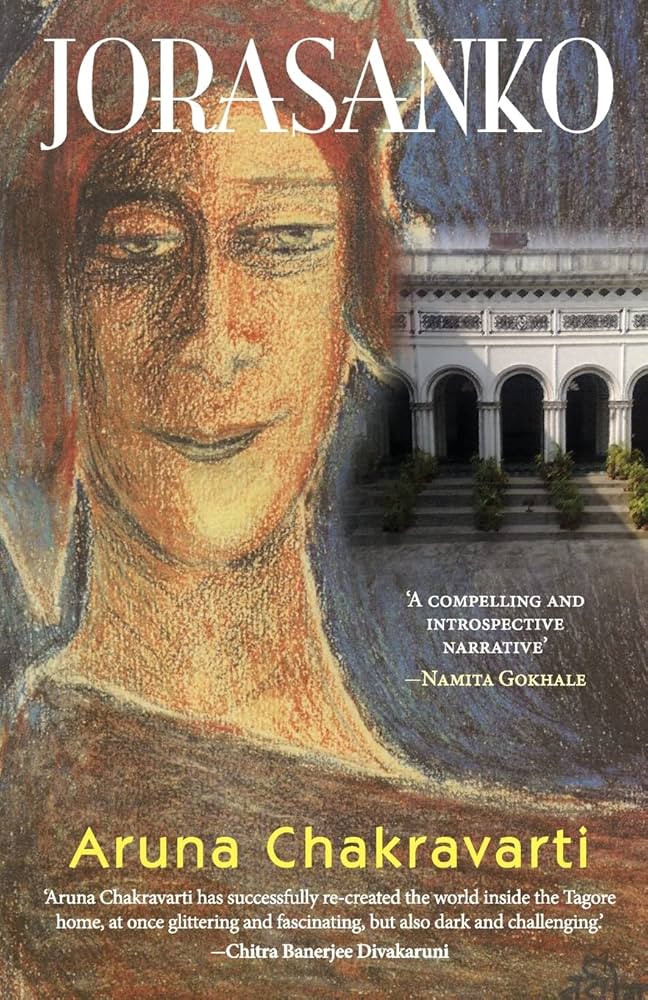
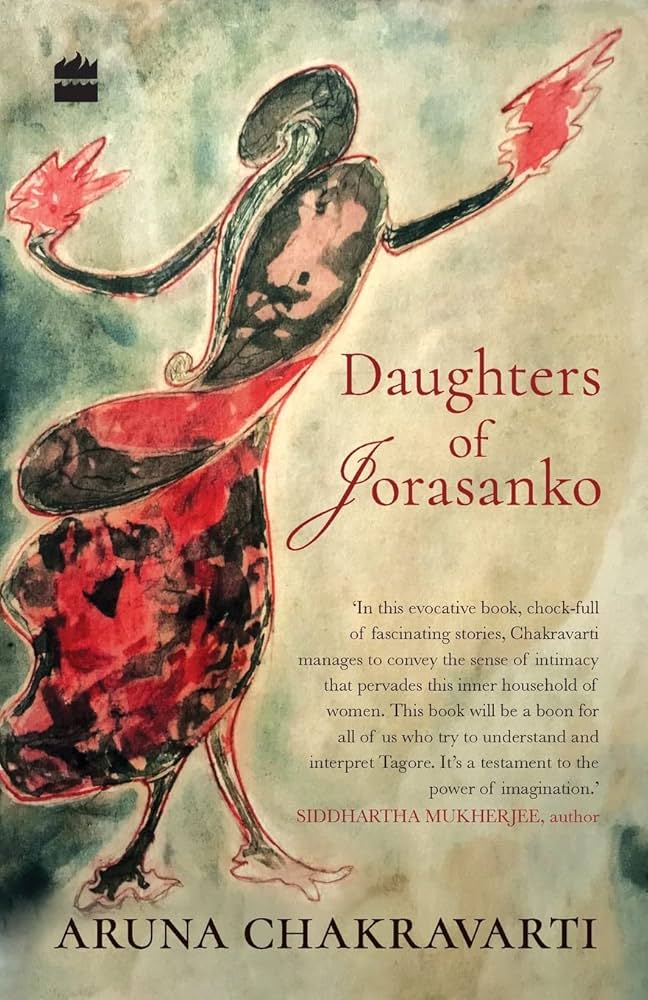
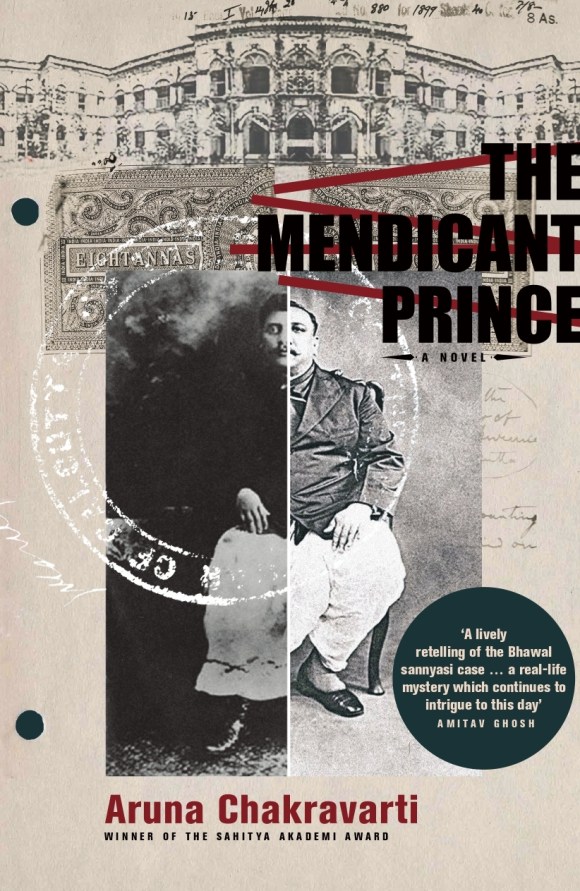
Aruna Chakravarti has been the principal of a prestigious women’s college of Delhi University for ten years. She is also a well-known academic, creative writer and translator. Her novels, Jorasanko, Daughters of Jorasanko, The Inheritors, Suralakshmi Villa and The Mendicant Prince have sold widely and received rave reviews. She has two collections of short stories and many translations, the latest being Rising from the Dust. She has also received awards such as the Vaitalik Award, Sahitya Akademi Award and Sarat Puraskar for her translations.
.
PLEASE NOTE: ARTICLES CAN ONLY BE REPRODUCED IN OTHER SITES WITH DUE ACKNOWLEDGEMENT TO BORDERLESS JOURNAL
Title: Rising From the Dust: Dalit Stories from Bengal
Selected and Translated by Aruna Charavarti
Publisher: Om Books International
Though Bengali Dalit writing is comparatively newer compared to Dalit writing in Marathi and other Dravidian languages, nevertheless it has already carved a niche for itself in a significant way. The main difference between the Dalit writing emanating from other regions of India and that of Bengal is that whereas the thrust area elsewhere is primarily on the untouchables, the downtrodden and the way the Dalits have been marginalised in society for a long time, in Bengal the problem is further complicated by caste and class issues which is not so significant elsewhere. This collection of twelve Dalit short stories from Bengal, carefully selected and translated by Aruna Chakravarti, spans a long period and what distinguishes it is the gendered lens that explores the Dalit woman’s cause and holds it up to the light.
There is a difference in the style of narrating the Dalit experience from writer to writer and accordingly it can be divided into two groups. In the first category are writers who themselves belong to the Dalit community and their writing stem out of experiential feelings. The second group of writers belong to the upper castes, and their writing stems from a feeling of empathy for the marginalized and the downtrodden. Spanning a long period of almost a century, Aruna Chakravarti has decided to blend both these categories and has meticulously translated the dozen stories from well-known writers to those a little lesser known. While literary stalwarts like Mahasweta Devi, Saratchandra Chattopadhyay, Tarashankar Bandopadhyay and Prafulla Roy share their profound understanding of the Dalit woman’s fears and traumas, hopes, dreams and aspirations, contemporary voices from the Dalit community itself like Manoranjan Byapari, Bimalendu Haldar, Manohar Mouli Biswas, Kalyani Thakur Charal, Anil Ghorai and Nakul Mallik explore aspects of survival and social ostracisation with both sensitivity and angst. On the one hand we have centuries of oppression being still carried upon these subaltern people, and even within that restricted space, we also often find protest and upheaval that the doubly marginalized womenfolk attempt to revolt against.
In the opening story titled “Fortress” by Manoranjan Byapari, we find Nakul’s widow Sarama, unwillingly forced to sell her body to oppressive menfolk everyday finds her unique way of protest by deliberately copulating with her ex-husband Ratan who is inflicted with venereal disease, thereby driving out all her fear and henceforth would ‘welcome every touch’ and ‘would wait outside her door in delicious anticipation.’ In Bimalendu Haldar’s “Salt” we are shown how a fisherman Madhai who works for his employer Nishay Ghosh, goes missing and his wife Chintay, collecting three other suffering women registers their protest in a unique way. In “Shonkhomala” Manohar Mouli Biswas tells us a relatively contemporary and true story relating to the grabbing of agricultural land in the fertile Singur area by the government for setting up of the Tata Motor Factory. It tells us of how Shonkhomala Dom, a Dalit woman, changes her name to Tapashi Malik and is gangraped and murdered because she was unwilling to give up her land and organized a protest march instead. Incidentally, till date, the court case for identifying the murderer and the rapists of Tapashi Malik is unresolved.
Another very touching story “Illegal Immigrant” by Nakul Mallick brings in the plight of refugees from erstwhile East Bengal coming to India after the partition. It tells us of the plight of an extremely poor jhalmuri seller called Madhav who, along with his wife Shefali, lives in a slum beside the train track and somehow manages to eke out a decent living. When Madhav is picked up as an illegal Bangladeshi immigrant and thrown out of the country, his wife’s life goes haywire as she goes to the Petrapole border looking for her husband in vain. Kalyani Thakur Charal deliberately adds the word ‘Charal’ meaning ‘Chandal’ or ‘untouchable’ to her name in order to take pride of her Dalit identity. In “Motho’s Daughter” she tells the story of one Nishikanta who wants to get his children educated first and foremost and is frustrated in the end because his stray son gets married to a woman who doesn’t encourage education. Anil Ghorai, another powerful Dalit writer, tells an interesting story about Larani, belonging to the tanner caste, her relationship with Hola Burho, a dhol[1] repairer and his son Pabna. The main thrust of the story “The Insect Festival” is of course the attack of locusts in the village and how the majority of the illiterate villagers take resort to superstitious rituals in order to ward off the menace instead of confronting the situation in a scientific manner.
As mentioned earlier, each story by the four empathetic writers goes on emphasizing the pressures of caste and class upon the lower classes of people in different situations. In “The True Life Story of Uli-Buli’s Mother” Mahasweta Devi tells us the story of a helpless woman who becomes a destitute after being thrown away for having four daughters. She lives under the delusion that someone has stolen her young twins Uli and Buli. Again in “Nalini’s Story” she draws a beautiful pen picture of Nalini, who after being abandoned by her husband, lives with her grandson and ekes out her living by working as a maid. Years later, her estranged son along with his wife and her landlord Gobindo all desire to take possession of her house by arranging an elaborate shraddha ceremony for her estranged husband. Nalini understands their ploy and, in the end, she puts her foot down, unwilling to be in eternal debt for the extravagant rituals proposed by them.
Prafulla Kumar Roy’s “Snake Maiden” gives us an inside story of the gypsies or nomads who are known as ‘bedyes’ and who deal with snakes and charms. Here Shankhini is the mistress of a band of bedeys who come and settle in Sonai Bibir Bil for the season and accidentally meets her ex-lover Raja saheb. She is in a quandary because he wants her to renounce the bedeni’s life and settle down in one place and turn into a farmer’s wife. The tug between domesticity and the age-old tradition of this nomadic gypsy tribe’s rituals and customs is elaborated through the rest of this interesting story. The powerful storyteller Tarashankar Bandyopadhyay gives us two stories with totally different locales and characters. In “The Witch” he elaborates upon the idea of a woman who is defined as a witch and is ostracised by society because she is said to cast an evil eye upon everything she sees. She dies an agonising death in the end as her dark and unholy blood oozes out from her veins. Incidentally, even to this day the idea of identifying certain low caste woman as witches and even burning them to death persists in several villages in rural Bengal and such superstitions are not overcome at all.
In the second story “Raikamal”, Tarashankar gives us an in-depth picture of a Vaishnav community, their rituals and their manner of living. The protagonist Kamalini had to abandon her crush on Ranjan because he belongs to another caste, weds Rasik who consumes poison in the end out of jealousy and ultimately Kamalini has to live all alone. Sarat Chandra Chattopadhyay’s eponymous story “Abhagi’s Heaven” is once again a depiction of Bengali society strictly divided according to caste lines. In this story, Kangali’s mother Abhagi, an untouchable, a ‘duley’ by caste, watches the funeral pyre of a Brahmin lady and imagines her going to heaven in a golden chariot. She nourishes the desire to be cremated in a similar fashion when she dies, but after her actual death she is denied the privilege of being burnt and has to be buried near the riverside as per societal norms.
The stories in this collection capture the essence of a way of life marked by the enduring defiant spirit of the dispossessed and the marginalised. This is a must-read not only for literary enthusiasts, but also for students and scholars of Dalit and caste studies, development studies, Indian literature in translation and gender studies. In her foreword, Meena Kandasamy categorically states that “every short story in this collection holds together a precious, precarious universe – the old order continues with its oppression, the new is struggling to be born; everyday life is a struggle and yet, struggle itself is the terrain, where life, liveliness, and being alive come into their full glory.” This translated volume is therefore strongly recommended for non-Bengali readers who are not aware of the nuances of Bengali Dalit writing at all and it will dispel the notion that all kinds of Dalit writing cannot be brought together under a single umbrella. Kudos to Aruna Chakravarti for her excellent selection and meticulous translation of these one dozen stories.
[1] Musical instrument akin to a drum but hung from the neck
.
Somdatta Mandal, critic and translator, is a former Professor of English at Visva Bharati, Santiniketan.
PLEASE NOTE: ARTICLES CAN ONLY BE REPRODUCED IN OTHER SITES WITH DUE ACKNOWLEDGEMENT TO BORDERLESS JOURNAL
Neeman Sobhan, born in the West Pakistan of Pre-1971, continues a citizen of both her cultural home, Bangladesh, and her adopted home, Italy. Her journey took her to US for five years but the majority of times she has lived in Italy – from 1978. What does that make her?
She writes of her compatriots by culture – Bangladeshis — but living often in foreign locales. Her non-fiction, An Abiding City, gives us glimpses of Rome. These musings were written for Daily Star and then made into a book in 2002. Her short stories talk often of the conflicting cultures and the commonality of human emotions that stretch across borders. And yet after living in Rome for 47 years – the longest she has lived in any country – her dilemma as she tells us in this interview – is that she doesn’t know where she belongs, though her heart tugs her towards Bangladesh as she grows older. In this candid interview, Neeman Sobhan shares her life, her dreams and her aspirations.
Where were you born? And where did you grow up?
I was born in Pakistan, rather in the undivided Pakistan of pre-1971: the strange land we had inherited from our grandparents’ and parents’ generation when British colonial India was partitioned in 1947 down the Radcliffe line, creating an entity of two wings positioned a thousand miles apart on either side of India! The eastern wing, or East Pakistan was formerly East Bengal, and my cultural roots are in this part of the region because I come from a Bengali Muslim family. But I was born not there but in West Pakistan, which is culturally and linguistically distinct from Bengal, comprising the regions of Western Punjab, Sindh, Baluchistan and the NWFP (North-West Frontier Provinces, bordering Afghanistan), where the official language is Urdu.
So, my birthplace was the cantonment town of Bannu in the NWFP, (now KPK or Khyber Pakhtunkhwa).
Perhaps my life as the eternal migrant, living outside expected geographical boundaries started right there, at birth.
My father’s government job meant being posted in both wings of Pakistan. So, I grew up all over West Pakistan, and in Dhaka, whenever he was posted back to East Pakistan. Much of my childhood and girlhood were spent in Karachi (Sindh), Multan and Kharian (Punjab) and Quetta (Balochistan).
How many years did you spend in Pakistan?
The total number of years I spent in undivided Pakistan (West Pakistan, now Pakistan, and East Pakistan, now Bangladesh) is about two decades, or one year short of twenty years. From my birth in 1954, my growing years, till I left the newly independent Bangladesh in 1973 when I got married and came to the US at the age of nineteen.
What are your memories about your childhood in West Pakistan? I have read your piece where you mention your interactions with fruit pickers in Quetta. Tell us some more about your childhood back there.
I have wonderful memories of growing up in West Pakistan, in Karachi, Multan and Kharian of the late 50’s and early 60’s (despite the era of Martial Law under Field Marshall Ayub Khan, and later his military-controlled civilian government). However, the political environment is invisible and irrelevant to a child’s memories that center around family, school and playmates, till he reaches the teen years and becomes aware of the world of adults. Since, my father’ job entailed us going back and forth between West and East Pakistan, by the time we arrived in Quetta in late 1967, it ended up being my father’s last posting, because by then Ayub Khan’s regime was tottering under protests in both wings of Pakistan; and by the time (I should say in the nick of time) we left for Dhaka, it was already the turbulent year of 1970, which turned Pakistan upside down with General Yahya Khan becoming the new Marshall Law administrator. When we returned to Dhaka, it was the beginning of the end for Pakistan, with preparations for the first democratic general elections, and the blood soaked nine months war of independence for Bangladesh about to be staged.
But as a child, growing up in a Pakistan that was till then my own country, what remains in my treasure trove of memories are only the joys of everyday life, and the friendships (with those whom I never saw again, except one school friend from Quetta with whom I reunited in our middle age in Toronto, Canada!)
Also precious are the road trips with my five siblings and our adventurous mother, as we always accompanied our father on his official tours, across the length and breadth of West Pakistan.
But if I start to recount all my precious memories, I will need to write a thick memoir. And that is exactly what I have been doing over the years: jotting down my recollections of my past in Pakistan, for my book, a novel that is a cross between fact and fiction. The happy parts are all true, but the sad ones relating to the war that my generation underwent in 1971 as teenagers is best dealt with from the distance of fiction.
What I can offer is a kaleidoscopic view of some random memories: the red colonial brick residence of my family in the 60’s in Multan, one of the hottest cities of Punjab, known for its aandhi — dust storms — that would suddenly blow into the courtyard of the inner garden in the middle of the night as my sister and I slept on charpoys laid out in the cool lawn under a starlit sky, and being bundled up in our parents’ arms and rushed indoors; tasting the sweetest plums left to chill in bowls of ice; being cycled to school by the turbaned chowkidar weaving us through colourful bazars to the Parsi run ‘Madam Chahla’s Kindergarten School’ or on horse drawn tanga (carriages); learning to write Urdu calligraphic letters on the wooden takhta (board) with weed Qalam(pens) and a freshly mixed ink from dawaat (ink pots); and to balance this, my mother helping us to write letters in Bengali to grandparents back in East Pakistan on sky-blue letter pads, our tongues lolling as pencils tried to control the Brahmic alphabet-spiders from escaping the page.
In Karachi, returning home on foot from school with friends under a darkening sky that turned out to be swarms of locusts. Learning later that these grain eating insects were harmful only to crops not humans (and Sindhis actually eat them like fried chicken wings) does not take away the thrill of our adventure filled with exaggerated, bloodcurdling shrieks to vie with the screen victims of Hitchcock’s The Birds, viewed later as adults in some US campus. Picnics and camel rides on the seabeaches of Clifton, Sandspit, or Paradise Point. Near our home, standing along Drigh Road (the colonial name later changed to Shahrah-e-Faisal after King Faisal of Arabia, I later heard) waving at the motorcade of Queen Elizabeth II passing by with Ayub Khan beside her in a convertible with its roof down. That was in the 60’s. Later in 1970, embarking with my family on the elegant HMV Shams passenger ship at Karachi port for our memorable week long journey back to Dhaka across the Arabian Sea and the Indian Ocean, with a port of call at Colombo in what was still Ceylon, to disembark at Chittagong port, not knowing then that we were waving goodbye not just to the Karachi of our childhood but a part of our own country that would soon become the ‘enemy’ through its marauding army.
But I reset my memories and bring back the beauty and innocence of childhood with images of my family’s first sight of snowfall in Quetta, the garden silently filling with pristine layers of snowflakes piling into a cloudy kingdom under the freshly tufted pine trees, as we sipped hot sweet ‘kahwa’ tea, and cracked piles of the best chilgoza pine-nuts and dried fruits from Kabul. And since Quetta was our last home in Pakistan, I leave my reminiscences here.
In Front of their home With full family in the snow In Quetta: Photos provided by Neeman Sobhan
There are so many ways to enter the past. Photographs in albums discolor after a time, but words keep our lived lives protected and intact to be accessible to the next generation. I hope my novel-memoir will provide this.
How many countries have you lived in? Where do you feel you belong — Bangladesh, Pakistan, US or Italy — since you have lived in all four countries? Do you see yourself a migrant to one country or do you see yourself torn between many?
I have indeed lived in four countries, for varying lengths of time. In the sense of belonging, each country and stage of my life has left its unique impact. But I have still not figured out where I belong.
Although I lived in Pakistan and Bangladesh from birth till I was nineteen, these were the formative years of my life, and I feel they have coloured who I am fundamentally. The culture and languages of the subcontinent is fundamental to me as a human being. Also, having shared my parent’s experience of being almost foreigners and expats in their own country, trying to speak Urdu to create a Bengali lifestyle at home in a culturally diverse world of Punjabis, Sindhis, Baluchis or Pathans, I know it made them (and us as a family), different from our compatriots in East Pakistan who never left their region and had only superficial understanding of the West Pakistanis. My introduction to a migrant’s life and its homesickness started there, observing my parents’ life.
When I moved to the US after my marriage in 1973, it was to follow my husband Iqbal, to the Washington-Maryland area, where he had moved earlier as a PhD student after giving up, in 1971, his position in the Pakistani central government where he was an officer of the CSP (Civil Service of Pakistan) cadre. These were the days of being newly married and setting up our first home, albeit in a tiny student’s apartment, because more than as a home maker, I spent 5 years attending the University of Maryland as an undergraduate and then a graduate student. We thought our future might be here in the US, he working as an economist for a UN agency, and I teaching at a university. A classic version of the upwardly mobile American immigrant life.
But before we settled down, we decided to pursue a short adventure, and Iqbal and I came to Italy in 1978, from the US, on a short-term assignment with FAO, a Rome based agency of the UN. The mutual decision was to move here, temporarily! We would keep our options open for returning to the US if we did not like our life in Italy.
Well, that never happened! And given the fact that since then, we have spent the last 47 years in Italy, the Italian phase of my life is the longest period I have ever spent in any country in the last 71 years!
Meanwhile, we slowly disengaged ourselves from the US and it was clear that if we had to choose between two countries as our final homes, it would be between Bangladesh, our original home country, and Italy our adopted home.
Still, living away from ones’ original land, whether as an expatriate or an immigrant, is never easy. Immigrants from the subcontinent to anglophone countries like the US, UK, Canada, Australia etc, do not face the hurdles that migrants to Italy do in mastering the Italian language. I am still constantly trying to improve my language skills. Plus, there is the daily struggle to create a new identity of cultural fusion within the dominant and pervasive culture of a foreign land
So, in all these years, though I love Italy and my Roman home, I do not feel completely Italian even if my lifestyle incorporates much of the Italian way of life. For example, after a week of eating too much pasta and Mediterranean cuisine my husband and I yearn for and indulge in our Bengali comfort food. Although I enjoy the freedom and casual elegance of Italian clothes, I look forward to occasions to drape a sari, feeling my personality transform subtly, softly.
Yet, I cannot conceive of choosing one lifestyle over the other. The liberty to veer between different ways to live one’s life is the gift of living between two or more worlds.
The only incurable malaise, though, is the chronic nostalgia, especially during festivals and special occasions. For example, when Eid falls on a weekday, and one has to organise the celebration a few days later over a weekend, it takes away the spontaneous joy of connecting with one’s community, forcing one instead to spend the actual day as if it were an ordinary one. I miss breaking my fasts during the month of Ramadan with friends and family over the elaborate Iftar parties with special food back in Dhaka or celebrating Pohela Boishakh (Bengali new year) or Ekushey February (21st February, mother language day) in an Italian world that carries on with its everyday business, unaware of your homesickness for your Bengali world. Over the years, when my sons were in school, I made extra efforts for. But you know you cannot celebrate in authentic ways.
Of course, these are minor matters. And I am aware that by virtue of the fact that I have dual nationality (I’m both an Italian citizen, and a Bangladeshi), I cannot consider myself a true and brave immigrant — someone who leaves his familiar world and migrates to another land because he has no other options nor the means to return; rather, I feel lucky to be an ex-patriate and a circumstantial migrant — someone who chooses to make a foreign country her home, with the luxury of being able to revisit her original land, and, perhaps, move back one day.
Meanwhile, I feel equally at home in Italy and in Bangladesh because we are lucky to be able to make annual trips to Dhaka in winter.
Whether I am considered by others to be an Italo-Bangladeshi or a Bangladeshi-Italian, I consider myself to be a writer without borders, a global citizen. I feel, I belong everywhere. My home is wherever I am, wherever my husband and my family are. My roots are not in any soil, but in relationships.
I often quote a line by the Mexican poet Octavio Paz. “Words became my dwelling place.” It resonates with me because for me often, it is neither a tract of land, nor even people, but language, literature and my own writings that are my true sanctuary, my homeland. I feel blessed to have the gift of expressing myself in words and shaping my world through language. My home is etched on the written or printed page. My books are my country. It’s a safe world without borders and limits.
Maybe it’s the conceit of a writer and a migrant, nomadic soul, but I think our inner worlds are more substantial than our external ones.
When I read your writing, I find a world where differences do not seem to exist among people in terms of nationality, economic classes, race or religion. Is it not far removed from the realities of the world we see around us? How do you reconcile the different worlds?
I believe and trust in our common humanity, not the narrowness of nationality, race or religion. Nationality particularly is limiting, dependent on land, and boundaries that can shift due to physical or political exigencies. Nationality by conferring membership also necessarily excludes on the basis of manmade criteria, while humanity is boundless, all encompassing, and inclusive, based on shared natural, biological, and spiritual traits.
In my case, I consider the whole world my family. I say this not just as idealistic hyperbole and wishful thinking, but from the fact that I have a multi-cultural, multi-racial family. Only my husband and I are a homogenous unit being Bengali Muslims by origin, but both my sons are married outside our culture, race and religion. One of my daughters in law is Chinese, the other has an English-French father and a Thai mother. So, through my grandchildren, who are a veritable cocktail, yet my flesh and blood, I am related to so many races. How can I bear malice to any people on the globe? The whole world is my tribe, my backyard, where we share festivals and food and rituals and languages. We celebrate unity in diversity.
Kindness and caring for others are values I hold dear in myself and others. I believe in sharing my good fortune with others, and in peaceful co-existence with my neighbours, wherever I live. I believe in living with responsibility as a good citizen wherever I find myself. And so far, the world that I see around me, perhaps narrow, is peopled with those who invariably reflect my own sense of fraternity. Maybe I am foolish, but I believe in the essential goodness of humanity, and I have rarely been disappointed. Of course, there are exceptions and negative encounters, but then something else happens that restores ones faith.
Love is more powerful than hate and generates goodness and cooperation. Change can happen at the micro level if more people spread awareness where needed. Peace can snowball and conquer violence. The human will is a potent spiritual tool. As is the power of the word, of language.
Literature is about connections, communications, bridges. It can bring the experiences and worlds of others from the margins of silence and unspoken, unexpressed thoughts and emotions into the centre of our attention. It brings people who live in the periphery within our compassionate gaze. Language is one of the most effective tools for healing and building trust. Responsible writers can persuasively break down barriers and make the world a safe home and haven for everyone, every creature.
You have a book of essays on Rome, short stories and poems set in Rome. Yet you call yourself a Bangladeshi writer. You have in my perception written more of Rome than Bangladesh. So which place moves your muse?
Any place on God’s beautiful earth can move my muse. Still, the perception is not completely accurate that I have written more of Rome than Bangladesh. It is true that many of my columns, short fiction or poems are set in Rome, but they are not necessarily just about Italy and Italians. In fact, my columns and poems were written from the perspective of a global citizen, who celebrates whichever place she finds herself in.
Poetry, in any case, is never just about any place or thing, but a point of departure. It always goes beyond the visual and the immediate and transcends the particular to the philosophical. The sight of a Roman ruin may jumpstart the poem, but what lifts it into the stratosphere of meaningful poetry is the universal, the human. For example, even when my poem speaks of a certain balcony in Verona, the protagonist is not a girl called Juliet but the innocence of first love, in any city, in any era.
My book of short stories, even when located in Rome, actually concern characters that are mostly Bangladeshi. In fact, it is my fiction that makes me a Bangladeshi writer, because my stories are ways for me to preserve my memories of the Bengali world of my past and an ephemeral present. I write to root myself. I often feel that I should write more about the new Italians, the Bangladeshi immigrants generation, rather than the expats of my generation, but my writing stubbornly follows its own compass.
Regarding my book of essays, my original columns for the Daily Star were written about many other cities I travelled to, including Dhaka and places in Bangladesh, and encounters with people in various countries not just Italy. Constrained to select columns from two decades of weekly writing, for a slim volume to be published, I narrowed the field of topics to Italy and Rome. But I had many essays and travel pieces concerning China, Russia, Vietnam, Egypt, Brazil, Spain, Netherlands and many other European cities and Asian capitals. In the end, a handful of columns about Italy became my book An Abiding City: Ruminations from Rome.
However, in the preface I said: “I must remind that the scope of the book, as suggested in the title, is ‘Ruminations FROM Rome’ not ‘Ruminations ON Rome’ with a tacit emphasis on ‘from’ because the writing relates to matters not just concerning ROME but also encompasses reflections of a more general kind. This is a collection of writings from a columnist who, within her journey through the Eternal City, also attempts to share with her readers her passage through life. I wish my fellow travellers a smoothsojourn into my abiding city, the one WITHIN and WITHOUT.”
I know that had I not lived in Rome but, say, Timbuctoo, I would find something to inspire me to write about. Of course, I am privileged to have lived in Rome and Italy, but nature is beautiful everywhere, in its own way, and there are other civilisations with rich cultures, histories, arts, cuisines, poetry and philosophy that can inspire the sensitive observer and writer.
My elder son lives in Jakarta, my younger son in Bangkok and in all the years of visiting them, I am blown away by the culture and beauty of the Indonesian and Thai worlds, and I have a notebook full of unwritten essays. And there is still so much of the world I have not seen, yet every part of this wondrous earth including my backyard is a chapter in the book of human knowledge. So, had I never left Bangladesh I would still have written. Perhaps “Doodlings from Dhaka!”
What inspires you to write?
Many things. A face at a window, a whiff of a familiar perfume, an overheard conversation, a memory, a sublime view…. anything can set the creative machine running. Plus, if I’m angry or sad or joyous or confused, I write. It could become a poem, fiction, or a column.
The writer in me is my inner twin that defines my essential self. I am a contented wife of 52 years of marriage, a mother of two sons, and a grandmother of four grandsons (aged 8-7-6-5). These roles give me joy and help me grow as a human being. But my writer-self continues on its solitary journey of self-actualisation.
Yet, I write not just for myself, I write to communicate with others. I write to transmit the nuances of my Bengali culture and its complex history to my non-Bengali and foreign readers and students, but more importantly to my own sons, born and brought up in Italy, and my grandchildren, whose mothers (my daughters-in-law) are from multi-cultural backgrounds, one a Chinese, and the other a combination of English, French and Thai. I write also for the younger generation of Bengalis, born or raised abroad, who understand and even speak Bangla, but often cannot read the language, yet are curious about their parents’ world and their own cultural heritage.
What started you on your writerly journey? When did you start writing?
I have always written. As an adolescent, I wrote mostly poetry, and also kept a journal, which I enjoyed reading later. It created out of my own life a story, in which I was a character enacting my every day. It clarified my life for me. Interpreted my emotions, explained my fears and joys, reinforced my hopes and desires. Writing about myself helped me grow.
My columnist avatar is connected to this kind of self-referral writing, but in real life it emerged by accident when I was invited to write by the editor of the Daily Star. The act of producing a weekly column was a learning experience, teaching me creative discipline and the ability to marshal my life experiences for an audience. I learnt to sift the relevant from the irrelevant and to edit reality. What better training for fiction writing? For almost two decades my experience as a columnist was invaluable to my writer’s identity.
Soon I concentrated on fiction, especially short stories that were published in various anthologies edited by others in Bangladesh, Pakistan and India. I now realised that while column writing was about my life in the present tense and about the daily world around me, my fiction could finally involve the past. The result was my collection of short stories: Piazza Bangladesh.
Ironically, it was my book of poems, Calligraphy of Wet Leaves that was the last to be published.
Your short stories were recently translated to Italian. Have you found acceptance in Rome as a writer? Or do you have a stronger reader base in Bangladesh? Please elaborate.
Without a doubt, as an anglophone writer, my reader base is better not just in Bangladesh, but wherever there is an English readership. However, books today are sold not in bookshops but online, so these days readers live not in particular cities or countries but in cyberspace.
But living in Italy as a writer of English has not been easy. The problem in Italy is that English is still a foreign and not a global language, so very few people read books in the original English. Every important or best-selling writer is read in translation. This is unlike the Indian subcontinent where most educated people, apart from reading in their mother tongues, read books, magazines and newspapers in English as well.
This is why I was thrilled to finally have at least one of my books translated into Italian, and published by the well-known publishing house, Armando Curcio, who have made my book available at all the important Italian bookstore chains, like Mondadori or Feltrinelli. Also, through reviews and social media promotion by agents and friends, and exposure through book events and literary festivals in Rome, including a well-known book festival in Lucca, it has gained a fair readership.
That’s all I wish for all my books, for all my writing, that they be read. For me, writing or being published is not about earning money or fame but about reaching readers. In that sense, I am so happy that now finally, most of my Italian friends and colleagues understand this important aspect of my life.
You were teaching too in Rome? Tell us a bit about your experience. Have you taught elsewhere. Are the cultures similar or different in the academic circles of different countries?
I taught Bengali and English for almost a decade at the Institute of Oriental Studies of the University of Rome, La Sapienza., till I retired, and it was an enriching experience.
I studied for a year at the University of Dhaka before I got married and came to the US in 1973, where I continued my studies at the University of Maryland, earning my B.A in Comparative Literature and M.A in English Literature. I mention this because these experiences gave me the basis to compare the academic cultures in the Bangladeshi, American and Italian contexts.
I discovered more in common between the Bangladeshi and Italian academic worlds, especially regarding the deferential attitudes of students towards their teachers. In Italy, a teacher is always an object of reverence. In contrast, I recall my shock at the casual relationships in the American context, with students smoking in front of their teachers, or stretching their leg over the desk, shoes facing the professor. Of course, there was positivity in the informality and camaraderie too, between student and teacher. But with our eastern upbringing we cannot disregard our traditional veneration of the Guru and Master by the pupil.
In Italy it was rewarding for me to have received respect as a ‘Professoressa’ while teaching, and even now whenever I meet my old students. However, some of the negative aspects of the academic world in Italy linked to the political policies that affect the way old institutions are run, cause students to take longer to graduate than at universities in the UK or US for example.
Are you planning more books? What’s on the card next?
I have a novel in the pipeline, a fusion of fiction and memoir, that has been in gestation for more than a decade. Provisionally titled ‘The Hidden Names of Things’, it’s about Bangladesh, an interweaving of personal and national history. It’s almost done, and I hope to be looking for a publisher for it soon. Perhaps, it has taken so long to write it because over the years while the human story did not change much, the political history of the country, which is still evolving through political crises kept shifting its goal posts, impacting the plot.
Most of my writings illustrate, consciously or inadvertently, my belief that as against political history our shared humanity provides the most satisfying themes for literature.
To share my stories with a readership beyond the anglophone one, my collection of stories ‘Piazza Bangladesh’ was translated into Italian and published recently in Italy, as ‘Cuore a Metà’ (A Heart in Half) which underlines the dilemma of modern-day global citizens pulled between two worlds, or multiple homes.
Meanwhile, my short stories, poems and columns will be translated into Bengali to be published in Dhaka, hopefully, in time for the famous book fair in February, Ekushey Boimela. Then my journey as an itinerant Italian-Bangladeshi writer will come full circle and return home.
Nazrul’s Lyrics translated from Bengali by Professor Fakrul Alam
Born in united Bengal, long before the Partition, Kazi Nazrul Islam(1899-1976) was known as the Bidrohi Kobi, or “rebel poet”. Nazrul is now regarded as the national poet of Bangladesh though he continues a revered name in the Indian subcontinent. In addition to his prose and poetry, Nazrul wrote about 4000 songs. Pictures from Public Domain
Generations after generations I’ve trod the path of hope. Yet, O desert wayfarer, there seems to be no border in sight. Year after year have come and gone for someone like me. When I tried quenching my thirst even as my eyes watered Lighting up hope’s lamp futilely, mirages crowded my vision. Hundreds of songs seemed to sing out of desert groves Which once upon a time must have been part of the ocean. Desert wayfarer that I am, I see its watery expanse in dreams And think of the ocean’s bottom, where my craft had sunk— A craft I was in with my mate whom I keep looking for now!
A Bengali rendition of the song by Feroza Begum (1930-2014)
A review of Anuradha Kumar’s Wanderers, Adventurers, Missionaries: Early Americans in India (Speaking Tiger Books) and an interview with the author
Migrants and wanderers — what could be the differences between them? Perhaps, we can try to comprehend the nuances. Seemingly, wanderers flit from place to place — sometimes, assimilating bits of each of these cultures into their blood — often returning to their own point of origin. Migrants move countries and set up home in the country they opt to call home as did the family the famous Indian actor, Tom Alter (1950-2017).
Anuradha Kumar’s Wanderers, Adventurers, Missionaries: Early Americans in India captures the lives and adventures of thirty such individuals or families — including the Alter family — that opted to explore the country from which the author herself wandered into Singapore and US. Born in India, Kumar now lives in New Jersey and writes. Awarded twice by the Commonwealth Foundation for her writing, she has eight novels to her credit. Why would she do a whole range of essays on wanderers and migrants from US to India? Is this book her attempt to build bridges between diverse cultures and seemingly diverse histories?
As Kumar contends in her succinct introduction, America and India in the 1700s were similar adventures for colonisers. In the Empire Podcast, William Dalrymple and Anita Anand do point out that the British East India company was impacted in the stance it had to colonisers in the Sub-continent after their experience of the American Revolution. And America and India were both British colonies. They also were favourites of colonisers from other European cultures. Just as India was the melting pot of diverse communities from many parts of the world — even mentioned by Marco Polo (1254-1324) in The Kingdom of India — America in the post-Christopher Columbus era (1451-1546) provided a similar experience for those who looked for a future different from what they had inherited. The first one Kumar listed is Nathaniel Higginson (1652-1708), a second-generation migrant from United Kingdom, who wandered in around the same time as British administrator Job Charnock (1630-1693) who dreamt Calcutta after landing near Sutanuti[1].
Kumar has bunched a number of biographies together in each chapter, highlighting the commonality of dates and ventures. The earliest ones, including Higginson, fall under ‘Fortune Seekers From New England’. The most interesting of these is Fedrick Tudor (1783-1864), the ice trader. Kumar writes: “In Calcutta, Dwarkanath Tagore, merchant and patron of the arts (Rabindranath Tagore’s grandfather), expressed an interest to involve himself in ice shipping, but Tudor’s monopoly stayed for some decades more. Tagore was part of the committee in Calcutta along with Kurbulai Mohammad, scion of a well-established landed family in Bengal, to regulate ice supply.”
Also associated with the Tagore family, was later immigrant Gertrude Emerson Sen (1890-1982, married to Boshi Sen). She tells us, “Tagore wrote Foreword to Gertrude Emerson’s Voiceless India, set in a remote Indian village and published in 1930. Nobel Laureate Rabindranath Tagore called Emerson’s efforts, ‘authentic’.” She has moved on to quote Tagore: “The author did not choose the comfortable method of picking up information from behind lavish bureaucratic hospitality, under a revolving electric fan, and in an atmosphere of ready-made social opinions…She boldly took in on herself unaided to enter a region of our life, all but unexplored by Western tourists, which had one great advantage, in spite of its difficulties, that it offered no other path to the writer, but that of sharing the life of the people.’” Kumar writes of an Afro-American scholar, called Merze Tate who came about 1950-51 and was also fascinated by Santiniketan as were some others.
Another name that stuck out was Sam Higginbottom, who she described as “the Farmer Missionary” for he was exactly that and started an agricultural university in Allahabad. Around the same time as Tagore started Sriniketan (1922), Higginbottom was working on agricultural reforms in a different part of India. In fact, Uma Dasgupta mentions in A History of Sriniketan: Rabindranath Tagore’s Pioneering work in Rural Reconstruction that Lord Elimhurst, who helped set up the project, informed Tagore that “another Englishman” was doing work along similar lines. Though as Kumar has pointed out, Higginbottom was a British immigrant to US — an early American — and returned to Florida in 1944.
There is always the grey area where it’s difficult to tie down immigrants or wanderers to geographies. One such interesting case Kumar dwells on would be that of Nilla Cram Cook, who embraced Hinduism, becoming in-the process, ‘Nilla Nagini Devi’, as soon as she reached Kashmir with her young son, Sirius. She shuttled between Greece, America and India and embraced the arts, lived in Gandhi’s Wardha ashram and corresponding with him, went on protests and lived like a local. Her life mapped in India almost a hundred years ago, reads like that of a free spirit. At a point she was deported living in an abject state and without slippers. Kumar tells us: “Her work according to Sandra Mackey combined ‘remarkable cross-cultural experimentation’ and ‘dazzling entrepreneurship.’”
The author has written of artists, writers, salesmen, traders (there’s a founder/buyer of Tiffany’s), actors, Theosophists, linguists fascinated with Sanskrit, cyclists — one loved the Grand Trunk Road, yet another couple hated it — even a photographer and an indentured Afro-American labourer. Some are missionaries. Under ‘The Medical Missionaries: The Women’s Condition’, she has written of the founders of Vellore Hospital and the first Asian hospital for women and children. Some of them lived through the Revolt of 1857; some through India’s Independence Movement and with varied responses to the historical events they met with.
Kumar has dedicated the book to, “…all the wanderers in my family who left in search of new homes and forgot to write their stories…” Is this an attempt to record the lives of people as yet unrecorded or less recorded? For missing from her essays are famous names like Louis Fischer, Webb Miller — who were better known journalists associated with Gandhi and spent time with him. But there are names like Satyanand Stokes and Earl and Achsah Brewster, who also met Gandhi. Let’s ask the author to tell us more about her book.
Anuradha Kumar
What made you think of doing this book? How much time did you devote to it?
These initially began as essays for Scroll; short pieces about 1500-1600 words long. And the beginnings were very organic. I wrote about Edwin Lord Weeks sometime in 2015. But the later pieces, most of them, were part of a series.
I guess I am intrigued by people who cross borders, make new lives for themselves in different lands, and my editors—at Scroll and Speaking Tiger Books—were really very encouraging.
After I’d finished a series of pieces on early South Asians in America, I wanted to look at those who had made the journey in reverse, i.e., early Americans in India, and so the series came about, formally, from December 2021 onward. I began with Thomas Stevens, the adventuring cyclist and moved onto Gertrude Emerson Sen, and then the others. So, for about two years I read and looked up accounts, old newspapers, writings, everything I possibly could; I guess that must mean a considerable amount of research work. Which is always the best thing about a project like this, if I might put it that way.
What kind of research work? Did you read all the books these wanderers had written?
Yes, in effect I did. The books are really old, by which I mean, for example, Bartolomew Burges’ account of his travels in ‘Indostan’ written in the 1780s have been digitized and relatively easy to access. I found several books on Internet Archive, or via the interlibrary loan system that connects libraries in the US (public and university). I looked up old newspapers, old magazine articles – loc.gov, archive.org, newspapers.com, newspaperarchive.com, hathitrust.org and various other sites that preserve such old writings.
You do have a fiction on Mark Twain in India. But in this book, you do not have very well-known names like that of Twain. Why?
Not Twain, but I guess some of the others were well-known, many in their own lifetime. Satyanand Stokes’ name is an easily recognisable still especially in India, and equally familiar is Ida Scudder of the Vellore Medical College, and maybe a few others like Gertrude Sen, and Clara Swain too. I made a deliberate choice of selecting those who had spent a reasonable amount of time in India, at least a year (as in the case of Francis Marion Crawford, the writer, or a few months like the actor, Daniel Bandmann), and not those who were just visiting like Mark Twain or passing through. This made the whole endeavour very interesting. When one has spent some years in a foreign land, like our early Americans in India, one arguably comes to have a different, totally unique perspective. These early Americans who stayed on for a bit were more ‘accommodating’ and more perceptive about a few things, rather than supercilious and cursory.
And it helped that they left behind some written record. John Parker Boyd, the soldier who served the Nizam as well as Holkar in Indore in the early 1800s, left behind a couple of letters of complaint (when he didn’t get his promised reward from the East India Company) and even this sufficed to try and build a complete life.
How do these people thematically link up with each other? Do their lives run into each other at any point?
Yes, I placed them in categories thanks to an invaluable suggestion by Dr Ramachandra Guha, the historian. I’d emailed him and this advice helped give some shape to the book, else there would have been just chapters following each other. And their lives did overlap; several of them, especially from the 1860s onward, did work in the same field, though apart from the medical missionaries, I don’t think they ever met each other – distances were far harder to traverse then, I guess.
What is the purpose of your book? Would it have been a response to some book or event?
I was, and am, interested in people who leave the comforts of home to seek a new life elsewhere, even if only for some years. Travelling, some decades ago, was fraught with risk and uncertainty. I admire all those who did it, whether it was for the love of adventure, or a sense of mission. I wanted to get into their shoes and see how they felt and saw the world then.
Is this because you are a migrant yourself? How do you explain the dedication in your book?
I thought of my father, and his cousins, all of whom grew up in what was once undivided Bengal. Then it became East Pakistan one day and then Bangladesh. Suddenly, borders became lines they could never cross, and they found new borders everywhere, new divisions, and new homes to settle down in. They were forced to learn anew, to always look ahead, and understand the world differently.
When I read these accounts by early travellers, I sort of understood the sense of dislocation, desperation, and sheer determination my father, his cousins felt; maybe all those who leave their homes behind, unsure and uncertain, feel the same way.
You have done a number of non-fiction for children. And also, historical fiction as Aditi Kay. This is a non-fiction for adults or all age groups? Do you feel there is a difference between writing for kids and adults?
I’d think this is a book for someone who has a sense of history, of historical movements, and change, and time periods. A reader with this understanding will, I hope, appreciate this book.
About the latter half of your question, yes of course there is a difference. But a good reader enters the world the writer is creating, freely and fearlessly, and I am not sure if age decides that.
You have written both fiction and non-fiction. Which genre is more to your taste? Elaborate.
I love anything to do with history. Anything that involves research, digging into things, finding out about lives unfairly and unnecessarily forgotten. The past still speaks to us in many ways, and I like finding out these lost voices.
What is your next project? Do you have an upcoming book? Do give us a bit of a brief curtain raiser.
The second in the Maya Barton-Henry Baker series. In this one, Maya has more of a lead role than Henry. It’s set in Bombay in the winter of 1897, and the plague is making things scary and dangerous. In this time bicycles begin mysteriously vanishing… and this is only half the mystery!