First published in 1915 in Sabuj Patra, ‘Hobe Joye (Victory will be ours)’, has been translated as ‘Song of Hope’
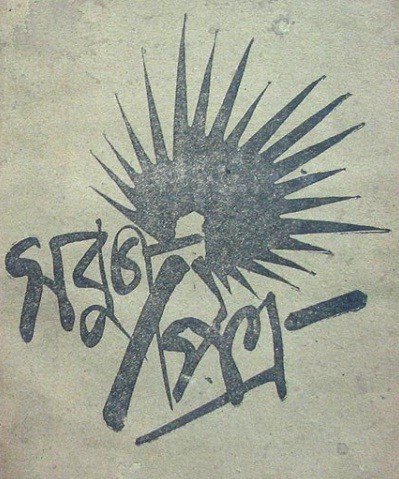
Sabuj Patra was a magazine in which Tagore published often. This is the logo designed by the eminent artist Nandalal Bose who was a close associate of Tagore. The lettering in Bengali gives the name of the journal, which translated means, Green Leaves.
SONG OF HOPE

Victory will be ours, victory will be ours, victory will be ours,
O valiant, O fearless!
Life will conquer — eternal life, the song of joy will triumph.
Love will win over anger. The enlightened will prevail.
This dusk too shall pass, shall fritter away.
O valiant, O fearless!
Awake, open your eyes, may your weariness fade away.
Let the light of hope illuminate a fresh dawn.
The song in the original Bengali had been rendered by the legendary Pankaj Mullick(1905-1978), who was impacted by Tagore and even gave the music for Diner Sheshe, Ghumer Deshe (translated as ‘The Last Boat’).
This has been translated by Mitali Chakravarty with editorial backing from Sohana Manzoor and Anasuya Bhar.
.
PLEASE NOTE: ARTICLES CAN ONLY BE REPRODUCED IN OTHER SITES WITH DUE ACKNOWLEDGEMENT TO BORDERLESS JOURNAL
Tagore’s Nobobarsha (or ‘New Showers’) celebrates the onset of rains. The poem was written in 1900 and brought out that year itself as part of Kshanika (Momentary). It can also be found in Sanchayita (An Anthology of Selected Works), his poetry collection brought out by Visva Bharati, in 1931.
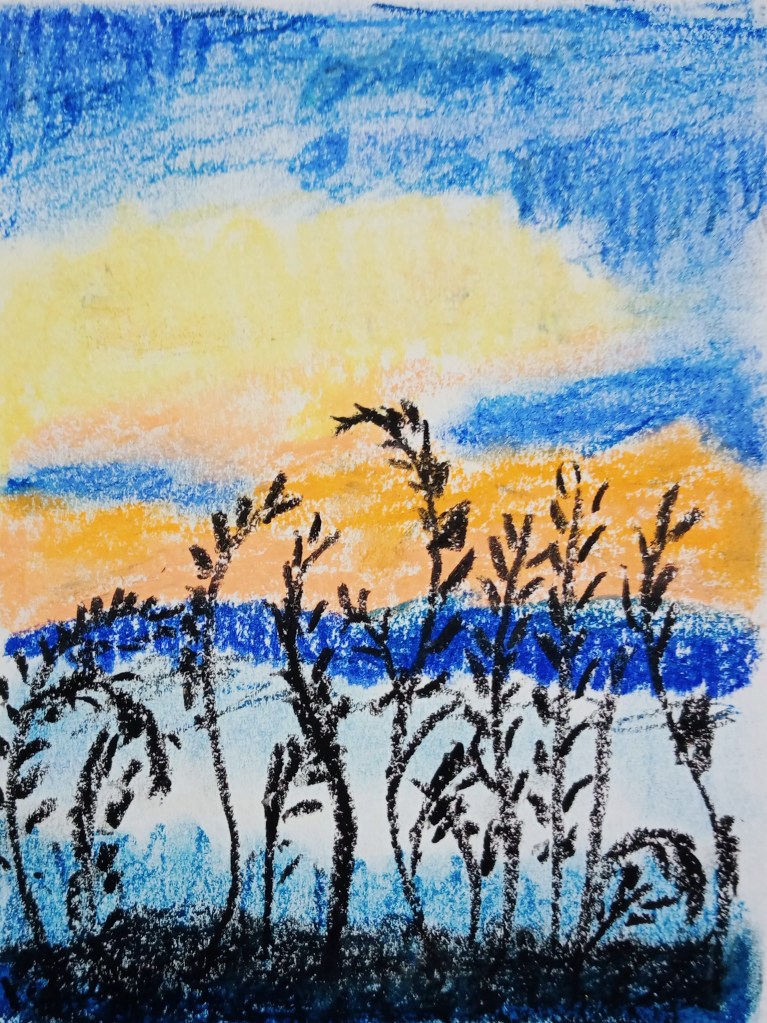
Clouds . Art by Sohana Manzoor
New Rains

My heart dances today — dances like a peacock.
Like the shimmer of its plumes,
My heart glistens with rapturous colours.
When I see the sky, my longing loses itself in euphoria.
My heart dances today — dances like a peacock.

The clouds rumble, rumble high up in the heavens.
The rain rushes in.
The new stalks of rice quiver.
Doves shiver silently in their nests, frogs croak in flooded fields,
The clouds rumble, rumble in the heavens.

I see the clouds’ tear-filled eyes lined, lined with blue kohl.
Ecstasy innervates
The grass and deep shady woods.
The floral bowers bloom with a new zest.
I see the clouds’ tear-filled eyes are lined with blue kohl.

Oh, who has untied her hair in gay abandon, in abandon on the palace's roof?
Who has covered her bosom
In blue, who has come
Back to play with slivers of lightning?
Oh, who has untied her hair in abandon on the palace's roof?

Oh, by the riverbank lined with grass, who sits in dark raiment dripping purity?
The young malati flowers wonder distractedly
As they gaze at the distant skies, where
Does the vessel float as it leaves the ghats?
Oh, by the riverbank lined with grass, who sits in dark raiment?

Oh, who swings today on the lonely swaying bakul branch, swings and sways?
The bakul flutters and falls.
An aanchal* soars to the the sky with yearning,
A lock of hair flies to cover the eyes, the karabi flower drops.
Oh, who swings today on the lonely swaying bakul branch?

In this chaos, who has moored his boat, his new boat by the riverside?
Clumps of cotton-like moss
Fill the watery banks.
The clouds sing soulful songs with tear-filled eyes.
In this chaos, who has moored his new boat by the riverside?

My heart dances today —
Dances like a peacock.
A heavy downpour falls on the new leaves,
The garden quivers with the chirrup of crickets.
The river has crossed the bank and approaches the village.
My heart dances today — dances like a peacock.

*Loose end of a Saree

(This poem has been translated by Mitali Chakravarty)
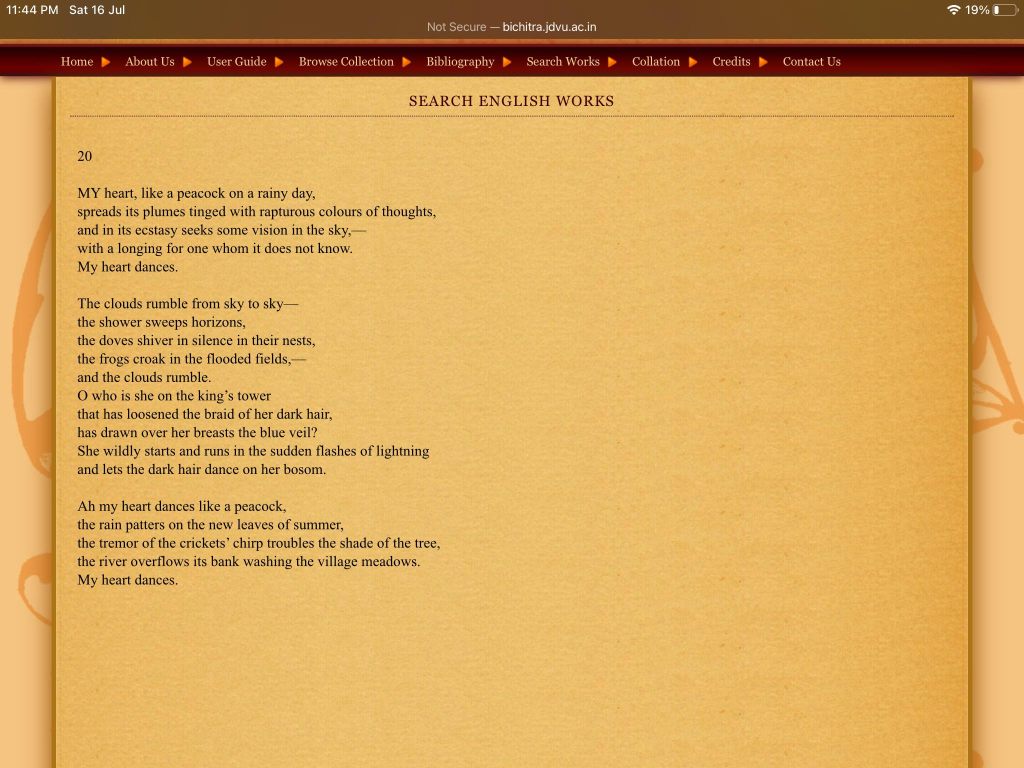
There is also an English translation [1]of the poem by Tagore. The translation is shorter and of twenty lines only as opposed to the 41 lines of the full-length poem. The poet’s translation is a part of Tagore’s Poems edited by Krishna Kripalani, Amiya Chakravarty, Nirmalchandra Chattopadhyay and Pulinbehari Sen ( Calcutta: Visva Bharati, 1942).
Screenshot of Tagore’s own translation from Bichitra Varorium by Anasuya Bhar
The poet’s own translation is sung in the original language it was written in, Bengali. Here we present the song sung by a reputed singer, Srikanto Acharya.
Thanks to Bichitra Varorium, to Anasuya Bhar for her research and editorial advise, Sohana Manzoor for her art and editorial comments. Tagore’s short translation has also been used as a resource for improving the translation of the full-length poem. The translation is by Mitali Chakravarty.
Taal Gaach or The Palmyra Tree was published as part of Shishu Bholanath (Child Bholanath) brought out in 1922. The poem has an inbuilt cadence and rhythm that flows like the sway of palmyra (commonly referred to as taal ) leaves in the breeze.
Taal Gaach, painting by Sohana Manzoor
THE PALMYRA TREE

The palmyra towers over all trees
Standing on one foot, it peeps
Into the sky.
It yearns to fly,
Piercing through dark clouds nigh
But where will it find wings?
That is why, it thinks —
Leaves circling its crown
Are wings to float around.
To soar unhindered, free,
Leaving its home, it flees.
The whole day, the foliage rustles,
Murmurs, susurrates and bustles.
The tree imagines its flight,
Drifting past stars in the sky,
Towards a destination up high.
Then the breeze stalls.
The swish of leaves halts.
When it regards the loam
As its mother, its hearth.
It loves again its home,
The nook on Earth.
(This poem has been translated for Borderless Journal by Mitali Chakravarty with editorial comments from Sohana Manzoor and Anasuya Bhar.)
.
PLEASE NOTE: ARTICLES CAN ONLY BE REPRODUCED IN OTHER SITES WITH DUE ACKNOWLEDGEMENT TO BORDERLESS JOURNAL
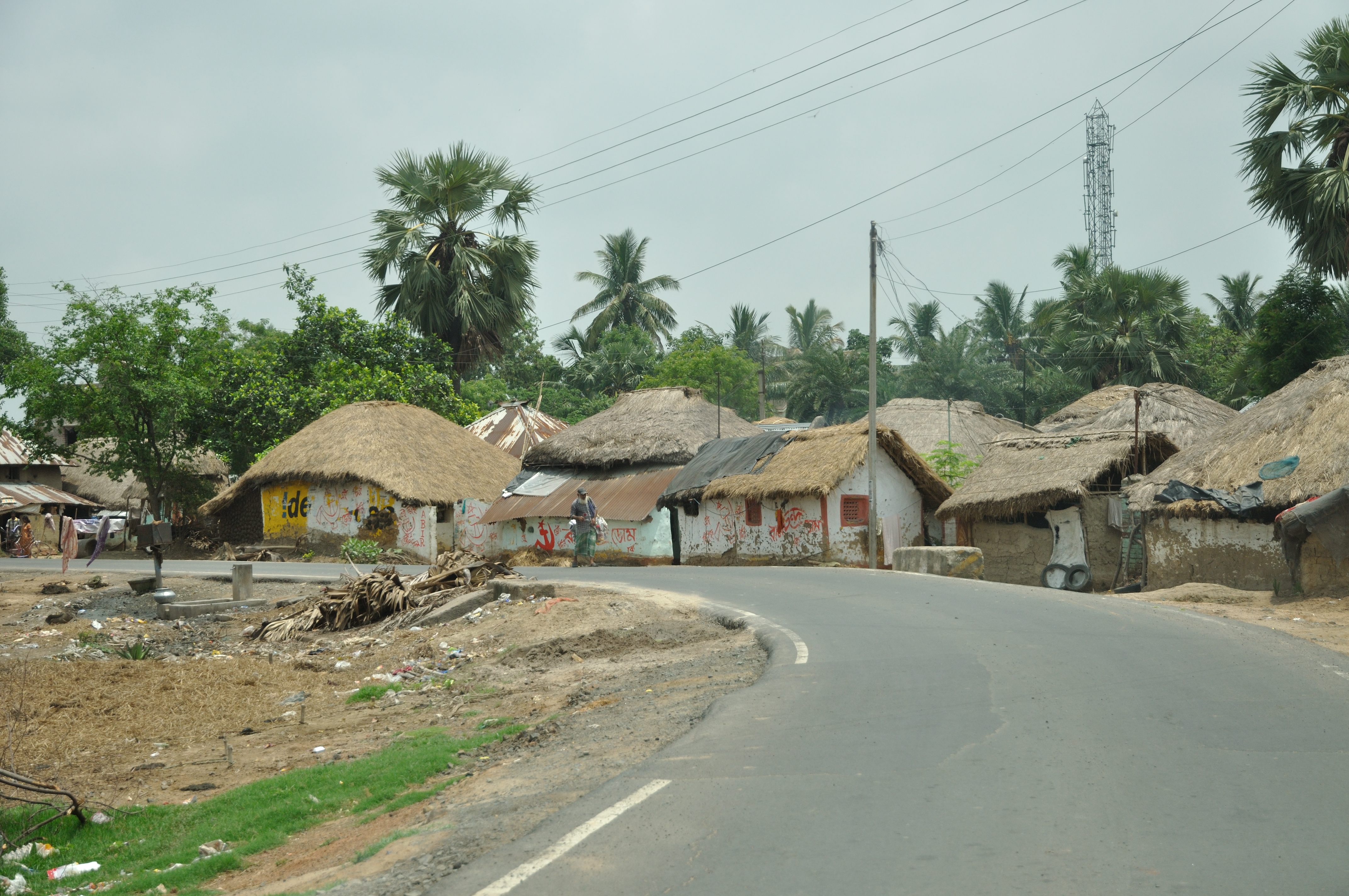
Tagore empathised with the suffering of humankind. Out of it was born Sriniketan, a project that hoped to initiate a slow merger of differences and reduce human suffering. Ebar Phirao More (Take me back) was a poem he wrote in 1894 on the plight of villagers steeped in poverty, servitude and ignorance. Tagore regarded his ‘life work’ as that of restoring the dignity and the economy of villages, deftly showcased in Professor Uma Das Gupta’s A History of Sriniketan, Rabindranath Tagore’s Pioneering work in Rural Reconstruction. Here, we present to you a transcreation/ translation of the poem.
Gateway to the Srijani Shilpagram, SriniketanSurul: A village under the Sriniketan projectCourtesy: Creative Commons
TAKE ME BACK

While the world moves busily
You play the flute, like a truant boy,
Leaning under a shady tree in a field with
The fragrance of the forest floating on
A tired breeze. O, arise — there is a fire!
Who plays the conch to awaken
The world? Whose cries resound in space?
What dark shackles imprison the orphan
Asking for support? The burden of insults
heaped on the shoulders of the helpless
sup of their blood. The self-centred

Mock unjustly. Oppressed, scared slaves
Hide in disguise. There they stand with
Heads bowed, silent — centuries of pitiful
Exploitation written on their pallid faces.
As their shoulders are plied with growing
burdens, they move slowly till their last breath—
Then, their progeny inherit generations of this load.
They are not invisible, have no memory of criticism.
They do not blame humans, nor do they have pride.
They only look for a few grains of food to survive.
When their food is snatched away, when they are
Exploited, they do not know where to go for justice.
They call out to the God of the poverty stricken, then
Die silently. These silent souls need to be given a
Voice — their suffering souls have to be roused
With hope — a clarion call has to be given —
As of now, raise your heads, unite. The person
Who you fear is more of a coward than you.
When you awake to confront him, he will flee.
When you stand up to him, he will be terrified
To retreat, like a stray dog. In God’s court,
He will have no support as swollen with
False pride, he will know only contempt
In his heart.

   Poet, come forward — if you have only life,
Then get that with you, and dedicate that today.
With immense pain, sorrow, the deprived
Suffer hardships, weakness, death and darkness.
They need food to live, light to find the breeze of freedom.
They need strength, health, a bright happy future
Courage, guts. Amidst this poverty, O poet,
Inspire a vision of trust that creates a heaven.
Imagination, I bid your colours to take me back
To the edge of civilisation. Do not distract me with
The soft breeze, the waves and alluring illusions.
Do not let me stay steeped in lonely depression
In the shade of a bower. Day ends. Dusk sets in.
The direction is lost in darkness. The woods
Cry In hopeless despair. I step out
To be under the open skies, on the grey road that
Leads to the common man. Where do you go?
O traveler, I do not know you. Turn and look at me.
Tell me your name. Do not distrust me.
I have lived alone in this strange world
For many days and nights. That is why my
Garb is amazing. I am different — my eyes
Dream, my heart is hungry. When I returned to this world,
Why did you, o mother, give me this playful flute?
Over long days and long nights, mesmerised by
My own tunes, I have wandered far from the
Limitations imposed by civilisation. If the tunes that
I have learnt can inspire with exultation the
Music-less exhausted, if even for a moment, my
Music can instil life—giving hope in the lives of the
Hapless, if touched by the manna from heaven
they voice their sadness, the sleeping thirst is
Roused from deep within — then my song will be
Blessed, my dissatisfaction appeased to find nirvana.

What is sung or heard? Happiness are lies.
Sorrows are lies. A self-centred individual
has not learnt to live in a larger world.
With Truth as the guiding star, run fearlessly,
Dancing in unison with the waves of cosmic life.
There is no fear of death. The tears of poverty
Will rain on my head — in the midst of that,
I will go for a tryst with the person to whom
I dedicate my life forever. Who is that? I do not know —
I only know this— that he is the wayfarer through ages
Trudging in the darkness of the the night, amidst
Thunder and lightening, carrying a flickering lamp.
I only know he has heard the invocation and fearlessly
Come to help the needy, rejecting civilisation’s dictates,
He has embraced the cries of the tortured to his heart
Like a favourite tune. Burnt by flames,
Pierced by spears, pieced by an axe, he has
Gathered all his belongings and
Sacrificed all his desires through his life —
He has shredded his heart as an offering
With devotion for the repayment of his birth.
He has given up his life to serve the masses.
Influenced by him, the prince wears rags,
Disgusted with his wealth, akin to a beggar.
The great soul tolerates all tortures and derisions.
The intellectuals sneer in disbelief.
Loved ones mock at him. Close acquaintances are
Contemptuous while he silently forgives them all
with his merciful eyes. He is incomparable and

Beautiful. For him, the proud have forsaken
Their pride, the rich their wealth, the brave
Their lives. For his ideals, the poet has written
Poetry and spread it across the globe. I know
Praise for him is whispered by the breeze,
The seas. Paeans sung by dear ones soar
Across the land and the vibrant blue skies
To celebrate his victory, perfection, love
And kindness. I just know that he will
Sacrifice his own petty needs for the love of
Humankind. He will transcend all insults.
He will stand with his progressive head held high.
Fearlessness is inscribed across his forehead.
The dust of slavery has not contaminated him.
Internalise him. Move forward alone
On the thorny path of life, wipe away precious
Tears, face sorrows with patience,
Work relentlessly to please. When weary,
Worn with exhaustion at the end of the long
Journey of life, there will be an abode of
Peace and contentment. The celestial will
Smile and garland the devotee. At this abode,
There will be peace, relief from all grief,
All misfortune. Tears will cleanse all
Past anguishes. Embroidering hope,
Plead for mercy for life’s disabilities.
Maybe, the despondencies will dwindle and
Eternal love will quench life’s thirsts for ever.
(The poem has been translated for Borderless Journal by Mitali Chakravarty with editorial comments from Anasuya Bhar.)
.
PLEASE NOTE: ARTICLES CAN ONLY BE REPRODUCED IN OTHER SITES WITH DUE ACKNOWLEDGEMENT TO BORDERLESS JOURNAL
And as imagination bodies forth
The forms of things unknown, the poet's pen
Turns them to shapes and gives to airy nothing
A local habitation and a name.

-- Midsummer Night's Dream (premiered 1605)by William Shakespeare
Imagine… if words could weave a world in harmony! Perhaps… then as Shakespeare declared and more recently John Lennon wrote in his song ‘Imagine’ (1971), we might have constructed a new world…
In hope of the same perhaps, Nazrul had published his poem, ‘Bidrohi‘ or the rebel a hundred years ago, a few months before TS Eliot published Wasteland, again a poem raising humane concerns and reinforcing values post the First World War. More recently Akbar Barakzai who has passed on at the start of this month, wrote about a better world in his poem, ‘We are all Human‘. And yet we have a war …
In response to the war, we have modern voices that ring out in harmony, including the voice of a Ukranian refugee. In reaffirmation of a world that can transcend divisions created by human constructs and soar in a virtual world, we also present to you interviews of half-a-dozen poets.
From the Treasury
Rebel or ‘Bidrohi’: Nazrul’s signature poem from 1922, ‘Bidrohi‘, translated by Professor Fakrul Alam. Click here to read.
A Special Tribute
We are All Humanby Akbar Barkzai, translated by Fazal Baloch, has been published as not only a tribute to the poet who left us forever on 7/3/2022, but also as his paean to humanity to rise about differences which lead to war and horror, to unite us as one humankind. Clickhere to read.
War, Peace and Poetry
Poetry from across the world in support of peace and voicing concerns over the humanitarian crisis in Ukraine, we have Ukranian Lesya Bakun give us poetry as a war victim, a refugee. Rhys Hughes, Ron Pickett, Michael R Burch, Kirpal Singh, Malachi Edwin Vethamani, Suzanne Kamata, Mini Babu, Sybil Pretious and Mitali Chakravarty have contributed poetry written for the Ukraine crisis. Click here to read.
Poets across Borders
Half-a-dozen poets from different continents tell us about their poetry. The poets include Ryan Quinn Flanagan, George Freek, Luis Cuauhtémoc Berriozabal, Ihlwha Choi, Sutputra Radheye, Anusuya Bhar. Click here to read.
We surfed virtually around the globe to gather half-a-dozen poets for the lovely lines they write to ask them what makes them write as such. We start from the top of the cold frozen north to travel down to warmer climes where birds and bees have started singing tunes of a vibrant spring. Meet some of the moderns who contribute towards a world undivided by manmade constructs...
Ryan Quinn Flanagan is a Canadian-born author residing in Elliot Lake, Ontario, Canada with his wife and many bears that rifle through his garbage. His work can be found both in print and online. He is truly prolific and his poetry endears as you read it repeatedly. Click here to read a poem by him.
Why do you write poetry?
Writing, particularly the physical mechanism, has always been something I enjoyed. It is a solitary act that I derive great enjoyment from. To be able to sit down and create something seems a wonderful thing to me, regardless of medium. I love fine art as you know, but cannot paint. Writing is my music, my form of painting I guess. It is a great release as well. To be able to create and express as I wish is the ultimate freedom.
What is your poetic process?
I may have a few rough notes and ideas/titles, but nothing really fleshed out. I get up and never shower on a writing day. I don’t know why, but it seems to get me in the right head space. Then I listen to the same music and eat the same thing I have for years. For writing days, that is oatmeal. Then I head upstairs and sit down to write with some wine. I tend to put on some classical music so that my voice is the only one, but I can still zone out to the musicality of what is playing. I tend to do that for about six hours at a time. That is the same writing process I have followed for years now.
Do you believe in inspiration and the Muse? Or is it the sweat of your brow alone?
I most definitely believe in inspiration and the Muse. That is why I repeat the same processes, to put myself in the right inspirational mood or be ready for the Muse or whatever you wish to call it. I believe that things are created in a certain time and space and once created, belong to that specific time and space. You can never really return to that exact place, but you can look back on it through the work for sure. Other things are then created in a whole other head space and the process continues. Sweat of the brow or hard work is also important though, not only in creation but in submissions, building and assembling, as well as editing books. There is a lot of work that goes into everything, so hard work must be there to compliment any inspiration that may come.
Do you think what can be said in poetry can be said in prose too?
I think so. I don’t really differentiate between poetry and prose that much. It’s all a voice and time and expression to me, so whatever way it chooses to come out is not overly importance to me. For me, it is much more to get it out instead of caring much about how or why. And to enjoy the mechanism while doing so.
George Freek is a poet and playwright living in Illinois. His poetry and plays have been widely published. His plays have been performed by the Milwaukee Repertory Theatre, the Changing Scene in Denver, and the Organic Theatre in Chicago, among others. He has also received grants from the Illinois Arts Council and The National Endowment for the Arts. His poetry is modelled often after Chinese poets of the Tang and Song dynasty. Click here to read his poem.
Why do you write poetry?
I write poetry because it’s the form that best suits my thoughts and feelings.
What is your poetic process?
The process begins with the need to express an emotion. Then it’s work to find the appropriate “objective correlative” in T.S. Eliot’s words.
Do you believe in inspiration and the Muse? Or is it the sweat of your brow alone?
I don’t necessarily believe in “Inspiration” unless that means simply the initial urge to express the emotion or the thought. After that it’s mostly work to make it sound right and unpretentious and yet avoid banality.
Do you think what can be said in poetry can be said in prose as well?
I think my response to your last question is included in my first statement. If something can be expressed in prose, it’s not poetry, although there is some prose which has the quality of poetry, e.g. Joseph Conrad!
Luis Cuauhtémoc Berriozabal is a Mexican-born author, who resides in California and works in the mental health field in Los Angeles. He is prolific and often his poetry shuttles is enriched by his ability to assimilate varied cultures into one lore. Click here to read his poetry.
Why do I write poetry?
I write poetry because I like to read it. In the many years I have been reading poetry, I continue to find new writers, some no longer in this world. These writers have influenced my work over the years. I write poetry because I enjoy writing it. Sometimes I write personal poetry. It is a sort of catharsis. It is a way describing how I am feeling about myself, about others, and about the world. Sometimes I write nonsense and rubbish, which I try to keep away from readers.
What is your poetic process?
My poetic process is writing one poem a day. It is really that simple for me. It could be a three liner, a ten liner, or a long poem of more than 20 to 30 lines. If a poem comes out like rubbish or a journal entry, I try my best to come up with something better the next time around. There are times I get lucky, and a keeper comes along. I am not writing to impress anyone. I am writing for myself most of all and I share my words with readers. If some like what I have written, then that makes me feel good. If someone hates what I have written, I could not care less. I will not lose any sleep over it. I will continue to write as long as I have breath or until something else comes along that takes up my interest.
Do you believe in inspiration and the Muse? Or is it the sweat of your brow alone?
I do believe in inspiration and the Muse. I am inspired by everything and everyone I come in contact with: nature, night and day, moon and sun, the stars and the rain; the woman I love and the dreams that come along, some haunting and some sublime. I am inspired by the poetry, art, lyrics, and music of others. I am inspired by the news of the world, by the clients I work with in mental health, and those close to me that care for me (my family and friends). I am influenced by the birds in flight, the landscape of Los Angeles, trees, flowers, and animals. The sweat of my brow alone only comes into play when you consider everything else that provides knowledge to one’s mind. Whether clever or strange, imagination is also a great thing to have.
Do you think what can be said in poetry can be said in prose as well?
While poetry is brief and concise as opposed to prose, what can be said in poetry can also be said in prose. Authors writing prose can be poetic in their words and have been throughout the years. If I had more patience, I would give prose a try one day. I am more comfortable in poetry, where I can express something in a few words. Get in, write it, and get it out.
Ihlwha Choi is a South Korean poet. He has published multiple poetry collections and what is most interesting is that he translates his own Korean poetry to English to reach out to the world. Click here to read his poetry.
Why do you write poetry?
I grew up in the countryside. Most of the people at that time were poor agriculturists. I was accustomed to the lifestyle of a farmer. I couldn’t access musical instruments or painting equipment. I naturally expressed my thoughts and feeling with my pencils on the notebook. During my middle school, I fell in love with a popular girl. She was popular because she received a poetry award. I fell in love with her, but my love was unrequited. I was very disappointed, so I began to write something on the paper. Most of them were poems but I have never learned the method of poetry writing. There were no teachers around me who taught me about poetry. I tried hard to write good poetry but always failed. After that period, I was very busy studying for university entrance exam and military service. In our country, all young men must go to the army or navy or air force. I served as a sergeant in the army for three years. Then, I had another problem of earning a living and marriage. My passion for writing poetry revived after I married. I don’t think that I had been born with lot of poetic talent. I don’t want to be famous but try hard to write better poetry for my own satisfaction.
What is your poetic process?
Usually, I do not sit in front of the desk to write a poetry. When I brush my teeth, wash dishes or read, one line of a poem comes to me and I catch it in my memory or on the memo of cell phone. I call it the seed of poetry. Later, when I sit in front of my personal computer, I write a poem based on that line. Sometimes I write a poem very quickly because of the first line and sometimes it is a longer process.
Do you believe in inspiration and the Muse? Or is it the sweat of your brow alone?
I think both sides are necessary. Inspiration gives the poet pleasure and happiness. But if he does not try hard, he will not be able to write poetry.
Do you think what can be said in poetry can be said in prose too?
Yes, what we say in a poetry can be said in prose. The only difference is the form of expression. One poet said that when you want to know if a poem is good or not, it is necessary to rewrite it in prose. Some poems are so difficult to understand that ordinary reader cannot grasp it. When a poetry can be explained meaningfully into prose they are recognised as good poetry. But every prose cannot be changed into poetry. Poetry needs symbol, metaphor, rhythm, simile, compression etc. Though nowadays a poems are sometimes written like a prose without any stanza or poetic line. There should at least be some rhythm to make it into a poem, even though it is written like a prose.
Sutputra Radheye is a poet from India. He has published two poetry collections — Worshipping Bodies (Notion Press) and Inqalaab on the Walls (Delhi Poetry Slam). His works are reflective of the society he lives in and tries to capture the marginalised side of the story. Click here to read his poetry.
Why do you write poetry?
I write poetry because it gives me a voice. For me, it is a personal and intimate affair. In poems, I can be naked. I can roam naked on the streets of my mind without pretending. I can be blunt, and raw without filtering myself. I feel safe in my poetry and so I write.
What is your poetic process?
There is no such process for me. I write when I feel something. I write when I am angry. I write when I am happy (though this only happens sometimes). I write when I am depressed and pessimistic. I write to unleash my demons on paper so that I don’t need to carry them to bed with me. It is more like a release for me. Sometimes, I find it to be metaphysical where you can just leave everything behind once you write it down. But not always. The process keeps changing. I used to listen to music while writing two years back. Now, I don’t. What has remained constant is this burst of raw feelings.
Do you believe in inspiration and the Muse? Or is it the sweat of your brow alone?
Yes. I believe in inspiration and muse. As human beings with different tastes or choices, we will get intrigued by different things in life and they somehow become a part of our poetry. It is those things that separates our poetry, I believe.
Do you think what can be said in poetry can be said in prose too?
Yes it can be said in prose too. But, the way it will be said will be different. It will lose certain elements that poetry brings but will gain what prose has to offer.
Anasuya Bhar is an academic teaching English literature in St. Paul’s Cathedral Mission College, Kolkata, India. She would also want to be known as a poet. She writes lovely essays and has written on eminent voices like Tagore and Satyajit Ray. Click here to savour her poetry.
Why do you write poetry?
I write poetry merely to unburden. In many ways, poetry is also therapeutic for me. The motive impulse for my poetry is mostly a moment of pain and sorrow. I feel that the best way to come to terms with such moments is to weave words around them in comfort, camaraderie and friendship. My poetry usually concentrates on the self and its many experiences, moods and flavours.
What is your poetic process?
Most commonly, poetry comes to me in a whiff of words, pluri-significant and usually in a gust, like a burst of fresh air, triggered by memory. I also often get excited by particular and occasional colours, shades of light, and even smells, because they bring with them a certain cosiness, which is both intimate and personal. It is only in moments of calm and silence, when my mind usually processes these sudden words into some kind of meaning, trying to give concrete forms to fleeting bouts of impressions. My poems are usually ready after one, or two revisions, but they do need tending and pruning.
Do you believe in inspiration and the Muse? Or is it the sweat of your brow alone?
Yes, I do believe in inspiration and the concept of the Muse. My poetry is imbued with a feminine presence – that of warmth, care, nurture, protection and sometimes even passion. Such a presence has sometimes found embodiment but, almost always remains elusive and a figment of my imagination, unseen but, powerfully felt. This has always remained with me; it is only now that it has compelled me to express myself in words and through poetry. My muse is a picture of beauty and charm and sometimes even of spirituality.
Do you think what can be said in poetry can be said in prose too?
Yes, at times, perhaps. But poetry is metaphorical, and one can suppress as well as express oneself in it. Prose might prove to be more probing at times. I feel that there are subtle differences between prose and poetry, even though prose can be poetic and philosophical.
We are grateful to all the poets for sharing with us their personal journeys.
The poets have been interviewed online by Mitali Chakravarty.
PLEASE NOTE: ARTICLES CAN ONLY BE REPRODUCED IN OTHER SITES WITH DUE ACKNOWLEDGEMENT TO BORDERLESS JOURNAL.
In ‘When will we ever learn? Oh, will we ever learn?’, Ratnottama Sengupta,comments on the current situation in Ukraine while dwelling on her memorable meeting with folk legend Pete Seeger, a pacifist, who wrote ‘Where have all the Flowers gone’, based on a folk song from Ukraine. Click here to read.
In Can Peace come Dropping by…,Candice Louisa Daquin explores war and peace pausing over the attack on Ukraine. Click hereto read.
Munir Momin’s You & I translated from Balochi by Fazal Baloch. Clickhere to read.
Down the stairs by Nabendu Ghosh, a gripping story exploring the greyer areas of ethical dilemmas, has been translated by Sarmishta Mukhopadhyay with editorial input from Ratnottama Sengupta. Click here to read.
Autumn is Long, a poem written in Korean and translated to English by Ihlwha Choi. Click here to read.
Tagore’s Anondodhara Bohichche Bhubone (The Universe reverberates with celestial ecstasy)…translated from Bengali by Mitali Chakravarty. Click here to read.
Pandies’ Corner
These narratives are written by youngsters from the Nithari village who transcended childhood trauma and deprivation. A letter to Godby Tanveer Hussain uses the epistolary technique to asks questions that would be relevant for all humankind. It has been translated from Hindustani by Vritika Thareja. Click here to read.
Erwin Coombs takes us through his life in Egypt and has a relook at Nazi occupied Europe with a dollop of humour to come to an amazing conclusion. Click here to read.
At Home Across Continents : In Conversation with Neeman Sobhan, a Bangladeshi-born writer who writes of her experiences as an expat in Pakistan, Bangladesh, Italy and America. Click here to read.
Meenakshi Malhotra ponders at the exclusivity that reinforces divisions, margins and borders that continue to plague humankind, against the backdrop of the Women’s Month, March. Click here to read.
Only when the cries of the wretched of the earth will stop renting the skies,
Only when the oppressor’s bloody sword will cease smearing battlefields,
			A rebel, weary of war,
			Only then I won’t stir.
…
I’m the ever-rebellious hero--
	Soaring over the world, all alone, head forever held high!

--  Rebel or 'Bidrohi' (1922) by Nazrul, translated by Fakrul Alam
Borderless: Digital Art by Ayaan Ghoshal
These fragments I have shored against my ruins
…
Datta. Dayadhvam. Damyata.
 Shantih shantih shantih

-- Wasteland (1922) by TS Eliot
These lines reiterate values we would do well to live by in a war-torn, dissension-worn world where the need for a rebel to recreate a humane society that lives with values such as peace, generosity, acceptance, tolerance, compassion and restraint — is a felt need. The two great poems made history by remaining as popular a hundred years after they were written — ‘The Rebel’ by Nazrul and TS Eliot’s ‘Wasteland’. Nazrul defined a rebel as an iconoclast who breaks norms to find peace, justice and love for all, to move towards the creation of an ideal world. TS Eliot quoted from the Upanishads and ended with redemption coming with giving (giver perhaps denoted generosity), compassion and restraint. Despite the wisdom of these great poets and seers, war still continues a reality. The values remain neglected not just in as we see in conflicts, like the one in Ukraine that destroys lives, property and nature with intolerance towards differences, but also in our personal lives. Tagore also reiterated the same need for stepping out of personal, social, economic and political insularity. We carry a translation of a song that echoed this need while inviting participation in his ecstasy. He wrote:
Why do you sit in isolation,
Dwelling on self-centred issues?
Tagore had not only written of the negative impact of isolation from the world but he led by example, building institutions that could lead the world towards pacifism with acceptance of diversity and inclusiveness. Sriniketan and Santiniketan were created to move towards these ideals. Many of the people he influenced or who studied in Santiniketan made history, like Prime Minister Indira Gandhi, Satyajit Ray; many added to the sense of inclusiveness, like Mahasweta Devi, who other than her enormous work to integrate different cultures, also wrote a memoir about Santiniketan in Bengali. Radha Chakravarty, nominated for the Crossword Translation Award (2004) for In the Name of the Mother by Mahasweta Devi, has translated this memoir, a narrative which brings us close to Tagore’s ideals of the whole world being a family. How wonderful it would be if the world were open to such ideals and would behave like a global family and not go to war! Mahasweta Devi, Our Santiniketan, which has been reviewed by Meenakshi Malhotra, reiterates Tagore’s vision of a planet living in harmony with the flora and fauna.
Bhaskar Parichha has reviewed another non-fiction by Ashok Kumar Pandey, Why They Killed Gandhi; Unmasking the Ideology and the Conspiracy. Parichha writes: “The finest point about this book is its storytelling…” The book review brings to mind in the midst of a war and violence that Gandhi had tried to erase this mindless destruction of lives, nature and cities with Ahimsa or non-violence. Will we ever rise up to it? Perhaps… We see strains of recognising the negative impact of insular outlook in writings like that of Temsula Ao, a Sahitya Akademi Award winner, according to Indrashish Banerjee who has reviewed her new book,The Tombstone in My Garden: Stories from Nagaland. Keith Lyons has reviewed Asian Anthology: New Writing Vol. 1: Stories by Writers from Around the World, edited by Ivy Ngeow, an exotic medley of Asian stories, one of which has been excerpted as well.
We are privileged to carry another excerpt from Ruskin Bond’s Friends in Wild Places: Birds, Beasts and Other Companions, a hilarious story about a pet tiger adopted by the legendary writer’s grandfather. What is amazing about Ruskin Bond’s writing is the love and compassions for all creatures great and small that colours the tongue-in-cheek humour he rolls out to his readers. If only we could think like Bond, there would be no wars. His writing, I feel, transcends political borders or ‘isms’, and laces with love and compassion tales of menageries of monkeys, snakes, mongoose, humans of different denominations. This excerpt is a treat we are giving Borderless Journal as the journal completes two years of its existence. We are truly grateful to Speaking Tiger for sharing this excerpt with us. But our celebrations this time are sombre as the war rages with incoherence accompanied by heart-breaking ravages.
The refrain from Ukraine has been taken up by Ratnottama Sengupta as she takes us through the past and present experiences of the devastated country, bringing in the views of the legendary folk singer and pacifist, Pete Seeger (1919-2014), who she had interviewed over a span of four days. The writer of ‘Where have all the Flowers Gone?’, a song based on an Ukrainian folk song, Seeger said, “The point is not to ask for yourself alone — one has to ask for everybody: Either we all are going to make it over the rainbow or nobody is going to make it.” Candice Louisa Daquin has also pondered on the justification of war, contextualising it with the current one along with her essay on the paradox of modern linguistic communication.
We have an exhaustive essay on the legendary Satyajit Ray’s creations by Anasuya Bhar. Malhotra has pondered at exclusivity reinforcing divisions, margins and borders to plague humankind, against the backdrop of the Women’s Month, March. Highlighting women in writing, we have interviewed two female writers, one from Nepal and another from Bangladesh. Sangita Swechcha lives in UK but her writing, till now largely in Nepali, often pines for her home embedded in the Himalayas whereas, an expat, Neeman Sobhan, shuttles between Bangladesh and Italy with the affluence and assurance of a privileged background.
Finding a way to override lack of privileges, deprivation and violence, are the youngsters of Nithari on the outskirts of Delhi where less than two decades ago other than poverty, savage criminality devastated the local populace. These youngsters transcended the suffering over time with help from volunteering NGOs to create narratives that amaze with their inventiveness and confidence. Tanveer Hussain from Nithari, self-motivated and self-made from a young age, asks questions that would be relevant for all humankind in a letter to God. It has been translated from Hindustani by Vritika Thareja of pandies’. This edition’s translations include Professor Fakrul Alam’s mellifluous rendition of Jibanananda Das’s poetry from Bengali to English, Ihlwha Choi’s Korean poetry and a Balochi poem by Munir Momin rendered in English by Fazal Baloch. Baloch had earlier translated poems by Akbar Barakzai, a great poet who departed on 7th March, depriving the world of yet another powerful writer who imbibed hope of a better future in his poetry. We are privileged to have hosted the translations of some of his poems and his last interview.
Another well-known poetic voice from Singapore, Kirpal Singh, has given us poignant poetry that can be applied to the situation that is leading to the wreck of Ukraine. Anasuya Bhar has poetry, one of which despite being in the ilk of Nazrul’s great poem, ‘Rebel or Bidrohi’, questions gently mainly social constructs that obstruct the flow of harmony. Ryan Quinn Flanagan has pondered on the acceptance of a changed world. We have humour from Rhys Hughes in poetry and wonderful poems by Michael R Burch on spring. Jay Nicholls shares the last of her dozen Pirate poems as Blacktarn sails the lemon seas to fight pollution. Luis Cuauhtémoc Berriozábal, George Freek, Sutputra Radheye, Mike Smith, Shaza Khan and many more have contributed a wealth of beautiful lines. Penny Wilkes has captured storms and seas with photographs and text and Rhys has surprised us with some strange, bizarre tales in his column.
Suzanne Kamata continues writing on Japan as she introduces us to an Australian film maker who is making films in Japan and in Japanese, called Felicity Tillack. Cultures are perhaps truly crossing borders as we can see Kenny Peavy, an environmentalist who moved from US to Indonesia start a new column with us called ‘Mission Earth’. We hope, like Tagore or Rousseau, he will help to revive our felt need to live with nature, acknowledge the nurture that we get from the planet to live in harmony with it and on it.
At the end of twenty-four months of existence – that sounds better than a mere two years— we are happy to host a melange of writers from across the borders and be the meeting grounds of writers and readers from across continents. I am truly thankful to all of you for helping concretise an ideal. Huge thanks to all the writers, artists, photographers and the readers for the contribution of their time, effort and love. And thanks to our fabulous team who continue to support the journal unwaveringly. I would also like to thank Sohana for the lovely visuals she generously shares with us. A special thanks also to young Ayaan Ghoshal for his digital art where hands reach out to support a truly borderless world.
As usual, all the content has not been covered here, I invite you all to enjoy our March edition of Borderless Journal.
At the start of the third year of our existence, let us march onwards towards renewed hope – maybe the Ukraine experience will take us closer to a war-free world with an awakening of a felt need for peace and compassion in a planet without borders.
In quest of a peaceful, humane world, I invite you all to continue being part of this journey.
The Universe reverberates with celestial ecstasy

The Universe reverberates with celestial ecstasy.
Days and nights overflow with ambrosia in the limitless sky.
The moon revels sipping nectar from her cupped palms—
The eternal light that never fades shimmers forever—
Illuminating our daily lives with its aura.

Why do you sit in isolation,
Dwelling on self-centred issues?
Look around you and expand your heart.
Petty sorrows are insignificant.
Fill your vacant life with love for humanity.
The Universe reverberates with celestial ecstasy.
These lyrics seem to capture not just the distance between Tagore’s own ecstatic experience of the natural universe and the self-centred pettiness that afflict those who continue to remain disconnected from the poet’s euphoria but also his attempts to help humanity discover the same joyful reverberations. Such emotions seem to find an echo in his letters later as found in Uma Dasgupta’s A History of Sriniketan. In 1915, Tagore wrote to an estate worker who was part of his work at Sriniketan (a project to upgrade villages): “I have something else to urge upon you. A note of joy has to be sounded in all your work. Village life has become very dull. The dryness of the heart has to be banished. All welfare work ought to be turned as far as possible into an occasion of festive joy.” Is he doing just that in this song?
Here we present the song beautifully rendered by the legendary singer who was groomed in Tagore’s school at Santiniketan, Kanika Bandopadhyay during his times. Kanika Bandopadhyay was a contemporary of Mahasweta Devi who wrote of her as Mohor in her memoir on Santiniketan (translated by Radha Chakravarty) where she explained the ambience that existed, “But during my time in Santiniketan, how forceful was the torrent of energy that flowed from the source the river of creativity descending from the snowcapped mountain peak!”
(The song has been translated for Borderless Journal by Mitali Chakravarty, edited by Anasuya Bhar. Tagore’s words used here have been translated by Uma Dasgupta in A History of Sriniketan (2022) and Mahasweta Devi’s by Radha Chakravarty in Mahasweta Devi, Our Santiniketan (2022) )
.
PLEASE NOTE: ARTICLES CAN ONLY BE REPRODUCED IN OTHER SITES WITH DUE ACKNOWLEDGEMENT TO BORDERLESS JOURNAL
DUSK
The line of dusk makes itself visible
Not in orangish yellow, but in sullen grey,
And confused white –
I yearn towards my tea,
Sip in its golden warmth,
Feel it surging down my parched throat
Along the cold tissues.
It wizens me --
Making me quietly aware
Of all the days gone by
And how slowly my own sun
Has passed its noon
And is veering towards its dusky route,
Mostly in grey abandon –

CODES
There are codes
Unsaid arrangements
Making you act, talk and move
In a pattern specific
Rendering facile, redundant, peripheral
The presence of the other,
Called the outsider,
Who seems to intrude
Into your closed circles
Of intimacy or conspiracy.
It is the codes
That determine loyalty and staying –
Beyond which, there is hardly any saying

DISCOVERY
Again and again
Into the cesspool
Of confusion, desire and hurt,
Of misgivings and disbeliefs too,
Sinks the sad heart –
Until one discovers how
The deliverer is the destroyer.
Again and again
One realises
The slips so made and,
In the clarity
One perceives
The dynamics of play.
Dr. Anasuya Bhar is an academic teaching English literature in St. Paul’s Cathedral Mission College, Kolkata, India. She would also want to be known as a poet.
.
PLEASE NOTE: ARTICLES CAN ONLY BE REPRODUCED IN OTHER SITES WITH DUE ACKNOWLEDGEMENT TO BORDERLESS JOURNAL











 Borderless