Categories
Stories

The Call


By Nirmala Pillai

The street lay wet and shimmering after the afternoon rains. I stood at the window sipping tea, enjoying the cool breeze  for a moment entranced by the glitter of the raindrops falling off the potted plants, on window sills and ledges, down electric poles and wires by the street crossings where crows and pigeons preened and shivered like musical notes. In the sudden burst of sun warmed air,  the rainbow hued petrol drips trembled in the puddles. It was a single moment  of evanescence and peace, as in Robert Browning’s poem,‘Pippa Passes’ in ‘God’s in his Heaven/All’s right with the world!’

The mood gave way when I suddenly noticed the gait of a woman on the street. She turned into the street  bent down with the weight of the bags on her shoulders and trudged slowly with the open black umbrella even though the rains had stopped.  I  could not see  her face but I recognised her.

Staring at her, my heart thumped  with sudden anxiety as I turned away  and tried to quell the panic inside  me. I knew her. I had seen her since my childhood  following the same set routine as a young woman. Now as an old lady without changing her daily habit  for more than fifty years, she continued  doing the same thing, a creature of habit. 

I felt the need to sit down. On the way to the sofa the ornamental mirror on the wall caught my reflection. 

I could not stop staring at it  in fear and fascination. That person was me now. Where had I gone? Alone with myself ! Age! Time! The sinuous whisper of crawling fear made me tremble.  Age is just a number! I am as young as I feel — love  is ageless. 

All those self-assertions were hopeless. I could feel the sweat break out of my pores. 

I sat down and gripped the poetry book I had been reading. He had insisted I read it when he gave it as a surprise gift — a good friend and colleague who had kept in touch. Why did he still remain kind and nice. Was he like or unlike others with whom I had been on good terms? Did he expect anything from me. Have I missed the signals all my life?

I  was now a middle-aged single woman and fear gripped me as the thought that sprung to my mind was, I would also end up like her. My calm was tattered to pieces, fluttering away in confusion. I was caught in a whirl of emotions and thoughts. Why did she disturb me so much?

I had definitely traversed a very different path  from her. There were no parallels in our lives. But now at this moment, suddenly when I was enjoying my ‘me’ time,  the splintering truth struck out of the blue. I am alone. The sprawling  apartment spoke of comfort,  care and luxury with a live-in maid, with all the gizmos and art and cultural ambience of a successful life and career, a single woman could achieve; I suddenly felt like a cipher. Raw, exposed and empty. Why did I feel like that? 

The demon called loneliness mocked my aloneness. It had no shape or size or smell. It was like a vapour, like air that sometimes crept silently or jumped up terrorising my very breath. Those moments of sheer emptiness and choking sensations that I had thought were over, seized me again.

Who are you.? What have you achieved. Have you made any one happy? Does anyone wait for you, ask about you ? Such were the dark numbing thoughts that gathered inside me and gave way to spontaneous outflow of tears. My sighs cradled unknown sorrows I could not fathom. Melancholy and depressed, moody and restless all the shine was tarnished and  lost meaning. I thought I was beyond it and a very stable person. But I knew now that I was deluding myself. 

My eyes fell on the page I had been reading, Andrew Marvell’s poem ‘To His Coy Mistress’.

Had we but world enough and time, 
This coyness, lady, were no crime. 
We would sit down, and think which way 
To walk, and pass our long love’s day. 
Thou by the Indian Ganges’ side 
Shouldst rubies find; I by the tide 
Of Humber would complain. I would 
Love you ten years before the flood, 
And you should, if you please, refuse 
Till the conversion of the Jews. 
My vegetable love should grow 
Vaster than empires and more slow; 
An hundred years should go to praise 
Thine eyes, and on thy forehead gaze; 
Two hundred to adore each breast, 
But thirty thousand to the rest; 
An age at least to every part, 
And the last age should show your heart. 

Am I lonely? Am I old ? Why am I still single?  The looping thoughts suffocated me in its coils.

The naked bulbs of truth has a harsh way to call attention in the most make-believe moment of tranquillity. The mirror held me  in its snare but it did not crack my  image — vanity, pride, self-delusions shatter inside me.

I look at the degrees framed on the wall;  the decorative pieces brought from the different countries  during my world-wide travels, and wander into a mental fog . 

What use are these papers  to me now? In my loneliness, do I crave aloneness? However high I go, I must come down to earth among people, to get applause;  hear it, share it to have meaning.

My mind was filled with her image. I knew  without looking  she would stop under the old banyan tree, pause for breath  and turn into the narrow lane where the cluster of chawls[1] with the rows of common toilets and bathrooms existed since I could remember. They were all built more than eighty years ago and opened into the central courtyard. The multi-storied building and high-end gated communities I occupied came later and had gates,  gardens and lifts with bathrooms and toilets inside our homes. 

Her name was Kokilaben.  All knew her as she was well known in the locality called  Gaiwadi, for singing and dancing during the nine day garba festival[2] during Navaratri. She would decorate others homes  with beautiful rangoli designs if requested. Whether it was her nickname or her real one, whether her dark complexion contributed to her remaining single, no one knew and no one confirmed. Since I could remember, she was a slim young woman who wore her saree in the traditional Gujarati style, taught in the primary Muncipal school  and looked after her ailing mother after her father passed away. 

I remember the ladies in our old building talking about her in whispers sometimes, and at other times, praise her spirit and dedication to her mother for taking care of her.

Growing up, the difference I perceived in my teenage mind, was that she was single, unmarried and had a job unlike the married women who looked after their husbands, children  and ran a budgeted households. They cooked, cleaned, argued with the vegetable and fruit vendors, hung clothes and gossiped across their balconies  and windows . They fought with other women for water  and at the ration shop, women who  looked dishevelled and pulled up their sarees tight, and knotted its end as if ready to fight and take on the world. After 4 O’clock they became ladies and dressed up in the evening to await their husbands return.

Kokilaben was a permanent subject of gossip ; no one spoke to her but about her. Her immediate neighbours kept watch on who visited her. They watched out to see if she spoke to men of the locality – whether strange men visited her. They wondered why she showed no interest in marriage.

  Everyone kept an eye on her while they  gossiped about the new couples, which boy made eyes at which girl. Inquisitiveness and curiosity was a virtue here. They spoke of not giving dowries and cursed the burden of daughters, but secretly took it for their sons on the pretext of marrying their daughters. They gossiped about , mothers-in-law, sisters-in-law and good husbands, saintly husbands and philandering ones, of shame and cruelty and all that happened in their lives, but the worst was kept for the working single girl and she was suspected of committing the worst crimes. They praised  their children, told lied about them too. Behind the  closed doors, they beat them and abused them and took out their frustrations in secret silence. All wore masks. 

One common topic for a long time I remember was the marriage of Kokilaben, as she was the one who chose to live alone after her mother passed away.  She  used to go missing for a week every three months and no one knew where she went . After some years, she did not disappear. Once her hair turned grey she ceased to exist. 

Realisation struck me when I passed my civil service exams,  from the security of my loving family how she must have craved the sense of freedom after carrying the burden of a home and her parents. I understood she was a rarity in the conservative middle class of 1960s.

Now I too stay alone. Kokilaben had no one and she had still lived the way she wanted. People spread stories about her. She was a transgender. She was a witch. She brought bad luck if you met her on the way. She ate children. She was not the pleasing friendly auntie but did not disturb any one and gave money for the annual Holi, Ganesh Chathurthi, and Navaratri festivals when the colony held mass celebrations. She lived quietly and asked no body’s help as she grew old. She paid her bills and fed the street dogs during the monsoons. She gave shelter in her chawl verandah to dogs during downpours and then drove them away when the rains ceased.

So today why was my calm broken by this familiar figure.?

She had not existed in my daily frame. She had merged with my memories even though she was alive like part of the furniture in the background.  Living a full animated, varied life, only the present and exciting future mattered. On a certain day called retirement, all that ceased with the strike of a government rule. We all had to retire at the age of sixty. I suddenly became  a senior, a retired officer, a suffix, a past tense, a marginalised peripheral person brought down from the tabletop, kept in a corner sometimes consulted. My importance diminished.  I was an afterthought,  with no fresh shoots , only roots.

It was not loss or failure in love; A spinster missed the bus  for not making efforts to find a mate. It was not a voluntary decision to be single. It was not even a decision to be self-sufficient and complete. It was not out of vanity waiting for the best catch or being rejected. I had security, love, care and many relatives and friends looking out for me .

Still I stayed unmarried. I did not have an affair or secret  liaisons. I felt I was not ready. I did not know how to handle that particular relationship while I could handle anything else. I feared domination or giving in to being used or abused, being beholden to someone, losing independence, feared not sharing common values and ideas on what I cared or despaired about, feared of the other not being empathetic or sympathetic with me on all issues. Would I be mentally free without commitments?

In my case, it was because of a personality trait of fear, anxiety or disorder as you may call it. Externally, I seemed like a perfect apple but the insides was not perfect. It was flawed with delusional mental problems and phobias. Seeing the woman today, the realisation was stunning. There was no difference between me and her. Both lived but at the end of day, I was alone and lonely and she was not. She lived within herself content with her difficulties. 

I lived in my mental cocoon, a moth, and did not struggle to come out as a butterfly. She did emerge out of her pupa. I hid all the  broken glass pieces of my mind well and succeeded by external calibration to become a versatile achievement-oriented woman.  Kokilaben lived and lives while I now search for the shades and shadows with regret. I fooled myself for I never learnt to depend on myself for my happiness.  

 Why did he give this book to me,  I wondered?  The suspicions started gathering like thundered clouds before a storm. The old pain of not  believing in my own capacity and struggling to get appreciation and achieve heights of fame and praise imploded inside me. I could not form a trusty relationship; commitment phobic for the fear of failure as anxiety eroded my fragile feelings and left me feeling numb. I was convinced that it was safer to hide behind my own self, not sharing my life with anyone.

But at my back I always hear 
Time’s wingèd chariot hurrying near; 
And yonder all before us lie 
Deserts of vast eternity. 
Thy beauty shall no more be found; 
Nor, in thy marble vault, shall sound 
My echoing song; then worms shall try 
That long-preserved virginity, 
And your quaint honour turn to dust, 
And into ashes all my lust; 
The grave’s a fine and private place, 
But none, I think, do there embrace. 

(Andrew Marvell’s poem ‘To His Coy Mistress’, published posthumously in 1681)

My single hood was surely inferior to Kokilaben’s life.  I took the cup to wash in the sink and did not know where the detergent and wipe was kept. I had to wait for the maid to return from the market.  I felt my illusions of grandeur turn to mundane sniggers of self-pity. 

Kokilaben opened up my deep seated fears and the truth sprang punching my face.

Life is for living. I dreamt my life away. Yes, with luck and some help I slid through life, but at some point or moment, like now my face smashed on that reflection on the mirror. I will taste the salt of blood and tears of reality, feel the  self-demeaning  regret and pain of not having experienced the love, the hurts and happiness of having a partner.

Kokilaben had self-respect I did not , for I lived in others words and mind . 

Why did he still remain my friend or was he trying to say something? Was it too late? I must call him. Talk to him now! Can I live a life time in the time I have? Time was dripping drop by drop, but now I felt life gushing by in my tears .

The panic attack when it came was bad. I struggled up panting to swallow the tablet that was kept handy as an ‘sos’ , but at that moment the telephone rang and I trembled  as I took the call, in hope, in fear, in desperation.

Now therefore, while the youthful hue 
Sits on thy skin like morning dew, 
And while thy willing soul transpires 
At every pore with instant fires, 
Now let us sport us while we may, 
And now, like amorous birds of prey, 
Rather at once our time devour 
Than languish in his slow-chapped power. 
Let us roll all our strength and all 
Our sweetness up into one ball, 
And tear our pleasures with rough strife 
Through the iron gates of life: 
Thus, though we cannot make our sun 
Stand still, yet we will make him run. 

(Andrew Marvell’s poem ‘To His Coy Mistress’, published posthumously in 1681)

[1] Tenements for low-income people

[2] Traditionally, garba is performed during the nine-day Indian festival, Navarātrī, that is held around September-October.

Nirmala Pillai is a writer, painter, and an Ex-Civil Service Officer, who has published three collections of poems and one of short stories. Her published works have appeared in PEN, The Asian Age, Indian Literature, Bare Root review from Minnesota University, Poetry Can, UK [Poetry Southwest], The Telegraph, The Little Magazine, Cha; An Asian literary journal.

PLEASE NOTE: ARTICLES CAN ONLY BE REPRODUCED IN OTHER SITES WITH DUE ACKNOWLEDGEMENT TO BORDERLESS JOURNAL

Click here to access the Borderless anthology, Monalisa No Longer Smiles

Click here to access Monalisa No Longer Smiles on Kindle Amazon International

Categories
Poetry

Stasis

By Reeti Jamil

STASIS

Tell me if the road stops,

Where roads meet

And then stop again.

Yet, one never advances

While suspended in mid-air,

Unable to come down or fly higher.

.

Is one then as powerful as gulls and eagles?

Or an impractical fool eager to reveal skills?

Or then, neither but both and conceited —

Thinking that all errors can be acquitted?

Are we so myopic, disorderly and defeated?

.

Tell me if the road stops,

If I stop,

Or my heart stops.

Despite legions of errors,

I cannot call myself human.

.

Reeti Jamil is an avid reader and lover of books, arts and humanity. She writes with the hope of inspiring people to move towards a world larger than themselves.

PLEASE NOTE: ARTICLES CAN ONLY BE REPRODUCED IN OTHER SITES WITH DUE ACKNOWLEDGEMENT TO BORDERLESS JOURNAL. 

Click here to access the Borderless anthology, Monalisa No Longer Smiles

Click here to access Monalisa No Longer Smiles on Kindle Amazon International
Categories
Essay

The Saga of a Dictionary: Japanese-Malayalam Affinities

By Dr. KPP Nambiar

Can anyone say for sure, when Japan and Kerala or, for that matter, Japanese and Malayalam languages, came into contact for the first time? No, it is all buried in the chronicles of yore! This is so, in spite of the legendary Bodhidharma travelling from somewhere in the South-West part of India (Kerala?) to China on its way to Japan in AD 520, albeit still disputed!

With the arrival of the Portuguese in Southern Japan from Cochin(?) during AD 1543, there was obviously a possibility of Malayalee priests or laymen including ‘horse trainers’ and cooks, reaching Japan along with Portuguese navigators. But records of such visits are yet to be made public, being either in Portuguese, Chinese or Japanese archives.

However, according to Takako Mulloor, a daughter-in-law from Japan living in Kerala for the past half a century, such obscurities need not always be the case.  She remembers the story of four Japanese youths who happened to visit Quilon and from there to North Kerala, sometime during the reign of Ōtomo Sōrin (1530-1587).

Sorin was one of the few feudal lords of Japan (Daimyo), to embrace Catholicism under the influence of Portuguese missionaries. Originally known as ‘Fujiwara-no-Yoshishige’, he was very powerful at the time, ruling most of Japan. Apparently, he thought it apt to ascertain the ‘truth’ behind the new religion that was spreading fast in his domain. Thus, he is said to have deputed four Japanese youths to Rome and Europe – a new world — to meet the Holy Pope and report back to him.

These youths, after completing their mission successfully, landed in Quilon, on their return voyage. Quilon was a flourishing port of that period. Due to some unknown reasons, they proceeded further north towards Cochin by local crafts, called ‘Kettuvalloms’. Unfortunately, one of them caught malaria and died somewhere on the way and was buried.

According to personal communication from Takako, such records are available with the NHK ( Nippon Hōsō Kyōkai) Brodcasting Corporation of Japan. She remembered that a TV team from NHK had visited Kerala sometime in 1979-80, to make a documentary on these youths and to locate the grave of the one who had lost his life. Takako was their interpreter on this mission, being fluent in Malayalam, Japanese and English.

While I was in Japan from 1965 to 1969, very little information was available in Kerala about Japan. Prior to leaving India, except for some writings by the renowned author MT Vasudevan Nair, the knowledge of Japanese language or culture was scanty.

On joining Osaka University of Foreign Languages (Ōsaka Gaidai), I was fascinated by the general manners of people in and out of the university. They were always kind, polite and willing to help especially students and others from abroad. 

Despite having an advanced ‘Language Laboratory’ and excellent faculty, my language proficiency was mostly strengthened by the people on the street or in the villages of the Osaka suburbs. From the very beginning, I was also struck with an inexplicable quality in their language, with its unaccented delivery and melodious intonations that always reminded me nostalgically, of Malayalam!

Amazingly, both these languages were similar in several respects such as the order of alphabets, vowels and structure of sentences that usually didn’t end in a consonant.

We foreign students had to learn some special topics namely ‘Things Japanese’ that included Flower arrangement (Ikebana); Japanese theatre traditions Kabuki, Bunraku and the oral Rakugo and so on. In general, most of them including folk arts, proverbs, and day to day practices, reminded me of the village life in Kerala.

For instance, ‘banishing’ evil spirits from home was just the same as practiced in villages here. Above all, I could also recognise a few Japanese words more or less similar in meaning and pronunciation, synonymous with Malayalam!

That was when the idea of a Japanese-Malayalam Dictionary germinated in me. But, back in Tokyo University after completing six months’ language course, my attention was mainly focused on research, to earn a doctorate. Still, I was able to hone my Japanese speaking skills by constant interaction with the local people who were always enthusiastic about teaching foreigners, their language.

During the second year in Tokyo, unexpectedly one day, the Indian Embassy in Tokyo called me to enquire if I could teach a few senior Japanese government officials, Malayalam.

Didactic skill being not my forte with Malayalam, my first response was a polite ‘no’, despite the attractive remuneration offered. But the potential pupils would not be dissuaded. Thus started my part-time job as ‘Malayalam Teacher’, in Tokyo. Nearly three years of teaching came to an end on my completing my doctoral research, so as to return home.

Contacts with my erstwhile students were soon reduced to almost nil. One exception was an exchange of communication with a Shyoichi Itoh, who retained his interest in Malayalam as also Kerala. Occasionally, he used to write to me in Malayalam to my great delight, for comments and correction. He had also written some articles on Kerala in Japanese journals, on topics of interest to Japanese readers, based on his experience.

The unique Writers’ Co-operative of Kerala (SPCS) was one of such topics covered. Similarly, at my request and as suggested by the editor M T Vasudevan Nair, he wrote an article for the Malayalam weekly, Mathrubhoomi, focusing on the ritual suicide of the famous Japanese writer Yukio Mishima, in 1970. He had also written a guide book for Japanese students interested in learning Malayalam entitled ‘Malayalam for Beginners’.

Subsequently in 1974, Itoh made a surprise visit to me in Poona where I was working at the time. In fact, he came with the happy news of joining The Tokyo University of Foreign Studies (TUFS) as Professor and Head of the Department of Malayalam. That was a deserving recognition of his dedication to the study of Malayalam. His Malayalam for Beginners is still in use in the University and elsewhere.

My last meeting with Prof. Itoh was during early 1982, when he visited my official residence in Tokyo, with his dear daughter. At that time, I was on a government of India assignment (1981-’85), renewing old contacts as well.

Sadly, Prof. Itoh passed away rather prematurely, in 1998.

After taking superannuation from my employer — an international organisation at that time – at the beginning of the current millennium, I settled down in Cochin, India. Still, the dictionary dream was alive and efforts for bringing Japanese and Malayalam closer, was always a passion!

During the early nineties, despite being immersed in professional activities, I had undertaken the translation of Nobel Laureate Yasunari Kawabata’s [1]novel, Yama no Oto or ‘Sound of the Mountain’ (1971) directly from Japanese to Malayalam as Malayute Shabdam.

Published by Current Books (Trissur) in 1994, the translation was well received by Malayalee readers, resulting in more editions. Considering the fact that such translations are usually based on the English version due to language constrains, my work, directly from the original Japanese, is thought to be the first of its kind, in Malayalam.

However, the dictionary project could not be taken up immediately even after retirement, due to personal preoccupations. Ultimately, work on this long-awaited project was started in 2002, two years after retirement, in right earnest.

An old dictionary of Japanese-English-Japanese format, brought along from my ‘student’ days in Osaka was used as the first reference source. Published in 1950 by the Obunsha Company of Tokyo, it was the only one available for me at that juncture.

Following untiring work, the first draft was ready in two years. It was prepared in the Japanese-English-Malayalam format covering some 2000 foolscap pages and nearly a hundred thousand head-words. The meaning of each word and phrase was given in English and Malayalam with Japanese pronunciation in Malayalam fonts. The entire manuscript was compiled in long hand, without using a typewriter or computer!

Thereafter, attempts to get a competent publisher in Kerala was futile mainly due to the non-availability of Japanese fonts for printing. As a final solution, it was felt necessary to obtain fonts from Japan. However, the impasse was broken finally when my old friend and great historian Prof (Dr.) M.G.S. Narayanan introduced Toshie Awaya, a faculty member of the TUFS, as a conduit for assistance from that university.

While discussing various possibilities with Awaya, it was a pleasant surprise to know that late Prof. Itoh, my ‘old student’, used to be her Malayalam Professor!

Subsequently, on visiting Japan with my wife, a meeting was arranged with the late Indologist and renowned historian, Prof. Noboru Karashima, whom I knew during Tokyo University days. He was living in Kamakura, and Awaye took us to his very impressive residence for discussion.

On that occasion, as he suggested, it was decided we meet Prof. Jun Takashima and Prof. Makoto Minegishi engaged in dictionary-related research, in TUFS. They were attached to the Institute of Languages and Cultures of Asia and Africa (ILCAA). Established in 1964 within TUFS, this institute was engaged in promoting academic exchanges between Japan and other Asian-African nations, having been recognised as competent to carry out that task.

The two Professors during a meeting that ensued in the Institute, were amazed to see the sample manuscript of the dictionary that was shown to them. Firstly, use of ‘long hand’ instead of typing or computer printing, seemed out of this world to them.

Another fact, of more importance, was that the dictionary used as reference source material was outdated. It was pointed out that in view of the fast-evolving nature of languages with the addition of new words incessantly, the earlier work had become redundant.

While agreeing to discard the manuscript, we decided to start afresh using a latest dictionary as source to digitalise the new version with the help of a software developed by Prof. Takashima! It was also agreed that the manuscript thus produced with my data would be arranged in a ‘camera-ready’ copy at the ILCAA, that could be suitably published in Kerala.

After several exchanges of visits from India to Japan and Japan to India followed by umpteen number of corrections and revisions, the promised ‘final’ product was ready by the end of 2018.

Then, it was a matter of finding a qualified publisher. The Kerala State Institute of Languages, Thiruvananthapuram, that readily agreed, was found to be the most appropriate one to accomplish that task, in an excellent manner.

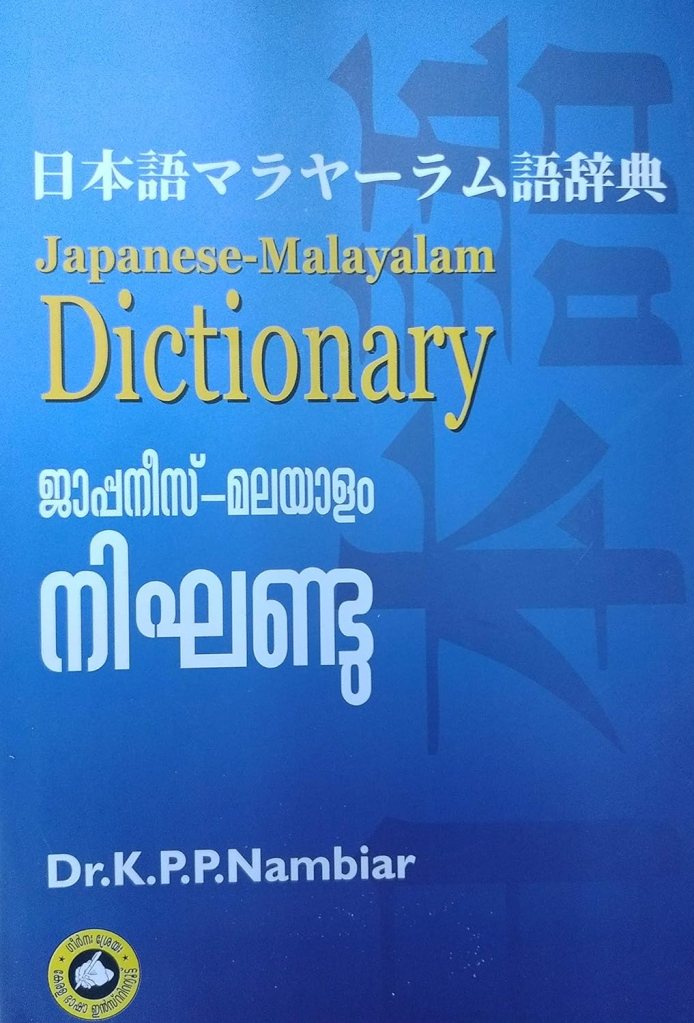
The formal release of the beautifully printed and bound Japanese-Malayalam Dictionary of some 1500 pages was formally carried out in the presence of the ILCAA Professors, by Kerala State Cultural Minister A.K. Balan.  Hideki Asari, Minister and Dy. Chief of Mission, Japanese Embassy, New Delhi and several other dignitaries were present on the occasion in Thiruvananthapuram on March 8, 2019.

With such a happy finale of a hard work put in during some sixteen years of my post-retirement years, the dictionary may represent a milestone in the annals of Japanese-Malayalam affinities.

During the half a century that elapsed from the time of my first landing in Japan and the release of the dictionary, major changes are manifested in the ethos of Japan-Kerala interactions. Exchange of visits by artists, academics, writers and common people, resulted in the publication of several travelogues, translations, studies, and so forth enabling people of these two parts of the world to come closer, as I dreamt in the 1960s.

Several literary works from Japanese were translated into Malayalam by eminent writers from Kerala including M.K. Menon (Vilasini), K. Kunhikrishnan and others!  General studies were also published about Japan, in Malayalam. An in-depth study of Kerala-Japan cultural relations is available in the remarkable book, ‘The Throne of Chrysanthemums’ by the gifted writer and artist, K. Asok Kumar.

In addition to such developments, many professionals from Kerala are now finding gainful employment in Japan, something unheard of a few years back.

In conclusion, it has to be emphasised that the age-old affinity between Japanese and Malayalam needs to be studied afresh by our linguists and historians, in the light of significant evidence emerging from various new studies.

When Rev.(Dr.) Robert Caldwell (1814-1891) postulated the theory of possible origin of Japanese and Tamil languages from the same root, there was no mention of Malayalam, in particular. So also Japanese professors – Akira Fujiwara (1981) and Susumu Ohno (2007) — who revived that hypothesis recently, were also not referring to the Malayalam connection.

Meanwhile, some of our erudite linguists such as Prof. Naduvattom Gopala Krishnan, were able to prove the ancient origin of Malayalam, from the same root as modern Tamil, proving eligibility of both these languages to be included in the ‘Classical Languages’ category, already accepted officially.

According to Prof Gopala Krishnan, the very fact that some ‘Malayalam only’ words were identified in ‘Sangam Literature’ of 300 BCE- 300 ACE, reaffirms its classical position. Even epigraphical evidence from the Edakkal Caves of Wayanad (Malabar), that go back to 6000 BCE, are said to be supportive of ancient origin of Malayalam, together with Tamil.

As such, there is an urgent need for a relook into our perspective of the gamut of Japanese-Malayalam affinities!

[1]  Yasunari Kawabata (1899-1972) was the first Japanese to win a Nobel prize in 1968

Dr. KPP Nambiar, formerly a Consultant/Technocrat at the UN Food and Agriculture Organisation, is the author of many scientific papers and books, including a 1500-page Japanese-Malayalam dictionary.

PLEASE NOTE: ARTICLES CAN ONLY BE REPRODUCED IN OTHER SITES WITH DUE ACKNOWLEDGEMENT TO BORDERLESS JOURNAL. 

Click here to access the Borderless anthology, Monalisa No Longer Smiles

Click here to access Monalisa No Longer Smiles on Kindle Amazon International


Categories
Poetry

Cast Away the Gun: Balochi Poetry by Mubarak Qazi

Translated by Fazal Baloch


Mubarak Qazi (24 December 1955 – 16 September 2023). Photo courtesy: Kamanchar Baloch
Fellow traveler! “Moons and seasons” have changed.
The eyes and the gaze are now trailed to elsewhere. 
You too forget the roar of muskets and bullets, 
Of our sorrow and happiness, the reasons have changed. 
Speak of the sun,
Of the moon.
Speak of light, 
Of life.
Cast away the gun! 
  
Fiddle pain, pluck soulful strings. 
Stop rhyming songs, extolling the curse of war. 
Don’t raise the fire of envy and hatred anymore. 
I long for love, its love I’m so desperate for. 
Speak of wine,
Of wineglass.
Speak of pain,
Of colors. 
Cast away the gun! 
  
Remind me of soft-treading maidens, 
And of sweet and dainty betel nuts.
Nobody’s pain is ever healed by fire and steel. 
Remind me of those fair and pretty damsels.
Speak of flowers,
Of lips. 
Speak of love, 
Of intimate moments. 
Cast away the gun! 

Mubarak Qazi (1955-2023), is one of the most prolific and popular of modern Balochi poets. He is credited with making poetry a vocation for the masses in a lucid vocabulary. In other words, Qazi is lile the conscience of the people — one who addresses them in a language they can easily comprehend and decipher. Instead of maintaining a subtle or vague approach, he conveyed his sentiments in simple and unembellished language. He has published ten anthologies of poetry. The translated poem is taken from the second edition of his first anthology published by Drad Publication Gwadar in 2007.

Fazal Baloch is a Balochi writer and translator. He has translated many Balochi poems and short stories into English. His translations have been featured in Pakistani Literature published by Pakistan Academy of Letters and in the form of books and anthologies.

.

PLEASE NOTE: ARTICLES CAN ONLY BE REPRODUCED IN OTHER SITES WITH DUE ACKNOWLEDGEMENT TO BORDERLESS JOURNAL

Click here to access the Borderless anthology, Monalisa No Longer Smiles

Click here to access Monalisa No Longer Smiles on Kindle Amazon International

Categories
Conversation

Roads Less Travelled

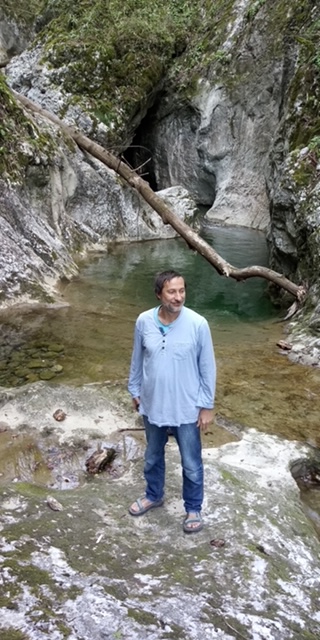
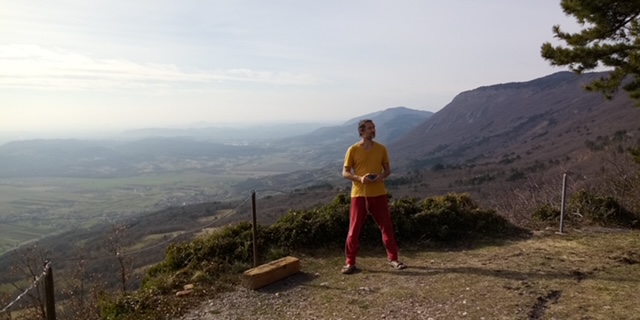
If he had stayed in his first job as a bank clerk, perhaps Tomaž Serafi would never have discovered new worlds beyond the borders of the small central European country he grew up in. But he ventured out to find both ancient wisdom and inner truths. He talks to an old friend Keith Lyons.

In Mahayana Buddhism, there is a term ‘Bodhisattva’ for those who reach the threshold of enlightenment, but choose instead to remain behind delaying personal liberation, to dedicate themselves to the benefit of others. To me, Tomaž Serafi is like a compassionate Bodhisattva, gently opening doors for others, and encouraging them to go through. 

But then, what do I know? I first met Tomaž more than 20 years ago, connected by a woman we loved. But when I recently scanned a map of Europe, one of the first things that came to mind was that in a modest apartment overlooking the Ljubljanica River near the heart of Slovenia’s capital, Tomaž was doing his thing, living his life to the fullest, letting his light shine. 

He doesn’t just feature in my own personal geography or spiritual map of the world. Over the last two decades when travelling in Asia or Australasia I’ve come across people from Ljubljana, and on too many occasions, it turns out they also know Tomaž. 

What can you tell us about where you live, in Ljubljana?

Ljubljana is located in the heart of Europe, nestled between Italy, Austria, Hungary, Croatia, and the Adriatic Sea. Slovenia’s capital city is neither large nor small, with a population of 300,000. It’s a delightful place to reside, featuring a vibrant community of young people, and hosting numerous cultural events.

Ljubljana. Courtesy: Creative Commons

I live in the city centre, right alongside the picturesque green river known as the Ljubljanica. From my window, I enjoy a spectacular view of Ljubljana’s castle perched atop a hill and the flowing river. If I wish to take a stroll in nature, there’s a forest just a 3-minute walk from my house in one direction and 15 minutes in the other. Even in the city centre, there are plenty of trees and green spaces.

Ljubljana is a hidden gem in Europe, and not many people know about its story. What can you say about the country and its people?

When I was born in 1962 Slovenia was a part of Yugoslavia, which was a non-aligned country, not affiliated with either the capitalist Western bloc or the communist Eastern bloc. Yugoslavia was a socialist country, somewhere between communism and capitalism. It was wealthier than communist countries but not as affluent as capitalist ones. Back then, we didn’t have much, but there were no truly impoverished people. Nobody was starving, and nobody was wealthy. 

Today, we have a significant number of very wealthy individuals alongside many who are extremely poor, struggling with hunger and homelessness. Presently, life in Slovenia is not significantly different from that in other European countries.

What was it like for you growing up in the 1960s and 1970s in Slovenia?

Back then, we didn’t have cell phones and computers, so we spent most of our time outdoors playing with friends. We played games like hide and seek and competed to see who could run the fastest, jump the highest, climb the highest tree, and so on. When I was a child, I either played outside with friends or read books. 

Where did reading books take you?

Books became my passion from the moment I learned how to read. Through books, I learned about other places on Earth and different cultures. I especially adored books about Native Americans. I read all of Karl May’s  books [1]– Apache chief Winnetou was my number one hero.

So your interest in the whole wide world came from books?

Yes, my love of books furthered my fascination with other cultures. I’ve always been an avid reader. When I recognised that our own culture was not faring well, that it was troubled and leading us toward a precipice, I became curious about other cultures, especially indigenous ones. I began to delve into literature about Native American, Aboriginal, Celtic, and other cultures, exploring their spirituality and beliefs.

What put you on a path of exploring spirituality?

When I was 15, I fell off a rock wall in a canyon while I was climbing, plummeting 15 meters to the ground. I lay there, unable to move, and had to be rescued and taken to the hospital. Fortunately, it turned out that nothing was broken, but that incident profoundly changed my life. I began to contemplate the concepts of life and death. Death came close, examined me, and decided to spare me for a while longer. 

Since that moment, I haven’t been afraid of death anymore. I also started pondering the meaning of life, which became the most significant question for me: What is the meaning of life? That question guided me towards spirituality and spiritual growth. Ever since, spirituality has been the most vital aspect of my life, (alongside, of course, the elements of sex, drugs, and rock and roll).

How were your first experiences venturing overseas?

My first journey took place when I was 15 years old, and I hitchhiked through Europe. I passed through Italy, and in Genoa, I attempted to buy marijuana. I gave money to a guy who entered a house but never returned. It was only then that I realised he had exited through another entrance at the back of the house.

Later in the Côte d’Azur, I purchased LSD, only to discover that I had received plain candy instead. In Nice, I was robbed by a group of 14-year-old Algerians. While hitchhiking on the highway outside of Paris, a large truck deliberately ran over my backpack, scattering all my belongings on the road. Moments later, the police arrived and informed me that hitchhiking on the highway was prohibited. When I showed them what had happened to my backpack, they simply shrugged and drove away.

In Brittany, a kind couple invited me to sleep in their house because it was raining, and I had intended to sleep outside in my sleeping bag. In Paris, a young man around 20-years-old invited me to stay in his apartment, but as we shared the same bed, he tried to put his hand into my underwear. 

From these experiences, I learned that I couldn’t trust everyone and that I needed to be cautious. I also discovered that some people are incredibly generous and trustworthy. Most importantly, I learned that I am the master of my life, and it’s best to rely on myself. I also realized that the world is vast, and not every place is the same as my small Slovenia. I encountered people of various nationalities and skin colours, broadening my horizons. I understood that a person’s nationality doesn’t matter; fundamentally, we are all the same. In every country, there are both good and not-so-nice people. But regardless of where they are, everyone shares the same desire: to find happiness.

Has your style of travel changed over time from those first adventures in Europe?

When I was younger, I was restless and eager to explore as many places as possible, often staying in one place for no more than a day or two. However, as time went on, I came to realise that the longer I remain in one location, the more fulfilling it becomes. I grow more peaceful and content, and it’s only then that I can truly savour and fully immerse myself in the experiences.

I also came to understand that the slower I travel, the more profoundly I connect with the landscapes I traverse. When I travel by car, it feels like I’m merely watching the scenery on a television screen. Travelling by bicycle is a much richer experience. Walking on foot is even better, as I absorb every step of the journey. Travelling by public transport has its own appeal. On a bus, I can keenly observe the locals, their personalities, and their customs, which offers a splendid perspective on the places I visit.

What has been a really memorable travel experience for you?

One of the most memorable places that I visited in Ghana was a village called Sonyon. I was travelling by bicycle, and wherever I went, I would tell the people that I wasn’t a tourist but a pilgrim who had come to bestow blessings upon them. You can only reach this village on foot or by bicycle. Later, I learned that it’s a spiritual village where people from all over come to heal or achieve specific goals. They perform offerings, and then conduct certain ceremonies, and they say it has a powerful effect. 

The houses in this village are single-story, made of mud, and have flat roofs. They are built close together, so in the evening, the villagers go up to the roofs, where it’s cooler due to a gentle breeze, and they walk around the village from house to house, like on a promenade. They even sleep there sometimes. I lay on the roof, and children came up and started touching me because they were curious about my white skin. I lay on my stomach, patted my back, and said, “You can touch me here,” and they began to stroke and massage me. It was a fantastic feeling, like being caressed and massaged by five or six children! 

And how about when travelling in my home country, New Zealand?

One of the most memorable experiences during my first trip to New Zealand’s North Island was while stopping for a short break near a magnificent coastline while hitchhiking. I wanted to stay there for a while. So, I headed towards the coast, found a suitable spot, and set up camp. I spent quite a few days there. I was truly enjoying myself. I remained naked throughout the experience, frequently leaping into the water, singing loudly, dancing, and engaging in meditation, among other activities. 

Then I was walking for a long time and eventually, I ran out of water and food. With my last bit of strength, I managed to reach the top of a hill. According to the information in my book, I should have soon come across the first settlement along the way. However, the path had disappeared. Tall grass had grown all around me. I climbed onto a rock and saw a belt of forest nearby, with a path beyond it. I headed towards the forest. Wild boars ran past me. The forest was so overgrown that it took me an hour to reach a path about a hundred meters away. I was dirty and scratched, my clothes were torn, and I was hungry and thirsty. It was Christmas Eve.

Soon, I heard human voices and saw a holiday trailer. People were having a picnic. I asked them if I was heading in the right direction towards the main road. They confirmed it and said, “Wait a minute. Are you thirsty, or hungry? Have a beer. It’s Christmas Eve.” I stayed with them. Soon, Māori friends joined them. We sat around the fire, ate and drank, talked, an elderly Māori woman shared stories of their spirituality and sang their songs, and I sang some of ours. I couldn’t have asked for a better Christmas gift.

Let’s go back to your earlier existence. What happened for you to give up a career working in a bank?

It all began with Illusions (1989) by Richard Bach. I was still employed at a bank when I came across this book – and it had a profound impact on me. It meant so much to me that I made a personal commitment to translate it, despite having no prior experience in translation. And so, I translated it. Subsequently, I submitted my translation to all the publishers in Slovenia, but unfortunately, none of them were interested (back then, the book didn’t align with the socialist Yugoslavia prevailing system). Undeterred, I took matters into my own hands. I photocopied 200 copies of my translation and sold them independently. With the proceeds from those sales, I was able to print an additional 500 copies. To my surprise, I found that I was earning more from these efforts than I would have if a publishing house had purchased my translation.

This realization led me to make a life-altering decision—I left my job at the bank and embarked on a journey of translating and publishing other books that I believed had the power to touch people’s hearts and were of great importance. Authors such as Kahlil Gibran, J.R.R. Tolkien, the Dalai Lama, Louise Hay, William Bloom, Paul Solomon, Dan Millman, and Lobsang Rampa were just a few of the writers whose works I translated and shared with the Slovenian audience.

What do you think is the purpose of your life?

When I was going through a very difficult period in my life and couldn’t sleep one night, I went to the balcony and suddenly heard a voice loudly asking me, “Tomaž, why are you here, why did you come to this world?” Suddenly, it dawned on me, and I replied, “I came here to be happy!” The voice replied, “That’s right, Tomaž. Now, take a look at yourself. Are you happy?”

That’s when I decided to be happy. Once I made that decision, I stuck to it, and I truly was happy.

Later, many years later, I realised that I didn’t just come to be happy. I discovered that I’m even happier and more fulfilled when I make someone else happy. Gradually, I realised that my mission is to help others. I help them in various ways. At one point, I helped by translating and publishing books that benefited them. Later, I assisted them with counselling at the New Age Information Centre, which I founded. Now, I help them with therapeutic massages, with conscious and loving touch.

So what’s your superpower?

My superpower is undoubtedly my touch. However, this transforms into true power only when I am fully aware of it and fill it with love. In fact, my superpower is the awareness that everything is one, that all that exists, the entire universe, and all the things and beings that fill it, both material and immaterial, are actually one vast super being or God.

What things do you do most days to keep you balanced?

For a long time now, I’ve had a morning routine that fulfils me and makes mornings the most beautiful part of my day. When I wake up, I first express gratitude for the night and greet the new day that lies ahead, even before I open my eyes. Then I engage in exercise. I limber up all my joints, perform tantric exercises, breathing exercises, practice yoga, tai chi, and chi gong. 

Afterwards, I sit down to meditate and spend some time in silence. Only then am I prepared for the day’s responsibilities. Similarly, in the evening, when I close my eyes, I give thanks for the day I’ve lived and bid goodnight to the night that approaches. 

How do you think you’ve made an impact on the lives of others?

When I was publishing books, I received a lot of feedback from my customers which made my heart sing. Some were praising my translations, and some were thankful that I decided to publish such beautiful and meaningful books. 

I receive even more grateful feedback from the people I massage. One client commented “I was led to the place where everything just is and exists.” And, Frida, gave me this wonderful endorsement, “For a moment you caught me in timelessness that lasted and lasted. My body was dancing under your loving hands and melted with your grace. Thank you for this magical experience. Your love for the work you are doing and for the people can be felt and it is healing.”

Recently I received this feedback, with the person saying “This was not an ordinary massage. Tomaž’s gentle presence made me feel safe, so I entrusted him with my process.” Another wrote “Tomaž, your creation is truly something special. You’ve given the world a wonderful gift, and I thank you for it.” I’m grateful to people like Medeja who thank me by saying “As if a flock of angels, completely devoted and determined angels, guided me through all possible processes — fears, pains, freedom, love, and beauty — and brought me to their home, where it is so beautiful and pleasant that there are no words to replace this feeling.”

What are the most important things you’ve learned?

I’ve learned that the most important thing for me is to live my soul.

I’ve also learned that no one is more important than another, that there is no good or bad, and that life isnot serious; rather, everything is like dust in the wind of the Universe, or as I like to say, “chickenshit.”

The most fulfilling action one can take is to help others because it brings genuine joy. As socialbeings, our connections with others are the most crucial aspects of life, far surpassing thesignificance of material possessions.

If you have a message or advice for others, what would it be?

Don’t worry; life is not so serious. Follow your heart and live your soul. Be yourself; you don’t have to be somebody else, you don’t have to pretend to be somebody else. Everything is changing; nothing is permanent; everything will end or transform. Live fully, live, and be aware of every moment of your life. That’s why we are here: to live our life fully, to experience everything from joy to sadness, from anger to love, from despair to fulfilment. And to be aware of all of this.

website: singingheart.weebly.com
Email: tomaz.serafi@gmail.com

[1] Karl May( 1842-1912) German author. Winnetou was a novel by him.

Keith Lyons (keithlyons.net) is an award-winning writer and creative writing mentor originally from New Zealand who has spent a quarter of his existence living and working in Asia including southwest China, Myanmar and Bali. His Venn diagram of happiness features the aroma of freshly-roasted coffee, the negative ions of the natural world including moving water, and connecting with others in meaningful ways. A Contributing Editor on Borderless journal’s Editorial Board, his work has appeared in Borderless since its early days, and his writing featured in the anthology Monalisa No Longer Smiles.

PLEASE NOTE: ARTICLES CAN ONLY BE REPRODUCED IN OTHER SITES WITH DUE ACKNOWLEDGEMENT TO BORDERLESS JOURNAL. 

Click here to access the Borderless anthology, Monalisa No Longer Smiles

Click here to access Monalisa No Longer Smiles on Kindle Amazon International
Categories
A Special Tribute

Celebrating Gandhiism

We know him variously — a man whose face and form appear on currency notes in India and on stamps, as statues and as art, internationally. He was known as a pacifist, one who inspired the likes of Nelson Mandela, Martin Luther King Jr, Obama and many more leaders. And yet, he was a tiny, frail man, rather adamant and uncomfortable to live with and with food choices that many might find difficult to digest. This man was called Mohandas Karamchand Gandhi.

Born on October 2nd 1869, in Porbandar, Gujarat, he became an internationally renowned figure for all of us. Like all great leaders, he impacted the world in ways more than one but he had some idiosyncrasies, for example, he had no faith on the film industry though a number of films have been made on and about him. Highlighting that is an essay from Shantanu Ray Chaudhuri. Gandhi affected people and much of the writing in this edition goes to show how he or his ideas impacted them. Ratnottama Sengupta comments and translates parts of the episode from the biography of eminent Bengali writer, Nabendu Ghosh, her father, as well as a short story by him, to focus on Gandhi’s impact on India’s Direct Action Day (16th August 1946). A poem by contemporary Santosh Bakaya about the same incident make one wonder why suddenly there is so much focus on this part of history.

Here’s to unraveling the mystery and celebrating Gandhiism in spirit—

‘He Belongs to Me, He Belongs to You’: Santosh Bakaya weaves magic in poetry around the persona of Gandhi. Click here to read. 

Gandhiji, a short story by Nabendu Ghosh, has been translated from Bengali by Ratnottama Sengupta. Click here to read.

Magic of the Mahatma , Ratnottama Sengupta shows the impact of Gandhi and his call for non-violence on Nabendu Ghosh as she continues to emote over his message of Ahimsa and call for peace amidst rioting. Click here to read.

Gandhi in Cinema Shantanu Ray Chaudhuri explores Gandhi in films and also his views on the celluloid screen. Click here to read.

Courtesy: Creative Commons
Categories
Tribute

‘He Belongs to Me, He Belongs to You’

Santosh Bakaya weaves magic around the iconic Gandhi

Courtesy: Creative Commons
MAGIC

 
Lo! I saw a magician last night. 
 A slender silhouette -- almost half-naked. 
Was the night at its tricks once again? 
Was the frail figure about to pull rabbits out of his hat? 
Magicians do have this incorrigible habit of pulling rabbits from hats.
But this magician defied all stereotypes. Where was his hat? 
Where the rabbits? 

I looked at the calendar, and gasped. It was 16 August 1946. 
How bizarre! The stars outside had a fickle glow. 
There was chaos, there was confusion. There was hatred. 
The graffiti on the mildewed walls screamed: 
Direct Action Day! 

Piercing the cacophony, a soft, feathery voice
 fell on the turbulent crowd. 
Not a rabble rousing voice, but a magical one.

“I have come here to serve Hindus and Muslims.” 
A hush fell. Louder – louder – louder grew the hush.

Then I saw the half-naked figure walking away. 

All alone – but in sync with 'Gurudeb's words 
'Ekla chalo Re*’. 

But lo and behold! There was more magic! 
The pages of the calendar fluttered in the breeze. 
With great ardour, swayed the trees.
I was amazed; the calendar now showed the year 2023.

I peeped through the window.
 Birds perched on bowers were singing, impromptu songs.
 The folds of their yellow-green-blue-wings hid musical notes.
Then I again saw the half-naked figure. 
Walking alone, but in sync with 'Gurudeb's words, 
'Ekla chalo Re,' ringing in his ears.  

But lo and behold! There was more magic! 
The One Man Army was no longer alone.
The trickle had become a deluge. 
Music poured from every tree.

A multi-layered song was being sung in every tone, 
every tenor, every pitch, pouring love melodies.  
The sun of a new morn smiled from above.  
The heady scent of freshly hewn lawn spread in the air.

Megalomaniacs had fallen pathetically silent.
The muted falling of a leaf creating a quiet turbulence.
An invisible drummer was beating his drum.

“Back to nature --Back to peace --Back to love. 
An eye for an eye, a tooth for a tooth will make the whole world blind. 

Blind-Blind-Blind.” 
The surroundings resounded.
 The boughs seemed to be swaying to the beat of myriad stringed instruments 
Queedle queedle -queedle hoo- ah hoo- hoo- hoo kleek kik ik ik ik .honk honk 
koo- ookoo hoooooooo…

Birds sang from every branch-- high pitch – low pitch, contralto cadences,
 chirruping notes, and even hoarse, grating rattles and loud caws. 
Magic again happened-- creating a soul-- soothing symphony 
of eclectic pitches and rhythm. 

 “He belongs to me, he belongs to you. 
He belongs to the man in the street. 
He belongs to the coward and the bold. 
He belongs to the strong and the effete.
He belongs to the one shivering on the pavement.
He belongs to me, he belongs to you.  

"He belongs to the man whimpering under the awning.
Hoping for something good in the coming morning. 
He belongs to the bruised and the battered.
And the one with unshed tears and clothes tattered. 

"He belongs to the one who lives by his labour. 
And even to the one who does not love his neighbor. 
The spunky woman bending in ceaseless toil.
And the youngster whose blood is on the boil. 
 
"He belongs to the one with the frown. 
He belongs to the white, black and brown. 
The one with a swagger in his gait. 
The one who suffers viciously at the hands of fate.

"The bird fluttering helplessly in the cage. 
The youth struggling with road rage. 
Those engrossed in ego tussles 
and the one flaunting his muscles.
He belongs to me, he belongs to you.”

With a revolutionary fervor, every leaf was shaking.
A symphony of love and peace was in the making. 
The pilgrim was no longer alone 
Love had injected every bone. 
Faces glimmered with hope -- there was no mistaking. 

*Gurudeb means Teacher and refers to Tagore in this case. 'Ekla Cholo Re' (Walk Alone) is a well known song by Tagore.

Santosh Bakaya, PhD, poet, essayist, novelist, biographer, TEDx speaker, has written twenty-three books across different genres, Ballad of Bapu, and Only in Darkness can you see the Stars [Biography of Martin Luther King Jr]. have won international acclaim. What is the Meter of the Dictionary? is her latest solo book of poetry. 

.

PLEASE NOTE: ARTICLES CAN ONLY BE REPRODUCED IN OTHER SITES WITH DUE ACKNOWLEDGEMENT TO BORDERLESS JOURNAL

Click here to access the Borderless anthology, Monalisa No Longer Smiles

Click here to access Monalisa No Longer Smiles on Kindle Amazon International

Categories
Celebrating Translations

We are the World

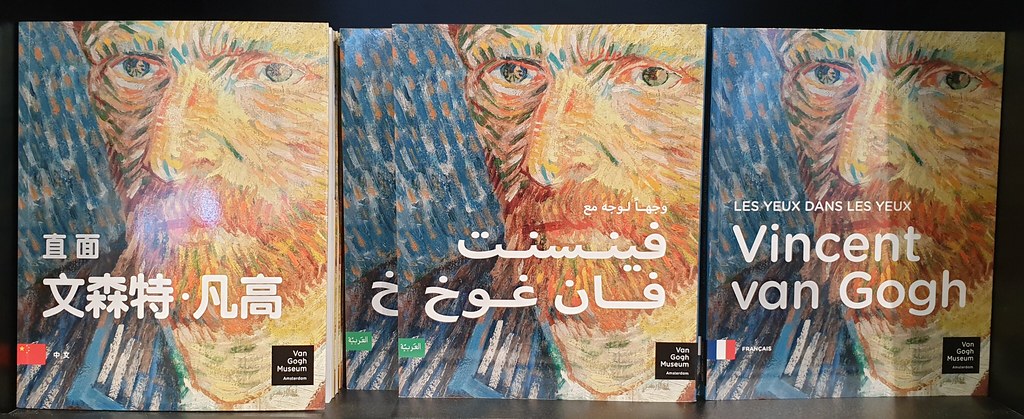
Vincent Van Gogh written is different scripts. Courtesy: Creative Commons

The whole world opens up in the realm of ideas that have existed wafting and bridging across time and space. Sometimes they find conduits to come to the fore, even though they find expression in different languages, under varied cultural milieus. One way of connecting these ideas is to translate them into a single language. And that is what many have started to do. Celebrating writers and translators who have connected us with these ideas across boundaries of time and place, we bring to you translated writings in English from twenty eight languages on the International Translation Day, from some of the most iconic thinkers as well as from contemporary voices. 

Prose

Tagore’s short story, Aparichita, has been translated from Bengali as The Stranger by Aruna Chakravarti. Click here to read. 

Travels & Holidays: Humour from Rabindranath, have been translated from Bengali by Somdatta Mandal. Click here to read.

Hena, a short story by Nazrul, has been translated from Bengali by Sohana Manzoor. Click hereto read.

Munshi Premchand’s Balak or the Child has been translated from Hindi by Anurag Sharma Click here to read.

Munshi Premchand’s Pus Ki Raat or A Frigid Winter Night  has been translated from Hindi by C Christine Fair. Click here to read.

Nadir Ali’s The Kabbadi Player has been translated from Punjabi by Amna Ali. Click here to read.

Kamaleswar Barua’s Uehara by  has been translated from Assamese and introduced by Bikash K. Bhattacharya. Click here to read.

S Ramakrishnan’s Muhammad Ali’s Singnature has been S. Ramakrishnan, translated from Tamil by Dr B. Chandramouli. Click here to read. 

PF Mathews’ Mercy,  has been translated from Malayalam by Ram Anantharaman. Click here to read.

Road to Nowhere, an unusual story about a man who heads for suicide, translated from Odiya by the author, Satya Misra. Click here to read.

An excerpt from A Handful of Sesame by Shrinivas Vaidya, translated from Kannada by Maithreyi Karnoor. Click here to read.

Writings from Pandies’ Corner highlight the ongoing struggle against debilitating rigid boundaries drawn by societal norms. Each piece is written in Hindustani and then translated by a volunteer from Pandies’ in English. Click here to read.

Rakhamaninov’s Sonata, a short story by Sherzod Artikov, translated from Uzbeki by Nigora Mukhammad. Click here to read.

Of Days and Seasons, a parable by the eminent Dutch writer, Louis Couperus (1863-1923), translated by Chaitali Sengupta. Click here to read.

The Faithful Wife, a folktale translated from Balochi by Fazal Baloch. Click here to read.

An excerpt from Ramy Al-Asheq’s Ever Since I Did Not Die, translated from Arabic by Isis Nusair, edited by Levi Thompson. The author was born in a refugee camp. Click here to read.

Poetry

Two songs by Tagore written originally in Brajabuli, a literary language developed essentially for poetry in the sixteenth century, has been translated by Radha Chakravarty. Click here to read. 

Rebel or ‘Bidrohi’, Nazrul’s signature poem,Bidrohi, translated from Bengali by Professor Fakrul Alam. Click here to read.

Banlata Sen, Jibananada Das’s iconic poem, translated from Bengali by Professor Fakrul Alam. Click here to read. 

Poetry of Michael Madhusudan Dutt has been translated from Bengali by Ratnottama Sengupta. Click here to read.

Our Children, a poem by well-known Iranian poet, Bijan Najdi, has been translated from Persian by Davood Jalili. Click here to read.

Akbar Barakzai’s Be and It All Came into Being has been translated from Balochi by Fazal Baloch. Click here to read.

Biju Kanhangad’s The Girl Who Went Fishing has been translated from Malayalam by Aditya Shankar. Click here to read.

Jitendra Vasava’s Adivasi Poetry,  translated from the Dehwali Bhili via Gujarati by Gopika Jadeja. Click here to read.

Sokhen Tudu’s A Poem for The Ol Chiki, translated from the Santhali by Hansda Sowvendra Shekhar. Click here to read.

Thangjam Ibopishak’s Gandhi & Robot translated from the Manipuri by Robin S Ngangom. Click here to read.

 Rayees Ahmad translates his own poem, Ab tak Toofan or The Storm that Rages, from Urdu to English. Click here to read.

Poetry by Sanket Mhatre has been translated by Rochelle Potkar from Marathi to English. Click here to read.

An excerpt from Evening with a Sufi: Selected Poemsby Afsar Mohammad, translated from Telugu by Afsar Mohammad & Shamala Gallagher. Click hereto read.

Ihlwha Choi’s Universal Language written at Santiniktan, translated from Korean by the poet himself. Click here to read.

Sangita Swechha’s Motherhood: A Tiny Life inside Me has been translated from Nepali by Hem Bishwakarma. Click here to read.

Rosy Gallace’s Two poems from Italy  have been translated from Italian by Irma Kurti. Click here to read.

Poetry in Bosnian written and translated from Bosnian by Maid Corbic. Click here to read.

Lesya Bakun translates three of her own poems from Ukranian and Russian to English. Click here to read.

Poems from Armenia by Eduard Harents translated from Armenian by Harout Vartanian. Click here to read.

Categories
Contents

Borderless September 2023

Art by Sohana Manzoor

Editorial

What do They Whisper?… Click here to read.

Conversations

Shantanu Ray Chaudhuri in conversation with M.S. Viraraghavan and Girija Viraraghavan ( grand daughter of President Sarvepalli Radhakrishnan) on their new book, Roses in the Fire of Spring: Better Roses for a Warming World and Other Garden Adventures. Click here to read.

In conversation with Isa Kamari, a celebrated writer from Singapore, with focus on his latest book, Maladies of the Soul. Click here to read.

Translations

A Hunger for Stories, a poem by Quazi Johirul Islam, has been translated by Professor Fakrul Alam. Click here to read.

A Hand Mill, a story by Ammina Srinivasaraju, has been translated from Telugu by Johny Takkedasila. Click here to read.

Kiyya and Sadu, a part of this long ballad on the legendary lovers from Balochistan, has been translated from Balochi by Fazal Baloch. Click here to read.

The Time for the Janitor to Pass by, poetry written in Korean and translated by Ilhwah Choi. Click here to read.

Sharat or Autumn, a poem by Tagore, has been translated from Bengali by Mitali Chakravarty. Click here to read.

Poetry

Click on the names to read the poems

Jared Carter, Rhys Hughes, Santosh Bakaya, Luis Cuauhtémoc Berriozábal, Sagar Mal Gupta, Nirmala Pillai, George Freek, Pramod Rastogi, Peter Devonald, Afshan Aqil, Hela Tekali, Swarnendu Ghosh, Alpana, Michael Burch

Poets, Poetry & Rhys Hughes

In Tintin in India, Rhys Hughes traces the allusions to India in these iconic creations of Hergé while commenting on Tintin’s popularity in the subcontinent. Click here to read.

Musings/Slices from Life

Black Pines and Red Trucks

Meredith Stephens shares the response of some of the Californian community to healing after the 2020 forest fires with a narrative and photographs. Click here to read.

Remembering Jayanta Mahapatra

KV Raghupathi travels down nostalgia with his memories of interactions with the recently deceased poet and his works. Click here to read.

The Toughness of Kangaroo Island 

Vela Noble draws solace and lessons from nature around her with her art and narrative. Click here to read.

Where is Your Home?

Madhulika Vajjhala explores her concept of home. Click here to read.

A Homecoming like No Other

Saumya Dwivedi gives a heartwarming anecdote from life. Click here to read.

Musings of a Copywriter

In Hair or There: Party on My Head, Devraj Singh Kalsi explores political leanings and hair art. Click here to read.

Notes from Japan

In Against Invisibility, Suzanne Kamata challenges traditions that render a woman invisible with a ‘sparkling’ outcome. Click here to read.

Essays

Jayanta Mahapatra: A Tribute to a Poetic Luminary

Dikshya Samantrai pays tribute to a poet who touched hearts across the world with his poetry. Click here to read.

Celebrating the novel… Where have all the Women Writers Gone?

G Venkatesh writes about a book from 1946. Click here to read.

Chandigarh: A City with Spaces

Ravi Shankar travels back to Chandigarh of 1990s. Click here to read.

The Observant Immigrant

In Climate Change: Are You for Real?, Candice Louisa Daquin explores the issue. Click here to read.

Stories

The Infamous Art Dealer

Paul Mirabile travels through Europe with an art scammer. Click here to read.

Getting Old is like Climbing a Mountain

Saranyan BV explores aging and re-inventing homes. Click here to read.

The Airport

Prakriti Bandhan shares a short, whimsical narrative. Click here to read.

Book Excerpts

An excerpt from Syed Mujtaba Ali’s Tales of a Voyager (Joley Dangay), translated by Nazes Afroz. Click here to read.

An excerpt from Sanket Mhatre’s A City Full of Sirens. Click here to read.

Book Reviews

Somdatta Mandal reviews Begum Hazrat Mahal: Warrior Queen of Awadh by Malathi Ramachandran. Click here to read.

Basudhara Roy reviews Sanket Mhatre’s A City Full of Sirens. Click here to read.

Bhaskar Parichha reviews Samragngi Roy’s The Wizard of Festival Lighting: The Incredible Story of Srid. Click here to read.

.

Click here to access the Borderless anthology, Monalisa No Longer Smiles

Click here to access Monalisa No Longer Smiles on Kindle Amazon International

Categories
Editorial

What do they Whisper?

No, they whisper. You own nothing.
You were a visitor, time after time
climbing the hill, planting the flag, proclaiming.
We never belonged to you.
You never found us.
It was always the other way round.

‘Moment’ by Margaret Atwood

With an unmanned mission reaching the moon — that moon that was chipped off the Earth’s surface when Theia bashed into the newly evolving planet — many feel mankind is en route to finding alternate biomes and perhaps, a solution to its housing needs. Will we also call moon our ‘Homeland’ and plant flags on it as we do on Earth?  Does the Earth — or the moon — really belong to our species. Do we have proprietary rights on these because of lines drawn by powerbrokers who say that the land belongs to them?

These are questions Margaret Atwood addresses in her writings which often fall into a genre called cli-fi. This is gaining in popularity as climate has become uncertain now with changes that are wringing fear in our hearts. Not all fear it. Some refuse to acknowledge it. While this is not a phenomenon that is fully understood by all of us, it’s impact is being experienced by majority of the world — harsh stormy weather, typhoons, warmer temperatures which scorch life and rising water levels that will eventually swallow lands that some regard as their homeland. Despite all these prognostications, wars continue to pollute the air as much as do human practices, including conflicts using weapons. Did ‘climbing a hill’ and ‘planting the flag’ as Atwood suggests, ever give us the rights over land, nature or climate? Do we have a right to pollute it with our lifestyle, trade or wars — all three being human constructs?

In a recent essay Tom Engelhardt, a writer and an editor, contended, “Vladimir Putin’s greatest crime wasn’t simply against the Ukrainians, but against humanity. It was another way to ensure that the global war of terror would grow fiercer and that the Lahainas of the future would burn more intensely.” And that is true of any war… Chemical and biological weapons impacted the environment in Europe and parts of Afghanistan. Atom bombs polluted not only the cities they were dropped in, but they also wreaked such havoc so that the second generation’s well-being continues impacted by events that took place more than seven decades ago. Yet another nuclear war would destroy the Earth, our planet that is already reeling under the impact of human-induced climate change. Flooding, forest fires and global warming are just the first indications that tell us not only do we need to adapt to living in changed times but also, we need to change our lifestyles, perhaps even turn pacifist to survive in a world evolving into an altered one.

This month some of our content showcase how to survive despite changes in norms. Suggesting how to retain our flora in a warming world is a book, Roses in the Fire of Spring: Better Roses for a Warming World and Other Garden Adventures, by M.S. Viraraghavanand Girija Viraraghavan, the grandson-in-law and granddaughter of the second President of India, Sarvepalli Radhakrishnan (1888-1975). They have been in conversation with Shantanu Ray Chaudhuri to explain how they have adapted plants to create hybrids that survive changing climes. Would it be wishful to think that we can find solutions for our own survival as was done for the flora?

Critiquing the darker trends in our species which leads to disasters is a book by an eminent Singaporean writer, Isa Kamari, called Maladies of the Soul. He too looks for panacea in a world where the basic needs of humans have been satiated and they have moved on towards overindulgence that can lead to redundancy. In a conversation, he tells us how he hopes his writings can help towards making a more hopeful future.

This hope is echoed in the palliative poems of Sanket Mhatre from his book, A City full of Sirens, excerpted and reviewed by Basudhara Roy. Bhaskar Parichha’s review of Samragngi Roy’s The Wizard of Festival Lighting: The Incredible Story of Srid, is a tribute also from a granddaughter to her grandfather celebrating human achievements. Somdatta Mandal’s discussion of fiction based on history, Begum Hazrat Mahal: Warrior Queen of Awadh by Malathi Ramachandran not only reflects the tenacity of a woman’s courage but also explores the historicity of the events. Exploring bits of history and the past with a soupcon of humour is our book excerpt from Syed Mujtaba Ali’s Tales of a Voyager (Joley Dangay[1]), translated from Bengali by Nazes Afroz. Though the narrative of the translation is set about ninety years ago, a little after the times of Hazrat Mahal (1820 –1879), the excerpt is an brilliant introduction to the persona of Tagore’s student, Syed Mujtaba Ali (1904-1974), by a translator who describes him almost with the maestro’s unique style. Perhaps, Afroz’s writing bears these traces as he had earlier translated a legendary work by the same writer, In a Land Far from Home: A Bengali in Afghanistan. Afroz starts with a startling question: “What will you call someone who puts down his profession as ‘quitting job regularly’ while applying for his passport?”

Other than a semi-humorous take on Mujtaba Ali, we have Rhys Hughes writing poetry in a funny vein and Santosh Bakaya giving us verses that makes us laugh. Michael Burch brings in strands of climate change with his poems as Jared Carter weaves in nature as we know it. George Freek reflects on autumn. We have more poetry by Luis Cuauhtémoc Berriozábal, Pramod Rastogi, Peter Devonald, Afshan Aqil, Hela Tekali and many more, adding to the variety of colours that enhance the vivacity of conversations that run through the journal. Adding more vibrancy to this assortment, we have fiction by Paul Mirabile, Saranyan BV and Prakriti Bandhan.

In non-fiction, we have Devraj Singh Kalsi’s funny retelling of his adventures with a barber while Hughes‘ essay on the hugely popular Tintin makes us smile. The patriarchal past is reflected in an essay by G Venkatesh, whereas Suzanne Kamata from Japan talks of women attempting to move out of invisibility. Meredith Stephens and Candice Louisa Daquin both carry on the conversation on climate change. Stephens explores the impact of Californian forest fires with photographs and first-hand narrative. Vela Noble draws solace and strength from nature in Kangaroo Island and shares a beautiful painting with us. Madhulika Vajjhala and Saumya Dwivedi discuss concepts of home.

Two touching tributes along with a poem to recently deceased poet, Jayanta Mahapatra, add to the richness of our oeuvre. Dikshya Samantrai, a researcher on the poet, has bid a touching adieu to him stating, “his legacy will continue to inspire and resonate and Jayanta Mahapatra’s name will forever remain etched in the annals of literature, a testament to the enduring power of the poet’s voice.”

Our translations this time reflect a diverse collection of mainly poetry with one short story by Telugu writer, Ammina Srinivasaraju, translated by Johny Takkedasila. Professor Fakrul Alam has introduced us to an upcoming voice in Bengali poetry, Quazi Johirul Islam. Ihlwha Choi has translated his own poetry from Korean and brought to us a fragment of his own culture. Fazal Baloch has familiarised us with a Balochi ballad based on a love story that is well known in his region, Kiyya and Sadu. Our Tagore translation has attempted to bring to you the poet’s description of early autumn or Sharat in Bengal, a season that starts in September. Sohana Manzoor has painted the scene depicted by Tagore for all of us to visualise. Huge thanks to her for her wonderful artwork, which invariably livens our journal.

Profound thanks to the whole team at Borderless for their support and especially to Hughes and Parichha for helping us source wonderful writings… some of which have not been mentioned here. Pause by our content’s page to savour all of it. And we remain forever beholden to our wonderful contributors without who the journal would not exist and our loyal readers who make our existence relevant. Thank you all.

Wish you all a wonderful month.

Mitali Chakravarty

borderlessjournal.com

[1] Translated literally, it means Water & Land

.

.

Visit the September edition’s content page by clicking here

READ THE LATEST UPDATES ON THE FIRST BORDERLESS ANTHOLOGY, MONALISA NO LONGER SMILES, BY CLICKING ON THIS LINK.