Categories
Contents

Borderless, March 2022

Painting by Sohana Manzoor

Editorial

Where Have All the Sunflowers Gone?… Click here to read.

Ukranian Refrains

In When will we ever learn? Oh, will we ever learn?, Ratnottama Sengupta, comments on the current situation in Ukraine while dwelling on her memorable meeting with folk legend Pete Seeger, a pacifist, who wrote ‘Where have all the Flowers gone’, based on a folk song from Ukraine. Click here to read.

In Can Peace come Dropping by,Candice Louisa Daquin explores war and peace pausing over the attack on Ukraine. Click here to read.

Three Poems from Ukraine by Leslya Bakun. Click here to read.

Translations

Manush: Nazrul’s Lines for Humankind: Translated from Bengali by Professor Fakrul Alam. Click here to read.

Jibananda Das’s Where have all these Birds Gone & On the Pathways for Longtranslated from Bengali by Professor Fakrul Alam. Click here to read.

Munir Momin’s You & I translated from Balochi by Fazal Baloch. Click here to read.

Down the stairs by Nabendu Ghosh, a gripping story exploring the greyer areas of ethical dilemmas, has been translated by Sarmishta Mukhopadhyay with editorial input from Ratnottama Sengupta. Click here to read.

Autumn is Long, a poem written in Korean and translated to English by Ihlwha Choi. Click here to read.

Tagore’s Anondodhara Bohichche Bhubone (The Universe reverberates with celestial ecstasy)…translated from Bengali by Mitali Chakravarty. Click here to read.

Pandies’ Corner

These narratives are written by youngsters from the Nithari village who transcended childhood trauma and deprivation. A letter to God by Tanveer Hussain  uses the epistolary technique to asks questions that would be relevant for all humankind. It has been translated from Hindustani by Vritika Thareja. Click here to read.

Poetry

Click on the names to read

Kirpal Singh, Rhys Hughes, Sutputra Radheye, Jay Nicholls, Uma Gowrishankar, Mike Smith, Anasuya Bhar, Luis Cuauhtémoc Berriozábal, Supatra Sen, George Freek, Pramod Rastogi, Ryan Quinn Flanagan, Ananta Kumar Singh, Michael R Burch, Shaza Khan

Nature’s Musings

In Storms & Seas, Penny Wilkes explores birds and the ocean during rough weather. Click here to read.

Poets, Poetry or Rhys Hughes

In Tall or Short Tales, Rhys Hughes explores the absurd. Click here to read.

Musings/Slices from Life

Eva Zu Beck & Marco Polo

San Lin Tun writes of how, in Yangon, he spends the lockdown watching a travel blog by Eva Zu Beck. Click here to read.

Messages through Space and Time

Meredith Stephens explores how the art of letter writing creates links across borders of time and place. Click here to read.

It’s Amazing the Things We can Do

Erwin Coombs takes us through his life in Egypt and has a relook at Nazi occupied Europe with a dollop of humour to come to an amazing conclusion. Click here to read.

An Existential Dilemma

G Venkatesh uses the laws of thermodynamics to try to interpret the laws that define life. Click here to read.

Musings of a Copywriter

Devraj Singh Kalsi ponders on his Visit to a Book Fair. Click here to read.

Notes from Japan

In Imagining a Possible Future: Filmmaker Felicity Tillack, Suzanne Kamata introduces us to an Australian film maker who is making films in Japan now and some are in Japanese. Click here to read.

Mission Earth

Kenny Peavy starts his column with Mama Calling, a cry to go back to living with nature. Click here to read.

Interviews

From the Himalayas to the Banks of Thames: In Conversation with Sangita Swechcha, a writer shuttles between England and Nepal and writes of her homeland. Click here to read.

At Home Across Continents : In Conversation with Neeman Sobhan, a Bangladeshi-born writer who writes of her experiences as an expat in Pakistan, Bangladesh, Italy and America. Click here to read.

Stories

The Man Who got Eaten

 Kieran Martin tells a tall tale or is it short? Click here to read.

Death Will Come

Munaj Gul Muhammed captures the wafting sadness of grieving in this short poetic narrative. Click here to read.

SofieMol

Sharika Nair paints a vignette of the past merging with the present in her narrative. Click here to read.

Faith & Fortune

Devraj Singh Kalsi shows how the twists of faith are aligned to wealth and fame. Click here to read.

Henrik’s Journey

Farah Ghuznavi follows a conglomerate of people on board a flight to address issues ranging from Rohingyas to race bias. Click here to read.

Essays

The Kaleidoscopic World of Satyajit Ray

Anasuya Bhar takes us into the literary world of Satyajit Ray, the world famous film director. Click here to read.

Are Some of Us More Human than Others ?

Meenakshi Malhotra ponders at the exclusivity that reinforces divisions, margins and borders that continue to plague humankind, against the backdrop of the Women’s Month, March. Click here to read.

The Observant Immigrant

In The Paradox of Modern Communication, Candice Louisa Daquin takes us through the absurdities that haunt modern verbal communication. Click here to read.

Book Excerpts

An excerpt from Friends in Wild Places: Birds, Beasts and Other Companions by Ruskin Bond. Click here to read.

An excerpt of a short story by Yang Ming from Asian Anthology, edited by Ivy Ngeow. Click here to read an excerpt.

Book Reviews

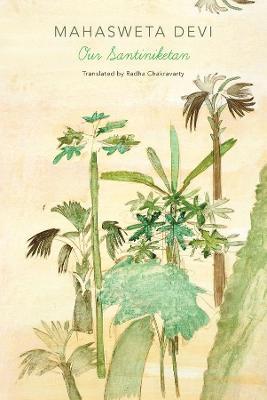
Meenakshi Malhotra reviews Mahasweta Devi, Our Santiniketan translated by Radha Chakravarty. Click here to read.

Indrashish Banerjee reviews The Tombstone in My Garden: Stories From Nagaland by Temsula  Ao. Click here to read.

Keith Lyons reviews Asian Anthology: New Writing Vol. 1: Stories by Writers from Around the World, edited by Ivy Ngeow. Click here to read.

Bhaskar Parichha reviews Why They Killed Gandhi; Unmasking the Ideology and the Conspiracy by Ashok Kumar Pandey. Click here to read.

Special Issues

Imagine… Click here to read our World Poetry Day Special.

Categories
Editorial

Where Have All the Sunflowers Gone?

Only when the cries of the wretched of the earth will stop renting the skies,
Only when the oppressor’s bloody sword will cease smearing battlefields,
			A rebel, weary of war,
			Only then I won’t stir.
…
I’m the ever-rebellious hero--
	Soaring over the world, all alone, head forever held high!

--  Rebel or 'Bidrohi' (1922) by Nazrul, translated by Fakrul Alam
Borderless: Digital Art by Ayaan Ghoshal
These fragments I have shored against my ruins
…
Datta. Dayadhvam. Damyata.         
 Shantih shantih shantih

-- Wasteland (1922) by TS Eliot

These lines reiterate values we would do well to live by in a war-torn, dissension-worn world where the need for a rebel to recreate a humane society that lives with values such as peace, generosity, acceptance, tolerance, compassion and restraint — is a felt need. The two great poems made history by remaining as popular a hundred years after they were written — ‘The Rebel’ by Nazrul and TS Eliot’s ‘Wasteland’. Nazrul defined a rebel as an iconoclast who breaks norms to find peace, justice and love for all, to move towards the creation of an ideal world. TS Eliot quoted from the Upanishads and ended with redemption coming with giving (giver perhaps denoted generosity), compassion and restraint. Despite the wisdom of these great poets and seers, war still continues a reality. The values remain neglected not just in as we see in conflicts, like the one in Ukraine that destroys lives, property and nature with intolerance towards differences, but also in our personal lives. Tagore also reiterated the same need for stepping out of personal, social, economic and political insularity. We carry a translation of a song that echoed this need while inviting participation in his ecstasy. He wrote:

Why do you sit in isolation,
Dwelling on self-centred issues? 

Tagore had not only written of the negative impact of isolation from the world but he led by example, building institutions that could lead the world towards pacifism with acceptance of diversity and inclusiveness. Sriniketan and Santiniketan were created to move towards these ideals. Many of the people he influenced or who studied in Santiniketan made history, like Prime Minister Indira Gandhi, Satyajit Ray; many added to the sense of inclusiveness, like Mahasweta Devi, who other than her enormous work to integrate different cultures, also wrote a memoir about Santiniketan in Bengali. Radha Chakravarty, nominated for the Crossword Translation Award (2004) for In the Name of the Mother by Mahasweta Devi, has translated this memoir, a narrative which brings us close to Tagore’s ideals of the whole world being a family. How wonderful it would be if the world were open to such ideals and would behave like a global family and not go to war!  Mahasweta Devi, Our Santiniketan, which has been reviewed by Meenakshi Malhotra, reiterates Tagore’s vision of a planet living in harmony with the flora and fauna.

Bhaskar Parichha has reviewed another non-fiction by Ashok Kumar Pandey, Why They Killed Gandhi; Unmasking the Ideology and the Conspiracy. Parichha writes: “The finest point about this book is its storytelling…” The book review brings to mind in the midst of a war and violence that Gandhi had tried to erase this mindless destruction of lives, nature and cities with Ahimsa or non-violence. Will we ever rise up to it? Perhaps… We see strains of recognising the negative impact of insular outlook in writings like that of Temsula Ao, a Sahitya Akademi Award winner, according to Indrashish Banerjee who has reviewed her new book, The Tombstone in My Garden: Stories from Nagaland. Keith Lyons has reviewed Asian Anthology: New Writing Vol. 1: Stories by Writers from Around the World, edited by Ivy Ngeow, an exotic medley of Asian stories, one of which has been excerpted as well.

We are privileged to carry another excerpt from Ruskin Bond’s Friends in Wild Places: Birds, Beasts and Other Companions, a hilarious story about a pet tiger adopted by the legendary writer’s grandfather. What is amazing about Ruskin Bond’s writing is the love and compassions for all creatures great and small that colours the tongue-in-cheek humour he rolls out to his readers. If only we could think like Bond, there would be no wars. His writing, I feel, transcends political borders or ‘isms’, and laces with love and compassion tales of menageries of monkeys, snakes, mongoose, humans of different denominations. This excerpt is a treat we are giving Borderless Journal as the journal completes two years of its existence. We are truly grateful to Speaking Tiger for sharing this excerpt with us. But our celebrations this time are sombre as the war rages with incoherence accompanied by heart-breaking ravages.

The refrain from Ukraine has been taken up by Ratnottama Sengupta as she takes us through the past and present experiences of the devastated country, bringing in the views of the legendary folk singer and pacifist, Pete Seeger (1919-2014), who she had interviewed over a span of four days. The writer of ‘Where have all the Flowers Gone?’, a song based on an Ukrainian folk song, Seeger said, “The point is not to ask for yourself alone — one has to ask for everybody: Either we all are going to make it over the rainbow or nobody is going to make it.” Candice Louisa Daquin has also pondered on the justification of war, contextualising it with the current one along with her essay on the paradox of modern linguistic communication.

We have an exhaustive essay on the legendary Satyajit Ray’s creations by Anasuya Bhar. Malhotra has pondered at exclusivity reinforcing divisions, margins and borders to plague humankind, against the backdrop of the Women’s Month, March. Highlighting women in writing, we have interviewed two female writers, one from Nepal and another from Bangladesh. Sangita Swechcha lives in UK but her writing, till now largely in Nepali, often pines for her home embedded in the Himalayas whereas, an expat, Neeman Sobhan, shuttles between Bangladesh and Italy with the affluence and assurance of a privileged background.

Finding a way to override lack of privileges, deprivation and violence, are the youngsters of Nithari on the outskirts of Delhi where less than two decades ago other than poverty, savage criminality devastated the local populace. These youngsters transcended the suffering over time with help from volunteering NGOs to create narratives that amaze with their inventiveness and confidence. Tanveer Hussain from Nithari, self-motivated and self-made from a young age, asks questions that would be relevant for all humankind in a letter to God. It has been translated from Hindustani by Vritika Thareja of pandies’. This edition’s translations include Professor Fakrul Alam’s mellifluous rendition of Jibanananda Das’s poetry from Bengali to English, Ihlwha Choi’s Korean poetry and a Balochi poem by Munir Momin rendered in English by Fazal Baloch. Baloch had earlier translated poems by Akbar Barakzai, a great poet who departed on 7th March, depriving the world of yet another powerful writer who imbibed hope of a better future in his poetry. We are privileged to have hosted the translations of some of his poems and his last interview.

Another well-known poetic voice from Singapore, Kirpal Singh, has given us poignant poetry that can be applied to the situation that is leading to the wreck of Ukraine. Anasuya Bhar has  poetry, one of which despite being in the ilk of Nazrul’s great poem, ‘Rebel or Bidrohi’, questions gently mainly social constructs that obstruct the flow of harmony. Ryan Quinn Flanagan has pondered on the acceptance of a changed world. We have humour from Rhys Hughes in poetry and wonderful poems by Michael R Burch on spring. Jay Nicholls shares the last of her dozen Pirate poems as Blacktarn sails the lemon seas to fight pollution. Luis Cuauhtémoc Berriozábal, George Freek, Sutputra Radheye, Mike Smith, Shaza Khan and many more have contributed a wealth of beautiful lines. Penny Wilkes has captured storms and seas with photographs and text and Rhys has surprised us with some strange, bizarre tales in his column.

We have musings from around the world. San Lin Tun, Meredith Stephens, Erwin Coombs, G Venkatesh have all brought in flavours of multiple cultures. Devraj Singh Kalsi has spoken of a book fair he visited in a semi-sardonic tone. He has also given us a short story as has Farah Ghuznavi – a truly borderless story which takes place in an aeroplane, in the sky where all borders collapse. We have more stories from Balochistan, US and India.

Suzanne Kamata continues writing on Japan as she  introduces us to an Australian film maker who is making films in Japan and in Japanese, called Felicity Tillack. Cultures are perhaps truly crossing borders as we can see Kenny Peavy, an environmentalist who moved from US to Indonesia start a new column with us called ‘Mission Earth’. We hope, like Tagore or Rousseau, he will help to revive our felt need to live with nature, acknowledge the nurture that we get from the planet to live in harmony with it and on it.

At the end of twenty-four months of existence – that sounds better than a mere two years— we are happy to host a melange of writers from across the borders and be the meeting grounds of writers and readers from across continents. I am truly thankful to all of you for helping concretise an ideal. Huge thanks to all the writers, artists, photographers and the readers for the contribution of their time, effort and love. And thanks to our fabulous team who continue to support the journal unwaveringly. I would also like to thank Sohana for the lovely visuals she generously shares with us. A special thanks also to young Ayaan Ghoshal for his digital art where hands reach out to support a truly borderless world.

As usual, all the content has not been covered here, I invite you all to enjoy our March edition of Borderless Journal.

At the start of the third year of our existence, let us march onwards towards renewed hope – maybe the Ukraine experience will take us closer to a war-free world with an awakening of a felt need for peace and compassion in a planet without borders.

In quest of a peaceful, humane world, I invite you all to continue being part of this journey.  

Mitali Chakravarty

Borderless Journal

Categories
Excerpt

Ruskin Bond’s Friends in Wild Places

Title: Friends in Wild Places: Birds, Beasts and Other Companions

Author: Ruskin Bond

Illustrator: Shubhadarshini Singh

Publisher: Talking Cub, the children’s imprint of Speaking Tiger.

Timothy

TIMOTHY, THE TIGER cub, was discovered by Grandfather on a hunting expedition in the Terai jungle near Dehra.

Grandfather was no shikari, but as he knew the forests of the Siwalik hills better than most people, he was persuaded to accompany the party—it consisted of several Very Important Persons from Delhi—to advise on the terrain and the direction the beaters should take once a tiger had been spotted.

The camp itself was sumptuous—seven large tents (one for each shikari), a dining-tent, and a number of servants’ tents. The dinner was very good, as Grandfather admitted afterwards; it was not often that one saw hot-water plates, finger-glasses, and seven or eight courses, in a tent in the jungle! But that was how things were done in the days of the Viceroys… There were also some fifteen elephants, four of them with howdahs for the shikaris, and the others specially trained for taking part in the beat.

The sportsmen never saw a tiger, nor did they shoot anything else, though they saw a number of deer, peacocks, and wild boars. They were giving up all hope of finding a tiger, and were beginning to shoot at jackals, when Grandfather, strolling down the forest path at some distance from the rest of the party, discovered a little tiger about 18 inches long, hiding among the intricate roots of a banyan tree. Grandfather picked him up, and brought him home after the camp had broken up. He had the distinction of being the only member of the party to have bagged any game, dead or alive.

At first the tiger cub, who was named Timothy by Grandmother, was brought up entirely on milk given to him in a feeding bottle by our cook, Mahmoud. But the milk proved too rich for him, and he was put on a diet of raw mutton and cod liver oil, to be followed later by a more tempting diet of pigeons and rabbits.

Timothy was provided with two companions—Toto the monkey, who was bold enough to pull the young tiger by the tail, and then climb up the curtains if Timothy lost his temper; and a small mongrel puppy, found on the road by Grandfather.

At first Timothy appeared to be quite afraid of the puppy, and darted back with a spring if it came too near. He would make absurd dashes at it with his large forepaws, and then retreat to a ridiculously safe distance. Finally, he allowed the puppy to crawl on his back and rest there!

One of Timothy’s favourite amusements was to stalk anyone who would play with him, and so, when I came to live with Grandfather, I became one of the favourites of the tiger. With a crafty look in his glittering eyes, and his body crouching, he would creep closer and closer to me, suddenly making a dash for my feet, rolling over on his back and kicking me in delight, and pretending to bite my ankles.

He was by this time the size of a full-grown retriever, and when I took him out for walks, people on the road would give us a wide berth. When he pulled hard on his chain, I had difficulty in keeping up with him. His favourite place in the house was the drawing room, and he would make himself comfortable on the long sofa, reclining there with great dignity, and snarling at anybody who tried to get him off.

Timothy had clean habits, and would scrub his face with his paws exactly like a cat. He slept at night in the cook’s quarters, and was always delighted at being let out by him in the morning.

‘One of these days,’ declared Grandmother in her prophetic manner, ‘we are going to find Timothy sitting on Mahmoud’s bed, and no sign of the cook except his clothes and shoes!’

Of course, it never came to that, but when Timothy was about six months old a change came over him; he grew steadily less friendly. When out for a walk with me, he would try to steal away to stalk a cat or someone’s pet Pekinese. Sometimes at night we would hear frenzied cackling from the poultry house, and in the morning there would be feathers lying all over the veranda. Timothy had to be chained up more often. And finally, when he began to stalk Mahmoud about the house with what looked like villainous intent, Grandfather decided it was time to transfer him to a zoo.

The nearest zoo was at Lucknow, 200 miles away. Reserving a first-class compartment for himself and Timothy—no one would share a compartment with them— Grandfather took him to Lucknow where the zoo authorities were only too glad to receive as a gift a well-fed and fairly civilized tiger.

About six months later, when my grandparents were visiting their relatives in Lucknow, Grandfather took the opportunity of calling at the zoo to see how Timothy was getting on. I was not there to accompany him, but I heard all about it when he returned to Dehra.

Arriving at the zoo, Grandfather made straight for the particular cage in which Timothy had been interned. The tiger was there, crouched in a corner, full-grown and with a magnificent striped coat.

‘Hello Timothy!’ said Grandfather, and, climbing the railing with ease, he put his arm through the bars of the cage.

The tiger approached the bars, and allowed Grandfather to put both hands around his head. Grandfather stroked the tiger’s forehead and tickled his ear, and whenever he growled, smacked him across the mouth, which was his old way of keeping him quiet.

He licked Grandfather’s hands and only sprang away when a leopard in the next cage snarled at him. Grandfather ‘shooed’ the leopard away, and the tiger returned to lick his hands; but every now and then the leopard would rush at the bars, and the tiger would slink back to his corner.

Excerpted from Friends in Wild Places: Birds, Beasts and Other Companions by Ruskin Bond; illustrated by Shubhadarshini Singh. Published by Talking Cub, the children’s imprint of Speaking Tiger.

ABOUT THE BOOK

Since he was a young boy, Ruskin Bond has made friends easily. And some of the most rewarding and lasting friendships he has known have been with animals, birds and plants—big and small; outgoing and shy. This collection focuses on these companions and brings together his finest essays and stories, both classic and new. There are leopards and tigers, wise old forest oaks and geraniums on sunny balconies, a talking parrot and a tomcat called Suzie, bears in the mountains and kingfishers in Delhi, a family of langurs and a lonely bat—and many more ‘wild’ friends, some of an instant, others of several years.

Beautifully illustrated by Shubhadarshini Singh, this is a gift for nature- and book-lovers of all ages.

ABOUT THE AUTHOR

 Ruskin Bond is the author of numerous novellas, short-story collections and non-fiction books, many of them classics. Among them are The Room on the Roof, The Night Train at Deoli, Time Stops at Shamli, Rain in the Mountains, The Blue Umbrella, When I Was a Boy, Lone Fox Dancing (his autobiography) and A Book of Simple Living. He received the Sahitya Akademi Award in 1993, the Padma Shri in 1999 and the Padma Bhushan in 2014.

Ruskin lives in Landour, Mussoorie, with his extended family.

ABOUT THE ILLUSTRATOR

 Shubhadarshini Singh was brought up in Kolkata and studied in Visva-Bharati, Shantiniketan. She has been an ad woman, a journalist and a film-maker. She shares Ruskin Bond’s deep love for animals and wildlife and has made his best stories into a series for television: Ek Tha Rusty. Shubhadarshini runs an art gallery for Outsider Arts, and has had shows of her paintings in Delhi and Bhopal. She lives in Delhi with her husband, son and dogs.

PLEASE NOTE: ARTICLES CAN ONLY BE REPRODUCED IN OTHER SITES WITH DUE ACKNOWLEDGEMENT TO BORDERLESS JOURNAL

Categories
Tagore Translations

Ecstasy & Tagore

Written in 1894, the year his son Samindranath was born, Tagore’s Anondodhhara bohichche bhubone (The Universe reverberates with celestial ecstasy), can be found in the largest collection of his songs, Gitabitan.

Painting by Sohana Manzoor
The Universe reverberates with celestial ecstasy 

The Universe reverberates with celestial ecstasy. 
Days and nights overflow with ambrosia in the limitless sky. 
The moon revels sipping nectar from her cupped palms—
The eternal light that never fades shimmers forever—
Illuminating our daily lives with its aura.

Why do you sit in isolation,
Dwelling on self-centred issues? 
Look around you and expand your heart. 
Petty sorrows are insignificant.
Fill your vacant life with love for humanity. 
The Universe reverberates with celestial ecstasy. 

These lyrics seem to capture not just the distance between Tagore’s own ecstatic experience of the natural universe and the self-centred pettiness that afflict those who continue to remain disconnected from the poet’s euphoria but also his attempts to help humanity discover the same joyful reverberations. Such emotions seem to find an echo in his letters later as found in Uma Dasgupta’s A History of Sriniketan. In 1915, Tagore wrote to an estate worker who was part of his work at Sriniketan (a project to upgrade villages): “I have something else to urge upon you. A note of joy has to be sounded in all your work. Village life has become very dull. The dryness of the heart has to be banished. All welfare work ought to be turned as far as possible into an occasion of festive joy.” Is he doing just that in this song?

Here we present the song beautifully rendered by the legendary singer who was groomed in Tagore’s school at Santiniketan, Kanika Bandopadhyay during his times. Kanika Bandopadhyay was a contemporary of Mahasweta Devi who wrote of her as Mohor in her memoir on Santiniketan (translated by Radha Chakravarty) where she explained the ambience that existed, “But during my time in Santiniketan, how forceful was the torrent of energy that flowed from the source the river of creativity descending from the snowcapped mountain peak!”

(The song has been translated for Borderless Journal  by Mitali Chakravarty, edited by Anasuya Bhar. Tagore’s words used here have been translated by Uma Dasgupta in A History of Sriniketan (2022) and Mahasweta Devi’s by Radha Chakravarty in Mahasweta Devi, Our Santiniketan (2022) )

.

PLEASE NOTE: ARTICLES CAN ONLY BE REPRODUCED IN OTHER SITES WITH DUE ACKNOWLEDGEMENT TO BORDERLESS JOURNAL

Categories
Review

Santiniketan: Memories of a Curriculum of Love

Book review by Meenakshi Malhotra

Title: Mahasweta Devi, Our Santiniketan

Translator: Radha Chakravarty

Publisher: Seagull

Mahasweta Devi’s reminiscences about Santiniketan, where she spent some of her formative years, between early 1936 and the end of 1938, (almost three years between the ages of 10 and 13), is a beautifully written and luminous tribute to this unique educational institution.

The place, people, flora, fauna, educational method and curriculum (through co-curricular activities), the people it housed and the ideas it nurtured are described by Mahashweta Devi in loving detail, with great skill and observation. What makes these reminiscences even more remarkable is that the book Amader Santiniketan is based on memories of events which transpired almost sixty-four years before the book finally came to be written. A richly flavoured chiaroscuro of events, ideas and people all woven into the fabric of memory, Mahashweta compares her memories to a feather. “Like a dazzling feather that has floated down from some unknown place, how long will the weather keep its colours, waiting? The feather stands for memories of childhood. Memories don’t wait. Memories grow tired. They want to go to sleep”

Describing a life lived in the lap of nature, the book depicts the beginnings of her growing closeness with the natural environment and the eco-system it fostered before the depredations caused by man’s excessive needs and greed. Thus, she writes, “Santiniketan taught us to respect nature, and to love it.” Using two frames — of a dimly remembered past time steeped in nostalgia and a disturbing present — she voices her sense of disillusionment: “Now with each passing day, I see how humans destroy everything. Through the agency of humans, so many species of trees, vines, shrubs and grasses have vanished from the face of the earth-so many species of forest life! Aquatic creatures and fish, so many species of birds, have become extinct, lost forever.” Further, a great calamity has befallen the natural world and while science and technology have advanced, the “balance of nature can never be restored.”

The author’s sensitivity to and observation of animals is perhaps unusual and also prescient in its engagement. Thus, she recalls how she long harboured a “profound tenderness” towards donkeys. Her thinking seems to almost anticipate a trend in thinking that has increasingly been identified as post humanistic.

The translation captures the iridescent quality of the writing irradiated by flashes of memory as the ageing author is often assailed by amnesia. Thus, she writes, “I have travelled a long distance away from my childhood” and that her memories are losing their colour and their sheen.

A book by a trailblazing activist writer like Mahasweta Devi writing about Santiniketan, a unique educational experiment nurtured and fostered by Tagore, who was a world-famous poet and Asia’s first Nobel laureate, is a literary treat of a special kind.

Tagore was so prolific that it could be said of him, that not only was he great but also that he was the cause of greatness in others. Santiniketan was the privileged space which witnessed a cultural efflorescence, the full flowering of the 19th century Bengal Renaissance that started more than half a century before. Thus, it was a site where the creative arts, literature, painting, sculpture, music and dance flourished. The institution attracted new talent to itself, both from India and beyond. About the educational methods of Santiniketan, Mahasweta writes: “In Rabindranath’s time, Santiniketan offered independence and nurture.” And “those days, they did not teach us the value of discipline through any kind of preaching. They taught us through our everyday existence.” Precepts and ideals were instilled subliminally, “they (instructors in Santiniketan) would plant in our minds the seeds of great philosophical ideals, like trees.” She also adds that Aldous Huxley felt that Rabindranath’s major legacy lay in his thoughts on child education. The educational curriculum that was practised in Santiniketan taught students not just to know things, but to love nature and the universe. A vital question that she poses is: why does education in love not figure in today’s curriculum?

Time and again, Mahasweta bemoans the fact that the outlook and attitude towards education that is in evidence these days has entirely missed the point and the essence of Tagore’s teachings that were manifested and actualised in Santiniketan. This is not just nostalgia but a clear-eyed recognition of the quality of nurture — both physical and intellectual– offered by Santiniketan. It offered a wonderfully varied work schedule. It trained their vision and       offered the valuable lesson that no activity is worthless.

 At the center of her narrative is of course that colossus among men, the towering figure of  Rabindranath Tagore, poet extraordinaire and visionary, carrying out a unique educational and pedagogical experiment. The author feels inadequate and unable to measure his greatness. She also describes with particular poignancy the eco-system devised by him which nurtured, honed and showcased the talents of others. Many luminaries figure in the book. Some hover in the margins of the texts -characters /personages whose achievements merit a narrative of their own. So whether it is the artists Kinkar (Ramkinkar Baij) and Nandalal Bose, singers like Mohor (Kanika Bandopadhayay) and Suchitra (Suchitra Mitra),a leader and nationalist like Sarala Debi Choudhurani, a writer like Rani Chanda and a dancer like Mrinalini Swaminathan (later Sarabhai)—Amader Santiniketan takes us through a veritable hall of fame.

The book is also interesting in the glimpses it affords into the formative influences of an important writer, Mahasweta Devi herself. Her writings constitute a unique blend of narrative and activism, theory and praxis and marks a strong sympathy with the dispossessed. She writes of tribal cultures with a strong conviction of their relationship with the land. In the Imaginary Maps (1995, short stories translated by Gayatri Spivak), Mahashweta Devi bemoans a lost civilisation:

“Oh ancient civilisations, the foundation and ground of the civilisation of India……A continent! We destroyed it undiscovered ,  as we are destroying the primordial forest, water, living beings, the human.”

There is a self-revelatory aspect to the narrative. Even as her reminiscences conjure up a glowing image of Santiniketan as an idyllic haven in a bygone era, there is a poignancy in the book’s dedication to Bappa, her son Nabarun Bhattacharya, when she writes “I gift you the most carefree days of my own childhood, let my childhood remain in your keeping.” Mahasweta’s son was estranged from her, since she left her husband and his father Bijan Bhattacharya, when Nabarun was presumably thirteen.

Radha Chakravarty is a fairly renowned translator with a vast repertoire of experience. She has translated many writings both by Rabindranath Tagore and Mahasweta Devi. That she has previously worked on Mahasweta Devi’s writing, adds to the nuanced quality of her translation and observations. Beautifully and sensitively translated by Chakravarty and produced/brought out by Seagull, the book is a collector’s delight.   

While the book is not an autobiography in the traditional sense, it weaves together fact and affect, “a fragmented whimsical mode of narration” punctuated with digression and asides. A mixture of hazily remembered facts and sharp recollections, it is peppered by flashes of the author’s indomitable spirit. In the words of the translator, “Mahasweta Devi’s text draws us in what she tells, yet baffles us with what it withholds or reinvents, teasing us with its silences uncertainties and incompleteness.” Further, “vividly present to our imagination, yet beyond the reach of our lived reality, a remembered Santiniketan hovers in the pages of the book, just like the dazzling but elusive feather inside the locked up treasure box of Mahasweta’s memory.”

.

  Dr Meenakshi Malhotra is Associate Professor of English Literature at Hansraj College, University of Delhi, and has been involved in teaching and curriculum development in several universities. She has edited two books on Women and Lifewriting, Representing the Self and Claiming the I, in addition  to numerous published articles on gender, literature and feminist theory.       

.

Click here to read a book excerpt of Mahasweta Devi, Our Santiniketan

PLEASE NOTE: ARTICLES CAN ONLY BE REPRODUCED IN OTHER SITES WITH DUE ACKNOWLEDGEMENT TO BORDERLESS JOURNAL

Categories
Slices from Life

‘When will we ever learn? Oh, will we ever learn?’

Pete Seeger (1919-2014) lamented about the futility of war, but he also imparted hope, says Ratnottama Sengupta, as she recalls her memorable meeting with folk legend Seeger, in a tete-a-tete with friends

Courtesy: Creative Commons

Last week, as people crowded the Kiev railway station to flee the Ukrainian capital, visuals started trending of the giant staircase inside the pedestrian bridge over the Yauza River to the Kiev Railway Station, the deepest station in the world. It reminded Sonia, my batchmate from Elphinstone College, of the hours she’d spent on the fabulous stairs that take you all the way down with her father who had an attack of trachycardia as they arrived in Kiev by a train from Moscow. “With great difficulty we made our way to the waiting hall from which you have to descend by this enormous staircase. I remember all the Ukrainians helped us, just as all the Russians would help us. And father kept taking Calmposes until I supported him down the stairs into a cab that took us from the station to the hotel.”

Only after that Sonia had called for an ambulance. But why not do that two hours ago? “Because father did not want me to engage with the local health authorities as we didn’t know whether they would have the drugs he used and had forgotten in India,” she explained. “And as soon as I made that call, within five minutes the ambulance was there – with that drug.” Only after that Sonia found out that Kiev has the fastest ambulance service in the world – “and the finest,” she added – “because of what they faced in WWII…” 

All through those few hours Sonia felt so supported by the local people. “I didn’t have to explain anything to the cab driver or the hotel staff – we were whisked into our room and then I went back to check in!” So today Sonia wonders how people in the bunkers are coping with small necessities such as brushing their teeth. Even as she sends Kiev her love and prayers, she feels that “peace keeping forces have to go in rather than arming Ukraine.”

“But who will stand in the line of fire?” quips Liz George, another college mate. “So, may God help the people who are facing such terrible times!” she echoes Sonia. “May god protect everyone in Kiev,” Bhamini Subramanian’s heart goes out to the innocent civilians who lost their lives and the countless families displaced, fleeing and seeking shelter to save their lives…

Watching images of the bizarre war at Kiev opens a floodgate of memories amongst us. “Yet, put aside politics and people anywhere in the world are ready to go out of their way to help people in dire situations,” Sonia sums up. And, like her, I have seen from my travels around the world that people are the same everywhere – they just want the humdrum of a normal, peaceful day to day life. But circumstances – “and policies,” Sonia adds deny a whole lot of them that. “Wish we could find a less harmful way to settle disputes,” we sigh.

*

The mention of the staircase made me think of the Potemkin Steps – the giant stairway in Odessa, another landmark habitation in Ukraine. Originally known as the Boulevard Steps, or the Giant Steps, these are considered the formal entrance into the city from the sea. Odessa, perched on a high steppe plateau, needed direct access to the harbour below which was, in days of yore, connected only by winding path and crude wooden stairs. A hundred years eroded ‘the monstrous stairs’ built with greenish grey sandstone shipped from Italy – and so in 1933, the sandstone was replaced by granite and the landings by asphalt. And in 1955, the Soviet government renamed it as the Potemkin Stairs to honour the 50th anniversary of the mutiny on the battleship Potemkin. After Ukraine gained independence it restored – as it did with many other streets and landmarks — the previous name of Primorsky Stairs.

But why did I recall this bit of history? Because of Sergei Eisenstein’s Battleship Potemkin . “That silent 1925 film is a handbook for every editor!” –  Hrishikesh Mukherjee had said to me as he must have to hundreds of other students of cinema in India. And just seven years ago, in 2015, the European Film Academy put a commemorative plate on the stairs to indicate that the Potemkin staircase is a memorable place for European cinema.

*

Watching the news unfolding tirelessly on the idiot box my friend Shireen Elavia is reminded of the Hindi film Airlift (2016), which had dealt with the evacuation of the Indian expatriates stranded in that state bordering Iraq and Saudi Arabia, at the outbreak of the Gulf War in 1990, when the soldiers of Saddam Hussain’s Iraq had walked into Kuwait and run over it… “In a massive rescue operation in which our friend Raji had also participated, Air India under its regional director Mascarenhas had airlifted 170000 people…” Sonia pitched in. “I was at that time posted in Moscow.”

“It is not a question of the negativity of war,” again Sonia recounted what a dear friend of hers – Polish by birth and Indian by marriage – has said. “Ukraine suffers because of its geopolitical position.” History repeatedly shows that “Countries suffer either because they have a certain geopolitical position or because they sit on earth filled with riches.” How very tragic! For, if they now forget they are all still in East Europe, we all forget that we are inmates of the same home – this planet.

Pete Seeger: Courtesy: Creative Commons

A profound truth that we often overlook – or render to oblivion. A truth that Pete Seeger (1919-2014) had driven home to me in Delhi sometime in 1996. “The point is not to ask for yourself alone — one has to ask for everybody: Either we all are going to make it over the rainbow or nobody is going to make it. And that is how suddenly a song about the greens becomes a song that takes a step forward. This is what I call the folk process.”

*

The human drama unfolding between Russia and Ukraine, the two countries that have been described by a cartoonist as ‘divorced spouses,’ led yet another of my university friends, Usha Kelkar Srivastava, to re-play Where have all the flowers gone (1955), that old Pete Seeger favourite “which turns out to be a Ukrainian folk song”. The poignant melody was a favourite of ours when we went to university – much like Bob Dylan’s Blowin’ in the Wind (1962) and John Lenon’s Imagine (1964) – and for decades after he’d penned it, regardless of which country he was in, the guru of country singing would sing the peace songs and the audience would sing with him. “They would sing the songs in schools and in summer camps. Some of us sang in churches and unions, some sang in coffee houses and people would gather around us and sing with us old songs and new…” Pete had recounted in the course of the four days I was really fortunate to have spent in his company. The legend who sang in defence of humanity, had come to Delhi at the invitation of the Indian Council of Cultural Relations (ICCR) — and when he returned to America, he gifted me a set of CDs signed to me which are among my prized possessions. 

“Just as a river takes the shape of the land it flows through, a song can echo the raw emotions of a land and people,” said Usha culling from her background in Music History. “Rarely has any song touched the world like the simple Where have all the flowers gone…” It has the cyclic structure of another Hebrew folk song about violence that I’d heard in an Amos Gitai film. Pete, while travelling in air, had come across a few lines in Sholokov’s And Quiet Flows the Don: “Where are the flowers, the girls have plucked them. Where are the girls, they’ve all taken husbands. Where are the men, they’re all in the army.” 

The lines from a Caucasian folk song “are sung in the Ukrainian countryside as Tovchu tovchu mak and Koloda Duda,” Usha added. Pete had adapted these words, adding the refrain of ‘Long time passing and Long time ago’ almost as a chorus. At some point in time he combined it with the tune of a traditional Irish lumberjack song – “only, I slowed down the energetic and full of vigour rendition,” and thus was born the haunting song. The three verses were later expanded by other country singers who added two more verses that underscore the tragedy thus: ‘Where have all the soldiers gone? They’re in the graves, everyone of them…and Now the flowers have come back, on the graves…’

“My only complaint is that this song is not specific enough,” Pete once said at a live concert in Sweden. “It’s too easy just to say, ‘When will we ever learn? Oh when will we ever learn?’ without saying what you want people to learn.” Yet, how potent this critique of war is can be gauged by the number of recordings, and the spread of languages in which it has been rewritten. 

The Kingston Trio first recorded it in 1961 not knowing it to be authored by Pete Seeger. In 1962 Marlene Dietrich performed it in English, French and German at a UNICEF concert – “and she sings it even better,” Seeger had said. On a tour of Israel, she rendered it in German, breaking the taboo of using that language publicly in that country. The song has versions in Dutch, Polish, Czech, Croatian, Hungarian, Irish. It has been adapted to the piano, it exists in an instrumental version, and also as a parody! In 1964, Columbia Records released it in the Hall of Fame series and in 2002 Seeger was inducted into the Grammy Hall of Fame in the Folk category. In 2010 New Statesman listed it among the Top 20 Political Songs worldwide.

I had the opportunity to hear the other American icon, Joan Baez, sing the contemporary folk song with operatic flourishes, in Manchester sometime in 1977. The activist songwriter had included the German version in her 1965 album, Farewell, Angelina. The very next year the much-loved voice of Harry Belafonte had recorded it in a Benefit concert in Stockholm. A Russian version was recorded in 1998 by Oleg Nesterov, who founded the Moscow based rock band Megapolis just before Perestroika. In the present century Olivia Newton-John recorded it in her 2004 album Indigo: Women of Song while Dolly Parton recorded it in 2005 for her album Those Were the Days. On August 9, 2009, it was sung at the funeral of Harry Patch, the last surviving British soldier of WW1.

In Kolkata, where I now live, Anjan Dutt had covered “the old but always relevant song” in Rawng (Colour) Pencil, going on to remind us at the outset of the Gulf War, “Ekii chinta Bangla tey korechhe Lalon, Notun korey eki gaan geyechhe Lenon, Shei eki katha aaj gaichhe Suman, gaichhi aami shei eki gaan (The same thought had inspired the Baul Lalon Fakir; the American John Lenon, and Kolkata’s own Suman and me, to ask — When will they ever learn?)” As for Kabir Suman, who penned the Bengali version, Kothay gelo tara: he had himself rendered it on stage with Pete during that India tour of 1996.

Back then Pete was “very happy that the Berlin Wall came down so peacefully”. I distinctly recall asking the self-effacing giant if the wide reach of Where have all the flowers gone indicates that the world is finally learning about not going to war. The Times of India had carried his answer: “I don’t know whether songs really change things. All I do know is that throughout history, leaders have been particular about which songs they want sung!” And then the balladeer sang of a youth who was asked the same question, to say, ‘I don’t know if I can change the world… But I will make sure the world doesn’t change me…’ 

“That was a good song,” Pete had concluded. “When people around the world say that — that’s when the world will be changed.” 

Notes:
Shlokov received the Nobel prize for And Quiet Flows the Don in 1965. The book came out in four parts from 1928 to 1940.

Ratnottama Sengupta thanks the people mentioned here: Both Sonia Singh and Raji Sekhar are her batchmates from Elphinstone College, Bombay (now Mumbai). They worked in Air India. Usha Srivastava and Elizabeth George (then Vergese) were singers in Pranjyoti Choir. Usha Kelkar Srivastava, trained in Western classical music, later went on to give lessons in Music History at the American Embassy School, New Delhi. Bhamini Subramaniam is a designer while Shireen Elavia. Havewala, is a retired banker.

.

Ratnottama Sengupta, formerly Arts Editor of The Times of India, teaches mass communication and film appreciation, curates film festivals and art exhibitions, and translates and writes books. She has been a member of CBFC, served on the National Film Awards jury and has herself won a National Award. 

.

PLEASE NOTE: ARTICLES CAN ONLY BE REPRODUCED IN OTHER SITES WITH DUE ACKNOWLEDGEMENT TO BORDERLESS JOURNAL

Categories
Musings

Can Peace come Dropping by…

Candice Louisa Daquin explores war and peace pausing over the attack on Ukraine

Courtesy: Creative Commons

War is among the main stays in human history. Is anything more instinctive than to go to war? I’ve never been able to relate to this but perhaps that’s because I have the advantage of living in a society where we’re protected from the literalisms of war. Or perhaps it’s because I’m female, although I don’t think it is as simple as being a male prerogative (though we can never be sure until a history of women making decisions proves this). To the outsider, war always seems futile. But what we must always do in order to fully understand something is to understand the other side. Not our own opinions but those we do not comprehend. As French philosopher Albert Camus said: “We used to wonder where war lived, what it was that made it so vile. And now we realise that we know where it lives…inside ourselves.”

Why would anyone ever want to go to war?

Imagine the first reason war was enacted. Was it as simple as Cain and Abel? Or one village attacking another village? One child attacking another child?

War tends to be on a larger scale, but perhaps it begins on a smaller scale.

It is said murderers have ‘symptoms’ of evolving as killers as do rapists and predators. If this is true, then watching children and seeing them skinning a cat as a predictor to future violence, could also be applied to war-mongering behaviour. Or conversely, could we establish what experiences that child has that engenders him/her to favour war?

If children who become violent often witness violence, then it stands to reason children who support wars or encourage wars, may witness something that in their minds is pro-war. What could it be? If you grow up in a war-torn country, surely you are more likely to seek peace and an end to violence, than to crave it? The fifth century famed military strategist Sun Tzu is quoted as saying: “Victorious warriors win first and then go to war, while defeated warriors go to war first and then seek to win.” Is war about the appearance of bravery or perceptions of strength? Ironically, Sun Tzu also said: “The wise warrior avoids the battle.” But do we follow this wisdom?

Studies show wars are committed by groups who are cohesive and decide (on invasion) and groups who defend. In essence, there is an aggressor and a protector. Sometimes wars start with two aggressors, but rarely with two protectors (this would cancel the desire for war out). Therefore, the thing everyone has in common who enters a war, is they are either seeking to invade or protect.

If people did not seek to protect, the invader would arrive and receive no resistance, and thus there would be no war. Sadly, it wouldn’t stop the invaders from say, raping and pillaging, so laying down arms and hoping for fairness, may lead to slaughter and oppression.

If people did not seek to invade, there would be no need to go to war.

What are the main reasons historically people have warred? Over land. Religion is a close second. The historic wars were over disputes of land or religion or other reasons related to both of these. The seizure of assets is related to greed/wealth/power, same as seeking to enslave people or promote an agenda (social control – another form of power). Essentially then all invasions can be reduced to one sentence: Seeking power.

One group believes they should have (more) power over another group. They invade. The other group defends or capitulates. This is the essence of war.

If we assume then most wars are enacted over a need to gain power of one sort or another, the next question becomes; Are all humans as likely to war? Or do certain societies promote war more than others? Throughout history there have been wars, many times one group did not want to go to war but were forced to in order to defend themselves. It implies there are those who are (warmongers) and there are those who are not (peacemakers or pacifists) and possibly while the latter may not seek war, they get involved if there is no alternative.

War then is to some extent – a luxury. Odd that if this is so, it’s often during the hardest times in human experience that a war begins. Wouldn’t you think if war is a luxury (by being a choice, as no war is enacted because the invaders have no choice), they’d choose not to go to war during hard times? Yet, the reverse is true.

We’re still in the struggling with the pandemic, but instead of seeking reconciliation and safety, Vladimir Putin has started the invasion into Ukraine. On the face of things this makes no sense because Russia must be hurting economically post the pandemic. To go to war when you are struggling seems madness.

Yet if this is often the case, maybe it’s like when everything is hard, people are less balanced and considerate than when things are easier? People are more charitable when they feel they can be, versus when it’s an emergency. That’s when they start looting and trampling over others. There is an inherent selfishness to humanity where they feel. “If I am alright I might be charitable but if I’m not alright you’re on your own’. It takes a really truly charitable person to stay behind and help others. Most people flee.

If we use this ‘typical’ personality trait and then apply it to a megalomaniac leader, it becomes less surprising they would choose an inopportune moment to strike. Perhaps it’s as inconvenient for everyone else as it is for Putin, therefore they have the element of surprise and inconvenience. They strike when the iron is hot, so to speak. The other impact of war is misdirection. If everyone believes something won’t happen (the invasion of Poland by Germany 1939 in WW2) when it does happen, everyone’s so surprised that they have a delayed reaction (which adds to the invader’s strengthen).

War strategy aside, do some people actually relish war ‘games’ and enjoy the enactment and planning of war? Boys are taught culturally to play with guns, war-gaming, mock-battles etc. If they were not, I suspect they would be no more inclined to go to war than a woman. Then again since we cannot prove or disprove this, we can only guess what is nature and what is nurture. Without doubt, the machinations of the war ‘machine’ promote an ideology of war – not unlike the machinations of a religion to promote an ideology. It’s a form of brain washing. Perhaps, one can agree that “In war, truth is the first casualty.”

When countries encourage a percentage of their population to join the military and have a robust army, they tend to be primarily pro-war – in that – they may not wish to die fighting nor encourage a war, but if one happens, they’re ready and, perhaps, they want it to happen because that’s what they have trained for. If you spend billions on war machines, would you wish them never to be used? Or would you see them as more than deterrents? Would you want to manufacture all this impressive battalion equipment only to see it do nothing? The problem with the creation of tools of war is then someone wants to use them. It is much like the debate raging in America over whether the ownership of guns perpetuates violence. On the one hand some believe if we didn’t have (access to) guns we’d have less violence or gun-deaths. They point to countries with lower rates of gun-ownership to ratify their beliefs. On the other hand, people say it’s not the gun but the person who wields the gun; if they don’t use a gun, they will use something else. They point to the rates of stabbing deaths and other forms of violence endemic in countries with low gun-ownership and to countries with high gun ownership (Switzerland/Canada) who have low gun crime.

There is no easy answer here. Guns have caused countless futile deaths, and gun ownership is a hot topic not likely to be resolved. But if we had less machines of war, would we be less inclined to go to war? Critics point to this as a reason to scale back the US military, whilst others say without such deterrents there would be more attacks on America (or any country without a robust military) because peace is actually wrought by both sides having enough machines of war (and nuclear weapons) that neither side feels they can strike without the other side striking back – and this is what enables us to avoid war. It’s a pretty twisted scenario that makes sense until someone in power decides – I’m not going to play by those rules. In non-interventionist theory, there was a drive to establish international courts to adjudicate disputes between nations and an emphasis on war contributing to moral decline and brutalisation of society in general. Whether true or not, it hasn’t stopped millions signing up for war.

In considering whether being anti-war is realistic, we must analyse the history of war, why humans go to war, what war means to us and what provokes it, as well as whether we can realistically avoid it? It’s one thing to wish for no war, I think a great many of us would share that perspective. But there is an old joke about this: A woman meets a genii and she gets one wish, she wishes for world peace. The world grinds to a halt. Why would the world grind to a halt? Do we depend on war so much? Personally, I don’t think war keeps us ticking over but if we consider our history, much of what we have done revolved around war of some kind (or the prevention of) and thus, we’d have a very different planet earth today if we had world peace. Classics like  All Quiet on the Western Front (1929) by German writer Erich Maria Remarque, have become part of a canon of anti-war media, that enduringly influences the pacifist movement. Perhaps without knowing war, we cannot know why war is such a terrible price to pay.

I am utopian in that I would like to see world peace. Imagine a world where people received funding for healthcare and food rather than bullets and violence? But is that like wishing human nature should have been different? Can we ever hope to become enlightened enough to actually stop wars from occurring? In 2022 as with history thus far, humanity as a whole has not been enlightened sufficiently to stop war from occurring. America, as a developed nation, is the only country to have used nuclear bombs on another country in our entire history. A less developed country that has historically been a trigger for war, may have more growing pains and therefore more wars. But let us not believe in ‘developed’ versus ‘developing’ to judge the pacifist intent of one country over another. Historically, we’re all guilty.

“Just war theory has been converted into a form of apologetics for whatever atrocities your favoured state is carrying out,” says Noam Chomsky in his book What We Say Goes: Conversations on U.S. Power in a Changing World. It’s not ethnicity, income or development that causes war. It’s human beings. Within us is a penchant for going to war, that cannot easily be explained but clearly has existed since the beginning of (human) time. Until we can come up with alternatives to war, this destructive cycle shows no hope of ending. We can reason ourselves to death, but it only takes one unpredictable leader, the right speech, and we’re at war again. What we know if nothing else is, humans go to war. What we don’t yet know, is how to remove that impulse.

Is it an impulse like sexual attraction or hunger? Something as intrinsic and hard-wired or more of a defense mechanism for men? Again, I think without proof of this, it makes more sense to assume this is a human predilection and not a gender-driven one. Would women go to war as gladly as men? We may not have enough historical precedence to substantiate this issue. It could be argued they were working with a masculine model, but we have no proof either way. Rather than entering the ‘blame game’ what would be a way to avoid war altogether?

Negotiations only go so far. What one country may wish another country to do, doesn’t mean they will. If that country feels that is a deal breaker, then war is on. How can you ever alter that outcome when it’s as common place as two people disagreeing? This will always occur and if those two people are world leaders, then war may be the result. Is it unavoidable even if so many of us wish for peace? What are the ‘necessities’ of peace? German philosopher, Immanuel Kant was one of the earliest exponents of the idea that “perpetual peace could be secured through universal democracy and international cooperation.” Democracy isn’t a save-all and has severe down-sides, making ideas in reality, less like their philosophical ideal. Novelist Victor Hugo contended, “Peace is the virtue of civilisation. War is its crime.”

I feel fortunate I did not grow up in war-torn countries, but even in my lifetime, I have heard of so many wars. All wars are a huge waste of money. Even the World Wars, where nearly every country entered in order to fight off the invading fascists. Whether anti-imperialism, an end to totalitarianism or nuclear disarmament, are the answers for enduring peace, they’re complicated and don’t explain the enduring penchant for violence and war within humanity.

One thing I noticed when I immigrated to America was how many people believed being pro military meant being pro war. People would say things like; ‘they are defending our freedom’ and I would ask; ‘how are they defending our freedom if our freedom was never in jeopardy?’ I felt most of the wars in America since WW2 were completely unnecessary. Not a single one of them was really justified (in terms of it being necessary to defend America against a true threat). Most were born out of paranoia and a need for control (anti-communism) or greed and a need for control (Afghanistan and beyond). They were not ‘as advertised’ meaning the average American thought America invaded countries for one reason but it was often a completely different reason.

When 9/11 happened, the entire world was shocked. America did not have a history of being attacked on their soil since the Civil War (and that, by their own populous). The outrage with a staggering death toll of about 3000 was so stunning that a need for vengeance or rectitude was experienced. The result was the longest drawn war in American history which led to billions being spent and weapons getting into the hands of ‘the enemy’ which so often has been the case. How can this be a good thing? Anymore than creating a generation of young men who seek vengeance for what was done to their countries in the name of ‘freedom.’

The polarisation of religion, culture, politics and ethos seems more acute than ever before. There is no universal agreement and those who sue for peace, must realise that just wishing for it, isn’t going to resolve those long-standing fractions. Maybe it’s simply not in our nature to want to all get along, to avoid war and seek peace. Maybe humans are warmongers and we’ve replaced the hunt of big game with fighting each other. Maybe the veneer of our so-called civilisation is very thin and waiting for any excuse to implode. That said, I’m an optimist. As such I believe there are ways to gain peace and avoid war. I don’t think it’s as simple as putting our weapons down, because someone will always cheat. Trust must be earned and even then. But if we seek the same goal, that’s a start. It may not happen in my lifetime, but it is my hope with every generation we come closer to a rejection of war. There are quite simply, too many other needs and just imagine — if we poured our collective funds into helping those in need, we could live in a paradise instead of buying bullets that erase life. Ultimately every single one of us is responsible for what happens going forward, collectively.

Quoting Ralph Waldo Emerson, “Nobody can bring you peace but yourself.”

Candice Louisa Daquin is a Psychotherapist and Editor, having worked in Europe, Canada and the USA. Daquins own work is also published widely. She has written five books of poetry, the last published by Finishing Line Press is called Pinch the Lock. Her website is www thefeatheredsleep.com

.

PLEASE NOTE: ARTICLES CAN ONLY BE REPRODUCED IN OTHER SITES WITH DUE ACKNOWLEDGEMENT TO BORDERLESS JOURNAL.

Disclaimer: The opinions expressed are solely that of the author and not of Borderless Journal.

Categories
Notes from Japan

Imagining a Possible Future: Filmmaker Felicity Tillack

Suzanne Kamata brings to us people, experiences and cultures from Japan

Director and writer, Felicity Tillack, preparing a shot at Uji.  Photo courtesy : William Yagi Lewis

Before coming to Japan in 2006, Felicity Tillack had hoped to become a Japanese high school teacher in Australia. She had grown up in Mackay in West Queensland where Japanese was one of the languages taught in primary school. “I fell in love,” Tillack says. In spite of her passion for the language and culture, she concedes that she wasn’t very good at Japanese. She decided to drop education as a major. After earning a B.A. in literature, she got on a plane to Japan. Now based in Kyoto, Tillack teaches at an international school, writing and making films on the side.

Tillack started making videos in 2012 on her Youtube channel Where Next Japan. She eventually moved on to documentaries such as New Japanese Citizens and 3rd Culture Kids in Japan. These projects, she says, “really started me thinking more deeply about the concept of identity and how it is tied to the culture you grow up in as well as your ethnic roots and background. I’ve seen so many kids struggle with their identity. I taught many biracial kids, with one Japanese parent and one foreign parent who, in their struggle to feel legitimate and accepted within Japan, would often strongly reject their non-Japanese heritage. So, a lot of experiences and observations started to come together and slowly built into a story.”

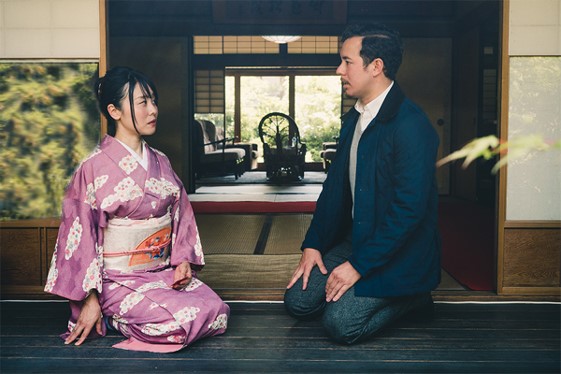
Impossible to Imagine, her debut narrative feature film is the story of Ami Shimizu (played by Yukiko Ito), a Kyoto woman doing her best to keep her mother’s kimono rental shop alive, and Hayato Arai (played by first-time actor William Yagi Lewis), the biracial Japanese business consultant that she hires for advice. It evolves into a romance, but it’s also an exploration of tradition versus change in one of Japan’s most traditional and impenetrable cities.

Although Tillack is Australian, the film is mostly in Japanese. “I felt that it was a story that needed to be told in Japanese with Japanese characters,” she says. “I wanted to start a conversation here in Japan.” She wrote the script initially in English and had it translated into Japanese. Tillack admits that the language barrier is “a big difficulty” when filmmaking in Japan, but both of the actors in the starring roles are bilingual. They were able to offer advice on cultural details and interpret, when necessary.

Tillack made the film on a shoestring budget of about a million yen (around US$10,000), financed out of her own pocket. The movie was shot in about ten days on the streets near her home. Although she wasn’t able to pay her actors and crew much, she said that she and her colleagues saw the making of the film as a “learning experience.”

Left to right: Felicity Tillack (director, writer), Yukiko Ito (main actress, Ami Shimizu) and William Yagi Lewis (main actor, Hayato Arai) at the Kyoto premiere of Impossible to Imagine.  Photo Courtesy: Morgan Lewis

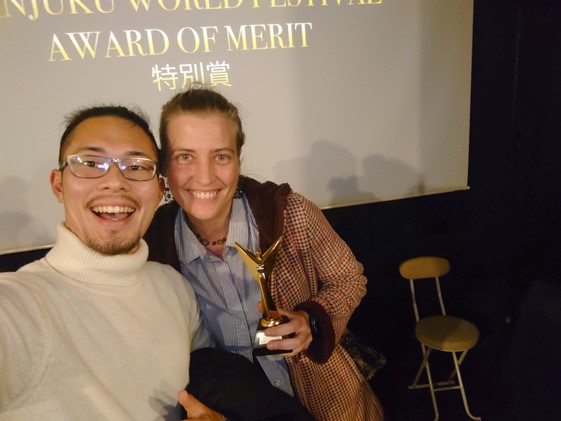
Impossible to Imagine has been shown at several film festivals, including the Paris Lift-Off Film Festival, and the Shinjuku World Film Festival in Tokyo. Tillack has also hosted screenings at various venues in Japan. At one such event held at a Buddhist temple in Kagawa Prefecture, the audience was mostly elderly and eager to discuss the issues brought up by the film. The movie is now streaming on Amazon, making it accessible to viewers all over the world.

Tillack, who cites Richard Linklater’s Before Sunrise series as an inspiration, had plans to start shooting a sequel: I had written the script, lined up financing, and everything.” But then the pandemic hit. Unable to make movies for the time being, she has started on another script, this one tentatively entitled Before Real Life Begins. It refers to the idea that foreigners often come to Japan after graduating from college intending to stay for a year or two before their “real life” starts. Tillack’s script contends that time spent in Japan is real life. Keeping in mind that Westerners experience Japan differently than Filipinos, for example, she hopes to explore this issue from various viewpoints. She is working on this story with two other writers who are based in Tokyo.

Tillack also had a hand in the forthcoming film Matcha and Vanilla, a love story written and directed by her friend Hamish Downie, who was the producer of Impossible to Imagine. Tillack is listed in the cast as “journalist” on the movie’s IMBD site, however she insists it’s only a bit part. Tillack’s future in filmmaking is off to a promising start.

In imagining a future for Japan, Felicity Tillack looks back at her own country’s history. “I was told when I was very young not to marry outside my culture,” she says – advice that she did not heed. She points out that in the 1970s, Australia was “95% white”, however, now, one in four in the country were born overseas. “Australia has changed culturally.” Through her work, both on this film and her other creative endeavors, Tillak suggests that her adopted country, too, may become more inclusive and accepting in the not-too-distant future.


Felicity Tillack (director, writer) and Shota Wanibe (sound mixer, boom operator) receiving an award at Shinjuku World Festival. Photo Courtesy: Shota Wanibe

.

Suzanne Kamata was born and raised in Grand Haven, Michigan. She now lives in Japan with her husband and two children. Her short stories, essays, articles and book reviews have appeared in over 100 publications. Her work has been nominated for the Pushcart Prize five times, and received a Special Mention in 2006. She is also a two-time winner of the All Nippon Airways/Wingspan Fiction Contest, winner of the Paris Book Festival, and winner of a SCBWI Magazine Merit Award.

Thanks to the columnist Suzanne Kamata for sourcing the photographs.

PLEASE NOTE: ARTICLES CAN ONLY BE REPRODUCED IN OTHER SITES WITH DUE ACKNOWLEDGEMENT TO BORDERLESS JOURNAL

Categories
Mission Earth

Mama Calling

By Kenny Peavy

The streetlights would dim. The magic hour when the sun sets over the horizon was settling in. Everything bathed in golden light.

It was the time of day that always beckoned for one last toss of the ball, one last kick, one last run.

Soon I would hear, “Keeeeeeeennnnnyyyyyyy! Keeeeeennnnnyyyyyy!!”

My mama would be shouting from the porch calling me home.

Time to scoot home before dark.

Whatever we happened to be doing that day was coming to its finale.

If we were playing some sort of ball, we’d have one last run. Screaming wildly as we knew it would be the last epic play of the day.

If we were in the woods, we’d scramble down the trail giggling the whole way. Stumbling over tree roots and errant rocks we’d make our way home before it got too dark to follow the path out into the clearing where it would still be bright enough to get home before it was pitch black out.

That was our life as kids. We had no idea it could be any different.

If you had this lifestyle, you were most likely born before the late 1980’s or early 1990’s. Most folks born in the 60’s, 70’s and 80’s had a childhood growing up outdoors playing with other children.

Youngsters went to school until about 3 o’clock. After school, you changed clothes as fast as you could standing on one leg without falling over. You would gulp down some cookies and water and scamper out of the door not to be seen until the sun slid below the horizon.

That’s how it was.

We played all sorts of games. Half of them we just made up ourselves like stick ball, jump rope using a water hose, and plenty of variations of a ball game with the core theme to throw a ball up in the air and then pounce fiercely and tackle whoever caught it.

Gangs of youngsters voraciously roamed the neighborhood looking for fun and diversion. Boys and girls alike. Mostly from about age 8 to 12 years old. 

If I recall correctly, the teens were just a bit too cool for our childish games. They had their own club.

If we weren’t playing ball games, we were fishing, exploring trails or building tree huts and forts of all size and manner.

I particularly liked fishing and exploring the pond and nearby creeks. 

I was drawn to anything outdoors in the woods, really. A fascination for learning how nature works grew out of a natural curiosity to discover what might lie under half-decomposed logs, below the leaf litter or straddled on the creek banks.

Those days of endless outdoor play. Searching. Looking. Finding. With boredom as a major component of what spurred us into creating our own games and entertainment.

Those memories are burned in my soul like the Georgia sun on a sweltering August day. 

We were always hot and sweaty. Perpetually looking for adventure. Seeking new ways to play and ultimately connect with each other and the earthy soil where we’d lie down in the shade of a massive oak tree collapsed from exhaustion. 

I’m afraid children don’t get that sort of freedom anymore. Free to explore and roam and play with their peers unfettered, unsupervised and unafraid.

I am hoping we can recapture that. A time for kids to play and explore. 

I wish we could see that it is necessary. We all need to get outside and connect with Nature.

I invite you to listen. Listen carefully and you will hear.

Our mama is calling. Shouting our names, she is calling us home.

She needs us to play in her forests and streams. 

She beckons us to roam around seeking, searching and exploring the natural world.

The magic hour is once again upon us and it’s time to bathe in golden light.

Courtesy: Kenny Peavy

Kenny Peavy is an environmentalist who has a memoir called Young Homeless Professional. He has co-authored a pioneering environmental education handbook, As if the Earth Matters, and recently, an illustrated book, The Box People , was re-released digitally to enable children, young people and their parents and educators anywhere in the world to use the book. He also created Waffle House Prophets: Poems Inspired by Sacred People and Places

PLEASE NOTE: ARTICLES CAN ONLY BE REPRODUCED IN OTHER SITES WITH DUE ACKNOWLEDGEMENT TO BORDERLESS JOURNAL

Categories
Poetry

Poetry by Luis Cuauhtémoc Berriozábal

By Luis Cuauhtémoc Berriozábal

GIVE NIGHT

Give night
my purest blessings 

and sky

my deepest thanks,
a solemn sigh,
the lost words
of a child that has
grown too fast.

It is not easy
to watch morning fade.
My eyes fixate on the sun
and the sound of nature
when I close my eyes.
The smell of your
absent scent 

is a smell I miss.
Between you and I,
I dread summer
and its heat
which finds joy

in my suffering. A
day does not go by
where sleeping soothes
these tears.
Suddenly,
the fiery sun
and the smell of you

not being here
reminds me how far
away you are. Funeral 
processions
fill my thoughts. The dead
go to the light.

In this state of being
it is hard to think.

The cool breeze fills the room
as I shake the sheets.
My soft pillow awaits
to take me to a new land.
I open my mind
and give in to sleep.

Give night
my dark blessings
and let the sleeping begin.

TAKEN DOWN

Taken down
by the huge
security guards
at the break
of dawn. This
village is
not for all
of us. I 
feel like First
Blood Rambo.
I just want
a place where
I could sleep
till five in
the a.m.
I will get
off the floor 
at five or
four forty-
five. No one 
is working
here until
six or so.
I was slammed
on my face.
I am not
so pretty.
I look worse
now than I 
did last night.

Luis Cuauhtémoc Berriozábal is a Mexican-born author, who resides in California and works in the mental health field in Los Angeles. His poems have appeared in Blue Collar Review, Kendra Steiner Editions, and Unlikely Stories.

.

PLEASE NOTE: ARTICLES CAN ONLY BE REPRODUCED IN OTHER SITES WITH DUE ACKNOWLEDGEMENT TO BORDERLESS JOURNAL