Categories
Review

Boats in a Storm: Migrant Narratives

Book Review by Bhaskar Parichha

Title: Boats in a Storm: Law, Migration, and Decolonization in South and Southeast Asia, 1942–1962

Author: Kalyani Ramnath

Publisher: Westland/Context

The legal frameworks established during the period from 1942 to 1962 in South and Southeast Asia played a crucial role in shaping migration patterns and influencing decolonisation processes. This era witnessed significant changes as countries in these regions sought to redefine their legal systems in the wake of colonial rule, which in turn affected the movement of people across borders.

Migration patterns were influenced by various factors, including the aftermath of World War II, the struggle for independence, and the establishment of new national identities. Additionally, the decolonisation processes during this time were marked by the emergence of new legal frameworks that aimed to address the complexities of post-colonial governance and the rights of migrants. Understanding the interplay between these legal frameworks, migration trends, and decolonisation efforts provides valuable insights into the socio-political landscape of South and Southeast Asia during this transformative period.

Boats in a Storm: Law, Migration, and Decolonization in South and Southeast Asia, 1942–1962  authored by Kalyani Ramnath is a thoroughly researched work. This book is  part of the series South Asia in Motion and was originally published by Stanford University. Ramnath serves as an Assistant Professor of History at the University of Georgia and has conducted extensive research on migration.

Says the blurb: “For more than a century before World War II, traders, merchants, financiers, and laborers steadily moved between places on the Indian Ocean, trading goods, supplying credit, and seeking work. This all changed with the war and as India, Burma, Ceylon, and Malaya wrested independence from the British empire.”

This captivating book is set against the backdrop of the tumultuous post-war period. It delves deeply into the legal struggles encountered by migrants who are determined to maintain their traditional ways of life and cultural practices. The narrative highlights their experiences with citizenship and the broader process of decolonisation. Even as new frameworks of citizenship emerged and the political landscapes of decolonisation created complexities that often obscured the migrations between South and Southeast Asia, these migrants consistently shared their cross-border histories during their engagements with the legal system.

These narratives, often obscured by both domestic and global political developments, contest the notion that stable national identities and loyalties emerged fully formed and free from the influences of migration histories after the fall of empires.

In her book, Kalyani Ramnath draws on archival materials from India, Sri Lanka, Myanmar, London, and Singapore to illustrate how former migrants faced legal challenges in their efforts to reinstate the prewar movement of credit, capital, and labour. The book is  set against the  backdrop of a climate marked by rising ethno-nationalism, which scapegoated migrants for taking away jobs from citizens and monopolising land.

Ramnath fundamentally illustrates in the book that the process of decolonisation was marked not just by the remnants of collapsed empires and the establishment of nation-states emerging from the debris of imperial breakdown. It also encompasses the often-ignored stories of wartime displacements, the unexpected consequences that arose from these events, and the lasting impacts they have had on societies.

This perspective highlights the complex and multifaceted process of decolonisation, demonstrating how it was shaped not only by significant political transformations but also by the personal narratives and experiences of individuals who faced the challenges of conflict and displacement.

An excellent book to read!
.

.

Bhaskar Parichha is a journalist and author of Cyclones in Odisha: Landfall, Wreckage and ResilienceUnbiasedNo Strings Attached: Writings on Odisha and Biju Patnaik – A Political Biography. He lives in Bhubaneswar and writes bilingually. Besides writing for newspapers, he also reviews books on various media platforms.

PLEASE NOTE: ARTICLES CAN ONLY BE REPRODUCED IN OTHER SITES WITH DUE ACKNOWLEDGEMENT TO BORDERLESS JOURNAL

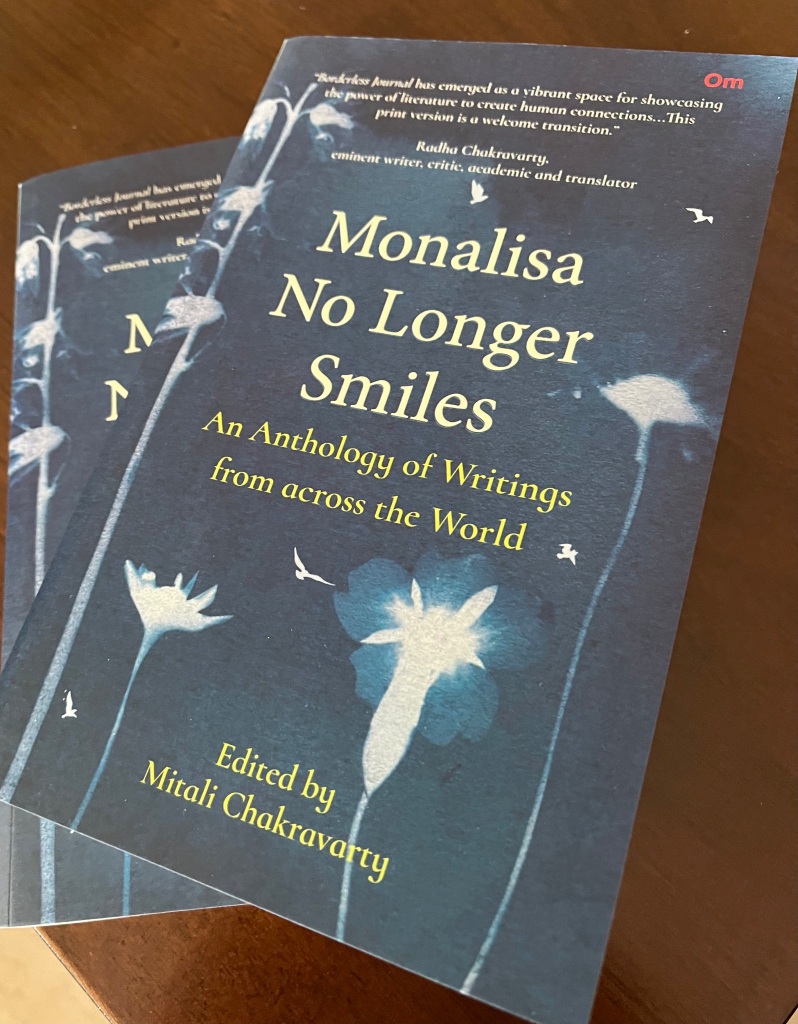
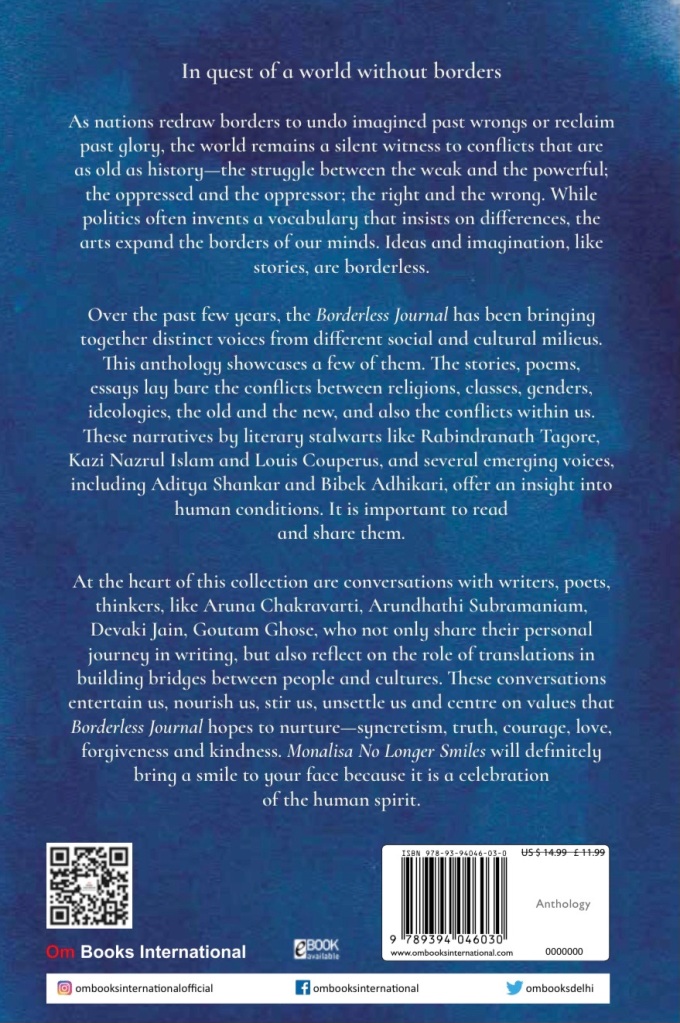
Click here to access the Borderless anthology, Monalisa No Longer Smiles

Click here to access Monalisa No Longer Smiles on Amazon International

Categories
Musings

What is Great Anyway?

By Farouk Gulsara

It all started with a Facebook post which quoted Churchill and read, “If you are twenty and not a Communist[1], you don’t have a heart. But if you are forty and still a leftist, you do not have a brain.” That snowballed into a literary discourse on the word great and what constitutes greatness. The funny thing is that Churchill never said anything to that effect. The closest one gets to that quotation is Otto von Bismarck, the first Chancellor of Germany who may have uttered, “He who is not a socialist at 19, has no heart. He who is still a socialist at 30, has no brain.” By the way, Bismarck’s brand of politics earned him the title ‘Iron Chancellor’. How do we classify something or someone as great or otherwise?

As written by the victors, history also designates Churchill as a great leader and statesman. A towering figure, he stood steadfast with the people, with his oratory skills, during ‘The Darkest Hour[2], as London was bombarded by German fighter planes. Surprisingly, he was also voted out of office after World War II. He was mentioned to have said, “History will be kind to me, for I intend to write it.”[3] I do not think that the family members of the 1943 Bengal famine victims will consider him anything but great – a racist, a bigot and a white supremacist, maybe. 

Even then, many in the United Kingdom thought Churchill was not a statesman but a foul-mouthed drunkard. At a function, a female guest of aristocratic standing, obviously not his fan, berated him and his politics. She is said to have said, “Sir, if you were my husband, I’d poison your tea.” Without a single pause, the witty Churchill quipped, “Madame, if you were my wife, I’d drink it!” [4]

When Churchill was informed about the Bengal Famine, he was infamously quoted as saying, “Serves them right for breeding like rabbits and, by the way, why isn’t Gandhi dead yet?” [5]

My point is that one man’s great leader may be another’s mortal enemy. This is especially true in a world where power and wealth are used as a yardstick of prosperity. We often forget that these commodities are finite; the losses of one side exactly offset the gains of the other.

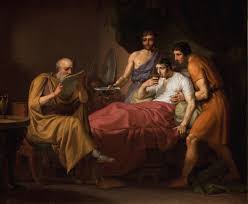
Alexander may be ‘Great’ for putting a small region called Macedonia on the world map. With all the carnage and misery he spread over the lands he and his army traversed, it took only the might of a tiny mosquito to bring him down. At least, that is one of the likely ways he died. Other contenders include alcoholic liver disease, depression and strychnine poisoning. 

Alexander The Great On His Sickbed, By Christoffer Wilhelm Eckersberg (c. 1783 – 1853). From Public Domain

Like Alexander, many monarchs with the suffix ‘The Great’, such as Peter, Catherine, and Frederick II, left behind an enormous body count and a trail of devastation. 

The Great ‘state-of-the-art’ Titanic was marketed as ‘unsinkable’, and itself was a lifeboat with tight watertight compartments, giving ample time for ferry passengers to be rescued by rescue vessels. Hence, the need for an adequate number of lifeboats was deemed unnecessary. We all know about the irony of its disastrous maiden journey, which is still spoken about a century later as one of Man’s greatest miscalculations.[6]

Indians of the 20th century honoured Karamchand Mohandas Gandhi as a selfless soul who chose a life of poverty to stir the masses’ consciousness towards self-rule. The people thought it appropriate to address him as Mahatma (the Great Soul) or the Father of the Nation. Today, an increasing number of Indians are having second thoughts. Perhaps they may have been taken for a ride and got the short end of the stick from the British. It is amusing that Gandhi’s son, Harilal, despite the reverence of the people of the subcontinent towards his father, also did not hold his father in high regard. Disillusioned with the senior’s move to block his law scholarship to England, Harilal became a rebel, spiralling into alcoholism, eventually becoming a public nuisance and falling into oblivion.[7] 

The Great War, also known as World War I, was touted as a necessary battle to end all wars. We know it never ended anything, but its post-war deals remain a nidus for World War II and the turmoils that persist even today. 

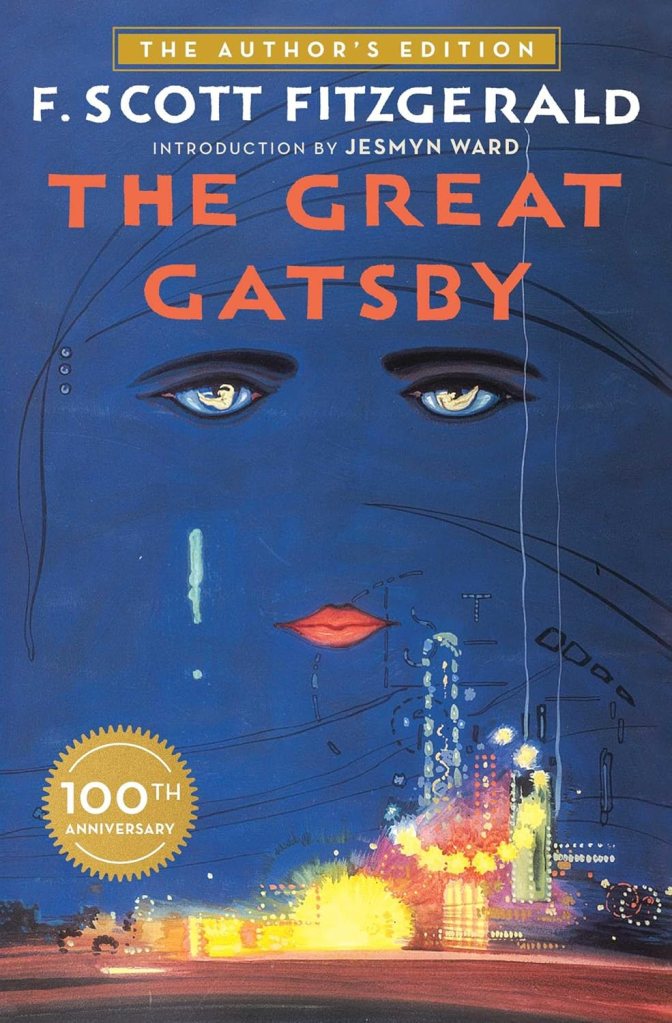
The Great Gatsby exposes the fallacy of the American Dream and the notion of a successful life under capitalism. F. Scott Fitzgerald shows that success-based materialism and trying to relive a nostalgic past will not lead to fulfilment. Instead, it will lead to a decadent path and disappointment. [8]

In a world so entrenched in wealth acquisition, we have heard of many families afflicted with the misfortune of striking it rich in the lottery and seeing their family spiral into an abyss.

The Great Train Robbery in 1963, the UK’s biggest heist, where the robbers scooted off with the present-day value of £62 million, ended with none of the culprits laying their hands on the loot, but mostly just behind bars. [9]

Just look at Trump and his track to the White House using the ticket which promises to ‘Make America Great Again (MAGA)’. The illusion of the blissful past only morphed into civil unrest, which required the deployment of National Guards and Marines to use flash-bang grenades and tear gas to squash down their own citizens. If that was not enough, now there is talk of MIGA — Make Iran Great Again, perhaps returning Iran to its glory days of the Persian Empire! [10]

When we describe something as great, we usually refer to it in a positive light, as something extraordinary pushing human abilities beyond normal boundaries. It is a subjective assessment. One man’s greatness is another’s failure. It can serve as a cautionary tale for those who have fallen. 

It’s just food for thought. After having a bad day at the office when nothing went right, we returned to find that we had forgotten the house key at work and had to go all the way back to the office to retrieve it. What do we say? “Great!”

.

[1] ). Even though this quote is often referred to as coming from Churchill, it may have  been originated from Otto von Bismarck, the first Chancellor of unified Germany between 1871 and 1890. He could have said, “he who is not a socialist at 19, has no  heart. He who is still a socialist at 30, has no brain.”

Katycarruther’s.com

https://en.wikiquote.org/wiki/Talk:Otto_von_Bismarck#Unsourced

[2] Speech and 2017 bmovie, which included the speech called ‘The Darkest Hour’

[3] https://www.goodreads.com/quotes/4611-history-will-be-kind-to-me-for-i-intend-to

[4] People probably put words into Churchill’s mouth. It may be a misquotation. The conversation may have taken place between Lady Astor and Churchill’s aide. 

https://www.smithsonianmag.com/history/illustrious-history-misquoting-winston-churchill-180953634/

[5] Churchill’s policies contributed to the 1943 Bengal famine – study.

https://www.theguardian.com/world/2019/mar/29/winston-churchill-policies-contributed-to-1943-bengal-famine-study

[6] Did Anyone Really Think the Titanic was Unsinkable? The makers probably oversold it.’

https://www.britannica.com/story/did-anyone-really-think-the-titanic-was-unsinkable

[7] Father to a nation, stranger to his son.

https://www.theguardian.com/film/2007/aug/10/india

[8] The reality was not what success for everyone in America.

https://www.ewadirect.com/proceedings/chr/article/view/9147

[9] The men behind the Great Train Robbery

https://www.bbc.co.uk/culture/article/20250410-the-men-behind-the-great-train-robbery

[10] MAGA to MIGA.

https://www.wionews.com/world/from-maga-to-miga-donald-trump-suggests-regime-change-to-make-iran-great-again-1750631822282/amp

.

Farouk Gulsara is a daytime healer and a writer by night. After developing his left side of his brain almost half his lifetime, this johnny-come-lately decided to stimulate the non-dominant part of his remaining half. An author of two non-fiction books, Inside the twisted mind of Rifle Range Boy and Real Lessons from Reel Life, he writes regularly in his blog, Rifle Range Boy.

Disclaimer: The opinions expressed are solely that of the author and not of Borderless Journal.

PLEASE NOTE: ARTICLES CAN ONLY BE REPRODUCED IN OTHER SITES WITH DUE ACKNOWLEDGEMENT TO BORDERLESS JOURNAL

Click here to access the Borderless anthology, Monalisa No Longer Smiles

Click here to access Monalisa No Longer Smiles on Kindle Amazon International

Categories
Review

Six Economists and the World they Made

Book Review by Bhaskar Parichha

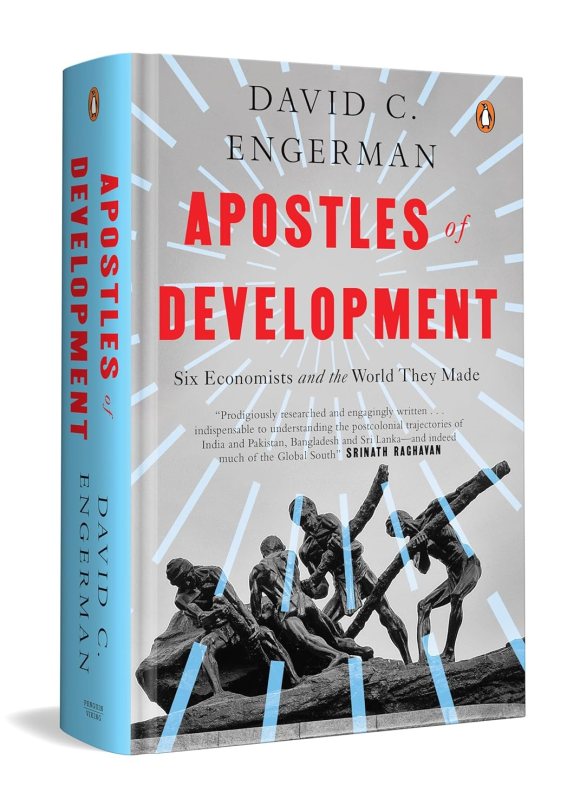
Title: Apostles of Development: Six Economists and the World They Made 

Author: David C. Engerman

Publisher: Penguin Viking

David C. Engerman is a Yale University professor focused on twentieth-century international history. He has authored two books on Russia and the USSR’s influence on American politics and has extensively studied international development assistance. His key works include the co-edited volume Staging Growth: Modernization, Development and the Global Cold War (2003) and the monograph, The Price of Aid: The Economic Cold War in India. His research was featured in his 2016 presidential address to the Society for Historians of American Foreign Relations. He is currently writing a comprehensive history of international development, tentatively titled International Development: A History in Eight Crises.

Apostles of Development: Six Economists and the World They Made by Engerman focuses on six influential economists from South Asia : Amartya Sen, Manmohan Singh, Mahbub ul Haq, Jagdish Bhagwati, Rehman Sobhan and Lal Jayawardena.

All six were born as colonial subjects in the British Empire and studied at Cambridge University. They emerged as pioneering “Third World development experts”, playing central roles in shaping global debates on poverty, inequality, and economic development.

The book highlights that the fight against global poverty, which began in the aftermath of World War II, represented a monumental effort that brought together economists, engineers, and a multitude of organisations.

This period marked the emergence of economists as a vital force in global affairs, playing a crucial role in shaping international dialogues focused on poverty alleviation and development strategies. Their contributions were essential in formulating policies and initiatives aimed at addressing the complex challenges of poverty on a worldwide scale.

Writes Engerman in the introduction: “The Apostles’ careers — and their home countries — demonstrate that there was no one path to development. Many governments in new nations opted to build factories. Others focused on roads and power plants, or on schools and hospitals. Some, like India, stressed economic self-reliance while others, including Pakistan and Ceylon, pursued international trade. Whatever the strategy, debates over the role of government-which frequently divided these six-resonated with the growing tensions of the Cold War, which pitted contrasting economic and political models against each other. Yet development was no mere creature of the Cold War, especially when examined from the perspective of the former colonies.” 

He further contends: “Core ideas and practices of development changed dramatically over the Apostles’ long careers. Debates roiled academic conferences, di- vided planning commission discussions, and dominated international venues — and the Apostles participated on all sides. Was the goal of development to alleviate poverty or was it to reduce inequality? Was the best solution to expand the economic role of government or to reduce it? Was national development better served by becoming self-sufficient was economic theory universal or did a different set of economic rules (and therefore economic tools) apply to poor countries than to rich ones? Development was always contested. 

“The Apostles’ turn to economics was in keeping with the spirit of the age. Economic questions loomed large in the middle of the twentieth century and economists proved ready, willing, and able to offer answers. Political leaders frequently sought their expertise and the century’s leading economists answered that call. The Depression cried out for an explanation that suggested a solution; the doyen of Cambridge economics, John Maynard Keynes, took on that task with gusto. The fate of World War II was determined as much by each side’s ability to mobilize resources as it was by battlefield tactics– hence Paul Samuelson’s boast that it was ‘an economist’s war’. And the problems of the postcolonial world arose precisely as economics was becoming what one historian called ‘the master discipline of the 20th century’.”

The book emphasizes that the origins and driving force of development were rooted in the Global South, aiming to improve the conditions of the world’s poorest countries, rather than being a project imposed by the West.It explores the different economic philosophies of these six economists and the ongoing debate about how economic theory should differ for poor versus rich countries.

Engerman challenges the idea that development is simply a tool for rich countries to dominate or a pure expression of humanitarianism. Instead, he argues that successful development comes from practical solutions tailored to real-world problems, not rigid ideological frameworks.

The book advocates for a modest, pragmatic approach to development, prioritising the reduction of gross inequality and insisting that development means more than just economic growth.

The narrative situates these economists’ work in the broader context of the Cold War and the shifting global landscape, highlighting how their ideas shaped and were shaped by international politics and economic crises.

This extensively researched and substantial book is acknowledged as a significant and timely addition to the literature concerning economics, economic history, and the progression of development thought, particularly in light of current global discussions regarding inequality and the prospects for economic growth.

Apostles of Development is suggested for those who are interested in the historical context of development economics, the influence of the Global South on global policy formulation, and the life stories of several of the most impactful economists of the 20th century.

.

.

Bhaskar Parichha is a journalist and author of Cyclones in Odisha: Landfall, Wreckage and ResilienceUnbiasedNo Strings Attached: Writings on Odisha and Biju Patnaik – A Political Biography. He lives in Bhubaneswar and writes bilingually. Besides writing for newspapers, he also reviews books on various media platforms.

.

PLEASE NOTE: ARTICLES CAN ONLY BE REPRODUCED IN OTHER SITES WITH DUE ACKNOWLEDGEMENT TO BORDERLESS JOURNAL

Click here to access the Borderless anthology, Monalisa No Longer Smiles

Click here to access Monalisa No Longer Smiles on Amazon International
Categories
Review

A Stranger in Three Worlds

Book Review by Bhaskar Parichha

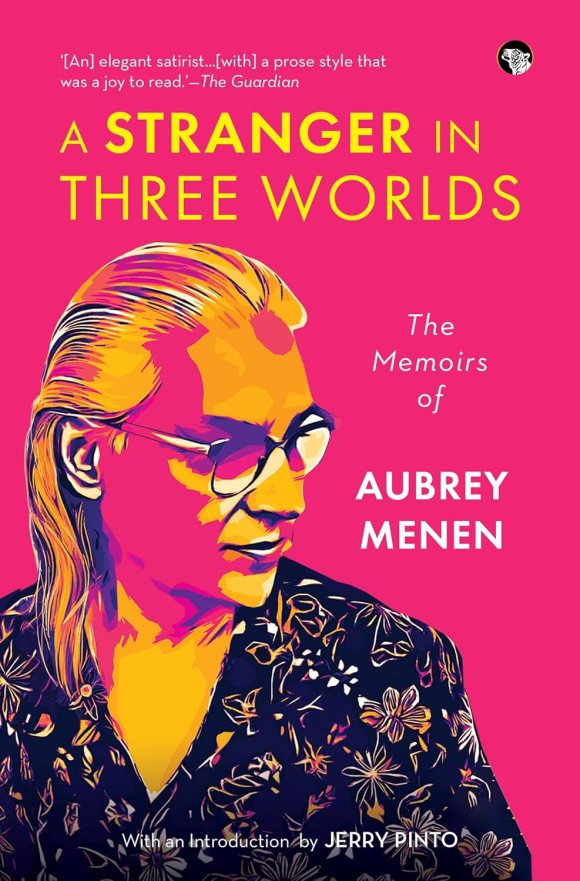
Title: A Stranger in Three Worlds: The Memoirs of Aubrey Menen

Author: Salvator Aubrey Clarence Menen

Publisher: Speaking Tiger Books

Salvator Aubrey Clarence Menen (April 22, 1912 – February 13, 1989) was a British author, novelist, satirist, and theatre critic. Born in London to Irish and Indian parents, he studied at University College, London, before becoming a drama critic and stage director. During World War II, he was in India, organising pro-Allied radio broadcasts and editing film scripts for the Indian government.

After the war, he returned to London and worked in an advertising agency’s film department, but the success of his debut novel, The Prevalence of Witches (1947), led him to write full-time. Menen’s satirical works explore themes of nationalism and the cultural contrast between his Irish-Indian heritage and his British upbringing.

Menen, a remarkably gifted author who frequently goes unnoticed, adeptly delves into the intricate themes of identity, nationality, and the sense of belonging. He does so with his signature blend of irony and profound insight in his two acclaimed autobiographical pieces. A Stranger in Three Worlds: The Memoirs of Aubrey Menen is an exceptional autobiographical account that spans multiple continents. Menen’s writing is noted for its irony, insight, and a nuanced exploration of themes such as belonging and the quest for the self in a multicultural context.

Menen’s life narrative is defined by his experience as an outsider, or a ‘stranger,’ within the three distinct cultures of England, Ireland, and India. This position of being an outsider enables him to keenly observe and critique the social and cultural norms prevalent in each society with remarkable clarity and humor.

 The memoir explores the inherent tensions and contradictions that arise from possessing multiple, often conflicting, identities, as well as the difficulties of establishing a coherent sense of self when one does not entirely belong to any particular group.

The book’s narrative style is marked by irony and a keenly humorous outlook on the absurdities of the social conventions and biases he encounters across these cultures. His insights are both deeply personal and widely relatable, resonating with anyone who has navigated the complexities of multicultural or diasporic identity.

The essays featured in Dead Man in the Silver Market, originally published in 1953, analyse themes of jingoism, social class, and the absurdities associated with national pride, intertwining personal stories with sharp social critique.

Written shortly after World War II, his irreverent insights into English society, colonial history, and human nature continue to resonate powerfully in contemporary discourse. ‘The Space within the Heart’, authored in 1970, presents a more personal and philosophical exploration of existence, love, and self-awareness.

Infused with humour and gentle satire, it contemplates the essence of the soul, drawing from the Upanishads and European literary traditions. Menen’s seemingly straightforward yet deeply impactful writing encourages readers to transcend rigid identities and appreciate the fluidity inherent in the human experience.

With an introduction by Jerry Pinto, this omnibus edition functions as a memoir, offering personal reflections and experiences, while simultaneously serving as a critique of imperialism, examining its impacts and consequences.

Furthermore, it thoroughly explores the intricacies of identity, rendering it an exceptional piece of literature that is both informative and captivating, prompting readers to engage in deep reflection on its themes.

.

Bhaskar Parichha is a journalist and author of Cyclones in Odisha: Landfall, Wreckage and ResilienceUnbiasedNo Strings Attached: Writings on Odisha and Biju Patnaik – A Political Biography. He lives in Bhubaneswar and writes bilingually. Besides writing for newspapers, he also reviews books on various media platforms.

.

PLEASE NOTE: ARTICLES CAN ONLY BE REPRODUCED IN OTHER SITES WITH DUE ACKNOWLEDGEMENT TO BORDERLESS JOURNAL

Click here to access the Borderless anthology, Monalisa No Longer Smiles

Click here to access Monalisa No Longer Smiles on Amazon International
Categories
Excerpt

Let’s Be Best Friends Forever

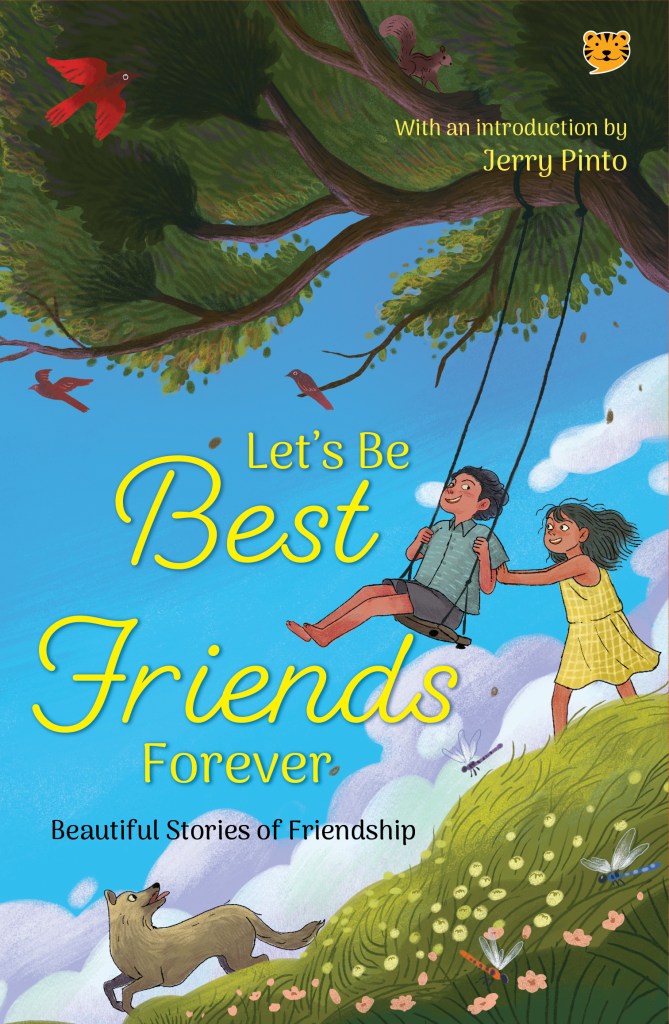
Title: Let’s Be Best Friends Forever: Beautiful Stories of Friendship

Publisher: Talking Cub, Speaking Tiger Books

From ‘The Tunnel of Friendship’ by Ruskin Bond

I had already started writing my first book. It was called Nine Months, but had nothing to do with a pregnancy; it referred merely to the length of the school term, the beginning of March to the end of November, and it detailed my friendships and escapades at school and lampooned a few of our teachers. I had filled three slim exercise books with this premature literary project, and I allowed Azhar to go through them. He was my first reader and critic. ‘They’re very interesting. But you’ll get into trouble if someone finds them,’ was his verdict.

We returned to Shimla, having won our matches against Sanawar, and were school heroes for a couple of days. And then my housemaster discovered my literary opus and took it away and read it. I was given six of the best with a Malacca cane, and my manuscript was torn up. Azhar knew better than to say ‘I told you so’ when I showed him the purple welts on my bottom. Instead, he repeated the more outrageous bits he remembered from the notebooks and laughed, till I began to laugh too.

‘Will you go away when the British leave India?’ Azhar asked me one day.

‘I don’t think so,’ I said. ‘My stepfather is Indian. My mother’s family have lived here for generations.’

‘Everyone is saying they’re going to divide the country. I think I’ll have to go away.’

‘Oh, it won’t happen,’ I said glibly. ‘How can they cut up such a big country?’

‘Gandhi will stop them,’ he said.

But even as we dismissed the possibility, Jinnah, Nehru and Mountbatten and all those who mattered were preparing their instruments for major surgery.

Before their decision had any effect on our life, we found a little freedom of our own—in an underground tunnel that we discovered in a corner of the school grounds. It was really part of an old, disused drainage system, and when Azhar and I began exploring it, we had no idea just how far it extended. After crawling along on our bellies for some twenty feet, we found ourselves in complete darkness. It was a bit frightening, but moving backwards would have been quite impossible, so we continued writhing forward, until we saw a glimmer of light at the end of the tunnel. Dusty, a little bruised and very scruffy, we emerged at last on to a grassy knoll, a little way outside the school boundary. We’d found a way to escape school!

The tunnel became our beautiful secret. We would sit and chat in it, or crawl through it just for the thrill of stealing out of the school to walk in the wilderness. Or to lie on the grass, our heads touching, reading comics or watching the kites and eagles wheeling in the sky. In those quiet moments, I became aware of the beauty and solace of nature more keenly than I had been till then: the scent of pine needles, the soothing calls of the Himalayan bulbuls, the feel of grass on bare feet, and the low music of the cicadas.

World War II had just come to an end, the United Nations held out the promise of a world living in peace and harmony, and India, an equal partner with Britain, would be among the great nations…

But soon we learnt that Bengal and Punjab provinces, with their large Muslim populations, were to be bisected. Everyone was in a hurry: Jinnah and company were in a hurry to get a country of their own; Nehru, Patel and others were in a hurry to run a free, if truncated, India; and Britain was in a hurry to get out. Riots flared up across northern India.

At school, the common room radio and the occasional newspaper kept us abreast of events. But in our tunnel Azhar and I felt immune from all that was happening, worlds away from all the pillage, murder and revenge. Outside the tunnel, there was fresh untrodden grass, sprinkled with clover and daisies, the only sounds the hammering of a woodpecker, and the distant insistent call of the Himalayan barbet. Who could touch us there?

‘And when all wars are done,’ I said, ‘a butterfly will still be beautiful.’

‘Did you read that somewhere?’ Azhar asked.

‘No, it just came into my head.’

‘It’s good. Already you’re a writer.’

Though it felt good to hear him say that, I made light of it. ‘No, I want to play hockey for India or football for Arsenal. Only winning teams!’

‘You’ll lose sometimes, you know, even if you get into those teams,’ said wise old Azhar. ‘You can’t win forever. Better to be a writer.’

One morning after chapel, the headmaster announced that the Muslim boys—those who had their homes in what was now Pakistan—would have to be evacuated. They would be sent to their homes across the border with an armed convoy.

It was time for Azhar to leave, along with some fifty other boys from Lahore, Rawalpindi and Peshawar. The rest of us—Hindus, Christians, Buddhists, Sikhs and Parsis—helped them load their luggage into the waiting British Army trucks that would take them to Lahore. A couple of boys broke down and wept, including our departing school captain, a Pathan who had been known for his unemotional demeanour. Azhar waved to me and I waved back. We had vowed to meet again some day. We both kept our composure.

The headmaster announced a couple of days later that all the boys had reached Pakistan and were safe. On the morning of 15 August 1947, we were marched up to town to witness the Indian flag being raised for the first time. Shimla was still the summer capital of India, so it was quite an event. It was raining that morning. We were in our raincoats and gumboots, while a sea of umbrellas covered the Mall.

(Extracted from Let’s Be Best Friends Forever: Beautiful Stories of Friendship, with an introduction by Jerry Pinto. Published by Talking Cub, the children’s imprint of Speaking Tiger Books.)

ABOUT THE BOOK

 An Afghan trader and a young Bengali girl form a touching connection that transcends cultural barriers in Rabindranath Tagore’s classic story ‘The Kabuliwala’. Jo March and Laurie from Little Women meet at a dull party and become companions for life. L. Frank Baum’s timeless characters Dorothy and Toto adventure around Oz forging magical bonds of friendship.

The brave queen of Jhansi and her ally Jhalkaribai come together to fight for freedom and dignity; Jesse Owens narrates an inspiring tale of sportsmanship and solidarity from his Olympic days; and twelve-year-old Kamala and her friends, Edward, Amir and Amma, endure the Partition riots together in Bulbul Sharma’s heart-warming story.

In these pages you will also meet Nimmi and her best pal, Kabir, whose school misadventures include spirited debates; Sunny, whose love for books leads to a new friendship on a trip to Darjeeling; Cyril and Neil, who face life’s challenges with inventive word games, and Siya, who discovers that true friends can come in the most unexpected forms—even as a cherished doll.

Animal lovers will delight in the escapades of Gillu, the charming squirrel, Harold, the handsome hornbill, Rikki-tikki-tavi, the loyal mongoose, Hira and Moti, the powerful oxen, and Bagheera, the brave panther who looks after the young boy Mowgli.

With stories from beloved and popular authors—Ruskin Bond, Rudyard Kipling, Mahadevi Varma, Jerry Pinto, Shabnam Minwalla, and many more—Let’s Be Best Friends Forever is an enchanting collection that celebrates the universal power and beauty of friendship.

.

PLEASE NOTE: ARTICLES CAN ONLY BE REPRODUCED IN OTHER SITES WITH DUE ACKNOWLEDGEMENT TO BORDERLESS JOURNAL

Categories
Essay

How Do You Live?

By Aditi Yadav

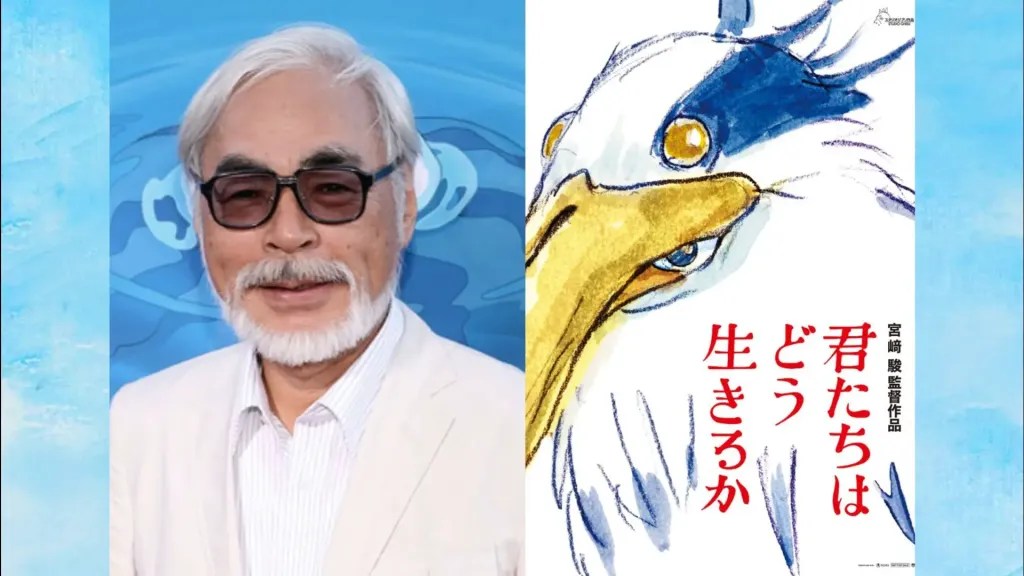
Hayao Miyazaki and the poster of The Boy and the Heron in Japanese

In January 2024, The Boy and the Heron became the first Japanese movie to win the Golden Globe Award for the Best Animated Feature Film. However, when the original movie was released by Studio Ghibli in the summer of 2023 in Japan, it was marketed with ‘no marketing at all’-without any trailers, TV commercials or newspaper advertisements. A minimalist movie poster carrying the sketch of a heron and the Japanese title Kimitachi wa Dō Ikiru ka, was all it took the movie to record the biggest box office opening in Studio Ghibli’s history.

Hayao Miyazaki, the godfather of Japanese animation who celebrated his 83rd birthday in January, 2024, broke a decade long hiatus to give his directorial swansong to the world. The movie is inspired by Miyazaki’s favourite book Kimitachi wa Dō Ikiru ka, written by Genzaburo Yoshino in 1937. This coming-of-age Japanese classic had been tenderly translated into English under the title How Do You Live? by Bruno Navasky and brought out by Penguin in 2021 with a foreword by a writer no less than Neil Gaiman.   

The protagonist of the story is Honda Junichi, a fifteen-year-old boy nicknamed ‘Copper’ after Copernicus, by his uncle.  He has a diminutive frame, but his intelligence, bright personality and athletic skills, make him a popular kid at school. As Copper has been raised by a single mother, his uncle, who is a fresh law graduate, is the only male guardian around him. Their bond is an interesting one: not only do they share a warm friendship, but also discuss about the world at large, its history, philosophy, human relationships, so on and so forth. 

 The book chronicles Copper’s world, his thoughts and day-to-day incidents, in a format that alternates between a third person narrative and notes from the diary Copper’s uncle. Copper’s everyday experiences are similar to those of any other school going child — peers bullying, fighting, discovering class differences, bonding over games, pranking one another, and so on. The book delves into the mind of the adolescent boy, trying to make sense of the world to understand how he’d transition to an adult. He approaches the world with an innocent curiosity, musing how people are ‘a little like water molecules’ in the vast ocean of human society.

His uncle deeply moved by these observations and expressions, begins to pen down about these interesting episodes in his notebook. He also adds facts and references associated with them, that encompass wide range of topics including art, science, economics, history, politics, philosophy and language. He probably thinks that when Copper reads the notebook later on, it would help him see the world better alongside his personal mental and moral evolution. These notebook entries bear sagacious titles like- ‘on ways of looking at things’, ‘on human troubles, mistakes and greatness’, ‘on human relationships’, ‘on poverty and humanity’, etc. However, the words do not intend to preach. They brim with warmth of empathy, and capture the strengths and vulnerabilities of being human: “If it means anything at all to live in this world, it’s that you must live your life like a true human being and feel just what you feel. This is not something that anyone can teach from the sidelines, no matter how great a person becomes.”

Yoshino wrote the book as a part of the “Nihon Shoukokumin Bunko” (Library of books for the Younger Generation) that aimed at disseminating progressive knowledge and ideas to Japanese young adults. The work is a precious one – a classic example of how thoughtful adults can help young children to have a healthy mind and human heart.

Published in 1937, this masterpiece itself is an act of resistance against all regressive beliefs and authoritarianism, as Navasky pens in his Translator’s note, the book is “…particularly valuable to us now, when violence against citizens is on the rise, and independent thinkers are being attacked by their governments”. The book itself was censured several times, before it could be printed in its originally intended form. It’s important to mention here that from 1911 to 1945, Tokubetsu Kōtō Keisatsu (or Tokko), the Special Higher Police, heavily monitored political groups and ideologies that posed a threat to the Empire of Japan.  The Peace Preservation Law passed in 1925, expanded the powers of Tokko to suppress all socialist and communist idea in Japan. The heavy-handed ‘thought policing, only ended in 1945 with Japan’s surrender in World War II.

How we live, invariably depends on how we think. The universality of the book lies in how it links thought processes across borders — individual and collective — will have decisive roles in the ideals we follow and the society we construct. Our journey from the primitive caves to modern skyscrapers has been a long and tumultuous one. The prowess of human mind and the resilience of human spirit has brought of this far, but a peaceful society demands empathy and honesty of the human heart. Copper is sensitive enough to realise this, when he jots down–

“I think there has to come a time when everyone-one in the world treats each other as if they were good friends. Since humanity has come so far, I think now we will definitely be able to make it to such a place.

So, I think I want to become a person who can help that happen.”

Charting the ups and downs in the life of young Copper, the book closes on a sunny fulfilling note where our protagonist sees the world with an open heart as his extended family. And so, this timeless classic that touches the heart ends with a deep question for all of us – “How will you live?”

.

Aditi Yadav is a public servant from India. As and when time permits she engages in creative pursuits and catches up her never-ending to-read list. Her works appear in Rain Taxi Review of books, EKL review, Usawa Literary Review, Gulmohur Quarterly, Narrow Road Journal and the Remnant Archive.

PLEASE NOTE: ARTICLES CAN ONLY BE REPRODUCED IN OTHER SITES WITH DUE ACKNOWLEDGEMENT TO BORDERLESS JOURNAL

Click here to access the Borderless anthology, Monalisa No Longer Smiles

Click here to access Monalisa No Longer Smiles on Amazon International

Categories
Essay

Uehara by Kamaleswar Barua

A story based on the end of a world war II soldier by Kamaleswar Barua in Assamese, translated by Bikash K. Bhattacharya

Ei Ran Ei Jivan, a collection of wartime narratives penned and published in 1968 by the Assamese writer, Kamaleswar Barua who served as a military engineer in the British Indian Army during the Second World War. Photo: Bikash K. Bhattacharya

Introduction

This is a translation of the narrative “Uehara” from Kamaleswar Barua’s Ei Ran Ei Jivan [1], a collection of narratives published in Assamese in 1968 based on “true events and characters” the author had encountered while serving as a military engineer in the British Indian Army in the Second World War.

Kamaleswar Barua is a relatively lesser-known figure in Assamese literature. Having earned a bachelor’s degree in Civil Engineering from the University of Calcutta in 1932, Barua joined the British Indian Army as an engineer serving in the Naga hills, Manipur and Burma. Attached to engineering field companies, he saw combat in some of the fiercest battles fought in the region in the course of the Second World War. He rose to the rank of major. After the war, Barua earned a master’s degree in City Planning from the University of California, Berkley, in 1951.

Barua was an active member of Assamese literary clubs and reading groups like the Mukul Sangha, a club formed in January 1945 in Shillong, the then capital of Assam. It was in the weekly meetings of Mukul Sangha that Barua shared his personal accounts of the war before turning them into written narratives. Uehara’s story was also first told to a small audience of Assamese litterateurs who encouraged Barua to publish it [2]. However, the project took a backseat for a long time and Barua finally published an anthology of nine narratives, “based on characters he’d encountered during the war”, in 1968. Titled Ei Ran Ei Jivan—which translates as “This War, This Life” or as “Now War, Now Life”—the anthology’s fourth narrative is “Uehara”.

What makes the anthology interesting is the novelty of the genre. The author terms it “a collection of kahini (narratives) about a few wartime characters.” The standard word for short story in Assamese is galpa, while the word kahini doesn’t refer to a specific literary genre. A kahini could be fictional, but it could also be a true historical account. The generic instability notwithstanding, Barua declares in the preface to the anthology, “The names of the characters have been fictionalised unless they’re historically well-known people. I’ve strived to remain true to the characters as best as I could as I’d known and witnessed them.” The preface makes it amply clear that the kahinis Barua tells us are a specific type of wartime memoir narratives rather than autobiographical short stories.

While Barua’s “Uehara” remains a little-known, obscure work, the most prominent literary artefact in Assamese depicting the Japanese in the Second World War in northeast India is Birendra Kumar Bhattacharyya’s short story ‘Agyaat Japani Xainik’ (An Unknown Japanese Soldier) [3]. However, “Uehara” is probably the only work in Assamese that depicts an actual historical encounter between an Assamese native serving the Raj and an Imperial Japanese Army soldier. Barua’s narrative not only portrays an empathetic picture of the mortally wounded Japanese soldier, which is rare in the region’s Second World War literature, but also evokes Pan-Asianism [4].

The original text, by Barua, didn’t contain any notes in it. The endnotes, referenced to academic works for driving home the broader historical context, or for the purposes of clarification, have been added by the translator.

Translation

Uehara

July, 1944. It wouldn’t be an exaggeration to say that Imphal, the capital of the Kingdom of Manipur, was completely encircled by the Imperial Japanese Army. The only way out of Imphal was via air [5]. The city had been maintaining contact with the outside world through Koirengei airport. The plains of Imphal were surrounded on all sides by circular formations of Japanese troops. The city of Imphal and the Allied troops and war equipment it hosted, had been under siege for three months. During this period, there had been several fights between Allied soldiers and Japanese troops just outside the city centre of Imphal. The Japanese suffered huge losses. Many Japanese soldiers were captured and kept as prisoners of war (POW) by the Allied forces. Those who died were buried in temporary graves. The wounded Japanese soldiers were treated in Allied military hospitals and despatched to POW camps in Imphal. Starvation and sleeplessness had taken a toll on their war-weary, scarred bodies. The medical treatment they received was far from satisfactory. Shortage of doctors, nurses as well as medical supplies made it difficult to meet the requirements of the wounded Allied soldiers [6].In such a dire situation, it was only natural that the Allied forces fell short when it came to providing medical care to the wounded enemy soldiers, the Japanese POWs. As a result, the tally of dead soldiers increased by the day.

I had been undergoing treatment at a hospital in the besieged city of Imphal. I was gradually recovering from an intermediate risk surgery. Wounded soldiers from the frontline were arriving at the hospital all the time. By then, I’d been well acquainted with the horrors of war. The scenes were indescribable. It appeared as if lives and limbs of men had little value. I’d become accustomed to the sight of countless wounded soldiers, without limbs or a portion of the face, being brought to the hospital on stretchers. This war was necessary in order to establish peace and freedom, especially individual freedom, they said!

The ward next to the one I was staying at was reserved for the wounded enemy soldiers. Armed sentries guarded the ward all the time. This was where I met Uehara, an Imperial Japanese Army officer who’d sustained severe combat wounds in his chest. The angel of death appeared to be calling him. Uehara expressed his desire to share his last words with a fellow Asian.

Following the order of the commanding officer of the hospital, a British interpreter with knowledge of the Japanese language accompanied me to Uehara’s bed. I sat on a chair close to his bed and the interpreter sat beside me. As Uehara started to speak in Japanese, the interpreter translated his words into English for me.

Uehara was from a small village located on the outskirts of the city of Nagasaki. He was born to a family of farmers. He studied Japanese language, mathematics, geography and Japanese history in the village school. He started assisting his father in farm work since he was sixteen. They had a small plot of land. They cultivated paddy twice a year, and on a separate plot of land, they planted soy bean and vegetables. They had a cow, a few pigs and a flock of roosters and hens. And they had a small but neat wooden house where the four members of the family—Uehara, his parents and his sister—lived. They also had a small garden consisting of a few cherry trees and chrysanthemums. The blossoming of the cherry flowers in the month of May would bring a joy-filled atmosphere to the family. Although their garden was small, they had different colours of chrysanthemums that decorated the courtyard. Uehara’s sister would take care of the garden. The Ueharas would not earn much but they had a stable and happy life sustained by whatever income they would gain from their farm.

But destiny would not tolerate the peaceful life of the Ueharas. Things would take a sharp turn, and dark clouds of misfortune hung in the heavens.

December, 1941. Japan bombed Pearl Harbour, and the President of the United States of America declared war on the Empire of Japan. The young men of Japan either volunteered for, or drafted to, the Imperial Japanese forces. Uehara was one of them. Having undergone training in Tokyo, he was recruited to the Imperial Guards Division of the Japanese Army where he rose to the rank of officer. While serving in Tokyo, he met Yuzuki, a military nurse.

Yuzuki had a round face, a bright pair of eyes and beautiful black hair tied to the back of her head. Uehara was enamoured of her spritely and empathetic behaviour. They fell in love and got married. As the newlywed couple was nurturing dreams about their future, Uehara’s regiment was ordered to Burma [7]. With teary eyes, Uehara and Yuzuki took leave from each other at the Tokyo airport.

Uehara was hopeful. He had unwavering faith in the Mikado [8] and that Japan would emerge victorious in the war. And once the war was over, Uehara would settle down with Yuzuki somewhere in a quiet corner of Nagasaki or Tokyo in a small house with a courtyard and a garden of cherry trees that would offer a nice view of daybreak on the seashore. There they would raise a small family. This youthful determination kept Uehara and Yuzuki going even in separation.

In the jungles of Burma, Uehara’s regiment kept advancing—capturing town after town, Hakha, Falam, Tedim—on their way to Imphal in Manipur. Along with other Japanese troops, his regiment also took part in the siege of Imphal. One day, during the Battle of Imphal, artillery shells hit his chest, severely wounding him. Once he regained consciousness, Uehara found himself in the Allied military hospital. The days that followed were very painful for him. The doctors, despite their efforts, could not stop the bleeding from the wound. Although war essentially entails killing enemy troops, the rules of war also dictate that one is responsible for providing medical care to enemy soldiers wounded in combat. That said, many wounded soldiers are left in the battlefield to die.

When Uehara was narrating his story through the interpreter, I could not understand his language. But I could feel a sense of calm in his voice. I felt that he had a gentle heart that bore no hatred towards anyone. I tried to figure out what could have been the source of his power: Was it in his Japanese culture? Or, was it in his love for Yuzuki?

Uehara politely asked me to take custody of a few articles he’d with him: a blood-stained silk handkerchief in which both Uehara and Yuzuki’s names were inscribed in Japanese characters, a gift from Yuzuki, he said; an incomplete letter to Yuzuki; a flag of Japan with a blazing morning sun on it [9]; and a sword. He requested me as a fellow Asian to keep these items so that I could return them to his wife, Yuzuki if someday I got such an opportunity. He then handed me a note containing Yuzuki’s address in Japan. I took the items from Uehara and came back to my ward with a heavy heart tormented by sombre thoughts. Alas, this is human life! This is how all the dreams and desires come to an end. The next day, I was told, Uehara passed away.

After the end of the war, my peripatetic life once took me to Tokyo. Needless to mention that I took along with me the items Uehara had entrusted in my custody. With the help of the Indian embassy in Tokyo, I informed Yuzuki about my visit and one afternoon I knocked at her door. Yuzuki and her mother greeted me into their small wooden house. The house consisted of only one large room. There were two floor looms on one side of the room while the other side had a raised wooden sitting arrangement. On the wall was a scroll inscribed with Japanese characters. A framed photo of Uehara in military uniform was placed in the middle of the scroll.

The two women slept on the wooden floor. They cooked in the small kitchen in an extended corner of the room. Yuzuki and her mother received me very warmly. Following the Japanese custom, I’d taken off my shoes before entering the house. It was no exaggeration to say that at that time Japan was under the occupation of the United States of America. Items manufactured in Japan at that time were labelled with the phrase ‘made in Occupied Japan’. The Japanese people had learned to speak English. Yuzuki too could speak English. So I didn’t face any difficulty in communicating with her. The two women were happy to receive me. I gave Yuzuki the items Uehara had left with me. She held each of the items close to her bosom and then placed carefully on a cloth spread on a wooden table. Her face radiated with satisfaction. I saw on her face a sense of determination and self-conviction rather than signs of past trauma. The two women then brought tea and bowls of rice and boiled fish. We had dinner together. I felt like an emissary bringing greetings and news from Uehara. I spent several hours in their company. I took leave from them at about nine in the evening. On the way, I noticed the bright and tender moon in the sky. The cherry flowers were shining under the pale moonlight and I could see ripples on the waters of a nearby lake. The ripening apples on the apple trees that I passed by looked astonishingly fresh. The earth is so beautiful! The people are so good!

Translator’s Notes

[1] Kamaleswar Barua, Ei Ran Ei Jivan (Guwahati: Kamaleswar Barua, 1968), p. 23.

[2] Preface to Ei Ran Ei Jivan.

[3] The short story first appeared in the seventh volume of the Assamese literary magazine Jayanti in 1943-44.

[4] Pan-Asianism is an idea, movement, and ideology based on an assumed cultural and ethnic commonality of Asians. It assumes the existence of common political and economic interests and of a shared destiny which necessitate a union of Asian peoples or countries to realize common aims. For more on Pan-Asianism see Sven Saaler and Christopher W. A. Szpilman (Eds.), Pan-Asianism: A Documentary History, 1850-1920, Volume 1 (Maryland: Rowman & Littlefield Publishers, 2011).

[5] Although the author here states that Imphal remained cut off by the Imperial Japanese Army till July, 1944, the British Indian forces succeeded in opening the Imphal-Kohima road on 22 June, 1944, thus ending the three-month long siege of Imphal. See Raghu Karnad, The Farthest Field: An Indian Story of the Second World War (New Delhi: Fourth Estate, HarperCollins, 2015), p.209.

[6] General Sir George J. Giffard’s despatch submitted to the British Secretary of State for War on operations in Burma and Northeast India, 16 November 1943 to 22 June, 1944, mentioned the “decided shortage of medical officers, and a serious shortage of nurses and nursing personnel, though there has been no general shortage of hospital accommodation.” See John Grehan and Martin Mace, The Battle for Burma 1943-1954: From Kohima & Imphal through to Victory, (South Yorkshire: Pen & Sword, 2015), p.115.

[7] Imperial Guards Division of the Japanese Army didn’t take part in the siege of Imphal and they primarily fought in Malaya, Singapore and China. However, it was not impossible that certain officers from Imperial Guards Division were deployed to the Japanese Fifteenth Army that laid siege in Imphal. In fact, during the invasion of Burma, the Fifteenth Army was commanded by General Shojiro Iida, who had previously commanded the Imperial Guards Division in the China Theatre of the war. See Peter S. Crosthwaite A Bowl of Rice Too Far: The Burma Campaign of the Japanese Fifteenth Army (Fort Leavenworth, Kansas: School of Advanced Military Studies, United States Army Command and General Staff College monograph, 2016), p. 27.

[8] Mikado (御門) is a term commonly used in English and other foreign language writings to refer to the Emperor of Japan. However, the term originally meant not only the Sovereign, but also his palace, the court and even the State, and therefore is misleading when applied only for the Emperor. The native Japanese instead use the term Tennō (天皇) for their emperor. See Kanʼichi Asakawa, The Early Institutional Life of Japan: A Study in the Reform of 645 A.D. (Tokyo: Shueisha, 1903).

[9] Perhaps it was a yosegaki hinomaru, a “good luck” flag gifted to Japanese servicemen deployed into battle. For more on yosegaki hinomaru see Michael A. Bortner, Imperial Japanese Good Luck Flags and One-Thousand Stitch Belts (Schiffer Publishing Ltd., 2008).

.

Bikash K. Bhattacharya is a graduate student of anthropology at the University of Texas at Austin from fall 2023. He is a bilingual author writing in English and Assamese. His works have appeared in Journal of Global Indigeneity, The Indian Express and Border Criminologies among others.

PLEASE NOTE: ARTICLES CAN ONLY BE REPRODUCED IN OTHER SITES WITH DUE ACKNOWLEDGEMENT TO BORDERLESS JOURNAL

Click here to access the Borderless anthology, Monalisa No Longer Smiles

Categories
Essay

One Happy Island

Text and photographs by Ravi Shankar

Downtown Orenjestad

The plane was descending steadily. We were approaching an island. The sandy coastline and the hotels were now visible on the left. I was seated in the last row and luckily had the entire row to myself. The sand was white, and the waters of the Caribbean Sea were a deep turquoise blue. I was fascinated by the depth and translucence of the colours. A few boats and yachts were seen, cutting through the waters and we landed shortly.

Aruba, a small island located just off the coast of Venezuela is a part of the Netherlands. The island is a major destination for sun worshippers from North America. During the cold winter months, they do their surya namaskars (saluting the Sun exercise) in Aruba and other sunny places. The island is small at around 32 kilometres by 10 kilometres. The soil is sandy and there are no rivers. The island was considered useless by the Spaniards who termed it islas inutiles[1]. The origin of the name Aruba is debated. The most accepted version is that the name may have been derived from Caquetio Indian, Oruba meaning well situated. The island is mostly flat and there are four main settlements.  Oranjestad is the capital and the biggest city. San Nicholas is the entertainment hub, and Paradera and Santa Cruz are located more inland. Noord and Savaneta are the other settlements. The legal population is around 140, 000 though there may be several thousand undocumented immigrants.

Tourism has become a major source of revenue for the island like other islands and countries in the Caribbean. The island is well known in North America and the Netherlands and advertises itself as ‘One Happy Island’. During the pre-COVID days, the island used to receive nearly one million tourists yearly. Aruba is distant from South Asia; the most convenient connections are through Amsterdam and the United States (US). The island is well connected to the Eastern US and there is a US Immigration pre-clearance facility at the airport.

I was living in the capital, Oranjestad (orange city — named after the royal Dutch family, House of Orange),working at the Xavier University School of Medicine and my old friend from Nepal, Dr Dubey, was the Dean of Basic Sciences. I stayed near the school in a place called Paradijs.

Trade winds constantly blow across the island bringing down the temperature and keeping things tolerable. Walking in the housing colonies in Aruba can be a challenge. Most houses have aggressive dogs who seem to think their areas of influence extends right to the middle of the road. A house near mine had three dogs who always gave me a tough time.

Rains are not common in Aruba. Clouds gather but are blown away to the mainland of Latin America. Aruba is not built for rain. The streets flood and the college also used to get flooded after a downpour. I enjoyed walking along the seashore.

Once you leave the houses behind, the dogs are absent. A linear park runs from the airport to the cruise ship terminal. The path is paved with red stones and lined with divi-divi trees.

There is also exercise equipment installed at the surfside beach. The view of the sea is great and the sunsets on the island are spectacular. Divi-divi trees are common on the island and always point in a south-westerly direction due to the strong trade winds. Watching the planes land and take off at the airport is fascinating. KLM Royal Dutch Airlines flies the Airbus A330 which is the largest plane flying to the island.      

The carnival is a major celebration in Aruba and started as a series of street celebrations in 1954. The month of February is full of different carnival events. I attended a night parade one year and the event was spectacular. The sun can be hot and this needs to be factored in while watching the parades in the daytime.

San Nicolas has an oil refinery and is the fun side of the island. It also has a more Caribbean feel, and the cost of living is lower than Oranjestad. The oil refinery was once the largest in the Western hemisphere and was the target of German U-boats during WW II. There is a beautiful beach (Baby Beach) near the refinery.

Aruba has a Jekyll and Hyde personality. The Caribbean side facing Latin America has spectacular beaches and calm, turquoise waters. The Atlantic side is a different matter. The coast is rocky and splintered and the waters of the Atlantic Ocean crash with brute force.

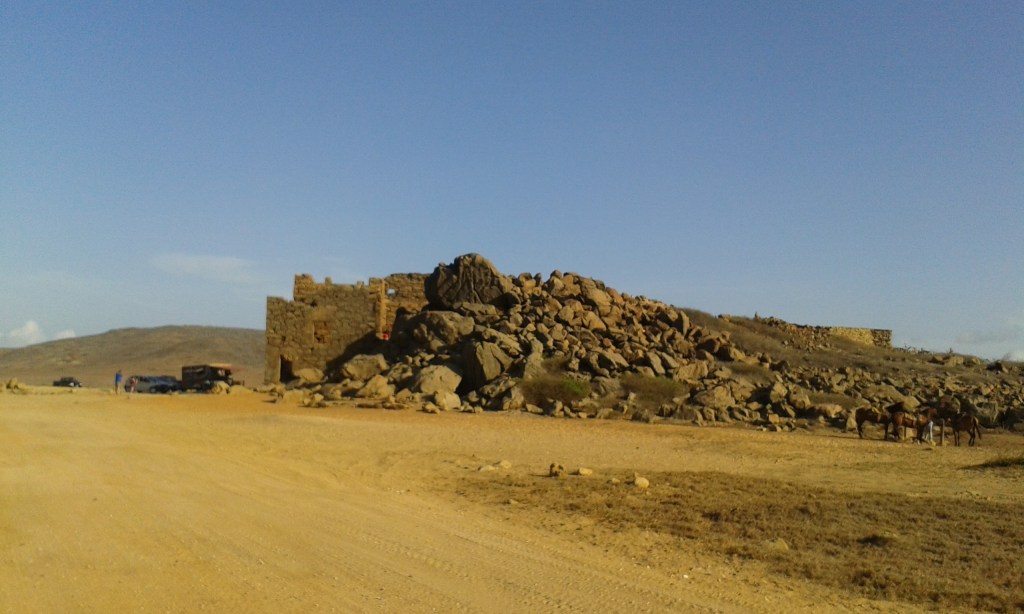
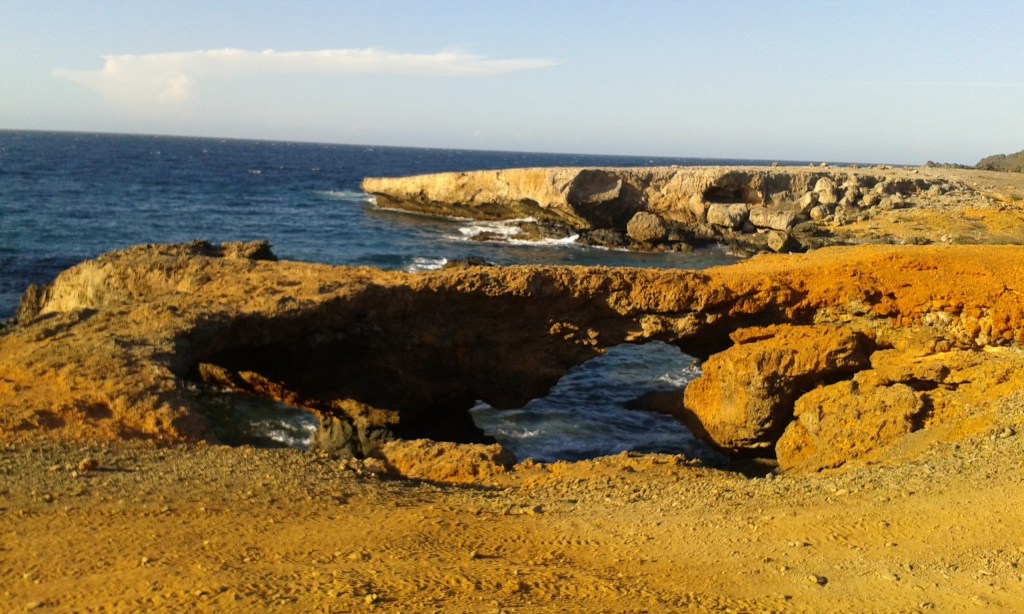
There is a gold mine and a natural bridge on the north and a large windmill farm. Semi-domestic goats graze in the arid landscape. I liked going to the wild side and watching the brute force of nature. The Arikok National Park occupies nearly a third of the island and has the highest peak, Yamanota (about 250 m), and spectacular cacti. It also has a cunucu, a traditional Aruban house. A Cunucu has thick walls that are whitewashed with small windows to stay cool in the heat.

Rainwater is collected for daily use. Today the water needs are met by desalinating sea water. The plant is located near Savaneta on the highway to San Nicolas. Water and electricity supply is stable, and disruptions are rare.

Most people have cars while the blue Arubuses provide public transportation. The bus frequency is low. Hooiberg is a mountain that rises steeply from the surrounding plains and climbing to the top provides excellent views of Oranjestad, the harbour, and the surrounding countryside.

The area around Noord is the tourist heartland and the lemon-yellow California lighthouse is located here. The lighthouse is named after the steamship, California, which sank near these waters in 1891. The downtown area of Oranjestad has Wilhelmina Park, Fort Zoutman, and the Willem III tower. The fort was built in 1798 by African slaves. There is also a historical museum nearby providing an excellent overview of the island’s history and geology. The Alto Vista chapel has a spectacular view of the surroundings and was originally built in 1750 by the Spanish missionary, Domingo Antonio Silvestre.

Aruba may be the most Latinised of the Caribbean islands. There is also a strong Dutch influence. Dutch and Papiamento are widely spoken. Papiamento is a Portuguese-based creole language. English and Spanish are also widely understood.

A lagoon

Aruba grows high-quality aloe vera and Aruba Aloe founded in 1890 is the world’s oldest aloe factory.  Aruba has plenty of beaches, Druif beach, Eagle beach, Palm beach, Malmok beach, and others. The island has invested in equipment to maintain the beaches. Turtles lay their eggs in the white sand and hatchlings clumsily move back to the ocean. The natural pool or conchi is located on the north side. Butterfly farm, Philips’s animal garden, and the Donkey sanctuary provide shelter to the fauna. You can volunteer at the donkey sanctuary. In Aruba, many families camp out on the beach during Easter. My landlord and his family used to camp on the surfside beach near the airport.

Aruba has high human development indicators. Healthcare is provided by the government through a corporation financed by taxes. Alcohol is widely consumed but I did not see drunken fights or disorderliness during my time on the island. Drivers need to be careful on Friday nights when parties get going. This arrow-shaped island with a variety of cultures and influences is geographically sheltered from the worst hurricanes with the balmy weather, caressing winds caressing, and inviting waters. The people are friendly. The moniker ‘One Happy Island’ may be well deserved!         

[1] Translates to Islands Useless

Dr. P Ravi Shankar is a faculty member at the IMU Centre for Education (ICE), International Medical University, Kuala Lumpur, Malaysia. He enjoys traveling and is a creative writer and photographer.

.

PLEASE NOTE: ARTICLES CAN ONLY BE REPRODUCED IN OTHER SITES WITH DUE ACKNOWLEDGEMENT TO BORDERLESS JOURNAL

Click here to access the Borderless anthology, Monalisa No Longer Smiles

Categories
Editorial

We Did It!

That good things happen despite darkness, despite prognostications of doom, that light glimmers hope if you strive to focus on your strength in hard times is borne true both in fiction and in life. Perhaps, we cannot get back the old ways (but is that what we want?) but new paths emerge. Old gives way to new. And while trying to gather pearls of human excellence — borne not of awards or degrees but of bringing out the best, the kindest, the most loving in human hearts — we managed to create with a team an outstanding anthology. Woven with the writings of old and new — we created a tapestry together that the editor in chief of our publishing house said was “classy, literary, engaging and international”. That one of the oldest and most reputed publishing houses in India with bookshops countrywide took it on was also an unusual event! We are truly grateful to Om Books International, Shantanu Ray Chaudhuri and Jyotsna Mehta along with all our writers and readers who made our anthology a reality, and to Radha Chakravarty and Fakrul Alam for the kind words they bestowed on our effort.

Click here to access the Borderless anthology, Monalisa No Longer Smiles

Please greet our first anthology, Monalisa No Longer Smiles, with love and friendship. It could be the perfect Christmas gift in the spirit of the season! And as the blurb says, “it will definitely bring a smile to your face because it is a celebration of the human spirit.”

The anthology is different from our journal in as much as it has a sample of an eclectic collection that has been honed with further editing and has some new features. Most of the writing is from our first year and showcases our ethos, except for Lesya’s poetry and interview. Lesya Bakun from Ukraine is still on the run, looking for a refuge — she cannot return home like you or I can. Her family is scattered across number of countries. Her cousin, who was guarding the factory at Azovstal, was taken prisoner. We included her story in the anthology hoping to create global empathy for refugees as the numbers will increase not only due to war but also due to climate change.

The reason we felt a hardcopy anthology was a good idea was because nothing beats the joy of having a bunch of interesting reads in the warmth of your hands (especially where internet cannot reach or is unavailable). In any case, books with the feel of paper, the rustling whispers which carry voices of leaves can never be replaced as Goutam Ghose had also said in his interview which is now part of our anthology.

And that is why we celebrate more books… this time we feature Singaporean prima donna of literature, Suchen Christine Lim, with her new book Dearest Intimate, a novel that spans more than hundred years including the harrowing Japanese invasion during World War II. She shared sound advice with writers: “Suffering is good for the writer. It will deepen lived experience and expand the heart’s empathy.” And perhaps that is what is echoed through the experiences of the other writer interviewed on our pages by Keith Lyons. This is a writer who not only brought out his own books but was a regular contributor of travel pieces for Frommer’s and National Geographic traveling to unexplored destinations — Christopher Winnan. Another writer Lyon had interviewed recently, Steve Carr, has passed on. We would like to convey our heartfelt condolences to his family and friends.

We have a number of books that have been reviewed. Reba Som reviewed Aruna Chakravarti’s Through the Looking Glass: Stories that span eras spread across time. Somdatta Mandal has reviewed Shehan Karunatilaka’s The Birth Lottery and Other Surprises and Bhaskar Parichha, Rahul Ramagundam’s The Life and Times of George Fernandes. Basudhara Roy has written of Afsar Mohammad’s Evening with a Sufi: Selected Poems, translated from Telugu by the poet and Shamala Gallagher, verses that again transcend borders and divides. We have an excerpt from the same book and another from Manoranjan Byapari’s How I Became a Writer: An Autobiography of a Dalit, translated from Bengali by Anurima Chanda.

More translations from Bengali, Balochi and Korean enrich our November edition. Fazal Baloch has translated a story by Haneef Shareef and Rituparna Mukherjee by Shankhadeep Bhattacharya. We have the translation of an inspirational Tagore poem helping us find courage (Shonkho Dhulaye Pore or ‘the conch lies in the dust’). Another such poem by Nazrul has been rendered in English from Bengali by Professor Fakrul Alam. He has also shared an autobiographical musing on how he started translating Tagore’s Gitabitan, which also happens to be his favourite book. More discussion on the literary persona of TS Eliot and the relevance of his hundred year old poem — ‘The Waste Land’ by Dan Meloche adds variety to our essay section.

Evoking the genius of another outstanding artiste, Kishore Kumar, who happened to pen thought provoking dialogues in some films, is Shantanu Ray Chaudhuri’s essay, review of a recent book on the legendary actor-singer and an interview with the authors. Infringing the boundaries of literary with popular culture and art and integrating all forms into a wholistic bundle has been part of our ethos. In that spirit we have a musing by Prithvijeet Sinha on Edvard Munch’s famous painting called Scream. We have non-fiction from Australia spanning Meredith Stephens’s recent brush with Covid, Mike Smith visits a Scottish beach in the footsteps of a novelist, Ravi Shankar has given us a poignant piece for a late friend and Candice Lousia Daquin talks of the existence of bi-racial biases. In contrast, Suzanne Kamata sent a narrative that bridges divides showcasing a German wife of a Japanese scientist that draws us to conclude that biases erode over time to create an acceptance of bi-racial people. Devraj Singh Kalsi brings in humour with his funny narrative about a guitarist. Rhys Hughes writes in a lighter vein on Indian cuisine in his column and spouts more funny poetry bordering on the absurd.

Jared Carter has shared beautiful poetry on murmuration in birds and we have touching verses from Asad Latif for a little girl he met on a train — reminiscent of Tagore’s poem Hide and Seek (Lukochuri). Michael R Burch has given us poems setting sombre but beautiful notes for the season. We host more poetry by Luis Cuauhtémoc Berriozábal, Quratulain Qureshi, Jim Bellamy, Gayatri Majumdar, Ryan Quinn Flanagan, Alpana, Jonathan Chan, Saranyan BV, George Freek and many more. We have stories from around the world: India, France and Bangladesh.

Gathering all of your thoughts in strings of words from all corners of the world, we present to you the bumper November issue of Borderless Journal . Thank you all for sharing your thoughts with us. Thanks to Sohana Manzoor for her fantastic painting and more thanks to the whole Borderless team for seeing this issue through. We would not have been able to do the anthology or these issues without each one of you — writers and readers.

Thank you all from the bottom of my heart.

There is always hope for a new tomorrow!

Mitali Chakravarty

borderlessjournal.com

Click here to access the Borderless anthology, Monalisa No Longer Smiles

Categories
Interview Review

The Storyteller of Singapore: Suchen Christine Lim

Singapore moved from being a little island to a trading port to an affluent glamorous city that bridges the East and the West. Spanning the spirit of the wide expanse of this movement within a century are some iconic writers. One of them is Suchen Christine Lim, an award-winning author who writes narratives embedded in history, lined with hope and love — two values that need to be nurtured in today’s war-torn world.

Dearest Intimate is her most recent novel that shuttles against the backdrop of Japanese invasion of not just China but of what was then Malaya and modern-day Singapore. The story revolves between the worlds of Chan Kam Foong and her granddaughter, Xiu Yin. A passion for Cantonese opera that spans across generations weaves all the threads together into a single multi-layered rich tapestry of life. That life is never about a single strand or a single facet is brought into play by her intricate craftsmanship.

Suchen has taken seven years to complete this novel creating a story that immerses the reader in different time periods. The time periods are congealed with a variety of techniques of narration. Both, the first-person narrative — the voice of Xiu Yin — and the third person — the diary which unravels her grandmother’s story — are seamlessly knit into a whole. Though to me, the diary is perhaps more compelling with its historic setting and its interludes of amazing passionate poetry, like these lines:

“Though hills and mountains, rivers and plains separate us,
nothing can separate our thoughts and dreams.
Though a thousand li separate our bodies, no mountains nor
rivers, not even the Four Mighty Oceans can separate our heart.”

As the book progresses, it unfolds Xiu Yin’s journey towards rediscovering her strength and love. She rises from the ashes of an abusive marriage which is in sharp contrast to the marriage of her grandmother, Kam Foong, arranged by the family in a traditional Chinese village in the early part of the twentieth century. That victimisation and abuse see no borders of education and can be born of a sense of frustration and an over-competitive outlook is skilfully reflected in the marriage of Xiu Yin, whose husband is from an educated Westernised Catholic background. She had been brought up on traditional lores among Chinese opera artists. Interesting observations on gender issues and local concerns — like the housing policies in Singapore — are wound into the narrative.

To me, one of the most enduring qualities of Suchen’s novels are that they deal with the common man against a historical backdrop. In an earlier interview, she had said: “I wanted to see the past from the perspective of coolies, the illiterate, who have largely been left out of history books. And yet without them, who would pick up the nightsoil?” In this novel too, she has dealt with the common man — farmers and opera singers only the historic setting and their responses have changes because of changed circumstances. We live, feel, emote with the common people before, during and after the second World War to the modern twenty first century Singapore. The author’s skilful characterisation enlivens her creations. The cruelty of Japanese invaders during 1940s is highlighted in the suffering of the people and their abuse. Published around the same time as Sumantra Bose’s Netaji Subhas Chandra Bose’s Life, Struggle and Politics, which shows how the Indian leader thrown out of Congress took support from the Axis powers (German and Japanese), it gives a contrasting perspective. Though this is fiction, Singapore history does corroborate that the Japanese invaders were extremely brutal in their outlook, even among the colonials.  Suchen’s reiteration of their cruelty is heart rending.

She has through her characters reiterated on the need of art not just to express but to make people laugh, give them hope and cheer them in dark times. This is an interesting theme which in itself makes one wonder if it is a comment on the perspectives of writers depicting unmitigated darkness. We find this strand of hope in great fiction from the last century — like JRR Tolkien’s Lord of the Rings series or Margaret Mitchell’s Gone with the Wind. They all end with hope as do Suchen’s works.

Suchen’s oeuvre very often encompasses the story of migrants as it has done here. And the interesting progression in this novel is the migrants’ complete acceptance of their new homelands — Singapore and Malaysia. In an earlier interview, Suchen had said, “A man can rise and go beyond borders but the land that he leaves will always be in his bones and heart.” And some of her protagonists had headed back to China. But in this novel, one is left wondering if the characters from China have not transcended their national frontiers to embrace the Cantonese opera, declared an intangible cultural heritage, like Durga Puja, by UNESCO.  Art and love have overridden all kinds of borders — and perhaps, that is why the name of the novel Dearest Intimate, which is used by Kam Foong for her love and for Xiu Yin by her beloved justifies the title. At the end, it is a heartfelt love story between humans and even between humanity and an art form that evolved to embrace the common man. Like all good books — it touches hearts across all borders with its message of love and acceptance as do Suchen’s other novels. To discuss, her world view and her novel, we had a brief conversation with Suchen —

What made you write this novel, Dearest Intimate? What led you to it?

I had a strange dream while I was on the Writers Immersion and Cultural Exchange (WrICE) residency in the ancient city of Hoi An in Vietnam. I dreamt of a pale orange pillow embroidered with two mandarin ducks and two rows of Chinese characters. When I woke up, I wrote down the two sentences in English, which eventually became the opening paragraph of this novel. So, you can say it was an unexpected gift from the universe that led me to write this novel.

In your earlier novels like A Bit of Earth the protagonist always felt for part of their homelands. However, in Dearest Intimate, the protagonists dwelt on the theme of love and Cantonese opera, not so much on homeland. Has your world view changed since your first novel? How and why?

Well, I don’t think there is a quick easy answer to the how and why of change in worldview. The time gap between the publication of my first novel, Rice Bowl, and the latest, Dearest Intimate, is more than 30 years. Over that span of time my novels had examined issues of political /historical import, race and identity, moving from the past to the contemporaneous. Over the course of 30 years, it is natural for an author’s ideas and obsessions to change.  I would be very worried if I do not change, or my characters and themes do not change. For example, my sudden interest in the pipa led to the writing of The River’s Song, which in turn led me to Chinese music and Hong Kong Cantonese opera and the learning of Cantonese.

Tell us about why you took up the Cantonese opera in a major way in this novel?

It was the strange gift of a dream of two mandarin ducks embroidered on a pillowcase, which reminded me of the Cantonese operas I used to watch as a child with my grandmother and mother. Such pillowcases with embroidered mandarin ducks were symbols of love and fidelity and were sewn by young women in love in Chinese operas. Cantonese opera was a part of my childhood that was largely forgotten till this dream. Looking back, I think in writing Dearest Intimate I was reclaiming that forgotten part of my childhood.

Why did the novel take seven years to write? What kind of research went into the novel?

Partly because the research was such fun. I wasn’t concerned about deadlines. I had already flung away deadlines the moment I resigned from the Ministry of Education years ago. And I must admit I was fortunate that I didn’t have to write to fill my rice bowl. My research obsession began after I had watched a Hong Kong Cantonese opera troupe perform at the Kreta Ayer People’s Theatre, and later, other operas at the Esplanade during Moon Festival. Curious about the actors’ training, I went to the National Archives and listened to the many interviews with old opera actors and actresses of local Chinese opera troupes. Every year, I flew to Hong Kong to watch one or two Cantonese operas, and once I even met Chan Poh Chee and Bak Suet Xin, the icons of Hong Kong’s Cantonese opera. When I started writing the novel I would watch one Cantonese opera on YouTube every afternoon, even re-watching a few favourites. Unhappy that I could not understand the literary Cantonese used in the operas I joined a Cantonese class in Chinatown to deepen my understanding of Cantonese.

Why did the novel take seven years to write?  Well, one of the reasons is my troublesome health. I had several health issues to deal with. Very boring chronic issues which, naturally, gobbled up my time and distracted my attention. The most serious of these troublesomes was a minor stroke that affected my movement and speech for some months.

You have written many children’s stories, a play, short stories, non-fictions and novels. What is your favourite form of storytelling and why?

The novel. It is humanity’s greatest literary invention. Within the novel, raw messy lived experience is transformed into coherent narrative.

All your novels have a sense of hope and seem to reach out with the message of love and acceptance. Why is it you feel reiterating this is important?

I am glad you think my novels have a sense of hope. Hope is often the reason we live another day. Hope is what helps us to endure, to wait. To write, to make art is an act of hope.

What in your opinion is the purpose of art? You have repeatedly mentioned in your novel that people will respond better to hope or laughter in opera in dark times. Would you say this also applies to writing? Do you think people in dark times prefer books that give hope? Please elaborate.

I will quote Master Wu in the novel: “Play our music! Tell our stories! Sing our songs! Write our histories! Preserve our humanity! That is what the arts are for. Never, never for one moment forget who we are …”  in the age of robotics, story-generating AI and Twittering twitterati. 

Do you have any advice or message for budding writers?

Suffering is good for the writer. It will deepen lived experience and expand the heart’s empathy. 

Thank you for your wonderful answers and for giving us the time.

(The book has been reviewed and the interview conducted online by emails by Mitali Chakravarty)

Click here to access the Borderless anthology, Monalisa No Longer Smiles

PLEASE NOTE: ARTICLES CAN ONLY BE REPRODUCED IN OTHER SITES WITH DUE ACKNOWLEDGEMENT TO BORDERLESS JOURNAL