Ratnottama Senguptagives a glimpse of the life of Zohra Sehgal, based on the book Zohra: A Biography in Four ActsbyRitu Menon, and her own personal interactions with the aging Zohra Sehgal. Click here to read.
“It just so happens that their[1] universes were different from ours: because why would their imaginations be constrained by a nation-state that would not exist for another thousand years?”
These lines from a recent article on conquests carried out by the Indian subcontinent in ancient times brings to focus that earlier countries or nation-states as we know of them today did not exist till the industrial revolution set the concept in motion. In the month many countries in Asia celebrate their independent existence or rather the drawing of borders based on colonial mapmakers’ whims, we should perhaps relook at the way the world stands divided.
Is this what we want as humans? Where are we headed? While conquerors write the history, we tend to gloss over what is left unsaid. The millions who died crossing borders, in race riots and of hunger, starvation and disease in refugee camps is overlooked, or worse, used to justify the divisions that still hurt the residents of the sub-continent and try to destroy any sense of oneness among the human species. We tend not to forget the atrocities of the colonials but we overlook the violence of the mobs that incensed with hatred instilled by politics annihilated and murdered. Their story is reduced to “us” and “them”. In our mood of jubilation, the recent bombings in the Middle East and the Ukraine-Russia war have already been delegated to the newsreels. But these are all people who are killed and displaced without any justification for the need to do so. One of the things that George Orwell had depicted in 1984 was an acceptance of a constant state of war. Are we stepping into that frame of mind with our cold acceptance of the situation worldwide?
In the last century, many united against the atrocities of the empire builders. They wanted to rise above the divides. At least greats like Nazrul vociferously objected to the basis of divides that were used to draw the borders. Translations brought to us by Professor Fakrul Alam showcase such poetry as does much of Tagore’s own writing and actions. Tagore organised a protest march against the colonial proposal of Partition of Bengal in 1905 by taking a procession in which he encouraged Hindu and Muslim women to tie rakhis[2] on men from the other community and make them their brothers. Tagore put the welfare of humanity above nationalism as can be seen in his writings and speeches. Reflecting on humanity, we have Munshi Premchand’s powerful story,Pus Ki Raat or A Frigid Winter’s Night, translated from Hindi by C Christine Fair, dwelling on the sad state of peasantry under the Raj. In a bid to rouse people like the protagonist of Premchand’s story, Tagore wrote inspirational songs, one of which, Hobe Joye(Victory will be Ours) has been translated on our pages. We also continue sharing Rabindranath’s humour with a skit translated by Somdatta Mandal from Bengali.
Humour is also stirred into Borderless by Rhys Hughes with a series of mini sagas in his column and a trip around the world in eighty couplets. These couplets actually are more in number — I tried counting them — and are guaranteed to make you laugh. We have travel stories in plenty too. Ravi Shankar again treks to the Himalayas and brings us wonderful photographs of his journey and G Venkatesh stops over at Istanbul airport to find a friend from across the border. Meredith Stephens travels to a French colony called Lifou Island — sounds unbelievable as in the month we celebrate the independence of so many countries across Asia, there is still a country in the Pacific that owes allegiance to a democratic European power! But other than writing about the beaches, Stephens talks of a temporary pet dog while Suzanne Kamata gives us cat talk in her notes from Japan in a lighter vein — a very pleasant glimpse of life. Devraj Singh Kalsi brings a grin when he talks of his stint at trying to run a restaurant.
Interesting non-fictions from a book lover, Sindhu Shivprasad, and from PG Thomas who talks of King Lear performed a la classical Indian dance mode, Kathakali, by an international caste add to narratives that focus on bringing the pleasanter side of life to our readers. Such stories are a welcome relief in dark times when people find themselves caught between price hikes due to the pandemic and wars. An essay by Candice Louisa Daquin looks for a way out of the stresses of these times. Erwin Coombs gives us a funny, poignant and tragic classroom encounter which reminds me of the 1967 Sidney Poiter movie, To Sir, with Love. We have darker tones brought into our journal also with Aysha Baqir’s story on child exploitation, a sad but hopeful narrative from Nepal by Santosh Kalwar about the rejection of a girl-child by her mother and a horrific murder brought to us by Paul Mirabile.
An excerpt from B. M. Zuhara’sThe Dreams of a Mappila Girl: A Memoir, translated from Malayalam by Fehmida Zakeer, brings us close to a community we know very less about in the Southern part of India. Meenakshi Malhotra has reviewed Tagore’s Four Chapters translated from Bengali and introduced by Radha Chakravarty, a book that is a powerful voice against violence in the name of nationalism touching on the independence of women, a theme that is reiterated in another book that has been visited by Rakhi Dalal. While exploring Neelum Saran Gour’s Requiem in Raga Janki, Dalal contends that the book familiarises us with a singer “who carved her own destiny and lived life on her own terms, in times when women were generally subjugated and confined to roles given by society”. Gracy Samjetsabam has visited Mamang Dai’s Escaping the Land, a novel that tries to weave issues faced in the Northeast of India and integrate it with the mainstream by stirring human emotions. Bhaskar Parichha has reviewed Rakesh Batabyal’s Building a Free India, a collection of powerful speeches from the past.
Within the confines of the Raj, there was a long court case where a prince who had been declared dead resurfaced as a Naga sadhu[3], a claimant to the throne, this time not to abuse his power as of past but to be a sympathiser of the people in their tryst to fight the Raj. Aruna Chakravarti has woven a historical fiction around this controversy centring around the prince of Bhawal. In an exclusive interview, she tells us the story behind the making of The Mendicant Prince— her novel that was published just last month. Her responses could well teach us how to write a historical novel.
We have much more than the fare that has been mentioned here. Pause by on our contents page to take a look. My heartfelt thanks to the whole team at Borderless for helping with this issue, which we managed to get out in a shorter time than usual and Sohana Manzoor for her wonderful artwork. I am grateful to all our contributors as well as our readers. We could not have made it this far without all of you.
In the spirit of uniting under a borderless sky, let us look forward to cooler climes and happier times.
[1] Guptas (4-6 century CE), Cholas (300 BCE -1279 CE) and other ancient rulers in the Indian sub-continent
[2] A festival held in August where sisters of all ages tie a talisman or amulet called the rakhi around the wrists of their brothers, who promise to protect them.
But one day, my husband said, “How about a cat?” His high school friend, who was a veterinarian, had an American long-haired kitten to give away. His children had found it abandoned by the side of the road, scared and shivering, and brought it home. It was black – an unpopular colour due to its bad luck connotations. The colour of a witch’s familiar.
“Yes!” my son, now fifteen, said. By this time, he would have been happy with a hedgehog or a salamander – any pet at all.
Although I love cats, I was more reluctant. After all, I’d just bought a brand-new sofa and love seat with some book money I’d gotten. I could just imagine what a cat’s claws would due to those leather cushions.
Nevertheless, my husband and son set out for the vet’s office. They came home later with the kitten cuddled against my son’s chest and all the accoutrements – food dish, cat toys, scratching post, and a multi-tiered tower that my husband immediately assembled.
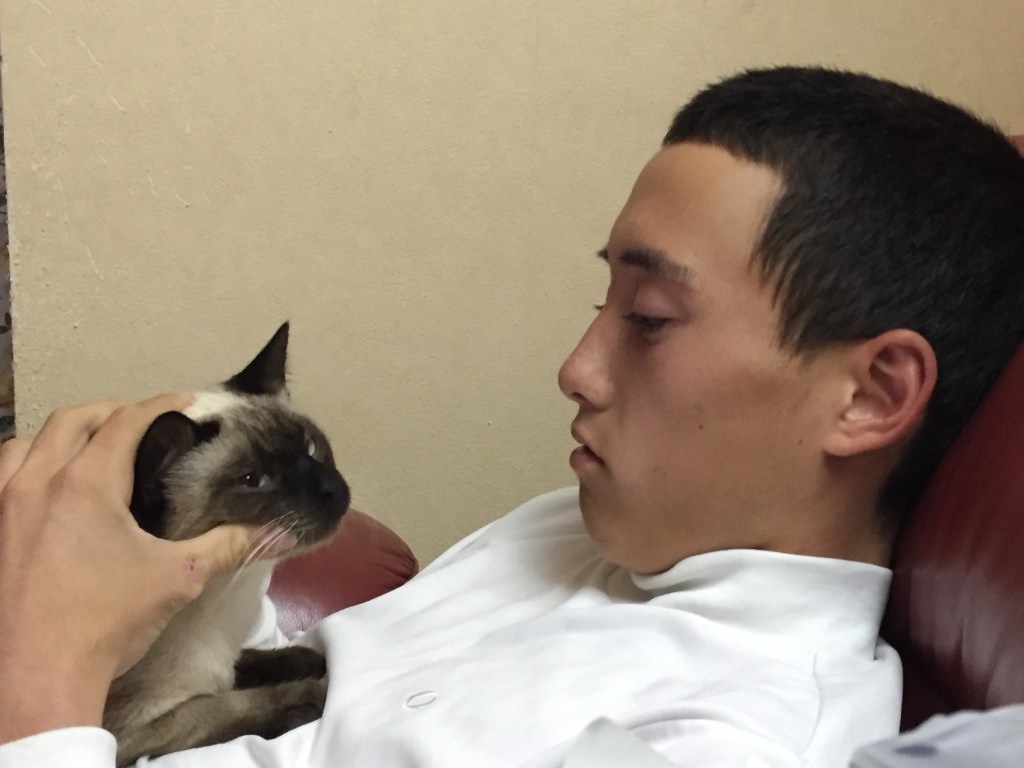
From the beginning, like a duckling that imprints on the first thing that it sees, the kitten, which we named Sumi (the Japanese word for the black ink used in traditional calligraphy) liked my son the best. My early rising husband may have been the one to fill his food dish every morning, and my daughter sometimes coaxed him into her room for sleeping, but my son was his favourite. Sumi would leap from my lap to greet him at the door when he returned from school, and mew plaintively and persistently at his bedroom door until he was admitted. Sumi was skittish and inclined to hiss at strangers. He’d run away and hide under a bed when my sister-in-law dropped by for a visit. But he crooned a greeting when my son walked into the room. They bumped their heads together with mutual affection.
Of course, I grew to love Sumi as well even though, predictably, he clawed the new sofa, scratched the wallpaper, and regurgitated his food on our freshly installed tatami mats.
My husband tried to discipline Sumi, sometimes by holding him immobile and roaring at him, but instead of becoming docile and obedient, Sumi began avoiding him or hissing in his presence. My husband began to grumble that a dog would have been better.
One afternoon, a couple of years later, my son came home with another kitten. She was a tiny, mewling thing with blue eyes and white fur, with a smudge of black on her face – a Siamese, by the looks of her.
“She followed me,” my son said. He’d been down by the riverbank, pitching a baseball against a brick wall, when the tiny creature had found him. “I couldn’t just leave her there.”
Apparently, she’d been recently abandoned, her trust and innocence still intact. She wasn’t skittish and shy like Sumi. She was adorable, but we all knew that Sumi wouldn’t welcome her, and one cat was really enough. How much more violence could our sofa and wallpaper endure? Besides, my son, a sophomore in high school, was taking off the very next day for a four-day school trip to Tokyo. Who would deal with the kitten?
However, she quickly grew on us humans (though Sumi, now quite large, was terrified of the little ball of fur). We ended up keeping her, and she quickly adapted, co-opting the litter box, happily eating kibble – and tomatoes! And broccoli! — from the same dish as Sumi and hopping up onto the nearest warm lap. My daughter named her “Mii.” But she, too, had a special relationship with my son, her saviour. He taught her to fetch – like a dog! And she came when he called her, like a dog.
We tried to keep her safely indoors. But one day, she managed to escape. Hours later, she turned up, limping. We took her to the vet, who said that she had gotten into a fight. He gave her some antibiotics. For a couple days, she lost interest in going outdoors.
But a week later, she got out again! This time she was gone overnight, I searched all over the neighbourhood, calling her name, but she didn’t come.
That evening, rain started to fall. Suddenly, we heard her distinctive mewling. My son grabbed a flashlight and we went in the direction of her voice. We found her stranded on the tile roof of a nearby house and pounded desperately on the door. Finally, it creaked open to reveal an elderly woman in her nightclothes. I wonder what she thought, seeing two foreign-looking strangers on that rainy dark night.
“Our cat’s on your roof,” my son explained. “Can we go into your yard?”
The woman kindly provided us with a ladder, and we got the kitten down.
As my son began his last year of high school and began thinking about applying to universities in distant cities, we couldn’t help but think about the cats. They’d be so lonely without our boy.
“You should take Sumi with you,” my husband joked, as if any student apartment would allow such a pet. As if a cat would be happy confined to a tiny college dorm.
When he was accepted into a university in the far north of Honshu, in a city without a direct flight to our own, my husband ordered our son to get rid of all the stuff he didn’t need.
“You’ll be gone for good,” he said, “and we don’t want to have to deal with all of your junk.”
I knew that my husband’s gruffness was a front meant to conceal his sadness at our son’s departure. Our daughter would be leaving, too. Our nest would be empty. He was gearing himself up for grief.
“We’ll take Sumi off somewhere and dump him,” my husband said darkly. Sumi glared at him from underneath the table as if he’d understood, but I knew that the threat was empty. The cats would stay. They would keep us company after our children had left.
Already I was imagining the anxious queries from the north about Sumi and Mii, the photos that I would send by smartphone, the joyous meows at the beginning of university breaks.
“We have to keep the cats,” I told my husband, “so that our son will come back.”
Suzanne Kamatawas born and raised in Grand Haven, Michigan. She now lives in Japan with her husband and two children. Her short stories, essays, articles and book reviews have appeared in over 100 publications. Her work has been nominated for the Pushcart Prize five times, and received a Special Mention in 2006. She is also a two-time winner of the All Nippon Airways/Wingspan Fiction Contest, winner of the Paris Book Festival, and winner of a SCBWI Magazine Merit Award.
PLEASE NOTE: ARTICLES CAN ONLY BE REPRODUCED IN OTHER SITES WITH DUE ACKNOWLEDGEMENT TO BORDERLESS JOURNAL
“I was three years old at the time of the bombing. I don’t remember much, but I do recall that my surroundings turned blindingly white, like a million camera flashes going off at once.

Then, pitch darkness.

I was buried alive under the house, I’ve been told. When my uncle finally found me and pulled my tiny three year old body out from under the debris, I was unconscious. My face was misshapen. He was certain that I was dead..."

-- YASUJIRO TANAKA/ LOCATION: NAGASAKI/DISTANCE FROM HYPOCENTER: 3.4 KM, AFTER THE BOMB, https://time.com/after-the-bomb/
The two atom bombs that ended the Second World War. (1939-1945) Courtesy: Creative Commons
Recalling the incidents of 1945 — when two bombs were dropped in the name of peace destroying towns, populations and a way of life of innocents who had nothing to do with the aggressive invasion of the power-hungry, instilling suffering for generations to come, and justifying the whole incident in the name of peace — should have taught humankind lessons that we would never forget. When I read about the incidents, the horror of these make me shudder. Even the sky changed colours. The Earth grew barren as life on it writhed to an untimely halt, some wounded towards a painful end and some dead. Some of our species suffered in the most horrific ways. For some death lingered with pain. For others, life lingered with pain — both emotional and physical. Has that all been forgotten or erased from our minds?
Given the current global atmosphere, we perhaps most need to pray for peace: peace, to alleviate hunger; peace to be with loved ones; peace to have access to resources at a reasonable price so that all of us can afford to live in comfort. And yet the wars rage…
As we move ahead this year, poetry around war has proliferated in our pages, showing why we need peace. Today, in this issue we bring to you writing that looks for peace as well as our older pieces describing the horrors of the atom bomb in Hiroshima.
An interview with nuclear war survivor’s daughter, authorKathleen Burkinshaw, who continues to suffer the aftermath of the Hiroshima blast that only her mother had faced and has written a book, The Last Cherry Blossom, describing the horrors of the war, life before it and after. Clickhereto read.
Can Peace come Dropping by... An essay by Candice Louisa Daquin, contextualising the current global issues and exploring peace. Click hereto read.
Tagore’s Mono Mor Megher Shongi (‘The Clouds, My Friends‘)has been translated by Professor Fakrul Alam. Click here to read.
The Welcome, a skit by Tagore, has been translated by Somdatta Mandal. Click here to read.
The Bus Conductor, a short storyby Dalip Kaur Tiwana has been translated from Punjabi by C. Christine Fair. Click here to read.
Hasan Sol: A Balochi Folktale from Geedi Kessah-4(Folktales Vol: 4) compiled and retold by Gulzar Khan Mari, has been translated by Fazal Baloch from Balochi. Click here to read.
Cry of the Sunflower written in Korean and translated to English by Ihlwha Choi, a poem for Ukraine. Click here to read.
This narrative is written by a youngster from the Nithari village who transcended childhood trauma and deprivation. Lockdown had been written in Hindustani by Jishan and translated to English by Grace M Sukanya. Click here to read.
InThe Anthology in my Mind, Rhys Hughes talks of a make believe anthology. Clickhere to read and find out what he imagines.
Conversations
Eminent film journalist, Ratnottama Sengupta, converses with legendary actress, Deepti Naval, on her literary aspirations at the Simla Literary festival, Unmesh, in June 2022. Click hereto read.
Keith Lyons interviews Steve Carr, a writer who has written 500 short stories and has founded the Sweetycat Press. Click here to read.
Meenakshi Malhotra reviews Tagore’sGleanings of the Roadtranslated by Somdatta Mandal. Click here to read.
Rakhi Dalal reviews Geetanjali Shree’s Mai, Silently Mother, a Sahitya Akademi winning translation of the Hindi novel by Nita Kumar. Click hereto read.
When the mountains and grass
had life, stones whispered
how the world came to be…

'Stonehenge', Daily Star
And as the world came to be, there was war — war that seems to rage in some part of the world or other. The British Museum has an exhibit which states the first battle was staged 13,000 years ago… in what is now Sudan, long before the advent of written history. This was even before the advent of people who built the ancient Stonehenge which was constructed around 3000-2000 BCE. And battles still continue to rage. The Jebel Sahaba casualties in Sudan 13000 years ago were less than 100. But the current conflicts claim in terms of tens of thousands which prolonged could stretch to millions. The last world war (1939-1945) which lasted for six years had a total of 75-80 million persons who perished. Ukraine-Russia conflict has within five months had a casualty count of more than 14000. And yet weapons and nuclear arms continue to proliferate decimating humanity, nature and towns, destroying homes, erasing ruthlessly and creating more refugees. The only need for such battles seem to be to satiate the hunger of the warlords secure in their impenetrable fortresses while tens of thousands are annihilated and natural or nurtured landscapes lie emaciated, mutilated and polluted.
What would be a good way of ending such wars?
Tagore sought the development of better instincts in humankind as an antidote. He wrote in the last century: “Any teaching concerning man must have human nature for its chief element. How far it will harmonise with human nature is a matter of time.”
With wars getting deadlier and more horrific, we can only try to awaken, as Tagore suggests, the better nature in man to move towards a peaceful world. What would be a more effective way of doing it than writing with the hope of a kinder and accepting future?
For that let us start with translations of the maestro Tagore himself. We have a song about the season — monsoon, ‘Monomor Megher Songi (My Friends, the Clouds)’, translated by Professor Fakrul Alam, a painting by Sohana Manzoor interpreting the lyrics and a transcreation of ‘Nababarsha or New Rains’ was shrunken into a popular Rabindra Sangeet and reduced to twenty lines in English by Tagore himself. The connect with nature is an important aspect that enables humans to transcend petty concerns leading to dissensions of different kinds as evidenced in the maestro’s humorous feline skit, translated by Somdatta Mandal. A translation of Dalip Kaur Tiwana’s ‘The Bus Conductor’ from Punjabi by C. Christine Fair adds zest to this section. Fazal Baloch has translated a folktale from Balochistan involving the supernatural and Ihlwha Choi has taken on the cry for peace on behalf of Ukraine while translating his own poem in Korean. The Nithari column has a story by Jishan in Hindustani, translated to English by Grace M Sukanya, showcasing the struggle of a youngster during the pandemic – rather a sad narrative, which though fictitious has its roots in reality.
Our short story section has echoes of humour around felines by Manzoor, somewhat in tune with the mind frame seen in Tagore’s skit on this issue. Humour rings tinged with an apparition in Erwin Coombs’s narrative – should one call it dark humour or is it just his style? Paul Mirabile goes for gothic darkness in his meanderings around Italy.
Strangely, we seem to have a focus on short stories this time. Keith Lyons has interviewed Steve Carr, a journalist, a publisher and writer of 500 short stories who is questing to create a ‘perfect short story’. Reading out excerpts from her short story at a literary festival in Simla, Bollywood celebrity, Deepti Naval, was in conversation with eminent film journalist, Ratnottama Sengupta. She spoke of her literary aspirations while unveiling her autobiography in verse, A Country Called Childhood. This conversation has been shared by Sengupta with Borderless. It is interesting to see how Naval’s reactions to social malaise contrasts with that of the film director, cinematographer and actor, Goutam Ghose, who was present during the unveiling of her book. He had responded to communal violence by making a film on Lalan Fakir extolling virtues of love and kindness, called Moner Manush (2010) and then made a book on the film called, The Quest (2013) which has beautiful translations of Lalan Fakir’s lyrics by Sankar Sen.
Our non-fiction sections seem to be hosting multiple travel stories across UK by Mike Smith, along the Australian coastline by Meredith Stephens, on the Himalayas with Ravi Shankar and an unusual visit by Hema Ravi to a farm in US where animals that had been used in Disney films in the past are homed. Our environmental columnist, Kenny Peavy, actually wrote about his cycling trip from Thailand to Indonesia on a bamboo cycle made by a Singaporean! And from Japan, Suzanne Kamata explored a museum in the neighbouring town of Mure. The museum on a hill hosts the art of American Japanese Artists, Isamu Noguchi.
We do have non-fiction that moves away from travel: noir humour by Devraj Singh Kalsi and an essay by Candice Louisa Daquin on a very interesting subject – ‘Is it Okay to be Ordinary?’ Is it? Dan Meloche has written a literary essay on Canadian novelist Andre Alexis’s award-winning novel, Fifteen Dogs: An Apologue(2015). While Meloche spoke of how the novel departed from Orwell’s Animal Farm, his narrative brought to my mind a novel closer to our times set in England by Jasper Fforde called Constant Rabbit (2020) – this a science fiction while Alexis’s was an apologue or an animal fable. Fforde did use the rabbits rather well to highlight the current times.
We have book excerpts of two recent books that I would call really outstanding. One of them is Aruna Chakravarti’s The Mendicant Prince, which is being released this week, and is based on the evergreen contentious case of the prince of Bhawal that has even been explored even in cinema. The other, Dadamoni: The Life and Times of Ashok Kumarby Nabendu Ghosh, has been published posthumously and is not a translation from Bengali but written in English originally by this trilingual writer.
Called ‘Dadamoni’ affectionately, iconic actor Ashok Kumar is regarded as “the one personality who symbolises Indian cinema’s journey from Bombay Talkies to Bollywood”. This book has been reviewed by Indrashish Banerjee, who calls it ‘a reflection on the Hindi film industry’ as well as a biography. Rakhi Dalal has reviewed Booker winner Geetanjali Shree’s Mai, Silently Mother, a Sahitya Akademi winning translation of her Hindi novel by Nita Kumar, reiterating the dialogue that had been kindled on motherhood last month by Rinki Roy Bhattacharya and Maithili Rao’s The Oldest Love Story (2022). Bhaskar Parichha has reviewed Prosanta Chakrabarty’s Explaining Life Through Evolutionplotting how life evolved on earth. Parichha tells us: “Meaningful, wide-ranging and argumentative, this is a must-read book. It will propel us to imagine and reimagine life around us.” Another book that sounds like a must-read has been reviewed by Meenakshi Malhotra, Tagore’s Gleanings of the Road, translated by Mandal. She tells us: “ ‘Gleanings’ represents the quintessential Tagore…Ably introduced and translated by Somdatta Mandal, a renowned Tagore scholar, the translation captures the iridescent and luminous quality of Tagore’s prose and its chiaroscuro effects.”
There is more to tempt. Please stop by on our contents page and take a look.
We would like to hugely thank all our contributors and readers for being with us and helping us grow. I would like to thank my team, who despite hurdles they face, always lend a helping hand and wonderful words from their pens or computers to get Borderless on its feet. I apologise for the delay and thank you all for your patience. Special thanks to Sohana Manzoor for her fabulous artwork.
I wish you all a wonderful July and peace in a war-torn world. We are all affected by the ongoing conflicts. Let us hope for peaceful and just resolutions.
Visiting a museum is serious business in Japan. Suzanne Kamatavisits a Museum dedicated to an American Japanese artist
Landcape of Time, WashingtonRed Cube in BroadwaySculptures by Isamu Noguchi. Courtesy: Creative Commons
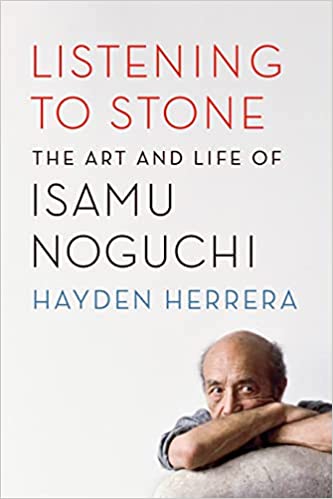
The famous American sculptor Isamu Noguchi (1904-1988) lived in the town of Mure, just fifty minutes by car from my house. Now it’s the site of an outdoor museum featuring his work. Although I was interested in seeing his stone sculptures, I had never been to the museum. I’d had just read Listening to Stone, Hayden Herrera’s fabulous new biography of the artist, which had reignited my interest in his life and his work. I knew that his mother, Leonie Gilmour, was American. His father, the poet Yone Noguchi, was Japanese.
I learned that he had once posed as the Confederate General Sherman for the sculptor originally commissioned to create the Civil War monument on Stone Mountain in Georgia. Also, I read that Noguchi volunteered to teach Japanese Americans interned during World War II. He was so handsome and charming that married women in the camp fought over him. I read about how he created his famous paper lanterns. I read of his tribute to Benjamin Franklin. I also learned of his affinity for the blue stones of Shikoku.
I decided that it was finally time to go to the museum. I invited my friend Wendy to go with me. She’s a college professor and a writer. Like me, she’s from the Midwest. She has also lived in Shikoku for over twenty years. Like me, she’s married to a Japanese man and has Japanese/American children. We often get together to discuss our writing, her pet goats, and other things. Wendy grew up in the town of Rolling Prairie, Indiana, which has a population of about 500 people. Coincidentally, when Isamu Noguchi was a boy, his mother sent him to an experimental boarding school in that very town. Wendy is also a fan of Noguchi. She had been to the Museum a few times before.
“I’ll ask Cathy to go with us,” she said.
Cathy is a Canadian translator who sometimes does work for the museum. She had translated a best-selling Japanese book about tidying up. This book was always popping up in my Facebook feed. The sight of this title always makes me feel as if I should be cleaning my house instead of writing books or reading Facebook updates. Housework is not my favorite thing. I had never met Cathy, but I’d heard of her. I worried that Cathy might be an extremely tidy person. She might not approve of me.
“That sounds great,” I said. “I’d love to meet Cathy.”
It takes some planning to visit the Isamu Noguchi Garden Museum Japan. For one thing, the village of Mure is not exactly a well-trodden spot. For another, the museum is only open three days a week — Tuesday, Thursday, and Saturday. Tours are held three times a day by appointment only. In order to make an appointment, potential visitors must write their preferred dates and times on a postcard and mail it. Email is not allowed, at least not for those living in Japan. Finally, the admission fee for adults is 2,160 yen (about $25), which is a bit pricey, as museums go. The barriers are intentional. They are meant to weed out people who are not serious about Noguchi’s art.
We made a reservation to visit on a Thursday at one p.m. Cathy suggested that we go out for udon[1] beforehand. The area is famous for its fat, doughy noodles served in broth. Cathy knew of a restaurant on a mountainside that we could reach by ropeway. I imagined slurping noodles while watching wild monkeys in the trees. We would have a leisurely lunch. Afterwards, we would admire the sculptures in the garden museum. How lovely!
The morning of our outing, a light rain was falling. I entered my destination in my cell phone’s navigation app and started the car’s engine.
“Turn right,” a woman’s calm voice said.
“Okay,” I replied, turning right.
The voice directed me onto the highway.
I drove and drove. I went past pine-covered mountains. I passed small villages nestled in valleys. The rain pattered against my windshield. A sign warned me to beware of wild boar which sometimes wandered onto the road. Off to the left, I glimpsed the Inland Sea, the tiny islands that seemed to be floating just offshore.
Although I knew that the village of Mure was only fifty minutes from my house, the voice on my app convinced me to keep going. When I was in the middle of a tunnel, far from any city, the woman’s voice said, “You have arrived at your destination.” Clearly, I was now lost.
I tried to send Wendy a message. She didn’t reply. After backtracking and driving around for another hour, I pulled over. I checked my phone. Foolishly, I had not given Cathy my phone number. Even so, she had managed to call me and gave me directions.
Time was ticking by. We wouldn’t be able to have lunch on the mountainside restaurant. We might even miss our long-awaited appointment at the museum. Why hadn’t I taken the bus? I scolded myself. Why hadn’t I studied a map? Why had I relied upon my stupid cell phone?
I got back on the road. As it turned out I was going in the wrong direction again. After another phone call, I turned around. I paid the man in the toll booth again, and drove on, finally arriving at our meeting place, a convenience store parking lot.
Wendy motioned me over to Cathy’s car. “Hurry.” She wasn’t smiling. Her voice was stern. “We are quite late.”
I climbed in the car, apologising profusely. Wendy seemed a bit angry. Who could blame her? She had arranged for me to meet the famous translator, who was probably an excellent housekeeper. Cathy had made a reservation at the exclusive museum. I was making a terrible impression.
“We’re just glad you made it,” Cathy said kindly.
“We bought these for you,” Wendy said. She tossed a couple of rice balls and a sandwich into the back seat. They had already eaten lunch while waiting in the car. Once again, I regretted missing out on our ladies’ lunch in the restaurant on the side of the mountain.
Cathy called the museum and asked if it was okay to join the tour a bit late. She was on the board of the museum. She had even interpreted at the memorial service for Noguchi when he died in 1988. If she hadn’t been with us, I’m sure I would have been denied entrance.
“I’m so sorry,” I said again.
We pulled up in front of the building which housed the reception desk and gift shop. The rain had abated. Cathy parked the car. She went to buy our tickets. Our scheduled tour had already begun. We hurried to join the others who had made a reservation in the garden. As I followed Cathy, I noticed that there were piles of rocks everywhere. Somehow the grey sky and the wet stones made the scene all the more poignantly beautiful.
First, we entered the Stone Circle sculpture space. There were many stone sculptures. Some were finished at the time of Noguchi’s death and signed with his initials, some were not. Although the sculptures had been named, they were not labeled.
We asked the guide about some of them. She told us that one tall sleek stack of blocks was made partly of stones imported from Brazil. The area has a history as a quarry. Noguchi sometimes used stones from the nearby island Shodoshima. He also sourced his materials in Italy and other far-off places. Imagine the shipping costs!
We peeked into his workspace, housed in a weathered wooden shed.
“He was very particular about his tools,” I said. I had read that in the book. Yes, here were his carving tools, carefully aligned. They were just as they had been when Noguchi was alive.
“Yes, he was,” Cathy agreed, raising her eyebrow.
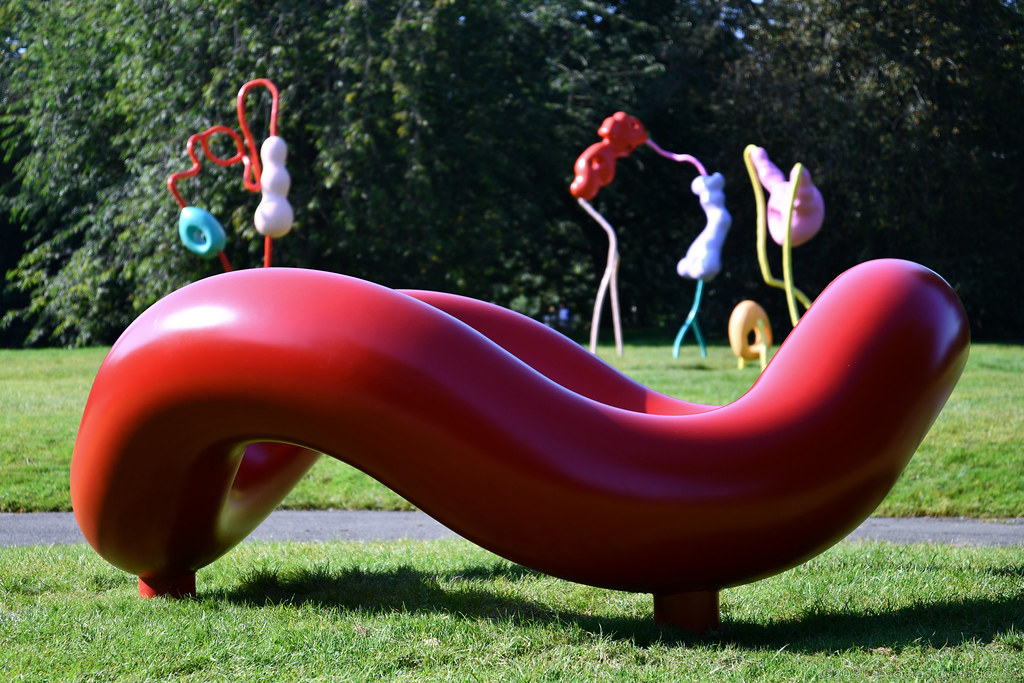
Red painted tubular-steel by Noguchi. At the 2021 Frieze Sculpture exhibition in Regent’s Park. London. Courtesy: Creative Commons
“Oh, and here is the model for his slide!” I recognised an image from the book I had just read. It was a white spiral, resembling a seashell. Noguchi believed that art should be part of daily life. He thought that art was for everyone, including children. He designed several playgrounds. Not all were constructed. This slide had been exhibited at the Whitney Biennial, one of the most prestigious art shows in the world.
We took a meditative stroll among the arranged rocks. Next, we climbed stone slab steps to a sculpted garden enclosed by a grove of bamboo trees. The space featured small grassy hills and a moon-viewing platform.
“I read that his ashes are in one of the stones here,” I said.
“Yes,” Cathy said, surprised at my font of Noguchi knowledge. “Up at the top of the hill. Shall we go pay our respects?”
As we climbed, Cathy explained how this space had been sculpted. Stones had been arranged to mimic the islands visible in the distance. Noguchi had been furious when someone had built a house higher up the mountain. Although it wasn’t on Noguchi’s property, it spoiled the view. Thus, it spoiled the work of art which was the garden. Traditional Japanese gardens often make use of “borrowed scenery.” Eventually, the house was bought by the museum’s caretaker and destroyed. Now, the view is as Noguchi intended it to be.
We paused for a moment before the giant egg-shaped rock at the top of the hill which had been cut in half. After Noguchi was cremated, some of his ashes were encased in the stone, and the stone was reassembled.
Next, we had a look at the house where he lived in the last years of his life. Inside, a paper lantern which resembled a jellyfish hung from the ceiling. The floors were made of straw mats. I knew from reading his biography that he had lived here with a Japanese woman who was married to a friend of his. Noguchi couldn’t speak much Japanese, and the woman couldn’t speak English. Even so, they were lovers. I imagined them sitting on the verandah, gazing out at the sculptures. Maybe they sat there sipping tea in silence. I thought of mentioning the lover to my companions, but I decided that it was too gossipy. I didn’t want them to think that I wasn’t serious about his art.
Afterwards, we decided to go to a café near Cathy’s house. We drank coffee and ate mango cheesecake. It occurred to me that my frustration from earlier that morning had disappeared. Wendy no longer seemed stressed and angry with me. Being in that beautiful, natural garden had made us all feel calm.
I was sure that I would be able to find my way back home.
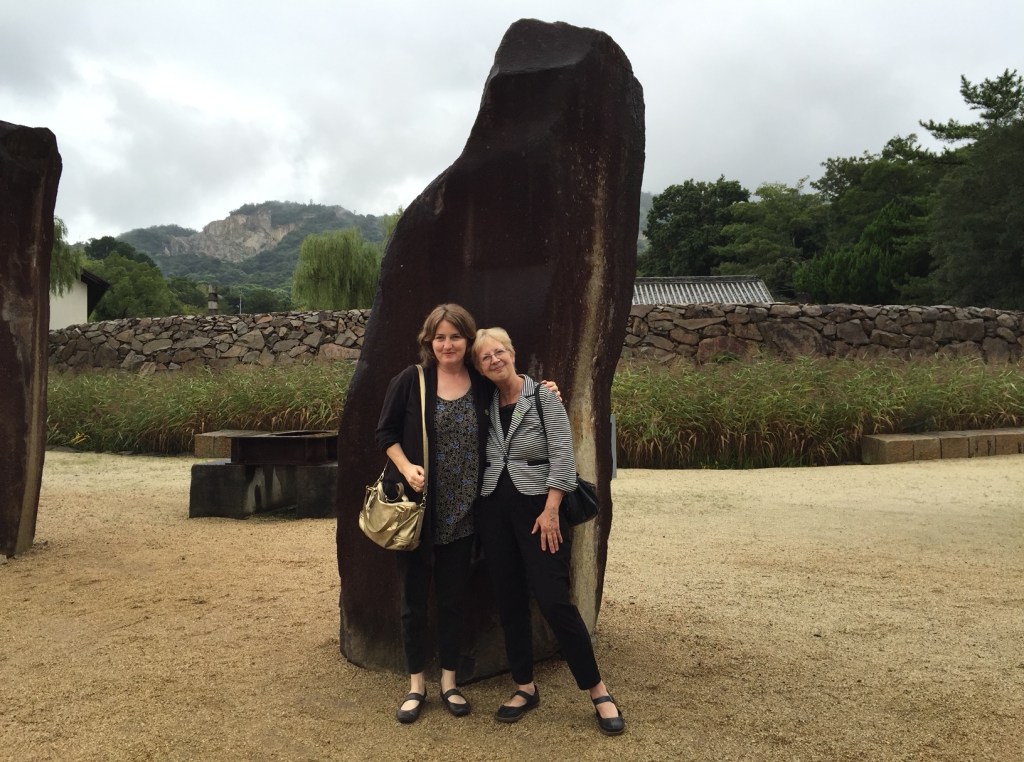
Suzanne Kamata with her friend, Wendy, outside the museum in Mure, Japan. Photo Courtesy: Suzanne Kamata
Suzanne Kamatawas born and raised in Grand Haven, Michigan. She now lives in Japan with her husband and two children. Her short stories, essays, articles and book reviews have appeared in over 100 publications. Her work has been nominated for the Pushcart Prize five times, and received a Special Mention in 2006. She is also a two-time winner of the All Nippon Airways/Wingspan Fiction Contest, winner of the Paris Book Festival, and winner of a SCBWI Magazine Merit Award.
PLEASE NOTE: ARTICLES CAN ONLY BE REPRODUCED IN OTHER SITES WITH DUE ACKNOWLEDGEMENT TO BORDERLESS JOURNAL
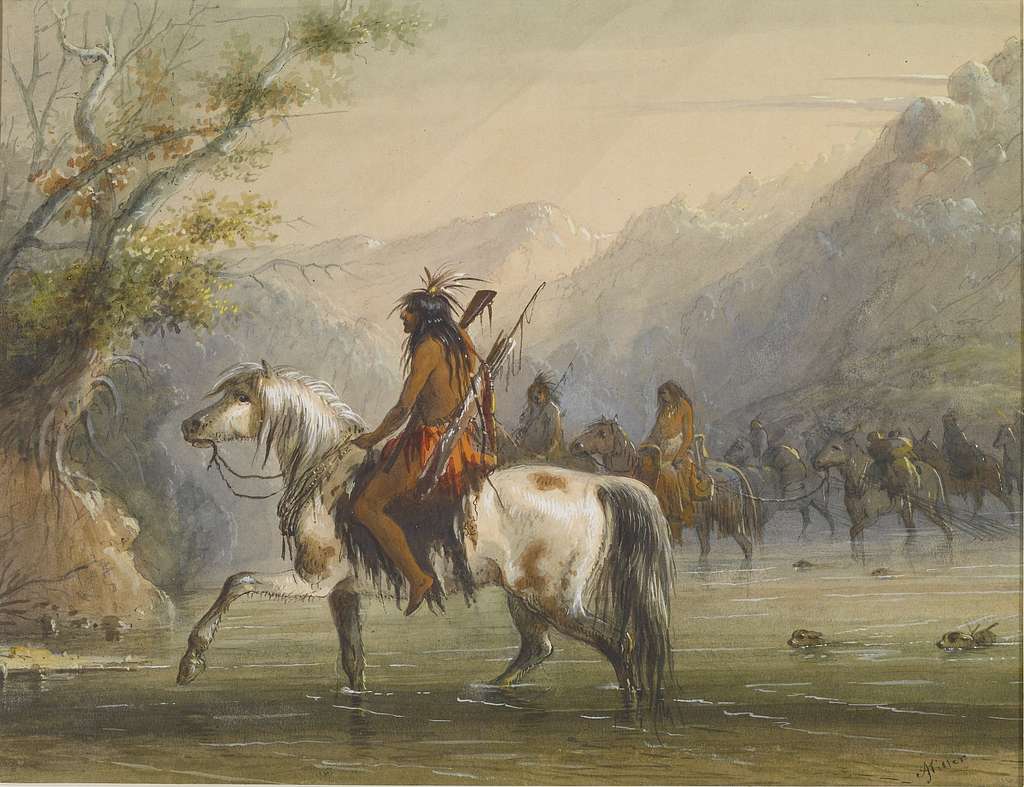
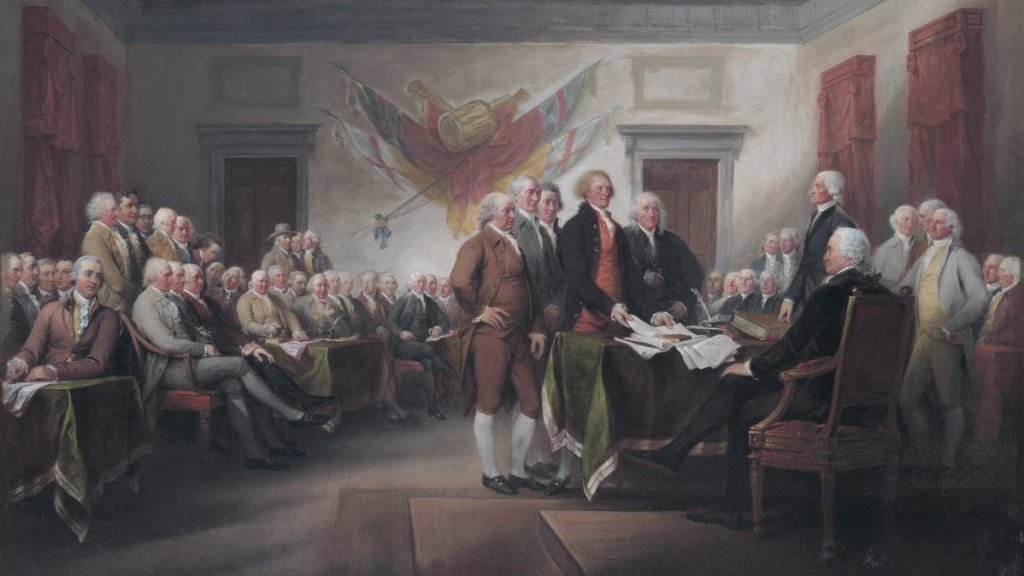
‘Shoshonee Indians – Fording a River,’ by Alfred Jacob Miller (1810-1874)The Declaration of Independence, July 4, 1776 by John Trumbull (1756-1843)Courtesy: Creative Commons
On the 4th of July, 1776, one of the world’s largest democracies came into being amidst revolution and violence. It grew as a land of immigrants to attract the best talents for many years. While the original inhabitants of the land who survived the exodus of the first generation immigrants were pushed into reserves, majority of the world looked up to the land of plenty in hope of a better life, especially post the two World Wars. Today, while looking forward to a new start in a post pandemic scenario, we present to you poetry that explores different facets of the United States of America.
Configuration by Jared Carter explores American impressionist Glen Cooper Henshaw (1880-1946) through art. Click here to read.
American Dreams, consisting of two poems by Michael R Burch, traces the historic growth of the country. Clickhereto read.
In the Honduran Dusk by Lorraine Caputo, giving voice to the spirit of exploration. Click here to read.
Languages Lost & Found, three poems by Luis Cuauhtémoc Berriozabal, gives voice to modern immigrants. Click here to read.
Waiting, four poems from Suzanne Kamata, give us glimpse of a heinous crime against women that is rampant worldwide, but to break silences helps move towards resolution. Click here to read.
In Conversation withRinki Roy(daughter of legendary director Bimal Roy) about The Oldest Love Story, an anthology on motherhood, edited and curated byjournalist and authors, Rinki Roy and Maithili Rao. Click here to read.
Achingliu Kamei in conversation with Veio Pou, author of Waiting for the Dust to Settle, a novel based on the ongoing conflicts in North-east India. Clickhereto read.
Translations
The Funeral, a satirical skit by Tagore, translated by Somdatta Mandal. Click here to read.
Pie in the Sky is a poem written and translated from Korean by Ihlwha Choi. Click here to read.
Taal Gaachh or The Palmyra Tree, a lilting light poem by Tagore, has been translated from Bengali by Mitali Chakravarty. Click here to read.
Pandies’ Corner
This narrative is written by a youngster from the Nithari village who transcended childhood trauma and deprivation. Dhaani has been written in Hindi and translated to English by Kiran Mishra. Click here to read.
Keith Lyons discovers the import and export of desires in Varanasi, one of the oldest cities in the world, beside one of the most revered rivers. Click here to read.
Notes from Japan
In Marathon Blues, Suzanne Kamata talks of pandemic outcomes in Japan in a lighter tone. Click here to read.
Musings of a Copywriter
In Journey of an Ant, Devraj Singh Kalsi explores life from an insect’s perspective. Click here to read.
Mission Earth
In Tuning in to Nature, Kenny Peavy tells us how to interact with nature. Click here to read.
Yes! It is vacation time, and we are all able to travel at last. Though the pandemic which had closed borders for us seems to be evolving as an endemic, another huge human crisis, a war which cannot be justified in any way, stares us in the face. Loss of lives, homes, towns, cities and threats of global recession follow in the footsteps of refugees wandering into our lives. Lesya Bakun, the Ukrainian refugee whose story we have been following, told me four of her relatives’ homes in Mariupol have been erased out of existence and her extended family has scattered where they found safety as her cousin continues a prisoner of war, captured while defending the iron and steel factory at Azovstal. While majority of the world expresses solidarity with the Ukrainians, another set of refugees remain in shadows. They have completely lost their country in which they had lived from ancient times. I am referring to the Rohingya of Arakan. CNN world states:
“The Rohingya are a stateless Muslim minority in Myanmar’s Rakhine State, thought to number about 1 million people.
“Myanmar does not recognize them as citizens or one of the 135 recognized ethnic groups in the country.”
We are privileged to host a powerful poignant translation by Arifa Ghani Rahman of Shaheen Akhtar’s short story about such a voiceless Rohingya child in a refugee camp. Though this is a fiction inspired by Akhtar’s visits to such shelters, we hope at some point these children will be able to build new lives to create a world free of violence, intolerance, hatred and greed.
One of the questions that springs to one’s mind, watching such atrocities destroy innocent lives is that should one accept bullies and give in to their pressure tactics? Bullies can be found among world leaders as well as perpetrators of decadent societal norms which are often critiqued by satires. Somdatta Mandal has translated one such satirical playlet where social conventions are targeted in a lighter vein by Tagore. In the same spirit, the maestro’s iconic poem about a palmyra tree called Taal Gaachh has been transcreated to bring the joy of innocent wanderings back into the narrative, creating an island of healing thoughts. We continue with our translations of Jibananada Das by Professor Fakrul Alam, a Korean poem by Ihlwha Choi and a magical Balochi folktale by Fazal Baloch. Let us read such translations to connect with varied cultures so that compassion and acceptance of diverse perspectives end horrors like wars, starvation and hunger.
Tagore’s writings translated to English by Mandal in Gleanings of the Road, a collection covering the maestro’s travel to the West, is part one of our book excerpts and highlights Rabindranath’s perspectives on the need to connect with the larger world. The other book excerpt, from Waiting, poetry by Suzanne Kamata, takes up the theme of victimisation, crime and murder. Dwelling on no less horrific narratives, though justified as non-criminal, is a review by Meenakshi Malhotra of Harsh Mander’s Locking down the Poor: The Pandemic and India’s Moral Centre. Gracy Samjetsabam’s assessment of Half-Blood by Pronoti Datta informs about the greyer areas of a whole community in Mumbai. Indrashish Banerjee reviewed Keki Daruwalla’s stories on human relationships anthologised in a collection called Going: Stories of Kinship while Bhaskar Parichha has acquainted us with Deepti Priya Mehrotra’s Her Stories –Indian Women Down the Ages — Thinkers, Workers, Rebels, Queens, a non-fiction that visits inspiring women.
Inspiration can also be drawn from Rinki Roy Bhattacharya’s and Maithili Rao’sThe Oldest Love Story, featuring a medley of men and women writing on the theme of motherhood along with some narratives about their mothers or on the experience of being one. The medley includes well-known names from films and literature like Shabana Azmi, Saeed Mirza, Shashi Deshpande, Nabanita Dev Sen and more. We interviewed Roy Bhattacharya to find out more about this impactful book. Achingliu Kamei, an academic and writer, has conversed with Naga writer, Veio Pou, whose award-winning book, Waiting for the Dust to Settle, was reviewed earlier — a book that gives a glimpse of conflicts in the Northeast of India.
Taking on the theme of conflicts at a personal level, Atreyo Chowdhury’s and Banerjee’s stories create a sense of disquiet as Paul Mirabile’s explores crime, madness and its impact on humans. G Thomas takes a relook at heroism and bravery as a concept. His story set in Kerala shakes our complacency, upending traditional concepts of heroism and bravery just as Candice Louisa Daquin has upended the cult of positivity in her essay. Notes of discord and accord seem to ring through this edition and the undertones of greys spread out towards an exploration of life and death. We have multiple ghost stories this time, even from the Nithari column written by Kiran Mishra, a youngster who got over the trauma of violence in the community and discovered her place as a bilingual writer and educator.
Keith Lyons has got the bug of tongue-in-cheek too as he gives us a piece on his travels in Varanasi that well captures the dichotomies we find in India. Dwelling on social dichotomies also is Ratnottama Sengupta’s powerful tribute to Swatilekha Sengupta, a film and theatre doyenne who brought to life Tagore’s novel, Ghare Baire (Home and the World, 1985). An essay by Mozid Mahmud exploring both the syncretic elements in Tagore’s and Kabir’s works, the medieval poet’s impact on the Nobel laureate and a dispute over Rabindranath’s own translation blends with the tone of greys in this edition.
Travel narratives and photographs by Meredith Stephens sailing the seas in Tasmania and Ravi Shankar trekking on the slopes of the Himalayas to get a view of Mt Everest make for perfect holiday adventures. From Japan, Kamata has given us a narrative set in the pandemic. And environmentalist Kenny Peavy dwells on reconnecting with nature in Mission Earth.
We have a fair deal from across the globe in the June issue. But, as usual, some of the treats in the content have not been mentioned though they are wonderful pieces of writing too. We look forward to your continued support as you delve into our treasure trove of gems from across the oceans. A huge thanks to our fabulous team, to the contributors and readers. I especially want to thank Sohana Manzoor for sharing her lovely artwork and wish you all a wonderful read!






 Borderless