Five poems by Pravasini Mahakudahave been translated to English from Odia by Snehaprava Das. Click here to read.
A Poet in Exileby Dmitry Blizniuk has been translated from Ukranian by Sergey Gerasimov. Click hereto read.
Kalponik or Imaginedby Tagore has been translated from Bengali by Mitali Chakravarty. Click hereto read.
Pandies Corner
Songs of Freedom: The Seven Mysteries of Sumona’s Life is an autobiographical narrative by Sumona (pseudonym), translated from Hindustani by Grace M Sukanya. These stories highlight the ongoing struggle against debilitating rigid boundaries drawn by societal norms, with the support from organisations like Shaktishalini and Pandies. Click here to read.
A real life narrative by Sumona (pseudonym), translated from Hindustani by Grace M Sukanya
Songs of Freedom bring stories from women — certainly not victims, not even survivors but fighters against the patriarchal status quo with support from the organisation Shaktishalini.[1]
–Sanjay Kumar (1961-2025), founder of pandies’
What I Don’t Know
If I had to choose a moment that changed everything, it would be when the police rang the bell at Nakul’s house. Or perhaps, when I found out that I was pregnant. But both happened within a few hours of each other so… maybe it was that whole day.
Or maybe it was when I was finally rid of the brothels? I am so glad to be out of it and it was Nakul who helped me do that, no matter what he did otherwise. I am grateful for that.
Or maybe when I found out that Sanjay was married. I didn’t believe it for the longest time. And I lost the only family that had ever cared about me because of that…
The First Mystery: Maybe sometimes it can be an accident?
My older brother was sick. They said someone gave him drugs, mixed in with some chicken, and he became an addict. The drugs ate away at him.
Even when I was a child – he was very sick. And he was the most important person to me in the world; my mother had died, my stepmother drank, and my father did bad things to me at night. (I don’t know whether he did it on purpose or accidentally… maybe he didn’t know what he was doing because he used to be quite drunk too?)
So, I had to save my brother somehow… I asked a pastor in my village to help me find work. He knew a couple in Sikkim, he said, who needed help taking care of their two children. I decided to go.
I was very young then. I hadn’t even started my periods. For the first couple of years, things were okay. I even came back home at the end of those two years, to meet my brother. He was still unwell and my employers had told me they’d send my earnings home as soon as I went back to work.
But when I did go back — the man started abusing me. And not like my father – he knew what he was doing because he told me to keep quiet about it or he’d kill me.
I used to believe him too. Of course, he could me kill me – and no one would know. Or even care. Even if I told anyone, who would believe me? His wife would obviously be on his side. And the pastor would scold me. I was ashamed, and I was scared. So, I kept quiet.
I also needed the money. I asked him to send it to my parents, so my brother could get treated. After a few days he said he had done it. Therefore, I kept quiet.
He used to do things to me so frequently that I was not able to complete my chores. His wife started getting annoyed with me. She started burning me with things. Once she did it with a hot pressure cooker. The burn festered and became large and infected.
It was he who took care of me then… He scolded her on my behalf, told her if something happened to me, they would be held responsible. And I don’t know how but he got the wound to heal faster somehow.
I escaped back to my village soon after that.
I came back and found out that my brother was still sick, despite the Rs. 12,000 [2] my employers had sent to my home for the two years of work I had done in their house. I went and asked the doctor why he had not been treated yet. He told me he had never received any payment for the treatment. Then I found out from others that my step mother had used the money to buy alcohol. I had to look for work again…
I finally told the pastor the truth about the couple. He was angry with them, and at first, I was relieved. But then he decided to call and confront the family, and tell them off. The lady told him that they were on their way to speak to me, and that I should not say anything to anyone else until they met with me.
Sikkim was 3 hours away from my village by car (there were no buses plying on this route) and I was terrified of meeting them.
I ran away from home a second time.
The Second Mystery: Can I have a home in city I don’t know?
There was a girl called Rekha in my village, my age, or maybe slightly older than me. She worked in Delhi and earned fairly well. I asked her if she would help me find work in the city too. I told her I had experience working as a maid and a nanny. She said that I could go to Delhi with her.
So when the pastor told me that my former employers from Sikkim were on their way, I hightailed it out of the village with her.
We reached Delhi around 11 am in the morning. Rekha took me to a building that had a lot of small, independent rooms on a floor. In one room were some young men who did some work with computers. One room had a family with some children. And in one room were some young girls just like us. I thought I was to live with the girls and look after the family.
Within 5-10 minutes of reaching, Rekha told me that we had to go shopping. She took me to a large bazaar — it was bigger than any village market I had been to. There, she bought me a bunch of clothes: a lot of short dresses and skirts, the kind I had never worn before. I was happy to be starting this new phase of my life, and I couldn’t believe someone was buying clothes for me. It made me very happy.
We went back to The Home That Wasn’t. Rekha told me to get ready. As I was tired, I asked her why I was getting ready in the evening? Why could I not start working next morning? She told me I had to get ready right then in the new clothes I’d bought. I didn’t understand then what was about to happen.
I got “ready” in my new clothes, and Rekha took me to a hotel. Some men joined us, drinks were passed around, and then I was sent off with one of them to a room.
I was shocked. I didn’t know what to think or even feel about it. I said nothing.
The next morning, Rekha took me back to The House That Wasn’t and told me to pack my bags. I put all my new clothes in a bag and walked out of there. This time she took me to a tall, narrow building in a congested, crowded street. On the 4th floor of The Tower was a very small, very dirty room, not big enough for even a bed. I was told to get in.
I still didn’t understand what was happening.
There was a man there, Nishant. Rekha spoke to him for some time, then left. When I asked what was happening, he told me that she had left me there to work for him. I still didn’t know what to think (I was 11).
Soon after, an old man came to my room. He was as old as my father. He started forcing me to do things, taking advantage of me. This is when I first had the thought that maybe what was happening to me was wrong…
But it was too late. I was never let out of that room. The door was always locked. There was some space between the bottom of the door and the floor – it was used to slide in food. I don’t know how many years I spent in that room.
I used to dream of the things I would do once I got out. I kept trying to figure out how to get out. But I knew nothing at all – I didn’t know this city, or where I was located, or even the language. How would I ever get out?
Soon, they started sending me out to men’s places. The men were supposed to come pick me up and then drop me back. I didn’t know how to run away and they knew that: my captivity was complete.
The Third Mystery: If my work pays someone else, what am I?
There were always other people who got the money I earned.
After a few years in the city, I was sometimes allowed to visit The Home That Wasn’t. Nishant knew that it was the only place I “knew” (except for the The Tower). If I was sent to work from there, Meera got the money. If I was sent to work from The Tower then Nishant got the money. Rekha I never heard from again (she ran away with all the commission she had earned on my work in The Tower, while I was still locked up in the small dirty room).
One day, I was feeling unwell so I went to The Home That Wasn’t.
They had a frequent customer, Nakul. All the girls there had already been to his place. He insisted on someone “new”. So Meera sent me to him.
He was young, maybe about 25 or 26 years old. He was in the police, I don’t know what post. He was married, he told me, but it had been against his will so he was unhappy and therefore sleeping with other women.
That first day he met me, he asked me whether I was doing this out of my own free will or whether I was being coerced. I told him the truth. He said he would help me. I didn’t trust his offer of help – men often asked me whether I was being coerced, and then offered their help; but no one ever actually did anything to help me.
Nevertheless, I was hurt when Nakul proceeded to take advantage of me – I kept telling him no but he did bad things to me anyway. I was hurt that I had told him the truth about my life and he still treated me badly, like everyone else had.
One day he called his friends over and introduced me to them. They were all drinking and encouraged me to have a cold drink too. But they’d put something in it, and I passed out. When I came to, I knew that his friends had done things to me– and I knew it had been planned and he was in on it. I hated that but I didn’t say anything because he had also promised to save me.
Meera and Nishant called him about 2-3 days after he took me to his place, asking when he’d be bringing me back. I told him to say that I had run away and was no longer with him. They threatened to report him to the police. But he was fearless – he told her that he would them report them for forcing me into prostitution. They backed off after that.
And that is how I became free. Nakul helped me get free. So, I started living with him.
The Fourth Mystery: If my “friend” stands between the whole world and me, am I free?
About a week into staying at his place, he bought me an enormous bundle of clothes and so many shoes!
The shoes were all the wrong size though… he said he would go back and exchange them for the right size.
Two days later, he took me out on a drive at night with three other men, two of whom I knew.
We stopped after some time, and everyone was asked to put their phones in a small polybag. I didn’t understand what was happening. At this point, another man was called to the car. All the four men I had arrived with started beating this man up. Gunshots rang out. I don’t know who fired them. A crowd had gathered. We heard the police siren. Nakul shouted at me to get into the trunk of the car. I jumped in, and I saw him get into the car as well. I could see everything from a crack in the cover.
The police chased us through many streets. The car was being driven very fast and recklessly to lose them. I was starting to feel sick and suffocated; I kept banging around inside the trunk and I was hurt. Eventually, after several hours, the car stopped. I was asked to get out. Only one man was left – the one I didn’t know. He asked me to get into the front seat. He’d managed to lose the police.
I finally felt like I could breathe again. We drove some distance. Dawn was breaking. The man stopped the car and started trying to do things to me. But I had had enough. I felt sick and angry. I did everything I could to stop him. Finally, when I had scratched his face, he stopped and agreed to send me to Nakul’s.
Luckily, we also found Nakul’s phone in the car, maybe he had dropped it by mistake. My phone had disappeared with the polybag. I identified Nakul’s friends’ numbers by their profile pictures on Whatsapp. The man tried these numbers one by one and finally got through to Nakul. He took the address down and booked me a cab home.
I arrived back at Nakul’s place around 7 am. The two other men who had been in the car with us were there, as was a woman I didn’t know.
I shouted at Nakul then about what he had put me through. I knew he didn’t treat me well; I knew he slept with other women; I knew he pimped me out – but I also felt like I had a right over him, that I could shout at him and he would listen to him. Not that he gave me any explanations… I still don’t know what exactly happened that night.
Eventually, the two men left for their homes. Nakul also left with the woman, saying he had to drop her off. By 11:30 am, I was alone in the house.
My brain wasn’t working. I had shouted at Nakul. But I had failed to process anything anybody had said that morning. I felt like I kept swimming in and out of consciousness – not literally… but I couldn’t hear people, I couldn’t process what I was hearing… I felt like my brain had shut down.
That was the state I was in when the bell rang at 11:30 pm that night. I was still alone at home. When I went to open the door, it was the police along with the two men who had been there at the house that morning. No sign of Nakul.
The Fifth Mystery: It is my decision
The police took me to the thana[3] with them and questioned me till about 2-3 am that night. Eventually they understood that I had no idea about what these men had been up to. And also, that I had been taken advantage of. Early in the morning they took me to a hospital. I was tested and I (along with everyone else) found out I was pregnant.
At this, my brain shut down even further. I was taken to court. As a minor, I was put under the protection of the state and assigned a hostel. The police asked me if I wanted an abortion – they even urged me to get one. They told me I was still a child, I would not be able to take care of a baby of my own, that I would find it difficult to lead a life of my own, or move on from everything that had happened if I were to become a mother, that it would be best for my future if I aborted the foetus… But there were also people who told me that the baby had a life too, that if I aborted, I would be killing a life and did I want to be a murderer?
For a long time, I could not think for myself at all. But the police did tell me they’d support whatever decision I made… To be honest, I found them very helpful. It took me over a month to come to a decision. I thought about all the things I would be able to do if I didn’t have a child – get educated, get a job, earn money, maybe fall in love again and get married.
I also thought about what life with my kid would be like and all the things I would do for him / her that weren’t done for me. These dreams also made me happy – but I realised I had no means to fulfill them. How would I feed the kid without a job? How would I educate him / her? Some people kept telling me I could give my child up for adoption but that thought filled me with sadness too… So finally, I decided to get an abortion.
The police, as promised, helped me get it done. It was done at a state hospital. I was four months pregnant. The whole thing took almost a month. Then I needed two more months to recover. I wasn’t getting proper food at the hostel I was in, so at my request, my case supervisor had me transferred to another hostel. And this is where a new life began for me.
The Sixth Mystery: How unconditional is the love of a “family”?
I was sent to another hostel in Delhi NCR, which was quite large.
Sometime after the move, my stepmother turned up at the gates and asked me to leave the facility to spend some time with her. Since I was still under state protection, the hostel had to take clearance from them. When they were called, a woman at the institution told them not to let me out at any cost as my life was in danger: Nakul had managed to break out of prison and would try to kill me to stop me from testifying against him. So, I wasn’t let out to see my stepmother.
Years later, when I asked her how she had found the money to come all the way to Delhi to see me, she admitted that some man had bribed her to lure me out of the hostel…
In the 3 years I was there, my father and older brother passed away. My father was an old drunk so it wasn’t a shock. But my brother – he died terribly. By the end, he had TB, cancer, paralyses. He couldn’t move. And with both of them gone, I had no home to go back to anymore…
The hostel warden and other staff had become my new family. Here, I finally felt accepted and taken care of. After I turned 18, they even made me floor-in-charge for one of the floors of the hostel (since I could not be a resident anymore). They were the only people I felt I could depend on.
Until I fell in love with the wrong man.
Sanjay was significantly older than me – perhaps, by about 15 years, definitely more than 10. He was a shopkeeper near the hostel. I used to go to his shop sometimes to buy some groceries. I never noticed him but he started flirting with me one day.
I didn’t respond to it for some time but he was relentless. Every day, he would propose that we start up with something. Eventually I started talking to him. We exchanged numbers. We started talking all day. I’d even write letters to him.
The hostel people found out and they didn’t approve of the age difference. But I said I was in love with Sanjay and that I intended to marry him. I convinced them that I was serious about it and so was he. Therefore, they went off to talk to his family about the relationship.
They came back and told me something I never expected to hear: it turned out that the man I was in love with had been married for three years; he had one child, and another one was on the way.
I couldn’t believe this. For a long time, I didn’t believe it. Then one day, his wife called me. She had found one of my letters to him. She screamed at me a lot on the phone. And then I could no longer deny the truth of the situation…
All this turned my new family against me. I was asked to leave, and that is how I ended up here at Shakti Shalini. Or maybe it was because you can’t stay in the hostel past the age of 19… But they no longer speak to me.
If I could change one thing in life, it would be this. I wish they’d talk to me once again. I miss them all very much.
The Seventh Mystery: The First Revelation: This is Me
I don’t know why I still find it difficult to let go of the feelings I have for Sanjay when I know that everything he ever said to me was a lie…Or why I always love like it’s a drug… Maybe it’s about finally feeling like I belong somewhere. With Sanjay, I had imagined a whole life together. It’s very painful to accept that this’ll never happen.
And there’s so much more I have learnt about myself in all this time…
I know I can take care of myself. I know I can stand up for myself. I know now when someone’s touch feels wrong. For a long time, I didn’t know how to feel or think about these things… I used to be so shut down. I had no control over what I would eat or drink… I could not make any decisions at all.
But now I can fight for myself and others.
I am grateful I am out of the brothel. I am grateful Nakul got me out of it even if he tried to kill me later. I am grateful I got to experience care at the hostel, even if they don’t speak to me anymore.
And I know now what makes me happy:
Making fried rice and momos for myself and everyone else
Travelling to new places — I went to Jim Corbett with the hostel people and loved it!
Meeting new people, making new friends — like at my new workplace!
Earning my own money — I hope to buy myself a phone soon.
Wearing nice clothes and accessorising how I please — I love matching clothes to jewellery.
Listening to songs – this always makes me smile, and I love the feeling.
Dancing – I dance quite well, and I like learning new steps and choreography.
The way my life keeps changing and moving, no matter what happens; people leave, yes, but new people also keep arriving and isn’t that the best part?
From Public Domain
Sumona (pseudonym) is 19 years old and hails from Darjeeling in West Bengal. Currently she working as a Child Caregiver with a family based out of Delhi. Sumona loves her piping hot momos with spicy chutney and finds peace and solace when she spends time with children.
[1] “pandies and Shaktishalini – different in terms of the work they do but firmly aligned in terms of ideological beliefs and where they stand and speak from. It goes back to 1996 when members of the theatre group went to the Shaktishalini office to research on (Dayan Hatya) witch burning for a production and got the chance to learn from the iconic leaders of Shaktishalini, Apa Shahjahan and Satya Rani Chadha. And collaborative theatre and theatre therapy goes back there. It is a mutual learning space that has survived over 25 years. Collaborative and interactive, this space creates anti-patriarchal and anti-communal street and proscenium performances and provides engaging workshop theatre with survivors of domestic and societal patriarchal violence. Many times we have sat together till late night, in small or large groups debating what constitutes violence? Or what would be gender equality in practical, real terms? These and many such questions will be raised in the stories that follow.” — Sanjay Kumar
Grace M Sukanya, the translator, has facilitated workshops with Shaktishalini through 2020 and 2025, and been associated with pandies’ theatre since 2020 in various capacities.
.
PLEASE NOTE: ARTICLES CAN ONLY BE REPRODUCED IN OTHER SITES WITH DUE ACKNOWLEDGEMENT TO BORDERLESS JOURNAL
Baraf Pora (Snowfall) by Rabindranath Tagore,gives a glimpse of his first experience of snowfall in Brighton and published in the Tagore family journal, Balak (Children), has been translated from Bengali by Somdatta Mandal. Clickhere to read.
Himalaya Jatra( A trip to Himalayas) by Tagore, has been translated from his Jibon Smriti (1911, Reminiscenses) by Somdatta Mandal from Bengali. Click here to read.
Bhumika (Introduction) by Tagore has been translated from Bengali by Ratnottama Sengupta. Click here to read.
The Fire-grinding Quern by Manzur Bismil has been translated from Balochi by Fazal Baloch. Clickhere to read.
The Tobacco Lover by Ihlwha Choi has been translated from Korean by the poet himself. Clickhere to read.
Pochishe Boisakh(25th of Baisakh) by Tagore(1922), has been translated from Bengali by Mitali Chakravarty. Click here to read.
Pandies Corner
Songs of Freedom: Dear Me… is an autobiographical narrative by Ilma Khan, translated from Hindustani by Janees. These narrations highlight the ongoing struggle against debilitating rigid boundaries drawn by societal norms, with the support from organisations like Shaktishalini and pandies’. Click here to read.
Paul Mirabile gives a gripping tale about a young pyromaniac. Click hereto read.
Conversation
Ratnottama Sengupta in conversation about Kitareba, a contemporary dance performance on immigrants, with Sudarshan Chakravorty, a choreographer, and founder of the Sapphire Dance Company. Click here to read.
Story by Ilma Khan, translated from Hindustani by Janees
Songs of Freedom bring stories from women — certainly not victims, not even survivors but fighters against the patriarchal status quo with support from the organisation Shaktishalini
Dr.Ilma Khan is 24 years old, was born and brought up in Rampur, Uttar Pradesh, India. She is studying BUMS (Bachelor of Unani Medicine & Surgery) and currently practising in the same field. Ilma loves to describe herself as ambitious, flawless and fearless, believing in ‘good vibes’, big dreams, and self-love always.
Dear Me . . .
2023
This year I met the most broken version of me, but also the strongest…
24 years ago…
Wednesday, 11 November 1998,
I was born into a family where when a woman is pregnant, she was expected to deliver a baby boy, but I was born…
I do not remember my childhood, but I do remember my family always wanting a boy. And so here we are with seven sisters now and one brother. I always wonder why they always wanted a son? What would have changed in their lives if they had a male child?
This greatly impacted my life and I decided to take matters in hand. I decided to do all the work which a boy could do. That didn’t seem to help much because I was constantly reminded of my ‘disabilities’, that ‘physically I was a girl and I should know my limits’, that I ‘should remember that one day when I would turn eighteen and I would get married. My parents’ house was just another impermanent motel’.
So, I started believing that this is my parents’ house and after marriage I would go to my husband’s house. But what if … they tell me someday that, ‘this is NOT YOUR home!’.
THEN WHERE EXACTLY IS MY HOME?
— LETTER TO MYSELF —

Dear Ilma,
I am meeting you after so long. You know it's been six years since we talked…
Just wanted to tell you that you were so genuine and innocent. I remember you always worried about little things, but you know this time it's different -- as in a ‘good different’. The Ilma I know now is strong enough to face her own journey. She has faith that she can always stand up for herself. The only things that haven't changed are the fact that she still likes to chill like you, she loves the rain, she does everything which is full of madness and enjoys every little moment of her life, she loves snow too…Though you were quieter than her you know. This Ilma -- she is aggressive, bold -- unlike your shy and scared self…
Oh yes and her nails have finally grown. She doesn't gnaw her nails like you. She loves to put paint on these. Can you imagine that?
Since that time, I started dreaming of having my home, a life full of adventures and freedom. But as I grew older, my family and relatives started asking about marriage. I was studying in college at that time.
I was completely shattered that I was very close to my career goals, but all this will stop me from achieving my dreams. Religion of course played a very important role in my life, as I was allowed to do things under ‘some limits’ because my family believed so.
I was just sixteen years old when my engagement was fixed with one of my cousins while my heart cried out in loud protest. But I was not able to express this to anyone. I decided that I would do something for myself — so that I could respond to all that was happening to me in which family members were complicit.
I had studied hard. When I completed school. I gave entrance exams and got selected for the medical profession. Since that time, I have been trying to tell my family members that I do not want to marry the person they choose.
Everything was going fine. I was living my life, but one call changed everything.
— LETTER TO MYSELF —

Dear Ilma,

I know you always wonder how you will pursue your career, how you will live your life if allowed to live on your own terms, about how smooth things will go if a person or your family will let you go or just abandon you or not want you to live by their rules.
But don't worry now because time has changed things, she is doing every single thing step by step, the way you thought it would be in future.
She is here to fulfill your dreams. I know you love to help the one in need. You know she has got a platform where she learns these things and is helping other ‘survivors’.
I promise when you will see this Ilma, you will be amazed because she is exactly the way you wanted her to be.
My mother called me, and said, “We are coming to pick you up after 3 days. You are getting married. Resign and come back with us. We have to do the preparations.”
I was silent. I could not utter a single word during the call. A feeling of hopelessness and helplessness mauled at me.
Somehow, I managed to muster the courage, assemble my shattered self together and called my mother –
“I don’t want to resign. I want to work. I want to be financially independent. I can’t marry now. This is not the right time.”
“No! You are 23 now and this is the right age. We have made the decision!”
“I don’t want to marry that person. He is annoying and this is final! I am not coming home!”
“How dare you talk like this? We are coming now to get you and you have to come with us. There’s nothing you can do about it.”
I was thinking about my next step. I took help from an NGO2 and they helped me. When my parents came, they promised that they would not ask me to marry any person and they would allow me to study. Somehow, they managed to convince me emotionally, and I decided to go back home with them to celebrate the festival of Eid.
When we were home, suddenly the behaviour of my mother changed, she snatched my phone and said, “Now do whatever you can? We will see how you will say no to marriage. There, we were helpless because of that NGO but now it’s all our say.”
REMEMBER THAT HEIGHT OF FEAR WHEN…

Her parents abused her physically with a belt, blood was coming out from her nose and head.
After all those arguments her parents finally decided to take her life and locked her in a room.
She was locked up in a room, with no hope of light in the darkest time. She was afraid, they were talking outside the room – planning and plotting. Her uncle was fighting with her family members to let her live. He was asking them not to kill her – to spare her. She lost all hope. Every second she was breathing, thinking this could be the last, this could be the last… this could… be the… last.
It was difficult to control her emotions. Her nose was bleeding, her tears were not coming out, her lips were dry with fear, she was shivering that this could be her last day and she could do nothing to save herself.
You’re alive today, Ilma. You lived through that time. The peak of fear.
But somehow, I was saved… and then I was screaming, crying… I wanted to disappear.
The next day I decided to do anything and everything to save myself, my life. I contacted many NGOs and left my home…and never looked back. How did it all happen? I am yet to make sense of it. One moment, I was trapped and hopeless, and the next moment, I was running for life.
Since then, I have been independently living on my own. I am currently studying, and at some point, I think that everything needs to be left alone – your past, even your pain.
But, yes, I remember when I was young, I thought that I would be helping poor people and I would do something through which I could be the person who would make others happy…
I decided to be a doctor and today it gives me hope and happiness which I cannot define in words. The very first time when I went to the gynaecology department and my duty was in the labour room. When I went there regularly for one month, I used to practice how to deliver a baby. After a few months, I learnt to do that on my own and when I helped one of my patients in delivering her baby, that was the best thing that ever happened to me in life…
The smiles on their faces were precious. Her mother-in-law gave me her blessings and all of them were just so happy.
So many times, I have tried to save the lives of people, pushing through to give them hope even if the situations are not in their favour.
Today when I go to the hospital and my patients, who are very ill and are in pain, give their blessings placing their trust in me, I realise what I’m living for.
YOU SHOULD KNOW --

You were in a toxic relationship, you know, you should know about red flags now. Why do you chase such people who don't value you, who don't care about the efforts you put into everything? You know she wants to be valued and respected by every individual she has in her life.
Things are very different now, but those memories of you with your family, she misses that.
Tell everyone in the past that she has moved on from things and no one can make her feel inferior.
And at last, I just want to say that I am so proud of everything you’ve done. Because of you, she discovered that she is fierce, and strong, and full of fire, and that not even she could hold herself back because her passion burned brighter than her fears.
Will meet you soon. Love and only love.
ME. YOU. US.
I faced a lot of hardships in life – mentally, physically, verbally, and socially. Despite being triggered by those memories I chose to live… I chose to live freely, I chose to love myself, I chose to owe myself a life which I dreamt of from an early age.
I was scared, but I realised that I am my own power. On certain days, when self-doubts creep in, I tell myself that I am worth every great thing. All that I have done till now. I am capable of reaching my dreams even if they’re beyond the stars. It’s only a matter of time. You look back and thank yourself for not giving up and for treating yourself with respect and kindness.
Now I am manifesting my life, my dream and everything I have wanted. I am becoming the best version of myself, and I deserve good things. This moment is always precious to me, the most satisfying moment of my life.
And I think once you choose HOPE, everything is possible in life…
“Establishing itself as a premier women’s organisation in India from 1987, Shaktishalini has spread out and deals with all kinds of gender based violence. A shelter home, a helpline and more than that a stunning activist passion are the hallmarks of this organisation. “pandies and Shaktishalini – different in terms of the work they do but firmly aligned in terms of ideological beliefs and where they stand and speak from. It goes back to 1996 when members of the theatre group went to the Shaktishalini office to research on (Dayan Hatya) witch burning for a production and got the chance to learn from the iconic leaders of Shaktishalini, Apa Shahjahan and Satya Rani Chadha. And collaborative theatre and theatre therapy goes back there. It is a mutual learning space that has survived over 25 years. Collaborative and interactive, this space creates anti-patriarchal and anti-communal street and proscenium performances and provides engaging workshop theatre with survivors of domestic and societal patriarchal violence. Many times we have sat together till late night, in small or large groups debating what constitutes violence? Or what would be gender equality in practical, real terms? These and many such questions will be raised in the stories that follow.” — Sanjay Kumar↩︎
Ratnottama Sengupta talks to Ruchira Gupta, activist for global fight against human trafficking, about her work and introduces her novel, I Kick and I Fly. Click here to read.
The White Lady by Atta Shad has been translated from Balochi by Fazal Baloch. Click here to read.
Sparrows by Ihlwha Choi has been translated from Korean by the poet himself. Click here to read.
Tagore’s Dhoola Mandiror Temple of Dust has been translated from Bengali by Mitali Chakravarty. Click here to read.
Pandies Corner
Songs of Freedom: What are the Options? is an autobiographical narrative by Jyoti Kaur, translated from Hindustani by Lourdes M Supriya. These narrations highlight the ongoing struggle against debilitating rigid boundaries drawn by societal norms, with the support from organisations like Shaktishalini and pandies’. Click here to read.
Ratnottama Sengupta travels back to her childhood wonderland where she witnessed what we regard as Indian film history being created. Click here to read.
Aditi Yadav explores the universal appeal of the translation of a 1937 Japanese novel that recently came to limelight as it’s rendition on the screen won the Golden Globe Best Animated Feature Film award (2024). Click here to read.
Love is a many splendoured thing and takes many forms — that stretches beyond bodily chemistry to a need to love all humankind. There is the love for one’s parents, family, practices one believes in and most of all nurtured among those who write, a love for words. For some, like Tagore, words became akin to breathing. He wrote from a young age. Eventually, an urge to bridge social gaps led him to write poetry that bleeds from the heart for the wellbeing of all humanity. Tagore told a group of writers, musicians, and artists, who were visiting Sriniketan in 1936: “The picture of the helpless village which I saw each day as I sailed past on the river has remained with me and so I have come to make the great initiation here. It is not the work for one, it must involve all. I have invited you today not to discuss my literature nor listen to my poetry. I want you to see for yourself where our society’s real work lies. That is the reason why I am pointing to it over and over again. My reward will be if you can feel for yourself the value of this work.”
And it was perhaps to express this great love of humanity that he had written earlier in his life a poem called Dhoola Mandirthat urges us to rise beyond our differences of faith and find love in serving humankind. In this month, which celebrates love with Valentine’s Day, we have a translation of this poem that is born of his love for all people, Dhoola Mandir. Another poet who writes of his love for humanity and questions religion is Nazrul, two of whose poems have been translated by Niaz Zaman. Exploring love between a parent and children is poetry by Masood Khan translated from Bengali by Fakrul Alam. From the distant frontiers of Balochistan, we have a poem by Atta Shad, translated from Balochi by Fazal Baloch, for a fair lady — this time it is admiration. Ihlwha Choi translates poetry from Korean to express his love for a borderless world through the flight of sparrows.
Suzanne Kamata writes a light-hearted yet meaningful column on the recent Taylor Swift concert in Tokyo. Aditi Yadav takes up the Japanese book on which was based a movie that won the 2024 Golden Globe Best Animated Feature Film Award. Sohana Manzoor journeys to London as Devraj Singh Kalsi with tongue in cheek humour comments on extracurriculars that have so become a necessity for youngsters to get to the right schools. Snigdha Agrawal gives us a slice of nostalgia while recounting the story of a Santhali lady and Keith Lyons expresses his love for peace as he writes in memory of a man who cycled for peace.
In reviews, Somdatta Mandal has explored Tahira Naqvi’s The History Teacher of Lahore: A Novel. Srijato’s AHouse of Rain and Snow, translated from Bengali by Maharghya Chakraborty, has been discussed by Basudhara Roy and Bhaskar Parichha has reviewed Toby Walsh’s Faking It: Artificial Intelligence in a Human World. News and Documentary Emmy Award winner (1996) Ruchira Gupta’s daring novel born of her work among human traffickers, I Kick and I Fly, has been brought to our notice by Sengupta and she converses about the book and beyond with this socially conscious activist, filmmaker and writer. Another humanist, a doctor who served by bridging gaps between patients from underprivileged backgrounds, Dr Ratna Magotra, also conversed about her autobiography,Whispers of the Heart — Not Just a Surgeon: An Autobiography, where she charts her journey which led her to find solutions to take cardiac care to those who did not have the money to afford it,
We have fiction this time from Neeman Sobhan reflecting on how far people will go for the love of their mother tongue to highlight the movement that started on 21st February in 1952 and created Bangladesh in 1971. Our stories are from around the world — Paul Mirabile from France, Ravi Shankar from Malaysia, Sobhan from Bangladesh and Ravi Prakash and Apurba Biswas from India — weaving local flavours and immigrant narratives. Most poignant of all the stories is a real-life narrative under the ‘Songs of Freedom’ series by a young girl, Jyoti Kaur, translated from Hindustani by Lourdes M Supriya. These stories are brought to us in coordination with pandies’ and Shaktishalini, a women’s organisation to enable the abused. Sanjay Kumar, the founder of pandies’ and the author of a most poignant book about healing suffering of children through theatre, Performing, Teaching and Writing Theatre: Exploring Play, writes, “‘Songs of Freedom’ bring stories from women — certainly not victims, not even survivors but fighters against the patriarchal status quo with support from the organisation Shaktishalini.”
While looking forward in hope of finding a world coloured with love and kindness under the blue dome, I would like to thank our fabulous team who always support Borderless Journal with their wonderful work. A huge thanks to all of you from the bottom of my heart. I thank all the writers who make our issues come alive with their creations and readers who savour it to make it worth our while to bring out more issues. I would urge our readers to visit our contents’ page as we have more than mentioned here.
By Jyoti[1], translated from Hindustani by Lourdes M Supriya
Songs of Freedom bring stories from women — certainly not victims, not even survivors but fighters against the patriarchal status quo with support from the organisation Shaktishalini[2].
–Sanjay Kumar, founder, pandies‘
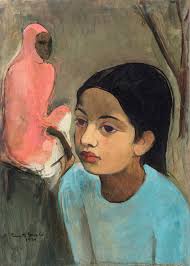
Painting by Amrita Shergil (1913-1941)
What are the Options?
“So then what happened?”
Nothing. My father came and took me back to his house. My nana-nani[3] didn’t stop him. He put me in a good school though, so this time I didn’t mind going back there. Last time he took me, I hated it.
“Why did you hate it?”
He wasn’t a nice man. I think that’s why my grandparents took me in. They knew what kind of a man he was. I loved being at my grandparents’. My mama, mother’s brother, he would take me shopping during holidays. I could pick anything in the entire shop, he’d never say no. Whenever I wanted new clothes, my masi, mother’s sister, took me to the markets\. She was like my mother. I was so loved there. But then my father took me away…
He had too many restrictions. My mother and I weren’t allowed to leave the house. I couldn’t leave after I came back from school. He kept an eye on us from his shop, it was down the street. Then the drinking got too much, the yelling, the swearing. I was afraid of his footsteps. I could tell from the sound of them what the night was going to be like. My mother was very scared of him, she couldn’t protect me from him. She felt helpless, I felt really bad for her. Then I was sent away again to my grandparents. I liked it there. I was studying in a government school. I did well in studies. I liked it. But then he came and took me back to the village. I had to repeat my third standard[4] there. I cried a lot at first, but it was a private school, better than the government one in Delhi.
“So this was the second time you were going there?”
Yes. I’ve lived at my father’s a couple of times. Sometimes I ran away and came back to my grandparents’, sometimes my mother brought me with her and stayed. But she always went back pretty soon. The first time he took me, I used to cry to my grandparents every night to take me back. I had to repeat classes so many times, I’m really behind on my studies. This has ruined my education. That’s why I hate it.
“What about the last time you were there? What happened then?”
Nothing. The same. But worse. He was more violent. My mother herself asked me to go with her to my grandparent’s. But I had exams in a month. I was a good student. I’d worked so hard. That year was especially bad at home; I’d put all my energy into school. I didn’t want to just drop it all and repeat the class again. I begged my mother to stay till the end of the term. He would beat her over everything. So I had to beg her. I promised her I would support her if she’d just let me give those exams. I was 14. I was old enough to start working.
“So did she stay?”
Yes. And then I came back to my grandparents’. But she went back the second day. Then she stopped taking my calls. Finally, I called her from someone else’s phone. She recognised my voice. I could tell. She didn’t say anything for a long time. I kept asking her to come. Then she said, “Aaj se tera mera rishta khatam; you’re not my daughter anymore. Don’t call again.”
I felt very alone. Things at my grandparents’ were also changing. My aunt was getting married. Everyone was busy with the preparations.
Nana[5] used to drive the auto 15 hours a day to save up for it. But he first had to pay back the loan he took out for the auto before he could save for the wedding. It was his last installment and they were really breathing down on him. One day he came home and told us he was short of 1000 bucks and it was time to make the payment. He asked my uncle, who was married by then, but his wife said they couldn’t spare it since they were also paying for the wedding and saving for the baby they planned to have next year. My uncle didn’t even have the balls to refuse his father himself. His wife had to do it. My grandfather turned to my mother, but she said, she couldn’t spare it either, she’d spent it all on me.
“Wait, your mother was there?”
Yes. She’d come eventually, some two months after me. She was working as a cook. It was really nice. For the first time, it felt like she was there. But that day she had used me as an excuse. I didn’t see any of that money. She wasn’t even paying for my school fees. I took tuitions and paid for it. I was starting to resent her too, I could see why the rest of them hated her.
“Wait, who hated her? Why did you resent her, you just said she was there for you.”
She was. When she came. She got a job. She got offs on Sunday and she would spend those with me. On Sundays, I didn’t have to cook for the family, she did. She even gave me money for school supplies, like new copies or pens, whenever I asked for it. She got me a small phone too. But this didn’t last long. She met someone. She used to take the same rickshaw to work everyday. He’d take her from one place to the next, they used to talk, then she’d talk to him at night too. She kept to herself. She started spending her Sundays with him. He wasn’t a good man. One day, he went to the village.
I thought it would end but her late-night conversations continued. They hated her, my grandparents and my uncle, his wife, even my mother’s sister. She knew her sister was to get married soon but she was roaming around with a man. All the neighborhood knew about it. What would they think? And then she stopped contributing to the house. How much could my grandfather do? She didn’t even give me any money anymore. Not even for notebooks. I had to work. And it was so difficult. I had to make breakfast for everyone in the house in the mornings, pack my lunch, rush back and do all the cleaning of the house, make lunch for everyone, then clean up the kitchen and wash the vessels. Then my kids would come. But everyone was selfish then. They were angry with my mother, and then with me. I gave my grandmother a part of my earnings, and I paid for my school. I did everything. She’d stopped staying home on Sundays too, so I had to do the work. That day, when my grandfather asked for money, she said she didn’t have any. He got so angry with her, he called her a slut, a leach, a parasite, draining him, killing him slowly, he slapped her. She ran away. I noticed that he didn’t react the same way when his daughter-in-law had refused to give him the money. But he was just so upset, he started crying. I couldn’t bear it. So I took one thousand from the money I’d saved for all those months and gave it to him. My grandmother took me aside and told me I shouldn’t have done it, that she could have dipped into the money I gave her. I told her that was for her. She didn’t have any money at all. And she’d been so kind to me. She was the only one who didn’t resent me. But she respected my grandfather too much to contradict him when he called me names.
“I thought your grandparents were supportive, that you’d felt safe in their house?”
I did. But my aunt was getting married, that changed everything. And I understand why they were angry with my mother. She brought us so much shame. One day, that man that she’d been having an affair with, he went to her workplace and started beating her up. He forced her onto his rickshaw, holding her hair throughout, and then brought her to our neighborhood and dragged her through the streets by her hair to his friend’s house. She’d started an affair with his friend when he’d gone to his village, and he found out about it. All the people heard him that day. She was so scratched up when he finally let her go. I took her to the police station but they didn’t file a complaint. My grandparents also encouraged her to file a complaint. But she didn’t. The new man she was seeing told her he was going to help her. So she listened to him, trusted that he would get her justice. I’ve never seen him, none of us had. But she really trusted him.
One day my aunt was really anxious. She came into the room when I was taking a class, and she asked me to go to the terrace because she needed the room. I had to move all the kids upstairs, take all the chairs. When I came back after the class, she started yelling at me, telling me I’m a burden, then she started beating me, abusing my mother too. I didn’t say anything to her when she was beating me; she left me in the room. I waited for my mother to come and comfort me. But she didn’t come. So I went looking for her, thinking this could bring us together. But I found her on the terrace, talking to her new boyfriend, telling him about all this. I felt really abandoned. She couldn’t even bother to check on me but she wanted his sympathy. Then they got into a fight. At one point, I overheard her begging him not to leave her or she’d kill herself. It made me so angry, I felt like I could break something. I didn’t like this man at all. One day, she just got up left. I asked my grandparents to file a missing person’s report but they didn’t want to do it because it would bring shame to the family and my aunt was getting married. So they waited till it was over and then filed it, three years later. But I haven’t seen her since. I think she’s missing, we need to find her.
“How long ago was this?”
I don’t know. I can’t tell.
“What happened after your mother left?”
They all blamed me, they said I drove her to do it, that I hated her, that I was like her. They asked me to start contributing to the house, to stop living like a freeloader. I started giving all my tuition money home. I couldn’t continue school anymore. But they were so angry. One day, after my aunty’s marriage, the police came to our house in response to the missing person’s complaint I’d made them file. They wanted to ask questions about my mother and her boyfriend. I think she planned her escape. She’d been staying overnight at his house 2-3 times a week, and slowly taking her clothes there. The police pointed this out, how she couldn’t have taken a big bag when she escaped, or we’d have seen her packing. I think they’re right. She abandoned me.
“Do your grandparents believe she’s okay, living somewhere else?”
Yes. It makes sense. She didn’t like it at home. They felt so ashamed by the police visit. They were angry that I’d made them file the complaint only to find out that their daughter had run away willingly. My grandfather was livid that day. He beat me up, then tried to drag me down the stairs. But I fell down at the 3rd floor landing so he started kicking me. Then he left me lying there. My grandmother didn’t come to help me. I was so distraught. I couldn’t even go to school, everyone hated me. What future did I have? No one wanted to help me, I didn’t know anyone who could help me or even who to turn to. I jumped off the landing there. I tried to commit suicide. That’s why I’m here now. Now I go to school.
[1] Note: Loosely based on the writer’s lived experiences
[2] “Establishing itself as a premier women’s organisation in India from 1987, Shaktishalini has spread out and deals with all kinds of gender based violence. A shelter home, a helpline and more than that a stunning activist passion are the hallmarks of this organisation.
“pandies and Shaktishalini – different in terms of the work they do but firmly aligned in terms of ideological beliefs and where they stand and speak from. It goes back to 1996 when members of the theatre group went to the Shaktishalini office to research on (Dayan Hatya) witch burning for a production and got the chance to learn from the iconic leaders of Shaktishalini, Apa Shahjahan and Satya Rani Chadha. And collaborative theatre and theatre therapy goes back there. It is a mutual learning space that has survived over 25 years. Collaborative and interactive, this space creates anti-patriarchal and anti-communal street and proscenium performances and provides engaging workshop theatre with survivors of domestic and societal patriarchal violence. Many times we have sat together till late night, in small or large groups debating what constitutes violence? Or what would be gender equality in practical, real terms? These and many such questions will be raised in the stories that follow.” — Sanjay Kumar
Ujjal Dosanjh, former Minister from Canada and former Premier of British Columbia, discusses his autobiography, Journey After Midnight – A Punjabi Life: From India to Canada, and the need for a world with less borders. Click hereto read.
Professor Fakrul Alam discusses his new book of Tagore translations, Gitabitan: Selected Song-Lyrics of Rabindranath Tagore. Click here to read.
Translations
Tagore’sMusalmanir Galpa(A Muslim Woman’s Story) has been translated from Bengali by Aruna Chakravarti. Clickhere to read.
Masud Khan’s poem,In Another Galaxy, has been translated from Bengali by Professor Fakrul Alam. Click hereto read.
Wakeful Stays the Door, a poem by Munir Momin, has been translated from Balochi by Fazal Baloch. Click here to read.
Songs of Freedom: An Ordinary Taleis a narrative by Nandani based on her own experiences, translated from Hindustani by Janees. These narrations highlight the ongoing struggle against debilitating rigid boundaries drawn by societal norms, with the support from organisations like Shaktishalini and Pandies. Click hereto read.
Story by Nandani, translated from Hindustani by Janees
Songs of Freedom bring stories from women — certainly not victims, not even survivors but fighters against the patriarchal status quo with support from the organisation Shaktishalini[1]
–SanjayKumar, founder, pandies‘
Nandani is an 18 year-old from Delhi, currently studying in the 10th grade. In her free time, she loves to read biographies, hang out with her friends, dancing and singing. She calls books as good friends of hers and looks forward to travelling across the world once in her lifetime.
An Ordinary Tale
A story set in the year 2002. An ordinary story I must tell.
When a girl child is born in a Panditfamily, the mother welcomes Goddess Lakshmi. But the mother-in-law is unable to fathom bahu’s [2] joy over the girl baby. Call it outdated, archaic, outmoded. For the saas[3], a son would have proven to be a boon, a blessing straight from the heavens, a support to the family’s genes. She, like many others, was of the belief that a girl born is nothing but a burden who must be ‘disposed’ off to another family at the earliest. What are women but estranged wealth?! The world is run by men, their divine masculinities, their valour, by their being. Women are absolute subordinates to men. She failed to understand that being born a ‘male’ is simply a matter of – birth.
But bahu was not ready to give up. She would put in efforts to make her family think otherwise. She named her daughter Avantika. When Avantikahad grown up a bit, the saas one day cunningly said, “Bahu! See I like to put forward things as they are, no sugar-coating. I want you to focus on giving birth to my grandson now. I hope I will not be disappointed this time.”
The poor bahu was busy attending household chores. She tended to ignore the otherwise outrageous demands the mother-in-law burdened her with. Meanwhile the saas thought to herself, “Now that I have explicitly expressed my wish to bahu, maybe it’s better to let my raja beta[4] know of my justified desire.” So, she made sure she had her wish conveyed to her son. “My dear son, I have expressed my wish to Bahu – for a grandson, with whom I can enjoy the joys of grandmotherhood.” For the son, the mother’s wish was as good as a divine decree.
The bahu, who has overheard their conversation, felt betrayed and outraged. “How could you say yes on my behalf? What about my consent? I am not ready for another child. You don’t have a job. You don’t let me go out and work. You are living off your mother’s expenses… drinking, beating me to death every night! I don’t want to traumatise another child the way Avantikahas been traumatised.”
Her husband retorted, “How dare you? Who are you to stop me from taking decisions?” Basically, what he meant was that she was his slave and had no authority in deciding how many kids she wanted, when to have and so on and so forth.
The saas interfered in the matter and somehow convinced, or rather forcibly convinced the bahu to bear a child. We will not go into the details of this.
2005
Another girl child was born! The saas, was not just disappointed this time. She experesses her intolerance of this development. “All I ever wanted was one grandson! Not five or eight. Bahu is deliberately depriving me of this privilege. It was wrong of me to trust her.” Again, she simply failed to comprehend how sex and science works!
With the birth of Nira, the bahu’s life became hell … rather was made hell by her mother-in-law and husband. Violence grew. “Ever since this girl has taken birth, a curse has taken over the joys and prosperity of our home. I refuse to accept her. Her arrival is a time of tribulation for us.”
The contempt and disgust if the saas towards the bahu and her daughters were echoed by the husband and father, who had turned more violent than before, and why not ? He had all the more reason to inflict pain on his wife. Backed by his mother, he started beating his wife every day, cursed her all day. When Niraturned one-and-a-half, the hostility worsened. The bahu turned numb. A wish as simple as wanting a decent life was out of her reach. “Because of you I live a miserable life despite being a man. You are the reason my brothers and mother don’t respect me. You and your daughters have ruined my relations with them….”
One day something changed. She mustered the courage to say ‘no’ despite the routine beatings. She was not willing to take it anymore and so, with her two little daughters, she decided to leave the house.
“I have not sinned. I have given birth to daughters and that is no sin. There is not a single defect in me or my daughters. It is you, your intentions, and your mentality that is defective…I reject living a life like this.”
She sought refuge at her paternal home and soon began working to support her daughters. Now, she had a life that promised, to all intents and purposes, a relief from the darkness of the past. A few months later, she fell in love with a colleague at work. Nobody knew what occurred to her, but leaving her two daughters behind, the mother eloped with the lover to start a new life. She turned blind to the plight of her own daughters who were just starting out with the promise of a fresh start.
Avantika and Nira, unaware that another calamity had befallen them, adapted to the new life under the shadow of their maternal grandmother, their nani. Unable to look after the girls with growing time, nani took a difficult call due to her ailing health. “Can you look after the girls when I die? Can you take care of them?” she asked her other daughter (the girls’ aunt). “I wish I could…but in today’s time managing two more children… It’s beyond my capacity…I understand what they mean to you…so for you maybe I can look after Avantika, the elder one…however, something must be done about Nira…”
A few weeks later, the nani sent for their aunt and said, “I am here today, but who knows about tomorrow? We must take final decisions with regards to Avantika and Nira. All they have is me. I am glad you took charge of one of them. But something must be thought about the other as well. I am sure God will send help.”
“Mother, I have an acquaintance who is associated with a shelter home. Sending Nirato a girls’ hostel should take care of our worries. Let me get in touch with her.”
Little Nirawas sent to a girls shelter home. She cried a lot on separation from sister and nani. A year later the news of nani’s death upended the girls’ lives. Trying to cope with the grief, they adapted to their new lives – one day at a time, one goal at a time.
2023
Both Avantika and Nira are growing up at their own pace – finding new goals to focus on. They are not together, nor are they in touch. But they are fighters and survivors. And this is how this story has end for the time being. However, certain questions continue to haunt me…
Do you discriminate between a son and a daughter? What would Avantika and Nira’s mother do if her parents did not offer to support her? Can women discriminate against other women? Why is it that a woman often finds it difficult to find solidarities from fellow women?
It is quite difficult to single out the oppressor and the oppressed in this story, however, that does not spare us from rejecting to inflict this age-old atrocity on our women. This has to stop with our generation.
.
[1] “Establishing itself as a premier women’s organisation in India from 1987, Shaktishalini has spread out and deals with all kinds of gender based violence. A shelter home, a helpline and more than that a stunning activist passion are the hallmarks of this organisation.
“pandies and Shaktishalini – different in terms of the work they do but firmly aligned in terms of ideological beliefs and where they stand and speak from. It goes back to 1996 when members of the theatre group went to the Shaktishalini office to research on (Dayan Hatya) witch burning for a production and got the chance to learn from the iconic leaders of Shaktishalini, Apa Shahjahan and Satya Rani Chadha. And collaborative theatre and theatre therapy goes back there. It is a mutual learning space that has survived over 25 years. Collaborative and interactive, this space creates anti-patriarchal and anti-communal street and proscenium performances and provides engaging workshop theatre with survivors of domestic and societal patriarchal violence. Many times we have sat together till late night, in small or large groups debating what constitutes violence? Or what would be gender equality in practical, real terms? These and many such questions will be raised in the stories that follow.” — Sanjay Kumar
Shantanu Ray Chaudhari converses with writer Gajra Kottary, a well-known writer of Indian TV series, novels and stories. Clickhereto read.
A discussion on Samaresh Bose’s In Search of the Pitcher of Nectar, a book that takes us to the heart of the Kumbh Mela, a festival recognised by the UNESCO as an Intangible Cultural Heritage, with the translator, Nirmal Kanti Bhattacharjee. Clickhere to read.
Translations
Nazrul’s Why Provide Thorns has been translated by Professor Fakrul Alam. Clickhere to read.
Mercy, a story be P. F. Mathews, has been translated from Malayalam by Ram Anantharaman. Clickhere to read.
Songs of Freedom: Vikalangta or Disability is an autobiographical narrative by Kajal, translated from Hindustani by Janees. These narrations highlight the ongoing struggle against debilitating rigid boundaries drawn by societal norms, with the support from organisations like Shaktishalini and Pandies. Clickhere to read.
Paul Mirabile explores James Joyce’s Stephen Dedalus and his passion for words keeping in mind the hundred year old Ulysees & the even older, A Portrait of the Artists as a Young Man. Clickhere to read.
Book Excerpts
An excerpt from Radha Chakravarty’s translation of Tagore’s Farewell Song. Clickhere to read.
An excerpt or two short narratives from Rhys Hughes’ Yule Do Nicley. Clickhere to read.




 Borderless