Categories
Poetry

The Imaginary Menagerie

By Rhys Hughes

THE IMAGINARY MENAGERIE

1. 
A banshee on a rooftop
can wail all night
when the mists swirl thickly.
A whale on a rooftop
ought to get down quickly.

2. 
A cockatrice is not very nice,
in fact some say it's a curse
when it struts around in the nude.
But when it is wearing socks
I'll say it's even worse.

3. 
Medusa and a French writer:
as opposites they are polar.
They are pleased to dine on cheese
but only Gorgon Zola.

4. 
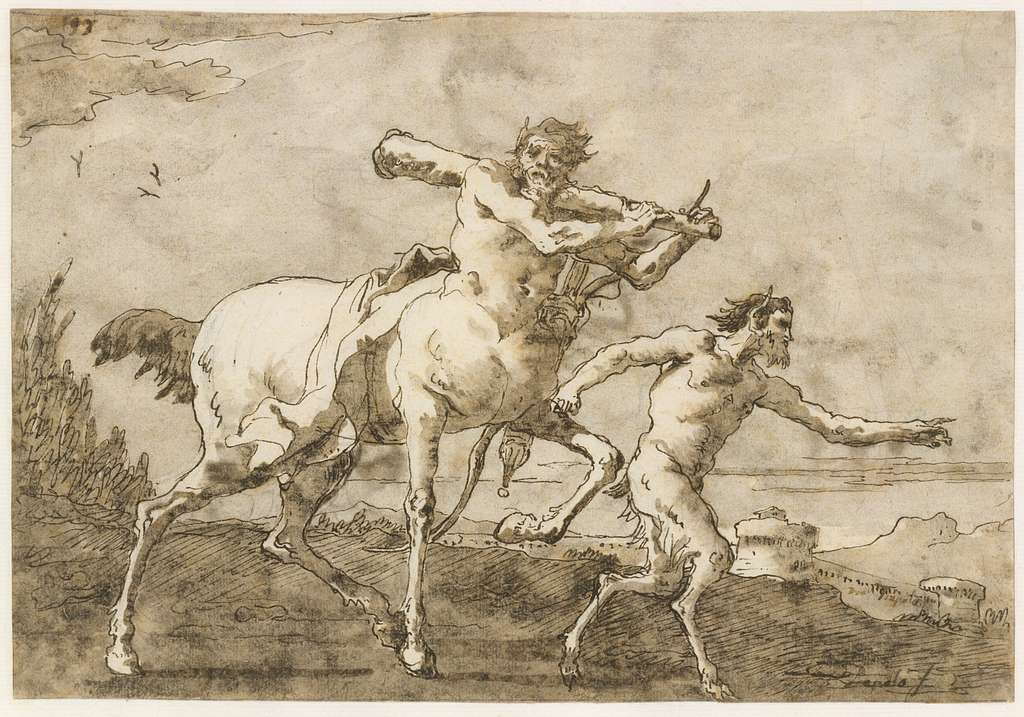
Part man, part horse,
the centaur trots around the race course
shooting arrows at the hats
worn by all the toffs
in the crowd who watch
but with insufficient force
to knock them off.

5. 
The vampire with sore gums
bites only sorghum
but he likes to reminisce
about the throats and biscuits
of priests in the seminary.
Fangs for the memory!

6. 
The simurgh is a beautiful bird
rarely kept as a pet
because few people can afford her.
Among our feathered friends
she ranks highest in the pecking order.

7. 
What has been written
about the minotaur
is true enough from feet to neck
but don't believe the text in full:
the remainder is a lot of bull.

8. 
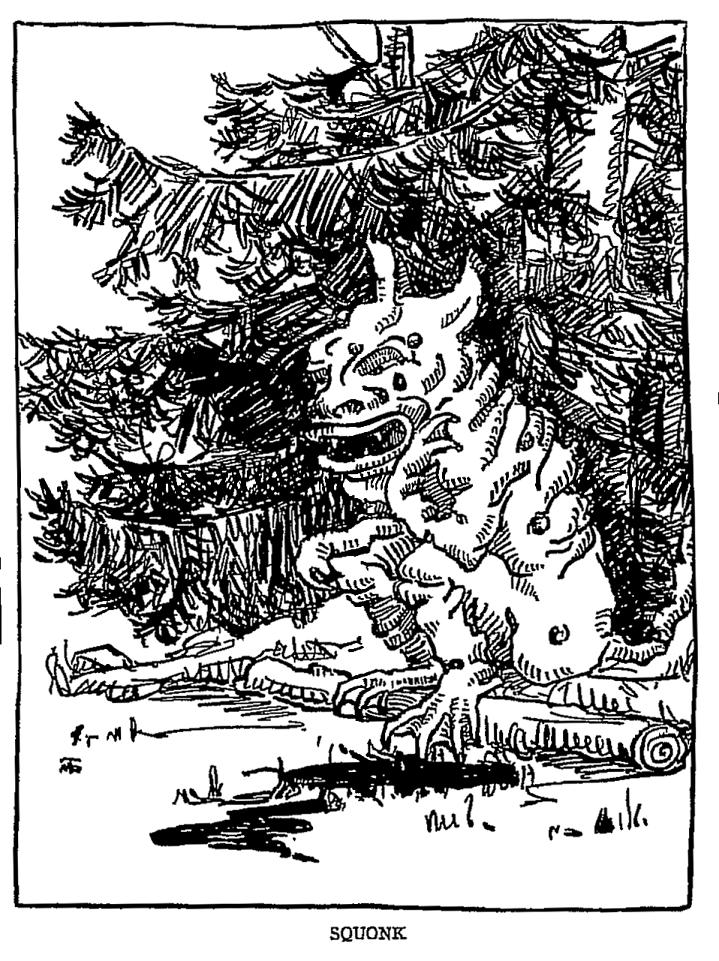
There is a squonk who weeps all night
on the roof of my tropical bathroom.
The tears that drip through bamboo shoots
are always gloomy, fat and sour
but in them I prefer to shower.

9. 
The hydra is a kind of snake
with many heads
who for the sake of better relations
with all the nations
of humanity
decided to get an education
and began with trigonometry.
Now he's a mythical snake
with many headaches.

10. 
A phoenix has no politics
but knows a trick or two.
Perched in a bowl of cake mix
and bursting into flames
it may bake that cake for you.

11. 
A Cyclops with a telescope
can stare at distant pears,
the planet Mars as well,
but a cyclops with binoculars
has no hope in hell.

12. 
A hippogriff on the edge of a cliff
can safely leap into the void and soar
but a hippopotamus or hypocrite
would splatter on the canyon floor.

13.
The wealth of an elf
and the security of an Elf
in our world's fairyland sector
are important considerations
for an 'Elf & Safety' inspector.

14. 
There's a manticore
behind a door
inside the betting shop
but that door is a jar
and the stopper in the top
prevents it getting out.

15. 
Although his wings are extended
the dragon wears trousers
recently mended
for courtesy's sake
because the damsel in distress
turned out to be
a knight in a dress
with an awkward curtsy.
Yes, the Dragon wears trousers
but he's flying low.

16. 
The leprechaun has worn
out his shoes
and torn his green cap
and sits on the lawn,
bottles of booze in his lap,
until the break of dawn.

17. 
The satyr is a goat man
who chases river nymphs
in a boat with leers: his plan
is to catch them in a net
but he hasn't got any yet.
He is wet behind the ears.

18. 
A Wyvern is a kind of dragon
with only two legs: the front ones
and both of those are frail.
That's why his tail
tends to drag on the ground
while he is toing and froing
and running around
to see what fun things we are doing.

19. 
The Titan
wants to bite on
the biggest sandwich in creation
but no doubt
his mastication
will meet negation
when all the filling falls out.

20.
The happy harpy
plays the flute too loudly
or so the other Harpies claim.
The unhappy Harpy
plays a lute too sadly
to attain musical fame.
Later they will beat
their wings against the ceiling
to express their mutual feeling:
distrust, dislike and irritation.

21. 
Triffids are insipid
when added to salad
but they are always in a hurry
to jump into curry.
Who can say why? Not I.

22. 
I knew a ghoul
who was nobody's fool.
He enrolled in a university
adjacent to a cemetery.
Corpus Christi College
extended his knowledge
that corpses are tasty.

23. 
There's a yeti
in the freezer
and we don't know
how he got there.
Extracting him with tweezers
seems petty
and unfair, so we won't
dislodge him from his lair
of artificial snow
but leave him unmolested
next to the polar bear.

24. 
Always a risk
to kiss a basilisk
especially if you miss
and kiss the wrong end.

25. 
The mermaid paid with alacrity
her parking fine.
She had tethered her seahorse
to our ship's anchor.
I must descend in a diving suit
to personally thank her.

26. 
With ten long arms
he can do great harm
when he takes over
the submarine factory
by poking big holes in hulls
but the workers in Quality Control
are more afraid the Kraken
boss will simply say, "Sack 'em!"
and that's exactly what he does.

27. 
A unicorn is a horse with a spike
that can eat apples and leap a fence.
But a graph with a spike is evidence
that something isn't right.

28. 
The gnome at home
is worse than a ghost
but an absent Gnome
is a generous host.
How is this possible?

29. 
If the chimera came here
you would surely run away.
The lion part would roar at you,
the snake part would hiss,
and as you beat a hasty retreat
the goat part would bleat
at your receding feet.

30. 
The golem is a man of clay
but who can say
if the potter's wheel made him dizzy?
He never eats or even drinks
while he is busy
unless it's something fizzy.

Rhys Hughes has lived in many countries. He graduated as an engineer but currently works as a tutor of mathematics. Since his first book was published in 1995 he has had fifty other books published and his work has been translated into ten languages.

.

PLEASE NOTE: ARTICLES CAN ONLY BE REPRODUCED IN OTHER SITES WITH DUE ACKNOWLEDGEMENT TO BORDERLESS JOURNAL

Categories
Travel

Planes, Trains & Automobiles

I should like to rise and go
Where the golden apples grow;—
Where below another sky
Parrot islands anchored lie...

-- Travel, RL Stevenson (1850-1894)

December is often a time when we look forward to a vacation and travel. Through the pandemic ravaged years, moving out of the house itself had become a challenge. Now as the world opens up slowly (hopefully the Omicron variant of the virus will be more benign), travel stretches its limbs to awaken to a new day with new trends and rules. Borderless invites you to savour of writing that takes you around the world with backpackers, travellers, hikers, sailors and pirates — fantastical, imaginary or real planned ones in a post-pandemic world. Enjoy!

Poetry

In the Honduran Dusk

Lorraine Caputo takes us on a visit to a small Garífuna village on Honduras’ Caribbean coast. Click here to read.

The Voyages of Caracatus Gibbon

Rhys Hughes time travels back to the first century voyaging vicariously with his imagination and a Welsh king who resisted Roman invasion. Click here to read.

Pirate Blacktarn gets Lost

Have you ever got lost while traveling like Pirate Blacktarn? Who can help the pirate find his way… Narrated by Jay Nicholls, click here to read.

Classics

Travel & Holidays: Humour from Rabindranath

Do you enjoy babysitting nieces, nephews on trips and have you ever traveled with ‘hundreds of pieces of luggage, a few coolies, five women and only one man’? Tagore did. Somdatta Mandal translates hilarious writings from young Tagore on travel. Click here to read.

The Witch

Travel through Bengal with Shorodhoni, a woman dubbed a ‘Daini’ or witch, in her quest to find a home in Aruna Chakravarti’s translation of Tarasankar Bandhopadhyay’s poignant story. Click here to read.

Gliding down the Silk Road

“Stories that tell us about human lives and human emotions highlight one simple thing: Humans are the same everywhere.” That is what Ratnottama Sengupta concludes as she vicariously travels through the famed route from the past. Click here to read.

Around the World

Antarctica

Click here to read Keith Lyon’s travels in Antarctica and savour the photographs he clicked.

Adventures of a Backpacking Granny

Sybil Pretious takes you on her adventures that start at sixty years of age with photographs and narration.

St Petersburg, Russia

Click here to read.

Mount Kiliminjaro

Click here to read.

Lake Baikal in Siberia

Click here to read.

Baoying, Rural China

Click here to read.

Volcanic Lake Toba. Photo Courtesy: Sybil Pretious

Philippines, Volcanoes & More

Click here to read.

Indonesia

Click here to read

Myanmar

Click here to read John Herlihy’s exhilaration with Myanmar in a pre-pandemic world in four-parts.

Australia

Click here to read Meredith Stephens’ sailing experiences between Adelaide and Kangaroo island.

Pandemic Diaries

Click here to read how Sunil Sharma moved continents, pausing in Maldives to find a new home in Canada.

Categories
Seasonal Outpourings

Auf Wiedersehen Autumn

Autumn by Sohana Manzoor

As autumn gives way to winter, here are explorations that give us a glimpse of the season, its colours, its feel across different parts of the world and their varied interpretations. We have the vibrancy captured in colours by Sohana Manzoor and Sybil Pretious. There are reactions to events that happened at this time in different parts of the globe from Ratnottama Sengupta and Sutputra Radheye — have we healed after these events? Have things got better?

As Europe starts a new wave of pandemic lockdowns, Mike Smith takes us for a trip to Trieste, rich with the heritage of James Joyce, Umberto Saba and Baron Von Trapp of Sound of Music. Prose from Tagore(1861-1941) translated by Somdatta Mandal showcases some of his reactions while traveling in Japan, America and Europe in the autumn of his life. We can vicariously travel to different parts of the planet! While verses by Michael Burch and George Freek explore the season and the autumn of life, poetry by Rhys Hughes and Sekhar Banerjee add zest to the fall with humour. Revathi Ganeshsundram brings us a poignant narrative of new friendships. A short story from maestro storyteller from Holland, Louis Couperus(1863-1923), translated by Chaitali Sengupta, paints a darker hue of autumn while Tagore’s poetry gives us a festive feel generated by the season in Bengal. Enjoy our melange of autumnal lores!

Poetry

Autumn & Me: Poetry by Michael Burch. Click here to read.

Algae Masks: Poetry by Sekhar Banerjee. Click here to read.

Autumnal Dirge: Poetry by Sutputra Radheye. Click here to read.

The Night Music: Poetry by George Freek. Click here to read.

A story poem by Rhys Hughes about The Clock Tower of Sir Ticktock Bongg, who spends his autumn of life in the most peculiar way. Click here to read.

Translation of Amaar Nayano Bhulano Ele or The Advent Song by Tagore describes autumn in Bengal. Click here to read. 

Prose

Yesterday Once More?: Ratnottama Sengupta revisits an autumn in Egypt. Click here to read.

Me & James Joyce in Trieste: Mike Smith travels in autumn to Trieste, an autumn in a pre-pandemic world. Click here to read.

Of Days & Seasons: A parable by Louis Couperus, translated from Dutch by Chaitali Sengupta. Click here to read

The Cockatoo: A short story about new friendships in the autumn of life by Revathi Ganeshsundaram. Click here to read.

 Letters from Japan, Europe & America: An excerpt from letters written by Tagore in the autumn of his life, translated from Bengali by Somdatta Mandal. Click hereto read.

Painting by Sybil Pretious
Categories
Contents

Borderless, November, 2021

Autumn: Painting in Acrylic by Sybil Pretious

Editorial

Colours of the Sky…Click here to read.

Interviews

In Conversation with Akbar Barakzai, a Balochi poet in exile who rejected an award from Pakistan Academy of Letters for his principles. Click here to read.

In Conversation with Somdatta Mandal, a translator, scholar and writer who has much to say on the state of Santiniketan, Tagore, women’s writing on travel and more. Click here to read.

Translations

Rebel or ‘Bidrohi’

Nazrul’s signature poem,Bidrohi, translated by Professor Fakrul Alam. Click here to read.

Motorcar

Jibonananda Das‘s poetry translated from Bengali by Rakibul Hasan Khan. Click here to read.

The Beloved City

Poetry of Munir Momin, translated from Balochi by Fazal Baloch. Click here to read.

Rebranding

A poem in Korean, written & translated by Ihlwha Choi. Click here to read.

Perhaps the Last Kiss

A short story by Bhupeen giving a vignette of life in Nepal, translated from Nepali by Ishwor Kandel. Click here to read.

Morichika or Mirage by Tagore

Tagore’s poetry translated by Mitali Chakravarty. Click here to read.

Poetry

Click on the names to read

Rhys Hughes, Sutputra Radheye, Luis Cuauhtémoc Berriozábal, Sheshu Babu, Michael Lee Johnson, Prithvijeet Sinha, George Freek, Sujash Purna,  Ashok Manikoth, Jay Nicholls, Pramod Rastogi, Ryan Quinn Flanagan, Vijayalakshmi Harish, Mike Smith, Neetu Ralhan, Michael R Burch

Poets, Poetry & Rhys Hughes

A story poem about The Clock Tower of Sir Ticktock Bongg. Click here to read.

Nature’s Musings

Penny Wilkes takes us for a stroll into the avian lives with photographs and poetry in Of Moonshine & Birds. Click here to read.

Stories

Waking Up

Christina Yin takes us on a strange journey in Sarawak, Malaysia. Click here to read.

Rains

A pensive journey mingling rain and childhood memories by Garima Mishra. Click here to read.

Khatme Yunus

Jackie Kabir brings us a strange story from Bangladesh. Click here to read.

First International Conference on Conflict Continuation

Steve Davidson explores an imaginary conference. Click here to read.

The Literary Fictionist

In Fragments of a Strange Journey, Sunil Sharma sets out with Odysseus on a tour of the modern day world. Click here to read.

Musings/Slices from Life

Yesterday Once More?

Ratnottama Sengupta recalls her experiences of the Egyptian unrest while covering the 35th Cairo International Film Festival in 2012. Click here to read.

Embroidering Hunger

An account of life of dochgirs (embroiderers) in Balochistan by Tilyan Aslam. Click here to read.

To Daddy — with Love

Gita Viswanath takes us into her father’s world of art and wonder. Click here to read.

Simon Says

Ishita Shukla, a young girl, explores patriarchal mindset. Click here to read.

Welcoming in the dark half of the year

Candice Louisa Daquin takes a relook at the evolution of Halloween historically. Click here to read.

Musings of the Copywriter

In Crematoriums for the Rich, Devraj Singh Kalsi regales his readers with a dark twist of the macabre. Click here to read.

Essays

Renewal

Jayat Joshi, a student of development studies, takes a dig at unplanned urban development. Click here to read.

Once Upon A Time in Burma: Leaving on a Jet Plane

John Herlihy’s last episode in his travels through Burma. Click here to read.

A Legacy of Prejudice, Persecution and Plight

Suvrat Arora muses on the impact of a classic that has been coloured with biases. Click here to read.

The Observant Migrant

In Is Sensitivity a Strength or a Weakness?, Candice Louisa Daquin explores our value systems. Click here to read.

Book Excerpts

Arundhathi Subramaniam’s Women Who Wear Only Themselves. Click here to read.

CJ Fentiman’s award winning book, The Cat with Three Passports. Click here to read.

Book Reviews

Himadri Lahiri reviews Somdatta Mandal’s ‘Kobi’ and ‘Rani’: Memoirs and Correspondences of Nirmalkumari Mahalanobis and Rabindranath Tagore. Click here to read.

Suzanne Kamata reviews Iain Maloney’s Life is Elsewhere/ Burn Your Flags. Click here to read.

Bhaskar Parichha reviews Anita Agnihotri’s Mahanadi –The Tale of a River, translated from Bengali by Nivedita Sen. Click here to read.

Meenakshi Malhotra reviews Turmeric Nation: A Passage Through India’s Tastes, authored by Shylashri Shankar. Click here to read.

Categories
Editorial

Colours of the Sky

A riot of colours starts the day
with happiness, vibrancy and hope,
dispelling the winter of discontent
with whispers of new lores…
Courtesy: Sohana Manzoor

Devi (The Goddess) is a 1960 Satyajit Ray film, based on a story by a writer called Prabhat Kumar Mukhopadhyay, that showcases nineteenth century India, where the silence of a young girl who is deified, wreaks havoc in her home, village and life. In an interview, Satyajit Ray contended that the film was to make people rethink ‘messiahdom’. The exact words he used to state this was that the film was against ‘religious dogmatism’ as the film and story literally dealt with the deification of a young bride. Tagore had similarly questioned blind deification in a number of his poems and plays. These (as Ray spelt out in his interview) did not address religion per se but malpractices, among them, the tendency to worship an idol to a point where flaws are justified, accepted and emulated. Satyajit Ray and Tagore were both Brahmos — which can be seen as a reform movement. These two were not criticising religion but talking of rising above gawky hero worship to think logically and arrive at logical conclusions. When we talk of characters from the Ramayana, the Mahabharata, other mythologies or substitute the adulated with stars, writers, politicians and businessmen who run huge concerns, we tend to idolise them. But these were and are all characters with flaws, whether fictitious or real. We can well learn from their mistakes, rather than deify and worship them to justify bad behaviour by quoting instances from lives of past legends or prominent persons in the current world.

Akbar Barakzai, a poet exiled from Balochistan, talks in a similar vein in his interview. You can see it in his poetry too — some of which can be found translated by Fazal Baloch in our pages. Barakzai talks of transcending barriers we draw for ourselves in the real world, of writing with honesty and sincerity. He has shared vignettes of his life as he changed countries to continue his work. Baloch has also brought to us another excellent poet in translation, Munir Momin. A major poem by Nazrul (the ‘bidrohi kobi’), ‘Bidrohi or Rebel’ has wound its way to our pages translated by Professor Fakrul Alam. We are honoured and grateful that Prof Alam chose to share this excellent translation with us. We have more translations: Jibonananda’s ‘Motorcar’(1934) by Rakibul Hasan Khan, a Korean translation by Ihlwha Choi, another short story from Nepal and Tagore’s powerful poem,Morichika or Mirage’, which is a wake-up call for the inert affluent who hold themselves aloof from common masses. We have also interviewed a major prose translator of Tagore, Professor Somdatta Mandal. With much to share on Santiniketan, Nabanita Deb Sen and many interesting anecdotes, Mandal talks of her extensive work with her translations spanning many more writers from the past.

We have a colourful ensemble this time almost as vibrant as the autumnal colours that have invaded nature in some parts of the Northern Hemisphere. Michael R Burch has given us beautiful poems on autumn, including the autumn of life. We have a poem in a similar vein by George Freek whose work continues influenced by Liu Yong (1719-1805), an influential minister and calligrapher in the Qing Dynasty. Ryan Quinn Flanagan touches on Leonardo Da Vinci’s Mona Lisa in his poetry. Rhys Hughes has given us humour in both his poetry and his column. Our other humorist, Devraj Singh Kalsi has given us darker, more caustic black humour in his narrative. We have lovely photographs from Penny Wilkes with her verses in Nature’s Musings. It is amazing the way she photographs birds in flight. Stories from Malaysia, Bangladesh, India and America add to the richness of our oeuvre. Sunil Sharma has given us an avant-garde telling of Odysseus’s voyage in the modern world, transcending the borders of time and ethnicity.

A well-known senior journalist, Ratnottama Sengupta, has also travelled through time to give us a recall of her experience at the 35th Cairo Film Festival one November, nine years ago. Her narrative about the time that the Shariat law was adopted by Egypt reminds me of the way things moved in Afghanistan few months ago and what is even more stunning is the way in which organisations dubbed extremists earlier are allowed to run countries now. Is it really not yet time to get rid of messiahs and look for one world?

We conclude our travels in Burma with John Herlihy and his friend, Peter, this month. And start a column with Candice Louisa Daquin, The Observant Immigrant. Her essays always draw much discussion. An experienced psychotherapist, she has looked into our value systems. We have books excerpts from Arundhathi Subramaniam’s Women Who Wear Only Themselves and CJ Fentiman’s award winning book, The Cat with Three Passports. Himadri Lahiri has done an in-depth review of Somdatta Mandal’s ‘Kobi’ and ‘Rani’: Memoirs and Correspondences of Nirmalkumari Mahalanobis and Rabindranath Tagore. It is amazing how much we can learn about a person from their letters. Suzanne Kamata has shared her review of Iain Maloney’s Life is Elsewhere/ Burn Your Flags. Reviewed by Meenakshi Malhotra, Shylashri Shankar’s Turmeric Nation: A Passage Through India’s Tastes, sounds like an erudite read that spans thousands of years of history. Anita Agnihotri’s Mahanadi –The Tale of a River, translated from Bengali by Nivedita Sen, has been reviewed by Bhaskar Parichha. The narrative sounds like a powerful voice weaving together the lores around the river.

Do pause by and find many more authors who dot our November edition. As usual, naming each one will keep you away from our delectable reads for longer. We thank all our readers for their continued patronage, and I would like to thank my fabulous team who are now even providing visuals to brighten our pages. A huge thanks to Sohana Manzoor and Sybil Pretious, who write as well as they paint. Thanks to all our wonderful contributors for making Borderless a reality.

Wish you all sunshine and laughter!

Best,

Mitali Chakravarty

Borderless Journal

Categories
Pirate Poems

Pirate Blacktarn & The Worm

By Jay Nicholls

PIRATE BLACKTARN AND THE WORM


Pirate Blacktarn, Terror of the Lemon Seas 
Was feeling so hungry he ate three teas
And even after that he still wanted more.
He ate cookies and cakes and puddings galore.
But though Big Bob the Cook kept cooking and cooking
Blacktarn ate parrot food when Tim wasn’t looking.
He ate sea weed and star fish and slippery eels
And doughnuts and dumplings, all between meals.

“You’ll burst,” said Mick, “this is rather a worry.”
“No I won’t,” answered Blacktarn, eating barnacle curry. 
“This is ridiculous,” said Big Bob, feeling cross,
“You’re eating more than the great albatross.
The ship’s stores and supplies are vanishing fast,
These barrels of food are meant to last.”

But even though Blacktarn still ate and ate
He went on being hungry from morning till late.
In the middle of the night he crept out of his hammock
To try asking for crumbs from the wild seagull flock. 
And he stole Big Bob’s stew that he’d d only just made 
In a secret and stealthy, dark midnight raid.
But strangest of all, he grew more and more thin.
His cheeks became hollow and sunken in. 
His legs and arms looked like sticks on a twig 
And only his tummy stayed round and big.
“I’m fading away,” cried Blacktarn, eating some more,
“I’ll be nothing but a belly with the food it can store.”

“Something very strange is going on here,”
Said Bob to Rakesh, who was standing near. 
“Are you thinking what I’m thinking?”
“What?” asked Blacktarn, his fearful heart sinking.

“Worms!” said Bob. 

“WORMS!” cried Blacktarn. “HELP! HELP! I’ve got WORMS!” 

A small sneaky worm living in a ship’s biscuit 
Had jumped right out when Blacktarn bit into it.
It had slithered down his throat and settled in his stomach
And once it was there, it couldn’t believe its luck, 
For so much food kept coming its way,
Chocolate and cake, sweets and biscuits, day after day,
That the worm grew bigger and bigger and bigger 
While Blacktarn shrank to a small, thin figure. 
“Help,” groaned Blacktarn, so scared he nearly cried, 
“I’ll starve to death with this worm inside.”

“Don’t worry Captain,” said Rakesh the mate,
“We’ll see this worm has a nasty fate.”
And he took out his pipe and started to play
In a wiggly, weavy, wormy way.
And the worm stopped eating and started to listen 
To the magical music that made his eyes glisten. 
The tune sang of sea serpents swimming through the waves
And electric eels in undersea caves 
And the gleaming glow worms that light up the deeps
And the huge ocean snake that never ever sleeps. 

And the worm uncurled and started to rise 
In Blacktarn’s stomach which burped in surprise. 
And Rakesh played on, in his wriggly way 
And the worm began to squirm, then started to sway
Forwards and back he wriggled his body about 
Till he reached Blacktarn’s mouth and peered right out. 

Then fast as a dart swooped Parrot Tim 
And grabbed the worm and pulled and pulled him. 
Until out he wriggled all pink and squirmy 
And Tim quickly snatched him and dropped him in the sea,
Where he swam away most unhappily. 

Hurrah, hurrah Captain,” everyone cried. 
“Hurrah,” exclaimed Blacktarn, “that worm’s not inside.
But I’m feeling so hungry I really need a feast 
Now I’ve got rid of that slinky slimy beast.”

Big Bob groaned but began cooking again
And they ate huge helpings of cake and sugar cane 
And mangoes and melons all firm and ripe,
While Rakesh played more tunes on his marvellous pipe. 
And they danced the dance of the greedy little worm
Until Blacktarn spoke, sounding very firm,
“Of course no worm could last long in a pirate like me 
But now I’m worm free and I’m not even hungry,
I think we should sail again, across the Lemon Sea.”

Note: The ‘Pirate Blacktarn’ poems were written in the early 1990s but were never submitted anywhere or shown to anyone. By lucky chance they were recently rescued from a floppy disc that had lain in the bottom of a box for almost thirty years. There are twelve poems in the series but no indication as to what order they were written in and the author no longer remembers. However, they seem to work well when read in any order. They all feature the same cast of characters, the eponymous pirate and his crew, including a stowaway and an intelligent parrot. The stories told by the poems are set on a fictional body of water named the Lemon Sea. (Dug up by Rhys Hughes from the bottom of an abandoned treasure chest).

Jay Nicholls was born in England and graduated with a degree in English Literature. She has worked in academia for many years in various student support roles, including counselling and careers. She has written poetry most of her life but has rarely submitted it for publication.

.

PLEASE NOTE: ARTICLES CAN ONLY BE REPRODUCED IN OTHER SITES WITH DUE ACKNOWLEDGEMENT TO BORDERLESS JOURNAL
Categories
Poets, Poetry & Rhys Hughes

The Clock Tower of Sir Ticktock Bongg

Big Ben, London. Courtesy: Creative Commons
THE CLOCK TOWER OF SIR TICKTOCK BONGG


When Ticktock Bongg was knighted by the Queen
it should have been like a scene from a dream
but his heart was set on something rather different
and so he went away feeling indifferent.
What he truly craved was to possess the power
of transforming himself into a tall clock tower.
Yes, that’s what he wanted more than anything else,
to chime the passing hours high above the town
with bells located between his nose and his frown.

Who knows what possessed him in those mad days?
We all have our own peculiar little ways
but Sir Ticktock Bongg was surely in the wrong
to wish that his face would sound like a gong.
Alas! it’s too late now to worry about that
because one summer evening not long after supper
Sir Ticktock Bongg’s heart began to flutter
and he felt all his muscles and sinews stretch
as he muttered and mumbled and softened to butter.

His form became fluid and he started to grow
and for the reason that up was the best way to go
he was presently higher than the season required.
Soon his expression was ecstatic, full of bliss,
the features of a man elongated into an edifice.
Now the tallest structure in town glanced down
and saw two feet with ten toes standing on the street
but of hands on the ends of arms there was no sign
for they had relocated to his face to indicate the time.

Well, that was fine, Sir Ticktock Bongg concluded,
if it meant that no one would ever again be late.
About this prospect in fact he was most effusive
though his smile of gladness still proved elusive
because he now lacked a mouth, but what of that?
It is also quite futile to be troubled by the stray cat
that got stuck in his belfry after the change occurred.
To climb up there is absurd, but that’s what it did,
and was scared to come down again, poor little thing.

Much time has passed since that momentous evening
and the citizens regard him at last with affection,
considering him an emissary of perfect punctuality,
whether professional or apprentice they are grateful,
but there’s one objection to the way he fulfils his task,
for his clock head is so distant it can’t be easily read
and the people are forced with hoarse shouts to ask:
“What is the time please, Sir Ticktock Bongg?”
and he always replies with the same resonant song:

“Bing bong ding dong chime whine boom bong dong
bong dong boom whine chime dong ding bong bing.”

.

Rhys Hughes has lived in many countries. He graduated as an engineer but currently works as a tutor of mathematics. Since his first book was published in 1995 he has had fifty other books published and his work has been translated into ten languages.

.

PLEASE NOTE: ARTICLES CAN ONLY BE REPRODUCED IN OTHER SITES WITH DUE ACKNOWLEDGEMENT TO BORDERLESS JOURNAL
Categories
Halloween Greetings

Ghosts, Spooks and Pirates

Why do we enjoy literature on spooks and ghosts?

A million dollar question that seems to have no satisfactory answers. While around October-November, many cultures pay respects to the departed, there are those who do pray at a different time of the year. Is there a link between that and the fun of disguising and collecting candy or playing tricks on Halloween? There are no conclusive answers or evidence to link these.

In this special edition, we decided to have a bit of fun with imps, pirates, ghost, zombies and spooks brought to you from across the world on Halloween as well as a concluding essay on the reasons we celebrate spooks. Enjoy!

Poetry

Witchy Halloween: Michael Lee Johnson gives us a magical glimpse into Halloween night. Click here to read.

Pirate Poems: Jay Nicholls brings us fun-filled ‘spooky-gooky’ adventures across the Lemon Sea. Click here to read.

The Tickle Imp: Is this horrific, funny or what? Only can be had from the bizarre or genius pen of Rhys Hughes. Click here to read.

Prose

The Turret: An eerie story by Niles M Reddick that seems to be right out of an edition of The Most Haunted Houses. Click here to read.

The Return of the Dead: Gita Vishwanath explores spooks in afterlife in a short story. Do we become zombies? Click here to find out.

Ketchup: A scintillating ghost story by Rakhi Pandey, set in the old Residency at Lucknow. Click here to read.

When Two or Three are Gathered: A weird dark tale from Tan Kaiyi where a victims of a virus mutate. What kind of fear is instilled by this situation? Click here to find out.

Welcoming the Dark Half of the Year: Winding up the section is Candice Louisa Daquin’s essay that takes a relook at the evolution of Halloween historically. Click here to read.

Categories
Contents

Borderless, October 2021

An Ode to Autumn: Painting by Sohana Manzoor.

Editorial

Making a Grecian Urn… Click here to read.

Interviews

Unveiling Afghanistan: In Conversation with Nazes Afroz, former editor of BBC and translator of a book on Afghanistan which reflects on the present day crisis. Click here to read.

The Traveller in Time: An interview with Sybil Pretious who has lived through history in six countries and travelled to forty — she has participated in the first democratic elections in an apartheid-worn South Africa and is from a time when Rhodesia was the name for Zimbabwe. Click here to read.

Translations

Travels & Holidays: Humour from Rabindranath

Translated from the original Bengali by Somdatta Mandal, these are Tagore’s essays and letters laced with humour. Click here to read.

The Quest for Home

Nazrul’s Kon Kule Aaj Bhirlo Tori translated from Bengali by Professor Fakrul Alam. Click here to read.

Mysteries of the Universe

Akbar Barakzai’s poetry in Balochi, translated by Fazal Baloch. Click here to read.

Gandhi & Robot

A poem reflecting the state of Gandhi’s ideology written in Manipuri by Thangjam Ibopishak and translated from the Manipuri by Robin S Ngangom. Click here to read.

Sorrows Left Alone

A poem in Korean, written & translated by Ihlwha Choi. Click here to read.

The Song of Advent by Tagore

Written by Tagore in 1908, Amaar Nayano Bhulano Ele describes early autumn when the festival of Durga Puja is celebrated. It has been translated from Bengali by Mitali Chakravarty. Click here to read.

Poetry

Click on the names to read

Michael R Burch, A Jessie Michael, John Grey, Rupali Gupta Mukherjee, Mike Smith, Saranyan BV, Tony Brewer, Baisali Chatterjee Dutt, Jay Nicholls, Beni S Yanthan, Luis Cuauhtémoc Berriozábal, Pramod Rastogi, Jason Ryberg, Michael Lee Johnson, Oormila Vijayakrishnan Prahlad, Rhys Hughes

Animal Limericks by Michael R Burch. Click here to read.

Nature’s Musings

In The Lords of Lights, with photographs and a story, Penny Wilkes makes an interesting new legend. Click here to read.

Poets, Poetry & Rhys Hughes

In Pessoa and Cavafy: What’s in a Name?, Rhys Hughes comically plays with the identity of these two poets. Click here to read.

Musings/ Slices From Life

At the Doctor’s

In this lighthearted narration, Farouk Gulsara uses humour to comment on darker themes. Click here to read.

Taking an unexpected turn

Nitya Pandey talks of a virtual friendship that bloomed across borders of countries during the pandemic. Click here to read.

Travel in the Time of Pandemics: Select Diary Entries of an Urban Nomad

Sunil Sharma gives us a slice from his travels with vibrant photographs, changing continents and homes during the pandemic. Click here to read.

Musings of a Copywriter

In Surviving to Tell a Pony-taleDevraj Singh Kalsi journeys up a hill on a pony and gives a sedately hilarious account. Click here to read.

Essays

A Season of Magical Mellow Wistfulness

Meenakshi Malhotra through folk songs that are associated with Durga Puja explores the theme of homecoming. Click here to read.

What Gandhi Teaches Me

Candice Louisa Daquin applies Gandhiism to her own lived experiences. Click here to read.

How Women’s Education Flourished in Aligarh Muslim University

Sameer Arshad Khatlani dwells on the tradition of education among Muslim women from early twentieth century, naming notables like Ismat Chughtai and Rashid Jahan. Click here to read.

Once Upon a Time in Burma: Of Friendships & Farewells

John Herlihy takes us through more of Myanmar with his companion, Peter, in the third part of his travelogue through this land of mystic pagodas. Click here to read.

When Needles Became Canons…

Ratnottama Sengupta, who has edited an encyclopaedia on culture and is a renowned arts journalist, gives us the role ‘kanthas’ (hand-embroidered mats, made of old rags) played in India’s freedom struggle. Click here to read.

Stories

Lunch with Baba Rinpoche in Kathmandu

Steve Davidson takes us for a fictitious interview with a Tibetan guru in Nepal. Click here to read.

The Tree of Life

An unusual flash fiction by Parnil Yodha about a Tibetan monk. Click here to read.

Odysseus & Me: A Quest for Home

A short fiction from Bangladesh by Marzia Rahman on immigrants. Click here to read.

Dawn in Calicut

Krishna Sruthi Srivalsan writes of a past that created the present. Click here to read.

I am a Coward with Priorities

Tejaswinee Roychowdhury tells a story from a soldier’s perspective. Click here to read.

The Literary Fictionist

In Bapu, Denied, Sunil Sharma explores the fate of Gandhiism in a world where his values have been forgotten. Click here to read.

Book Excerpts

An excerpt of In a Land Far From Home: A Bengali in Afghanistan by Syed Mujtaba Ali, translated by Nazes Afroz. Click here to read.

An excerpt from letters written by Tagore from Kobi & Rani, translated by Somdatta Mandal. Click here to read.

Book Reviews

Aruna Chakravarti reviews Golden Bangladesh at 50: Contemporary Stories & Poems edited by Shazia Omar. Click here to read.

Somdatta Mandal reviews Wooden Cow by T. Janakiraman, translated from Tamil by Lakshmi Kannan. Click here to read.

Gracy Samjetsabam reviews Suzanne Kamata’s The Baseball Widow. Click here to read.

Bhaskar Parichha reviews Mohona Kanjilal’s A Taste of Time: A Food History of Calcutta. Click here to read.


Categories
Editorial

Making a Grecian Urn

“Beauty is truth, truth beauty — that is all
                Ye know on earth, and all ye need to know.”  
  
John Keats (1795-1821), Ode to a Grecian Urn
‘Beauty is Truth’ : The Potato Eaters(1885) by Vincent van Gogh (1853-1890). Courtesy: Creative Commons

What makes for great literature? To me, great literature states the truth — the truth that touches your heart with its poignancy, preciseness, sadness, gentleness, vibrancy, or humour.  If Khayyam, Rumi, Keats, Tagore, Frost or Whitman had no truths to state, their poetry would have failed to mesmerise time and woo readers across ages. Their truths – which can be seen as eternal ones — touch all human hearts with empathetic beauty. Lalon Fakir rose from an uneducated illiterate mendicant to a poet because he had the courage to sing the truth about mankind — to put social norms and barriers aside and versify his truth, which was ours and still is. This can be applied to all genres. Short stories by Saki, O’ Henry or plays and essays by Bernard Shaw — what typifies them? The truth they speak with perhaps a sprinkle of humour. Alan Paton spoke the truth about violence and its arbitrariness while writing of South Africa — made the characters so empathetic that Cry, My Beloved Country (1948) is to me one of the best fictions describing divides in the world, and the same divides persist today. The truth is eternal as in George Orwell’s 1984 (1949) or Suskind’s Perfume (1985). We love laughter from Gerald Durrell or PG Wodehouse too because they reflect larger truths that touch mankind as does the sentimentality of Dickens or the poignancy of Hardy or the societal questioning of the Bronte sisters, George Eliot, and Jane Austen. The list of greats in this tradition would be a very long one.

 Our focus this time is on a fearless essayist in a similar tradition, one who unveiled truths rising above the mundane, lacing them with humour to make them easily digestible for laymen – a writer and a polyglot who knew fourteen languages by the name of Syed Mujtaba Ali (1904-1974). He was Tagore’s student, a Humboldt scholar who lived across six countries, including Afghanistan and spoke of the things he saw around him. Cherished as a celebrated writer among Bengali readers, he wrote for journals and published more than two dozen books that remained untranslated because his witticisms were so entrenched by cultural traditions that no translator dared pick up their pen. Many decades down the line, while in Afghanistan, a BBC editor for South and Central Asia, Nazes Afroz, translated bits of Mujtaba Ali’s non-fiction for his curious friends till he had completed the whole of the travelogue.

The translation named In a Land Far from Home: A Bengali in Afghanistan was published and nominated for the Crossword Awards. This month, we not only run an excerpt from the translated essays but also have an interview with the former BBC journalist, Afroz, who tells us not only about the book but also of the current situation in ravaged Afghanistan based on his own first-hand experiences. Nazes himself has travelled to forty countries, much like our other interviewee, Sybil Pretious, who has travelled to forty and lived in six. She had been writing for us till she left to complete her memoirs — which would cover much of history from currently non-existent country Rhodesia to apartheid and the first democratic election in South Africa. These would be valuable records shared with the world from a personal account of a pacifist who loves humanity.

We have more on travel — an essay by Tagore describing with wry humour vacations in company of his niece and nephew and letters written by the maestro during his trips, some laced with hilarity and the more serious ones excerpted from Kobi and Rani, all translated by Somdatta Mandal. We have also indulged our taste for Tagore’s poetry by translating a song heralding the start of the Durga Puja season. Durga Puja is an autumnal festival celebrated in India. An essay by Meenakshi Malhotra explains the songs of homecoming during this festival. It is interesting that the songs express the mother’s views as highlighted by Malhotra, but one notices, never that of the Goddess, who, mythology has it, gave up her life when the husband of her own choosing, Shiva, was perceived by her family as ‘uncouth’ and was insulted in her parent’s home.

In spirit of this festival highlighting women power and on the other hand her role in society, we have a review by Somdatta of T. Janakiraman’s Wooden Cow, translated from Tamil by Lakshmi Kannan, where the protagonist upends all traditional values ascribed to women. Another book which is flavourful with food and would be a real fit on every festive occasion is Mohana Kanjilal’s A Taste of Time: A Food History of Calcutta. Bhaskar Parichha tells us in his review, “In the thriving universe of Indian food books, this clearly stands out.”

Aruna Chakravarti’s review of Shazia Omar’s Golden Bangladesh at Fifty also stands out embracing the colours of Bengal. It traces the title back to history and their national anthem — a Tagore song called ‘Amaar Sonar Bangla – My Golden Bengal’. Gracy Samjetsabam’s review of Suzanne Kamata’s The Baseball Widow, a cross cultural novel with an unusual ending that shuttles between America and Japan, winds up our review section this time.

As Kamata’s book travels across two continents in a pre-covid world, Sunil Sharma in reality moved home from one continent to another crossing multiple national borders during the pandemic. He has written an eye-opening account of his move along with his amazing short story on Gandhi. Another unusual story creating a new legend with wonderful photographs and the narrative woven around them can be relished in Nature’s Musings by Penny Wilkes. This time we have fiction from India, Malaysia, Bangladesh and America. Steve Davidson has given a story based partly on Tibetan lore and has said much in a light-hearted fashion, especially as the Llama resumes his travels at the end of the story. Keeping in step with light humour and travel is Devraj Singh Kalsi’s account of a pony ride up a hill, except it made me laugh more.

The tone of Rhys Hughes cogitations about the identity of two poets across borders in ‘Pessoa and Cavafy: What’s in a Name?’ reminds me of Puck  or Narada! Of course, he has given humour in verses with a funny story poem which again — I am not quite sure — has a Welsh king who resisted Roman invasion or is it someone else? Michael Burch has limericks on animals, along with his moving poem on Martin Luther King Junior. We have much poetry crossing borders, including a translation of Akbar Barakzai’s fabulous Balochi poetry by Fazal Baloch and Sahitya Akademi winning Manipuri poet, Thangjam Ibopishak, translated by Robin S Ngangom. A Nazrul song which quests for a spiritual home has been translated from Bengali by no less than Professor Fakrul Alam, a winner of both the SAARC award and Bangla Academy Literary Award.

Former Arts Editor of Times of India, Ratnottama Sengupta, has shared an essay on how kantha (hand embroidered rug) became a tool to pass on information during the struggle against colonial occupation. The piece reminded me of the narrative of passing messages through mooncakes among Chinese. During the fourteenth century, the filling was of messages to organise a rebellion which replaced the Yuan dynasty (1271-1368) with the Ming (1368-1644). Now the filling is delicious lotus paste, chocolates or other edible delicacies. Women were heavily involved in all these movements. Sameer Arshad Khatlani has highlighted how women writers of the early twentieth century writing in Urdu, like Ismat Chughtai, created revolutionary literature and inspired even legendary writers, like Simone de Beauvoir. There is much more in our content — not all of which has been discussed here for again this time we have spilled over to near fifty pieces.

We have another delightful surprise for our readers – a cover photo of a painting by Sohana Manzoor depicting the season titled ‘Ode to Autumn’. Do pause by and take a look at this month’s issue. We thank our writers and readers for their continued support. And I would personally like to give a huge thanks to the team which makes it possible for me to put these delectable offerings before the world. Thank you all.

Wish you a wonderful month full of festivities!

Mitali Chakravarty,

Borderless Journal