Categories
Editorial

Triumph of the Human Spirit

On August 8th 2021, the chief of the International Olympic Committee, Thomas Bach, pointed out during the closing ceremony that these games were “unprecedented” and brought messages of “hope, solidarity and peace” into a world torn with the desolation generated by the pandemic. It was a victory of the human spirit again, a precursor of what is to come. That the Japanese could get over their pandemic wrought hurdles, just as they did post the nuclear disasters wrought by the Second World War and by the 2011 earthquake-tsunami at Fukushimaya, to host something as spectacular and inspiring as these international games reflects, as the commentators contended, a spirit of ‘harmony and humility’. The last song performed by many youngsters seemed to dwell on stars in the sky — not only were the athletes and organisers the stars but this also reminded of unexplored frontiers that beckon mankind, the space.What a wonderful thing it was to see people give their best and unite under the banner of sports to bring messages of survival and glimpses of a future we can all share as human beings! Our way of doing things might have to evolve but we will always move forward as a species to thrive and expand beyond the known frontiers.

One such explorer of yet unknown frontiers who mingles the historic with the contemporary, Goutam Ghose, an award-winning filmmaker and writer, has honoured our pages with an extensive interview showing us how art and harmony can weave lores that can help mankind survive. This is reinforced by the other interview with Singaporean academic, Dr Kirpal Singh, whose poetry reflects his convictions of a better world. With our intelligence, we can redefine processes that hold us back and grind our spirits to dust — be it the conventional ‘isms’ or norms that restrict our movement forward – just as Tagore says in the poem, we have translated this time, ‘Deliverance’.

…On this auspicious dawn,
Let us hold our heads high in the infinite sky 
Amidst the light of bounteousness and the heady breeze of freedom.

As the Kobiguru mentioned earlier in the poem, the factors that oppress could be societal, political, or economic. Could they perhaps even be the fetters put on us by the prescribed preconceived definition of manmade concepts like ‘freedom’ itself? Freedom can be interpreted differently by multiple voices.

This month, on our pages, ‘freedom’ has found multiple interpretations in myriad of ways — each voice visualising a different dream; each dream adding value to the idea of human progress. We have discussions and stories on freedom from Nigeria, Argentina, India, Pakistan, Myanmar, Malaysia and more. Strangely enough, August holds multiple independence/ national days that are always for some reason seen as days of being ‘freed’ by many — at least from oppression. But is that true?

From Malaysia, Julian Matthews and Malachi Edwin Vethamani cry out against societal, religious and political bindings – quite a powerful outcry at that with a story and poems. Akbar Barakzai continues his quest with three poems around ideas of freedom translated from Balochi by Fazal Baloch. Jaydeep Sarangi and Joan Mcnerny pick up these reverberations of freedom, each defining it in different ways through poetry.

Jared Carter takes us back to his childhood with nostalgic verses. Ryan Quinn Flanagan, Michael Lee Johnson, Vandana Sharma and many more sing to us with their lines. Rhys Hughes has of course humour in verse that makes us smile as does Jay Nicholls who continues with her story-poems on Pirate Blacktarn – fabulous pieces all of them. The sport of hummingbirds and cats among jacaranda trees is caught in words and photographs by Penny Wilkes in her Nature’s Musings. A poetic tribute to Danish Siddiqui by young Sutputra Radheye rings with admiration for the Pulitzer prize-winning photographer who met his untimely end last month on 16th while at work in Afghanistan, covering a skirmish between Taliban and Afghanistan security forces. John Linwood Grant takes up interesting issues in his poetry which brings me back to ‘freedom’ from colonial regimes, perhaps one of the most popular themes for writers.

Indo-Pak independence, celebrated now on 14th (Pakistan) and 15th August (India), reflects not only the violence of the Partition which dislocated and killed millions historically but also the trauma caused by the event. Capturing this trauma is a short story based on memories of Partition by Nadir Ali, translated from Punjabi by his daughter, Amna Ali. Ratnottama Sengupta translates from the diary of Sandhya Sinha (1928-2016), a woman’s voice from the past that empathises with the subjugated who were subdued yet again after an upsurge of violence during the Quit India Movement (1942) against the colonials. Sinha contends that though the movement frittered away, the colonials were left with an after-taste of people hankering for self-rule. A thought-provoking short story by Sunil Sharma explores the results of self-rule in independent India.

Alluding to Jinnah’s vision for women, Aysha Baqir muses emotionally about the goals that remain yet to be fulfilled 74 years after independence. Moazzam Sheikh’s story of immigrants explores dementia, giving us a glimpse of the lives of Asian immigrants in America, immigrants who had to find a new home despite independence. Was this the freedom they dreamt of — all those who fought against various oppressive regimes or colonialism?

Tagore’s lyrics might procure a few ideas on freedom, especially in the song that India calls its National Anthem. Anasuya Bhar assays around the history that surrounds the National Anthem of India, composed by Tagore in Bengali and translated to English by the poet himself and more recently, only by Aruna Chakravarti. We also carry Dr Chakravarti’s translation of the National Anthem in the essay. Reflecting on the politics of Partition and romance is a lighter piece by Devraj Singh Kalsi which says much. ‘Dinos in France’ by Rhys Hughes and Neil Reddick’s ‘The Coupon’ have tongue-in-cheek humour from two sides of the Atlantic.

A coming-of-age story has been translated from Nepali by Mahesh Paudyal – a story by a popular author, Dev Kumari Thapa – our first Nepali prose piece.  We start a four-part travelogue by John Herlihy, a travel writer, on Myanmar, a country which has recently been much in the news with its fight for surviving with democracy taking ascendency over the pandemic and leaving the people bereft of what we take for granted.

Candice Louisa Daquin discusses a life well-lived in a thought provoking essay, in which she draws lessons from her mother as do Korean poet, Ihlwha Choi, and Argentinian writer, Marcelo Medone. Maybe, mothers and freedom draw similar emotions, of blind love and adulation. They seem to be connected in some strange way with terms like motherland and mother tongue used in common parlance.

We have two book excerpts this time: one from Beyond the Himalayas by the multi-faceted, feted and awarded filmmaker we have interviewed, Goutam Ghose, reflecting on how much effort went in to make a trip beyond boundaries drawn by what Tagore called “narrow domestic walls”. We carry a second book excerpt this time, from Jessica Muddit’s Our Home in Myanmar – Four years in Yangon. Keith Lyons has reviewed this book too. If you are interested in freedom and democracy, this sounds like a must read.

Maithreyi Karnoor’s Sylvia: Distant Avuncular Ends, is a fiction that seems to redefine norms by what Rakhi Dalal suggests in her review. Bhaskar Parichha has picked a book that many of us have been curious about, Arundhathi Subramaniam’s Women Who Wear Only Themselves. Parichha is of the opinion,Elevated or chastised, exonerated or condemned, the perturbation unworldly women in India face is that they have never been treated as equal to men as spiritual leaders. This lack of equality finds its roots not only in sociological and cultural systems, but more particularly at the levels of consciousness upon which spirituality and attitudes are finally based.”One wonders if this is conclusive for all ‘unworldly women’ in India only or is it a worldwide phenomenon or is it true only for those who are tied to a particular ethos within the geographical concept of India? The book reviewed by Meenakshi Malhotra,  Somdatta Mandal’s The Last Days of Rabindranath Tagore in Memoirs, dwells on the fierce independence of the early twentieth century women caregivers of the maestro from Bengal. These women did not look for approval or acceptance but made their own rules as did Jnadanandini, Tagore’s sister-in-law. Bhaskar Parichha has also added to our Tagore lore with his essay on Tagore in Odisha.

As usual, we have given you a peek into some of our content. There is more, which we leave for our wonderful readers to uncover. We thank all the readers, our fantastic contributors and the outstanding Borderless team that helps the journal thrive drawing in the best of writers.

I wish you all a happy August as many of the countries try to move towards a new normal.

Mitali Chakravarty
Borderless Journal, August 2021

Categories
Review Tribute

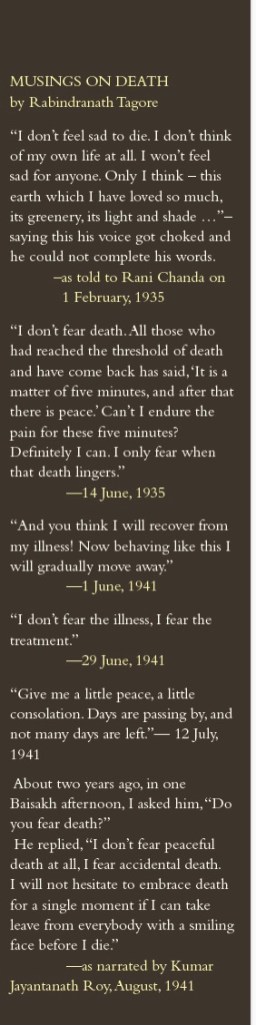
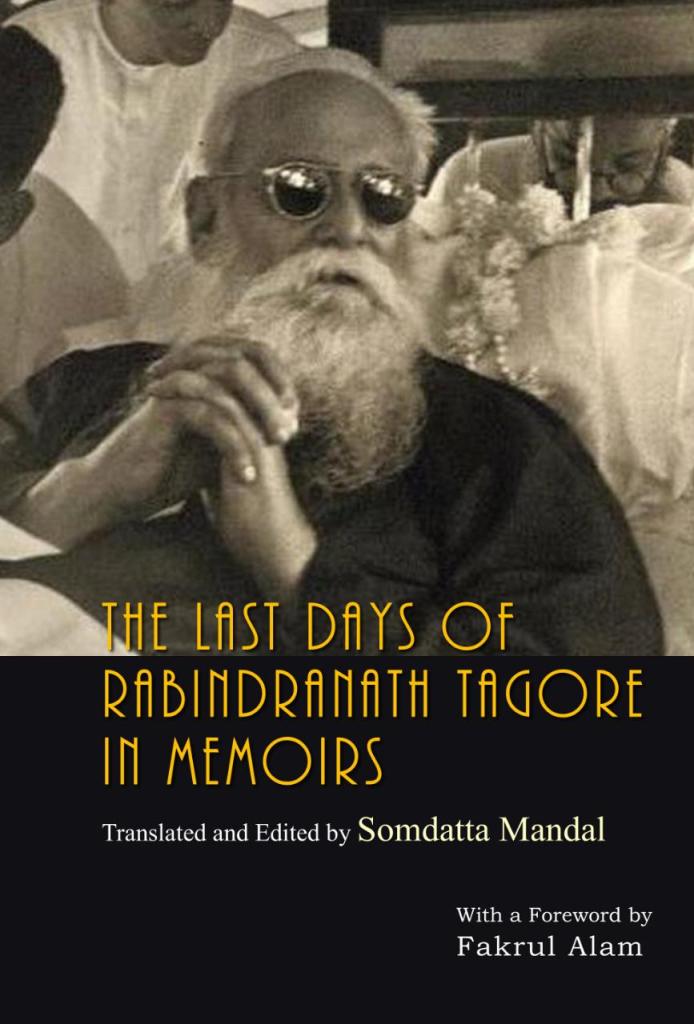
Under the Shadow of Death: Memoirs of Tagore’s Last Days

To Commemorate Tagore’s 80th Death anniversary, we present a review of Somdatta Mandal’s translation of memoirs around Tagore’s last days with a forward by Professor Fakrul Alam

Book Review by Meenakshi Malhotra

Title: The Last Days of Rabindranath Tagore in Memoirs

Translator/ Editor: Somdatta Mandal

Publisher: Birutjatio Sahitya Sammiloni, 2021

The Last Days of Rabindranath Tagore in Memoirs, selected, edited, translated, and put together from the original Bangla by Somdatta Mandal, hovers along a fine line between biography, autobiography and perhaps a bit of hagiography around the account of a life lived in the shadow of imminent death. Mandal draws on all these genres to create a rich chiaroscuro of effects, with a chorus of the memoirs of a few caregivers, mostly women, who were in close proximity to Tagore and served and took care of him in the last year of his life.

Criss-crossing between bouts of illness and creativity, the caregivers also doubled as scribes and notetakers, transcribing the precious words of the great poet. Together, they create an incredibly rich web of narratives, which have been very ably selected and translated by Professor Somdatta Mandal. The memoirs also convey a sense and flavour of the place, whether it is Santiniketan, Jorasanko, Kalimpong or Mongpu — the various places and haunts of Rabindranath in the twilight of his life. The interesting thing is that many of these ancillary memoirs were written by young people who later became famous as writers and artists, their talents often nurtured, encouraged and incubated by the greatly revered poet himself.

The titles of their respective memoirs attest to their unique writerly talents: ‘Nirbaan’ by Pratima Devi, representing a release and freedom from a painful state. Rani Chanda, the second section talks about the ‘alapchari’(Musical) Rabindranath and Gurudev, highlighting his sensitivity to and concern for others.  Mongpu-te Rabindranath and Swarger Kachakachi (Rabindranath at Mongpu and Close to Heaven) by Maitreyi Devi are deeply evocative pieces. Nirmalkumari’s “22nd Shravan” is perhaps given the most space by the editor/translator and shows his anxieties about the fate of the university built by him, a unique educational experiment very dear to his heart. Living in the shadow of the great man, it is as if each memoir and person measures up their life which gains in meaning and significance, as a result of the unique legacy bequeathed to them, with love and affection, by the poet.    

In reflecting and refracting, through the prism of their care and service, the closing year of Rabindranath’s life, the memoirs lay bare several facts. The bard was often a difficult patient, experiencing several crests and troughs as far as his moods — creative and otherwise — were concerned. Too intelligent and perceptive to avoid facts, he could see his imminent death, but did not want his caregivers to be morose and mournful. On them, fell the job of entertaining him, creating laughter and fun, in which he would participate when his health permitted him. He was less scared of death, he said, than of surgery advocated by his very eminent doctors like Dr Bidhan Chandra Roy (later he Chief Minister of West Bengal from 1948-1962) and Dr Nilratan Sarkar.

That this book is a labour of love is evident from Professor Mandal’s careful selection and editing, as well as her meticulous and competent translation. She has presented the momentous and moving final months of Rabindranath Tagore’s eventful life up to the day of his death which witnessed an outpouring of grief from many quarters. It is the final months of his life which is transcribed and inscribed by his memorialists, among whom are Pratima Devi, his daughter-in-law and son Rathindranath’s wife; Rani Chanda, his secretary Anil Chanda’s wife and a writer herself; Maitreyi Devi, the well-known writer and a protégé and favourite of Tagore’s; Nirmalkumari Mahalanabis, whose exchanges with the kobi-guru (great poet) have been detailed in Kobi and Rani (translated by Professor Mandal in 2020) and Amita Thakur, his granddaughter.

The first selection Pratima Devi’s ‘Nirbaan’ (1942) demonstrates his faith in and affection for his conscientious daughter-in-law, who, along with Rani Chanda and others, become an embodiment of care and nurture. He is aware of being a difficult patient and this awareness, which shines through in many of his comments and pet peeves, not only redeems him, but makes him more human. Musing “fondly on the poet’s twilight moments” while punning on the Robi (Bangla for sun) in the poet’s name, Maitreyi Devi, a Sahitya Akademi award-winning novelist writes: “The almost setting sun…was no less pleasant than the glory and radiance of the afternoon sun” and even within the sickroom, the poet continued “playing” his tunes, along with the march of time.

In his sensitive and nuanced foreword, Professor Fakrul Alam points out the memorialists’ refusal to minimize or sentimentalize Gurudev’s illness. In fact, Rani (Nirmalakumari Mahalanobis) expresses her impatience and criticism of the happenings and the people around the poet in the last stages. Amita Thakur, Rabindranath’s granddaughter was a notable exponent of his songs in her time, and he would depend on her to note down the songs as they came to him. Her work is chosen, says Alam, “as a coda for her assemblage of extracts from the memoirs of the five devoted caregivers who were women who had served him selflessly for sustained periods.”

The literary and archival value of such a work is undeniable and its benefits for exploring literary culture is immense. Between its glimpses of a towering giant in the world of letters with a truly international perspective to its comments about Tagore’s closeness to women and his seeking women as caregivers, the collection is also a testament to Tagore’s faith in the selfless capacity of women.

The book and Rabindranath’s close relationship with his many caregivers and later, memoirists, sometimes created a family dynamic of some tension between his natal family and adopted one. At one point, Maitreyi Devi (called “Mongpobi” or “Mitra” by the poet) talks of the negative comments made about her by Indira Debi (Bibi), one of Tagore’s favourite nieces, daughter of Satyendranath Tagore and Jnadanandini Debi. Later however, Maitreyi Devi also mentions the kindness shown to her by Indira Debi when they are together in Santiniketan.

Like in Kobi and Rani, the memoirs of Rani Mahalanobis (called Prathama or first to differentiate her from Rani Chanda who was referred to as Dwitiya or second) show the many facets of the great man himself — his many moods from his mellow moods even when he was in extreme pain to his irascible mood to his playful and humorous moments. It is to the credit of the editor/translator that she has organised and arranged the material very skillfully to bring out his mercurial nature, his flashes of temper and his expectation that his caregivers would wear their responsibilities lightly.

Overtly committed to personal memory, life narratives and biographies occasionally come  close to hagiography. They also lay bare a  performativity inscribed in the very form, implicit in the relationship between the great man/ luminary and those who are satellites in his orbit. The many layers of feeling get reflected in a plurality of forms that are both sedimented and fluid in structure — comprising letters, diaries, poems, fragments. These innovative narrative structures are evolved to convey through an overlapping of various genres: non-fiction, poetry, memoir, autobiography, letters, etc. Extending well beyond any coherent theoretical coordinates to streamline its disparate forms, life narratives are as much constructed by an individual artist — subject as they are the product of her/his intersecting textures of historical, social, political, economic, and cultural contexts.

The socio-cultural context  is specifically that of the progressive environment of Santiniketan and Vishwa Bharati. We see how the ambience of cultural efflorescence and Brahmo liberal ideas helped shape these young women. Perhaps, because of the reformist cast of Brahmo womanhood or the holistic educational schemes fostered by Tagore, in his caregivers, we see the emergence of relatively independent or mobile women, cast in agentic roles of decision making. We see an extraordinary sense of  a tightly-knit community of caregivers whether in Pratima Devi and Maitreyi Devi during the harrowing journey back from Kalimpong to Calcutta when Tagore’s illness worsens, the encounters of Maitreyi Devi with British doctors in Kalimpong or the journey undertaken by Maitreyi from Mongpu along with her young daughter immediately after a landslide, when her husband, Manmohan Sen, undertakes  to get the landslide cleared.

With a vibrant assembly of many pictures and voices, the story emerges from a collage. Piecemeal in bits and pieces, like the oranges sent to Rabindranath by Maitreyi Devi from Mongpu. Each experience, like the fruit, is savoured slowly and with relish. The remaining fruit, both actually and figuratively/symbolically, is given to the students.

A life, even one as extraordinary as Rabindranath Tagore’s, unfolds in time, simultaneously, it also participates in eternity. Thus, even as his nearness and the promise of proximate greatness draws his mentees into his magical orbit, we see him worrying about his imminent death and the fate of Santiniketan. We have to also see the life of the women, details of which get inscribed in their memoirs. The demands placed upon them are often relegated to the margins as they form part of the enchanted circle around the ailing poet, who at times seems to assert his claim on their time, albeit often  in jest, sometimes in a semi-serious way, competing for their attention with their other affections and preoccupations. Their lives, they realise, are given significance and irradiated by his presence, endowed with value through the care they could extend to the great soul.  

Ultimately the collection testifies to the power of great literature and poetry. As the poet himself says:

“Of course, literature is based upon lies — from beginning to end. Whatever I have said, whatever I am saying, how much of that is true? I have done a lot of farming for 80 years. I cannot vouch that all the grains will be stored in the barn. Some will be eaten by rats, but even then, something would be left behind. I cannot say that with certainty, eras change, times change and along with that everything also changes. But I can say with certainty that my songs will last the longest. Especially Bengalis will have no other way except to sing my songs in grief, sorrow, joy and happiness. They will have to go on singing them for ages.”

Kumar Sri Jayantanath is aptly quoted in Appendix B of the memoirs: “There is nothing new to say about Rabindranath because whatever we had to say has already been said by him.” Therefore, we pay a tribute to the poet in the poet’s own words:

You had brought along with you

 Deathless soul

In your death you have

Donated that

You have donated that

In your death.”

.

  Dr Meenakshi Malhotra is Associate Professor of English Literature at Hansraj College, University of Delhi, and has been involved in teaching and curriculum development in several universities. She has edited two books on Women and Lifewriting, Representing the Self and Claiming the I, in addition  to numerous published articles on gender, literature and feminist theory.       

.

PLEASE NOTE: ARTICLES CAN ONLY BE REPRODUCED IN OTHER SITES WITH DUE ACKNOWLEDGEMENT TO BORDERLESS JOURNAL

Categories
Contents

Borderless, June 2021

Editorial

Restless Stirrings… Click here to read.

Interviews

In conversation with Fakrul Alam, an eminent translator, critic and academic from Bangladesh who has lived through the inception of Bangladesh from East Bengal, translated not just the three greats of Bengal (Tagore, Nazrul, Jibanananda) but also multiple political leaders. Click here to read.

In conversation with Arindam Roy, the Founder and Editor-in-cheif of Different Truths, an online portal for social journalism with forty years of experience in media and major Indian newspapers. Click here to read

Poetry

Click on the names to read

Jared Carter, Geetha Ravichandran, Heena Chauhan, Michael R. Burch, Ruchi Acharya, Jim Bellamy, Bibek Adhikari, Rhys Hughes, Ihlwha Choi, Sutputra Radheye, Jay Nicholls, Geethu V Nandakumar, John Grey, Ana Marija Meshkova

Limericks by Michael R. Burch

Nature’s Musings

Changing Seasons, a photo-poem by Penny Wilkes.

Poets, Poetry & Rhys Hughes

In Never Knowingly Understood : The Sublime Daftness of Ivor Cutler, Rhys Hughes takes us to the world of a poet who wrote much about our times with a sense of humour. Click here to read.

Translations

Akbar Barakzai’s poem, The Law of Nature, translated by Fazal Baloch. Click here to read.

Kazi Nazrul Islam’s poem, Shammobadi (The Equaliser) translated by Shahriyer Hossain Shetu. Click here to read.

Tagore’s Amar Shonar Horin Chai (I want the Golden Deer) translated by Mitali Chakravarty, edited and interpreted in pastel by Sohana Manzoor. Click here to read.

To mark the birth centenary of Satyajit Ray, Ratnottama Sengupta translates from Nabendu Ghosh’s autobiography experience of Pather Panchali ( Song of the Road) — between covers and on screen. Click here to read.

Musings

An Immigrant’s Story

Candice Louisa Daquin tells us what it means to be an American immigrant in today’s world. Click here to read.

Navigating Borders

Wendy Jones Nakanishi, an academic who started her life in a small town called Rolling Prairie in midwestern US, talks of her journey as a globe trotter — through Europe and Asia — and her response to Covid while living in UK. Click here to read.

I am a Jalebi

Arjan Batth tells us why he identifies with an Indian sweetmeat. Click here to read why.

The Significance of the Roll Number

Shahriyer Hossain Shetu writes of ironing out identity at the altar of modern mass education. Click here to read.

Musings of a Copywriter

In Creative on Campus, Devraj Singh Kalsi with a soupcon of humour, explores young romances and their impact. Click here to read.

Adventures of a Backpacking Granny

Sybil Pretious visits volcanoes and lakes in Frenetic Philippines. Click here to read.

Essays

Here, There, Nowhere, Everywhere

‘Did life change or did I change from the events of the last year,’ ponders New Zealander Keith Lyons who was in the southern state of Kerala when the first cases of Covid-19 were detected in India last January. Click here to read.

The Story of a Bald Eagle & a Turkey

A photo essay by Penny and Michael B Wilkes on the American bald eagle to commemorate their Independence Day. Click here to read.

The Day Michael Jackson Died

A tribute  by Julian Matthews to the great talented star who died amidst ignominy and controversy. Click here to read.

Remembering Shiv Kumar Batalvi

Amrita Sharma has written a memorablia on the Punjabi poet, Shiv Kumar Batalvi, who wrote in the 1960s. Click here to read.

Tagore and Guru Nanak’s Vision

Parneet Jaggi talks of the influence Guru Nanak on Tagore, his ideology and poetry. Click here to read.

Bhaskar’s Corner

In Amrita Sher-Gil: An Avant-Garde Blender of the East & West, Bhaskar Parichha shows how Amrita Sher-Gil’s art absorbed the best of the East and the West. Click here to read.

Stories

Flash Fiction: Peregrine

Brindley Hallam Dennis tells us the story of a cat and a human. Click here to read.

The Crystal Ball

Saeed Ibrahim gives us a lighthearted story of a young man in quest of a good future. Click here to read

The Arangetram or The Debut

Sheefa V. Mathews weaves lockdown and parenting into a story of a debuting dancer. Click here to read.

Ghumi Stories: The Other Side of the Curtain

Nabanita Sengupta explores childhood and its experiences. Click here to read.

The Literary Fictionist

Sunil Sharma explores facets of terrorism and its deadly impact on mankind in Truth Cannot Die. Click here to read.

Book Reviews

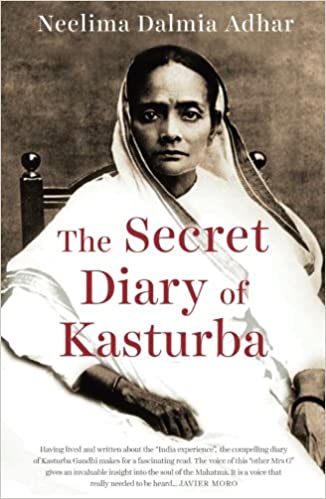
Neelima Dalmia Adhar’s The Secret Diary Of Kasturba reviewed by Meenakshi Malhotra. Click here to read.

Shrilal Shukla’s Fragments of Happiness translated by Niyati Bafna and reviewed by Rakhi Dalal. Click here to read

Bhaskar Parichha reviews Transformational Leadership in Banking edited by Anil K. Khandelwal. Click here to read.

Book Excerpt

An excerpt from Enter Stage Right by Feisal Alkazi with a visual of young Alkazi dancing in one of the earliest discos of New Delhi. Click here to read.

Categories
Editorial

Restless Stirrings

As we stand on the threshold of a new normal that will eternally rewrite the history of social interactions, of movements across the globe, of new world orders that will have to be more inclusive and more transparent to world view, we will, perhaps, feel the need to redefine business laws so that even countries with lesser wealth are able to access vaccinations and peace. We are now looking  up to leaderships which seem to be in crises themselves. Sitting securely on a tiny island that is well governed, an island where affluence and well-being set it adrift from the turmoils of countries around it, I wonder thirty years from now, what will mankind be like…  Will we be forever marred by the current events of the world? Globalisation has ensured that none of us can be secure on any secret island. There can be no land of lotus eaters hidden from the rest of mankind and accessed by only a few anymore. Even if one region is affected by the virus in any corner of the world, can the rest of the world be pandemic free? Perhaps, a question that those who peddle in vaccines and human well-being can address.

These issues have not only been highlighted by the news media but have also found echoes in some of our content this time. Keith Lyons’s essay talks of his last stay in India, when a tourist carried the  the pandemic  unwittingly into Kerala in February 2020 and subsequent repercussions. More stories and poems that dwell on the spread of the virus this year cry out for compassion. One hopes young poet Ruchi Acharya’s verses are born true.

One day the roses of hope will grow
Meeting the horizon,
Roses that, even plucked, will not die
But will bloom and bloom
Every single day that passes by.

We have young writers on the virulence of the virus and mature pens like that of globe-trotting academic Wendy Jones Nakanishi, who maps the pandemic from UK. Perhaps, we will find a new direction eventually.

There have been calls for uniting above divides as a single unit called mankind earlier too, from greats like Tagore and Nazrul. This time we carry translations of both — Nazrul’s translated poem calls for uniting against artificial divides drawn by man-made constructs and Tagore’s translation talks of redefining through self-reflection. An essay on Tagore by academic Parineet Jaggi talks of the impact of the teachings of Guru Nanak, the founder of Sikhism, on Tagore.

We have essays on writers and icons from around the globe. A photo-essay on the bald eagle, heralding the American Independence Day on the 4th of July, gives a humorous anecdote on how the eagle was chosen above the turkey. We have more variety by Candice Louisa Daquin, an immigrant in US, who shows how important human movement across man-made borders is to the development of a country. Michael Burch has given us beautiful poetry reflecting the history of America and American dreams, one of them with the voice of the legendary Mohammed Ali. These verses add substance to the concerns raised by Daquin. Jared Carter brings to us the colours of life with his poetry.

We have humour in verses from Rhys Hughes and even from a young poet, Sutputra Radheye. Limericks from Michael Burch and Penny Wilkes photo-poetry on ‘Changing Seasons’ puts us in a more cheerful mood.  More poetry from multiple writers across the world, including Nepal, Macedonia and Korea, have found their way into our journal.

Hughes has also given us a comprehensive and interesting essay on a twentieth century poet called Ivor Cutler, who said much as he sang his poetry and was encouraged by Paul McCartney of the Beatles. The brilliant poetry of Akbar Barakzai continues translated on our pages by Fazal Baloch and one must give many thanks to the translator for his indefatigable energy and for bringing us wonderful fare from Balochistan. An excerpt translated by eminent journalist Ratnottama Sengupta from Nabendu Ghosh’s autobiography ends with Satyajit Ray’s starting his famed career with Apu’s triology (based on Pather Panchali, a novel by Bibhuti Bhushan Bandopadhyay). These three films have become iconic in cinema history.

We were fortunate to have Professor Fakrul Alam agree to an interview. An eminent translator, critic and academic who has lived through the inception of Bangladesh from East Bengal, Alam has translated not just the three greats of Bengal (Tagore, Nazrul, Jibanananda) but also multiple political leaders like Mujibur Rahman. In this exclusive, he has taken us through the annals of history, reflecting on less-known perspectives of the Partition. Also, in conversation with Borderless, is Arindam Roy, a journalist with forty years’ experience and the founder of Different Truths who started his writing career, much in the tradition of Cyrano de Bergerac on a humorous note.

This time our backpacking granny, Sybil Pretious, gives us a glimpse of her wisdom, wit and compassion while visiting Philippines and talks of an ancient death ritual, volcanoes and strange mud baths. Devraj Singh Kalsi explores young romance in his tongue-in-cheek fashion. We also have more semi-humorous musings from young writers across borders. While Sunil Sharma has explored facets of the impact of terrorism, the other stories are told in a lighter vein.

Our book excerpt from Feisal Alkazi’s Enter Stage Right has a picture of the young artiste in a discotheque dancing in abandon — check it out. It made me smile. Rakhi Dalal has reviewed Jnanpith Award winner Shrilal Shukla’s Fragments of Happiness translated by Niyati Bafna. The book review by Meenakshi Malhotra of Neelima Dalmia Adhar’s The Secret Diary of Kasturba brings out an interesting facet on Gandhi and women in the Independence movement. It makes one notice the contrasts in the perspectives of Gandhi and Tagore, who created women like he saw around him in fiction. Kasturba’s life also contrasts with the independence found in the life of the avant-garde artist, Amrita Sher-Gil, who lived around the same time. In an essay, Bhaskar Parichha has shown how Sher-Gil lived out her dreams, blending the best of the East and West, while Malhotra writes, that though “Gandhi called women to join the national movement … he was not seeking to emancipate, but more to call forth their capacity for self-abnegation and self-sacrifice.”

Parichha has also introduced us to the need for changes in the banking sector in India while reviewing Transformational Leadership in Banking edited by Anil K. Khandelwal. Perhaps these will be part of the changes that will ultimately lead to a revision of old systems and the start of new ones. Changes, though not always welcomed or convenient, hopefully will lead to progress that can mould our future into a happier one. Restless stirrings transformed mankind from cave dwellers to an intelligent race that can assimilate nature and technology to survive and dream of a future, living among stars.

As Borderless reaches out to unite mankind transcending artificial constructs, its attempts can bear fruit only with support from each and every one of you. I would like to thank all our editorial team for their wonderful support, contributors for being the backbone of our content, and all our readers for continuing to patronise us.

Do take a look at our current issue for the writers who remain unmentioned here but create phenomenal bridges towards a borderless world.

Best wishes,

Mitali Chakravarty

Categories
Review

The Secret Diary of Kasturba

Book Review by Meenakshi Malhotra

Title: The Secret Diary of Kasturba

Author: Neelima Dalmia Adhar

Publisher: Tranquebar, Westland Books

The Secret Diary of Kasturba by Neelima Dalmia Adhar was an interesting experience as it traverses known ground, albeit from a feminine perspective. The book lays no claim to authenticity or historical veracity since Kasturba was barely literate, obdurate in the face of her husband’s efforts to educate her. Adhar’s retelling of the personal life of the Gandhis is obviously inseparable from Mohandas Karamchand’s huge public persona which acquired almost mythic status during his own lifetime, as he became the “father of the nation”. That the public role came at a certain cost is what this fictionalized memoir/ autobiography makes clear. The fight against imperialism also took its toll and some aspects of this fictionalized biographical account might be seen as a sort of collateral damage.

Married off at a young age when both were thirteen, she describes the sexual passion between the two which cemented their conjugality. At the same time, his early experience of lust and unbridled passion fills Gandhi with guilt and remorse and his autobiography, The Story of My Experiments with Truth, comes out strongly against the practice of child marriage, as he feels that it stunts the growth and potential of children trapped in the practice.

The other reason for his guilt is the fact that his ailing father was on his deathbed when Mohandas was overtaken by desire. That sense of guilt plagues him later, since he leaves his father’s room knowing well that the father’s chances of survival were slim. Soon after, he receives the news of his father’s death. Later in life, he took a vow of celibacy, but his decision of celibacy was taken unilaterally without consulting Kasturba, who felt resentful about being excluded from something that concerned them both. While Gandhi’s behaviour towards his wife, his tendency to dominate and control, were within the expected parameters of conjugality in late 19th century, they would stand out as oppressive by today’s standards.

Two episodes stand out in this context, both providing ample anecdotal evidence of Gandhi’s high-handedness and tendency to dictate terms to his wife. One is his injunction to clean out the chamber-pots of guests in the house in South Africa. When she refuses to do so, he is ready to throw her out of the house. On another occasion, when they are about to leave South Africa, Kasturba is given gifts of jewelry as a goodwill gesture. Gandhi forbids her to keep any of it and she is forced to relinquish all of it against her will. Her resentment is not because she is greedy but is based on the instincts of a middle-class homemaker who has, in the past, been a mute witness to her own jewelry being sold off, to fund Mohandas’s journey to England to study law. At every step, Kasturba, who comes from a relatively affluent background, has had her desires thwarted. Strong-willed and decisive in many things, with definite opinions of her own, Kasturba is curbed and controlled, her will broken by her overbearing husband.

 A similar pattern follows as far as his children’s lives and education are concerned. The book also shows Gandhi’s attempt to control and shape the lives of his children and his growing rift with his eldest son, which ensues as a result. His ideas of self-sacrifice and austerity do not always sit well with his sons, who view his refusal of a formal education to them as a disprivilege and a denial of opportunity. Ironically, he helps his nephews and other associates, but his immediate family is always put through impossible tests. Not only is the bar raised for them, but they are also made to forego all legitimate desires and aspirations, for example their desire for proper schooling. While there could be an element of exaggeration in Adhar’s book, some of these facts are on record. Adhar quotes a letter from Gandhi to his friend:

“I don’t know what evil resides in me,” he wrote to a friend, “I have a streak of cruelty in me that compels people to attempt the impossible in order to please me.”

The eminent historian K.M. Pannikker once wrote that the Indian national movement was India’s version or an equivalent of the suffragette movement in the West, since it served to grant women equal rights to citizenship of the country. My caveat is that these rights were only in the domain of the political, that too construed in a limited way. While Gandhi called women to join the national movement that he was in the forefront (and practically the face) of, right from 1918 to 1948, he was not seeking to emancipate, but more to call forth their capacity for self-abnegation and self-sacrifice. He was definitely not seeking to challenge the entrenched structures of Hindu society, but seeking to marshal women’s energies to bring about a sea-change in the minds and hearts of men and political system. His attitude to the Dalit-Bahujans was similarly status quoist. His nomenclature for them-“Harijans” or children of God was refused by them; instead they chose to foreground their own oppression by calling themselves Dalits.

There is no denying that Gandhi strode into the national movement like a messiah. He also gave the world a moral substitute for war. Yet his subsuming of all other aspects of his wife’s and children’s identities and aspirations to serve the cause of the nation seems excessive and impossibly demanding. As the blurb phrases it: “He is the Mahatma, a man the world venerates as a prophet of peace. But for Kastur, the child bride who married the boy next door, Mohandas was a sexually-driven, self-righteous, and overbearing husband. Mohandas Karamchand Gandhi was sworn to poverty, celibacy and the cause for India’s freedom; Kastur spent sixty-two years of her life, juggling the roles of a devoted wife, a satyagrahi and sacrificing mother, who was eclipsed because of a man who almost became God for India’s multitude.”

Ready to sacrifice his family at the altar of the nation’s freedom, Gandhi’s demands as a husband along with his intolerance and harshness as a father, threaten at times to exceed the boundaries of acceptable behaviour. Such are the paradoxes that constitute history or is glossed over in its official versions. For the longest time, feminist historiography has sought to redress the imbalanced and skewed nature of official history. This book could be seen as an attempt to fill the blanks and gaps in a narrative which tells us about one of the most revered and reviled figures in South Asia.

Neelima Dalmia Adhar’s book is interesting and engaging. Some embellishments and degree of artistic freedom are permissible and in line with historical fiction and fictionalized history. On the whole, the book conforms to well known facts of Gandhi’s life, basing itself on already existing documentation of it.

The Secret Diary performs an important function as biographical/historical fiction. Experiences like the time in South African are detailed in Gandhi’s autobiography but this fictionalized account fleshes it out, adding effect, conflict and detailing tensions of a kind we perhaps know well, both in his public life and between an authoritarian and self-righteous husband/father and his wife and growing children. It captures the everyday, in a layered and nuanced way, helping us to unravel and capture a sense of the various strands that are woven together to weave the fabric of the daily life of Mohandas Gandhi (before he became the Mahatma) and his family. The ‘truth’ that autobiographies, biographical and historical fiction express in never one-sided or singular or a monolith but is often many-sided, plural and multi-faceted. Such a work lends a chiaroscuro effect, where we see the life of the great man sometimes in light, sometimes in shadow, adding up to a complex whole.

For a colossus of a man, who was committed to righteousness and treading the path of truth, he did not seem to have acknowledged or come to terms with the fact that his truth might have clashed against the truth of other life-journeys. The search for truth is a fraught task, a journey up a slippery slope, provisional and contingent and comes perhaps at a cost.  

.    

  Dr Meenakshi Malhotra is Associate Professor in English at Hansraj College, University of Delhi and has been involved in teaching and curriculum development at several universities. She has edited two books on Women and Lifewriting, Representing the Self and Claiming the I, in addition  to numerous published articles on gender and/in literature and feminist theory.       


.

PLEASE NOTE: ARTICLES CAN ONLY BE REPRODUCED IN OTHER SITES WITH DUE ACKNOWLEDGEMENT TO BORDERLESS JOURNAL


Categories
Index

Tagore Anniversary, 2021

Celebrating the 160th birth anniversary of the polymath, Kobiguru Rabindranath, we offer our readers a selection of translations of his songs and stories and some essays on and around him. For more exhaustive translations and coverage on Tagore, do visit our new section — Tagore & Us.

We launched this section with the translation of seven of his songs by the gifted Sahitya Akademi winning translator and author, Aruna Chakravarti.

Songs of Tagore: Translations by Aruna Chakravarti

This selection of seven songs has been excerpted from Songs of Tagore translated by Aruna Chakravarti and brought out by Niyogi books. Click here to read.

Tagore Translations: One Small Ancient Tale

Rabindranath Tagore’s Ekti Khudro Puraton Golpo (One Small Ancient Tale) from his collection Golpo Guchcho ( literally, a bunch of stories) has been translated by Nishat Atiya. Click here to read.

Tagore Songs in Translation

To commemorate Tagore’s 160th birth anniversary, we translated five of his songs from Bengali to English. Click here to read, listen and savour.

At Home in the World: Tagore, Gandhi and the Quest for Alternative Masculinities

Meenakshi Malhotra explores the role of masculinity in Nationalism prescribed by Tagore, his niece Sarala Debi, Gandhi and Colonials. Click here to read.

A Tale of Devotion and Sacrifice as Opposed to Jealousy and Tyranny

Sohana Manzoor explores the social relevance of a dance drama by Tagore, Natir puja. We carry this to commemorate Tagore’s birth anniversary. Click hereto read

Categories
Contents

Borderless, April, 2021

Greetings from Borderless Journal for all Asian New Years! Click here to read our message along with the video and a translation of a Tagore song written to greet the new year, with lyrics that not only inspire but ask the fledgling to heal mankind from deadly diseases.

Editorial

New Beginnings

A walk through our content and our plans for the future. Click here to read.

Interviews

In Conversation with Arundhathi Subramaniam: An online interview with this year’s Sahitya Akademi winner, Arundhathi Subramaniam. Click here to read.

Sumana Roy & Trees: An online interview with Sumana Roy, a writer and academic. Click here to read.

Poetry

(Click on the names to read)

Arundhathi Subramaniam, Jared Carter, Matthew James Friday, Michael R Burch, Aparna Ajith, Jenny Middleton, Rhys Hughes, Jay Nicholls, Achingliu Kamei, Vatsala Radhakeesoon, Ihlwha Choi, Smitha Vishwanath, Sekhar Banerjee, Sumana Roy

Photo-poetry by Penny Wilkes

Poets, Poetry & Rhys Hughes

With an introduction to Blood and Water by Rebecca Lowe, Rhys Hughes debuts with his column on poets and poetry. Click here to read.

Translations

The Word by Akbar Barakzai

Fazal Baloch translates the eminent Balochi poet, Akbar Barakzai. Click here to read.

Malayalam poetry in Translation

Aditya Shankar translates a poem by Shylan from Malayalam to English. Click here to read.

Tagore Songs in Translation

To commemorate Tagore’s birth anniversary, we translated five of his songs from Bengali to English. Click here to read, listen and savour.

Tagore Translations: One Small Ancient Tale

Rabindranath Tagore’s Ekti Khudro Puraton Golpo (One Small Ancient Tale) from his collection Golpo Guchcho ( literally, a bunch of stories) has been translated by Nishat Atiya. Click here to read.

Musings/Slice of Life

Pohela Boisakh: A Cultural Fiesta

Sohana Manzoor shares the Bengali New Year celebrations in Bangladesh with colourful photographs and interesting history and traditions that mingle beyond the borders. Click here to read.

Gliding along the Silk Route

Ratnottama Sengupta, a well-known senior journalist and film critic lives through her past to make an interesting discovery at the end of recapping about the silk route. Click here to read and find out more.

The Source

Mike Smith drifts into nostalgia about mid-twentieth century while exploring a box of old postcards. What are the stories they tell? Click here to read.

Lost in the Forest

John Drew, a retired professor, cogitates over a tapestry of the Ras lila. Click here to read.

Tied to Technology

Naomi Nair reflects on life infiltrated by technology, by Siri and Alexa with a tinge of humour. Click here to read.

Adventures of a Backpacking Granny

In Inspiriting SiberiaSybil Pretious takes us with her to Lake Baikal and further. Click here to read.

Musings of a Copywriter

In Tributes & AttributesDevraj Singh Kalsi pays tribute to his late mother. Click here to read.

Essays

Reflecting the Madness and Chaos Within

Over 150 Authors and Artists from five continents have written on mental illness in an anthology called Through the Looking Glass. Candice Louisa Daquin, a psychotherapist and writer and editor, tells us why this is important for healing. Click here to read.

At Home in the World: Tagore, Gandhi and the Quest for Alternative Masculinities

Meenakshi Malhotra explores the role of masculinity in Nationalism prescribed by Tagore, his niece Sarala Debi, Gandhi and Colonials. Click here to read.

A Tale of Devotion and Sacrifice as Opposed to Jealousy and Tyranny

Sohana Manzoor explores the social relevance of a dance drama by Tagore, Natir puja. We carry this to commemorate Tagore’s birth anniversary. Click here to read

Photo Essay: In the Midst of Colours

Nishi Pulugurtha explores the campus of a famed university with her camera and words and shares with us her experiences. Click here to read.

Bhaskar’s Corner

Oh, That lovely Title: Politics

A short piece by Bhaskar Parichha that makes for a witty comment on the forthcoming Indian elections. Click here to read.

Stories

Pothos

Rakhi Pande gives us a story about a woman and her inner journey embroiled in the vines of money plant. Click here to read.

Elusive

A sensitive short story by Sohana Manzoor that makes one wonder if neglect and lack of love can be termed as an abuse? Click here to read

Ghumi Stories: Grandfather & the Rickshaw

Nabanita Sengupta takes us on an adventure on the rickshaw with Raya’s grandfather. Click here to read

Flash Fiction: The Husband on the Roof

Carl Scharwath gives us a story with a strange twist. Click here to read

Flash Fiction: Flight of the Falcon

Livneet Shergill gives us a story in empathy with man and nature. Click here to read

The Literary Fictionist

A playlet by Sunil Sharma set in Badaun, The Dryad and I: A Confession and a Forecast, is a short fiction about trees and humans. Click here to read.

Book reviews

Bhaskar Parichha reviews Reconciling Differences by Rudolf C Heredia, a book that explores hate and violence. Click here to read.

Nivedita Sen reviews Nomad’s Land by Paro Anand, a fiction set among migrant children of a culture borne of displaced Rohingyas, Syrian refugees, Tibetans and more. Click here to read

Candice Louisa Daquin reviews The First Cell and the Human Costs of Pursuing Cancer to the last by Azra Raza. Click here to read.

Book Excerpt

Excerpted from Raising a Humanist: Conscious Parenting in an Increasingly Fragmented World by Manisha Pathak-Shelat and Kiran Vinod Bhatia, the focus is on media and its impact. Click here to read.

Sara’s Selection, April 2021

A selection of young person’s writings from Bookosmia. Click here to read.

Categories
Essay

At Home in the World: Tagore, Gandhi and the Quest for Alternative Masculinities

By Meenakshi Malhotra


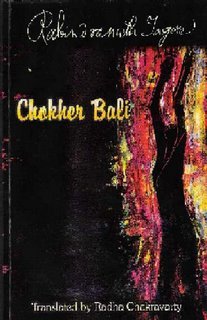
In exploring the question of Rabindranath Tagore (1861-1941) and alternative masculinities, it is important to keep in mind the multiple contexts and registers in which this question can be explored. One is obviously Tagore’s critique of and take on man-woman relationships in his books and stories throughout his life, which he had observed at close quarters in an extended/joint family context. Many of his short stories, like “The Exercise-Book”, and novels like, Chokhher Bali (A Grain of Sand), show a keen sympathy for women’s aspirations and the situation of that unaccommodated woman, the young widow. Tagore demonstrates his sympathy, even empathy, with the young widow, Binodini, while recognizing that she might pose a threat to social stability within the household of Mahendra and Asha, his girl-wife. The second register is the intertwining of creative writing and androgyny (the latter being a necessary attribute for an author, according to Virginia Woolf), and how Tagore in his capacity as a creative writer had qualities of empathy and sensitivity, which he drew upon to forge unusually close emotional bonds with women. This theme  has been discussed by writers and critics under the rubric of Tagore and the feminine or Tagore and women. However, this article seeks not just to explore Tagore’s views on women but his search for a calibrated and balanced way of being in the world without falling into the binaries of imperial and colonized masculinities, and to shape the contours of a self which makes the world its home and is at home in the world.

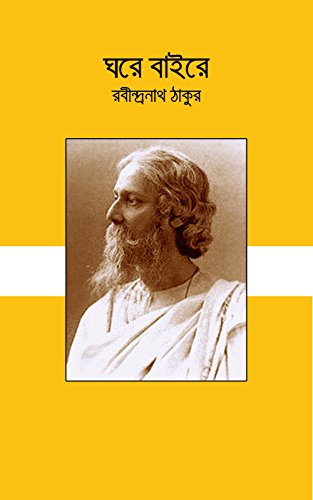
In his novel Ghare Baire (The Home and the World), we come across a criticism of extremist politics and jingoistic nationalism. A tripartite narrative about the growing political consciousness of Bimala, her failure to understand her liberal husband, Nikhilesh, a landlord and his friend Sandip, a fiery nationalist and a turbulent petrel, who storms the bastions of their household and marriage. Sandip’s brand of militant nationalism appeals to Bimala, who had once harboured feelings of inferiority because of her birth in an ordinary family, and who feels elevated and special under Sandip’s scrutiny. Sandip singles her out for special attention and calls her the “Queen Bee’’ and his muse and inspiration leading her to ignore Nikhilesh’s more mature and balanced views. Early in the novel, Nikhilesh who often functions as a mouthpiece for Tagore’s views in the novel, says that though he loves his country/nation, he cannot place nationalism over humanity. Reflecting Tagore’s views, which espouses internationalism and humanitarianism, Nikhilesh is not understood by his politically immature wife and ignored by his self-serving and unscrupulous friend.

Central to the formation of Tagore’s political views and suspicion about nationalism was his ideological debate with his own niece, his sister, the novelist Swarnalata Debi’s daughter, Sarala Debi Chaudhurani. A keen and fiery nationalist and patriot, Sarala was deeply impressed by the physical culture of imperial masculinities. She was particularly enthused/motivated by the concept of uplifting the nation through encouraging the growth of a physical culture. A statement that resonated with her was the idea of national character and she quotes lines from the ‘Educationist’:

“Physical weakness is a crime-against yourself and those who depend on you. Weaklings are despised and a weakling nation is doomed. The decline of ancient Greece and Rome which fell rapidly from the pinnacle of supreme civilization was due to physical neglect and abuse of the inflexible laws of nature. A physically weak nation is drained out mentally, its feet are on the downward path and it will end upon the scrap-heap if it does not act before it is too late.”

She also quotes a proverb which pronounces that the “battles of England are fought and won in the fields of Eton” (Chapter 18,129).  Her interest in and involvement with the politics of the freedom movement led her to initiate the celebration of Birashtami (festival of heroes to celebrate martial prowess, bravery and courage)) to mark courage and martial valour. Her belief in developing a physical culture and strengthening the national character made her revive certain traditions, re-invent rituals in order to paint a glorious version of India’s past. In doing so, she encouraged celebrations of Birashtami and invoked and revived the ‘braveheart’, Pratapditya, a landlord with questionable antecedents since he was also guilty of killing his father. In elevating such a figure to a status of a nationalist war-hero, she elicited mixed responses, particularly from her Brahmo family and her uncle, Rabindranath Tagore.

Rabindranath Tagore, among others, strongly objected to Sarala’s invocation of the figure of a parricide as a martial hero. Such a figure could act as a dangerous precedent since it would seem to encourage untrammeled and uncontrolled aggression and blur moral boundaries and ethical codes. This blunting of all moral and ethical codes and boundaries, the danger lurking in a militant and violent nationalism was, as indicated above, represented by Tagore in his novel, Ghare Baire but also in his essays on nationalism. In the novel, the conflict between a rational civic and humanitarian nationalism which eschews violence is embodied by the idealized figure of Nikhil and the primordial reactionary chauvinistic version of nationalism which endorses violence by his ‘friend’, Sandip. After casting a spell (metaphorically speaking) over the impressionable Bimala, whose affection he then misuses to drive a wedge between the couple and then to extract money from her to fund his terrorist activities.

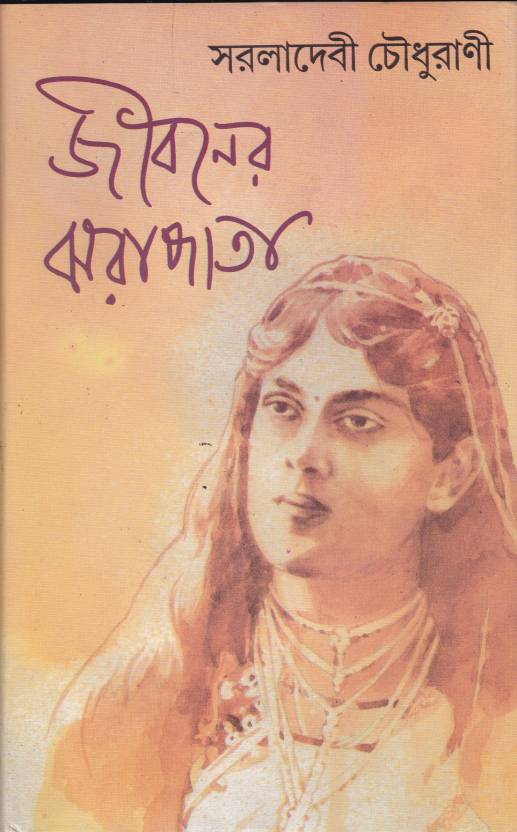
The Scattred Leaves of my Life By Saraladebi Chaudhurani

Rabindranath’s indictment of Sandip could be viewed as his response, a sort of extended debate and dialogue with an ideological viewpoint diametrically different from his own, which was represented by his niece.  The increasing rift and estrangement between the two — Rabindranath and Sarala — might explain the wistfulness and occasionally melancholic and autumnal tone of Jibaner Jharapata (The Scattered Leaves of My Life) Saraladebi’s autobiography. A proud and self-respecting person, Sarala was probably conscious of the slur or aspersion of effeminacy that the British had cast on the Bengali character. She felt the humiliation and indignity too keenly to accept such descriptions and attributions quietly.

Gandhi and the Crafting of Political Masculinity

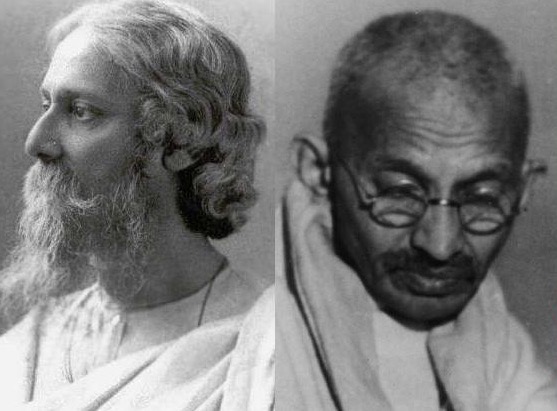
One common threadthat runs through the work and writings both these towering personalities of Tagore and Gandhi, is a critique of existing, culturally prescribed and sanctioned models of masculinity as they prevailed in the eastern (Tagore) and western (Gandhi) extremities of India. Both these great men, as public personages, were conscious that they were thought leaders and role models and that examples set by them would be emulated.

In the case of M.K. Gandhi(1869-1948), a great national leader who was instrumental in India’s throwing off the yoke of colonialism in 1947, there is a conscious experimentation with the “truth’’, presumably of one’s inner self, to oppose certain culturally sanctioned models of masculinity. Interestingly, his great-niece, Manu Gandhi referred to the ageing Gandhi as “Gandhiji, my mother” in her diaries, which were translated into English in 2019. When we focus on his corporeal politics, we see in Gandhi’s “experiments with truth” a series of experiments to do with the body which express both a consciously crafted gender ambivalence and throws a challenge to the concept of the manly body of the colonizer. Here my point is that Gandhi was consciously deploying his self, his body identity/ies and attendant subjectivities, in order to make a political point. He used his body and body-politics to establish his difference from the colonially attributed native body and also to mark his distance from colonial models of masculinity. While in one sense, this fluid body seems almost gender ambivalent, it is also an invitation to re-imagine and revision stereotypical notions of gender which circulate in cultures.

  Both of these thinkers were probably conscious of the import of the political masculinities espoused by them, particularly under the yoke of imperialism, at a specific historical conjuncture. This conjuncture is the first two decades of the twentieth century, when the models of masculinity available can be broadly conceptualized as imperial, colonial and ascetic masculinities.

The imperial masculinity model is based on the white imperial ‘master’, the civil servant, the ‘pukka saheb’, the kind extolled by Kipling and criticized by E. M.Forster. Coincidentally, this Kiplingesque masculinity, often caricatured, found its takers in people who extolled the muscular, strong masculinity of imperial cultures, like Sarala Debi, Tagore’s niece. The Forsterian view that the English public school culture shaped “well developed bodies, under-developed minds and undeveloped hearts’’ was not known to her, nor would it have found favour. This model also made its way into Indian discourses where it becomes linked with questions of national character and patriotism. In his book, The Intimate Enemy (1983) Ashis Nandy proffers the view that the Indian elite in the 19th century perceived the British as agents of progressive change and accepted the ethos of aggressive imperial masculinities.

According to historians and critics like Indira Chowdhury, Mrinalini Sinha and Chandrima Chakraborty, there was a developing discourse of de-masculinization and emasculation among the British, where they denigrated the Indian middle class and particularly the Bengali men as weak and effeminate and this also led some political leaders to move in the direction of defining and conscious crafting of alternative masculinities.    

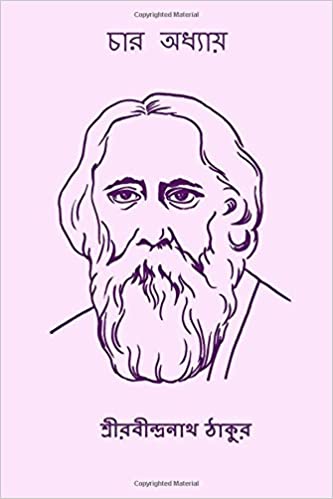
Four Chapters by Tagore

The third or ascetic model is available in Ananda Math by Bankim Chandra Chatterjee and Char Adhay ( Four Chapters, 1933), the last and thirteenth novel by Tagore along with real life characters such as Swami Vivekanand (1863-1902) and Sri Aurobindo (1872-1950), albeit delineated with some ambivalence. Chandrima Chakraborty in her book on Masculinity, Asceticism, Hinduism: Past and Present Imaginings of India (2011), highlights the “conjunctural alignment of asceticism and masculinity in Indian political history,” in order for its transformation into a strident symbol of Indian nationalism.

Interestingly, there is a further dimension and  addition to this narrative. Jibaner Jharapata is not the only source of Sarala’s life story. She is described in Rajmohan Gandhi’s biography as Gandhi’s “spiritual wife”, because he felt strongly drawn to her, seeing in her a woman who possessed a unique combination of education and emotional strength. To Gandhi, she was a woman whose love for the nation was equally strong as his, although it followed and developed along different trajectories. In a peculiar role-reversal, we find Sarala Debi, who spent her formative years in Tagore family mansion at Jorashanko, inverts the models of “colonized masculinity” to promote and propagate militant nationalism. Tagore and Gandhi, whose spheres of influence she existed in, do not seem to have brought about much of a change in her. The great men eschewed and turned away from existing models of masculinity and moved towards the crafting of new masculinities, drawing on asceticism and spiritualism to do so.

References

Chakraborty, Chandrima(2011)Masculinity, Asceticism, Hinduism: Past and Present Imaginings of India. Delhi: Permanent Black

Chattopadhyay, Bankimchandra, Anandamath or The Sacred Brotherhood.Trana Julius Lipner, New DelhiOUP

Chaudhurani, Sarala Debi(2007)Jibaner Jharapata, Calcutta, Dey’s Publishing.(Bengali) All references in the text are to this edition,with translations by the author of this paper

Gandhi, Rajmohan (2006) Mohandas: A True Story of a Man, his People and an Empire. New Delhi:Penguin/Viking.

Kumar, Radha (1993) The History of Doing: An Illustrated History of Doing. New Delhi, Kali for Women

Malhotra, Meenakshi (2018) A Dark Goddess for a Fallen World: Mapping Apocalypse in Some of Bankim C.Chatterjee’s Novels in Unveiling Desire: Fallen Women in Literature, Culture and Films of the East eds Devaleena das and Colette Morrow. New Brunswick: Rutgers University Press

Ray, Sangeeta (2000) En-Gendering the Nation: Women and nation in Colonial and Postcolonial Narratives Duke UP

Dr Meenakshi Malhotra is Associate Professor in English at Hansraj College, University of Delhi and has been involved in teaching and curriculum development at several universities. She has edited two books on Women and Lifewriting, Representing the Self and Claiming the I, in addition  to numerous published articles on gender and/in literature and feminist theory.

.

PLEASE NOTE: ARTICLES CAN ONLY BE REPRODUCED IN OTHER SITES WITH DUE ACKNOWLEDGEMENT TO BORDERLESS JOURNAL

Categories
Review

The Myriad Hues of Love

Book Review by Meenakshi Malhotra

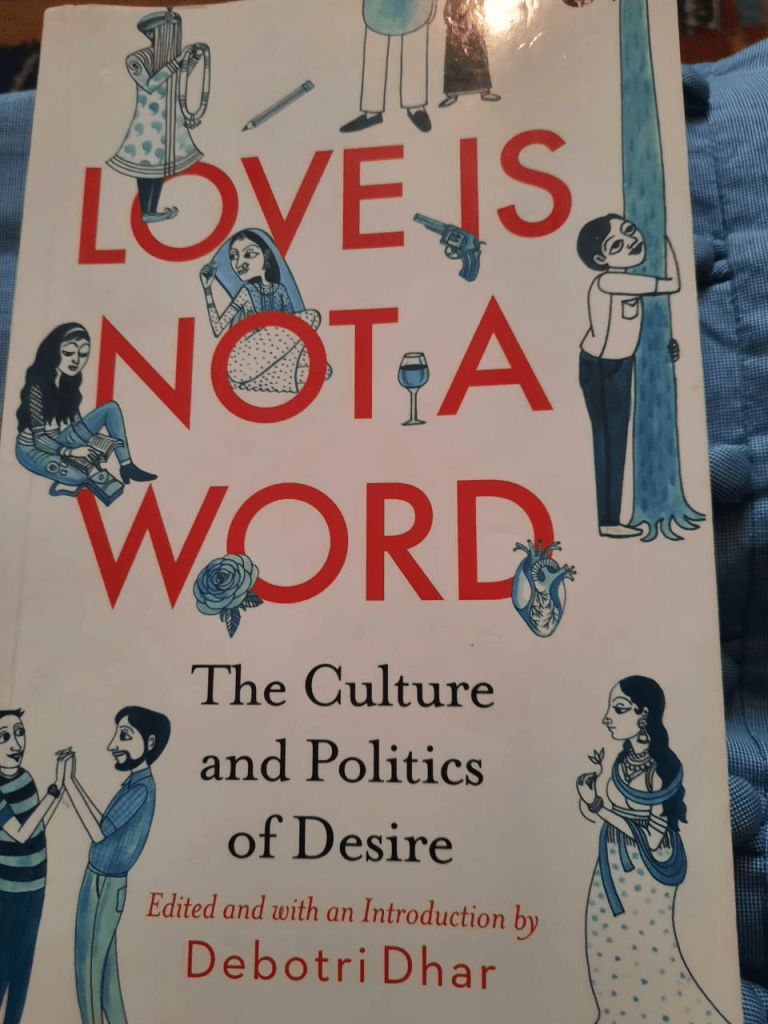
Title: Love is not a word: The Culture and Politics of Desire

Editor:  Debotri Dhar

Publisher: Speaking Tiger, 2020

Love is not a word: The Culture and Politics of Desire edited by Debotri Dhar is a timely and illuminating book. It asks the right questions, sets up the debate on issues which need to be debated in order to bring the many hues of love and desire out of stranglehood of monolithic constructions. Dhar has brought together some interesting essays  by noted academics, art historians and curators, cultural and literary  historians  and writers  musing on the theme of love, its histories and its manifestations in religious mythography.

In the first essay in the anthology, ‘Swayamvara, Arranged Marriage, Desi Romance’, Professor Malashri Lal brings her considerable acumen and expertise to offer “some fascinating perspectives on Indian love, mapping both continuity and change, possibility and paradox.” She draws upon a spectrum of sources to unsettle some of the binaries and clichés about love and marriage in India. She points out the very heterogeneous nature of Indian realities and the simultaneous existence of designer weddings along with the prevalence of child marriage, the latter motivated by  stark poverty and custom. In this heterogeneous context, where contradictions exist and jostle with one another, it is difficult to formulate one overarching reality which collapses every aspect of Indian reality into one single, overwhelming truth.  Drawing upon a diverse set of sources from the Indian epics like Ramayan and Mahabharata to the writings of diasporic women writers in the US, to Bollywood films, Lal problematises the question of women’s choice in love and marriage, even when it is arranged. In her essay, she highlights the exercise of agency enabled by the ancient practice of  swayamvara, where the  bride reviews a number of suitors and selects one as her husband to the popular Hindi film, Queen (2014), where the ‘bride’, jilted by her suitor at the eleventh hour when practically at the altar, sets off alone on a ‘honeymoon’ to Paris and Amsterdam. All these vignettes, according to Lal, point to a long history of critiques of compelled marriages for women. Decoding the history of marriage and the space both accorded to and  negotiated by women within it, the author traces both continuities as well as complicating questions of love versus arranged marriage, choice, desire and agency.

Some of the themes and issues initiated by the first essay are questions that come up elsewhere, albeit in varying registers. Professor Makarand Paranjape’s essay focuses on immortal love and on the lover-God Krishna and his consort Radha, who is “a milkmaid elevated to the status of the erotic and holy beloved of the Supreme Godhead”. Paranjape reads the figure of Radha in the context of Indian history, art, culture and metaphysics, traces the genealogy and argues that the increasing importance of Radha acted as a corrective to the male-dominated theology which lacked a strong Goddess prior to the emergence of Radha. According to the author, she is largely absent in the classical sources and in the scriptures, her origins shrouded in obscurity, but assumes importance later as Krishna’s chosen paramour in Jayadev’s Gitagovinda, which is how medieval poets like Chandidas, Vidyapati and Surdas write of her.

A common theme which is indicated in the previous essay is developed by Paranjape and then later, by Alka Pande in the subsequent essay on ‘Love, Longing and Desire: A Nayika’s tale’. The flattening out of desire in keeping with the imperial puritanical norms of social control dwell on how desirous voices create discomfort. The messiness of love and desire is sought to be controlled and circumscribed into the heteronormative frame of marriage. Both imperial control and nationalistic schemes of reform collude to silence and erase traces of lascivious female desire and the erotic is therefore subdued and subsumed into the discourse of female purity, with which it sits uncomfortably. Thus, Prof Paranjape discusses how, “with the beginnings  of colonial modernity in India, Radha the Goddess underwent another drastic modification, now coming to often represent illegitimate sexual desire. In the new Puritanism fostered during the so-called Indian renaissance(18th to 19th century), Radha and her dalliance with Krishna proved an embarrassment to the agenda of social reform that the proponents of Hindu respectability espoused.”

By the 20th century, Radha was represented as “a victim of patriarchy” — as a symbol of the degraded and exploited woman, a fallen or abandoned woman. This is a far cry from the tantric version of Radha , which exalts her, sometimes over Krishna. In other traditions, she is often domesticated and shown to be a “chaste and jealous wife”, very possessive of Krishna, given to fits of rage. The theme of romantic love  is played out in varying registers and the sacred and profane so intermingled and intertwined that it is difficult to separate the two.

Alka  Pande’s essay on ‘Love, Longing and Desire: A Nayika’s Tale’ is deliciously erotic in its texture as it  narrates the tale of Amrapali, the “nagarvadhu”(bride of the city) of Patliputra, who lives life and fulfils her desire on her own terms. It shows the courtesan as an empowered figure, who exercises considerable agency in her choice of partner after the demise of her royal consort. As a reader and an editor of Vatsyayana’s Kamasutra, she claims to have transformed the book “from a compendium of living a deeply enriched and sexually fulfilled life to much more: strategies of romance, love, longing, desire, seduction and an unabashed valorization of carnal love.” (Pande,44) The essay also sets the record straight about the popular reception in the public imagination which sees the book as a manual of sex; rather it conforms to the Indian philosophy of “Purusharthas” which includes the goals of “dharma”, “artha”, “kama” and “moksha”, roughly translatable as virtuous living, material prosperity, aesthetics and pleasure and salvation, respectively. Kamasutra, in this narrative, emerges  as  a document which explores the art of living life to the fullest. Love and its many facets are explored along a spectrum of aestheticism, in a way that elevates it to a level beyond hedonism.

Christina Dhanaraj’s essay on ‘Swipe me Left, I’m Dalit’ explores the world of possibilities of romantic love for Dalit women, and finds the odds heavily weighted against them on account of caste prejudice. She therefore finds the optimistic and celebratory accounts on social media and /or dating apps like tinder which declare ‘caste’ as a thing of the past to be false and facile. Dalit women, according to the author, “carry the double burden of gender and caste, and are one of the most socially undervalued in India, are therefore under constant pressure to project an acceptable version that mimics the ‘savarna’ (upper caste) ideal.”

From the problems besetting inter-faith Hindu-Muslims relationships because of a persistent polarisation intensified by right-wing ideologies to the variegated spectrum of love’s vows and woes in Urdu poetry, are some of the themes explored in some of the subsequent essays.

 Rakhshanda Jalil, the eminent literary historian , points out interesting aspects of the “Barahmasa”( Twelve Months)which are songs of love, separation and yearning, both mystic and secular, in a woman’s voice. However, while the form concerned itself with the “women’s world, adopted a woman’s voice and spoke of a woman’s needs , none were actually written by women poets.’’(Jalil,125)Further, a study of the “barahmasas show how the word was lost to text, and orality to textuality, but also how pluralism was replaced by Unitarianism, multi-culturalism by puritanism, the feminine-gendered narration by the masculine, and inclusion by exclusion.”(Jalil,112)

Debotri Dhar’s thought-provoking musings on the profoundly gendered nature of love and waiting is a delightful read, punctuated with valuable insights into women’s writing and experiences. So are the other essays by Sumana Roy, Parvati Sharma and Didier Coste.

In its exploration of the variegated hues and discourses of love and its analysis of its many histories, the essays in the book demonstrate that love — as text, as play, pain and pleasure, in somewhat unequal measure —  is truly a many-splendoured thing and makes the world go around. These essays also illustrate the peculiarly gendered nature of love, where we are tempted to echo Byron’s  lines from Don Juan

Man’s love is of man’s life a thing apart,

‘Tis woman’s whole existence

  .

Dr Meenakshi Malhotra is Associate Professor in English at Hansraj College, University of Delhi. She  has edited two books on Women and Lifewriting, Representing the Self and Claiming the I, in addition  to numerous published articles on gender and/in literature and feminist theory. Some of her recent publications include articles on lifewriting as an archive for GWSS, Women and Gender Studies in  India: Crossings (Routledge,2019),on ‘’The Engendering of Hurt’’  in The State of Hurt, (Sage,2016) ,on Kali in Unveiling Desire,(Rutgers University Press,2018) and ‘Ecofeminism and its Discontents’ (Primus,2018). She has been a part of the curriculum framing team for masters programme in Women and gender Studies at Indira Gandhi National Open University(IGNOU) and in Ambedkar University, Delhi and has also been an editorial consultant for ICSE textbooks (Grades1-8) with Pearson publishers. She has recently taught a course as a visiting fellow in Grinnell College, Iowa. She has bylines in Kitaab and Book review.

.

PLEASE NOTE: ARTICLES CAN ONLY BE REPRODUCED IN OTHER SITES WITH DUE ACKNOWLEDGEMENT TO BORDERLESS JOURNAL.             

Categories
Review

Dara Shukoh: Where would we be if he were King

Book Review by Meenakshi Malhotra of a historical narrative that continued in the Top 10 Bestsellers List for 10 Consecutive weeks, on publication. Recently, Audible has released an audiobook version of this book.

Title: Dara Shukoh: The Man who would be King

Author: Avik Chanda

Publisher: Harper Collins, 2019

Scanning the list of books already written on Dara Shukoh, I wondered why the author had chosen to write yet another book about Dara Shukoh, but that was before I came across Avik Chanda’s impressive work. A magnificent tome, it is richly palimpsestic and multi-layered and articulates the many complex layers of its protagonist’s personality and the forces that he had to grapple with. The book also displays an impressive array of materials and archives that were sourced by the author in putting together this fascinating chronicle.

In adding to a genre of what is known as popular history, the author has left no stone unturned. In doing so, he neither puts Dara on a pedestal, nor does he vilify him. Instead, he shows his protagonist’s limitations in his military campaigns, his aloofness and withdrawal from much of court politics, his intellectual leanings and his impatience with the petty nitty gritty of everyday politics on the ground, which often came across as arrogance to the people surrounding him.     

Avik Chanda’s prodigious research helps him write what seems like the definitive version on the tragic prince.. About Dara Shukoh, he writes:

The emperor’s Shah Jahan’s favourite son, heir-apparent to the Mughal throne prior to his defeat by Aurangzeb, Dara has sometimes been portrayed as an effete prince, utterly incompetent in all military and administrative matters. But his tolerance towards other faiths, the legacy of his philosophy and the myriad myths surrounding him, have far outlived him and continue to fuel the popular imagination. In truth, the Crown Prince was a highly complex person: a visionary thinker, a talented poet and prolific writer, a scholar and theologian of unusual merit, a calligraphist and connoisseur of the fine arts, and a dutiful son and warm –hearted family man.

He also goes on to add:

…he was also cold and arrogant to the mass of courtiers and commanders, whom he felt were inferior to him, intensely superstitious by nature, easily swayed by mystery and magic, an indifferent army general and shockingly naïve in his judgement of character.

Chanda thus sets the record straight; there are no heroes and villains in his version. Instead, we are presented with a complex, multi-faceted scholarly man whose aesthetic taste and judgement were impeccable and one who could participate in scholarly debate and disputation with the best scholars  of his time. A man of eclectic tastes, entrenched in his faith, deeply spiritual and almost other-worldly, Dara Shukoh did not like the strict asceticism of the mendicants. Instead, he believed in a faith full of love and compassion, and experienced nothing but supreme disdain at the Machiavellian machinations of the nobles and courtiers surrounding the king. Interested in mysticism, he was also open in his pursuit of religious knowledge, heterodox rather than orthodox.

Biographies can be of many types, hagiographical, celebratory, laudatory and critical. The best biographies are the ones which show not only fidelity to fact, but also stop short of creating two-dimensional cardboard cut-outs of its protagonists as heroes. Instead, the author undertakes a prodigious amount of research  and steers clear of the epistemic trap of producing historical stereotypes. Rather than depicting heroes and villains, who are judged based on present standards of morality, we have historically dense, nuanced characters whose impulses and motives are subjected to psychological scrutiny. Thus Dara writes of his encounter with Mullah Shah, an experience so profoundly moving that he felt it had to be recorded:

The doors of divine bounty and mercy were opened upon my heart and he(Mullah Shah) gave me whatever I asked.   Now even though I belong to the people of the world…..I am not one of them, for  I have known their ignorance and affliction. Even though I am far from a dervish, spiritually I belong with them.

Dara Shukoh goes on to add:

In the discipline of the school to which I belong, there is  contrary to the practices laid down in other schools, no pain or difficulty. There is no asceticism in it, everything is easy, gracious and a free gift. Everything here is love and affection, pleasure and ease.

Dara is an avid notetaker, and wonders, whether like his grandfather, Jahangir, he too, should keep a detailed journal. We remember also the richly woven narrative and sensuous details of the Baburnama (written originally in Persian by Abdul Rahim, 1589-90, and translated later from the nineteenth century onwards), which has come in for a fair amount of appreciation and critical work.

 It is in these moments that we see the panoramic sweep of monumentalist history and historiography interspersed with jewels like these, little vignettes which record the still, small voice of history. This massing of small but telling details, like  Dara’s relationship with his wife, and his sister, Jahanara  Begum, shows a man to whom humanity is of paramount value, a man who seemed to have an understanding of the bedrock of our common humanity. While Dara’s understanding of the nuances of his  faith, especially Sufism, is truly remarkable, with its notions of tawhid and dhikr/zikr, fana (love and devotion), ideas that are similar to many ideas within the contours of Bhakti devotion. We are in danger of losing sight of this substratum of a common devotional and cultural imagination in the present climate of intolerance that seems to sweep across the world.

Even as he extols Dara Shukoh’s understandings of these nuances, Avik Chanda also mentions, in almost the same breath, that his immersion in the biography of Sufi saints, Nafahat-al-Uns, results in his neglect of state affairs and administration of the empire. His ignoring the call of duty is overlooked by his doting father but noticed by the courtiers.

Historical agency and history’s inevitability are both in evidence here. Further, it is noteworthy to see the intelligence and capabilities of Dara’s sister, Jahanara Begum. Apart from remarkable women like Mehr-Un-Nisa or Nur Jahan, there were many notable women in the Mughal court. It is interesting to speculate if there could be a ‘her story’ (or her stories) that we could wrest from the margins of  this historical and biographical discourses. There are more stories here, not only the tragedy of Dara but of his handsome, noble , dignified son, Suleman Shukoh, which leaves a lasting impression on Zebunissa, Auranzib/ Alam’s daughter who had been betrothed to her cousin and then turns rebellious, penning verses that reek of apostasy, as if to avenge his execution. Aurangzeb may have won the throne, but that victory certainly comes at a cost.

The book ends on a note where there are no absolute winners or losers. As Aurangzib/Alamgir realises, with hardly and inheritors who are both competent and trustworthy, his earthly achievements fade before Dara Shukoh’s reputation, which seems to grow in posterity/ posthumously. In a sense, all historical events are but wrinkles in time, as viewed from the perspective of eternity.               

Reading through Avik Chanda’s account, it is worthwhile to pause for a moment and think about the purpose and function of history, both in narrativising as well as studying it. History is not just a compendium of facts about the past, but a revisiting of the past in the light of the present. Further, there is no one overarching historical truth, but a series of facts which are woven into narratives with different and varying interpretative twists, from varying ideological perspectives and vantage points.

To that extent, the history and biography of a man who stood for a confluence of Indo-Islamic tradition and culture, went beyond its doctrinaire aspect, and embraced mystical traditions which embodied the richest motifs of Sufism, so remarkably similar to that of the  Bhakti movement calls for varied interpretations. It is interesting — and at times tempting — to speculate, in a counterfactual way, whether history would have been any different if Dara Shukoh, and not his brother, Aurangzeb, had ascended the Mughal throne. Perhaps not, since history is the great leveller, devouring good and bad alike as it races and hurtles through time and space.  

  .

Dr Meenakshi Malhotra is Associate Professor in English at Hansraj College, University of Delhi. She  has edited two books on Women and Lifewriting, Representing the Self and Claiming the I, in addition  to numerous published articles on gender and/in literature and feminist theory. Some of her recent publications include articles on lifewriting as an archive for GWSS, Women and Gender Studies in  India: Crossings (Routledge,2019),on ‘’The Engendering of Hurt’’  in The State of Hurt, (Sage,2016) ,on Kali in Unveiling Desire,(Rutgers University Press,2018) and ‘Ecofeminism and its Discontents’ (Primus,2018). She has been a part of the curriculum framing team for masters programme in Women and gender Studies at Indira Gandhi National Open University(IGNOU) and in Ambedkar University, Delhi and has also been an editorial consultant for ICSE textbooks (Grades1-8) with Pearson publishers. She has recently taught a course as a visiting fellow in Grinnell College, Iowa. She has bylines in Kitaab and Book review.

.

PLEASE NOTE: ARTICLES CAN ONLY BE REPRODUCED IN OTHER SITES WITH DUE ACKNOWLEDGEMENT TO BORDERLESS JOURNAL.