Categories
Celebrating Translations

We are the World

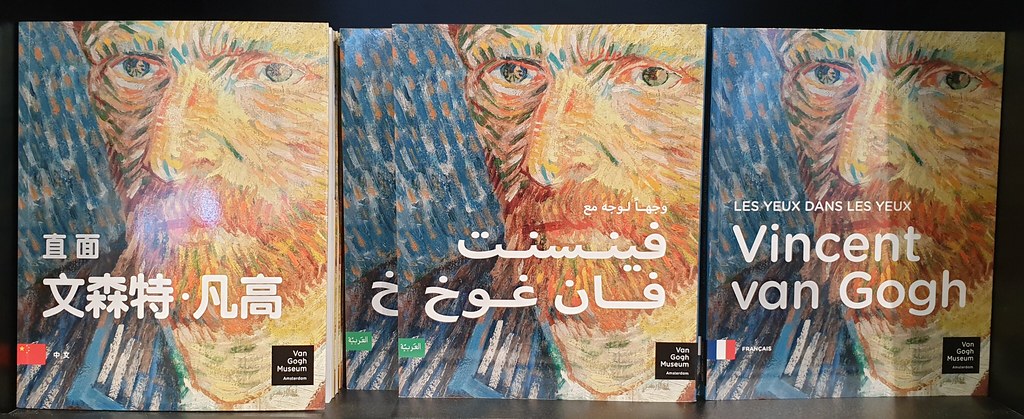
Vincent Van Gogh written is different scripts. Courtesy: Creative Commons

The whole world opens up in the realm of ideas that have existed wafting and bridging across time and space. Sometimes they find conduits to come to the fore, even though they find expression in different languages, under varied cultural milieus. One way of connecting these ideas is to translate them into a single language. And that is what many have started to do. Celebrating writers and translators who have connected us with these ideas across boundaries of time and place, we bring to you translated writings in English from twenty eight languages on the International Translation Day, from some of the most iconic thinkers as well as from contemporary voices. 

Prose

Tagore’s short story, Aparichita, has been translated from Bengali as The Stranger by Aruna Chakravarti. Click here to read. 

Travels & Holidays: Humour from Rabindranath, have been translated from Bengali by Somdatta Mandal. Click here to read.

Hena, a short story by Nazrul, has been translated from Bengali by Sohana Manzoor. Click hereto read.

Munshi Premchand’s Balak or the Child has been translated from Hindi by Anurag Sharma Click here to read.

Munshi Premchand’s Pus Ki Raat or A Frigid Winter Night  has been translated from Hindi by C Christine Fair. Click here to read.

Nadir Ali’s The Kabbadi Player has been translated from Punjabi by Amna Ali. Click here to read.

Kamaleswar Barua’s Uehara by  has been translated from Assamese and introduced by Bikash K. Bhattacharya. Click here to read.

S Ramakrishnan’s Muhammad Ali’s Singnature has been S. Ramakrishnan, translated from Tamil by Dr B. Chandramouli. Click here to read. 

PF Mathews’ Mercy,  has been translated from Malayalam by Ram Anantharaman. Click here to read.

Road to Nowhere, an unusual story about a man who heads for suicide, translated from Odiya by the author, Satya Misra. Click here to read.

An excerpt from A Handful of Sesame by Shrinivas Vaidya, translated from Kannada by Maithreyi Karnoor. Click here to read.

Writings from Pandies’ Corner highlight the ongoing struggle against debilitating rigid boundaries drawn by societal norms. Each piece is written in Hindustani and then translated by a volunteer from Pandies’ in English. Click here to read.

Rakhamaninov’s Sonata, a short story by Sherzod Artikov, translated from Uzbeki by Nigora Mukhammad. Click here to read.

Of Days and Seasons, a parable by the eminent Dutch writer, Louis Couperus (1863-1923), translated by Chaitali Sengupta. Click here to read.

The Faithful Wife, a folktale translated from Balochi by Fazal Baloch. Click here to read.

An excerpt from Ramy Al-Asheq’s Ever Since I Did Not Die, translated from Arabic by Isis Nusair, edited by Levi Thompson. The author was born in a refugee camp. Click here to read.

Poetry

Two songs by Tagore written originally in Brajabuli, a literary language developed essentially for poetry in the sixteenth century, has been translated by Radha Chakravarty. Click here to read. 

Rebel or ‘Bidrohi’, Nazrul’s signature poem,Bidrohi, translated from Bengali by Professor Fakrul Alam. Click here to read.

Banlata Sen, Jibananada Das’s iconic poem, translated from Bengali by Professor Fakrul Alam. Click here to read. 

Poetry of Michael Madhusudan Dutt has been translated from Bengali by Ratnottama Sengupta. Click here to read.

Our Children, a poem by well-known Iranian poet, Bijan Najdi, has been translated from Persian by Davood Jalili. Click here to read.

Akbar Barakzai’s Be and It All Came into Being has been translated from Balochi by Fazal Baloch. Click here to read.

Biju Kanhangad’s The Girl Who Went Fishing has been translated from Malayalam by Aditya Shankar. Click here to read.

Jitendra Vasava’s Adivasi Poetry,  translated from the Dehwali Bhili via Gujarati by Gopika Jadeja. Click here to read.

Sokhen Tudu’s A Poem for The Ol Chiki, translated from the Santhali by Hansda Sowvendra Shekhar. Click here to read.

Thangjam Ibopishak’s Gandhi & Robot translated from the Manipuri by Robin S Ngangom. Click here to read.

 Rayees Ahmad translates his own poem, Ab tak Toofan or The Storm that Rages, from Urdu to English. Click here to read.

Poetry by Sanket Mhatre has been translated by Rochelle Potkar from Marathi to English. Click here to read.

An excerpt from Evening with a Sufi: Selected Poemsby Afsar Mohammad, translated from Telugu by Afsar Mohammad & Shamala Gallagher. Click hereto read.

Ihlwha Choi’s Universal Language written at Santiniktan, translated from Korean by the poet himself. Click here to read.

Sangita Swechha’s Motherhood: A Tiny Life inside Me has been translated from Nepali by Hem Bishwakarma. Click here to read.

Rosy Gallace’s Two poems from Italy  have been translated from Italian by Irma Kurti. Click here to read.

Poetry in Bosnian written and translated from Bosnian by Maid Corbic. Click here to read.

Lesya Bakun translates three of her own poems from Ukranian and Russian to English. Click here to read.

Poems from Armenia by Eduard Harents translated from Armenian by Harout Vartanian. Click here to read.

Categories
Editorial

As Imagination Bodies Forth…

Painting by Sybil Pretious
And as imagination bodies forth
The forms of things unknown, the poet's pen
Turns them to shapes and gives to airy nothing
A local habitation and a name

 A Midsummer Night's Dream (1595) by William Shakespeare

Famous lines by Shakespeare that reflect on one of the most unique qualities in not only poets — as he states — but also in all humans, imagination, which helps us create our own constructs, build walls, draw boundaries as well as create wonderful paintings, invent planes, fly to the moon and write beautiful poetry. I wonder if animals or plants have the same ability? Then, there are some who, react to the impact of imagined constructs that hurt humanity. They write fabulous poetry or lyrics protesting war as well as dream of a world without war. Could we in times such as these imagine a world at peace, and — even more unusually — filled with consideration, kindness, love and brotherhood as suggested by Lennon’s lyrics in ‘Imagine’ – “Imagine all the people/ Livin’ life in peace…”. These are ideas that have been wafting in the world since times immemorial. And yet, they seem to be drifting in a breeze that caresses but continues to elude our grasp.

Under such circumstances, what can be more alluring than reflective Sufi poetry by an empathetic soul. Featuring an interview and poetry by such a poet, Afsar Mohammad, we bring to you his journey from a “small rural setting” in Telangana to University of Pennsylvania, where he teaches South Asian Studies. He is bilingual and has brought out many books, including one with his translated poetry. Translations this time start with Bankim Chandra Chattopadhyay’s advice to new writers in Bengali, introduced and brought to us by Abdullah-Al-Musayeb. Tagore’s seasonal poem, ‘Megh or Cloud’, has been transcreated to harmonise with the onset of monsoons. However, this year with the El Nino and as the impact of climate change sets in, the monsoons have turned awry and are flooding the world. At a spiritual plane, the maestro’s lines in this poem do reflect on the transience of nature (and life). Professor Fakrul Alam’s translation of Masud Khan’s heartfelt poetry on rain brings to the fore the discontent of the age while conveying the migrant’s dilemma of being divided between two lands. Fazal Baloch has brought us a powerful Balochi poet from the 1960s in translation, Bashir Baidar. His poetry cries out with compassion yet overpowers with its brutality. Sangita Swechcha’s Nepali poem celebrating a girl child has been translated by Hem Bishwakarma while Ihlwha Choi has brought his own Korean poem to readers in English.

An imagined but divided world has been explored by Michael Burch with his powerful poetry. Heath Brougher has shared with us lines that discomfit, convey with vehemence and is deeply reflective of the world we live in. Masha Hassan is a voice that dwells on such an imagined divide that ripped many parts of the world — division that history dubs as the Partition. Don Webb upends Heraclitus’s wisdom: “War is the Father of All, / War is the King of All.” War, as we all know, is entirely a human-made construct and destroys humanity and one cannot but agree with Webb’s conclusion.  We have more from Kirpal Singh, Ryan Quinn Flanagan, Nivedita N, John Grey, Carol D’Souza, Vernon Daim, George Freek, Saranyan BV, Samantha Underhill and among the many others, of course Rhys Hughes, who has given us poetry with a unique alphabetical rhyme scheme invented by him and it’s funny too… much like his perceptions on ‘Productivity’, where laziness accounts for an increase in output!

Keith Lyons has mused on attitudes too, though with a more candid outlook as has Devraj Singh Kalsi with a touch of nostalgia. Ramona Sen has brought in humour to the non-fiction section with her tasteful palate. Meredith Stephens takes us on a picturesque adventure to Sierra Nevada Mountains with her camera and narrative while Ravi Shankar journeys through museums in Kuala Lumpur. We travel to Japan with Suzanne Kamata and, through fiction, to different parts of the Earth as the narratives hail from Bangladesh, France and Singapore.

Ratnottama Sengupta takes us back to how imagined differences can rip humanity by sharing a letter from her brother stationed in Bosnia during the war that broke Yugoslavia (1992-1995). He writes: “It is hard to be surrounded by so much tragedy and not be repulsed by war and the people who lead nations into them.” This tone flows into our book excerpts section with Red Sky Over Kabul: A Memoir of a Father and Son in Afghanistan by Baryalai Popalzai and Kevin McLean. Popalzai was affected by the Russian invasion of Afghanistan in 1980 and had to flee. A different kind of battle can be found in the other excerpt from The Blue Dragonfly – healing through poetry by Veronica Eley – a spiritual battle to heal from experiences that break.

In our reviews section, KPP Nambiar reviews The Stolen Necklace: A Small Crime in a Small Town by Shevlin Sebastian and VK Thajudheen, a book that retells a true story. Sangeetha G’s novel, Drop of the Last Cloud, we are told by Rakhi Dalal, explores the matrilineal heritage of Kerala, that changed to patriarchal over time. Bhaskar Parichha reviews Burning Pyres, Mass Graves and A State That Failed Its People: India’s Covid Tragedy by Harsh Mander. Parichha emphasises the need never to forget the past: “It is a powerful book and sometimes it is even shattering. The narrative is a live remembrance of a national tragedy that too many of us wish to forget when we should, instead, etch it in our minds so that we can prevent another national tragedy like this one from recurring in the future.”  While we need to learn from the past as Parichha suggests, Somdatta Mandal has given a review that makes us want to read Ujjal Dosanjh’s book, The Past is Never Dead: A Novel. She concludes that it “pays tribute to the courage and tenacity of the human spirit and its capacity for hope despite all odds.”

We have more content than mentioned here… all of it enhances the texture of our journal. Do pause by our July issue to savour all the writings. Huge thanks to all our contributors, artists, all our readers and our wonderful team. Without each one of you, this edition would not have been what it is.

Thank you all.

Have a wonderful month!

Mitali Chakravarty

borderlessjournal.com

.

Visit the July edition’s content page by clicking here

READ THE LATEST UPDATES ON THE FIRST BORDERLESS ANTHOLOGY, MONALISA NO LONGER SMILES, BY CLICKING ON THIS LINK.

Categories
Poetry

Motherhood: A Tiny Life inside Me

A poem by Sangita Swechcha, translated from Nepali by Hem Bishwakarma

Painting by Bernardus Johannes Blommers (1845-1914). Courtesy: Creative Commons


A purpose in my life,
A reason to survive,
A flower budding inside me
That impatiently cried,
Begging to understand the meaning of life.

The terrible struggle with life --
Hundreds of questions from
A one-day old
Deluged me, 
Exhausted and distressed.

Though life was not that easy--
The flower that desired to flower
Did not want to wither 
Without a struggle.

The amusement in my life,
Lost in strange thoughts 
With silent, helpless emotions,
Tensed, fell down and cried,
With an abrupt pain of separation.

A life as in a story
And a story of life
With hope dared to live.
She, her courage and I --

The entanglement of 
Struggle and pain,
Perhaps, was a trial of restraint. 
A tiny life to chuckle that learned
Living was a novel mesh of affection.

The life that sprouted inside me,
Has patience to contend her life.
There is a desire, and a trust 
For her whole life is a dream that has yet to unfold!


Dr.Sangita Swechcha
has been an ardent lover of literature from an early age. She has published a novel and co-authored a collection of short stories before the collection GulafsangakoPrem (The Rose: An Unusual Love Story) in Nepali. She has many short stories and poems published in various international journals and online portals. The Himalayan Sunrise: Exploring Nepal’s Literary Horizon and A Glimpse Into My Country are her recent publications, co-edited with Karen Van Drie and Andrée Roby respectively. Email: sangyshrestha@hotmail.com, Website: www.sangitaswechcha.com

Hem Bishwakarma is a translator and poet from Nepal. He is an ELT teacher and educator by profession.

Hem Bishwakarma is a translation enthusiast, he also writes poems and reviews.  Email: swarmadhurya@gmail.com

PLEASE NOTE: ARTICLES CAN ONLY BE REPRODUCED IN OTHER SITES WITH DUE ACKNOWLEDGEMENT TO BORDERLESS JOURNAL

Click here to access the Borderless anthology, Monalisa No Longer Smiles

Click here to access Monalisa No Longer Smiles on Kindle Amazon International

Categories
A Special Tribute

Peace in the footsteps of Hiroshima & Nagasaki

The mother of a soldier once told me she did not agree that winning a war was a solution to peaceful living. She said, “If our army kill the enemy, some other mothers lose their sons; some other wives are widowed; some other children lose their fathers…”

Her summation of the war seems like an accurate description of the current day scenario. While politically the bombs that killed 140,000 in Hiroshima and 74000 in Nagasaki on 6th and 9th August respectively(1945), destroyed two cities, ended the Second World War (1939-1945) which claimed a total of 70-85 million lives over six years and led to the celebration of VE Day (Victory Europe Day), can we afford such horrors of violence and annihilation again? This is a question that remains in the grey zone as nuclear non-proliferation looks like agreeing to peace because the terror of war frightens. Will we ever have a world where peace is loved for the sake of what it brings and not for the fear of annihilation?

Writers in this special commemorate the horrors of the atom bomb and write their plea for peace. While American-Japanese writer, Suzanne Kamata, and Manjul Miteri of Nepal explore victimhood, Michael Burch talks of the Enola Gay, the legendary bomber that dropped “Little Boy” and annihilated a whole city. He reflects on the testing that continued on Bikini Island and further to ‘maintain peace’. We also have the words of Kathleen Burkinshaw who continues impacted by this terror — though it was her mother who was the hibakusha or survivor of the bomb blast. We round up this section with Candice Louisa Daquin’s reflections on peace and the reality as it is.

Poetry

Commemorating Hiroshima: Poetry by Suzanne Kamata that brings to life August 6th and the impact of the bombing on the victims and the devastation around them. Click here to read.

Oh Orimen! A poem in Nepalese about a victim of the blast written by a sculptor, Manjul Miteri, who while working on the largest Asian statue of the Buddha in Japan visited the museum dedicated to the impact of the blast. The poem has been translated to English by Hem Bishwakarma. Click here to read.

Mushroom Clouds: Poetry by Michael Burch that reflects on Enola Gay and the Bikini atoll. Click here to read

Prose

Surviving Hiroshima

Kathleen Burkinshaw is the daughter of a woman who survived the Hiroshima blast. Burkinshaw suffers neural damage herself from the impact of the bomb that her parent faced. She has written a book called The Last Cherry Blossom recounting her mother’s first hand experiences. Her novel has been taken up by the United Nations as a part of its peacekeeping effort. She has been actively participating in efforts to ban nuclear weapons, including presenting with Nobel Laureates. Click here to read the interview.

Peace: Is it even Possible?

In the post second world war scenario, Candice Lousia Daquin explores war and peace through history. Is peace possible? Click here to read.

Categories
World Poetry Day, 2021

Celebrating Poetry without Borders

“And as imagination bodies forth
The forms of things unknown, the poet’s pen
Turns them to shapes and gives to airy nothing
A local habitation and a name”

(William Shakespeare, A Midsummer's Night's Dream,1596)

Like clouds float, words waft through currents of ideas and take shapes and forms. We celebrate poetry across the world, across space and time, with the greatest and the new… our homage in words to the past, present and future…

A paean to the skies, the Earth and empathy with nature sets the tone for this poetic treat. I offer you a translation/transcreation of a Tagore song, from the original lyrics penned by the maestro in Bengali…

The Star-Studded Sky  by Rabindranath Tagore

( A translation/transcreation of Akash Bhora, Shurjo Tara, 1924)

The sky replete with sun and stars, the Earth brimming with life,
In the midst of this universe, I have found my abode.
Spellbound by the plenitude, songs awaken in my being. 

The infinite, eternal waves that create planetary tides 
Resonate through the blood coursing in my veins.

As I walk to the woods, I step on the grass. 
Heady perfumes of flowers startle me into a rhapsody.
Benefactions of joy anoint the universe.

I have listened, I have watched, I have poured my life into the Earth.
Through knowing, I have sought the unknown. 
Spellbound by the plenitude, songs awaken in my being. 

(Translated/transcreated by Mitali Chakravarty on behalf of Borderless Journal,2021)

Poetry connects with eternal human emotions over space and time with snippets from old and verses from new.

Poets continue to draw from nature to express and emote. In empathy with the forces that swirl around us are poems written by moderns, like Jared Carter.

 What is that calling on the wind
           that never seems a moment still?
 That moves in darkness like a hand
           of many fingers taken chill?

(Excerpted from Visitant by Jared Carter)

Click here to read Jared Carter’s Visitant and more poems.

Tagore wrote and painted. Here we have a poem about a painting done by the poet-artist herself, Vatsala Radhakeesoon.

An endless expanse swirls
over the tropical island.
At the foot of the Meditative Mountain,
birds, bees and butterflies wonder --
who is this mystic blue?

(Excerpted from Swirling Blues by Vatsala Radhakeesoon)

Click here to read Swirling Blues by Vatsala Radhakeesoon and gaze at the painting.

Separated by oceans and decades, were poets empathetic?

I CELEBRATE myself, and sing myself,
And what I assume you shall assume,
For every atom belonging to me as good belongs to you...

The smoke of my own breath,...

My respiration and inspiration, the beating of my heart, the passing of blood and air through my lungs,
The sniff of green leaves and dry leaves, and of the shore and 
dark-color'd sea-rocks, and of hay in the barn,
The sound of the belch'd words of my voice loos'd to the eddies of the wind,
A few light kisses, a few embraces, a reaching around of arms,
The play of shine and shade on the trees as the supple boughs wag,
The delight alone or in the rush of the streets, or along the fields and hill-sides,
The feeling of health, the full-noon trill, the song of me rising from bed and meeting the sun.

(Excerpted from Song of Myself, Walt Whitman, 1881)

And despite exuberance of poets and their love of nature, came wars from across continents. Here are some of the responses of poets from all over the world to war and the pain it brings…

A soldier and a poet, Bijan Najdi (1941-1997) wrote in Persian, he captured the loss and the pain generated by war on children for us. This has been translated by Davood Jalili for Borderless

The world does not become bitter with the sword.

It does not become bitter with shooting, cries and fists.

The bitterness of the world

Is not the deer’s necks

And leopard’s tooth

And the death of a fish...

(Excerpted from Our Children by Bijan Najdi)

Click here to read Our Children by Bijan Najdi

Maybe children have a special place in poets’ hearts. Michael R Burch from across the Pacific writes of their longings too…

I, too, have a dream …

that one day Jews and Christians

will see me as I am:

a small child, lonely and afraid,

staring down the barrels of their big bazookas,

(Excerpted from I, too have a dream by Michael R Burch)

Click here to read Dreams of Children by Michael R Burch and more by him.

From Nepal, Manjul Miteri travelled to Japan to design a giant Buddha. While visiting the Hiroshima museum, he responded to the exhibits of the 1945 nuclear blast, a bombardment that ended not just the war, but many lives, many hopes and dreams… It heralded the passing of an era. Miteri’s poem was translated by Hem Biswakarma for us from Nepali.

Orimen*!
Oh, Orimen!
Mouthful of your Tiffin
Snatched by the ‘Little Boy’*!
The Tiffin box, adorned with flowers,
Scattered and spoilt,
Blown out brutally.

(Excerpted from Oh Orimen! by Manjul Miteri)

Click here to read Majul Miteri’s Oh Orimen!

Continuing on the theme of war, what can war weapons not do? Karunakaran has written a seemingly small poem about warplanes in Malayalam that embraces the nuclear holocaust and more. The words are few but they say much… It has been translated by Aditya Shankar for us.

No warplane 
has ever flown like a bird,
has lost way like a bird,
has halted mid-flight reminiscing a bygone aroma.

(Excerpted from No Warplane Has Ever Flown Like A Bird by Karunakaran)

Click here to read No Warplane Has Ever Flown Like A Bird by Karunakaran.

From wars and acquisition of wealth, grew the greed for immortality.

Aditya Shankar writes rebelling against man’s greed, greed that also leads to war.

Through the tube,

the world poured into that room

with news of war and blood.

(Excerpted from Human Immortality Project  by Aditya Shankar)

Click here to read Human Immortality Project by Aditya Shankar.

Continuing the dialogue on discrepancies is a poem written by a visiting professor from Korea. Ihlwha Choi was in Santiniketan and just like Tagore found poetry in Krishnokoli, he found poetry in Nandini…

There was Nandini’s small shop along with fruits' stalls and the bike shop.

Cows passing by would thrust their heads suddenly

Into the shop thatched with bamboo stems....

...There lived a flower-like little girl selling chai near the old house of Poet R. Tagore.

(Excerpted from Nandini by Ihlwha Choi)

Click here to read Nandini by Ihlwha Choi

Poetry is about moods — happiness and sadness, laughter and tears.

Reflecting on multiple themes that mankind jubilates and weeps about is the poetry of John Grey, camping out in Australian outbacks, revelling in the stars and yet empathising with hunger… A few lines from his poem hunger.

Hunger can sing soft but compelling

in the voice of the one who last

provided you with three meals a day.

That’s years ago now.

Hunger has no memory

but it assumes that you do.

(Excerpted from Hunger by John Grey)

Click here to read Camping out, Hunger and more … by John Grey

And now we introduce some laughter. A story-poem by Rhys Hughes, about an alien who likes to be tickled…

“Oh, tickle me under the chin,
   the chin,
 please tickle me
 under the chin.
 It might seem quite fickle
 or even a sin
 to make this request,
 to ask such a thing,
 but I must confess
 that to ease my distress
 there’s nothing so fine
    as a tickle.
 So please tickle me 
 under the chin,
    the chin.
 Tickle me under the chin.” 

(Excerpted from The Tickle Imp by Rhys Hughes)

Click here to read The Tickle Imp by Rhys Hughes

And here is a poem by Tamoha Siddiqui, jubilating the borderless world of friendship.

Yesterday I heard the sound of colourful feet

to Indonesian beats, in the middle of Michigan:

white, black, brown, all were one

pitter-patter paces in a conference hall.

(Excerpted from Birth of an Ally by Tamoha Siddiqui)

Click here to read Tamoha Siddiqui’s Birth of an Ally

We share with you now from the most unusual poetry we have on our site, from a book called Corybantic Fulgours. If you want to know what it means, click here to check it out!

Concluding our oeuvre to jubilate a world without borders, here are lines from a poet who probably has influenced and united majority of writers across the world…another truly universal voice.

Time present and time past
Are both perhaps present in time future,
And time future contained in time past.
If all time is eternally present
All time is unredeemable.
What might have been is an abstraction
Remaining a perpetual possibility
Only in a world of speculation.
What might have been and what has been
Point to one end, which is always present.
...
The dance along the artery
The circulation of the lymph
Are figured in the drift of stars
Ascend to summer in the tree
We move above the moving tree
In light upon the figured leaf
And hear upon the sodden floor
Below, the boarhound and the boar
Pursue their pattern as before
But reconciled among the stars.

Excerpted from TS Eliot's Four Quartets, Burnt Norton(1936)

The poetry of the historic greats are all woven by eternal threads that transcend man made boundaries. They see themselves almost as an extension of the Earth we live. Tagore, Whitman and Eliot write of the universe coursing through their veins. Shakespeare gives the ultimate statement when he brings in the play between imagination and nature to lift the mundane out of the ordinary. With inspiration from all these, may we move into a sphere, where poetry not only moves but also generates visions for a more wholistic and inclusive future.

.

PLEASE NOTE: ARTICLES CAN ONLY BE REPRODUCED IN OTHER SITES WITH DUE ACKNOWLEDGEMENT TO BORDERLESS JOURNAL

Categories
Poetry

Oh, Orimen!

A Nepali poem by Manjul Miteri: Translated to English by Hem Bishwakarma

Manjul Miteri
Orimen*!
Oh, Orimen!
Mouthful of your Tiffin
Snatched by the ‘Little Boy’*!
The Tiffin box, adorned with flowers,
Scattered and spoilt,
Blown out brutally.
A handful of your young breath
In the silence of Hiroshima Peace Museum,
In the depth of this stillness,
Sobs every day and night,
Cascading incessant tears!

Oh, Orimen!
Blown out
With the hot lethal smoke of the Bomb
In the misfortune of your hunger and thirst.
Looking at your Tiffin box that carries
An unuttered scream,
I feel that
In the nooks and corners of this Earth,
By the tremor of the missiles
Blasted in war celebrations,
Your deformed body
that bears the creviced Earth,
Is postured in peace.

Oh, Orimen!
The war slays 
Countless innocents like you.
The war deletes many opportunities
For innocents like you.
Then,
As your Tiffin box
Stands on the ruins of life
That is destroyed and slain,
War repetitively writes
Histories of triumph and courage!

The war
In the sky, in the cloud, in the air,
In the rays of the sun and the moon,
In the womb of the Earth,
In the surface of the oceans,
Is trying to pen a ballad
Wiping out the existence of life.

We are out to teach,
The scripts of love, life, peace and harmony
Copied from your Tiffin box
To all the guns that merely write death!

With the same avowal,
I have arrived feeling so frantic
From the land of the Buddha, Nepal,
Striding on the roads fired in war,
To bring this message to you.
Sorry, if I have been too late!

*An innocent boy who lost his life in Hiroshima Bombing during WWII.

*A devastating atomic bomb dropped in Japanese city, Hiroshima during WWII.

Manjul Miteri is a  renowned sculptor and poet from Nepal. He is currently working with the biggest sculpture of Gautam Budhha in Asia in Japan. 

Hem Bishwakarma is a translator and poet from Nepal. His works have been published in national and international poetry and literature journals and magazines.

First published in Gorkha Times, edited by Borderless to suit our needs.

.

PLEASE NOTE: ARTICLES CAN ONLY BE REPRODUCED IN OTHER SITES WITH DUE ACKNOWLEDGEMENT TO BORDERLESS JOURNAL

Categories
Poetry

Poetry from Nepal

By Bina Theeng Tamang and translated by Hem Bishwakarma

Bina Theeng Tamang

My Father

Ere yesterday,

I could not see my father

He turned up—

While I had been to collect the sun

.

For the second chance,

He turned up at daytime, yesterday

Oh! I’m sorry, I could not see him

For I went out

To seek a morsel of food

.

Perhaps,

He will turn up this evening

Yet, I am walking out to reap the time

I know, I would not see him yet again

.

My father had to take me

To a hospital

Lifting a spiky sun on his head

Along the bank of the Rapti River

.

I am here —

Showcased as a city-marionette

Grasped by a lollypop so tight

.

He used to look into the sky

With a deep sigh!

I used to look at the city

.

He used to ask briskly

Groping money —

Earned selling the Kulfi

“Which did you like, dear?”

.

He used to laugh

With the face shattered by helplessness;

And the chest stroked by fate

Then he would say,

“You are my heart

How would I live heartbroken?”

.

After four to five years of his avowal

He let his heart

To a strange person

.

He is unwell nowadays

However,

He comes to see a piece of his heart

.

How would he know?

For seeking a mouthful bread

Sometimes for collecting the sun

And frequently to reap the time

The Heart rushes ever

In the marathon of life

.

We may not see each other

In the next visit, too!

.

Bina Theeng Tamang is a writer from Kathmandu. She is an author of two books, Chhuki, a story collection and Rato Ghar, a poem collection. She is an awardee of different Nepali awards.

Hem Bishwakarma is a writer and translator from Nepal. He has poetry and short stories translations, and poems in Nepali and English published to his credit. He mostly works on Nepali-English translations.

.

PLEASE NOTE: ARTICLES CAN ONLY BE REPRODUCED IN OTHER SITES WITH DUE ACKNOWLEDGEMENT TO BORDERLESS JOURNAL.