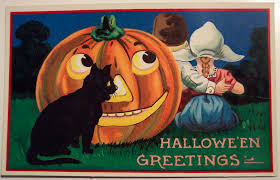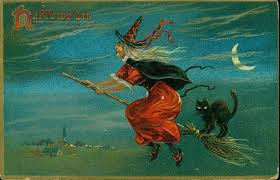
While the horror generated by wars deeply saddens with its ultimate disregard for all kinds of flora and fauna, including humans, the horrific as we savour in festivals can cease to be terrifying. It can even be cathartic in the midst of the terror of destruction and violence. Halloween is a festival that brings to mind a time when kids go trick or treating as houses and gardens assume a ‘haunted look’. This year, in the spirit of fun, we bring to you a collection of the spooky and the gooky — poems and prose — from across multiple countries and cultures. These hope to provide a moment of respite and unalloyed fun for all of you, despite their darker notes. Perhaps, as an afterthought, these will also unite with the commonality of human needs to connect… even if it’s with a plethora of spooks from across all kinds of human borders…
Mr Richards, employed by the British Council, had been teaching English at a posh, private preparatory school in Thailand for more than four years in the Province of Prachuap Khira Khan in a coastal town named Mawdaung. His first and sixth form pupils enjoyed his humour much more than his tedious grammatical explanations, and Mr Richards had no qualms about this.
Mr Richards taught twelve hours a week which offered him ample time to learn Thai, travel extensively throughout the country, especially up North in the dusk-filled jungles and along the Mekong River shores exploring villages and temples.
The one-storey school, perched high up on the brow of a hill, overlooked the turquoise-tainted Indian Ocean. The large windows of his class afforded pupil and professor much visual pleasure when grammar became too much of a bore, and Mr Richards too weary or hot to break the boredom.
“Now, instead of casting cursory glances out of the windows,” shouted a nettled Mr Richards, one very grey, windy day, “who can tell me what function the word ‘chewing’ plays in the composed word ‘chewing-gum’ ?” All the smiling faces and darting eyes happily translated their perfect ignorance of the answer. However, a minute later, a very pretty girl, one of the brightest in his class, excitedly cried out, “A verb, sir !” Mr Richards gave her a benign smile and shook his head.
“No, no. It is not because it ends in -ing that it is a verb,” he lectured in a paternal tone, so overtly exercised by Mr Richards, and so perfunctorily accepted by the pupils. He scanned the eager heads of the others ; alas none had the desire to crack the enigma. He checked his watch : “Oh well, I’ll let them out ten minutes or so before the bell rings. I have to catch that bus to Bangkok,” he sighed, still waiting for an answer that never came.
“No bother. Tonight think about it and tomorrow morning let me know, right ?” He stood up. “Go on now … down the hill … off to the beach, I’ll give you a treat this afternoon.”
Before he had even finished the word ‘afternoon’ the whole class, besides two girls, grabbed their books and scrambled for the door. Out they stormed, racing downhill towards the shingled beach of the crescent-shaped bay. Mr Richards observed them from the large windows. Their delightful screams made him a bit queasy: he had been told never to allow the pupils out before the bell. He, nevertheless, had done so on several occasions. He shrugged his shoulders, picked up his books and papers from the wooden desk and was about to make for the door when a terrible thundering or roaring sound froze him in his footfalls. He swivelled on his heels and gasped in horror as rolls and rolls of water smashed against the plate glass of the window panes. The violence of the impact threw the two girls to the floor screaming, but besides a few chinks through which spouts of water gushed in, the windows had miraculously withstood the brunt of the tidal wave. For a tidal wave it was, and a tremendous one! The two girls remained lying on the floor, crying but unhurt.
Mr Richards ran to the windows. The waves had receded, but what he espied below on the crescent-shaped seascape, or what had been a crescent-shaped seascape, caused him to fall back and scream involuntarily : “Dear God! There’s nothing left!” Indeed nothing remained: no palm trees, no vendors’ shacks along the shore, no boulders. No shore ! Only a vast ocean that lay several metres below the school, now churning a glaucous thickness under grey, sultry skies, upon which floated a myriad bobbing flotsam: uprooted palm-trees, lifeless cows and dogs, shoals of bloated fish, roofs of straw, pots and pans, planks, bright coloured robes with or without their proprietors’ bodies inside them !
“Bodies !” he cried covering his mouth. “My pupils … Have they all …” He dared not finish his sentence. The two girls stared at him, mouths agape, eyes deorbited. “The boys and girls floating in the water … Dear God they’ve all drowned !” He wept and wailed, stamping his feet, grabbing at his hair. The girls too began to weep and wail.
In an instant he came to himself. “Their deaths are my fault,” he mused. “I let them out too soon … against all school regulations. Blast ! Why did I do that … just today ?” He soon realised that the headmaster would be on to him soon enough; he feared his starched character. And the parents ? They would accuse him of manslaughter. He would be arrested and put in prison, even hanged for involuntary homicide ! He had every call to be frightened …
Taking hold of himself, Mr Richards knew he had to flee very quickly from Thailand before the headmaster and the parents learned about his unpardonable blunder. And they would learn about it soon enough when the panic and hysteria had died down.
He leapt over the still supine girls and rushed out the door. Once outside he noted that the town near the school had hardly been damaged. But below, he caught glimpses of undulating corpses being poled out of the waters by villagers and policemen in pirogues, rowboats or catamarans. The tidal wave had been gigantic. He turned his attention away from the catastrophe and fled home …
He jogged up to his bungalow further up the grassy hill at the edge of town. Speedily he gathered what he could, for the alert would be out for him at any moment … Or, so he believed. A change of clothes, one or two books and his official documents he stuffed into a small backpack, and without locking his door quickly made a bee-line for the bus station, where luckily he managed to jump on a bus for Bangkok. Apparently no one recognised him, nor followed him. He paid the fare, settled into one of the many empty seats and stared stony-eyed out of the window. His red, puffy eyes filled with tears. What a blithering fool he had been ! And now, what had he become ? A fugitive … no, worse, a murderer ! “Dead ! All dead !” rose a ghastly whisper in his ear. He had to get away as far as possible as the scenes of the bloated pupils danced before his bloodshot eyes.
Once in Bangkok he wasted no time. Further North he travelled by bus into the Province of Chiang Rai. There, in a village whose name he hardly recalled, he spent two nights pondering his dilemma, assuaging his jaded nerves, chary of leaving any sign or evidence of his frantic intinerary, thinking only of a plan to save his neck. He couldn’t possibly stay in Thailand, the police surely were now on his trail, or would be very soon. Neither could he return to England: the bobbies would be waiting for him at the airport, ready to handcuff the murderer of over a dozen innocent children !
Then in the middle of a hot, sleepless night it suddenly occurred to him: he would shave his head and eyebrows, don a monk’s robe, change his expensive Russell and Bramley shoes for sandals and set out for Laos. He had travelled widely in Laos and could even speak a smattering of Kra-dai. He had taught in Luang Prabang for three years and had many friends amongst his former pupils, two of whom had entered monkhood in Pak Beng at the Wat or temple Jin Jong Jaeng. “I shall escape naked from the shipwreck of mundane life,” he murmured, smiling inwardly at his little metaphor which he recollected from his childhood upbringing. But would he ?.. Mr Richards sunk into his lumpy bed: the figure of an outlaw, a pariah, a self-exile stood before him like a shadow … a double of himself: -swollen little bodies drift like flotsam in waters,darkly … that fey voice droned above a tumult of incongruous thoughts.
Mr Richards shook his head and said aloud, “To Pak Beng. There I’ll join the sangha[1] of the Theravada monks. There I shall seek spiritual solace, rid my mind and spirit of those drifting bodies of cheerful boys and girls, swept away from the joys of life because I had a bus to catch!” So he hoped.
Yet the obstacles of reaching the temple caused him concern. The Laotian government frowned upon Western spiritual-seekers cluttering their monasteries and temples. He needed a visa. Where would he find a consulate in the North of Thailand ? And would they issue one to a ‘Western monk’ ?
He jumped up from the bed, and as he did his mind cleared of all that tumultuous tossing. He had befriended many of his pupils’ parents whilst working in Luang Prabang, and he knew, by correspondence, and his frequent voyages to Laos, that one of them, Mr Inthavong, had been appointed consul in one of the North Thailand consulates. He rushed down to the reception and asked at the desk where the nearest Laotian consulate could be found.
“You must travel by bus to Wiang Kaen near the Mekong River, sir.”
“Are there any other consulates ?”
“Not that I know of, sir.”
Mr Richards heart skipped a beat; Mr Inthavong must be working there. He had to take the chance.
The next morning the ‘Western monk’ got on a bus for Wiang Kaen, carrying only a small bag for his passport, photos and a bit of lunch. All along the tedious journey to the North-Eastern town Mr Richards prayed that Mr Inthavong would be there; it was his only chance to obtain a visa for Laos.
He reached Wiang Kaen by nightfall, found accommodations at a temple guest house and spent a horribly sleepless night, tormented now by the thought of the failure of his plan, now by the screeching rats and buzzing mosquitoes.
At nine o’clock sharp he was at the front gate of the bright new consulate, a lovely two-storey bungalow-like edifice enshrined by lush gardens carpeted with the most perfume-scented fruit trees and flowers. He rang. The security guard strolled out and sized him up. Mr Richards politely mentioned his friend’s name. The unshaven security guard raised two quizzical eyebrows, but took his passport and photo and left him to ruminate the events that were about to unfold behind that iron barrier, inside the lovely bungalow. It all seemed hours to him as that voice repeated “irresponsible murderer !” Suddenly the security guard stood before him, together with a small, portly man dressed in a suit and tie.
“Can that be you Mr Richards? A bonze? A monk? What have you done? Where is all your beautiful black hair ?” All this was said in imperious tones much to the delight of the monk who sighed in relief: his pupil’s father had recognised him! He wiped the perspiration off his furrowed brow. “Step in, please … out of the heat,” the consul pleaded. So they both strolled into the air-conditioned consulate, Mr Inthavong wearing Russell and Bramley shoes, recently polished, Mr Richards, a pair of worn-out sandals.
Inside the monk was served tea and a bowl of rice in Mr Inthavong’s office, he himself abstaining from joining him since he had already breakfasted. “I’m so happy to see you Mr Richards,” began the enthusiastic consul. “What brings you here, and dressed like that ? Are you really a monk now ?” Mr Richards broke into a tapestry of lies that, as time went by, he himself began to believe: Living so long in Asia had infused his soul with the compassionate virtues of Buddhism, and in Laos, he hoped to pursue his path deeper in the compassionate depths of Buddhahood in order to glean its treasures. The consul smiled like a child does when listening to his or her favourite nursery rhyme.
Mr Richards then got down to business: his visa ! Mr Inthavong nodded, examining his passport and two photos. “You shall have it in three days. Meanwhile, you are to be my guest here, upstairs with my wife and two children.”
And so the first snag had been circumvented. For those three days, Mr Richards, plied with food, drink and homely conversation, had all but forgotten the wave, the floating bodies and merciless whisper … the abominable figure of a self-exiled …
On the morning of the fourth day, armed with a three-month visa, the Western monk set out to cross the Mekong River to Ban Houei Sai on a Nam Ou boat with six other passengers. It had been so long since he had been on the Mother of all Rivers. He inhaled the tropical river air in silent jubilation. As they navigated slowly downstream, his thoughts interlaced with the flecks of foam, wandered back to his days spent on the Mekong at Guan Lei on the Chinese border, where having been temporarily stranded, he finally was welcomed aboard a small six-cabin dai, a Chinese boat, heading for Thailand.
What a voyage! They had anchored by the soundless jungles at night, machetted through them in the evenings in search of mangoes, navigated by bathing rosy water buffalows and by tiny golden stupa-tipped isles. What an adventure! The crew had left him off in a small Laotian village where he made his way to Luang Prabang on one of those blue, wooden box-boats, gliding by stilt-home villages under whose piles lounged or snorted huge black pigs, scenes so reminiscent of Alix Aymé’s paintings[2] housed at the Luang Prabang Royal Palace. Then the real adventure began, upstream on the Nam Ou in a frail six-seater river boat, slowly weaving between treacherous snags and swift cross-currents. He passed the Park Ou caves, Nong Khiaw and Muang Khwa, sleeping in bungalows and eating rice with thick pieces of pork in the pristine territories of the Hmong tribal peoples. Alas, his grand voyage to Hatsa ended in Sop Pong near the Vietnamese border, the authorities refusing him an entry visa to cross Vietnam then back into Laos where he wished to continue on his river voyage to Chao Dan Tra at the Chinese border.
Ah yes, those were the days of freedom … of existential sovereignty. And now ? A fugitive … a prisoner to his own wretched egoism, Mr Richards suddenly felt overwhelmed by a deep loneliness. His mixed recollections were suddenly interrupted by shouts from the shore : they had reached Ban Houei Sai.
Once the formalities were completed, Mr Richards managed to hop on a collective taxi which sped him towards Pak Beng on a smooth road. He reached the town before nightfall, and to his joy he spotted his two former pupils seated on the temple steps. Were they waiting for him ? Indeed they were, thanks to a letter sent by Mr Inthavong who had explained in great detail to the Satu or Venerable Father of the temple-sangha Mr Richards’ religious fervour and enthusiastic intentions to enter monkhood. The consul had added that nothing should be said to the police or to other state authorities of his entry into Buddhahood.
His former pupils, who had grown into full manhood, heads shaven and bare foot, happily led him to meet the Satu Father. To tell the truth, Mr Richards hardly recognised them. But that made no difference. As expected, he deposited a large donation (all the cash he had on him which amounted to some six hundred pounds), then was given three bright new ochre-coloured robes of pure cotton, shown to his splayed window cell, through which he had a slight view of the inner temple gardens, and was told the daily procedures of his initiation as a pha or a novice: collective prayers in the Prayer Hall, breakfast, Sutra readings until lunch, discussion, rest period, an hour or two of manual labour such as gardening, restoring frescoes or termite-riddled woodwork, personal perpetual moving meditations, yoga exercises, then a light meal before the final collective prayer and sleep until the sound of the gong at four o’clock in the morning.
When the two monks had left him, Mr Richards lay back on the straw mat on the earthen floor that served as a bed. He had been given immaculately clean sheets and a pillow. A mosquito net had been nailed to the splayed window. The walls bore no images nor any other colour than a light beige. Putting his hands behind his head he followed the slowly turning ceiling fan with his eyes: yes, his plan had succeeded. No one would ever find him here. Yet he had no reason to rejoice. He would never again see his aging parents seated at the hearth reading or conversing in low voices, his trusty Irish Setter … his friends at the pub. A sharp pain of remorse, or better put, compunction stabbed at his chest. “Dead!Drowned ! All dead !” the whispers hammered at his temple. Would that relentless voice ever grant him respite ? Would anyone ever forgive him ? Only penance. Only the fires of tribulation could scrape away the rust of vice that had corroded his being. A life of contrition would be the most appropriate path for him, the most responsible. Tears again began to well up in his eyes. He fell asleep and awakened to the cascading sound of two or three vibrating gongs.
So began Mr Richards’ initiation into Therevada monkhood. He had to learn the akkara alphabet in order to read the sutras, the Buddhist acriptures. His practice of many languages enabled him to accomplish this in two months. What he enjoyed most was the tham nong or the musical rhythm method which empowers the monks to memorise the hundreds of sutras of the Sacred Books ; it formed part of the didactic games that the bonzes played every morning and afternoon. These didactic games also included dancing and chanting sessions. The ‘western bonze’ adapted quite rapidly to his new lifestyle … his new home … No doubt his last …
As time passed, the rigours of the monastic code, the kindness of all the monks towards him, his slow but steady immersion into the Kra-Dai language and the marvels of the modality of Buddhist life attenuated, to a certain extent, the mortifying effects his spirit and body had suffered since that horrendous wave. Images of the drowned bodies did wake him up in the middle of certain nights, heaving and panting in one sweaty mass of anguish. However, the whispered voice had long since been silenced. His prayers and ruminations served as a watershed for those waves of guilt, an oceanic ointment for his slowly healing wounds. He was so glad to do service at the temple, run errands for the personnel who worked in the kitchen, wash and hang to dry the three robes of all twenty or so monks.
Gradually he succumbed to the beauties of Buddhahood, of attaining inner peace, his mind having all but vacated that remorseful past. His wide struggles between jubilation and despondency, gaiety and sorrow, ecstasy and debasement dwindled to a few chinks of dread. In short, he enjoyed his laborious leisure …
It was his seventh year at the temple. In spite of his three-month visa having expired, the Satu Father allowed him to take up his begging bowl and go into town to beg for donations, and even have a bite to eat at one of the roadside stands if he so desired. Mr Richards beamed with joy. In all those seven years he had hardly stepped out of the temple. He knew nothing of Pak Bent besides several photos that had been left behind by some tourists on the bench of the veranda of the main Prayer Hall.
He strolled about the crowded streets of the main arteries admiring the colourful markets and smelling the cooked food that had once given him pleasure, especially the pork and prawns. He went from shop to shop, his bowl filling with dented coins and frazzled bills. He was about to order himself a vegetarian meal in one of the market eateries when a group of well-dressed men addressed him in broken English. He shrugged his shoulders, prudently. They then spoke in Thai which he feigned to understand a bit. They appeared to be part of a large tourist group. One man placed a five-dollar bill in the monk’s bowl. They spoke very politely to him, and even invited the good monk to their hotel for a bite to eat … vegetarian of course ! The monk hesitated at first, but finally agreed. Who knows, perhaps these good men, quite wealthy-looking, would donate a fine sum to the temple-sangha.
They hailed two taxis and soon stood outside the palacial Le Grand Pakbeng, a sumptious five-star hotel. The finest in Pak Beng. In the lift that shot them up to the Presidentielle Suite, he looked at himself in the lift mirror ; he hadn’t seen his face for over seven years (the temple-sangha had no mirrors) and noted that the corners of his eyes had shrivelled into crow’s eyes. He winced.
ThePresidentielle Suite was fabulously fitted out with an outdoor spa and living area. The majestic terrace looked out upon the rolling Mekong which snaked through the rich greens of the mountainous forests.
The door was slammed shut and locked behind him …
And that was the last time anyone ever saw the monk from the Wat Jin Jong Jaeng, alias Mr Richards.
An investigating detective, sent by the Richards’ family, after a year or two of intense enquiry, believed that their son had been abducted by the group of Thai tourists who had checked into Le Grand Pakbeng. The detective, once learning their names, discovered that three or four of them were the parents of the pupils who had drowned in the terrible tidal wave that struck southern Thailand some nine or ten years back. Alas nothing could be proven against them. What proved very odd was the fact that Mr Richards’ parents had no idea their son had been the cause of the drowned children in Thailand, and even ignored his entry into monkhood, having received no letter from him for over seven years ! The detective had nothing to say about this silence. Nor did he wish to say anything.
The detective concluded in his report to the grief-stricken parents, rather sententiously, that no human being has ever disappeared completely, however altered his or her appearance. This trite remark hardly brought a ray of solace to them.
[2] (1894-1989) French painter. She discovered the use of lacquer in her landscape paintings of Southeast Asia.
.
Paul Mirabile is a retired professor of philology now living in France. He has published mostly academic works centred on philology, history, pedagogy and religion. He has also published stories of his travels throughout Asia, where he spent thirty years.
.
PLEASE NOTE: ARTICLES CAN ONLY BE REPRODUCED IN OTHER SITES WITH DUE ACKNOWLEDGEMENT TO BORDERLESS JOURNAL
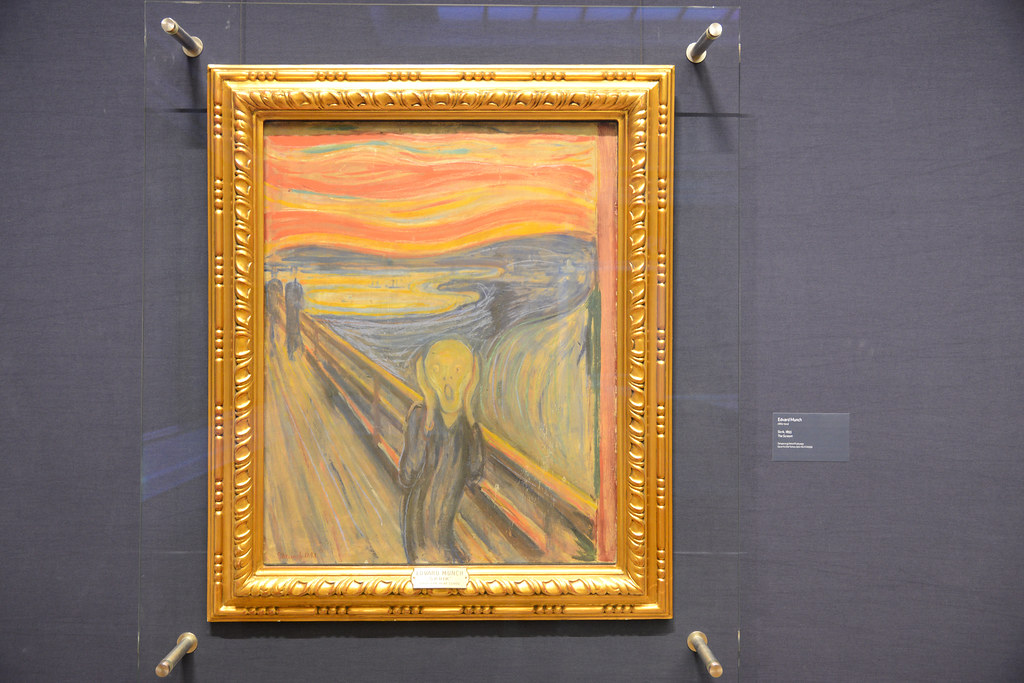
The Scream by Edvard Munch(1863-1944). Courtesy: Creative Commons
I met Gustav Beekhof twice whilst travelling in North Africa, once in Tunisia on the island of Djerba, and then in Algeria when I emerged from the desert after spending about seven months living amongst the Touregs.
Gustav was a Dutchman, tall, slender, long blond hair falling to his rounded shoulders. His blue eyes shone like scintillating mountain lakes in the morning sun. He spoke excellent English, French and German, all learned at school but polished and refined ‘on the road’ as he said in his high, nasalised voice.
Over a glass of tea, we spoke about many subjects, he emphasising that the voyager must touch Africa with his or her feet, and not ‘do’ it either in vans or in Land-Rovers as so many ‘doers of Africa do’. Gustav indeed had a whiff of smugness about him.
We split, the cocky Dutchman en route to Morocco, I back into the desert to Tamanarasset. Before leaving, however, he gave me his phone number and insisted that if I ever found myself in Amsterdam I should look him up. He threw back his long blond hair and as he got up to leave, said that he held my friendship in high regard.
Seven years later this was exactly what I did! I had been shuffling between Madrid and Burgundy France as a Flamenco guitarist at Rosario’s dance studios in the mornings and Antonio’s mesón[1]at night, and as a grape-picker at several farms between Dijon and Beaune in Burgundy. Every Autumn I would hitch to Burgundy from Madrid and for a month or so labour in the fields, in the wine-cellars, bottle wine and study oenology with the wine-growers in my spare hours.
The life of a mediocre musician and a seasonal farm labourer made no sense. I needed a change. Was not life a thick forest of possibilities ? One day as I treaded wine in one of the enormous kegs that aligned the cellar of a famous wine-grower, what the Burgundians call ‘piger‘, I suddenly thought of Gustav Beekhof. That night, back in my little room on the farm, I searched through my belongings and found his address. Yes, I would go to Amsterdam for that change.
When my work had finished on the farm I left my guitar with some friends, borrowed a bicycle and cycled up to Holland via Liechtenstein and Belgium, a strenuous journey, given the fact that the bicycle had no gears. I arrived in Amsterdam, thoroughly exhausted, but immediately set out to find my ‘friend’, if I may say so at this point in my narrative.
And indeed I did find him: having telephoned Gustav, that nasalised voice gave me directions to his home. I set off on my bike in search of him. It took me hours as I crossed bridges, turned in and out of little roads and lanes. As I struggled on, I had a strange feeling that Gustav did not know with whom he was speaking over the phone. Be that as it may, I finally found his ‘humble home’ as he merrily said, one of the many barges that float listlessly in the canals that criss-cross Amsterdam. A rather shoddy one at that, but its bohemian appearance did suit the personality of the individual I had met some seven or eight years ago in North Africa, and who was at present standing on the plank that led to the barge from the grassy pavement-bank. He was all smiles. He gestured for me to come ‘aboard’, shook my hand and led me into his ‘humble home’ …
A home that rocked and rolled ever so gently when a barge cruised by. Gustav warned me that to live in a barge one must develop sea-legs. He laughed, and the twinkle in his eye intuited that the Dutchman had no idea with whom he was speaking. I felt rather uncomfortable at first, but this loss of memory seemed not to disturb my host who spread out his long arms as if to engulf all the belongings that swam before my eyes: dozens and dozens of paintings, either framed, rolled up in clusters or on easels covered the uncarpeted ‘bottom deck’ along with hundreds of acrylic paint tubes, whilst more books and documents rose in high stacks against the unpanelled ‘starboard’, barring the grey afternoon light from penetrating two ‘portholes’. Large packages lay on a bunk bed at the ‘stern’. There were no rooms, only a very long and narrow ‘hole’ with a kitchenette at the ‘prow’. Rusting red-painted iron beams horizontally crossed the ‘hull’. Two tables had been placed in middle of this capharnaum[2], one for writing, I presumed, and one for eating ; both had seen better days. The toilet, a cubby hole, was located on ‘portside’ …
I was overwhelmed by the quantity of paintings, some of which I recognised.
“How do you like my prized collection ?” Gustav began. His tone had an undercurrent of secrecy. “I have acquired them at great pains, some are originals, others copies … and a few a result of my own genius.” Modesty was never a quality of Gustav’s personality … not even false modesty !
“But you have a Jasper Johns[3] … a Frans Van Mieris[4] and a Nicolais Astrup[5]!” I rejoined in amazement. They must have cost a fortune. My host shrugged his shoulders.
“Why do you think I live on a rubbishy barge and not in a golden palace, my dear lad ?” He threw back his long blond hair and motioned to the hackney table, where two plates, two forks and two knives had been neatly set. I sat opposite a lovely Laurits Andersen Ring painting: Road in thevillage of Bunderbrøde. Original or copy ? From the kitchenette Gustav sailed back gingery to the table carrying a large tray of chips ; they were dripping with oil. I put one or two in my mouth and felt sick to my stomach. From a cupboard near the toilet he brought forth a bottle of Jenever which presumedly was to wash down the chips. I looked over to his writing table and observed an open notebook.
“My Waybook,” he laughed. “I’m writing a collection of poems and stories about my voyages in India, Central Asia and Africa. Poems and stories written out ‘on the road’, but here in my barge-solitude, polished to a lacquered lustre.” My host was beaming with self-complacency.
I let Gustav make inroads on that greasy stack of chips whilst I cast cursory glances at those many paintings… “Remember those horrible mosquitoes in Africa ?” he reminisced. “They always bit me … perhaps because my blood is so sweet.” His voice had a fluty tone to it. I nodded perfunctorily.Was his blood sweeter than mine ?
I left about midnight, rather sozzled from all that Jenever.
For the next few days, my Dutch friend took me about Amsterdam, especially to the bars where we would invariably get thoroughly drunk, but also to the countryside on bicycle, gliding by the still standing windmills cranking their sails, the tulip fields in blushing bloom, over a streamlet or two, our bicycles poled over on small barques. One day we stopped near one of those streamlets to indulge in some Gouda and Edam cheese. It was there that Gustav, his mouth full of cheese and bread, made me a proposition which I was to regret for the rest of my living days …
“Listen,” he began, munching merrily, washing down his cheese and bread with a few shots of Jenever. “Since you’re out of work, how about working for me ?” I raised a quizzical eyebrow. He gave me a sly wink. “Don’t worry, it’s not hard labour. I need an itinerant salesman for my paintings. You know, I’m stuck here in Amsterdam and can’t meet the demands of all my clients. I have clients in Italy, Spain, France, England ; all over Eastern Europe, too. You’d be a perfect dealer for me, you know many languages, you have a bit of artistic talent yourself to explain certain niceties, and above all, you’re honest. I know you won’t cheat me.” His grin stretched from ear to ear. A strange grin, plastic-like. “I’ll give you ten percent of the proceeds.” And he had another spot of Jenever.
“Why ten ?”
“Why not ? It’s a number like any other. And don’t forgot, some of those paintings are going for over 8,000 Guilders, even double that in other currencies. What do you think ?” He eyed me fixedly, the deep blue of those two tarns swirling before me like turbulent whirlpools.
It took me three days to think over his proposition, and during those three days, when I visited him, we tramped about Amsterdam’s bars, drinking and conversing. Never once did he enquire about my decision. It was whilst licking off the foam of my Heineken in one of Gustav’s favourite bars, where it was his wont to reach into a drinker’s open poach of tobacco, serve himself a good pinch and roll a cigarette without ever asking permission, a rite that he alone exercised at the counter, that I decided to accept his offer. “Fifteen percent !” I added. He winced at first, but that mask slowly transformed into a broad smile. We shook hands and the deal was sealed. He ordered another round for us whilst pinching a bit more tobacco from the pouch of his displeased but stoic neighbour …
And that is how I became an itinerant dealer for Gustav Beekhof’s paintings. My wanderings took me to the most remotest of European towns, and to the most hideous suburbs of those towns. Instead of dealing with rich bourgeois families, small museum curators or private collectors, Gustav’s mailed instructions directed me to shifty-eyed men, well-dressed and well-spoken indeed, but shifty in our negotiations. Besides, we effected our transactions in the oddest of places: warehouses, depots, repositories, seedy hotel rooms. I would remove the paintings from long, plastic cylinders similar to those that the Chinese use to carry their scrolls, unroll the merchandise they were expecting, and after a thorough inspection, the head of these delegations would produce a wad of bills, and without counting them push them into the pocket of my vest. They would leave me standing there without a word, although now and then, one of them was given orders to drive me to the centre of the town and drop me off at my hotel.
Gustav had advised me to deduct my fifteen percent from the purchases, deposit the maximum amount of cash that was permitted in one of the subsidiaries of a Dutch bank, found in Greece, Norway, Belgium, France, England, Luxembourg and Germany. If a large amount of cash remained, I was to travel to another country, locate another subsidiary and deposit the rest. Gustav had absolute faith in my integrity; at any time, I could have run off with thousands of francs, liras, pounds or any currency and simply disappeared. Of course the thought never occurred to me. As to the paintings themselves, they were sent through a special mail service along with a note at one of my hotels directing to the addresses where I had my the appointments. In this way I had no need to return to Amsterdam.
These proceedings continued without respite for two years as I scurried from country to country and town to town. I must admit that over the course of time I began to question the probity of the individuals I was dealing with, for all these transactions seemed enshrouded in mystery, carried out by dubious characters, each and every one of whom bore a rank odour of unprincipled morals, although their behaviour towards me was always impeccably polite, aloof indeed, but nevertheless perfectly respectful. I, thus, disregarded these apprehensions; after all, I was earning vast amounts of money. And I wasn’t one to, as the French say, cracher dans la soupe[6] !
One fine Spring day, I received six paintings at my hotel in Thessaloniki, Greece, and a note directing me to Istanbul, where an Armenian merchant was waiting impatiently to buy the paintings at a very handsome price. However, the note warned me that the merchant was a bit of a rogue, and a clever one at that. I smiled inwardly; I had been to Istanbul several times and could negotiate quite well in Turkish. I rubbed my hands ready for the joust …
It was on the fourth day of my arrival in Istanbul by bus from Thessaloniki that our appointment had been fixed in the Armenian’s small shop near the Armenian Church of Üç Horan (Trinity) inside the Fish Market. His shop, crowded with every object that one could possibly find on the face of the earth: wooden religious statues, candelabras, thuribles, musical instruments, Ottoman-styled hanging lamps, church paintings, ikons, antique furniture, travelling chests dating from the Ottoman Empire, sabres and shields, made it difficult for me to find the merchant seated behind a long, knotty mahogany table upon which had been stacked books, paper-weights and a scruffle of yellowing documents. He had a sinister look about him, doleful, suspicious, a darkly look that matched his dark frizzy hair, thick eyebrows and beard. When he noted my arrival he sat there in frozen silence which lasted longer than I had expected of a potential buyer of Gustav’s long-sought paintings. I sensed something amiss … something which did not sit well in this Ali Baba’s cave.
The Armenian stood and cleared away the books that encumbered his table. He bade me deposit the paintings in his outstretched arms. I took them out of the cylinder and placed them gently in the crooks of his arms, where like a mother holding her child, he cradled them for a few long seconds before laying them delicately on the knotty mahogany table.
Without a word he unrolled each one, admiring the colours, the textures, the shapes, the lines.
“Very nice … lovely !” he finally said in rough Turkish. “The colour saturation of this one is marvellous. And here, the crackle paste indeed gives the village a mediaeval aura. The application of mica flake certainly highlights the effects of the tempest over the sea, whilst here, the dry brush technique impresses an eerie velatura of the Scandinavian landscape.” He looked up at me. “And what do you think of Jasper Johns’ Between the Clock and the Bed ?” The question snapped me out of my reverie; no client had ever posed a question to me concerning the contents or quality of the paintings ; all my dealings had always been conducted with the utmost taciturnity.
“I don’t know … I’m not an art specialist, only a dealer.”
He chuckled : “Are you now ?” He touched the painting ever so delicately. “Pop art ? Expressionism ? What do you think, dealer ?” I remained silent, fidgeting about, the atmosphere had become unbearably oppressive. “Look, these fourteen colours set out like a lithograph should have been painted on Japan paper … do you follow me ?” I shook my head, ignorant of all these technical details. “Well, Mr Dealer, this is not Japan paper, consequently, the painting it not an original, which leads me to surmise that it’s a forgery !” The word forgery shot through me like a bullet. “So are those four, all falsified due to over-enthusiastic scrambling[7]. Only one is an original: The Scream, one of the eight versions by Munch, stolen this year from the Munchmusect in Oslo !” He stopped, stealing a glance at me. “How did you steal it?” he asked in a deep-toned voice, authoritative, one that does not brook rebuke. “And all the others stolen from museums, private collectors and galleries ? Just how do you do it ?” I cringed, feeling engulfed in a welter of confusion.
Mouth agape, I stammered : “I’m not a thief … I sell paintings for Gustav Beekhof, that’s all. I know nothing about where the paintings come from, except that …”
“I shall repeat the question once again,” retorted that deep-toned voice: “How do you steal them ?”
I stepped back. The whole affair was becoming a nightmare. “I told you I sell paintings for Gustav …”
My interrogator bent over the table and slapped me twice in the face. The violence sent me reeling backwards into some wooden statues. He circled round the table and stood menacingly over me. “We have been following your doings for months and months Mr Gustav Beekhof. Your repugnant affair has brought death and destruction to many innocent people.”
“Please, I don’t understand …”
“Shut up and listen !” And he punched me in the stomach, doubling me over. “Interpol shall be here in a moment or two to question you. But I would suggest you tell me everything here and now, for their methods are far from savoury.”
“Really … I’m not Gustav Beekhof … my name is Vigilius Notabene …”
“Oh really ?Vigilius Notabene ? Well now, Mr Notabene, let me inform you that you have been selling stolen paintings and forgeries to underworld criminal organisations and terrorist groups. Do you understand what that means Mr Notabene ? That means with the money they earn by selling what you have sold them for double or triple your amount, they buy arms to execute military personal and politicians, bombs to blow up train stations and aeroports. Did you think you could continue your lucrative affair with impunity ?” He grasped my collar, his face screwed up.
Suddenly, the shop door swung open. Three or four burly men dressed in civilian clothes wove their way towards us. They took me by the arms whilst the Armenian slapped me repeatedly across the face. I began to swoon. He turned to the men: “Gustav says his name is Vigilius Notabene.”
“But … I’m not Gustav !” I whimpered.
“Shall I juggle your memory ?” continued the Armenian. And that powerful fist drove into my chest. I cried out, hanging limp in the strong arms of the agents who looked on indifferently. “No, I’ll tell you your real name. Javier Fuentes, born and raised in Madrid, lover of bullfights and flamenco music. You left Spain for Holland where you changed your nationality and became Gustav Beekhof, amateur painter, counterfeiter and arch-cozen. Do you think we would never get on to your little affair ?” Again that hairy fist ploughed into my ribs.
I gasped for air. In low voices, the agents spoke to the Armenian in Dutch and in Turkish. I was amazed that I understood every word that was said. “Yes, yes Mr Beekhof, you understand everything we are saying. Polyglot, dilettante painter and musician, intrepid thief and casual traveller — it has taken us a while to corner you. And here we all are in my little shop. Cozy, eh ?”
A blow to the midriff sent me hurtling against a gaggle of porcelain geese, where I then slid squirming to the floor breaking the necks of two ! The agents violently grabbed my long, blond hair and stood me up.
“I’ll give you Gustav’s address …” I managed to gasp, my mouth filling with blood. Two agents squeezed my rounded shoulders so hard that I buckled over.
“Still on about Gustav, eh ? There is no Gustav Beekhof in Amsterdam on a barge. Gustav is right here in front of me, and there he will remain until he tells us the truth … If not …” I lifted my arms to ward off a blow, albeit none came.
“Come, come Gus, your mind has been unsettled by all these false identities ; all these wanderings in and out of cheap hotels, dealing with a bunch of thugs and killers. Fifteen percent ? Why give yourself fifteen percent when you deposit the rest in your own name in a Dutch bank account ? You must be completely daft!” I stared at my interrogator in disbelief. How did he know such precise details ?
“We know everything about you, Gussy!” as if reading my mind. “Everything except how you managed to steal these paintings from the museums. That remains a mystery to us all.”
“I’m Vigilius Notabene, born in Gotland on a farm. My parents died when I was thirteen so I left for Holland, Spain and France. In France …”
“Enough!” The Armenian began pummelling me. The agents stopped him. Then I heard the door of the shop swing open. I caught a glimpse of four men dressed in white ; tiny, white skull-caps coiffed their bald heads. They forced me into a straitjacket and hurried me into an ambulance. I was given an injection and that is all I remember until now …
I awoke in a small room, an all ghost-white room: white walls, door, window bars, curtains, bed and bedsheets, writing table. The whiteness pricked my eyes. My arms were strapped to my sides ; they had straitjacketed me. I lay helplessly surrounded by all this monochromatic melodrama.
One day a man, dressed in white whisked into the room, threw me a cursory glance, laid a notebook and pen very carefully on the white, metal table then strode to the bedside. He undid the straps of the straitjacket, pointed to the notebook on the table, and left as quickly as he came, wordlessly.
I stretched my stiff limbs and sat at the table. I had no idea where I was, and no one to turn to: no family, no friends, no lawyers … no one. I stared down at the white, lineless, notebook pages. Yes, I knew what they wanted from me. Ah, Gustav, you are a slippery sod. Here you are at last slipping out of that phantasmagoria of so many faces and places. So many existences that never existed! Take note that Vigilius Notabene will expose the truth of the past. As to Javier Fuentes, he had no future. Gustav is the true wayfarer, the ever-questing pilgrim present, here and now.
So in a renewed state of extreme excitement I now record on those very white pages :
“I met Gustav Beekhof whilst travelling in North Africa…”
.
[1] A small bar or tavern where people eat, drink and listen to flamenco music if there is a guitarist and a singer present.
[7] A technique that allows to paint over areas of a painting to enhance the tone of dark-coloured areas.
Paul Mirabile is a retired professor of philology now living in France. He has published mostly academic works centred on philology, history, pedagogy and religion. He has also published stories of his travels throughout Asia, where he spent thirty years.
.
PLEASE NOTE: ARTICLES CAN ONLY BE REPRODUCED IN OTHER SITES WITH DUE ACKNOWLEDGEMENT TO BORDERLESS JOURNAL
I suppose it is politically incorrect to say that I was somewhat under the influence of the movie, Out of Africa (1985), which featured European expatriates living the colonial life on a coffee plantation, or that my do-gooder impulse had been activated by other films such as Cry Freedom (1987) with Biko in it. I had decided that after I graduated from college, I would join the Peace Corps as a volunteer.
I had wanted to be a writer since I was a little girl growing up in Michigan. I have especially always wanted to write fiction. However, by the time I became a student of English literature in college, I realised that it would be difficult to make a living as a novelist. My plan upon graduation was to travel the world through teaching English as a foreign language. In this way, I would accumulate life experiences which would become fodder for my stories and novels.
Earlier, as a junior, I had spent a semester in Avignon, France, on foreign study, somewhat following in the footsteps of my older brother, who’d spent a year in Germany while we were in high school. I’d been inspired by his letters telling of his adventures abroad, sleeping on Spanish beaches, skiing down Austrian slopes. When he came back home, I saw how living abroad could transform a person. I wanted that for myself.
The interview for the Peace Corps was gruelling – a four-hour grilling, sometimes quite personal. They asked me if I had a boyfriend. I winced, because I had recently broken up with someone I thought I wanted to marry. “No,” I said. They told me that the most common reason for leaving a Peace Corps posting early was a boyfriend or girlfriend back home.
In the meantime, my brother, who’d majored in business, and who was concerned that I would be working for free, sent me a newspaper clipping about something called the JET Program, a fledging one-year scheme for “native speakers of English” to work as assistant language teachers in Japanese public schools. The position came with a salary that was decent at the time. I applied to that, too, as a back-up, in case the Peace Corps didn’t want me.
To be sure, I had an interest in Japan. At t the time, its economy was thriving and Japanese companies were buying up iconic American buildings. It seemed as if Japan was about to take over the world, and that it would behoove me to know something about the country. Also, I had taken a course in Asian history, and developed an interest in Heian Court poetry. I loved the idea of a country where people had communicated by passing poems to one another. And I was intrigued by the futuristic images depicted in the movie, Blade Runner (1982) the kitschy aspects rendered in Jay McInerney’s novel, Ransom (1985).
Anyway, I was accepted into the Peace Corps and told that I would be sent to Cameroon. After some consideration, I decided that I would go to Japan for one year, and then enter into a two-and-half stint in the Peace Corps. But then once I arrived in Japan, I found that I wanted to stay a little bit longer. Just one more year. There was still so much to learn, so much to explore. I hadn’t yet climbed Mt. Fuji! I hadn’t been to Okinawa! I renewed my contract. In my second year, I fell in love with a Japanese high school teacher. And, yes, dear reader, I married him. I stayed in Japan and started a family. I have never been to Africa.
As I write this, I have been living in Japan for well over half of my life. From time to time, I wonder how my life might have turned out differently if I had gone to Cameroon as originally planned. Would I be working for an NGO in Africa? Or what if I had gone back to the United States after one or two years? Would I be living somewhere in suburbia, working nine to five at a company?
However, I also often consider what Japan has given me. Living outside my country has opened my mind, and has given me countless opportunities, including fodder for the stories that I write. And thanks to my writing, I am now employed at a small university where we have many students from around the world. I continue to nourish my heart and mind by reading literature and watching films from and about other cultures.
I find that we are not so different after all.
.
Suzanne Kamatawas born and raised in Grand Haven, Michigan. She now lives in Japan with her husband and two children. Her short stories, essays, articles and book reviews have appeared in over 100 publications. Her work has been nominated for the Pushcart Prize five times, and received a Special Mention in 2006. She is also a two-time winner of the All Nippon Airways/Wingspan Fiction Contest, winner of the Paris Book Festival, and winner of a SCBWI Magazine Merit Award.
PLEASE NOTE: ARTICLES CAN ONLY BE REPRODUCED IN OTHER SITES WITH DUE ACKNOWLEDGEMENT TO BORDERLESS JOURNAL
Islands belong to oceans and seas and lakes. They are born within the deepest depths of the marine underworld like infants in the depths of their mothers’ wombs. Born often from surging volcanic eruptions, the molten lava hardens into rock. The rock is smoothed by ocean-swept sands that turn fecund over time. They are gradually populated by migrating birds who rest their weary wings and deposit seeds from which sprout rich and luxuriant vegetation. To these shingled or sandy shores, little by little, pirates, buccaneers, conquistadors, renegades, the exiled or self-exiled, slaves, missionaries and migrant workers come to explore and eventually settle.
They all come flocking to this primordial land floating in the waters of the world, birds and humans, animals too follow. Bees buzz their contentment, donkeys hee-haw, goats baa and mosquitoes whine. And yet the islands do not belong to any one of these creatures. They belong to the oceans and seas and lakes — their creators and benefactors.
Ah! The birth of an island! The centre of which rises high above those shingled or sandy shores, the dense jungles or arid scrub, where Vulcan in rampant rage had spat out smouldering rock and tongues of lava. There they now waft as if levitating from their aqueous-bed, home to a new Humanity …
Since my childhood, whenever I poured over maps my eyes would invariably fall on the islands that dotted the oceans or seas or lakes of our world. They held a more significant, a more imaginative, a stronger attraction for me, ones with which I could empathise. For Sicily was my genealogical point of attachment on those maps, a legacy of thirteen civilisations or so which had landed, settled or departed, leaving their immemorial traces both on the land, in the architecture, in our very mixed genes. Sicily is a perfect ‘officina‘[1] which I translate as the ‘melding of Humanity’ !
I day-dreamed while pouring over those frazzled maps and islands, whilst reading Jules Vernes’ MysteriousIsland and Daniel Defoe’s Robinson Crusoe. Actually, I don’t believe that I love islands because of those novels (or any other), but they did arouse in me a sense of friendship, affection and human compassion towards islands because of the extraordinary diversity of their errant or settled communities, their many languages and customs, their manifold landscapes. Languages that have forged the hybrid compositions of Creole, forged inter-marriages, forged populations whose quotidian merges into the hybrid species of fauna and flora.
I read and read again and again the fabulous tale of Hayy Ibn Yaqzān[2] who lived on his uninhabited island amongst the plants, trees and animals, all alone in wondrous solitude, learning from them: his human qualities, his religion, his love of humanity and sympathy for every quintessential being or object that came into contact with him — be it mineral, vegetal, animal or eventually human …
Islands are bursting with nature and nature is a friend of humanity, thus islands are bursting with friendship — bursting with hybrid species … like their ethnicities and their languages. Even when Nature can become an enemy, this enmity offers islanders the possibility of strength and force through trial and error. When storms arise, they build sturdier homes. When dangerous interlopers reach their shores, they offer hospitality and eventual integration. Perilous sea creatures and beating waves against boulders demand of islanders to muster their ingenuity and imagination. To cultivate friendship, virtue ; to draw closer to one another ; to be able to live only in a way that conforms to Nature … to an island’s generous and bountiful treasures ; to befriend Nature and Humanity, for they are equal in diversity and disinterestedness.
I suddenly stopped dreaming of islands as they pinched with patriotism, narrow nationalism, circumscribed communitarianism. I stopped dreaming of islands and with my fingers touched Sicily, Cuba, Cyprus, Malta, Madeira, and the Princess Islands stringing out in the Marmara Sea. I slid them upon the island of Olkhon on Lake Baikal in Russia, the oldest and deepest in the world; an island where Shamanism, the oldest religion of the world, and Orthodox Christianity vie in relative peacefulness. There my fingers brushed against layers of civilisation, of ethnic blending, of howling winds and raging white-crested waves off boulders and high cliffs and laughing seagulls on the wing. There I heard a myriad of languages spoken by the communities of Humanity both in the public and the private domains: Greek, Turkish, Sicilian, Spanish, Italian, Maltese, Russian, Arabic, Jewish-Spanish, Norman, Armenian and so on. There swelled dark secrets of mythical creatures, of legendary figures whose wild wisdom infused a shroud of enigma that piqued my curiosity towards the universal sympathy that exudes from those aforesaid islands: the fragrance of bougainvillaea, wisteria, honeysuckle and jasmine, of ossified forests laden with the ice of deep winter, of the briny sea spray of stoic rocks, of cries of fishermen at the docks and those of traders at the markets. When I lift my finger that sacred moment, that spell which has been cast upon me vanishes from my waking state …
To Sicily, Cuba, Malta, Madeira Cyprus, Olkhon and to the Princess Islands I weighed anchor and set sail on various shaped vessels — ships that cleaved the high seas or navigated the coasts. At dawn upon disembarking, the colours of the skies drip from violet to orange to red to blue. The fishermen at the harbours or docks always asked me: “How do you like it ?”
“What, the island ?”
“Yes.”
“There is no point on Earth that rivals an island,” I would always repeat in sympathetic earnest.
On shore, wherever that shore be, we would drink coffee or tea in one of the wooden cooperatives for fishermen, traders and sailors. Chickens cackled, dogs barked, seagulls laughed whilst glasses and conversation chimed out the tunes of the islanders’ community spirit: tunes chanted in many tongues, gesticulated in many forms. I broke bread and filled my glass, observing the leathern faces of these hard-working tradesmen mending their nets, fitting their poles, scraping or painting their sea vessels … accomplishing their livelihood together as a whole.
“The wind is blowing from the southeast,” a rough-looking chap declared for all to ponder upon.
“That’s rain !” shouted another with a slight nod of his head.
And then I fell asleep in my bungalow and dreamt of dancing boats and throngs of fishermen talking about their fortunes or misfortunes. Villagers living near the rising waves filled my sleep with their colourful robes or coiffeurs, their daily gestures of sympathy to both nature and humanity.
Pouring over maps filled my childhood. Fingering the points that we call islands submerged me in oceanic rhapsody. Entire archipelagos coiling from North to South and West to East pervaded my soul with the rhythmic cadence of their tides. And as the tides beat out cosmological tunes, my dreams ended. I woke and embarked on many an island adventure in Sicily, Madeira, Cuba, Cyprus, Olkhon, Malta and on the Princess Islands. Points on the map became the unchartered lands of my great middle age sympathetic adventure. I had returned to the lands of my ancestors ! Ships had bore me to those points of human sympathy, exploring fantastic landscapes, communicating in innumerable tongues. There I breathed the air of island sovereignty, simplicity, silence and solitude.
I lived happily on all those islands. And in spite of certain prejudices and intolerances, I rejoiced living with the islanders who are good, heroic, honest and fair in their daily commerce. Who earn their daily living by the sweat of their brow and by the devotion to one another, whoever be that one or other. Inside the cafés faces furrowed by wind and sun concentrated on their drink or their cards or dominoes, whilst outside, hands hardened by generations of toil and moil, mended nets, built boats, cut fish, rowed boats. I rejoiced at all those acts of universal friendship.
I lived happily, intermingling with the melded species of plants, birds and humanity — not only as a spectator, but as an actor: the spectator who observes himself acting, and the actor who perceives his observations. Like in a dream … day and night !
It seemed to me like paradise. Paradise, a word derived from the Old Persian ‘pairidaëza‘ which meant ‘enclosure, a place walled in’: walled in or enclosed by its creator — the water ! But its meaning shifted when read by the Hebrews and became ‘pardēs‘ ‘a garden’. The Garden of Eden ? Yes, a garden so pristine and divine, yet possessing that infamous apple tree of the forbidden fruit. All paradises can descend into the bowels of Hell if tempted by a slithering, sly, snaky and insidious interloper … As we shall soon see !
At present the tides of time have consumed my youth, so I have decided to write a humble meditation about my mingling amongst the islanders of so many islands, of so many archipelagoes. I see them all from the porch of my bungalow, stretching out like a necklace of pearls. A pearly necklace cast in its oceanic casket. So I write and wander upon the silent, deserted roads of the many islands that I have treaded; that I have seen, touched, smelt and tasted. The time has hence come to render homage to those islands, to the nature of those islands, to the nature of those populations.
At this point, I expect readers will retort and point out that not all islands should benefit from such a distinguished homage: How about Cyprus, and the Turkish-Greek conflict ? And Sri Lanka and the terrible war that raged between 1983 and 2010 ? Japan and England, too, big islands indeed but islands, nevertheless. Was the subjugation of Welsh, Scot and Irish not enough? No, those English islanders set out on the high seas to subjugate other ethnic communities … other islands! The first being Ireland, invaded in the XIVth century and conquered uninterruptedly by Henry the Eighth and Oliver Cromwell. The ‘de-Irelandising’ of the island, or more appropriately formulated, the genocidal ‘civilising mission’ produced exile, persecution, misery and death until the founding of the Irish Free State in 1921 and finally the Republic of Ireland in 1949![3]
Were the Japanese not content to eliminate any foreign intrusion on their precious island ? No, they set out to decimate and enslave the ethnic communities that thrived on the islands of the Pacific: Guam, Wake Island, the Philippines, the Solomon Islands, the Aleutian Islands, etc. Japan’s violent and bloody imperialism during WW II, and England’s century’s long brutal colonisation have marked all our History books and memories of their so called ‘civilising missions’. Be it the imperialistic brutality in the lands of the rising sun or that of the setting, as the French say: c’est bonnet blanc et blanc bonnet ![4]
Yes, these counter examples are, alas, historically documented. Are they then accidents of history or sorrowful exceptions? I will answer that in the case of Cyprus, the Cypriots, a fine blend of Greek and Turkish ethnic commingling since the Middle Ages, with a sprinkling of English since King Richard the Lion Heart (1191), became the unfortunate victim of Britain’s ‘civilising mission’. One needs only to read Lawrence Durrell’s Bitter Lemons of Cyprus[5]to understand the sad and tragic events that erupted in the 1950s and their never-ending aftermath and continuity. Cyprus belongs neither to Greece nor to Turkey (and certainly not to Great Britain), but to the Cypriot Greek and Turk, who in turn know perfectly well that their grand island for centuries has always belonged and will always belong to the brilliant whiteness of the Mediterranean Sea! The tragedy that befell this island sprang from the combined effort of British cynicism, Greek nationalism and Turkish overweening military reaction.
As to Sri Lanka, Sinhalese and Tamils had been living together since the twelfth century, assuredly not under the most perfect idyllic neighbourly conduct, yet the intermingling populations, be they Hindu, Christian or Budddhist, carried out their daily lives without too many eruptive disturbances. It was only with the full British conquest in 1815, and their fancied game of pitting one community against another, there, favouring the Tamil populations of the island, that a slow but steady bitterness, rancour and animosity grew within the Sinhalese population. The pent-up enmity exploded as soon as the British abandoned their ‘mission’, leaving both communities in a sort of political vacuum: Who was to govern? Who was to replace the ‘civilisers’ once they decamped without preparing Sinhalese and Tamil for self-rule, as the British had always done in the benignity and magnanimity of their decolonisation? The vacant legacy they left behind was rapidly filled with ethnic rivalry, exposed to Sinhalese vindictiveness and Tamil claims to share power and land in spite of their minority status. Each community claimed their rights as the deprived community at the expense of one another, a situation so similar to the void left behind by the British in Cyprus. The dramatic events that followed became the final act in the history of Britain’s ‘civilising mission’ performance …
In these two cases, the two communities, forsaken victims of the British colonial mindset, instead of achieving ethnic unity, wallowed in the abysmal chasm of oblivion. Islands that could be paradises plunged into the throes of Hell !
To conclude, an island belongs to the vast waters that enshrine it, as its etymology translates: a ‘land’ in ‘water’. Islands do not belong to imperialists or colonialist powers ; they belong to the oceans or seas or lakes that give birth to them, to the nature that stretches its silken carpet over them, to the ethnic groups or communities that gradually settle upon them, intermingling, trading, marrying, creating together a hybrid or Creole culture worthy of any ‘continental’ civilisation. For this very reason, there should not be any dominate power on an island, or official boundaries which sever communities from one another save the natural one that has nurtured and provided for its very existence: the surging billows and silent tides of their eternal creator …
.
[1]‘Factory’ or ‘workshop’ of production. It is of Latin origin
[2] An allegory written by Alī Ibn Sinā or Avicenna (950-1037) Hayy Iby Yazqān, the Bird Salāmān and Absāl interpreted and adapted by Ibn Tufayl with the same title, born in Muslim Spain in the XIIth century. See Lenn Evan Goodman, Ibn Tufayl’s Hayy Ibn Yaqzān, gee tee bee, Los Angelos, CA, 2003.
[3]The slaughter of all Irish aristocrats, the prohibition of inter-marriage between Anglo-Normand and Irish and the prohibition of the Gaelic written language in 1592 were part of the English ‘civilising mission’ in Ireland.
[4]‘It all amounts to the same thing’ or ‘It’s six of one and half a dozen of the other’.
[5] Lawrence Durrell, Bitter Lemons of Cyprus, 1957.
Paul Mirabile is a retired professor of philology now living in France. He has published mostly academic works centred on philology, history, pedagogy and religion. He has also published stories of his travels throughout Asia, where he spent thirty years.
.
PLEASE NOTE: ARTICLES CAN ONLY BE REPRODUCED IN OTHER SITES WITH DUE ACKNOWLEDGEMENT TO BORDERLESS JOURNAL
And as imagination bodies forth
The forms of things unknown, the poet's pen
Turns them to shapes and gives to airy nothing
A local habitation and a name
A Midsummer Night's Dream (1595) by William Shakespeare
Famous lines by Shakespeare that reflect on one of the most unique qualities in not only poets — as he states — but also in all humans, imagination, which helps us create our own constructs, build walls, draw boundaries as well as create wonderful paintings, invent planes, fly to the moon and write beautiful poetry. I wonder if animals or plants have the same ability? Then, there are some who, react to the impact of imagined constructs that hurt humanity. They write fabulous poetry or lyrics protesting war as well as dream of a world without war. Could we in times such as these imagine a world at peace, and — even more unusually — filled with consideration, kindness, love and brotherhood as suggested by Lennon’s lyrics in ‘Imagine’ – “Imagine all the people/ Livin’ life in peace…”. These are ideas that have been wafting in the world since times immemorial. And yet, they seem to be drifting in a breeze that caresses but continues to elude our grasp.
Under such circumstances, what can be more alluring than reflective Sufi poetry by an empathetic soul. Featuring an interview and poetry by such a poet, Afsar Mohammad, we bring to you his journey from a “small rural setting” in Telangana to University of Pennsylvania, where he teaches South Asian Studies. He is bilingual and has brought out many books, including one with his translated poetry. Translations this time start with Bankim Chandra Chattopadhyay’s advice to new writers in Bengali, introduced and brought to us by Abdullah-Al-Musayeb. Tagore’s seasonal poem, ‘Megh or Cloud’, has been transcreated to harmonise with the onset of monsoons. However, this year with the El Nino and as the impact of climate change sets in, the monsoons have turned awry and are flooding the world. At a spiritual plane, the maestro’s lines in this poem do reflect on the transience of nature (and life). Professor Fakrul Alam’s translation of Masud Khan’s heartfelt poetry on rain brings to the fore the discontent of the age while conveying the migrant’s dilemma of being divided between two lands. Fazal Baloch has brought us a powerful Balochi poet from the 1960s in translation, Bashir Baidar. His poetry cries out with compassion yet overpowers with its brutality. Sangita Swechcha’s Nepali poem celebrating a girl child has been translated by Hem Bishwakarma while Ihlwha Choi has brought his own Korean poem to readers in English.
An imagined but divided world has been explored by Michael Burch with his powerful poetry. Heath Brougher has shared with us lines that discomfit, convey with vehemence and is deeply reflective of the world we live in. Masha Hassan is a voice that dwells on such an imagined divide that ripped many parts of the world — division that history dubs as the Partition. Don Webb upends Heraclitus’s wisdom: “War is the Father of All, / War is the King of All.” War, as we all know, is entirely a human-made construct and destroys humanity and one cannot but agree with Webb’s conclusion. We have more from Kirpal Singh, Ryan Quinn Flanagan, Nivedita N, John Grey, Carol D’Souza, Vernon Daim, George Freek, Saranyan BV, Samantha Underhill and among the many others, of course Rhys Hughes, who has given us poetry with a unique alphabetical rhyme scheme invented by him and it’s funny too… much like his perceptions on ‘Productivity’, where laziness accounts for an increase in output!
Ratnottama Sengupta takes us back to how imagined differences can rip humanity by sharing a letter from her brother stationed in Bosnia during the war that broke Yugoslavia (1992-1995). He writes: “It is hard to be surrounded by so much tragedy and not be repulsed by war and the people who lead nations into them.” This tone flows into our book excerpts section with Red Sky Over Kabul: A Memoir of a Father and Son in Afghanistanby Baryalai Popalzai and Kevin McLean. Popalzai was affected by the Russian invasion of Afghanistan in 1980 and had to flee. A different kind of battle can be found in the other excerpt from The Blue Dragonfly – healing through poetry by Veronica Eley – a spiritual battle to heal from experiences that break.
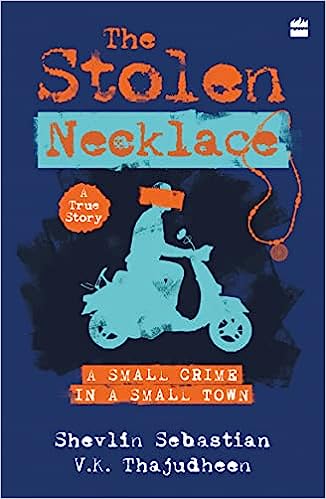
In our reviews section, KPP Nambiar reviews The Stolen Necklace: A Small Crime in a Small Town by Shevlin Sebastian and VK Thajudheen, a book that retells a true story. Sangeetha G’s novel, Drop of the Last Cloud, we are told by Rakhi Dalal, explores the matrilineal heritage of Kerala, that changed to patriarchal over time. Bhaskar Parichha reviews Burning Pyres, Mass Graves and A State That Failed Its People: India’s Covid Tragedy by Harsh Mander. Parichha emphasises the need never to forget the past: “It is a powerful book and sometimes it is even shattering. The narrative is a live remembrance of a national tragedy that too many of us wish to forget when we should, instead, etch it in our minds so that we can prevent another national tragedy like this one from recurring in the future.” While we need to learn from the past as Parichha suggests, Somdatta Mandal has given a review that makes us want to read Ujjal Dosanjh’s book, The Past is Never Dead: A Novel. She concludes that it “pays tribute to the courage and tenacity of the human spirit and its capacity for hope despite all odds.”
We have more content than mentioned here… all of it enhances the texture of our journal. Do pause by our July issue to savour all the writings. Huge thanks to all our contributors, artists, all our readers and our wonderful team. Without each one of you, this edition would not have been what it is.
Title: The Stolen Necklace: A Small Crime in a Small Town
Authors: Shevlin Sebastian and VK Thajudheen
Publisher: HarperCollins India
With an enigmatic cover, reflecting the nature of the content, this is the true story of a small-town crime. A gripping narrative, it is the poignant saga of an innocent citizen, forced to suffer incarceration due to the mishandling of a theft case by the police.
Veteran journalist Shevlin Sebastian, and businessman, VK Thajudheen, are the authors. Thajudheen is the kingpin of this book, and also the victim. The incident took place a few years ago in the historic town of Thalassery in north Kerala.
Shevlin is based in Kochi, which is hundreds of kilometres away, in the south. Shevlin and Thajudheen came together following the media hype. With his impressive credentials, and long-standing in the journalistic field, Shevlin has proven his mettle by publishing more than 4500 feature articles in reputed periodicals. He has authored four children’s novels also.
Thajudheen, around whom the thriller revolves, has his home in Kadirur, a suburb of Thalassery. A middle-class businessman in Qatar, he had left his family of wife and three children at Kadirur. A God-fearing upright man, he is middle-aged and balding. His courage led him to an adventurous love marriage with his teenage sweetheart. Nasreena, being from a financially backward family, the alliance was considered of low status for his wealthy family.
Nevertheless, he had the temerity to ignore and disobey even his patriarchal father, in carrying on his long affair. However, before his secret wedding, his father passed away. Even then Nasreena had to wait for three years to be accepted in his home. That was after the birth of their second child – a son. The arrival of a boy child in his family after a long gap, mellowed his mother and two sisters who changed their hostile attitude against Nasreena.
All this happened years ago. Meanwhile, Thajudheen had a checkered career spread over different locations, which ended up with a business in Doha. That was when he fulfilled his dream of marrying his daughter to an eligible young man, Shiraz Abdulla.
The tragic turns of events, entangling Thajudheen in the stolen necklace fiasco, commenced a couple of days after the celebration of Thazleena’s wedding. The family was returning from his sister’s home after a sumptuous dinner hosted for the newly-wedded couple.
It was a rainy night. Suddenly, they spotted two police jeeps with eight occupants waiting near their Kadirur home. Three of the men were in uniform. The rest were also from the same genus, it was revealed. They were from a station outside Kadirur police control called Chakkarakkal. Stopping their car, their leader, approached the family with an expression of “You are all prey. I am a lion looking for a meal”.
Biju, having already earned a name as being reckless in controlling crime, was a known terror. He and his team had arrived armed with a phone evidence showing that Thajudheen was the culprit in a necklace-snatching crime. The incident was reported in his station a few days back. The CCTV camera that showed the purported thief cannot lie, they thought. It showed someone exactly resembling Thajudheen! But was it Thajudheen?
Thus started the ordeal of an innocent family man in the presence of his loving wife, and children. After a heart-breaking scene, near his home, Thajudheen was offered a compromise — pay the price of the stolen necklace and avoid litigation.
The offer was with a friendly ‘advice’: “I heard your daughter has just got married. The reputation of your family is at stake. We will inform the media that you are the thief.”
Anyone with a chicken heart would have yielded, but not Thajudheen, who always admired his late father for standing up to injustice. That was how Thajudheen had to languish in Thalassery sub jail till the story led to the final proverbial ‘happy ending’, nearly seven weeks later.
As a remand prisoner Thajudheen had the most undesirable company of robbers, underworld gang members, sex offenders, political workers, and so forth. At the same time, outside, his shattered family and Abdulla, the father of Shiraz, Thajudheen’s son-in-law, did not leaving any stone unturned to unravel the mysterious crime. They were making all-out efforts to obtain bail as well.
But Sub Inspector Biju was not to give up the big catch that easily. The police were even trying to trap Thajudheen in some other unsolved cases as a possible culprit.
This included even a murder case where the perpetrator was missing.
Ultimately, when the higher court decided to let him free, the readers, along with Thajudheen himself, are left to wonder about the dispensation of justice by the police in a democracy. It is true that the politicians, the legislature, and even the Chief Minister had to interfere in ensuring proper investigation in this case. But still the question remains: what can one do to enforce timely change in the method of handling of criminal cases by the police?
Imprisonment of innocents and their vindication in the end is nothing new in the annals of ‘crime and punishment’. Fiction being a reflection of fact, such cases are not uncommon in world literature. Inspector Javert of Victor Hugo’s ‘Les Miserables’ (1862) can very well match up with the modern-day Biju, the sub inspector.
Likewise, in Leo Tolstoy’s short story, ‘God Sees the Truth but Waits’ (1872), a young merchant named Ivan Dmitrich Aksionov was accused of a crime he did not commit. One can see the forerunner of Thajudheen! After all, human nature is basically the same whether in France, Tsar’s Russia or India.
Undoubtedly, Shevlin and Thajudheen have succeeded in bringing out the darker side of the police force. However, though the narrative is touching, one wonders at the intent of the book. Have the authors succeeded in openly projecting the atrocities of the police force to draw the attention of the establishment to prevent such incidents in future? Apart from presenting the insensitive and sadistic attitude of Sub Inspector Biju, little effort seems to be expended to indict the system to which he is linked. The fact that Biju is ‘punished’ for his ‘crime’ by just a transfer and withholding a few increments is an eloquent testimony to the laissez-faire attitude of our society at large.
Dr. KPP Nambiar, formerly a Consultant/Technocrat at the UN Food and Agriculture Organisation, is the author of many scientific papers and books, including a 1500-page Japanese-Malayalam dictionary.
PLEASE NOTE: ARTICLES CAN ONLY BE REPRODUCED IN OTHER SITES WITH DUE ACKNOWLEDGEMENT TO BORDERLESS JOURNAL.
First published in the collection titled Baethar Daan (Offerings of Pain, 1922), Kazi Nazrul Islam’s short story, Hena, is set against the backdrop of the First World War where the writer himself had fought as a young soldier (1917-1919). It has been translated by Sohana Manzoorand brought out to commemorate Nazrul’s 124th Birth Anniversary.
Nazrul in British Army uniformBaethar Daan or Offerings of Pain book cover
A trench in Verdun,France
This must be what they call rain of fire! And the sounds! The roaring sound of the artillery! Not a speck of blue sky can be seen– as if the whole sky has been set on fire. The thick rain of fire that pours down from the exploding cannonballs and bombs is so intense that if those were real raindrops trickling out of the blue eyes of the sky, the entire world would have been flooded just in a day. And if these sounds that were louder and more intense than any thunderstorm, would continue like this, people’s eardrums would split, turning them deaf. Today, we the soldiers could only recall the song that is sung during Holi celebrations:
“We will play holi with swords today,
All the soldiers of the world are gathered here
Shields playing the trumpets, cannon balls the squirt pumps
Ammunitions are colourful, the battle is intense.”
It is very true that the ammunition has caused the sky and ground to turn completely red. The reddest are the congealed blood on the bayonetted chests of the unfortunate ones! No other colour but red! As soldiers fall one by one, each one a martyr, they lie on the ground, dressed in red like bridegrooms!
Agh! The worst of all is the smoky smell. It is enough to turn your stomach. Are not human beings the best of all creations? Then why have them killed in such ugly and terrifying ways? When the inanimate lead bullets, hit someone’s bones, they explode with a horrid force and tear through the flesh.
If human beings used their intelligence in more productive ways, they could have claimed a place close to the angels. Oh, and this heart-rending thirst! The friend lying next to you, his rifle slipping from his hand, cannot be awakened even if a thousand cannons roar by his ear. No general can ever make him obey his orders. After fighting for seven days at a stretch in this muddy trench he has finally fallen asleep. He is finally at peace! A rare touch of soothing contentment lingers on his cold and dry lips.
But I feel so thirsty. Let me take the water-bottle from his waist and take a sip! I haven’t had a drop since yesterday. No one cared to offer me a drink. Aah…! This one sip feels so sweet! My Lewis gun doesn’t work anymore. It grew tired after days of continuous shooting. I will take the gun of my deceased friend then. If his mother, sister or wife were present here, they would surely have taken his broken skull on their laps and cry their hearts out! Well, I guess, in a few minutes, a heavy shell will land in front of the trench and bury the two of us! It won’t be too bad actually!
It is really funny as I think of the women crying. All of us will die one day, what is there to weep? Death is an eternal truth — why should one grieve over something that is so normal and inevitable?
I am going through so much pain, after receiving so many wounds, but my heart is filled with a demonic joy! I cannot sketch this feeling with this wooden pencil! There is often a joy that lies asleep at the heart of extreme pain which we can’t really feel! And is this habit of writing something bad? I have been swimming in fire, with scores of dead bodies under my feet and bombs dropped from aircraft bursting over my head, artillery shells are exploding and rifle and machinegun bullets are zooming past, still, deep inside, I feel restless because I couldn’t write down my innermost thoughts in the past seven days! But today, I feel relieved that I could start writing again!
Let me rest for a while, leaning against my dead friend. Ah, it feels so good!…
An unknown young girl of this distant land across the sea gave me some pickles and two slices of bread with butter which I haven’t had time to eat… The women of this country look at us with affection and pity! . . . . Ha ha ha, look at the bread here—these are dry and seem roasted! Let’s see if the bread is tougher than my teeth. I have no other option but to eat these — I am so hungry. The pickle is still quite fresh though!
That girl who was thirteen or fourteen (in our country, she would be wedded by now, if not already a mother), put her hands around my neck and kissed me. She said, “Brother, you must drive the enemy out with full force.” I broke into a pure, sad smile.
Ah! I can finally see the sky. A strip of blue sky can be seen behind the mass of heavy clouds. It is so beautiful– like a pair of blue eyes filled with tears! Anyway, I will write down my other thoughts later. The spirit of my dead friend must be mad at me by now. What, my friend, you want a drop of water? See, how he is staring at me! No, my friend, I tell you your beloved is waiting for you with a glass of lemonade in the other world. I would not want to disappoint her, would I?
Ah, I seem to remember so many things today. But no! There’s nothing to remember! These are all lies. Let me pick up the Lewis gun and start shooting. I see some of those who are helping me have stolen a nap!
But there, I can hear the sound of footsteps. They are all marching– left-right-left. That sound is so melodious! Are they coming to relieve us from duty?
Ouch! A moment of distraction has allowed a bullet to bruise my arm! Let me dress it. I hate those nurses. If a woman cares for me without loving me, why should I accept it? Ah! A war shows how killing others can be addictive.
The man who has fallen beside me is far stronger and healthier than me! But I have also seen how one’s mind has more strength than one’s body.
This Lewis gun is shooting about six to seven hundred rounds per minute. If only I could know how many I have killed! But the two Lewis guns here are keeping the enemies confined to their position. You can hear the loud groans of the enemies as they die in droves! The beauty of such youthful deaths is boundless!
A tent at the river Seine, France
I slept for all forty-eight hours of the last two days. And now I have to get dressed for battle and go out to destroy God’s creatures once again. The killing game is the right kind of activity for stone-hearted person like me.
Today that kind girl took me to visit her house… How clean and pretty are the houses here! The girl has clearly fallen in love with me. And I, too, have begun to love her… In our country, people would have said that the girl has gone bad… They would not have liked to see a young girl going out with a young man of twenty or twenty-one.
People look at love in such ugly ways these days! Are these human beings, or vultures? There is so much sin in the world! How did the people become so petty? The sky above is so vast and blue, but beneath the same sky human beings are so mean and narrow-minded!
Fire, you keep raining down! Let the curse of God float downward like frozen chunks of ice… Oh the horn of Israfil[1]! Do blow and immobilize the world! Oh, the thunder of destruction, strike inside the human brains, like the bombs and the artillery shells. And let the entire sky fall on the heads of those people who slander love, and blight the flowers…
If I could dress up one of my countrymen the way I am dressed now, and pushed him down, I am sure he wouldn’t be able to get up, no matter how hard he tried. I am highly amused at my bulky and sluggish appearance.
A ‘wicked’ friend once commented “What pleasing looks!” What a weird adjective! And another one is supposed have said, “The bullock looks like a katla fish!”
A thick forest near Paris, France
All on a sudden, we were sent to this dense forest yesterday. I have no clue why we had to fall back. This is the beauty of military life—an order is given and you are told “Get it done!” You can never ask “Why do I have to do this,” or ask for an explanation. It’s an order –that’s all!”
If I say, “I am going to die,” a stern voice will reply, “As long as you breathe, keep on doing what you are doing, if you fall dead on your right foot while you are marching, let your left foot keep up the pace!”
There is a strange beauty in obeying orders with blind obedience! What tenderness it is that lies at the heart of a thunder! If the entire world could come under one (and only) such military regime, then it would turn out so beautiful that even calling it a heaven on earth would not be enough.
The British nation is so great now because of the discipline they exercise on everything they do. They walk so tall that we can never see the crown of their heads no matter how hard we crane our necks — and let our headgears fall off while doing that! To speak frankly, their empire is like a huge clock that is always correct and faultless. Its two hands run in precision. The clock is oiled every day so there is no speck of rust anywhere.
We were the ones who chased the Germans to the Hindenburg Line and then we had to retreat so far! Only the maker of the clock knows which hand has to move at what pace, but the hands don’t know anything about it. But the hands have to keep ticking because these are continuously driven by a spring from the rear.
We badly need a disciplined, clockwork system like this. This reckless nation of ours really needs to be tied up and disciplined; otherwise, there is no hope of it rising anytime in future! If everybody wants to be the leader, who will do the work?
Oh, the artillery shells raining on us even at this distance! This is really uncanny… The war is being fought so far away but cannon-balls are dropping on us in the forest!
Well, an elephant might think that it is the biggest animal in the world. But even a mosquito can cause it enough trouble through a single bite in its head.
It’s cool in this shady darkness here. How my heart had been yearning for this solace in darkness.
Alas! Darkness seems to trigger in my mind so many fond memories! But, no, let me just climb up the tree and see if any enemy is hiding nearby.
How charming that distant ice-covered river looks from the tree! But there are also some big houses around which shells have torn through, leaving ugly gaping holes! This game of destruction reminds me of my childhood when we used to build clay doll’s houses. After we were done with our play, we used to crush them with our feet and sing:
“We made them gleefully with our hands
We broke them gleefully with our feet!”
The cannon-balls are flying through the air and dropping on distant planes, and from my vantage point, they look like falling stars.
And the sound these fighter planes are making! Oh! The way they are climbing and diving– it looks as if an expert kite flier is maneuvering his fighter-kite to hurtle through the sky in search of a rival. That plane is ours! The German zeppelins look from a distant more like big, flying caterpillars.
Anyway, let me get a bit of pickle out of my haversack. That foreign girl is so far away from me today but the pickle seems to retain her touch! Hell! What am I doing? Why do I keep on thinking of all this gibberish? I don’t need the pain that arises from nowhere and tortures me!
Well, well! What do I see there? A friend of mine is trying to take a nap on that tree. See, he has tied himself with his belt to a branch quite tightly. If he somehow falls in the water below, it will be quite a hassle for him! But then why not? Oh God, let him fall!
Should I shoot a bullet past his ear? Ah, no! Poor thing! Let him sleep awhile. Nobody except me has such hapless eyes that sleep never touches, or a blasted mind like mine which gets sick thinking about the goings on in the world. It’s night – quite deep into the night, I guess! I will have to stay here in this crouching position till dawn…. Perhaps when I am old (if I live that long), the trials I am going through will turn into sweet memories.
The light of the moon, which will turn into a full moon tomorrow night, is creating patterns of light and shadow in the forest below, which make the forest look like a giant cheetah! The heavy, dark clouds over my head are slowly drifting towards some unknown destination. A few drops of cool water fall on my head. Ah, how sad these drops feel! Ah!
The moon is now hidden by a cloud, and now it shoots out and hides behind another cloud! It seems like a game of peekaboo played by beauties living in the glass palace of a king. Who is running in the sky now? The clouds or the moon? I would say the clouds but a simple child might say the moon. Who is right? Aha! How lovely is the play of light and shadow!
What’s that bird cooing in the distance? The delicate tones of the bird songs of this country seem to evoke a sweet laziness… I find them intoxicating.
In this light and shadow, I remember so many things! But the memory is so full of pain.
I recall telling her, “I love you so much, Hena.”
Hena shook her raven black silky hair and replied, “But Sohrab, I haven’t been able to love you.”
That day, the bright saffron flowers seemed to be playing a game to welcome the new day in the garden of Balochistan. Unmindfully, I broke a branch of walnut and collected some flowers from the deodar tree and threw them at her feet.
A few drops of tears trickled down her dark eyes lined with Istanbul kohl! Her face turned redder than her henna dyed hands!
I picked up a bunch of raw plums and threw them at the nightingale sitting in bush of screw pine flowers. The birds stopped singing and few away.
What Human beings think is the closest turns out to be the farthest from them! This is indeed a profound mystery! Hena! Oh Hena! There’s just so much regret…!
Hindenburg Line
Oh! What is this place? I cannot believe that this is an underground land of fairies and monsters! Can a trench built during the wartimes be really as huge as a city full of houses? Who could have imagined this? What a gigantic venture so deep down underground! This is indeed another wonder of the world! One can live as luxuriously as the Nabobs of Bengal in this place!
But I did not come here for the peace it offers! I did not ask for comfort. I only wanted pain and suffering. I am not made for enjoyment and comfort! I would have to seek out another path then. It seems like I found a house under the tamarind tree in trying to escape from tasting sour things.
No, I need to be active. I want to drown myself in work. But this life of comfort here is embarrassing!
I heard that iron turns into steel when it burns in fire. What about human beings? Only ‘baptised’?
Being freed of restraints, my mind has fled again to that room full of grapes and pomegranates! I recall those days again!
“Hena, I’m about to jump into the fire that burns in a free country. I am burning inside, so let my body burn too! Maybe, I will never return. But what means do I have? How do I find travel expenses? How will I live in the foreign land?”
Hena’s henna-dyed fingers trembled like young shoots in my hands. She replied in a clear voice, “But that’s not how your life becomes meaningful, Sohrab! This is only the hot-headed youthfulness! You’re clinging to a lie! There is still time for you to get the message!… See I’ve not been able to love you yet.”
All is empty. Nothing remains. A gusty wind blew through the thick tamarisk trees and cried, “Ah!… Ah!… Ah! When the first battalion of our Baloch Regiment 127 started off for this country from Quetta, one of my friends, a young Bengali doctor, sang while sitting under a pear tree:
“How will you make him return
The one you bade farewell in tears.
In this languid air
At night in the garden
Have you recalled him under the bakul tree?
How will you make him return!
The honeymoon of the full moon
Returns from time to time,
But the one who has gone, does not come back!
Now how will you make him return?”
How weak I am! No wonder I did not want to come to this place. What would I do in this palatial life? Fellows of my regiment think there is no one as carefree and happy as I am. It’s because I laugh a lot. Does anybody know how much blood is hidden in the heart of the henna leaves?
I played “Home sweet home” on the piano and sang along so beautifully that the French were amazed! It was as if we are not human beings and so we cannot do anything as well as them! We have to break such preconceived notions.
Hindenburg Line
What else can I do if there’s no work? I have to find something to do. So last night I crawled for about a couple of miles and cut through much of their wires. Nobody seemed to notice.
My commanding officer said, “You’ll be rewarded for this.”
So, I became a corporal today.
The other day, I met that foreign girl too. She has grown much prettier in these two years! She told me directly that if I had no objection, she would like to have me as her partner! I told her, “That’s impossible!”
I said to myself, “A blind man loses his staff only once. Again? No way. I have had enough.”
The way her blue eyes filled with tears and her bosom heaved made a stone-hearted person like me cry!
She controlled herself and said, “But you’ll allow me to love you? Like a brother at least…?”
I am just a god forsaken wayfarer. So, I showed a lot of interest and replied, “Of course.” Then she left bidding me adieu. She never came back! I can only recall that line, “But the one who has gone does not come back.” Oh!
Anyway, the day was well-spent with the Gurkhas. These Gurkhas were really like big babies. I would not have believed that grown men could be so naive and innocent. These Gurkhas and their brothers-in-law, the Garwhals– both turn into killing machines in the battle field! Each of them turns into a tiger, a “Sher-e-Babbar.” Even the Germans throw away their rifles and run off at the sight of their kukri knives. If these two fighter groups did not exist, we would never be able to achieve this much. Only a handful of them are still alive. Entire regiments of them have perished. Yet, the few of them that are still alive are so full of life, as if nothing has happened!
Nobody can make them understand what great feat they have achieved. And those tall and sturdy Sikhs—what betrayers they have turned out to be! Some shot themselves in the arm and ended up at the hospital.
Look there! There is a battalion ‘march’ going on in the trench. We are marching at the beat of a French band! Left- right-left. A thousand people are all marching at the same pace– all at once. How amazing!
Balochistan
My cottage in Quetta
In the grapevine garden
What happened? I am trying to find out an answer to the question, sitting in this walnut and pear garden. All our Indian soldiers have returned home, and so have I. But how happily did those two years pass by!
I am looking at the blue sky washed by rain, which reminds me of the wide blue eyes of the young French woman. Looking at the mountain-yaks I remember her silky curly hair. And those ripe grapes– aren’t they exactly like the sparkling tears of her eyes?
After becoming an ‘officer’ I also received the title “Sardar Bahadur.” My boss would not let go of me. How could I make him understand that I was not there to form a permanent bond? I did not cross the seas with any high ideals. I only went to purify myself in fire — to hide myself too.
And I never thought I would return here of all places. But I had to– it seems I am tied to this land!
I have no one, I have nothing. And yet I feel, everything is here. Who am I trying to comfort?
I have not hurt anybody; nobody hurt me. Then why was I reluctant to come here? But that’s a matter of unspeakable agony. I can’t articulate it well enough. Hena! Oh! There’s nobody around, still the wind carries the broken echo “na…na”. “No” it is then!
The brook still flows through the hill; only the girl Hena, whose footprints are still etched on the stone-steps, is no longer there. There are so many things lying around that remind me of her soft touch.
Hena! Hena! Hena! Again that echo! Na –Na- Na!
***
I have found her! She is — here. Hena! My Hena! I saw you here today, here in Peshawar! Why do you keep hiding the truth behind those lies? She watched me from a distance and cried. She did not utter a word; she only looked at me and shed tears.
In such meetings, tears are the most articulate language of the heart. She told me again that she could not bring herself to love me. The moment she uttered the word “no” she cried so dejectedly that even the morning air became mournful!
The biggest puzzle in this world is the mind of a woman!
Kabul
Dakka camp
When I heard that the great man Ameer Habibullah Khan had been martyred, I felt that the top of the Hindukush had collapsed! And Suleiman Mountain must have been torn out of its base!
And I wondered what I should do. For ten days, I kept on thinking. It was no easy task!
I decided that I would fight for Ameer. Why? Well, there’s no answer to that question. But let me say candidly that I do not consider the British as my enemy. I have always thought of them as my best friends. But even if I say the reason for my joining the war this time was to protect the weak, even if it meant sacrificing my life, it won’t be quite the right answer. Even I do not understand my own whims!
That morning, someone seemed to have set fire to the pomegranates. They looked bright red! That was perhaps the blood from the hearts of many like me!
The vast sky had just paused after crying incessantly. Its eyes are still misty, so it would start crying again. A broken-hearted cuckoo had also been weeping somewhere, turning its eyes red and its voice rang through the damp winds of the autumnal morning. Someone on the other side of the dried river was playing the Asawari raga[2]on the shehnai. Its notes echoed the doleful cries of a lonely heart. I felt the sadness more than anyone else. The strong smell of henna flowers intoxicated me.
I said, “Hena, I am going to war again, to fight for the Ameer. I won’t come back. Even if I live, I won’t come back.”
Hena buried herself in my chest and cried, “Sohrab, my love! Yes, go wherever you will. Now is the time to tell you how much I love you. I won’t hide the truth anymore. I won’t cause my love further pain….”
I understood. She was a warrior-woman, a daughter of the Afghans. Even though being an Afghan myself I have spent my entire life fighting, she had wanted me to sacrifice my life at the feet of our country. She wanted me to sacrifice my life for our land.
O, the heart of a woman! How could you hide yourself like this? What perseverance! How could such a soft-hearted woman be so tough at the same time?
Kabul
My body has taken five bullets. But until the moment I lost consciousness, I had defended my soldiers with all my strength!
O my God! If protecting my country with my blood makes me a martyr, then I am a martyr.
I came back. Hena followed me like a shadow. How could she hold back so much love that flowed like a rapid tumbling uncontrollably down the mountain with her fragile ribcage!
The Ameer has given me a place in his court. I am one of the commanders of his army.
And Hena? There is Hena, sleeping by my side, clinging to my chest…. Her heart is still fluttering with some unknown fear. Her sighs are still pervading the winds with some dissatisfaction.
The poor girl has also been badly wounded like me! Let her sleep. No, we’ll sleep together. O God — don’t give us any more pain by waking us up from this pleasurable sleep! Hena! Hena! –na—na—Ah!
.
[1] The angel who blows the trumpet on the day of judgement in Islam.
[2] A morning raga or melodic composition in the Hindustani classical tradition.
.
Kazi Nazrul Islam(1899-1976) was born in united Bengal, long before the Partition. Known as the Bidrohi Kobi, or “rebel poet”. Nazrul is now regarded as the national poet of Bangladesh though he continues a revered name in the Indian subcontinent. In addition to his prose and poetry, Nazrul wrote about 4000 songs.
Sohana Manzoor is an Associate Professor at the Department of English and Humanities at ULAB, a short story writer, a translator, an essayist and an artist.
PLEASE NOTE: ARTICLES CAN ONLY BE REPRODUCED IN OTHER SITES WITH DUE ACKNOWLEDGEMENT TO BORDERLESS JOURNAL
I had a jigsaw of a map of India but it wasn’t a proper map. It had the names of cities on it but it was covered in pictures too, scenes of ‘typical everyday life’ for people who lived in various parts of the country. This jigsaw introduced me to India. I saw lots of elephants and tigers and women picking tea and men drinking the tea and coconut trees and mountains and a few deserts. The trees, elephants, tigers, women and mountains were all the same size. Sri Lanka was included in the map and because it is a much smaller landmass it only had room to show one elephant and one woman picking tea.
This jigsaw was one of several jigsaws that I had in the same series. They were all the same size too, so that I came away with the mistaken impression that India, Australia, New Zealand, Japan and South America were all as large as each other. I have checked just now and I see that these jigsaws were made by Waddingtons and called ‘jig-maps’ and now I also learn that the Indian one didn’t contain Sri Lanka after all. The fallibility of memory! Looking at it for the first time in almost fifty years I discover that Bangalore is represented by a man playing a flute to two cobras in a basket while a wise mongoose looks on. Was Bangalore ever really like that? Was it like that when the jigsaw was made? Clearly a lot has changed in half a century.
The jigsaw was only the starting point of my intellectual discovery of the Indian subcontinent. Films augmented my growing awareness. Films showed me that the meaning of India could be found in elephants, tigers and women picking tea, not to mention men drinking tea, coconut trees, mountains, deserts. The place seemed marvellous. I decided to go there one day. But when? The thing to do was to consult a proper atlas, not a jigsaw, in fact a battered old atlas bound in ripped green cloth that dated from the 1920s and was probably a book once owned by my great-grandfather.
India seemed far away, yes, but not as far as Australia, and because I had cousins in Australia who had come to visit (bringing me a boomerang as a gift), I knew the voyage was feasible. First, I would reach France, that was the first step, and I felt confident I could walk to France. There was the inconvenience of a stretch of open sea between Britain and France, but I believed I could construct a raft from driftwood and sail across without too much trouble. Once I arrived in France the remainder of the journey would look after itself. I equipped myself for the walk. I took a penknife and a flask of orange squash, and I set off. There was woodland near the house where I grew up and I walked for ten minutes or so before meeting a boy I knew who was unsuccessfully trying to climb a tree. He came down with a crash, asked me for a drink and I obliged. Half the squash went down his gullet and I knew I could never hope to reach France on a half empty canteen. I returned home.
But I never abandoned the quest to reach India, I merely postponed it. The country had snakes in baskets! How could I resist that? Where I came from, the only stuff you found in wicker baskets was laundry. Boring in comparison! The snakes in India were musical and loved flute melodies. That also was amazing. It occurred to me that snakes were flute-like themselves and perhaps had even evolved from flutes (or vice versa) which explained the association. What if the strong resemblance led to a flautist accidentally trying to play a snake instead of a flute? The question alarmed me for days.
Maybe the music produced as a result would be the best ever heard by any human ear? Or perhaps it would be the worst! Yet another thing to find out for myself when I got to India. In the meantime, to continue my research, I spent a lot of time with a toy called a ‘View-Master Stereoscope’ that showed images on slides in 3-D. It was a plastic box with two lenses and a lever that rotated a disc on which the images were fixed.
One of the discs in my possession was an arrangement of “spectacular views” from around the globe. It included Banff in Canada, the Golden Horn in Turkey (those are the only other two I remember) and yes, a frontal view of the Taj Mahal. I studied the Taj Mahal carefully. It was vast and white. What clues could I glean from it? I wasn’t sure. Someone told me it was constructed by elephants. I accepted this but wondered what use elephants had for such a grand monument. It wasn’t edible. It wasn’t a bun.
On a school trip I was taken on a bus to Bristol Zoo, which seemed to lie at an extraordinary distance from the small town where I lived. We were shown an elephant and informed by a teacher that it was an Indian elephant, because it had small ears. Those ears looked vast to me and from that moment I had no choice but to regard the teacher as incompetent, a fool who didn’t know the difference between big and small. The incompetence of adults was something I learned the hard way, like most children. For instance, another teacher told us that crude oil was ‘liquid gold’ but I knew he was wrong. Oil was black and gold was golden, they couldn’t be the same. He had neglected to explain it was a metaphor. That might have helped his credibility.
My grandmother knew a little about India because one of her uncles was a sailor and had been there. He came back full of stories about it. People in India were able to levitate cross-legged, he had told her, after studying a thing called yoga. But yoga was dangerous. Some men had tied themselves in knots doing it and couldn’t be untied. They had spent the rest of their lives as a knot. Only the lightest men could levitate as far as the ceiling. Occasionally one of them would go up the chimney and drift away on the breeze. He had sometimes been far out at sea and watched them drifting over his ship. He had waved to them but if they broke their concentration they would come back down and make a splash, so his cheerful greetings were ignored. No offence taken, he said, he understood their predicament. Well, that was India for you.
In Calcutta he had seen a magician with a rope who had thrown it up high in the air and it had become rigid. Then he climbed it and vanished at the top. It was an impressive trick but he couldn’t see the point of it. He preferred the men who slept on nails instead of mattresses. Had he actually seen any of these chaps himself? No, not exactly. Nails grew on trees in that country and during his stay there had been a drought and a bad harvest and there weren’t enough nails to spare and those magic men had to sleep on porcupines instead. It was better than nothing, he supposed. My grandmother passed these tales onto me, uncritically and with evident approval. She always regretted not being born a man and going to sea herself. She wanted to be a pirate.
My grandmother’s uncle knew all about curries but I didn’t and I waited a long time before I tasted my first. It blew off the roof of my mouth, but looking back, I imagine, it was a very mild curry. Like most British men I soon acquired a taste for spices and eventually I became what is known in common parlance as a ‘chilli head’, going so far as to munch on the spiciest raw chillies available and insisting through a forced grin that they were “nothing special”, but that was later. My first curry was an eye opener. On second thoughts, it was more of an eye shutter, as I squeezed back the tears into my ducts. Yet this experience is a necessary rite of passage for all British males. It is the ‘test of fire’ and no less important than ‘the test of liquid’ (one’s first beer in a pub) and the ‘test of hair’ (the first shaving of the chin). These are the three essential tests, although there might be some others of lesser importance.
It must also be admitted, and I don’t say this cheerfully, that Kipling had a deep influence too on what I thought I knew about ‘India’. He is a problematic author now, one who made too many assumptions about how acceptable it was to work within the rigid structures of an imperialist system and only petitioning for greater humanity within that system. We can look back now and chide him for not opposing the system itself, but as a young British boy, I had no thoughts about systems of any kind. I was unhistorical despite my interest in history. The past was a place of knights bashing each other with maces, the distant past was a place where cavemen bashed each other with clubs. The present could never be history because it wasn’t the past, a simple equation in my head, and when Kipling wrote of his contemporary India, I received his impressions in my own time. Therefore, his India became mine too. ‘Gunga Din’ was exactly the sort of chap one might meet in the streets today. It never occurred to me that Kipling was a relic, an antique, for the reason that his books stood on my bookshelves now, and thus had contemporary relevance.
My sister’s best friend at school was an Indian girl, Joya Ghosh by name, but because we lived in a small town in Wales, I don’t think it registered in my mind that her parents had come from elsewhere. I didn’t think about the matter very much, if at all. She was merely a person with a deep laugh, much deeper than the laugh any child ought to have, thinking back on it now. It rumbled. It was the sort of laugh I later came to associate with hearty men with big beards, Captain Haddock or Taras Bulba types. She didn’t have a big beard or even a small one, at least I don’t recall seeing one.
She once courageously interceded in order to stop a pillow fight between myself and my sister. Her diplomacy in maintaining her neutrality as she did so impressed me considerably. But I never asked her anything about India. Maybe she wouldn’t have known much, but that is beside the point. I never even made the attempt. Nor do I remember meeting her parents or siblings, though I surely must have. She was here and India was elsewhere, so no connection could be logically made. The Jungle Book cartoon film filled in all the gaps anyway. I learned that in India wolves held conferences, that monkeys had kings, and that vultures were willing to join forces with humans to frustrate the machinations of tigers. This seemed perfectly reasonable.
When I was 14 years old, a brief article on Buddhism in an encyclopaedia captured my imagination. I wanted to know more about this philosophy. Where should I turn in order to find out more? There were no books on the subject in my local library, which was the only source of reading material in the town, and no adults I asked knew anything about it. The Buddha had found enlightenment under a tree in India. Would I have to travel to India to find enlightenment about his enlightenment? That seemed probable. My grandmother’s uncle hadn’t said anything to her about it, strangely enough, so I had to extrapolate from that one encyclopaedia article. It mentioned reincarnation and I liked this idea. To get an opportunity to be every other animal under the sun! To understand that already I had been many of those animals. Sublime!
The deeper aspects of the philosophy were passed over in that article. But my mind was made up, I would henceforth be a vegetarian, and I have been one ever since. There was familial opposition to my decision, of course. If I was no longer going to eat meat, what would I eat? British food back then was famous for being terrible (some would say it still is) and there was no tradition of tasty vegetarian meals. A vegetarian meal was simply an ordinary meal but without a lump of meat included, in other words a plate of boiled potatoes, boiled carrots, boiled cabbage, sprinkled with salt and pepper. This was years before the Curry Revolution that shook our island nation to the core, threw out our complacency and shattered our culinary blandness.
I now decided that I was a Buddhist and would go to live in a monastery in the mountains when I was older. Unlike my first attempt at walking to India, my second attempt would see me equipped with more than just a penknife and flask of orange squash. I would go equipped with inner tranquillity. That was the idea anyway. If I met with an accident during the journey, savaged by wild beasts or attacked by bandits on mountain slopes, it wouldn’t matter too much because I would be reborn as some other animal, maybe a squirrel or goose, and have an interesting life in a new form. I might even be reborn as an animal with enough strength to turn the tables on my attackers. A rhinoceros or hippopotamus. That would be fun and I regretted that I wouldn’t be there to see what happened, even though in another sense I was there…
But I kept putting off the day of my departure. There were too many other things to do first, such as pass my school exams and save enough pocket money to buy a new bicycle. Also, I didn’t want to shave my head. Time and tide wait for no man, or so they say, and weeks turned into months, months into years, and then I lost interest in walking seven thousand kilometres overland because I had started to go on hiking trips with friends and was learning what distance really meant to legs and feet. My first proper manly hike was 28 Km through forested hills and my feet were blistered on the soles so badly that for the next three days I walked on tiptoes like a conspirator but while making noises that no conspirator would make, “Ouch!” and “Yow!”
I grew up even more than I already had, went to university, graduated and travelled. I had friends who went to India and came back and they told me tales of their adventures. These adventures were suspiciously devoid of canyon rope bridges and cobras swaying to flute music, and equally suspiciously full of ghee-laden sweets and cheap beer. I eventually made it to India, but I went first to Sri Lanka, for reasons too complicated to outline in an article of such a short length. Yes, there were ghee-laden sweets and cheap beer shortly after I landed in Bangalore, but I think that was just coincidence. As for canyon rope bridges I still haven’t encountered any, but I did see an incredibly rickety broken bridge when I went to Coorg, absolutely the sort of thing one finds in old adventure novels or in the films adapted from them.
And now I sit under a magnificent banyan tree and consider how all my current knowledge about India deviates from what I thought I knew about the country in my distant youth. I think I have only really learned one thing, which is that India is simply too large to comprehend. There is too much of it, and it is full of people doing things, and those things are baffling even when explained because the explanations, no matter how lucid they are, are also baffling. This is a complicated way of saying I haven’t found any snakes in my bed yet, no bears in my bathroom, and I still haven’t been eaten by a tiger and reincarnated as a mongoose. But anything at all can happen.
Rhys Hughes has lived in many countries. He graduated as an engineer but currently works as a tutor of mathematics. Since his first book was published in 1995 he has had fifty other books published and his work has been translated into ten languages.
.
PLEASE NOTE: ARTICLES CAN ONLY BE REPRODUCED IN OTHER SITES WITH DUE ACKNOWLEDGEMENT TO BORDERLESS JOURNAL
Adamov led an introverted life. Perhaps because everyone, both friends and foes, thought he was ugly. In fact, he himself, when looking in the mirror that hung lopsided on his peeling wallpaper drew the same conclusion. An ugliness that drove him deeper into his own world, and which would lead him to become the foremost collector of books in the Kalmak region of the Caucasian mountains, and even beyond … This intense activity, which began at a very early age until his violent, and I may add, mysterious death in a dingy New York City hotel room, took him to the four corners of the earth, buying, bartering, stealing manuscripts, first published books, political pamphlets, rare essays. He even possessed, heaven knows how, an incunabulum[1]: a Lutheran Bible! Adamov also acquired, as a picturesque pastime, miniatures of Mughal, Kangra and Rajput stamps, Tibetan thankas, Buddhist prayer masks, mediaeval Chinese scroll paintings. It was said that he amassed more than 25,000 books at the humble two-storey lodging of his home village in the mountains of Daghestan ! But this, I will not confirm …
In short, books became his very existence, his raison d’être. His trusty companions and faithful, consoling friends in his many moments of maniac depression. His book-hunting transformed Amadov into a detective, snooping out the scent of an affair, flaring the odour of yellowing pages, crispy to the touch, invigorating to the smell, pleasing to the eye.
For Adamov, it was not just a question of tracking down a book like a hunter hunting his prey, but of locating the author’s place of residence, his or her favourite haunts. He would spend weeks, months in cities and towns, even after having procured his book, following the daily footfalls of those illustrious or obscure writers. If the writer happened to be alive, he would trail him or her from his or her home to a restaurant, a hotel, a library or book-shop, but never like a sleuth. If caught red-handed, this might have caused him some embarrassment. Adamov was afraid of direct confrontation, especially if it involved the law. To tell the truth, Adamov had no real intention of meeting an author, however famous. He reckoned that authors never measure up to their books, so why waste time actually meeting them? What would they talk about anyway: the birds and the bees? The weather?
It was during those moments of utter dolefulness on the road that Adamov recalled his childhood with a faint smile: He recollected rummaging through the dilapidated homes of his village in search of maps, pamphlets, books, picture cards or any scribblings that caught his eye, classing them in files either by theme or by date of their finding. For example, in 1960 he found 345 miscellaneous documents; in 1961, only 127. He had such a wonderful childhood, in spite of the periodic bombings from above, parental scoldings or beatings, visits from the neighbouring village militia that demanded money, food or young blood for the ’cause’ … A ’cause’ which he never adhered to, nor was ever recruited for, given his frail body and nervous disposition …
Finally he left his home village in search of bigger game, although he promised his parents that he would always keep in contact with them by his book trade; that is, every book purchased, after having read it, would be sent to their two-storey home … A home which became legally his after their deaths in the 1970s …
In 1974 we find our book-hunter in Amsterdam, lodged at the Van Acker Hotel, Jan Willem Brouuersstaat 14, just opposite the Concertgebouw, the famous concert hall, where he had been listening to Beethovan’s symphonies during that delightful month of May. It was in that hotel, in his room, that he arranged an appointment with a Dutch book dealer, a pasty-faced, unscrupulous dwarf, who negotiated hard for his wares. He clutched in his chubby, wrinkled arms an XVIIIth century first edition of Dom Bedos’ L’Art du Facteur d’Orgue[2], that Adamov had been tracking down for years. And finally, there it lay in the hands of that despicable dwarf who wanted more than 7,000 guilders for it! Adamov knew this was an illegal purchase, being classed as patrimonial property, probably having been stolen from the National Library by this slimy sod, but he had to possess it ! They haggled over the price for hours and hours well into the night. Following a rather violent squabble, the dwarf suddenly clutched at his chest, gurgled a few irrelevant syllables, and fell stone dead at Adamov’s shoeless feet. He wretched the priceless treasure from the still clutching arms of the dwarf, slipped on his shoes, checked the street from his window, then the corridor from the door, noiselessly. Adamov quickly packed his meagre belongings (he always travelled light), locked the door behind him and silently crept out into the soothing blackness of the street. In his flight, he threw the hotel door key in a rubbish bin, then made a bee-line for the bus station, where at six o’clock in the morning he was already headed for Berlin, and without wasting a moment, on a train for Istanbul where he was expected by an Armenian seller (or reseller ?) who possessed several Armenian illuminated manuscripts of mediaeval stamp, costly indeed, but since he paid nothing for Dom Bedos’ invaluable treasure, after an hour or two of desperate haggling, bought two manuscripts. The Armenian threw in two or three miniatures from Herat and Tabriz in the hope that his client would return for the other four illuminated manuscripts … Adamov never did: He was murdered sixteen years later …
Now the incident in Amsterdam caused our book-hunter much discomfiture; not any pangs of conscience mind you; Adamov felt no grief over the sudden death of that dwarf. He feared rather police enquiries about the death, and the overt fact that he fled from his hotel without assistance to him, and without paying the bill to boot! The police might accuse him of the dwarf’s death … As to the manuscript, that posed no particular problem since the dwarf had undoubtedly had it stolen or had stolen it himself. Wherever he went now, the hunter would have to look over his shoulder, staying at the grottiest hotels imaginable to avoid the police or their hired henchmen, travelling on night-buses or trains or on cargo ships when crossing oceans or seas.
The Amsterdam incident happened three years ago. Since, Adamov had eluded local police and Interpol not by any Arsène Lupin[3] tactics or strategies, but perhaps by some lucky star or a guardian angel, if the readers are inclined to believe in these wardens of the wanton. But still our book-hunter remained on the qui-vive[4]! Since that unfortunate (or fortunate?) incident, Adamov had been seen in Georgia, Armenia, Iran and Uzbekestan, where he spent over a year, illegally (his visa having expired after three months!), in Bukhara haggling over a XIVth century publication of Hoca Ahmet Yesevi’s Hikmets (Strophes of Wisdom)in the original Chagatai language, a language that he learned to read in three months.
How he slipped out of Uzbekistan is anyone’s guess. He probably bribed the custom officials. In any case, we find traces of him in the Yunnan, at Lijiang, southern China, bargaining hard for three colourful Naxi pictographic manuscripts from a Dongba priest, manuscripts which the Chinese government absolutely forbade to be taken out of the country, but whose exorbitant estimated price on the black market, a cheery sum of 25,000 yuan, persuaded the wily priests to take the risk. Besides, the priest could always imitate the three XVIth century manuscripts : it was all a question of time and patience … And he had both! Who would ever know? Adamov sensed the abysmal greed of his vender, and promised him 10,000 yuan more if he would relinquish two more of the forbidden scriptures, but payable in two days since he would have to wire back to Daghestan for the money. The plucky priest, all agog, smiling a wicked smile, handed the two booklets over to him without hesitation. Adamov never returned. He disappeared, travelling quickly through Nepal to the Himalayas via Sikkim, Ladakh and Zanskar, where, at last, at the Phuktal monastery he sojourned for five months, reading a first edition of James Hilton’s LostHorizons whilst ploughing through the Hungarian philologist and Tibetologist, Alexander Csoma’s Tibetan-English Dictionary. Before he bid farewell to his kind and generous hosts, he had filched six illuminated prayer books in Tibetan, two festival masks and a thangka[5]. By the time the good monks noticed the theft, the incorrigible thief had trekked to Kaylong, bussed it to Manali, finally arriving in Karachi, where he boarded a cargo ship for Japan, then on to Oakland, California.
Aboard the cargo the thief had time to mediate upon his book-hunting existence. He admitted it wasn’t particularly glamorous — abandoned parents, a dead dwarf, stolen patrimonial property, false passports and bribery of officials. Nevertheless, these unsavoury moments of his hunting never dampened his enthusiasm. His lust for sweet-smelling tomes, his craving to possess, at any cost, more and more of them. To tell the truth, Adamov had become completely obsessed by his collection. Oddly enough, the more he accumulated the uglier he became ! In fact, he not only became uglier, he became fatter … Adamov had no qualms about this ponderous load; indeed, it enveloped him with a sort of pompous aura, whose fleshy freight he swaggered about the decks of the ship like some august, stately sultan. It added to the mystery of his past, present … and future. A future that had little cheer and much disquiet. He was running out of money, for he refused to sell what he bought. Even the many stolen books he dreaded to forswear. How many times had he asked himself why he hoarded such a vast treasure without really capitalising on his assets, without developing a trading-network throughout Asia, without, at least, rereading his precious volumes two or three times, sniffing their illuminated contents, inhaling the strange forms of their letters and signs, touching ever so lightly, again and again, the brittle paper of their pages or the calfskin vellum of their covers … To these questions he had no clear answer. He felt trapped in a conundrum, out of whose meshes Adamov, the hunter, gradually fancied himself the hunted!
But by who? The few passengers aboard hardly looked at him, much less spoke to him. He ate his meals with two or three burly fellows, perhaps Koreans, who beyond a good morning, afternoon or night, never pronounced a word to him, nor amongst themselves for that matter.
So he churned these thoughts over and over in his head as the days went by on the never-ending Pacific Ocean. What he needed was a project. Yes, a project that would offer him a meaning to his collecting … to his cherished collection. He resolved to go to New York City once disembarking at Oakland. Why New York City? Because Adamov had read about a Jewish New Yorker, named Louis Wolfson, who spoke many languages and wrote in French because he hated his mother speaking English to him. An odd chap indeed, but this is what he read. The idea fascinated him. The fact that Wolfson was still alive, in spite of the many sojourns in psychiatric wards and clinics. It was his book : Le Schizo et la Langue[6]that he would find and read. This posed no real problem, having been edited and re-edited since 1970. Yes, this book would put him on the trail of something enormous … Something worthwhile. Adamov looking out to sea gazed complacently into his future. A piercing crimson glow hollowed out a widening hole amidst the thick, grey clouds … He spun on his heels. The hunter sensed a pair of eyes bearing down on him. Yet, when he searched out the deck and the bridge high above him there was not a soul in sight. He sighed, padded his paunch, and casually shuffled off to his cabin as the swells lifted the ship high into the crests of the grey sky, only to drop with tremendous speed into the black, oceanic valleys below …
Six months later, Adamov had reached New York City on a greyhound bus from Atlanta, Georgia. He took up his lodgings at a sleezy hotel on the Lower East Side, Water Street, number 9. It wasn’t long before Adamov, weaving in and out of the 8 million New Yorkers day after day, night after night, had purchased a cheap 1970 edition of the aforesaid book by Louis Wolfson, with a preface by Gilles Deleuze, a French philosopher of some renown in Europe. He pored over this odd book as if he himself had written it. His fascination over such a contemporary edition unnerved him. This Wolfson grew on him like a drug-addiction — not for his writing, which indeed proved rather drab, but to the singularity of his method to achieve a written work through strenuous exercises of self-neglect and utter detachment from maternal infringement. The schizophrenic maniac had managed to create his own sphere of reality through the myriad experiences of listening to such diverse languages as Yiddish, French, Russian and German on his make-shift Walkman whilst strutting through the streets, sitting in parks, at the table when eating with his obnoxious mother, ensconced in the public library as he read or wrote in all the languages he knew … except English, that accursed language that his mother tortured him with like a sadist would when ripping out fingernails! That language which he hated as much as he hated his mother …
Adamov bought a Walkman and had recorded Persian, Arabic and Mongolian on it, which he listened to as he strolled about the same streets that Wolfson had strolled. Or, he sat in the same New York Public Library where Wolfson had sat for hours and hours until closing time. He couldn’t give a biscuit where Wolfson was now living, probably locked up in some clinic for the alienated in a straitjacket. He had nothing personal against English. However, these dippings into ‘alien tongues’ hour after hour, day after day, lifted him out of the ‘New World’ into one of his own making … his own created polyphonic world. His excitement grew as he shifted from Wolfson’s book to the many languages that he repeated over and over again …
It was more or less at this time that I penetrated Adamov’s world. I, too, had my grotty lodgings at the same hotel, a room right next to his. At night I heard his wild, inflamed exclamations about things I hardly deciphered. However, one day we met in the low-lit, begrimed corridor as he dawdled to his room. He had shaved his head and let grow a beard down to his chest. He wore a skullcap of pure white. Adamov’s black, beady eyed bore into mine with some suspicion at first, but my soft spoken, causal demeanour put him immediately at ease. I introduced myself, and he invited me into his room for an evening chat …
It was the first and last discussion I had with this odd fellow, and it lasted well into the night. The oddness lay not so much in the subjects that we touched upon, but the dream-like atmosphere that Adamov somehow created. There he sat enthroned behind his reading and writing table near the unclean window like Genghis Khan himself, stroking his beard, turning the pages of Wolfson’s book that lay before him, his pudgy fingers smearing coffee grinds on page 40, heavily marked with pencilled notes ! He would address me in English, then after several minutes switch to Spanish and Italian with the utmost ease, an ease that I echoed since I was well versed in those languages. My host appeared to be pleased by this hollow echo in the night. After a drink or two of some cheap red wine, Adamov would burst into a soliloquy in Turkish, afterwards slipping into Russian, German, Dutch and French, attempting to throw me off the chase, to deviate my beating. And in this, I must confess, he thoroughly succeeded. Oftentimes the sly polyglot began a sentence in Russian and finished it in Chinese or Tamil, a feature that linguists call ‘code-switching’. I was flabbergasted …
But what really stupefied me was this strange man’s ability to alter his speech patterns and accents. Now he would impersonate, linguistically, an American from the deep South, now one from New York City. Now a Frenchman from Paris, now from Marseilles! When he fell into speaking Spanish, he conversed ever so casually with a Mexican ‘gaucho’[7] accent, only to follow up with a ‘caballero’[8] one from Barcelona or Madrid … All these inflections and modulations left me swooning, to say the least. At length, at four in the morning, I rose and retired to my room, having learnt absolutely nothing of importance about this amazing creature. In short, I felt more ignorant of this man than before I ever laid eyes on him …
Everyday Adamov spent over ten hours at the public library. It was there that his great project suddenly took form, looming larger and larger in his excited mind. Why not write stories myself ? Why not write stories in many languages and not just read or listen to them ? Yes, different stories written in different languages, signed by invented names! Twelve stories – fiction, each bearing a style of its own, a flavour and texture of its own, yet signed by twelve different writers. Adamov grew more and more agitated, fidgeting in his chair much to the annoyance of two elderly readers opposite him, poring over a William F. Buckley essay and Eric Lux’s 1991 edition: WoodyAllen: A Biography.
But what languages could he choose? French, Spanish, English, Turkish, Italian and German … Any. How about Russian and Chinese? That would make eight. “I can get on all right with Tamil and Persian … and Armenian?” Adamov paused, collecting his thoughts. What would be the twelfth language ? His own ? Never. It was his mother’s tongue, and besides who would ever read it? But was being read all that important, vital to his existence? No. This project was beyond a reading public … beyond mankind’s expectations of what writing and literature meant to him.
By this time, Adamov’s eyes seemed to pop out of their sockets. The two elderly readers rose from their chairs and left with many a smirk and sneer. What did he care? Still, he needed one last language: “I got it, I’ll invent a language from all the languages I know! That will be my twelfth story; a story to end all stories …”
He mapped out his plan of action mentally. Our future short-story writer shot out of his chair and made a bee-line for his hotel. He would put his plan into action that very night … He set to work at his reading and writing table, having decided to begin the Twelve with English, the language that Wolfson loathed! He cringed under that delicious stroke of inspiration. Let the bugger loathe all he might! Adamov could love his book, but he harboured no devotion towards its writer. Besides, he was residing in an English-speaking country and there he wanted to write in English. He would write French in France or Belgium, Spanish in Spain or in Latin America, Turkish in Turkey, and so on.
Hours went by as Adamov pressed on and on, burning oil of the midnight lamps, filling sheets of cheap notebook paper as quickly as his imagination spiralled out. Coffee after coffee kept pace with his hand, à la Balzac, amidst the screaming police sirens, the bickering of pimps and their whores below his window, rubbish bin cans crashing on pavements as stray cats or vagrants rummaged through their contents. Through the thin walls of his room he heard coughing, sneezing, cursing, snoring and sleep-talking.
As the sun broke through the thick, colourless skies of a New York City morning, Adamov, thoroughly exhausted, threw down his mighty writing tool. He had finished the first of the Twelve: The Gardenof Enchantment, signed Hilarius Eremita …
Just at that triumphant moment a sudden hammering at his door rocked him out of his reverie. He rose sluggishly and shuffled to the unlocked door. As he grasped the knob the door burst open in one forceful thrust. Two hooded men seized Adamov by the throat, pinned him against the wall and strangled him with their bare hands. The ponderous writer slid limply to the floor, mouth ajar, eyes open in tragic astoundment. The hooded men fled, vanishing into thin air, as the expression goes …
Hearing hurried footsteps, I waited until they had died down, then tip-toed to his room. For some unknown reason his premeditated murder, for premeditated murder it undeniably was, did not surprise nor move me. I swiftly, however, rushed to the writing table : Nothing had been touched ! I gathered all his papers then returned briskly to my room …
And this was how I was able to salvage from the malevolent hands of Adamov, or Hilarius Eremita, the story called, The Garden of Enchantment …
When I think back on this whole affair there is no shadow of a doubt that the hunter had become the hunted for reasons that we shall never really know. In light of that, I departed from New York City the day after the murder on a flight to Buenos Aires, then on to Madrid …
.
[1] A book printed on a Gutenburg Press before 1500.
[3] Famous French ‘gentleman’ robber who steals from the rich to give to the poor, and in doing so, always outsmarts the police, but without ever shedding any blood. Arsène’s adventures were written by Maurice Leblanc (1864-1941).
Paul Mirabile is a retired professor of philology now living in France. He has published mostly academic works centred on philology, history, pedagogy and religion. He has also published stories of his travels throughout Asia, where he spent thirty years.
.
PLEASE NOTE: ARTICLES CAN ONLY BE REPRODUCED IN OTHER SITES WITH DUE ACKNOWLEDGEMENT TO BORDERLESS JOURNAL