Categories
Slices from Life

Not Quite a Towering Inferno

By Farouk Gulsara

We were told to be ready for dinner by 6 p.m., so we had one and a half hours to kill before gathering at the lobby. My varsity mates and I, fourteen of us, on our regular bromance outing, had decided to embark on a six-day tour around Sri Lanka. Colombo was our last stop.

I told myself there was time for a shower. I thought I heard the yell of two men. They must be at the heights of merry-making, I reckoned. Nothing wrong. After all, many were holidaying in Colombo, like us, in what was hailed as paradise on Earth. Maybe they took the celebrations too far. It was then that the lights went off. Then I thought I heard a barrage of a loud bang. Did somebody drop something heavy? Then came the indistinctive smell of burning rubber.

Then it clicked. Everything fell into place. Damn. There must be a fire somewhere! I open my room door. I could see a hint of smoke whirling at the ceiling.

What happened to the fire alarm and emergency light or water sprinklers? This is not a rundown half-grade hotel. This is a reputable hotel with its rich Scottish tradition plastered all over its walls, tartans, Scots family insignia and all. Even though we think the British ruled India, the Scottish served in the East Indian Company in big numbers as well. They, too, joined the bandwagon to usurp wealth from unsuspecting natives through their mercantile activities.

As a matter of reflex, I got into the drill. The passive learning from watching all those disaster movies had to be put to good use. Like a child regurgitating what he learnt from rote learning, I fell in line.

“Relax, said the night man!” The first thing that came to mind was, “Don’t panic!” Earlier there had been a blackout. I was too relaxed to think of sitting through the outage and letting the electricians sort it out. That was the wrong move.

Learned experience from flight stewardesses was “in case of emergency, leave behind your belongings and head to the exit”. I realised that it may only work sometimes. Stuck in a third-world country, running around to the fancy of their bureaucracy is not my idea of a holiday. I stuffed my passport, wallet and mobile phone into my jeans and headed out of the room without my luggage. Again, another mistake, I thought.

I remember reading, “Do not use the elevator in case of emergency,” during those long hours spent waiting for lifts. Keeping that in mind, I headed to the stairs. Wow, so far, so good. I began wondering how everything was working like clockwork. Are people so desensitised after watching so many reels on YouTube that they just know what to do? The hotel staff must have been bombarded with so much footage of disasters elsewhere that they could perform the next course of action half asleep.

To be fair, the hotel staff were on their toes, guiding guests down to the exit with the light of their phones. Without their help, the stairs would have been pitch dark. Now, what happened to the emergency lights along the stairway?

Going down was easy, but there was mayhem once I reached the ground floor. Visibility was almost zero, and the lobby was filled with thick smoke. For the first time, panic was palpable. People were coughing and shouting. My first instinct was to pull up my T-shirt to cover my mouth and crouch down as low as possible to minimise smoke inhalation. I switched my mobile phone light on to guide my way forward. My foot hit upon what was the Christmas tree. Huh! I remember observing a giant Christmas tree in the lobby very near the entrance while checking into the hotel. The only differences were it was then brightly lit and covered with fake snow. Now it is dull and grey. I knew the exit was nearby. I followed the steady traffic of the crowd herding out.

Still, the thick smoke was overwhelming, and the pungent smoke slowly irritated my throat. I continued the rest of the journey in anaerobic mode, trying not to inhale more smoke than I had already ingested. Luckily, the way out was short.

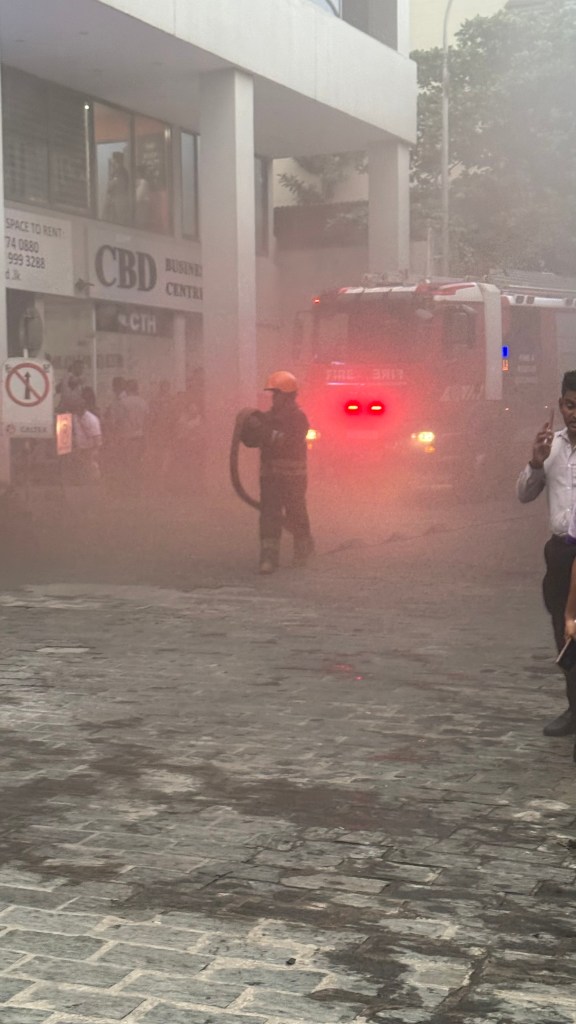
It was hard to stay relaxed when everybody else was not. Somehow, I made it out, patting myself for staying calm. What greeted me outside was a crowd surrounding the perimeter of the hotel, directing me to an area nearby. They were pointing up at the building that was supposed to be my two-night stay. There was thick smoke bellowing from its 7th floor.

News spreads like wildfire in this digital world. People were engrossed in getting the best angle for the personal shot with their devices. Soon, the footage would grace their social media and, perhaps, be potentially ‘viralled’. Photographers with zoom lenses were already there as if they had purposely ignited a fire to film it. Curious onlookers with work clothes were locked in their gaze, in awe, as if it were the second coming. I followed.

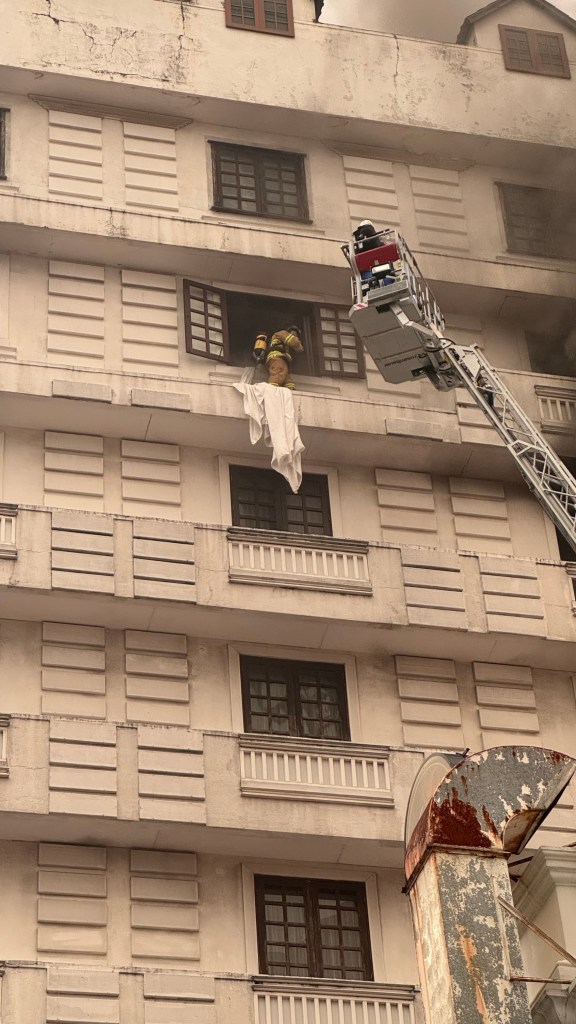
I could see one elderly gentleman out at the window. Yes, I had seen that man before when checking in. He was then struggling to move. He must have opened his window to let the smoke out of his room. But luck had different plans. The smoke had grown in intensity and was blowing directly at his window. Desperate, he climbed out of his window and wanted to jump out against the pleading and yells of onlookers, including me. Maybe it was the confusion of inhaling carbon monoxide; he must have thought the fast out of his misery was to jump down without a safety harness.

A modern fire engine moved in just then, much to everyone’s relief. In a jiffy, an aerial ladder was summoned to whisk the victim from the window. Applause ensued, and the victim was quickly stretchered to a nearby ambulance.
The bellowing smoke quickly settled down, and my friends and I sighed in relief. Though one of my friends went on a tirade of cough. Even before the start of the holiday, he had been recovering from a nasty dry cough. The smoke must have made it worse. The paramedics checked on him, too, and took him in for overnight observation. 

The hotel was cordoned off with yellow tape and classified as a crime zone. The police had to investigate to rule out arson. Until then, our luggage was the property of the Sri Lankan Police Department, and no one could go in or out. 

We were left out like refugees with only our pants and clothes on our backs.

“… but we have our luggage stuck upstairs. We need them!” we told the hotel staff.

As expected, the reply was, “Sorry, Sir. Nobody can enter the building. But don’t worry, Sir. We will take care of your things.”

We were later given rooms in a nearby hotel, which was better and newer than the drab one we had been given earlier.

We soon left to bury our sorrows in some Ceylonese comfort food: apom[1] and coconut milk-rich crab curry. We had enough action for the day.

In retrospect, leaving the luggage behind was a wise move. Chugging the bags along the dark stairs and smoke-filled foyer is quite daunting. Sleeping with the clothes on our backs without toiletries must have been a trade-off for smoke inhalation and hospital admissions.

Overnight, we had become stars of sorts. Everywhere we went, it became the ice breaker. We became the talk of the town as the ‘guys who cheated the hotel fire”. Of course, we did nothing like that. Still, it spiced up our holiday and gave us friends of more than forty years something to reminisce about in our twilight years.

We only had access to our bags the following morning, which also meant we could not personally enter the premises to collect our belongings. Only designated hotel staff could do that. The hotel was still a crime investigation zone, which must mean we were considered potential arsonists who could tamper with evidence. The police personnel were still busy taking samples and photographs of the crime scene.

Luckily, the fire was localised, and the firefighters did not need to hose the whole building down. Hence, our baggage was dry. My room was on the second floor, while my other friends were on different floors. The fire had been on the seventh. Even though most of our rooms were far from where the fire allegedly started, the retrieved luggage came with a grimy layer of soot, compliments of the furious, fiery invader. Even the garments and bags gave a whiff of smoke for days afterwards, even after sunning it in the open. 

Imagine how it would have been if I had waited a little longer. What is damage to property when, above all, health and life matter most? Going back without the luggage is better than returning in a body bag.

.

[1] apom – soft, sweet and fluffy traditional pancake from Southern India and Sri Lanka.

Farouk Gulsara is a daytime healer and a writer by night. After developing his left side of his brain almost half his lifetime, this johnny-come-lately decided to stimulate the non-dominant part of his remaining half. An author of two non-fiction books, Inside the twisted mind of Rifle Range Boy and Real Lessons from Reel Life, he writes regularly in his blog, Rifle Range Boy.

.

PLEASE NOTE: ARTICLES CAN ONLY BE REPRODUCED IN OTHER SITES WITH DUE ACKNOWLEDGEMENT TO BORDERLESS JOURNAL

Click here to access the Borderless anthology, Monalisa No Longer Smiles

Click here to access Monalisa No Longer Smiles on Kindle Amazon International
Categories
Greetings from Borderless

Auld Lang Syne…

As we wait for the new year to unfold, we glance back at the year that just swept past us. Here, gathered together are glimpses of the writings we found on our pages in 2024 that herald a world of compassion and kindness…writings filled with hope and, dare I say, even goodwill…and sometimes filled with the tears of poetic souls who hope for a world in peace and harmony. Disasters caused by humans starting with the January 2024 in Japan, nature and climate change, essays that invite you to recall the past with a hope to learn from it, non-fiction that is just fun or a tribute to ideas, both past and present — it’s all there. Innovative genres started by writers to meet the needs of the times — be it solar punk or weird western — give a sense of movement towards the new. What we do see in these writings is resilience which healed us out of multiple issues and will continue to help us move towards a better future.

A hundred years ago, we did not have the technology to share our views and writings, to connect and make friends with the like-minded across continents. I wonder what surprises hundred years later will hold for us…Maybe, war will have been outlawed by then, as have been malpractices and violences against individuals in the current world. The laws that rule a single man will hopefully apply to larger groups too…

Poetry

Whose life? by Aman Alam. Click here to read.

Winter Consumes by Luis Cuauhtémoc Berriozábal. Click here to read.

Hot Dry Summers by Lizzie Packer. Click here to read.

House of Birds (for Pablo Neruda) by Ryan Quinn Flanagan. Click here to read.

Poems for Dylan Thomas by Michael Burch. Click here to read.

Dylan Thomas in Ardmillan Terrace? by Stuart McFarlane. Click here to read.

Bermuda Love Triangle & the Frothiest Coffee by Rhys Hughes. Click here to read.

Satirical Poems by Maithreyi Karnoor. Click here to read.

Three Poems by Rakhi Dalal. Click here to read.

Manish Ghatak’s Aagun taader Praan (Fire is their Life) has been translated from Bengali by Indrayudh Sinha. Click here to read.

Manzur Bismil’s poem, Stories, has been translated from Balochi by Fazal Baloch. Click here to read.

Ye Shao-weng’s poetry ( 1100-1150) has been translated from Mandarin by Rex Tan. Click here to read.

Amalkanti by Nirendranath Chakraborty has been translated from Bengali by Debali Mookerjea-Leonard. Click here to read.

The Mirror by Mubarak Qazi has been translated from Balochi by Fazal Baloch. Click here to read.

Homecoming, a poem by Ihlwha Choi on his return from Santiniketan, has been translated from Korean by the poet himself. Click here to read.

Pochishe Boisakh (25th of Baisakh) by Tagore (1922), has been translated from Bengali by Mitali Chakravarty. Click here to read.

Nazrul’s Ghumaite Dao Shranto Robi Re (Let Robi Sleep in Peace) has been translated from Bengali by Professor Fakrul Alam. Click here to read.

Jibananada Das’s Andhar Dekhecche, Tobu Ache (I have seen the dark and yet there is another) has been translated from Bengali by Professor Fakrul Alam. Click here to read.

Tagore’s Shotabdir Surjo Aji ( The Century’s Sun today) has been translated from Bengali by Mitali Chakravarty. Click here to read.

Non-fiction

Baraf Pora (Snowfall)

A narrative by Rabindranath Tagore that gives a glimpse of his first experience of snowfall in Brighton and published in the Tagore family journal, Balak (Children), has been translated from Bengali by Somdatta Mandal. Click here to read.

Dylan on Worm’s Head

Rhys Hughes describes a misadventure that the Welsh poet had while hiking as a tribute to him on Dylan Thomas Day. Click here to read.

Travels of Debendranath Tagore 

These are from the memoirs of Tagore’s father translated from Bengali by Somdatta Mandal. Click here to read.

Two Pizza Fantasies

Rhys Hughes recounts myths around the pizza in prose, fiction and poetry, Click here to read

Is this a Dagger I See…?

Devraj Singh Kalsi gives a tongue-in-cheek account of a writer’s dilemma. Click here to read.

Still to Moving Images 

Ratnottama Sengupta explores artists who have turned to use the medium of films… artists like the legendary MF Husain. Click here to read.

How Dynamic was Ancient India?

Farouk Gulsara explores William Dalrymple’s latest book, The Golden Road: How Ancient India Transformed the World. Click here to read.

The Magic Dragon: Cycling for Peace

Keith Lyons writes of a man who cycled for peace in a conflict ridden world. Click here to read.

A Cover Letter

Uday Deshwal muses on writing a cover letter for employment. Click here to read.

A Manmade Disaster or Climate Change?

Salma A Shafi writes of floods in Bangladesh from ground level. Click here to read.

Pinecones and Pinky Promises

Luke Rimmo Minkeng Lego writes of mists and cloudy remembrances in Shillong. Click here to read.

 Educating for Peace in Rwanda

Suzanne Kamata discusses the peace initiatives following the terrors of the 1994 Rwandan Genocide while traveling within the country with her university colleague and students. Click here to read.

Breaking Bread

Snigdha Agrawal has a bovine encounter in a restaurant. Click here to read.

From Srinagar to Ladakh: A Cyclist’s Diary

Farouk Gulsara travels from Malaysia for a cycling adventure in Kashmir. Click here to read.

A Saga of Self-empowerment in Adversity

Bhaskar Parichha writes of Noor Jahan Bose’s Daughter of The Agunmukha: A Bangla Life, translated from Bengali by Rebecca Whittington. Click here to read.

Safdar Hashmi

Meenakshi Malhotra writes of Anjum Katyal’s Safdar Hashmi: Towards Theatre for a Democracy. Click hereto read.

Meeting the Artists

Kiriti Sengupta talks of his encounter with Jatin Das, a legendary artist. Click here to read.

The Comet’s Trail: Remembering Kazi Nazrul Islam

Radha Chakravarty pays tribute to the rebel poet of Bengal. Click here to read.

The Myriad Hues of Tagore by Aruna Chakravarti

Aruna Chakravarti writes on times and the various facets of Tagore. Click here to read.

The Year of Living Dangerously

Professor Fakrul Alam takes us back to the birth of Bangladesh. Click here to read.

A Short, Winding, and Legendary Dhaka Road 

Professor Fakrul Alam takes us on a historical journey of one of the most iconic roads of Dhaka, Fuller Road. Click here to read.

 A Sombre Start 

Suzanne Kamata talks of the twin disasters in Japan. Click here to read.

Fiction

The Snakecharmer

Shapuray by Nazrul, has been translated from Bengali by Sohana Manzoor. Click here to read.

Significance

Naramsetti  Umamaheswararao creates a fable around a banyan tree and it’s fruit. Click here to read.

Just Another Day

Neeman Sobhan gives a story exploring the impact of the politics of national language on common people. Click here to read.

The Ghosts of Hogshead

Paul Mirabile wanders into the realm of the supernatural dating back to the Potato Famine of Ireland in the 1800s. Click here to read.

A Queen is Crowned

Farhanaz Rabbani traces the awakening of self worth. Click here to read.

The Last Hyderabadi

Mohul Bhowmick talks of the passage of an era. Click here to read.

The Gift 

Rebecca Klassen shares a sensitive story about a child and an oak tree. Click here to read.

Galat Aurat or The Wrong Woman

Veena Verma’s story has been translated from Punjabi by C Christine Fair. Click here to read.

The Melting Snow

A story by Sharaf Shad,  has been translated from Balochi by Fazal Baloch. Click here to read.

Conversations

Ratnottama Sengupta talks to Ruchira Gupta, activist for global fight against human trafficking, about her work and introduces her novel, I Kick and I Fly. Click here to read.

A conversation with eminent Singaporean poet and academic, Kirpal Singh, about how his family migrated to Malaya and subsequently Singapore more than 120 years ago. Click here to read.

A brief overview of Rajat Chaudhuri’s Spellcasters and a discussion with the author on his book. Click here to read.

A review of and discussion with Rhys Hughes about his ‘Weird Western’, The Sunset Suite. Click here to read.

Categories
Contents

Borderless, December 2024

Art by Sohana Manzoor

Editorial

‘Footfalls Echo in the Memory’… Click here to read.

Translations

Jibananada Das’s Andhar Dekhecche, Tobu Ache (I have seen the dark and yet there is another) has been translated from Bengali by Professor Fakrul Alam. Click here to read.

Manish Ghatak’s Aagun taader Praan (Fire is their Life) has been translated from Bengali by Indrayudh Sinha. Click here to read.

Manzur Bismil’s poem, Stories, has been translated from Balochi by Fazal Baloch. Click here to read.

Homecoming, a poem by Ihlwha Choi on his return from Santiniketan, has been translated from Korean by the poet himself. Click here to read.

Tagore’s Shotabdir Surjo Aji ( The Century’s Sun today) has been translated from Bengali by Mitali Chakravarty. Click here to read.

Poetry

Click on the names to read the poems

Michael R Burch, Farah Sheikh, George Freek, Rajiv Borra, Kelsey Walker, Lokenath Roy, Thompson Emate, Joy Anne O’Donnell, Jayant Kashyap, John Grey, Aman Alam, Stuart McFarlane, Ayesha Binte Islam, Ryan Quinn Flanagan, Saranyan BV, Rhys Hughes

Musings/ Slices from Life

Autumn in Hyderabad

Mohul Bhowmick muses on Hyderabad. Click here to read.

Straight Back Across the Strait

Meredith Stephens gives a vignette of life in South Australia with a sailing adventure built in. Click here to read.

My Patchwork Year

Keith Lyons muses on what 2024 meant for him. Click here to read.

Musings of a Copywriter

In Byline Fever, Devraj Singh Kalsi travels down the path of nostalgia. Click here to read.

Essays

Still to Moving Images

Ratnottama Sengupta explores artists who have turned to use the medium of films… artists like the legendary MF Husain. Click here to read.

How Dynamic was Ancient India?

Farouk Gulsara explores William Dalrymple’s latest book, The Golden Road: How Ancient India Transformed the World. Click here to read.

A Short, Winding, and Legendary Dhaka Road

Professor Fakrul Alam takes us on a historical journey of one of the most iconic roads of Dhaka, Fuller Road. Click here to read.

Stories

Significance

Naramsetti  Umamaheswararao creates a fable around a banyan tree and it’s fruit. Click here to read.

The Dance of Life

Snigdha Agrawal explores ageism. Click here to read.

The Unsuspecting Suspect

Paul Mirabile wraps his telling like a psychological thriller. Click here to read.

Conversations

Ratnottama Sengupta converses with Divya Dutta, an award-winning actress, who has authored two books recently, Stars in my Sky and Me and Ma. Click here to read.

Lara Geyla converses about her memoir, Camels of Kyzylkum, and her journey as an immigrant. Click here to read.

Book Excerpts

An excerpt from Thomas Bell’s Human Nature: A Walking History of the Himalayan Landscape. Click here to read.

An excerpt from Savi Naipaul Akal’s The Naipauls of Nepaul Street, a retelling of VS Naipaul’s heritage in Trinidad by his sister. Click here to read.

Book Reviews

Somdatta Mandal reviews Kusum Khemani’s Lavanyadevi, translated from Hindi by Banibrata Mahanta. Click here to read.

Aditi Yadav reviews Nanako Hanada’s The Bookshop Woman, translated from Japanese by Cat Anderson. Click here to read.

Jagari Mukherjee reviews Kiriti Sengupta’s poetry collection, Oneness. Click here to read.

Bhaskar Parichha reviews Noor Jahan Bose’s Daughter of The Agunmukha: A Bangla Life, translated from Bengali by Rebecca Whittington. Click here to read.

.

Click here to access the Borderless anthology, Monalisa No Longer Smiles

Click here to access Monalisa No Longer Smiles on Amazon International

Categories
Editorial

‘Footfalls Echo in the Memory’

Painting by Claud Monet (1840-1926). From Public Domain

Acknowledging our past achievements sends a message of hope and responsibility, encouraging us to make even greater efforts in the future. Given our twentieth-century accomplishments, if people continue to suffer from famine, plague and war, we cannot blame it on nature or on God.

–Homo Deus (2015), Yuval Noah Harari

Another year drumrolls its way to a war-torn end. Yes, we have found a way to deal with Covid by the looks of it, but famine, hunger… have these drawn to a close? In another world, in 2019, Abhijit Banerjee had won a Nobel Prize for “a new approach to obtaining reliable answers about the best ways to fight global poverty”. Even before that in 2015, Yuval Noah Harari had discussed a world beyond conflicts where Homo Sapien would evolve to become Homo Deus, that is man would evolve to deus or god. As Harari contends at the start of Homo Deus, some of the world at least hoped to move towards immortality and eternal happiness. But, given the current events, is that even a remote possibility for the common man?

Harari points out in the sentence quoted above, acknowledging our past achievements gives hope… a hope born of the long journey humankind has made from caves to skyscrapers. If wars destroy those skyscrapers, what happens then? Our December issue highlights not only the world as we knew it but also the world as we know it.

In our essay section, Farouk Gulsara contextualises and discusses William Dalrymple’s latest book, The Golden Road with a focus on past glories while Professor Fakrul Alam dwells on a road in Dhaka , a road rife with history of the past and of toppling the hegemony and pointless atrocities against citizens. Yet, common people continue to weep for the citizens who have lost their homes, happiness and lives in Gaza and Ukraine, innocent victims of political machinations leading to war.

Just as politics divides and destroys, arts build bridges across the world. Ratnottama Sengupta has written of how artists over time have tried their hands at different mediums to bring to us vignettes of common people’s lives, like legendary artist M F Husain went on to make films, with his first black and white film screened in Berlin Film Festival in 1967 winning the coveted Golden Bear, he captured vignettes of Rajasthan and the local people through images and music. And there are many more instances like his…

Mohul Bhowmick browses on the past and the present of Hyderabad in a nostalgic tone capturing images with words. From the distant shores of New Zealand, Keith Lyons takes on a more individualistic note to muse on the year as it affected him. Meredith Stephens has written of her sailing adventure and life in South Australia. Devraj Singh Kalsi describes a writerly journey in a wry tone. Rhys Hughes also takes a tone of dry humour as he continues with his poems musing on photographs of strangely worded signboards. Colours are brought into poetry by Michael R Burch, Farah Sheikh, George Freek, Rajiv Borra, Kelsey Walker, John Grey, Stuart McFarlane, Saranyan BV, Ryan Quinn Falangan and many more. Some lines from this issue’s poetry selection by young Aman Alam really resonated well with the tone defined by the contributors of this issue:

It's always the common people who pay first.
They don’t write the speeches or sign the orders.
But when the dust rises, they’re the ones buried under...

Whose Life? By Aman Alam

Echoing the theme of the state of the common people is a powerful poem by Manish Ghatak translated from Bengali by Indrayudh Sinha, a poem that echoes how some flirt with danger on a daily basis for ‘Fire is their life’. Professor Alam has brought to us a Bengali poem by Jibanananda Das that reflects the issues we are all facing in today’s world, a poem that remains relevant even in the next century, Andhar Dekhecche, Tobu Ache (I have seen the dark and yet there is another). Fazal Baloch has translated contemporary poet Manzur Bismil’s poem from Balochi on the suffering caused by decisions made by those in power. Ihlwha Choi on the other hand has shared his own lines in English from his Korean poem about his journey back from Santiniketan, in which he claims to pack “all my lingering regrets carefully into my backpack”. And yet from the founder of Santiniketan, we have a translated poem that is not only relevant but also disturbing in its description of the current reality: “…Conflicts are born of self-interest./ Wars are fought to satiate greed…”. Tagore’s Shotabdir Surjo (The Century’s Sun, 1901) recounts the horrors of history…The poem brings to mind Edvard Munch’s disturbing painting of “The Scream” (1893).  Does what was true more than hundred years ago, still hold?

Reflecting on eternal human foibles, Naramsetti Umamaheswararao creates a contemporary fable in fiction while Snigdha Agrawal reflects on attitudes towards aging. Paul Mirabile weaves an interesting story around guilt and crime. Sengupta takes us back to her theme of artistes moving away from the genre, when she interviews award winning actress, Divya Dutta, for not her acting but her literary endeavours — two memoirs — Me and Ma and Stars in the Sky. The other interviewee Lara Gelya from Ukraine, also discusses her memoir, Camels from Kyzylkum, a book that traces her journey from the desert of Kyzylkum to USA through various countries. In our book excerpts, we have one that resonates with immigrant lores as writer VS Naipual’s sister, Savi Naipaul Akal, discusses how their family emigrated to Trinidad in The Naipauls of Nepaul Street. The other excerpt from Thomas Bell’s Human Nature: A Walking History of the Himalayan Landscape seeks “to understand the relationship between communities and their environment.” He moves through the landscapes of Nepal to connect readers to people in Himalayan villages.

The reviews in this issue travel through cultures and time with Somdatta Mandal’s discussion of Kusum Khemani’s Lavanyadevi, translated from Hindi by Banibrata Mahanta. Aditi Yadav travels to Japan with Nanako Hanada’s The Bookshop Woman, translated from Japanese by Cat Anderson. Jagari Mukherjee writes on the poems of Kiriti Sengupta in Oneness and Bhaskar Parichha reviews a book steeped in history and the life of a brave and daring woman, a memoir by Noor Jahan Bose, Daughter of The Agunmukha: A Bangla Life, translated from Bengali by Rebecca Whittington.

We have more content than mentioned here. Please do pause by our content’s page to savour our December Issue. We are eternally grateful to you, dear readers, for making our journey worthwhile.

Huge thanks to all our contributors for making this issue come alive with their vibrant work. Huge thanks to the team at Borderless for their unflinching support and to Sohana Manzoor for sharing her iconic paintings that give our journal a distinctive flavour.

With the hope of healing with love and compassion, let us dream of a world in peace.

Best wishes for the start of the next year,

Mitali Chakravarty

borderlessjournal.com

Footfalls echo in the memory
Down the passage which we did not take
Towards the door we never opened
Into the rose-garden.

TS Eliot, ‘Burnt Norton’, Four Quartets (1941)

Click here to access the content’s page for the December 2024 Issue

.

READ THE LATEST UPDATES ON THE FIRST BORDERLESS ANTHOLOGY, MONALISA NO LONGER SMILES, BY CLICKING ON THIS LINK.

Categories
Essay

How Dynamic was Ancient India?

Farouk Gulsara discussed William Dalrymple’s latest book

Growing up in the later part of the 1970s, kids of my generation were drilled with stories that India was a subcontinent of poverty, filth, and pickpockets. Even our history books taught us that it was a land of darkness, living in its myths, superstitions, and cults, waiting to be civilised by the mighty European race and their scientific discoveries. 

That was what was impressed upon us as we sauntered into adulthood. The media did not help either. With eye-catching news like a particular Indian Prime Minister having his daily dose of gau mutra[1] for breakfast and another ousted after thirteen days of taking oath as the Prime Minister, India was made out to be just another third-world country. Then came the 21st century and the turn of tides. Locally bred academicians started teasing deeper into India’s forgotten history. They started doubting the self-deprecating history that was taught to them by leftist historians in the textbooks.

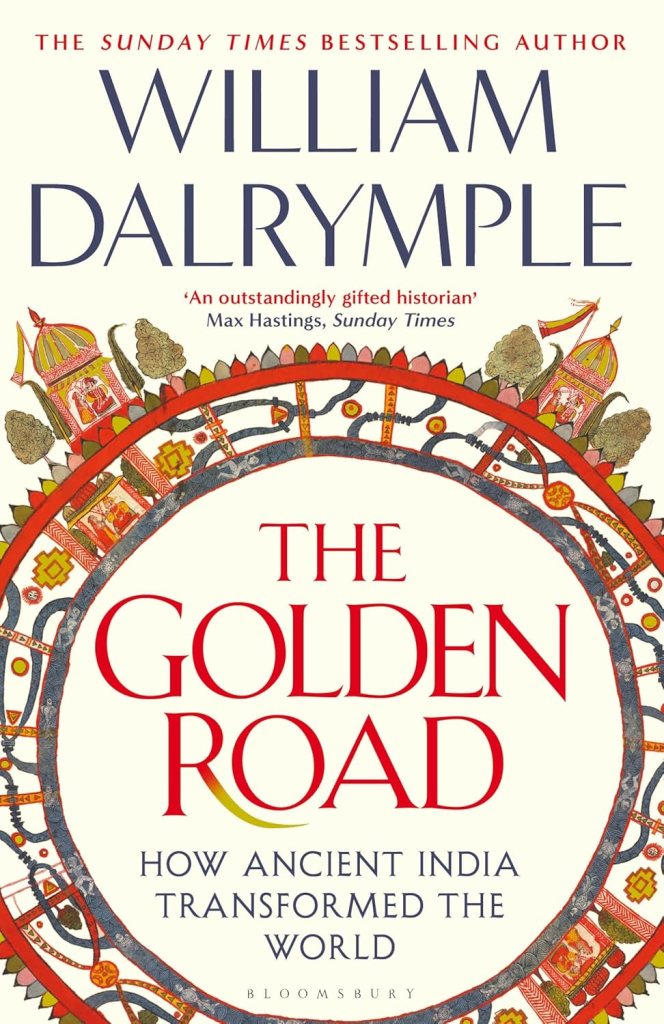
Like many historians before him, historian William Dalrymple, in his latest book, The Golden Road: How Ancient India Transformed the World outlines the importance of India as a cradle of knowledge that peddled wisdom to regions near and far. Its scientific knowledge was far ahead of its time. This know-how was put into practice and spread via trade routes. Their port of entry received not just their goods but also their culture and way of life.

Enduring attack after attack from foreign invaders, Indians had already forgotten their glorious past by the time of the British Raj. A tiger hunting expedition inadvertently brought British hunters to various beautiful cave carvings and Buddhist sculptures. That kind of rekindled India’s history, which had disappeared from the Indian imagination.

India had been a crucial economic fulcrum and a civilisational engine in early world history. As early as 31BCE, Indians had learnt to manipulate the monsoonal winds to steer their ship to the West to the prosperous kingdom of Ethiopia, Egypt and subsequent access to the Mediterranean. With their mammoth merchant ships, they transported pearls, spices, diamonds, incense, slaves and even exotic animals like elephants and tigers in exchange for gold. Trade favoured India so much that a Roman Naval Commander, Pliny the Elder, lamented the unnecessary spicing of the food and the almost transparent Indian fabric that left nothing to the imagination. It is said Buddhism reached the shores of Egypt through these ships. The Christian monastic way of life is said to have been influenced by these monks.

With seasonal monsoon winds, Indian ships brought not just trade but philosophy, politics, and architectural ideas to Southeast Asia, China, and even Japan. All this cultural allure and sophistication did not happen through conquest. Sanskrit was the language of knowledge and a conduit for spreading knowledge. 

Buddhism emerged in the 5th century BCE as an alternative to caste-centred and animal sacrifice-filled rituals. Unlike Jainism’s strict austerities, it offered a middle path. Due to King Ashoka’s untiring efforts, Buddhism spread beyond its borders. Contrary to the belief that Buddhism promotes an impoverished way of living, early Buddhists drew interests (and resources) from the merchant group, as evidenced by the Ajanta Caves’ findings. Buddhism drew many Chinese scholars to India’s centres of higher learning in Nalanda and Kanchipuram in the South to get first-hand experience reading Buddhist scriptures in Sanskrit. India’s universities later became the template for other varsities the world over. 

India’s cultural influence on South Sea Asia is phenomenal. Stories from Indian epics, Ramayana and Bhagvad Gita, are told and retold in children’s stories, plays and cultural art forms. Their ruling elites were Hindus. The biggest Hindu and Buddhist temples are not in India but in Cambodia and Java, respectively, as Angkor Wat and Borobudur. Marvellous stony statues and temple are similar to those in India. At a time when the Byzantines were presiding over Europe, the Suryavarman clan was ruling a Hindu Empire so huge it would dwarf their European counterpart.  

The 5th to 7th century of the common era was the golden age of Indian mathematics. Between Aryabhata and Brahmagupta, their knowledge of the nine-number system (and zero) brought them the know-how of negative numbers, algebra, trigonometry, algorithms and astronomy far ahead of their time. They understood that Earth was a sphere spinning on its axis, about the eclipse, gravity and planetary rotations. The Indians even built a space observatory tower in Ujjain to study constellations and devise a solar calendar. The idea of a prime meridian arose from here. 

In the 8th century, the Abbasids exerted control over the Afghanistan region through treaties with local viziers. At that time, the Bamiyan region in Afghanistan had over 460 monasteries and 10,000 monks. A member of an influential Buddhist family, the Barmakid, converted to Islam to establish his family in the Abbasid fold. They brought Indian medicines, texts, and scholars with them and encouraged and promoted Islamic engagement with the East. Sanskrit texts were translated into Arabic. It is said that the Barmakids were instrumental in the building of Baghdad. 

The Islamic hegemony spread, as did the scholarship it had built. 

The Bamakid-Abbasid liaison met a tragic end due to palace power dynamics. The Abbasids started looking at the Romans for inspiration. Many Europeans were drawn to the Golden Age of Islam. Many texts were translated into Latin. Toledo of Andalusia introduced the science of timekeeping from Ujjain to Oxford. A particular young Italian named Leonardo of Pisa picked up the beauty of Mathematics during his stay in Algeria. He returned to publish ‘Liber Abaci‘ (The Book of Calculation) in 1202, which introduced Europe to the sequence of Fibonacci numbers and the mystic power of mathematics. This sudden gush of knowledge spurred the European Renaissance.  

The whole cycle completed its full arc when European powers rose to great heights. Benefitting from the knowledge from India that layered its way through, passing from hand to hand, the colonial masters returned to chop off [2]the hands that had nourished it. 

Emerging rejuvenated from their occupation-induced slumber, with their Anglophilic familiarity, Indians have risen from the ashes to claim their status in the Indosphere[3], a world where Indian influences permeated every layer of society.

This well-researched, unputdownable book is for all history buffs. Infused with little nuggets from cover to cover that would excite nerds, it is a joy to read about the history of India in a way that is not often told in the mainstream.

[1] Gau mutra, cow urine, has a sacred role in some forms of Hinduism and Zoroastrianism and is used for medicinal purposes and in some Hindu ceremonies.

[2] https://www.thedailystar.net/lifestyle/special-feature/the-muslin-story-187216#

[3] Indosphere is a collective linguistic term for areas under Indian linguistic influence. It includes countries in the Southern, Southeast, and East Asian regions. 22 languages, including Indo-European and Dravidian languages, are recognised under this category and are considered to have originated in India. 

Farouk Gulsara is a daytime healer and a writer by night. After developing his left side of his brain almost half his lifetime, this johnny-come-lately decided to stimulate the non-dominant part of his remaining half. An author of two non-fiction books, Inside the twisted mind of Rifle Range Boy and Real Lessons from Reel Life, he writes regularly in his blog, Rifle Range Boy.

.

PLEASE NOTE: ARTICLES CAN ONLY BE REPRODUCED IN OTHER SITES WITH DUE ACKNOWLEDGEMENT TO BORDERLESS JOURNAL

Click here to access the Borderless anthology, Monalisa No Longer Smiles

Click here to access Monalisa No Longer Smiles on Kindle Amazon International

Categories
Contents

Borderless, November 2024

Art by Sohana Manzoor

Editorial

Clinging to Hope…Click here to read.

Translations

Nazrul’s Tumi Shundor Tai Cheye Thaki (Because you are so beautiful, I keep looking at you) has been translated from Bengali by Professor Fakrul Alam. Click here to read.

Hotel Acapulco, has been composed and translated from Italian by Ivan Pozzoni. Click here to read.

On the Reserved Seat of the Subway, a poem by Ihlwha Choi, has been translated from Korean by the poet himself. Click here to read.

Tagore’s Phul Photano (Making Flowers Bloom) has been translated from Bengali by Mitali Chakravarty. Click here to read.

Poetry

Click on the names to read the poems

Michael R Burch, Jahanara Tariq, Luis Cuauhtémoc Berriozábal, Shahalam Tariq, Stuart McFarlane, Saranyan BV, George Freek, G Javaid Rasool, Heath Brougher, Vidya Hariharan, Paul Mirabile, Ananya Sarkar, Ryan Quinn Flanagan, Pulkita Anand, Rhys Hughes

Musings/Slices from Life

Pinecones and Pinky Promises

Luke Rimmo Minkeng Lego writes of mists and cloudy remembrances in Shillong. Click here to read.

Elusive XLs

Shobha Sriram muses on weight management. Click here to read.

The Eternal Sleep of Kumbhakarna

Farouk Gulsara pays a tribute to a doctor and a friend. Click here to read.

Musings of a Copywriter

In Becoming a ‘Plain’ Writer, Devraj Singh Kalsi explores the world of writer’s retreats on hills with a touch of irony. Click here to read.

Notes from Japan

In Educating for Peace in Rwanda, Suzanne Kamata discusses the peace initiatives following the terrors of the 1994 Rwandan Genocide while traveling within the country with her university colleague and students. Click here to read.

Essays

The Year of Living Dangerously

Professor Fakrul Alam takes us back to the birth of Bangladesh. Click here to read.

Deconstructing Happiness

Abdullah Rayhan analyses the concept of happiness. Click here to read.

More Frequent Cyclones to Impact Odisha

Bijoy K Mishra writes of cyclones in Odisha, while discussing Bhaskar Parichha’s Cyclones in Odisha – Landfall, Wreckage and Resilience. Click here to read.

Stories

Hotel du Commerce

Paul Mirabile gives a vignette of life in Paris in the 1970s. Click here to read.

Chintu’s Big Heart

Naramsetti Umamaheswararao gives a value-based story about a child. Click here to read.

Headless Horses

Anna Moon relates a story set in rural Philippines. Click here to read.

A Penguin’s Story

Sreelekha Chatterjee writes a story from a penguin’s perspective. Click here to read.

Phantom Pain

Lakshmi Kannan writes of human nature. Click here to read.

Conversations

A conversation with Dutch author, Mineke Schipper, with focus of her recent book Widows: A Global History. Click here to read.

Ratnottama Sengupta converses with Veena Raman, wife of the late Vijay Raman, an IPS officer who authored, Did I Really Do All This: Memoirs of a Gentleman Cop Who Dared to be Different. Click here to read.

Book Excerpts

An excerpt from Vijay Raman’s Did I Really Do All This: Memoirs of a Gentleman Cop Who Dared to be Different. Click here to read.

An excerpt from Rhys Hughes’ Growl at the Moon, a Weird Western. Click here to read.

Book Reviews

Somdatta Mandal reviews The Collected Short Stories of Kazi Nazrul Islam, translated by multiple translators from Bengali and edited by Syed Manzoorul Islam and Kaustav Chakraborty. Click here to read.

Rakhi Dalal reviews The Long Strider in Jehangir’s Hindustan: In the Footsteps of the Englishman Who Walked From England to India in the Year 1613 by Dom Moraes and Sarayu Srivatsa. Click here to read.

Bhaskar Parichha reviews Mohammad Tarbush’s My Palestine: An Impossible Exile. Click here to read.

.

Click here to access the Borderless anthology, Monalisa No Longer Smiles

Click here to access Monalisa No Longer Smiles on Amazon International

Categories
Editorial

Clinging to Hope

I will cling fast to hope.

— Suzanne Kamata, ‘Educating for Peace in Rwanda

Landscape of Change by Jill Pelto, Smithsonian. From Public Domain

Hope is the mantra for all human existence. We hope for a better future, for love, for peace, for good weather, for abundance. When that abundance is an abundance of harsh weather or violence wrought by wars, we hope for calm and peace.

This is the season for cyclones — Dana, Trami, Yixing, Hurricanes Milton and Helene — to name a few that left their imprint with the destruction of both property and human lives as did the floods in Spain while wars continue to annihilate more lives and constructs. That we need peace to work out how to adapt to climate change is an issue that warmongers seem to have overlooked. We have to figure out how we can work around losing landmasses and lives to intermittent floods caused by tidal waves, landslides like the one in Wayanad and rising temperatures due to the loss of ice cover. The loss of the white cover of ice leads to more absorption of heat as the melting water is deeper in colour. Such phenomena could affect the availability of potable water and food, impacted by the changes in flora and fauna as a result of altered temperatures and weather patterns. An influx of climate refugees too is likely in places that continue habitable. Do we need to find ways of accommodating these people? Do we need to redefine our constructs to face the crises?

Echoing concerns for action to adapt to climate change and hoping for peace, our current issue shimmers with vibrancy of shades while weaving in personal narratives of life, living and the process of changing to adapt.

An essay on Bhaskar Parichha’s recent book on climate change highlights the action that is needed in the area where Dana made landfall recently. In terms of preparedness things have improved, as Bijoy K Mishra contends in his essay. But more action is needed. Denying climate change or thinking of going back to pre-climate change era is not an option for humanity anymore. While politics often ignores the need to acknowledge this crises and divides destroying with wars, riots and angst, a narrative for peace is woven by some countries like Japan and Rwanda.

Suzanne Kamata recently visited Rwanda. She writes about how she found by educating people about the genocide of 1994, the locals have found a way to live in peace with people who they addressed as their enemies before… as have the future generations of Japan by remembering the atomic holocausts of 1945.

Writing about an event which wrought danger into the lives of common people in South Asia is Professor Fakrul Alam’s essay on the 1971 conflict between the countries that were carved out of the 1947 Partition of the Indian subcontinent. As if an antithesis to this narrative of divides that destroyed lives, Luke Rimmo Minkeng Lego muses about peace and calm in Shillong which leaves a lingering fragrance of heartfelt friendships. Farouk Gulsara muses on nostalgic friendships and twists of fate that compel one to face mortality. Abdullah Rayhan ponders about happiness and Shobha Sriram, with a pinch of humour, adapts to changes. Devraj Singh Kalsi writes satirically of current norms aiming for a change in outlook.

Humour is brought into poetry by Rhys Hughes who writes about a photograph of a sign that can be interpreted in ways more than one. Michael Burch travels down the path of nostalgia as Ryan Quinn Flanagan shares a poem inspired by Pablo Neruda’s bird poems. Luis Cuauhtémoc Berriozábal writes heart wrenching verses about the harshness of winter for the homeless without shelter. We have more colours in poetry woven by Jahanara Tariq, Stuart MacFarlane, Saranyan BV, George Freek, G Javaid Rasool, Heath Brougher and more.

In translations, we have poetry from varied countries. Ihlwha Choi has self-translated his poem from Korean. Ivan Pozzoni has done the same from Italian. One of Tagore’s lesser-known verses, perhaps influenced by the findings of sensitivity in plants by his contemporary, Jagadish Chandra Bose (1858-1937) to who he dedicated the collection which homed this poem, Phool Photano (making flowers bloom), has been translated from Bengali. Professor Alam has translated Nazrul’s popular song, Tumi Shundor Tai Cheye Thaki (Because you are so beautiful, I keep gazing at you).

In reviews, Somdatta Mandal has discussed The Collected Short Stories of Kazi Nazrul Islam, translated by multiple translators from Bengali and edited by Syed Manzoorul Islam and Kaustav Chakraborty. Rakhi Dalal has written about The Long Strider in Jehangir’s Hindustan: In the Footsteps of the Englishman Who Walked From England to India in the Year 1613 by Dom Moraes and Sarayu Srivatsa, a book that looks and compares the past with the present. Bhaskar Parichha has written of a memoir which showcases not just the personal but gives a political and economic commentary on tumultuous events that shaped the history of Israel, Palestine, and the modern Middle East prior to the more than a year-old conflict. The book by the late Mohammad Tarbush (1948-2022) is called My Palestine: An Impossible Exile.

Stories travel around the world with Paul Mirabile’s narrative giving a flavour of bohemian Paris in 1974. Anna Moon’s fiction set in Philippines gives a darker perspective of life. Lakshmi Kannan’s narrative hovers around the 2008 bombing in Mumbai, an event that evoked much anger, violence and created hatred in hearts. In contrast, Naramsetti Umamaheswararao brings a sense of warmth into our lives with a story about a child and his love for a dog. Sreelekha Chatterjee weaves a tale of change, showcasing adapting to climate crisis from a penguin’s perspective.

Hoping to change mindsets with education, Mineke Schipper has a collection of essays called Widows: A Global History, which has been introduced along with a discussion with the author on how we can hope for a more equitable world. The other conversation by Ratnottama Sengupta with Veena Raman, wife of the late Vijay Raman, a police officer who authored, Did I Really Do All This: Memoirs of a Gentleman Cop Who Dared to be Different, showcases a life given to serving justice. Raman was an officer who caught dacoits like Paan Singh Tomar and the Indian legendary dacoit queen, Phoolan Devi. An excerpt from his memoir accompanies the conversation. The other book excerpt is from an extremely out of the box book, Rhys Hughes’ Growl at the Moon, a Weird Western.

Trying something new, being out of the box is what helped humans move out from caves, invent wheels and create civilisations. Hopefully, this is what will help us move into the next phase of human development where wars and weapons will become redundant, and we will be able to adapt to changing climes and move towards a kinder, more compassionate existence.

Thank you all for pitching in with your fabulous pieces. There are ones that have not been covered here. Do pause by our content’s page to see all our content. Huge thanks to the fantastic Borderless team and to Sohana Manzoor, for her art too.

Hope you enjoy our fare!

Mitali Chakravarty

borderlessjournal.com

Click here to access the  content’s page for the November 2024 Issue

.

READ THE LATEST UPDATES ON THE FIRST BORDERLESS ANTHOLOGY, MONALISA NO LONGER SMILES, BY CLICKING ON THIS LINK.

Categories
Tribute

The Eternal Sleep of Kumbhakarna

By Farouk Gulsara

I reported to Kuala Pilah[1]District Hospital on 11th August 1989. Just having passed out from medical school a year earlier, followed by a year of housemanship training, I was rearing to go. Like Dr. David Livingstone, who explored the interior of Africa to treat the needy (and convert them), I thought I would change the world.

1989 Kuala Pilah District Hospital was a secondary 100-bedded hospital with a resident Obstetrician-Gynaecologist, a few medical officers and a functioning operating theatre. Many seriously ill patients who needed tertiary care were transferred to a general hospital about 40km away.  

The hospital administrator was pleasantly surprised to meet me. He thought I would join the team when the rest of the doctors reported on the first of the month. Truth be told, I was down with a case of occupational hazard. I was down with chicken pox after delivering a mother with the disease. I had to extend my training ten days after exhausting my annual leave.

After the cursory formalities, I was given time off to help settle in. The hospital did not have any accommodation facilities for its staff. They only had a vacant but rundown wooden attap house just outside the hospital. It had all the basic amenities, electricity and water supply. I thought I would use it temporarily before getting better accommodation elsewhere. That is when I was introduced to CK. CK was to be my housemate. 

CK was working as an anaesthetic medical officer in the hospital. He was a year senior to me in service and was training to be an anaesthetic specialist. He alternated with another medical officer trained in anaesthesia to do daily calls in the Kuala Pilah District Hospital. 

CK walked in when I was talking to the hospital administrator, Dr Teng. 

“Oh yes. This is Dr. CK. He can be your housemate,” Dr Teng said. He will move into a new place once he gets one.”

“I think I’ll stay with CK and probably share his new place,” I said, “…that is if he is okay with sharing.”

CK was a lovable chap with a smiling face and an approachable demeanour. Slightly chubby, he resembled a cuddly teddy bear. His affable charm put everyone at ease, which helped him in his career as an anaesthetist. I later found that, understandably, the one thing he loved in his life was his food. He would later jokingly say that his paunch was an asset for him in his job. It helped to stabilise patients’ heads when he was intubating them. 

A tall Minangkabau roof. From Public Domain

Before the phrase ‘living out of a suitcase’ became vogue, I was already living that life. Uprooting from point A to point B meant shoving everything into a couple of suitcases into the car’s boot, and off I went. My needs were few. 

My stay was at an old wooden house built with a tall Minangkabau-styled roof. At any time of the day, it was cool. A cool breeze constantly swept through the length of the house. The tall ceiling helped. Despite its location in the heart of Kuala Pilah town, it was eerily quiet. The only noise one hears is the squeaking of its wooden floor when someone walks. As mentioned, the home had modern electricity and water supplies. The quarters pleasantly surprised me with a newly installed telephone line. 

It was a time before digital mobile devices came into existence. All we had were landlines and pagers. Telephones were essential to medical treatment as they remained the only way to track down doctors on the go, from ward to ward, in a compound with single-story buildings. It was comical to see musical chairs at play. Sometimes calling someone is like playing ‘Whac-a-Mole’. One calls Ward B only to be told the doctor has gone to Ward A, which has just been called. In emergencies, if a doctor could not be tracked down, a runner (literally the most agile of the staff) would run from point to point to hunt the doctor down. The public announcement system was available but would forever be under repair, and the person holding the key to the audio room would be AWOL[2]

As CK was the anaesthetic medical officer (MO) on call, attending cases that needed surgery, he did not need to sleep in the hospital. He could return to his quarters (the one I was to share) after midnight to retire for the night. He would typically hang around the hospital before leaving for his quarters when the coast was clear.

Now, CK was a heavy sleeper. Like Kumbhakarna[3], he was one of those who could sleep through a nuclear holocaust. The only thing that CK woke up to was a telephone ringing—the first ring at that! No, the bleep of the pager would not do.

Later that evening, after meeting around the new colleagues, CK and I walked to a nearby food court for dinner. The char koay teow[4] stall there later became our favourite hunting ground for dinner for the next year while we were there in Kuala Pilah. 

Ah Chong, the char koay teow seller, who had known CK for his regular patronage, ran out. Ah Chong was born and bred in Kuala Pilah. He ran Kuala Pilah’s famous halal char koay teow stall and took a keen interest in every little gossip around town. A simple-looking man whose wardrobe probably had two types of garments — white pagoda tee-shirts and black knee-length trousers — must probably be one of the wealthiest men in Kuala Pilah. 

“Hello, boss. What happened early this morning, ah? So much commotion, with lights, honking and ambulance sirens. What happened? A bus accident or something like that? I think the whole of Kuala Pilah got up!”

CK sheepishly told Ah Chong, “No, nothing. The hospital just wanted to contact me.” Ah Chong left to prepare our dish.

After Ah Chong left our table, CK started to chuckle.

“You know what he is talking about?” asked CK.

“No.” I shrugged.

“The day I arrived here, I knew I would be on-call. And I took the quarters to stay before getting a proper house. Teng, the administrator, told me to do calls on the third day I arrived.” CK started. “I told Teng he needed to install the telephone line at the quarters immediately as they may need to contact me after late.” 

“Teng told me he will get it done next week. He said, “You know, these small towns, they do things slowly.”

“I told him I was doing calls and that I am a deep sleeper. The only thing that wakes me up is the sound of a phone ringing.”

“But he said he would get it done as soon as possible.”

“Yesterday, I was on call. I don’t know why; maybe it was because it was the start of the hungry ghost month or something, and the wards were eerily quiet. There were no cases after 4pm.”

“I was at the doctors’ lounges watching TV and dosed off. Can you imagine there were bed bugs on the settee cushion?”

“I started scratching and scratching like a monkey on heat. I left for the quarters, telling the Operation Theatre (OT) staff to contact me if needed.”

“I left close to midnight. As luck would have it, a mother came in just as I left, after being in labour at home since morning. Our friend, Morrison, thought she needed a Caesarian Section. They paged me. Twice. No reply. So, Wahab, the OT attendant, ran to the quarter.”

“Wahab came to the quarters’ gate. He was just too shy to come in. So, he started calling for me. I must have been in my deepest sleep state. I guess I was just too tired yesterday. Too tired, not doing any work.”

“After a few times, he started throwing pebbles at my window. No response. Then he ran back to the nurse to tell the situation. The OT nurse, now in desperate mode, called the ambulance driver. She thought the ambulance driver, being good at raising the alarm, could raise me from a dead sleep!”

“What?” I exclaimed. I had no clue in which direction this story was going.

“Now, the ambulance driver is a smart man. He knew it was 4 o’clock on a Tuesday morning. He can’t simply turn on the ambulance siren at full blast. People had to go to work the next morning. He had to answer if any of the townfolks were to complain.” 

“He brought the ambulance near the quarters, parked it facing the main gate and turned on the high beam. No reply. Then he flickered it repeatedly. All were quiet in the rooms.”

“Then the genius thought, why not turn on the beacon? So, up came the stroboscopic red light twirling around town, waking everybody!”

“He was not prepared for what came next. Lights from nearby shophouses started flickering, too. Soon, he could see silhouettes of people drawing their curtains, trying to figure out the commotion. One by one, everyone was up!”

“Still, I was sleeping, it seemed. As a last measure, before calling the police, the driver started blaring the siren!”

“Luckily, I got up. As an instinct, I saw my pager and the numerous messages there.”

“I ran out like the Merry Melodies cartoon character. I got the shock of my life when I came out to the gate. Outside, to greet me were the uncles and aunties, with their sarongs[5]and nighties, all with blurry eyes trying to make sense of the pandemonium. I could see through the windows that the lights were on. People were craning their necks trying to see all the excitement — lights, ambulance lights, siren and crowd.”

“KP is a peaceful town. I think people never get more excitement in their lives. Ever.”

“Anyway, the surgery went fine and baby too.”

That was how our first day started. A few days after that episode, we moved to a single-storey house some 10 minutes from the hospital. Filled with quirky moments like that and many more, we got embroiled in our respective works. A year flew past by. CK went on to be a consultant anaesthetist a few years later. We have been in contact since.

One October morning, 2024, I heard CK was found slouched in the bathroom. He had an apparent coronary event. Nothing could arouse CK this time, not even the 1,000 elephants who allegedly walked over Kumbhakarna to wake him up. 

.

[1] Kuala Pilah is the second in the State of Negeri Sembilan, Malaysia. It is 36 km from the state capital, Seremban, and 101 km from Kuala Lumpur.

[2] Absent without official leave

[3] In Ramayana, Ravana’s (the king who abducted Sita) brother is Kumbhakarna. An intellectual and physically menacing prince was tricked into receiving the boon of sloth. He remained asleep for six months, just to get up, eat and sleep again. Legend has it that he could only be awakened by having 1,000 elephants walking over him.

[4] A popular stir-fried flat rice noodle dish of Southern Chinese origin

[5] A loose cloth wrapped around the lower body, worn by men and women of the Malay Archipelago.

Farouk Gulsara is a daytime healer and a writer by night. After developing his left side of his brain almost half his lifetime, this johnny-come-lately decided to stimulate the non-dominant part of his remaining half. An author of two non-fiction books, Inside the twisted mind of Rifle Range Boy and Real Lessons from Reel Life, he writes regularly in his blog, Rifle Range Boy.

.

PLEASE NOTE: ARTICLES CAN ONLY BE REPRODUCED IN OTHER SITES WITH DUE ACKNOWLEDGEMENT TO BORDERLESS JOURNAL

Click here to access the Borderless anthology, Monalisa No Longer Smiles

Click here to access Monalisa No Longer Smiles on Kindle Amazon International

Categories
Celebrating Humanity

Autumnal Melodies

Art by Sybil Pretious


October spins a series of celebrations that carry on to herald a glorious start of a new year and beyond. From the Chinese Festival of the Nine Emperor Gods which happens to coincide with Navratri to Christmas and beyond — festivals bring joy into our lives. Majority of these human constructs ring in happiness and hope while reflecting the victory of what we consider good over evils. Often these celebrations are syncretic, roping in people from all cultures and religious creeds, creating a sense of oneness in a way that only a stream of contentment can.

Here we bring to you writings that reflect this cross cultural joyous streak of humanity with translations of Tagore, Nazrul, poetry from the contemporary voices of Ihlwha Choi and John Grey and more prose from Fakrul Alam, Aruna Chakravarti, Ravi Shankar, Snigdha Agrawal, Rhys Hughes, Keith Lyons and Farouk Gulsara. Let us celebrate our commonalities with joy and revive love in a war-torn world. 

Poetry

A Lovesong in the Battlefield by Afsar Mohammad. Click here to read.  

One Star by Ihlawha Choi. Click here to read.

Groundhog Day by John Grey. Click here to read.

Nazrul’s Prolloyullash ( The Frenzy of Destruction) has been translated from Bengali by Professor Fakrul Alam. Click here to read.

 Tagore’s Andhokaarer Utso Hote(From the Fount of Darkness) has been translated from Bengali. Click here to read.

Prose 

The Oral Traditions of Bengal: Story and Song by Aruna Chakravarti describes the syncretic culture of Bengal through its folk music and oral traditions. Click here to read.

Memories of Durga Puja : Fakrul Alam recalls the festivities of Durga Puja in Dhaka during his childhood. Click here to read.

An Alien on the Altar! Snigdha Agrawal writes of how a dog and lizard add zest to festivities with a dollop of humour. Click here to read

In Dim Memories of the Festival of Lights, Farouk Gulsara takes a nostalgic trip to Deepavali celebrations in the Malaysia of his childhood. Click here to read.

A Doctor’s Diary: Syncretic Festivities: Ravi Shankar writes of his early life in Kerala where festivals were largely a syncretic event. Click here to read.

In I Went to Kerala, Rhys Hughes treads a humorous path bringing to us a mixed narrative of Christmas on bicycles . Click here to read.

Hold the roast turkey please Santa  Celebrating the festive season off-season with Keith Lyons from New Zealand, where summer solstice and Christmas fall around the same time. Click here to read.

Categories
Contents

Borderless, October 2024

Art by Sohana Manzoor

Editorial

Where Are Those Happy Days? … Click here to read.

Conversations

In conversation with Malashri Lal with focus on her poetry book, Mandalas of Time. Click here to read.

Keith Lyons speaks to novelist Lya Badgley about her life, books and travels. Click here to read.

Translations

Tagore’s poem on Africa has been translated from Bengali by Debali Mookerjea-Leonard. Click here to read.

Nazrul’s Shukno Patar Nupur Paye (With Ankle Bells of dried leaves) has been translated from Bengali by Professor Fakrul Alam. Click here to read.

Veena Verma’s story, Galat Aurat or The Wrong Woman, has been translated from Punjabi by C Christine Fair. Click here to read.

Sharaf Shad’s story, The Melting Snow, has been translated from Balochi by Fazal Baloch. Click here to read.

Tagore’s Andhokaarer Utso Hote (From the Fount of Darkness) has been translated from Bengali by Mitali Chakravarty. Click here to read.

Poetry

Click on the names to read the poems

Rhys Hughes, Afsar Mohammad, Fhen M, Luis Cuauhtémoc Berriozábal, Shamik Banerjee, George Freek, Shahin Hossain, Stuart MacFarlane, Matthew James Friday, Udita Banerjee, Jenny Middleton, Alpa Arora, Stephen Philip Druce, Malashri Lal, Michael Burch

Poets, Poetry & Rhys Hughes

In Two Pizza Fantasies, Rhys Hughes recounts myths around the pizza in prose, fiction and poetry, Click here to read.

Musings/Slices from Life

An Alien on the Altar!

Snigdha Agrawal writes of how a dog and lizard add zest to festivities with a dollop of humour. Click here to read.

To Be or Not to Be…

Farouk Gulsara ponders over the nature of humanity. Click here to read.

Memories of my Grandfather

Alpana writes of her interactions with her late grandfather. Click here to read.

From Diana to ‘Dayaan’

Rajorshi Patronobis talks of Wiccan lore. Click here to read.

Musings of a Copywriter

In Libraries and Me, Devraj Singh Kalsi recalls his experiences in school and University in a lighter vein. Click here to read.

Notes from Japan

In Among Ghosts in the Land of a Thousand Hills, Suzanne Kamata travels with a Japanese colleague and students to Rwanda. Click here to read.

Essays

Memories of Durga Puja

Fakrul Alam recalls the festivities of Durga Puja in Dhaka during his childhood. Click here to read.

A Doctor’s Diary: Syncretic Festivities

Ravi Shankar writes of his early life in Kerala where festivals were largely a syncretic event. Click here to read.

Stories

The Return

Paul Mirabile unravels the homecoming of a British monk. Click here to read.

The Mango Thief

Naramsetti Umamaheswara Rao writes a story about peer pressure among children. Click here to read.

Sunset Memories

Saeed Ibrahim writes from near the Arabian Sea. Click here to read.

A Whiff of the Past…

Tanika Rajeswari V gives a haunting story set in Kerala. Click here to read.

Book Excerpts

An excerpt by Ruskin Bond from Let’s Be Best Friends Forever: Beautiful Stories of Friendship. Click here to read.

An excerpt from Lara Gelya’s Camel from Kyzylkum. Click here to read.

Book Reviews

Meenakshi Malhotra reviews Anjum Katyal’s Safdar Hashmi: Towards Theatre for a Democracy. Click here to read.

Somdatta Mandal reviews Ammar Kalia’s A Person Is a Prayer. Click here to read.

Bhaskar Parichha reviews Selected Works of Vyasa Kavi Fakir Mohan Senapati, edited by Monica Das. Click here to read.

.

Click here to access the Borderless anthology, Monalisa No Longer Smiles

Click here to access Monalisa No Longer Smiles on Amazon International