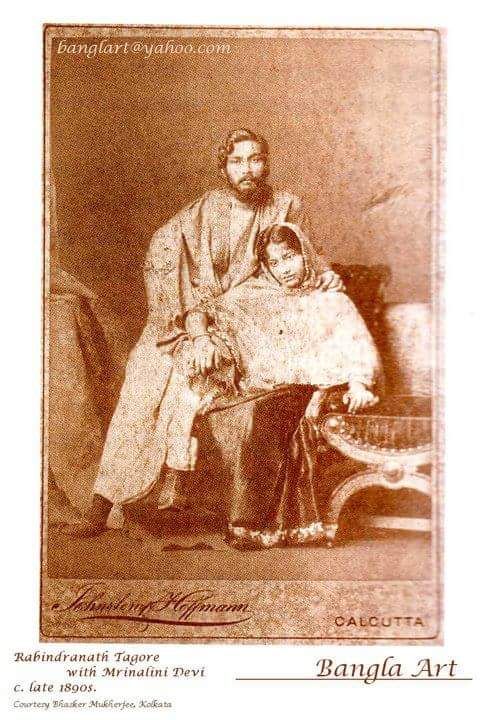
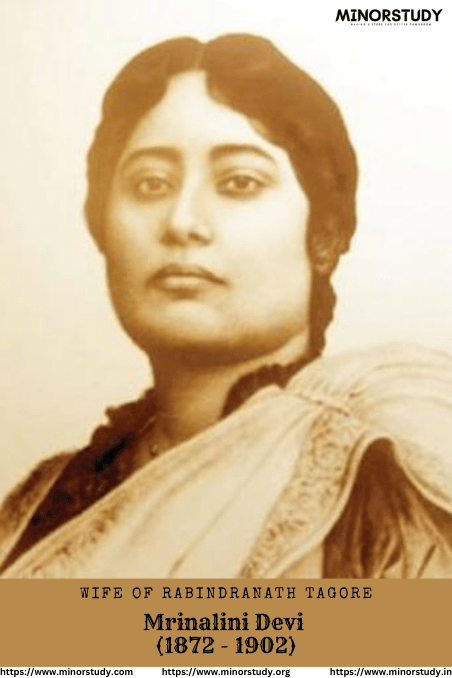
Acche Dukho, Acche Mritu (Sorrow Exists, Death Exists) was written by Tagore when his wife, Mrinalini Devi, died in 1902. His lyrics have been translated by Professor Fakrul Alam.
Photos from Public Domain
Sorrow exists, death too; partings scald as well
And yet peace, and yet delight, arise eternally.
Life goes on; the sun, moon and stars keep smiling!
Spring comes to gardens singing varied tunes.
Waves scatter and fling themselves up again.
Where old flowers shed, new flowers blossom.
Overall, there’s no decay, no lasting misery,
And in such fullness the mind seeks solace
A rendition of Tagore’s song by the legendary Debabrata Biswas (1911-1980)
Ratnottama Sengupta muses on acts of terror and translates a Bengali poem by Tarik Sujat which had come as a reaction to an act of terror. Click here to read.
Renee Melchert Thorpe recounts her mother’s migration story, hopping multiple countries, starting with colonial Calcutta and Darjeeling. Click here to read.
Paul Mirabile wanders into the realm of the supernatural dating back to the Potato Famine of Ireland in the 1800s. Clickhere to read.
Conversations
In conversation with eminent Singaporean poet and academic, Kirpal Singh, about how his family migrated to Malaya and subsequently Singapore more than 120 years ago. Click hereto read.
There was a time when humans walked the Earth crossing unnamed landmasses to find homes in newer terrains. They migrated without restrictions. Over a period of time, kingdoms evolved, and travellers like Marco Polo talked of needing permissions to cross borders in certain parts of the world. The need for a permit to travel was first mentioned in the Bible, around 450BCE. A safe conduct permit appeared in England in 1414CE. Around the twentieth century, passports and visas came into full force. And yet, humanity had existed hundreds of thousand years ago… Some put the date at 300,000!
While climate contingencies, wars and violence are geared to add to migrants called ‘refugees’, there is always that bit of humanity which regards them as a burden. They forget that at some point, their ancestors too would have migrated from where they evolved. In South Africa, close to Johannesburg is Maropeng with its ‘Cradle of Humanity’, an intense network of caves where our ancestors paved the way to our evolution. The guide welcomes visitors by saying — “Welcome home!” It fills one’s heart to see the acceptance that drips through the whole experience. Does this mean our ancestors all stepped out of Africa many eons ago and that we all belonged originally to the same land?
And yet there are many restrictions that have come upon us creating boxes which do not allow intermingling easily, even if we travel. Overriding these barriers is a discussion with Jessica Mudditt about Once Around the Sun: From Cambodia to Tibet, her book about her backpacking through Asia. Documenting a migration more than a hundred years ago from Jullundur to Malaya, when borders were different and more mobile, we have a conversation with eminent scholar and writer from Singapore, Kirpal Singh. Telling the story of another eminent migrant, a Persian who became a queen in the Mughal Court is a lyric by Nazrul, Nur Jahan, translated by Professor Fakrul Alam from Bangla. Ihlwha Choi has self-translated his own poem from Korean, a poem bridging divides with love. Fazal Baloch has brought to us some exquisite Balochi poems by Munir Momin. Tagore’s poem, Okale or Out of Sync, has been translated from Bengali to reflect the strange uniqueness of each human action which despite departing from the norm, continue to be part of the flow.
We have a tongue in cheek piece from Devraj Singh Kalsi on traveling in a train with a politician. Uday Deshwal writes with a soupçon of humour as he talks of applying for jobs. Snigdha Agrawal brings to us flavours of Bengal from her past while Ratnottama Sengupta muses on the ongoing wars and violence as acts of terror in the same region and looks back at such an incident in the past which resulted in a powerful Bengali poem by Tarik Sujat. Kiriti Sengupta has written of a well-known artist, Jatin Das, a strange encounter where the artist asks them to empty fully even a glass of water! Ravi Shankar weaves in his love for books into our non-fiction section. Recounting her mother’s migration story which leads us to perceive the whole world as home is a narrative by Renee Melchert Thorpe. Urmi Chakravorty takes us to the last Indian village on the borders of Tibet. Taking us to a Dinosaur Museum in Japan is our migrant columnist, Suzanne Kamata. Her latest multicultural novel, Cinnamon Beach, has found its way to our book excerpts as has Flanagan’s poetry collection, These Many Cold Winters of the Heart.
In reviews, Somdatta Mandal has written about an anthology, Maya Nagari: Bombay-Mumbai A City in Storiesedited by Shanta Gokhale and Jerry Pinto. Rakhi Dalal has discussed a translation from Konkani by Jerry Pinto of award-winning writer Damodar Mauzo’sBoy, Unloved. Basudhara Roy has reviewed Trailokyanath Mukhopadhyay’s Tales of Early Magic Realism in Bengali, translated by Sucheta Dasgupta. Bhaskar Parichha has introduced us toThe Dilemma of an Indian Liberal by Gurcharan Das, a book that is truly relevant in the current times in context of the whole world for what he states is a truth: “In the current polarised climate, the liberal perspective is often marginalised or dismissed as being indecisive or weak.” And it is the truth for the whole world now.
Our short stories reflect the colours of the world. A fantasy set in America but crossing borders of time and place byRonald V. Micci, a story critiquing social norms that hurt by Swatee Miittal and Paul Mirabile’s ghost story shuttling from the Irish potato famine (1845-52) to the present day – all address different themes across borders, reflecting the vibrancy of thoughts and cultures. That we all exist in the same place and have the commonality of ideas and felt emotions is reflected in each of these narratives.
We have more which adds to the lustre of the content. So, do pause by our content’s page and enjoy the reads!
I would like to thank all our team without who this journal would be incomplete, especially, Sohana Manzoor, for her fabulous artwork. Huge thanks to all our contributors who bring vibrancy to our pages and our wonderful readers, without who the journal would remain just part of an electronic cloud… We welcome you all to enjoy our June issue.
In Dylan on Worm’s Head, Rhys Hughes describes a misadventure that the Welsh poet had while hiking as a tribute to him on Dylan Thomas Day. Clickhereto read.
Munaj Gul gives an in memoriam for a photographer from Balochistan. Clickhere to read.
Musings of a Copywriter
In ‘Is this a Dagger I See…?‘, Devraj Singh Kalsi gives a tongue-in-cheek account of a writer’s dilemma. Click here to read.
Notes from Japan
In A Golden Memory of Green Day in Japan, Suzanne Kamata tells us of a festival where she planted a tree in the presence of the Japanese royalty. Click here to read.
Perhaps when Dylan Thomas wrote these lines, he did not know how relevant they would sound in context of the world as it is with so many young dying in wars, more than seven decades after he passed on. No poet does. Neither did he. As the world observes Dylan Thomas Day today — the day his play, Under the Milkwood, was read on stage in New York a few months before he died in 1953 — we have a part humorous poem as tribute to the poet and his play by Stuart McFarlane and a tribute from our own Welsh poet, Rhys Hughes, describing a fey incident around Thomas in prose leading up to a poem.
May seems to be a month when we celebrate birthdays of many writers, Tagore, Nazrul and Ruskin Bond. Tagore’s birthday was in the early part of May in 1861 and we celebrated with a special edition on him. Bond, who turns a grand ninety this year, continues to dazzle his readers with fantastic writings from the hills, narratives which reflect the joie de vivre of existence, of compassion and of love for humanity and most importantly his own world view. His books have the rare quality of being infused with an incredible sense of humour and his unique ability to make fun of himself and laugh with all of us.
Nazrul, on the other hand, dreamt, hoped and wrote for an ideal world in the last century. The commonality among all these writers, seemingly so diverse in their outlooks and styles, is the affection they express for humanity. Celebrating the writings of Nazrul, we have one of his fiery speeches translated from Bengali by Radha Chakravarty and a review of her Selected Essays: Kazi Nazrul Islam by Somdatta Mandal. An essay from Niaz Zaman dwells on the feminist side of Nazrul while bringing in Begum Roquiah. Zaman has also shared translations of his poetry. Professor Fakrul Alam, who had earlier translated Nazrul’s iconic ‘Bidrohi or Rebel‘, has given us a beautiful rendition of his song ‘Projapoti or Butterfly’ in English. Also in translation, is a poem by Tagore on the process of writing poetry. Balochi poetry by Manzur Bismil on human nature has been rendered into English by Fazal Baloch and yet another poem from Korean to English by Ilwha Choi.
Ratnottama Sengupta this month converses with a dancer who tries to build bridges with the tinkling of her bells, Sohini Roychowdhury. Gita Viswanthan travels to Khiva in Uzbekistan, historically located on the Silk Route, with words and camera. An essay on Akbar Barakzai by Hazran Rahim Dad and another looking into literature around maladies by Satyarth Pandita add zest to our non-fiction section. Though these seem to be a heterogeneous collection of themes, they are all tied together with the underlying idea of creating links to build towards a better future.
In focus this time is a writer whose prose is almost akin to poetry, Rajat Chaudhuri. A proponent of solarpunk, his novel, Spellcasters, takes us to fictitious cities modelled on Delhi and Kolkata. In his interview, Chaudhuri tells us: “The path to utopia is not necessarily through dystopia. We can start hoping and acting today before things get really bad. Which is the locus of the whole solarpunk movement with which I am closely associated as an editor and creator…”
On that note, I would like to end with a couple of lines from Nazrul, who reiterates how the old gives way to new in Proloyullash (The Frenzy of Destruction, translated by Alam): “Why fear destruction? / It’s the gateway to creation!” Will destruction be the turning point for creation of a new world? And should the destruction be of human constructs that hurt humanity (like wars and weapons) or of humanity and the planet Earth? As the solarpunk movement emphasises, we need to act to move towards a better world. And how would one act? Perhaps, by getting in touch with the best in themselves and using it to act for the betterment of humankind? These are all points to ponder… if you have any ideas that need a forum on such themes, do share with us.
We have more content which has not been woven into this piece for the sheer variety of themes they encompass. Do pause by our content’s page and browse on all our pieces.
With warm thanks to our wonderful team at Borderless — especially Sohana Manzoor for her fabulous art — I would like to express gratitude to all our contributors, without who we could not create this journal. We would also like to thank our readers for making it worth our while to write — for all of our words look to be read, savoured and mulled, and maybe, some will evolve into treasured wines.
Projapoti or Butterfly by Nazrul, translated by Professor Fakrul Alam
Projapoti! Projapoti!

Butterfly, dear butterfly,
From where did you get such colourful wings?
Wings flaming red and blue,
Such sparkling, wavy wings!
I see you getting drunk sipping the honey of wildflowers.
Be my friend; share some of the liquor with me.
Lend me your pollen-tinted golden-silvery wings as well.
My mind doesn’t like the idea of going to school anymore.
Butterfly, dear butterfly—please, please take me along
As your companion. You dance in the wind as you go…
This day, why not share your delight with me too?
I don’t want to wear the dress I have on anymore.
Let me wear your flaming, sparkling dress from now on!
A rendition of the song in Bengali by a legendary singer, Feroza Begum (1930-2014)
Born in united Bengal, long before the Partition, Kazi Nazrul Islam(1899-1976) was known as the Bidrohi Kobi, or “rebel poet”. Nazrul is now regarded as the national poet of Bangladesh though he continues a revered name in the Indian subcontinent. In addition to his prose and poetry, Nazrul wrote about 4000 songs.
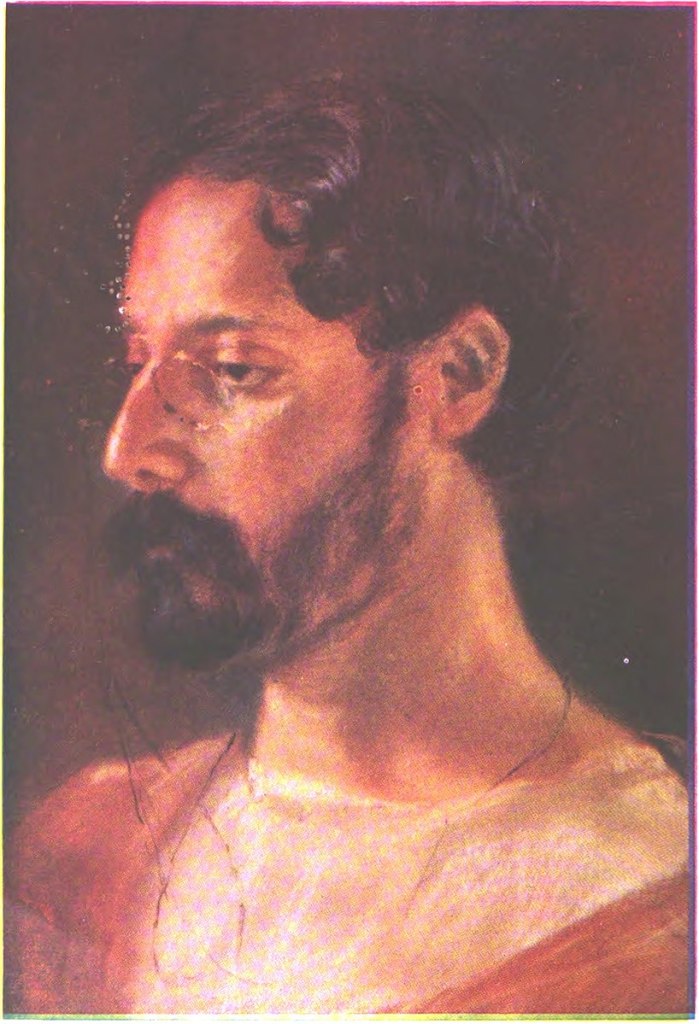
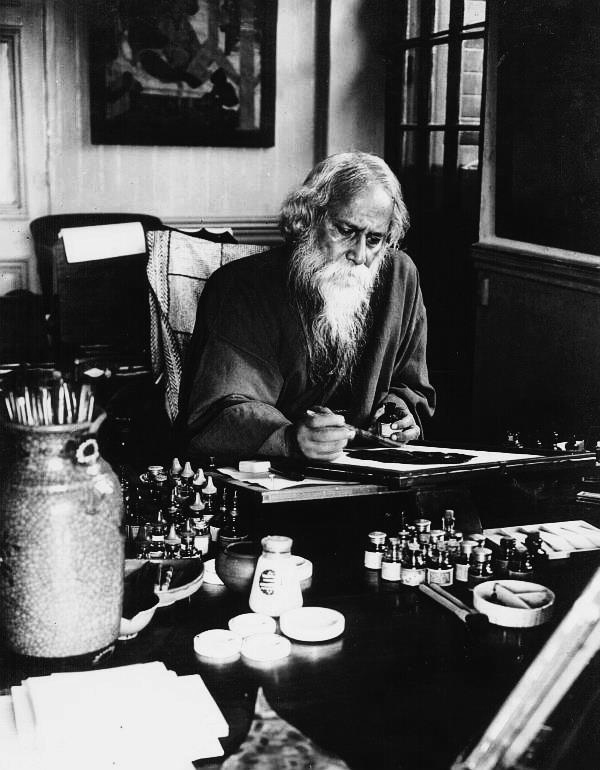
Portraits of Tagore by his nephew, Abanindranath Tagore (1871-1951)
Rabindranath Tagore (1861-1941) has a unique place in many lives. His works continue to impact us. His songs continue to feel relevant. It is not easy to grasp him in totality, to comprehend how he towered over divisive constructs created by humans with his work at Sriniketan and Santiniketan, funded eventually by his Nobel Prize money that poured in with his writings. We all unite not just under the umbrella of his writings and wisdom, but also seek solutions from his life and times — a period of dynamic changes, a renaissance. Can we find these answers? Is it to be found in the breeze that wafts across boundaries at war… or in an eternity where he continues to touch hearts…
For many of us who have not grown up listening to Tagore songs and know of him as a distant figure, here is an attempt to bring his life to you starting with the naming of the infant Rabindranath — reimagined by Aruna Chakravarti, to his first trip out of his cloistered home in Jorsanko and his first experience of snow as he went to study in England — both translated from his writings by Somdatta Mandal. We have a transcreation of a poem he wrote celebrating his birthday on pochishhe boisakh where he shares the joy of his birth with all of us. We wind up translations with Ratnottama Sengupta’s rendition of a song where he offers his lyrics to all those who are willing to listen.
Showcasing the current relevance of Tagore is a brief musing from Sengupta. To relate the wonder of Tagore’s lyrics, we have writings from professor Fakrul Alam and Asad Latif, who contend how Tagore continues evergreen…
Birth
The Naming of Rabindranath: Aruna Chakravarti shares how he chanced upon the name Rabindranath in this excerpt from Jorasanko. Click here to read.
Joys of Living
Himalaya Jatra ( A trip to Himalayas) by Tagore, has been translated from his Jibon Smriti (1911, Reminiscenses) by Somdatta Mandal from Bengali. This records his first trip out of Jorasanko as a teenager. Click here to read.
Baraf Pora (Snowfall) by Rabindranath Tagore, gives a glimpse of his first experience of snowfall in Brighton and published in the Tagore family journal, Balak (Children), has been translated from Bengali by Somdatta Mandal. Clickhereto read.
Pochishe Boisakh (25th of Baisakh), a birthday poem by Tagore(1922), has been translated from Bengali by Mitali Chakravarty. Click here to read.
Bhumika (Introduction) by Tagore has been translated from Bengali by Ratnottama Sengupta. Click here to read.
Professor Fakrul Alam muses on the impact of Tagore in his life. Click here to read.
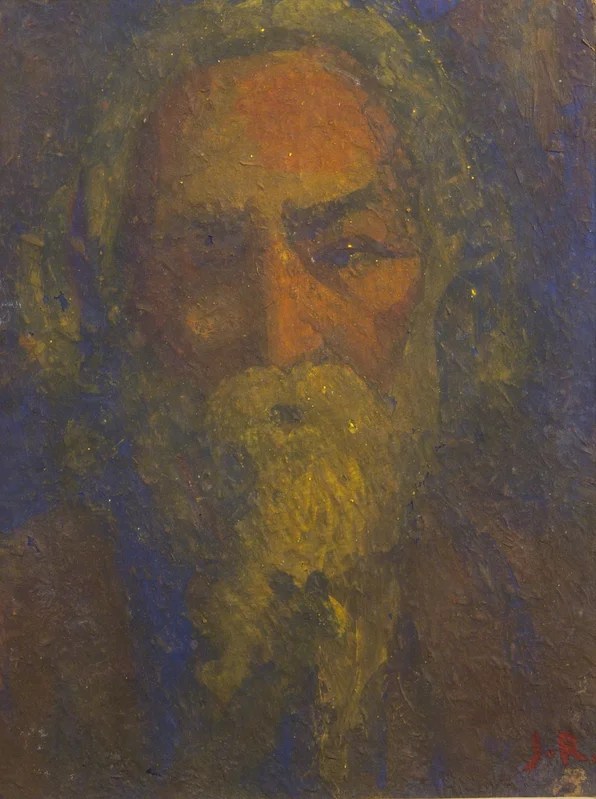
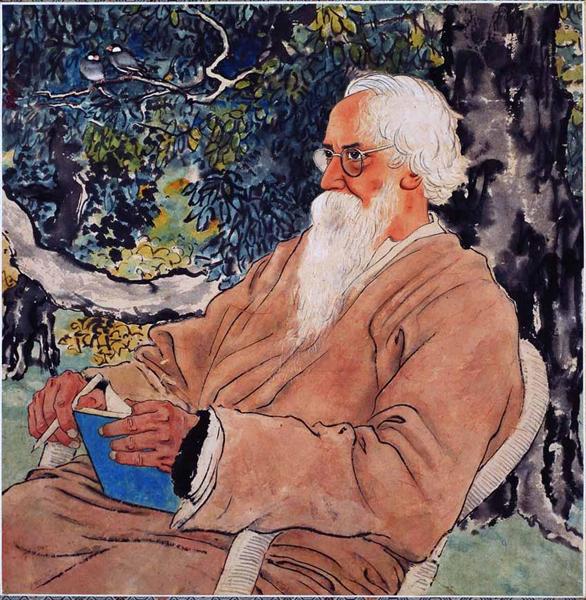
Portrait of Tagore by Jamini Roy (Indian Artist, 1887-1972)Portrait of Tagore by Xu Beihong ( Chinese Artist, 1895-1953)
Celebrate Tagore’s legacy not only with translations but with a unique discussion on Tagore between Aruna Chakravarty and the late Sunil Gangopadhyay (1934-2012). The discussion took place under the auspices of Sahitya Akademi during the celebration of 150 years of Tagore. The book is available online on Amazon, in Om and more bookstores in India and in Bookworm, Bangladesh.
Baraf Pora (Snowfall) by Rabindranath Tagore,gives a glimpse of his first experience of snowfall in Brighton and published in the Tagore family journal, Balak (Children), has been translated from Bengali by Somdatta Mandal. Clickhere to read.
Himalaya Jatra( A trip to Himalayas) by Tagore, has been translated from his Jibon Smriti (1911, Reminiscenses) by Somdatta Mandal from Bengali. Click here to read.
Bhumika (Introduction) by Tagore has been translated from Bengali by Ratnottama Sengupta. Click here to read.
The Fire-grinding Quern by Manzur Bismil has been translated from Balochi by Fazal Baloch. Clickhere to read.
The Tobacco Lover by Ihlwha Choi has been translated from Korean by the poet himself. Clickhere to read.
Pochishe Boisakh(25th of Baisakh) by Tagore(1922), has been translated from Bengali by Mitali Chakravarty. Click here to read.
Pandies Corner
Songs of Freedom: Dear Me… is an autobiographical narrative by Ilma Khan, translated from Hindustani by Janees. These narrations highlight the ongoing struggle against debilitating rigid boundaries drawn by societal norms, with the support from organisations like Shaktishalini and pandies’. Click here to read.
Paul Mirabile gives a gripping tale about a young pyromaniac. Click hereto read.
Conversation
Ratnottama Sengupta in conversation about Kitareba, a contemporary dance performance on immigrants, with Sudarshan Chakravorty, a choreographer, and founder of the Sapphire Dance Company. Click here to read.
Apnake jana amar phurabe na/Ei Janare shongo tomai chena/

There will be no end to my discovery of myself/And this discovery keeps coming with my discovery of you
On the one hand, Rabindranath Tagore [1861-1941] has been with me almost all my life. On the other, I only began to discover that I had Rabindranath so centrally in me relatively late in my life. In fact, I have now realised that the process of discovering the way he has been embedded in me is part of the process of discovering my own self in the course of the life that I have been leading till now. Indeed, at this stage of my life, it seems to me that there will be no end to my discovery of the way Rabindranath has become part of my consciousness since I feel that there will be no end to discovering myself till I lose consciousness once and for all. The one thing I can say with certainty, using his words but in my translation is “There will be no end to my discovery of myself.” For sure, this process of discovering myself endlessly keeps happening with my continuing discovery of Rabindranath.
Surely, the process through which Rabindranath had become embedded in me began in childhood. However, I did not encounter his work in my (English medium) textbooks since I did not learn Bengali in school for a while. How then did I come to remember poems such as “Tal gach ek paye dariye/shob gach chareea/ Uki mare akaashe” (Palmrya tree, Standing on one foot/Exceeding all other trees/Winking at the sky”) or “Amader Choto Nadi chole bnake bnake” (“Our little river keeps winding its way”). How do I remember these opening lines even now? And why do I still associate such palm trees and winding little rivers with these lines even now whenever I am in the Bangladeshi countryside? Surely, it must have been my mother who planted Rabindranath in me in my seed time so that he would become embedded in my unconscious, only to surface in my consciousness decades later. It is surely no coincidence that she taught me Bengali and made me learn Rabindranath’s poems indirectly.
As a boy growing up at a time when the radio was the main source of entertainment in middle-class Bengali houses, my siblings and I were made to listen to Rabindra Sangeet in our house by my father, who felt that he had to share his favourite songs and singers in the musical genre with us, whether we wanted to listen to them or not. Of course, at that age I would have much rather not listen to those solemn-sounding, soulful songs, and whenever I could put my hands on the radio dials, I would listen to English popular music on Radio Ceylon. My favourite singers were Pat Boone, Elvis Presley, Cliff Richards and—a little later—the Beatles. In school, when we were not playing or talking about sports or girls, we boys would be discussing the pop music we heard on Radio Ceylon. By the end of the 60s, we would be talking about the English thrillers and comedies we saw on Dhaka television. What place could Rabindranath have in one’s life then? If Rabindranath had been placed in my innermost self by my mother through her reading of his poems to us children or my father through his addiction to Rabindra Sangeet, for the moment he was getting occluded deep inside me and, it would now seem, all but forgotten!
But from the middle of the 1960s, our lives in Dhaka began to change as the claims of Pakistan on us East Pakistanis started to loosen, little by little. It was a time when in neighbourhoods and on streets, processions would come out singing gonosangeet—literally songs of the people, but in effect music of protest and patriotism. First, the Six Points Movement and then the Agartala Conspriacy case were on everyone’s lips and East Pakistanis everywhere were becoming activists in one way or the other. There was no escaping songs like “Shonar Bangla” (“Golden Bengal”) or “Banglar mati, banglar jol, banglar baiuo, banglar phol/Punno houk”” ( “Let the land, the waters, the air and fruits of Bengal be blessed…) and “Bartho Praner Aborjona Purea Phele Agun Jalo” (“Burn the frustrated soul’s detritus and light up a flame”). In my school where we boys now studied “Advanced English” and “Easy Bengali”. There was no way we could have learned enough Bengali to read Rabindranath or Nazrul in the original in any sustained attempt, but how could we escape the call from such songs and poems like Nazrul’s “Bidrohi” (“The Rebel”) or the call from the streets to protest and even burn for our emancipation? At home, three of my four sisters would be practicing Rabindra Sangeet regularly, since this was what my parents wanted them to do, and so there would be no evading Rabindranath’s songs at home for this reason as well, but I was more interested in friends and sports than staying home and so I would hear the songs only in snatches at this time.
By the end of the decade though, Rabindranath was everywhere in our lives since becoming Bengali became first and being a Pakistani only came later. Even on Dhaka Television, Rabindranath’s songs and dance numbers were being aired fairly regularly then. Outside, one could get to see his plays and dance dramas being performed every now and then in functions and cultural events all over the city. He would soon become an important part of Pohela Boisakh, which itself would become instantly popular amongst us all almost as soon as Chhayanaut[1] organised the first event in Balda Garden as the decade came to a close. But while Rabindranath was everywhere around me all of a sudden, I was still not reading him at all, preferring English thrillers and westerns initially, and later, when I became a “serious” reader from college onwards, contemporary classics of English and European literature available in English editions.
In the early seventies, however, you could not be in Bangladesh without imbibing Rabindranath at least a little, for there was a process of osmosis at work at this time. Glued as we were to Swadhin Bangla Betar Kendro[2] during our Liberation War[3], we kept listening to his patriotic songs on our radios; the promise of Shonar Bangla seemed alive and possible then. The years after liberation, my generation was exposed to Rabindranath in new ways; we would get to hear and view singers like Kanika, Debobroto and Suchitra Mitra on stage in Dhaka; their songs became freely available in tapes in our shops; and Satyajit Ray’s film version of Rabindranath’s fiction and Ray’s documentary on him became staples of Dhaka’s film societies. I was finally growing up intellectually and was hungry for culture, and so how could I have escaped the poet’s works totally at this time?
But the Rabindranath that I was imbibing thus was almost entirely coming to me aurally and visually. Because he was becoming embedded in my consciousness through songs and the silver screen as well as television, he still inhabited the surface of my consciousness. And I was certainly not making any conscious bid to savor him. The seventies and the eighties were, in fact, decades when I was becoming an even more “serious” student of English literature than before and getting “advanced” degrees in my subject and acquiring expertise for my teaching career; where would I get the time to read Rabindranath then? As an expatriate student for six years in Canada and as a visiting faculty member for two years in the USA, I would be getting small doses of Rabindranath in those countries through the songs I kept hearing in the cassettes I had brought along of my favorite singers and in the occasional film versions of his work that I would get to see because of campus film societies, and I suppose nostalgia played a part in my yearning for him then, but I had no time to spare for him and not enough exposure to his works to let his ideas and his achievement resonate in me in any way.
To sum up my encounters with Rabindranath till then, I was discovering Rabindranath in small doses all the time and experiencing him directly here and there, but my knowledge was all very superficial and my understanding of him too limited. And nothing much had happened that would allow me to tap into the unconscious where all the memories of poems and songs by him I had first come across through my parents’ enthusiasm for his works were hidden.
“Dekha hoi nai chokkhu melia/Ghor hoite shudhu dui pa felia”/

“I haven’t seen with my eyes wide open/what was there only a stride or two away from my house”
In the 1980s, I became smitten by theory, especially the works of Edward Said, and suddenly questions of postcoloniality, ideology, power and location became all-important for my understanding of literature. I was coming around to the belief that I could not be a good and truly advanced student of English literature in Bangladesh, let alone a good teacher of the subject here, unless I sensitised myself to my roots and look at the world around me. And now I remembered some lines I had been hearing since childhood without realising their relevance for me and everyone else around us then: “Dekha hoi nai chokkhu melia/Ghor hoite shudhu dui pa felia” (“I haven’t seen with my eyes wide open/What was there only a stride or two away from my house”). Rabindranath had been all around me and yet I had not opened my eyes wide enough to learn from him. I had not read his works with any kind of sensitised attention at all and I had not been able to arrive at any kind of appreciation of his achievements except the smug sense of self-satisfaction at the thought that this Bengali had once won the Nobel Prize.
Towards the end of the 1990s, for the first time really, I plunged into Rabindranath and found—to quote Dryden on Chaucer— “here was God’s plenty”. Having opened my eyes to him I realized that there was so much to him than one could take in at any one time. He had once said in a song about the infinite contained in the finite and I now thought, “How appropriate of him!” He had said in one of his most famous poems, “Balaka[4]” about how one must not succumb to stasis and how the essence of life is motion and I thought, “how inspirational!” He had written in a song about viewing the Ultimate Truth through music and I thought “Exactly!” He had looked on in amazement in a starry night at how humans have a place in the cosmos (Akaash Bhora Surjo Tara[5]) and I thrilled at the idea now. He made me see the monsoonal kadam flower that I had passed every year without blinking an eye as immensely lovely. Every poem that I read enlightened me, every song lent my soul harmony, every short story or novel took me to eternal truths about human relationships. Who would not learn from a man who had been given some of the highest honors the world has offered any human being, when he says with such unambiguous humility, “Mornam ei bole khati houk/Aami tomaderi lok…” Let this be my claim to fame/I am all yours/This is how I would like to be introduced.” And so I kept reading him in between teaching and writing, finding him an endless source of inspiration, creativity and wisdom. I strove to learn about nature, the universe, people, relationships, beauty and the dark side of humans through his works. And soon I felt compelled to translate some of them.
Rabindranath, then, opened my eyes not only to the world I lived in but also helped me discover my own self as a product of forces that had taken our nation past 1947 to true liberation. He helped root me in Bengali and Bangladesh as never before, making me discover myself not merely as a Bengali but as a citizen of the world, a product of a certain history but also of the history of mankind. My discovery of him and my place in the world was furthered by the work I did in co-authoring The Essential Tagore and authoring a collection of essays on diverse aspects of his work.
But Rabindranath truly contains multitudes. What I now realise is that it is impossible to discover him fully in one life, especially when one embarks on the process of discovery so late in life. By now, therefore, I have despaired of knowing the whole man and feel I will get to know only parts of him. But I also know whatever I read of him will enlighten me and make me know myself better in every way than before. And so I’ll keep reading him and translating him, if only to know him and myself better in the days left for me!
[1] Centre for promotion of Bengali Culture established in 1961
Celebrating poetry around the world, our focus this year is on refugees, immigrants or poetry by migrants… In a way, we are all migrants on this Earth and yet immigration for both climate and war has created dissatisfaction in the hearts of many. Can mankind unify under the single blue dome which covers all our home?
“The Journey” by Alwy Fadhel, an asylum seeker to Australia. The piece is included in the Exile collection of the Refugee Art Project. Art from Public Domain.
We start by welcoming migrants from Jupiter but how do we react to human migrants within Earth… ?
All the Way from Jupiter

By Rhys Hughes

All the way
from Jupiter came the refugees,
their heads
made of hydrogen,
and helium, their knees.
No one cried:
depravity!
for we were pleased
to help them
relocate to Earth: we offered
them homes
inside plastic domes
uncrowded but
full of swirling clouds
blown by the music of
fierce trombones
to mimic the crushing gravity.

All the way
from one of our homegrown
war zones
came refugees on their knees
and we said:
no, no, no, and no again!
Go back home right now,
be killed,
assaulted,
it’s all your own fault
for being born here on Earth.
The newcomers
from Jupiter are tubular
like cucumbers,
but men, women and children
like yourselves
aren’t welcome.
And what do refugees from war-torn zones on Earth have to add?These are poems by those who had to escape to safety or move homes for the sake of conflict.
I am Ukraine brought to us by Lesya Bakun, while she was on the run from her home to a place of refuge outside her homeland. Click here to read.
Immigrant’s dream brought to us by Ahmad Al-Khatat, who migrated from Iraq to the West to find sustenance. Click here to read.
In some cases, the wounds lingered and the progeny of those who escaped earlier conflicts give voice to past injuries as well as some immigrants who wandered to find a better life share their experiences.
In 1947, Masha Hassan writes of her grandmother’s plight during the Partition of the Indian Subcontinent. Click here to read.
Birth of an Ally reflects Tamoha Siddiqui’s wonder with new flavours she experiences away from her original homeland. Click here to read.
Two Languages by Luis Cuauhtémoc Berriozabal explores linguistic diversity in immigrants. Click here to read.
These could be listed as turns of history that made people relocate.
Red Shirt Hung from a Pine Treeby Ryan Quinn Flanagan takes two issues into account — violence against humanity and colonial displacement of indigenous people — is that migration? Click here to read.
Products of War by Mini Babu talks of the displacement of humanity for war. Click here to read.
Some empathise with those who had to move and write of the trauma faced by refugees.
Migrant Poems by Malachi Edwin Vethamani reflect on migrants and how accepted they feel. Click here to read.
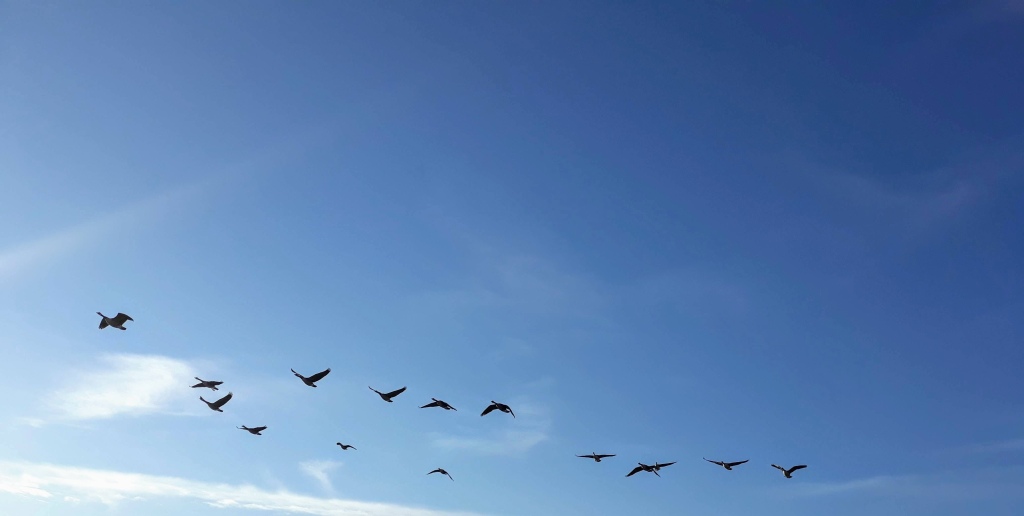
Birds in Flight by A Jessie Michael empathises with the plight of refugees. Click here to read.
The Ceramicist by Jee Leong Koh records the story of a migrant. Click here to read.
And some wonder about the spiritual quest for a homeland… Is it a universal need to be associated with a homeland or can we find a home anywhere on Earth? If we stretch the definition of homeland to all the planet, do we remain refugees or migrants?
Anywhere Particular by Wendy Jean MacLean reflects on the universality of homes — perhaps to an extent on nomadism. Click here to read.
Where is Home? by Shivani Shrivastav meditates on the concept of home. Click here to read.
Sparrows, a poem translated from Korean by the poet — Ihlwha Choi — questions the borders drawn by human laws. Click here to read.
Journey of Hope by Tagore has been translated from Bengali by Mitali Chakravarty. It explores the spiritual quest for a home. Click here to read the poem in English and listen to Tagore’s voice recite his poem in Bengali.
Some look forward to a future — perhaps in another galaxy — post apocalypse.
In Another Galaxy by Masud Khan translated from Bengali by Fakrul Alam wonders at the future of mankind. Click here to read.
And yet others believe in the future of humankind.
We are all Human by Akabar Barakzai, translated from Balochi by Fazal Baloch, is a paean to humanity. Click here to read.
We are all Human
By Akbar Barakzai...
Russia, China and India, Arabs and the New World*, Africa and Europe, The land of the Baloch and Kurds -- Indeed, the whole world is ours. We are all human. We are all human...





 Borderless