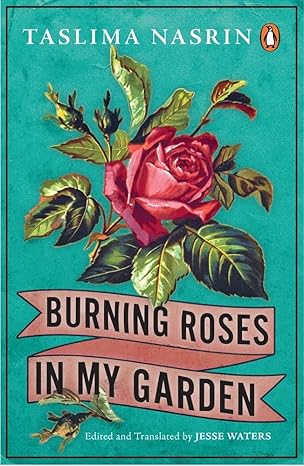
Imagine a woman bound by shackles – not of iron, but of her own people, her country, her religion, and above all, by men. This is not just a metaphor; it is the reality that moulded Taslima Nasrin’s life and journey as a writer. Her first English poetry collection, Burning Roses in My Garden (translated and edited by Jesse Waters), gathers 103 poems that bear the scars of exile and the defiance of survival.
Nasrin, hounded by fatwas and banned for her unflinching criticism of patriarchy and religious dogma in Bangladesh, writes from the margins yet refuses to be silenced. The anthology commences with early meditations on passion and desire, seen in poems like ‘A Bouquet of Scarlet Envy’ and ‘On Love’, toward darker elegies like ‘The Cycle of Loneliness’, ‘Walking through This Life and into Death’, and ‘Am I Not to Have a Country of My Own?’ that grapple with loneliness, mortality, and the burden of political banishment. These poems become the very tools with which she breaks the restraints, not to escape them, but to forge them into weapons of truth.
The collection opens with poems like ‘On Love’, which delve into romantic love and intimacy as the poet tenderly explores physical connection through sensory detail. In the piece ‘The Last Kiss’, the poet reminisces about a lover’s touch that transcends geographical boundaries. “That kiss that brought an entire world within her grasp, /…a rush of youth, /His kiss was becoming more than him,” compares her memories to permanent imprints. These early poems in the collection reveal a different register – more vulnerable, more willing to dwell in private emotions rather than public testimony. It creates a counterpoint to the later poems of exile and loss, suggesting what was left behind when she was forced to choose between fragile love and unwavering candour.
Through images of loss and displacement, which work both as wound and testimony, the poet confronts her banishment with stark honesty: “To me, my country is now a crematorium. /A lonely dog stands and whines all night, a few/Pyre-makers lie here and there, drunk to the bone.” In her traversal of exile, she transforms personal anguish into universal questions of belonging and continues to write from a place of loss. Her voice carries the weight of those who cannot speak, turning poetry into both elegy and resistance.
Feminist consciousness also flows through Nasrin’s verses with unflinching directness. In ‘Another Life’, she exposes the grinding reality of women’s domestic servitude through devastating metaphor: “Women spend half of their lives picking stones from rice. /Stones pile up in their hearts.” The image suggests not only physical drudgery but emotional calcification – the heart itself becoming a repository of unspoken grievances. Her feminist vision extends beyond individual suffering to collective oppression, revealing how patriarchal structures trap women in cycles of invisible labour.
The poet’s political views turn philosophical, confronting mortality while examining the cost of speaking truth to power through the lens of displacement and exile. This progression from the collection’s early love poems to these darker meditations reflect not only her growing maturing but also usher in a socio-political awakening – the recognition that private desire cannot exist separately from public consequence.
Nasrin doesn’t shy away from contemporary political realities; instead, she shows how religious fundamentalism and state censorship became suffocating forces that compress individual expression. She highlights the way authoritarian systems silence dissent through both legal mechanisms and social ostracism. In ‘Am I Not to Have a Country of My Own?’, she directly questions the price of dissent and the meaning of citizenship when one’s own nation rejects its truth-tellers. In contrast, particular tender pieces like ‘Miserable Ma’ highlight the endurance of personal relationships despite geographical separation within the collection’s otherwise relentless critique.
This collection’s strength lies in its refusal to separate the personal from the global. An American poet and professor, Waters preserves Nasrin’s directness in her translation while maintaining the emotional intensity that makes her work so compelling. These poems serve as both autobiography and historical document, charting one woman’s journey from intimate expression to public testimony. Her masterful use of juxtaposition, placing tender domestic moments against brutal political realities, creates a poetic tension that amplifies both spheres of experience.
Ultimately, Burning Roses in My Garden becomes a new mythology of endurance, not the tidy myth that comforts, but a foul-weather myth that survives storms. In the current climate, Nasrin’s poetry resonates with startling immediacy – mass rallies, hardline backlashes, midnight vigils, and student protests – the streets themselves find their voice through her verses. As if to remind us what her poetry truly stands for, the last poem of the collection bears the words: “I don’t write poetry, I write life on paper. /I don’t write poems; the wind that hits my body/When I stand on the top of a hill? I pen it down.” In closing lines like “when all game ends… I’ll sit down to write about love,” Nasrin promises that love’s survival against cruelty becomes an article of faith. The world of the poet and that of the reader blur here, and in that blurring, a strange comfort arrives, a lesson that even in a country’s crematorium, the rose of hope can burn and perfume the air.
Anindita Basak, a student at the University of Calcutta, is an avid enthusiast of literature and philosophy. Her published works include poetry, prose, and reviews in reputed magazines.
PLEASE NOTE: ARTICLES CAN ONLY BE REPRODUCED IN OTHER SITES WITH DUE ACKNOWLEDGEMENT TO BORDERLESS JOURNAL
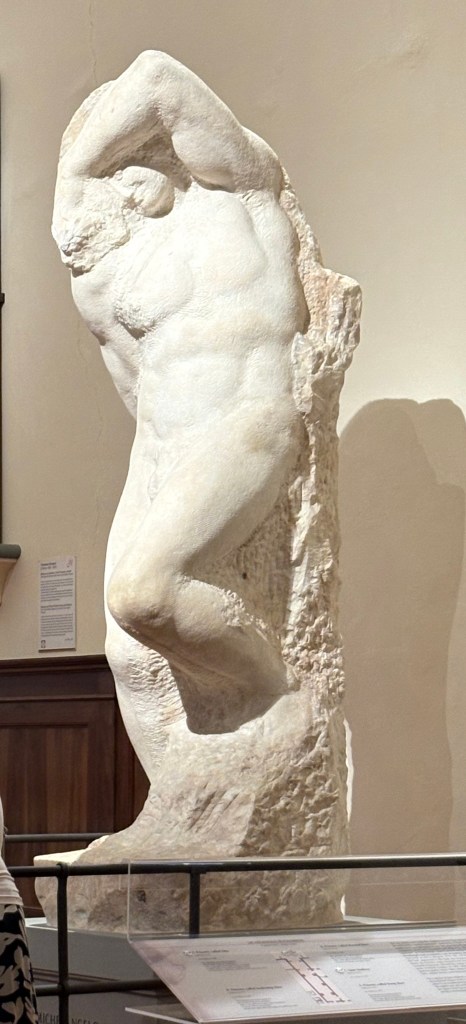
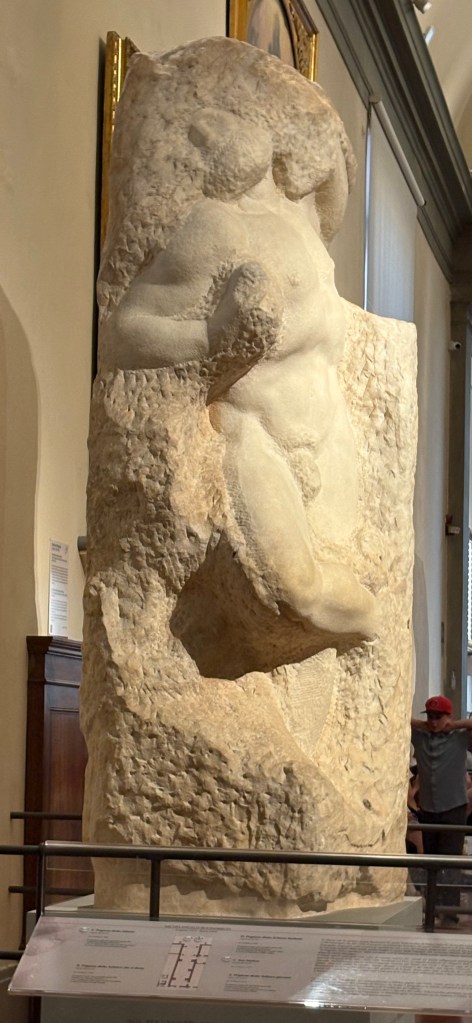
Incomplete statues of Michelangelo in Accademia Gallery, Florence
In the Accademia Gallery, Florence, are housed incomplete statues by Michelangelo that were supposed to accompany his sculpture of Moses on the grand tomb of Pope Julius II. The sculptures despite being unfinished, incomplete and therefore imperfect, evoke a sense of power. They seem to be wresting forcefully with the uncarved marble to free their own forms — much like humanity struggling to lead their own lives. Life now is comparable to atonal notes of modern compositions that refuse to fall in line with more formal, conventional melodies. The new year continues with residues of unending wars, violence, hate and chaos. Yet amidst all this darkness, we still live, laugh and enjoy small successes. The smaller things in our imperfect existence bring us hope, the necessary ingredient that helps us survive under all circumstances.
Imperfections, like Michelangelo’s Non-finito statues in Florence, or modern atonal notes, go on to create vibrant, relatable art. There is also a belief that when suffering is greatest, arts flourish. Beauty and hope are born of pain. Will great art or literature rise out of the chaos we are living in now? One wonders if ancient art too was born of humanity’s struggle to survive in a comparatively younger world where they did not understand natural forces and whose history we try to piece together with objects from posterity. Starting on a journey of bringing ancient art from her part of the world, Ratnottama Sengupta shares a new column with us from this January.
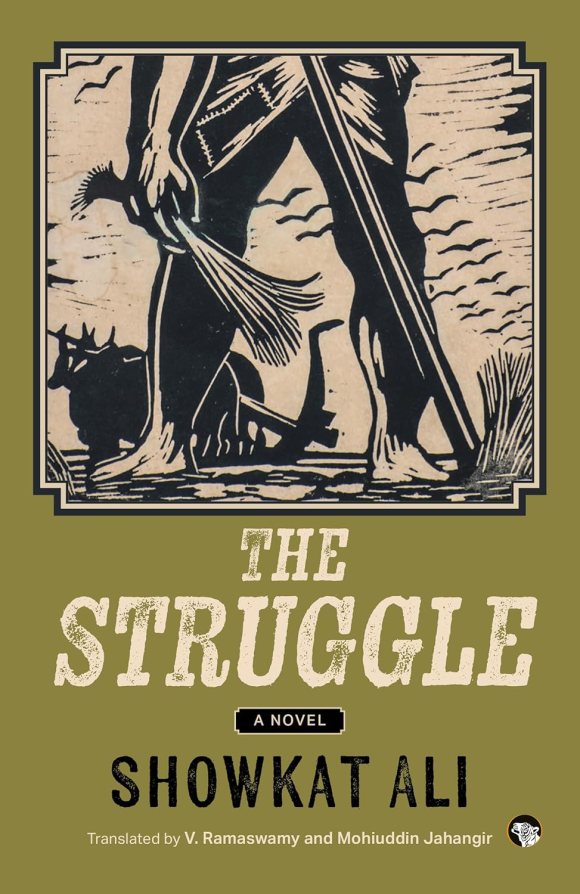
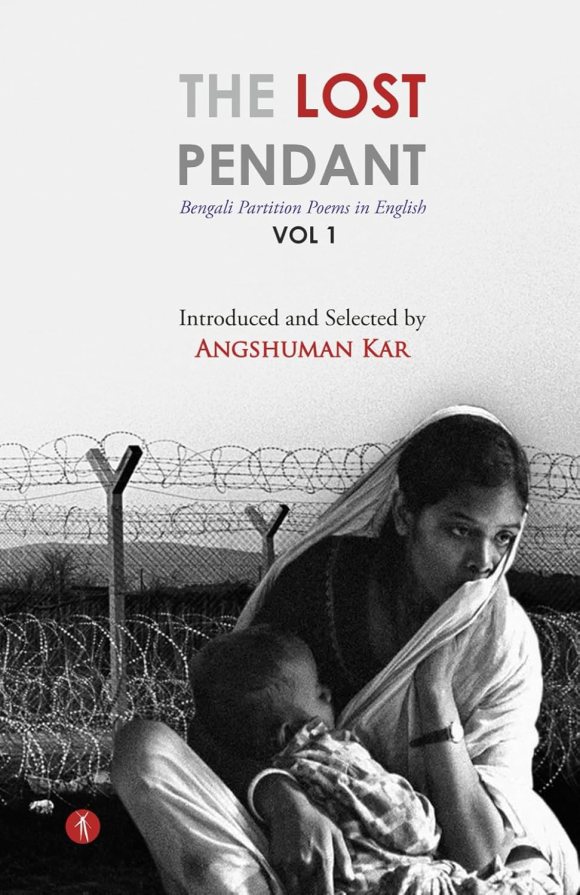
Drenched in struggles of the past is also Showkat Ali’s The Struggle: A Novel, translated from Bengali by V. Ramaswamy and Mohiuddin Jahangir. It has been reviewed by Somdatta Mandal who sees it a socio-economic presentation of the times. We also carry an excerpt from the book as we do for Anuradha Marwah’s The Higher Education of Geetika Mehendiratta. Marwha’s novel has been reviewed by Meenakshi Malhotra who sees it as a bildungsroman and a daring book. Bhaskar Parichha has brought to us a discussion on colonial history about Rakesh Dwivedi’s Colonization Crusade and Freedom of India: A Saga of Monstrous British Barbarianism around the Globe. Udita Banerjee has also delved into history with her exploration of Angshuman Kar’s The Lost Pendant, a collection of poems written by poets who lived through the horrors of Partition and translated from Bengali by multiple poets. One of the translators, Rajorshi Patranabis, has also discussed his own book of supernatural encounters, Whereabouts of the Anonymous: Exploration of the Invisible. A Wiccan by choice, Patranbis claims to have met with residual energies or what we in common parlance call ghosts and spoken to many of them. He not only clicked these ethereal beings — and has kindly shared his photos in this feature — but also has written a whole book about his encounters, including with the malevolent spirits of India’s most haunted monument, the Bhangarh Fort.
Bringing us an essay on a book that had spooky encounters is Farouk Gulsara, showing how Dickens’ A Christmas Carolrevived a festival that might have got written off. We have a narrative revoking the past from Larry Su, who writes of his childhood in the China of the 1970s and beyond. He dwells on resilience — one of the themes we love in Borderless Journal. Karen Beatty also invokes ghosts from her past while sharing her memoir. Rick Bailey brings in a feeling of mortality in his musing while Keith Lyons, writes in quest of his friend who mysteriously went missing in Bali. Let’s hope he finds out more about him.
Charudutta Panigrahi writes a lighthearted piece on barbers of yore, some of whom can still be found plying their trade under trees in India. Randriamamonjisoa Sylvie Valencia dwells on her favourite place which continues to rejuvenate and excite while Prithvijeet Sinha writes about haunts he is passionate about, the ancient monuments of Lucknow. Gulsara has woven contemporary lores into his satirical piece, involving Messi, the footballer. Bringing compassionate humour with his animal interactions is Devraj Singh Kalsi, who is visited daily by not just a bovine visitor, but cats, monkeys, birds and more — and he feeds them all. Suzanne Kamata takes us to Kishi, brought to us by both her narrative and pictures, including one of a feline stationmaster!
We've run away from the simmering house
like milk that is boiling over. Now I'm single again.
The sun hangs behind a ruffled up shed,
like a bloody yolk on a cold frying pan
until the nightfall dumps it in the garbage…

('A Poet in Exile', by Dmitry Blizniuk, translated from Ukranian by Sergey Gerasimov)
In translations, we have Professor Fakrul Alam’s rendition of Nazrul’s mellifluous lyrics from Bengali. Isa Kamari has shared four more of his Malay poems in English bringing us flavours of his culture. Snehaparava Das has similarly given us flavours of Odisha with her translation of Pravasini Mahakuda’s Odia poetry. A taste of Balochistan comes to us from Fazal Baloch’s rendition of Sayad Hashumi’s Balochi quatrains in English. Tagore’s poem ‘Kalponik’ (Imagined) has been rendered in English. This was a poem that was set to music by his niece, Sarala Devi.
After a long hiatus, we are delighted to finally revive Pandies Corner with a story by Sumona translated from Hindustani by Grace M Sukanya. Her story highlights the ongoing struggle against debilitating rigid boundaries drawn by societal norms. Sumana has assumed a pen name as her story is true and could be a security risk for her. She is eager to narrate her story — do pause by and take a look.
In fiction, we have a poignant narrative about befriending a tramp by Ross Salvage, and macabre and dark one by Mary Ellen Campagna, written with a light touch. It almost makes one think of Eugene Ionesco. Jonathan B. Ferrini shares a heartfelt story about used Steinway pianos and growing up in Latino Los Angeles. Rajendra Kumar Roul weaves a narrative around compassion and expectations. Naramsetti Umamaheswararao gives a beautiful fable around roses and bees.
With that, we come to the end of a bumper issue with more than fifty peices. Huge thanks to all our fabulous contributors, some of whom have not just written but shared photographs to illustrate the content. Do pause by our contents page and take a look. My heartfelt thanks to our fabulous team for their output and support, especially Sohana Manzoor who does our cover art. And most of all huge thanks to readers whose numbers keep growing, making it worth our while to offer our fare. Thank you all.
Here’s wishing all of you better prospects for the newborn year and may we move towards peace and sanity in a world that seems to have gone amuck!
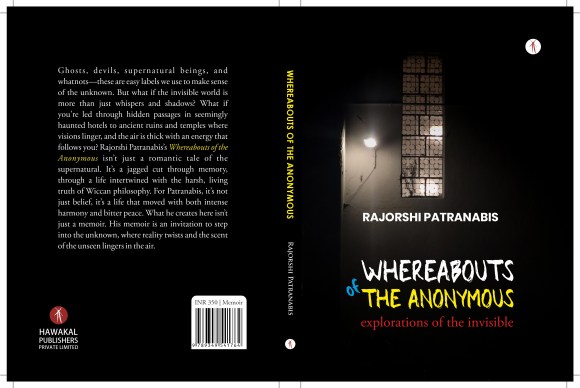
A brief discusion of Whereabouts of the Anonymous: Exploration of the Invisible by Rajorshi Patrnabis, Hawakal Publishers, with an exclusive interview with the author on his supernatural leanings
Whereabouts of the Anonymous: Exploration of the Invisible by Rajorshi Patrnabis could have been a regular book of intense ghost stories, with the oldest ‘presences’ dating back to the regime of Sher Shah Suri (1472 – 1545). ‘Presences’ are basically spirits — visible or barely visible — that cause disturbances in the energy field surrounding us, as per the book.
One of the most coherent of these ‘spirits’ was from 1920, confiding her story on Christmas eve — reminds one of Dickens’ A Christmas Carol and Uncle Scrooge — only this spirit was a British woman from the Raj era, a spirit that lost her beloved who was from a Bengali royal family. Her strict father stepped in and stopped the marriage. No one knew what happened to the groom. And she continued to weep and wait while haunting the premises of the popular and populous Park Street where she was supposed to meet her beloved more than a hundred years ago… Then there’s a ghost that takes you back to his funeral pyre… drawing back the curtain between the two dimensions — one in which we exist and one in which they hover…
These, however, are not your regular ghost stories. There is a difference for Patranabis claims to have met these sad spirits in real life.
A Wiccan by choice, Patranabis has tried to draw back the curtains to reveal a dimension whose existence is elusive and avoidable for most of us at best and rejected by many. He claims to have a spiritual bent of mind which helps him experience these out-of-the-box scenarios, meet the dearly departed. He has done a number of books of poetry around his beliefs. He has even photographed these spirits!
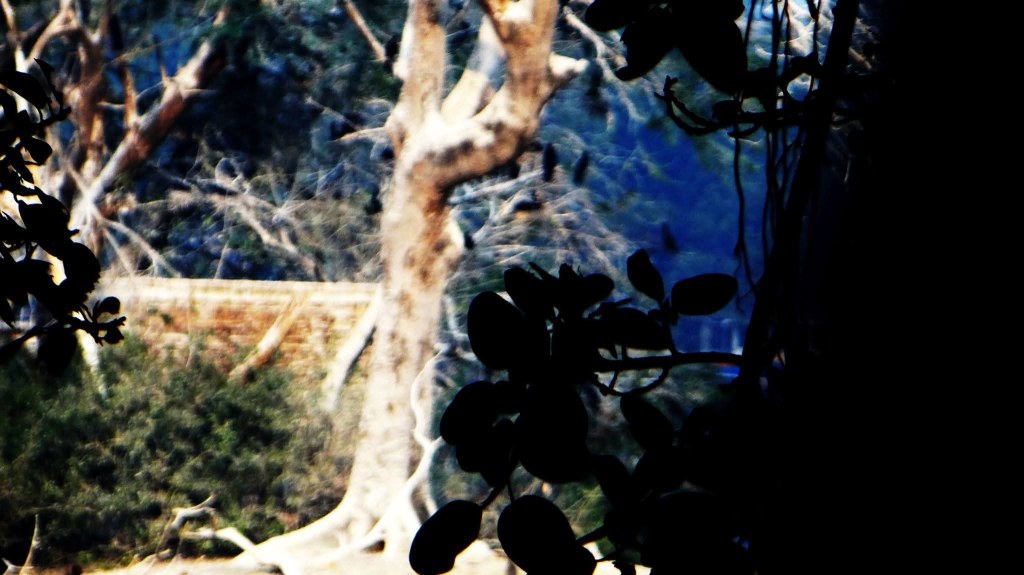
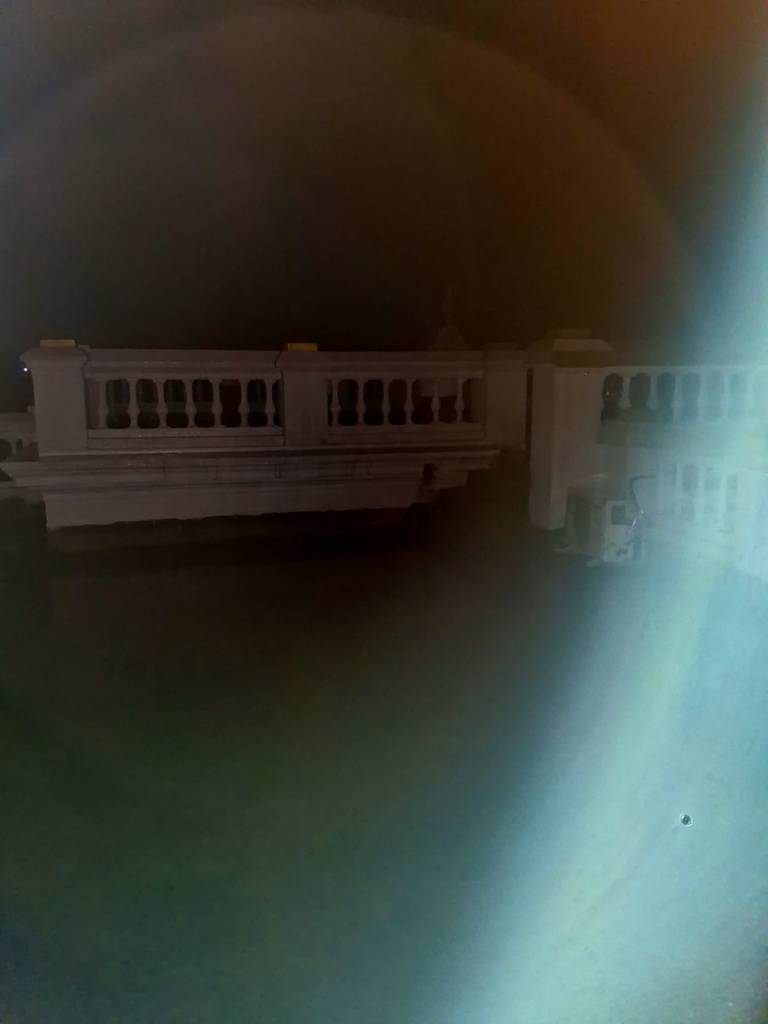
Photographs of spirits by Rajorshi Patranabis
Though the images are blurry at the first viewing, you have to focus hard to see the ethereal outlines of shadows beyond the realm of the living, I guess.
Whereabouts of the Anonymous is a memoir that spans his interactions with, as the title says — ‘the anonymous’ — or the blurry ‘presences’ and explores the invisible for majority of the spirits are merely depicted as shadowy in his narrative as in his photographs except for a few whose images have not been taken.
Occasionally, the spirits can be malevolent as in the Bhangarh Fort, where a foul-smelling female spirit and some lost souls in the ancient jails wounded Patranabis physically and chased him out. Set in the Aravalli hills of Rajasthan. Bhangarh is the most haunted place in India. There is a story of a princess and her spurned lover associated with it. Evidently, a sage fell in love with the princess and made a special concoction which would make her fall in love with him. When she went to buy a perfume, the smitten lover tried to replace it with his love potion. The princess threw away the bottle of love potion. It fell on a rock, dislodging it. The rock rolled down to kill her admirer, who cursed her with his dying breath!
There is also the narrative about a whole village that accepts and lives in peace with the spirits of their dearly departed, even giving them rickshaw rides and offering them chairs!
Patrnanabis has brought his Wiccan outlook into the discourse. His language flows. The narrative is simple and easy to understand. The descriptions are so graphic that one can almost visualise the disembodied spirits and their interactions. The 150-page book is an enjoyable and easy read and a perfect companion for travel or an evening or two. But the author’s experiences and his interests stretch beyond what the pages can hold. In this interview, we discuss his beliefs and his experiences…and maybe, another book?
How old were you when you had your first supernatural sighting? Were you scared the first time?
When I look back, the first time that I had a feel of the ‘other dimension’ was perhaps at the age of 7 or 8. I remember going to my paternal home at Digboi during our winter vacations. I remember going to my parent’s bedroom at the first floor and my mother used had to send me to her room to fetch something. The room was across a terrace, and I remember running through the terrace from the staircase to the room. But every time, I could feel someone running with me through the terrace. But as and when I would enter the room, it was all perfect. I would run back again again to the stairs. When I would blurt this out to my parents, they would simply ignore me, but somehow, I was never completely convinced. It was much later, sometime around the year 2000 that my father confided with me of a real ‘presence’ there. He told me that there had been many an experience where people had felt the presence of something eerie there. But by then I had had some very deep experience of the supernatural existence.
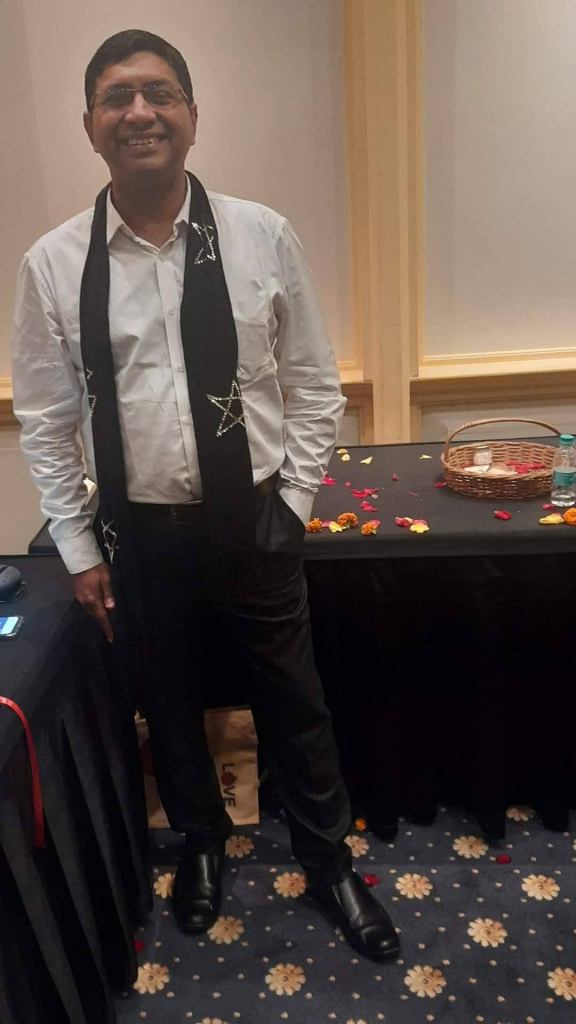
Rajorshi Patranabis in Wiccan wear
When did you become a Wiccan and why?
The answer to this ‘why’ is a wee bit dicey. I am myself not sure of this. It was just a flow that I couldn’t control. Mind you, I had already gone through some extremely remarkable experiences and my stint at the hill top temple and my encounter with that 97 year old person who taught me numerology was way before I joined Wicca. I would call myself pretty insane in those phases of my life. By the time Wicca happened, I had calmed down considerably and joining my teacher was nothing less than an accident. It so happened that my friend, Subhodip, and I were walking down the Southern Avenue in Kolkata when we spotted another school friend ( a senior Wiccan) standing at the door of an otherwise inconsequential book store. He waved at us and asked us to join in, as it was an open session by my teacher. We joined. Subhodip was skeptical, while I followed it up with an email and I was called for an interview with Ma’am. The journey started. I had mentioned about my experience in ‘Whereabouts…’ This was early 2013.
Did becoming a Wiccan help you align to the supernatural better?
Infact, my Wiccan knowledge taught me the nuances of alignment with the forces of nature. Why just the supernatural? The vibrations that the earth emanates, the animal kingdom throws out, to feel and spot across dimensions etc. The most important thing is perhaps the use of sound like the chatter of a rainfall, the melodies of a singing bowl or even drum beats (like in Voodoo) as means of invocation, that, was passed on to me. More than anything, the pleasures of immersing oneself in ancient knowledges can be very ‘intoxicating’. Our school concentrates most on the Egyptian origins. If you ask me now, I worship Goddess Isis as my altar Goddess along with the 64 yoginis. Yes, Wicca has helped align myself to me, if I say this philosophically.
You have called yourself ‘spiritual’ and also spoken of ‘seers’? Can you explain these two terms?
I wouldn’t get into the linguistic trap of English. But a Wiccan would say spiritual comes from ‘spirit’. A very basic tenet of Wicca is to align your body, mind, soul and spirit. As and when the becomes one with nature does your mind uplift itself to being a soul. A soul that gets through the rigours of lust becomes a spirit. We are in the habit of using the word spirituality very lightly, but a true Wiccan would say that a pure spirit sits on the pinnacle of the pyramid. There are many references in our Sanatan scriptures too about such spirits and the recourse they take to leave the body, as and when they cross over.
A seer is a saint who has won over the realms of the physical nuances. He/she is automatically clairvoyant as all their faculties have attained the higher plains in the atmosphere. Please don’t mistake a seer for only a saint. A scientist or a litterateur who had immersed themselves in the claustrophobic depths of knowledge can be a seer too. Many such examples can be sighted to prove this.
How did/does your family respond to your being a Wiccan or interacting with spirits?
My family doesn’t always subscribe to what I do, but in all honesty they had never been a hindrance to my learnings. There are Wiccan ceremonies that I celebrate or spells that I do from time to time for the well being of people, they had all along been very supportive. They stand as a pillar beside me.
When and why did you turn to writing?
I started writing at a very young age. My first poem, if I can recall was at the age of 13. But as time went on, everything slowed down. My next phase was from 2015 and my first published book was in 2018. By this phase I was well and truly into Wicca.
You have used Japanese techniques in poetry to describe your journey as a Wiccan and to interact with spirits. Why? Do these align better to help you describe your experiences?
Well, I wouldn’t say I use Japanese poetry forms to interact with any spirit. Though I must accept that I’ve had communications with the other dimension which were very poetic at times. In my book, Gossips of our Surrogate story, I had used quite a bit from my Wiccan Book of Shadows and even you had accepted that they were poems alright, good or bad, notwithstanding. But I would also like to harp on the inherent pertinence of this question. Gogyokha or Gogyoshi are short form poetry in just 5 lines and my forays into the other dimension had just had similar experiences — short, crisp and at most times life altering. In my Gogyoshi collection, Checklist Anomaly, all the poems are either true happenings or near life occurings. My writing (poetry) as a whole, until now, had been with deep metaphysical love. Perhaps my thought process is challenged. But Japanese forms had been a huge compliment to this particularly weird handicap of mine.
What made you think of doing this book — your memoir of supernatural interactions so to speak?
To be very honest, all these experiences that I had shared in Whereabouts of the Anonymous would have stayed with me through out this physical life had it not been for a dear brother and publisher, Bitan Chakraborty. It was on his persistent insistence that I decided to put my ‘stories’ on paper. But that was again a very difficult thing. I really had to scoop things from the nook and crannies of my memory to make for a reasonably good compilation. Even Bitan had certain experiences with me or otherwise ( like his camera giving up on a particular shot etc.) and was most interested on such a memoir seeing the light of the day. I have dedicated this book to Bitan. I had to, it was his brainchild and as a Wiccan would say, the Universe made me write it.
You seem to seek out departed spirits or ghosts. Why? Are you not scared?
I find this word ‘ghosts’ very disrespectful. Departed spirits, well, if you ask me no spirits depart. Remember, the law of conservation of energy — the total energy remains constant, it can neither be created nor be destroyed. The energies ( whether spirits or not) have this affinity to get in touch with other souls who can feel them and with a little effort can hear them. The ectoplasmatic fusions that happen inside the cosmos are mostly not registered by ‘so called science minded sceptics’. There are gadgets to measure such vibes. And afraid? No. You would only be afraid if you stay in denial of the other dimension. If I say that the other dimension is omnipresent, no matter what, you won’t be afraid of it. Remember you are afraid of darkness because you don’t see through it, but as soon as you put on a light, it becomes a part of you. Precisely the unknown is magic or mysticism and the known is science.
Do you only sight spirits or auras around people? Are you into Noetics as a subject?
Auras form the atmosphere, it really doesn’t matter whether you have a body or not. There are ascetics who would ask you not to touch anyone’s feet while paying obeisance. The say, the aura or the protonic energy of a person is as long as that person’s height. They say you put your head on the ground, possibly, to absorb a concoction of the Earth’ s magnetism coupled with the aura of that person. By the bliss of this Universe, I do feel a few energies that are devoid of a body. Noetics or the consciousness levels automatically become part of these. But I am personally not into Noetic sciences or research. But ancient knowledges under the umbrella of Wicca does take you through the subconscious to superconscious levels of the mind with twinings of the nature, supernature and the supernatural. There are very thin lines segregating them.
In you memoir, you keep asking people to leave a glass of water to satiate the spirit. Do you see yourself as a person who appeases ghosts? Do you help people – how do they reach out to you if they feel a ‘presence’?
What does a glass of water do? Think of a situation where you stand in front of everyone, yet you’re being ignored by everyone. You would not realise that you’re actually not visible to them. Just think of the insecurity that you would have to realise that persons whom love so dearly are slowly getting ahead with life and that you have become a fading memory. That glass of water just reinstates the faith that he/she still matters to you.As time goes, like all energies, they would also dissipate. But with pleasantness in them.
I don’t appease anyone. As my teacher says, it’s all about alignment. If I may say so, the Universe makes me do certain things that a psychiatric practitioner would do to people with mental illness. These are very small techniques that I had learnt over the years to put a restless soul to a restful state. As far as the last part of your question is concerned, I don’t do anything for any consideration. I have a promise to keep. If the cosmos so wills that I would be of help to someone, I would definitely land up from nowhere.
Do you plan to do something with this ‘gift’ you have? Can you see spirits where others cannot? Will you be doing more books about your supernatural experiences?
Well, after the book went for print, I realised that I could have included many more of the experiences that I had gone through. So, another book is very much in the offing. And as far as doing something with this ‘gift’ is concerned, I am completely in sync with you that this is a ‘gift’ that the cosmos had bestowed upon me and when you have such an invaluable gift, you keep them. You generally don’t use them. Seeing spirits? I feel them and I see them only when the spirit wants to show them off (like the school Master of Bhanjerpukur – one of my most remarkable experiences).
(This review and online interview by email is by Mitali Chakravarty)
PLEASE NOTE: ARTICLES CAN ONLY BE REPRODUCED IN OTHER SITES WITH DUE ACKNOWLEDGEMENT TO BORDERLESS JOURNAL
Kalponik (Imagined) was written by Tagore in 1897 and published in his collection called Kolpona (Imagination) in 1900.
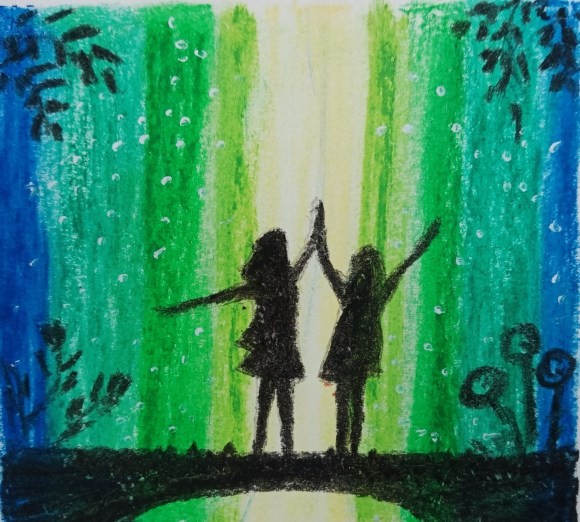
Art by Sohana
IMAGINED

I yearn  only for dreams sown
         In the breeze’s sigh —
That is why in despair I gather
         Wishful thoughts nigh.
The ferry of hope has lost its path
In the shady corners of the Earth.
   Fictitious images lose themselves
             Wafting high.

Nothing  emerges from my scattered
           Desires' streams.
No one  joins me to
     Pursue my distant dreams.
       I play with flames alone
       I sit on my own. At the end
       Of the day, I see my dreams
                 Turn to ashes.
I yearn  only for dreams sown
          In the breeze’s sigh.
The poem was set to music by his niece Sarala Devi. Click here to hear it performed as a song by contemporary artiste, Srabani Sen.
.
This poem has been translated from Bengali by Mitali Chakravarty with editorial input by Sohana Manzoor
.
PLEASE NOTE: ARTICLES CAN ONLY BE REPRODUCED IN OTHER SITES WITH DUE ACKNOWLEDGEMENT TO BORDERLESS JOURNAL
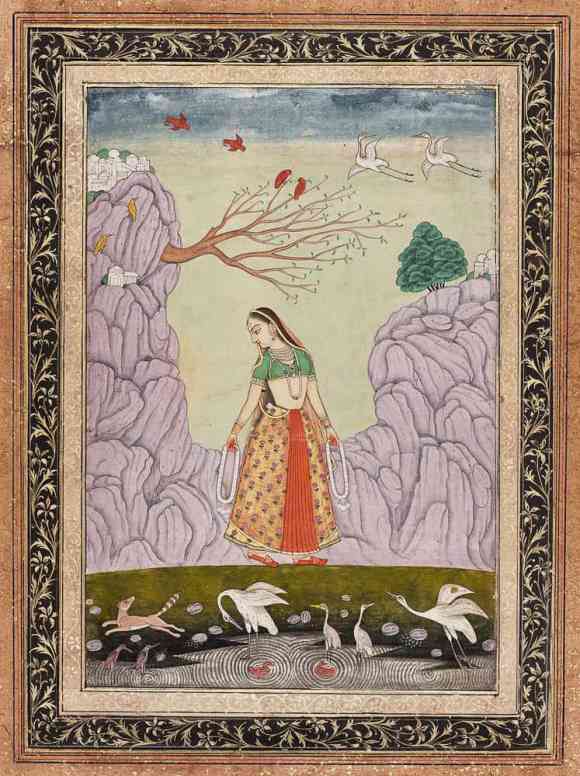
Akashe Aaj Choriye Delam Priyo (I sprinkle in the sky) by Nazrul has been translated from Bengali by Professor Fakrul Alam
From Public Domain
Dearest, I sprinkle in the sky my lyrics this day.
I’ve woven on my own a garland of songs
From the flowers produced by my words.
Pick it up if you can, please.
Let my tune’s rainbow be a transient joy,
Orchestrating my sense of loveliness,
And embodying sweetness through the passions of its colours.
What does it matter if you fail to note
The tears moistening my eyelids?
My voice quavers because of my tears!
Spreading across the lotus that is my heart,
Lyrics make the round, buzzing like a bee in flight.
Do taste my mind’s loveliness from that bee if you can!
Born in united Bengal, long before the Partition, Kazi Nazrul Islam(1899-1976) was known as the Bidrohi Kobi, or “rebel poet”. Nazrul is now regarded as the national poet of Bangladesh though he continues a revered name in the Indian subcontinent. In addition to his prose and poetry, Nazrul wrote about 4000 songs.
It was being said that the landlords were terribly angry, and that apparently they would not let the sharecroppers harvest the paddy. The paddy would be cut by people brought from outside. If there was a conflict over the matter, only Allah knew what would happen. Phulmoti did not know any prayers or Quranic verses; ‘Allah’ and ‘Bismillahe Rahamanur Rahim’ were the only sacred words she knew. She inwardly uttered those whenever the fear overwhelmed her.
One morning, Qutubali suddenly spotted someone in the distance, running along the boundary ridge towards their house. The person appeared familiar. So, he kept looking, trying to make out who it was. And why on earth was he running like that?
He recognized the man soon enough. ‘Aare, it is Mahindar!’ Qutubali advanced. Gasping for breath, Mahindar informed him that he had been to Ranisankoil to meet the peasants’ union there. He said he saw many men from Bihar at Pirganj station. They had long-moustachioed faces, and were hefty of build, and they were all carrying long lathis with a brass grip. He had heard that they were going to the house of the landlord Mitra Babu of Ranisankoil to guard the paddy fields. Apparently, thieves were cutting the paddy and taking it away and so the paddy on his field had to be guarded.
Qutubali grew anxious when he heard the news. Both of them rushed to the market, discussing the matter as they went. If the landlords in their locality too brought in Bihari watchmen from the west and made them guard the paddy fields, what would the peasants do? Would the watchmen let the sharecroppers cut the paddy? And what if they did not? Would the sharecropping peasants sit idly by with folded hands? The plough and the bullocks belonged to the sharecropper; he was the one who toiled, and it was he who raised the crop. Would he have no claim over that crop now? Would they not permit him to even enter the crop field? What nonsense was this? Hired musclemen from Bihar to guard ripe paddy in the fields was simply unacceptable!
Both of them were in agreement. No, the sharecroppers would cut the paddy. If there was resistance, then a fight would break out, and if indeed it did, then they must fight.
‘There’s no option but to fight,’ Mahindar said. ‘Let anyone say what they want, but we must fight.’
When they reached the union office, they saw that Baram Horo was already there, puffing on a beedi. He was surprised to see the two of them.
‘You people? Where’s Mondol? And Dinesh?’
Qutubali and Mahindar were startled. ‘Why, was Delbar Mondol supposed to come here?’
‘Yes,’ Baram said. ‘Dinesh asked Mondol to come. He needs to be here.’
‘Why? What happened?’
The news wasn’t good, Baram informed them. ‘Instructions have been received in all the police stations that since the paddy in the landlords’ fields might be looted, the police must guard the paddy with rifles until the harvest is over. I think they won’t let the sharecropping peasants cut the paddy.’
They didn’t realize how quickly the day passed—it was already afternoon. A lot of people had joined them by now. All were sharecropping peasants, except for Dr Abhimanyu Sen. There were discussions and information was shared. No one could say what the district-level leaders had decided.
‘They will decide what they think is appropriate,’ Doctor Babu said, ‘but will we sit twiddling our thumbs because of that? The landlords are bringing musclemen. We can’t bring guns, but we too have to pick up lathis. This isn’t anything new; the peasant earlier carried a cattle-prod, now he’ll carry a six-foot-long lathi of seasoned bamboo. Go, brothers, go and cut lathis from bamboo clumps…’
Dinesh Murmu kept shaking his head, growling, ‘What rubbish is this! Saala, the government, police and political parties are all on the side of the landlords. No one is on our side.’
The stalks full of ears of ripe paddy stood all over the floodplain with their heads bowed, waiting for the festival of harvest to begin! But the festive moment never arrived.
Qutubali was unable to sleep. Countless millions of stars shed dew smeared with blue light as the night advanced towards the next horizon. From many faraway fields could be heard the cries of ‘Hoshiyar…jaagte raho—o—o… Beware, stay awake!’ He had seen with his own eyes that Ghosh Babu too had brought a hired band of Bihari guards from Purnea district. He had no idea whose counsel the Mistress had followed in taking this step. Was she planning on getting the paddy cutting done by someone else? What about the task of husking the paddy? That too?
His wife was asleep next to him, as was his son, but he remained awake.
At some point during those still hours, Doctor Babu arrived at their house on a bicycle. He gave clear instructions: Delbar Mondol and Mahindar Burman were not to remain at home at night, nor were they to set foot in the nearby town or the marketplace in the market town. If they did, they might be arrested by the police and sent to jail. Doctor Babu also conveyed the news that the police had gone to arrest Dinesh and Baram, but fortunately, they couldn’t. Having got the news, the two had gone into hiding.
‘We are not going to start fighting just now…that’s right… but that doesn’t mean that we will let the police catch us,’ Doctor Babu said. ‘We will be careful and keep ourselves safe. And we will cut the paddy and bring it home—we must keep that in mind.’
No cutting of the paddy, no ploughing of the soil for the next crop, just sitting and waiting! If the ears dried up, would the paddy be fit to cut? All the stalks would drop off their ears.
Extracted from The Struggle: A Novel by Showkat Ali, translated by V. Ramaswamy and Mohiuddin Jahangir. Published by Speaking Tiger Books, 2025.
ABOUT THE BOOK
Set in a remote village in the Dinajpur region of undivided Bengal during the mid-1940s, The Struggle tells the intertwined story of Phulmoti—a young widow fighting to hold on to her land, her dignity and her child—and Qutubali, a simple-minded outsider whose unexpected kindness and fierce loyalty make him her unlikely ally amid the upheavals of a precarious feudal order and the stirrings of a nation on the verge of independence.
The death of Phulmoti’s husband shatters her fragile world. Her ten-year-old, Abed, can offer little defence against the men now circling her—neighbours, relatives, even the local cleric—drawn by desire and the lure of her small property. Malek, a kindly bookseller at the local market, too, proves not to be what he seems. It is Malek’s hired hand, Qutubali, who finds himself drawn into her struggles, standing by her in ways that others do not. The politics of the Congress and the Muslim League hover on the margins of village life, far removed from their daily battles. But when the tebhaga struggle breaks out in Bengal—with sharecroppers demanding two-thirds of the harvest from landlords as their rightful due—Phulmoti and Qutubali stand to lose what little of their lives they have pieced back together.
First published in 1989 as Narai, this novel is not only a vivid portrayal of endurance in the face of isolation and rural exploitation, but also a sharp indictment of the social and political systems that deny justice to the poor. This sensitive translation introduces to a wider audience a forgotten classic of Bengali literature—politically clear-eyed and deeply moving.
ABOUT THE AUTHOR
Showkat Ali (1936–2018) was a renowned Bangladeshi novelist, short story writer and journalist whose work explored history, class and identity in Bengali society. His most celebrated novel, Prodoshe Prakritojon (1984), is considered a landmark in Bangladeshi literature.
ABOUT THE TRANSLATORS
Mohiuddin Jahangir is currently Assistant Professor in Khabashpur Adarsa University College, Bangladesh. His articles on literature, history and heritage have been published in scholarly journals, and he is the author of seven books.
V. Ramaswamy has translated many well-known Benglai authors. He was awarded the Translation Fellowship by the New India Foundation, and the English PEN Presents award in 2022.
The Lost Pendant brings together poems translated from Bengali by translators such as Himalaya Jana, Mandakranta Sen, Rajorshi Patronobish, Sanjukta Dasgupta, Angshuman Kar, and Souva Chattopadhyay. Through these compelling translations, the volume makes a significant intervention in Partition literature, arriving at a moment when revisiting the lingering spectres of the event has become especially urgent. The Partition of India in 1947, which divided the subcontinent into India and Pakistan, resulted in one of the largest mass migrations in history and left enduring scars of displacement, violence, and fractured identities. As the editor, writer and academic, Angshuman Kar, notes in the book’s introduction how Partition remains a 78-year-old wound that continues to bleed.
The anthology showcases poetry from the eastern parts of the subcontinent, chiefly Bengal, Assam, and Bangladesh, featuring works by 41 poets from India and Bangladesh. Kar does not simply compile these poems but thoughtfully curates them to reveal several critical nuances. He invokes the concept of “buoyant memory,” introduced in his earlier work, Divided: Partition Memoirs from Two Bengals, to depict how “forgetting the past is impossible for the direct victims of Partition.” He also draws attention to the disproportionate representation of upper-caste Hindu Bengali poets, in contrast to the relative invisibility of Muslims and those from marginalised communities. This imbalance extends to gender as well, with a noticeable disparity between male and female poets in the collection.
The book is structured in two parts, respectively featuring poets from India and Bangladesh. The Indian section is notably larger and presents a wide range of emotions, reflecting both the immediate trauma of Partition and its long-lasting reverberations over the years. Many of the poems in this section express a deep nostalgia for a lost homeland. For instance, Alokeranjan Dasgupta’s ‘Exile’ evokes memories of abandoned spaces. Similarly, Ananda Sankar Rai’s ‘The Far Side’ laments the estrangement from what was once familiar. He writes, “Once it was a province, now an alien land / where you must enter passport in hand.” Basudeb Deb’s ‘Picture of My Father’ constructs a powerful portrait of the nation through the figure of the father: “Swadeshi movement war sirens famine flood / Riot and partition written in the wrinkles on his forehead.” After the father’s death, only a walking stick remains. The poem draws a powerful parallel between the futility of the father’s dismissive words, “This country is not a pumpkin that you can cut it in one blow”, and the uselessness of the walking stick after his passing. This object comes to embody the spirit of the deceased father, “just another old toy”, offering a stark commentary on how individuals became pawns in the hands of the state.
Several poets in the anthology focus intensely on the experiences of refugees, capturing both their suffering and the complexities of their identities. In ‘The Refugee Mystery’, Binoy Majumdar laments the loss of linguistic roots, noting how “the Bangals now speak the dialect of Kolkata all the time, having forgotten the dialects of Barishal and Faridpur / The Moslems of Dhaka are heard singing and speaking in the radio with the lilt of Uluberia.” His reflections emphasise the deep connection between language and social identity. This theme finds a resonance in Sunil Gangopadhyay’s poem ‘That Day’, where he writes, “On one side they named the waters Pani / on the other side–Jol.” Through this simple yet evocative contrast, Gangopadhyay underscores how a shared concept can be articulated through divergent linguistic expressions in India and Bangladesh, which become subtle yet potent markers of socio-linguistic divisions. Such poems provoke profound questions: Can the adoption of a new dialect truly redefine one’s identity? How does one navigate the tension between past and present linguistic selves, and is reconciliation even possible?
Viewed through the intertwined lenses of faith and suffering, poetry often functions as a repository of collective memory and a means of resilience. In this regard, Devdas Acharya’s three poems present a poignant exploration of the lived experiences of refugees in post-Partition India. A recurring and haunting image emerges in his work: a grieving father, who has recently lost a child to hunger, standing before a deity symbolically embodied by a swadeshi leader. This image encapsulates both the profound deprivation endured by displaced communities and their simultaneous reliance on unshaken faith. Despite the magnitude of loss, what sustained many refugees was a deeply rooted belief system that imbued their suffering with meaning.
By foregrounding the gendered dimensions of violence, Partition poetry exposes how women’s bodies became contested sites of power and trauma. In “She, on the Platform of a Station”, Krishna Dhar powerfully captures the plight of women during Partition. She writes, “Chased from the other side of the border, escaping fire and the fangs and tongues of wolves, one day she arrived,” evoking the image of a refugee woman doubly marginalised– “devastated by Partition” and simultaneously “dodging the eyes of the hyenas.” Here, the metaphorical wolves and hyenas represent predatory men who treated women’s bodies as extensions of territorial conquest. Kar points out in the introduction that very few women wrote poetry about their Partition experiences, largely because they were already engaged in the broader struggle for gender equality. While women’s memoirs on Partition exist, poetry by women addressing these themes, particularly from the 1970s, is strikingly limited. This absence is significant, as women’s experiences are crucial to understanding how deeply gendered the space of the subcontinent was during and after Partition.
Following independence, conflicts often emerged within the nation, revolving around issues of region, language, religion, and ethnicity. In ‘The Diary of a Refugee’, Shaktipada Brahmachari reflects on his sense of belonging across borders, juxtaposing his memories of a past home in Bengal with his present life in Assam. He writes, “The world is my home now, in Bangla my love I spell–Prafulla and Vrigu are the cousins of my heart,” referencing two leaders of the Asom Gana Parishad. While refugees in Assam experienced a more complex form of marginalisation due to ethno-linguistic differences, Brahmachari portrays a gradual process of acceptance, where both the homeland he left and the land he adopted come to hold emotional significance.
Across the border in Bangladesh, the theme of displacement persists. In “Leaving Home”, Jasimuddin asserts, “this land is for Hindus and Muslims,” calling on educators to return and “build the broken schools once more…we will find out our beloved brother, whom I lost,” a poignant appeal for reconciliation and return of Hindu families displaced by Partition. The motifs of memory and loss recur throughout most of these poems, a trope common between both the nations. This sense of finality is further echoed in Binod Bera’s lament: “Our nation is now three, all three are independent, and love lives an alien existence.” The emotional chasm created by Partition, and the subsequent loss of mutual affection, renders any notion of return futile.
The collection deserves commendation for its ambitious effort to recover voices from Bengali literature and render them accessible to a global readership beyond linguistic boundaries, through gripping translations. It is the first-ever translated collection of Bengali Partition poetry that captures the angst of the original poems with perfect nuance. The very title, The Lost Pendant, merits particular attention, for it resonates with themes of liminality and the fractured sense of identity experienced by the refugee poet Nirmalyo Bhushan Bhattacharya, better known by his pseudonym, Majnu Mostafa. Born in Khulna, Bangladesh, yet spending much of his life in Krishnanagar, India, Bhattacharya embodies the dislocation and dual belonging of Partition’s afterlives. As Kar insightfully observes, the choice of pseudonym can be read as a deliberate act of defiance, “a strategy to cross the boundaries set up by religious politics and fundamentalism–a move much needed in the subcontinent of our times.” In this sense, The Lost Pendant is not merely an anthology but a work of cultural recuperation as it attempts to resurrect poets whose voices risked erasure, while simultaneously protecting their oeuvres from the twin threats of historical amnesia and linguistic inaccessibility.
.
Udita Banerjee is an Assistant Professor of English at VIT-AP University. Her work has previously been published in platforms such as Outlook Weekender, Borderless Journal, Indian Review, and Poems India.
PLEASE NOTE: ARTICLES CAN ONLY BE REPRODUCED IN OTHER SITES WITH DUE ACKNOWLEDGEMENT TO BORDERLESS JOURNAL
It has been a strange year for all of us. Amidst the chaos, bloodshed and climate disasters, Borderless Journal seems to be finding a footing in an orphaned world, connecting with writers who transcend borders and readers who delight in a universe knit with the variety and vibrancy of humanity. Like colours of a rainbow, the differences harmonise into an aubade, dawning a world with the most endearing of human traits, hope.
A short round up of this year starts with another new area of focus — a section with writings on environment and climate. Also, we are delighted to add we now host writers from more than forty countries. In October, we were surprised to see Borderless Journal listed on Duotrope and we have had a number of republications with acknowledgement — the last request was signed off this week for a republication of Ihlwha Choi’s poem in an anthology by Hatchette US. We have had many republications with due acknowledgment in India, Bangladesh, Pakistan and UK too among other places. Our team has been active too not just with words and art but also with more publications from Borderless. Rhys Hughes, who had a play performed to a full house in Wales recently, brought out a whole book of his photo-poems from Borderless. Bhaskar Parichha has started an initiative towards another new anthology from our content — Odia poets translated by Snehaprava Das. We are privileged to have all of you — contributors and readers — on board. And now, we invite you to savour some of our fare published in Borderless from January 2025 to December 2025. These are pieces that embody the spirit of a world beyond borders…
I Am Not My Mother: Gigi Baldovino Gosnell gives a story of child abuse set in Philippines where the victim towers with resilience. Click here to read.
Persona: Sohana Manzoor wanders into a glamorous world of expats. Click here to read.
In American Wife, Suzanne Kamata gives a short story set set in the Obon festival in Japan. Click here to read.
Sandy Cannot Write: Devraj Singh Kalsi takes us into the world of advertising and glamour. Click here to read.
Reminiscences from a Gallery: The Other Ray: Dolly Narang muses on Satyajit Ray’s world beyond films and shares a note by the maestro and an essay on his art by the eminent artist, Paritosh Sen. Click here to read.
A discussion of Jaladhar Sen’s The Travels of a Sadhu in the Himalayas, translated from Bengali by Somdatta Mandal, with an online interview with the translator. Click here to read.
Gower Bhat discusses the advent of coaching schools in Kashmir for competitive exams for University exams, which seem to be replacing real schools. Clickhere to read.
Nazrul’s Shoore O Baneer Mala Diye (With a Garland of Tunes and Lyrics) has been translated from Bengali by Professor Fakrul Alam.
From Public Domain
With a garland of tunes and lyrics, you caressed me.
To my body and mind, you gave buds of affection.
Why, then, didn’t you instill love in my heart?
Having played the flute, where was it that you hid?
The flower that you had helped bloom is drying
And losing something dear. My soul cries out, alas!
If you wanted something so, why didn’t you take it?
Having hugged me tight, why did you leave me?
Tell me, what upset you? Why doesn’t joy stir me now?
Where is the sweetness and delight I once felt in my soul?
I must have misunderstood you completely
For surely you had come to make my love bloom.
Dearest, why didn’t you speak out at that time?
Why, why didn’t you hurt and correct me then?
You can listen to the Bengali rendition of this song by contemporary eminent singer, Ajoy Chakraborty, by clicking on this link.
Born in united Bengal, long before the Partition, Kazi Nazrul Islam(1899-1976) was known as the Bidrohi Kobi, or “rebel poet”. Nazrul is now regarded as the national poet of Bangladesh though he continues a revered name in the Indian subcontinent. In addition to his prose and poetry, Nazrul wrote about 4000 songs.



 Borderless