THE IMAGINARY MENAGERIE

1.
A banshee on a rooftop
can wail all night
when the mists swirl thickly.
A whale on a rooftop
ought to get down quickly.

2.
A cockatrice is not very nice,
in fact some say it's a curse
when it struts around in the nude.
But when it is wearing socks
I'll say it's even worse.

3.
Medusa and a French writer:
as opposites they are polar.
They are pleased to dine on cheese
but only Gorgon Zola.

4.
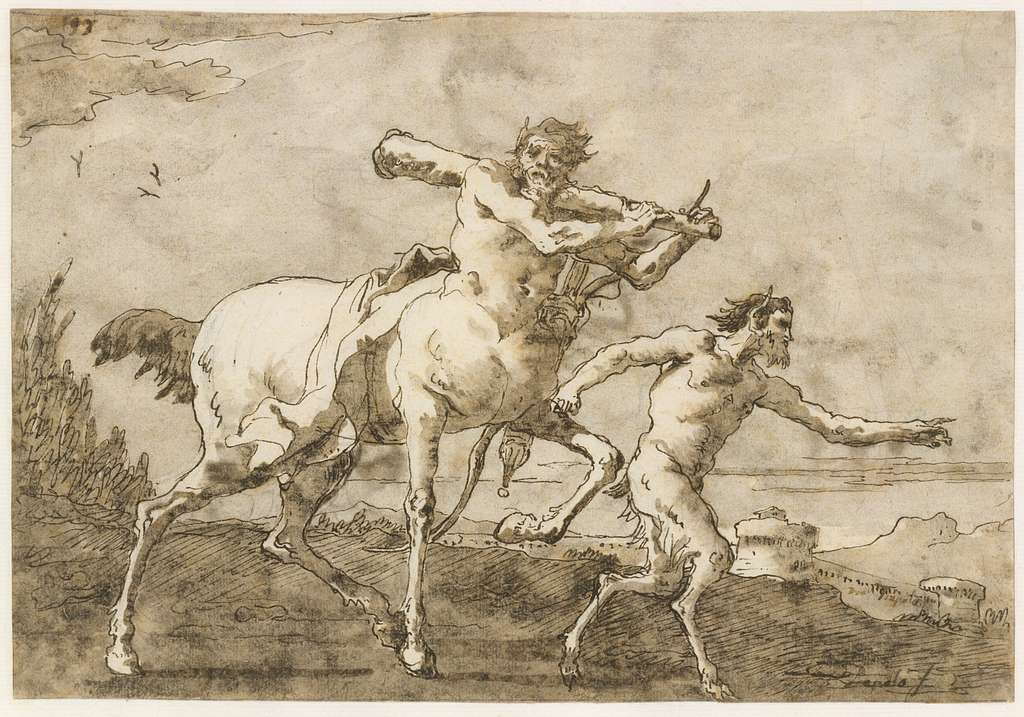
Part man, part horse,
the centaur trots around the race course
shooting arrows at the hats
worn by all the toffs
in the crowd who watch
but with insufficient force
to knock them off.

5.
The vampire with sore gums
bites only sorghum
but he likes to reminisce
about the throats and biscuits
of priests in the seminary.
Fangs for the memory!

6.
The simurgh is a beautiful bird
rarely kept as a pet
because few people can afford her.
Among our feathered friends
she ranks highest in the pecking order.

7.
What has been written
about the minotaur
is true enough from feet to neck
but don't believe the text in full:
the remainder is a lot of bull.

8.
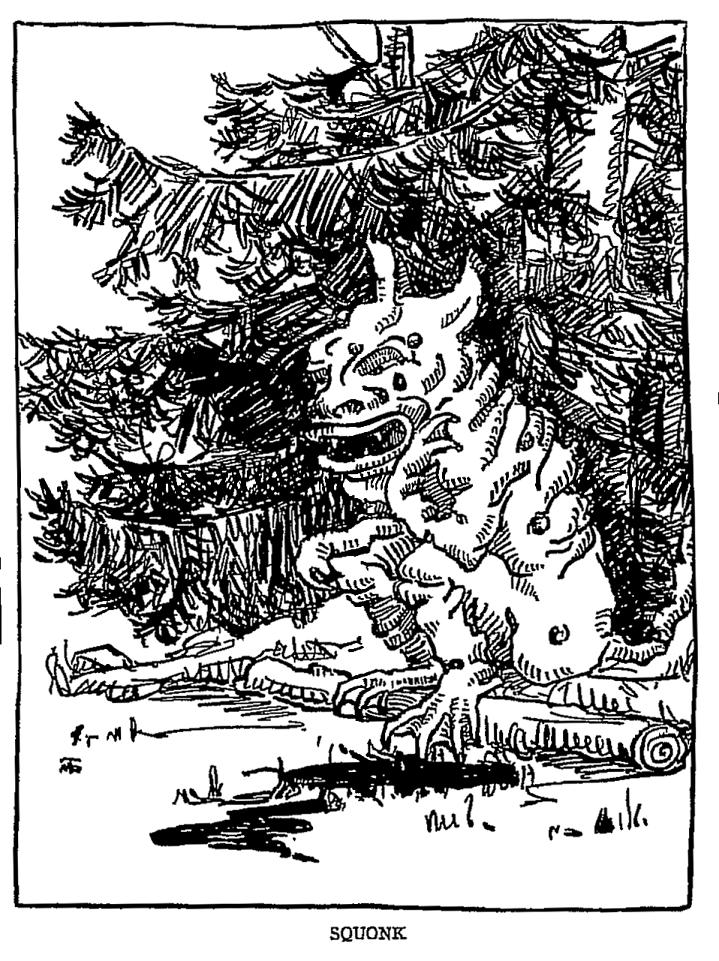
There is a squonk who weeps all night
on the roof of my tropical bathroom.
The tears that drip through bamboo shoots
are always gloomy, fat and sour
but in them I prefer to shower.

9.
The hydra is a kind of snake
with many heads
who for the sake of better relations
with all the nations
of humanity
decided to get an education
and began with trigonometry.
Now he's a mythical snake
with many headaches.

10.
A phoenix has no politics
but knows a trick or two.
Perched in a bowl of cake mix
and bursting into flames
it may bake that cake for you.

11.
A Cyclops with a telescope
can stare at distant pears,
the planet Mars as well,
but a cyclops with binoculars
has no hope in hell.

12.
A hippogriff on the edge of a cliff
can safely leap into the void and soar
but a hippopotamus or hypocrite
would splatter on the canyon floor.

13.
The wealth of an elf
and the security of an Elf
in our world's fairyland sector
are important considerations
for an 'Elf & Safety' inspector.

14.
There's a manticore
behind a door
inside the betting shop
but that door is a jar
and the stopper in the top
prevents it getting out.

15.
Although his wings are extended
the dragon wears trousers
recently mended
for courtesy's sake
because the damsel in distress
turned out to be
a knight in a dress
with an awkward curtsy.
Yes, the Dragon wears trousers
but he's flying low.

16.
The leprechaun has worn
out his shoes
and torn his green cap
and sits on the lawn,
bottles of booze in his lap,
until the break of dawn.

17.
The satyr is a goat man
who chases river nymphs
in a boat with leers: his plan
is to catch them in a net
but he hasn't got any yet.
He is wet behind the ears.

18.
A Wyvern is a kind of dragon
with only two legs: the front ones
and both of those are frail.
That's why his tail
tends to drag on the ground
while he is toing and froing
and running around
to see what fun things we are doing.

19.
The Titan
wants to bite on
the biggest sandwich in creation
but no doubt
his mastication
will meet negation
when all the filling falls out.

20.
The happy harpy
plays the flute too loudly
or so the other Harpies claim.
The unhappy Harpy
plays a lute too sadly
to attain musical fame.
Later they will beat
their wings against the ceiling
to express their mutual feeling:
distrust, dislike and irritation.

21.
Triffids are insipid
when added to salad
but they are always in a hurry
to jump into curry.
Who can say why? Not I.

22.
I knew a ghoul
who was nobody's fool.
He enrolled in a university
adjacent to a cemetery.
Corpus Christi College
extended his knowledge
that corpses are tasty.

23.
There's a yeti
in the freezer
and we don't know
how he got there.
Extracting him with tweezers
seems petty
and unfair, so we won't
dislodge him from his lair
of artificial snow
but leave him unmolested
next to the polar bear.

24.
Always a risk
to kiss a basilisk
especially if you miss
and kiss the wrong end.

25.
The mermaid paid with alacrity
her parking fine.
She had tethered her seahorse
to our ship's anchor.
I must descend in a diving suit
to personally thank her.

26.
With ten long arms
he can do great harm
when he takes over
the submarine factory
by poking big holes in hulls
but the workers in Quality Control
are more afraid the Kraken
boss will simply say, "Sack 'em!"
and that's exactly what he does.

27.
A unicorn is a horse with a spike
that can eat apples and leap a fence.
But a graph with a spike is evidence
that something isn't right.

28.
The gnome at home
is worse than a ghost
but an absent Gnome
is a generous host.
How is this possible?

29.
If the chimera came here
you would surely run away.
The lion part would roar at you,
the snake part would hiss,
and as you beat a hasty retreat
the goat part would bleat
at your receding feet.

30.
The golem is a man of clay
but who can say
if the potter's wheel made him dizzy?
He never eats or even drinks
while he is busy
unless it's something fizzy.
Rhys Hughes has lived in many countries. He graduated as an engineer but currently works as a tutor of mathematics. Since his first book was published in 1995 he has had fifty other books published and his work has been translated into ten languages.
.
PLEASE NOTE: ARTICLES CAN ONLY BE REPRODUCED IN OTHER SITES WITH DUE ACKNOWLEDGEMENT TO BORDERLESS JOURNAL
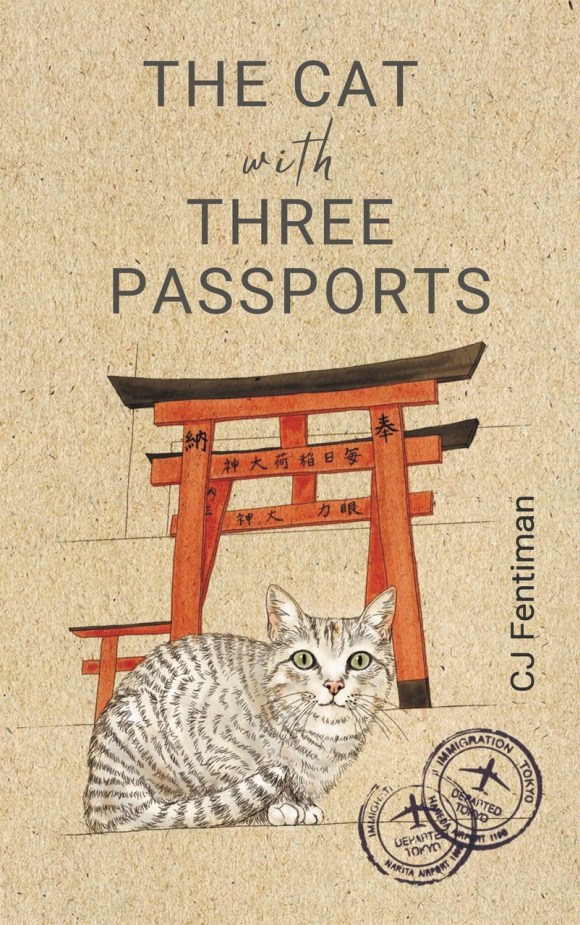
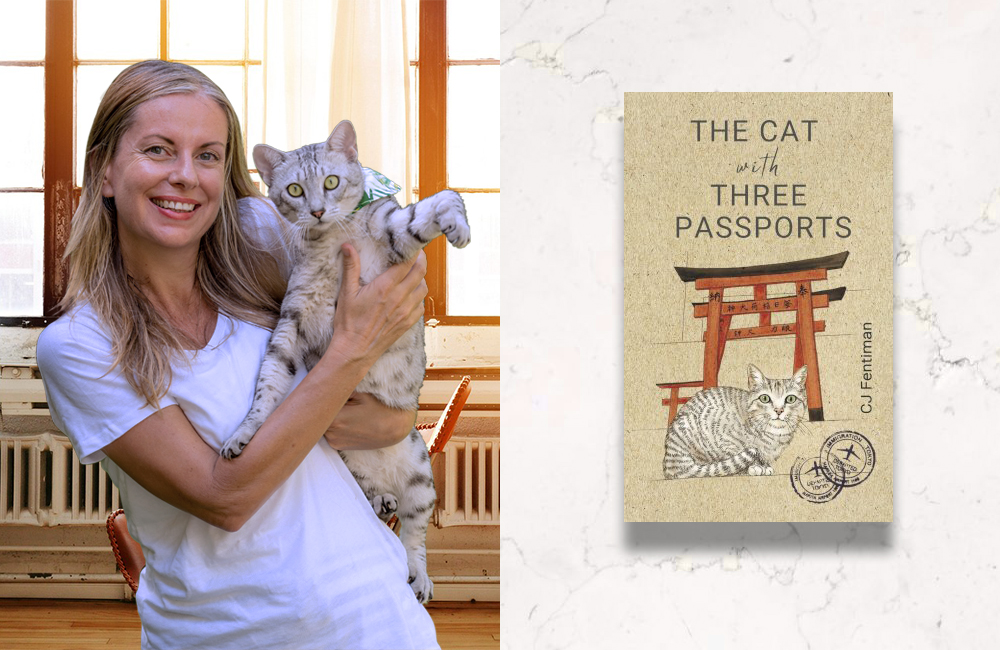
Going to Japan to teach English seemed like a good way to earn money, but animal lover CJ Fentiman came away from living and working in Japan with more than she expected as chronicled by her in The Cat with Three Passports: What a Japanese cat taught me about an old culture and new beginnings.
A book that could be considered a travel memoir, but it stretches beyond the normal scope of a travelogue, due partly to the introverted author’s inner reflection and personal transformation, but mainly due to the courageous actions of the writer in turning a soft spot for a cat into an international animal relocation mission. Sorry to spoil the ending of the book, but in most cases, foreigners going to a strange and different country take a “What happens in Vegas, stays in Vegas” approach. So when they leave, it is with fond memories, tales of culture shock and culinary misadventures, and bulging suitcases.
Not so with Fentiman and her partner, Ryan, who faced new challenges while taking a homeless cat with them to Australia, some 8,000 kilometres away. So why would you rescue from the streets a bedraggled silver tabby and then contemplate taking it with you across the oceans? If you are a cat lover, you already know the answer.
Let’s back up. One of the reasons The Cat with Three Passports is such a good read is that from the outset, the reader is invited in to experience Japan as seen through the eyes of someone right off the plane after a long flight. Throughout the book, there are vivid descriptions of landscapes, encounters and events, including weird festivals (naked men) which give an insight into an unfamiliar culture.
If the anticipation isn’t enough, the author exposes her vulnerability by sharing her anxieties and self-doubts, along with her past patterns of escaping situations and places, and how she has been distant from her estranged family.
Cats feature literally and figuratively throughout the book, and the author has blended in feline-related sayings and some of Japan’s cat wisdom. In a way, the cats make CJ and Ryan more “at home” in Japan among the cherry blossoms, bullet trains and vending machines. Essentially, the cats they encounter are the facilitators of the adaption and softening, helping them discover their purpose and giving them fulfilment.
Things take a turn for the surreal when they transfer to a job at a school set in a British theme park high in the mountains. Their time in Japan is not complete without a visit to the famed Cat Island, where cats outnumber humans perhaps thirty five to one. In the same way that cats love warmth and sun, humans are also attracted to cats because they bestow blessings on homo sapiens. One study found that cat owners have better psychological health than people without pets. Cat feeders claim to feel happier, more confident, less nervous and to sleep, focus and face problems better in their lives.
The Cat with Three Passports will appeal to anyone who has or wants to visit Japan, any animal lover or ailurophile along with readers who enjoy travel memoirs. It is a heart-warming and touching tale of outer and inner discovery.
If you’ve already encountered some travel classics on Japan, such as Lost Japan by Alex Kerr, Hokkaido Highway Blues by Will Ferguson, or Pico Iyer’s recent A Beginners Guide to Japan, consider reading The Cat with Three Passports even if you aren’t a pet lover or Japan fan.
Keith Lyons (keithlyons.net) is an award-winning writer, author and creative writing mentor, who gave up learning to play bagpipes in a Scottish pipe band to focus on after-dark tabs of dark chocolate, early morning slow-lane swimming, and the perfect cup of masala chai tea. Find him@KeithLyonsNZor blogging at Wandering in the World (http://wanderingintheworld.com).
CJ Fentiman & the much travelled cat. Courtesy: CJ Fentiman
CJ Fentiman is a writer, an entrepreneur, and an animal lover, originally from the UK, but currently living in Australia with her partner and two cats. She runs the Australian website, Pet Friendly Accommodation, and published a handy guidebook Travelling with Pets on Australia’s East Coast now in its fifth edition. Regarded as an expert on pet travel, CJ’s memoir The Cat with Three Passports: What a Japanese cat taught me about a old culture and new beginnings tells the story of her adventures as an English teacher in Japan, a fateful encounter with a homeless cat, and her own personal journey of growth and discovery, Fentiman and her partner, Ryan, lived in Japan from 2004 to 2007, but as we’ll learn, some of the biggest challenges came from CJ’s past and their future after working in Japan.
What attracted you to live and work in a place which is very foreign?
When a teaching opportunity came up in Japan, complete with two cats in the work apartment, I jumped at the chance. At first, Japan offered a way to travel and make money, I never thought I’d fall in love with the culture as much as I did, and that I’d learn so much from living there.
Do you think living in a strange and foreign place, and living as a couple, focused more on you, how you are in the world, and past patterns?
It can be quite a culture shock with regard to the work ethic and way of doing things in Japan, but the longer I was there I developed a real appreciation for the attention to detail to things, the politeness, respect, and courtesy. It also made me appreciate how fortunate I am to have the opportunities I have as an English speaker to work and study abroad without too many visa restrictions. I love the anonymity that Japan provided me. There I was just another ‘foreigner’.
Living as a couple in Japan was attractive to many employers, as I guess they saw you as more stable than a single person, so it actually helped when applying for jobs.
One of the themes is about your running away from things in the past. What do you think was behind this flight/escape urge?
That’s a good question. Three generations of women in my family have all emigrated internationally for one reason or another, so I guess I was following in their footsteps. The main temptation in living away from home offers you the opportunity to reinvent yourself and start afresh.
How did Japan, travel and cats (and Ryan) help you deal with this instinctive response?
Being able to just be the gaijin (foreigner) was really liberating for me, I was able to shed a lifetime of labels and reboot myself in a very positive way. Having a cat also meant a commitment, so I couldn’t just flit off when I chose. It gave me a reason to stay in one place and put down some roots and by doing so, connected with local people on a much deeper level, and was warmly welcomed as part of their community.
What do you think makes your book a little different from the standard foreigner goes to Japan travel memoir?
I like to think that it has a message of hope that no matter how bad things get, there is a way out. Changing your location and your surroundings can have a huge impact on how you see the world, and for me travel has been the greatest teacher.
How did your experiences in Japan and then moving Gershwin develop into articles and then your book and website?
It happened very naturally. Seeing people take their pets on holiday in Japan, was the inspiration for my first book, which is about ‘Travelling with Pets’. I remember seeing a couple at Lake Inawashiro in Fukushima Prefecture with a cat and dog, thinking that’s exactly what I want to do! The inspiration for my second book, The Cat with Three Passports, was the experience of relocating internationally with a pet, and all the amazing people I met along the way.
How was the process of writing The Cat with Three Passports, given that it was your first book of that kind?
It was a challenge because I had so many positive experiences while living in Japan that I felt would be good material, I almost had too much, so I had to spend a lot of time editing. My first book pretty much wrote itself, but as a travel memoir is much more personal, I had to dig a lot deeper, which wasn’t always easy!
Who do you think your book will appeal to?
It will definitely appeal to people interested in going to Japan, cat lovers, and even Japanese people themselves. Recently, I received a lovely message from a Japanese lady, who said how much she enjoyed the book because she was living in New Zealand during the lockdown and couldn’t return home to Japan, she said my book helped her with homesickness. It was a very special moment for me.
How are sales of your book going, and in what countries is it selling?
It seems to be hugely popular in the USA at the moment, and it even won an award there at the International Book Awards for American Book Fest in the narrative non-fiction category for animals.
What have been the highlights and lasting experiences of having your book appear in print and in bookshops?
I would say the biggest highlight has been the people that I have met, to hear that people have felt connected to the story is amazing. It’s nice to know that there are others out there that have had similar experiences in life.
The comments I get from different people around the world about how much people related to my story are beyond rewarding and make it all worthwhile.
You’ve lived away from the UK for quite some time — where are you now, and what are your plans for future, such as going back to the UK?
Never say never – but the older I get, the more I realise how lucky I am to have lived in many countries. I love the UK and will always consider it home, it’s just there are so many other places I’d love to visit and live in. We currently live in Australia, and although I do have a romantic idea of living back in the UK, I’m unsure when that will happen at the moment.
Keith Lyons (keithlyons.net) is an award-winning writer, author and creative writing mentor, who gave up learning to play bagpipes in a Scottish pipe band to focus on after-dark tabs of dark chocolate, early morning slow-lane swimming, and the perfect cup of masala chai tea. Find him@KeithLyonsNZor blogging at Wandering in the World (http://wanderingintheworld.com).
.
PLEASE NOTE: ARTICLES CAN ONLY BE REPRODUCED IN OTHER SITES WITH DUE ACKNOWLEDGEMENT TO BORDERLESS JOURNAL
December is often a time when we look forward to a vacation and travel. Through the pandemic ravaged years, moving out of the house itself had become a challenge. Now as the world opens up slowly (hopefully the Omicron variant of the virus will be more benign), travel stretches its limbs to awaken to a new day with new trends and rules. Borderless invites you to savour of writing that takes you around the world with backpackers, travellers, hikers, sailors and pirates — fantastical, imaginary or real planned ones in a post-pandemic world. Enjoy!
Rhys Hughes time travels back to the first century voyaging vicariously with his imagination and a Welsh king who resisted Roman invasion. Click here to read.
Do you enjoy babysitting nieces, nephews on trips and have you ever traveled with ‘hundreds of pieces of luggage, a few coolies, five women and only one man’? Tagore did. Somdatta Mandal translates hilarious writings from young Tagore on travel. Click here to read.
Travel through Bengal with Shorodhoni, a woman dubbed a ‘Daini’ or witch, in her quest to find a home in Aruna Chakravarti’s translation of Tarasankar Bandhopadhyay’s poignant story. Click here to read.
“Stories that tell us about human lives and human emotions highlight one simple thing: Humans are the same everywhere.” That is what Ratnottama Sengupta concludes as she vicariously travels through the famed route from the past. Click here to read.
As autumn gives way to winter, here are explorations that give us a glimpse of the season, its colours, its feel across different parts of the world and their varied interpretations. We have the vibrancy captured in colours by Sohana Manzoor and Sybil Pretious. There are reactions to events that happened at this time in different parts of the globe from Ratnottama Sengupta and Sutputra Radheye — have we healed after these events? Have things got better?
As Europe starts a new wave of pandemic lockdowns, Mike Smith takes us for a trip to Trieste, rich with the heritage of James Joyce, Umberto Saba and Baron Von Trapp of Sound of Music. Prose from Tagore(1861-1941) translated by Somdatta Mandal showcases some of his reactions while traveling in Japan, America and Europe in the autumn of his life. We can vicariously travel to different parts of the planet! While verses by Michael Burch and George Freek explore the season and the autumn of life, poetry by Rhys Hughes and Sekhar Banerjee add zest to the fall with humour. Revathi Ganeshsundram brings us a poignant narrative of new friendships. A short story from maestro storyteller from Holland, Louis Couperus(1863-1923), translated by Chaitali Sengupta, paints a darker hue of autumn while Tagore’s poetry gives us a festive feel generated by the season in Bengal. Enjoy our melange of autumnal lores!
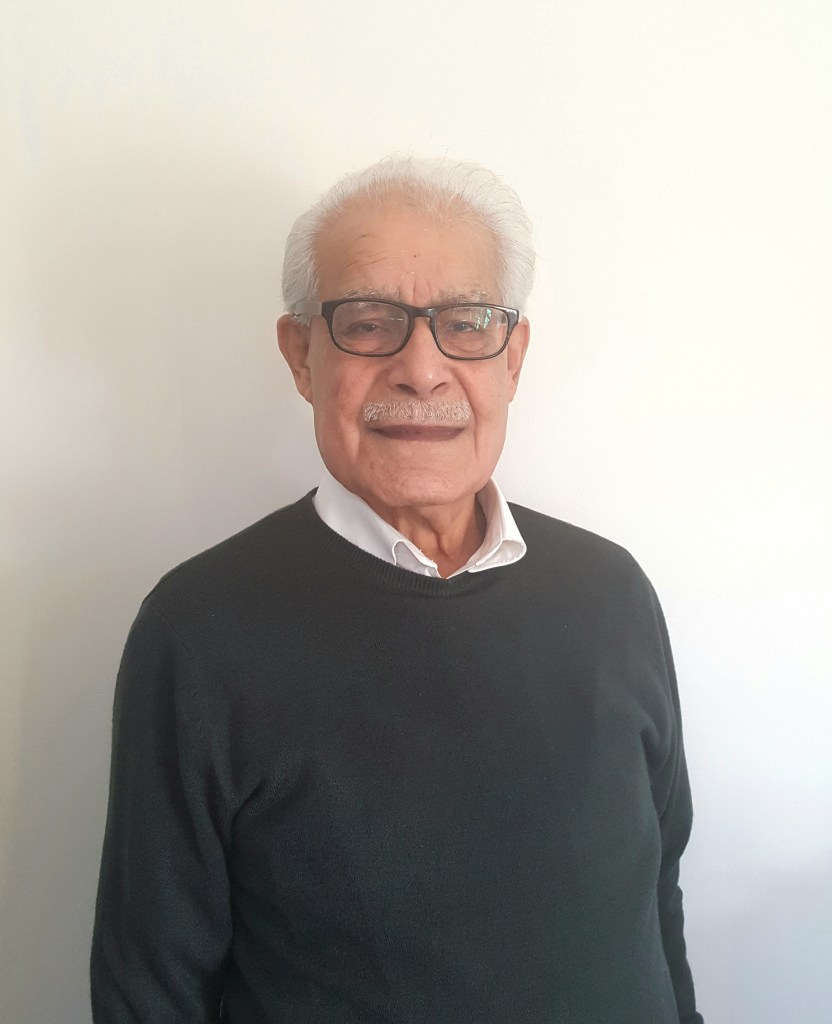
In Conversation with Akbar Barakzai, a Balochi poet in exile who rejected an award from Pakistan Academy of Letters for his principles. Click here to read.
In Conversation with Somdatta Mandal, a translator, scholar and writer who has much to say on the state of Santiniketan, Tagore, women’s writing on travel and more. Click here to read.
Ratnottama Sengupta recalls her experiences of the Egyptian unrest while covering the 35th Cairo International Film Festival in 2012. Click here to read.
Devi (The Goddess) is a 1960 Satyajit Ray film, based on a story by a writer called Prabhat Kumar Mukhopadhyay, that showcases nineteenth century India, where the silence of a young girl who is deified, wreaks havoc in her home, village and life. In an interview, Satyajit Ray contended that the film was to make people rethink ‘messiahdom’. The exact words he used to state this was that the film was against ‘religious dogmatism’ as the film and story literally dealt with the deification of a young bride. Tagore had similarly questioned blind deification in a number of his poems and plays. These (as Ray spelt out in his interview) did not address religion per se but malpractices, among them, the tendency to worship an idol to a point where flaws are justified, accepted and emulated. Satyajit Ray and Tagore were both Brahmos — which can be seen as a reform movement. These two were not criticising religion but talking of rising above gawky hero worship to think logically and arrive at logical conclusions. When we talk of characters from the Ramayana, the Mahabharata, other mythologies or substitute the adulated with stars, writers, politicians and businessmen who run huge concerns, we tend to idolise them. But these were and are all characters with flaws, whether fictitious or real. We can well learn from their mistakes, rather than deify and worship them to justify bad behaviour by quoting instances from lives of past legends or prominent persons in the current world.
Akbar Barakzai, a poet exiled from Balochistan, talks in a similar vein in his interview. You can see it in his poetry too — some of which can be found translated by Fazal Baloch in our pages. Barakzai talks of transcending barriers we draw for ourselves in the real world, of writing with honesty and sincerity. He has shared vignettes of his life as he changed countries to continue his work. Baloch has also brought to us another excellent poet in translation, Munir Momin. A major poem by Nazrul (the ‘bidrohi kobi’), ‘Bidrohi or Rebel’ has wound its way to our pages translated by Professor Fakrul Alam. We are honoured and grateful that Prof Alam chose to share this excellent translation with us. We have more translations: Jibonananda’s ‘Motorcar’(1934) by Rakibul Hasan Khan, a Korean translation by Ihlwha Choi, another short story from Nepal and Tagore’s powerful poem, ‘Morichika or Mirage’, which is a wake-up call for the inert affluent who hold themselves aloof from common masses. We have also interviewed a major prose translator of Tagore, Professor Somdatta Mandal. With much to share on Santiniketan, Nabanita Deb Sen and many interesting anecdotes, Mandal talks of her extensive work with her translations spanning many more writers from the past.
We have a colourful ensemble this time almost as vibrant as the autumnal colours that have invaded nature in some parts of the Northern Hemisphere. Michael R Burch has given us beautiful poems on autumn, including the autumn of life. We have a poem in a similar vein by George Freek whose work continues influenced by Liu Yong (1719-1805), an influential minister and calligrapher in the Qing Dynasty. Ryan Quinn Flanagan touches on Leonardo Da Vinci’s Mona Lisa in his poetry. Rhys Hughes has given us humour in both his poetry and his column. Our other humorist, Devraj Singh Kalsi has given us darker, more caustic black humour in his narrative. We have lovely photographs from Penny Wilkes with her verses in Nature’s Musings. It is amazing the way she photographs birds in flight. Stories from Malaysia, Bangladesh, India and America add to the richness of our oeuvre. Sunil Sharma has given us an avant-garde telling of Odysseus’s voyage in the modern world, transcending the borders of time and ethnicity.
A well-known senior journalist, Ratnottama Sengupta, has also travelled through time to give us a recall of her experience at the 35th Cairo Film Festival one November, nine years ago. Her narrative about the time that the Shariat law was adopted by Egypt reminds me of the way things moved in Afghanistan few months ago and what is even more stunning is the way in which organisations dubbed extremists earlier are allowed to run countries now. Is it really not yet time to get rid of messiahs and look for one world?
Do pause by and find many more authors who dot our November edition. As usual, naming each one will keep you away from our delectable reads for longer. We thank all our readers for their continued patronage, and I would like to thank my fabulous team who are now even providing visuals to brighten our pages. A huge thanks to Sohana Manzoor and Sybil Pretious, who write as well as they paint. Thanks to all our wonderful contributors for making Borderless a reality.
His poetry rings with the spaces between mountains. It rushes like the wind of freedom, taking you to the heart of the land and people he writes about.
Balochistan has a bit of the blood and bones of many cultures and people through the ages – dating back to Harappa and Indus Valley civilisations. Akbar Barakzai, the Baloch poet and activist, writes about transcending the suffering that exudes from hurts inflicted on humankind. He urges the masses to voice out against oppression.
Don’t ever bury the word
In the depth of your chest
Rather express the word
Yes, speak it out.
The Word brings forth
Freedom and providence.
--Akbar Barakzai, The Word
He writes for freedom from injustices and lives by his beliefs and principles. Having been forced to move countries to run journals, he is an immigrant in quest of a future that will unite the East and the West. Gently opposing oppressors with his writing, beliefs and ideas, Barakzai made news when he turned down the Pakistan Academy of Literature award last year because he says; “The Pakistan Academy of Literature is sponsored by the Islamabad rulers. I cannot accept an award from an organisation that operates at the beck and call of the tormentors of my people.” A writer who continues to emote for his people and their rights, he has been translated to English by a lecturer, Fazal Baloch, and published.
Barakzai calls himself “a part time poet” – but his poetry moves our hearts and minds – it makes us think, imagine a better world. Is he really a part time poet or a major inspiration crying out for mankind to move out of ‘messiahdom’, dogmatism and take charge of their own lives? In this interview, Barakzai not only reveals his life but also his sense of freedom from oppression, his love of human rights which forced him to move countries to conserve the voice of his people.
Since when have you been writing poetry? What set your muse going?
I started writing poetry in 1954 when I was still in school. I was inspired by our people’s long struggle for freedom and justice against the Pakistani and Iranian occupiers.
Your poetry mixes many strands of thoughts and many lores. Can you tell us what influences your writing? Books, music, writers?
My writing has been influenced by many poets and writers from different languages and cultures. The lasting influence on my art has been that of classical Balochi poetry. However, I must mention some great names from diverse poetic traditions who have had an impact on my poetry, such as the Persian poets Hafiz, Rumi and Nima Yushij; Urdu poets Ghalib and Mir; English poets Shelley and Keats; Russian poets Pushkin and Pasternak and the Chilean poet Pablo Neruda.
Your poem ‘Waiting for Godot’ depicts the theme of the play by Samuel Beckett. It has a beautiful mingling of East and West. What led to it?
Beckett’s Godot is perhaps the most mysterious character in modern (world) literature. My poem is a reminder that the so-called Messiahs never return to this world. Mankind has to find its own solutions. East and West are two different aspects of the same coin. Unlike the infamous poem by Rudyard Kipling, that great apologist of Western imperialism, the East and the West are slowly but steadily inching towards each other. Despite enormous odds “the twain” are destined to “meet” and be united to get rid of the geographical lines created by imperialist powers.
You deal with both the political and the spiritual in your poetry. How do you attune Che Guevara with the God who even if ruthless exists in your poetry?
I made peace with God quite some time ago. I hope we understand each other better now. I do not believe that God is necessarily ruthless. It may sound strange, but my spirituality is not religious at all, it is based on humanism. Your interpretation of my poem is different from what I had intended. I am not sure if such a dichotomy exists in the poem. However, it appears that poetic curiosity in the end has succeeded in detecting some kind of duality. With regard to Che, he symbolizes the primordial fighter for justice. He embodies all those millions of people who have fought against the forces of darkness. Hence the allusion to Phoebus Apollo and the ever-conquering brilliance of the sun.
Do you write only in Balochi? You must be fluent in English having lived in England for many years. Why do you not write in English? Or translate your own poems?
I used to write in Urdu and Persian in my younger years, until I discovered that I could write a lot better in my mother tongue. As far as writing in English is concerned, I do not feel confident enough to write in it.
Your poetry, the little I have read, takes on elemental truths and uses nature, intermingles those to arrive at larger truths toward the end. Is it all spontaneously expressed? Or do you need to work on it? Tell us a bit about your poetic process.
My experience of the poetic process tells me that it is spontaneous. Design and architecture of the poem occupy a secondary position. After a poem is formed in my mind my main concern would then be to revise and improve its language. This process may take any length of time. I must confess that I am an obsessive reviser. For example, one of my longer poems took many long years to complete.
As a poet, you continue shrouded in mystery. Tell us about your life.
My life is and has always been an open book. I don’t think a few random poems are sufficient to reveal the life story of any poet. However, without these fistful of poems, I would have appeared to be a greater mystery. My life, like the billions of ordinary people in this world, is indeed very ordinary. My great grandfather migrated from Western (Iranian) Balochistan as a result of the brutal military operations in the early twentieth century in which thousands of old men, women and children were killed and injured and thousands of others migrated to Sindh. My great grandfather was a small-time farmer. As a result of the Iranian atrocities, he was forced to abandon his land and livestock and move to Eastern (now Pakistani) Balochistan and finally to Sindh. In 1928, Reza Shah of Iran ultimately succeeded in occupying our country. Once they settled in Sindh my great grandfather and grandfather worked as labourers until they saved enough to buy a small shop.
My father had a basic English education. He had left high school when still in the 4th or 5th grade to support the family with odd jobs. A few years later, he opened his own shop, a ration shop. These shops had mushroomed all over during the war as the English authorities introduced a food rationing system in India. I believe with this background I must have belonged to the lowest rungs of the class system. But my family worked hard to improve their lot.
When I was ten or twelve, my father thought I was strong enough and responsible enough to work in the shop. I would go to school in the morning. As soon as I finished school, I would rush to the shop to help my father.
A few years before I finished high school, my father got a job in the Directorate of Civil Supplies as the manager of a warehouse. He rented out the shop. With two incomes our lot did improve a little. I was now in high school. I didn’t have to work in the shop anymore. During this period, I became interested in books – any books. These were mainly Urdu, Persian, Sindhi and Balochi books. I read a lot, but my reading wasn’t systematic. I wrote a few nondescript poems during this period and became interested in politics, particularly in Baloch politics. By then I was in college reading literature and related subjects. However, I was more interested in politics than in my studies which meant I wasn’t a good student. Despite this I somehow managed to graduate from Karachi University. My father wanted me to study further and enter the Civil Service. But by then I was completely radicalised. I think I disappointed him then by refusing to continue my studies in order to take competitive exams to join the civil service. However, a few years later as a result of the escalating Pakistani military operations in Balochistan, he told me that although at the time he was not happy with my refusal, he confessed wholeheartedly that my decision was absolutely right. I was so proud of him that he had finally approved of my decision. Although he passed away a long time ago, because of this confession I do love him and miss him more.
This rather lengthy snapshot of my life should be sufficient to explain why my poetry is expressly concerned with social and political issues.
What led to your move to England?
This was the busiest period of my political activism. It was the time when General Ayub Khan had imposed Martial Law in Pakistan and was trying to consolidate his rule by hook or by crook. In Balochistan he had re-ordered the military to crush the Baloch resistance once and for all. But the resistance has outlived Ayub Khan, and his military might. It has grown stronger and stronger with the passage of time albeit with huge sacrifices sustained by ordinary people. The rulers treated the Baloch people like dirt and our leaders as traitors who “deserved” to be hanged. By 1965, the military government stepped up its operations in cities and towns, especially in Karachi where the Baloch formed a sizable minority and naturally supported the struggle for freedom. By this time the majority of our leaders were imprisoned in various Pakistani jails. Hundreds of young activists were also put behind bars. I was constantly harassed by the secret police. They raided my house three times and confiscated all my books and papers. These included some precious manuscripts left by a maternal uncle of mine. I was told that they would be returned “in due course”, but I never saw them again.
In those days, at least in the big cities, the government showed that they believed in the legal system. However, things would soon change. They started arresting people at will, without producing them in a court of law. People would languish in prisons for many years without any charges brought against them. They kept on introducing new forms of brutality, including bombing the population and “disappearing” activists and ordinary people. Under their “kill and dump” policy, they to this day torture and kill activists and then dump their bodies in the periphery of a town or village. So far, they have “disappeared” about 5,000 activists and their family members. Recently they have started abducting young female activists and then dumping their bodies. Almost all of these victims have been assaulted and raped.
I was picked up twice by the secret police. The second time they brought the great poet Gul Khan Naseer (the Baloch Nazrul) from prison. We were both delighted to see each other. We hugged and exchanged greetings in Balochi. We were told firmly not to speak in Balochi. We protested at this suggestion. Without reacting, they started the interrogation which took about three or four hours. Naseer was taken back to prison. I was told to go home but be prepared for further sessions.
I was advised by our leadership to go underground and eventually leave the country and head for the Gulf region to organise the Baloch migrants working in that part of the world. I did exactly as I was instructed to do. Because of visa problems, I could not stay in the Gulf for long. I therefore moved to Syria, Lebanon and finally to Iraq where in 1973-74, I was joined by some other friends. Together we used to edit a monthly newspaper in Balochi called Tipaakie Raah (Path of Unity). In fact, this used to be the Balochi edition of the paper which was also published in Arabic, Persian, Azari (Azarbaijani) and Kurdish editions. We also managed a daily radio programme in Balochi. Additionally, we published a monthly newspaper in English from London which was called People’s Front. This task was assigned to a senior friend who moved from Baghdad to London for this purpose. Our stay in Iraq would soon be short lived. After Saddam Hussain and the Shah of Iran met in North Africa to end the dispute over Shatt al Arab waterway, the situation in Iraq changed drastically. We were told very politely that the “world situation” had changed. We would still be welcome to live in Iraq, but the publication of the newspaper and the radio broadcasts must stop. It was therefore decided I should move to London. With the help of a doctor friend, I obtained a British visa and moved to London.
Your poetry still cries out for your motherland. Do you want to return? Is a return possible?
Who wouldn’t want to go back to the country they love? But it is not possible. I am only tolerated if I keep silent and remain as far away from Balochistan as possible.
Why did you turn down the Pakistan Academy of Literature award?
The Pakistan Academy of Literature is sponsored by the Islamabad rulers. I cannot accept an award from an organisation that operates at the beck and call of the tormentors of my people.
You have published very selectively — do you have more writing which you have not published? If so, do you have plans to publish those?
I have never been a prolific writer or a poet. I keep on telling people that I am a part-time poet.
What message would you like to give to emerging writers?
As a part-time poet I don’t feel I am in a position to advise young writers. I can only say this much to them — be honest to yourselves and your art.
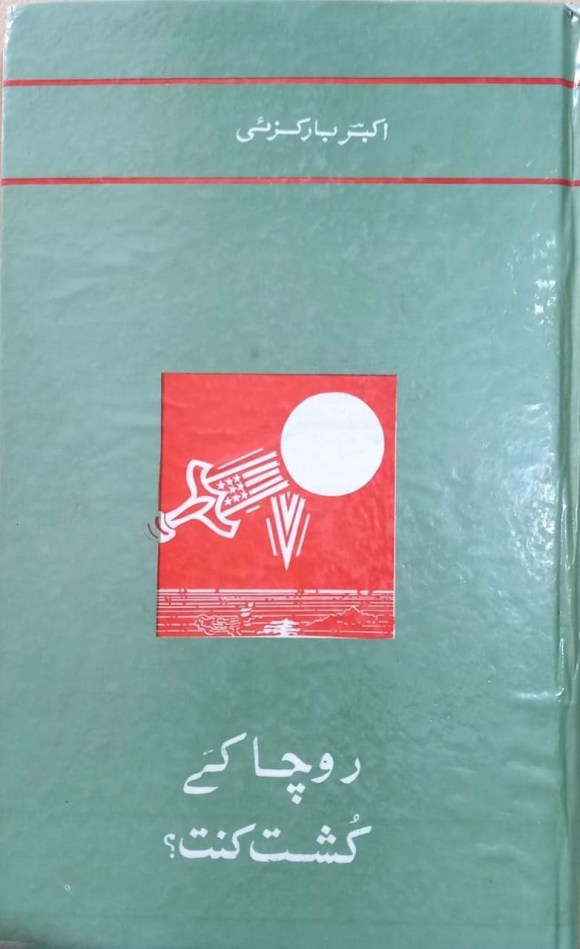
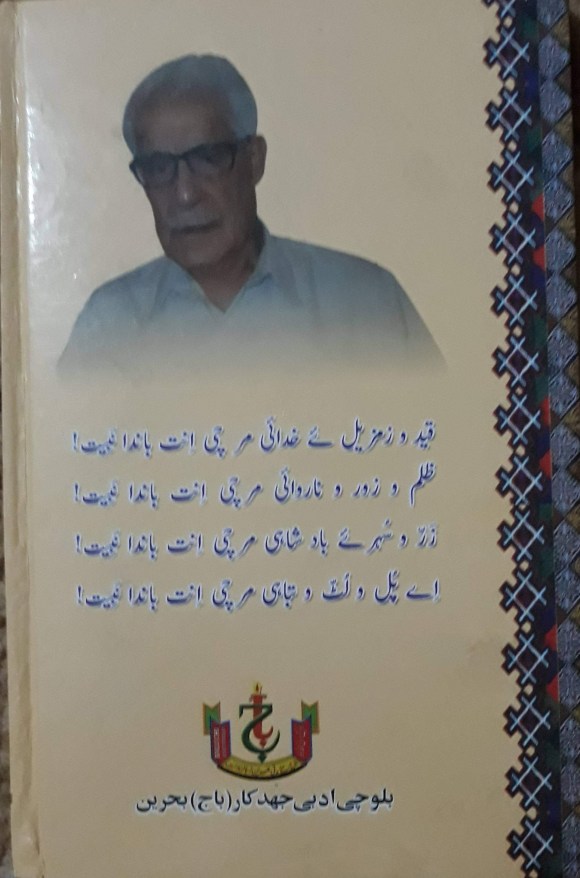
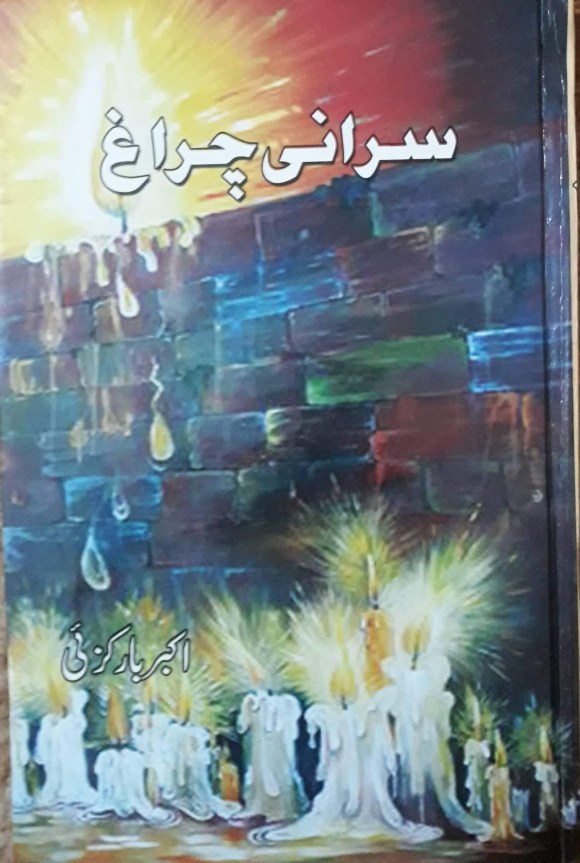
Who Can Kill the Sun?The Lamps of HeadsBooks by Akbar Barakzai in Balochi: Photographs provided by Fazal Baloch
Akbar Barakzai (1939-2022) was born in Shikarpur, Sindh. He is ranked amongst the proponents of modern Balochi literature. His poetry reflects the objective realities of life. Love for motherland, peace and prosperity and dignity of a man are the recurrent themes of his poetry. His love for human dignity transcends all geographical and cultural frontiers. Barakzai is not a prolific poet. In a literary career which spans over half a century, Barakzai has managed to bring out just two anthologies of his poems, but his poetry has depth and reaches out to human hearts with its profundity. Last year, Barakzai rejected the Pakistan Academy of Letters (PAL) award, quoting the oppressive policies meted out to his region by the government as the reason.
‘The East and the West are slowly but steadily inching towards each other. Despite enormous odds “the twain” are destined to “meet” and be united to get rid of the geographical lines…’
Renowned film analyst Ratnottama Sengupta revisits a page from her past, weaving history and films into an eyewitness account of events that had occurred as chaos reigned on the streets of Cairo, Egypt.
Cairo Film Festival, November 27 – December 6, 2012
Cairo.
“This one week will change everything,” Amir told Farah in The Winter of Discontent. Ibrahim El Batout’s recapitulation of the Arab Spring had inaugurated the 35th Cairo International Film Festival (CIFF) on November 27 of 2012. “It will take them one week to find out who uploaded the protest on the net,” the activist tells the journalist, “but one week later this government may not be there.” These words were borne true in January of 2011. They had sounded ironic when the festival was flagged off on the sixth day of Tahrir Square 2 — by Egypt’s Minister for Culture, Mohamed Saber Arab. He had hugged festival director Ezzat Abu Ouf who was in tears as he said, “In difficult times, it is important to protect one’s freedom of expression.”
It surely must have been difficult to host the festival that was paused following the Revolution. “I am Positive” was the slogan of CIFF that urged ‘positive thinking’ on revolution and freedom. Besides the inaugural film by Ibrahim El Batout, who mastered shooting in war zones for international channels, there was an entire section devoted to cinema of revolution. These documentaries included Good Morning Egypt that displayed people’s mixed emotions on the eve of dismantling Mubarak’s regime. The Road to Tahrir Square searched for the roots of the Egyptian revolution in the country’s labour movement. Eyes of Freedom and Street of Death documented the demand to speed up Presidential elections and handing over of authority from the Military Council to a Civilian government. By the end of the day in January 2011, the police and army had attacked the demonstrators and forced them to evacuate Tahrir Square, outraging the world by the human rights violation.
All this would have been perfect material “to express the heritage of the past, the reality of the present and the dreams of the future” – to quote the city’s Governor, Osama Kamal. For, “cinema records and relays to the world stories of our lives, our thoughts, feelings, social issues, principles…” And “meaningful art is one of the basic pillars of struggle and progress of a people,” he declared. That is why the logo of the revived CIFF depicted the hawk, a symbol of the pharaohs, perched on the metal arm of the revolutionaries in the precious metal of gold.
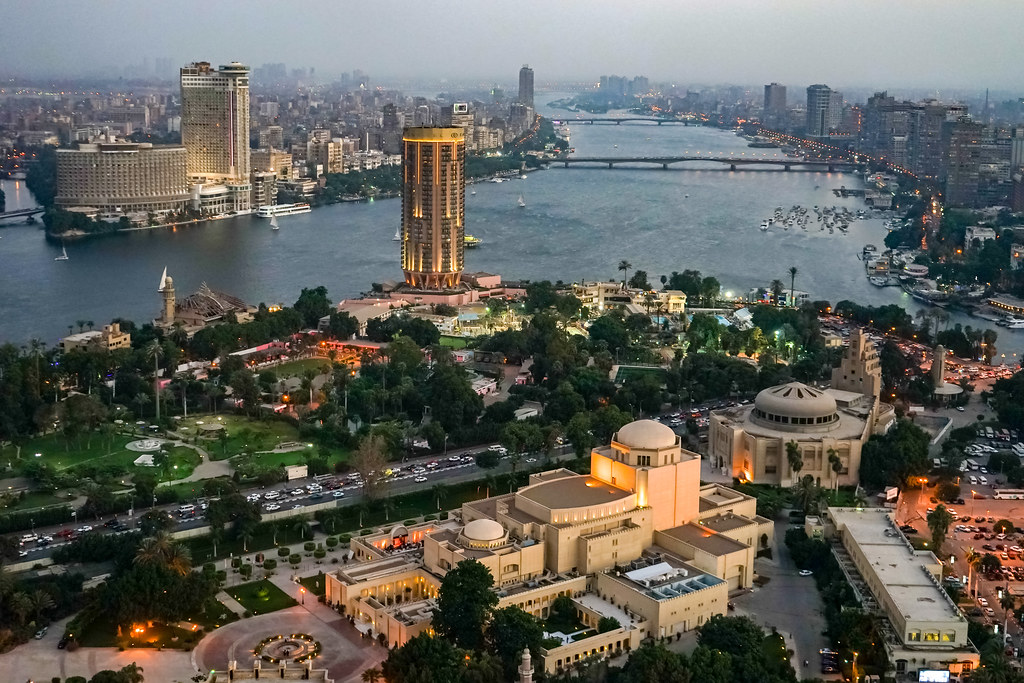
But it had turned ironic as the awards were cancelled due to the reality outside the Opera, close to the Square and venue of the festival that seeks to empower the youth by providing a platform for their talents. On Thursday, Qasir el Niel bridge leading to Tahrir Square had been blocked off. The museum housing the treasures of Tutankhamen was closed as it was on the turbulent Square. People — reportedly paid by the Brotherhood — were being trucked in for Saturday’s show of strength. Deaths were being reported from outlying areas where the Opposition was more restive as the channels were agog with news that the draft of the Constitution was ready and “any hour now” President Mohamed Morsi would sign it, pre-empting the opposition by the judiciary, intelligentsia, and the liberals who would lose much of their freedom if the Shariat laws would be enforced in Cairo’s open society.
The “action replay” on Tahrir Square was protesting the President’s move to arrogate himself extraordinary powers “until the new Constitution is in place.” Their objection was that he had pushed out the Christians and liberals from the Constituent Assembly, in order to ensure a smooth passage of the Constitution and present it as fait accompli before its expected date.
Yes, that one week in November 2012 had once more changed the course of history on Tahrir Square.
Ratnottama Sengupta, formerly Arts Editor of The Times of India, teaches mass communication and film appreciation, curates film festivals and art exhibitions, and translates and write books. She has been a member of CBFC, served on the National Film Awards jury and has herself won a National Award.
.
PLEASE NOTE: ARTICLES CAN ONLY BE REPRODUCED IN OTHER SITES WITH DUE ACKNOWLEDGEMENT TO BORDERLESS JOURNAL









 Borderless