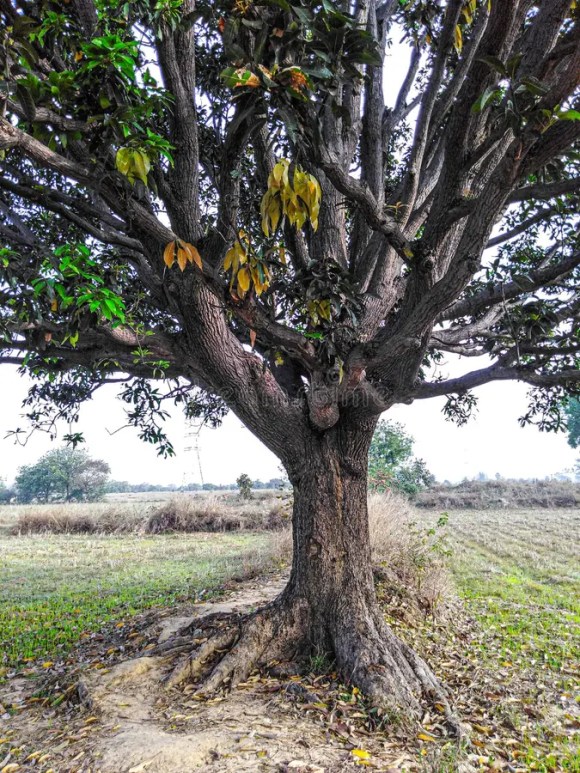
The Chaitra koel's routine visit to the Lone mango tree in the compound Of a lonelier house, Where life rests in a shadow of silence, Is delayed this time. Has it forgotten the tree That stands shrunken, pale And waits patiently to gather The silk whisper of spring colours In its brittle arms and Coax music out of it?
*
What is keeping the bird back, The tree wonders. And the answer comes in A startling cacophony That loops and rolls in angry surges Across the neighbouring vacant lot Where the mid-spring sun slants , Warm and oily, on the Massive drilling rigs, Excavators, concrete mixers, Behemoths from some alien world Filling the empty hours With too much life, Hurling ugly sermons of urbanity At its placid apathy.
The clangs, the clatters and the grinding; Stones gritting, metals rattling, Smell of smouldering tobacco and toxicity Hang over the mounds of red earth Like a crumpled canopy Of noisy ash.
Will the koel return to the Chaitra tree With its gentle silky lilts Drowning the tumults, The tree wonders, but waits Shaking dust and doubt Off its welcoming fragrant boughs Throbbing, trembling in the heavy vibrating breeze And gathering itself back Steadfast in its hope and trust.
*Chaitra: March
From Public Domain
Snehaprava Das is an academic, translator and writer. She has multiple translations, three collections of stories and five anthologies of poetry to her credit. She has been published in Indian Literature, Oxford University Press, Speaking Tiger, Penguin and Black Eagle Books.
.
PLEASE NOTE: ARTICLES CAN ONLY BE REPRODUCED IN OTHER SITES WITH DUE ACKNOWLEDGEMENT TO BORDERLESS JOURNAL.
Signing in the Air, Malashri Lal’s second poetry collection, announces itself as a meditative, non-linear poetic journey from the very outset. A poet, academic and critic, Lal explains in her preface, there is “no linearity in such a theme,” and the poems move instead through cycles of time, memory, myth, and lived experience. The seventy-six poems converse with each other and portray her meticulous craftsmanship.
The collection draws deeply from the Indian concept ofritu — the six seasons — while simultaneously acknowledging the disruptions of climate change and modern dislocation. Nature in Lal’s poetry is neither sentimental nor static; it is capable of both “ravage and rejuvenation,” a duality that becomes central to the collection’s philosophical stance.
The poet’s voice resists fixity. The lyrical “I” is deliberately “timeless, generic author, reader, witness,” allowing the poems to transcend individual autobiography and become collective meditations on human and feminine destinies. This makes the book not merely confessional but contemplative, situating personal memory within wider cultural and ecological continuums.
The five sections of the book do not function as isolated compartments but intricately connected that speak to one another.
‘Whispers of the Earth’ foregrounds the elemental: trees, rain, seasons, and landscapes, yet avoids pastoral nostalgia. Lal speaks to nature rather than about it, creating an intimacy that acknowledges environmental fragility without moralising.
‘Installations’ shift attention to material culture and memory. Objects, such as, old books, domestic utensils, inherited artefacts become repositories of time. Lal’s reflection on ancestral possessions, such as the hamam or the dol[1] for washing clothes, raises radical questions: have women’s destinies changed as technology has advanced, or have only the tools evolved while labour and inequality persist?
‘Echo of Myths’ is one of the most resonant sections, reworking mythological figures like Lakshmi, Sita, and Radha not as static icons but as evolving subjects. Lal’s engagement with myth is neither reverential nor iconoclastic; it is dialogic. Myth becomes a living language through which contemporary women’s struggles, endurance, and resilience are articulated.
‘Meditative Missives’ carries a distinctly philosophical tone. Time dissolves into moments of stillness, and poetry itself becomes an act of contemplation. Lal explicitly frames the volume as possessing “a meditative streak weaving through it,” where mind and body interact to create “kaleidoscopic images” that search for form and vocabulary.
‘Women Who Wander’ brings the collection into the socio-political present. Drawing upon the idea of the flâneuse, Lal reimagines wandering as a gendered act—women moving through cities, histories, and emotional terrains. These poems reclaim mobility as agency and witness.
Lal’s language is marked by clarity rather than excess. Her metaphors are precise, often luminous, and grounded in lived experience. The imagery functions kaleidoscopically: fragments turning to reveal new patterns rather than fixed meanings. Light, shadow, seasons, and movement recur as motifs, reinforcing the book’s concern with impermanence and continuity.
A powerful example of Lal’s ethical and spiritual engagement appears in the opening poem, ‘Invocation: Devi Stuti – The Divine Feminine’. Here, the feminine divine is portrayed as both creator and destroyer, compassionate yet fearsome:
She, the feminine power creates as well as destroys…
Evil seems to flourish and goodness struggles
but She knows whom to vanquish
in the final reckoning.”
The poem moves beyond ritual praise to a contemporary plea, invoking divine protection against “violence, brutality, torture of the everyday woman”. This invocation sets the moral and emotional tone of the entire collection, anchoring the personal within the cosmic.
A recurring concern in Signing in the Air is hybridity of place, language, identity, and time. Lal reflects on her own transitions between Jaipur, Bengal, and Delhi, embracing what critics have described as her ability to be “at home in her multiple worlds, and an outsider looking in”. This tension enriches the poems, allowing them to speak across geographies and generations.
Memory functions not as nostalgia but as ethical inheritance. The poet’s recollection of her grandmother—an early graduate of the University of Calcutta—foregrounds women’s intellectual legacies often erased from public history.
The book cover is understated yet evocative. The image of a silhouetted tree against a luminous sky visually echoes the book’s thematic preoccupations: imprint and erasure, presence and absence, rootedness and transcendence. The title Signing in the Air is aptly suggestive, writing that leaves no permanent mark yet insists on meaning.
In terms of physical quality, the book is finely produced. The paper and layout are reader-friendly, lending dignity to the text without distraction. The careful structuring of sections and the inclusion of preface, acknowledgements, and critical blurbs enhance the book’s scholarly and aesthetic value.
Signing in the Air is a mature, reflective, and deeply humane collection. Malashri Lal writes with quiet authority, weaving together ecology, myth, memory, spirituality, and women’s lived realities. The poems resist closure, inviting readers into an ongoing conversation, one that unfolds across seasons, histories, and inner landscapes.
Ultimately, this is a book that does not shout but resonates. It affirms poetry as an act of witness, meditation, and ethical imagination: truly, as Lal suggests, a way of “scribbling in the empty air where intimations of spirituality and social truth coexist without definable boundaries.”
I have struggled all my life To keep my dreams alive. They have held sway over me, Those that consoled me And those I learned to disdain.
But in the darkness of time, None, not even my thoughts, Stood aligned with me. The fire Once ignited in my dreams Left me blind, barely
Clinging to the timber of my bed. These dreams, like faded stars, Have drifted awfully far, too far To cast me still beneath their spell. Yet I doubt. All is not ash.
Embers lie in slumber. In storm or in calm, I must tread Deftly as a whisper, lest a dying ember Shriek its way from the clutter And ignite my life into flames.
Pramod Rastogi is an Emeritus Professor at the EPFL, Switzerland. He is a poet, academician, researcher, author of nine scientific books, and a former Editor-in-chief (1999-2019) of the international scientific journal, Optics and Lasers in Engineering. He was an honorary Professor at the IIT Delhi between 2000 and 2004. He was a guest Professor at the IIT Gandhinagar between 2019 and 2023. He is presently an honorary adjunct Professor at the IIT Jammu.
.
PLEASE NOTE: ARTICLES CAN ONLY BE REPRODUCED IN OTHER SITES WITH DUE ACKNOWLEDGEMENT TO BORDERLESS JOURNAL
There was a time when watching films was nothing more than rest, an evening comfort after work, a temporary escape into worlds beyond my own. Like most people raised in an era saturated with visual storytelling, I consumed narratives without questioning their construction. I laughed, worried, and wondered alongside characters, yet I rarely asked how those emotions were engineered or how those journeys were shaped. Stories simply happened, and I accepted them as complete experiences rather than crafted designs.
My relationship with cinema began to change when my relationship with writing deepened. As I started shaping my own manuscripts and essays, I discovered that watching films could be far more than entertainment. They could instruct how to be subtle, practical, and immediate. Gradually, the screen became a classroom where narrative structures revealed themselves through observation rather than formal lectures. This transformation did not occur overnight. It emerged from habit, curiosity, and a need to look beyond spectacle into construction.
I did not learn storytelling theory in abstraction. I learned it by noticing patterns and by asking why certain stories held my attention while others dissolved into forgetfulness. The first lesson I absorbed was that nearly every compelling narrative rests upon a recognisable arc, a beginning, a middle, and an end. This realisation might seem elementary yet seeing it repeatedly across films gave it clarity and emotional substance. I began recognising this structure not as formula but as rhythm, the natural pulse of storytelling that guides audience engagement.
In the beginning of a story, I observed how filmmakers introduce their worlds with efficiency and intention. Characters appear within contexts that suggest their ordinary reality. Atmosphere, tone, and relationships are established with subtle precision. Tensions are hinted at, even when not fully expressed. Soon an event disturbs equilibrium. Something shifts irreversibly, and the narrative awakens. I came to understand this as the true starting point of storytelling. Watching this transition repeatedly taught me how crucial it is to establish stakes early in writing. Without disruption, there is no curiosity, and without curiosity, there is no reader commitment.
As I continued observing, the middle portion fascinated me most, because here stories breathe and struggle. I noticed how conflicts deepen, relationships evolve, and obstacles accumulate. Rarely does tension remain static. Instead, it escalates, twists, and transforms. Films helped me grasp pacing, how narrative momentum must be sustained without overwhelming or exhausting the audience. I learned to appreciate shifts in direction where revelations redirect expectations and intensify engagement. Translating this insight into writing helped me maintain movement in long narrative stretches that might otherwise drift.
This exploration also introduced me to the art of foreshadowing, those delicate hints planted early that later bloom into significance.
At first, I experienced these moments subconsciously, feeling satisfaction without understanding its source. Later, I trained myself to detect them consciously. A line of dialogue, a recurring symbol, or a passing gesture might appear trivial, yet later return with emotional resonance. Observing this taught me the elegance of preparation and restraint. Foreshadowing became a lesson in trust, demonstrating how writers guide readers gently rather than instructing them bluntly. It is not manipulation. It is anticipation crafted with care.
From foreshadowing I moved toward understanding twists. Watching narratives unfold, I realised that satisfying surprises rarely appear without groundwork. Effective twists do not betray logic. They reinterpret it. They cause viewers to revisit earlier scenes mentally and perceive them differently. This discovery reshaped my own approach towards writing. I began questioning whether my narrative turns felt earned or merely sudden. Films revealed that the most powerful twists balance unpredictability with inevitability. They shock the mind while satisfying the intellect.
Eventually, the story advances toward culmination, the climax. I learned to recognise this convergence where tension peaks and decisions crystallise. Cinema often dramatises this moment visually, yet its structural importance remains universal. Climax is not spectacle alone. It is consequence. It represents the meeting point of character, conflict, and choice. Observing this repeatedly helped me appreciate emotional resolution as much as narrative resolution. Writing began to feel less about describing events and more about guiding emotional progression toward meaningful closure.
Then comes the ending, not merely stopping the story but settling it. Watching endings taught me that resolution does not require complete explanation. Instead, it must honour the journey undertaken. Closure arises through thematic harmony rather than exhaustive answers. Some endings comfort, some provoke reflection, and some remain deliberately open. Each variation revealed to me that endings must resonate rather than conclude mechanically. This awareness influenced how I approach narrative responsibility in my own work.
Beyond structural awareness, films broadened my understanding of storytelling elements intertwined within that structure. Dialogue revealed character identity through vocabulary and rhythm. Settings shaped emotional atmosphere and influenced decision making. Secondary characters reflected or challenged protagonists, often revealing hidden dimensions. Physical gestures conveyed interior conflict that words might obscure. Observing these layers expanded my appreciation for narrative texture and encouraged me to incorporate similar awareness into my writing.
Yet while learning from cinema, I also became aware of its limitations in comparison with the written form. Films often rely on action and expression to communicate thought, whereas writing allows direct entry into the interior life of characters. This distinction reminded me that visual storytelling could inform craft without replacing literary strengths. The purpose was not imitation, but adaptation. I absorbed lessons about pacing and structure while preserving the depth of introspection unique to prose.
One practice that accelerated my learning was revisiting familiar films analytically. Knowing outcomes freed me to examine construction rather than suspense. I studied how scenes transitioned, how tension was distributed, and how narrative clues were planted. Sometimes I watched without sound, observing gestures and movement alone. At other times I focused exclusively on dialogue patterns. These exercises sharpened my sensitivity to storytelling architecture and strengthened my capacity for conscious observation.
Reflecting on this journey, I recognise that films can never replace reading or scholarly study. They complemented them. In a cultural moment where visual narratives dominate collective imagination, ignoring their instructional potential would be wasteful. The screen became not a distraction from writing, but a partner in understanding it.
Today, when I sit to write, echoes of those observations accompany me. I think about beginnings that invite curiosity, middles that sustain tension, and endings that resonate emotionally. I consider foreshadowing that prepares revelation, twists that deepen understanding, and climaxes that honour investment. These insights have become instinctive rather than theoretical, woven into my creative process through attentive viewing and reflection.
The screen, once merely entertainment, became an unexpected mentor. And perhaps that is the quiet gift of storytelling in all its forms. It teaches those willing to observe. For me, learning structure through films did not diminish the magic of writing. It enriched it, providing shape to imagination and confidence to craft.
I still watch films for enjoyment. I also watch with awareness. Somewhere between these two experiences lies growth, the gradual shaping of a writer who learns not only from books and lived experience, but from the stories unfolding in light and motion before him. In that space between viewing and reflection, I continue discovering new dimensions of narrative, reminding myself that learning, like storytelling, never truly ends.
.
Gowher Bhat is a a columnist, a freelance journalist, and educator from Kashmir. He writes about memory, place, and the quiet weight of the things we carry, often exploring themes of longing, belonging, silence, and expression. A senior columnist in several local newspapers across the Kashmir Valley, he is also an avid reader and book reviewer. He believes the smallest moments can carry the deepest truths.
PLEASE NOTE: ARTICLES CAN ONLY BE REPRODUCED IN OTHER SITES WITH DUE ACKNOWLEDGEMENT TO BORDERLESS JOURNAL
He was the icicles hanging from winter’s white breath. I was a cactus in a forgotten desert.
He carved his image in frost while I searched for his face in a mirage.
Now I listen to songs that remind me how easily I fall in love.
As he walked through snow dunes, I stood a single grain of sand.
Laila Brahmbhatt, a Kashmiri/Jharkhand-rooted writer and Senior Immigration Consultant in New York, has published haiku and haibun in several international journals, including Cold Moon Journal and Failed Haiku.
.
PLEASE NOTE: ARTICLES CAN ONLY BE REPRODUCED IN OTHER SITES WITH DUE ACKNOWLEDGEMENT TO BORDERLESS JOURNAL
Story by Lakhvinder Virk, translated from Punjabi by C. Christine Fair
Translator’s note
This story comes from Lakhvinder Virk’s first collection of Punjabi-language short stories titled, Colors that Were Not Red (Rang Jo Suuha Nahin Sin), which was published in 2024 by Ojj Parkashan in India. Punjabi literature, despite the presence of important giants such as Amrita Pritam and Ajeet Cour, is still dominated by male voices and male interiorities. Even when male authors ventrilolocute for female characters, it often feels voyeuristic. Upon reading this story, I was immediately struck by its distinctive voice and storyline. This story is distinctive both because of its adventurous female protagonist, who is willing to explore her own sexuality and negotiate the boundaries of marriage, but also its theme of a husband who seeks an open marriage. In India such concepts are even more rare and controversial than they are in the United States. Upon encountering this story, I was awed by Virk’s brave willingness to engage a subject matter that is so verboten in India. While other stories in her collection of short stories flirt with similarly provocative themes, I believed “Open Marriage” was an important story to translate. While the specificities of this story are rooted in upper-class Mumbai, India, the challenges confronted by the young female protagonist are universal. How do women everywhere negotiate unreasonable demands and behavior from a husband who was heretofore presented as loving and caring? When has the Rubicon been crossed? When does a woman leave a marriage that is destroying her? How much is too much to tolerate? This story presents its own answers.
Lakhvinder Virk
Open Marriage by Lakhvinder Virk
The sound from the phone caught both of their attention. It was likely text message. Indeed, Siddarth got a message on his phone. He did not pick up his phone to look. Tania’s gaze was fixed on the television screen. Because it was Sunday, both were free, and they planned to watch the film Animal on Netflix. They ordered out for food and began watching the movie.
On the TV. screen, there was a scene: the hero, having lied to his wife, formed a physical relationship with another girl. When the wife found out, she was inconsolable. She cried and left the house, taking the children with her.
Siddharth picked up the phone and went to the bathroom. But the sound of the message on his phone kept nagging Tania.
Tania tried to focus on watching the film. “Is it such a big deal if a husband is involved with another woman? He still loved his wife,” she thought to herself. “If what is being depicted is real, then so what?”
*
Siddarth and Tania were married two years ago. Siddarth was the CEO of a multinational company in Mumbai, and Tania was the general manager in a branch of the State Bank of India. They had an arranged marriage through a matchmaking app. After marriage, the husband and wife would clean the kitchen together as well as other household chores. Because Tania shifted from Delhi to Mumbai, she had to work hard to understand the new place and new environment. Siddarth helped her thoroughly in this process.
One day Siddarth asked, “Tania, did you have a boyfriend before marriage?”
“I am not so narrow-minded. Don’t worry. Come on. Tell me.”
“In truth, no.” Tania was collecting herself.
“This isn’t possible, dear. Don’t lie.”
“No Siddarth, it’s the truth.”
“This means that you don’t trust me, Tania. These days, there’s nothing bad about having relationships. Moreover, in our society, if you don’t have a relationship, it means that there is something wrong with you.” Siddarth wanted to know about Tania’s past.
“I never got the free time, Siddarth. I just focused upon my career and studies,” Tania answered, looking away. She was afraid that Siddarth would read her emotions.
“Tell me about yourself,” Tania asked.
“Yes. I had many. I had my first girlfriend when I was in the sixth grade. Before marriage, I had thirteen girlfriends.” Siddarth answered proudly, counting them on his fingers.
“Oh my god! At such a young age,” Tania said in bewilderment.
“Young?” Siddarth looked at Tania as if she had come out of the jungle and knew nothing about the world. “Some of my friends had several physical relationships by the time they were in the tenth grade. I even had a friend who was caught with his girlfriend in the school toilet. Both of them were kicked out of school. In this regard, I was slow. My friends would make fun of me because I was clueless. Then somehow, during my graduation, I mustered the courage with my fourth girlfriend,” Siddarth explained while laughing. Tania was looking at him, astonished.
“Delhi is also an open environment like this. How is it possible that you did not have a boyfriend? Yaar[1], these days one has to do a lot of things due to peer pressure. Among my friends, if someone didn’t have a girlfriend, they would kick him out of the group. I don’t believe you didn’t have a boyfriend. Come on. Tell me,” Siddarth insisted.
“It’s not necessary that every girl has a relationship.”
Tania had two boyfriends. One was in the twelfth grade. When Tania saw him, she fell in love with him. But this was a childhood crush that ended in a few days when he became friends with another girl. The second was when she was doing her MBA. She fell in love with a classmate. She was fairly serious in this relationship. She wanted to marry him, but when she raised this matter with him, he responded in rage. Tania was outdated to him. “I’ve never even thought like this. What does marriage mean?” he had said.
After that, they could never be normal again, and they broke up.
Tania wanted to tell all of this to Siddarth, but she was afraid. She had always heard that a boy could do whatever he wanted, but a boy wouldn’t tolerate hearing this from girls. Her mom said that talking about such things could lead to a divorce. Thinking about all of this, she kept quiet.
Siddharath brought Tania into his embrace and said, “This is normal, Tania. We go out of the house, it’s natural that we’re attracted to members of the opposite sex. If I can, why can’t you? I am not an old school type.”
Even though Tania didn’t want to, she hid the truth. After this, Siddarth did not raise the issue again.
One night after dinner, when all of the work was finished, Tania came into the bedroom. Siddharth was reclining on the bed, reading a magazine.
“Do you know about open marriages?” Siddharth asked, signaling her to come near him.
“Open marriage?” Tania asked out of great curiosity, sitting beside him.
“I am reading some stuff about open marriages and…So be it. I myself am thinking about this,” Siddarth said.
For a moment, silence spread between them.
“What is an open marriage?” Tania stood up and started putting on some lotion. She had put on a nightie in Siddarth’s favourite color, but Siddarth had paid it no attention.
“An open marriage means that within the marriage, there are some commitments, but both partners can form relationships apart from the other,” Siddarth explained. “It’s not cheating but understood as a different aspect of intimacy.” He was looking towards Tania and saying, “In doing this, the couple’s bond can deepen and they never get bored.”
Before responding, Tania was quiet for some time, thinking about this.
“It seems interesting but….is it practical? Moreover, it could bring stress to the couple. And consequently, the marriage will get very complicated.”
Siddarth shook his head, “I know that this isn’t easy, but if one talks openly and honestly with each other, it seems to me that it isn’t so hard.”
For some time, a silence spread between them.
“Tania I don’t want our marriage to become old and conventional, and after some years we fight and become distant. Many of my friends are in open marriages or are into wife swapping. Actually, I didn’t want to get married, but my parents pressured me and I got married.”
“You mean you can have a girlfriend, and I can have a boyfriend. Right?” Tania asked in astonishment.
“Yes. It’s necessary to keep our marriage alive.”
“But how will this work? This seems very awkward to me.” Tania was stuck, conflicted.
“Go back deep into history, there is polygamy in our culture,” he began to explain to Tania. “In our country, there are multiple such examples in which Kings had hundreds of marriages. Apart from this, they had other relations. The queens had relations with the various slaves living in her palace. Were these not open marriages? We boast about that culture. I also want to follow that culture. It’s not impossible.” Siddharth wanted to convince her through whatever means.
Tania, flabbergasted, sat there in silence listening to him speak.
“Then after some time when there are children, nothing can happen anymore. At the very least, until then, we should enjoy our life according to our wishes.”
For some days, this argument went on between them. In the end, after hearing the various arguments, Tania agreed with Siddharth, and they decided to have an open marriage.
Whenever Siddarth had a new girlfriend, he discussed it with Tania. If he went to see a film or went on a date, he definitely told Tania. In the beginning, Tania did not like this. She felt jealous, but this feeling gradually faded. Siddarth kept on asking Tania whether she had a boyfriend. Tania, in those days, was very busy at the office. She didn’t take a liking to any man.
“You are so lazy,” Siddarth teased her, laughing.
“I have made a third girlfriend and tomorrow I am going on a date with her.”
“Well done,” Tania said with great flair. They both began to laugh.
The next day, Tania looked very closely at the men working with her, but none struck her fancy.
For the last few days, Tania had begun taking yoga classes. On that day, she went to her yoga lesson after work, and she saw a new face in the class. He was about 30 years old. He was a tall, attractive young man. Tania’s attention kept floating towards him. As soon as the session finished, people began gathering their mats.
“Hello.” The young man said to Tania, sitting on the same bench where Tania was sitting, and putting on her shoes.
“Oh. Hello, I am Tania.” Tania extended her hand and immediately felt that her hand was the hand that had touched her shoes. She pulled her hand back.
“Gavi.” The young man extended his hand, smiling. “My hands also touched my shoes. It’s no big deal.”
Tania really liked his style. “This is the first time I am seeing you?” Tania asked.
“I have just joined. Actually, I just shifted from Chandigarh a few days ago,” he replied.
“Oh nice. Chandigarh is a happening place. I wonder how people from Chandigarh can live in a congested place like Mumbai,” Tania said as they were heading towards the parking.
“You are right, but this is my first required posting outside of the state. No doubt, Chandigarh is a very beautiful and peaceful city, with zero crime. But you have to leave it for career growth. Chandigarh is a city of retired people. After retirement, I will definitely shift to Chandigarh,” Gavi looked toward Tania while smiling.
“In which department are you?” Tania asked.
“I am an Indian Police Service Officer.”
“Oh Wow!” Tania said happily.
“And you?” Gavi also wanted to learn about her.
“I am a general manager at the State Bank of India.”
“Good post.”
“Thank you. My flat is just here, and where do you live?” Tania asked as she was opening the car door.
“My flat is a five-minute drive from here.”
“Nice to meet you. See you soon.” Saying this, Tania sat in the car.
“Same here.” And as he said this, Gavi closed Tania’s car door.
After some days, Gavi and Tania became good friends. They sat side by side doing yoga. Sometimes, after class, they would stop to drink organic juice, and they would make small talk. Because he was newly arrived in the city, Gavi had no friends, but because of Tania he felt no loneliness. Tania also felt a lot of affection for Gavi. When she was with Gavi, she felt very special herself which she had never felt with anyone else.
On a vacation day, they planned to see a movie.
Tania had a message from Gavi on her phone that they would leave their homes at 10 o’clock. First, they would see the movie, then they would have lunch together. Siddarth read this message.
“You are dating someone?” Siddarth asked over dinner.
“Not exactly dating, but something like that. It’s nothing like this. We are good friends.”
“Hmmm. So you are going?”
“Yes. We made a plan.”
“Listen. I don’t like this,” Siddarth said, twirling his fork on his plate.
“What?” Tania asked with inquisitive eyes.
“This open marriage…Let’s close it.” Siddarth said.
“So…You have been enjoying the open marriage. I am just going to see a movie, and you want to close it?” There was bitterness in Tania’s voice.
“Yes. I want to close it. I cannot now live in an open marriage. You yourself were saying that marriage would get very complicated. Now I think the same.” Siddharth announced his decision.
“OK. No problem.” Tania agreed. “But it should be closed from your side too.”
“Yes. Done.”
Tania messaged Gavi that she was busy and, for this reason, she couldn’t come. After that, on several occasions, Gavi tried to make plans with her, but Tania made some excuse or another. She began to ignore Gavi.
For some days, Siddarth was working from home. One day, Tania finished her work early and returned home quickly so that she could spend some time with Siddarth. She took the duplicate key from her purse, unlocked the door, and went inside.
From inside, she heard a girl’s voice filled with anger. “Bastard. Scumbag. Have you no shame in having relations with me even though you are married? Did you tell me that you are married? I didn’t know anything. Either divorce your wife and marry me, or give me 2 Crore Rupees. Otherwise, I am going to the police station.”
Tania was astonished hearing this.
She went to the bedroom from which this noise was coming. She saw Siddarth begging this girl to forgive him. Tania didn’t know what she should do. She felt pity for Siddarth as well as anger.
Seeing Tania, the girl left quietly.
Siddarth told Tonia that he had been in a relationship with her for the past five months, and now this girl was blackmailing him. “She kept some videos and photos of our private moments, which she is threatening to make viral,” he added.
Tania didn’t know how to help Siddharth.
During this dilemma, she went to her evening yoga class. When the class finished, Gavi asked her why she was so sad, “What happened. Is your health okay? You are absolutely ashen. What happened?”
Tania needed a friend at this time. She went with him to a nearby coffeehouse. While drinking coffee, Tania told Gavi everything. It was like icing on the cake that Gavi was a friend but also a police officer.
Gavi listened to the entire thing and said, “Don’t worry, Tania. These kinds of groups, which ensnare people, are very active these days. They take their photos. Make videos. Then they blackmail them. Sometimes, these people don’t personally meet the victim. They do sexting and then record the phone sex. On this basis, they blackmail them. This is an elaborate net that has been cast. Our entire department is searching for these people. Don’t you worry. I will help you as much as possible.”
“Thank you so much, Gavi. I had no idea what I should do.” Tania felt as if a burden would be lifted.
The next day, Gavi called Tania and Siddarth to the police station. Sitting them in his office, he took the First Information Report and began to take action. It turned out that the girl was a member of such a group. The police wiretapped the entire group and arrested them.
During this, the way Gavi took care of Tania drew her even closer to him. She felt as if she had always needed a wise companion like him. She saw in Gavi’s eyes love and honour for her, something she had always wanted to see in Siddharth’s eyes. But apart from emptiness, there was nothing in his eyes.
*
Siddarth returned from the bathroom and became engrossed again in watching a movie.
Siddarth had taken his phone to the bathroom. She was very bothered by this. For the past few days, she was feeling that Siddarth was hiding something from her, whereas they both had agreed that they would not hide anything from each other.
“Should I ask him straightaway?” Tania thought to herself, but she thought it better to wait a bit. He may tell me himself. Is he still?…”
“Tania, tomorrow I am going to Pune for two days, for a workshop,” Siddarth told Tania while looking at his screen.
“Okay. Alone?” Tania asked.
“Of course. Can I take friends to a workshop?” Siddharth said in irritation.
The film was over, but in Tania’s mind, the phone’s notification kept playing. She could not stop thinking about this.
In the evening, when Tania was in the kitchen working, Siddharth’s phone was on the dining room table when a message came. Tania saw that Siddarth was taking clothes out of the armoire and packing them.
Tania picked up the phone, but it was locked. She was very baffled. Previously, Siddarth did not lock his phone. She tried to unlock it. After some efforts, she managed to unlock the phone. She saw that a message had come on WhatsApp. When she opened the message, she saw a girl in a transparent nightie. The girl wanted to confirm that she should bring this nightie to Lohkhandwala if Siddharth liked it.
Tania, seeing this, was stunned. She messaged Gavi, “Can I stay in your house tonight?”
“Why not. But what happened?” Gavi quickly responded.
“I’ll tell you when I get there.” After messaging Gavi, she went to her armoire and took out clothes and necessary documents and began to pack them in a bag.
Seeing her do this, Siddarth repeatedly asked her where she was going? Why is she packing?
Tania did not answer. When she was leaving the house, she left the key to the flat on the shoe rack, and Siddarth grabbed her arm.
“Where are you going? What happened to you? Why aren’t you talking?” Siddarth didn’t understand what was going on.
“Wherever I may be going, I am definitely not going to Lokhandwala,” she said looking straight into Siddarth’s eyes.
Hearing this, Siddharth knew he was busted. He said nothing, and his grip loosened.
Lakhvinder Virk obtained her PhD from Punjabi University, Patiala in the department of linguistics and lexicography under the supervision of Professor Joga Singh. She lives in Chandigarh and serves as the head of the Punjabi Department in JDSD College in Kheri Gurana, Banur in Punjab. Her first book of short stories, Colors That Were Not Red, (Rang Jo Suuha Nahin sin) was published in 2024. This story was published in that volume.
Christine Fair did her Ph.D. in South Asian Languages and Civilizations at the University of Chicago. She is currently a professor of Security Studies at Georgetown University. Her translations have appeared in LIT Magazine, Muse India, Orientalia Suecana, The Bangalore Review, Borderless, The Punch Magazine, The Bombay Literary Magazine, and The Bombay Review.
PLEASE NOTE: ARTICLES CAN ONLY BE REPRODUCED IN OTHER SITES WITH DUE ACKNOWLEDGEMENT TO BORDERLESS JOURNAL
The cartographer of rooms maps his way through a labyrinth
of plaster and repurposed floors, smiling frame jobs and flea market
throws, all manner of seating and cushion; quite the thing to behold,
a formation of fire pokers which at first glace appear gathered for
warring parties, and upstairs above the clumsy creak, a writing desk
of wobbly scribbles.  The faded ink of this poem for the glassy eyes
of a doll, made in the image by makers on the make, object of
childly affections.  Knotted hair combed out and braided, secrets
exchanged, you can see the beginnings of the gossip parlour.
Dressed in nature's spun mimicry, an inanimate gaze which fires
cruelest imagination.  If anything has begun, it must be that.
First canning to empty pantry.
From Public Domain
Ryan Quinn Flanagan is a Canadian-born author residing in Elliot Lake, Ontario, Canada with his wife and many bears that rifle through his garbage. His work can be found both in print and online in such places as: Evergreen Review, The New York Quarterly, Borderless Journal, GloMag, Red Fez, and Lothlorien Poetry Journal.
.
PLEASE NOTE: ARTICLES CAN ONLY BE REPRODUCED IN OTHER SITES WITH DUE ACKNOWLEDGEMENT TO BORDERLESS JOURNAL
Let me begin by saying that like most readers enamoured by her works, I really enjoyed reading Arundhati Roy’s first work of memoir Mother Mary Comes to Me published in 2025. It is a soaring account, both intimate and inspiring, of how the author became the person and the writer she is, shaped by circumstance, but above all by her complex relationship to the extraordinary, singular mother she describes as a gangster, as ‘my shelter and my storm’. In the meantime, many reviews of the book have already been published, some full of praise and some quite critical, but it can be undoubtedly said that the book created a literary storm that one hadn’t experienced for quite a long time. And to add to that, social media is now flooded with her interviews, readings etc., some very recent and some as old as fifteen years. This essay delves into several issues pertaining to it that have struck me as unique.
Born out of the onrush of memories and feelings provoked by her mother Mary’s death in 2022, this is the astonishing, often disturbing and surprisingly funny memoir of the Arundhati Roy’s life, from childhood to the present, from her movement from Kerala to Delhi. There are forty-two chapters in this book, not numbered, but the titles themselves are self-explanatory. By following their interesting nomenclature, one can get an inkling of how Roy has laid out her narrative strategy, by talking not only about her own life but how it has been intertwined with her mother in a peculiar love-hate relationship. In the very first chapter titled ‘Gangster’, (which Roy has been reading in many gatherings till now), she tells us about her peculiar relationship with her mother. In her excellent and unique narrative style, she says:
“As a child I loved her irrationally, helplessly, fearfully, completely, as children do. As an adult I tried to love her cooly, rationally, and from a safe distance. I often failed. Sometimes miserably. I wrote versions of her in my books, but I never wrote her.”
She then advices her reader: “Most of us are a living, breathing soup of memory and imagination – and that we may not be the best arbiters of which is which. So read this book as you would a novel. It makes no larger claim.”
The narration of the incidents always does not follow a strict chronological order. Some of the stories are already quite well-known. This tells us how the young Syrian Christian Mary Roy married a Bengali tea planter in Assam and had to soon leave her husband because of his drunkenness and lack of responsibility towards his family. Having no support except for a bachelor’s degree in Education, she takes the bold decision of walking out of the marriage and lands in Ooty along with her two young children to live in her father’s cottage. A few months into her fugitive life, her estranged mother and elder brother arrived from Kerala to evict her. They told her that under the Travancore Christian Succession Act, daughter had no right to their father’s property and that they were to leave the house immediately. Years later Mary would challenge the act in the Supreme Court and demand an equal share of her father’s property, and luckily by winning the case in 1986 she became a sort of celebrity overnight.
The story then moves on to Kottayam and then to Ayemenem in Kerala (some of the details of which are beautifully narrated in The God of Small Things too) where Mary Roy struggles to find a foothold for herself and the children and open a school. That story of how that school began in a rudimentary form and how it gradually grew into the well-known residential institution called Pallikoodam designed by the famous architect Laurie Baker, how it remained a top priority in Mary Roy’s life ( the school children prioritised over her own) along with her own eccentricities, her uncompromising nature and peculiar behaviour ( her refusal to be accepted as the mother of the famous writer Arundhati Roy, being one of them), till her death remains one major strand of the narrative.
The other major narrative strand pertains to Roy’s own life. Arundhati’s version of the story tells us how in the summer of 1976 she finished her high school at sixteen and leaving Kottayam (and of course her mother whom she wanted to dissociate forever), arrived alone without any contact in a completely alien territory in Delhi to take the entrance exam for the School of Architecture. Not having any contact with her mother for several years, she led a bohemian life, lived together with different people, saw partly the underbelly of life and did odd jobs to sustain herself. In the architectural school, she met Pradip Kishen and eventually married him (who was then the husband of the boss under whom she was working for a while). She scripted a screenplay for a movie called In Which Annie Gives ItThose Ones about the college life and though it was once telecast in Doordarshan decades ago, it had been lost till recently the footage has been recovered, restored and set as an official entry in the Berlin Film festival this year but one which Roy refused to attend citing the cause of Palestine.
She was involved in another movie script Electric Moon and acted in minor roles in some off beat films like Massey Sahib till she changed her mission of life. After the publication of The God of Small Things, Roy stopped writing novels and got involved in political and social causes and got involved with social activists like Medha Patkar and the Maoists in the Chhattisgarh region and even faced jail for a day for her protests. The writing she produced for a couple of decades were all powerful political manifestos supporting leftist politics (“The Algebra of Infinite Justice” being one of the well- known texts and My Seditious Heart, published in 2019, is a collection of her non-fiction) till she came up with her second novel The Ministry of Utmost Happiness.
In the meantime, the handsome royalty she received from her first novel changed her living style and for the first time Arundhati Roy managed to eke out a comfortable lifestyle and even buy a house of her own. Her narration is interspersed with several interesting anecdotes, relating to her relationship with her brother whom she mentions throughout as LKC, and their chance meeting with Micky Roy, their father in pathetic condition in Delhi. The chapter titled ‘Mama Bear, Papa Bear’ is very interesting to read. It begins with the following lines: “Seven years had gone by since I’d last seen Mrs Roy. The strangest thing is that I cannot remember how she and I came to be in contact with each other again”. Then the joy of seeing her brother after so many years was exacerbated with their meeting of their father Micky Roy, who had totally disappeared from their lives when they were kids. The pathetic state of the man almost dying out of liquor addiction, we are told about how he was “as frail as a small bird, lame and hunched over …he was severely malnourished, like people in UN pamphlets.” This is how Roy narrates the incident:
‘You would never have believed I was your father. You look so much more like me than your mother. Doesn’t she, Kapil Dev? Same nose. Same eyes…sorry eye.’(Giggle.) ‘I say Orundhuti, do you hit the bottle?’
He pronounced my name the Bengali way.
‘Me? No.’
‘Oh, go on. Tell the truth. All good Roys hit the bottle. Whaddyou say, Kapil Dev?’
(Giggle. Slap.)
After going through all the ups and downs of life, especially in relation to her mother (too many to be narrated here), the story end in the last chapter aptly titled ‘A Declaration of Love’ when in January 2022 she got a message from her mother saying that she loved her. Despite everything that had happened between them, somehow, she knew that to be true. “My lifelong refusal to stop loving her, no matter what, had finally breached her barriers.” The story ends with her death, the details of her cremating process, the performance of the Kottayam Police Band, the 21-gun salute she received and ultimately the memorial they built for her in the bamboo grove where the headstone mentioned Mary Roy as ‘Dreamer Warrior Teacher’ and ‘Founder Pallikoodam.’ The strange love-hate relationship that persisted between Arundhati and her mother comes out beautifully in the end when she writes:
“The first night in a Mrs Roy-less world, I spun unanchored in space with no coordinates. I had constructed myself around her. I had grown into the peculiar shape that I am to accommodate her. I had never wanted to defeat her, never wanted to win. I had always wanted her to go out like a queen. And now that she had, I didn’t make sense to myself any more.”
Another interesting piece of information is revealed in this concluding chapter is about how Arundhati casually decided to get divorced from Pradip Kishen with the same lack of seriousness with which she had got married, so that he and the girls (and their property) had no legal connection to her. The order granting them the divorce had been delivered to her the previous morning, at the very moment Mrs Roy died. ‘So, I, free woman, free falling, was heir to nothing at all. But I was curious about our great will-making mother’s will.’ Later she gets to know that her brother had marked off Mrs Roy’s house and its compound from the rest of the school and had it registered in her name. So, she decided to renovate the house and build the Grove simultaneously in it.
The Cover Design
Before concluding, I want to draw the reader’s attention to the special care that has been taken to make and market this book. The cover design is a highly skilled piece of production. On the stark red cover of the book with the title embossed artistically, we have half a dust jacket in white with two different pictures of Roy on the front and the back cover– one a current photograph of the author with her head full of pepper and salt curls and with a discreet smile on her face. The other photograph is of a much younger and radical Arundhati with a distinct far-away look in her eyes and with a burning cigarette on her lips. Though the publisher gives the statutory warning that cigarette smoking is injurious to health and it does not support it in any way, a very stark visual statement about the unnatural bohemian nature of the author gets revealed through this photograph.
Incidentally, this selling of a book through its stark and attractive cover reminded me of a similar strategy undertaken in 1997 when Roy’s debut novel The God of Small Things won the Booker Prize and took the literary world by storm. The book came out in what was essentially the pre-internet and social media era and the maximum number of reviews and essays that came out during that time were in print. In an essay which I had authored then, calling it “The Making and Marketing of Arundhati Roy” I had shown that the contents of the dust jacket of the book differed radically from region to region and it was done through a deliberate and effectively thought-out strategy. So, in the Indian edition we had a different story outline giving us a gist of what to expect inside, especially the love of a paravan, an untouchable man with an upper-caste woman, along with the local setting in Kerala, Ayenemem to be exact.
In the Random House edition published from New York, the story outline was completely different, not only telling us about untouchability and the love between Radha and Krishna that would lure the western reader to pick up the book about a unique place in India defined as ‘God’s Own Country’ in tourist brochures. Also, the photographs of Roy (both taken by her then husband Pradip Kishen) differed radically. With this new book, of course, such strategies didn’t work anymore. With innumerable book launches, readings by the author everywhere (a search on Youtube will even land you with interviews that are more than a decade old) we now come upon other ways and means through which the book has been popularised. But all said and done, I must conclude by saying that whether you agree or disagree with the extreme left wing political views that Arundhati Roy professes, those who still haven’t read this memoir have really missed reading a wonderfully written book with its 372 pages that is really unputdownable, with its lyrical as well as down to earth style of narration, full of new metaphors, new word coinages that are the USP of Arundhati Roy.
Somdatta Mandal, critic and translator, is former Professor of English at Visva-Bharati University, Santiniketan, India.
.
PLEASE NOTE: ARTICLES CAN ONLY BE REPRODUCED IN OTHER SITES WITH DUE ACKNOWLEDGEMENT TO BORDERLESS JOURNAL
Six years ago, a few of us got together to bring out the first issue of Borderless Journal. We started as a daily blog and then congealed into a monthly journal offering content that transcends artificial borders to meet with the commonality of felt emotions, celebrating humanity and the Universe. Today as we complete six years of our existence in the clouds, we would like to celebrate with all writers and readers who made our existence a reality. We invite you to savour writings collected over the years that reflect and revel in transcending borders, touching hearts and some even make us laugh while exploring norms.
In this special issue. we can only offer a small sample of writings but you can access many more like these ones at our site…Without further ado, let us harmonise with words. We invite you to lose yourselves in a borderless world in these trying times.
Rebel or ‘Bidrohi’, Nazrul’s signature poem, ‘Bidrohi‘, translated by Professor Fakrul Alam. Click here to read.
Manish Ghatak’s Aagun taader Praan (Fire is their Life) has been translated from Bengali by Indrayudh Sinha. Click here to read.
Tagore’s poem, Tomar Shonkho Dhulay Porey (your conch lies in the dust), has been translated from Bengali by Mitali Chakravarty as ‘The Conch Calls’. Click here to read.
Ihlwha Choi spent some time in Santiniketan and here are poems he wrote in reaction to his observations near the ‘home of R.Tagore’, as he names Santiniketan and the Kobiguru. Click here to read Nandini.
Rituals in the Garden: Marcelo Medone discusses motherhood, aging and loss in this poignant flash fiction from Argentina. Click here to read.
Navigational Error: Luke P.G. Draper explores the impact of pollution with a short compelling narrative. Click here to read.
Henrik’s Journey: Farah Ghuznavi follows a conglomerate of people on board a flight to address issues ranging from Rohingyas to race bias. Click hereto read.
The Magic Staff , a poignant short story about a Rohingya child by Shaheen Akhtar, translated from Bengali by Arifa Ghani Rahman. Click here to read.
A Cat Story : Sohana Manzoor leaves one wondering if the story is about felines or… Clickhere to read.
When West Meets East & Greatness Blooms: Debraj Mookerjee reflects on how syncretism impacts greats like Tagore,Tolstoy, Emerson, Martin Luther King Jr, Gandhi and many more. Click here to read.
The Day Michael Jackson Died: A tribute by Julian Matthews to the great talented star who died amidst ignominy and controversy. Click here to read.
Potable Water Crisis & the Sunderbans: Camellia Biswas, a visitor to Sunderbans during the cyclone Alia, turns environmentalist and writes about the potable water issue faced by locals. Click here to read.
My Love for RK Narayan, Rhys Hughes discusses the novels by ths legendary writer from India. Click here to read.
Travels ofDebendranath Tagore: These are travel narratives by Debendranath Tagore, father of Rabindranath Tagore, translated from Bengali by Somdatta Mandal. Click here to read.
Baraf Pora (Snowfall): This narrative gives a glimpse of Tagore’s first experience of snowfall in Brighton and published in the Tagore family journal, Balak (Children), has been translated by Somdatta Mandal . Clickhere to read.
The Day of Annihilation: An essay on climate change by Kazi Nazrul Islam has been translated from Bengali by Radha Chakravarty. Clickhereto read.
Reminiscences from a Gallery: The Other Ray: Dolly Narang muses on Satyajit Ray’s world beyond films and shares a note by the maestro and an essay on his art by the eminent artist, Paritosh Sen. Click here to read.
The Bauls of Bengal: Aruna Chakravarti writes of wandering minstrels called bauls and the impact they had on Tagore. Click here to read.











 Borderless