The guava tree always stood in seclusion. The lemon tree also grew beside it. The potential of the lemon tree was curbed by the sharpness of its thorns. Jubilant children did not care about thorns on the lemon tree and swung beside it on the guava tree where their swing was attached. The potential of children was one thing and that of a tree with respect to its thorn was another. Ah! The sharpening of the senses and the sharpening of thorns, two things related in Nature, but created differently by Nature for two different subjects. Still, children cherished the playful act of swinging from a tree.
The tree that stood in seclusion was not at all alone because children visited it regularly. Had the children not cared to visit the tree, it would have remained alone. The thorny tree was also not lonely because it stood beside the guava tree and children visited the guava tree as their swing was attached to it. Every day they visited the guava tree after school. It was their place of recreation. They embraced the joy present in the air around the tree. The tree welcomed them with its spaciousness. The lemon tree was the only thing that occupied space and interfered with the space for children to play. The children were not able to climb or swing on it because of its thorns.
The children visited the guava tree every day after four in the afternoon. Manu was among those youngsters. He was a shy lad. He didn’t talk much in school. He occupied small space in the library while he visited, and sat with his books. Ideas and words went above his head. He sat with his vacant mind in the vastness of the library. His mind dwelt around the guava tree and its spaciousness which was very lively for him in comparison to the sedate, quiet library. He liked the vastness and liveliness around the guava tree.
Manu dwelt happily on the secluded space of the orchard where those trees stood. Sometimes, he used to swing alone at the fall of dusk. He found himself even in the aloofness. The tree caught and captured his scattered self and he always felt himself to be slightly amassed when he was near it. Loneliness did not occupy any space near those trees, especially near the guava tree. Manu did not feel vacant at all; such was the ambience and the feeling, the feeling of personal space, in the vastness of nature. His heart and mind were occupied in that playful act of swinging on a tree. The freshness of the air and invigorating atmosphere made him feel lively. He did not feel alone. He was present in the wholeness of the space. He kept swinging on the guava tree beside the lemon tree, without caring about thorns of the lemon tree.
Eventually, he was able to make few friends. His shyness gave way while he played. After all, life in the orchard was not bad at all. Even beside the thorny lemon tree, goodness prevailed. Yes, the guava tree always stood there in its seclusion like in the beginning of the story.
Sushant Thapa is a recent post-graduate in English Literature from Jawaharlal Nehru University, New Delhi, India. His short story “The Glass Slate” has been published in Kitaab.org from Singapore. His poems and essays have been published in Republica daily from Kathmandu. His short stories and poems have also been published by The Writers’ Club, New Jersey, United States. He revels in rock music, poetry, books and movies from his home in Biratnagar, Nepal.
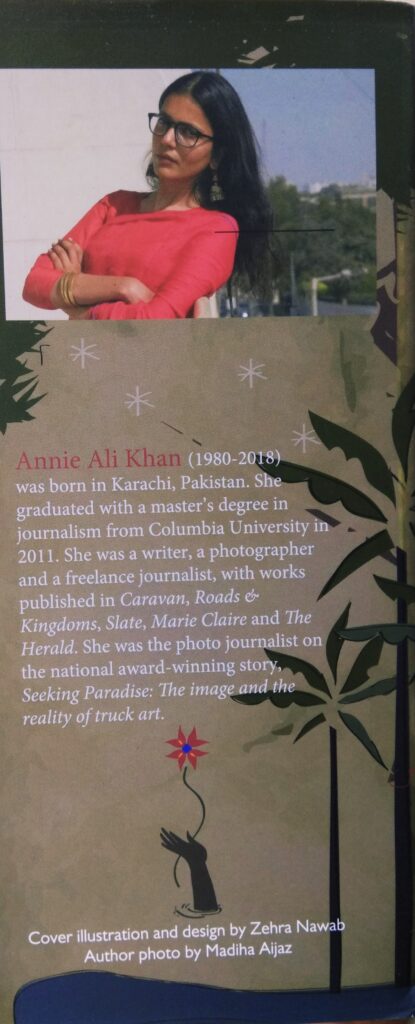
There is a poignant tale to this book. Before the manuscript could see the light of the day, its author Annie Ali Khan died in an accident in Karachi. Annie was merely thirty years at the time of death. A brilliant journalist with a master’s degree in journalism from Columbia University, she was a writer, a photographer with works published in Caravan, Marie Claire and The Herald. She had won Pakistan’s national photojournalist award for her story on truck art.
In the epilogue, Annie’s friend Manan Ahmed Asif writes equally touchingly about the events leading to the final publication of the book. Asif calls her a ‘fearless reporter of Pakistan’ and no journalist before had dared to do a newspaper story on a Hindu Pilgrimage in Pakistan. In reality, it is from this article that the book has originated.
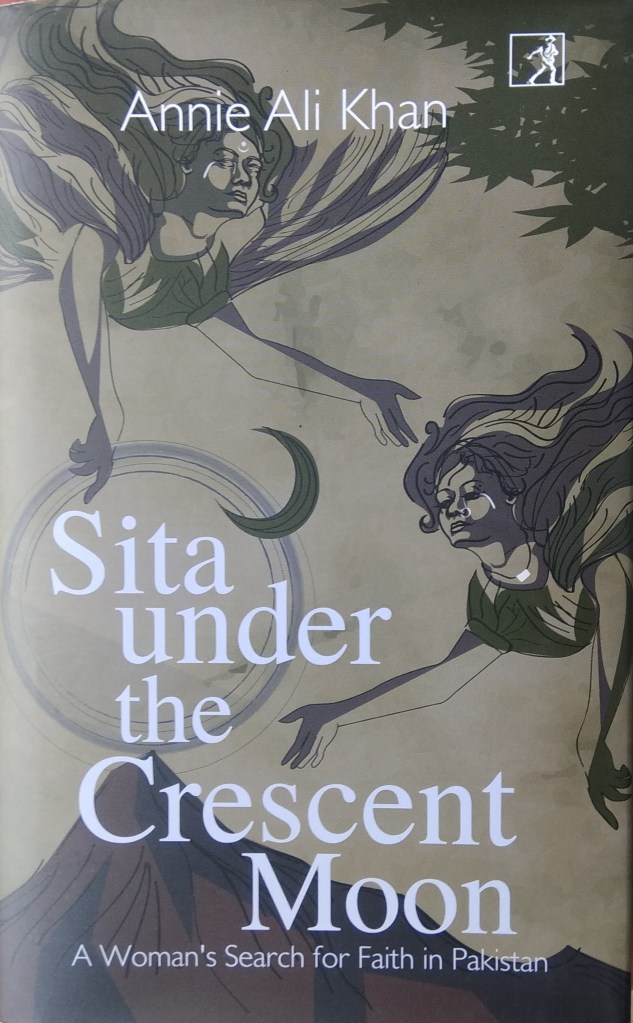
Sita Under the Crescent Moon – A Woman’s Search for Faith in Pakistan is a dazzling account of a tradition purely for the reason that it combines spirituality with travel. The blurb says it all: “In present-day Pakistan, in the far corners of Lyari in Karachi, or Hingol in Balochistan, or Thatta in Sindh, tightly knit groups of women keep alive the folklore, songs, and legends of Sati—their name for Sita in the Ramayana.”
Annie traveled with women devotees on pilgrimages to retrace the way they worship the goddess. She followed “healers, heretics, seekers, wives, mothers, sisters, grandmothers and believers”. These journeys intensely throw light on a veiled and obscure world. With loads of empathy, love, and self-sacrifice, the author listens to the stories of these women. She writes them down — word for word in some cases — capturing their dilemmas, the violence and the outfits they belong to.
Her exploration doesn’t stop there. She eats, rests, sleeps, prays, and lives with them. She was adopted by some as their daughter. Some even relied on her knowledge of the world to help show them the way of the government and the benefits therein.
The book lays bare, meaningfully, how worship has changed mind-sets and altered many of the mores of the land. While the sacral sites, made up of clay and thread grant a woman power and autonomy to fight her wretched conditions, the narrative demonstrates the pliability of women and depicts how, under the shadow of militant majoritarianism, women are keeping alive the memories of Sita’s exile, and her ultimate sacrifice.
The travelogue also tells Annie Ali Khan’s own journey. From her memories of Durga in the house of her grandfather’s friend to her own experience before Durga Mata in Hinglaj, the book is a chronicle of a woman in search of healing power. Hinglaj is a Hindu Pilgrimage in Balochistan which is the quiescent place of Hingula Devi, locally called Nani Pir. This is one of the 51 Shakti Peethas*of Sati, wife of Shiva. Meeting Durga at Hinglaj ‘inspires her to explore the way of the Satiyan, the seven sacred sisters, and also to look for Sita.’
Take a look at the narrative: “At Hub Chowki, a historic-city-turned-transit-town is now the gateway between Sindh and Balochistan. Those traveling through are greeted by a road sign that reads ‘Mundra’ – a Sanskrit word meaning temple or place of worship or chasm – overshadowed by a larger sign with a new name, proclaiming, in bold Arabic script, ‘Seerat’, meaning inner beauty, heavenly light hidden from view, veiled. These are the many paths to the sacred and the beautiful that abound in the Islamic Republic of Pakistan. May the goddess protect us!”
Next, she delves into the geography of the sub-continent: “Hinglaj, in the heart of the province, is as sacred as it is remote. The ancient temple is located along an endless terrain following a coastal route that reaches beyond the Malabar region in south India and extends further up north, past Rajasthan, then the coastal cities of Iran. I read somewhere that the road between the sea-facing shrine of Abdullah Shah Ghazi in the port city of Karachi and the shrine of Haji Ali, half-submerged in the sea in Bombay, was once a route well-traveled by pilgrims of the Sufi order – before the borders got in the way.”
The book is replete with a wide range of socio-political events — the uprising in Balochistan, clashes between Shia and Sunni sects, activities of Jamiat-e-Ulema-e-Islam.
There are also cultural references and quaint factoids: about the Odh people specializing in building homes of mud and straw; descriptions of the traditional quilt, rally; Makli being the city of a hundred thousand graves; women smoking chillum and Capstan cigarettes at shrines; use of “bird water” for healing; hierarchical relationships between the Sindhi and Baloch communities; the Chaaran community; the Meghwars being denied cocaine on grounds of their low caste status; the “Hanging Mela”; the “Ram Bagh” metamorphosing into “Aaram Bagh”; the Benazir Fund and her husband, Asif Ali Zardari, being known as “Mr. Ten Percent” for demanding a cut in all governmental deals, and so on.
Annie’s exploration of faith is once more syncretic: “I was accompanying a family of yatris on a pilgrimage to the temple, entering the heavily patrolled and policed borders of the province with them. It was also the last night of Navratri, the festival celebrating the victory in the battle of the goddess Durga over a demon buffalo to restore dharma, the order of the cosmos. Sati’s suffering and sacrifice and the joy of her victory were remembered like Moharram, like Mohabbat; love in the heart, eternal and ever-flowing like the suffering that was life on earth.”
The three-hundred-page travelogue Sita under the Crescent Moon is a remarkable tribute to Pakistani women who have always been the custodians of small traditions. It is their songs, folktales, and legends that become powerful mediums of transmission of traditions and faith in the absence of higher psychical goals.
Dedicated to Quratulain Ali Hyder, Sita under the Crescent Moon is not only a breathtaking documentation of a spiritual journey, but it is also a gender- gaze. Conspicuously, so many entities come up for closer investigation in the book – nationality, community, ethnicity et al.
Bhaskar Parichha is a Bhubaneswar-based journalist and author. He writes on a broad spectrum of subjects , but more focused on art ,culture and biographies.His recent book ‘No Strings Attached’ has been published by Dhauli Books.
*Shakti Peeth are shrines and pilgrimage destinations in Shaktism, a school of Hinduism which worships the mother goddess.
A review of Shankhachil – 2016 Bengali film by Gautam GhoseBy Abhinandan Bhattacharya
In the surging ripples of the meandering river one is most likely to hear the symphony of the universe. Does the river understand the definition of state or country borders? Can any force stop the flow of the river or refuse to accept the waters of the river because it flowed in from the other side of the border? The map of the biggest delta in the world has undergone a complete change with the water bodies gradually wiping out many differences set by human beings. The tigers and crocodiles have eaten their way into the geography of the region only to remind their human counterparts that there is more to life than engaging in conflicts on grounds of caste, gender and religion.
Shankhachil, one of the most brilliant Bengali films that I have watched in the recent times, is midwifed into existence from the Indo-Bangladesh dispute after the Partition touching upon the very fabric of the sensitive Hindu-Muslim religious bigotry. Dangling on the philosophy of ‘borderless border’, acclaimed Director Gautam Ghose has wonderfully echoed the appeal of ‘Where the world has not been broken up into fragments by narrow domestic walls’. Extremely well-spun montages have emphasised yet once again that we need to rise above our religious differences and start considering one another as human beings.
A poignant narrative of how a helpless father is compelled to cross border illegally just to get proper treatment for his twelve-year old daughter who is born with a congenital heart disorder. As a respectable school teacher, Muntasir Chaudhury Badol (Prosenjit Chatterjee) lives in his humble dwelling with his wife, Laila (Kusum Sikder) and daughter, Roopsha (Shajbati) in a little hut along the majestic Ichamati River that connects Bangladesh to India. Shankhachil (or Brahminy Kite in English) is a bird symbolizing freedom, a thought which, sadly, resides in a poet’s imagination only. Badol is a true Mussalman preaching about peace and silently sobbing in the face of communal violence that tends to tear the society apart.
A fine specimen of a crossover film and winner of the National Film award in the category of the Best Feature Film in Bengali, Shankhachil, talks painfully of the plight of the immigrants not because of the Partition but because of the prejudiced mindset of the so-called civilised and literate society who derive some sadistic pleasure in inciting communal hatred instead of finding ways to plant a proper pacemaker (read ‘peacemaker’). Muntasir and Laila lose their innocent Roopsha while navigating through this heart of darkness. But he is a proud father as he lost his daughter who had won in a different battle.
All countries look the same. Human beings respond to various stimuli in the same manner in all countries. Must we respond to communal hatred and indifference too in the same manner? Isn’t life too short to engage in such petty things? Does it cost a single penny to speak forth words of love without thinking about your and my religion? Isn’t everyone on earth ‘fed with the same food, hurt with the same weapon, subject to the same diseases, healed by the same means, warmed and cooled by the same winter and summer’?
It’s time to introspect. It’s time to reflect. It’s time to be educated. Once again.
Abhinandan Bhattacharya is a Secondary school teacher of English Language and Literature training students at the CAIE and IBDP levels at JBCN International School, Oshiwara, Mumbai. He has been honoured with several professional merits in the form of Nation Builder Awardby the Rotary Club of Mumbai and the Dedicated Teacher Award 2019 by Cambridge University Press in a campaign run by the University of Cambridge and CUP witnessing more than 40,000 nominations from across 150 countries worldwide. He is a published poet and writer winning the National level Poetry Writing Competition in 2019 organised by Story Mirror Schools Writing Competition. Today, he is a certified teacher trainer and mentor not only to his learners but to countless teachers as well.
Never talk to a bee as it is fecundating a sunflower,
Never talk to a butterfly as it is flying over a daisy,
Just keep seeing and thinking, and never glower
At them, just wonder on the way they go crazy!
Never abort their tuneful warbles while singing,
Never vex them or repress their deep thinking,
So, let them write the way their hearts like,
Let them think the way their minds like,
Let them sing the way their tongues love,
Let them have fun and fly with a cooing dove!
Never besiege or cage them in poetic death,
Never make them short of imaginative breath.
What garrulous lips that oppose calm and freedom!
Oh! Maybe they ignore that silence is wisdom!
Maybe, they think the two singers hate talking.
Yes, It’s true a bee and a butterfly hate talking,
And hate to be talked to while pollinating,
So, never imprison their words in one shut up house,
By talking to them about ladies’ soulless blouse,
As the butterfly and the bee like to resort to a journey
Across the world without a passport or a visa of entry,
As they don’t like to keep queuing at the embassy
To meet varied pollinated flowers from other continents,
Where they can go beyond any traditional confinements
Of thinking, feeling and creating a map of poetic seeds
That draws human love and peace that anyone needs,
So, let a ‘poet’ sing and fly like a bee and a butterfly,
Across his borderless world and transnational blue sky
Corona is a Plea for Love!
How stupid of world colorful peacocks
To boast of their wings and hearts of rocks!
How stupid of woodpeckers to eat bees!
How stupid of birds of prey to harm trees!
How stupid of wolves to eat rabbits!
What a gloomy forest of unfair habits!
*
How stupid of wealthy peasants
To sow hemlocks to kill thousands
Of pigeons put in dark dungeons,
Using Hitler’s nuclear weapons!
What a myopia to expose a pigeon to danger!
So, you fail to fight against a Honey badger!
Thus, corona is a cure for such a ‘corona!
It enfeebles tempted vultures’ vile stamina!
What a war that breaks out in the forest!
It stirs up peace and love to reach the crest,
As it’s unwise to keep seeing the waves of sea
And ignore inhaling its breeze that sows glee!
So, let’s quieten the roughness of East-West sea
Let’s stop political tides — it’s a sulky sky’s plea.
As the Nile and Euphrates complain of aridity,
Let’s unite world foes to celebrate humanity!
Enough of greedy guns, enough of grudge that is rife!
Coronavirus warns any lion as there is no eternal life!
Abdelmajid Erouhi is a Moroccan poet and writer. He is a teacher of English from Zagora, from an Amazigh origin. He is currently teaching in Tantan City in the south of Morocco. He has published some of his poems in different magazines and websites. He has an unpublished collection of poems, and he is now working on a new one. He is also interested in writing short stories.He is pursuing his PhD about Cultural Encounters between the East and the West in Postcolonial Narratives of Contemporary Arab Muslim writers in Diaspora at Sultan Moulay Slimane Faculty of Letters and Humanities in Beni Mellal. He is similarly interested in Travel literature, Diaspora, Cultural Studies and postcolonial theories. Besides, he is interested in Arabic literature.
“Stop cooking meat! I can smell it all the way up here,” my younger daughter Annika upbraided me from her upstairs bedroom.
I had made a rare purchase of mincemeat as part of a packet of ingredients to be assembled for the evening meal. Choices were so limited when you had a vegan in the family. I had almost given up buying meat and chicken, but persisted in buying eggs, fish and dairy. Eventually I found words to describe myself which I could use to feel virtuous, such as a ‘pescatarian’ – a fish eating vegetarian, and ‘flexitarian’ – a vegetarian when it was convenient. Annika didn’t mind if I made vegetarian dishes, but wouldn’t partake unless they were vegan.
“It’s okay for you to be vegan,” I retorted. “But you don’t have to impose your values on the rest of us. You don’t always conform to my values either.”
“Like what?” she asked.
“I’m not getting into that now. It’s okay for you not to eat meat but you can’t force the rest of us to give it up too,” I repeated.
I descended the stairs to the kitchen and took in the unusual smell of cooking meat, which has been absent from our kitchen for a couple of years. Then I bravely assembled the meal, spreading out the wrap, adding the mince mixture and topping it off with some tzatziki (a Greek yogurt sauce. I folded the wrap and sat down to eat it with my trusted Labrador Tia in front of me. Tia fixed her eyes on me unwaveringly and pricked up her ears. It was my habit to share all my meals and snacks with her.
When we had bought her at the Royal Society for the Protection of Animals (RSPCA) I had asked the vet whether it was okay to give her human food. He asked whether I meant sharing my toast with her in the morning. When I nodded he affirmed, “Of course!” From that moment I considered myself to have official approval to share any healthy food with Tia. If I were eating an apple, I would bite off one bit for her and one for me. When I was making a salad, I would hygienically feed her lettuce leaves, tomato tops, or slices of cucumber. (I do confess to feeding her occasional crumbs from my chocolate cake when no-one was looking.) The day that Annika scolded me for cooking meat, Tia was even more excited than usual. She was anticipating that I would share the mincemeat with her. I started to ingest the meat, but the smell put me off, so I passed most of it off to Tia. Needless to say, she was delighted. However, she didn’t savour it, but rather gulped it down quickly without leaving time to enjoy it.
Annika had always shown a sensitivity to the feelings of animals, even rodents. When we first moved into our house we would sometimes see a sudden movement as a mouse darted between the sofa and the fireplace. It was embarrassing to have a well-to-do guest suddenly ask you, “Was that a mouse?”
I wasn’t sure how to get rid of mice without killing them, and tried sonic deterrents which you could plug into an electric socket. Once Annika spotted a mouse in the house. She thought it was a native mouse, a marsupial, because its forelegs were shorter than its hind legs. She could even see the mouse’s heart beating through its chest as it trembled. Then she felt sorry for it and left it alone. After that I asked my husband to deal with the mice, and didn’t ask any more questions. The mice disappeared.
Until Annika became a vegan I had disassociated meat from animals. The packets of neatly wrapped meat in the supermarkets had nothing to do with the animals that you passed on farms in drives through the country. One day Annika drew a connection between Tia and meat, asking if I would eat Tia. From then on I could associate meat with living animals. The meat shelves in the supermarket became distasteful and I had to look the other way as I passed.
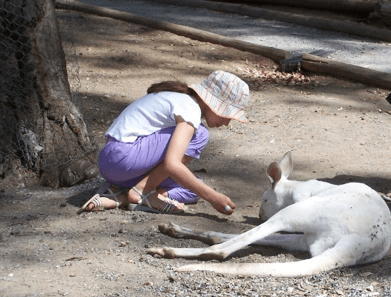
A friend has a business selling kangaroo meat overseas. She made a post on social media explaining why kangaroo meat is better than meat from farms; kangaroos are game, and they are not killed in the abbatoirs. I hesitated over the ‘like’ button as I read this. I was convinced by her argument but reluctant to agree with the notion of killing Australia’s national symbol, featured in our Coat of Arms and decorating the tail of the national carrier.
A kangaroo in the countryside
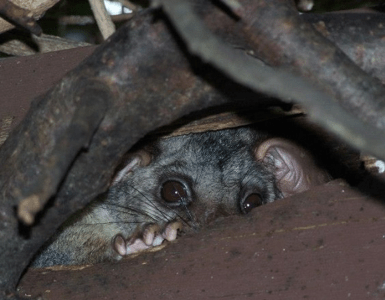
I work overseas and return to Australia every holiday. My pleasure in Australia’s fauna and flora is enhanced because of my long absences. When I return I am delighted to spot kangaroos in the countryside, possums in tree hollows, and koalas sleeping in trees in the neighbourhood.
Possum
A koala on a tree
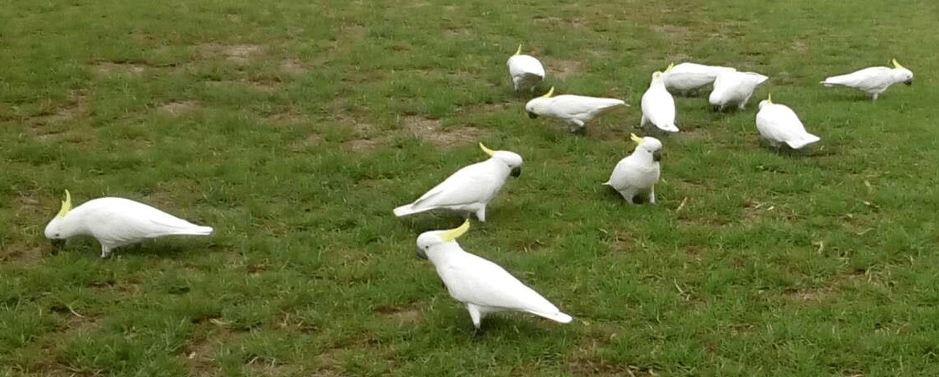
Every morning is a visual and auditory feast. I spot rainbow lorikeets on the balcony, and cockatoos feeding on neighbouring lawns.
Cockatoos on the neighbour’s lawn
I listen to families of kookaburras cackling, and magpies serenading me. I am enjoying the fauna more than ever, and I can understand Annika’s feelings for them.
Not only that, times of global turmoil when movement is restricted are ideal for slowing down and appreciating nature. As Alain de Botton says on his homepage, “You normally have to be bashed about a bit by life to see the point of daffodils, sunsets and uneventful nice days.” In these tumultuous and uncertain times there is an exquisite pleasure to be had in communing with animals and birds. Now I can find the time to still myself for long enough to enjoy watching the sulphur-crested cockatoos squawking as they land on the lawn to peck for their dinner.
Nevertheless, my dietary resolutions are more due to the impact of the younger generation than the enhanced appreciation of wildlife afforded by the time for reflection in the lockdown. I will probably remain a pescatarian, or even a flexitarian. I won’t become a vegan and I will respect the choices of my friends and family to eat whatever they want. However, I do understand the younger generation’s commitment to veganism, and am prepared to admit that older is not necessarily wiser.
Meredith Stephens is an applied linguist in Japan. Her work has appeared in Transnational Literature, The Blue Nib, The Font – A Literary Journal for Language Teachers, The Journal of Literature in Language Teaching, The Writers’ and Readers’ Magazine, Reading in a Foreign Language, and in chapters in anthologies entitled What’s Cooking Mom? Narratives about Food and Family, The Migrant Maternal: “Birthing” New Lives Abroad, and Twenty-First Century Friendship, all published by Demeter Press, Canada.
At such a time as ours, I can identify with the first three lines, but not the last three. As I read the poem, I utter instead, “Ah, what dark tunnels are we crossing?”
I can’t believe that it has been six weeks since I have been to my office at the university. It has been more than a month since I was at my newspaper office. Things have been shifted online — without any of us having any preparation or training whatsoever. With the number of coronavirus affected patients rising rapidly in the country, sometimes I pinch myself to see if I am awake or if it’s only a nightmare. As I drift through one day exactly like another, I wonder if it is actually the beginning of a dystopic age. I recall all the science fiction books I have ever read and the movies that I have watched. This reality is more horrific than any of those because I am living in it. According to WHO, the worst is yet to come. And I wonder, I really wonder how my dear Dhaka city will look like after another month. How will Bangladesh feature in the world map after six months? Or next year this time how will the world function?
The governments across the world have declared lockdown and curfew of one kind or another. The situation in Bangladesh is really at a problematic stage. Being one of the most densely populated countries in the world, if not checked, the pandemic will cause a devastation that nobody has yet encountered anywhere. The close proximity and the number of people also are the reasons behind our tension—how to control this mass? The city of Dhaka is home to 160,000,000 people. Even though some have left for their hometowns, the larger portion still abides here. But we are so many in number and most live in such congested houses that it is difficult for them to continue indoors through days and nights. So, at the slightest chance, they slip out of their dilapidated shanties and cluster around half opened tea stalls and shops; they whisper to one another over a biscuit and half a cup of tea about the strange epidemic they can barely comprehend.
They look in apprehension and curiosity at a said narrow street that has been sealed because a family living there has been identified as COVID-19 victims. Then the police arrive with their batons and sticks and start beating people and they run to hide into their holes. Except for a few residential areas, this is the general scenario in Dhaka. People are prohibited from going to work, but who can take away their addas? The Bengalis can go without food but they cannot live without adda and gossip.
Hence, even though the government is dictating social distancing, ours is a culture that disapproves of such distances. The month of Ramadan has begun and for the first time in history, people are not going to the mosque for mass prayer. In all probability, the Eid Jamaat will not be held on the morning of Eid-ul-Fitr. But there is this group of religious leaders that continue to claim that if one dies after going to the mass prayer, they will go straight to heaven. No wonder that just over a week ago, around 100,000 people turned up at the funeral ritual of a senior member of Bangladesh political party, Khelafat Majlish. Some people will always benefit from any kind of disaster and such incidents only testify to that. One might ask, what can one benefit from such mass gathering that might result in extreme suffering and death? Well, the answer is — the ultimate objective of any system is to wield power over others. If it leads to death even, so be it; you have power over the dead and for some leaders at least, human life is expendable.
The biggest problem for us in Bangladesh right now is that in spite of the wide accessibility of the news channels, we are not fully aware of what we are dealing with. I was reading an article just this morning quoting the Director of Transparency International Bangladesh, who observes how the country has failed in protecting its citizens from Coronavirus. The system is so debased that even at this stage of the pandemic, some government officials are busy making money and compromising the situation by buying lower quality equipment for doctors and patients. The public announcement says that Personal Protective Equipment (PPE) has been bought for all doctors and medical staff, but in reality, those have been distributed selectively. The doctors outside of the capital city of Dhaka are mostly purchasing PPE out of their own pockets. Across the country, about 120 doctors have been affected by COVID-19, and among these only a handful are from those chosen hospitals.
There are all sorts of rumours, and because of those, people are ready to ransack hospitals as COVID patients have been admitted there. No wonder that a number of people are refusing to reveal that they are carrying the virus. When even the educated and conscious segment of the society does not know what lies ahead, one can only assume how the working class, who live from hand to mouth feels. Their daily living has been wrenched away from them by an unknown force.
Strangely enough, amidst this chaos a group of people are hopeful that this cannot last forever and something good will surely come up. Many will develop awareness of what they have done wrong. For me, that is only a distant possibility. More prominently looming in the near future are scarcity of jobs, lack of provision, budget cuts and trauma. How hopeful can we actually be when we know at heart that there is nothing bright and hopeful in the coming months?
Sitting at the heart of the city’s posh area, some are congratulating themselves as a few trucks of relief goods are distributed to some lucky ones. What about the rest of the country? How do we know that they are getting to eat? But then, some might counter that these people are half dead anyway and hence it would not matter much if they actually die now. It might sound atrocious and something we do not want to face, but it is the reality.
I used to be a workaholic. But I have not really been able to be productive since the lockdown began. This might be the beginning of a different set of thoughts for me. But I do not yet know what that might be exactly. I certainly am able to concentrate on work or creative writing. I am watching movies and keeping track of the COVID news. I fall asleep at odd hours and keep awake through the night.
On rare moments, I dream of a cloudless blue sky and endless green pastures, of the not so crowded roads and streets of the late 80s and early 90s, of the people I have lost over the years. I might lose some more in the near future. How do I stand proud, strong and unshakable when the ground under my feet is giving away and I feel that I am drowning?
Sohana Manzoor is an Associate Professor in the Department of English and Humanities at the University of Liberal Arts Bangladesh. She is also the Literary Editor of The Daily Star.
Disclaimer: The opinions expressed are solely that of the author and not of Borderless Journal.
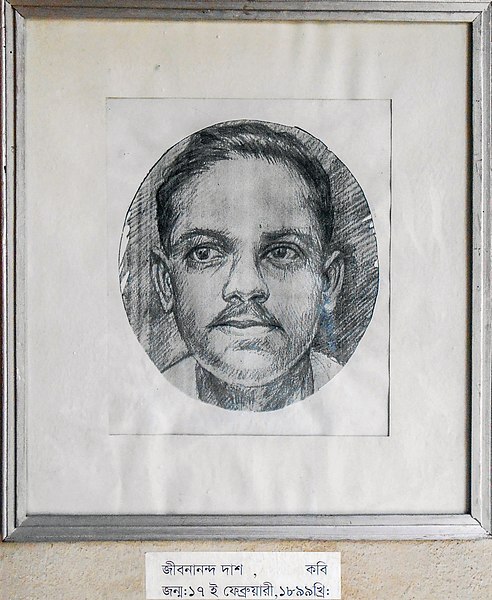
Often hailed as the most influential poet of the post-Tagore generation, Jibonananda Das remains one of Bengal’s most intimate and incisive observers. Born in 1899, at the cusp of change raging across India and indeed the world, Jibonananda started his poetic career as a Romantic celebrant of Bengal’s vast green fields, sun-dappled rivers, lush horizons, its minutest of elemental forces. As years rolled by, a variety of societal changes impacted this landscape and indeed his own life—colonialism, World Wars, the Bengal Famine, communalism and the dark days of Partition. His poetry and sensibility gradually took a turn to the urbane introspection of existential loneliness, tradition and its clash with modernity, death, sickness, and the newly evolving concept of the nation. However, the theme that towered over his thought-process was the concern of human civilization, its evolution and achievements and the paradox of death, disease and violence that this civilization always was confronted with. Both the pieces translated, ‘BANALATA SEN’ and ‘1946-47’ capture these romantic/humanist approach. ‘BANALATA SEN’ is perhaps his most-quoted poem, where the enigmatic, eponymous damsel offers respite and peace to the world-weary traveller-persona. What is striking in this piece, is the catalogue of places that the persona travels to—all strung together by a distinct Buddhist civilizational motif. Perhaps, he is quietly reflecting on India’s departure from its ethos of non-violence, peace and tolerance, across ages.
GLOSSARY:
Bimbisara: a 5th century BC king of the ancient kingdom of Magadha; remembered for his military exploits and his patronage of the Buddha
Asoka: Celebrated as one of the greatest imperialists in Indian history, he is remembered in history for his dramatic conversion from an aggressor to a Buddhist who spread the message of non-violence and peace.
Vidharba: The north-eastern territory of Maharashtra, on the banks of Godavari.
Natore: a district in northern Bangladesh. Legend has it that a Zaminder was once travelling by boat looking for a suitable place to build his principal residence. While travelling through Chalan beel (lake), he saw a frog being caught by a snake. His astrologers interpreted it as a sign of the end of his search for a place of residence. The Raja called out to his boatmen: ‘Nao Tharo, nao’ as in, ‘stop the boat’. From a corruption of this exclamation, the place eventually came to be called ‘Nator’.
Vidisha: Situated very to the Buddhist pilgrimage city of Sanchi, Vidisha was an important trade centre under Buddhist rulers in the 5th century BC.
Sravasti: Currently in modern day Uttar Pradesh, the city is one of the premiere centers of Buddhism.
‘1946-47’ is a landmark poem on the history of violence and bloodshed that came in the wake of Partition. The poet is a chronicler of Bengal’s changing landscape, her ethos and values in the modern times. But above all, Jibonananda voices the subaltern, especially the Bengal peasantry, whose plight and suffering under colonialism is deeply etched on his mind.
GLOSSARY:
majhi-bagdi: Denoting the caste of fisherfolk and tribal warrior communities of rural Bengal
Permanent Settlement: A revenue agreement between the East India Company and Bengal’s landlords to fix taxes/revenues to be raised from land.
charok-gaach: a maypole erected out of the stump of a tall tree during the season-end festival of the last month of Bengali calendar, Chaitra. On top of this tall maypole are tied bundles of jute and flags with which a merry-go- round is built. Congregants whirl around the top of the maypole, supported by the ropes and hooks.
Although he spent his early days in earstwhile East Bengal, yet he moved to Kolkata where he graduated with an Honours in English in 1919 and thereafter earned an M.A., also in English, from the Calcutta University in 1921. Following his tragic death in a road accident in 1954, a vast body of novels and short stories, written by him, were discovered. Throughout his life, he shied away from public attention as posthumously he emerged to be a modern poetic giant in the annals of Bengali Literature.
Suparna Senguptalives in Bangalore, India and is a faculty, Department of English at the Jyoti Nivas College for more than a decade now. She has translated various poets from India and Bangladesh and has been published in literature magazines. Her translated poem has been published in “Silence Between the Notes”, an anthology on Partition Poetry (ed. Sarita Jemnani and Aftab Hussain). She also features in the Annual Handbook of “Words and Worlds”, a bi-lingual magazine (PEN Austria Chapter) as also in ‘City: A Journal of South-Asian Literature’, Vol 7, 2019 (City Press Bangalore).
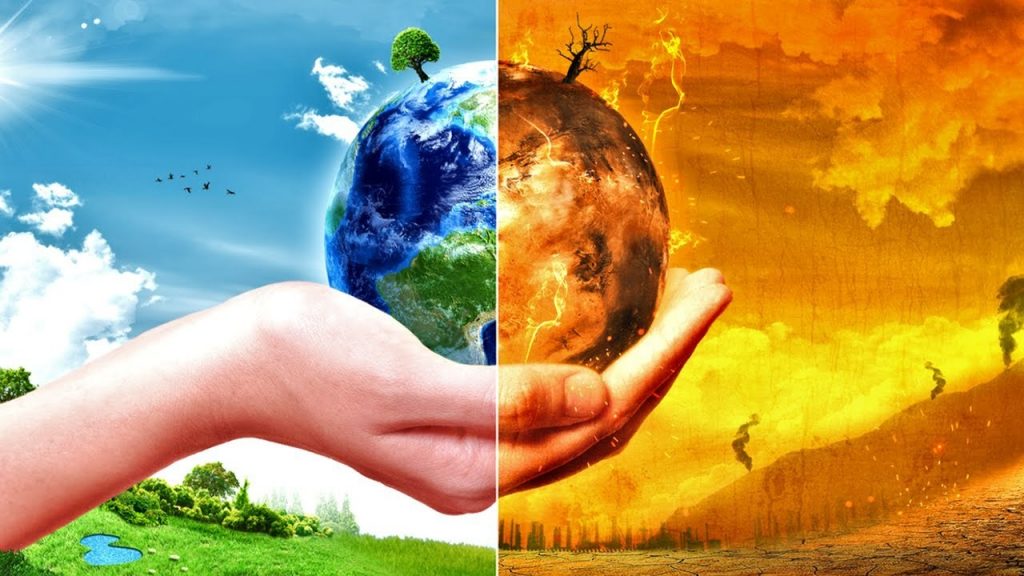
The COVID-19 has taught us that we are in an emergency. In 2019 a teenager named Greta Thumberg was crying hoarse that we are in an emergency and no one was listening. It’s time for us to take stock of the matter. Which is the greater emergency, this COVID-19 emergency or the climate emergency that Greta Thumberg was warning about?
Up to 1 million: species threatened with extinction, many within decades
>500,000 (+/-9%): share of the world’s estimated 5.9 million terrestrial species with insufficient habitat for long term survival without habitat restoration
>40%: amphibian species threatened with extinction
Almost 33%: reef forming corals, sharks and shark relatives, and >33% marine mammals threatened with extinction
25%: average proportion of species threatened with extinction across terrestrial, freshwater and marine vertebrate, invertebrate and plant groups that have been studied in sufficient detail
At least 680: vertebrate species driven to extinction by human actions since the 16th century
+/-10%: tentative estimate of proportion of insect species threatened with extinction
>20%: decline in average abundance of native species in most major terrestrial biomes, mostly since 1900
>6: species of ungulate (hoofed mammals) would likely be extinct or surviving only in captivity today without conservation measures Food and Agriculture
Yes this is an EMERGENCY that very few are talking about.
Why are all these species going extinct? Just because of the actions of this invasive dominant species called homosapiens!
The same UN report points out that:
1 degree Celsius: average global temperature difference in 2017 compared to pre-industrial levels, rising +/-0.2 (+/-0.1) degrees Celsius per decade
>3 mm: annual average global sea level rise over the past two decades
16-21 cm: rise in global average sea level since 1900
100% increase since 1980 in greenhouse gas emissions, raising average global temperature by at least 0.7 degree
40%: rise in carbon footprint of tourism (to 4.5Gt of carbon dioxide) from 2009 to 2013
8%: of total greenhouse gas emissions are from transport and food consumption related to tourism
5%: estimated fraction of species at risk of extinction from 2°C warming alone, rising to 16% at 4.3°C warming
Even for global warming of 1.5 to 2 degrees, the majority of terrestrial species ranges are projected to shrink profoundly.
When Countercurrents.org started in 2002, the CO2 level in atmosphere was 370 ppm. Now it stands at 412 ppm. Dr. Andrew Glikson, a climate scientist has pointed out in several articles in Countercurrents that total green house gases in the atmosphere in the atmosphere including CO2, Methane, Nitrous Oxide, Ozone etc has topped 500ppm.
The Paris Agreement’s goal is to keep the increase in global average temperature to well below 2 °C above pre-industrial levels; and to pursue efforts to limit the increase to 1.5 °C.
Coordinated by the World Meteorological Organisation which is also backed by the United Nations Environment Programme and the Intergovernmental Panel on Climate Change, the United in Science report released in September 2019 estimates global emissions are not likely to peak before 2030 on the current trajectory. It says policies to reduce emissions must triple to meet the 2°C target and increase fivefold to keep heating to within 1.5°C.
With the forced COVID-19 lockdown we are well on track to reach the Paris temperature goals. The COVID lockdown taught us what is essential for our sustenance. Most of the carbon emitting vehicles and airplanes are grounded. Our consumption has come down to our basic essentials. Continents jumping tourism has come to a standstill, so has the neoliberal globalisation. It is good time for globalisation to fail and save our planet. Pollution has come down. Cities have become serene. Rivers have become clean. We’ll have to wait for authentic studies to confirm how much carbon footprint did we reduce.
We were living a reckless life like there is no tomorrow, consuming as much as we can and travelling as far as we can. COVID lockdown has put a break to this reckless lifestyle. In fact it is so much better for the environment. The COVID lockdown has taught us how much wastage we were making. It also taught us we can live better life with much less than we usually consume.
The COVID lockdown has also taught us we have to do a lot more work to do make our economy resilient. We have to make our local economies resilient. We have to grow our food in our neighbourhood. It will create more local jobs and stop the long haul migration to the cities. The cities too have to become resilient by producing its own food. May be cities itself may not be a good idea and wither away.
The COVID lockdown has given us a sneak preview into the future if we are to meet the global temperature goals. We have no other choice if we are to believe our science experts. Scientists like James Hansen predicts that even the human species may go extinct if we can not control global warming.
Human civilization has seen many pandemics and have won over all of them. We’ll overcome this pandemic too. But I’m not so sure about the battle against global warming. The COVID-19 lockdown has taught us that we can win the battle against global warming too. With a little bit more planning we can do even better.
Green all around, shades of green actually, that seemed to smile at her as she looked out. The tall moringa tree that seemed to reach up high, its small leaves dazzling in the play of sun and rain. That tree that met her eyes each morning as she looked out of that large window always made her feel nice. The rusted iron grills, the wooden window shutters broken here and there, did not shut tight, the latch rusted too, some bit of concrete laid bare a little of the masonry – her eye moved along.
***
Bimala arrived in this house after her marriage. It was an arranged one. Baba and Ma looked for a suitable groom for their youngest born and the marriage was solemnised in the traditional way. Dida (grandmother) wanted it to be done just that way. Dada (elder brother) was working by then and just a few years before this they had moved into an apartment on the eastern fringes of the city.
It was a modest one and Bimala took great pains to do it up — from choosing the colours of the wall, the upholstery, the curtains, the fittings in the bathroom, almost everything. Bimala had a keen taste for the aesthetic and visitors to their home always made it a point to refer to it.
Baba had worked with the state government and retired a year after her marriage. They were a middle class family, and a very happy one at that. Bimala was never pampered, Ma and Baba were strict disciplinarians who made sure their children had the best in life.
Anupam, Bimala’s husband, lived with his mother in a neighbourhood in the southern part of the city. Anupam had his education from some of the best institutions in India, he obviously had been a very good student. He had been working with a multinational company for some years now and everyone knew he would soon rise to the top. Kumar Kaku (uncle) knew the family well and vouched for Anupam. He and Kakima (aunty) always said, Anupam was a wonderful person, soft spoken and reticent.
“A reserved lover, it is said, always makes a suspicious husband,” Kate Hardcastle’s line from the play she read in college had come to her mind. She spoke about it to Ma and Baba. Baba said, “You can surely talk to him. If you don’t approve, we will not go ahead.”
She remembered Ma’s reply, “Kumar is distantly related to the family. We have known him for years, he is our family friend, we can trust him completely. When he says the boy is good, we could go along. I see no reason why we need to have doubts.”
She did talk to him a few times before the wedding and Anupam came across as a decent guy. They met up too a few times. She did not want to rush into it, she wanted to take some more time, but Kumar Kaku was insistent. “I know the family well. They are decent people.”
“That is alright,” Baba said. “It is a question of Bimu’s life, let her take some more time before she decides.”
Kakima too waxed praises galore, “Anupam was such a nice person.” She spoke highly of him and his family and called up Ma regularly. For some days, this was what went on in the household. Dada also agreed with Baba.
“Bimala could be given time to decide,” she heard Baba tell Ma. That was all the kind of conversation that went on at home, these days, she thought. As days went by, Kumar Kaku’s visits to their house increased. Bimala said yes after some thought. Kakima and Kumar Kaku were jubilant.
“I know both families and this is what is best for our Bimala,” she could hear his words as he spoke to Ma.
Baba did not say much. “Are you sure, Bimu, you want to go ahead with it? If you have even a little bit of doubt, any questions, anything, let me know. I am sure I can talk with your Ma about it.”
Bimala just smiled, “Na, Baba, it is alright.”
So in about less than twelve months, the marriage was finalised. A flurry of activity – arrangements were done, invitations sent out, so much taken care of. Kaku and Kakima took an ever more eager interest in everything. Things moved real fast after she had agreed. A modest wedding and soon her new “life” in the new house began.
The ‘mask’ came off in less than six months. “Don’t touch that.” “Don’t do this.” “This is my house.” “Do not try to show off your learning.” “All your ideas are worthless” – they just kept coming at all times.
“Why do you need appliances? My mother did all these by herself. “
“But Khokha, things have changed now. Certain things are needed these days. Had they been available earlier on, my home would have been so very different.” Anupam’s mother had been the voice of good sense, not that she had much say in the house.
He would just stare at her. Bimala felt nice talking to her. A year after the marriage, a massive heart attack ended that life. They had been talking when the end came and Bimala was in a state of shock for weeks after that incident.
In summer months the house was unbearable. Bimala had not been used to this heat. Anupam had said that he would make provisions so that life could be nice. That was before the wedding. Kumar Kaku and Kakima too had said that he would do all that was needed to live life well. Nothing happened. Bimala tried to reason with him, he ignored her. That day, about a year and half after they had been married, the television was blaring and Anupam was watching the news. She tried speaking to him about getting an air conditioner, he turned away. She again tried speaking.
This time she switched off the television. He shouted at her. She tried keeping her cool, he refused to listen to anything. Suddenly he caught her with his two hands, he held her neck. He held her that way and pushed her from the living room to the bedroom, she tried to break free, but the grip was too strong. Bimala was so taken aback by the whole think that she could not utter a single word. He pushed her on the bed, holding her neck in his hands, shaking her. She struggled and struggled. After a while, he eased the grip, went into the living room, switched on the television.
She lay on the bed, crying in pain, in hurt, in humiliation, insulted. All for some cold air, to live life well. After some time, she got up, there were marks on her neck. Who should she turn to, she felt so lost. She called up Kakima and told her what had happened.
“Such things happen in marriages. Don’t pay much attention to them,” she said.
Bimala could not believe what she said, “Things will be alright now, you see.”
After the conversation was over, she took out her suitcase and started packing her things. The next morning she left.
Anupam did not say a word.
Baba told her, “You did just the right thing.” Ma was upset with the turn of events but they were both happy with the decision.
Bimala never went back.
***
It has been five years since then. Restricted by the lockdown, amid reports of an increase in domestic violence cases, she got talking about it that evening. I knew that was a traumatic period in her life. She had tried picking up her life little by little. I have known her for years and have seen her as she tried to begin things afresh.
“As I look at the masks that we are to wear these days as precautionary measures, I am so reminded of the masks that people always wore.” We were chatting online, and Bimala said, “Kumar Kaku and Kakima’s masks fell off after I walked out of that marriage. All those years of friendship with my parents ebbed so quickly. They never ever got in touch with us, never again.”
Dr. Nishi Pulugurtha is an Associate Professor in the department of English, Brahmananda Keshab Chandra College and has taught postgraduate courses at West Bengal State University, Rabindra Bharati University and the University of Calcutta. She is the Secretary of the Intercultural Poetry and Performance Library, Kolkata (IPPL). She writes on travel, film, short stories, poetry and on Alzheimer’s Disease. Her work has been published in The Statesman, Kolkata, in Prosopisia, in the anthology Tranquil Muse and online – Kitaab, Café Dissensus, Coldnoon, Queen Mob’s Tea House, The World Literature Blog and Setu. She guest edited the June 2018 Issue of Café Dissensus on Travel. She has a monograph on Derozio (2010) and a collection of essays on travel, Out in the Open (2019). She is now working on her first volume of poems and is editing a collection of essays on travel.
Dr. Santosh Bakaya is an academician, poet, essayist, novelist, biographer, Ted Speaker and creative writing mentor. She has been critically acclaimed for her poetic biography of Mahatma Gandhi [Ballad of Bapu]. Her Ted Talk on the myth of Writers’ Block is very popular in creative writing Circles . She has more than ten books to her credit , her latest books are a biography of Martin Luther King Jr. (Only in Darkness can you see the Stars) and Songs of Belligerence (poetry). She runs a very popular column Morning meanderings in Learning And Creativity.com.












 Borderless