Title: The Devil Take the Blues: A Southern Gothic Novel
Author: Ariel Slick
In her newest book, The Devil Takes the Blues, the Texan novelist, Ariel Slick, takes on a journey into the deep South. Her novel is very well written and crafted. It has been substantially enriched with blues music and its mythology.
The novel centres around Beatrice who learns of a threatening prophecy about her beloved sister, Agnes, that can only be prevented by making a pact with the Devil. The protagonists are joined by the handsome blues musician, Angelo, a mysterious voodoo practitioner, and the unlikeable husband of Agnes. The plot is superb as is the writing style. Slick is able to paint an immersive picture of the (fictional) rural town of Azoma in the 1920s. She knows how to write breathtaking action scenes as well as solemn moments and includes a lot of philosophical and ethical considerations. It is an entertaining read that also gives you food for thought.
The main reason why I picked this book was that blues is part of the title. I’m very much interested in the history of blue music, and if it is combined with (supernatural) Southern Gothic I am basically sold. Alas with many tales, blues is just some spice added into the mix and all too often reduced to a bleak cliché.
Ariel Slick approaches it differently. The novel is set in the 1920s, the period where blues was born as a popular genre of music. Victrola record players became relatively common in the US and mail delivery made the records available to the newly emerging customer group of African-Americans, even in rural regions. Slick also does not choose the obvious Mississippi Delta as the place for the story but a fictional small town in Louisiana. Slick’s book is no history class though. If you did some research on the origin of the blues you will find some errors, such as records with multiple tracks or that it’s a year too early (1924) for consumer phonographs. If you are into the history of blues music, you will also note how blues and jazz are somewhat conflated, which, by the way, is not always a problem, since genre boundaries are usually drawn in retrospect.
However, the novel tries to take on the culture that surrounded blues. The whole book is fundamentally informed by a world view apparent in pre-war blues. While there are minor flaws, Slick is able to present a much more complex picture of the blues than is usually present in fictional works. It is not about downtrodden “authentic” Black geniuses expressing their pain – a story that is too often repeated and tends to cater to expectations of a White audience – but about blues in all of its nuances. It’s about pain and racist experiences but also about love, joy and the very unique sense of humor and quick-wittedness prevalent in blues music.
What’s the deal with the devil?
As the title promises, the Devil plays a big part in this story. That comes as no surprise as the Devil is one of the core elements in the pop cultural view of the blues. Even if you don’t know a thing about the history of the blues, it’s likely that you have heard of Robert Johnson’s deal with the Devil. Fortunately, Slick doesn’t go down this path. She mentions and debunks the hurtful myth in passing and is absolutely on point in her ‘Historical Note on the Blues’ when she states, that “„[i]t’s probably a testament to racism that we’re more likely to believe a Black man sold his soul to a supernatural being rather than was a musical genius.”
Rather than solidifying the myth that the blues is the Devil’s music, she embeds it in the cultural discussion of its time. For example, she addresses the fearmongering against the alleged sins of the Devil’s music, while the actual terror was not the excess or the sexual promises of a juke joint but the lynching of human beings.
Instead of the Johnson myth and some crude idea of evil, she presents a Devil inspired by Papa Legba, that is not evil, just the guardian of the crossroads. Furthermore, this Devil is not only a concept but takes an active role in the story and even narrates parts of it. Most interesting and original is the fact that the Devil doesn’t follow a clear agenda. He is himself conflicted about his role and ethics. In some ways it’s the most human Devil I know, and for sure, more human than some of the human antagonists of the book …
Just as with the Robert Johnson myth, the book is also careful in catering to clichés when it comes to blues music. There are still some passages that put too much emphasis on a supposed immediate expressiveness and disorderliness of the genre, but the author clearly knows, that this is only a part of the blues at best. She knows that it is also an outlet to deal with hardship, by having a good time and laughing to keep from crying. Most importantly, Slick never mistakes poverty and discrimination for authenticity: “There [is] no nobility in suffering.”
Not limited to blues, the difficult topic of racism of the era is at the heart of the book. By that the book faces the particular challenge of reflecting worldviews and language from the 1920s without reproducing racist stereotypes and language itself. The book indirectly addresses this issue, when describing a situation as awkward as “a white author writing first-person perspective of a black character.” As a non-native speaker, I am not in a position to judge whether the book always succeeds in this task. There are passages where I find the choice of language problematic, but I can plainly see an anti-racist stance throughout the whole book.
The Devil Take the Blues is a unique Southern Gothic novel that stands out by seriously involving (the history of) blues music. Even with some flaws in historic accuracy it is able to present a nuanced picture of blues music what gives the story an interesting twist. For all my focus on history and the treatment of blues music and cultural sensitivity, it should not be forgotten that the book is simply a well-crafted, entertaining read. It is compelling read from page one to the last sentence. This novel’s a good read not only for blues enthusiasts but anyone who is looking for a well-crafted story with a special twang.
Five poems by Satrughna Pandab have been translated to English from Odia by Snehaprava Das
Satrughna Pandab
SUMMER JOURNEY

Does this journey begin in summer?
After the mango buds go dry
And the koel’s voice trails away…
When simuli, palash and krishna chuda
Blaze in red?
Does it begin when the blood
After reveling in the festivities of flesh
Crosses over the bone-fencing
And gets cold,
When the burning soul yearns for
The fragrant and cool sandalwood paste?

And the soothing monsoon showers?
 Where lies the destination --
At what border, which estuary,
Which desolate island of wordlessness?
The journey perhaps itself decides
The appropriate hour.
 You embark upon this journey alone --
Without friends, without kins,
Without allies without adversaries.

You yourself are the mendicant here.
You are the violin, you too are the ektara.
You are the alms too.
And what are the alms after all?
At that ultimate point,
When the end would wear the
Garb of blue ascetism,
The scorch of summer
Turns to
Sandalwood paste,
 Besmears the breath that
Leaves you overwhelmed
With its exotic fragrance.

A SKETCH OF FAMINE

The white wrap of the clouds
 Is ripped into shreds.
The pieces are blown away in the wind.

The sky spreads out like
A grey cremation ground,
Where the sun, like some kapalika
Performs a tantric ritual
A sacrificial act,
And slits the throat of a virgin cloud --
Moon:  The skull of a man just died,
Constellations: A crowd of beggars,
 Night:                        A Ghost Land
 Fissured farmlands: Human skeletons.

Flames leap.
Green vegetations char.
The blue of the sky turns ashy.
The tender earth
Lamenting its bruised honour
Sprawls in a pathetic, arid sprawl.

WAR (I)
 (FROM KURUKSHETRA TO KUWAIT)

All the Dhritarasthras
Between Kurukshetra and Kuwait
Are blinded kings,
Pride boiling in their blood,

Not a single weapon misses the target
Each Ajatasatru fights another
Ceaselessly,
Neither of them returns from the battlefield,

The weapons have no ears for
 The mantra of love
Or of brotherhood,
Nor does the blood recognise its kinsmen.
The battlefield does not care to know
Which warrior belongs to which camp.

Not a soul could be seen on the bank of
The bottomless river of blood
That flows across the battlefield
Desolate and forlorn.

And there is always an Aswatthama,
Ready with his Naracha, the iron arrow,
Awaiting the Parikshitas yet to be born.


AUTUMN

Is this river your body
Flowing, calm and pristine,
A translucent green?
Are the dazzling streamers of sunlight
Hanging from the sky of
Your glowing skin?
Are the rows of paddy fields
Stretching to the horizon,
Your sari?
Do you smell like the paddy buds?
Do the delicate murmur of the river waves
Or the cheery chirpings of the birds
Carry your voice?
The glimmering stars of the night --
Are they your ear-studs?
Do your eyes sparkle
Like those of some goddess?
Do you ever cry?
Really?
Are the dew drops clustering
On the grass your tears, then?

And the pool of blood under your
Lotus-like feet --
Whose blood is that?
Ripping apart the night
Coloured like the buffalo’s skin,
Your lotus-face gleams like stars,
My breath smells of the lotus, too.


A FAMILY MAN’S DAILY ROUTINE

The man stands
His back turned to the sun,
Or is it the wind?

A bare back, always
Rough hair, dry, windblown,
May be there is a hunch on his back,
Or, is it a load of some kind?
Heavy and sagging,
His toils do not show on his face.

He stands like a scarecrow,
Waving aimless, hollow hands
Warding off the emptiness
Around him, or the void within?

His face does not show it,
Or he does not have a face at all?
Just a headless body
Moves about here and there,
 Brushing the dust off,
Mopping the sweat beads away.
The cracks on his palms and his heels
 Could be seen, indistinct though.
There are, however, times, when
A face fixes itself to the headless torso,
When he comes to know
About the pregnancy of his unwed daughter,
Or, when he has to carry his dead son
Over his shagging shoulders,
The pair of eyes in that face look like marbles
 Deadpan, stiff and blank.

How does a family man take it
When the harvest succumbs
To the tyranny of flood and famine,
When a dividing wall is raised
 In the house or in the fields,
Does it matter to the family man?
May be,
A dagger rips his heart apart,
The pain does not show on the face.

Sometimes one can see something like
A basket on his back --
Who does the family man carry in that?
 His blind parents? His kids?
Perhaps his name is Shravan Kumar
And he is on a pilgrimage,
Perhaps not!

He buries his already sinking feet
Some more under earth,
Beads of sweat shine like pearls on him.
His beards hang off his face,
Like the aerial roots of a Banyan tree,
Does he move on carrying
A dead sun on his back?
His face reveals not much.

Who does the man stand
Showing his bare back to?
To the sun or to the wind?
Who knows?
Nothing shows clear on the family man’s face.
Satrughna Pandab is a conspicuous voice in contemporary Odia poetry. A poet working with an aim to define the existential issues man is confronted with in all ages, he adopts a style that embodies traditionalism and modernity in a proportionate measure. Highly emotive and poignant, his poetry that reveals a fine synthesis of the experiences both individual and universal, are testimonies of a rare poetic skill and craftmanship. A recipient of the Odisha Sahitya Akademi Award, the Sarala Award, and several such accolades the poet has nine anthologies of poems and several critical and nonfictional writing to his credit.
Dr.Snehaprava Das, is a noted writer and a translator from Bhubaneswar, Odisha. She has five books of poems, three of stories and thirteen collections of translated texts (from Odia to English), to her credit.
PLEASE NOTE: ARTICLES CAN ONLY BE REPRODUCED IN OTHER SITES WITH DUE ACKNOWLEDGEMENT TO BORDERLESS JOURNAL
In the town of Seethanagar lived Ramayya and Seethamma with their son Madhu. Though Madhu was twenty-five years old, he did not work at all. He spent his days lazily, eating well three times a day and sleeping soundly, without caring about anything else. His parents were tired of advising him again and again. Sometimes they scolded him out of anger, but Madhu remained indifferent and idle.
One day, Ramayya and Seethamma decided to teach him a lesson. They said firmly, “We will give you food only if you work. Otherwise, you will not get anything from us.” Not liking this condition, Madhu left home secretly.
He went to a nearby town and decided to beg for a living. Sitting on the temple steps, he planned to live on people’s charity and the offerings of the temple priest. To gain sympathy, he wrapped his left leg with a bandage from foot to knee and smeared it with red color to look like blood. He stretched that leg forward and begged from the devotees, pretending to be injured.
One day, a rich man named Subbayya came out of the temple after worship. Seeing Madhu, he stopped and said, “Why have you wrapped your leg? You are young and healthy. Don’t you feel ashamed to sit and beg instead of working?”
Madhu lied, “Sir, my leg is diseased. It always bleeds, and I have no money to get it treated. That is why I am begging here.”
Feeling sorry for him, Subbayya said, “Come with me. I will feed you and take you to a doctor.” Madhu followed him, limping and rejoicing secretly that he had found an easy way to live comfortably without work.
That day, Subbayya served him a full meal and asked him to rest. In the evening, he called his family doctor to examine Madhu. The doctor carefully checked Madhu’s leg and realized he was pretending. He told Subbayya that Madhu’s leg was perfectly fine and that his laziness must have made him act this way.
Subbayya then requested the doctor to teach the lazy boy a serious lesson.
Following Subbayya’s advice, the doctor returned to Madhu and pretended to examine him again. As Subbayya entered the room, the doctor said loudly, “This disease is very strange. It cannot be cured easily.”
Hearing that, Madhu felt happy. He thought he could stay in Subbayya’s house forever without doing any work.
Then the doctor added, “There is only one solution …. surgery. If we remove the leg, the disease will be cured completely.”
Subbayya replied, “If that’s the case, go ahead. Do the operation tomorrow. I will bear all the expenses.”
The doctor said, “But if we remove his leg, how will he live?”
Subbayya answered, “Anyway, he is used to begging near the temple. That’s his habit. People who refuse to work for their living can survive like that.”
The doctor said, “Alright, then tomorrow itself, I’ll remove his leg. Till then, don’t give him any food.”
Madhu overheard their entire conversation. His heart sank. His deception could cost him much. Out of fear, he could not sleep. After deep thought, he understood that no one feeds a lazy person for free. If he could do some work at home, he would never need to struggle like this. Leaving home was a mistake.
That night itself, he quietly slipped out of the house and ran away. By dawn, he reached his village. He met his parents and said, “My laziness is gone. I promise to obey you. From tomorrow, I will work sincerely as you say.” His parents were overjoyed.
From that day onward, Madhu gave up his idleness and began to enjoy the happiness that comes from honest hard work.
Naramsetti Umamaheswararao has written more than a thousand stories, songs, and novels for children over 42 years. he has published 32 books. His novel, Anandalokam, received the Central Sahitya Akademi Award for children’s literature. He has received numerous awards and honours, including the Andhra Pradesh Government’s Distinguished Telugu Language Award and the Pratibha Award from Potti Sreeramulu Telugu University. He established the Naramshetty Children’s Literature Foundation and has been actively promoting children’s literature as its president.
.
PLEASE NOTE: ARTICLES CAN ONLY BE REPRODUCED IN OTHER SITES WITH DUE ACKNOWLEDGEMENT TO BORDERLESS JOURNAL
Solitude, a warm fuzzy baby blanket gifted to me at birth, that I never outgrew, but forgot about during the noisy years of childhood, adolescence and youth; it gathered dust, faded like a distant memory, waited patiently for me to reclaim it as my own.
An inheritance from my father, it came to me on his passing -- a source of comfort, a companion that had helped him when my mother left. At forty-five, I drag it along with me like a child, on my walks in the park. Together, we watch the wagtails in the mornings
dipping their heads in the green grass searching for food, the yellow-throated warblers flitting from branch to branch surveying the world, the wild geese that fly home when the sun bids farewell, and the gardeners busy at work, trimming hedges. We breathe in the fragrance of honeysuckles and admire the hardiness of geraniums.
It sticks to me like skin, protecting me from the glare of a crowd; together, we listen, laugh, make conversation, and when alone, string it all into poetry; so much like dad, I think. Only his were stories of monkeys and foxes, chickens and bees, flies travelling to Sicily, Azerbaijan and Lyon,
carrying a wealth of information on their gossamer wings. The sparkle in his eyes when he shared the world with us and how it glazed when in a crowd -- I had blamed it as a quirk, felt sorry for him, not quite understanding that he wasn’t lonely or anti-social, but enjoyed the company of Solitude.
I understand now when on my own I sit, and it rests its head on my lap, I run my fingers through it, its familiar touch making me feel closer to dad and grateful that I inherited its quiet contentment from him.
Smitha Vishwanath is a writer based in Kenya. An ex-banker, she enjoys painting, writing poetry, reading, sharing book reviews, nature and travelling. Smitha has co-authored a poetry book, Roads- A Journey with Verses and a novel, Coming Home.
.
PLEASE NOTE: ARTICLES CAN ONLY BE REPRODUCED IN OTHER SITES WITH DUE ACKNOWLEDGEMENT TO BORDERLESS JOURNAL
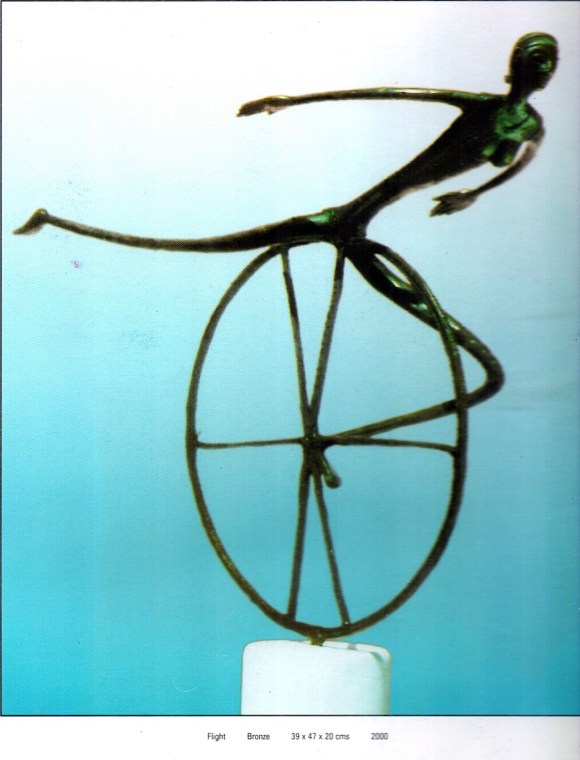
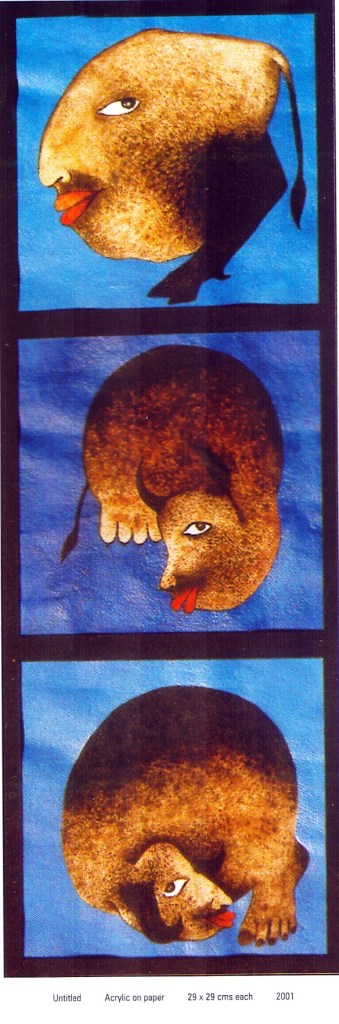
Ratnottma Sengupta revisits an exhibition full 25 years later
Images from exhibits at Anadi . Provided by Ratnottama Sengupta
On November 1 of 1956 was born a state in Central India called Madhya Pradesh. And 44 years later, on exactly the same day of November 1, in the year 2000 it was remapped. A new state — Chhattisgarh — was carved out of the land that had been home to the oldest Indians: the men and women who had peopled the caves at Bagh and Bhimbetka.
Standing at the threshold of that new beginning, I had curated an exhibition titled Anadi – that which has no beginning and, therefore, no end. The exhibition card was designed by M F Husain who came on the inaugural day in Delhi. The next day was graced by the presence of Madhavrao Scindia, scion of the royal family that continues to throw up political leaders. I was fortunate to have friends like collectors Anand Agarwal and H K Kejriwal, bureaucrats Bhaskar Ghose and Sarayu Doshi, art lovers like poet Gulzar and artists like Yusuf Arakkal. Happily, then, the exhibition travelled to Birla Academy in Kolkata to Chitrakala Parishath in Bangalore to the National Gallery of Modern Art in Mumbai. And with it travelled a batch of youngsters who were soon to be among the most sought after names in Indian Contemporary Art.
What made that exhibition so special? The card? The multi-venue display? The star viewers? The exhilarating combination of tribal paintings, figurative sculpture, and abstract images? Twenty five years later, I will look back to find an answer.
Images from exhibits at Anadi . Provided by Ratnottama Sengupta
At the intersection of two millennia I was amazed to note there was no rupture in continuity. Anadi offered a fresh look at a continuum that lives on beyond the geopolitical redefinition, because it began at a time when Chhattisgarh was not Madhya Pradesh, nor the Central Province of the Raj. Bhopal, Indore, Raipur, Jagdalpur, Sanchi, Vidisha, Malwa… these cities had no chief minister back then, nor a Prime Minister. Why, there were no Begums nor a Buddha. No Baj Bahadur loved a Roopmati nor did Kalidasa send a Cloud as Messenger. It was a time when the intrepid fingers that harnessed stones and hunted hides also painted rocks to sing of life. In the process – around 10,000 BCE – they crafted the rockbed of Indian Art at Bhimbetka, the UNESCO World Heritage Site mere miles away from Bhopal.
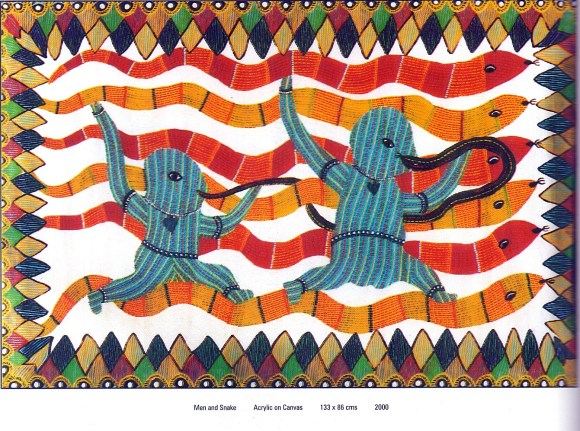
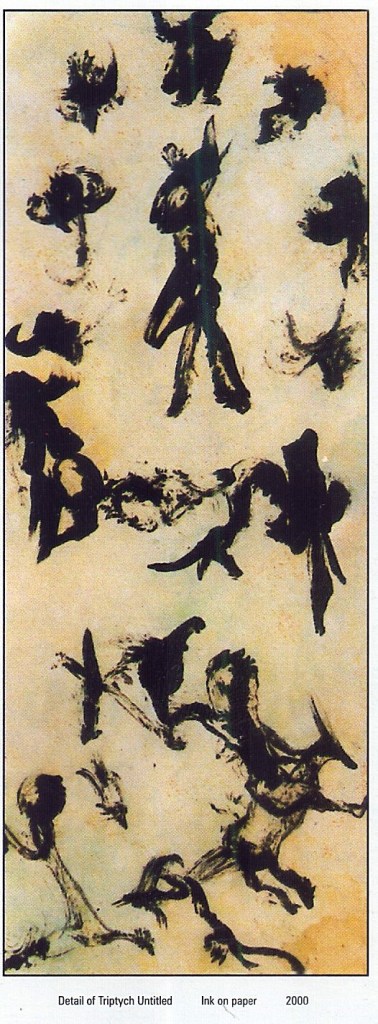
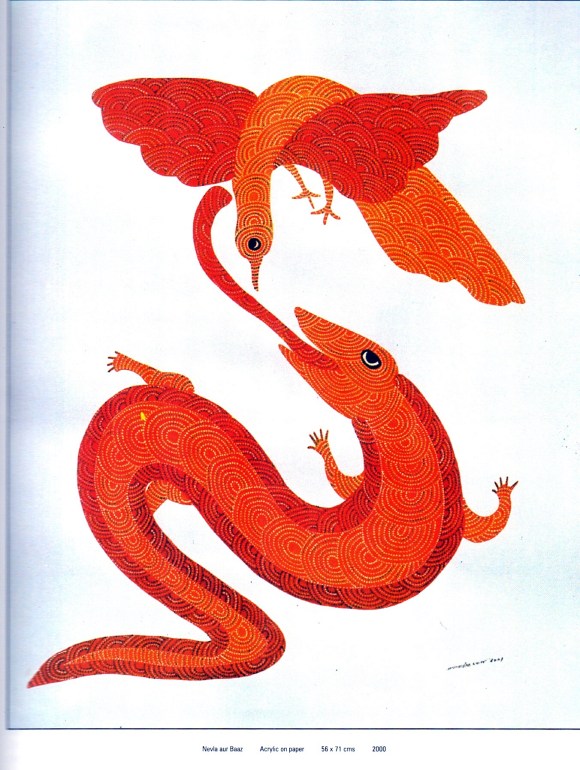
Bare lines that captured with only a twist and a turn the vigor of hunting and the verve of dancing, rock art is that elusive genre which is narrative, figurative and abstract – all at one go. And that is a characteristic common to the tribal stream of art which flourishes in the state from a forgotten past. There is a story in every figure painted by Bhuri Bai or Sukho Korwa. She paints a cart and tells you of the festival day when on its wheels it goes round habitats, collecting all the bimari and driving illness out of the village. He paints a bird that pounces on a snake which devours a rat, recounting the lifecycle that sustains ecological balance. But where is the third dimension? Where’s the likeness to the world of five senses? We see no effort here to evoke either. Instead, there is a stylization which is unique to the region that is home to the Bhil, Gond, Sahariya, Baiga, Saur and other tribes. A stylisation that abstracts the essence of the physical reality they celebrate through colour and line.
Images from exhibits at Anadi . Provided by Ratnottama Sengupta
Dots and crosses, circles and squares all come into play as the vivacious blues and reds, yellows and greens acquire life. A line is not simply a straight line or curve: that would be an unappetising repetition. The quest for variety and individuality finds Kala Bai, Lado, Sumaru break up the lines into an intricate arrangement of countless motifs. When the subject is the same, as too the colour, it’s the dots and crosses, dashes and stars that give the work the imprint of individuality. In the process, these artists who work in a community and send off their creations to markets in distant cities, have worked out a way of ‘patenting’ artistic property. Tradition did not require them to ever sign off a work with their names. In the age of copyright awareness and intellectual property rights, they might put their signatures on the canvas – but the unmistakable imprint of the artists lie in the manner of their assembling the familiar patterns.
That, make no mistake, is the sign of a master, be he in the tribal mould or a modernist. For corroboration, we have only to look at a painting by Maqbool Fida Hussain, N S Bendre or Syed Haider Raza. Madhuri or Mahabharat, Gandhi or Indira, M F Husain constantly painted figures. Eminent and easily recognised ones at that. And yet, they lived not in the details of their features but in the lines and colours that spelt ‘Husain’ to seasoned viewers. Likewise Bendre’s forms had little concern for photographic realism. In Raza’s case, it is the arrangement of colourful geometrical bindus (circles) and squares alone that speaks of the artist. So, regardless of whether or not there is a ‘McBull’ or ‘Bendre’ inked on the canvas, we readily identify these masters who, incidentally, all came from this same state of Madhya Pradesh.
Images from exhibits at Anadi . Provided by Ratnottama Sengupta
Note one more thing about these names. Each of them had set new watersheds for Indian contemporary art. All of them had opened up new avenues for artists who came after them. Bendre, the first to head the art education at the Maharaja Sayajirao University of Baroda, gave not just one more centre for mastering the brush. He gave shape to an institution which still assimilates the best of the home and the universe, giving the MSU artists a rare acceptability in India and in the West. Raza, who lived in Paris for years and years, did not sever his umbilical cord with this soil, yet carved a niche for Indianness in the Mecca of contemporary art. And Husain? The life as too the art of this ‘Picasso from Indore’ had become a legend in his own lifetime. Who else but MF could raise the high water mark at auctions, again at again, at home and abroad? Who but him could open up the markets for Indian artists, including those who preceded him like Jamini Roy?
Images from exhibits at Anadi . Provided by Ratnottama Sengupta
Talking of the masters who opened vistas, especially in the context of Madhya Pradesh, one comes to J Swaminanthan who facilitated a two-way transaction. While holding the reins of Roopankar Museum in Bhopal, he assimilated tribal art to such an extent that he could understand it, explain it, talk about it, write about it and paint after them, using their earth colours, and the bareness of their lines. At the same time, the outsider who became an insider gave, through Bharat Bhavan, all of Madhya Pradesh a new standing in the realm of contemporary art. Artists from all over the country would congregate in Bhopal with their art, exhibit it, discuss it threadbare in seminars, impart it to those keen to learn. Small wonder, the state boasts a host of artists like Akhilesh and Anwar, Seema Ghuraiya and Manish Pushkale, Yogendra and Vivek Tembe, Jaya Vivek and Jangarh Shyam. Artists who steal the attention of the world today.
This breed, which was born with the emergence of the state, came of age in artistic terms as the province consolidated its presence on the marquee. And an overwhelming number of them express themselves in just lines and colours. They care not for things like market – which seems to have an insatiable appetite for figurative art. Nor for the narrative tradition of the forefathers who painted on rocks. These neo-masters are all distilling forms, extracting experiences, working out their own equations with abstraction.
But, come to think of it, isn’t this exactly what the original artists of this land – and every other land on earth – set out to do when they picked up the sharpened tool that was millennia away from the paint brush?
Ratnottama Sengupta, formerly Arts Editor of The Times of India, teaches mass communication and film appreciation, curates film festivals and art exhibitions, and translates and writes books. She has been a member of CBFC, served on the National Film Awards jury and has herself won a National Award.
.
PLEASE NOTE: ARTICLES CAN ONLY BE REPRODUCED IN OTHER SITES WITH DUE ACKNOWLEDGEMENT TO BORDERLESS JOURNAL
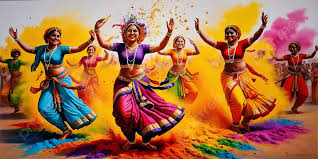
Festivals are affirmations of joy and love that bind humanity with their sense of hope even in a world torn by violence and climate change. As the end of the year approaches, we invite you to savour flavours of festivals past and, a few, yet to come, before the cycle starts again in the new year. The colours of celebrations are vibrant and varied as shades of nature or the skies.
We have new years spread out over the year, starting with January, moving on to the Chinese New Year around February, the Bengali new year in April to festivals of environment, light, darkness as in Wiccan beliefs, Tagore’s birth, more conventional ones like Deepavali, Eid, Durga Puja and Christmas. People celebrate in different ways and for different reasons. What we have also gathered is not only the joie de vivre but also the sadness people feel when celebrations are muted whether due to the pandemic, wars or for social reasons. In some cases, we indulge in excesses with funny results! And there are of course festivals of humanity … as celebrated by the bauls — the singing mendicants of Bengal — who only recognise the religion of love, compassion and kindness.
Ramakanta Rath’sSri Radha celebrating the love of Radha and Krishna have been translated from Odiya by the late poet himself, have been excerpted from his full length translation. Click here to read.
Bijoya Doushumi, a poem on the last day of Durga Puja, by the famous poet, Michael Madhusudan Dutt, has been translated from Bengali by Ratnottama Sengupta. Click here to read.
A Clean Start: Suzanne Kamata tells us how the Japanese usher in a new year. Click here to read.
Shanghai in Jakarta: Eshana Sarah Singh takes us to Chinese New Year celebrations in Djakarta. Click here to read.
Cherry Blossom Forecast: Suzanne Kamata brings the Japanese ritual of cherry blossom viewing to our pages with her camera and words. Clickhere to read.
Pohela Boisakh: A Cultural Fiesta: Sohana Manzoor shares the Bengali New Year celebrations in Bangladesh with interesting history and traditions that mingle beyond the borders. Clickhere to read.
The New Year’s Boon: Devraj Singh gives a glimpse into the projection of a new normal created by God. Click here to read.
A Musical Soiree: Snigdha Agrawal recalls how their family celebrated Tagore’s birth anniversary. Click here to read.
An Alien on the Altar! Snigdha Agrawal writes of how a dog and lizard add zest to Janmashtami (Krishna’s birthday) festivities with a dollop of humour. Click here to read
Memories of Durga Puja : Fakrul Alam recalls the festivities of Durga Puja in Dhaka during his childhood. Click hereto read.
KL Twin Towers near Kolkata?: Devraj Singh Kalsi visits the colours of a marquee hosting the Durga Puja season with its spirit of inclusivity. Click here to read.
Hold the roast turkey please Santa: Celebrating the festive season off-season with Keith Lyons from New Zealand, where summer solstice and Christmas fall around the same time. Click here to read.
Odbayar Dorj writes of celebrating the start of the new school year in Mongolia and of their festivals around teaching and learning. Click here to read.
Naramsetti Umamaheswararao gives a story set in a village in Andhra Pradesh. Clickhere to read.
Feature
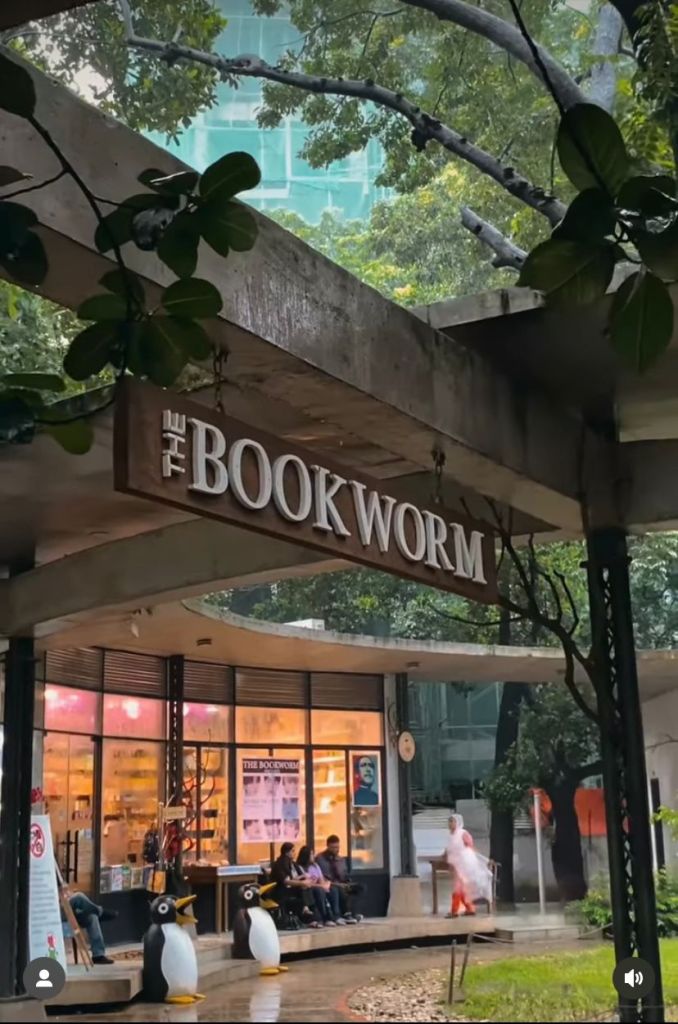
A conversation withAmina Rahman, owner of Bookworm Bookshop, Dhaka, about her journey from the corporate world to the making of her bookstore with a focus on community building. Clickhereto read.
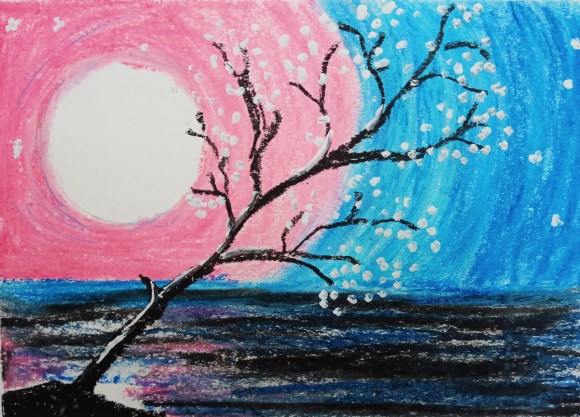
The idea of spring heralds hope even when it’s deep winter. The colours of spring bring variety along with an assurance of contentment and peace. While wars and climate disasters rage around the world, peace can be found in places like the cloistered walls of Sistine Chapel where conflicts exist only in art. Sometimes, we get a glimpse of peace within ourselves as we gaze at the snowy splendour of Himalayas and sometimes, in smaller things… like a vernal flower or the smile of a young child. Inner peace can at times lead to great art forms as can conflicts where people react with the power of words or visual art. But perhaps, what is most important is the moment of quietness that helps us get in touch with that inner voice giving out words that can change lives. Can written words inspire change?
Our featured bookstore’s owner from Bangladesh, Amina Rahman, thinks it can. Rahman of Bookworm, has a unique perspective for she claims, “A lot of people mistake success with earning huge profits… I get fulfilment out of other things –- community health and happiness and… just interaction.” She provides books from across the world and more while trying to create an oasis of quietude in the busy city of Dhaka. It was wonderful listening to her views — they sounded almost utopian… and perhaps, therefore, so much more in synch with the ideas we host in these pages.
Our content this month are like the colours of the rainbow — varied and from many countries. They ring out in different colours and tones, capturing the multiplicity of human existence. The translations start with Professor Fakrul Alam’s transcreation of Nazrul’s Bengali lyrics in quest of the intangible. Isa Kamari translates four of his own Malay poems on spiritual quest, while from Balochi, Fazal Baloch bring us Munir Momin’s esoteric verses in English. Snehprava Das’s translation of Rohini K.Mukherjee poetry from Odia and S.Ramakrishnan’s story translated from Tamil by B.Chandramouli also have the same transcendental notes. Tagore’s playful poem on winter (Sheeth) mingles a bit for spring, the season welcomed by all creatures great and small.
We have good news to share —Borderless Journal has had the privilege of being listed on Duotrope – which means more readers and writers for us. We are hugely grateful to all our readers and contributors without who we would not have a journal. Thanks to our wonderful team, especially Sohana Manzoor for her fabulous artwork.
Hope you have a wonderful month as we move towards the end of this year.
Sheeth or Winter was first published in 1909 in Tagore’s collection called Shishu (Children). The poem looks forward to winter giving way to spring using simple but eloquent verses.
Art by Sohana Manzoor
The bird says, “I will leave.”
     The flower says, “I will not bloom.”
The breeze merely says,
       “I will not flit across the woods.”
Young shoots do not look up,
   Instead, sprouts shrivel to shed.
Dusty bamboos loom
     To paint an untimely dusk.
Why do the birds migrate?
        Why do flowers not bloom?
Why has the agile breeze
    stopped romping in the woods?
The heartless winter
        Has a bleak outlook.
Wrinkled and harsh,
       She imparts hard lessons.
The gleaming moonlit night,
        The fresh fragrance of flowers,
The youthful sport of breeze,
      The cacophony of leaves —
All these she looks upon as sins,
       She thinks in nature,
The knowledgeable only sit
       Still like a picture.
That is why the bird bids “goodbye”.
     The flower says, “I’ll not bloom.”
The breeze merely says,
       “I’ll not run across the woods.”
But when Hope says, “Spring’ll come,”
        The flower says, “I’ll bloom.”
The bird says, “I’ll sing.”
         The moon says, “I’ll smile.”
The newly-fledged spring
       Has just started to awake.
He smiles at whatever he sees.
       He plays with everything.
His heart is full of hope.
          Unaware of his own desires,
His being runs hither and thither
         Looking for kindred spirits.
Flowers bloom, so does the child.
         Birds sing, so does he.
He hugs the caressing breeze
         To play vernal games.
That’s why when I hear, “Spring’ll come,”
    The flower says, “I’ll bloom.”
The bird says, “I’ll sing.”
         The moon says, “I’ll smile.”
Winter, why did you come here?
       Your home is in the north —
Birds do not sing there,
       Flowers do not bloom on trees.
Your home is a snowy desert
        That’s dark and lifeless —
Sit there alone, O knowledgeable,
         Spend your days contemplating.
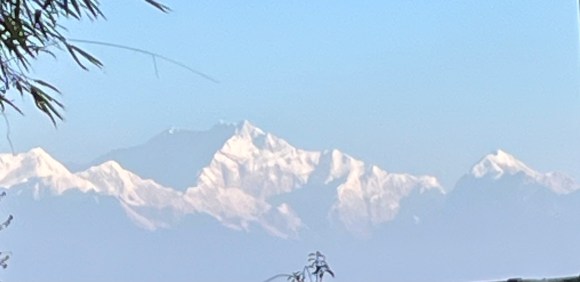
Snowy Kanchenjunga photographed from Darjeeling, West Bengal, in winters.
This poem has been translated from Bengali by Mitali Chakravarty with editorial input by Sohana Manzoor
.
PLEASE NOTE: ARTICLES CAN ONLY BE REPRODUCED IN OTHER SITES WITH DUE ACKNOWLEDGEMENT TO BORDERLESS JOURNAL
An interview with Amina Rahman, owner of Bookworm, Dhaka
In a world, where online bookshops and Amazon hold the sway, where people prefer soft copy to real books, some bookshops still persist and grow. There are of course many that have closed business or diversified. But what are these concerns that continue to show resistance to the onslaught of giant corporations and breed books for old fashioned readers? How do they thrive? To find answers, we talked to a well-known bookshop owner in Bangladesh.
Amina Rahman is an entrepreneur who runs such a concern called Bookworm, a haven for book lovers in Dhaka. Schooled in Italy, India and America, Rahman married into the family that owned a small bookshop. Started by her father-in-law, it was a family refuge till she took over the running and created a larger community – a concept that she believed in and learnt much about during her youth spent on various continents. She believes that just as it takes a community to bring up a child, a bookshop has to be nurtured in a similar vein. Bookworm started at Dhaka’s old airport in 1994 and eventually moved to a more community friendly locale at the town centre. Rahman took over in 2012, rebranding it, repurposing and breathing new life into it.
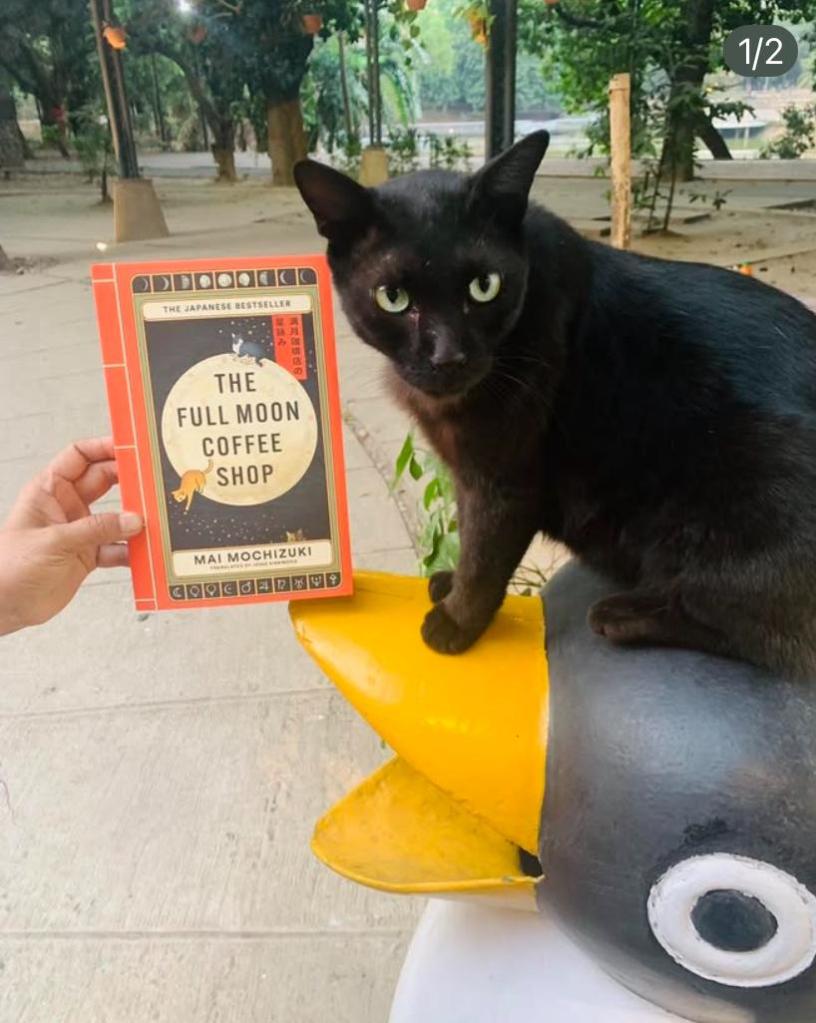
Bookworm houses books from all over the world, holds special launches, as they did recently of Sam Dalrymple’s Shattered Lands:Five Partitions and the Making of Modern Asia, and of many other local and foreign authors, like Vikram Seth and Aruna Chakravarti. They have even been adopted by the cats in the park! This month they are opening a book-café. Rahman has a unique outlook that makes her redefine ‘success’ and here she also talks about how she evolved into her dream project to make it a reality.
Sam Dalrymple at his launch on 9/11/2025A local launch
You studied environmental policy and environment, worked for several NGO’s and multinational concerns. What made you turn to or opt to run the bookstore over your own career options?
My choice of subject in university was impacted by a fantastic biology teacher I had in middle school at Rome. He took us out on regular field trips and made us collect garbage to learn about the environment! You can imagine — in 1984-85, when we were kids, he would pick up garbage and show us how diapers and cigarette butts were completely not biodegradable. Disgusting but effective. He told us it would take years before they deteriorated and dissolve into the Earth. These things stick in your mind.
To be honest, I followed the Environment path and ended up working for the King County solid-waste department in Seattle which was all about garbage and recycling and so fascinating. But as you get older and you travel through Asia, you realise the pointlessness of it all as none of it is applicable in the same way in our region. Bangladesh and Asia were green in those days until plastics were introduced in a big way about fifteen years ago. At the end of the day, the community is at the heart of taking care of everything, and if everyone takes care of their particular communities, it’s a better world. And this resonates with why I went into running the bookstore – to make community.
I realised that I was missing some kind of dynamism and I wanted to move forward. I wanted something more to happen. This had been a consistent strain I had with everything. You worked for organisations. They would become very top-heavy. Change happened slowly. When I shifted into the corporate world in Dhaka, I felt that was the most dynamic thing — it was fast moving. I learnt much. Then I went into market research, which was incredible research into human behaviour but was completely tuned into making money at whatever cost. It all was very self-serving and opposite of a welfarist approach towards the community. Corporations trumped community here.
I lost inspiration.
My father-in-law and I had a mutual love for books. I fell in love with my husband over his books. I married in 2004, and it was in 2012, when I was taking time out to assess my goals that my father-in-law suggested I spend time in his bookstore. So, I did. What was an amazing coincidence, was that the Dhaka LitFest started the same year! And the chief organiser asked if Bookworm could be part of the it and I agreed. Vikram Seth was the star guest that year.
Amina Rahman
Can you briefly tell us the story of Bookworm?
When I joined the Bookworm, it was almost a forgotten venture. The family had moved on to other interests. It was used more as a refuge for relatives, old staff, dusty books, unpaid debts and stalled time.
I had never run a business in my life before. For the book business I literally had to climb from the bottom up. It was definitely not easy. I had to figure out the book world, the suppliers, the publishers, the distribution network. Customer preferences, not to mention accounting, taxes, salaries and taking over a small business and the responsibilities that go with it.
The publishing world and the distributing world is a whole different ball game from every other business. It’s a supply chain of such remarkability from the packers and warehousing to the authors and customers. You go from the very basics to the highest and that is so fulfilling. Nothing can compare to that.
Besides, the love of books, one thing I knew was at bookstore was community. It is the ultimate community for booksellers and writers to connect with the world. As you will know, we hit every audience — everybody from the newborn baby to the old man or woman to young adults to school students to university goers to the erudite pursuing literature. We cover just about everything. Ultimately a physical bookstore is where the community meets, and that’s where the ideas are shared, that’s where if you put attention to it people meet inspiration.
While the Dhaka Literary Festival, in whose first iteration Bookworm was a participant, seems to have petered off, Bookworm continues to hold launches on its own. Do you see the shop as a substitute for the festival?
Absolutely not. I mean book launches are wonderful and are a must for every physical bookstore. They connect the people, and as I tell everyone, if you want to sell your book, even if you written the greatest book, you need to work hard at promoting the book. So, every writer needs to have venues whether small or big to launch their books.
Every city needs to have a LitFest, and it is a must. Dhaka is absolutely famous for having our Boimela[1]. That is a real heritage.
What is it you offer readers other than books? Do you have a café?
Actually, we are opening one now.
We didn’t have a cafe in the store, but we’ve had very interesting sort of cafe and bookstore combination when we were in the old airport. We had a cafe next-door to us, which I finally assimilated, also adding to more space for the books. And that became our own little cafe. It wasn’t really anything great; it was just regular we did not even have a coffee machine. Coffee was the old fashion Nescafe, but it did the trick. The whole set up had a very local flavour. Most of all people just like having an area to sit and drink something hot while freely reading books. And this sufficed.
That was wonderful. That store was in the old airport, which we loved with all our heart, and we were there for 30 years. Then we left. I opened up a branch in Dhanmundi, which is probably the best place for books sellers because the book reading population is huge there. We also got the opportunity to open up our bookstore inside a very famous Coffeehouse called Northend. They had a huge base, and they asked us if we’d like to take some of it and we did and that was fantastic.
We had to close that for Covid. Many say they miss it. And that was the first time we had ventured out of our space and opened a new store like a second branch. Then we got this chance to be in a park where we don’t have a cafe inside of our bookstore, but on the other side of the park, which is why we opened a café in our store.
What do you see as the future of bookstores like yours with the onset of online giants like Amazon? Does that impact you?
Yes. Amazon has had a huge impact. Luckily, we don’t have Amazon in Bangladesh. Amazon has had a very negative impact on our fellow booksellers in India and other places. I won’t even bother to compete with them.
I think everyone’s realised that there is a big difference with access points and how Amazon works. At the end of the day, people who come to our bookstore for the experience, for meeting other people, authors too, and talking to their bookseller. It’s more than just getting the book you want to read — that’s part of it — but it’s also about browsing and finding quiet time.
I think that my great experience with books was in bookstores I didn’t have to buy a book. I could browse. Sometimes, you may not be able to afford the book, but you can open it on any page. You could just read a passage, and that might change you. You could come back and buy it or the passage could just stay with you forever. You know it’s those sort of fleeting moments that you have when you’re browsing a book that makes a bookstore precious. That’s a very different experience from Amazon.
Amazon is much more utilitarian. Both have their ups and downs, I guess. You can’t have book launches on Amazon, but I think, Amazon is a big competition… in the sense that it also gives so many discounts.
What kind of books does your store offer? What kind of writers?
I tried to offer everything. In the beginning when we started, I started to try to figure out what books to get. I started with the catalogues, and it was a bit of hit and miss. You slowly start to realise what works. One of the worst experiences for bookstore are books that sit on shelves and don’t move. Sometimes you can buy what is really number one on the best seller list and it just doesn’t move because it’s irrelevant or it’s number one in a different country. You learn by trial and error and then you start to figure out your customers. It was painstaking yet enjoyable.
We use social media to draw readers to our shelves.
As a wholesome bookstore, we have a bit of everything from literature to history, kids’ books, romance, young adult fictions, thrillers, bestselling thrillers, to fantasy. Christie, Sydey Sheldon, Gabriel Garcia Marquez, Manga, graphic novels, spiritual and religious books to Bangla books and collector’s items, special editions to lighter books that just bring solace. We see your customer choices and learn. You do not stuff literature down their throats. It has to be relevant to our customers.
What are the challenges of running a bookstore like yours in a country where English is not the first language?
I think actually it’s a challenge to run a bookstore anywhere in, especially with the new market forces of Amazon and online shopping and the digital world. Having physical stores is becoming a challenge. I have travelled to bookstores all over the world and learnt from the experience. A bookstore is more of a tactile experience for all people, readers and non-readers. Humanity has learnt from tactile experiences and to touch and smell a book, browse and sit amidst books is very much that. When realised that people were not coming to me, I took the books to them. I took our books to every mela(fairs). Social media was the next big thing. The ultimate was of course the Dhaka LitFest. People were excited to see our English books, and they all sold. Bangladeshis would travel to other countries to buy books as Bengalis love reading.
The LitFest helped a lot. It brought big authors, like Vikram Seth, for they were interested in exploring new readers.
We also started a delivery service. Some customers said it was hard to get to our store. So, we started a thrice week delivery service and then increased it. We bought a cycle for the rider. He went out and delivered the books that readers had ordered and paid for.
When Covid hit, it was prime time for many to turned to books and we had everything in place – our social media and our delivery service. We did well during that phase, though that is not a good thing to say.
What do you see as the future for your bookstore? There are chains like Takashimaya, Times Books and others — which despite having shrunk, post online bookstores, maintain an international presence. Do you see yourself as a chain that will grow into an international presence?
I think a chain store goes beyond the community. It is a model for more profit-oriented sellers. I would rather have a community-based culture where all people are welcome and find something that draws them and gives them a sense of quiet.
A lot of people mistake success with earning huge profits and if that’s what you’re in for that’s fine too — that’s business but what I do isn’t that. I get fulfilment out of other things –- community health and happiness, and you know just interaction. I think one of the ways to make a very powerful long-lasting brand and business is trust and good service. There’s no substitute for hard work and passion. When you love something, you really put your mind to it. And that helps you keep your friends forever.
(This online interview has been conducted over transcribed voice messages in What’sApp by Mitali Chakravarty. All the photographs have been provided by Amina Rahman.)
PLEASE NOTE: ARTICLES CAN ONLY BE REPRODUCED IN OTHER SITES WITH DUE ACKNOWLEDGEMENT TO BORDERLESS JOURNAL












 Borderless