Categories
Celebrating Translations

We are the World

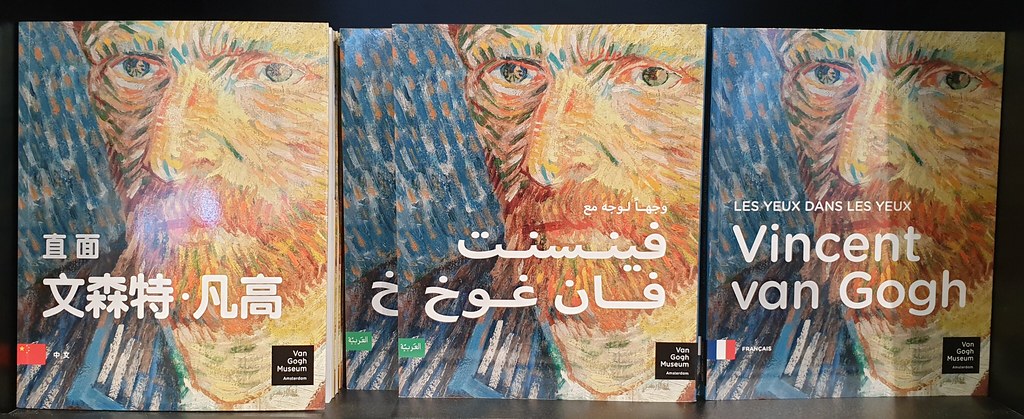
Vincent Van Gogh written is different scripts. Courtesy: Creative Commons

The whole world opens up in the realm of ideas that have existed wafting and bridging across time and space. Sometimes they find conduits to come to the fore, even though they find expression in different languages, under varied cultural milieus. One way of connecting these ideas is to translate them into a single language. And that is what many have started to do. Celebrating writers and translators who have connected us with these ideas across boundaries of time and place, we bring to you translated writings in English from twenty eight languages on the International Translation Day, from some of the most iconic thinkers as well as from contemporary voices. 

Prose

Tagore’s short story, Aparichita, has been translated from Bengali as The Stranger by Aruna Chakravarti. Click here to read. 

Travels & Holidays: Humour from Rabindranath, have been translated from Bengali by Somdatta Mandal. Click here to read.

Hena, a short story by Nazrul, has been translated from Bengali by Sohana Manzoor. Click hereto read.

Munshi Premchand’s Balak or the Child has been translated from Hindi by Anurag Sharma Click here to read.

Munshi Premchand’s Pus Ki Raat or A Frigid Winter Night  has been translated from Hindi by C Christine Fair. Click here to read.

Nadir Ali’s The Kabbadi Player has been translated from Punjabi by Amna Ali. Click here to read.

Kamaleswar Barua’s Uehara by  has been translated from Assamese and introduced by Bikash K. Bhattacharya. Click here to read.

S Ramakrishnan’s Muhammad Ali’s Singnature has been S. Ramakrishnan, translated from Tamil by Dr B. Chandramouli. Click here to read. 

PF Mathews’ Mercy,  has been translated from Malayalam by Ram Anantharaman. Click here to read.

Road to Nowhere, an unusual story about a man who heads for suicide, translated from Odiya by the author, Satya Misra. Click here to read.

An excerpt from A Handful of Sesame by Shrinivas Vaidya, translated from Kannada by Maithreyi Karnoor. Click here to read.

Writings from Pandies’ Corner highlight the ongoing struggle against debilitating rigid boundaries drawn by societal norms. Each piece is written in Hindustani and then translated by a volunteer from Pandies’ in English. Click here to read.

Rakhamaninov’s Sonata, a short story by Sherzod Artikov, translated from Uzbeki by Nigora Mukhammad. Click here to read.

Of Days and Seasons, a parable by the eminent Dutch writer, Louis Couperus (1863-1923), translated by Chaitali Sengupta. Click here to read.

The Faithful Wife, a folktale translated from Balochi by Fazal Baloch. Click here to read.

An excerpt from Ramy Al-Asheq’s Ever Since I Did Not Die, translated from Arabic by Isis Nusair, edited by Levi Thompson. The author was born in a refugee camp. Click here to read.

Poetry

Two songs by Tagore written originally in Brajabuli, a literary language developed essentially for poetry in the sixteenth century, has been translated by Radha Chakravarty. Click here to read. 

Rebel or ‘Bidrohi’, Nazrul’s signature poem,Bidrohi, translated from Bengali by Professor Fakrul Alam. Click here to read.

Banlata Sen, Jibananada Das’s iconic poem, translated from Bengali by Professor Fakrul Alam. Click here to read. 

Poetry of Michael Madhusudan Dutt has been translated from Bengali by Ratnottama Sengupta. Click here to read.

Our Children, a poem by well-known Iranian poet, Bijan Najdi, has been translated from Persian by Davood Jalili. Click here to read.

Akbar Barakzai’s Be and It All Came into Being has been translated from Balochi by Fazal Baloch. Click here to read.

Biju Kanhangad’s The Girl Who Went Fishing has been translated from Malayalam by Aditya Shankar. Click here to read.

Jitendra Vasava’s Adivasi Poetry,  translated from the Dehwali Bhili via Gujarati by Gopika Jadeja. Click here to read.

Sokhen Tudu’s A Poem for The Ol Chiki, translated from the Santhali by Hansda Sowvendra Shekhar. Click here to read.

Thangjam Ibopishak’s Gandhi & Robot translated from the Manipuri by Robin S Ngangom. Click here to read.

 Rayees Ahmad translates his own poem, Ab tak Toofan or The Storm that Rages, from Urdu to English. Click here to read.

Poetry by Sanket Mhatre has been translated by Rochelle Potkar from Marathi to English. Click here to read.

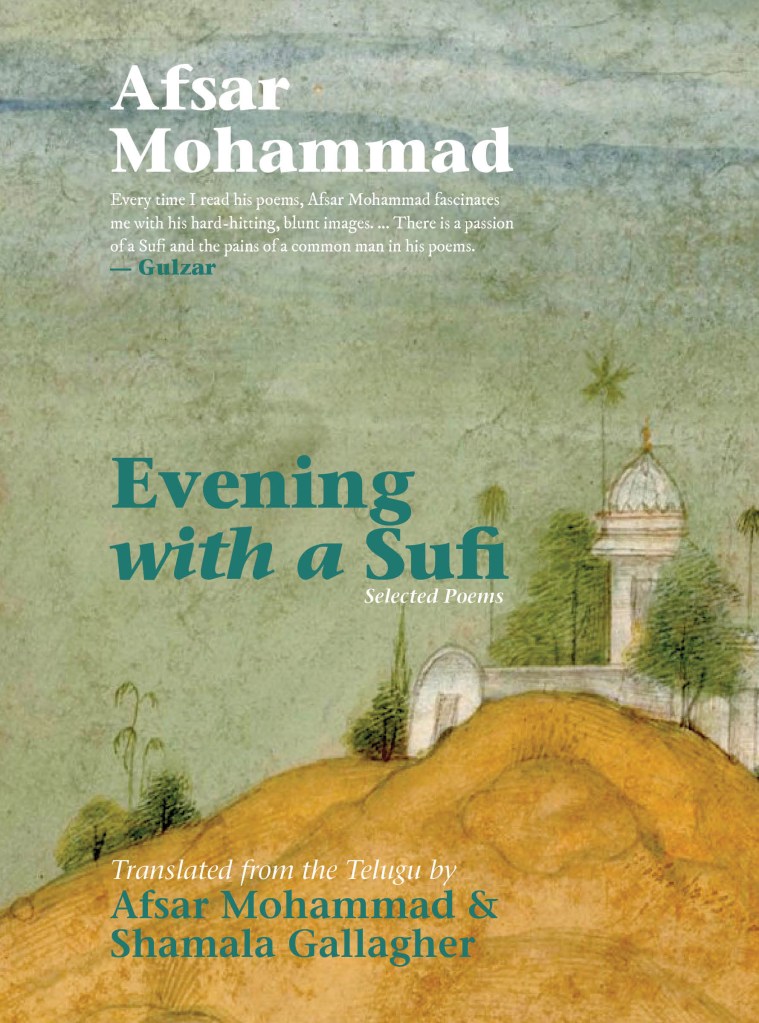
An excerpt from Evening with a Sufi: Selected Poemsby Afsar Mohammad, translated from Telugu by Afsar Mohammad & Shamala Gallagher. Click hereto read.

Ihlwha Choi’s Universal Language written at Santiniktan, translated from Korean by the poet himself. Click here to read.

Sangita Swechha’s Motherhood: A Tiny Life inside Me has been translated from Nepali by Hem Bishwakarma. Click here to read.

Rosy Gallace’s Two poems from Italy  have been translated from Italian by Irma Kurti. Click here to read.

Poetry in Bosnian written and translated from Bosnian by Maid Corbic. Click here to read.

Lesya Bakun translates three of her own poems from Ukranian and Russian to English. Click here to read.

Poems from Armenia by Eduard Harents translated from Armenian by Harout Vartanian. Click here to read.

Categories
Interview

In Conversation with Afsar Mohammad

Afsar Mohammad
In your final rest
on a rope-cot,
 
were you still dreaming
of a piece of bread?
 
Beloved one,
we the people
of this country,
 
of that country,
can make anything
 
but a piece of bread
for you. 

--Evening with a Sufi: Selected Poems by Afsar Mohammad, translated from the Telugu by Afsar Mohammad & Shamala Gallagher, Red River Books, 2022.

These lines send shivers down the spine and recreate an empathetic longing for immigrant souls in search of succour. They also swiftly draw an image laced with poignancy — a loss, a regret, the economics that deny innovative young men their keep and force immigration in search of sustenance. Would the poet have been one of them? 

Travelling from a small village in the South Indian state of Telangana, Afsar Mohammad has journeyed across continents and now teaches South Asian Studies at the University of Pennsylvania. Known as a trendsetting poet and literary critic for post-1980s Telugu literature, Afsar has brought out five volumes of poetry, one collection of short stories and two volumes of literary theory essays. He is also a distinguished scholar of Indian studies and has published extensively with various international presses, including Oxford and Cambridge. He is currently working on a translation of Sufi poetry from Telugu to English. In this interview, we trace his growth as a writer and editor of the webzine, Saranga, which now seems to be transcending linguistic barriers to give voice to multiple cultures… 

Tell us about your journey as a writer. When and how did it start?

It’s a long story, but to cut it short — the beginnings were somewhat puzzling… Inspired by Shakespearean sonnets, I first wrote some sonnets in English, and then switched to free verse. Since most of my friends in my high school started pushing me to write something in Telugu, I had to migrate to Telugu. Quite surprisingly, I was first published in English, and then it took me a while to get something published in Telugu. I had hard time getting published in Telugu due to its newness in expressions and most editors felt that there was nothing “Telugu” in that kind of writing. So, my early writings quite naturally found their home in some English journals!

Your poetry rings with the pain of distance, the pain and struggle from others’ suffering transcending your own self. What is the source of your inspiration — is it your past or your present? What affects you more — your being an immigrant or a Sufi?

We’re distanced by many things — not just physically!  We live in many shattered and scattered worlds, and sometimes we fail to reflect on those worlds. I feel like I’m a constant immigrant — despite my formal citizenship and legal boundaries. Sufism is merely a segment of this expansive realm. Both past and present define our destiny, right?! Of course, I try to live in the present rather than in the past, but never deny the baggage of the past.

Why do you subscribe to the Sufi school of poetry? What is Sufism all about? 

I come from an extremely local rural setting where such Sufi mystical practices openly defined my everyday life. It’s not about the technicalities and theories or institutionalised Sufi schools of their philosophies, this is more about what I learned from my childhood, and its physical surroundings dotted by several hybrid shrines. I’ve described this cultural setting in my 2013 Oxford University Press publication, The Festival of Pirs: Popular Islam and Shared Devotion in South India. This version of Sufism has more to do with everyday life rather than a spiritual domain. 

You have lived away from your country for long, and yet the past seems to still haunt you. What is the identity you seek as a poet? Is it necessary to have a unique identity or can one be like a drop that flows and moulds as per the needs of the vessel?  

In a way — physically– I’m away from my birth place, but in many ways, I’m also closer to my homeland than in my past. When I moved away from the actual picture, I see many dimensions from a new lens. Each dimension contributed to my rethinking and reconsidering the idea of India. As I wander around and meet totally different places and people, I learn more about my birthplace and moved a little closer to it. I totally understand this as a process to reconcile with the past and connect it to a new present intensified by many factors, not just personal. We’re living in a virtual world, which also looks like “real” in its sounds, colours and words. Every moment it makes me realise that I’m actually not that far. On the other hand, I also see the people in my homeland who are far more removed by their immediate reality and everyday experiences. We need to read this conditionality more in terms of perspective rather than physical distance. 

You are fluent in Telugu, Urdu and English. You started writing in English and then moved to Telugu. And all your poetry collections have been in Telugu. Why? Would the outreach of English not have been wider? What made you pick Telugu over English? 

Great question! My literary graph is neither linear nor simplistic. When I look back and reflect on it, it’s a quite messy roadmap — actually, there’s nothing like a map to get its contours.  Yes, I started writing in English and then suddenly stopped sending out the poems to magazines. In fact, I write more in my personal journals rather than in print journals. Theoretically, I saw poetry as a personal diary for my experiences for many years. Due to financial concerns within my family, I had to start working very early on and left most of my journals at home. Then, my friends found them by chance and put them together that became my first collection of poems in Telugu. The collection was an instant success for its innovative style and then that opened up my career in Telugu rather than English which was my first language of literary expression. 

You are now bringing out a bi-lingual online magazine, Saranga? What made you think of a magazine in two languages? 

Before entering into teaching career, I worked as an editor of the literary supplement and Sunday magazine for a largest circulated Telugu newspaper. When we moved to the USA, I thought it would be better to have some outlet to engage with my home language and literature. In the early phase, Saranga was primarily a Telugu webmagazine. When I started teaching South Asian literature, then I realised the importance of making Indian literary texts available to contemporary generation in the USA. That was just one reason, but there’re were many factors as our team saw a rise in the Indian diaspora writings in the new millennium. Luckily, we got wonderful support from writers and poets in various Indian languages. The humble beginnings have actually ended up as a rewarding experience. 

What is it you look for in contributors from two languages? Is it the same guidelines or different?

We’re still learning how this works! As it appears now, these two sections require two different approaches and guidelines. Since the English section has been now attracting writers from various languages, it’s moving more towards a multi-lingual base. We’re trying to accommodate more translations into English from different Indian languages. We still need to do lots of work there. 

Is the journal only aimed at South Asian diaspora or would you be extending your services to all cultures and all geographies? 

Saranga, as we see it right now, is more about South Asia and its diaspora. As you know, we need more such spaces for South Asia and its diaspora. Not sure about its future directions at this point, however, if the situation demands, we will extend its services further.

You have number of essays and academic books in English. But all your creative writing is in Telugu. Why? Would you be thinking of writing in English too because proficiency in the language is obviously not an issue?

Most of my academic writing came out of my teaching experience. As I started teaching new courses, I then realised that we need more material from South Asia. I started focusing on producing such materials primarily for my courses and then gradually, they became useful for many academicians elsewhere too. I still believe creating writing as a more personal space — that enables me to articulate more about myself. However, the publication of Evening with a Sufi, brought a new change — as I’ve been getting more requests for more writing in English for the last two years. As you know pretty well, I’m an extremely slow writer. 

How do you perceive language as a tool for a poet? 

I see language working many ways since I dwell in multiple languages. I started my elementary education in Urdu, and my middle school was in Telugu, and the subsequent studies were in English. Through the last day of her life, my mother was extremely particular about me learning Arabic and Farsi. So, I believe that helped me so much to understand how language works in a poem. When I published my first poem in Telugu, the immediate critique was it was a not a “Telugu” poem. Telugu literary critics labelled me as a poet who thinks either in Urdu or English, then writes in Telugu. Of course, most of them were also fascinated by the new syntax of my Telugu poems and the new images and metaphors—that totally deviate from a normative or mainstream Telugu poem of those days. The uses of language in a poem varies for each poet. If you’re reading, writing and thinking in just “one” language, that might be a safe condition. A contemporary or modern poet, however, belongs to many languages and cultures. We also migrate from one language to another in our everyday life. 

Do borders of nationalism, mother tongue and geographies divide or connect in your opinion? Do these impact your writing?

The response to this question might be an extension to the above conditionality of a person. Anyway, I’m not a big fan of those ideas of nationalism, mother tongue and singular geographies. They don’t exist in my world. Most of my writings both creative and academic contest such boundaries and borders. To describe this in a single term- borderless. In fact, I believe we’re all borderless, but unfortunately, many boundaries and borders are now being imposed on our personalities. 

(The online interview has been conducted by emails by Mitali Chakravarty)

Click here to access Afsar Mohammad’s poetry

PLEASE NOTE: ARTICLES CAN ONLY BE REPRODUCED IN OTHER SITES WITH DUE ACKNOWLEDGEMENT TO BORDERLESS JOURNAL. 

Click here to access the Borderless anthology, Monalisa No Longer Smiles

Click here to access Monalisa No Longer Smiles on Kindle Amazon International

Categories
Contents

Borderless, November 2022

Art by Sohana Manzoor

Editorial

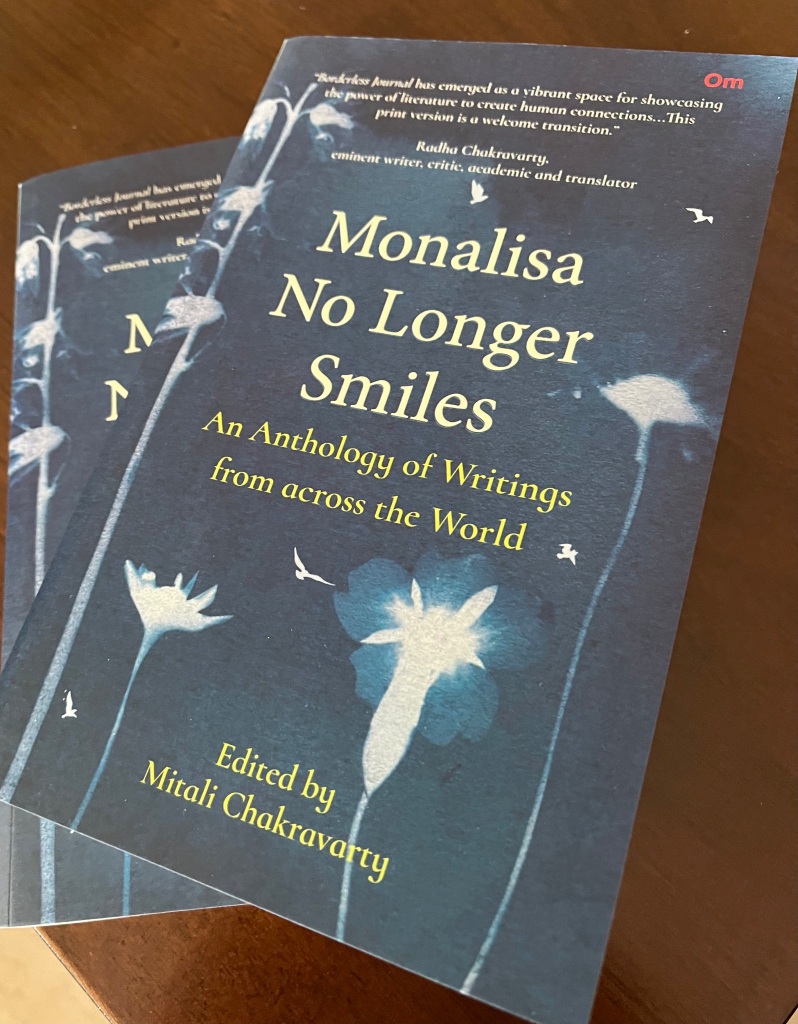
We did it! … Announcing our first anthology … Monalisa No Longer Smiles… Click here to read.

Conversations

Suchen Christine Lim, an iconic writer from Singapore in conversation about her latest book, Dearest Intimate. Click here to read.

Blazing trails, as well as retracing the footsteps of great explorers, Christopher Winnan, a travel writer, delves into the past, and gazes into the future while conversing with Keith Lyons. Click here to read.

Translations

Rows of Betelnut Trees by My Window by Nazrul has been translated from Bengali by Professor Fakrul Alam. Click here to read.

A Day in the Life of the Pink Man is a story by Shankhadeep Bhattacharya, translated from Bengali by Rituparna Mukherjee. Click here to read.

The Clay Toys and The Two Boys is a story by Haneef Shareef, translated from Balochi by Fazal Baloch. Click here to read.

Saturday Afternoon is a poem by Ihlwha Choi, translated from Korean by the poet himself. Click here to read.

Tagore’s poem, Tomar Shonkho Dhulay Porey (your conch lies in the dust), has been translated from Bengali by Mitali Chakravarty as The Conch Calls. Click here to read.

Poetry

Click on the names to read

Jared Carter, Asad Latif, Rhys Hughes, Alpana, Mimi Bordeaux, Saranyan BV, Luis Cuauhtémoc Berriozábal, Quratulain Qureshi, Jim Bellamy, Sourav Sengupta, Ron Pickett, Davis Varghese, Ryan Quinn Flanagan, Jonathan Chan, Terry Trowbridge, Amrita Sharma, George Freek, Gayatri Majumdar, Michael R Burch

Poets, Poetry and Rhys Hughes

In Infinite Tiffin, Rhys Hughes gives an unusual short story centring around food and hunger. Click here to read.

Musings/Slices from Life

The Scream & Me

Prithvijeet Sinha writes of how Edvard Munch’s painting, The Scream, impacts him. Click here to read.

A Fine Sunset

Mike Smith travels with a book to a Scottish beach and walks in the footsteps of a well-know novelist. Click here to read.

The Death of a Doctor

Ravi Shankar mourns the loss of a friend and muses on mortality in his experience. Click here to read.

My Contagious Birthday Party

Meredith Stephens writes of her experience of Covid. Click here to read.

Dim Memories of the Festival of Lights

Farouk Gulsara takes a nostalgic trip to Deepavali celebrations in Malaysia. Click here to read.

Musings of a Copywriter

In Strumming Me Softly with His Guitar…, Devraj Singh Kalsi talks of his friends’s adventure with the guitar. Click here to read.

Notes from Japan

In Therese Schumacher and Nagayoshi Nagai: A Love Story, Suzanne Kamata introduces us to one of the first German women married to a Japanese scientist and their love story. Click here to read.

Essays

My Favourite Book by Fakrul Alam

The essay is a journey into Fakrul Alam’s evolution as a translator. Click here to read.

The Ultimate Genius of Kishore Kumar

Shantanu Ray Chaudhuri, an eminent film critic, writes on the legend of Kishore Kumar. Click here to read.

T.S Eliot’s The Waste Land: Finding Hope in Darkness

Dan Meloche muses on the century-old poem and its current relevance. Click here to read.

The Observant Immigrant

In Piano Board Keys, Candice Louisa Daquin talks of biracial issues. Click here to read.

Stories

The Funeral Attendee

Ravi Prakash shares the story of the life of a migrant in rural India. Click here to read.

A Letter I can Never Post

Monisha Raman unravels the past in a short narrative using the epistolary technique. Click here to read.

Red Moss at the Abbey of Saint Pons

Paul Mirabile takes us to St Pons Abbey in France in the fifteenth century. Click here to read.

You have lost your son!

Farhanaz Rabbani gives a light story with a twist that shuttles between Dhaka and Noakhali. Click here to read.

Book Excerpts

An Excerpt from Manoranjan Byapari’s How I Became a Writer: An Autobiography of a Dalit, translated from Bengali by Anurima Chanda. Click here to read.

An excerpt from Evening with a Sufi: Selected Poems by Afsar Mohammad, translated from Telugu by Afsar Mohammad & Shamala Gallagher. Click here to read.

Book Reviews

Reba Som has reviewed Aruna Chakravarti’s Through the Looking Glass: Stories. Click here to read.

Somdatta Mandal has reviewed Shehan Karunatilaka’s The Birth Lottery and Other Surprises. Click here to read.

Basudhara Roy has reviewed Afsar Mohammad’s Evening with a Sufi: Selected Poems, translated from Telugu by Afsar Mohammad and Shamala Gallagher. Click here to read.

Bhaskar Parichha has reviewed Rahul Ramagundam’s The Life and Times of George Fernandes. Click here to read.

Borderless Journal Anthology

Click here to access the Borderless anthology, Monalisa No Longer Smiles

Categories
Editorial

We Did It!

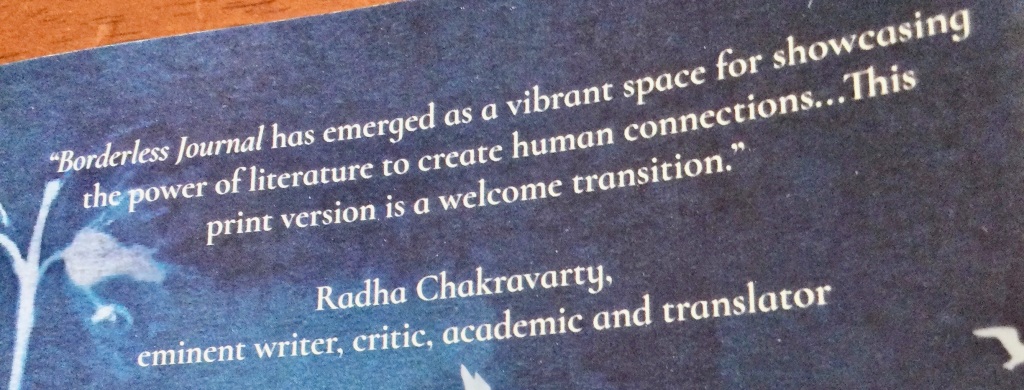
That good things happen despite darkness, despite prognostications of doom, that light glimmers hope if you strive to focus on your strength in hard times is borne true both in fiction and in life. Perhaps, we cannot get back the old ways (but is that what we want?) but new paths emerge. Old gives way to new. And while trying to gather pearls of human excellence — borne not of awards or degrees but of bringing out the best, the kindest, the most loving in human hearts — we managed to create with a team an outstanding anthology. Woven with the writings of old and new — we created a tapestry together that the editor in chief of our publishing house said was “classy, literary, engaging and international”. That one of the oldest and most reputed publishing houses in India with bookshops countrywide took it on was also an unusual event! We are truly grateful to Om Books International, Shantanu Ray Chaudhuri and Jyotsna Mehta along with all our writers and readers who made our anthology a reality, and to Radha Chakravarty and Fakrul Alam for the kind words they bestowed on our effort.

Click here to access the Borderless anthology, Monalisa No Longer Smiles

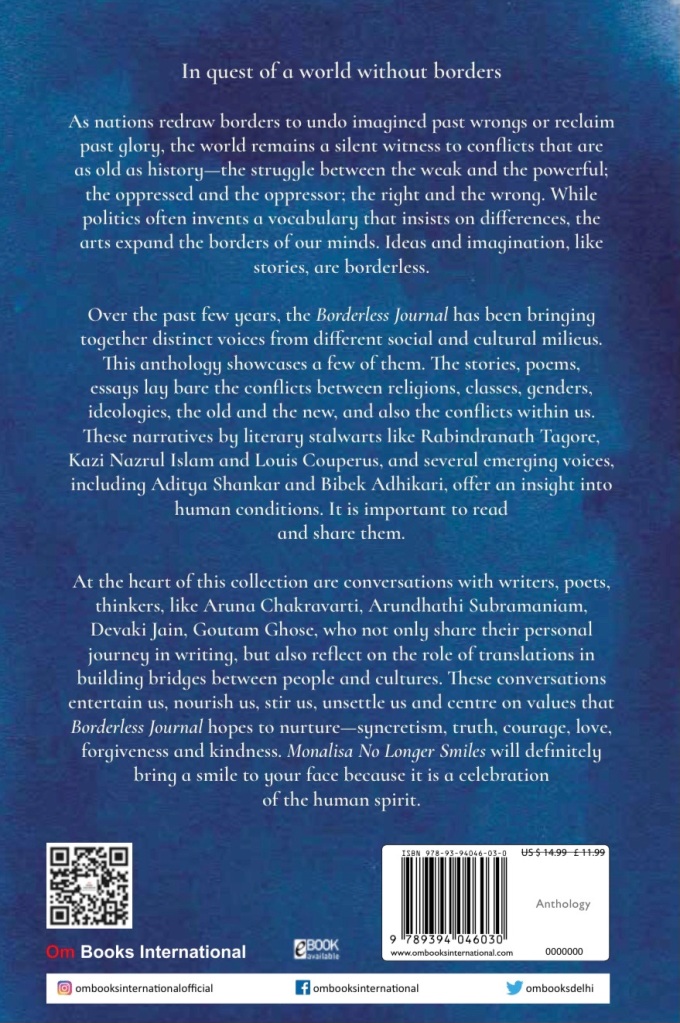
Please greet our first anthology, Monalisa No Longer Smiles, with love and friendship. It could be the perfect Christmas gift in the spirit of the season! And as the blurb says, “it will definitely bring a smile to your face because it is a celebration of the human spirit.”

The anthology is different from our journal in as much as it has a sample of an eclectic collection that has been honed with further editing and has some new features. Most of the writing is from our first year and showcases our ethos, except for Lesya’s poetry and interview. Lesya Bakun from Ukraine is still on the run, looking for a refuge — she cannot return home like you or I can. Her family is scattered across number of countries. Her cousin, who was guarding the factory at Azovstal, was taken prisoner. We included her story in the anthology hoping to create global empathy for refugees as the numbers will increase not only due to war but also due to climate change.

The reason we felt a hardcopy anthology was a good idea was because nothing beats the joy of having a bunch of interesting reads in the warmth of your hands (especially where internet cannot reach or is unavailable). In any case, books with the feel of paper, the rustling whispers which carry voices of leaves can never be replaced as Goutam Ghose had also said in his interview which is now part of our anthology.

And that is why we celebrate more books… this time we feature Singaporean prima donna of literature, Suchen Christine Lim, with her new book Dearest Intimate, a novel that spans more than hundred years including the harrowing Japanese invasion during World War II. She shared sound advice with writers: “Suffering is good for the writer. It will deepen lived experience and expand the heart’s empathy.” And perhaps that is what is echoed through the experiences of the other writer interviewed on our pages by Keith Lyons. This is a writer who not only brought out his own books but was a regular contributor of travel pieces for Frommer’s and National Geographic traveling to unexplored destinations — Christopher Winnan. Another writer Lyon had interviewed recently, Steve Carr, has passed on. We would like to convey our heartfelt condolences to his family and friends.

We have a number of books that have been reviewed. Reba Som reviewed Aruna Chakravarti’s Through the Looking Glass: Stories that span eras spread across time. Somdatta Mandal has reviewed Shehan Karunatilaka’s The Birth Lottery and Other Surprises and Bhaskar Parichha, Rahul Ramagundam’s The Life and Times of George Fernandes. Basudhara Roy has written of Afsar Mohammad’s Evening with a Sufi: Selected Poems, translated from Telugu by the poet and Shamala Gallagher, verses that again transcend borders and divides. We have an excerpt from the same book and another from Manoranjan Byapari’s How I Became a Writer: An Autobiography of a Dalit, translated from Bengali by Anurima Chanda.

More translations from Bengali, Balochi and Korean enrich our November edition. Fazal Baloch has translated a story by Haneef Shareef and Rituparna Mukherjee by Shankhadeep Bhattacharya. We have the translation of an inspirational Tagore poem helping us find courage (Shonkho Dhulaye Pore or ‘the conch lies in the dust’). Another such poem by Nazrul has been rendered in English from Bengali by Professor Fakrul Alam. He has also shared an autobiographical musing on how he started translating Tagore’s Gitabitan, which also happens to be his favourite book. More discussion on the literary persona of TS Eliot and the relevance of his hundred year old poem — ‘The Waste Land’ by Dan Meloche adds variety to our essay section.

Evoking the genius of another outstanding artiste, Kishore Kumar, who happened to pen thought provoking dialogues in some films, is Shantanu Ray Chaudhuri’s essay, review of a recent book on the legendary actor-singer and an interview with the authors. Infringing the boundaries of literary with popular culture and art and integrating all forms into a wholistic bundle has been part of our ethos. In that spirit we have a musing by Prithvijeet Sinha on Edvard Munch’s famous painting called Scream. We have non-fiction from Australia spanning Meredith Stephens’s recent brush with Covid, Mike Smith visits a Scottish beach in the footsteps of a novelist, Ravi Shankar has given us a poignant piece for a late friend and Candice Lousia Daquin talks of the existence of bi-racial biases. In contrast, Suzanne Kamata sent a narrative that bridges divides showcasing a German wife of a Japanese scientist that draws us to conclude that biases erode over time to create an acceptance of bi-racial people. Devraj Singh Kalsi brings in humour with his funny narrative about a guitarist. Rhys Hughes writes in a lighter vein on Indian cuisine in his column and spouts more funny poetry bordering on the absurd.

Jared Carter has shared beautiful poetry on murmuration in birds and we have touching verses from Asad Latif for a little girl he met on a train — reminiscent of Tagore’s poem Hide and Seek (Lukochuri). Michael R Burch has given us poems setting sombre but beautiful notes for the season. We host more poetry by Luis Cuauhtémoc Berriozábal, Quratulain Qureshi, Jim Bellamy, Gayatri Majumdar, Ryan Quinn Flanagan, Alpana, Jonathan Chan, Saranyan BV, George Freek and many more. We have stories from around the world: India, France and Bangladesh.

Gathering all of your thoughts in strings of words from all corners of the world, we present to you the bumper November issue of Borderless Journal . Thank you all for sharing your thoughts with us. Thanks to Sohana Manzoor for her fantastic painting and more thanks to the whole Borderless team for seeing this issue through. We would not have been able to do the anthology or these issues without each one of you — writers and readers.

Thank you all from the bottom of my heart.

There is always hope for a new tomorrow!

Mitali Chakravarty

borderlessjournal.com

Click here to access the Borderless anthology, Monalisa No Longer Smiles

Categories
Excerpt

Evening with a Sufi: Selected Poems

Title: Evening with a Sufi: Selected Poems

Author: Afsar Mohammad

Translator: Afsar Mohammad & Shamala Gallagher

Publisher: Red River

Across from the Char Minar

You see how one butterfly
left us a trace of its colour,
before killing itself
on this busy street.

Here one thousand people,
one then the other
crossed and walked on
without even looking. 

Any afternoon, when the sun
smiles like a white flower
on the head of the Char Minar,
just walk straight into his look.

It’s not so hard
to pour one look into
an ever-burning oven,
a house of molten sights.

Here where the butterfly forgot
its colour and flew off into the dark,
stay and stare straight into life.     
Tell me how it looks.

The thousand people who walked,
limped, and ran by this road
told me at least a thousand lies
but in innocent tongues. 

Another Word

At the end of crying out, 
my word is a dwarf. 

How long can I live on a dwarf? 

The tear that sang before my beginning
never leaves me a gasp of shore. 

I can’t become your sea or sky. 

I am just a tearlet
beneath your eye. 

The drop 
that can swallow a desert.  


In the Middle of the Poem

The line gasps, interrupted. 
Quick gulp of silence. 
Someone pants at the rear. 

The road flies back. 
A scene flits past,
along with the footsteps. 
Silence has so many faces. 

Someone walks on either side,
hazy, indistinct. 
Someone sighs behind the shoulder. 
The poem stops. 

A Rain Lost in Hyderabad
1

Since there is nothing like evening here,
I just dream an evening
in every bit of my sleep.

When the trees erase their shades,
when the sky dries out its final sunshine,
a cold wave scoops me.

I rush to my nest and hide in its wings
before the dark night takes me.

2

Never know if this was raining since morning
or just began this noon.
The lives that unfurl in the noons
don’t know morning breezes.

Getting up past noon,
I realise the alarm was tired
of alarming me and sighed itself off.

I am best at reading time
in reverse.

3

I am the crooked one

who is born when all the rains and winters
lose their hope of moving.

4

Hyderabad is my altered self —

a dreamless sleep,
a sleepless dream,

awaking slipped under a nap. 

(Excerpted from Evening with a Sufi: Selected Poems by Afsar Mohammad, translated from the Telugu by Afsar Mohammad & Shamala Gallagher. Published by Red River, 2022)

About the book

Evening with a Sufi: Selected Poems volume brings together, for the first time in English translation (translated by the poet in collaboration with Shamala Gallagher) the selected, and often groundbreaking poetry of the celebrated Telugu poet Afsar Mohammad, known for his trendsetting poetry and literary criticism in the post-1980s Telugu literary culture. Beside an erudite translator’s note from Gallagher, Evening with a Sufi also contains two in-depth essays on Afsar Mohammad’s poetry by David Shulman and Cheran Rudhramoorthy, plus an interview with the poet by poet and translator Rohith.

About the Author

Born in a small village in the South Indian state of Telangana, Afsar Mohammad now teaches South Asian Studies at the University of Pennsylvania. Known as a trendsetting poet and literary critic in the post-1980s Telugu literary culture, Afsar has published five volumes of poetry, one collection of short stories and two volumes of literary theory essays. Afsar is also a distinguished scholar of Indian studies and has published extensively with various international presses, including Oxford and Cambridge. He is now working on a translation of Sufi poetry from Telugu to English. He can be reached at afsartelugu@gmail.com

About the translator

Shamala Gallagher is a mixed-race Indian American writer, community college teacher, and mother to a preschooler. She is the author of a poetry collection, Late Morning When the World Burns (The Cultural Society, 2019), and her writing has been published in several literary journals, including Poetry, Gulf Coast, Black Warrior Review, and the Missouri Review. She lives in a hundred-year-old house in Athens, Georgia, USA with her family and cats.

Click here to read the review

PLEASE NOTE: ARTICLES CAN ONLY BE REPRODUCED IN OTHER SITES WITH DUE ACKNOWLEDGEMENT TO BORDERLESS JOURNAL

Categories
Review

Reconstructing a Broken World with Sufism

Book Review by Basudhara Roy

Title: Evening with a Sufi: Selected Poems

Poet: Afsar Mohammad

Translator: Afsar Mohammad and Shamala Gallagher

Publisher: Red River

I’m sorry, my Lord. 

My poem is not your slave,
it’s a sickle with its head to the sky. 

My poem is not a damsel timid in your moonlight,
it’s a tiger prowling in a shadowed forest. 

My poem won’t be your grand constitution, 
devoted to your happiness 
at all costs.

-	‘Outcast’s Grief’ from Evening with a Sufi

Not all poetry can be read with the same eye or ear. Certain poems demand to be seen and heard on their own terms, offering to the reader their own canons of understanding and appreciation in imaging an idea that, through them, has just been born into thought. Afsar Mohammad’s Evening with a Sufi sets out to be one such thought-provoking book of poems.

A slim collection of twenty-six verses selected and translated from Afsar Mohammad’s extensive oeuvre in Telugu by Shamala Gallagher and the poet himself, these are existential political poems that are as theoretically perspicacious as they are urgent and astounding in their overwhelming sincerity. Like Eliot’s The Waste Land, Afsar Mohammad’s Evening with a Sufi aesthetically documents a difficult world, especially one criss-crossed with systemic hegemony, and bereft of equality. An engagement with these poems is a direct invitation to the reader to embark on an epistemological tour into a sharp symbolic landscape that encapsulates visceral records of social meaning.

The title, to begin with, itself upholds a strong symbolism. Its ‘evening’ bespeaks the twilight of civilisation, the personal-social moment of the unleashing of despair, and a decadent global landscape thriving on inequity and deprivation. And yet, evening, in these poems, is also the transitional period of awareness, self-reflection, evaluation, and the collective envisioning of an egalitarian dawn. These poems, therefore, become investigations and articulations of both fatigue and rest, of falling apart and re-gathering, and of old failures and new beginnings, leading us to look at the idea of the Sufi or Sufism anew.

“For me, Sufism is nothing but a tool of resistance,” avers the poet, indicating how Sufism, as a philosophy, offers a vigorous counternarrative to transnational policies and practices of discrimination, marginalisation, disempowerment and exclusion. “In my village Sufism, I see how people of diverse colours and castes share food, rituals and stories. As a village person, it’s not a far-fetched utopia for me — but an everyday reality. My writings are nothing but reminders of that shared realm of life.”

In Afsar’s poems, Sufism becomes a political as well as existential search for a vision of oneness. This vision is, at the same time, philosophical and social, local and global, integrating and intimidating in the way that most revolutions are – “The drop that can swallow a desert” (‘Another Word’) or “Where walls are knocked down,/ we won’t need the splendour of curtains” (‘The Spectator is Dead’) or “I always speak the language of war.” (‘A Green Bird and the Nest of Light’)

Identity surfaces as a significant theme in this book. Most of the twenty-six poems in Evening with a Sufi embark on a complex exploration of identity on geographical, cultural, social, historical or linguistic terrains. However, the book’s conceptualisation of identity is far from monolithic. Germane to the vision of these poems is the essentially dialogic space of identity and its characterization as an ever-contingent work-in-progress.

Mark the first poem in the collection, for instance. Titled ‘Name Calling’, an ambiguous phrase that poignantly addresses the phenomenon of naming as an act of use and abuse, the poem captures the essential seamlessness of names and identities. The protagonist of the piece is a boyhood contemporary called Usman who is visibly an ‘other’ to the speaker of the poem, the difference between them marked out distinctly in class terms and perhaps also (less evidently) in terms of physical ability – “You scared all the children/ away from the river./ A body like a wound/ peeks from your torn shirt.” It is, however, to this social pariah – “the one street dog doggedly haunted by a ball” that the speaker feels affiliated in his later life:

Now I don’t see much difference between you and me. 
We are the same.[…]
Usman, times never change 
only the roles change.

Muslim, Telugu and Third-world migrant, the poet reads the theory and experience of otherness on a number of sociological axes and through a variety of cultural lenses. In ‘The Accented Word’, he uses the idea of accent to explore the complex genealogies of language on the intersections of purism and cultural hegemony, contemplating variously, through the three sections of the poem, on linguistic integrity, capitalist subordination, and postcolonial erasure:

Words 
are stillborn babies. 

Their blood has gone bad with white poison, 
their words have gone bad from the accent. 

I’ve been poured, shared, and bathed in white poison 
since I was little 
and now I want to speak out for myself. 

But my voice is in chains 
and my language is poisoned, 

and the language of my time is poisoned. 

We live on the brackish water of life.

While Shakespeare’s Caliban in The Tempest felt that the colonizer’s language profited him by teaching him “how to curse”, Afsar’s poems approach language with utmost caution, forever mindful of the possibility of trampling and obscuring buried histories of domination and betrayal. Many of the poems, here, are metapoetic in their thrust, assiduously exploring the value of meaningful postcolonial poetic creation from the inescapable inequities and ideological loopholes of language: “a market piles up words sounding like poetry” (‘The Accented Word’) or “How long this slavery to white poems?” (‘Outcast’s Grief’) or again as in “Poetry: / just one dried leaf.” (‘Walking’)

In ‘A Piece of Bread, a Country, and a Shehnai’, bread, music, war and pain – all come together to avow our subcontinent’s shared heritage of poverty and cultural intimacy brutally shredded by politico-religious separation. In ‘No Birthplace’, the speaker of the poem is as much the Indian subcontinent as its hapless postcolonial citizen faced with the inability to reconcile its historical legacy of cultural plurality with the blind spots in its mythological and ideological machinery:

Come, divide me by myself, I say. 
Not by forty-seven. 

My laughs, screams, harangues, deaths, and rapes — 
They’re all yours too! 

It is interesting to note how Afsar’s poems consistently invigorate and socially translate the idea of spirituality through sinewy sociological imagery with the result that spirituality is transformed from a closeted and socially-indifferent personal practice to a welfare-oriented everyday social ritual. In ‘Iftar Siren’, the idea of fasting as self-purification is ironically brought to bear on the understanding of the hunger-stricken socially dispossessed as perpetually cleansed while the overfed victimisers walk about unconcerned:

What a great life. 
In the holy month, 

do you see how you are all becoming pure? 
I’ve been like this for years 

burning in the divine fire. 
Unable to turn into ashes. 

I’m a fire-pit you try 
and try to stamp out. 

Yes, the fire-pit 
is tired too.

The haunting and incendiary metaphor of hunger as fire and the stomach/body as the fire-pit, tired of being stamped out or dispossessed, makes these poems powerful bandages for social injustices as well as flaming flags of protest. In ‘Qibla’, the posture of prayer, again, pivots on the stomach – “a belly turned deep/ into itself/ in which I obscure my body,/ feet, hands and everything/ for a long time” – suggesting the omnipotence of hunger as surpassing all acts of asocial faith. The poem concludes with considerable uncertainty of the efficacy of prayer and with an ideological pun on “arms” (arm/armament) as a means of erasing human hatred.

The stupendous yet composed energy of the book needs no forestatement. Every single word here is deftly chosen, well-placed, and tersely poised to make emotional leaps on command. The images are taut, the sentiments thoroughly grilled in the fire of creative originality, and everywhere, there is a sense of potential unruliness held firmly in check by a balanced and farsighted imagination.

In considering these poems, one must not forget, also, their complex linguistic history. Though translated from the original Telugu, the Telugu language itself includes, for the poet, “the entangled history of Urdu, Hindi and English — the languages that indeed shaped my emotional realm.” Arriving into English via such multi-layered linguistic travails and travels, these exceptionally well-translated poems infuse postcolonial English with a visceral depth, a spiritual profundity and a razor-sharp urgency that would be difficult to come by in the original English.

Accompanied by a very relevant author interview and insightful essays by the translator and  valuable first readers of this collection, Evening with a Sufi arrives, in its essential philosophy and call for humanitarian action, with a new theory and praxis for the world, determined to reconstruct rather than redeem it.

Basudhara Roy teaches English at Karim City College affiliated to Kolhan University, Chaibasa. Drawn to gender and ecological studies, her four published books include a monograph and three poetry collections. Her recent works are available at Outlook India, The Dhaka Tribune, EPW, Madras Courier and Live Wire among others.

.

Click here to read the book excerpt from Evening With a Sufi

PLEASE NOTE: ARTICLES CAN ONLY BE REPRODUCED IN OTHER SITES WITH DUE ACKNOWLEDGEMENT TO BORDERLESS JOURNAL