Categories
Essay

A City for Kings

Narratives and photographs by P Ravi Shankar*1
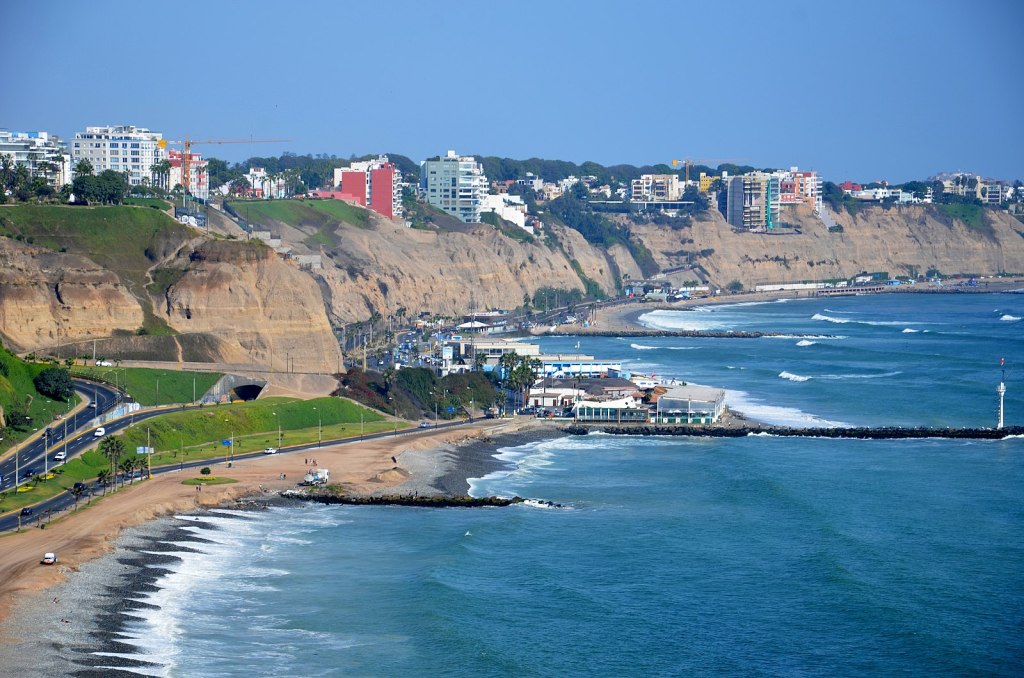
Lima. Courtesy: Creative Commons

The rich golden-brown skin peeled off easily to expose the pink flesh underneath. The ‘frita’ was a perfect symphony of flavours with every note being in the right place. I enjoyed the entire fish including the bones and the head. I was having a ‘trucha frita’ (fried trout) at a restaurant in Magdalena del Mar, Lima, Peru. The fish was large and had been fried without much oil. Peru is known for its food, and I enjoyed my lunch (almuerzo) throughout my visit. Lunch is the major Peruvian meal. There were special lunch menus and for around 8 nuevo soles (around 2 US dollars and fifty cents). I got an entrada (usually a soup or a salad) and a segundo (seconds with a big variety of dishes) with a drink and often a dessert.

I landed at Lima’s Jorge Chavez International Airport late at night late in September. The airport is not very large by international standards but functions quite well. Taxi fares from the airport are on the higher side. I had taxi-hailing apps on my phone, but they did not seem to work at the airport. Lima is a city of around 11 to 12 million people. About a third of Peru’s population lives in the capital. There has been a recent influx of Venezuelan refugees to the city. The city is crowded but most of it is well-planned with squares, roundabouts, parks, and sidewalks.

I liked Lima. For a large city, it is not very polluted though some areas are dusty. The city is usually covered by haze or fog till late in the morning. The weather is usually cloudy though it rarely rains. About 40% of Peru’s population lives in the arid coastal region (la Costa). You see a lot of cambios or shops where you can change money. You also see a lot of restaurants. Lima is the third largest city in Latin America and recently has gained a reputation for its food. Peru has a lot of Japanese and Chinese immigrants (most of whom arrived at the end of the nineteenth and beginning of the twentieth century) and may be the most ‘Asian’ country in Latin America. Many Chinese run Peruvian Chinese restaurants called ‘chifas’.

Lima gained in importance during the Spanish rule and was the capital of the viceroyalty of Peru which included parts of modern-day Ecuador, Colombia, Bolivia, Chile, and Argentina. The city became very wealthy. During my different visits, I stayed in three different parts of the city — Pueblo Libre (Free town), Magdalena del Mar, and Jesus Maria. Lima is divided into several municipalities.

In Pueblo Libre, I stayed near the Plaza de la Bandera (Plaza of the Flag), a huge roundabout. The archeological ruins of Mateo Salado were nearby. Peruvians take great pride in their rich heritage. Following the Spanish conquest, the pre-Hispanic religions and cultures were violently suppressed by the Spaniards. They do continue to influence modern Peru in several ways but there is a stark discontinuity.
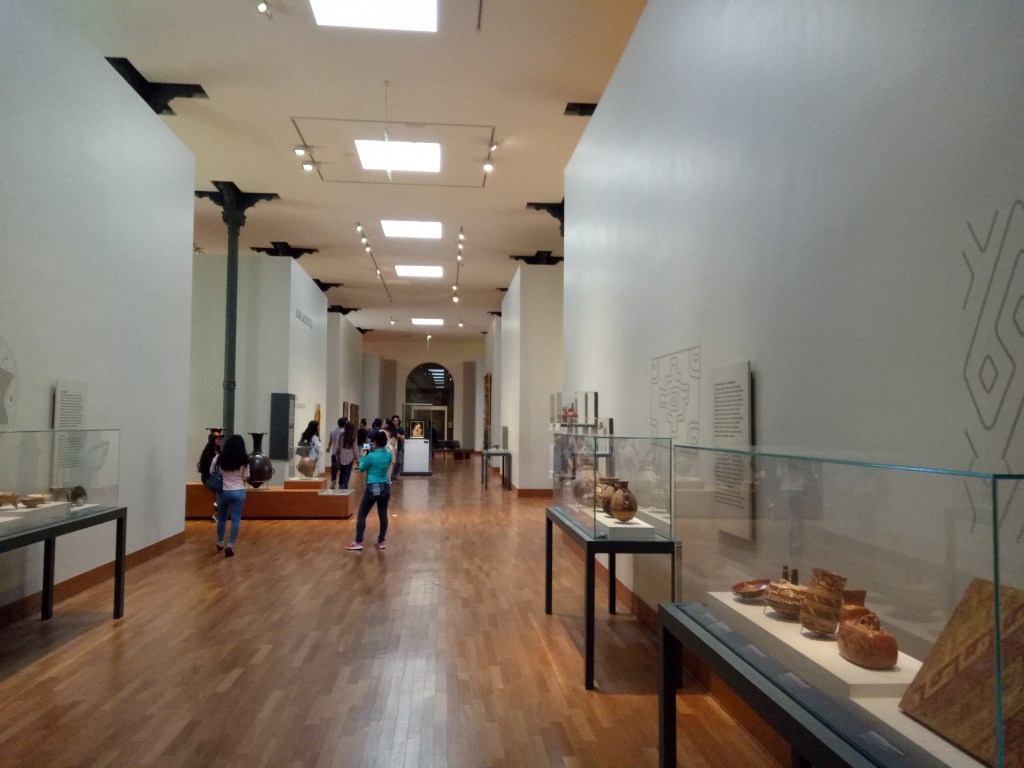
The Larco Museum is one of the many fine museums in the city. The museum has a rich collection of pre-Columbian art, is well-maintained, and is very appealing to the senses. Many civilisations took root on the arid coast. The Paracas and Nazca civilisations were prominent. The population had to learn to harness and use water from underground sources. The Anthropology Museum was under renovation, and I could only see the section commemorating the life of the liberator, Simon Bolivar. Bolivar is very popular in South America with several streets and buildings named after him. There is even a detergent named after him.

The Parque de la Leyendas (Park of Legends) is the zoo. The zoo is huge and is structured according to the three regions of Peru, the coast (costa), the mountains (sierra), and the jungle (selva). The Amazon rainforest constitutes the largest part of the country by land area. The largest city, Iquitos, can be reached only by boat or by air. The zoo also has a huge garden with plants from all over the world and a huge archeological site.
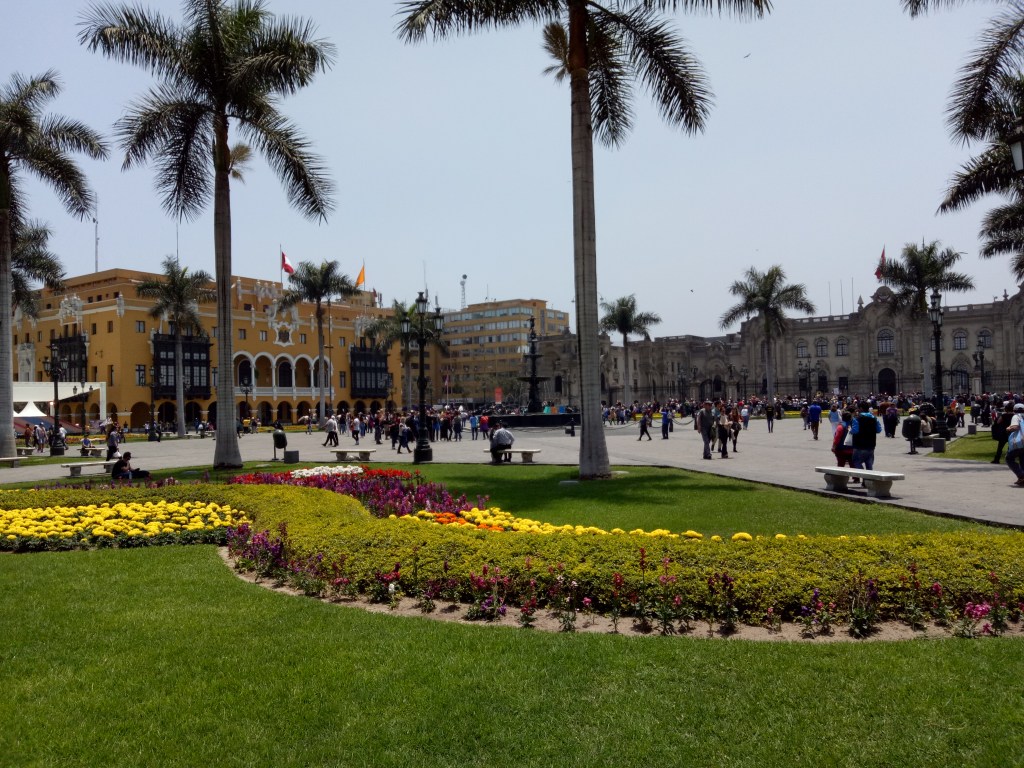
Plaza de Armas

Plaza de Armas de Lima (Plaza Mayor lof Lima) is the main square of the city surrounded by fine Spanish colonial buildings. Every town in Peru has a Plaza de Armas. Town planning is mostly good with numbered sectors and streets within the city. I was fortunate to see the changing of the guard at the Presidential palace which takes place around noon. What a show of pomp, colour, and pageantry on horseback! The synchronisation was perfect. The cathedral of Lima, the municipal palace, and the palace of the Union are major historical buildings.

Changing of Guards

I had heard and read a lot about one of the more recent attractions of Lima – the magical water fountain. The Circuito Magico de Agua creates magic with water. I reached the place mainly known for the spectacular fountains around 5 p.m. You can walk underneath a tunnel of water. As the sun began to set the lights were turned on. The lights at the main fountain could reproduce an extravagant palette of colors and different scenes were created in tune with the music. There was a light show at 7.15 pm. Crowds began to gather around the main fountain. The light and sound show using lasers and lights was spectacular and provided a brief introduction to the rich tapestry of Peru.     
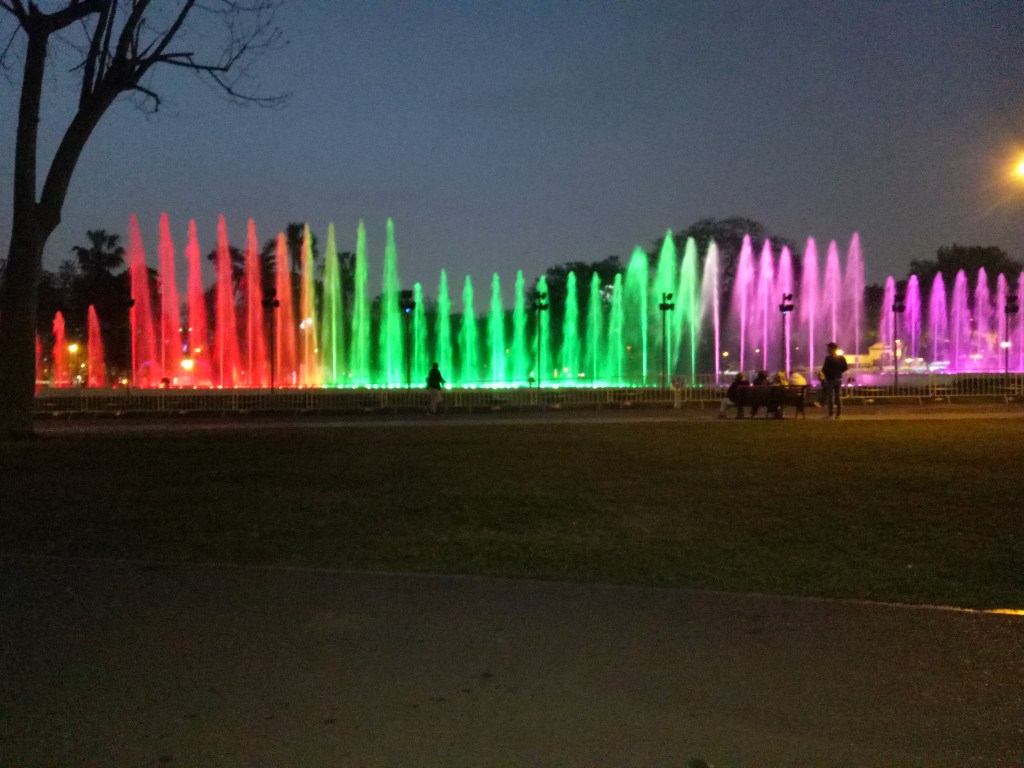
Magical Fountains

Chicha morada is a drink from the Andes region and is made from purple corn. Rich in antioxidants, the drink is refreshing and healthy. Chicha morada is smooth and beautifully complements various Peruvian dishes. The alcoholic variety plays an important role in different religious and other ceremonies from ancient times to the present day. There is a legend about the corn (mama jora, mother corn) plant from which these drinks are derived.

The legend about the chicha[1] is especially popular in Cuzco, the ancient capital of the Inca empire, and also in other cities in Peru. In ancient times the God Viracocha (the creator) saw people working hard. He wanted to help them, so he came down from Hanaq Pacha (the world above) to place in a single plant the powers he wanted to give humans.  He chose a weak plant that struggled to grow amidst spiny weeds. To give his power to this plant, Viracocha took from his bag a sliver of huaranguay wood, a puma hair, a condor feather, and the fox’s brain.  He put them together and placed them on the small plant.

The city that treats visitors like kings with its sumptuous meals and friendliness, creates mystery with magical legends, like the one about Viracocha. Perhaps, that is why a sense of lingering longing and gratitude fills my being as I think of the colourful capital of that distant country on the other side of the globe.

Acknowledgment: Senor Fernando needs to be thanked for his hospitality and help during my visit — Dr P Ravi Shankar

[1] The legend is mentioned in a blog article by WC Morveli titled ‘Drink chicha to become wiser than a fox’ (https://cuzcoeats.com/drink-chicha-wiser-fox/)

  1. Unless otherwise stated ↩︎

Dr. P Ravi Shankar is a faculty member at the IMU Centre for Education (ICE), International Medical University, Kuala Lumpur, Malaysia. He enjoys traveling and is a creative writer and photographer.

.

PLEASE NOTE: ARTICLES CAN ONLY BE REPRODUCED IN OTHER SITES WITH DUE ACKNOWLEDGEMENT TO BORDERLESS JOURNAL

Click here to access the Borderless anthology, Monalisa No Longer Smiles

Click here to access Monalisa No Longer Smiles on Kindle Amazon International

Categories
Contents

Borderless September 2023

Art by Sohana Manzoor

Editorial

What do They Whisper?… Click here to read.

Conversations

Shantanu Ray Chaudhuri in conversation with M.S. Viraraghavan and Girija Viraraghavan ( grand daughter of President Sarvepalli Radhakrishnan) on their new book, Roses in the Fire of Spring: Better Roses for a Warming World and Other Garden Adventures. Click here to read.

In conversation with Isa Kamari, a celebrated writer from Singapore, with focus on his latest book, Maladies of the Soul. Click here to read.

Translations

A Hunger for Stories, a poem by Quazi Johirul Islam, has been translated by Professor Fakrul Alam. Click here to read.

A Hand Mill, a story by Ammina Srinivasaraju, has been translated from Telugu by Johny Takkedasila. Click here to read.

Kiyya and Sadu, a part of this long ballad on the legendary lovers from Balochistan, has been translated from Balochi by Fazal Baloch. Click here to read.

The Time for the Janitor to Pass by, poetry written in Korean and translated by Ilhwah Choi. Click here to read.

Sharat or Autumn, a poem by Tagore, has been translated from Bengali by Mitali Chakravarty. Click here to read.

Poetry

Click on the names to read the poems

Jared Carter, Rhys Hughes, Santosh Bakaya, Luis Cuauhtémoc Berriozábal, Sagar Mal Gupta, Nirmala Pillai, George Freek, Pramod Rastogi, Peter Devonald, Afshan Aqil, Hela Tekali, Swarnendu Ghosh, Alpana, Michael Burch

Poets, Poetry & Rhys Hughes

In Tintin in India, Rhys Hughes traces the allusions to India in these iconic creations of Hergé while commenting on Tintin’s popularity in the subcontinent. Click here to read.

Musings/Slices from Life

Black Pines and Red Trucks

Meredith Stephens shares the response of some of the Californian community to healing after the 2020 forest fires with a narrative and photographs. Click here to read.

Remembering Jayanta Mahapatra

KV Raghupathi travels down nostalgia with his memories of interactions with the recently deceased poet and his works. Click here to read.

The Toughness of Kangaroo Island 

Vela Noble draws solace and lessons from nature around her with her art and narrative. Click here to read.

Where is Your Home?

Madhulika Vajjhala explores her concept of home. Click here to read.

A Homecoming like No Other

Saumya Dwivedi gives a heartwarming anecdote from life. Click here to read.

Musings of a Copywriter

In Hair or There: Party on My Head, Devraj Singh Kalsi explores political leanings and hair art. Click here to read.

Notes from Japan

In Against Invisibility, Suzanne Kamata challenges traditions that render a woman invisible with a ‘sparkling’ outcome. Click here to read.

Essays

Jayanta Mahapatra: A Tribute to a Poetic Luminary

Dikshya Samantrai pays tribute to a poet who touched hearts across the world with his poetry. Click here to read.

Celebrating the novel… Where have all the Women Writers Gone?

G Venkatesh writes about a book from 1946. Click here to read.

Chandigarh: A City with Spaces

Ravi Shankar travels back to Chandigarh of 1990s. Click here to read.

The Observant Immigrant

In Climate Change: Are You for Real?, Candice Louisa Daquin explores the issue. Click here to read.

Stories

The Infamous Art Dealer

Paul Mirabile travels through Europe with an art scammer. Click here to read.

Getting Old is like Climbing a Mountain

Saranyan BV explores aging and re-inventing homes. Click here to read.

The Airport

Prakriti Bandhan shares a short, whimsical narrative. Click here to read.

Book Excerpts

An excerpt from Syed Mujtaba Ali’s Tales of a Voyager (Joley Dangay), translated by Nazes Afroz. Click here to read.

An excerpt from Sanket Mhatre’s A City Full of Sirens. Click here to read.

Book Reviews

Somdatta Mandal reviews Begum Hazrat Mahal: Warrior Queen of Awadh by Malathi Ramachandran. Click here to read.

Basudhara Roy reviews Sanket Mhatre’s A City Full of Sirens. Click here to read.

Bhaskar Parichha reviews Samragngi Roy’s The Wizard of Festival Lighting: The Incredible Story of Srid. Click here to read.

.

Click here to access the Borderless anthology, Monalisa No Longer Smiles

Click here to access Monalisa No Longer Smiles on Kindle Amazon International

Categories
Essay

Chandigarh: A City with Spaces

By Ravi Shankar

I was apprehensive. I had spent time in New Delhi when I was very young. But after that, I had never travelled to the north of India. I was traveling by chair car on the Rajdhani Express to Delhi and from there, by bus to Chandigarh. Sleeping on a chair is difficult though the coach offers enough legroom, and the seats are wide. The time was December, and the weather would be cold. The bus journey to Chandigarh from New Delhi took a long time. I was moving through the flat plains of Haryana with fields on both sides of the road. The sun set early during winter in the north. By 5 pm, it was beginning to get dark. The sun had truly set by the time I reached Chandigarh.

The cold was a de novo experience. Using a quilt was something new though later I began the appreciate the gentle warmth provided using the body’s own heat. Coming from the claustrophobic confines of Mumbai, the wide-open spaces of Chandigarh were a welcome change. Some of the traffic circled the roundabouts that were larger in this city than apartment complexes in Mumbai. Space, space, and plenty of space was my first impression of the city.

Chandigarh is believed to have been named after the Goddess Chandi whose temple is located near the city. Garh means a fort. This was India’s first planned city. Various teams of architects had been commissioned and the Swiss-French artist, Le Corbusier was the last in the series. Le Corbusier designed several buildings in Chandigarh including the secretariat, the high court, and the Palace of Assembly. He created an open-hand sculpture like he had done in the other cities designed by him. He designed many structures at the Postgraduate Institute of Medical Education and Research (PGIMER) where I was a resident doctor. His influence was also seen in Panjab University across the road in Sector 14. One of the challenges with a sprawling low-density design was services were located far away and you required a vehicle to access services and go to different areas. In high-density areas like Mumbai, you can just step down to access shops and services. This was in the days before online ordering and e-commerce platforms.

The city is divided into sectors. I settled in the Old Doctor’s Hostel or ODH in Sector 12, where the institute was located. I eventually shifted to the D block of ODH, the newest to be constructed. This had the benefit of a wash basin within the room reducing your trips to the shared restrooms. The research blocks and the college canteens had the trademarks of Le Corbusier’s design. He was fond of using primary colours like blue, yellow, and red as evidenced in the bright hues of the doors and windows of the hostel. The original structure was good but was constructed in the 1960s. By the late 1990s, living standards had improved and the rooms began to feel inadequate. He was also fond of using curves in his buildings and each room had a curve and there was a specially made wooden table to fit into the curve. Most of these had been destroyed over the years. The hostel rooms were single occupancy. This was especially important for the residents in clinical departments as it allowed them to rest after long hours of duty.

Sector 17 was the main commercial hub of the town and had several high-end restaurants and shops. People were fashionably dressed though the cold weather during winter required a lot of clothing. Winter mornings could get very foggy. In those days air pollution levels were still low and winters were generally pleasant. The food was good — ranging from aloo parathas (Indian flatbread stuffed with a spicy potato mix), gobi parathas (made with a stuffing of cauliflower), mooli parathas (Indian flatbread stuffed with a spicy radish mix), tandoori chicken (chicken grilled in a clay oven called the tandoor), tikkis (a small cutlet made of potatoes, chickpeas and different spices), chole bhature (a type of chana masala and puris) and samosas (triangular fried pastry with a savoury filling). Punjabis love their food. The food is wholesome but may be high in saturated fats. There were several tandoori chicken restaurants and chicken was a perennial favourite. The tandoor is a great invention though it may be difficult for the person making rotis in the heat of peak summer. But tandoori rotis eaten piping hot dipped in a spicy gravy on a cold night are a pure delight.

The sector 11 market was the nearest to PGI and there were two or three dhabas (roadside eateries) serving Punjabi delicacies. There was also a more upscale restaurant serving variations of the dosa. These had been modified to north Indian tastes and this was my first introduction to chicken dosa. The taste was good, but the stuffing was very unconventional. The buses were old and had seen better days. I usually took the bus to Sector 17 and to The Tribune colony in Sector 29. Started in 1881, The Tribune is one of the oldest newspapers in North India and one of my father’s acquaintances worked at the newspaper.                 

The Panjab University had a sprawling campus just across the road at Sector 14. I loved to roam through the beautiful campus. The market at the university had shops selling delightful Punjabi samosas. These were large, the covering was crisp, and the stuffing of potatoes and chickpeas was spicy and tasty. Those days a samosa cost around one rupee and fifty paisa — light on the pocket though wages were lower those days.

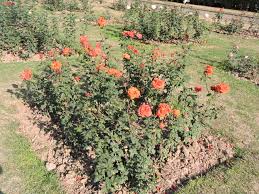
The northern sectors of the city including 12 where PGI was located were the older ones and more prosperous. The Zakir Hussain Rose Garden in sector 16 was named after India’s former president and had over 1600 species of roses. I used to visit occasionally, especially during the winters when the roses were in bloom. Summers in Chandigarh are hot but less than in many other places in the plains due to the closeness to the hills.

The Rock Garden is a major attraction. The garden was begun to be built by Nek Chand in 1957. The garden was built illegally but later became world famous. It is built entirely from discarded household and industrial waste. There is also a doll’s museum inside the garden. One of my fellow residents knew Nek Chand very well and he used to play with his son when he was young. Models of rock gardens have since been built in several Indian cities.

Summers in Chandigarh are difficult. The sun is relentless. The institution timings change. Before the onset of summer, one visits the desert cooler shops to buy new grass screens for the coolers. The cooler is a great invention with a water pump and screens moistened by water through which air is drawn to cool the room. They work well but when there were power outages in summer, they stopped functioning. The onset of the monsoon in late July makes things difficult. The humidity is high, and the temperature is still above 35 degrees celsius. October to December and March to April are usually pleasant. Late December, January, and February are cold and there is a threat of western disturbances that bring rain and cold damp weather. The city has two satellite townships, one in Punjab (Mohali) and the other in Haryana (Panchkula).

Chandigarh has one of the highest human development indicators in India. I enjoyed my three years in this planned city at the foothills of the Himalayas and I look forward to a visit in the future!  

Dr. P Ravi Shankar is a faculty member at the IMU Centre for Education (ICE), International Medical University, Kuala Lumpur, Malaysia. He enjoys traveling and is a creative writer and photographer.

.

PLEASE NOTE: ARTICLES CAN ONLY BE REPRODUCED IN OTHER SITES WITH DUE ACKNOWLEDGEMENT TO BORDERLESS JOURNAL

Click here to access the Borderless anthology, Monalisa No Longer Smiles

Click here to access Monalisa No Longer Smiles on Kindle Amazon International

Categories
Contents

Borderless August 2023

Art by Sohana Manzoor

Editorial

Other Echoes in the Garden… Click here to read.

Interviews

Ujjal Dosanjh, former Minister from Canada and former Premier of British Columbia, discusses his autobiography, Journey After Midnight – A Punjabi Life: From India to Canada, and the need for a world with less borders. Click here to read.

Professor Fakrul Alam discusses his new book of Tagore translations, Gitabitan: Selected Song-Lyrics of Rabindranath Tagore. Click here to read.

Translations

Tagore’s Musalmanir Galpa (A Muslim Woman’s Story) has been translated from Bengali by Aruna Chakravarti. Click here to read.

Masud Khan’s poem, In Another Galaxy, has been translated from Bengali by Professor Fakrul Alam. Click here to read.

Wakeful Stays the Door, a poem by Munir Momin, has been translated from Balochi by Fazal Baloch. Click here to read.

Dangerous Coexistence, written in Korean and translated by Ilhwah Choi. Click here to read.

Proshno or Questions by Tagore has been translated by Mitali Chakravarty. Click here to read.

Pandies Corner

Songs of Freedom: An Ordinary Tale is a narrative by Nandani based on her own experiences, translated from Hindustani by Janees. These narrations highlight the ongoing struggle against debilitating rigid boundaries drawn by societal norms, with the support from organisations like Shaktishalini and Pandies. Click here to read.

Poetry

Click on the names to read the poems

Jared Carter, Rhys Hughes, Malachi Edwin Vethamani, Luis Cuauhtémoc Berriozábal, Saranyan BV, Ryan Quinn Flanagan, A Jessie Michael, Jahnavi Gogoi, George Freek, Koushiki Dasgupta Chaudhuri, David Francis, Akil Contractor, Michael Burch

Poets, Poetry & Rhys Hughes

In An Experiment with Automatic Poetic Translation, Rhys Hughes auto translates an English poem sequentially through 28 languages and then back to English with hilarious results. Click here to read.

Musings/ Slices from Life

Mister, They’re Coming Anyway

Timothy Jay Smith writes on the refugee crisis in Lesbos Island, Greece with photographs by Michael Honegger. Click here to read.

Migrating to Myself from Kolkata to Singapore

Asad Latif explores selfhood in context of diverse geographies. Click here to read.

Islands that Belong to the Seas

Paul Mirabile muses on how humans are like migrants on islands borrowed from the seas. Click here to read.

Of Dreams, Eagles and Lost Children

Aysha Baqir muses on the narrow, closed borders that condemn children. Click here to read.

Mushroom Clouds and Movies: Response from a Hibakusha’s Daughter

Kathleen Burkinshaw discusses Oppenhiemer the movie. Click here to read.

Sleepless in the High Desert, Slumber in the Sierra

Meredith Stephens covers Nevada to Columbia in a car with her camera. Click here to read.

My Hostel Days

Ravi Shankar reminisces on bygone days. Click here to read.

Musings of a Copywriter

In The Amateur Professional, Devraj Singh Kalsi writes of a amateur who thought of himself as a professional. Click here to read.

Notes from Japan

In How I Wound Up in Japan, Suzanne gives her story as an immigrant. Click here to read.

Essays

A Different Persuasion: On Jane Austen’s Novels & their Adaptations

Deepa Onkar delves into the world of Jane Austen books and films. Click here to read.

A Foray into Andamans

Mohul Bhowmik explores Andaman with a camera and narrative. Click here to read.

Bhaskar’s Corner

In Chittaranjan Das: A Centenary Tribute, Bhaskar Parichha discusses the life of one of the most legendary Odia writers. Click here to read.

Stories

Belacan

Farouk Gulsara shares a story based on the life of a migrant in 1950s. Click here to read.

The Japanese Maple

Shivani Shrivastav weaves a story of friendship and loneliness among migrants. Click here to read.

The Coin

Khayma Balakrishnan explores human and supernatural interactions in a school setting in Malaysia. Click here to read.

The Vagrant

Reeti Jamil narrates a strange tale set in a village and told by a farmer. Click here to read.

Book Excerpts

An excerpt from Ujjal Dosanjh’s Journey After Midnight: A Punjabi Life from Canada to India. Click here to read.

An excerpt from Roses in the Fire of Spring: Better Roses for a Warming World and Other Garden Adventures, by M.S. Viraraghavan and Girija Viraraghavan. Click here to read.

Book Reviews

Somdatta Mandal reviews Amitav Ghosh’s Smoke and Ashes: A Writer’s Journey Through Opium’s Hidden Histories. Click here to read.

Basudhara Roy reviews Greening the Earth: A Global Anthology of Poetry, edited by K. Satchidanandan & Nishi Chawla. Click here to read.

Bhaskar Parichha reviews Arunava Sinha’s The Greatest Indian Stories Ever Told: Fifty Masterpieces from the Nineteenth Century to the Present. Click here to read.

.

Click here to access the Borderless anthology, Monalisa No Longer Smiles

Click here to access Monalisa No Longer Smiles on Kindle Amazon International
Categories
Editorial

Other Echoes in the Garden…

“Other echoes
Inhabit the garden. Shall we follow?
Quick, said the bird, find them, find them…”

— TS Eliot, ‘Four Quartets: Burnt Norton’(1936)

Humans have always been dreamers, ideators and adventurers.

Otherwise, could we have come this far? From trees to caves to complex countries and now perhaps, an attempt to reach out towards outer space for an alternative biome as exploring water, in light of the recent disaster of the Titan, is likely to be tougher than we imagined. In our attempt to survive, to live well by creating imagined constructs, some fabrications backfired. Possibly because, as George Orwell observed with such precision in Animal Farm, some perceived themselves as “more equal”. Of course, his was an animal allegory and we are humans. How different are we from our brethren species on this beautiful planet, which can survive even without us? But can humanity survive without Earth? In science fiction, we have even explored that possibility and found home among stars with the Earth becoming uninhabitable for man. However, humanity as it stands of now, continues to need Earth. To live amicably on the planet in harmony with nature and all the species, including our own, we need to reimagine certain constructs which worked for us in the past but seem to have become divisive and destructive at this point.

Ujjal Dosanjh, former Minister in the Canadian cabinet and former Premier of British Columbia, in his autobiography, Journey After Midnight – A Punjabi Life: From India to Canada, talks of regionalism as an alternative to narrow divisive constructs that terrorise and hurt others. He writes in his book: “If humanity isn’t going to drown in the chaos of its own creation, the leading nations of the world will have to create a new world order, which may involve fewer international boundaries.” We have a candid conversation with him about his beliefs and also a powerful excerpt from his autobiography.

An interview with Professor Fakrul Alam takes us into Tagore’s imagined world. He discussed his new book of Tagore translations, Gitabitan: Selected Song-Lyrics of Rabindranath Tagore. He has brought out a collection of 300 songs translated to English. In a bid to emphasise an inclusive world, we also have a translation of Tagore’s ‘Musalmanir Galpa’ (A Muslim Woman’s Story) by Aruna Chakravarti. A transcreation of his poem, called ‘Proshno or Questions’ poses difficult challenges for humanity to move towards a more inclusive world. Our translation by Ihlwha Choi of his own Korean poem to English also touches on his visit to the polymath’s construct in the real world, Santiniketan. All of these centring around Tagore go to commemorate the month in which he breathed his last, August. Professor Alam has also translated a poem from Bengali by Masud Khan that has futuristic overtones and builds on our imagined constructs. From Fazal Baloch we have a Balochi translation of a beautiful, almost a surrealistic poem by Munir Momin.

The poetry selections start with a poem on ‘Wyvern’, an imagined dragon, by Jared Carter. And moves on to the plight of refugees by Michael Burch, A Jessie Michael, and on migrants by Malachi Edwin Vethamani. Ryan Quinn Flanagan has poetry that suggests the plight of refugees at a metaphorical level. Vibrant sprays of colours are brought into this section by Luis Cuauhtémoc Berriozábal, Saranyan BV, Jahnavi Gogoi, George Freek and many more. Rhys Hughes brings in a spot of humour with his mountainous poetry (literally) and a lot of laughter with his or rather Google’s attempt at automatic translation of a poem. Devraj Singh Kalsi has shared a tongue in cheek story about an ‘amateur professional’ — rather a dichotomy.

We travel to Andaman with Mohul Bhowmick and further into Sierra with Meredith Stephens. Ravi Shankar travels back in nostalgia to his hostel and Kathleen Burkinshaw dives into the past — discussing and responding to the media presentation of an event that left her family scarred for life, the atomic holocaust of 1945 in Japan. This was a global event more than seven decades ago that created refugees among the survivors whose homes had been permanently destroyed. Perhaps, their stories are horrific, and heart wrenching like the ones told by those who suffered from the Partition of India and Pakistan, a divide that is celebrated by Independence Days for the two nations based on a legacy of rifts created by the colonials and perpetrated to this day by powerbrokers. Aysha Baqir has written of the wounds suffered by the people with the governance gone awry. Some of the people she writes of would have been refugees and migrants too.

A poignant narrative about refugees who flock to the Greek island of Lesbos by Timothy Jay Smith with photographs by Michael Honegger, both of whom served at the shelters homing the displaced persons, cries out to halt wars and conflicts that displace them. We have multiple narratives of migrants in this issue, with powerful autobiographical stories told by Asad Latif and Suzanne Kamata. Paul Mirabile touches on how humans have adopted islands by borrowing them from seas… rather an unusual approach to migrations. We have an essay on Jane Austen by Deepa Onkar and a centenary tribute to Chittaranjan Das by Bhaskar Parichha.

The theme of migrants is echoed in stories by Farouk Gulsara and Shivani Shrivastav. Young Nandani has given an autobiographical story, translated from Hindustani to English by Janees, in which a migration out of various homes has shredded her family to bits — a narrative tucked in Pandies Corner.  Strange twists of the supernatural are woven into fiction by Khayma Balakrishnan and Reeti Jamil.

In reviews, Parichha has explored Arunava Sinha’s The Greatest Indian Stories Ever Told: Fifty Masterpieces from the Nineteenth Century to the Present. Somdatta Mandal’s review of Amitav Ghosh’s Smoke and Ashes: A Writer’s Journey Through Opium’s Hidden Histories seems to be an expose on how historical facts can be rewritten to suit different perceptions and Basudhara Roy has discussed the Greening the Earth: A Global Anthology of Poetry, edited by K. Satchidanandan and Nishi Chawla.

There is more wonderful content. Pop by our August’s bumper edition to take a look.

I would like to give my grateful thanks to our wonderful team at Borderless, especially to Sohana Manzoor for her fabulous artwork. Huge thanks to all our gifted contributors and our loyal readers. Borderless exists today because of all of you are making an attempt to bringing narratives that build bridges, bringing to mind Lennon’s visionary lyrics:

You may say I'm a dreamer
But I'm not the only one
I hope someday you'll join us
And the world will live as one

Thank you for joining us at Borderless Journal.

Have a wonderful month!

Mitali Chakravarty

borderlessjournal.com

.

Visit the August edition’s content page by clicking here

READ THE LATEST UPDATES ON THE FIRST BORDERLESS ANTHOLOGY, MONALISA NO LONGER SMILES, BY CLICKING ON THIS LINK.

Categories
Nostalgia

My Hostel Days

By Ravi Shankar

The air was getting colder. There was an early morning chill. I wrapped my cotton blanket more tightly around me. January is one of the colder months of the year in Thrissur, Kerala, India. During winter and summer, I had taken to sleeping on the terrace of the men’s hostel. More peaceful and soothing. You can watch the twinkling stars and the clouds. A few other kindred souls did the same. Though it did rain on occasions and then we had to beat a hasty retreat with our bed rolls. The terrace also attracted students who studied using their table lamps till the small hours of the morning.

I stayed at the same hostel room throughout my undergraduate medical (MBBS) course and the first month of my internship. I still remember my entry into the men’s hostel. I had a big suitcase, a bedding roll, a table lamp, a plastic bucket, a mug, and a few daily necessities. We were allotted the first floor of the C Block called the C’ block. We were the sixth batch of the institution and the last one to enjoy the privilege of being allotted rooms together in a single block. Of the twelve rooms in C’ all except three were allotted to our batch.

Ragging was still going strong though strong anti-ragging efforts were also ongoing. We had security guards posted at the entrance to our block and our seniors screaming abuse at us. Gradually after the first few weeks, things quietened down. Reminiscing about those days, I am struck by the simplicity of our lives. Each room had two windows, a ceiling fan, three wooden tables with three wooden chairs, three wooden cots, three metallic cloth hangers, and concrete wall shelves. There was also a ventilator opening into the corridor. Each room was shared by three students. The older medical college hostels had high roofs and did not always have a ceiling fan.

The men’s hostel was located at the edge of the vast campus of the Medical College, Thrissur. There were three blocks (A, B and C) with each block spread over two floors. There was a big portico in front with a phone room and a phone boy. There were bigger rooms (with attached baths) for the tutors and a TV room on the first floor. We had an improvised gym on the ground floor. A room for indoor games was on the first floor next to the TV room and the hostel mess was on the ground floor. In those days there were no cell phones and subscriber trunk dialling (STD) was not yet available. Trunk calls had to be booked manually. The newspaper and magazines room were right at the hostel entrance.  

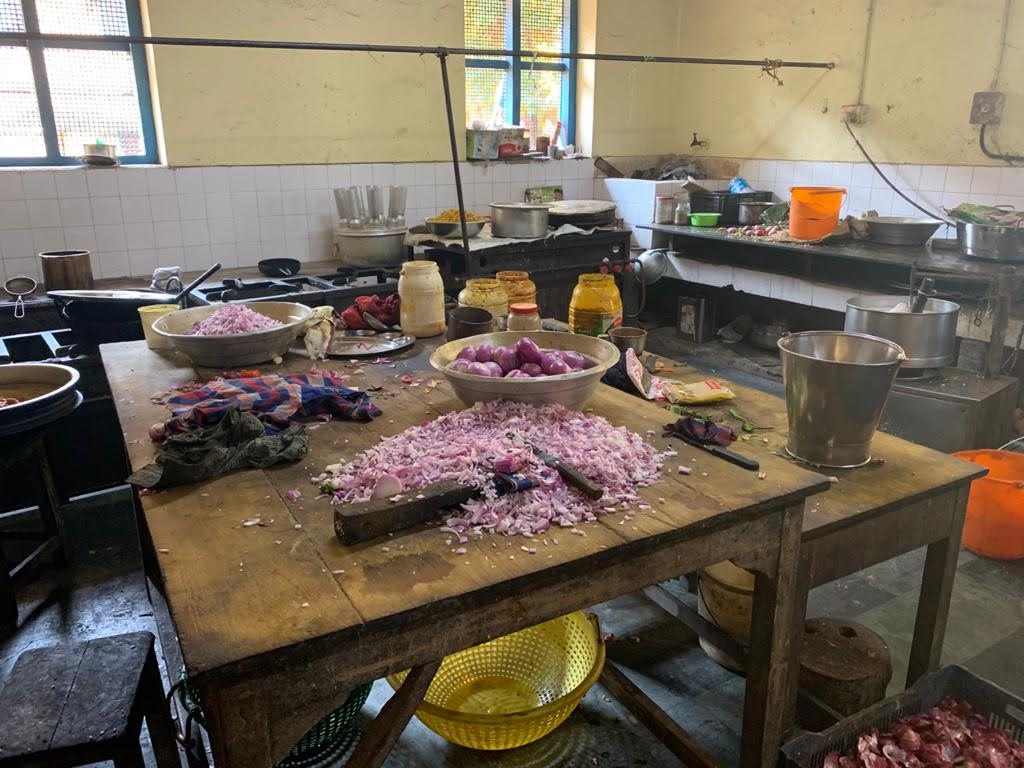
The mess was a simple affair with eight wooden tables and wooden stools and chairs. The chairs had to be strong enough to withstand frequent abuse from the students. There was a serving window, and the main kitchen was inside. Mornings were busy as the clinical students had to board the college buses to reach the hospitals in the town. We had a varied menu for breakfast. This could be masala dosa (a flat bread of rice and lentil flours stuffed with vegetables) puttu (steamed cylinders of ground rice, layered with coconut shavings and fillings), idli (a savoury rice cake), upma (a thick porridge made from rice flour or semolina), noolputtu (called string hoppers in Sri Lanka), bread with jam and butter and something that we called the fractional test meal (FTM). FTM consisted of a glass of warm milk, two boiled plantains and two hard boiled eggs. Quite nutritious and filling. Lunch was usually a hurried affair except on Sundays. Afternoon tea or coffee was one of my favourite repasts. Kerala has a rich and varied selection ranging from different types of vadas (savoury fried snacks), adas (fresh coconut and jaggery wrapped in a dough made of rice) steamed in banana leaf, cutlets, pazhampori (fried banana fritters) and something we called the grenade. The grenade was shaped like one, was mildly sweet and required some effort eating. Neither the mess tea nor coffee were remarkable.   

Hostel mess. Photo courtesy: Ravi Shankar

The quality of dinner varied greatly. On the menu could be chappati (unleavened flat bread), Kerala parotta (layered bread), biryani, plain rice among others. People from the central parts of the state were fond of kanji (a rice gruel). Each month we selected three mess secretaries to oversee the mess. Later we started having a dinner feast toward the end of the month with a grand menu. I still fondly remember the biryani and the lime juice. Lime juice is a specialty of the area with a beautiful blend of sourness and sweetness. We had the Indian Coffee House (ICH) run the college canteen off and on. They closed and reopened a number of times. The crowd we had was not enough for their operation? They served masala dosas with a stuffing of beetroot and potatoes, cutlets, and strong rich coffee. Economics restricted this outing to may be once a week. I survived on a monthly money order from my family.

We also had a local tea shop run by an old people a five-minute walk from the hostel. We used to drop in there during the evening for tea, coffee, and snacks. They also occasionally served lunch. The lunch was served on banana leaves and consisted of papadam, injipulli (dark brown sweet-sour and spicy curry made of ginger, tamarind, green chillies and jaggery), vegetables, sambar (a lentil-based vegetable stew), rasam (a spicy South Indian soup-like dish) and fish curry and fish fry as an extra. The fish was mackerel coated in a spicy rich coconut coating and deep fried in coconut oil. During the early days the mess had frequent financial difficulties resulting in closure and we had to hunt for food outside. Luckily there were a few local tea shops around the campus though this often required a long walk. This was challenging especially at night. Eventually the situation stabilized, and closures, luckily became rare. We also had water problems before we were connected to the main water supply. We were dependent on a small pond, which used to dry up during the summer. The mess had a huge water storage container placed near the wash basins in case the taps run dry.    

The medical college campus was the old TB sanatorium. The sanatorium was established several decades ago far away from human habitations. The campus was vast, and the soil rocky. There were a lot of cashew trees on the sprawling campus. Soon campus roads were constructed, and we could walk move about more easily amidst nature. The basketball and the badminton courts were closed to the hostel and were packed during the evenings. Summers were hot though the temperature was usually below 40 Celsius. Now summer temperatures are routinely over 40 degrees throughout much of Kerala. The state is facing the full brunt of global warming.

We organised a hostel day only once during the time I was at the college. That was a grand affair with music and dancing and several courses of food. The ground in front of the hostel was converted into a fairyland with twinkling lights and decorations. We had a system of ‘late mess’ where dinner was stored for us till 10 pm. We often used this service when we went to watch movies in Thrissur town. The bus fare then was below two rupees and now it is around twenty rupees.

We used to enjoy long walks in the sprawling campus and through the by lanes of surrounding villages. Life was very stressful with assignments, submissions, and frequent examinations. We had to find creative means to relax and recharge. I still remember my last week at the hostel. I was doing my posting in the hospital at Thrissur town and decided to shift to a lodge at the town outskirts. I had accumulated several medical textbooks during my study years, and these were heavy and had to be transported safely. Carrying these around required brute physical effort. You had to be physically strong to be a doctor. I developed close links with my room mates and my floor mates during my stay at the Men’s Hostel (MH). These are nurtured and maintained through our batch WhatsApp group. At my alma mater each batch is named after a famous personality in medicine. As I read more about Osler and his stellar contributions to medicine I felt justly proud that our batch carry his illustrious name. MH, Medical College, Trichur you have left an indelible mark on me and my fellow hostelers. MH tujhe salam[1]!    

[1] Salute to you.

Dr. P Ravi Shankar is a faculty member at the IMU Centre for Education (ICE), International Medical University, Kuala Lumpur, Malaysia. He enjoys traveling and is a creative writer and photographer.

.

PLEASE NOTE: ARTICLES CAN ONLY BE REPRODUCED IN OTHER SITES WITH DUE ACKNOWLEDGEMENT TO BORDERLESS JOURNAL

Click here to access the Borderless anthology, Monalisa No Longer Smiles

Click here to access Monalisa No Longer Smiles on Kindle Amazon International

Categories
Editorial

As Imagination Bodies Forth…

Painting by Sybil Pretious
And as imagination bodies forth
The forms of things unknown, the poet's pen
Turns them to shapes and gives to airy nothing
A local habitation and a name

 A Midsummer Night's Dream (1595) by William Shakespeare

Famous lines by Shakespeare that reflect on one of the most unique qualities in not only poets — as he states — but also in all humans, imagination, which helps us create our own constructs, build walls, draw boundaries as well as create wonderful paintings, invent planes, fly to the moon and write beautiful poetry. I wonder if animals or plants have the same ability? Then, there are some who, react to the impact of imagined constructs that hurt humanity. They write fabulous poetry or lyrics protesting war as well as dream of a world without war. Could we in times such as these imagine a world at peace, and — even more unusually — filled with consideration, kindness, love and brotherhood as suggested by Lennon’s lyrics in ‘Imagine’ – “Imagine all the people/ Livin’ life in peace…”. These are ideas that have been wafting in the world since times immemorial. And yet, they seem to be drifting in a breeze that caresses but continues to elude our grasp.

Under such circumstances, what can be more alluring than reflective Sufi poetry by an empathetic soul. Featuring an interview and poetry by such a poet, Afsar Mohammad, we bring to you his journey from a “small rural setting” in Telangana to University of Pennsylvania, where he teaches South Asian Studies. He is bilingual and has brought out many books, including one with his translated poetry. Translations this time start with Bankim Chandra Chattopadhyay’s advice to new writers in Bengali, introduced and brought to us by Abdullah-Al-Musayeb. Tagore’s seasonal poem, ‘Megh or Cloud’, has been transcreated to harmonise with the onset of monsoons. However, this year with the El Nino and as the impact of climate change sets in, the monsoons have turned awry and are flooding the world. At a spiritual plane, the maestro’s lines in this poem do reflect on the transience of nature (and life). Professor Fakrul Alam’s translation of Masud Khan’s heartfelt poetry on rain brings to the fore the discontent of the age while conveying the migrant’s dilemma of being divided between two lands. Fazal Baloch has brought us a powerful Balochi poet from the 1960s in translation, Bashir Baidar. His poetry cries out with compassion yet overpowers with its brutality. Sangita Swechcha’s Nepali poem celebrating a girl child has been translated by Hem Bishwakarma while Ihlwha Choi has brought his own Korean poem to readers in English.

An imagined but divided world has been explored by Michael Burch with his powerful poetry. Heath Brougher has shared with us lines that discomfit, convey with vehemence and is deeply reflective of the world we live in. Masha Hassan is a voice that dwells on such an imagined divide that ripped many parts of the world — division that history dubs as the Partition. Don Webb upends Heraclitus’s wisdom: “War is the Father of All, / War is the King of All.” War, as we all know, is entirely a human-made construct and destroys humanity and one cannot but agree with Webb’s conclusion.  We have more from Kirpal Singh, Ryan Quinn Flanagan, Nivedita N, John Grey, Carol D’Souza, Vernon Daim, George Freek, Saranyan BV, Samantha Underhill and among the many others, of course Rhys Hughes, who has given us poetry with a unique alphabetical rhyme scheme invented by him and it’s funny too… much like his perceptions on ‘Productivity’, where laziness accounts for an increase in output!

Keith Lyons has mused on attitudes too, though with a more candid outlook as has Devraj Singh Kalsi with a touch of nostalgia. Ramona Sen has brought in humour to the non-fiction section with her tasteful palate. Meredith Stephens takes us on a picturesque adventure to Sierra Nevada Mountains with her camera and narrative while Ravi Shankar journeys through museums in Kuala Lumpur. We travel to Japan with Suzanne Kamata and, through fiction, to different parts of the Earth as the narratives hail from Bangladesh, France and Singapore.

Ratnottama Sengupta takes us back to how imagined differences can rip humanity by sharing a letter from her brother stationed in Bosnia during the war that broke Yugoslavia (1992-1995). He writes: “It is hard to be surrounded by so much tragedy and not be repulsed by war and the people who lead nations into them.” This tone flows into our book excerpts section with Red Sky Over Kabul: A Memoir of a Father and Son in Afghanistan by Baryalai Popalzai and Kevin McLean. Popalzai was affected by the Russian invasion of Afghanistan in 1980 and had to flee. A different kind of battle can be found in the other excerpt from The Blue Dragonfly – healing through poetry by Veronica Eley – a spiritual battle to heal from experiences that break.

In our reviews section, KPP Nambiar reviews The Stolen Necklace: A Small Crime in a Small Town by Shevlin Sebastian and VK Thajudheen, a book that retells a true story. Sangeetha G’s novel, Drop of the Last Cloud, we are told by Rakhi Dalal, explores the matrilineal heritage of Kerala, that changed to patriarchal over time. Bhaskar Parichha reviews Burning Pyres, Mass Graves and A State That Failed Its People: India’s Covid Tragedy by Harsh Mander. Parichha emphasises the need never to forget the past: “It is a powerful book and sometimes it is even shattering. The narrative is a live remembrance of a national tragedy that too many of us wish to forget when we should, instead, etch it in our minds so that we can prevent another national tragedy like this one from recurring in the future.”  While we need to learn from the past as Parichha suggests, Somdatta Mandal has given a review that makes us want to read Ujjal Dosanjh’s book, The Past is Never Dead: A Novel. She concludes that it “pays tribute to the courage and tenacity of the human spirit and its capacity for hope despite all odds.”

We have more content than mentioned here… all of it enhances the texture of our journal. Do pause by our July issue to savour all the writings. Huge thanks to all our contributors, artists, all our readers and our wonderful team. Without each one of you, this edition would not have been what it is.

Thank you all.

Have a wonderful month!

Mitali Chakravarty

borderlessjournal.com

.

Visit the July edition’s content page by clicking here

READ THE LATEST UPDATES ON THE FIRST BORDERLESS ANTHOLOGY, MONALISA NO LONGER SMILES, BY CLICKING ON THIS LINK.

Categories
Contents

Borderless June 2023

Art by Sohana Manzoor

Editorial

Where have All the People Gone? … Click here to read.

Translations

Hena, a short story by Nazrul, has been translated from Bengali by Sohana Manzoor. Click here to read.

Mohammad Ali’s Signature, a short story by S Ramakrishnan, has been translated from Tamil by Dr B Chandramouli. Click here to read.

Three poems by Masud Khan have been translated from Bengali by Professor Fakrul Alam. Click here to read.

Shadows, a poem in Korean, has been translated by the poet himself, Ihlwha Choi. Click here to read.

Pran or Life by Tagore has been translated from Bengali by Mitali Chakravarty. Click here to read.

Conversations

Shantanu Ray Chaudhuri converses with Vinta Nanda about the Shout, a documentary by Vinta Nanda that documents the position of women in Indian society against the backdrop of the #MeToo movement and centuries of oppression and injustice. Click here to read.

In Conversation with Advait Kottary about his debut historic fiction, Siddhartha: The Boy Who Became the Buddha. Click here to read.

Poetry

Click on the names to read the poems

Michael Burch, Ananya Sarkar, George Freek, Smitha Sehgal, Rachel Jayan, Michael Lee Johnson, Sayantan Sur, Ron Pickett, Saranyan BV, Jason Ryberg, Priya Narayanan, Ryan Quinn Flanagan, Evangeline Zarpas, Ramesh Karthik Nayak, Rhys Hughes

Poets, Poetry & Rhys Hughes

In Ghee-Wizz, Rhys Hughes talks of the benefits of Indian sweets while wooing Yetis. Click here to read.

Musings/Slices from Life

Humbled by a Pig

Farouk Gulsara meets a wild pig while out one early morning and muses on the ‘meeting’. Click here to read.

Spring Surprise in the Sierra

Meredith Stephens takes us hiking in Sierra Nevada. Click here to read.

Lemon Pickle without Oil

Raka Banerjee indulges in nostalgia as she tries her hand at her grandmother’s recipe. Click here to read.

Apples & Apricots in Alchi

Shivani Shrivastav bikes down to Alchi Ladakh to find serenity and natural beauty. Click here to read.

Musings of a Copywriter

In Trees from my Childhood, Devraj Singh Kalsi muses on his symbiotic responses to trees that grew in their home. Click here to read.

Notes from Japan

In Superhero Sunday in Osaka, Suzanne Kamata writes of her experience at the Osaka Comic Convention with her daughter. Click here to read.

Stories

The Trial of Veg Biryani

Anagha Narasimha gives us a social satire. Click here to read.

Am I enough?

Sarpreet Kaur explores social issues in an unusual format. Click here to read.

Arthur’s Subterranean Adventure

Paul Mirabile journeys towards the centre of the Earth with his protagonist. Click here to read.

Essays

No Bucket Lists, No Regrets

Keith Lyons muses on choices we make while living. Click here to read.

In Search of the Perfect Dosa

Ravi Shankar trots around the world in quest of the perfect dosa — from South India to Aruba and West Indies. Click here to read.

“Bookshops don’t fail. Bookshops run by lazy booksellers fail.”

Shantanu Ray Chaudhuri takes us for a tour of the Kunzum bookstore in New Delhi. Click here to read.

Book Excerpts

An excerpt from Greening the Earth: A Global Anthology of Poetry, edited by K. Sachitanandan and Nishi Chawla. Click here to read.

An excerpt from Advait Kottary’s Siddhartha: The Boy Who Became the Buddha. Click here to read.

Book Reviews

Somdatta Mandal reviews Behind Latticed Marble: Inner Worlds of Women by Jyotirmoyee Devi Sen, translated from Bengali by Apala G. Egan. Click here to read.

Rakhi Dalal reviews Rhys Hughes’ The Wistful Wanderings of Perceval Pitthelm. Click here to read.

Basudhara Roy reviews Prerna Gill’s Meanwhile. Click here to read.

Bhaskar Parichha reviews Zac O’Yeah’s Digesting India: A Travel Writer’s Sub-Continental Adventures With The Tummy (A Memoir À La Carte). Click here to read.

.

PLEASE NOTE: ARTICLES CAN ONLY BE REPRODUCED IN OTHER SITES WITH DUE ACKNOWLEDGEMENT TO BORDERLESS JOURNAL

Click here to access the Borderless anthology, Monalisa No Longer Smiles

Click here to access Monalisa No Longer Smiles on Kindle Amazon International
Categories
Editorial

Where have All the People Gone?

Courtesy: Creative Commons

Can humankind ever stop warring and find peace?

Perhaps, most sceptics will say it is against human nature to stop fighting and fanning differences. The first recorded war was fought more than 13,000 years ago in what is now a desert but was green long ago. Nature changed its face. Continents altered over time. And now again, we are faced with strange shifts in climate that could redefine not just the dimensions of the surface area available to humankind but also our very physical existence. Can we absorb these changes as a species when we cannot change our nature to self-destruct for concepts that with a little redefining could move towards a world without wars leading to famines, starvation, destruction of beautiful edifices of nature and those built by humankind? That we could feed all of humans — a theory that won economist Abhijit Banerjee his Nobel Prize in 2019 so coveted by all humanity — almost seems to have taken a backseat. This confuses — as lemmings self-destruct…do humans too? I would have thought that all humanity would have moved towards resolving hunger and facing the climate crises post-2019 and post-pandemic, instead of killing each other for retaining constructs created by powerbrokers.

In the timeless lyrics of ‘Imagine’, John Lennon found peace by suggesting we do away with manmade constructs which breed war, anger and divisions and share the world as one. Wilfred Owen and many writers involved in the World Wars wrote to showcase the desolation and the heartfelt darkness that is brought on by such acts. Nazrul also created a story based on his experience in the First World War, ‘Hena’, translated for us by Sohana Manzoor. Showcasing the downside of another kind of conflict, a struggle to survive, is a story with a distinctive and yet light touch from S Ramakrishnan translated from Tamil by B Chandramouli. And yet in a conflict-ridden world, humans still yearn to survive, as is evident from Tagore’s poem Pran or ‘Life’. Reflecting it is the conditioning that we go through from our birth that makes us act as we do are translations by Professor Fakrul Alam of Masud Khan’s poetry and from Korean by Ihlwha Choi.

A figure who questioned his own conditioning and founded a new path towards survival; propounded living by need, and not greed; renounced violence and founded a creed that has survived more than 2500 years, is the man who rose to be the Buddha. Born as Prince Siddhartha, he redefined the norms with messages of love and peace. Reiterating the story of this legendary human is debutante author, Advait Kottary with his compelling Siddhartha: The Boy Who Became the Buddha, a book that has been featured in our excerpts too. In an interview, Kottary tells us more of what went into the making of the book which perhaps is the best survivor’s guide for humanity — not that we need to all become Buddhas but more that we need to relook at our own beliefs, choices and ways of life.

Another thinker-cum-film maker interviewed in this edition is Vinta Nanda for her film Shout, which highlights and seeks resolutions for another kind of crisis faced by one half of the world population today. She has been interviewed and her documentary reviewed by Shantanu Ray Chaudhuri. Chaudhuri has also given us an essay on a bookshop called Kunzum which continues to expand and go against the belief we have of shrinking hardcopy markets.

The bookshop has set out to redefine norms as have some of the books featured in our reviews this time, such as Rhys Hughes’ latest The Wistful Wanderings of Perceval Pitthelm. The reviewed by Rakhi Dalal contends that the subtitle is especially relevant as it explores what it says — “The Absurdity of Existence and The Futility of Human Desire” to arrive at what a person really needs. Prerna Gill’s Meanwhile reviewed by Basudhara Roy and poetry excerpted from Greening the Earth: A Global Anthology of Poetry, edited by K. Satchidanandan and Nishi Chawla, also make for relooking at the world through different lenses. Somdatta Mandal has written about Behind Latticed Marble: Inner Worlds of Women by Jyotirmoyee Devi Sen, translated by Apala G. Egan and Bhaskar Parichha has taken us on a gastronomic tour with Zac O’Yeah’s Digesting India: A Travel Writer’s Sub-Continental Adventures with the Tummy (A Memoir À La Carte).

Gastronomical adventures seem to be another concurrent theme in this edition. Rhys Hughes has written of the Indian sweets with gulab jamun as the ultimate life saver from Yetis while trekking in the Himalayas! A musing on lemon pickle by Raka Banerjee and Ravi Shankar’s quest for the ultimate dosa around the world — from India, to Malaysia, to Aruba, Nepal and more… tickle our palate and make us wonder at the role of food in our lives as does the story about biryani battles by Anagaha Narasimha.

Talk of war, perhaps, conjures up gastronomic dreams as often scarcity of food and resources, even potable water and electricity is a reality of war or conflict. Michael Burch brings to us poignant poetry about war as Ramesh Karthik Nayak has a poem on a weapon used in wars. Ryan Quinn Flanagan has brought another kind of ongoing conflict to our focus with his poetry centring on the National Day (May 5th) in Canada for Vigils for Missing and Murdered Indigenous Women by hanging red clothes from trees, an issue that perhaps has echoes of Vinta Nanda’s Shout and Suzanne Kamata’s poetry for her friend who went missing decades ago as opposed to Rachel Jayen’s defiant poetry where she asserts her womanhood. Ron Pickett, George Freek and Sayantan Sur have given us introspective perspectives in verse. We have more poetry asking for a relook at societal norms with tongue-in -cheek humour by Jason Ryberg and of course, Rhys Hughes with his heartfelt poem on raiders in deserts.

The piece that really brought a smile to the lips this time was Farouk Gulsara’s ‘Humbled by a Pig’, a humorous recount of man’s struggles with nature after he has disrupted it. Keith Lyons has taken a look at the concept of bucket lists, another strange construct, in a light vein. Devraj Singh Kalsi has given a poignant and empathetic piece about trees with a self-reflective and ironic twist. We have narratives from around the world with Suzanne Kamata taking us to Osaka Comic Convention, Meredith Stephens to Sierra Nevada and Shivani Shrivastav to Ladakh. Paul Mirabile has travelled to the subterranean world with his fiction, in the footsteps perhaps of Jules Verne but not quite.

We are grateful to all our wonderful contributors some of whom have not been mentioned here but their works were selected because they truly enriched our June edition. Do visit our contents page to meet and greet all our wonderful authors. I would like to thank the team at Borderless without whose efforts and encouragement our journal would not exist and Sohana Manzoor especially for her fantastic artwork as well. Thank you all.

Wish you another lovely month of interesting reads!

Mitali Chakravarty

borderlessjournal.com

.

READ THE LATEST UPDATES ON THE FIRST BORDERLESS ANTHOLOGY, MONALISA NO LONGER SMILES, BY CLICKING ON THIS LINK.

Categories
Essay

In Search of the Perfect Dosa

Ravi Shankar trots around the globe in quest of the perfect dosa

Dosa is a speciality of South Indian cuisine. Courtesy: Creative Commons

I was intrigued by the filling of the masala dosa. I had never come across a beetroot-based filling before. The dosas of my childhood used potatoes coloured yellow with large doses of turmeric as the filling. The dosa (a thin pancake made from a batter of fermented lentils and rice) was nice and the strong coffee enhanced the flavour. Indian Coffee House (ICH) is an institution in the Southern Indian state of Kerala though they have a few branches outside. The coffee workers’ cooperative operates over 400 outlets in India. The dosa is good and the chain serves decent food and has an old-fashioned vibe with turbaned servers and solid wooden furniture. There are several restaurants run by ICH in the town of Thrissur (Kerala’s cultural capital). There has been one operating for several years at the Government Medical College campus and two at the Swaraj Round in Thrissur.

Bharat is today a very popular hotel in Thrissur, Kerala, and is packed from morning till evening. People crowd all around you as you eat, waiting for you to finish and vacate your table so that they can enjoy their repast. I find this very disturbing and am unable to enjoy my food when someone is waiting in the wings. Bharat had introduced a triangular dosa in the nineties and they offered a good selection of chutneys and powders to accompany the dosa. The huge crowds mean that the server may not always be able to bring your dosa to the table at the optimum temperature.

Dosa should be served at the perfect temperature. Within a minute or two it should be on your plate from the griddle. Too long a wait and the dish become cold and soggy. Not all establishments are able to commit to this tight time frame. Serving a dosa at large gatherings may be challenging as people have to wait patiently for fresh dosas. Creating a perfect dosa requires expertise, commitment, patience, talented people, and maybe a little bit of magic.

In my opinion, there are two main varieties. The restaurant one is crisp, thinner, and larger while the home-made variety is thicker, smaller, and less crisp. There can be a variety of batters ranging from white rice, a combination of different varieties of rice and pulses and millets among others. Making dosas can be a tough task in hot climates. The kitchen is hot, the griddle is sizzling and the flame a glimpse of the fires of hell. Hot weather is needed for fermenting of the batter. Chefs in cold climes face challenges in this regard.

I have always preferred dosas right from childhood. My mother used to make one from a batter consisting of different types of rice and pulses and the thick dosa went well with spicy chutneys.

A dosa uses the nutritionally sound combination of cereals and pulses used by humans throughout the planet since ancient times. The oil required to roll out the dosa from the pan could be a worry for some. But with non-stick pans, the amount of oil required can be very much reduced.  

Our hostel mess at Thrissur used to make good dosas though we often had to rush into the kitchen to get it piping hot. We also visited a local tea stall where we had the more homely variety with onion chutney and coconut chutney. Pathans, an old restaurant and hotel in Thrissur serves great dosas as do several other hotels.  

Neer dosa with chicken curry. Courtesy: Creative Commons

During my residency in Chandigarh, I was introduced to more unconventional fillings. In sector 11 next to the Postgraduate Institute there was a restaurant that served a chicken dosa with a spicy filling. Punjabis love their chickens. For a brief period, the hospital canteen at Manipal, Pokhara, Nepal was run by a group from Mengaluru, India. I got to taste the neer[1]dosa that goes well with spicy chicken curry. Neer dosa uses water, true to its name. In Nepal, Marwaris carry on the Indian food tradition but their dosas usually are not up to my standards. I used to visit Coimbatore in Tamil Nadu, India as a FAIMER[2] fellow and faculty and this city has a rich tradition of dosa making. The PSG[3] Guest House has a famous dosa maker whose skills and reputation are legendary

The island nation of Aruba in the Caribbean may not be in your mind when you think of dosas. However, the Taj Mahal Indian restaurant in the capital, Oranjestad, would serve dosas every alternate Tuesday. The masala dosas were quite good and filling. I visited with my colleagues from the University. In Saint Lucia in the West Indies, the college canteen made good dosas and these were available in the mornings and afternoons.

Ragi dosas Courtesy: Creative Commons

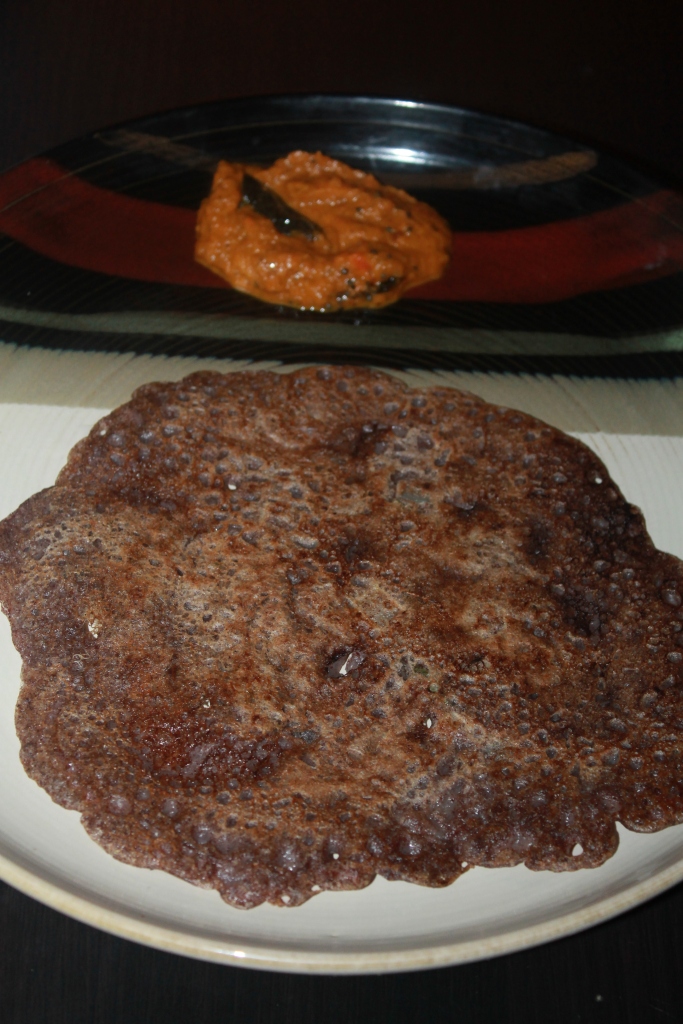
I was introduced to the ragi dosa in the town of Kolar in Karnataka, India. Ragi and millet have gained a formidable reputation as miracle foods. The ragi dosa is darker in color than its rice cousin, thicker, and may be more filling. I really enjoy ragi dosas. These days I occasionally go to MTR[4] in downtown Kuala Lumpur to enjoy this treat. The MTR ragi dosa plate has two delectable pieces with a small dollop of clarified butter and two chutneys and sambar. Filling and nutritious!In KL, I usually ate dosas for breakfast at the Sai Canteen in the International Medical University. The dosas are crisp and go well with the freshly ground chutney. The Indian restaurants in Brickfields in downtown KL serve very good dosas. Saravana Bhavan, Adyar Ananda Bhavan, and Sangeeta are a few examples. There may be a shortage of servers and the dosas may not always reach you piping hot and ready to eat. Making and serving dosas is labour intensive.

In Mumbai, the Udupi restaurants usually serve good quality dosas and these restaurants have become synonymous with South Indian food. I recently had a Mysore dosa at the Ram Ashraya restaurant in Matunga Mumbai. The Mysore dosa has a spicy lining on the inside and is a delightful concept. The waiting lines were long, and the restaurant was old-fashioned. I felt distinctly uncomfortable. The dosa however was delicious.

Pesarattu is a dosa mainly from Andhra and Telugu-speaking areas of south India made of green gram, ginger, cumin, and chillies. I was first introduced to this delight during lunch at PSGFAIMER, Coimbatore. Each afternoon there were specialties from a particular South Indian state. In KL, I can taste pesarattu at the Green Chillies restaurant near my apartment.

The accompaniments play a huge role in enhancing the taste of the dosa. A perfect sambar with drumstick and other vegetables, different types of chutneys, chamandi (a thick condiment made from chillies, coconut, ginger and a variety of other ingredients) and idli powder (termed gun powder). Chutneys can be made from red chilies, green chillies, and mint. There is also a gunpowder dosa, where a paste of gunpowder is smeared on the inner side of the dosa like a Mysore dosa.  

Spanish Masala movie poster

I remember watching the dosa-making skills of the actor, Dileep, in the Malayalam film Spanish Masala. Dileep was an illegal immigrant in Spain and invents a new filling for the dosa and names the dosa Spanish Masala. With a dosa batter, a hot griddle, cooking oil, clarified butter and passion you can create magic in the form of a rich, thin, crackling dosa. In many ways, the dosa is as adaptable as a pizza. Various fillings and batter can be used, and the dish can be adapted for various tastes. However, maintaining a dosa piping hot may be more challenging, which may account for its lesser popularity as a takeout item. I may have tasted perfection in a dosa only around twenty times in my life. Often, the dosa was not crisp enough, was not served at the optimum temperature, the accompaniments were not of good quality, or the place was too crowded. I often dream of the perfect dosa, thin, crisp, dark brown, and piping hot, just waiting to melt in the mouth!    

.

[1] Tulu word for water

[2] Foundation for Advancement of International Medical Education and Research

[3] PS Govindswamy

[4] Mavalli Tiffin Rooms, a restaurant chain started in 1942

Dr. P Ravi Shankar is a faculty member at the IMU Centre for Education (ICE), International Medical University, Kuala Lumpur, Malaysia. He enjoys traveling and is a creative writer and photographer.

.

PLEASE NOTE: ARTICLES CAN ONLY BE REPRODUCED IN OTHER SITES WITH DUE ACKNOWLEDGEMENT TO BORDERLESS JOURNAL

Click here to access the Borderless anthology, Monalisa No Longer Smiles

Click here to access Monalisa No Longer Smiles on Kindle Amazon International