Categories
Tribute

The Voice that Sings Hope through Suffering…

By Rakibul Hasan Khan

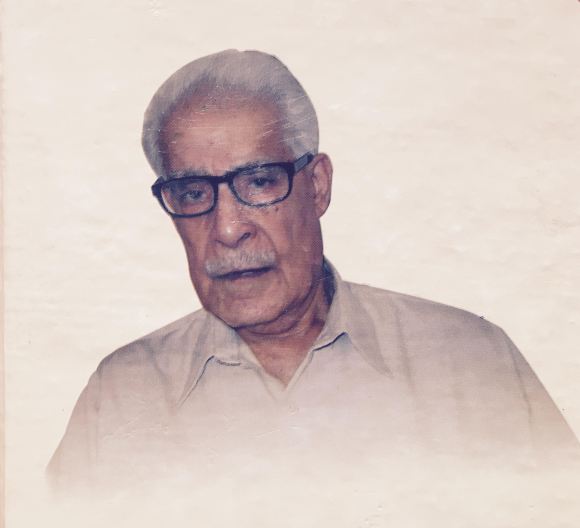
Hasan Azizul Huq. Photo Courtesy: Rakibul Hasan Khan

Hasan Azizul Huq (1939-2021), one of the leading Bangladeshi writers, passed away on 15 November 2021, leaving behind him an exceptional body of works. He was mainly a short story writer, but he also wrote three novels and many essays. His first book, Samudrer Swapna (Dream of the Ocean), Shiter Aranya (Winter Garden) a collection of short stories, was published in 1964. Each volume he published since then contributed to cementing his position as one of the most powerful writers of Bangla literature. Therefore, he is supposed to be remembered for long, at least as long as there will be those who care about the lives of the people whose stories he wrote. I wish I could say that he will be always remembered. I sincerely wish that, but the grim reality is that the number of those who care about the lives of the people whose stories he narrated is disconcertingly decreasing. Whose stories did he narrate? Simply put, he wrote the stories of suffering humanity – the oppressed, people at the margins, the outcasts, and most prominently, the victims of the Partition of India.

Huq was not a popular writer in the typical sense; rather, I would say that he was one of the most “unpopular” writers of Bangla literature. This statement may sound outrageous to those who hold him dear to their hearts for the irresistible attraction of his writings, but I consider them the most endangered species as readers, precariously hanging on the verge of extinction. My premonition is that Huq will be mostly forgotten within a not-so-long-time because there will be very few readers left worthy of his works.

On the other hand, the type of society we are heading towards will consciously and cunningly make him irrelevant, and this process has already started. Huq will soon be considered as a dangerous writer, neither because he is extremely revolutionary nor because he is uncompromisingly rebellious, but because his writings make people think, and thinking is a very dangerous activity. Thinking people are considered dangerous for social harmony and progress, and in future they will be treated as criminals. Even so, there will be some such criminals who will try to read him, but ultimately they will throw his books away with utter disgust and horror because his writings, be it a short story, a novel, or an essay, will inevitably fill their minds with profound shame and guilt for being complicit in perpetuating the suffering of those whose stories he wrote. Since hypocritical and insensitive readers will not be able to read him, gradually his works will lose readership in the days to come.

I can imagine how disbelievingly and contemptuously such a dark vision of the future will be received by Huq’s present readers, admirers, and family members. Huq himself would definitely disagree with me, for he had faith in people and their indomitable spirit as we can see it in so many of his characters, perhaps most notably in the character of the old woman in Agunpakhi (Firebird). But I am very optimistic about my pessimism, and think that such a dispassionately passionate writer like Huq will hardly find any reader in future. Some of his works, of course, will be read, especially those which have already got “classic” status in Bangla literature, but his overall readership will be miserably poor contrasting with his greatness. The smart generation of the smart age will spend their time smartly on their smartphones, smart TVs, smart cards, and all the other smart things that the world has to offer them, rather than troubling themselves with the works of a writer who is not that smart. They will hardly find any interest and time to read an “unsmart” and “unpleasant” writer like Huq.

Huq is in his distinct way a truly unpleasant writer, and he never tried to please anybody by his writing, neither readers nor the people in power. This quality makes him different from many writers. Another reason of his unpopularity is his persistence in using Partition as a recurring theme. Probably this particular feature of his works draws more attention in West Bengal than in Bangladesh, for partition is largely a subject matter of distant past for most Bangladeshis, grossly overshadowed by the more recent memories of the liberation war in 1971.

The oppressive rule of Pakistan period from 1947 to 1971 and the struggle for national liberation of the then East Pakistanis resulted in the general amnesia of Partition memories for the post-liberation generation. This is why, many of Huq’s readers, especially those who are a product of the de-historicising process that dominates our culture and curriculum, struggle to connect with his themes. The paradox that pervades the national imagination of the Bangladeshis in general is that they imagine Partition as a distant and altogether different phenomenon residing outside of their “national” issues. Against this backdrop of the general amnesia of Partition memories, Huq’s writings on the theme are like slaps of words to recuperate a recall of the bitter past. And who likes to be slapped?

Yet, there are those who know how overwhelmingly enchanting Huq’s writings are, and they can derive pleasure from the “unpleasant”. Probably here lies the hope. The future of Huq’s readership may not be so bleak after all! However, the opposite of what I feared will not happen automatically, unless some conscious effort is made by those who really care about his works. We should bear in mind that Huq is a type of writer who “educates” his readers in the process of reading him. So, if a reader can overcome the primary challenge of dealing with his unique style of writing and his “weighty” subject matters, they will eventually emerge as a competent reader to relish his works. Therefore, it is important to create an atmosphere that general readers might become more interested in reading his works.

To this end, it is immensely important to create a culture of critical engagement with the works of Huq. Academics and literary critics are the first who should come forward to invest their time on his works and communicate their readings with general readers. Along with them, translators are those magicians who can really give an appropriate afterlife to his works. To prove ourselves worthy of what he has left behind for us, we need to read him, remember him, and try as far as possible to establish an egalitarian and happy society he envisioned through his works.

(First Published in Countercurrents.org)

Rakibul Hasan Khan is a PhD candidate in the Department of English and Linguistics at the University of Otago, New Zealand. He can be reached at rakib.hasan82@gmail.com.

.

PLEASE NOTE: ARTICLES CAN ONLY BE REPRODUCED IN OTHER SITES WITH DUE ACKNOWLEDGEMENT TO BORDERLESS JOURNAL

Categories
Interview

In Conversation with Akbar Barakzai, a ‘Part-time Poet’ in Exile

Who can snuff out the sun? 
Who can suppress the light?
-- Akbar Barakzai, Who Can Snuff Out the Sun

Akbar Barakzai (1939-2022)

His poetry rings with the spaces between mountains. It rushes like the wind of freedom, taking you to the heart of the land and people he writes about.  

Balochistan has a bit of the blood and bones of many cultures and people through the ages – dating back to Harappa and Indus Valley civilisations. Akbar Barakzai, the Baloch poet and activist, writes about transcending the suffering that exudes from hurts inflicted on humankind. He urges the masses to voice out against oppression.

Don’t ever bury the word 
In the depth of your chest 
Rather express the word 
Yes, speak it out. 
The Word brings forth 
Freedom and providence.
--Akbar Barakzai, The Word

He writes for freedom from injustices and lives by his beliefs and principles. Having been forced to move countries to run journals, he is an immigrant in quest of a future that will unite the East and the West. Gently opposing oppressors with his writing, beliefs and ideas, Barakzai made news when he turned down the Pakistan Academy of Literature award last year because he says; “The Pakistan Academy of Literature is sponsored by the Islamabad rulers. I cannot accept an award from an organisation that operates at the beck and call of the tormentors of my people.”  A writer who continues to emote for his people and their rights, he has been translated to English by a lecturer, Fazal Baloch, and published. 

Barakzai calls himself “a part time poet” – but his poetry moves our hearts and minds – it makes us think, imagine a better world. Is he really a part time poet or a major inspiration crying out for mankind to move out of ‘messiahdom’, dogmatism and take charge of their own lives? In this interview, Barakzai not only reveals his life but also his sense of freedom from oppression, his love of human rights which forced him to move countries to conserve the voice of his people.

Since when have you been writing poetry? What set your muse going?

I started writing poetry in 1954 when I was still in school. I was inspired by our people’s long struggle for freedom and justice against the Pakistani and Iranian occupiers.

Your poetry mixes many strands of thoughts and many lores. Can you tell us what influences your writing? Books, music, writers?  

My writing has been influenced by many poets and writers from different languages and cultures. The lasting influence on my art has been that of classical Balochi poetry. However, I must mention some great names from diverse poetic traditions who have had an impact on my poetry, such as the Persian poets Hafiz, Rumi and Nima Yushij; Urdu poets Ghalib and Mir; English poets Shelley and Keats; Russian poets Pushkin and Pasternak and the Chilean poet Pablo Neruda.

Your poem ‘Waiting for Godot’ depicts the theme of the play by Samuel Beckett. It has a beautiful mingling of East and West. What led to it?

Beckett’s Godot is perhaps the most mysterious character in modern (world) literature. My poem is a reminder that the so-called Messiahs never return to this world. Mankind has to find its own solutions. East and West are two different aspects of the same coin. Unlike the infamous poem by Rudyard Kipling, that great apologist of Western imperialism, the East and the West are slowly but steadily inching towards each other. Despite enormous odds “the twain” are destined to “meet” and be united to get rid of the geographical lines created by imperialist powers.

You deal with both the political and the spiritual in your poetry. How do you attune Che Guevara with the God who even if ruthless exists in your poetry?  

I made peace with God quite some time ago. I hope we understand each other better now. I do not believe that God is necessarily ruthless. It may sound strange, but my spirituality is not religious at all, it is based on humanism.  Your interpretation of my poem is different from what I had intended. I am not sure if such a dichotomy exists in the poem. However, it appears that poetic curiosity in the end has succeeded in detecting some kind of duality. With regard to Che, he symbolizes the primordial fighter for justice. He embodies all those millions of people who have fought against the forces of darkness. Hence the allusion to Phoebus Apollo and the ever-conquering brilliance of the sun.

Do you write only in Balochi? You must be fluent in English having lived in England for many years. Why do you not write in English? Or translate your own poems?  

I used to write in Urdu and Persian in my younger years, until I discovered that I could write a lot better in my mother tongue.  As far as writing in English is concerned, I do not feel confident enough to write in it.

Your poetry, the little I have read, takes on elemental truths and uses nature, intermingles those to arrive at larger truths toward the end. Is it all spontaneously expressed? Or do you need to work on it? Tell us a bit about your poetic process.  

My experience of the poetic process tells me that it is spontaneous. Design and architecture of the poem occupy a secondary position. After a poem is formed in my mind my main concern would then be to revise and improve its language. This process may take any length of time. I must confess that I am an obsessive reviser. For example, one of my longer poems took many long years to complete.

As a poet, you continue shrouded in mystery. Tell us about your life.  

My life is and has always been an open book. I don’t think a few random poems are sufficient to reveal the life story of any poet. However, without these fistful of poems, I would have appeared to be a greater mystery. My life, like the billions of ordinary people in this world, is indeed very ordinary. My great grandfather migrated from Western (Iranian) Balochistan as a result of the brutal military operations in the early twentieth century in which thousands of old men, women and children were killed and injured and thousands of others migrated to Sindh. My great grandfather was a small-time farmer. As a result of the Iranian atrocities, he was forced to abandon his land and livestock and move to Eastern (now Pakistani) Balochistan and finally to Sindh. In 1928, Reza Shah of Iran ultimately succeeded in occupying our country. Once they settled in Sindh my great grandfather and grandfather worked as labourers until they saved enough to buy a small shop.      

My father had a basic English education. He had left high school when still in the 4th or 5th grade to support the family with odd jobs. A few years later, he opened his own shop, a ration shop. These shops had mushroomed all over during the war as the English authorities introduced a food rationing system in India. I believe with this background I must have belonged to the lowest rungs of the class system. But my family worked hard to improve their lot.

When I was ten or twelve, my father thought I was strong enough and responsible enough to work in the shop. I would go to school in the morning. As soon as I finished school, I would rush to the shop to help my father. 

A few years before I finished high school, my father got a job in the Directorate of Civil Supplies as the manager of a warehouse. He rented out the shop. With two incomes our lot did improve a little. I was now in high school. I didn’t have to work in the shop anymore. During this period, I became interested in books – any books. These were mainly Urdu, Persian, Sindhi and Balochi books. I read a lot, but my reading wasn’t systematic. I wrote a few nondescript poems during this period and became interested in politics, particularly in Baloch politics. By then I was in college reading literature and related subjects. However, I was more interested in politics than in my studies which meant I wasn’t a good student. Despite this I somehow managed to graduate from Karachi University. My father wanted me to study further and enter the Civil Service. But by then I was completely radicalised. I think I disappointed him then by refusing to continue my studies in order to take competitive exams to join the civil service. However, a few years later as a result of the escalating Pakistani military operations in Balochistan, he told me that although at the time he was not happy with my refusal, he confessed wholeheartedly that my decision was absolutely right. I was so proud of him that he had finally approved of my decision. Although he passed away a long time ago, because of this confession I do love him and miss him more.  

This rather lengthy snapshot of my life should be sufficient to explain why my poetry is expressly concerned with social and political issues.

What led to your move to England?  

This was the busiest period of my political activism. It was the time when General Ayub Khan had imposed Martial Law in Pakistan and was trying to consolidate his rule by hook or by crook. In Balochistan he had re-ordered the military to crush the Baloch resistance once and for all. But the resistance has outlived Ayub Khan, and his military might. It has grown stronger and stronger with the passage of time albeit with huge sacrifices sustained by ordinary people. The rulers treated the Baloch people like dirt and our leaders as traitors who “deserved” to be hanged. By 1965, the military government stepped up its operations in cities and towns, especially in Karachi where the Baloch formed a sizable minority and naturally supported the struggle for freedom. By this time the majority of our leaders were imprisoned in various Pakistani jails. Hundreds of young activists were also put behind bars. I was constantly harassed by the secret police. They raided my house three times and confiscated all my books and papers. These included some precious manuscripts left by a maternal uncle of mine. I was told that they would be returned “in due course”, but I never saw them again. 

In those days, at least in the big cities, the government showed that they believed in the legal system. However, things would soon change. They started arresting people at will, without producing them in a court of law. People would languish in prisons for many years without any charges brought against them. They kept on introducing new forms of brutality, including bombing the population and “disappearing” activists and ordinary people. Under their “kill and dump” policy, they to this day torture and kill activists and then dump their bodies in the periphery of a town or village. So far, they have “disappeared” about 5,000 activists and their family members. Recently they have started abducting young female activists and then dumping their bodies. Almost all of these victims have been assaulted and raped.   

I was picked up twice by the secret police. The second time they brought the great poet Gul Khan Naseer (the Baloch Nazrul) from prison. We were both delighted to see each other. We hugged and exchanged greetings in Balochi. We were told firmly not to speak in Balochi. We protested at this suggestion. Without reacting, they started the interrogation which took about three or four hours. Naseer was taken back to prison. I was told to go home but be prepared for further sessions.

I was advised by our leadership to go underground and eventually leave the country and head for the Gulf region to organise the Baloch migrants working in that part of the world. I did exactly as I was instructed to do. Because of visa problems, I could not stay in the Gulf for long. I therefore moved to Syria, Lebanon and finally to Iraq where in 1973-74, I was joined by some other friends. Together we used to edit a monthly newspaper in Balochi called Tipaakie Raah (Path of Unity). In fact, this used to be the Balochi edition of the paper which was also published in Arabic, Persian, Azari (Azarbaijani) and Kurdish editions. We also managed a daily radio programme in Balochi. Additionally, we published a monthly newspaper in English from London which was called People’s Front. This task was assigned to a senior friend who moved from Baghdad to London for this purpose. Our stay in Iraq would soon be short lived. After Saddam Hussain and the Shah of Iran met in North Africa to end the dispute over Shatt al Arab waterway, the situation in Iraq changed drastically. We were told very politely that the “world situation” had changed. We would still be welcome to live in Iraq, but the publication of the newspaper and the radio broadcasts must stop. It was therefore decided I should move to London. With the help of a doctor friend, I obtained a British visa and moved to London.

Your poetry still cries out for your motherland. Do you want to return? Is a return possible?

Who wouldn’t want to go back to the country they love? But it is not possible. I am only tolerated if I keep silent and remain as far away from Balochistan as possible.

Why did you turn down the Pakistan Academy of Literature award?  

The Pakistan Academy of Literature is sponsored by the Islamabad rulers. I cannot accept an award from an organisation that operates at the beck and call of the tormentors of my people.    

You have published very selectively — do you have more writing which you have not published? If so, do you have plans to publish those?

I have never been a prolific writer or a poet. I keep on telling people that I am a part-time poet.

What message would you like to give to emerging writers?

As a part-time poet I don’t feel I am in a position to advise young writers. I can only say this much to them — be honest to yourselves and your art.   

Thank you very much for giving us your time.

Click here to read translated poetry by Akbar Barakzai.

(This is an online interview conducted by Mitali Chakravarty.)

PLEASE NOTE: ARTICLES CAN ONLY BE REPRODUCED IN OTHER SITES WITH DUE ACKNOWLEDGEMENT TO BORDERLESS JOURNAL

Categories
Interview Review

Unveiling Afghanistan: In Conversation with Nazes Afroz

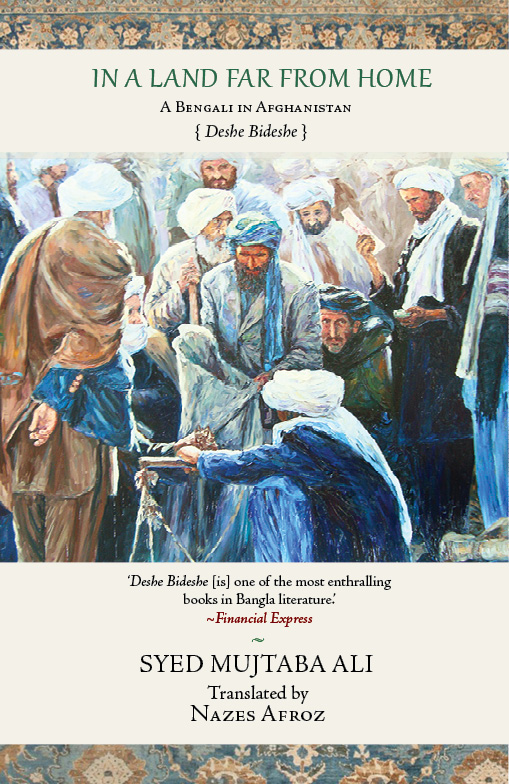
 Cry, My Beloved Country (1948) reflected the plight of Africans and the deep divides that created schisms between different groups in South Africa. The book won the author, Alan Paton, a Nobel prize. Another remarkable book that was published in the same year was a non-fiction written by a student of Tagore called Syed Mujtaba Ali. Mujtaba Ali wrote Deshe Bideshe in Bengali. This has been translated in recent times by the former BBC editor, Nazes Afroz, as In a Land Far from Home: A Bengali in Afghanistan. It is an outstanding memoir that demystifies and explains what led to the issues that are being faced by a country repeatedly jostled by varied regimes, a country that seems to be so steeped in problems that worrying about the pandemic remains a far cry for the common inhabitants.

For many decades this book had been feted by only a small group of readers, though the book is no lesser than Paton’s in crying out against injustices, terrors of violence and starvation, because it was written in Bengali. It was so witty and flavourful that people were afraid to translate it for the fear of losing the nuances of the original. As Afroz tells us in this interview, he had similar reservations. A book written by a scholar, it peppers history and political issues with lucidity and humour, making it an enjoyable experience for the lay reader. The author has a way of turning the mundane or intellectual into an amusing anecdote. During a conversation at an embassy party, the author through the voice of a fellow professor, makes a hilarious observation – but also, one that does convey much about Afghanistan despite its attempts at liberalisation.

Madame Vorvechievichi argued, ‘But there are mullahs in this country.’

“Dost Muhammad said reassuringly, ‘No need to worry, Madame. I know these mullahs very well. Their knowledge of religion is very little and I can teach you all of it in three days. However, a woman can’t be a mullah.’

Madame Vorvechievichi said angrily, ‘Why not?’

“With a deep sigh Dost Muhammad said, ‘Because she can’t grow a beard.’”

The book is speckled with multiple such instances. Along with these witticisms, the pathos of the country, the plight of the people is well captured by poignant observations:

“The real history of the country was buried beneath the soil, much like the way that Indian history was hidden in its Puranas, Mahabharata-Ramayana. Afghanistan is a poor country; Afghans do not have the time or the resources for archaeological excavations to write their own history.”

The writer, Syed Mujtaba Ali (1904-1974) a polyglot, scholar, traveller and humanitarian did just that – he recorded the history of the time he spent in Afghanistan, a time when a swift takeover from the liberal king Amanullah (1892-1960) was staged by Bacha-ye-Saqao (1891-1929) during the Afghan Civil War (1928-29).  Does this sound familiar, reminding one of the recent August 2021 takeover by Taliban?

A Humboldt scholar, Mujtaba Ali was conversant in fourteen languages, lived in five countries, including Afghanistan, where he had gone to teach. That his erudition never interfered but enhanced without marring the simplicity of rendition is what makes the book an attractive read for all lay persons. His astute observations are laced with wit and realism. The residue of the book lingers as the vibrant narrative flows — vicariously bringing to life, with humour and empathy, a culture that is distinct and yet warm in its uniqueness. His style is reflective of an in depth understanding of the situation and a sense of empathy for the common people with who he interacted daily – like his man Friday and the colleagues he mentions. For the author, everyone, from an uneducated villager to the crown prince (who invited him to play tennis), seemed to grow effortlessly into a rounded persona of a friend. All these have been transmitted by Afroz in the translation too. Translating two cultures across borders in a language that does not have all the words to capture the intimate nuances is not an easy feat, but it has fruited into an unusual and captivating read.

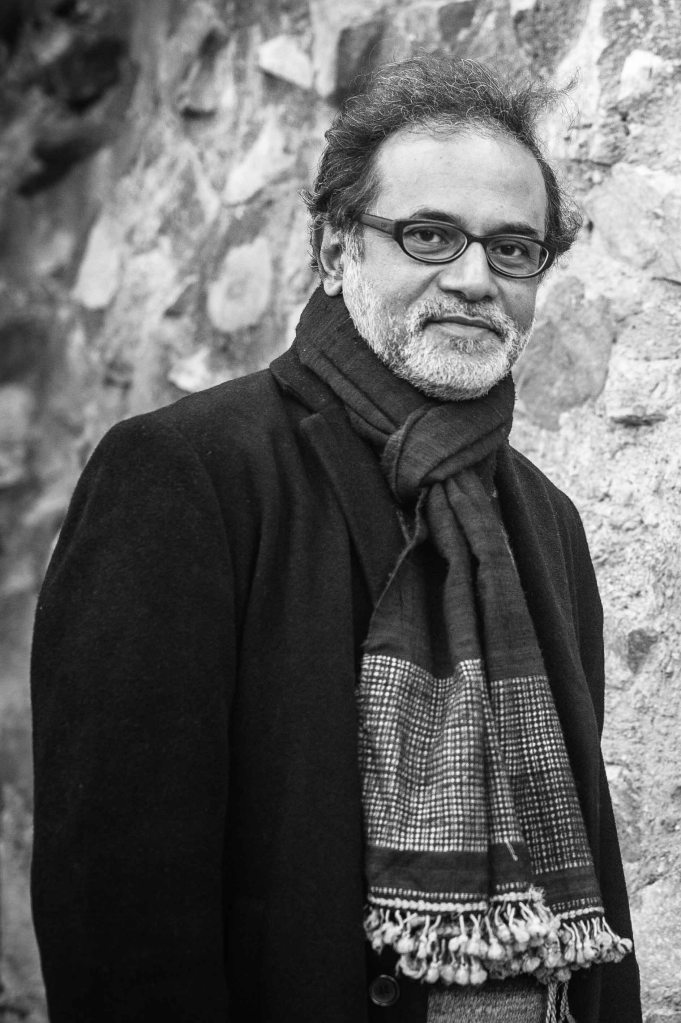
Nazes Afroz

Afroz’s maiden venture at translation was shortlisted for the Raymond Crossword Book Award. Afroz himself has spent a long stretch of time in Afghanistan. He joined the BBC in London in 1998. He was a senior editor in charge of South and Central Asia for a number of years. He has visited Afghanistan, Central Asia and West Asia regularly for over a decade. In 2013, he moved back to India. A passionate photographer, he writes in English and Bengali for various newspapers and magazines. In recent articles, he has been voicing his own concerns about developments in Afghanistan. In this interview, he reflects on what led him to translate the book, the situation as it was then and as it is now.  He dwells not only on the historic civil war as captured in the book but also on current day politics and the Taliban takeover.

You are a journalist. What got you interested in translating a Bengali classic from the last century?

I became a journalist five years after I read Deshe Bideshe. I was still a teenager when I picked up the book from a library rack. Reading Mujtaba Ali at that age had a profound impact on me. The erudition, the smooth sailing between multitude of cultures and languages, the gripping storytelling in his writing mesmerised me. I had never read anything like that in Bangla. Every Bengali reader of Syed Mujtaba Ali had felt the same way as I did. As a child I had the uncontrollable urge for travels and seeing the world. In Mujtaba Ali I found a role model. Deshe Bideshe stayed with me since then. It was one book that I would read two to three times a year from my teenage. So, by the time I decided to translate Deshe Bideshe more than thirty years after I first laid my hands on the book, I had read it for more than a hundred times! I knew its each page, I knew its each story and Afghanistan had seeped inside me permanently as I could relate to all the characters of the book.

While working for the BBC World Service in London, I had the opportunity to go to Afghanistan in 2002 soon after the Taliban were dislodged from power in a short war towards the end of 2001. I visited the country a number of the times in the following few years. As I travelled more, I befriended my BBC colleagues there and met other journalists and people on various walks of life. Some of them became good friends as well. I used to refer to events from the times of King Amanullah while discussing Afghanistan. They were surprised to hear all the details that I mentioned from a time that they said, ‘Even we don’t know!’ So, I mentioned how a Bengali scholar came from Kolkata to Kabul in 1927 and taught here, was a participant of the modernisation project of Amanullah by teaching English and French, played tennis with the crown prince Inyatullah (1888-1946) became an eyewitness of the rebellion against the king, got caught in the anarchy in the winters of 1928-29, and nearly perished starving before managing to go back to India. Hearing my story, they asked if there was any English translation of the book as they were keen to read. I told them that there was none as it was untranslatable!

As years went by and more and more of my Afghan friends got to know about Deshe Bideshe, they demanded that I did the translation. But I had my doubts. Would I be able to capture Mujtaba Ali’s unique language? Would I be able to transpose his wicked sense of humour? Would I be able to convey his erudition?

Eventually in 2011, I had already made up my mind to quit the BBC and move back to India. At that point my day-to-day workload in the BBC was significantly reduced. As I had ample time in hand, I thought I would attempt the translation. At that point I didn’t think of any publication; I wanted to do it just for fun and for my Afghan and non-Afghan friends who knew about the book and were keen to read it. I thought I would give them a taste of Mujtaba Ali’s writing by doing a few chapters. So, I did the first few chapters and shared them with a few friends. After reading those chapters they wanted to read more. I felt encouraged and I carried on with the translation for the following few months. Eventually the whole book was complete in about a year. After completing the translation, I let it sit for a few months before picking it up again and reread it as new text without looking at the original text. That exercise went on several times over the following one year till the final manuscript shaped up.

How many countries have you worked from? You were also in Afghanistan for several years I believe. Can you share your experiences?

My work has taken me to a dozen country or so. But as an intrepid traveller, I have visited more than 40 countries so far across four continents. Apart from my regular visits to Afghanistan, I spent months at a stretch on several occasions. Working in Afghanistan was certainly a unique experience. It wasn’t a country where one could travel and roam around freely. There were always the security alerts. One needed to negotiate security barriers everywhere. The accommodations – hotels, guesthouses were guarded by armed men. In the early years – in 2002 to 2004, there weren’t so much security in the hotels or guesthouses we stayed in. But that started to change from 2010 onwards as the Taliban had at that time started to regroup, and they made their presence felt in the country and in Kabul. Even at that time, cities like Mazar-e-Sharif and Herat were considered lot safer than Kabul. With increased and unpredictable attacks by the Taliban, the country became more and more edgy.

What was it about the book that drew you to it?

As I mentioned earlier, the uniqueness of Mujtaba Ali was that his erudition wasn’t frightening. He penned Deshe Bideshe almost twenty years after he left Kabul. By then, he had completed his PhD in comparative religion from Germany as a Humboldt scholar, did his post-doctoral research from al-Azhar university in Cairo, learned more than a dozen languages, and travelled extensively in Europe. So, even though his narrative of Afghanistan was drawn from what he had witnessed in his mid-twenties while teaching there, when he decided to write the book, he had acquired profound knowledge in philosophy, literature, culture and history of the world in many languages. The multilingual and multicultural references with an oblique yet gripping story-telling style infused with a wicked sense of humour that came in his writing, had been drawing ardent followers, including me, since 1948 when Deshe Bideshe was first published.

The book highlighted a growing divide between the minority with liberal education and the majority without education. Is that true still? Would you call the book relevant to the present-day crisis?

Yes, that divide between the educated and the not educated that Mujtaba Ali elicited in Deshe Bideshe is still there. But the gap has certainly reduced. The years between 1929 to 1978 had been relatively stable and peaceful in Afghanistan. Modern education had spread but without giving a jolt to the conservative society and keeping the clergy more or less content. In Kabul and other major cities, girls and women were getting more and more education; they were also seen in public life more. Following the coup through which the communists – the People’s Democratic Party of Afghanistan or PDPA came to power in 1978, there was a big push for universal education. This created a much bigger educated class. Women were the biggest beneficiary of that time in terms of acquiring knowledge and finding jobs. Women were joining the police and military as well. Following the capitulation of the PDPA government in 1992, the modern education system collapsed during the Mujahideen civil war years until 1996 and then after the takeover of virtually the whole of the country by the Taliban.

A large number of Afghans – almost a quarter of the population became refugees in neighbouring countries or elsewhere. When the American led international forces ousted the Taliban from power in 2001 following the 9/11 attacks in the USA, the population got a fresh chance to get education. Schools opened again. Both girls and boys went back to school. Internationally there were many programmes to give scholarships to Afghan women and men who were seeking higher education. As a country with a very young population (the average age of Afghanis is 18), a large number of students joined the public and private universities. So, tens of thousands of young women and men are now educated holding masters or even PhD degrees in the country. But the rural areas lagged behind. So, the gap is more of the city and rural areas.

Do you find similarities between the Afghanistan of then and of now?

The way the Afghan society works, based on its ethnic and tribal identities as witnessed by Mujtaba Ali, still exist. The stranglehold that the clergy had on the uneducated mass about a century ago has possibly changed; it’s been replaced with more political interpretation of their religion. The ethnic divisions have sharpened for multitude reasons – primarily due to the outside interference and the way ethnic groups have been used in the larger geo-political game of the world powers.

One of the issues that tussles through the book is that people were basically poor and lacked education. Syed Mustaba Ali spoke of the vicious cycles of poverty, how much has it changed from what he wrote and what you experienced? Please elaborate.

Mujtaba Ali talked about how poverty contributed to the cycle of unrest in Afghan history. Yes, that poverty still exists but with that, a toxic potion of religio-politics has been added to the cauldron. The conflict of the past four decades is more due to the global religio-political dynamics rather that its own poverty.

Did/ do you find parallels in the political situation where Amanullah and his brother escaped from the invading hardliner, Bacha-ye-Saqao? Would you see Bacha as a precursor of Taliban?

The only parallel that one can draw between 1929 when Amanullah and his brother Inayetullah fled and now in 2021 is that the suddenness of the events. Amanullah’s fall happened in months and Bacha took over Kabul in matter of days – almost the same way the Taliban took control of the country.

I don’t think Bacha-ye-Saqao or Habibullah Kalakani as he called himself, was a precursor of the Taliban. Bacha was more of an opportunist; he grabbed the opportunity that came his way. But the Taliban are more of an organised religio-political force what was the product of the geo-politics of the last decade of the Cold War. So, they two are not comparable.

Did the American or Russian intrusions into Afghanistan serve any purpose? Did they actually help the Afghans?

The short answer is no. Both the superpowers came to achieve their own strategic and foreign policy objectives. The Soviets came to expand their sphere of influence beyond their borders in Central Asia. In the process they were badly bruised and had to retreat. The Americans came to get hold of Osama-bin-Laden and dismantle the al-Qaeda infrastructure. It was never about helping a nation that had been devastated by decades of conflict in which they had no role. They just became pawns in the greater game of geopolitics.

By the descriptions in the book, Afghans seem to be fairly open as humans and yet, they have a distinct identity borne of their culture, their ethos — very different from any other. Was that undermined in any way by the attempts at modernisation?

Like many other rural, traditional and old societies, Afghans are hospitable and warm people. They are bound and governed by their age-old custom and codes of conduct.

Even when they are outside of their own land – in the West too, they extend their hospitality to strangers the same way they would in their own country and their behaviour would not differ much. It is not the question, if modernisation has or will undermine their tradition. They have had encounters with modernisation – the way modernisation is understood from the Western prism. Did that change the people who had experienced that modernisation in the time of Amanullah? Mujtaba Ali saw that the ‘so called’ modern people did not lose their Afghan-ness. The same can be said now. As a people they have largely remained unchanged despite connecting with the outside world like never before.

In the book, the international community was practically chased off Afghanistan. As the US troops left, one felt the same way. Do you feel intervention from the international community is necessary in Afghanistan? Why?

The backdrops of 1929 and the present are not identical. In 1929, the rebellion was against the king who had lost the support of the clergy. The king did not come to power with foreign intervention. So, the international community was not chased out in 1929. The Europeans left because of the chaos and the violence. The rebels didn’t fight with the foreigners. Yes, there was an armed opposition to the presence of the USA since the war in 2001, but that opposition wasn’t big enough to send the USA packing.

The USA left because they had achieved their goals in Afghanistan, and it was becoming hugely expensive for them to stay on. Many are also drawing parallels of the US’s departure from Afghanistan with their hasty retreat from Vietnam in 1975. But they were again not identical. In Vietnam, the USA visibly lost the war. But in Afghanistan they did not lose. They could have stayed on if they wanted but it made no sense to them to spend tens of billions of dollars each year. Hence, they left. They had been talking about withdrawing from Afghanistan since 2012, a year after they killed Osama bin Laden in Pakistan.

The intervention that the Afghans had been experiencing since 1979 – first by the Soviets, then Pakistan and finally the US led Western nations, devastated the country and the ordinary Afghans had been paying for it with all they had. No external intervention is beneficial for any country. It’s not desirable to have; certainly not the way the global powers had been intervening for the past 40 odd years in various corners of the world. But the question is, if unspeakable atrocities are committed on certain sections of a country or society, what does the international community do? Should the international community intervene? The world powers have unfortunately always used these as pretexts to intervene to further and achieve their own objectives not only in Afghanistan but in other countries too.

In the book, only foreigners with work seemed to be in Afghanistan. Is/ Was it possible for tourists to visit Afghanistan, even before the Taliban took over?

In the last twenty years, Afghanistan had been unstable. Violent incidents kept happening. So, it was not advisable for tourist to go there. But the country always issued tourist visa for short visits! For a few years, Japanese tourist used to come to visit the ancient Buddhist sites like Bamiyan. That too waned due to the escalating conflict.

Thank you for this wonderful interview and also for the flawless translation of a classic memoir.

Click here to read a book excerpt from In a Land Far from Home: A Bengali in Afghanistan.

(This is an online interview/review by Mitali Chakravarty.)

PLEASE NOTE: ARTICLES CAN ONLY BE REPRODUCED IN OTHER SITES WITH DUE ACKNOWLEDGEMENT TO BORDERLESS JOURNAL

Categories
Independence Day

Born Free

Born free
As free as the wind blows
As free as the grass grows
Born free to follow your heart
-- Born Free by Andy Williams

These are lines from a song by Andy Williams, a pop icon whose song was the theme song in Born Free, a film made in 1966 about a lion cub bred in captivity, who had to be trained to live free even though she was born free. Does that apply to all living creatures, including humans? What is freedom? And who is free? Does political independence mean ultimate freedom?

We celebrate political ‘freedom’ of countries as national or independence days. Sometimes, as in the case of India and Pakistan, independent nationhood can be laced with bloodshed and grief . Two new countries were born of a single colonial India in the August of 1947. Pakistan awoke as a country on the midnight of 14th August and India called the late hour 15th August. Nehru’s speech has become an iconic one: “Long years ago we made a tryst with destiny, and now the time comes when we shall redeem our pledge… At the stroke of the midnight hour, when the world sleeps, India will awake to life and freedom…”

Common people while crossing the boundary line between the two new nations lost their lives, homes and lands over the mob violence. The resentment still simmers in a few hearts. In an attempt to find peace and amity, we have put forward a combined selection of writing from across borders, words devoid of angst or hate, words that look for commonality and harmony.

Interview

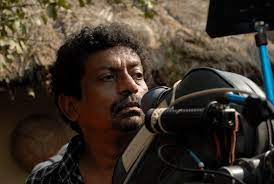
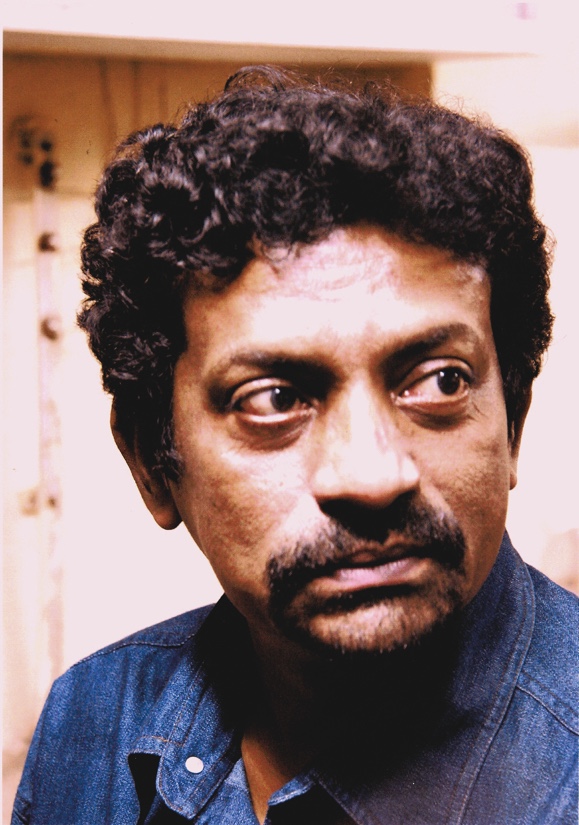
Goutam Ghose. Courtesy: Creative Commons

In Conversation with Goutam Ghose, multiple award-winning filmmaker, writer, actor discusses his films, film-books and journey as a humanitarian artiste who makes cross cultural films across all boundaries. Click here to read.

Poetry

Akbar Barkzai’s Songs of Freedom translated from Balochi by Fazal Baloch. Click here to read.

Poems by Jaydeep Sarangi: Click here to read

For Danish Siddiqui by Sutputra Radheye: Click here to read.

The Equalizer by Nazrul translated from Bengali to English by Shahriyer Hossain Shetu from Sammyabadi. Click here to read.

Deliverance by Tagore translated from Bengali to English from Tran (Sanchayita). Click here to read.

Non-Fiction

In The Idea of India: Bharata Bhagya Bidhata – The Making of a Motherland Anasuya Bhar explores the history around the National Anthem of India which started as a song, composed by Tagore. Only the first paragraph of the whole song in Bengali was adapted as the National Anthem. We include the translations of the complete song both by Tagore and by Aruna Chakravarti. Click here to read.

In An August Account of ‘Quit India’ Movement Ratnottama Sengupta,  translates from Bengali the excerpts recorded by Sandhya Sinha (1928-2016), who witnessed an upsurge in the wake of the Quit India Movement. Click here to read.

Temples & Mosques by Nazrul has been translated by Sohana Manzoor. Click here to read.

In Seventy-four Years After Independence…“Mil ke rahe gi Azadi” (We will get our Freedom), Aysha Baqir muses on Pakistani women’s role in the independence movement and their current state. Click here to read.

 In 2147 without Borders, Devraj Singh Kalsi meanders over Partitions, borders and love stories and looks for an amicable solution in a happier future. Click here to read.

Fiction

Bundu, Consoler of the Rich is a story based on memories of Partition by Nadir Ali, translated from Punjabi by Amna Ali. Click here to read.

In The Best Word, Maliha Iqbal explores the impact of wars in a spine chilling narrative, journeying through a range of emotions. Click here to read.

In Do Not Go!, Moazzam Sheikh explores dementia, giving us a glimpse of the lives of Asian immigrants in America. Click here to read.

In The Chained Man Who Wished to be Free, Sunil Sharma explores freedom and democracy versus conventions. We are left wondering is this the freedom we fought for? Click here to read. 

Categories
Editorial

Triumph of the Human Spirit

On August 8th 2021, the chief of the International Olympic Committee, Thomas Bach, pointed out during the closing ceremony that these games were “unprecedented” and brought messages of “hope, solidarity and peace” into a world torn with the desolation generated by the pandemic. It was a victory of the human spirit again, a precursor of what is to come. That the Japanese could get over their pandemic wrought hurdles, just as they did post the nuclear disasters wrought by the Second World War and by the 2011 earthquake-tsunami at Fukushimaya, to host something as spectacular and inspiring as these international games reflects, as the commentators contended, a spirit of ‘harmony and humility’. The last song performed by many youngsters seemed to dwell on stars in the sky — not only were the athletes and organisers the stars but this also reminded of unexplored frontiers that beckon mankind, the space.What a wonderful thing it was to see people give their best and unite under the banner of sports to bring messages of survival and glimpses of a future we can all share as human beings! Our way of doing things might have to evolve but we will always move forward as a species to thrive and expand beyond the known frontiers.

One such explorer of yet unknown frontiers who mingles the historic with the contemporary, Goutam Ghose, an award-winning filmmaker and writer, has honoured our pages with an extensive interview showing us how art and harmony can weave lores that can help mankind survive. This is reinforced by the other interview with Singaporean academic, Dr Kirpal Singh, whose poetry reflects his convictions of a better world. With our intelligence, we can redefine processes that hold us back and grind our spirits to dust — be it the conventional ‘isms’ or norms that restrict our movement forward – just as Tagore says in the poem, we have translated this time, ‘Deliverance’.

…On this auspicious dawn,
Let us hold our heads high in the infinite sky 
Amidst the light of bounteousness and the heady breeze of freedom.

As the Kobiguru mentioned earlier in the poem, the factors that oppress could be societal, political, or economic. Could they perhaps even be the fetters put on us by the prescribed preconceived definition of manmade concepts like ‘freedom’ itself? Freedom can be interpreted differently by multiple voices.

This month, on our pages, ‘freedom’ has found multiple interpretations in myriad of ways — each voice visualising a different dream; each dream adding value to the idea of human progress. We have discussions and stories on freedom from Nigeria, Argentina, India, Pakistan, Myanmar, Malaysia and more. Strangely enough, August holds multiple independence/ national days that are always for some reason seen as days of being ‘freed’ by many — at least from oppression. But is that true?

From Malaysia, Julian Matthews and Malachi Edwin Vethamani cry out against societal, religious and political bindings – quite a powerful outcry at that with a story and poems. Akbar Barakzai continues his quest with three poems around ideas of freedom translated from Balochi by Fazal Baloch. Jaydeep Sarangi and Joan Mcnerny pick up these reverberations of freedom, each defining it in different ways through poetry.

Jared Carter takes us back to his childhood with nostalgic verses. Ryan Quinn Flanagan, Michael Lee Johnson, Vandana Sharma and many more sing to us with their lines. Rhys Hughes has of course humour in verse that makes us smile as does Jay Nicholls who continues with her story-poems on Pirate Blacktarn – fabulous pieces all of them. The sport of hummingbirds and cats among jacaranda trees is caught in words and photographs by Penny Wilkes in her Nature’s Musings. A poetic tribute to Danish Siddiqui by young Sutputra Radheye rings with admiration for the Pulitzer prize-winning photographer who met his untimely end last month on 16th while at work in Afghanistan, covering a skirmish between Taliban and Afghanistan security forces. John Linwood Grant takes up interesting issues in his poetry which brings me back to ‘freedom’ from colonial regimes, perhaps one of the most popular themes for writers.

Indo-Pak independence, celebrated now on 14th (Pakistan) and 15th August (India), reflects not only the violence of the Partition which dislocated and killed millions historically but also the trauma caused by the event. Capturing this trauma is a short story based on memories of Partition by Nadir Ali, translated from Punjabi by his daughter, Amna Ali. Ratnottama Sengupta translates from the diary of Sandhya Sinha (1928-2016), a woman’s voice from the past that empathises with the subjugated who were subdued yet again after an upsurge of violence during the Quit India Movement (1942) against the colonials. Sinha contends that though the movement frittered away, the colonials were left with an after-taste of people hankering for self-rule. A thought-provoking short story by Sunil Sharma explores the results of self-rule in independent India.

Alluding to Jinnah’s vision for women, Aysha Baqir muses emotionally about the goals that remain yet to be fulfilled 74 years after independence. Moazzam Sheikh’s story of immigrants explores dementia, giving us a glimpse of the lives of Asian immigrants in America, immigrants who had to find a new home despite independence. Was this the freedom they dreamt of — all those who fought against various oppressive regimes or colonialism?

Tagore’s lyrics might procure a few ideas on freedom, especially in the song that India calls its National Anthem. Anasuya Bhar assays around the history that surrounds the National Anthem of India, composed by Tagore in Bengali and translated to English by the poet himself and more recently, only by Aruna Chakravarti. We also carry Dr Chakravarti’s translation of the National Anthem in the essay. Reflecting on the politics of Partition and romance is a lighter piece by Devraj Singh Kalsi which says much. ‘Dinos in France’ by Rhys Hughes and Neil Reddick’s ‘The Coupon’ have tongue-in-cheek humour from two sides of the Atlantic.

A coming-of-age story has been translated from Nepali by Mahesh Paudyal – a story by a popular author, Dev Kumari Thapa – our first Nepali prose piece.  We start a four-part travelogue by John Herlihy, a travel writer, on Myanmar, a country which has recently been much in the news with its fight for surviving with democracy taking ascendency over the pandemic and leaving the people bereft of what we take for granted.

Candice Louisa Daquin discusses a life well-lived in a thought provoking essay, in which she draws lessons from her mother as do Korean poet, Ihlwha Choi, and Argentinian writer, Marcelo Medone. Maybe, mothers and freedom draw similar emotions, of blind love and adulation. They seem to be connected in some strange way with terms like motherland and mother tongue used in common parlance.

We have two book excerpts this time: one from Beyond the Himalayas by the multi-faceted, feted and awarded filmmaker we have interviewed, Goutam Ghose, reflecting on how much effort went in to make a trip beyond boundaries drawn by what Tagore called “narrow domestic walls”. We carry a second book excerpt this time, from Jessica Muddit’s Our Home in Myanmar – Four years in Yangon. Keith Lyons has reviewed this book too. If you are interested in freedom and democracy, this sounds like a must read.

Maithreyi Karnoor’s Sylvia: Distant Avuncular Ends, is a fiction that seems to redefine norms by what Rakhi Dalal suggests in her review. Bhaskar Parichha has picked a book that many of us have been curious about, Arundhathi Subramaniam’s Women Who Wear Only Themselves. Parichha is of the opinion,Elevated or chastised, exonerated or condemned, the perturbation unworldly women in India face is that they have never been treated as equal to men as spiritual leaders. This lack of equality finds its roots not only in sociological and cultural systems, but more particularly at the levels of consciousness upon which spirituality and attitudes are finally based.”One wonders if this is conclusive for all ‘unworldly women’ in India only or is it a worldwide phenomenon or is it true only for those who are tied to a particular ethos within the geographical concept of India? The book reviewed by Meenakshi Malhotra,  Somdatta Mandal’s The Last Days of Rabindranath Tagore in Memoirs, dwells on the fierce independence of the early twentieth century women caregivers of the maestro from Bengal. These women did not look for approval or acceptance but made their own rules as did Jnadanandini, Tagore’s sister-in-law. Bhaskar Parichha has also added to our Tagore lore with his essay on Tagore in Odisha.

As usual, we have given you a peek into some of our content. There is more, which we leave for our wonderful readers to uncover. We thank all the readers, our fantastic contributors and the outstanding Borderless team that helps the journal thrive drawing in the best of writers.

I wish you all a happy August as many of the countries try to move towards a new normal.

Mitali Chakravarty

Borderless Journal, August 2021

Categories
Independence Day Interview

In Conversation with Goutam Ghose

Goutam Ghose: Photo provided by Niyogy Books

Goutam Ghose is a well-known award-winning film director, scriptwriter and even actor. He has been the only Indian to have received the Vittorio Di Sica Award from Italy in 1997 and was awarded the Knighthood of the Star of the Italian Solidarity in July 2006. Ghose has won fifteen National Awards, besides Filmfare Awards and a number of international awards like Silver Balloon, Nantes Film Festival, UNESCO Award at Venice, Golden Semurg at Tashkent, Fipresci Award and Red Cross Award at Verna Film Festival.

But did you know he has also authored a number of books? Just as he bridges borders with his poetic films that touch the human heart with a range of emotions, he does the same with his books. He takes up burning issues with artistry, never inciting with rage or hatred but conveying by his skill with the camera and words. He has created a world without borders with his transcontinental outlook and approach.

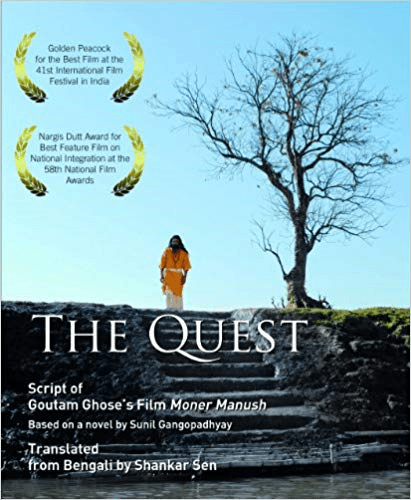
His reaction to the Ram Janmabhoomi riots was Moner Manush (2010), a film based on Lalon Fakir’s life, knitting together the best in Muslim and Hindu traditions instead of filming the clashes and the violence. Published in English as The Quest (2013), the book is a powerful dramatisation with pictures from the film. The book, like the film, is also an emotional lesson in humanism. Based on Sunil Gangopadhyay’s novel on Lalon Fakir’s life, the film is beautiful. But the book allowed me to mull over the words, which have been translated by Sankar Sen. It is a book that needs to be read when casteism and religious divides take precedence over humanitarian values. By bringing these songs into translation to readers unfamiliar with Bengali, both Ghose and Sen have opened a world of love and tolerance to new readers, who will hopefully find the time to mull over the wisdom of these songs.

‘What was your caste when you came here,
What caste did you take on arrival, dear,
What would be your caste when it’s time to go -- 
Ponder and tell me if you know.’

-- Translated by Sankar Sen, from The Quest

 His other book that traverses the silk route and journeys through China, Beyond the Himalayas (2019), transcends boundaries and fills the reader with a sense of exhilaration. It is based on his documentary of the same name. Both these recordings of their journey along the silk route are worth viewing and reading. They show humans are the same across all borders. The book, interspersed with lovely pictures of the landscape and mature writing pauses on history at the right junctures. The narration is poetic in both the book and the documentary.

Though Ghose claims that these texts and photographs capture memories of the film, both his books transported me to a different time and space. I saw the films after reading the books, but both were energising, emotionally charged and entertaining. The journey takes one through different parts of the world and gives a new perspective to a 4000-year-old route. Initiated and organised by Major Hari Singh Ahluwalia and Deng Xiaoping’s son, the travels in Beyond the Himalayas took me across borders to areas I have never visited and now, I hope to visit post pandemic. Both the book and the film acquainted me with cultures that excite. And The Quest reinforced the belief, through the depiction of Lalon’s life, that humanism exists despite the degradations of history. That riots can be calmed with the soothing notes of Lalon’s lyrics, rich in wisdom, would be a win for the human spirit.

Like all great artistes, Ghose speaks in beautiful poetic sentences about concepts that touch the human heart and imagination. In this exclusive, he speaks not just about his film-books, but about the real journey and issues he is facing through the pandemic, including the delay of his film with an Italian male lead and his new short film on the current times, Covid-worn and waiting…

You are a very well-known film director, cinematographer, and music director. You have directed award winning Bollywood and Tollywood movies. Normally books come before films but from two of these films, you have made books. Why did you go in for making books of the films?

I have loved books since my childhood. The shape and form of it, the touch and smell of a book fascinate me. They will never die even if we read on the screen rather than by turning pages of a physical object. A certain sense of the sacred has surrounded books from civilisations’ inception. In cinema, be it fiction or non-fiction, we write a script at the pre-production stage. A film-book is all about times gone by — a book of memories, of both cyclic and linear time. My producer from Bangladesh, Habibur Rehman Khan, had liked the idea of film books and had published three wonderful books on Padma Nodir Majhi (Boatman of the Padma River, filmed in 1993), Moner Manush (filmed in 2010 ) and Shankhachil (Unbound, filmed in 2016) in Bengali. Niyogi books of India has published a beautiful pictorial English version of Moner Manush as The Quest and also Beyond the Himalayas, my journey along the Silk Road. Another lovely film book is Pratikshan’s bilingual centenary tribute to Bismillah Khan (Bismillah in Banaras the film Goutam Ghosh made, 2017).

Is dubbing or subtitling the film not an easier option than doing a film-book?

Well, dubbing or subtitling is for watching a language film, but a film book is meant for reading. It becomes a part of your book collections. I have some wonderful film books published from Europe and United States.

Moner Manush is based on Lalon Fakir’s life and on the novel by Sunil Gangopadhyay. Why did you feel there was a need for a separate book after you made a very powerful film on it?

Lalon Fakir is an eternal savant. Scholars have been doing research on Lalon’s life and philosophy since long. It is heard that Lalon was an illiterate man. But going through the words of his songs and the implied significance, it seems as if he was an erudite scholar tutored in an age-old system of education.  His faith was not guided by any particular religion, rather it could be said to be comprised of the mysticism of Sufi and the love and forgiveness of Vaishnavism and the liberalism of the tantric sect of Buddhism. My film on Lalon fakir is research on this great man aswell. The Bengali film book contains important articles by scholars besides the script, reviews and memoirs.

Do you feel that the message of Moner Manush is relevant in a world beset by not just divides but even a pandemic? Is there something we can learn from the story?

Yes, of course the message of Moner Manush is even more relevant in today’s intolerant world, a world of greed and opportunism. The pandemic has victimised the togetherness of the human race but how can we survive without empathy? I don’t know how good the film is, but Moner Manush will serve as a gospel to those who revere humanity.

Lalon says as his own introduction “I am a human.” How important is that for humankind to see themselves as humans over titles of caste, profession, and economics?

The baul (minstrels in Bengal) community had renounced all recognised institutions of religion and revolted against long established rites, customs and faiths. Breaking down the barriers of the narrow confines of communal faith, they had found a large expanse under the sky which had served as a bountiful meeting place of many religions. Under that open sky, Lalon had found the truth in Humanism.

Lalon dreamt of a borderless world. Do you think adopting his outlook can change the outlook of nations which draw borders between the species? Do you think it is implementable at a personal, national or international level?

I think all mystics believe in borderless space of Earth where all centennial beings live in peace and harmony. But the wheel of time had moved in the direction of Divide and Rule. John Lennon’s Imagine has become the iconic song on the dream of a borderless world. It may have been a failed dream, but I confess it might have been one I shared growing up in India and will cherish till the last breath of my life. Let it be a dream and a wonderful utopia.

Beyond The Himalayas was first a documentary film. How long was it and when was it screened? How many episodes is the film?

Beyond the Himalayas was made as a documentary film during our expedition through the Silk Road in 1994. The final edited version is four-and-a-half hour long. It was shown in Discovery Channel in five parts in the late nineties. A shorter version was screened in BBC as well. The Indian national TV had screened a Hindi version of all five episodes.

The book seems to cover lesser than the documentary. Is that true or do the visuals/ music just seem to impact us more? Why did you leave out Pakistan?

Well watching the film with arresting visuals and absorbing the soundtracks of the trail is a linear viewing of our journey along the fabled Silk Road. It is very, very exciting indeed. But the film is also a journey back in time with many references and anecdotes from history. For instance, while showing the travel through the deadly Taklamakan desert, I referred to Sven Hedin’s(1865-1952) expedition of the region. I quote: ‘The first European to map this desolate region was the Swedish explorer, Sven Hedin. His first expedition in 1895 was very nearly his last.  The local guide supplied enough water for four days in the desert instead of ten requested. When the caravan lost its way, the guide was the first to die. The others became insane with thirst, drinking anything — even Sheep’s blood and camel’s urine. By the fifth day, the men, camels and other livestocks were all dead except for Sven Hedin and one other man. Hedin writes in Through Asia, “If I was doomed to die in the sand, I wanted to be properly attired. I wanted my burial clothes to be both white and clean.” But fate was on its side. Spying the dark green side of an oasis, he dragged himself to safety. “I stood on the brink of a pool with fresh cool water, beautiful water. I drank, drank, drank time after time. Every blood vessel and tissue of my body sucked up the life-giving liquid like a sponge.”’

Here the film-book helps the readers. One can refer back to the time past and time present more deeply to understand time as a metaphor of history.

How many days were you on the road? What was the experience like?

We were out for almost ten weeks covering a distance of 14,000 kms. The journey was fascinating for the entire team. There can be no journey more enchanting than the route we took. The collective trove of memories has made the Silk Road so memorable. We had to negotiate extreme weather conditions in Central Asia and Tibet. In a single day, we experienced two extremes. While negotiating the desert, temperatures rose to 48 degrees Celsius, and by nightfall when we pitched camp at Tianshan mountains, the temperature fell to 2 degrees. The situation is almost like the scenes of Satyajit Ray’s Goopy Gyne Bagha Byne — desert to snow in the blink of an eye.

Did you travel through the part of the route Marco Polo used? Did you find it much different from what you had imagined?

Well, the travels of Marco Polo described the wonders of the silk road, cities far greater than his own and a world more significant than anything imagined by the insular backward Europe of the thirteenth century. But he was a late traveller. The silk road was one of the greatest trade routes in history and men had already been travelling along for 4,000 years. Before sea routes were discovered in the fifteenth century, this trans-Asian highway was the sole link between the East and the West. It ran from Xian in China to all the way to the Mediterranean. There were many tributaries to the mighty river, not least of which were caravan routes across the Himalayan mountain range between India and Central Asia.  We could not follow the planned route through Pakistan and Afghanistan to Central Asia via Khyber Pass because of the civil war. The government of India did not want us to take such risks. All the members of the expedition, including the jeeps and equipment, were flown from Delhi to Uzbekistan on 18th May, 1994.

With the silk route being revived, do you think this film has significance?

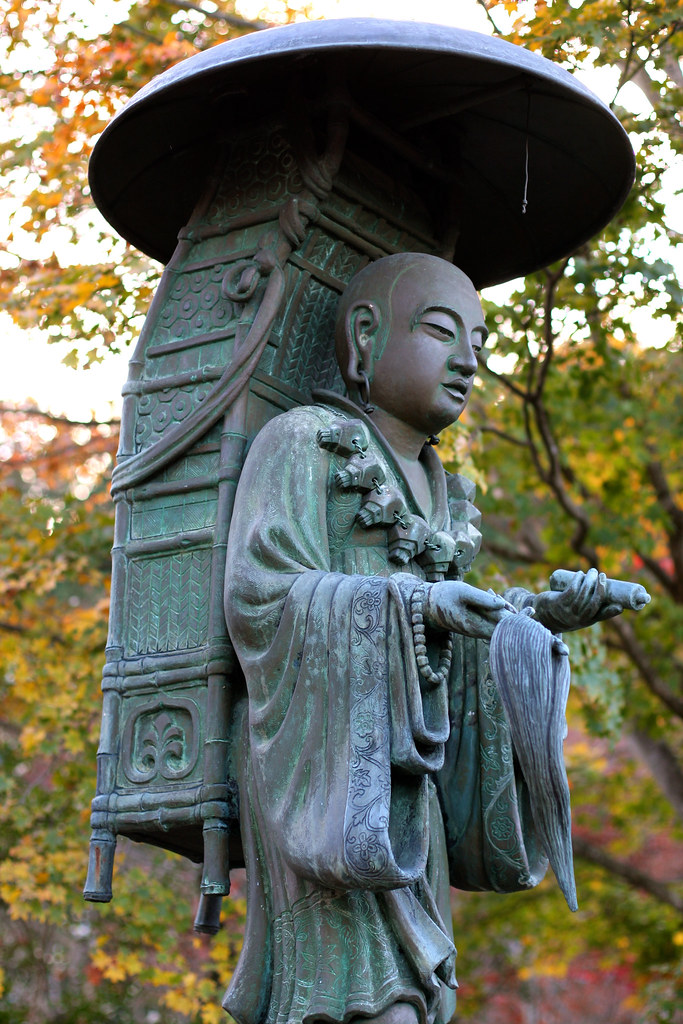
Xuanzang took back over 600 Sanskrit text. Courtesy: Creative Commons

Yes, the film is still significant because it carries the memories of time. We were the first group of travellers after many, many years to cross three new republics after the collapse of Soviet Union and a vast territory of China. Now, the route is open to tourists, and I was told that many travel packages are available all along the mighty river and its tributaries. I would like to revisit the cauldron once again to understand how those multi-ethnic republics have survived the onslaught of modern times with its regional rivalries, new mafias, and consumerist pressures. I wish the new silk route trade brings peace and harmony in this intolerant world. Travellers today can choose from many trails as we did during our expedition. My favourite was Xuanzang’s (602-664 AD) trail. I quote from my book. “At 27, he set out his pilgrimage until he was 43. Unconvinced by the translations available in China, he sought the true teachings of Buddha in the holy lands of India. He walked alone into the great unknown, crossing the world’s greatest deserts and its highest mountain ranges. He faced death many times and his courage and equanimity impressed kings, bandits and barbarians alike. He lectured at monasteries and debated with learned monks and by the time he reached his destination, his reputation as a great sage had already preceded him. Xuan Zhang was not the only Chinese pilgrim to visit the homeland of Buddhism, but he was the most important. Like a death star that keeps releasing energy for thousands of years, he continues to be a valuable source of knowledge and inspiration.”

You are making a new film I believe rooted in the present pandemic. What is it about? Will you be making that too into a book?

My 2019 film Rahagir or Wayfarer, starring Adil Hussain, Tillotama Som, Neeraj Kabir, had travelled to many festivals and received awards and appreciations but unfortunately, we could not release it in public theatres due to the pandemic. Another multilingual film is also stuck for obvious reasons. I could finish the Italian shoot in January 2020, but the Indian shoot did not happen till date. It is so frustrating.

Meanwhile, I have finished a short film Memories of Time on pandemic days. It is about a happy, cultured couple living in the heart of Kolkata. Like everyone else, they are caught in the claustrophobia of the pandemic and the consequent lockdown. The film travels back and forth in time as they try to navigate through these hard times and search for fresh air and sanity. The film is an exploration of their fears, realisation and going back to nature. It’s from my own experience — how I have navigated 2020 and moving through the course of this pandemic. I think one can really publish a film-book because it has so many elements, the fear of people and the inhuman approach of the human race and then the migrant labours — their terrible conditions, the psychological problem of people confined inside their home and the most importantly, the problem of the children. They are confined as if in a prison. They can’t go to school. They can’t really meet their friends. I think this could be a very, very interesting material for a film-book.

Thank you for giving us your time.

Click here to read an excerpt and see photographs from his book Beyond the Himalayas.

Goutam Ghose: Courtesy: Creative Commons

(This is an online interview conducted by Mitali Chakravarty)

.

PLEASE NOTE: ARTICLES CAN ONLY BE REPRODUCED IN OTHER SITES WITH DUE ACKNOWLEDGEMENT TO BORDERLESS JOURNAL

Categories
Stories

Do Not Go!

By Moazzam Sheikh

Pleased, beaming, yum yumming, she finished cooking pasta sauce the way he liked ‒ a bit more garlic and a dash of chilli powder ‒ and turned down the flame real low, the sauce simmering indolently. She was about to reach for a packet of flat spinach noodle to add to the boiling water when she fully realized that he wasn’t home yet. Mid-November and already dark beyond the windows, he could catch a cold, a flu, perhaps pneumonia. Touch wood, she whispered. One could trip, break wrist, hip, summoning visits to the hospital, restricted movement, crutches. A train of thought too frightening, she shook her head and cleared her throat. She set down the pasta on the countertop, unopened, reading the label mindlessly.

He went for his walk in the daylight though sometimes he did step out in the late afternoon. However, as far as she could remember he always returned before sundown. His routine she could depend on for the last two years. He must have misjudged, she shuddered, suddenly feeling hot in the kitchen. Although she breathed deep to calm her nerves, she couldn’t concentrate. The moment she tossed noodles into the water followed by a pinch of salt and half a spoon of olive oil, she regretted it. Pasta didn’t like to be left in water half-cooked. Agitation nudging her fear, she felt she’d have to turn off the stove and go out looking for him if he didn’t return in the next five minutes.

Five minutes passed and she frittered away a few more, paralyzed by indecision, when she cocked her ear to the noise of feet shuffling out in the corridor, nearing the apartment door. It turned out to be a sound conjured by hope. She snapped out, turned off the stove, and grabbing her keys and a light sweater, which Ronny had bought for her on her birthday, exited the building. Encountering the actual darkness which the onset of winter had ushered, despite the street pole lights, her heart sank further.

He could be anywhere, she inferred, and not knowing where that anywhere was, she could be walking in the opposite direction, away from him, lengthening his torment. She took a deep breath, again, and walked to the corner where her avenue intersected the busy street. From there she tried to scan the foot traffic in four directions. Her eyes traveling as deep as a block and beyond, and despite the thinness of the crowd due to the nippy winter air, she failed to spot a lost figure resembling him. She walked eastward unaware of the silent prayers her subconscious mind had been offering with little regard for her resolve throughout her adult life to not rely, as she put it many times, on the crutches of religion. She recognised it and let the prayers continue consoling her heart recalling the distinction she sometimes made between religion and spirituality. The fact that she also didn’t consider herself very spiritual, though nothing wrong with being one, amounted to very little right now. She was most concerned, at the moment, with his safety; her personal problems could wait.

A big sigh of relief! She spotted him outside Fresh Donuts, looking lost as she called out to him from across the street.

“I don’t know what happened. I just couldn’t figure out which way to go,” he explained, embarrassed.

She’d too felt like that many times, she came this close to voicing her thought, mesmerized by the doldrums, juggling personal life, work, moral obligations. As they walked home, she holding him by the arm lest he trip, he said he knew she’d be worried. The more he worried the more he lost his sense of reference. When he thought of asking a stranger for help, he shied away because he couldn’t remember the address or the cross street. He had enough sense to accept that he stood lost on Clement Street. That didn’t help much though, he laughed. She told him she was grateful and impressed he didn’t panic. Help would’ve come sooner or later. Nervous giggles escaped from their mouths as they neared the apartment. A combination of relief and premonition. At home, he went straight to the bathroom to relieve himself and heard her say that the pasta was going to be a little below his standard, not what counts for normal, a little soggy, fluffy perhaps, but the yummy sauce, she promised, would make up for it. She didn’t have to tell him about the tiny bit of rum she’d added to the sauce.

“Don’t worry, honey. Your father is hungry and will eat anything.”

She wanted to say thank god, you’re an easy eater. Not like Ammi, but she bit her tongue. When they sat down to eat, she hesitated but eventually wondered aloud if he remembered her phone number, which to her relief he rattled off without a hitch. Ah, the memory had returned. He said he’d eventually stop a passerby. She felt relieved and the food began to amble down to her stomach with more ease. The sips from her beer soothed her throat. She wished he’d share her beer, relax his strict adherence to the doctor’s advice. Perhaps another time. That night when she went to bed, her mind drifted to her brother struggling to survive in New York, in and out of rehab several times for the last couple of years. He’d already done his bit, taking care of their parents till mother died, mercifully quickly, without a whisper in her sleep. A silent heart attack, they said. Soon after her brother’s life unraveled. He couldn’t take care of father, who then faced a choice of moving back to Lahore or San Francisco.

She avoided sharing with Ronny the episode of father getting lost, but when she saw him a few days later she realized he had the right to know what’s been on her mind. Despite all the good qualities Ronny possessed as a human being, and lover, there was a cold side to him. A person is like a coin, Ronny relished using that metaphor, with two sides, at least. Where she saw his insensitivity, or impatience, towards certain things, he saw drawn boundaries, standing up for what was right, his rights, personal values, spaces, desires, likes and dislikes, cultural or personal baggage and so on. After having dated for more than a year, they were going through the process of exploring the possibility of getting hitched to each other. They both agreed they wouldn’t mind having a child or two. Her eggs were drying up. With a sense of urgency, one day Ronny did ask if she’d consider marrying him first in order to get pregnant. Though he was far from being Mr. Perfect, she’d already weighed the pros and cons of living with her boyfriend Ronald Ngyuen. Their plans got disrupted when Mr. Bhutta — that’s how Ronny preferred to address her father instead of by first name ‒ was brought by her to live in San Francisco. Despite old age, her father would’ve liked to live near his son. Even if that meant moving into a facility for elderly living. He also suggested moving back to Lahore. Neither choice was practical when emotional and economic reasons were taken into consideration.

Kausar initially cheered up to the idea of having father around. His liberal, open-minded side had pleasantly surprised her when he indicated that he considered his children adult now and the fact that they weren’t living in Pakistan anymore, his son and daughter had all the right to lead their lives without any pressure from the parents. Her mother turned out to be a bit more conservative than the children had realised, but she too sided with her husband’s wisdom. The couple tried their best to warm up to whoever their children were dating in college, and when a new partner showed up, they accepted him or her. There was a brief period, before the mother passed away, when the parents wondered if the mess their son had found himself in was, in fact, something do with their hands-off attitude once he went to college. But in their defense, they argued, Why, then, had Kausar turned out fine?

He went missing again. That time she couldn’t find him anywhere in the neighborhood. Blocking off a deep sense of foreboding, she called Ronny, busy assisting with the mounting of his photographs for an exhibition.

“I’d call police,” he suggested coldly. “They’ll spot him soon wandering around, lost.”

“I wondered if you were on your way, we could drive around in your car and look for him,” she said calmly, stifling her panic.

She knew he couldn’t come just like that. His suggestion made sense. Yet her fingers froze recalling the incident, was it somewhere in New Jersey? A cop seriously injured an elderly Indian man on a neighborhood stroll. He’d been visiting his son to help babysit his year-old grandson. A woman called the police about a suspicious looking man wandering around her neighborhood. The man from India, short and effeminate looking, in his mid-fifties, wearing glasses with thick lenses, did not speak English, only Hindi and Gujrati, was admiring neat looking cookie cutter suburban houses, their large fronts, mowed lawns, trimmed hedges. The already irritated cop lost his patience and slammed the visitor to the floor, paralyzing him forever. The jury, comprising of majority of white men, acquitted the cop because the man who’d come to help his son and daughter-in-law had ‒ the defense attorney pointed out ‒ committed a misdemeanor by leaving the house without identification papers. It made sense to people defending the cop. Don’t frustrate a cop; it doesn’t matter whether you pose a threat or not. The burden of failure to communicate is on you. She shook her head. She only hoped the San Francisco cops had more humanity and better training. Tonight!

In the end she dialed 911. Yes, an older man matching his name and description had been reported lost and an ambulance had taken him to General Hospital. Ronny had to stop everything and drive her to the hospital’s emergency ward. Thank god, he’s okay. He smiled sheepishly, his guilty smile although it wasn’t his fault. The old man had blanked out and made the mistake of approaching a passerby, who, unable to help and make father remember Kausar’s address, or phone number, had taken upon himself to call the ambulance. As per their procedure, by law, they had to run all kinds of tests now, check his vitals, to make sure he was fit to leave. It’s going to take a couple of hours. A senior nurse told her she’d have to be patient. Ronny had to return to help with the exhibition but would come back soon to take them home.

“What happened, Abba?” she asked, patting his hand, consoling a worried, defeated father.

She dreaded the moment she would have to contemplate the possibility of dementia snatching him from her. The fact that he actually stood right below her flat but couldn’t recognise it left Kauser stunned. What is he going to forget next? she wondered. As melancholy crept in, she tried to fight it off with positive thoughts. She was going to do everything in her power to make sure he didn’t succumb to the cruel malady without a fight. She admitted she could never have imagined it’d come knocking on her door so soon. She made up her mind to read up on the latest research, borrow or buy books on physical and mental exercises, and foods that help keep memory strong. She wouldn’t let him forget his wife and children’s names.

He didn’t forget their names or the names of his friends, past neighbors, even colleagues. As days went by, she felt relieved seeing him settle down a bit while accepting that he couldn’t venture out alone anymore. He’d never been the stubborn type. He could be feisty but not of late. She relied on Ron and one of her neighbors Doug to give company to her father when she had to go out. Thankfully, she could do most of her work from home. Both Ron and Doug enjoyed conversations with him on topics of mutual interest, especially foreign policy and history. Father’s humility impressed Doug, who besides having a crush on Kauser which he’d hinted at a few times, studied History with a minor in International Relations at Kent, Ohio State. On and off, he’d been reshaping the old man’s worldview crystalized by what he called Eurocentric education, although her father considered himself a political person, having taken part in ending General Ayub’s reign. Even when Bhutto was hanged, he openly criticized the military takeover under General Zia, right around when she left Pakistan. It’s a miracle that he didn’t lose his job at the Mayo Hospital.

“It’s the rigor, intensive studying at medical schools which kill critical analysis among most doctors. It decimates nuanced thinking. Otherwise, they’re very intelligent people,” Doug once said to her after he’d finished a long conversation with father on the topic of African countries and their independence from European powers. Ron and Doug, on the other hand, tolerated each other courteously. Doug saw Ron as a typical Vietnamese American unable to criticize America openly lest someone accused him of ungratefulness. Or worst still, telling him to go back to Vietnam! He found Ron’s critique of modern society, by which Ron meant modern western society, inadequate through his photography. Ron was content with what he’d been doing for the last several years, visiting Vietnamese seniors all over the country, photographing them in black and white, their faces, creased and ageless, eyes nostalgic and confused, capturing the front of their homes and apartments, the interior where east and west adjusted around each other. True, he avoided asking overt political questions, he still considered his work political. Kauser agreed with both.

Without appearing to be overt, Kauser played mind games with Father to see if he forgot important names. She asked him about their childhood, his childhood, when he first saw Ammi-jan, whether he remembered his grandparents, his neighborhood in Ludhiana before Partition. To her surprise his memory was crystal clear. She began to breathe a sigh of relief. What a scare he gave her! She’d hate to part with him, send him to a nursing home or back to live with one of her cousins. Better to be at the mercy of your own children, she insisted, however spoiled they might be, than the nurses or distant relatives.

“But what about your life, Kay?” asked Ronnie rhetorically one afternoon as they sat at a sidewalk table of a bar for happy hours near her apartment. She had set Mr. Bhutta up with munchies and a clean print of a classic of early Hindi cinema which she’d found on Youtube. One certain way to tie him down for two hours, she smiled sadly.

“What about it?” she asked, puzzled.

“I thought we were supposed to try living together . . .”

She picked up where he trailed off, “Get married,” she paused, sighed, “and make a go at having a child.”

Was she smirking or smiling? She couldn’t tell because her face had quickly reverted to appearing placid. Then as she took a sip of her drink, her forehead furrowed a bit.

“Kay, I know you have a lot on your mind and it’s affecting your work,” he waited for her to interrupt him, but she just looked away, far to the end of the block milling with neighbors out shopping. “But I am not sure what your plan is.”

“Plans about what, babe?” she asked without irritation.

“Oh, forget it!” he said, pretending to relax. “This is not the time.”

She fixed him with a stare. He dared her. Her face softened, a crease appearing around the side of her mouth. A beautiful woman, he thought. Still, he didn’t smile back.

“Are you quitting on me, sweetie?”

“No!” he replied. “I’m afraid I might lose you.”

She was tempted to ask how? Instead, she opted for silence. She knew the answer. Both Ronny and she had small apartments, and with rents the way they were, they couldn’t afford to quit their rent-control apartments and risk eviction. She hated to see her father as a burden or a barrier to her happiness. When he looked at her again, she nodded gently, conveying that she understood his apprehension. She placed her hand on his, then squeezed it.

“Me too. We have to trust,” she said.

As they walked back to Kausar’s apartment, they held each other close, her head nudging into his chest despite they almost tripped a few times when their legs bumped into each other. Yet they persisted, mimicking an image from a movie most likely, ignoring the awkwardness his short height had produced, bravely laughing it off. They kissed, outside the building, under the faint glow of streetlights, her ajar eyes catching an anti-Trump sign in a neighboring window.

“I’ll come over soon as he falls asleep,” she said. 

She heard him puttering around in the kitchen when she entered. Had the movie ended? She called out, asking if he needed help with something, as she took off her shoes. He emerged, smiling nervously, like a child caught rummaging through kitchen closets looking for cookies and candies.

“How was the film?” she asked.

“I’d seen it before but had forgotten it. One of Dilip’s best I think,” he said. “His acting so subtle, so controlled.”

“So you enjoyed it. That’s good.”

The screen had been turned off. The plates were still there which she collected now. Only when she went to the kitchen did she notice one of his shirts slung across his shoulders. Was he thinking of changing into a clean shirt? A dress shirt? She observed him quietly. He stood in the living room for a long moment, then turned to the wall and took a step. She couldn’t see him, so she left the kitchen and hid herself from him, beside the door. He was looking at the calendar. She’d forgotten to change the month. Did he know it was the wrong month?

“Why do you have that shirt on your shoulder?” she asked casually.

He noticed the shirt, surprised, held it, examined it, still puzzled, then looked at Kauser for an answer, smiling vulnerably. “Did you put it here?”

“Me? Abba, why would I? You must have done it.”

“Why would I do it? You’re crazy,” he mocked her and put the shirt down on a chair.

She called Ronny a little later and made up an excuse about feeling a little ill. Could be a cold, no, not a flu, she hoped, but rest was probably the best option. He said, okay, he too was feeling tired and ready to hit the sack.

A few days later when she returned from Ronny’s place a little after one in the morning, he was gently snoring away. Relieved, she decided to take a quick shower. His snores had stopped. She changed into her pajamas and crawled under her duvet covers. She’d hoped to fall asleep right away, after a nice time with Ronny, but found herself tossing and turning, questioning if it was the absence of his snores that disquieted her. She zoned out briefly before becoming fully awake. She got out and tiptoed to his room only to be shocked to notice the blanket pushed aside. Not in bed. When did he get up? Is he in the kitchen or living room? Both rooms were unlit, though her eyes by now had adjusted to the dark.

“Abba?” but no response came.

Did he collapse? She rushed through the apartment switching on the lights. He was nowhere. And then she noted the unlocked front door. She almost fainted. It was ten after three in the morning. Oh god! she cried. She chided herself instantly as she recognized her first impulse was to call Ronny.

Standing at the corner, she looked as far as her eyes could see, north, south, east, west, deserted streets with shuttered down shops, a sprinkle of cars parked on either side of the streets. She felt paralyzed. Too scared to cover the neighborhood territory on her own at this time of night. An uncanny fear, a sense of embarrassment, made her resist calling police. What if they arrest her for elderly negligence! What could she have done to stop him from sneaking out like this? Tears began to roll out of her eyes. Who could she wake for help? She dialed her brother’s number with unsteady fingers. It rang and rang with no possibility of leaving a message. Unawares, she shouted into the phone, “Come on, for god’s sake, pick up the phone! Abba’s missing! Again!” She cursed a few times before hanging up.

Taking a deep breath, she dialed 911. A professional, sympathetic voice came on. She was about to offer Father’s description after a standard drill of questions when she heard the front door in her building’s portico opening. She was startled to see Doug and her voice faltered.

“Kay, your father is with me,” he said.

“What? . . . Wait. Officer, I think my neighbor has found him . . . Thank you,” and as she hung up, she asked Doug, “How the hell did he . . .” and she burst out crying.

Doug walked up and held her, escorting her back into the building.

“I’m so afraid of him getting hurt,” she explained through sobs.

“He’s back at your place,” he said. “Lights were on in every room, and I knew you’d gone looking for him. You can always wake me up.”

She thanked him before finding her own balance with her feet searching for the stairs. He followed her down the corridor.

She stopped. “What did he say?”

“I heard the knock. Honestly, I was worried,” he giggled. “I opened the door and there he was, standing, looking confused. He almost didn’t recognise me when I said, ‘What’s wrong Anjum?’ Instead, he said he was hungry.”

“Just three doors down he lost his bearing?” she marveled aloud.

She knew from his expression that the fear in her eyes was clearly discernible. She tried to soften the tension on her face. They now stood outside her apartment, momentarily, lost for words.

“You should get some sleep, Doug,” she said.

“I won’t be able to. I’ll be up if you need me,” he replied before turning.

“I won’t be either,” she paused. “You’re welcome to come in if you like.”

“You sure?”

She nodded before pushing the door. She could hear his snores. Instead of calming her down, the sound made her furious.

Kauser didn’t bring up her father’s encroaching dementia, only found it ironic, when Ronny began talking about his exhibition of photographs of the Vietnamese American diaspora. He found the population of elders divided into half and half, those who had somehow managed to live with or nearby their children and those who either lived alone or in nursing homes.

“I plan on visiting Vietnam after the reception. You wanna come with me?”

Insensitive! was her first reaction, but she rebuked herself for focusing on the negative.

“Is it to see your father?” she asked. “I hope he’s not ill.”

“No, he’s very fit. I just want to visit, not particularly him, but he’ll be there of course. I want to surprise him.”

“You know I can’t. I have to sort out . . .”  she said.

Two weeks passed without an incident, except that once or twice he mixed up Kauser with his wife and his sister. It could be dementia, or it could be just old age. She, too, once called Ronny by her ex’s name John, the bread maker, always called him Johnny, never John.

Ronny flew to Vietnam for a month but left the idea of extending his stay open. Kauser understood now more than ever. He’d mentioned it before, though always wavering, afraid of encountering a father who, after defecting to the North, had abandoned him and his mother, who had no choice but to rely, as she put it, on the help provided by her brother employed by the Americans.

When Ronny, a year old, got sick, and was taken to the hospital, his mother and Ronny were eventually taken care of by an American soldier, a nurse until the Fall of Saigon. Thereafter, they continued with the American. The two younger sisters born in Cotati, California, lived together as a family. That was why it was always difficult to watch Vietnam War movies which portrayed all South Vietnamese women as whores for the pleasure of American soldiers, Ronny had explained it to Kauser and others. Dylan, Ronny’s stepdad died young from heart trouble, overweight, diabetes, and failed kidneys. It was more from grief that his mother, Ronny alleged, cursed Dylan for things which didn’t make sense to him or his sisters, having moved away to different colleges. One of the sisters, the elder, said that Dylan’s death was caused by his memories of American War in Vietnam. Kauser had met the mother and sisters several times and liked them very much, enjoyed getting together with them in Cotati, despite her dislike for similar places, over Thanksgiving and Christmas.

“Dylan was more a Buddhist, than Presbytarian,” intoned Ronny’s mother.

The sisters grew up more or less atheists, even before they moved to Cal, two years apart.

Kauser’s brother had promised to visit soon, said he’d been going clean and things were starting to work out on his end. There was something about the whole conversation which failed to convince her of a probable happy ending. After speaking with him she’d weep a bit. What is he thinking? she wondered. Is he going to take father off her hands? Abba was also becoming less and less conversant, even forgetting the fact that he’d just been fed, getting annoyed or angry that Kauser was depriving him of food.

“That’s elder abuse, Kauser!” he admonished her weakly.

She couldn’t stop laughing and hugged him tight, fearing she was losing her grip on him. She saw him one mid-morning sitting by the window, staring at the foot traffic, and heard a voice in her head whisper, “He’s gone!” She couldn’t help but shout, “Don’t leave me, father!”

He turned and, as if feeling caught, defended himself, “I am not going anywhere. What made you think so?” he pleaded rather than demanded.

Then she heard her own voice in the realm of silence, “No, you are. Abba, you’re already gone,” walking away.

Suddenly, her friend Miriam was back from traveling and offered to help out with being around her father when Kauser needed to step out for work. Doug was there too. Thanks to her supervisor, she could accomplish most of her work from home. Her brother had to postpone his visit for personal reasons, as he said with an added stress, not because of medical reasons.

“I understand. But I need you to sort this out before something happens,” she told him over the phone and regretted it.

In reply, she heard a sigh. She knew once off the phone, he’d weep too. Perhaps she could think about moving there, but the rent situation was untenable.

“I can’t find him, Kay,” he laughed a sarcastic laugh. “They say he just disappeared one day about six months ago.” She was speaking to Ronnie.

She failed to detect any pain in his voice.

“Oh my god!” she cried sympathetically. “What are you going to do? How are you feeling?”

“I don’t know. I have looked around at all the possible suspect places. I can’t do much.”

“Are you taking care of yourself?”

“Yes, I am. How about you?”
 “I’m okay. Are you coming back then?” she asked.

There was a silence that seemed to linger a tad too long.

“Hello?”

“I’m still here,” he paused again. “I think I’m going to stick around a little longer.”

“I see.”

“There’s this guy, a very good photographer; he wants to do a joint project. About the war,” he explained.

She felt terrible, deflated after hanging up. It turned out to be a wise decision to go out on a stroll with her father. They grabbed fresh spring rolls and sesame balls and ate them in the park watching kids run around the play structure, kicking sand, shrieking, tripping, crying.

“You were like him,” he pointed to a little boy who seemed to burst with energy. “Maqsood was the opposite.”

“You mean Qasim!” she corrected him.

“Yes, Qasim,” he seemed startled. “Who’s Maqsood?” he added before he broke down, weeping.

She didn’t comfort him, simply watched him; just let him be, she reasoned. Perhaps that’s all that was needed to cure his dementia! He stopped soon, raised his head ‒ a complete absence of tears. As if he forgot he’d just wept a minute ago. The food preoccupied him now. She struck up light conversation now and then, but she really wasn’t in the mood. Her thoughts wandered. She needed to be in control of her thoughts or else she wouldn’t survive. The way things were, she told herself, she wouldn’t. She saw herself succumbing to mild depression. Or it is anxiety? she asked. She must preoccupy herself with chores to stop bleak thoughts from entering her head. She saw herself walking out of the park to 19th Avenue which turns into a freeway to Golden Gate Bridge, her thumb sticking up offering herself to be hitchhiked to never come back. His, “Look at that brat,” chuckling, brought her back from her reverie.

Next time they spoke she couldn’t share Ronny’s excitement over his trips into the countryside collecting material for his project.

“There are so many stories here to be told,” he said excitedly.

He went on and on. A method of deflection.

“I am reaching a breaking point,” she said.

“Babe, tell Qasim to come and help out,” Ronny advised.

“He’s coming,” she lied. “I’m just tired.”

The real reason Ronny went to Vietnam was to distance himself from her personal problem, she was convinced. Her father’s health had started to affect her work now, not to mention her personal life. Abba’s doctor had brought up the subject of looking into the possibility of admitting him to a senior facility such as Laguna Honda. It sent shivers down her spine. There would be no way to know if the staff abused him. She imagined forgetting to visit, spacing out, forgetting him. Or worst, he not recognising her. Although she let it sink in, those hard choices had to be made, she wished she could just take him to Pakistan, where relatives and neighbours still stepped in. There was no one she could now rely on, she mourned. Abba had not stayed in touch with anyone because he got tired of helping out for his children worked in the US. He also encouraged the children to not stay in touch with their cousins. And now she was on her own. Just last week she overslept and missed an important meeting. Last night, she had to decline an invitation to Sheila’s baby shower, and she already knew, unless she could get Doug or Miriam to be with Abba, she wouldn’t be able to go to Ajit’s party. An old news item resurfaced in her mind, about a middle-aged Indian immigrant in Foster City hitting his eighty-year-old, wheel-chaired father on the head with a hammer, not with the intension of killing him but so, he mistakenly believed, he could be admitted to a nursing home; he couldn’t look after the old man alone. Sick! She shook off the thought. How people could stoop so low in difficult circumstances, she cried silently.

Qasim was back in rehab. His estranged wife, Laurie, called to tell Kauser that she and her kids have washed their hands off. Narcissism, she said, was at the root of all his problems and now no one could help him, let alone expecting help from him. When Laurie enquired about Anjum, Kauser told her how he’d tried to sneak out again. “Thank god, he couldn’t unlatch the door from inside, and the noise alerted me. I can’t even go to the bathroom!” Kauser pretended to laugh. Laurie understood as only another woman could, relating to her own situation while taking care of two very demanding children without her husband. Laurie said she wished she lived nearby. That sentiment touched Kauser deeply. She didn’t want to worry her sister-in-law too much by telling her that his appetite had also dipped. Should she end father’s misery by suffocating him with a pillow? She thought of shocking Laurie but ended up feeling awful.

That night Kauser snapped at her father for the first time in her recent memory when he began about his father serving in the Indian British army on the African front. She told him curtly to stop beating the dead horse. He was taken aback and gave her a look of deep hurt. She felt remorse but allowed that feeling to be overtaken by a surging wave of melancholy. It also didn’t help that Doug and Miriam had hit it off while having dinner at Kauser’s apartment with Miriam going gaga over a dish brought by Doug. Doug knew Ronny wasn’t coming back anytime soon, then, why, Kauser wondered, hadn’t he made a move? She believed she’d given enough hints. Unconsciously, she blamed her father for this snub. Doug, too, had quietly moved on.

She opened a bottle of wine, thinking, bizarrely, of previous lovers and sat down by the window after tuning the radio to a jazz station. A trumpet seemed to be searching, frantically, for the bluest note possible. But only succeeding in finding a red, blazing hot one. She was on her second glass. The music changed. Then on her third glass, she contemplated the sun lowering itself behind trees and rooftops and actually dropping dead, unleashing a snowstorm. She felt an obscure rage darting in and out of her body.

She wondered, worried, though absent-mindedly, if she was on her fifth or sixth glass when she saw the world around her beginning to spin. She knew better not to get up. Just sit there and follow the movements of the shadows she could vaguely discern, pale ghosts tiptoeing across the hardwood floor of the rooms, faces contorted while smiling and angry making a go at grabbing her attention to say something frivolous or important, cackling and some shouting, a few mocking her, one even sticking its tongue out at her. Sitting at the bottom of a sea of stupor a shadow emerged from one room and dissolved beyond the door frame. A click of the doorknob eventually beyond the water ripples pricked up her ears, only mildly, but her body sank back into the chair of its own volition, drained of the will to assert itself. She thought she heard, as she took another sip, her own voice utter the words Do not go . . . into the night! But the memory of her own sound dissolved slowly.

.

Moazzam Sheikh is the author of The Idol Lover and Other Stories and Cafe Le Whore and Other Stories. He has translated across Urdu, Punjabi and English, notably the fiction of Naiyer Masud, Intizar Husain, Ikramullah and Nadir Ali. He is also noted for being the editor of A Letter From India: Contemporary Pakistani Short Stories (Penguin, India) and Chicago Quarterly Review’s special number on South Asian American Issue (2017). He is a librarian in San Francisco and lives with his wife and two sons.

.

PLEASE NOTE: ARTICLES CAN ONLY BE REPRODUCED IN OTHER SITES WITH DUE ACKNOWLEDGEMENT TO BORDERLESS JOURNAL

Categories
Independence Day Stories

Bundu, Consoler of the Rich

A story by Nadir Ali, translated from Punjabi by Amna Ali

Nadir Ali(1936-2020), recepient of the Waris Shah Award from Pakistan Academy of Letters in 2006.

A peculiar dream replayed itself in my mind recently. I am the kind of man who always thinks deeply about dreams. When I lost and then initiated the arduous task of recalling my memory, I went in search of all those times I could not account for by raking through my dreams. We rarely make sense of the surreal glue that holds dreams together, reconstructing them as if they are stories.  Indeed, sometimes they chronicle our longings, other times they unfold our ardent desires reaching fulfilment, as in the union of a man and a woman! In essence, words lay the foundation, not only of the inner world, but also of our dreams. Words illuminate this journey we undertake in the pitch dark. They help us penetrate the maelstrom of existence!

This is how the dream began. I address a seated man, apparently a doctor, I recognize as Shahabuddin. He transmutes into a woman when I sit down across from him. She has the most beautiful eyes. Dark-complexioned, she appears to be Bengali. I find her very attractive. We take a stroll to the front of the Zamindara College in Gujrat. I point out Nawab Sahab’s grave to her. She moves closer to me as we approach the college hall. We continue onward to the back of the college. My heart turns tranquil as the dream fades. 

I did not have to venture far to find the rungs that would help me comprehend my dream. Ah, I had recently read the translation of the Musaddas by Sir Shahabuddin. Since Shahabuddin had tanned skin, he visited my dream as a woman with dark complexion. Again, it was he who dissolved into Balo Jati in my dream because he belonged to the Jat caste. I rushed to Balo and narrated the night’s dream. “Lady, I have to remove curtain upon curtain to find you, even in my dreams!” She laughed and explained, “Such a distance lies between an old man and his youth!” I persisted with my interpretation of the dream. “I showed you Nawab Sahab’s grave to indicate that I am old and decrepit, yet I live on, like Nawab Sahab’s name lives on.  We went to the back of the college to excavate my youthful days.”

“Lahore, Chaudhry Sahab, is overflowing with young lovers. My most prized beloved, though, remains this old man. He is a parent and lover rolled into one. People need conversations to share our joys and sorrows, no? Who would I converse with if I don’t see you Chaudhry Sahab?”  Balo’s words lifted my spirits. My dream bestowed its blessings and then was forgotten. Two months passed.

Yesterday, as I sat reading the biography of Khwaja Muinuddin Chishti – the Consoler of the Poor*, Bundu dhobi* appeared in my thoughts out of the blue.  Consider that one of Khwaja Sahab’s miracles or the secret of caring for the crushed! My mind was reminded of the two-month-old dream. I pictured the dark-skinned woman’s eyes. Ah, exactly like Bundu’s! So, the woman was in fact Bundu the washerman!  Bundu is the only person I remember fondly from my two-year stint as a professor at Gujrat’s Zamindara College.  He transformed me into a Sahab during those youthful days of surviving on the pittance I was paid as a novice professor. I wore the best starched and brightest white shalwar kameez in the entire college. 

I also happened to be the college hostel warden. One day, Bundu appeared with a plea. 

“Sahab, it is impossible to find accommodation in the homes seized after the exodus of the Hindus from the city. The Neighborhood of the Untouchables too is under the police’s control. They have escorted so many women there, turning it into their own personal cantonment. It is indeed not befitting for real men to spend nights at the police-station! Please if you get me a place at the hostel, I will manage.”

I arranged lodging for him at the hostel. Meanwhile, I found it hard to manage my expenses after sending two hundred and fifty rupees home each month. I had rashly jumped on the marriage bandwagon too. I ended up renting a house in Madina village situated on the outskirts of the town. Bundu would walk the two miles to my place. I had a bicycle at least.

Bundu never learnt to ride. “It has a mind of its own!  What if the damn machine decides to carry me to Momdipur from Madina village?” Bundu would tease.

The marriage ceremony and monthly expenses drained us of all our money within a month of marital bliss. One day, my wife announced, “Someone named Bundu dhobi is asking for you.”

I stepped outside to meet him. “Sorry Bundu, I am penniless this month. I won’t be able to pay you,” I told him.

“Sahab, I am not here to receive my payment. I am here to pick up the dirty laundry. Moreover, I haven’t even congratulated you on your marriage. Your wife is one lucky woman. A good man usually finds a good match.” Little by little, Bundu developed the routine of picking up our laundry from my wife multiple times a week, instead of once a week. Thanks to the care he showered upon our clothes, my wife and I climbed up the social ladder. When the college let him go, he managed to rent a small place that used to belong to Hindus in Muhammadi village. We remained broke.

One day, my wife took out some old bills. “Bundu heard us fighting about the expenses. He left thirty rupees with me.” I expressed my anger. We didn’t have a penny. How were we going to repay him given how impossible it was to borrow from anyone in our village?

“He said we could repay him after one month. He placed the money in my hand,” My wife tried to allay my worries.

Bundu played an important role in my transfer to Lahore when our principal accepted a position at the university and took me along. “You are the best-dressed man in all of Gujrat!”, the principal had said. From Lahore, I went on to Dhaka University in 1965.  My children and I took to Dhaka, but luck was not on our side.  We were spared the perils of detention in 1971 as we had returned to West Pakistan for the summer holidays. But I remained affected by 1971. I became very ill. I lost my memory during my treatment.  Once recovered, I made a trip to Gujrat after a gap of twenty-five years. Bundu had passed away by then.

Today, Khwaja Muinuddin, the Consoler of the Poor, reminded me of my Consoler of the Rich, a most loving and kind-hearted man. Perhaps even Khwaja Sahab had been softened by such love from people! After all, a poor person can also be a benefactor of the rich!  Such are the links of love. The foundational bond, too. As in the love between a man and a woman!  In my dream, he appeared as a beautiful, dark woman. He was a very handsome man. How can I ever forget his deeply telling eyes?

*Also known as Khwaja Ghareeb Nawaz (Consoler of the Poor), he was a sufi saint and founder of the Chistiya Sufi order in the early 13th century

*A dhobi is a washerman

Biographies:

Nadir Ali (1936-2020) was a Punjabi poet and short story writer. In 2006, he was awarded the Waris Shah award for his collection Kahani Praga. Coming late to writing, particularly fiction, Nadir Ali is credited with spearheading a unique style, blurring the boundaries between significant and petty, artistic and ordinary, primarily due to his preference for and command over the chaste central dialect understood by the majority of Punjabi speakers. He is also noted for writing and speaking about his experiences as an army officer posted in East Pakistan at the height of the 1971 war.

Amna Ali is Nadir Ali’s daughter.  She is currently translating a selection of Nadir Ali’s short stories into English. She is a librarian and lives in San Francisco with her husband and two sons.

(Published with permission of the author’s family)

.

PLEASE NOTE: ARTICLES CAN ONLY BE REPRODUCED IN OTHER SITES WITH DUE ACKNOWLEDGEMENT TO BORDERLESS JOURNAL

Categories
Essay

Peace: Is it Even Possible?

By Candice Louisa Daquin

We’ve all heard the adage, those who don’t know history are bound to repeat it. Maybe like any good saying, it’s been over-used and we’ve forgotten to consider its core truism. But think about it. If we don’t remember, we tend to repeat former mistakes, because human-beings are very alike in their actions and reactions, and we have a horrible habit of thinking we’re so unique when we’re anything but that. The ego of is young. Occasionally, ignorance shields us from historical realities. When we get older, we sometimes stop caring and leave it to those younger to us. But both approaches have deep flaws. They abdicate the responsibility of living in this world.

What reason could any of us have for truly abdicating responsibility to our grandchildren, and those who will invariably come after we are gone? Is being young an excuse? Is being old? Or are we intrinsically fond of passing the buck, as American’s say, and not believing we’ll make enough of an impact in this world to even bother? I don’t think it’s that. I think it’s apathy and a childish belief someone else will do it for us. Just look at people who drop litter in the ocean, they don’t care that it will cause havoc on sea-life, they are not thinking of the future repercussion, they are thinking only of now. They don’t see how that one act has this deleterious knock-on effect that reverberates throughout our planet.

If you’re rolling your eyes and are about to give up reading, consider this: What is your value? What do you stand for? If you died tomorrow what would have been your legacy? Don’t think wealth or children, but your place in the chain stretching from the beginning of humanity to now. What have you done to help that chain? If you don’t think that is relevant, consider why this isn’t important to you and why being self-interested is justifiable to you when so many suffer, and the world is damaged by those like yourself who don’t care.

Maybe that sounds judgmental because of course, it is. Too often we can look back in time and see these pioneers and campaigners who try to make a change and be swallowed by disinterest on the part of the masses. Literally speaking then, the masses are the problem, because whilst a few good apples stand out and speak to things we need to do, the majority are thinking of just their survival and their immediate gratification. The concept of immediate gratification has taken deep roots in the current times.

Psychologists and thinkers have many ways to explain why the majority do nothing and seem apparently not to feel they have any obligation to improve the world we live in. Some say, it’s about human development; few attain that stage of self-realization where they feel a need to contribute beyond themselves. Others point to the hardship of life, and how when you struggle, you often do not have enough left over to help others. Of course, we all know notable examples of those who despite a hard life, gave in abundance to others.

If we remove religion and its dictate that people should help each other as part of being a good (Christian, Hindu, Muslim, Jew, Buddhist) would we have a lawless approach to giving and caring, that made social concerns null void? I would say it has less to do with dogma and religion and more to do with personal ethics. There are plenty of atheists who do a great deal for others and this planet, without any desire for recompense or a place in heaven. Therefore, it seems to be a deeply personal choice or evolutionary step.

If so, why do some evolve more than others? What do we need to do to achieve that selflessness and why do not many not want to achieve it? Those questions many never be answered, but they are part of a larger picture, that of our place in this world, and what we do to ensure there is a decent world for our progeny. I’ve been told this is a utopian way of thinking and human nature is baser, seeking only to procreate and thrive, sometimes at the expense of others. I am an idealist in that I believe there is intrinsic good in many (not all) people and that’s what gives being alive its deepest worth. Without helping make the world a better place in some way, we are just oxygen users, having too many children, using too many resources and trying to kid ourselves this won’t affect the future.

Growing up I was familiar with the peace sign so popular in the sixties, and we touted many of those symbols without really considering their history or how ‘working toward peace’ had actually played out through history. Maybe like many words, ‘peace’ is over-used and we don’t consider what it means in relation to today’s world. It’s as relevant as ever. If we think we’re not needed to increase peace, we’re living in cloud cuckoo land. Peace is one of the only consistent needs we have, aside food and water. It is the erosion of peace that causes the majority of our concerns, and the dismissal of peace that leads to some of our greatest strife.

So many continue to live in a part of the planet where peace doesn’t ever reign. Let’s stop and really think about that for a moment. Those of us who don’t live in those parts often try not to think about it, because it makes us feel guilty. What can we really do? Yet if we watch the news, almost nightly politicians debate about how best to deal with this issue. Or that’s what we’re led to believe.

What if we’ve been lied to? What if major world governments and thus, the puppet political system, do not wish for peace but thrive on discord because it permits them to do what they really want, which usually has to do with power, domination/control and profit. Think of all the wars since the second World War  America has been involved in. Not one of them has brought peace, not one of them has ensured or guaranteed peace. The money spent is unfathomable and would have been enough to resolve many countries crisis’s forever. The profit is hidden and often in the sole possess of those who really pull the strings and many lives are lost. For what? Peace?

The idea of going to war to promote or guarantee peace is not a new concept. Traditionally however wars were fought for one reason only, one side wanted to conquer the other side to gain something (profit, land, slaves, control) and war was typically a male endeavor and one that seemed to exist in every society where human beings existed. You could say, war was uniquely human. Similar fighting has been witnessed in other primates, and animals, and they often share the occupation or protection of territory as their prime objective, so perhaps it’s an instinctual thing within our animal psyches to go to war. However, wars in the modern sense of the word have not been as basic, and their motivations have increased with the complexity of our societies, to make what we understand by war, a thoroughly human concept.

A complex society, invariably thinks of many more strategies related to war than a simple brawl in the old days, with sharpened rocks. The more complex, the more devastating and wide-reaching and drawn-out wars, think of Rome and their stampede across the world, or Alexander the Great’s conquests. Wars have been the cause of so many negatives, not the least; sexual assault, slavery, subjugation of people’s, famine, destruction of land and property and livelihood, physical and mental suffering and the collection of extreme wealth by the minority. Does that begin to sound modern to you? It does to me.

Today’s wars are all about the optics, the phantom, the illusion. Countries go to war to act out their own strength to ensure other countries don’t forget how mighty they are. The people who get caught in these, die or suffer terribly, the displaced cause huge economic fallouts and a minority get rich. It sounds a lot like a pyramid scheme to me. I began to think of the military machine as a pyramid scheme when I began studying the wars America has been in since WW2. One could argue without America half of Europe would be speaking German now. I personally don’t believe this is true, but it’s a common myth that thanks to America, Europe wasn’t destroyed. It might be worthwhile considering how WW2 began, what part America had in it, and the specific strategies employed, because it’s never as simple as it seems, not least this repeated thirst for groups to condemn and persecute other groups. Everyone involved has an agenda, few are as civic minded as they appear, and so a war is, as I said, more complicated.

What we do know is this: The World Wars (which sadly are being phased out of being taught at schools throughout the world, begging the question, if future generations don’t know what happened and why, how can we avoid a repeat?) was a consortium of countries, spearheaded by Germany, seeking to over-run vast parts of the world, and to promote a new ideology. I can resolutely say this needed stopping and at any cost because within that, were persecutions towards groups that led to mass slaughter. This is true in most wars but the difference is, this was on a larger scale (comparatively speaking with the then-populations) and anything less than involvement would have brought disaster.

What’s different about the wars since?

World Wars one and two were world wars, they involved nearly everyone, aside from Switzerland who decided in their neutrality they could make a tidy profit, and Spain, who were having their own civil war, and made a deal to be left out of it. When everyone is involved in a war that involves everyone, we can argue, this is a war that cannot be avoided, defused or worsened by involvement.

Can the same be said of Vietnam? Were the involvements of France and then America beneficial? Could the war have been avoided? Was it necessary?

The same can be said for many other so-called necessary wars, from the smaller (Falkland’s and the UK) to larger Korean or Afghanistan. In every situation, the involvement of other countries that were not directly affected, only worsened the war and suffering, the involvement was not simply to ‘help’ others, that was never the intention, the involvement had many motivations, and only one was a true sense of ‘aid’ with a view to peace. So why is it, when we see the soldiers leaving out, or the declaration of war, we also hear the word ‘peace’ bandied around? Why do people truly believe ‘going to war’ will ensue peace when history tells us, this is rarely the case?

Too often I have heard that people have to go to war for peace, or that peace-keepers will be sent in. I find it hard to find any war that has led to peace and even then, everyone involved would agree, if it could have been avoided, that would have been a better strategy altogether. In truth, WW1 and 2 could have been avoided, if you consider what really caused them. The feelings of helplessness and loss of face, led the German population for example, to vote for candidates who promised them a better future. Nobody knew how bad this would become, but the feelings of resentment and despair were the fuel for why extremism won the vote. In that sense, it’s very much a domino effect.

If then, most modern war begins with issues that can be resolved if identified, isn’t true peace keeping, to deal with those issues, before a war begins, rather than after that? Of course, those people are called diplomats and to be fair to them, many have thwarted worse outcomes through diplomacy, but just as diplomats can be successful, they are also used as pawns in a bigger system, that of the war machine. Certain countries wish to go to war almost at any cost. Consider the war between Pakistan and India and how culpable the English were for their interference with both countries as ‘peace keeper’ when in reality it was all about subjugation, control and imperialism. If we think this is an old-fashioned term, consider the patronizing tone of Western societies when ‘peace keeping’ in other countries, taking the paternalistic approach instead of considering what got them there in the first place. Years of exploitation aren’t easy to undo.

While this is never acknowledged and is hidden behind rhetoric about trying to protect others and ensure peace, we should bear in mind the true motivation. This doesn’t make us conspiracy theorists or negative thinkers, so much as realists who see history and its repetition of such wars and quiet conquests. The homogenization of the media has seemed on the surface, a good thing, but if the ‘facts’ are controlled then it’s more of an illusion of information, although preferable to the situation in those countries where international news is altogether restricted. When I moved to America, I was surprised at how little international news was on nightly TV and of that, how they only glossed over the most salient points. But it seems the rest of the world has followed suit, with the once immutable BBC now expressing opinion rather than fact, it seems they’re all spurred on by the rush to entertain rather than inform.

The outcome of exploitation is today greater than ever. It is the reason why so many refugees seek refuge in countries overburdened with too many asylums for their fragile infrastructures. A no win situation, begun after WW2 where Jews were not permitted asylum and the Geneva Convention acted to prevent this ever occurring again, to displaced peoples, yet countries who do not possess the jobs or social infrastructure like Spain, could not realistically take in the numbers arriving.  War is not always the sole determinant for asylum seeking, but it remains the main reasons. Small wars unreported on daily newscasts, prevail in areas ravaged by gangs and corrupt governments. The West might consider themselves far advanced from this desperation but if we consider how many times the West has been implicated (or should have been) in foreign affairs that led to wars, it’s definitely a fully fledged partner in the root cause.

Take the South and Central American refugees streaming into Mexico as I write, seeking asylum in America as a prime example. Thanks in part to years of American meddling in local politics. We can wash our hands of it and say: This is their war! But we should be mindful of what led to the war. It’s never as simple as it seems. Years of erosion, weaponization and drug sales that would not exist if wealthy countries were not buyers, there are so many factors to consider, many of which originate outside of the actual country in question. When civil or border wars begin, they are rarely unprovoked and locally generated, but the result of years of exploitation and meddling from foreign interests.

Maybe we don’t want to admit that. And many times, that’s what politicians do, they simply refuse to see what history proves is true. By stating categorically, ‘this is not our fault or problem’ they tap into those people who desperately want to hear that, rather than take responsibility for something they feel they had no part in. Sometimes they genuinely didn’t have a part in it, but oftentimes we are a part of the problem, even if we aren’t willing to admit it. Every time we buy deeply discounted goods from other countries, we condone through our purchase, the maquiladoras where underaged women work for pittance, displaced from their home towns because NAFTA (North American Free Trade Agreement) created a bigger market and eroded the traditional farmers. They now make our Levi’s jeans which we want at a good price, and therein is our part in the exploitation cycle.

True, we don’t have to admit this. We can turn away from the oceans filled with debris cast off from giant containers routinely sunk poisoning the sea and sea life, even as those containers give us the affordable middle-class existence, we feel we are owed. We can turn away from child labour, gunrunning, drug-crimes, all related to things we set in motion from influential countries. We can say if we specifically didn’t sell Mexico a US gun, we’re not responsible for kids being shot; if we didn’t smoke a joint at college, we can’t be responsible for the drug-trade and its fall out; but the situation is far more insidious. No one trade is in isolation, they are all linked. So, when you smoke a joint from weed coming out of Mexico, you’re not just supporting the drug-trade, you’re supporting the heroin trade, the smack trade, the child-prostitute trade etc.

None of us want to own that kind of legacy, so it’s easier to just say: I have nothing to do with it. I find myself thinking that when I want to buy a cheap dress from a chain store that makes things in China, I should be thinking of the worker who made it and how little they were paid. I feel it when I go for a cheap taco for lunch or expect a Mexican local lawn cutter to charge less for their services, there are so-called levels of ‘innocent’ subjugation we permit because they’re enshrined into our system and only the most moral will ever have the strength to protest them. With regard to peace, we also turn a blind eye, instead of holding people responsible, perhaps because we don’t know how to, we condone non-peaceful interventions throughout the world, in the ‘name’ of peace all the time.

With 9/11 the outrage in the US was at an all-time high. It was the perfect timing for launching a war that in any other setting would have been pronounced doomed, foolish and already tried and failed many times. Yet based on emotion and rhetoric that’s exactly what America did and few protested, because fear, fearmongering and inaccurate emotive rhetoric rules the day. Now with social media, this tendency has run amok and very little fact exists so much as knee-jerk reactions, immediate- gratification and social outrage which is more false outrage than accurate. We feel good if we speak out about injustice as we perceive it, cherry picked by social media as the dish du jour and we don’t ever question how much social media manipulates us.

I find those who are not on social media have the vantage point of not being susceptible to this invariable bias. When we go back and check our ‘facts’ as we perceive them, we run into mine fields of websites littered with inaccuracies and who has the time to truly fact check? Today, the media en mass is less accurate, more reactive, more immediacy-based, and we’re junkies of the like button and click bait more than ever before. In fact, I just finished watching a documentary about how social media is specifically set up to emulate the impulses you have when gambling, with one example being that tempting ‘ding’ we receive when getting a message and how hard it is not to check. This is all psychological programming, and it’s deliberate, but who ever considers that and its far-reaching consequence on truth?

As long as we have our new iPhone (criminally expensive), we’re all good. The modern world keeps us too tired and busy to really muster lasting outrage about anything. In fact, we’re gaslighted if we do. Unless of course it’s the sanctioned ‘approved outrage’ that’s flavour of the week. We’re controlled in our responses more than ever before but believe we are freer than we’ve ever been. What a fallacy and what a stellar job those who control us have done. And before you say, “I’m not controlled!” Think about it – really think about it.

So how can we live in a peaceful world if our very notion of peace is perverted by the long-standing agendas of those who really set the schedule? How do we as individuals have any power for change?  If we send our cousin off to war with misgivings and we’re told we’re not patriotic if we question his/her service, how can we ever expose the lies behind the notion of ‘peace keeping’ and what modern-notions of peace really mean? Just like Missionaries who originally might have had good intentions but essentially forced their way into cultures and demanded they adhere to a foreign God, we’re going into countries that have problems, possibly historically caused by the West, and thinking we know best. But there is absolutely no proof we do.

In fact, there is ample proof we don’t and we don’t learn. Of course, there are worse offenders. Iran’s shameful human-rights legacy, their determination to build a nuclear weapon are terrifying. But on the flip side, whilst I will never condone their punishment tactics or human-rights violations, I can see why they would wish to have access to a nuclear weapon if others have. What makes one country have the right to be weaponized and not another? Personally, I wouldn’t want Iran to have nuclear weapons but I also think it’s wrong of countries like America, the only country to have used (and some would argue, abused) a nuclear weapon, to dictate which countries can have access. It’s also wrong when you consider it is the very countries with weapons and power who often have sold those weapons to the countries, they then sanction for trying to build said weapons.

Ultimately as a peace striving person, I would wish NO country had nuclear weapons but how realistic is that nowadays? I think it’s like the Smallpox scenario. We can all agree to get rid of our Smallpox because we have eradicated Smallpox but what if one country keeps theirs and then has the upper hand over the rest? Can we ever trust other countries? Ideals aside, history tells us human nature is such, we rarely can trust even those closer, even our own governments. So perhaps skepticism and mistrust aren’t so much a peace-breaker as a natural response?

I’ve never felt there could be an ideal of total peace. I don’t think it’s within our purview as humans to achieve that. I hope I’m wrong and I hope the day comes that’s proven. Meanwhile, with America and Russia acting like stupid cold-war frien-amies again, I pause before I trust any country totally, not least my own. As such, we invariably have weapons of mass destruction to act as ‘deterrents’ as a stale-mate to prevent out-and-out war. Whether this will be our undoing, remains to be seen. It only takes one nuclear accident to prove anything nuclear wasn’t such a hot idea. Surely, we’ve learnt this? I would argue the younger generations haven’t because it’s not being taught and it takes me back to the idea of those who don’t know history are doomed to repeat it. If you believe your generation is ‘better’ and won’t make that mistake, consider how many generations had the same (wrong-headed) concept and the consequences thereafter.

Is there really an answer? I don’t have it But I think if we all stop hiding from reality and try to figure things out, we have a greater chance. Certainly, having a pie-in-the-sky approach doesn’t work anymore than being too reactionary does. At the moment, America is stymied by its polarization of thought and its reluctance to think. Until those change, we’re just a bunch of fussy children wishing bad things didn’t happen. I believe we can be more than that. Even if we don’t attain total peace, we can get closer.

 .

Candice Louisa Daquin is a Psychotherapist and Editor, having worked in Europe, Canada and the USA. Daquins own work is also published widely, she has written five books of poetry, the last published by Finishing Line Press called Pinch the Lock. Her website is www thefeatheredsleep.com

.

PLEASE NOTE: ARTICLES CAN ONLY BE REPRODUCED IN OTHER SITES WITH DUE ACKNOWLEDGEMENT TO BORDERLESS JOURNAL.

Categories
Musings

As History Unfolds

By Tehmina Khan

It started on Saturday, or perhaps even earlier on Friday, twenty-eight days ago, with tiredness and an odd tenseness in my body, which I attributed to stress. My husband returned to our home in Toronto from Pakistan on Monday afternoon and went into quarantine in our guestroom. Our COVID-19 days had begun.

By Tuesday morning, I had a sore throat, a dry cough, severe body pain, diarrhea, nausea and stomach cramps. I felt feverish though the thermometer gave a below average body temperature reading. My fever spells were followed by chills which set me shivering under a mountain of blankets. I made the terrible decision to get medical help.

I was worried because of COVID. The secretary at my doctor’s office asked me not to come in. My symptoms sounded too much like COVID and no one wanted to risk infection by seeing me.

 I called Telehealth and got bounced around until a nurse finally told me to get tested. Our closest assessment centre was North York General Hospital. This is where I gave birth to my son. This is where I had an uterine embolization and two surgeries a few years back. I associate kindness with this hospital. I am familiar with its corridors.

My husband was busy with a work-related call in the basement when I decided to walk the five kilometres to the hospital. I didn’t want to expose him or anyone else to my germs. The walk was slow and exhausting and the hospital I arrived at was not the place I was familiar with. They were construction workers erecting a pavilion of sorts outside the emergency department. The inside of the department looked like a scene from a war zone.

The doctor who finally saw me, spoke to me for a long while. He told me that while I was exhibiting all the symptoms other than fever (I had taken Tylenol before embarking on my walk), I did not meet their testing criteria. I was not over 65, immune compromised, or an essential worker. He was honest and told me that they do not have enough kits and therefore are conserving them for those most at risk. His last sentence to me before walking out was: “You are witnessing history unfold.”

I returned home and my condition continued to worsen. My husband and I swapped rooms. I was quarantined in the guestroom from my husband and two teenage kids. I was not bored. The trials my body was putting me through were relentless and left no scope for boredom. Around the two-week mark of my sickness, I had two days of feeling much better. I heaved a sigh of relief and announced my return to the land of the living.

But I was wrong, and I rapidly grew weaker. I became confused. I began spending much of my time crying from sheer weakness. As I felt my strength ebbing, I became convinced that I would not survive. At times, despite the layering of Advil and Tylenol, my pain was such that I almost wished for death.

My mental health lay in shambles. I could no longer read or write. I stared blankly at the same paragraphs trying to decipher the meanings behind the words. I felt I was a burden. I was unable to care for myself. People called to commiserate with my husband for being stuck taking care of me. I wanted to somehow magically return to my parents’ home in Karachi, Pakistan, and my mother’s care where no one would consider me a burden.

It is a strange thing to become dangerous to your own loved ones. My husband and I sleep in separate rooms. My children and husband use one bathroom, while I use the other. My family maintains physical distance from me. The last time I experienced human touch was more than three weeks ago. For the first two weeks of my husband’s return from Pakistan, our children did the groceries because both my husband and myself were under quarantine. I suffered guilt pangs knowing that we were placing our children in harm’s way in order to keep us fed.

Now, that my husband’s quarantine is over, he does the weekly grocery run. He and our kids also do all of the housework because I am unable to do more than take the few steps it takes to make it to the washroom.  People constantly call to tell me to thank God for His blessings. I wonder if they are simply trying to take advantage of my weakened state. They seem more interested in scoring brownie points with their God than in my well being because why else would you use this opportunity to intone God to a non-believer?

I eventually made a second trip to the Emergency department. It was a mistake caused by the burning in my chest. My family doctor the day before had prescribed an antibiotic and assured me that I should go to Emergency to get help if feeling worse. This time, I could barely manage the few steps into our car. I dissolved into tears at the hospital. I had trouble following the nurses’ instructions. They tested me for COVID. I was put on a drip and told that I was severely dehydrated. They did an EKG and a chest x-ray. Both were clear.

 By the time I left, it seemed that the attending doctor was just annoyed by my presence. She seemed to have decided on her own that my dehydration was caused by ongoing diarrhoea though I had informed her right in the beginning that my diarrhoea only lasted the first two days of my sickness. She lectured me on staying hydrated and sent me home where my symptoms continue till the present moment. My throat is still sore. My neck still hurts. The skin on my face and chest is red and splotchy. I still have bouts of nausea and dry heaving. My energy level is a bit better to the point where I was able to do a light housekeeping this morning, but even that bit of effort cost me, and so I am back to lying in bed. As for what is wrong with me? Who knows? But more importantly, who cares? We have all gone from being humans to just being statistics. Do you match these criteria? If not, please step aside.

This pandemic is the moment when we will reveal our humanity. Will we choose to overlook the ones who are easy to overlook? I don’t mean myself. I will be back to health soon enough.

I mean the ones who we have grown accustomed to overlooking; the people who were already struggling to exist. The ones who work multiple odd jobs and still barely manged to feed themselves. The ones who live in slums and have no access to clean water, decent food, education or health facilities. Others too, the elderly and the mentally and physically disabled who are not able to advocate for themselves. When we start to prioritize, as this pandemic will force us to do, who all will we choose to overlook?

 In our single-minded focus on COVID, we are neglecting all other illnesses and casting aside all other concerns. COVID is not the only health problem on the planet at the moment though it may be the only one on our television screens and while COVID is exacting its death tolls, shutting down the planet for a prolonged period will also exact a toll which we have not even gotten around to imagining as yet.

Tehmina Khan has her home in Toronto, where she lives with her husband, two children, and their dog, Luna. Mawenzi House published her collection of short stories, ‘Things She Could Never Have’, in the fall of 2017. She is currently working on retelling seven stories from ‘1001 Nights’. Her writing has appeared in the The Blue Minaret, ShedoestheCity, and The /temz/ Review.