Categories
Greetings

Happy Birthday Borderless

Borderless Journal started on March, 14, 2020. When the mayhem of the pandemic had just set in, we started as a daily with half-a-dozen posts. Having built a small core of writings by July, 2020, we swung to become a monthly. And we still continue to waft and grow…
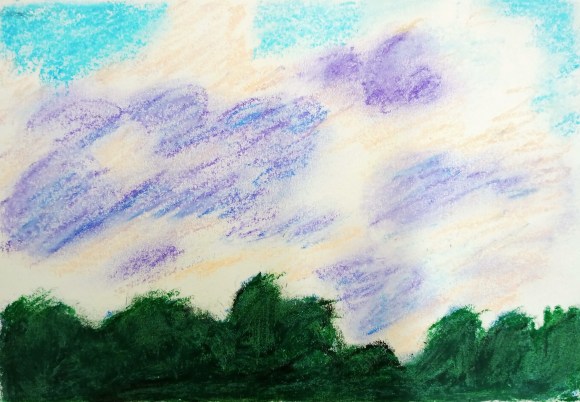
Art by Sohana Manzoor

We like to imagine ourselves as floating on clouds and therefore of the whole universe. Our team members are from multiple geographies and we request not to be tied down to a single, confined, bordered land. We would welcome aliens if they submitted to us from another galaxy…

On our Fifth Anniversary, we have collected celebratory greetings from writers and readers stretched across the world who share their experience of the journal with you and offer suggestions for the future. We conclude with words from some of the team, including my own observations on being part of this journey.

Aruna Chakravarti

Heartiest congratulations to Borderless on the occasion of its fifth anniversary! Borderless, an international journal, has the distinction of carrying contributions from many eminent writers from around the world. From its initiation in 2020, it has moved from strength to strength under the sensitive and skillful steering of its team. Today it is considered one of the finest journals of its kind. I feel privileged to have been associated with Borderless from its very inception and have contributed substantially to it. I wish to thank the team for including my work in their distinguished journal. May Borderless move meaningfully towards the future and rise to greater and greater heights! I wish it every success.

Professor Fakrul Alam

Five years ago, when Borderless set out on its literary voyage, who would have imagined the length and breadth of its imaginative crossings in this span of time? The evidence, however, is digitally there for any reader who has seen at least some of its issues. Creative writing spanning all genres, vivid illustrations, instant links giving resolute readers the option to track a contributor’s creative voyaging—here is boundless space always opening up for those seeking writing of considerable variety as well as originality. The best part here is that unlike name-brand journals, which will entice readers with limited access and then restrict their spaces unless you subscribe to them, all of Borderless is still accessible for us even though it has attracted a wide readership in five years. I certainly hope it will stay that way.

And what lies ahead for Borderless? Surely, more opportunities for the creative to articulate their deepest thoughts and feelings in virtual and seemingly infinite space, and innumerable avenues for readers to access easily. And let us hope, in the years to come Borderless will extend itself to newer frontiers of writing and will continue to keep giving space to new as well as emerging writers from our parts of the world.

May the team of Borderless, continue to live up to their claim that “there are no boundaries to human imagination and thought!”

Radha Chakravarty

Since its inception, Borderless Journal has remained true to its name, offering a vital literary space for writers, artists and scholars from around the world to engage in creative dialogue about their shared vision of a world without borders. Congratulations Borderless, and may your dream of global harmony continue to inspire.

Somdatta Mandal

According to the famous Chicana academic and theorist Gloria Anzaldua, the Borderlands are physically present wherever two or more cultures edge each other, where peopIe of different races occupy the same territory, where under, lower, middle and upper classes touch, where the space between two individuals shrinks with intimacy. Hatred, anger and exploitation are the prominent features of this landscape. There, at the juncture of cultures, languages cross-pollinate and are revitalized; they die and are born. Borders are set up to define the places that are safe and unsafe, to distinguish us from them. A border is a dividing line, a narrow strip along a steep edge. A borderland is a vague and undetermined place created by the emotional residue of an unnatural boundary. It is in a constant state of transition. The prohibited and forbidden are its inhabitants.

About five years ago, when a new online journal aptly called Borderless Journal was launched, these ideas which we had been teaching for so long were simply no longer applicable. Doing away with differences, with limits, it became a suitable platform where disparate cultures met, where people from all disciplines could express their views through different genres, be it poetry, translation, reviews, scholarly articles, creative writing and so on. Many new writers from different parts of the world became regular contributors to this unique experimentation with ‘borderlessness’ and its immense possibilities are very apt in this present global context where social media has already changed many earlier notions of scholarship, journalism, and creativity.

Jared Carter

In its first five years Borderless has become an important witness for international peace and understanding. It has encouraged submissions from writers in English based in many different countries, and has offered significant works translated from a wide range of national literatures. Its pages have featured writers based in India, Pakistan, China, Taiwan, Japan, South Korea, Australia, the UK, and the US. In the future, given the current level of world turmoil, Borderless might well consider looking more closely toward Africa and the Middle East. As the magazine continues to promote writing focused on international peace and freedom, new horizons beckon.

Teresa Rehman

The best part of this journal is that it is seamless and knows no margins or fringes. It is truly global as it has cut across geographical borders and has sculpted a novel literary genre called the ‘borderless’. It has climbed the mountains of Nepal, composed songs on the Brahmaputra in Assam, explored the hidden kingdom of Bhutan, walked on the streets of Dhaka, explored the wreckage of cyclones in Odisha, been on a cycling adventure from Malaysia to Kashmir, explored a scenic village in the Indo-China border, taken readers on a journey of making a Japanese-Malayalam dictionary, gave a first-hand account of the war in Bosnia-Herzegovina and described the syncretic culture of Bengal through its folk music and oral traditions. I hope it continues telling the untold and unchartered stories across mountains, oceans and forests.

Kirpal Singh

In a world increasingly tending towards misunderstandings across borders, this wholesome journal provides a healthy space both for diverse as well as unifying visions of our humanity. As we celebrate five distinguished years of Borderless Journal, we also look forward to another five years of such to ensure the underlying vision remains viable and visible as well as authentic and accurate.

My heartfelt Congratulations to all associated with this delightful and impressive enterprise!

Asad Latif

The proliferation of ethnic geographies of identity — Muslim/Arab, Hindu/Indian, Christian/Western, and so on — represents a threat to anything that might be called universal history. The separation and parcelling out of identities, as if they are pre-ordained, goes against the very idea (proclaimed by Edward Said) that, just as men and women create their own history, they can recreate it. Borders within the mind reflect borders outside it. Both borders resist the recreation of history. While physical borders are necessary, mental borders are not. This journal does an admirable job in erasing borders of the mind. Long may it continue to do so.  

Anuradha Kumar

I have been one of Borderless’ many readers ever since its first issue appeared five years ago. Like many others, I look forward with great anticipation to every issue, complete with stories, , reviews, poems, translations, complemented with interesting artwork. 

Borderless has truly lived up to its name. Within its portal, people, regardless of borders, but bound by common love for literature, and the world’s heritage, come together. I would wish for Borderless to scale even greater heights in the future. As a reader, I would very much like to read more writers from the ‘Global South’, especially in translation. Africa, Asia and Australasia are host to diverse languages, many in danger of getting lost. Perhaps Borderless could take a lead in showcasing writers from these languages to the world. That would be such an invaluable service to readers, and the world too.   

Ryan Quinn Flanagan

To me, Borderless Journal is a completely free and open space.  Topics and styles are never limiting, and the various writers explore everything from personal travelogues to the limp of a helpful druggist.  Writers from all corners of the globe contribute, offering a plethora of unique voices from countless circumstances and walks of life. Because of this openness, Borderless Journal can, and likely will continue to grow and expand in many directions simultaneously.  Curating and including many new voices along the way.  Happy 5th Birthday to a truly original and wonderfully eclectic journal!

George Freek

I feel the Borderless Journal fills a special spot in the publishing world. Unlike many journals, which profess to be open-minded and have no preference for any particular style of poetry, Borderless actually strives to be eclectic. Naturally, it has its own tastes, and yet truly tries to represent the broad spectrum which is contemporary poetry. I have no advice as to where it should go. I can only say keep up the good work, and stooping to a cliche, if it’s not broken, why try to fix it?

Farouk Gulsara

They say time flies when one is having fun. It sure does when a publication we love regularly churns out its issues, month after month, for five years now.

In the post-truth world, where everybody wants to exert their exclusivity and try to find ways to be different from the person standing next to them, Borderless gives a breath of fresh air. At a time when neighboring countries are telling the world they do not share a common history, Borderless tries to show their shared heritage. We may have different mothers and fathers but are all but “ONE”! 

We show the same fear found in the thunderous sounds of a growling tiger. We spill the exact hue of blood with the same pain when our skin is breached. Yet we say, “My pain is more intense than yours, and my blood is more precious.” Somehow, we find solace in playing victimhood. We have lost that mindfulness. One should appreciate freedom just as much as we realise it is fragile. Terrorism and fighting for freedom could just be opposing sides of the same coin.

There is no such thing as a just war or the mother of all wars to end all wars as it has been sold to us. One form of aggression is the beginning of many never-ending clashes. Collateral damage cannot be justified. There can be no excuse to destroy generations of human discoveries and turn back the clock to the Stone Age. 

All our hands are tainted with guilt. Nevertheless, each day is another new day to make that change. We can all sing to the tune of the official 2014 World Cup song, ‘Ola Ola,’ which means ‘We are One.’ This is like how we all get together for a whole month to immerse ourselves in the world’s favourite sport. We could also reminisce about when the world got together to feed starving kids in Africa via ‘Band-Aid’ and ‘We Are the World’. Borderless is paving the way. Happy Anniversary!

Ihlwha Choi

I sincerely congratulate Borderless Journal on its 5th anniversary. I am always delighted and grateful for the precious opportunity to publish my poetry in English through this journal. I would like to extend my special thanks for this.

Through this journal, I can read a variety of literary works—including poetry, essays, and prose—from writers around the world. As someone for whom English is a foreign language, it has also been a valuable resource for improving my English skills. I especially enjoy the frequent features on Rabindranath Tagore’s poetry, which I read with great joy. Tagore is one of my favourite poets.

I have had the privilege of visiting Santiniketan three times to trace his legacy and honor his contributions to literature and education. However, one aspect I find a little disappointing is that, despite having published over 30 poems, I have yet to receive any feedback from readers or fellow writers. It would be wonderful to have such an opportunity for engagement.

Additionally, last October, a Korean woman received the Nobel Prize in Literature—the first time an author from South Korea has been awarded this honor by the Swedish Academy. She is not only an outstanding novelist but also a poet. I searched for articles about her in Borderless Journal but was unable to find any. Of course, I understand that this is not strictly a literary newspaper, but I would have been delighted to see a feature on her.

I also feel honoured that one of my poems was included in the anthology Monalisa No Longer Smiles: An Anthology of Writings from across the World. I hope such anthologies will continue to be published. In fact, I wonder if it would be possible to compile and publish collections featuring several poems from contributing poets. If these were made available on Amazon, it would be a fulfilling experience for poets to reach a broader audience.

Moving forward, I hope Borderless Journal will continue to reach readers worldwide, beyond Asia, and contribute to fostering love and peace. Thank you.

Prithvijeet Sinha

The journey of authorship, self-expression and cultural exchange that I personally associate with Borderless Journal’s always diverse archives has remained a touchstone ever since this doorway opened itself to the world in 2020. Going against the ramshackle moods of the 2020s as an era defined by scepticism and distances, The journal has upheld a principled literary worldview close to the its pages and made sure that voices of every hue gets representation. It’s also an enterprise that consistently delivers in terms of goodwill and innocence, two rare traits which are in plenteous supply in the poems, travelogues, essays and musings presented here.

The journey with Borderless has united this writer with many fascinating, strikingly original auteurs, buoyed by a love for words and expression. It is only destined for greatness ahead. Happy Birthday Borderless! Here’s to 50 more epochs.

From Our Team

Bhaskar Parichha

As Borderless Journal celebrates its fifth anniversary, it is inspiring to see its evolution into a distinguished platform for discourse and exploration. Over the years, it has carved a unique niche in contemporary journalism, consistently delivering enlightening and engaging content. The journal features a variety of sections, including in-depth articles, insightful essays, and thought-provoking interviews, reflecting a commitment to quality and fostering dialogue on pressing global issues.
The diverse contributions enrich readers’ understanding of complex topics, with a particular focus on climate change, which is especially relevant today. By prioritising this critical issue, Borderless informs and encourages engagement with urgent realities.
Having been involved since its inception, I am continually impressed by the journal’s passion and adaptability in a changing media landscape. As we celebrate this milestone, I wish Borderless continued success as a beacon of knowledge and thoughtful discourse, inspiring readers and contributors alike.

Devraj Singh Kalsi

Borderless Journal has a sharp focus on good writing in multiple genres and offers readable prose. The platform is inclusive and does not carry any slant, offering space to divergent opinions and celebrating free expression. By choosing not to restrict to any kind of ism, the literary platform has built a strong foundation in just five years since inception. New, emerging voices – driven by the passion to write fearlessly – find it the ideal home. In a world where writing often gets commercialised and compromised, Borderless Journal is gaining strength, credibility, and wide readership. It is making a global impact by giving shape to the dreams of legendary poets who believed the world is one.  

Rakhi Dalal

My heartiest congratulations to Borderless and the entire team on the fifth Anniversary of its inception. The journal which began with the idea of letting writing and ideas transcend borders, has notably been acting as a bridge to make this world a more interconnected place. It offers a space to share human experiences across cultures, to create a sense of connection and hence compassion, which people of this world, now more distraught than ever, are sorely in need of. I am delighted to have been a part of this journey. My best wishes. May it continue to sail through time, navigating languages, literature and rising above barriers!

 Keith Lyons

Is it really five years since Borderless Journal started? It seems hard to believe. 

My index finger scrolls through Messenger chats with the editor — till they end in 2022. On the website, I find 123 results under my name. Still no luck. Eventually, in my ‘Sent’ box I find my first submission, emailed with high hopes (and low expectations) in March 2020. ‘Countdown to Lockdown’ was about my early 2020 journey from India through Thailand, Malaysia, Indonesia, and Australia to New Zealand as COVID-19 spread.

Just like that long, insightful trip, my involvement with Borderless Journal has been a journey. Three unique characteristics stand out for me. 

The first is its openness and inclusiveness. It features writers from all over the globe, with various contributions across a wide range of topics, treatments and formats. 

The second feature of the journal is its phenomenal growth, both in readers and writers, and in its reach. Borderless really does ‘walk the talk’ on breaking down barriers. It is no longer just a humble literary journal — it is so much bigger than that. 

The third unique aspect of Borderless is the devotion endowed in nurturing the journal and its contributors. I love the way each and every issue is conceived, curated, and crafted together, making tangible the aspiration ‘of uniting diverse voices and cultures, and finding commonality in the process.’

So where can we go from here? One constant in this world is change. I’d like to think that having survived a global pandemic, economic recession, and troubling times, that the core values of Borderless Journal will continue to see it grow and evolve. For never has there been a greater need to hear the voices of others to discover that we are all deeply connected.

Rhys Hughes

I have two different sets of feelings about Borderless Journal. I think the journal does an excellent job of showcasing work from many different countries and cultures. I want to say it’s an oasis of pleasing words and images in a troubled sea of chaos, but that would be mixing my metaphors improperly. Not a troubled sea of chaos but a desert of seemingly shifting values. And here is the oasis, Borderless Journal, where one can find secure ideals of liberty, tolerance, peace and internationalism. I appreciate this very much. As for my other set of feelings, I am always happy to be published in the journal, and in fact I probably would have given up writing poetry two years ago if it wasn’t for the encouragement provided to me by regular publication in the journal. I have written many poems especially for Borderless. They wouldn’t exist if Borderless didn’t exist. Therefore I am grateful on a personal level, as a writer as well as a reader.

Where can Borderless Journal go from here? This is a much harder question to answer. I feel that traditional reading culture is fading away year after year. Poets write poetry but few people buy poetry books. They can read poems at Borderless for free and that is a great advantage. I would like to see more short stories, maybe including elements of fantasy and speculative fiction. But I have no strategic vision for the future of the journal. However, one project I would like to try one day is some sort of collaborative work, maybe a big poem with lots of contributors following specific rules. It’s an idea anyway!

Meenakshi Malhotra

Borderless started with a vision of transcending the shadow lines and has over time, evolved into a platform where good writing from many parts of the world finds  a space , where as “imagination bodies forth/ The forms of things unknown, the poet’s pen/Turns them to shapes and gives to airy nothing/A local habitation and a name.”

It has been a privilege to be a part of Borderless’s journey over the last few years. It was a journey based on an idea and a vision. That dream of creating solidarity, of transcending and soaring over borders and boundaries, is evident in almost every page and article in the journal.

Mitali Chakravarty

Looking at all these responses, thinking on what everyone has said, I am left feeling overwhelmed.

Borderless started as a whimsical figment of the imagination… an attempt to bring together humanity with the commonality of felt emotions, to redefine literary norms which had assumed a darker hue in the post Bloomsbury, post existentialist world. The journal tried to invoke humour to brings smiles, joys to create a sense of camaraderie propelling people out of depression towards a more inclusive world, where laughter brings resilience and courage. It hoped to weave an awareness that all humans have the same needs, dreams and feelings despite the multiple borders drawn by history, geographies, academia and many other systems imagined by humans strewn over time.  

Going forward, I would like to take up what Harari suggests in Homo Deus — that ideas need to generate a change in the actions of humankind to make an impact. Borderless should hope to be one of the crucibles containing ideas to impact the move towards a more wholesome world, perhaps by redefining some of the current accepted norms. Some might find such an idea absurd,  but without the guts to act on impractical dreams, visions and ideas, we might have gone extinct in a post-dino Earth.

I thank the fabulous team, the wonderful writers and readers whose participation in the journal, or in engaging with it, enhances the hope of ringing in a new world for the future of our progeny.
Categories
Essay

How Dynamic was Ancient India?

Farouk Gulsara discussed William Dalrymple’s latest book

Growing up in the later part of the 1970s, kids of my generation were drilled with stories that India was a subcontinent of poverty, filth, and pickpockets. Even our history books taught us that it was a land of darkness, living in its myths, superstitions, and cults, waiting to be civilised by the mighty European race and their scientific discoveries. 

That was what was impressed upon us as we sauntered into adulthood. The media did not help either. With eye-catching news like a particular Indian Prime Minister having his daily dose of gau mutra[1] for breakfast and another ousted after thirteen days of taking oath as the Prime Minister, India was made out to be just another third-world country. Then came the 21st century and the turn of tides. Locally bred academicians started teasing deeper into India’s forgotten history. They started doubting the self-deprecating history that was taught to them by leftist historians in the textbooks.

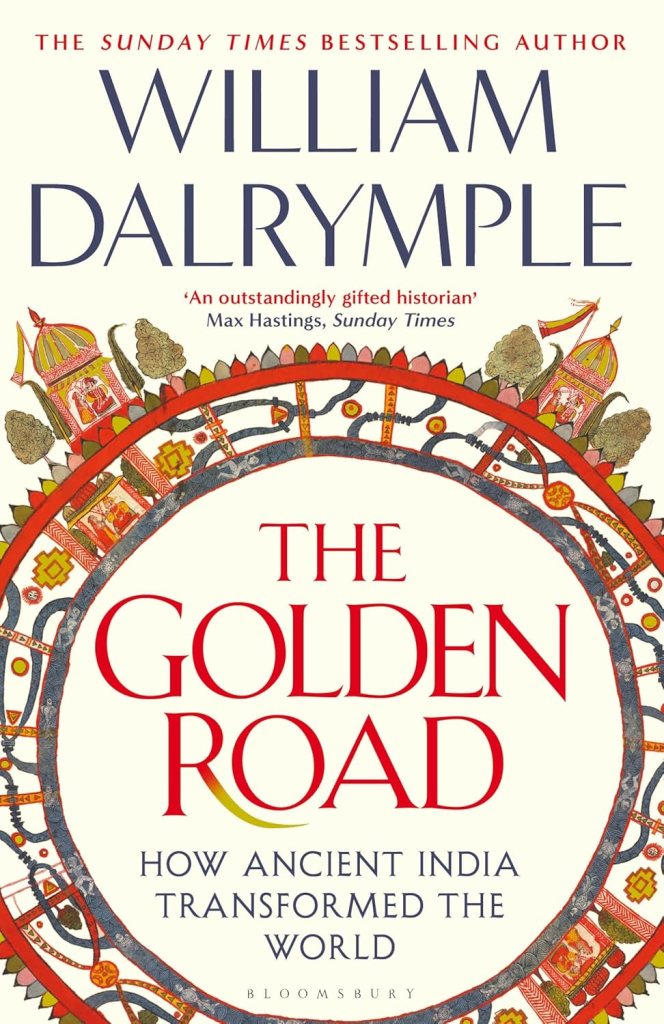
Like many historians before him, historian William Dalrymple, in his latest book, The Golden Road: How Ancient India Transformed the World outlines the importance of India as a cradle of knowledge that peddled wisdom to regions near and far. Its scientific knowledge was far ahead of its time. This know-how was put into practice and spread via trade routes. Their port of entry received not just their goods but also their culture and way of life.

Enduring attack after attack from foreign invaders, Indians had already forgotten their glorious past by the time of the British Raj. A tiger hunting expedition inadvertently brought British hunters to various beautiful cave carvings and Buddhist sculptures. That kind of rekindled India’s history, which had disappeared from the Indian imagination.

India had been a crucial economic fulcrum and a civilisational engine in early world history. As early as 31BCE, Indians had learnt to manipulate the monsoonal winds to steer their ship to the West to the prosperous kingdom of Ethiopia, Egypt and subsequent access to the Mediterranean. With their mammoth merchant ships, they transported pearls, spices, diamonds, incense, slaves and even exotic animals like elephants and tigers in exchange for gold. Trade favoured India so much that a Roman Naval Commander, Pliny the Elder, lamented the unnecessary spicing of the food and the almost transparent Indian fabric that left nothing to the imagination. It is said Buddhism reached the shores of Egypt through these ships. The Christian monastic way of life is said to have been influenced by these monks.

With seasonal monsoon winds, Indian ships brought not just trade but philosophy, politics, and architectural ideas to Southeast Asia, China, and even Japan. All this cultural allure and sophistication did not happen through conquest. Sanskrit was the language of knowledge and a conduit for spreading knowledge. 

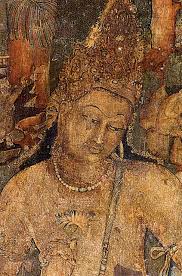
Buddhism emerged in the 5th century BCE as an alternative to caste-centred and animal sacrifice-filled rituals. Unlike Jainism’s strict austerities, it offered a middle path. Due to King Ashoka’s untiring efforts, Buddhism spread beyond its borders. Contrary to the belief that Buddhism promotes an impoverished way of living, early Buddhists drew interests (and resources) from the merchant group, as evidenced by the Ajanta Caves’ findings. Buddhism drew many Chinese scholars to India’s centres of higher learning in Nalanda and Kanchipuram in the South to get first-hand experience reading Buddhist scriptures in Sanskrit. India’s universities later became the template for other varsities the world over. 

India’s cultural influence on South Sea Asia is phenomenal. Stories from Indian epics, Ramayana and Bhagvad Gita, are told and retold in children’s stories, plays and cultural art forms. Their ruling elites were Hindus. The biggest Hindu and Buddhist temples are not in India but in Cambodia and Java, respectively, as Angkor Wat and Borobudur. Marvellous stony statues and temple are similar to those in India. At a time when the Byzantines were presiding over Europe, the Suryavarman clan was ruling a Hindu Empire so huge it would dwarf their European counterpart.  

The 5th to 7th century of the common era was the golden age of Indian mathematics. Between Aryabhata and Brahmagupta, their knowledge of the nine-number system (and zero) brought them the know-how of negative numbers, algebra, trigonometry, algorithms and astronomy far ahead of their time. They understood that Earth was a sphere spinning on its axis, about the eclipse, gravity and planetary rotations. The Indians even built a space observatory tower in Ujjain to study constellations and devise a solar calendar. The idea of a prime meridian arose from here. 

In the 8th century, the Abbasids exerted control over the Afghanistan region through treaties with local viziers. At that time, the Bamiyan region in Afghanistan had over 460 monasteries and 10,000 monks. A member of an influential Buddhist family, the Barmakid, converted to Islam to establish his family in the Abbasid fold. They brought Indian medicines, texts, and scholars with them and encouraged and promoted Islamic engagement with the East. Sanskrit texts were translated into Arabic. It is said that the Barmakids were instrumental in the building of Baghdad. 

The Islamic hegemony spread, as did the scholarship it had built. 

The Bamakid-Abbasid liaison met a tragic end due to palace power dynamics. The Abbasids started looking at the Romans for inspiration. Many Europeans were drawn to the Golden Age of Islam. Many texts were translated into Latin. Toledo of Andalusia introduced the science of timekeeping from Ujjain to Oxford. A particular young Italian named Leonardo of Pisa picked up the beauty of Mathematics during his stay in Algeria. He returned to publish ‘Liber Abaci‘ (The Book of Calculation) in 1202, which introduced Europe to the sequence of Fibonacci numbers and the mystic power of mathematics. This sudden gush of knowledge spurred the European Renaissance.  

The whole cycle completed its full arc when European powers rose to great heights. Benefitting from the knowledge from India that layered its way through, passing from hand to hand, the colonial masters returned to chop off [2]the hands that had nourished it. 

Emerging rejuvenated from their occupation-induced slumber, with their Anglophilic familiarity, Indians have risen from the ashes to claim their status in the Indosphere[3], a world where Indian influences permeated every layer of society.

This well-researched, unputdownable book is for all history buffs. Infused with little nuggets from cover to cover that would excite nerds, it is a joy to read about the history of India in a way that is not often told in the mainstream.

[1] Gau mutra, cow urine, has a sacred role in some forms of Hinduism and Zoroastrianism and is used for medicinal purposes and in some Hindu ceremonies.

[2] https://www.thedailystar.net/lifestyle/special-feature/the-muslin-story-187216#

[3] Indosphere is a collective linguistic term for areas under Indian linguistic influence. It includes countries in the Southern, Southeast, and East Asian regions. 22 languages, including Indo-European and Dravidian languages, are recognised under this category and are considered to have originated in India. 

Farouk Gulsara is a daytime healer and a writer by night. After developing his left side of his brain almost half his lifetime, this johnny-come-lately decided to stimulate the non-dominant part of his remaining half. An author of two non-fiction books, Inside the twisted mind of Rifle Range Boy and Real Lessons from Reel Life, he writes regularly in his blog, Rifle Range Boy.

.

PLEASE NOTE: ARTICLES CAN ONLY BE REPRODUCED IN OTHER SITES WITH DUE ACKNOWLEDGEMENT TO BORDERLESS JOURNAL

Click here to access the Borderless anthology, Monalisa No Longer Smiles

Click here to access Monalisa No Longer Smiles on Kindle Amazon International

Categories
Essay

A Doctor’s Diary: Syncretic Festivities

By Ravi Shankar

I fondly remember my first place of work after graduation and the lessons it taught me. My education and house surgency had prepared me well for medical practice. I was removed from the cocoon of my alma mater and learned to practice medicine in the community. I have not visited the place after I left, and the ensuing three decades must have brought about a lot of changes. Unsure if any of my colleagues are still working at the hospital.  I owe a debt of gratitude to the nurses, fellow resident doctors, specialists and others who got me started on the long road toward independent medical practice!

I recall… in the 1990s, the time was after two in the afternoon when I reached Perumpaddapa in Malappuram district of Kerala state in India. I had used public transport. Public transport in Kerala is mainly provided by private buses. I was happy to meet two of my seniors working at the KMM hospital as medical officers. The hospital had advertised a resident medical officer (RMO) post in local dailies, and I had travelled to apply for the position.

Coincidentally, two seniors both had the same name as me — Ravi, and they strongly recommended me for the position. The Medical Superintendent was a paediatrician. Based on my academic records and my friends’ recommendations, I was offered the position. The hospital was a busy one and it was my first job after graduation and house surgency. Soon we had three Ravis as RMOs at the hospital. The other two RMOs were named Abdul Ghafoor.

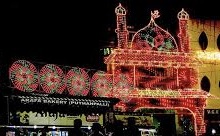
The hospital was next to the famous Puthenpalli (new mosque in Malayalam) and was located at the Southern border of Malappuram district. There was a strong influence from the neighbouring district of Thrissur where I did my undergraduate medical degree. The nearest town was Kunnamkulam. I had frequented the town many times before. We, the RMOs were posted in different departments, and had to take emergency duty in turns. There was an emergency duty room. We spent the evening and night there while on duty. The hospital had a psychiatry department and a coronary care unit (CCU). These were not common in the 1990s. In the evening, we accompanied the psychiatrist and the internal medicine specialist on their rounds in the psychiatry ward and the CCU. The hospital was not built to a central plan, and buildings had been added as per need leading to a warren of buildings and structures.

During the mornings I worked in the Paediatrics outpatient department (OPD) and assisted the Paediatricians. Our lead child specialist was very popular in the region and had a lot of patients. Most doctors working in the hospital did private practice in the afternoon and evenings. On my non-duty days, I would be free by around two in the afternoon. I stayed in a quarter provided by the hospital. The quarter was a two-story building surrounded by swaying coconut and betel nut trees. I was on the top floor and my apartment had a small sit out, a living room and a bedroom and a kitchen. There were two quarters on the top floor while the ground floor only had one large quarter occupied by our orthopaedic surgeon. There were two buildings in proximity.

The rooms had basic furniture —  armchairs, cots and beddings. There were no curtains and old fashioned open wooden cupboards fitted into the walls. These consisted of wooden planks and frames recessed into the wall. These are often depicted in older Malayalam movies.

I occasionally made house calls. The region had a lot of individuals working in the ‘Gulf’. Remittances had made the region prosperous.   

It was a short three-minute walk to the hospital. Puthenpalli was a popular place for pilgrimage. The mosque contains the maqbara (grave) of a renowned Sufi saint, Sheik Kunjahmed Musaliyar. Devotees believe that his blessings keep the place safe and radiant. The consecrated water at the mosque is believed to have divine healing powers.

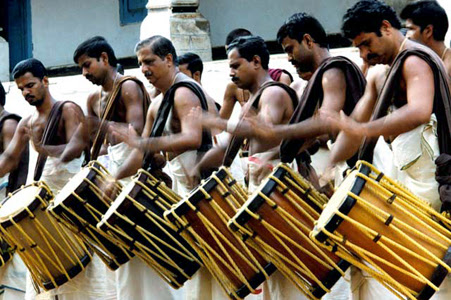
Puthenpalli Nercha[1] was the annual festival and drew pilgrims from far and wide. Ghee rice was distributed to the pilgrims and the needy. Ghee rice is a popular delicacy in the Malabar region. The flavour was largely syncretic as the festival was in December around Christmas and it catered to all communities irrespective of religious inclinations. A grand procession involving elephants and traditional musical performances like Chenda Melam using the traditional drums of Kerala and Mapila Pattu… dances like Kol Kali and Duffu Muttu followed.

It is typical of Kerala that religious festivals have both a religious and a community purpose. Over centuries, different religions have co-existed in harmony. Elephant processions are common in Hindu temple festivals and are also increasingly used in church and mosque celebrations.

In the olden days these festivals were also important locations for commerce as various stalls were set up selling a variety of goods. Today with online shopping sites and home delivery this may be less important though the shopping attraction still exists. These festivals enable people to forget the challenges of daily life and be transported to a different world for a few days. The Hindu festivals are called Poorams or Velas, the Christian ones are termed Perunnal and the Muslim ones are called either Nercha or Perunnal. Puthenpalli Nercha also boasted a mesmerising fireworks display at night.

The mosque committee served the community by running a school and an orphanage.

We were provided with food from the school hostel. The food was usually par boiled rice and sardines. We were provided with both spicy sardine curry and sardine fries. Two sardines in the curry and two or three well fried and crispy ones for both lunch and dinner. Eating the same food day after day could get a bit boring though! There would also be a vegetable that used to vary daily. And Kerala papadam. The Kerala fish curry used plenty of coconut and tamarind. A coconut and chilly paste was coated on the sardine and it was then deep fried in coconut oil before being part of the curry. Shallots, Kashmiri chillies and curry leaves are common ingredients. I discovered as you travelled up the Malabar coast toward Mangalore, the coating became less spicy.

The emergency department was busy during the evenings, but things usually quietened down at night. I always found night duty tiring as it took me a long time to go back to sleep after attending to a case. Injuries were common and we also received psychiatric patients for admission to the psychiatry ward and cardiac patients as we had an CCU. We were not sufficiently trained to handle aggressive patients. We did have a security person on duty outside the emergency. There were also other security personnel on duty at the entrance to the CCU and at different outpatient departments.     

The hospital was surrounded by village homes, and we often walked along the quiet by lanes. The quarter next to me on the top floor was occupied by a lab technician and he was good company and had a wealth of stories to tell. The buses were usually very crowded.

The coast was not far, and you could also walk on the beach and watch the fishermen set out in their boats. The mosque was usually crowded. There were no academic activities at the hospital, and we learned by doing. We would get a break after finishing our night duty and I used to combine my leaves and spend two or three days with my uncle in Palakkad once every two months. KMM hospital was a good place to work. I eventually left to join a small hospital and clinic at Areacode further north in the same district.

[1] The Perumpadappu Puthen Palli Nercha is a Muslim festival that celebrates Marhoom Kunji Mohammed Musaliar. https://www.keralatourism.org/1000festivals//assets/uploads/pdf/1515486704-0.pdf

.

Dr. P Ravi Shankar is a faculty member at the IMU Centre for Education (ICE), International Medical University, Kuala Lumpur, Malaysia. He enjoys traveling and is a creative writer and photographer.

.

PLEASE NOTE: ARTICLES CAN ONLY BE REPRODUCED IN OTHER SITES WITH DUE ACKNOWLEDGEMENT TO BORDERLESS JOURNAL

Click here to access the Borderless anthology, Monalisa No Longer Smiles

Click here to access Monalisa No Longer Smiles on Kindle Amazon International

Categories
Essay

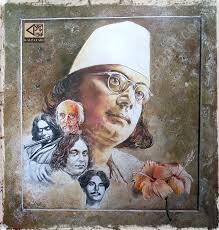
The Comet’s Trail: Remembering Kazi Nazrul Islam

By Radha Chakravarty    


The abiding image of Kazi Nazrul Islam (1899-1976) is that of the “Rebel Poet,” who defines himself as a fiery comet streaking across the firmament, emblazoning in the sky a message of revolutionary change. Unlike Rabindranath Tagore, Nazrul was not born into social and intellectual privilege. He has been described, in fact, as “the ‘other’ of the elite Kolkata bhadralok”.[1] Born in Churulia village in the Bardhaman district of Bengal, Nazrul was the son of the head of a mosque, studied in an Islamic school, and during his youth, joined a Leto group, a travelling band of local performers. When in high school, he was recruited into the British army, and served in Karachi. Even after he returned to Bengal as a young poet who had already acquired fame and repute, he remained something of an outsider to the intellectually sophisticated world of the literati. It was from this position of an outsider that he fashioned his own image as the bidrohi or ‘Rebel poet’ who challenged the structures of the political, social, cultural and literary establishment with the sheer force of his iconoclastic writings.

Though best known as a poet, composer and revolutionary, Nazrul’s oeuvre also includes novels, essays, stories, editorials and journalistic pieces on a remarkable variety of topics. He was also a lyricist and composer, creator of the iconic genre called “Nazrulgeeti”. Nazrul’s brilliant literary career lasted from 1919 to 1942, when illness brought it to a sudden end. During this short span of time, he wrote on an amazing range of subjects, including politics, nationalism, social change, religion, communalism, education, philosophy, nature, love, aesthetics, literature and music. He saw it as his mission to arouse public awareness about pressing issues, and to jolt them out of their complacency and general apathy. Remembering Nazrul on the 48th anniversary of his death, it is daunting to think about his extraordinary legacy, but also a timely moment to reflect upon his significance for our own times.

In his political stance, Nazrul argued passionately in favour of armed struggle for total independence from colonial rule, rejecting the Gandhian path to advocate a freedom won via armed resistance. The trope of violence recurs in his writings. Yet his apparent espousal of the principle of destruction springs from a utopian dream of constructive change. “Reform can be brought about, not through evolution, but through an outright bloody revolution,” he says in the essay ‘World Literature Today’. “We shall transform the world completely, in form and substance, and remake it, from scratch. Through our endeavours, we shall produce new creation, as well as new creators”.[2]

Nazrul’s ideas on education counter the colonial pattern, advocating instead a curriculum that draws on indigenous contexts and models. He feels that the new education policy should emphasise empathy, inclusiveness and heterogeneity, with a special focus on psychological and emotional development. “It is our desire that our system of education should be such that it progressively makes our life-spirit awakened and alive,” he says in ‘A National Education’, adding: “… We would rather produce daredevils than spineless young men.” [3]

Inclusiveness and acceptance of heterogeneities are central to Nazrul’s vision. During his stint as a soldier in Karachi in his young days, he became interested in Marxist thought. The influence of this line of thinking can be felt in his emphasis on economic egalitarianism, and his passionate support of the cause of the downtrodden peasantry, particularly in his journal Langal. Following the 1926 riots in Kolkata, he expresses his anguish at the communal antagonism between Hindus and Muslims, critiquing different forms of orthodoxy in both religions. In the poem ‘Samyabadi (Egalitarian)’ [4], he declares:

I sing the song of equality—
Where all divisions vanish and barriers dissolve,
Where Hindu-Buddhist-Muslim-Christian
merge and become one …

Nazrul was also a supporter of women’s rights. In his poetry, he speaks of equality between men and women. In ‘Nari (Woman)’ he argues: “If man keeps woman captive, then in ages to come, / He will languish in a prison of his own making”.[5]

Not surprisingly, Nazrul’s fearless, unconventional attitude aroused hostility in many quarters. His bold, outspoken magazine Dhumketu enraged the British. The journal was banned, and Nazrul condemned to rigorous imprisonment. At his trial in 1923, he delivered a resounding rejoinder in his speech ‘Rajbandir Jabanbandi (Deposition of a Political Prisoner)’.  He remained a thorn in the flesh for the British administration because of his revolutionary views. Nazrul’s religious views also raised many hackles. He married Ashalata Sengupta, or Pramila, who belonged to the Brahmo Samaj. This antagonised conservative Hindus as well as orthodox Muslims.

Nazrul’s success as a writer, especially Rabindranath Tagore’s appreciation of his work, also caused jealousy among contemporary writers. For Tagore had dedicated his play Basanta to Nazrul, and also sent a telegram to him when he was in prison, exhorting him to give up his hunger strike. In 1922, Tagore had written a poem addressed to Nazrul, which appeared in successive issues of the journal Dhumketu[6]:

Come, O shining comet! Blaze
Across the darkness, with your fiery trail.
Upon the fortress-top of evil days,
Let your victory-pennant sail.
What if the forehead of the night
Bear misfortune’s sinister sign?
Awaken, with your flashing light,
All who lie comatose, supine.

Rabindranath Tagore’s recognition of Nazrul’s talent created a lot of envy in literary circles. In 1926-27, parodies of Nazrul’s poetry started appearing in Shanibarer Chithi, a journal published by the Tagore circle. It came to be rumoured that Tagore had not liked Nazrul’s use of the Persianate word khoon (blood) instead of the Sanskritised word rakta, in his composition ‘Kandari Hushiar’. This gave rise to a controversy that became known as khooner mamla (the bloody affair), which drew a strong reaction from a deeply perturbed Nazrul, in the shape of an essay ‘Boror Piriti Balir Baandh” (A Great Man’s Love is a Sandbank)’, in which he blamed Tagore’s followers for the entire misunderstanding. The situation was resolved through the mediation of friends, and relations between Tagore and Nazrul remained cordial. When Tagore died in 1941, Nazrul broadcast a moving elegy, “Robi-Hara”, on Calcutta Radio.

In some ways, Nazrul was ahead of his time. Not many people know that he was aware of environmental issues and the threat of climate change, pressing problems in our own times. In ‘The Day of Annihilation’, he writes in a prophetic vein, of global warming, dissolving ice-caps and a changing ecology, cautioning his readers that if humans exploit the planet, we will eventually be responsible for the destruction of life on earth.

In Nazrul’s life and writings, we encounter the constant pull of contraries. His consciousness was simultaneously rooted in local culture, and infused with a broad transnational spirit. He felt inspired by movements in other parts of the world, such as the Turkish Revolution, the Irish Revolution and the Russian Revolution. In the essay ‘Bartaman Viswasahitya (World Literature Today)’, we discover his awareness about literary developments across the globe. In his political writings he espouses the path of violence, but he also composes exquisitely tender love songs, devotional songs drawing on both Hindu and Muslim imagery, and songs about the beauty of nature.

Nazrul’s style is a volatile mix of colloquial, idiomatic expressions, formal Bengali, Sanskrit and Persianate vocabulary, a smattering of English, and multiple registers of language. His polyglot sensibility also surfaces in his practice as a translator. He translated Omar Khayyam and Hafez from Persian into Bengali. His translations from Arabic into Bengali include 38 verses of the Qu’ran, part of the Mirasun Nagmat (a treatise on Hindustani classical music) and some poems. He translated Whitman’s ‘O Pioneer’ from English into Bengali. He is also known for his innovative ghazals in Bengali.

In 1942, Nazrul suddenly lost his speech. His illness brought his literary life to an abrupt end. All the same, the impact of his writings continued to be felt. In the Bangladesh Liberation War of 1971, the freedom fighters adopted Nazrul’s music as a source of inspiration. He was later declared the National Poet of Bangladesh. Today, while Nazrul’s poems and songs continue to delight and inspire, the true extent of his achievement remains in shadow. It is time for a comprehensive reappraisal of this much underestimated literary genius, because his writings have so much to offer us in our present world.

[1] The Collected Short Stories of Kazi Nazrul Islam, ed. Syed Manzoorul Islam and Kaustav Chakraborty (Hyderabad: Orient Blackswan, 2024), p. xviii. Bhadralok translates to gentleman

[2] Kazi Nazrul Islam, Selected Essays, translated by Radha Chakravarty (New Delhi: Penguin Random House, 2024), p. 137.

[3]  Kazi Nazrul Islam, Selected Essays, trans. Radha Chakravarty (2024), p. 60.

[4] Translation by Radha Chakravarty

[5] Translation by Radha Chakravarty

[6] The Essential Tagore, ed. Fakrul Alam and Radha Chakravarty. Cambridge, Massachusetts: Harvard University Press, 2011, pp. 115-116; Translation mine.

Radha Chakravarty is a writer, critic, and translator. She has published 23 books, including poetry, translations of major Bengali writers, anthologies of South Asian literature, and critical writings on Tagore, translation and contemporary women’s writing. She was nominated for the Crossword Translation Award 2004.

.

PLEASE NOTE: ARTICLES CAN ONLY BE REPRODUCED IN OTHER SITES WITH DUE ACKNOWLEDGEMENT TO BORDERLESS JOURNAL

Click here to access the Borderless anthology, Monalisa No Longer Smiles

Click here to access Monalisa No Longer Smiles on Kindle Amazon International

Categories
Stories

Roberto Mendoza’s Memoirs of Admiral Don Christopher Columbus

A fiction by Paul Mirabile

I, Roberto Mendoza, in this year 1550, ship’s boy on Christopher Columbus’ first and second voyages to the West Indies before my promotion to sailor on his third and fourth voyages, testify to the veracity of the eye witness events that I record for posterity. And in spite of their devastating raw truth, it is my troubled conscious that has conducted my hand, goaded my intelligence to write down these sorrowful facts. For facts they are, regardless of the prestige and boons that Columbus received from his protectors and admirers.

Where shall I begin? How do I burrow through the layers of unquestionable fame that has marked that name to reverberate with the clanking of the slave chains, the death rattles in the gold and silver mines, the gnashing of teeth, the hangings and dismemberments … the insensible apathy of the subjugation or submission of the Indian masses?

It has always appeared to my young eyes that Columbus’ achievements were enveloped in an aura of mystery or incomprehension. I may even add an aura of fantastic falsifications, mainly initiated and authorised by Columbus himself and his unquestioning gallants.

I knew him well, too well to be duped by those seductive charms of his, that subtle cunning, a mask donned whenever a fruitful occasion arose, yet under which lay a brutal, tyrannical individual bent on attaining his greatest ambition: wealth and glory, and this at any price. What was the little ditty that some fool invented for innocent children and naive adults to recite: “In fourteen ninety-two Columbus sailed the ocean blue?” A ridiculous rime to recall that wretched year. Yes, I say that wretched year for it celebrated the Genoan hero’s glorious voyage.

During that fatal year of 1492, two other major events occurred in Spain which I believe to be in relation to Columbus’ conniving his way into Isabella’s confidence: the expulsion of the Jews to North Africa, Italy and Constantinople, and the capitulation of Granada, the last stronghold of the Muslims in Spain, to the Christian kings. Henceforth, Spain rid herself of those ‘impure’, centuries-laden ‘foreign’ plunderers. Did not Columbus write in his logbook (if we are to believe Bartolomé de Las Casas’s transcribed copy of it) that he was overjoyed by those two events: ”thus you (the Monarchs) have turned out all the Jews from your kingdoms and lordships”, and ”the royal banners have been placed on the towers of Alhambra”[1].

This being said, because of the expulsion and the reconquest, Columbus’ true birthplace had to be concealed, for any negotiation with Isabella or Ferdinand. This hero was not born in the city of spaghetti and banks, Genova, as commonly known. The darling of the Spanish monarchy was born in the land of the corsairs, in Calvi, a lovely port town in Northern Corsica, indeed conquered by the Genovans and governed by them during five centuries, but none the less born and bred far from the banks of Italy. Corsica, where for centuries Vandals, Ostrogoths, Greeks and Lombards, and ill-bred Aragonese and Genovans vied for domination, intermingling, integrating and assimilating.

Why would Columbus lie about his place of birth? Was it out of fear of a possible ‘corsair descent’? One that connoted piratry, pillage and other misdeeds [2]? Be that as it may, the rogue managed to cajole Queen Isabella into giving him enough maravedis[3] to undertake a voyage that would heighten the glory of the conquering Spanish Monarchy and the new-founded kingdom.

And that was how Admiral Don Christopher Columbus frayed his way to fame and fortune!

With the Queen’s glittering maravedis he commissioned three caravels : the Nina, the Pinta and the Santa Maria, the third of which he navigated himself, the other two by the Pinzón brothers. How I happened to be aboard the Santa Maria is a long story with which I shall not bore my readers.

So there he stood at the prow, mantled in a vaporous circle of pride and arrogance whilst we, his sea-faring companions, sweated away on deck or in the hold, were fed rotten food, furled and unfurled the sails without respite, hunted out the innumerable rats that ran amok below, withered under the insufferable heat of September. I myself almost fainted under the long, long hours of tedious work, boredom and especially fear; fear that we and our tiny caravel, surrounded by thousands of leagues of far from blue waters, would be food for the horrible undersea monsters that had swallowed many a brave crew and their vessels with yawning jaws and leathery tentacles. All of us were terrified, and the five weeks we spent crossing a swelling ocean towards the East, or so we all thought, triggered a feeling of panic, alienness and remorse. The admiral described the ocean like a river; I myself felt like a cork in a rainswept pond, jostled and jolted, no land in sight, our water and meat, taken aboard at the Canary Islands, foul-tasting, half-eaten by the enormous black rats.

Did the great Admiral not consult the stars? Eastward? There was nothing — only rolls and rolls of higher and higher walls of water battering the fragile sides of our vessels. And I, so young, asked myself time and time again, how did an incompetent sea-faring fellow like Columbus ever win the confidence of Isabella and Ferdinand ? Oh how I recall his bulky figure at the prow, oftentimes behind the helm, screaming orders or simply staring out into the watery vastitude, dreaming no doubt of gold … gold … and more gold … He had written the word ‘gold’ seventy-five times in his logbook during the first two weeks of our crossing!

How many of our poor sailors had been beaten for insubordination, had suffered the excruciating trial of keelhauling[4], one or two even hanged for attempting mutiny, so fearful were they of being devoured by sea monsters, dying of thirst or hunger or being bitten by the furry rats that thrived below in our beds of straw?

At long last I heard the cry “Land ahoy!” coming from the crow’s nest. Yes, we finally reached a cluster of islands that would be named Guanahani[5], Cuba, Haiti and the Dominican Republic on the maps of future cartographers. It was on these islands that my first glimpses of a barbaric and despotic Columbus would not only be corroborated, but magnified to the heights of psychopathic insanity. For it became more and more evident to me that the Admiral, whom I considered in my youthful age as a hero, had no intentions of treating the indigenous peoples of these islands either as equals or with a soupçon of humane sympathy. He indeed judged them somewhat higher than animals, yet whose only human value was how much they would bring him as slaves sold in Spain, or how much gold and silver they would extract for him from the mines and rivers. All he saw in these peaceful peoples was the glitter of gold fastened to their noses and the rings of equal glitter hanging off their ears and arms. He saw gold everywhere, even gold stones shining in the rivers! He wrote in his logbook that gold grew in clusters and could be plucked off trees like fruit!

The way in which he ferreted information out of the Indians about gold deposits turned my stomach. His obsession with gold drove him into periodical frenzies during which time he would beat, even torture the poor indigenous man or woman who failed to locate the deposits. He spent his sweltering nights tossing and turning in bed, totally possessed by this maniacal craving.

But his brutality was not limited in this direction: The Spaniards or other Europeans who disobeyed  him or sought to outmanoeuvre him in the pursuit of power or riches were tracked down and hanged, accused of criminal acts. His barbarity knew no bounds, nor his slave-selling which began to enrich him immensely.

On our second and third voyages, which led us to the islands of Granada and Tobago, the abundance of gold extracted was tantamount to the number of Indians he enslaved for his own ‘household’ purposes, and those he sold into a slavery which by then had become a thriving, lucrative business. We navigated from island to island sowing the seeds of destruction as the stoic Admiral described their beauty, the exotic animals and birds, and especially the immense, awaiting riches buried under that beauty. How many of the indigenous he had killed when several tribes revolted against him, and how many committed suicide cannot be accurately tallied. I would learn much later that Las Casas put that tally at 1,500 Taion Arawaks.

Indeed, as time went by Columbus’ wrath found merciless outlets against Indians and Europeans alike as the settlements grew in economic and political importance. Indians who failed to extract enough gold from the mines had one of their arms cut off[6]. On many occasions he had rebellious Spaniards dismembered in public much to the outrage of the governors appointed to the settlements by the Spanish Monarchy.

The governors of these settlements began sending reports to the King and Queen relating the horrendous behaviour of Columbus, his obsession for power and riches, his masquerading as a ruling god-like figure over the ignorant natives. Testimonies piled higher and higher on the Queen’s pearl-inlaid writing-table, relating cases of rape, murder and mutilation.

On his return trip to Spain she immediately had him seized, chained and thrown into prison. She also expropriated all his extorted possessions, be they gold or land. There he rotted away for six weeks, so enraged was the Queen, betrayed by this ‘foreigner’. However, his brother Bartholomew, on his knees, pleaded tearfully in favour of his brother’s heart of gold, his innocence in all matters of governance, having been slandered by the governors and their lackeys who wrote defamatory reports to wreak vengeance upon a man whose glory and greatness surpassed theirs. The Queen hesitated. It was King Ferdinand who decided to have him released.

His release from prison had puffed up his ego, unlocked his megalomania.

Columbus’ fourth and last voyage, between 1502 and 1504 with four caravels, took us to Martinique, Honduras, Jamaica, Costa Rica and Nicaragua. I had been appointed a full-fledged sailor by then and relished the idea of accompanying the Admiral, jotting down all his actions, prudently of course, so that I would not to be arrested for bearing witness to his ruthlessness, perhaps even hanged as a traitor. The ‘civilising’ process undertaken by him included plundering, murdering, enslaving and mutilation. Amidst the unbridled violence and sadism, he posed as an evangelist, a disinterested zealot deeply desirous to convert the ‘savages’ into God-fearing Christians, into ‘civilised’ beings like himself.

Columbus returned to Spain a hero of piety, magnanimity, sanctity. The impostor even wrote two books : the Book of Privileges[7] in 1502, an indecent mass of statistics which enumerate all his accumulated rewards wrested from the Crown under which lay the beaten and mutilated bodies of the indigenous, and the Book of Prophecies[8] in 1505, a shameful scream of smut comprising hundreds of citations from the Bible, all of which spell out in his vapid style his Christian ‘mission’ in the New World, ever so charitable and lenient towards the ignorant, child-like ‘natives’ ; a mission, indeed, pure in spirit, rightful in act.

With Columbus’ death the unwarrantable fervour that he had kindled slowly shrivelled into ashes. I retired from sea-life and found work in the Custom’s Bureau, a most comfortable employment. Besides, I was disgusted by all the tales told about him by the sailors, especially their bawdy narratives about the native women in the New World. I wished to leave my sea-legs behind and tread more earthy paths. Furthermore, my new tasks gave me ample time to read the posthumous reports about Columbus[9], many of which belied the benignant deeds and bountiful achievements of the monarchial and New World idol. It was after these important readings that I decided to begin my memoirs …

The rogue’s Book of Prophecies created quite a stir amongst the aristocratic castes : Columbus’ fantasies of promoting Isabella and Ferdinand as heads of a new crusade to the Holy Lands to defeat the Muslims, and there spread Christianity kindled many a nostalgic and gun-ho heart. The monarchs, wary of the old Admiral’s apocalyptic inaccuracies and religious bigotry, never took him seriously. I wonder if they had even read his book …

None the less, Columbus certainly provided an excellent example for other freebooters to follow in the wake of his doughty adventures. The slave trade between the Old and the New World thrived as well as the gold and silver that flooded the Spanish markets. It is no mere metaphor that this period in Spain was called as El Siglo de Oro (The Golden Century).

.

[1]          Bartolome de Las Casas (1484-1566) a Dominicain priest who spent forty years in Hispaniola (Haiti and the Domican Republic) transcribed an abstract of Columbus’ lost logbook. How accurate or truthful is this copy is difficult to assess. Journal of the First Voyage of Christopher Columbus (1492-1493), translated by Clements R. Markhma : London, Hakluyt Society, 1893, pp. 15-93

[2]          Corsica : Columbus’ Isle, Joseph Chiari, edition Barrie and Rockcliff, 1960.

[3]          Gold coins used in mediaeval Spain during the 11th and 14th centuries.

[4]          A maritime punishment by which the sailor is ‘hauled’ under the ‘keel’ of the ship with ropes.

[5]          As called by the Indians. Columbus called this island San Salvador. Today it is called Watling.

[6]          On this point see Howard Zinn, Christopher Columbus and Western Civilization, Open Magazine Pamphlet Series, 1992.

[7]          El Libro de Privilegios. The English edition : Book of Privileges, The Claiming of the New World, John W. Hessler, 2014.

[8]          El Libro de Profesías. The English edition : Book of Prophecies, Repertorium Columbianum, Blair Sullivan, 2004.

[9]         Columbus and Las Casas : Two Readings on the Legacy of Columbus (1542 (The Devastation of the Indians. A brief Account) and 1550 (In Defense of the Indians).

Paul Mirabile is a retired professor of philology now living in France. He has published mostly academic works centred on philology, history, pedagogy and religion. He has also published stories of his travels throughout Asia, where he spent thirty years.

PLEASE NOTE: ARTICLES CAN ONLY BE REPRODUCED IN OTHER SITES WITH DUE ACKNOWLEDGEMENT TO BORDERLESS JOURNAL

Click here to access the Borderless anthology, Monalisa No Longer Smiles

Click here to access Monalisa No Longer Smiles on Amazon International

Categories
Poetry

A Beach Novel with a Difference…

In Conversation with Suzanne Kamata about Cinnamon Beach, published by Wyatt Mackenzie Publishing, and a brief introduction to her new novel.

Cinnamon beach by Suzanne Kamata seems to be ostensibly a normal romantic novel but there is an aspect that makes it unique. It glues all colours of humanity together. Almost all the families in her narrative are of mixed heritage or multiracial. She has stepped beyond the veneer of race and nationality to highlight that all humanity has the same needs— for love, acceptance and kindness, irrespective of colour and creed, a gentle reminder in a world that is moving towards polarisation in terms of constructs made by human laws.

Set against the backdrop of the Cinnamon Beach, the narrative shuttles through two countries that she has called home — Japan and USA. There are autobiographical elements woven into the narrative but perhaps, they halt in becoming lived experiences. The protagonist, upcoming writer, Olivia Hamada, an American married to a Japanese, has lost both her job and finds her marriage in doldrums when she visits her sister-in-law, Parisa. Parisa is a renowned fashion designer, daughter of an immigrant Indian and has lost her husband, Ted, Olivia’s elder brother. It is a poignant story with Olivia and her deaf daughter, Sophie, falling in love with a star, Devon, and his son, Dante respectively — both persons of colour. Devon’s ancestors were brought in from Africa. So how mixed are the races – Sophie is half Japanese-half American and Dante is part African-part American!

The narrative start simply and gains nuances as it progresses. There are comments and conversations that introduce twists and turns to explore attitudes and prejudices.

At a point Kamata tells us: “She’d heard, several years ago, of a revolt at a liberal college cafeteria in protest of its serving sushi. And there was that dust-up over a reality TV star using the name ‘kimono’ for her new line of shapewear. Perhaps she had been wrong to ever go to Japan in the first place. But she had done it and she had gone and written a collection of short stories heavily inspired by events in her real life, and now, here she was.” The bias against Japan that led to the destruction of Hiroshima and Nagasaki are hinted at conversationally – world events that conspired more than eighty years ago. Why do such biases still exist today when we have moved forward so much technologically?

When Olivia asks Devon why he never liked to talk race or indulge in activism, he tells her, “It’s just that I would rather build bridges than burn them.”

And he explains further, “Sometimes taking a stand on issues creates more division.”

Religious observances seem to be unboxed too with Buddhist, Hindu and Christian customs intermingled. All festivals become a celebration of love and acceptance. Her world is idyllic when it comes to interactions between the lead characters. Living in a city like Singapore, that does not seem an impossibility as many are of mixed origins. 

One would hope that the whole world will eventually learn that all these differences are only the colours of the rainbow, as shown in Kamata’s novel. The novel ends on a note of hope — hope for a new beginning and for love and for a multiracial relationship.  

Kamata’s style is fluid. The situations and events are so much a part of the lived reality that you can almost feel and see the characters come to life. Anyone can enjoy the novel, whether as a light read or to find the nuances that explore the need for the redefinition of societal norms. With her smooth and untroubled storytelling, Kamata leaves it to the reader to decide what they want to find in her storytelling. Nothing is coerced or made incomprehensible.

With a number of novels, short stories and poetry collections under her belt, as an award-winning storyteller, Kamata guides us through her world skilfully leaving us with a feeling of having made new friends and gained deeper insight into myriad colours of humanity. In this interview, she talks about her writing, her novel and beyond.

Tell us when you started writing? And how?

I have been writing since I was a child. I loved reading, so perhaps it was natural that I would start to make up my own stories. I got a lot of encouragement from my teachers and parents, which inspired me to continue.

How many novels have you written in all? And which has been your favourite?

I have written seven, including young adult novels and one for middle grade readers. At the moment, Cinnamon Beach is my favourite, maybe because it’s shiny and new.

You do stories for children too and poetry. Tell us a bit about those.

I subscribed to a magazine called Ladybug for my children when they were young. I decided to try writing a story and submitting it to the magazine, and it was accepted. Other stories, inspired by my children, followed. For example, my son requested a baseball story. My middle grade novel, Pop Flies, Robo-pets and Other Disasters is the result of that.

What is your favourite genre to read and to write?

I prefer to read and write realistic fiction. The age level doesn’t really matter. I personally read everything from picture books to middle grade novels to adult novels.

How did Cinnamon Beach come about? How long did it take you to write the novel?

This was my pandemic book. I wrote most of it within a year, which is unusual for me. It usually takes me about four years to finish something. But I had a lot of free time during the pandemic, when I was alone in my office, and I wrote. I was kind of obsessed with what was happening in the United States, where things were much, much worse than where I live in Japan. I actually made a visit to the US at the height of COVID-19 because my father broke his hip. So, my thoughts were turned toward South Carolina, where my parents and sister-in-law live. Also, I had been thinking about writing a multicultural beach novel for some time. I enjoy reading novels set at the beach, but they usually feature only white people. My family is very diverse, so when we go to the beach together there is a very interesting mix of cultures. I wanted the book to reflect that.

 What kind of research went into it?

As I mention above, I did visit South Carolina during the pandemic. I also talked about it with my sister-in-law, who is Indian American. She gave me some ideas and commented on the final draft. Other than that, I went for a lot of walks on a nearby beach here in Japan.

In Cinnamon Beach, you have woven in autobiographical elements. Tell us how much of it is from your lived experiences.

A lot of it starts with something true and then leaps into “what if”? I did lose my brother, but not during the pandemic. He died in 2019, and I attended his funeral, but what if he had died a year later, when travel restrictions were in place? Also, I did have a work experience similar to Olivia’s. I brought my story to a newspaper, but I found a new job before the story was published, and I asked that it not appear in print after all. But what if I had allowed it to be published? My daughter is deaf and she uses an app to communicate with non-Japanese users. As far as I know, she doesn’t have a secret boyfriend, but what if she did?

You have written of nepotism in a Japanese University. Is that based on your experiences, facts or is it fiction?

Olivia’s experiences at a Japanese university are based on mine. People often get jobs through connections in Japan.

Having been married to a Japanese for a number of decades, what are the cultural differences? How do you bridge them? Is that woven into your narrative?

There are so many! There are a lot of little ones, such as my husband’s expectation for homemade soup with every meal (which I find troublesome to prepare), and my expectation for some sort of celebration on my birthday (which is rarely met). And there are many greater differences. For example, I feel that people don’t take gender harassment as seriously in Japan as they do in my native country, or that they are unaware of what it means. Also, Americans are very forthcoming about mental health issues, whereas it seems more secret and shameful to talk about them in Japan. I don’t know that my husband and I have necessarily bridged our cultural differences, but I have accepted that we think differently about many things. Olivia is divorced, so she and her Japanese husband did not bridge them very well.

Are mixed marriages more common in Japan or America? Please elaborate.

Mixed marriages are much more common in the United States than in Japan. Marriages between Japanese men and Western women are quite rare. According to Diane Nagatomo’s Identity, Gender, and Teaching English in Japan, in 2013, less than 2 percent of the 21,488 marriages registered in Japan between a Japanese and foreign national were between Japanese men and American women. I doubt that those numbers have changed much.

Do such families — with Western, Japanese, Indian and black, exist outside your fiction? Please elaborate.

Certainly. The ethnic mix of the family in Cinnamon Beach is based on that of my own family. As another example, Nikki Haley, the former governor of South Carolina, is an Indian American married to a white man. Their daughter married a black man. Many children of my Western friends who are married to Japanese have partners who are of other cultures (neither Japanese, nor Western). I think Third Culture Kids tend to be very open to people from other cultures.

 What books, stories, music impact your writing and how?

In the case of Cinnamon Beach, having read beach novels by authors such as Elin Hilderbrand, Dorothea Benton Frank, Mary Alice Monroe, Patti Callahan Henry, Kristy Woodson Harvey and Sunny Hostin made me want to write my own beach novel. I don’t know that music influences my writing, because I write in silence, but it was fun to come up with a playlist of songs that related to the book.

Having said that, I love music and I have known people in bands. The music world is fascinating to me, and I have created musician or music-adjacent characters in other books as well. The character Devon was inspired by the Black American  Country and Western singer Darius Rucker. I knew him a bit in college, because he and his then-band sometimes practiced in the house next to mine. 

What are your future plans? What other books can we look forward to from you soon?

Next up in a short story collection, River of Dolls and Other Stories, which will be published in November by Penguin Random House SEA. And I also have an essay collection (mostly travel narratives) in the works. Will keep you posted!

Thank you for giving us a lovely novel and your time.

(The online interview has been conducted through emails and the review written by Mitali Chakravarty.)

Click here to read an excerpt from Cinnamon Beach

PLEASE NOTE: ARTICLES CAN ONLY BE REPRODUCED IN OTHER SITES WITH DUE ACKNOWLEDGEMENT TO BORDERLESS JOURNAL. 

Click here to access the Borderless anthology, Monalisa No Longer Smiles

Click here to access Monalisa No Longer Smiles on Kindle Amazon Internation

Categories
Conversation

‘Home has been a Process of Lifelong Search’

In Conversation with Kirpal Singh

Dr Kirpal Singh

 “Singapore is intimately linked with home and, yet for me, home has always been a process of lifelong search. Partly because of the early months of my birth. The record says I was born in March 1949, but the time was not certain as I do not have a birth certificate. My father forgot to register my birth,” reminisces Dr Kirpal Singh, an internationally recognised scholar. Born in the Straits Settlement of Singapore, before the island emerged as an independent entity, he has lived through much of history. He tells a story of multi-racial, multi-cultural growth that the island afforded him.  

His father, he tells us, was “well known throughout Malaya — Jeswant Singh nicknamed as ‘Just One’ — a boxer who would knock people down with his left hook. In 1954, he left boxing when he killed someone during a match.” His mother, a Jewish Scot who he cannot recollect, he tells us, “ might have been David Marshall’s sister according to my stepsister but no one else has said that.”  Marshall[1] was the first Chief Minister of Singapore from 1955 to 1956 and then Singapore’s Ambassador to France, Portugal, Spain, and Switzerland 1978 to 1993. He is the founder of the Worker’s Party. His parents had emigrated from Baghdad to Singapore in 1908 according to current resources.

How did Singh’s parents come to be in Singapore? Were they immigrants or colonials?

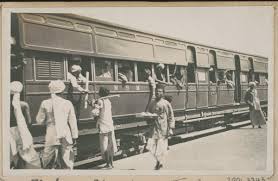
He responds with what he knows: “My grandfather and grandmother came to Singapore on board a ship in 1900. They left Jullunder, Punjab, in 1899. By the time they reached Singapore, it was the end of 1900. They left to seek their fortune. They were from the farming community. My grandfather was only sixteen and my grandmother was about twelve. They were in transit in Penang for six months. They came to Singapore in 1901. Actually, it was all Malaya — Singapore was part of the Straits Settlement. They came to Singapore by train. Trains were just starting out. It was around August 1901.

Trains in Malaya

“My uncle was conceived during this journey. They halted in Singapore for only two or three weeks. My grandfather’s cousin was in Perak[2], in Malaya. So, he wanted to be with his cousin. His cousin had cattle. Most of the Sikhs were cattle farmers. They settled in Pahang[3], an area which eventually became a nuclear dump[4] for Australia. It is closed to public now. There was a stone that proclaimed the land was a nuclear dump when I went with my son a few years ago.

“My father moved to Singapore as his prospects were better here as a boxer. This is where he met my mother. I was born here. He actually met mum because my mother’s two brothers had invited her to come from Glasgow. My mother is Scottish, from an industrial background. Her brothers came to the Far East to make money.  She finished her school leaving exams and came to visit her brothers during her vacation. She would go with her bothers to watch boxing, where she saw my father, the champ. She was only fifteen or sixteen. The next thing the brothers knew was she was pregnant with me.”

Jeswant Singh was popular with colonials. Kirpal Singh tells us: “Some Europeans saw him box and offered him a job then in the Base Ordinance Depot. This was the British Military camps in the Far East. There were three bases in Singapore: the naval base, Kranji and one in the South. He worked there for thirty years and retired after that. In 1972[5], after the final British withdrawal from Singapore, dad’s formal employment status ended. After that he just did odd jobs, ending up as a security guard, looking after the factories in Jurong, earning about two to three hundred dollars a month.”

Kirpal Singh spent his childhood with his grandmother and uncle. Before he started schooling, his father left him with his grandmother and divorced his mother in favour of a new bride. Dr Singh tells us the story of how he returned to Singapore: “I was basically in Perak with my grandmother. My uncle, who was the first Sikh to become a Christian in Southeast Asia, left home because his father gave him a beating for changing his religion. My uncle was an Anglican. His conversion saved him from the Great Depression as the clergy was very well looked after. From 1929 to 1933, the church looked after him because he was the priest in Seramban. My father was still young. My uncle was born in 1911 and my dad in 1923. My grandmother bore eighteen children. Five of the infants passed away before they were one month old. But thirteen survived. She passed away at 95… I knew when I left for my doctorate programme in Adelaide that that was the last time I would see her. I had a hunch and was crying on the plane. Six weeks later, I got a letter with the news of her death.”

He adds: “Dad was in not in a position to look after me. The responsibility fell on his brother William. His full name was William Massa Singh s/o Deva Singh. He had studied at the Ipoh Chinese school, topped the school, eventually worked as an insurance agent. He was very good in English. The principal of his school, a New Zealander, arranged for my uncle to move to Singapore. Then my father moved there too. Singapore was the metropolis even then. It was the centre of English education. Penang was the other one. In 1956, I was sent to Singapore from Perak on a train — a one-and-a-half-day journey to my uncle.”

His grandmother joined them within a few months as his uncle was, he says, “more interested in aiding Lee Kuan Yew get rid of the colonials. Lee Kuan Yew was a self-made man. He met Goh Keng Swee[6] and Rajaratnam[7] as students in England. They became buddies and wanted to move out of colonial rule and be independent.”

Then, how did a young child survive? Dr Singh tells us: “I used to earn my pocket money from age five six by watering gardens. I have had very interesting experiences. When I was in primary two, I used to give tuition to primary one students. With enough gumption, you can survive in this world.”

“I grew up with my uncle’s wards, who were brought home to be educated. There was even one who was a Chinese-Japanese mix. So, I grew up being familiar cross-cultural marriages and in a multicultural home. I grew up in the kampong with a Chinese boy and we became friends from the age of seven-and-a-half when we were in primary two. His name is Tan Jwee Song — I call him Jwee, ‘my good saint’.  He told me after O-levels he would support me to study further and took to teaching. At that time, you could become a teacher after completing your O level. I joined Raffles late during my time in high school because it was too expensive for me. I taught in night classes started by Lee Kuan Yew and studied. I owed Jwee $80,000 dollars and I wanted to pay his widow back — but she would not accept it. When I graduated in 1973 with an honours’ degree, I was $44 thousand in debt. Then, I was given a scholarship.”

And slowly, Kirpal Singh came to his own. When television came into being, he tells us: “I was often on TV in 1970s — days of early television — debates and interviews as a guest.” Kirpal Singh grew into an intellectual of repute as he worked and studied with the support of the many races and many people who, often like him, were migrants to Singapore.

As time moves forward, these stories — that are almost as natural as the sand, the wind and the sea — ask to be caught in words and stored for posterity, stories from life that show how narrow borders drawn by human constructs cannot come in the way of those with ‘gumption’.

(Written by Mitali Chakravarty based on a face to face conversation with Kirpal Singh. Published with permission of Kirpal Singh)

[1] https://www.roots.gov.sg/stories-landing/stories/david-marshall/story

[2] Now in Malaysia

[3] Now in Malaysia

[4] https://buletinonlines.net/v7/index.php/lynas-radioactive-waste-to-be-dumped-in-pahang-tax-free-while-australia-gets-a18-million-in-taxes-2/

[5] The British armed forces were scheduled to withdraw from Singapore by 1971. https://eresources.nlb.gov.sg/infopedia/articles/SIP_1001_2009-02-10.html#:~:text=On%2018%20July%201967%2C%20Britain,Singapore%27s%20defence%20and%20economic%20security.

[6] Deputy Prime Minister of Singapore, 1973-1980, one of the founding members of the ruling PAP (People’s Action Party) https://www.roots.gov.sg/stories-landing/stories/goh-keng-swee/story

[7] Deputy Prime Minister of Singapore from 1980 to 1985, one of the founding members of the ruling PAP https://www.roots.gov.sg/stories-landing/stories/sinnathamby-rajaratnam/story

PLEASE NOTE: ARTICLES CAN ONLY BE REPRODUCED IN OTHER SITES WITH DUE ACKNOWLEDGEMENT TO BORDERLESS JOURNAL. 

Click here to access the Borderless anthology, Monalisa No Longer Smiles

Click here to access Monalisa No Longer Smiles on Kindle Amazon Internation


Categories
Review

The History Teacher of Lahore by Tahira Naqvi

Book Review by Somdatta Mandal

Title: The History Teacher of Lahore: A Novel

Author: Tahira Naqvi

Publisher: Speaking Tiger Books

Tahira Naqvi, the Pakistani American writer, has extensively translated the works of Saadat Hasan Manto, Khadija Mastur, Hajra Masroor, and the majority of works by Ismat Chughtai from Urdu into English. As a teacher/professor of Urdu language and literature at New York University, she has regaled us with several short stories that speak of cross-cultural encounters of immigrant Pakistanis in America, especially about how women experience acculturation in the New World. The History Teacher of Lahore is her first novel where she recollects the sights, sounds, and ambience of growing up in Lahore in intimate details. The setting of this novel is the nineteen eighties, which was particularly a time of unrest in Lahore. In this debut political novel, Naqvi eloquently portrays the struggle between a besieged democracy and the rise of Islamic fundamentalism on the one hand, and the thriving cultural traditions of Urdu poetry on the other.

The story begins with the young protagonist Arif Ali who moves from his hometown of Sialkot to Lahore with a dream of being a history teacher and a poet. A ‘tall, slight man in his late twenties,’ we find him relaxing on a bench in Jinnah Park — a place that has become haven for him to spend his time reading, far away from the ferocity of traffic and street crowds. In the days that followed, Arif realised that in the Government Model School for Boys where he taught, he was forced to teach the boys another kind of history for his sake as much as theirs. But that required deep thought, time, and enthusiasm. He befriended Salman Shah, another teacher in his school, and his rapport with him grew stronger by the day. But once again, Arif found the atmosphere in the school was becoming increasingly confining. He would often engage in animated chatter with the high school Islamiyat teacher Samiullah Sheikh, whom he found disagreeable. Not only dressed in Shariyah compliant clothes, but this man was also waiting for his opportunity to teach at a madrassah[1]. This was the period when bans were being imposed on popular music of the kind Nazia Hasan and her brother sang for the younger generation, and even though ‘Disco Deewane’ and ‘Dreamer Deewane’ were sung loud, fear had become an elixir for rebellion. Arif was forced to resign from the school and along with his friend Salman. he ultimately got another position as a history teacher in another private school, Lahore Grammar Institute, where there was more freedom to teach than in the earlier one. The free socializing among the sexes here was new and noteworthy for Arif.

As Arif’s impotent rage towards the increasing religious intolerance grew, he joined his friend’s uncle Kamal and his partner Nadira to secretly help them rescue underprivileged children in clandestine ways. In the meantime, his poetic creations found great impetus when he found a secret admirer in Roohi, Salman’s sister, and started sending her his poems regularly. Though they never met, Roohi would write letters to him every week, and gradually, the more letters Arif received from her, the more his feelings for her grew. The secrecy of their epistolary courtship continued for quite some time till things were disclosed and after a lot of twists and turns in the story, they were finally engaged to get married.

In the meantime, his friend Salman got engaged to a colleague Zehra Raza, and despite the Shia-Sunni clashes that prevailed in society all around, they were unaffected by such ideology. The three of them developed a close camaraderie among themselves, but soon after, the General’s death brought in a lot of political turmoil in the city. The mentality of the public also changed, people went en-masse to watch public flogging, and trouble loomed ahead when Sunni Shia, Ahmadi non-Ahmadi, Punjabi Urdu-speaking, Protestant-Catholic, divisions and sub-divisions, inter-faith, inter-class and inter-religion issues became more and more marked in all spheres of society. The warp and weft of faith produced such tangled intricacies as could only be imagined in nightmares.

As the nation was caught in the vortex of religious extremism, Arif’s position also underwent a great change in the school when he wanted to teach ‘true’ history to his students. He was caught in a dilemma when he found he was forced to teach false historical information in the doctored textbook that Aurangzeb with his hatred of other religions was adored whereas Akbar with more religious tolerance was totally sidelined. He tried to rectify the errors by providing supplementary notes to his students, but that landed him in more trouble. Apart from differences of opinion with the other teachers in school, Arif’s was gripped with a kind of fear and frustration when some unidentified goons threatened him to stay away from issues that did not concern him. Things got worse when a Christian student in his class was falsely accused of blasphemy and Arif decided to save him from being arrested. He embarked on a dangerous mission to resolve this Christian-Muslim conflict that landed him in the middle of sectarian clashes and without giving out all the details, one just mentions that the novel ends at a tragic moment.

In the acknowledgement section Naqvi states that she is grateful to her father for many things but especially for his Urdu poetry which she has used freely in translation. These poems, ghazals and nazms, help to explain the different moods of the protagonist and his mental situation very clearly. One interesting aspect of the novel is that each of the twenty-two chapters is prefaced by a small quote that in a way summarizes the mood and content of that chapter. Most of these quotes are from Jean-Paul Sartre, while others are from Spinoza, Ghalib, Shakespeare’s Sonnet 116, H.W. Longfellow, Jacques Derrida, Tertullian, Thomas Mann, and four entries particularly from The Lahore Observer dated 15 September 1990, December 1990, January 1997, and January 1998 respectively. These wide-ranging quotes not only increase the story-telling impact, but also endorse the erudition of the novelist herself.

To conclude we can say that Bapsi Sidhwa’s The Ice-Candy Man gave us the sights, sounds and details of Lahore during the Partition in 1947, and the same city becomes wonderfully alive again through the pen of another woman writer from Pakistan who had spent her growing years there, and who gives us details about it from the 1980’s onwards when  the political situation of the country was once again very murky. The novel wonderfully portrays the radical Islamisation of the country that included murder, mayhem, and public flogging and more that was visible in Lahore, as this process resulted in terrible uncertainty in the lives of the city’s residents from all walks of life. Strongly recommended for all readers, we eagerly wait for more novels by Tahira Naqvi in the future. The insider-outsider’s point of view offered by her is remarkable and this debut novel can be counted as a collector’s item.

[1] Muslim religious school

Somdatta Mandal, critic and translator, is a former Professor of English from Visva-Bharati University, Santiniketan, India.

.

PLEASE NOTE: ARTICLES CAN ONLY BE REPRODUCED IN OTHER SITES WITH DUE ACKNOWLEDGEMENT TO BORDERLESS JOURNAL

Click here to access the Borderless anthology, Monalisa No Longer Smiles

Click here to access Monalisa No Longer Smiles on Kindle Amazon International

Categories
Review

The Warrior Queen of Awadh

Book Review by Somdatta Mandal

Title: Begum Hazrat Mahal: Warrior Queen of Awadh

Author: Malathi Ramachandran

Publisher: Niyogi Books

Over the past few decades there has been a surge in the publication of Indian historical fiction where the authors are fascinated by India’s rich past, and the many human stories of love and loss buried beneath the larger narratives. Simplistically speaking, historical fiction is a literary genre in which the plot takes place in a setting related to the past events, but is fictional.  An essential element of historical fiction is that it is set in the past and pays attention to the manners, social conditions, and other details of the depicted period. Authors also frequently choose to explore notable historical figures in these settings, allowing readers to better understand how these individuals might have responded to their environments. After The Legend of Kuldhara (2017) and Mandu (2020), Malathi Ramachandran has now presented us with a fascinating novel, Begum Hazrat Mahal: Warrior Queen of Awadh (2023). She endeavours in her novel not just to re-create history as it happened long ago, but to also explore the lives and relationships of those who lived in those times.

The setting of the novel is Lucknow, 1857 where the First War of Independence against the British is fought. Wajid Ali Shah, the last Nawab of Awadh has been exiled by the British to Calcutta along with his courtiers and his coterie some months ago. Only his second wife, the beautiful queen Begum Hazrat Mahal, who had refused to accompany her husband to Calcutta stays back with her young twelve-year old prince Birjis Ali. Hazrat vows to fight the British and win back her beloved Awadh for her people and the crown for her son. She builds a rebel army and high drama ensues as they besiege the Residency, the walled British cantonment, for five months. A fictional saga based on actual events, this book takes us within the walls of the Residency where love and passion rage alongside the battle, and into the world of Begum Hazrat and her loyal band. From the beginning we encounter Hazrat’s interactions with Major Kenneth Murphy, the Company’s liaison officer who is enamoured by the beauty of the Begum and succumbs to her machinations. She wants his help to crown Birjis Ali the next Nawab and win back their lands and their properties. Then there are many stereotypical British characters – women who came from England to seek husbands and worked in evangelical missions, doctors, sergeants, and officers who took up native women for sexual gratification, and the like.

When Hazrat decides on action against the Angrez1, she forms baithaks2 comprising of the rich and poor, powerful and subordinate, Hindu, Muslim and Christian, all of whom feel that they had had enough of subjugation by these tyrants from another land. They would not take any more of their religious conversions, their oppression on the streets, their suppression in the garrisons. Her friendship with Jailal Singh, based on a shared love for Hindustan, blossomed and he promised her his allegiance in the fight against the British. She had found in Jailal a confederate, an able accomplice.

A large section of the narrative is then devoted to the details of the fight that ensued. There were times when the natives thought that they had managed to restrict the British soldiers from winning; at other times the tide of fortune turned in their disfavour when even after forming women’s brigade and defiant groups among the natives, success didn’t come in their favour. The reader is kept guessing whether the rebel army would storm the British bastion before their relief forces arrived or the tide would turn in a wave of loss and grief, crushing Hazrat Mahal’s dream for Awadh and her son. In November 1858, after more than nine months of fighting in Lucknow, and finally establishing complete control over North India, the Governor General, Lord Canning, presided over the Queen’s Durbar in Allahabad and read out the Proclamation from Queen Victoria. The territories of India, up until now governed by the East India Company, would now come directly under the Crown, and be governed by the Queen’s civil servants and military personnel.

After several turns of incidents Hazrat realises that defeated she and her army may be, but they would never be vanquished in spirit. In her chamber in the Baundi fort, she paces back and forth, the printed proclamation crumpled in her hand. Her close supporters watched in mute frustration. She would never agree to the British offer of clemency with all its benefits. She would rather live in penury than become one of their vassals. Deep inside the stone fortress, she sits huddled in her quilt, and feeling the loneliness and desolation of one who had fought and lost everything. The story ends with Hazrat and her son silently leaving the already orphaned Awadh and heading into the forests to cross over to Nepal on the other side and seek asylum there.  

Malathi Ramachandran must be appreciated for the racy narrative style of the novel that does not weigh down under the plethora of historical events. Here one must mention the similarity of incidents narrated about the plight of another Indian queen in another historical fiction titled The Last Queen written by Chitra Banerjee Divakaruni. This novel also tells us the story of Jindan Kaur, Maharaja Ranjit Singh’s youngest and last queen, his favourite. She became regent when her son, Dalip, barely six-years-old, unexpectedly inherited the throne. Sharp-eyed, stubborn, passionate, and dedicated to protecting her son’s heritage, Jindan distrusted the British and fought hard to keep them from annexing Punjab. Defying tradition, she stepped out of the zenana, cast aside the veil, and conducted state business in public. Addressing her Khalsa troops herself, she inspired her men in two wars against the ‘firangs3.’ Her power and influence were so formidable that the British, fearing an uprising, robbed the rebel queen of everything she had, including her son. She was imprisoned and exiled. But that did not crush her indomitable will. Like Begum Hazrat Mahal, she also had to live the last years of her life in exile, shorn of all her power and wealth. In both the novels, we learn about the strong and determined will power of Indian women who wanted to retain the pride of their motherland despite all odds and machinations of the British. A perfect blending of fact with fiction, the novel is strongly recommended for all categories of readers, serious and casual alike.

  1. British ↩︎
  2. Concerts ↩︎
  3. Foreigners ↩︎

Somdatta Mandal, author, critic and translator, is former Professor of English at Visva-Bharati University, Santiniketan, India.

PLEASE NOTE: ARTICLES CAN ONLY BE REPRODUCED IN OTHER SITES WITH DUE ACKNOWLEDGEMENT TO BORDERLESS JOURNAL

Click here to access the Borderless anthology, Monalisa No Longer Smiles

Click here to access Monalisa No Longer Smiles on Kindle Amazon International

Categories
Interview Review

Is Mitra Phukan a Modern-Day Jane Austen?

In Conversation with Mitra Phukan about her latest novel, What Will People Say? A Novel , published by Speaking Tiger Books, March 2023

What will people Say? A Novel by Mitra Phukan, a well-known writer from Assam, plays out like a sonata with fugues introducing complexities into the narrative. It concludes in a crescendo of hope with an acceptance of love. At the end, Phukan writes: “It was love. A love great enough to conquer all the ‘What Will People Says’.”

What is remarkable about the novel is the light touch with which it deals with major issues like communal tensions, acceptance of love across divisive human constructs and questioning of social norms. She elucidates: “I have written What Will People Say in a conversational, everyday style, sprinkled liberally with humour, even though the themes are very serious.”

Phukan’s novel moves towards a more accepting world where social norms adapt to changing needs — perhaps an attitude we would all do well to emulate, given the need for a change in mindsets to broach not only divisive societal practices but the advancing climate crises which calls for unconventional, untried steps to create cohesive bonds among humanity.

The story is set in a small town in Assam called Tinigaon. Where the protagonist, Mihika, a widow and a professor, upends accepted social norms with her budding romance to a Muslim expat, a friend of her deceased husband. She has strong supporters among her family and friends but faces devastating social criticism and even some ostracisation. This makes her think of giving up the relationship that drew her out of the darkness of widowhood.

Suffering during widowhood is a topic that has been broached by many Indian writers ranging from Tagore, Sunil Gangopadhyay to many more. Before the advent of these writers, in 1856, the Hindu Widows’ Remarriage Act was brought into play by the efforts of Ishwar Chandra Vidyasagar, who had also written on the issue. But despite the law, has it as yet been accepted by conventional society? And how would such a society which bases its perceptions on rituals and traditions respond further to a relationship that discards marriage as a norm? These are questions that Phukan deals with not only in her novel but in the conversation that follows.

The plot showcases an interesting interplay of different perspectives. In certain senses, it has the delightful touch of a Jane Austen novel, except it is set in India in the twenty first century, where relationships are impacted by even social media. Phukan, herself, sees “ageism” and female bonding and friendship” as major issues addressed in the novel. She says that women’s bonding is a theme that “has not been focused on enough, at least in Assamese writing”, even though, it is a fact that this has been the focus in other literature like, Jane Austen’s novels written in the nineteenth century and in subsequent modern-day take-offs on her novels, like the The Jane Austen Book Club by Karen Joy Fowler, published in 2004. In the sub-continent, Begum Rokeya described a full woman’s utopia in Sultana’s Dream (1905), though Rokeya’s story is essentially a feminist sci-fi. Unlike Rokeya’s book, Phukan’s is not an intense feminist novel. The protagonist, Mihika, has men well-wishers and men friends-cum-colleagues too. The tone is lighter and makes for a fabulous read, like Austen’s novels.

As if rising in a fugue to Mihika’s romance are two more relationships of a similar nature. One is between her daughter and a young boy from a traditional, respected, conventional home. The other, which I found more interesting, and I wish Phukan had explored a bit more, is a relationship between Mihika’s Bihari beautician, Sita, and a tribal boy. While the girl is from a traditional vegetarian strictly Hindu family, the boy is an orphan, a tribal. It is a romance that is outside the conventional affluent, middle-class circle. And is used as a contrast to Mihika’s and her daughter’s experiences. Sita’s narrative highlights how the conventional finally accept the unconventionality of a romance that in the past might have been completely rejected.

The novel rises above victimhood by looking for resolutions outside the accepted norms subtly. The plot weaves the triangular interplay of relationships with notes of harmony. The story, devoid of gender biases and darker shades of drama, delves into serious themes with a feathery touch.

The structuring of the novel arrests the reader with its seeming simplicity but each is fitted into the composition to create a fiction that touches your heart and leaves you pining for a bit more… like the strains of a composition that has the deftness and neatness of a Jane Austen novel, written in the context of twenty first century Assam.

Phukan herself is a trained vocalist in Indian classical, a columnist, a translator and a writer. In this conversation, she reveals more about the making and intent of her novel and her journey as a writer.

You wear a number of hats — that of an Indian classical vocalist, a columnist, a children’s writer, a translator and so much more. How does this impact your work as a novelist?

I feel everything is related; everything flows seamlessly into the other aspects. Yes, I am a trained Shastriya Sangeet[1]vocalist, though I have retired from performances now. But at one time that was my life…even now, I write extensively about music through essays and reviews. And I’m always listening to music, of many genres.

I began writing, hesitantly comparatively late, though I always enjoyed it, getting prizes in school and college. Later, I began to write stories, etc, for magazines such as Femina, Eve’s Weekly. Mainly though it was the paper The Sentinel and its editor D N Bezboruah which gave me a platform through middles, short fiction, essays and other genres. My children were very young at the time, and somehow the children’s stories came to me at that point. Now that they are grown up, those stories don’t come any more…and I regret that.

Translation happened because two stalwarts of Assamese literature, Jnanpith awardee Dr Indira Goswami and Sahitya Akdami awardee poet Dr Nirmal Prova Bordoloi encouraged me to try my hand at it by translating their work. I found I enjoyed it …and the journey continues!

Writing fiction, especially novels, needs the writer to have a wide view of life, I feel.  I love storytelling. I write from observation, but also, I learn a lot about the literature of the place I come from, Assam, through the works of the greats in Assamese.

Do your other passions, especially music, impact your writing?                   

Music, definitely. In What Will People Say, for instance, there are so many references to songs and music, to concerts and musicians. There is an entire chapter devoted to songs in Hindi and Assamese where the theme is music. Besides, my novel A Monsoon of Music is about the lives of four practicing musicians. Many of my short stories from A Full Night’s Thievery have music as a theme …’The Tabla Player’, ‘The Choice’, ‘Spring Song’, and so on.

Also, musical metaphors seem to creep in, unbidden, to my writing…

Among the other passions that are reflected to a greater or lesser degree in my writing are gardening, and of course food!

What led you to write What Will People Say?

My stories, whether long or short, are always triggered by events, people, that I see around me. Sometimes it could even be a sentence I overhear while waiting at an airport, or maybe an expression on somebody’s face. They are based on reality, though they are fictionalised as they pass through the prism of my mind, my imagination.

What Will People Say was triggered by the fact that I see so many older women who have lost their spouses spend their lives in loneliness and sometimes despondency. Yes, their children may be caring, they may have women friends, a profession, but that is not enough. Love, finding a romantic partner, even companionship, is very unusual as a senior. There are so many unwritten codes, so many taboos and restrictions, especially in the small, peri-urban places.

And yet I find that change is coming. After all, people are exposed to other cultures, where going in for a second relationship is not seen as a betrayal of the dead husband, as it tends to be here.

The need for social change and a questioning of norms is part of the journey you take your readers through in your novel. Were these consciously woven into the story or did the story just happen? Please tell us about the journey of the novel.

This was the theme I have had in my mind for a while now. It was a conscious decision, and not always an easy one to implement, because of the binaries involved. 

The place where I live, the larger society, prides itself on being “liberal”. And it is, compared to some other places on the planet, or in the country. But in the twenty first century, we are aware that there is much more that needs to be done, a much longer path to be traversed. The theme came first. After which I began to think of the storyline, the characters, the incidents that would make the theme come alive, all in a fictional way, of course.

What Will People Say, the line, is a kind of whip used to keep “straying” members of society, usually young people, within the fold. But here I have inverted it …it is the older members, those who are supposed to uphold the status quo, who are doing what, for many, would be the unthinkable.

Do you still see widow remarriage as an issue? Is it still an issue in Northeast India as your book shows?

Assam is a multi-ethnic, multi-lingual, multi-cultural and multi-religious society.

The community I am describing is what is known as the “caste Hindu” society, in which, traditionally, widow remarriage is not “allowed”. Even now, even in urban Assamese society, it is uncommon. There are unspoken taboos, unwritten codes of conduct. The extreme strictness of the past has lessened no doubt, but also a lot depends on the economic and social status of the woman. I never, for instance, saw my grandmother, a staunch Brahmin, wear anything but stark white after she was widowed. Her vegetarian kitchen was separate from the main kitchen …leave aside meat or fish, even onions, garlic were not allowed there. My mother wanted to follow the same route after my father passed away, but her doctor forbade her from doing that, while her children insisted, she wear colour. Today, my generation of women wear colour and eat non-vegetarian after the demise of their husbands, so things are slowly changing. But a second marriage, or a romantic relationship, in middle age is still very rare indeed.

Your book describes middle class liberals, conservatives as well as immigrants and tribals. What kind of impact have tribals and immigrants had in Assam over time?

There have been many waves of migration into this fertile valley of the Brahmaputra. As a result, it is a rich cultural and linguistic mosaic. Different influences are at play all the time, communities that live in proximity to each other are definitely influenced. But it is a slow process, naturally. And usually takes place over generations.

You have hinted that tribals are more liberal and out of the framework of Hindu rituals. Is that a fact?

Many tribes are, in general, indeed more liberal when it comes to widow remarriage, as are the large Muslim and also the Christian communities. It is the “caste Hindus”, especially those from the “top” of the caste pyramid, who mostly have these taboos. The original inhabitants of these valleys were different ethnic groups, which, because of the riverine, heavily forested aspects of the region, tended to remain in isolation from each other. As a result, cultural practices were unique to each one. Different waves of immigrants from both the East of the region, from Southeast Asia and beyond, and from the rest of India in the west brought in different influences, which were absorbed slowly. We see this in the food practices, the music, the weaves and clothes that we traditionally wear, and religious and social practices, among other things.  

How do your characters evolve? Out of fact or are they just a figment of your imagination?

All are creations of my mind, my imagination. But I try to keep them as real as possible. It is all fiction. I love adding layers to them as I go along, till they have their own individuality, their own body language, their own ways of thinking, speaking, their food preferences, everything. By the end, they are “real” to me, though they actually exist only within the pages of a book.

What writers/ musicians/art impact you as a writer? Is there any writer who you feel impacts you more than others?

My music gurus have impacted me in many ways, beyond music. Guru Birendra Kumar Phukan, especially, taught me …through his music …what it means to be steeped in spirituality, and how to aspire higher through Shastriya music, which, to him, and sometimes to me, too, was and is prayer.

As for writers, there are so many I admire deeply. Among the Assamese writers are the scholar and creative writer of the 15th-16th Century, the Saint Srimanta Sankardev, Jnanpith awardees Birendra Kumar Bhattacharyya and Indira Goswami. I am always deeply moved by their humanity. Their works, their characters, are drenched in it.

Among writers that I have read in English are the obvious ones, so many of them …but for style and humour, I think nobody can beat P G Wodehouse, and for irony, Jane Austen.  And my Go To book during the pandemic was Three Men in a Boat by Jerome K Jerome, for an instant lifting of spirits.

You have written a lot of children’s stories and written columns. Have these impacted you as a novelist? How is writing a novel different from doing a fantasy-based children’s story or writing a column?

I have written biographies, short stories and essays too. Basically, I see myself as a storyteller, though I write non-fiction too.  The children’s stories came from my observations of the child’s world at one time, the way they thought and reacted. My columns are commentaries on society, couched in different “rasas”, including the humorous, but are sometimes a narration in the form of a story. The practice of writing, whatever the genre, and the habit of observation, have all helped me in the marathon task of writing novels!

What can we look forward to from you next? Are you working on a new novel?

Yes. I do have a novel in the pipeline, am giving it some final touches now. But what is due to be published next is a biography of Dr Bhupen Hazarika, a monograph really. He is a musical icon and so much else for us. It is being published by Sahitya Akademi. And then there is a translation of a novella by Sahitya Akademi Awardee Dr Dhrubjyoti Borah, to be published later this year by Om Books. And then of course there are the columns which I really enjoy doing, since the paper that I write for, The Assam Tribune, reaches the deepest areas of rural Assam. Many of the readers of this column, ‘All Things Considered’ are first generation literates, and that makes me really happy.

Thank you so much for these lovely questions.

Thanks for giving us your time.

.

[1] Classical Indian music

Click here to read the book excerpt of What Will People Say?

(The book review and the online interview conducted through emails are by Mitali Chakravarty)

PLEASE NOTE: ARTICLES CAN ONLY BE REPRODUCED IN OTHER SITES WITH DUE ACKNOWLEDGEMENT TO BORDERLESS JOURNAL. 

Click here to access the Borderless anthology, Monalisa No Longer Smiles

Click here to access Monalisa No Longer Smiles on Kindle Amazon International