Categories
Poetry

What I Said in My Meeting with the Sea…

By Mary Tina Shamli Pillay

WHAT I SAID IN MY MEETING WITH THE SEA

Oh well, there you are!
Forever sea --
Waving at me, beckoning
Me to come join you in your dance
Infinitely. We are not you.
You are not us. We are friends.
We live lives, we have wives,
Husbands, children, in-laws, families,
You have us. All of us. Plunging
Into the blurred depths of your soul,
Hounding, being hounded, honing
Our thoughts, perfecting our strokes
Clinging onto hope. We cannot
Afford your dance. Our score
Is written, we strut in step,
Finding partners, and keeping beat
Knowing it’s not for perpetuity.

No one beckons. You come,
You go. Master of the shore. Subsiding
At will, rising -- and how! You are
With our burdens, patient and tried.
Those sweeping arms console
And chide. Our hearts swollen
With pride. We cannot come.
We don’t want to go. Our steps recede
We swirl no more. Yet
You repeat, chargeless and
Thrashing about the board.

Mary Tina Shamli Pillay’s poems and stories have appeared on BBC RadioKitaab, Blink-Ink, MeanPepperVine, and other places. Her first book of poems, I met a Feather, was published in 2023. Tina is a teacher, language editor and political enthusiast. She can be contacted at:  mtspillay@gmail.com

.

PLEASE NOTE: ARTICLES CAN ONLY BE REPRODUCED IN OTHER SITES WITH DUE ACKNOWLEDGEMENT TO BORDERLESS JOURNAL

Click here to access the Borderless anthology, Monalisa No Longer Smiles

Click here to access Monalisa No Longer Smiles on Kindle Amazon International

Categories
Excerpt

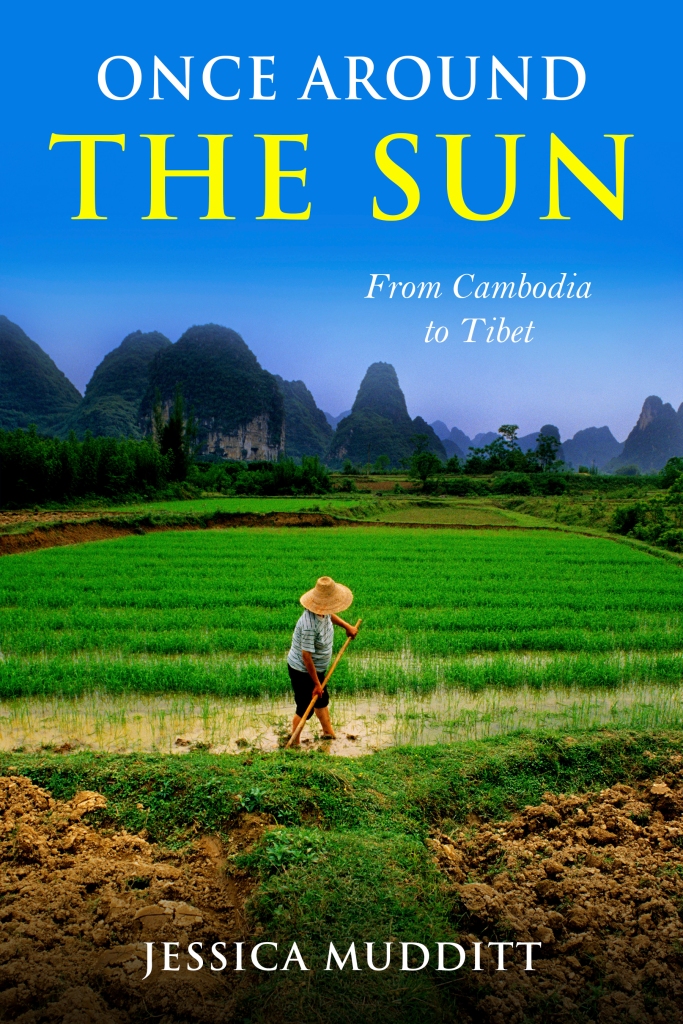
Once Around the Sun: From Cambodia to Tibet

Title: Once Around the Sun: From Cambodia to Tibet

Author: Jessica Mudditt

Chapter 20 – In or out?

As I walked the streets of downtown Hohhot in search of a travel agency, I felt further than five hundred kilometres from Beijing. I was still in East Asia, but the capital city of Inner Mongolia had Central Asian influences too, such as the cumin seed flatbread I bought from a hawker with ruddy cheeks and a fur hat. I passed a Muslim restaurant with Arabic lettering on the front of its yellow-and-green facade, and many street signs and shops featured Mongolian script as well as Mandarin. With its loops, twirls and thick flourishes, Mongolian looked more similar to Arabic than Chinese. In actual fact, the top-down script is an adaptation of classical Uyghur, which is spoken in an area not far to the west.

The winds that blew in from the Russian border to the northeast were icy cold, so I was glad to soon be inside a travel agency. It was crammed with boxes of brochures and a thick film of dust covered the windowpanes. Hohhot is the main jumping-off point for tours of the grasslands, so I was able to get a ticket for a two-day tour that began the following morning.

I wasn’t enthusiastic about going on a tour because I preferred to move at my own pace, however there was no other way to access the grasslands. The upside was that I was guaranteed to sleep inside a ger, which is a circular tent insulated with felts. The Russian term of ‘yurt’ is better known. I had read that Inner Mongolia was a bit of a tourist trap for mainland Chinese tourists, but I was nonetheless excited to get a glimpse of the Land of the Weeping Camel.

I walked into a noodle shop and a customer almost dropped her chopsticks when she saw me. The girls at the cash register were giggling and covering their faces as I pointed at a flat noodle soup on a laminated menu affixed to the counter.

Foreign tourists must be thin on the ground in Hohhot, I thought as I carried my bowl over to a little table by the window.

Inner Mongolia was one of the few places that Lonely Planet almost discouraged people from visiting: ‘Just how much you can see of the Mongolian way of life in China is dubious.’ But I was still keen to see what I could.

I ate slowly, enjoying each fatty morsel of mutton. I was pretty good with chopsticks by that point – I’d never be a natural, but I didn’t drop any bits of mutton into the soup with a splash, as I used to in Vietnam.

Hohhot seemed a scruffy, rather bleak sort of city – or at least in the area where I was staying close to the train station. Street vendors stood cheek by jowl on one side of the road, calling out the prices of their wares. The opposite side was under construction and the one still in use was unpaved, which meant that two lanes of traffic had to navigate a narrow area of bumpy stones while avoiding massive potholes and piles of dirt. I saw a motorbike and a three-wheel truck almost collide.

I spent the next few hours wandering around the Inner Mongolia Museum, which has a staggering collection of 44,000 items. Some of the best fossils in the world have been discovered in Inner Mongolia because its frozen tundra preserves them so effectively. The standout exhibit for me was the mammoth. It had been discovered in a coal mine in 1984 and most of its skeleton was the original bones rather than replicas. I gazed up at the enormous creature and tried to imagine it roaming the earth over a million years ago. Mind-boggling.

I admired the black-and-white portraits of Mongolian tribesmen, and then took photos of a big bronze statue of Genghis Khan astride his galloping mount. The founding leader of the Mongol Empire was the arch-nemesis of China, and parts of the Great Wall had been built with the express purpose of keeping out his marauding armies. Genghis Khan must have rolled in his grave when China seized control of a large swathe of his territory in 1947.

What was once Mongolia proper became a Chinese province known as ‘Inner Mongolia Autonomous Region’. This long-winded name is an example of Orwellian double-speak. So-called ‘Inner Mongolia’ is part of China, whereas the independent country to the north is by inference ‘Outer Mongolia’. Nor is the Chinese region autonomous. The Chinese state has forced Mongolians to assimilate. Their nomadic lifestyle and Buddhist beliefs had been pretty much eradicated, and although speaking Mongolian wasn’t outlawed, learning the state language of Mandarin was non-negotiable.

On top of this, the government provided tax breaks and other financial incentives to China’s majority ethnic group, the Han Chinese, if they relocated to Inner Mongolia. Mongolians now account for just one in five people among a total population of 24 million. The same policies of ethnic ‘dilution’ exist in China’s four other ‘autonomous regions’, which include Tibet and Xinjiang, the home of the Uyghurs.

Shortly before I left the museum, I came to a plaque that described the official version of history, which was at odds with everything I’d read in my Lonely Planet.

‘Since the founding of Inner Mongolia Autonomous Region fifty years ago, a great change has happened on the grasslands, which is both a great victory of the minority policy and the result of the splendid leadership of the Communist Party of China. The people of all nationalities on the grassland will never forget the kind-hearted concerns of the revolutionary leaders of both the old and new generations.’

I rolled my eyes, snapped a photo of the plaque for posterity, and continued walking.

* * *

I didn’t venture far from my hotel for dinner because I planned on having an early night. I chose a bustling restaurant with lots of families inside and was waiting for a waiter to come and start trying to guess my order when a group of men at the next table caught my eye. They seemed to be waving me over.

Me? I asked by pointing at myself.

Yes, they were nodding. Shi de.

I happily joined the group and introduced myself by saying that I was from ‘Aodàlìyǎ’. I think they were Han Chinese, as they didn’t look Mongolian. I whipped out my phrasebook and tried to say I had come from Beijing, but I was fairly certain they didn’t understand me.

Anyhow, no matter. Ten shot glasses were filled from a huge bottle of baijiu, and I was soon laughing as if I was with old friends. One of the slightly older guys used a set of tongs to place wafer-thin slices of fatty pork into the bubbling hotpot on the table, followed by shiitake mushrooms and leafy greens. As the impromptu guest of honour, my bowl was filled first once it was cooked – by which time I’d already had three shots.

The hotpot was fantastic, and I had to remind myself not to finish everything in my bowl. Bethan had told me that Chinese etiquette requires a small amount of food not to be eaten at each meal. This indicates that it was so satisfying that it wasn’t necessary to eat every last bite. As a kid, it was ingrained in me to finish everything on my plate. I loved food and was generally in the habit of licking my bowl clean, so I had to exercise a certain amount of restraint.

I had just rested my chopsticks across the top of my bowl to signal I was finished when I was invited to go sit on the wives’ table, which was across from the men’s. The women were very sweet and a couple of them seemed to be around my age. I once again tried to communicate using my phrasebook, but I was hopelessly drunk by then. I could hardly string a sentence together in English, let alone Mandarin. I was also beginning to feel queasy from the baijiu, so I gratefully accepted a cup of green tea from the porcelain teapot that came my way on the lazy Susan. After taking some photos together, I bid the two groups ‘zaijian’ (goodnight). I tried to contribute some yuan for the meal, but they wouldn’t hear of it. I curtsied as a stupid sort of thank-you, and then I was on my way.

* * *

More hard liquor awaited me the following day. A striking woman in a red brocade gown with long sleeves handed me a small glass of baijiu as I stepped off the minibus a bit before noon.

‘It’s a tradition,’ she said with a smile, while holding a tray full of shots.

I downed the baijiu with my backpack on and grinned as the backpacker behind me did the same. There were four foreign tourists on the tour, and about eight domestic ones. The liquor gave me an instant buzz, which I needed. I hadn’t slept well and woke up feeling lousy, so I’d kept to myself during the two-hour journey. Even though I should have been excited, I got grumpier and grumpier as the reality of being on a tour began to sink in. Plus, the landscape was not the verdant green steppes I’d been expecting. At this time of year, it was bone dry and dusty. It hadn’t occurred to me to check whether my visit coincided with the low season.

I began chatting to the other tourists. The guy who had the baijiu after me was Lars from Holland. There was also a couple from Germany. I could immediately tell they were pretty straitlaced. Their clothes looked very clean and functional, and the girl refused the baijiu.

The woman in red introduced herself as Li, our tour guide. Then she led us along a path lined with spinifex to a dozen gers. They faced each other in a circle, and off to the right was a much larger ger with the evil eye painted on its roof and Tibetan prayer flags fluttering in the fierce winds. There were no other buildings in sight and no trees.

Li told us to meet inside the big ger in fifteen minutes after we’d put our stuff in the smaller gers she proceeded to assign us. Lars and I would be spending the night in a ger with ‘82’ painted on its rusted red door. There certainly weren’t eighty gers, so the logic behind the numbering system wasn’t clear – but no matter. The German couple took the ger to the right of ours.

These were not portable tents for nomads. Each ger was mounted on a concrete base and I think the actual structure was made of concrete too, and merely wrapped in grey tarpaulins. The door was made of metal and at the top was a sort of chimney structure – perhaps for ventilation. Like igloos, the only opening was the door, and it was pitch-black inside. I located a dangling light switch as I entered.

‘Ah – I love it!’ I exclaimed.

It was a simple set-up, with single beds lining the perimeter and a low table in the middle of the room. Patterned sheets were draped from the concave ceiling. I chose the bed with a framed portrait of Genghis Khan above it. Lars put his backpack next to a bed on the other side. I was happy enough to share a ger with him. He gave off zero sleazy vibes.

‘I might just take a couple of those extra blankets,’ I said to Lars as I piled on a few extra floral quilts from another bed. The wind had an extra iciness to it out on the steppes and I shuddered to think what the temperature would drop to overnight. We zipped our jackets back up and headed out.

I wandered over to the toilet block, which was quite a distance from the gers. I made a mental note to drink as little as possible before getting into bed to avoid having to go in the night. Once I got closer to the toilets, I was glad they were so far away. The stench was unbelievable.

In the female section were two concrete stalls without doors. In the middle of the floor in each was a rectangular gap. I almost gagged. Just a few centimetres away from the concrete was an enormous pile of shit. I could make out bits of used toilet paper and sanitary pads and there were loads of flies buzzing around. Without running water or pipes, the excrement just sat there, day after day, building up. I would have turned and walked straight back out but I was busting for a wee. I held my breath so I wasn’t inhaling the smells. I wanted to close my eyes too, but I was terrified of falling in, so I had to look at what I was doing. I couldn’t get out of there fast enough.

‘Oh my god, Lars – the drop toilets are totally disgusting,’ I said after I met up with him in the big ger. ‘It’s just a pit of shit without running water.’

‘I know an American girl who fell into a drop toilet in China last year,’ he said.

‘No way,’ I said with a shudder.

‘Yeah. She said it was terrible. She was in a really poor village somewhere in central China and she went to the toilet at night. She couldn’t see that some of the wooden planks had gaps in them – and then one of them broke and she fell in. She was up to her neck in shit. She was screaming for people to come help her. Apparently, it took them half an hour to fish her out, and all the while she could feel creatures writhing around her body. She cut her trip short and had to get counselling when she got home.’

‘I bet she did,’ I said. ‘That’s the most disgusting thing I’ve ever heard in my life. The poor girl.’

Just then Li appeared and said we were heading outside to watch horse racing and traditional wrestling after some sweet biscuits and tea. We assembled around a fenced area where there were about thirty ponies tethered to poles. Some were lying down while still saddled.

‘Horses usually sleep while standing up, so these ponies must be knackered – pardon the pun,’ I joked to Lars.

Notwithstanding, they looked to be in reasonably good condition, with shiny coats and no protruding ribs. There were chestnuts, bays and dapple greys.

I heard the sound of hoofbeats and looked behind me. A group of men on horseback came thundering across the steppes. It was a magnificent sight, and any lingering resentment I had about being on a tour melted away.

One of the men rode ahead of the rest. He was wearing a cobalt-blue brocaded tunic and his wavy black hair came down past his ears. He was really good-looking. He approached Li with a smile, said something to her and dismounted with the ease of someone who had probably started riding horses before he learned to walk. Li and the man exchanged a few words – I definitely saw her blush – and then he got back on.

‘Gah!’ he yelled as he dug his heels into his horse’s sides.

The other horsemen followed after him with whoops, leaving a trail of dust in their wake. These Mongolian ponies were only about twelve or thirteen hands, but they sure were fast and could turn on a dime. I loved watching them carve up the dry earth.

Next a group of men on motorcycles appeared along the track. There were quite a lot of them – at least twenty. We formed a big circle, and the traditional wrestling began. I wasn’t sure what the rules were, but it was fairly self-explanatory: one man got another in a headlock and thumped him to the ground. The next man came along and fought the winner, and so on and so forth. The spectators egged on the fighters with what I assumed were good natured cat calls. Everyone was grinning. By the time the wrestling matches were over, the fighters were absolutely covered in dust and the sun was beginning to set. I’m sure it was all staged for our benefit, but it was good fun.

With the seamless orchestration of a tour that has been done a thousand times before, we gravitated to the big ger. Dinner was bubbling away in a large clay pot and it smelled pretty good. There was also a big vat of noodles with black sauce and the ubiquitous Chinese vegetables of thinly sliced carrot, bok choy, baby corn and onion. There was a bottle of baijiu on each table.

We were serenaded with traditional music while we ate. One of the instruments reminded me of the didgeridoo and there was also a violin. I had read that strands of horse mane are used to make violin strings. The male singer had a deep voice that was almost a warble, and it was hauntingly beautiful.

Five men and women emerged from behind a red curtain and began to dance. They wore long-sleeved, billowing satin tunics that were cinched at the waist with embroidered belts. One of the women had a tall hat made of white beads that dangled down to her waist. It must have been heavy. It was a high-energy display of kicks and splits and parts of it were reminiscent of Irish dancing. They twirled their billowing skirts like sufis. The Chinese tourists started clapping in time with the music and then we all joined in. Sure, it was a bit cheesy, but I was really enjoying myself. At the end of the concert, we had photos with the performers as they were still trying to catch their breath.

We were given torches to light our way back to our gers. It was absolutely freezing, so I wore all my clothes to bed. I snuggled into my blankets and pulled them right up to my chin, feeling grateful for the warmth of Bethan’s jumper.

Mercifully, I slept right through until morning and avoided a late-night visit to the shit pit.

When I wandered out of the ger the next morning, breakfast was being prepared nearby. The carcass of a freshly slaughtered sheep was hanging from the back of a trailer. A man was skinning it while the blood drained out of its neck into a big metal bowl. Its head was in a second bowl, while squares of wool were laid out flat to dry on a tarp. A toddler in a puffy orange jacket was playing in the dust while his mother worked away at skinning parts of the wool. What distressed me more than butchery up close was the live sheep that was watching on from the back of the trailer. He presumably knew he was next.

After a breakfast of ‘sheep stomach stew with assorted tendons’ (as Li described it) we headed out for a ride on the steppes. I couldn’t wait to ride a horse again. I’d spent most of my childhood obsessed with horses, and I was lucky enough to have one for a few years, until I got older and became more interested in hockey and parties.

I rode a stocky bay with a trimmed mane that bobbed up and down as it trotted along the path. I looked over its perky little ears. The saddle had an uncomfortable pommel that kept jabbing me in the stomach, but I loved being under the wide open sky. It was a pale blue with just a few wispy clouds. Sheep grazed and crows rested on clumps of rocky outcrops.

I winced at the Chinese guy ahead of me, who was bouncing out of time to the rhythm of his horse’s gait and landing with a heavy bump in the saddle; his oversized suit flapping in the wind and his feet poking out straight in the stirrups. Much easier on the eye was the guide two horses ahead of him. He was every inch the Mongolian cowboy. Dressed from head to toe in black, he wore a leather jacket, cowboy hat and scuffed black cowboy boots. He never took off his wraparound sunglasses and he spoke little. He smouldered like the heartthrob actor, Patrick Swayze.

We’d travelled several kilometres when we came to a building block that was the same greyish brown as the earth. Inside it had a cottage feel. We sat around a table covered with a frilly tablecloth and drank yak milk. As we did, Lars told me about his day trip to North Korea. While in South Korea for a couple of weeks, he had visited the demilitarised zone (better known as the ‘DMZ’), where a ceasefire was negotiated between the two Koreas in 1953. In a military building is what is known as the ‘demarcation line’ – and Lars had one foot in North Korea and another in South Korea. I hung on his every word.

Our conversation got me thinking about how cool it would be to go to North Korea. I was actually quite close to the border. When I got back to the ger, I retrieved my Lonely Planet out of my bag and thumbed to the section titled ‘Getting there and away’, which had instructions for every country that borders China.

‘Visas are difficult to arrange to North Korea and at the time of writing, it was virtually impossible for US and South Korean citizens. Those interested in travelling to North Korea from Beijing should get in touch with Koryo Tours, who can get you there (and back).’

I was pretty sure the cost would be prohibitive for my budget and decided to stick with my existing plan of cutting south-west towards Tibet. Maybe one day I’d get the chance to visit North Korea, but it wouldn’t be on this trip.

Once back in Hohhot, I boarded a train bound for Pingyao. As I watched the apartment blocks pass by in a blur, I thought with satisfaction about the past twenty-four hours. Any visit to Inner Mongolia is problematic, but I couldn’t fault the Chinese tour company. They had made every effort to keep us entertained. Mongolian culture was so new to me that I couldn’t even tell whether something was authentic or staged, but I had seen and done all the things I hoped to during my visit. And, sure, my time there was really brief. But I’d be forever grateful to have seen a part of the world I thought I’d only ever get to see in a documentary.

Photo Courtesy: Jessica Muddit

About the Book: While nursing a broken heart at the age of 25, Jessica Mudditt sets off from Melbourne for a year of solo backpacking through Asia. Her willingness to try almost anything quickly lands her in a scrape in Cambodia. With the nation’s tragic history continuing to play out in the form of widespread poverty, Jessica looks for ways to make a positive impact. She crosses overland into a remote part of Laos, where friendships form fast and jungle adventures await.

Vietnam is an intoxicating sensory overload, and the hedonism of the backpacking scene reaches new heights. Jessica is awed by the scale and beauty of China, but she has underestimated the language barrier and begins her time there feeling lost and lonely. In circumstances that take her by surprise, Jessica finds herself hiking to Mount Everest base camp in Tibet.

From a monks’ dormitory in Laos to the steppes of Inner Mongolia, join Jessica as she travels thousands of kilometres across some of the most beautiful and fascinating parts of the planet.

About the Author: Jessica Mudditt was born in Melbourne, Australia, and currently lives in Sydney. She spent ten years working as a journalist in London, Bangladesh and Myanmar, before returning home in 2016. Her articles have been published by Forbes, BBC, GQ and Marie Claire, among others. Once Around the Sun: From Cambodia to Tibet is a prequel to her earlier book, Our Home in Myanmar.

.

PLEASE NOTE: ARTICLES CAN ONLY BE REPRODUCED IN OTHER SITES WITH DUE ACKNOWLEDGEMENT TO BORDERLESS JOURNAL

Click here to access the Borderless anthology, Monalisa No Longer Smiles

Click here to access Monalisa No Longer Smiles on Kindle Amazon International

Categories
Poetry

Poems by David Mellor

David Mellor
                    THERE

                  I’m not there
               And neither are you

         But we have all danced at festivals 
             Walked down the streets 
             Cooked food in our homes 

                  I’m not there 
             And neither are they now… 

 
LOVED

Death is 
R
O
P
P
I
N
G

From the skies 

     L  lies  lifeless
     O on
 E  V ery 
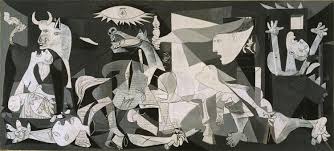
Str E et


Death is 
R
O
P
P
I
N
G
From the sky

Bodies mount up 
1.500 here…
1.500 there…


L
	O
		V
			E
			   Lies in ruins… 
			   No one utters her name 


JUST SOME BODY 
(a child refugee)

I heard the shots, I did 
And my siblings being dragged screaming
Out the door 

My father ran, carrying me like a football
Up into the hills and miles away
Terror in his eyes, “Which way now?”
	
Into the truck, freezing at night 
Dumped on the shore
There was no need to ask 
“Are they coming too?”
As I knew…
They were no more


The boat with a hundred frightened faces came ashore, 
We were taken to the airport and told… 
“Get back home!”
My father desperately pleaded, but to no avail 

We landed in Kabul 
He was tortured and murdered 
      And I followed suit

David Mellor has been published and performed widely from the BBC, The Tate, galleries and pubs and everything in between. Now, resident in Turkey he has continued his literary career with his work appearing in journals including a weekly column in Canakkale Gündem about his observations of Turkish life. His poems and writings are autobiographical, others topical and several his take on life. 

.

PLEASE NOTE: ARTICLES CAN ONLY BE REPRODUCED IN OTHER SITES WITH DUE ACKNOWLEDGEMENT TO BORDERLESS JOURNAL. 

Click here to access the Borderless anthology, Monalisa No Longer Smiles

Click here to access Monalisa No Longer Smiles on Kindle Amazon International

Categories
Essay

A Different Persuasion: On Jane Austen’s Novels & their Adaptations

By Deepa Onkar

Recently, a realisation dawned – it has been over a year since I have watched an adaptation of a Jane Austen novel as a film or television series. My earliest memories of watching them go back to 1995, when the BBC’s version of Pride and Prejudice was released – I would watch the DVDs, or episodes on YouTube, with some enthusiasm. Over the years, I didn’t lose a chance to watch others: Sense and Sensibility, (film), Emma (BBC television series) Pride and Prejudice (film) and so many others. Looking at the comments on YouTube, it was evident that the Jane Austen adaptation fandom was large, and on a global scale. The seamless way in which the adaptations were consumed in so many Indian homes, including mine, puzzled me. I was familiar with the novels, as I had been a student of English literature in postcolonial departments in India, but that could not be true of so many others.

I fretted about the fact that my literary moorings were not so much in my own mother-tongues, but in English. Middle-class India was forgetting its own languages. English has crept in slowly, unnoticed. We could of course, think like Chinua Achebe, the Nigerian novelist, for whom writing about our own cultural contexts, our histories, landscapes, and memories in English, changes the texture of that language, and diminishes its colonizing weight. It is also the attitude, conscious or unconscious, of so many Indian writers in English. Curiously not many Indian producers have picked up on the idea of serializing the novels of these writers – either in English or in an Indian translation – which should be easy to do. It was the BBC that first produced an Indian novel – Vikram Seth’s novel, A Suitable Boy as a television series (for a global audience).  

The Kenyan writer Ngugi wa Thiong’o has a much more radical perspective than Achebe – that it is not enough for people in previously colonised cultures to write in English, nor to claim it as their own. The very process by which English was acquired was violent and repressive. “(So) wherever you look at modern colonialism, the acquisition of the language of the coloniser was based on the death of the languages of the colonised. So it is a war zone.” Unless previously colonised cultures begin to train to think in their mother tongues again, he says, we will never really be able to shake off the mantle of colonisation.

This is a compelling, if daunting prospect – the work of decolonizing our minds perhaps begins within the education system which, in India, shows little inclination to change – it continues to lie in the shadows of the Anglo-American system, as it has for centuries. I draw comfort from Achebe’s attitude to English, which is the reality of many Indians. I don’t have to give up on Austen. But how do we rescue ourselves, and Austen? A critical and self-aware engagement with Austen – both the novels and the adaptations – seems to be a good place to begin. Reading Austen is arduous for those not born into English: I could hear my mother tongues tiptoe away as I read her. Reading is a solitary activity that connects us with the worlds of others, through the imagination. Watching an adaptation, on the other hand, can be solitary, or not. The visual text communicates through the senses rather than the imagination, although it does not mean it is not involved here.

It was not difficult to identify signs of England’s colonial links in either Austen’s novels, or the adaptations. Distant colonies such as the Caribbean and India were mentioned not infrequently in the novels: much of the income of the vast estates owned by the gentry was obtained from the colonies. Watching BBC’s Pride and Prejudice – and not for the first time – I spotted the tea, drunk in fine cups, the cigars that the men smoked, the cotton print dresses that women wore. I mentioned to a friend that some of the fabrics looked like the double-shaded handloom weaves from Andhra Pradesh, or Tamil Nadu. She agreed. Sometimes, the dresses also had paisley designs – these hugely popular prints were adaptations of Mughal mango motifs on textile. We, the global audience, need to train our gaze to the material roots of the English imagination, and be critical of it, rather than unreflectively consume its creations. Scenes of opulent country manors would appear repeatedly in many of the adaptations, and it was hard not to notice a kind of nostalgia for the glories of Empire. So much of the popularity of the adaptations seemed to be the result of clever packaging of Regency era settings and countryside.

Even as the lavish settings seemed to engulf Austen’s ingenious stories at times, a great deal of effort went into modernizing them. When Colin Firth came striding out of the lake in dripping wet shirt in 1995, the scene seemed to set the tone for other serials and films to become more inventive – as long as it created a stir. Almost every adaptation slipped in new scenes to suit their own narrative. They brought about a kind of visual cohesiveness to the series or films. Informal and relaxed body language, and facial expressions, and the manner in which emotions were expressed were adopted – rather than the stiff, stylized ways of the past. What we watched on screen was a hybrid text. I had no problem with this, unlike many die-hard Jane-ites the world over, who are perhaps purists at heart. Modern informality is, after all, a sign that the boundaries of class have become less rigid.  

When Austen’s world in the novel became too distant, and removed from my own, I would turn to the adaptations. They became relatable on screen. Besides, the adaptations were open to emotional expressiveness, where in the novels, emotions are sub-textual: I have lost count of the number of times I watched Elizabeth Bennett’s (Jennifer Ehle) fiery rejection of Darcy (Colin Firth) in Pride and Prejudice (1995, mini-series) or Elinor Dashwood (Emma Thomson) fall in love with Edward Ferras (Hugh Grant) in Sense and Sensibility (1995, film).

One of the main features of modernisation is the highlighting of the romantic plot. Love, is of course, central to Austen’s concerns, but on screen, it is difficult to see the larger moral order of which it was a part. Often, the biggest obstacle on the individual’s path to win over the object of their love is a moral flaw within themselves. Instead of Austen’s ironic, witty voice showing us the complexities of the individual, and of their interactions with society, we have to rely a lot on dialogue, and the point of view of the main character. Rather than the multiple layers of narrative in a novel, we have a linear effect in an adaptation. Everything is propelled towards a rather sentimental ‘happily ever after,’ which is not necessarily the point of a Jane Austen novel.

We do not – perhaps cannot – get to know the thoughts of Elizabeth Bennett or Elinor Dashwood on screen, independently of others. If emotions were more readily expressed on screen, we also had to contend with the loss of inner worlds, which a reader has access to. Action is all-important in an adaptation. The expression of physicality was thought to be enough to drive it, making up for our inability to know anything else. This seems to be the view of Andrew Davies, one of the most prolific adapters of Austen to the television screen. According to him, sexuality was already a major driver of the novels – his only task was to flesh it out. “Don’t be afraid (to represent) physicality… these are young people full of hormones and they are bursting with energy,” he says, when asked for pointers on adaptation.

In the novels, we also see how a character is separated from, or unable to communicate with the object of their love, until a morally satisfying solution is found. In Pride and Prejudice, Mr. Wickham’s true character had to be exposed, and Elizabeth could overcome her pride, and could accept that Mr. Darcy was right. In Emma, the eponymous heroine had much to learn in order to fully grow up: to be more self-aware and free from vanity, and realize she loved Mr. Knightley. Austen’s dislike of melodrama and writing that was overly invested in emotion is well-known. And so, it seems logical to think that she would not have liked mere ‘feel-good’ romanticism in the productions of her writings.

Morality as a force was more vivid on the page rather than the screen. It was arguably, an imaginatively constructed entity that was contemporaneous with the white man’s burden of colonization. Austen’s depictions of the world she lived in make her a ‘quintessentially English’ writer that is difficult for others to understand. But over the years, I learnt to understand her from my vantage point in post coloniality – the world is constituted of multiple identities and historical contexts, and being curious and open about others is a reasonable way of engaging with my own existential and sociological identities. 

Austen was an insider to her world – she deferred to the fact that women were very dependent on male approval and protection in order to survive. Most of the women in her novels were teenagers when they began their rounds of courtship, and often subjected to severe scrutiny by the world at large. But her women also used wit and rationality to make themselves seen and heard. Elizabeth Bennett (Pride and Prejudice) and Emma Woodhouse, (Emma) for example, challenged the existing model of the ‘superior,’ rational man.

Within the psychological worlds of men and women, Austen sought to describe the play of feeling, will and reason. Post-feminist critiques of Austen have been critical of her acceptance of these opposites and their implied gendered roles. Many adaptations exist, such as Lost in Austen, Pride and Prejudice Zombies, that satirize and parody Austen to a degree that ‘faithful’ adaptations do not aspire to. The comparisons and defenses could go on.

After years of reading Austen, my sympathies have recently begun to shift, imperceptibly – from the ‘wild and rational’ women of Austen’s novels, as Mary Wollestonecraft might have described them, to the quiet and introspective ones – more precisely, to Anne of Persuasion. Austen’s final novel seems to have achieved an introspective appeal that the other novels lacked. Anne’s deeply reflective and melancholic acceptance of her situation – a single woman stranded amidst a family that often exploited her situation – is the culmination of all of Austen’s literary prowess, and she herself seems to be on new ground as she explored Anne’s silences. A little into the novel, when she meets Captain Wentworth after eight years, there is some halting dialogue, as Anne comes to terms with her lost love, perhaps for the millionth time. Through these silences and halting dialogues, Austen seems to be testing the waters of what it means to be deeply self-aware. I’ve also read the dialogues to be a way in which words could be used to establish equality between them. It is through friendship that an egalitarianism of sorts is reached, that grows only gradually in strength.

The 2007 film adaptation of Persuasion portrayed the silences and the hesitant relationship between Anne and Wentworth admirably. It is difficult to portray interior worlds effectively on screen, and Sally Hawkins played the brooding, inconsolable Anne sensitively, particularly in the early scenes. Rupert Penry-Jones was striking as the embittered Captain Wentworth, seeking love elsewhere. The tension in their silences was palpably thick.

The letter Wentworth writes to Anne — “I am half-agony, half hope” — is a study in vulnerability: he is the flawed man who has to let go of his own stubborn refusal to acknowledge his feelings. The letter also indicates the difficulty of speech between them; writing is his only recourse. Men’s points of view are rarely presented in the novels. The adaptations turned this around – nearly all of the men have moments of vulnerability. This is a major breakthrough in modernization. Women all over the globe suddenly came upon visible evidence formen’s struggles with their feelings. This single factor alone, may be the reason for the huge popularity of the adaptations – men suddenly, were human and relatable.

When I learnt in 2022 of Netflix’s release of a new version of Persuasion, I began to watch it excitedly. But only a few moments in, I was sorely disappointed. The character of Anne (played by Dakota Johnson) was nothing like Austen’s – she was talkative and answered back. The key shortcoming of the film was the loss of Anne’s interior world.  When Anne and Wentworth (played by Cosmo Jarvis) meet, in the film, they engage in banter, from their very first meeting. Nothing much is left unsaid.  The absence of speech between Anne and Wentworth, which gives rise to one of the main tensions of the novel, and the earlier adaptation, is completely missing. They have finished saying a lot to each other in the very beginning. We cannot help wishing they hadn’t. Many of the characters were changed beyond recognition, and the sense of many scenes changed.

We know, early on, what the end is going to be. Austen plays words out in the final letter not coldly, but without a trace of extra emotion — that Wentworth’s maudlin show of tears were not for her. Perhaps, that was the final straw that drove me away from the film. I have not gone back to watching a film or adaptation after that. Something within me had died.

References

Language is a ‘war zone’: Conversation with Ngugi wa Thiong’o, The Nation, Rohit Inani, March 9, 2018

Adapting Emma for the 21st century:  An Emma no one will like; Laurie Kaplan, Jane Austen Society of North America (JASNA) V.30, no.1, (Winter 2009)

How to adapt Jane Austen to the screen, with Andrew Davies: Guardian Culture, YouTube, 2018

.

Deepa Onkar has degrees in English Literature from the Universities of Madras and Hyderabad, India. She was a teacher at Krishnamurti schools in Bangalore and Chennai, India, and a journalist at The Hindu. Her articles and poems have appeared in The Hindu, Punch magazine, The Bombay Literary Magazine, and The Lake, among others. 

.

PLEASE NOTE: ARTICLES CAN ONLY BE REPRODUCED IN OTHER SITES WITH DUE ACKNOWLEDGEMENT TO BORDERLESS JOURNAL

Click here to access the Borderless anthology, Monalisa No Longer Smiles

Click here to access Monalisa No Longer Smiles on Kindle Amazon International

Categories
Interview Review

Born Free to Follow your Heart

Anthony Sattin, an award winning journalist and travel writer in conversation about Nomads: The Wanderers Who Shaped our World, his recent book published by Hachette, India.

A breath-taking narrative that travels with the freedom of nomads, drawing from folklore, history and modern movements to give voice to an idea that might help move towards a more progressive and hopeful future — Anthony Sattin has achieved all this in a single book called Nomads: The Wanderers Who Shaped our World, a non-fiction that touches the heart with the concept of unifying humanity beyond the borders of ‘isms’ drawn over time. It explores the history of people who often have not been chronicled in conventional texts.

We are living in times where floods, forest fires, wars and divides are ravaging humanity as it wakes up from the coils of a pandemic that had almost stilled all normal interactions and economic activities for more than two years. The unrests and the changes attributed to “climate change” call for “continued solidarity” and a united front from all humanity as indicated by UN Secretary-General Antonio Gueterres and global guru Harari. In times such as these, an attempt to revive the concept of asabiyya, or bonds based on felt interests, is laudable and a necessity for the world to move forward. And that is exactly what Sattin has done in his recent book.

He has travelled with nomads; folklores, starting with Cain and Abel, Gilgamesh and Enkidu; history, Gobelki Tepe or Potbelly Hill, the place where he locates what might have been Eden, Achaemenid kings, Persian nomads, Mongols, Mughals to global nomads — spanning 12, 000 years of history.

In his book, Sattin tells us: “We are living at a time when the world — our world — shaped by the age of Reason and Enlightenment, powered by industrial and technological revolutions is faltering.  Social contracts are fraying and communications are breaking down. The raw materials and natural resources are becoming scarce, and the consequence of our actions … are written large across landscapes, the climate, the fabric of our lives…Change is needed.”

Sattin “traces the shifting relationships between people who move and those who were settled” to find the concept of asabiyya or the sense of bonding popularised by an Arab philosopher called Ibn Khaldun (1332-1406). Perhaps, this is an ideal that could benefit humankind if we were all to see ourselves as one tribe. He has mentioned modern attempts at asabiyya, like the call given by ‘Black Lives Matter’, to contextualise the concept for us and to show how a movement born from within the hearts of people could touch and change attitudes.

The book is divided into three parts after an initial introduction from Mount Zagros, where Sattin was rescued from a bout of sunstroke by nomads: the first part is called ‘The Balancing Act’, where he explores ancient folklore and history, Huns, Hyksos, Scythians, Xiongnu and more: the second part is called ‘The Imperial Act’, from  ‘The rise of the Arabs to the Fall of Mongols’ where kingdoms and world history is brought into play and the importance of asabiyya is introduced with historic instances and the last part is called ‘The Act of Recovery’, where changes towards redefining the world in terms of ideals aligned with asabiyya are explored.

The scope of the non-fiction is clarified at the start of the book from Mount Zagros. He starts the first section interestingly in a locale, termed by him as “Paradise” in 10,000 BC with a global population of ‘Perhaps 5 million’, of which he lists the nomad population as ‘Most of the number’. As he unfolds the history of mankind, from the past we find echoes of what could be called mobile or nomadic bonds that embrace to expand and heal civilisations. Sattin has been exploring such bonds for the last forty years.

Described as “a cross between Indiana Jones and a John Buchan hero” and “one of the key influences on travel writing today”, Sattin started his interactions with bedouins at age nineteen and found them nurturing. He elucidates: “After I left school, I went travelling in the Middle East. In the Sinai Peninsula, at that time, there were no hotels or other facilities outside of Sharm el Sheikh. So, I and the friend I was travelling with relied on the Bedouins for many things — they brought us fish and other food, they told us stories about the magical places in the desert mountains and although we had been told that they would rob us, they looked after us.”

Anthony Sattin. Photo Courtesy. John Murray/Hachette India. 

Sattin has several non-fictions under his belt and is an award-winning journalist, who writes in a number of well-known journals, like the Sunday Times, the Conde Nast Traveller and the Financial Times. An editorial advisor to the Geographical magazine, he is also a fellow of the Royal Geographical Society and a founder-member of Travel Intelligence and ASTENE (the Association for the Study of Travel in Egypt and the Near East). He was the director of the Principal Film Company, has written, advised and presented on television and radio productions, including the BBC.

In this exclusive conversation, Sattin discusses Nomads, and tells us how the book came to be.

What made you think of writing a book on nomads, who — you have stated in your book — now constitute only 40 million in a world of 7.8 billion humans?

Every book has its moment, and this is the right time for Nomads. It came out of a lifelong interest in people who live on the move and on the problems of settled society, especially with cities – some of the first thoughts in Nomads occurred decades back when I read Lewis Mumford’s The City in History[1]. But I also have many ideas for books in my head at any one time and they don’t all get written! And some of them sit around for ages and then it seems to me to be the right moment to write. The way our world has changed in the past decade helped shape my sense that this is the moment to write about open borders and freedom of movement. I also wanted to write something that would stretch me more than anything else I had written. Twelve thousand years of history seemed like a big enough challenge…

How long did it take you to research and write the book? What kind of research did you do?

I began shaping the idea nine years ago, after I finished my previous book, Young Lawrence[2], about how the second son of an anonymous, middle class Oxford family became Lawrence of Arabia. The proposal took more than a year to get right – as my editor at WW Norton in New York pointed out, a subject this big can be about everything and nothing. Then there were years of research, particularly in the Bodleian Library at Oxford and the London Library, which is a wonderful place, the largest private library in the world and which serves as my home from home. I had many conversations over the years with scholars, people in publishing, fellow writers, travellers and nomads. And then there was the travelling with nomads, the writing and rewriting.

You travelled and lived among nomads for some time? How many years? Were your travels affected by the pandemic? If so, how did you bypass that?

I have been meeting nomads for more than forty years, particularly in North Africa and the Middle East, where I have travelled extensively. When I was 19, I was looked after by Bedouin in the Sinai Desert. In 2010, I was back there on a camel trek with a guide who impressed me because he knew every mountain, every watering place and every cave, including one which he pointed out as the place where he was born.

In Mali, I spent time with Touareg nomads, who came together each year at a place in the desert beyond Timbuktu – these tribes used to be at war with central government (and are again), but a treaty had been brokered and one of the terms was that tribal and government leaders would meet once a year to sort out grievances. They also played music, danced, raced camels… How could one not be swept away?

Specifically for Nomads, I went to Iran to spend some time with the Bakhtiari, a large nomad tribe who I had chosen in part because they claim lineage that goes back millennia, because they had played a part in the making of modern Iran but also because in the 1920s, a movie[3] was made of their annual migration into the Zagros Mountains, amazingly by the director and producer[4] whose next movie was the original King Kong! The Bakhtiari taught me much about the challenges facing nomads today.

Can you tell us of a few interesting experiences while moving with nomads which are not part of the book?

When I first went into the Zagros Mountains to meet the Bakhtiari, I was taken by a guide (being British, I had to have a guide for my entire stay in Iran) and he could not understand why I would waste my money and my time going into the mountains. He was from the city and exhibited age-old prejudices against people who lived on the move, whom he called ‘primitives”. But I am not a nomad and although I don’t find them primitive, I do find some aspects of their lives very challenging: years ago, on a camel trek in the Thar Desert, I caught what I now assume was sunstroke and thought I was going to pass out. My guide – there were just the two of us travelling – got me out of the desert. At the first village we reached, he had someone bring a bed out of a house and placed in the shade of a tree. I lay down and remember no more until about four hours later when I woke to find myself surrounded by the whole village. They had been angry with the guide for bringing me to them – think of all the trouble they would face if I died! When I woke, in the middle of this scene, the whole crowd burst into cheers like a scene out of a Bollywood movie.

You have spoken of ‘asabiyya’ taught by Ibn Khaldun. Can you explain the concept briefly and tell us if this can be of relevance in the current global situation?

Asabiyya is a sense of group feeling, something that binds people together. Ibn Khaldun thought it had shaped the world and found that it was most powerful among nomads and people who lived in the desert, in part because they must rely absolutely on each other. When this group feeling is channelled by a leader – the Prophet Muhammed, for instance – it can lead the group towards extraordinary achievements, as when the first Arabs overcame the might of the better-trained and armed Byzantine and Persian armies. It might all sound like something from long ago but I think there is a sense, in our own time, of someone like Greta Thurnberg having channelled that same feeling to force our leaders to pay attention to the climate emergency.

At a point you tell us that “…cities posed existentialist risks, and their temptations could overwhelm the asabiyya and nomads would lose their identity.” Why was maintaining their identity for the nomads so essential? Do you think this is something that needs revival in the present?

The existential risks I mention are the ones that rob nomads of their asabiyya and therefore of their power. Ibn Khaldun had seen this first hand: in North Africa, several small reformist movements had come out of the harsh desert or mountains to the south and overwhelmed the courts and kingdoms along the north coast. But each of those movements had fallen apart within a few generations as the pure people of the desert found themselves corrupted by living in cities. As for identity, it is important for all of us to know who we are and where we have come from — that was one reason to write the book, because very little is taught about nomads in western schools.

Your book touches upon number of issues — including faith. Given the fact that the great Khan had a Nestorian church, a mosque and a Buddhist temple in his capital city despite following the Shamanistic faith, would you say that an openness or tolerance in beliefs and faiths led to a more strongly tethered kingdom, as they did not really seem to have concepts of permanent national boundaries then? Is this not a dichotomy that you create a strongly tethered kingdom and yet are open to move on, leaving the old capital behind? And is it not wasteful?

I think there are two things going on here. On the one hand, a belief in freedom of conscience, the right to follow any or no religion. This was certainly something the great Mongol khans believed in. They were mostly animists, believing in the Sky Father and reliant on signs and omens, but they were not adverse to being prayed for and blessed by an imam or priest. Even the Ottomans, who came out of a nomadic tradition and were clearly Muslims, thought it important to allow freedom of conscience in their empire. What mattered was not who you prayed to, but whether you were prepared to acknowledge the sovereignty of the khan or the sultan. Some of the most successful periods in human history have flourished because of this idea.

A strongly tethered kingdom is another issue. For nomads, cities and capitals were not as important as lands, particularly hunting and grazing lands. The Mongol khans, like ancient Persian emperors and many other nomad leaders, recognised the need for a pivotal meeting place, a capital, but they were mostly more interested in spending time elsewhere and on the move. A leader such as Attila, the Hun ruler, had no interest in the cities he conquered.

You mention British author, Bruce Chatwin(1940-1989), as having said “we are born to move, that we must move or die.” Can you explain what that would mean? In the current context, people talk of roots and homeland. If they keep moving what happens to their firm conviction in homeland?

It depends what sort of ‘moving’ we are talking about. On a mundane and personal level, research now tells us that we are less likely to get ill and more likely to live longer if we walk 10,000 steps a day. On a national and global scale, we need interaction, we need to live lighter, we need to be nimble on our feet and in our thoughts.  

You have divided the world into two groups — nomads and settlers — and said we need a bit of both. Can you tell us how and why?

Humans began to settle and cultivate some 12,000 years ago and since then, like Cain and Abel, humans have broadly been divided into those who stay in one place, usually either cultivating the land or living in towns/cities, and those who live on the move. For most of history they have lived in a state of mutual dependence and often even in harmony. A world without nomads, with everyone fixed in one place – which seems to be where we are heading – is a smaller, less rich, less fertile world.

In a post-pandemic world, would the nomadic lifestyle you have written of be feasible, especially with all the governmental issues creeping in? 

The word nomad comes from a very old Indo-European word meaning pasture or a fixed area, which suggest the right to graze. But if you take a broad view of what it means to be a nomad in the 21st century, you might also include digital nomads and others who move to work or just because that is how they want to or have to live. That might not have been possible during the pandemic, when we were all locked down, but the number of people on the move now in many parts of the world is right back up and that can only be a good thing – we need to mix and meet, to exchange experiences and opinions.

If we opt for a mobile lifestyle, would we need to redefine borders as of old? Would that take us back to a pre-nationalistic era? Do you think we should be redefining our mindsets and our isms? Do you suggest we all go back to an intermittent nomadic lifestyle?

We should always be questioning mindsets and isms! Happily, we are living through a golden age of revisionist history shaped by a number of forces, decolonialism, Black Lives Matter and #MeToo among them. We also live in an age of misinformation on a massive scale. Nomads has come out of a need I had to shine some light on a way of life that is either entirely missing, or misrepresented in our histories.

Are you planning to write more on this issue or move on to something else? Would you share with us your next project?

There is much more to be written about this issue, but after spending most of the past eight years working on Nomads, it is time for me to look elsewhere. I hope I have stimulated a debate about nomads that will encourage others to look further. Meanwhile my thoughts are turning to Egypt — and to Italy, from where I am writing today.

Thanks for giving us your time during your travels.


[1] First published in 1961

[2] First published in 2014

[3] Grass (1925)

[4] Merian C. Cooper (1893-1973)

(This review and online interview is by Mitali Chakravarty)

.

PLEASE NOTE: ARTICLES CAN ONLY BE REPRODUCED IN OTHER SITES WITH DUE ACKNOWLEDGEMENT TO BORDERLESS JOURNAL

Categories
Interview Review

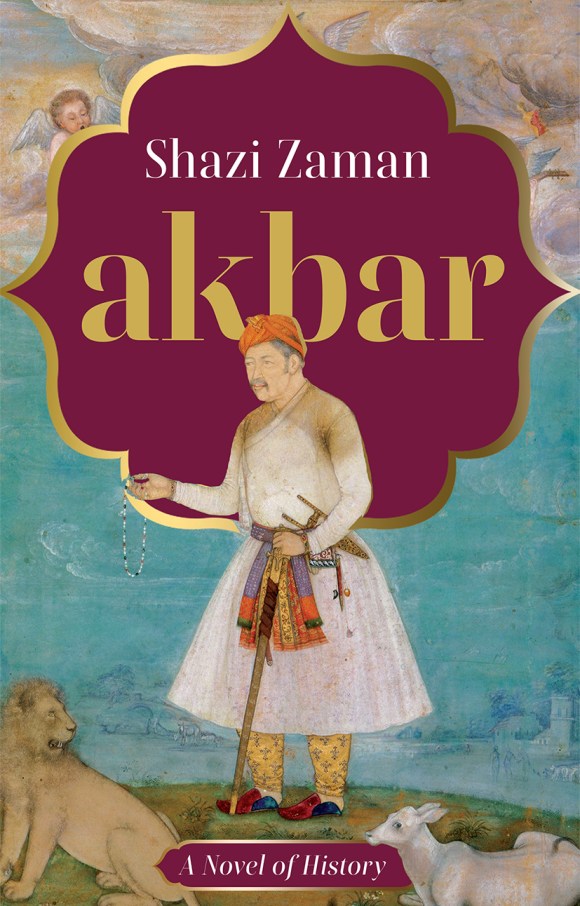
Akbar: The Man Who was King

In Conversation with Shazi Zaman, author of Akbar: A Novel of History, published by Speaking Tiger Books

“I profess the religion of love, and whatever direction
Its steed may take, Love is my religion and my faith.”
— Ibn-i-Arabi (1165-1240), Akbar: A Novel of History by Shazi Zaman

These lines were written by a mystic from Spain who influenced Emperor Akbar (1542-1605), a ruler who impacted the world with his broad outlook. Based on such ideology as preached by Ibn-i-Arabi more than three hundred years before him, with an urge to transcend differences and unite a world torn by strife, the great Mughal founded his own system of beliefs. He had few followers. But Akbar chose to be secular and not to impose his beliefs on courtiers, many of whom continued to follow the pre-existing religions. He tried to find tolerance in the hearts of practitioners of different faiths so that they would respect each other’s beliefs and live in harmony, allowing him to rule impartially.

Akbar is reported to have said: “We perceive that there are varying customs and beliefs of varying religious paths. For the teachings of the Hindus, the Muslims, the Parsis, the Jews and the Christians are all different. But the followers of each religion regard the institutions of their own religion as better than those of any other. Not only so, but they strive to convert the rest to their own way of belief. If these refuse to be converted, they not only despise them, but also regard them for this very reason as their enemies. And this causes me to feel many serious doubts. Wherefore I desire that on appointed days the books of all the religious laws be brought forward, and that the doctors meet together and hold discussions, so that I may hear them, and that each one may determine which is the truest and the mightiest religion.” Of such discussions and ideals was born Akbar’s new faith, Din-i-ilahi.

Was it exactly like this? Were these Akbar’s exact words?

They have been put in perspective by an author and a journalist who has written a novel based on his research on the grand Mughal, Shazi Zaman. He tells us in the interview why he opted to create a man out of Akbar rather than a historical emperor based only on facts. He has even mentioned that Akbar might have been dyslexic in the introduction. But Zaman’s admiration for the character he has recreated for us overflows and floods the reader with enthusiasm for this legendary Mughal. Akbar is depicted as a man who was far ahead of his times. He talked of syncretism and secularism in a world where even factions within the same religion were killing each other.

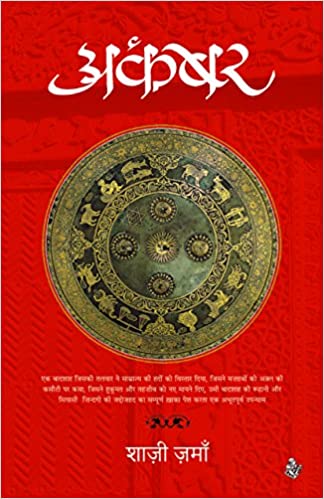
Akbar by Shazi Zaman in Hindi

The novel was first written and published in Hindi in 2017 by the bilingual Zaman, who started his three-decade-long career in broadcast journalism at Doordarshan and has since, worked with several media organisations. Zaman trans created his Hindi novel on Akbar to English to reach out to a broader audience. The whole experience has been a heady one for Zaman as the interview shows but for the reader what is it like? To start with one felt like the Connecticut Yankee in King Arthur’s court, except one was flitting around in the Indian subcontinent of the sixteenth century, with a few incursions to the Middle-East, but mostly within India. Transported to a different age, it takes a while to get one’s bearings. Once that is established, the novel is a compelling read.

The first part deals with Akbar’s developmental years and the second part with his spiritual outlook which helped him create an empire with many colours of people and religions. This is a novel that has been written differently from other historical novels, like Aruna Chakravarti’s  Jorasanko (2013), for the simple reason that it belongs to a different time and ethos which was farther from our own or Tagore’s times.  Akbar has a larger tapestry of people across a broader canvas than Jorasanko and it takes time to grasp the complexities of relationships and interactions. The other recent non-fiction which springs to the mind while reading Akbar is Avik Chanda’s Dara Shukoh: The Man Who would be King (2019) about the great grandson of the emperor who lived from 1615-1659. Again, this was a narrative closer to our times and was not a novel, but a creative non-fiction based strongly on history. While Dara’s character painted by Chanda showed weaknesses like an inability to respect the nobility or plan wars, Akbar painted by Zaman is kind but a man of action who ruled and intended to rule well. A leader — one has to remember — is not always the most popular man. Nor was Akbar with his eccentricities and erudition despite his inability to read — the book does tell us why he did not learn to read and how he educated himself. Most of the novel is a work of passion based on extensive research over two decades. As Henry Kissinger had said at a much later date, “The task of the leader is to get their people from where they are to where they have not been.” And the Akbar recreated by Zaman does just that.

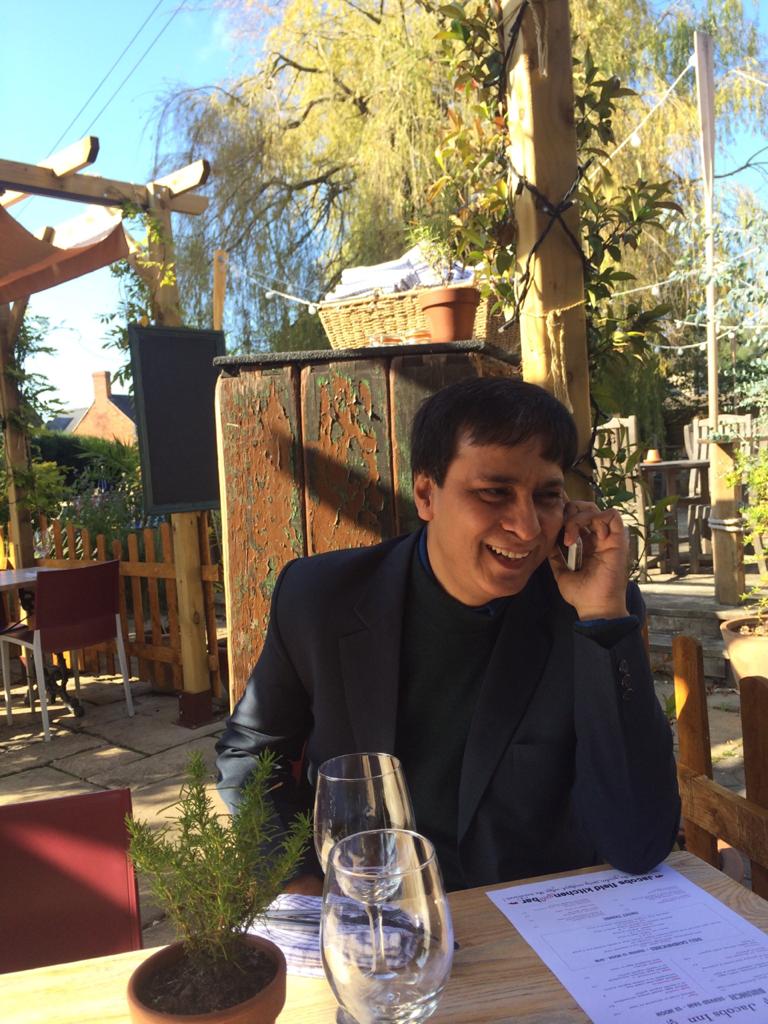
Shazi Zaman

Zaman who had been with the ABP (Anand Bazar Patrika) News Network as their Group Editor, was on the governing bodies of the Film and Television Institute of India, Pune, and the Indian Institute of Mass Communication, Delhi. He has worked with Aaj Tak, Zee News, Star News and also with the BBC World Service, London. He has served as the Director, Video Services of the Press Trust of India. Akbar is his third novel. He has authored two novels in Hindi earlier. In Akbar: A Novel of History (2021), Zaman with his journalistic background and his love for literature inherited from his novelist father, Khwaja Badiuzzaman, has done the mammoth task of astutely bringing to life a character who might have been a perfect solution to the leadership crisis that many are facing in the current day.

If you are still wondering how close this novel comes to the Bollywood movie called Jodha Akbar (2008), the major things in common were the grand Mughal’s sense of justice and his ability to tame wild elephants! For a deeper understanding of both the emperor and the book, in this exclusive, Zaman tells us what went into the making of this novel and his journey.

Why did you choose to write of Akbar?

One has to have a bit of Akbar inside oneself to write on him—and to read about him as well. Writing on Akbar was not a conscious decision. By the time I realised that I was going to write a novel of history on Akbar, my sub-conscious was miles ahead. Of course his personality had attributes that appealed to me consciously and sub-consciously, especially his belief in primacy of ‘aql’ (reason) over ‘naql’ (blind imitation of tradition) and his ability to question all orthodoxies.

Do you think Akbar is relevant in the current context?

I believe that his message is so ennobling that it transcends the boundaries of space and time. Across ages and across geographies, and within a geography by various groups and communities, his memory has been kept alive.

There was a book a few years ago called Dara Shukoh: The Man who would be King. Would you say he would be more relevant for our times than Akbar or is Akbar a better choice?

It is difficult to give them a comparative score. Dara could have been a very worthy successor to Akbar. And his initiatives and writings are really inspiring. Robustness of ideas and your resolve to push them are tested when faced with exigencies of statecraft. Sadly, Dara did not get that chance and Akbar did. I find that Akbar could navigate but sometimes be audacious to the extent that his courtier poet-musician Tansen had to caution, ‘dheere dheere dheere man, dheere hi sab kachhu hoye (Slowly, slowly, slowly, all happens at a slow pace)’.How would Dara have navigated while on throne is an unanswered question in Indian history. Having said this, his defeat in the battle of succession should not undermine the originality of his initiatives.

Why did you choose to write this in a novel form? Dara Shukoh was a non-fiction. Have you introduced fiction into this?

History largely tells us what happened. Most often it does not tell us of the state of mind that brought people to the point where we find them take momentous decisions. I think momentous events or actions are rooted in mental journeys. And these journeys are seldom documented. When Akbar faced a mental crisis—‘haalat-i-ajeeb’ (a strange state) as a contemporary called it— in the summer of 1578 on the banks of the river Jhelum, one wants to map what was happening in his mind and what had brought him to that point.

What lay behind the agitation of this man who was one of the mightiest emperors of the world, who had never lost a battle and was at the peak of his power ? Were there some forces testing his patience ?  Or as he stood at a place linked to the history of his forefathers, did he wonder about the trauma they had faced ? Or when he dealt a physical blow to a top cleric of yester years, there must have been a mental journey preceding this act. One can try and go into a person’s mind by closely studying his actions and utterances as also that of people and texts that influence him. We all know that people often mean much more than what they choose to say and sometimes, they say one thing and mean the other.

A close examination of this maze can give a glimpse of what was happening inside the great mind. As you try to create a period piece around his state of mind you mine information from all available sources—textual, aural, visual, architectural. For me fidelity to known facts is essential even in historical fiction. But there does come a point when the trail goes cold. Even the best documentary evidence might be insufficient in finding all the pieces of the period piece. For example, we do not know what Akbar was wearing the night he experienced the ‘haalat-i-ajeeb‘ but we have a Mughal miniature in all likelihood of the next morning when Akbar takes an unexpected decision about the great game. Now, it has come down to us that he appeared wearing last night’s clothes. So we know what he was probably wearing at the time he was in ‘haalat-i-ajeeb’ of the previous day. Or we do not know the details of the carpet of the room where he lay dying. Nobody recorded that. Thankfully, some details have come down to us of carpets of those times. I have chosen to use them. After exhausting all means of finding the right pieces of this period piece, I have exercised my imagination. So this is fiction very much rooted in history. If I have been able to do what I had intended, you would feel you have read his mind as also feel that you are actually standing backstage in the Akbarian arena.

In the debate I often encounter about the element of history in historical fiction, perhaps we miss a basic point. Most fiction has history in it. Some have history that is known. Some have history that is personal or unique to the author. It is only when known history figures in your work that the issue of reality versus fiction surfaces. Otherwise, this mingling is not questioned.

What was the kind of research you did? How long did it take you to research and write this book? Tell us about its evolution.

The idea had been simmering under the surface since early years. As I have mentioned in my preface, a childhood incident imprinted Akbar on my mind. During my school days, a member of the education department of the government made a surprise inspection and gave a short introduction to Akbar’s life and his relevance to our times. It left a mark. I was especially blessed to have teachers who stoked my interest. I shall be eternally grateful to my teacher Muhammad Amin–Amin Saheb as he was called at St.Stephen’s College (Delhi University) — to have brought history to life in classroom and sessions outside classroom. Amin Saheb taught us Akbar’s ‘sulh-i-kul’ , which he said stands not for tolerance or co-existence because even these terms denote some separation. He said, Akbar’s ‘sulh-i-kul’ meant harmony. Amin Saheb taught us about Akbar’s desire to build bridges and his respect for diversity. Many like me graduated from the university but never left his class. I feel privileged that for quarter of a century after leaving College I continued to sit at his feet and learn about Akbar. A good teacher teaches and also shows the path to further learning.

My interest in Mughal miniatures took me to various museums within the country and abroad and of course to places like Fatehpur Sikri–a city that Akbar created with a purpose– very often.  Over decades I have gathered in my personal collection most of what has been written about Akbar and almost all books published on his art and architecture. I can say that all published Mughal miniatures reside in my study now.  So Akbar was a character I had been breathing much before it became the idea of a novel.  However, for a period spread over two decades I did consciously try to piece together a story.

 How did you create the character of Akbar ?

Akbar was not merely a historical figure. He was also acutely conscious that he was making history. And as a person conscious of this, he left ample footprints.

When you try to get into a person’s mind you piece together all he saw and read (or in case of Akbar, was read to) and experienced; all he interacted with; all he surrounded himself with; all he spoke and wanted to be spoken, read and spread; and all that he created. Foremost, of course, is  Akbarnama which was a monumental image  building exercise entrusted to a close and trusted courtier, Abul Fazl. Abul Fazl knew what went on in Akbar’s mind. This work is rich in details and is a comprehensive history of Akbar and his forefathers. Akbar also commissioned others who knew his forefathers to write histories that would help Abul Fazl in his work. Akbarnama is an official account. It was vetted by Akbar and tells us how Akbar wanted to be seen by his contemporaries and by future generations. It is extremely useful in giving us the image the emperor aimed to project.

Then there were many others who wrote their histories during his reign. But it is the history called Muntakhab-ut-Tawarikh by a disgruntled cleric, Mulla Abdul Qadir Badayuni, which was written secretly that gives us an unofficial perspective.  I am grateful to the anonymous author of the historic Rajasthani work, Dalpat Vilas, for giving an informal and unique access into the emperor’s mind. Anybody studying Akbar feels especially grateful for the elaborate atelier —tasveer khana — as it was called — that the emperor established. Paintings made under his direction and patronage give us a vivid picture of what he thought was worth projecting. If you look closely, Mughal miniatures of his time often have a story and even a back story that gives you an indication of the emperor’s mind.

Akbar built at a huge scale and many of his buildings still stand tall and the stones speak even now of why he gave them the shape that he did. Then of course are works related to his ancestors like Baburnama which Akbar was fond of and later, of his son’s Tuzuk-i-Jahangiri. Akbar’s public contact and communication was prolific. We might well have seen him if we were living in that age. He travelled and interacted widely.

Almost every morning of his half a century long reign he appeared at the balcony so that the subjects could see him. Even those who did not see him felt his presence. Banarsidas, a trader of his time, who also wrote a chronicle, notes the widespread alarm amongst common people when the emperor fell ill. Letters  Jalaluddin Muhammad Akbar wrote to Uzbek and Persian kings, the emperor of Spain and Portugal, to nobles and others have been handed down to us. His interactions with religious persons find mention in Vaishnavite, Jain and Mahdawi literature. The letters that Jesuits at his court were writing to their superiors are useful for their perspective as also for the ‘unofficial’ details. Then there were personalities Akbar drew to his court who were poets, warriors, administrators and diplomats who were themselves eminent enough to be written about, or  were writers themselves. I closely studied them.

Abdur Rahim Khan-i-khanan was like a son to Akbar and wrote poetry that is timeless in its appeal. Tansen, an eminent poet and musician at his court wrote ‘takhat baitho Mahabali ishvar hoye avtar (the mighty Emperor sits on the throne as incarnation of God)’, which is how Akbar would have wanted to be described.  Works written on Raja Mansingh like Mancharit and Mancharitra Raso helped me understand a mighty noble, who again was like a son—‘farzand’—to Akbar. Akbar himself is believed to have been a poet and pieces of poetry deemed to be his have come down to us. His memory resonates even now in folk songs.

In terms of material evidence of personal effects, we have an armour of Akbar which was helpful in ascertaining his approximate height. Of course, this was achieved with the help of experts.  Not all that one gathered necessarily went into this work but I tried to gather as much as I could so as to know how Akbar lived, ate, slept, worked, played, deliberated, relaxed, fought and thought and what was the world he inhabited, and also what was the kind of world he wanted to inhabit.

I must say that I tried to access original sources in Persian, Sanskrit and other languages with the help of experts, in addition to what I could read myself in English, Hindi and Urdu.

In your introduction you have said Akbar might have been dyslexic or bipolar. Why? What made you think he might have been dyslexic or bipolar? Could it not be that as a child he was not just into books and therefore did not learn to read?

There has been some academic work on some of the issues Akbar faced. I think his behaviour on the full moon night of the year 1578 on the banks of the river Jhelum and on occasions before that definitely call for more investigations in that direction, though one is conscious that the emperor himself is not available for close examination. As for dyslexia specifically, one can say that the man loved books. He commissioned and collected them at a huge scale but he did not read them. They were read out to him. Historical sources indicate that he could not read or write. Though I have seen copies of his handwriting, they seem laboured. It would be a fair assumption that he was dyslexic. I think he was a great visual learner. That is why no Mughal emperor before or after had as big a tasveer khana as him.

You have repeated this phrase thrice in the book. ‘Hindus should eat beef, Muslims should eat pork, and if not this, fry a sheep in the pan. If it turns into pork, Hindus and Muslims should have it together. If it turns into beef, Hindus and Muslims should have it together. If it becomes pork, Muslims should have it. If it becomes beef, Hindus should have it. A divine miracle would thus happen.’ Why?

More than one account reveal puzzling behaviour and utterances of the emperor. This forced one person to say that this was ‘haalat-i-ajeeb’. Nobody at that time could fully understand his state or his words. I feel that it was reflective of his anguish over religious disputes and religious orthodoxy. An emperor who had never lost a contest was getting impatient. In moments of mental crisis it is possible for a person to  say things which have layers of meaning. One has to peep underneath the words to fathom the anguish of  a sensitive mind. This was one such utterance. 

What is the most endearing quality you found in Akbar? And why?

It is difficult to pinpoint one in a person who embodied numerous qualities. His belief in giving precedence to ‘aql’ (reason) over ‘naql’ (blind adherence to tradition). His spirit of enquiry and his desire to provide space for differing thoughts. He believed—“It is my duty to have good understanding with all men. If they walk in the way of God’s will, interference with them would be in itself reprehensible; and if otherwise, they are under the malady of ignorance and deserve my compassion.”

There is an incident mentioned in the book. The Jesuits who came with the intention of converting Akbar finally despaired because he would give them ample space and ample attention but stop short of conversion. So one evening, they came and sought leave since their embassy had failed in its purpose. Jalaluddin Muhammad Akbar replied, “…how can you say that the time you have spent with us has been profitless, seeing that formerly the Muslims had so much credit in my land that if any had dared to say that Jesus Christ was the true God, he would straightway have been put to death; whereas you are now able to say this, and to preach the same in all security ?”

You wrote the novel first in Hindi and then trans created it to English. Why? What is the difference between the Hindi and the English versions?

The novel Akbar naturally came to my mind in Hindi, a language the emperor would have been comfortable with had he been alive. Having said this, I am grateful to my publishers, Rajkamal and Speaking Tiger, for initiating the idea of an English  version. And I did immediately see the need to take Akbar to a wider audience because the novel has an idiom and language rooted in Hindustan but Akbarian thought and vision have an appeal that is wider than the regions he ruled. So the challenge was to take the text, sub-text and the idiom to an English audience. The challenge was also to make Akbar’s 16th century intelligible to 21st century English-speaking world. I have tried my best with help of editors at Speaking Tiger to make it a work English speakers would be at home with. I am sure they would be able to savour the milieu, the plot and the sensibility of 16th century Hindustan in their preferred language.  A good translation should in fact be a trans creation and should read like it has been written in the same language. 

You have two novels in Hindi. Do you plan to translate those too to English? Why? Why not write directly in English?

I believe that no thought is completely translatable into words and no words are completely translatable into another set of words. Thus the word transcreation. The first two novels Premgali Ati Sankri (The Narrow Alley of Love) and Jism Jism Ke Log (Various Bodies) have intense conversation between characters which is rooted in their shared understanding of an idiom. Translation is desirable and relatable because stories strike a chord across space but works have texts, sub-text and idiom. The problem and the challenge lies in taking the sub-text and the idiom into another language. That is why trans creation requires a deep understanding of the text, the sub-text and the idiom of the original work as also of the sensibilities of the audience for whom you are trans creating. Having said this, I would be happy to translate the first two novels for an English readership. The theme would strike a chord, the idiom would need some fine work.

Will you shuttle between English and Hindi in the future? Are you planning more books?

Shuttling between Hindi and English is an interesting thought. I am already seized by an idea that came to my mind as an English text. It is germinating. As for more books, I have already sent a Hindi novelet for publication which could be thematically seen as third in series after Premgali Ati Sankri and Jism Jism Ke Log. While telling stories to my children, and making them up as I went along, I created a short novel for children which awaits publication. I am also in the process of writing another novel in the genre of historical fiction.

Thank you for your time.

This is an online interview conducted on behalf of Borderless Journal by Mitali Chakravarty.

Click here to read an excerpt from Akbar: A Novel of History

.

PLEASE NOTE: ARTICLES CAN ONLY BE REPRODUCED IN OTHER SITES WITH DUE ACKNOWLEDGEMENT TO BORDERLESS JOURNAL

Categories
Greetings from Borderless

For Auld Lang Syne

Painting by Sohana Manzoor

What will the New Year bring? Will it connect us all like a tree that has its roots deep in the Earth but reaches out to the sky with its branches rearing high? Its blooms seem like stars on the planet, connecting all life and non-living in its embrace. We hope as global consciousness grows for living in harmony with nature and science, love and kindness, may we all move towards a better more connected world. We, at Borderless Journal, wish you all a happy start to a wonderful New Year!

Our oeuvre this time brings to you a selection from the year 2021 that showcases the change makers we met, and writing that with their values connect us or ring with goodwill and look forward to a better future.

Meet & Greet

These are people you can meet on our pages — people who impact the world in a way that touches lives.

Goutam Ghose, who finds colouring the world with syncretic lore as the best alternative to sectarian violence. Click here to read.

Anvita Abbi, an empathetic linguist who builds bridges to create a seamless world, accepting and co-existing with different ways of life as colours of a rainbow. Click here to read.

Nazes Afroz translated a book on Afghanistan by Tagore’s disciple, Syed Mujtaba Ali, a memoir that shows the roots of the current crises go deep. Also, a senior BBC editor of South Asia, Afroz takes us through the situation with compassion. Click here to read.

Jessica Mudditt travelled to Myanmar and wrote a book, which is an eye-opener about the current situation. She was brought to focus by Keith Lyons who interviewed her for us. Click here to read.

Sanjay Kumar founded Pandies, an activist theatre group that educates, bridging gaps between the divides of University educated and the less fortunate who people slums or terror zones. Click here to read.

 Sybil Pretious, a teacher who has taught in six countries to impact children, starting her career in Africa and living through and beyond Apartheid. Click here to read.

Poetry

Robert Burns & Tagore in Harmony : A transcreation of Tagore’s song, Purano Sei Diner Kotha, based on Robert Burn’s poem associated with new year’s revelries. Click here to read.

Snowball Earth: A long poem by Rhys Hughes in the spirit of a modern man’s Auld Lang Syne, touching on our climate debacle. Click here to read.

Gathering Blossoms: Poetry by Michael R Burch that lingers in the heart. Click here to read.

Humour

Travels & Holidays: Humour from Rabindranath: Translated from the original Bengali by Somdatta Mandal, these are Tagore’s essays and letters laced with humour. Click here to read.

Surviving to Tell a Pony-tale: Devraj Singh Kalsi journeys up a hill on a pony and gives a sedately hilarious account. Click here to read.

 Trouser Hermits: Rhys Hughes muses over men’s attire and the lack of them. Click here to read.

Prose

Temples and Mosques: Kazi Nazrul Islam’s fiery essay on the need for a syncretic lore translated by Sohana Manzoor. Click here to read.

To Infinity & Beyond!: Candice Louisa Daquin explores the magic of space travel. Click here to read.

Near the River Chenab and Under The trees: Sunil Sharma in a poignant telling takes us on a journey to the banks of a river where life, love and death sheathed in terrorism cumulate to a peak. Click here to read.

Richard Hughes: The Reporter Who Inspired Ian Fleming: Bhaskar Parichha showcases a journalist who wrote globally, spicing it up with humour. Click here to read.

The Lords of Lights: With photographs and a story, Penny Wilkes makes an interesting new legend. Click here to read.

Categories
Editorial

Making a Grecian Urn

“Beauty is truth, truth beauty — that is all
                Ye know on earth, and all ye need to know.”  
  
John Keats (1795-1821), Ode to a Grecian Urn
‘Beauty is Truth’ : The Potato Eaters(1885) by Vincent van Gogh (1853-1890). Courtesy: Creative Commons

What makes for great literature? To me, great literature states the truth — the truth that touches your heart with its poignancy, preciseness, sadness, gentleness, vibrancy, or humour.  If Khayyam, Rumi, Keats, Tagore, Frost or Whitman had no truths to state, their poetry would have failed to mesmerise time and woo readers across ages. Their truths – which can be seen as eternal ones — touch all human hearts with empathetic beauty. Lalon Fakir rose from an uneducated illiterate mendicant to a poet because he had the courage to sing the truth about mankind — to put social norms and barriers aside and versify his truth, which was ours and still is. This can be applied to all genres. Short stories by Saki, O’ Henry or plays and essays by Bernard Shaw — what typifies them? The truth they speak with perhaps a sprinkle of humour. Alan Paton spoke the truth about violence and its arbitrariness while writing of South Africa — made the characters so empathetic that Cry, My Beloved Country (1948) is to me one of the best fictions describing divides in the world, and the same divides persist today. The truth is eternal as in George Orwell’s 1984 (1949) or Suskind’s Perfume (1985). We love laughter from Gerald Durrell or PG Wodehouse too because they reflect larger truths that touch mankind as does the sentimentality of Dickens or the poignancy of Hardy or the societal questioning of the Bronte sisters, George Eliot, and Jane Austen. The list of greats in this tradition would be a very long one.

 Our focus this time is on a fearless essayist in a similar tradition, one who unveiled truths rising above the mundane, lacing them with humour to make them easily digestible for laymen – a writer and a polyglot who knew fourteen languages by the name of Syed Mujtaba Ali (1904-1974). He was Tagore’s student, a Humboldt scholar who lived across six countries, including Afghanistan and spoke of the things he saw around him. Cherished as a celebrated writer among Bengali readers, he wrote for journals and published more than two dozen books that remained untranslated because his witticisms were so entrenched by cultural traditions that no translator dared pick up their pen. Many decades down the line, while in Afghanistan, a BBC editor for South and Central Asia, Nazes Afroz, translated bits of Mujtaba Ali’s non-fiction for his curious friends till he had completed the whole of the travelogue.

The translation named In a Land Far from Home: A Bengali in Afghanistan was published and nominated for the Crossword Awards. This month, we not only run an excerpt from the translated essays but also have an interview with the former BBC journalist, Afroz, who tells us not only about the book but also of the current situation in ravaged Afghanistan based on his own first-hand experiences. Nazes himself has travelled to forty countries, much like our other interviewee, Sybil Pretious, who has travelled to forty and lived in six. She had been writing for us till she left to complete her memoirs — which would cover much of history from currently non-existent country Rhodesia to apartheid and the first democratic election in South Africa. These would be valuable records shared with the world from a personal account of a pacifist who loves humanity.

We have more on travel — an essay by Tagore describing with wry humour vacations in company of his niece and nephew and letters written by the maestro during his trips, some laced with hilarity and the more serious ones excerpted from Kobi and Rani, all translated by Somdatta Mandal. We have also indulged our taste for Tagore’s poetry by translating a song heralding the start of the Durga Puja season. Durga Puja is an autumnal festival celebrated in India. An essay by Meenakshi Malhotra explains the songs of homecoming during this festival. It is interesting that the songs express the mother’s views as highlighted by Malhotra, but one notices, never that of the Goddess, who, mythology has it, gave up her life when the husband of her own choosing, Shiva, was perceived by her family as ‘uncouth’ and was insulted in her parent’s home.

In spirit of this festival highlighting women power and on the other hand her role in society, we have a review by Somdatta of T. Janakiraman’s Wooden Cow, translated from Tamil by Lakshmi Kannan, where the protagonist upends all traditional values ascribed to women. Another book which is flavourful with food and would be a real fit on every festive occasion is Mohana Kanjilal’s A Taste of Time: A Food History of Calcutta. Bhaskar Parichha tells us in his review, “In the thriving universe of Indian food books, this clearly stands out.”

Aruna Chakravarti’s review of Shazia Omar’s Golden Bangladesh at Fifty also stands out embracing the colours of Bengal. It traces the title back to history and their national anthem — a Tagore song called ‘Amaar Sonar Bangla – My Golden Bengal’. Gracy Samjetsabam’s review of Suzanne Kamata’s The Baseball Widow, a cross cultural novel with an unusual ending that shuttles between America and Japan, winds up our review section this time.

As Kamata’s book travels across two continents in a pre-covid world, Sunil Sharma in reality moved home from one continent to another crossing multiple national borders during the pandemic. He has written an eye-opening account of his move along with his amazing short story on Gandhi. Another unusual story creating a new legend with wonderful photographs and the narrative woven around them can be relished in Nature’s Musings by Penny Wilkes. This time we have fiction from India, Malaysia, Bangladesh and America. Steve Davidson has given a story based partly on Tibetan lore and has said much in a light-hearted fashion, especially as the Llama resumes his travels at the end of the story. Keeping in step with light humour and travel is Devraj Singh Kalsi’s account of a pony ride up a hill, except it made me laugh more.

The tone of Rhys Hughes cogitations about the identity of two poets across borders in ‘Pessoa and Cavafy: What’s in a Name?’ reminds me of Puck  or Narada! Of course, he has given humour in verses with a funny story poem which again — I am not quite sure — has a Welsh king who resisted Roman invasion or is it someone else? Michael Burch has limericks on animals, along with his moving poem on Martin Luther King Junior. We have much poetry crossing borders, including a translation of Akbar Barakzai’s fabulous Balochi poetry by Fazal Baloch and Sahitya Akademi winning Manipuri poet, Thangjam Ibopishak, translated by Robin S Ngangom. A Nazrul song which quests for a spiritual home has been translated from Bengali by no less than Professor Fakrul Alam, a winner of both the SAARC award and Bangla Academy Literary Award.

Former Arts Editor of Times of India, Ratnottama Sengupta, has shared an essay on how kantha (hand embroidered rug) became a tool to pass on information during the struggle against colonial occupation. The piece reminded me of the narrative of passing messages through mooncakes among Chinese. During the fourteenth century, the filling was of messages to organise a rebellion which replaced the Yuan dynasty (1271-1368) with the Ming (1368-1644). Now the filling is delicious lotus paste, chocolates or other edible delicacies. Women were heavily involved in all these movements. Sameer Arshad Khatlani has highlighted how women writers of the early twentieth century writing in Urdu, like Ismat Chughtai, created revolutionary literature and inspired even legendary writers, like Simone de Beauvoir. There is much more in our content — not all of which has been discussed here for again this time we have spilled over to near fifty pieces.

We have another delightful surprise for our readers – a cover photo of a painting by Sohana Manzoor depicting the season titled ‘Ode to Autumn’. Do pause by and take a look at this month’s issue. We thank our writers and readers for their continued support. And I would personally like to give a huge thanks to the team which makes it possible for me to put these delectable offerings before the world. Thank you all.

Wish you a wonderful month full of festivities!

Mitali Chakravarty,

Borderless Journal

Categories
Interview Review

Unveiling Afghanistan: In Conversation with Nazes Afroz

 Cry, My Beloved Country (1948) reflected the plight of Africans and the deep divides that created schisms between different groups in South Africa. The book won the author, Alan Paton, a Nobel prize. Another remarkable book that was published in the same year was a non-fiction written by a student of Tagore called Syed Mujtaba Ali. Mujtaba Ali wrote Deshe Bideshe in Bengali. This has been translated in recent times by the former BBC editor, Nazes Afroz, as In a Land Far from Home: A Bengali in Afghanistan. It is an outstanding memoir that demystifies and explains what led to the issues that are being faced by a country repeatedly jostled by varied regimes, a country that seems to be so steeped in problems that worrying about the pandemic remains a far cry for the common inhabitants.

For many decades this book had been feted by only a small group of readers, though the book is no lesser than Paton’s in crying out against injustices, terrors of violence and starvation, because it was written in Bengali. It was so witty and flavourful that people were afraid to translate it for the fear of losing the nuances of the original. As Afroz tells us in this interview, he had similar reservations. A book written by a scholar, it peppers history and political issues with lucidity and humour, making it an enjoyable experience for the lay reader. The author has a way of turning the mundane or intellectual into an amusing anecdote. During a conversation at an embassy party, the author through the voice of a fellow professor, makes a hilarious observation – but also, one that does convey much about Afghanistan despite its attempts at liberalisation.

Madame Vorvechievichi argued, ‘But there are mullahs in this country.’

“Dost Muhammad said reassuringly, ‘No need to worry, Madame. I know these mullahs very well. Their knowledge of religion is very little and I can teach you all of it in three days. However, a woman can’t be a mullah.’

Madame Vorvechievichi said angrily, ‘Why not?’

“With a deep sigh Dost Muhammad said, ‘Because she can’t grow a beard.’”

The book is speckled with multiple such instances. Along with these witticisms, the pathos of the country, the plight of the people is well captured by poignant observations:

“The real history of the country was buried beneath the soil, much like the way that Indian history was hidden in its Puranas, Mahabharata-Ramayana. Afghanistan is a poor country; Afghans do not have the time or the resources for archaeological excavations to write their own history.”

The writer, Syed Mujtaba Ali (1904-1974) a polyglot, scholar, traveller and humanitarian did just that – he recorded the history of the time he spent in Afghanistan, a time when a swift takeover from the liberal king Amanullah (1892-1960) was staged by Bacha-ye-Saqao (1891-1929) during the Afghan Civil War (1928-29).  Does this sound familiar, reminding one of the recent August 2021 takeover by Taliban?

A Humboldt scholar, Mujtaba Ali was conversant in fourteen languages, lived in five countries, including Afghanistan, where he had gone to teach. That his erudition never interfered but enhanced without marring the simplicity of rendition is what makes the book an attractive read for all lay persons. His astute observations are laced with wit and realism. The residue of the book lingers as the vibrant narrative flows — vicariously bringing to life, with humour and empathy, a culture that is distinct and yet warm in its uniqueness. His style is reflective of an in depth understanding of the situation and a sense of empathy for the common people with who he interacted daily – like his man Friday and the colleagues he mentions. For the author, everyone, from an uneducated villager to the crown prince (who invited him to play tennis), seemed to grow effortlessly into a rounded persona of a friend. All these have been transmitted by Afroz in the translation too. Translating two cultures across borders in a language that does not have all the words to capture the intimate nuances is not an easy feat, but it has fruited into an unusual and captivating read.

Nazes Afroz

Afroz’s maiden venture at translation was shortlisted for the Raymond Crossword Book Award. Afroz himself has spent a long stretch of time in Afghanistan. He joined the BBC in London in 1998. He was a senior editor in charge of South and Central Asia for a number of years. He has visited Afghanistan, Central Asia and West Asia regularly for over a decade. In 2013, he moved back to India. A passionate photographer, he writes in English and Bengali for various newspapers and magazines. In recent articles, he has been voicing his own concerns about developments in Afghanistan. In this interview, he reflects on what led him to translate the book, the situation as it was then and as it is now.  He dwells not only on the historic civil war as captured in the book but also on current day politics and the Taliban takeover.

You are a journalist. What got you interested in translating a Bengali classic from the last century?

I became a journalist five years after I read Deshe Bideshe. I was still a teenager when I picked up the book from a library rack. Reading Mujtaba Ali at that age had a profound impact on me. The erudition, the smooth sailing between multitude of cultures and languages, the gripping storytelling in his writing mesmerised me. I had never read anything like that in Bangla. Every Bengali reader of Syed Mujtaba Ali had felt the same way as I did. As a child I had the uncontrollable urge for travels and seeing the world. In Mujtaba Ali I found a role model. Deshe Bideshe stayed with me since then. It was one book that I would read two to three times a year from my teenage. So, by the time I decided to translate Deshe Bideshe more than thirty years after I first laid my hands on the book, I had read it for more than a hundred times! I knew its each page, I knew its each story and Afghanistan had seeped inside me permanently as I could relate to all the characters of the book.

While working for the BBC World Service in London, I had the opportunity to go to Afghanistan in 2002 soon after the Taliban were dislodged from power in a short war towards the end of 2001. I visited the country a number of the times in the following few years. As I travelled more, I befriended my BBC colleagues there and met other journalists and people on various walks of life. Some of them became good friends as well. I used to refer to events from the times of King Amanullah while discussing Afghanistan. They were surprised to hear all the details that I mentioned from a time that they said, ‘Even we don’t know!’ So, I mentioned how a Bengali scholar came from Kolkata to Kabul in 1927 and taught here, was a participant of the modernisation project of Amanullah by teaching English and French, played tennis with the crown prince Inyatullah (1888-1946) became an eyewitness of the rebellion against the king, got caught in the anarchy in the winters of 1928-29, and nearly perished starving before managing to go back to India. Hearing my story, they asked if there was any English translation of the book as they were keen to read. I told them that there was none as it was untranslatable!

As years went by and more and more of my Afghan friends got to know about Deshe Bideshe, they demanded that I did the translation. But I had my doubts. Would I be able to capture Mujtaba Ali’s unique language? Would I be able to transpose his wicked sense of humour? Would I be able to convey his erudition?

Eventually in 2011, I had already made up my mind to quit the BBC and move back to India. At that point my day-to-day workload in the BBC was significantly reduced. As I had ample time in hand, I thought I would attempt the translation. At that point I didn’t think of any publication; I wanted to do it just for fun and for my Afghan and non-Afghan friends who knew about the book and were keen to read it. I thought I would give them a taste of Mujtaba Ali’s writing by doing a few chapters. So, I did the first few chapters and shared them with a few friends. After reading those chapters they wanted to read more. I felt encouraged and I carried on with the translation for the following few months. Eventually the whole book was complete in about a year. After completing the translation, I let it sit for a few months before picking it up again and reread it as new text without looking at the original text. That exercise went on several times over the following one year till the final manuscript shaped up.

How many countries have you worked from? You were also in Afghanistan for several years I believe. Can you share your experiences?

My work has taken me to a dozen country or so. But as an intrepid traveller, I have visited more than 40 countries so far across four continents. Apart from my regular visits to Afghanistan, I spent months at a stretch on several occasions. Working in Afghanistan was certainly a unique experience. It wasn’t a country where one could travel and roam around freely. There were always the security alerts. One needed to negotiate security barriers everywhere. The accommodations – hotels, guesthouses were guarded by armed men. In the early years – in 2002 to 2004, there weren’t so much security in the hotels or guesthouses we stayed in. But that started to change from 2010 onwards as the Taliban had at that time started to regroup, and they made their presence felt in the country and in Kabul. Even at that time, cities like Mazar-e-Sharif and Herat were considered lot safer than Kabul. With increased and unpredictable attacks by the Taliban, the country became more and more edgy.

What was it about the book that drew you to it?

As I mentioned earlier, the uniqueness of Mujtaba Ali was that his erudition wasn’t frightening. He penned Deshe Bideshe almost twenty years after he left Kabul. By then, he had completed his PhD in comparative religion from Germany as a Humboldt scholar, did his post-doctoral research from al-Azhar university in Cairo, learned more than a dozen languages, and travelled extensively in Europe. So, even though his narrative of Afghanistan was drawn from what he had witnessed in his mid-twenties while teaching there, when he decided to write the book, he had acquired profound knowledge in philosophy, literature, culture and history of the world in many languages. The multilingual and multicultural references with an oblique yet gripping story-telling style infused with a wicked sense of humour that came in his writing, had been drawing ardent followers, including me, since 1948 when Deshe Bideshe was first published.

The book highlighted a growing divide between the minority with liberal education and the majority without education. Is that true still? Would you call the book relevant to the present-day crisis?

Yes, that divide between the educated and the not educated that Mujtaba Ali elicited in Deshe Bideshe is still there. But the gap has certainly reduced. The years between 1929 to 1978 had been relatively stable and peaceful in Afghanistan. Modern education had spread but without giving a jolt to the conservative society and keeping the clergy more or less content. In Kabul and other major cities, girls and women were getting more and more education; they were also seen in public life more. Following the coup through which the communists – the People’s Democratic Party of Afghanistan or PDPA came to power in 1978, there was a big push for universal education. This created a much bigger educated class. Women were the biggest beneficiary of that time in terms of acquiring knowledge and finding jobs. Women were joining the police and military as well. Following the capitulation of the PDPA government in 1992, the modern education system collapsed during the Mujahideen civil war years until 1996 and then after the takeover of virtually the whole of the country by the Taliban.

A large number of Afghans – almost a quarter of the population became refugees in neighbouring countries or elsewhere. When the American led international forces ousted the Taliban from power in 2001 following the 9/11 attacks in the USA, the population got a fresh chance to get education. Schools opened again. Both girls and boys went back to school. Internationally there were many programmes to give scholarships to Afghan women and men who were seeking higher education. As a country with a very young population (the average age of Afghanis is 18), a large number of students joined the public and private universities. So, tens of thousands of young women and men are now educated holding masters or even PhD degrees in the country. But the rural areas lagged behind. So, the gap is more of the city and rural areas.

Do you find similarities between the Afghanistan of then and of now?

The way the Afghan society works, based on its ethnic and tribal identities as witnessed by Mujtaba Ali, still exist. The stranglehold that the clergy had on the uneducated mass about a century ago has possibly changed; it’s been replaced with more political interpretation of their religion. The ethnic divisions have sharpened for multitude reasons – primarily due to the outside interference and the way ethnic groups have been used in the larger geo-political game of the world powers.

One of the issues that tussles through the book is that people were basically poor and lacked education. Syed Mustaba Ali spoke of the vicious cycles of poverty, how much has it changed from what he wrote and what you experienced? Please elaborate.

Mujtaba Ali talked about how poverty contributed to the cycle of unrest in Afghan history. Yes, that poverty still exists but with that, a toxic potion of religio-politics has been added to the cauldron. The conflict of the past four decades is more due to the global religio-political dynamics rather that its own poverty.

Did/ do you find parallels in the political situation where Amanullah and his brother escaped from the invading hardliner, Bacha-ye-Saqao? Would you see Bacha as a precursor of Taliban?

The only parallel that one can draw between 1929 when Amanullah and his brother Inayetullah fled and now in 2021 is that the suddenness of the events. Amanullah’s fall happened in months and Bacha took over Kabul in matter of days – almost the same way the Taliban took control of the country.

I don’t think Bacha-ye-Saqao or Habibullah Kalakani as he called himself, was a precursor of the Taliban. Bacha was more of an opportunist; he grabbed the opportunity that came his way. But the Taliban are more of an organised religio-political force what was the product of the geo-politics of the last decade of the Cold War. So, they two are not comparable.

Did the American or Russian intrusions into Afghanistan serve any purpose? Did they actually help the Afghans?

The short answer is no. Both the superpowers came to achieve their own strategic and foreign policy objectives. The Soviets came to expand their sphere of influence beyond their borders in Central Asia. In the process they were badly bruised and had to retreat. The Americans came to get hold of Osama-bin-Laden and dismantle the al-Qaeda infrastructure. It was never about helping a nation that had been devastated by decades of conflict in which they had no role. They just became pawns in the greater game of geopolitics.

By the descriptions in the book, Afghans seem to be fairly open as humans and yet, they have a distinct identity borne of their culture, their ethos — very different from any other. Was that undermined in any way by the attempts at modernisation?

Like many other rural, traditional and old societies, Afghans are hospitable and warm people. They are bound and governed by their age-old custom and codes of conduct.

Even when they are outside of their own land – in the West too, they extend their hospitality to strangers the same way they would in their own country and their behaviour would not differ much. It is not the question, if modernisation has or will undermine their tradition. They have had encounters with modernisation – the way modernisation is understood from the Western prism. Did that change the people who had experienced that modernisation in the time of Amanullah? Mujtaba Ali saw that the ‘so called’ modern people did not lose their Afghan-ness. The same can be said now. As a people they have largely remained unchanged despite connecting with the outside world like never before.

In the book, the international community was practically chased off Afghanistan. As the US troops left, one felt the same way. Do you feel intervention from the international community is necessary in Afghanistan? Why?

The backdrops of 1929 and the present are not identical. In 1929, the rebellion was against the king who had lost the support of the clergy. The king did not come to power with foreign intervention. So, the international community was not chased out in 1929. The Europeans left because of the chaos and the violence. The rebels didn’t fight with the foreigners. Yes, there was an armed opposition to the presence of the USA since the war in 2001, but that opposition wasn’t big enough to send the USA packing.

The USA left because they had achieved their goals in Afghanistan, and it was becoming hugely expensive for them to stay on. Many are also drawing parallels of the US’s departure from Afghanistan with their hasty retreat from Vietnam in 1975. But they were again not identical. In Vietnam, the USA visibly lost the war. But in Afghanistan they did not lose. They could have stayed on if they wanted but it made no sense to them to spend tens of billions of dollars each year. Hence, they left. They had been talking about withdrawing from Afghanistan since 2012, a year after they killed Osama bin Laden in Pakistan.

The intervention that the Afghans had been experiencing since 1979 – first by the Soviets, then Pakistan and finally the US led Western nations, devastated the country and the ordinary Afghans had been paying for it with all they had. No external intervention is beneficial for any country. It’s not desirable to have; certainly not the way the global powers had been intervening for the past 40 odd years in various corners of the world. But the question is, if unspeakable atrocities are committed on certain sections of a country or society, what does the international community do? Should the international community intervene? The world powers have unfortunately always used these as pretexts to intervene to further and achieve their own objectives not only in Afghanistan but in other countries too.

In the book, only foreigners with work seemed to be in Afghanistan. Is/ Was it possible for tourists to visit Afghanistan, even before the Taliban took over?

In the last twenty years, Afghanistan had been unstable. Violent incidents kept happening. So, it was not advisable for tourist to go there. But the country always issued tourist visa for short visits! For a few years, Japanese tourist used to come to visit the ancient Buddhist sites like Bamiyan. That too waned due to the escalating conflict.

Thank you for this wonderful interview and also for the flawless translation of a classic memoir.

Click here to read a book excerpt from In a Land Far from Home: A Bengali in Afghanistan.

(This is an online interview/review by Mitali Chakravarty.)

PLEASE NOTE: ARTICLES CAN ONLY BE REPRODUCED IN OTHER SITES WITH DUE ACKNOWLEDGEMENT TO BORDERLESS JOURNAL

Categories
Independence Day Interview

In Conversation with Goutam Ghose

Goutam Ghose: Photo provided by Niyogy Books

Goutam Ghose is a well-known award-winning film director, scriptwriter and even actor. He has been the only Indian to have received the Vittorio Di Sica Award from Italy in 1997 and was awarded the Knighthood of the Star of the Italian Solidarity in July 2006. Ghose has won fifteen National Awards, besides Filmfare Awards and a number of international awards like Silver Balloon, Nantes Film Festival, UNESCO Award at Venice, Golden Semurg at Tashkent, Fipresci Award and Red Cross Award at Verna Film Festival.

But did you know he has also authored a number of books? Just as he bridges borders with his poetic films that touch the human heart with a range of emotions, he does the same with his books. He takes up burning issues with artistry, never inciting with rage or hatred but conveying by his skill with the camera and words. He has created a world without borders with his transcontinental outlook and approach.

His reaction to the Ram Janmabhoomi riots was Moner Manush (2010), a film based on Lalon Fakir’s life, knitting together the best in Muslim and Hindu traditions instead of filming the clashes and the violence. Published in English as The Quest (2013), the book is a powerful dramatisation with pictures from the film. The book, like the film, is also an emotional lesson in humanism. Based on Sunil Gangopadhyay’s novel on Lalon Fakir’s life, the film is beautiful. But the book allowed me to mull over the words, which have been translated by Sankar Sen. It is a book that needs to be read when casteism and religious divides take precedence over humanitarian values. By bringing these songs into translation to readers unfamiliar with Bengali, both Ghose and Sen have opened a world of love and tolerance to new readers, who will hopefully find the time to mull over the wisdom of these songs.

‘What was your caste when you came here,
What caste did you take on arrival, dear,
What would be your caste when it’s time to go -- 
Ponder and tell me if you know.’

-- Translated by Sankar Sen, from The Quest

 His other book that traverses the silk route and journeys through China, Beyond the Himalayas (2019), transcends boundaries and fills the reader with a sense of exhilaration. It is based on his documentary of the same name. Both these recordings of their journey along the silk route are worth viewing and reading. They show humans are the same across all borders. The book, interspersed with lovely pictures of the landscape and mature writing pauses on history at the right junctures. The narration is poetic in both the book and the documentary.

Though Ghose claims that these texts and photographs capture memories of the film, both his books transported me to a different time and space. I saw the films after reading the books, but both were energising, emotionally charged and entertaining. The journey takes one through different parts of the world and gives a new perspective to a 4000-year-old route. Initiated and organised by Major Hari Singh Ahluwalia and Deng Xiaoping’s son, the travels in Beyond the Himalayas took me across borders to areas I have never visited and now, I hope to visit post pandemic. Both the book and the film acquainted me with cultures that excite. And The Quest reinforced the belief, through the depiction of Lalon’s life, that humanism exists despite the degradations of history. That riots can be calmed with the soothing notes of Lalon’s lyrics, rich in wisdom, would be a win for the human spirit.

Like all great artistes, Ghose speaks in beautiful poetic sentences about concepts that touch the human heart and imagination. In this exclusive, he speaks not just about his film-books, but about the real journey and issues he is facing through the pandemic, including the delay of his film with an Italian male lead and his new short film on the current times, Covid-worn and waiting…

You are a very well-known film director, cinematographer, and music director. You have directed award winning Bollywood and Tollywood movies. Normally books come before films but from two of these films, you have made books. Why did you go in for making books of the films?

I have loved books since my childhood. The shape and form of it, the touch and smell of a book fascinate me. They will never die even if we read on the screen rather than by turning pages of a physical object. A certain sense of the sacred has surrounded books from civilisations’ inception. In cinema, be it fiction or non-fiction, we write a script at the pre-production stage. A film-book is all about times gone by — a book of memories, of both cyclic and linear time. My producer from Bangladesh, Habibur Rehman Khan, had liked the idea of film books and had published three wonderful books on Padma Nodir Majhi (Boatman of the Padma River, filmed in 1993), Moner Manush (filmed in 2010 ) and Shankhachil (Unbound, filmed in 2016) in Bengali. Niyogi books of India has published a beautiful pictorial English version of Moner Manush as The Quest and also Beyond the Himalayas, my journey along the Silk Road. Another lovely film book is Pratikshan’s bilingual centenary tribute to Bismillah Khan (Bismillah in Banaras the film Goutam Ghosh made, 2017).

Is dubbing or subtitling the film not an easier option than doing a film-book?

Well, dubbing or subtitling is for watching a language film, but a film book is meant for reading. It becomes a part of your book collections. I have some wonderful film books published from Europe and United States.

Moner Manush is based on Lalon Fakir’s life and on the novel by Sunil Gangopadhyay. Why did you feel there was a need for a separate book after you made a very powerful film on it?

Lalon Fakir is an eternal savant. Scholars have been doing research on Lalon’s life and philosophy since long. It is heard that Lalon was an illiterate man. But going through the words of his songs and the implied significance, it seems as if he was an erudite scholar tutored in an age-old system of education.  His faith was not guided by any particular religion, rather it could be said to be comprised of the mysticism of Sufi and the love and forgiveness of Vaishnavism and the liberalism of the tantric sect of Buddhism. My film on Lalon fakir is research on this great man aswell. The Bengali film book contains important articles by scholars besides the script, reviews and memoirs.

Do you feel that the message of Moner Manush is relevant in a world beset by not just divides but even a pandemic? Is there something we can learn from the story?

Yes, of course the message of Moner Manush is even more relevant in today’s intolerant world, a world of greed and opportunism. The pandemic has victimised the togetherness of the human race but how can we survive without empathy? I don’t know how good the film is, but Moner Manush will serve as a gospel to those who revere humanity.

Lalon says as his own introduction “I am a human.” How important is that for humankind to see themselves as humans over titles of caste, profession, and economics?

The baul (minstrels in Bengal) community had renounced all recognised institutions of religion and revolted against long established rites, customs and faiths. Breaking down the barriers of the narrow confines of communal faith, they had found a large expanse under the sky which had served as a bountiful meeting place of many religions. Under that open sky, Lalon had found the truth in Humanism.

Lalon dreamt of a borderless world. Do you think adopting his outlook can change the outlook of nations which draw borders between the species? Do you think it is implementable at a personal, national or international level?

I think all mystics believe in borderless space of Earth where all centennial beings live in peace and harmony. But the wheel of time had moved in the direction of Divide and Rule. John Lennon’s Imagine has become the iconic song on the dream of a borderless world. It may have been a failed dream, but I confess it might have been one I shared growing up in India and will cherish till the last breath of my life. Let it be a dream and a wonderful utopia.

Beyond The Himalayas was first a documentary film. How long was it and when was it screened? How many episodes is the film?

Beyond the Himalayas was made as a documentary film during our expedition through the Silk Road in 1994. The final edited version is four-and-a-half hour long. It was shown in Discovery Channel in five parts in the late nineties. A shorter version was screened in BBC as well. The Indian national TV had screened a Hindi version of all five episodes.

The book seems to cover lesser than the documentary. Is that true or do the visuals/ music just seem to impact us more? Why did you leave out Pakistan?

Well watching the film with arresting visuals and absorbing the soundtracks of the trail is a linear viewing of our journey along the fabled Silk Road. It is very, very exciting indeed. But the film is also a journey back in time with many references and anecdotes from history. For instance, while showing the travel through the deadly Taklamakan desert, I referred to Sven Hedin’s(1865-1952) expedition of the region. I quote: ‘The first European to map this desolate region was the Swedish explorer, Sven Hedin. His first expedition in 1895 was very nearly his last.  The local guide supplied enough water for four days in the desert instead of ten requested. When the caravan lost its way, the guide was the first to die. The others became insane with thirst, drinking anything — even Sheep’s blood and camel’s urine. By the fifth day, the men, camels and other livestocks were all dead except for Sven Hedin and one other man. Hedin writes in Through Asia, “If I was doomed to die in the sand, I wanted to be properly attired. I wanted my burial clothes to be both white and clean.” But fate was on its side. Spying the dark green side of an oasis, he dragged himself to safety. “I stood on the brink of a pool with fresh cool water, beautiful water. I drank, drank, drank time after time. Every blood vessel and tissue of my body sucked up the life-giving liquid like a sponge.”’

Here the film-book helps the readers. One can refer back to the time past and time present more deeply to understand time as a metaphor of history.

How many days were you on the road? What was the experience like?

We were out for almost ten weeks covering a distance of 14,000 kms. The journey was fascinating for the entire team. There can be no journey more enchanting than the route we took. The collective trove of memories has made the Silk Road so memorable. We had to negotiate extreme weather conditions in Central Asia and Tibet. In a single day, we experienced two extremes. While negotiating the desert, temperatures rose to 48 degrees Celsius, and by nightfall when we pitched camp at Tianshan mountains, the temperature fell to 2 degrees. The situation is almost like the scenes of Satyajit Ray’s Goopy Gyne Bagha Byne — desert to snow in the blink of an eye.

Did you travel through the part of the route Marco Polo used? Did you find it much different from what you had imagined?

Well, the travels of Marco Polo described the wonders of the silk road, cities far greater than his own and a world more significant than anything imagined by the insular backward Europe of the thirteenth century. But he was a late traveller. The silk road was one of the greatest trade routes in history and men had already been travelling along for 4,000 years. Before sea routes were discovered in the fifteenth century, this trans-Asian highway was the sole link between the East and the West. It ran from Xian in China to all the way to the Mediterranean. There were many tributaries to the mighty river, not least of which were caravan routes across the Himalayan mountain range between India and Central Asia.  We could not follow the planned route through Pakistan and Afghanistan to Central Asia via Khyber Pass because of the civil war. The government of India did not want us to take such risks. All the members of the expedition, including the jeeps and equipment, were flown from Delhi to Uzbekistan on 18th May, 1994.

With the silk route being revived, do you think this film has significance?

Xuanzang took back over 600 Sanskrit text. Courtesy: Creative Commons

Yes, the film is still significant because it carries the memories of time. We were the first group of travellers after many, many years to cross three new republics after the collapse of Soviet Union and a vast territory of China. Now, the route is open to tourists, and I was told that many travel packages are available all along the mighty river and its tributaries. I would like to revisit the cauldron once again to understand how those multi-ethnic republics have survived the onslaught of modern times with its regional rivalries, new mafias, and consumerist pressures. I wish the new silk route trade brings peace and harmony in this intolerant world. Travellers today can choose from many trails as we did during our expedition. My favourite was Xuanzang’s (602-664 AD) trail. I quote from my book. “At 27, he set out his pilgrimage until he was 43. Unconvinced by the translations available in China, he sought the true teachings of Buddha in the holy lands of India. He walked alone into the great unknown, crossing the world’s greatest deserts and its highest mountain ranges. He faced death many times and his courage and equanimity impressed kings, bandits and barbarians alike. He lectured at monasteries and debated with learned monks and by the time he reached his destination, his reputation as a great sage had already preceded him. Xuan Zhang was not the only Chinese pilgrim to visit the homeland of Buddhism, but he was the most important. Like a death star that keeps releasing energy for thousands of years, he continues to be a valuable source of knowledge and inspiration.”

You are making a new film I believe rooted in the present pandemic. What is it about? Will you be making that too into a book?

My 2019 film Rahagir or Wayfarer, starring Adil Hussain, Tillotama Som, Neeraj Kabir, had travelled to many festivals and received awards and appreciations but unfortunately, we could not release it in public theatres due to the pandemic. Another multilingual film is also stuck for obvious reasons. I could finish the Italian shoot in January 2020, but the Indian shoot did not happen till date. It is so frustrating.

Meanwhile, I have finished a short film Memories of Time on pandemic days. It is about a happy, cultured couple living in the heart of Kolkata. Like everyone else, they are caught in the claustrophobia of the pandemic and the consequent lockdown. The film travels back and forth in time as they try to navigate through these hard times and search for fresh air and sanity. The film is an exploration of their fears, realisation and going back to nature. It’s from my own experience — how I have navigated 2020 and moving through the course of this pandemic. I think one can really publish a film-book because it has so many elements, the fear of people and the inhuman approach of the human race and then the migrant labours — their terrible conditions, the psychological problem of people confined inside their home and the most importantly, the problem of the children. They are confined as if in a prison. They can’t go to school. They can’t really meet their friends. I think this could be a very, very interesting material for a film-book.

Thank you for giving us your time.

Click here to read an excerpt and see photographs from his book Beyond the Himalayas.

Goutam Ghose: Courtesy: Creative Commons

(This is an online interview conducted by Mitali Chakravarty)

.

PLEASE NOTE: ARTICLES CAN ONLY BE REPRODUCED IN OTHER SITES WITH DUE ACKNOWLEDGEMENT TO BORDERLESS JOURNAL