Mubarak Qazi (24 December 1955 – 16 September 2023). Photo courtesy: Kamanchar Baloch
Fellow traveler! “Moons and seasons” have changed.
The eyes and the gaze are now trailed to elsewhere.
You too forget the roar of muskets and bullets,
Of our sorrow and happiness, the reasons have changed.
Speak of the sun,
Of the moon.
Speak of light,
Of life.
Cast away the gun!

Fiddle pain, pluck soulful strings.
Stop rhyming songs, extolling the curse of war.
Don’t raise the fire of envy and hatred anymore.
I long for love, its love I’m so desperate for.
Speak of wine,
Of wineglass.
Speak of pain,
Of colors.
Cast away the gun!

Remind me of soft-treading maidens,
And of sweet and dainty betel nuts.
Nobody’s pain is ever healed by fire and steel.
Remind me of those fair and pretty damsels.
Speak of flowers,
Of lips.
Speak of love,
Of intimate moments.
Cast away the gun!
Mubarak Qazi(1955-2023), is one of the most prolific and popular of modern Balochi poets. He is credited with making poetry a vocation for the masses in a lucid vocabulary. In other words, Qazi is lile the conscience of the people — one who addresses them in a language they can easily comprehend and decipher. Instead of maintaining a subtle or vague approach, he conveyed his sentiments in simple and unembellished language. He has published ten anthologies of poetry. The translated poem is taken from the second edition of his first anthology published by Drad Publication Gwadar in 2007.
Fazal Baloch is a Balochi writer and translator. He has translated many Balochi poems and short stories into English. His translations have been featured in Pakistani Literature published by Pakistan Academy of Letters and in the form of books and anthologies.
.
PLEASE NOTE: ARTICLES CAN ONLY BE REPRODUCED IN OTHER SITES WITH DUE ACKNOWLEDGEMENT TO BORDERLESS JOURNAL
If he had stayed in his first job as a bank clerk, perhaps Tomaž Serafi would never have discovered new worlds beyond the borders of the small central European country he grew up in. But he ventured out to find both ancient wisdom and inner truths. He talks to an old friend Keith Lyons.
In Mahayana Buddhism, there is a term ‘Bodhisattva’ for those who reach the threshold of enlightenment, but choose instead to remain behind delaying personal liberation, to dedicate themselves to the benefit of others. To me, Tomaž Serafi is like a compassionate Bodhisattva, gently opening doors for others, and encouraging them to go through.
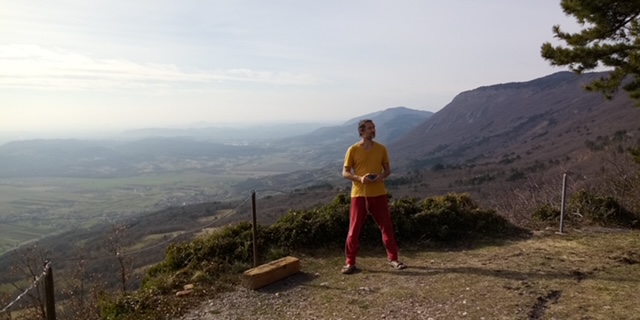
But then, what do I know? I first met Tomaž more than 20 years ago, connected by a woman we loved. But when I recently scanned a map of Europe, one of the first things that came to mind was that in a modest apartment overlooking the Ljubljanica River near the heart of Slovenia’s capital, Tomaž was doing his thing, living his life to the fullest, letting his light shine.
He doesn’t just feature in my own personal geography or spiritual map of the world. Over the last two decades when travelling in Asia or Australasia I’ve come across people from Ljubljana, and on too many occasions, it turns out they also know Tomaž.
What can you tell us about where you live, in Ljubljana?
Ljubljana is located in the heart of Europe, nestled between Italy, Austria, Hungary, Croatia, and the Adriatic Sea. Slovenia’s capital city is neither large nor small, with a population of 300,000. It’s a delightful place to reside, featuring a vibrant community of young people, and hosting numerous cultural events.
I live in the city centre, right alongside the picturesque green river known as the Ljubljanica. From my window, I enjoy a spectacular view of Ljubljana’s castle perched atop a hill and the flowing river. If I wish to take a stroll in nature, there’s a forest just a 3-minute walk from my house in one direction and 15 minutes in the other. Even in the city centre, there are plenty of trees and green spaces.
Ljubljana is a hidden gem in Europe, and not many people know about its story. What can you say about the country and its people?
When I was born in 1962 Slovenia was a part of Yugoslavia, which was a non-aligned country, not affiliated with either the capitalist Western bloc or the communist Eastern bloc. Yugoslavia was a socialist country, somewhere between communism and capitalism. It was wealthier than communist countries but not as affluent as capitalist ones. Back then, we didn’t have much, but there were no truly impoverished people. Nobody was starving, and nobody was wealthy.
Today, we have a significant number of very wealthy individuals alongside many who are extremely poor, struggling with hunger and homelessness. Presently, life in Slovenia is not significantly different from that in other European countries.
What was it like for you growing up in the 1960s and 1970s in Slovenia?
Back then, we didn’t have cell phones and computers, so we spent most of our time outdoors playing with friends. We played games like hide and seek and competed to see who could run the fastest, jump the highest, climb the highest tree, and so on. When I was a child, I either played outside with friends or read books.
Where did reading books take you?
Books became my passion from the moment I learned how to read. Through books, I learned about other places on Earth and different cultures. I especially adored books about Native Americans. I read all of Karl May’s books [1]– Apache chief Winnetou was my number one hero.
So your interest in the whole wide world came from books?
Yes, my love of books furthered my fascination with other cultures. I’ve always been an avid reader. When I recognised that our own culture was not faring well, that it was troubled and leading us toward a precipice, I became curious about other cultures, especially indigenous ones. I began to delve into literature about Native American, Aboriginal, Celtic, and other cultures, exploring their spirituality and beliefs.
What put you on a path of exploring spirituality?
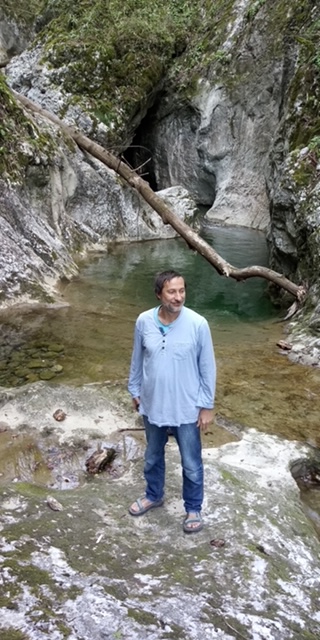
When I was 15, I fell off a rock wall in a canyon while I was climbing, plummeting 15 meters to the ground. I lay there, unable to move, and had to be rescued and taken to the hospital. Fortunately, it turned out that nothing was broken, but that incident profoundly changed my life. I began to contemplate the concepts of life and death. Death came close, examined me, and decided to spare me for a while longer.
Since that moment, I haven’t been afraid of death anymore. I also started pondering the meaning of life, which became the most significant question for me: What is the meaning of life? That question guided me towards spirituality and spiritual growth. Ever since, spirituality has been the most vital aspect of my life, (alongside, of course, the elements of sex, drugs, and rock and roll).
How were your first experiences venturing overseas?
My first journey took place when I was 15 years old, and I hitchhiked through Europe. I passed through Italy, and in Genoa, I attempted to buy marijuana. I gave money to a guy who entered a house but never returned. It was only then that I realised he had exited through another entrance at the back of the house.
Later in the Côte d’Azur, I purchased LSD, only to discover that I had received plain candy instead. In Nice, I was robbed by a group of 14-year-old Algerians. While hitchhiking on the highway outside of Paris, a large truck deliberately ran over my backpack, scattering all my belongings on the road. Moments later, the police arrived and informed me that hitchhiking on the highway was prohibited. When I showed them what had happened to my backpack, they simply shrugged and drove away.
In Brittany, a kind couple invited me to sleep in their house because it was raining, and I had intended to sleep outside in my sleeping bag. In Paris, a young man around 20-years-old invited me to stay in his apartment, but as we shared the same bed, he tried to put his hand into my underwear.
From these experiences, I learned that I couldn’t trust everyone and that I needed to be cautious. I also discovered that some people are incredibly generous and trustworthy. Most importantly, I learned that I am the master of my life, and it’s best to rely on myself. I also realized that the world is vast, and not every place is the same as my small Slovenia. I encountered people of various nationalities and skin colours, broadening my horizons. I understood that a person’s nationality doesn’t matter; fundamentally, we are all the same. In every country, there are both good and not-so-nice people. But regardless of where they are, everyone shares the same desire: to find happiness.
Has your style of travel changed over time from those first adventures in Europe?
When I was younger, I was restless and eager to explore as many places as possible, often staying in one place for no more than a day or two. However, as time went on, I came to realise that the longer I remain in one location, the more fulfilling it becomes. I grow more peaceful and content, and it’s only then that I can truly savour and fully immerse myself in the experiences.
I also came to understand that the slower I travel, the more profoundly I connect with the landscapes I traverse. When I travel by car, it feels like I’m merely watching the scenery on a television screen. Travelling by bicycle is a much richer experience. Walking on foot is even better, as I absorb every step of the journey. Travelling by public transport has its own appeal. On a bus, I can keenly observe the locals, their personalities, and their customs, which offers a splendid perspective on the places I visit.
What has been a really memorable travel experience for you?
One of the most memorable places that I visited in Ghana was a village called Sonyon. I was travelling by bicycle, and wherever I went, I would tell the people that I wasn’t a tourist but a pilgrim who had come to bestow blessings upon them. You can only reach this village on foot or by bicycle. Later, I learned that it’s a spiritual village where people from all over come to heal or achieve specific goals. They perform offerings, and then conduct certain ceremonies, and they say it has a powerful effect.
The houses in this village are single-story, made of mud, and have flat roofs. They are built close together, so in the evening, the villagers go up to the roofs, where it’s cooler due to a gentle breeze, and they walk around the village from house to house, like on a promenade. They even sleep there sometimes. I lay on the roof, and children came up and started touching me because they were curious about my white skin. I lay on my stomach, patted my back, and said, “You can touch me here,” and they began to stroke and massage me. It was a fantastic feeling, like being caressed and massaged by five or six children!
And how about when travelling in my home country, New Zealand?
One of the most memorable experiences during my first trip to New Zealand’s North Island was while stopping for a short break near a magnificent coastline while hitchhiking. I wanted to stay there for a while. So, I headed towards the coast, found a suitable spot, and set up camp. I spent quite a few days there. I was truly enjoying myself. I remained naked throughout the experience, frequently leaping into the water, singing loudly, dancing, and engaging in meditation, among other activities.
Then I was walking for a long time and eventually, I ran out of water and food. With my last bit of strength, I managed to reach the top of a hill. According to the information in my book, I should have soon come across the first settlement along the way. However, the path had disappeared. Tall grass had grown all around me. I climbed onto a rock and saw a belt of forest nearby, with a path beyond it. I headed towards the forest. Wild boars ran past me. The forest was so overgrown that it took me an hour to reach a path about a hundred meters away. I was dirty and scratched, my clothes were torn, and I was hungry and thirsty. It was Christmas Eve.
Soon, I heard human voices and saw a holiday trailer. People were having a picnic. I asked them if I was heading in the right direction towards the main road. They confirmed it and said, “Wait a minute. Are you thirsty, or hungry? Have a beer. It’s Christmas Eve.” I stayed with them. Soon, Māori friends joined them. We sat around the fire, ate and drank, talked, an elderly Māori woman shared stories of their spirituality and sang their songs, and I sang some of ours. I couldn’t have asked for a better Christmas gift.
Let’s go back to your earlier existence. What happened for you to give up a career working in a bank?
It all began with Illusions (1989) by Richard Bach. I was still employed at a bank when I came across this book – and it had a profound impact on me. It meant so much to me that I made a personal commitment to translate it, despite having no prior experience in translation. And so, I translated it. Subsequently, I submitted my translation to all the publishers in Slovenia, but unfortunately, none of them were interested (back then, the book didn’t align with the socialist Yugoslavia prevailing system). Undeterred, I took matters into my own hands. I photocopied 200 copies of my translation and sold them independently. With the proceeds from those sales, I was able to print an additional 500 copies. To my surprise, I found that I was earning more from these efforts than I would have if a publishing house had purchased my translation.
This realization led me to make a life-altering decision—I left my job at the bank and embarked on a journey of translating and publishing other books that I believed had the power to touch people’s hearts and were of great importance. Authors such as Kahlil Gibran, J.R.R. Tolkien, the Dalai Lama, Louise Hay, William Bloom, Paul Solomon, Dan Millman, and Lobsang Rampa were just a few of the writers whose works I translated and shared with the Slovenian audience.
What do you think is the purpose of your life?
When I was going through a very difficult period in my life and couldn’t sleep one night, I went to the balcony and suddenly heard a voice loudly asking me, “Tomaž, why are you here, why did you come to this world?” Suddenly, it dawned on me, and I replied, “I came here to be happy!” The voice replied, “That’s right, Tomaž. Now, take a look at yourself. Are you happy?”
That’s when I decided to be happy. Once I made that decision, I stuck to it, and I truly was happy.
Later, many years later, I realised that I didn’t just come to be happy. I discovered that I’m even happier and more fulfilled when I make someone else happy. Gradually, I realised that my mission is to help others. I help them in various ways. At one point, I helped by translating and publishing books that benefited them. Later, I assisted them with counselling at the New Age Information Centre, which I founded. Now, I help them with therapeutic massages, with conscious and loving touch.
So what’s your superpower?
My superpower is undoubtedly my touch. However, this transforms into true power only when I am fully aware of it and fill it with love. In fact, my superpower is the awareness that everything is one, that all that exists, the entire universe, and all the things and beings that fill it, both material and immaterial, are actually one vast super being or God.
What things do you do most days to keep you balanced?
For a long time now, I’ve had a morning routine that fulfils me and makes mornings the most beautiful part of my day. When I wake up, I first express gratitude for the night and greet the new day that lies ahead, even before I open my eyes. Then I engage in exercise. I limber up all my joints, perform tantric exercises, breathing exercises, practice yoga, tai chi, and chi gong.
Afterwards, I sit down to meditate and spend some time in silence. Only then am I prepared for the day’s responsibilities. Similarly, in the evening, when I close my eyes, I give thanks for the day I’ve lived and bid goodnight to the night that approaches.
How do you think you’ve made an impact on the lives of others?
When I was publishing books, I received a lot of feedback from my customers which made my heart sing. Some were praising my translations, and some were thankful that I decided to publish such beautiful and meaningful books.
I receive even more grateful feedback from the people I massage. One client commented “I was led to the place where everything just is and exists.” And, Frida, gave me this wonderful endorsement, “For a moment you caught me in timelessness that lasted and lasted. My body was dancing under your loving hands and melted with your grace. Thank you for this magical experience. Your love for the work you are doing and for the people can be felt and it is healing.”
Recently I received this feedback, with the person saying “This was not an ordinary massage. Tomaž’s gentle presence made me feel safe, so I entrusted him with my process.” Another wrote “Tomaž, your creation is truly something special. You’ve given the world a wonderful gift, and I thank you for it.” I’m grateful to people like Medeja who thank me by saying “As if a flock of angels, completely devoted and determined angels, guided me through all possible processes — fears, pains, freedom, love, and beauty — and brought me to their home, where it is so beautiful and pleasant that there are no words to replace this feeling.”
What are the most important things you’ve learned?
I’ve learned that the most important thing for me is to live my soul.
I’ve also learned that no one is more important than another, that there is no good or bad, and that life isnot serious; rather, everything is like dust in the wind of the Universe, or as I like to say, “chickenshit.”
The most fulfilling action one can take is to help others because it brings genuine joy. As socialbeings, our connections with others are the most crucial aspects of life, far surpassing thesignificance of material possessions.
If you have a message or advice for others, what would it be?
Don’t worry; life is not so serious. Follow your heart and live your soul. Be yourself; you don’t have to be somebody else, you don’t have to pretend to be somebody else. Everything is changing; nothing is permanent; everything will end or transform. Live fully, live, and be aware of every moment of your life. That’s why we are here: to live our life fully, to experience everything from joy to sadness, from anger to love, from despair to fulfilment. And to be aware of all of this.
[1] Karl May( 1842-1912) German author. Winnetou was a novel by him.
Keith Lyons (keithlyons.net) is an award-winning writer and creative writing mentor originally from New Zealand who has spent a quarter of his existence living and working in Asia including southwest China, Myanmar and Bali. His Venn diagram of happiness features the aroma of freshly-roasted coffee, the negative ions of the natural world including moving water, and connecting with others in meaningful ways. A Contributing Editor on Borderless journal’s Editorial Board, his work has appeared in Borderless since its early days, and his writing featured in the anthology Monalisa No Longer Smiles.
PLEASE NOTE: ARTICLES CAN ONLY BE REPRODUCED IN OTHER SITES WITH DUE ACKNOWLEDGEMENT TO BORDERLESS JOURNAL.
We know him variously — a man whose face and form appear on currency notes in India and on stamps, as statues and as art, internationally. He was known as a pacifist, one who inspired the likes of Nelson Mandela, Martin Luther King Jr, Obama and many more leaders. And yet, he was a tiny, frail man, rather adamant and uncomfortable to live with and with food choices that many might find difficult to digest. This man was called Mohandas Karamchand Gandhi.
Born on October 2nd 1869, in Porbandar, Gujarat, he became an internationally renowned figure for all of us. Like all great leaders, he impacted the world in ways more than one but he had some idiosyncrasies, for example, he had no faith on the film industry though a number of films have been made on and about him. Highlighting that is an essay from Shantanu Ray Chaudhuri. Gandhi affected people and much of the writing in this edition goes to show how he or his ideas impacted them. Ratnottama Sengupta comments and translates parts of the episode from the biography of eminent Bengali writer, Nabendu Ghosh, her father, as well as a short story by him, to focus on Gandhi’s impact on India’s Direct Action Day (16th August 1946). A poem by contemporary Santosh Bakaya about the same incident make one wonder why suddenly there is so much focus on this part of history.
Here’s to unraveling the mystery and celebrating Gandhiism in spirit—
Gandhiji, a short story by Nabendu Ghosh, has been translated from Bengali by Ratnottama Sengupta. Click here to read.
Magic of the Mahatma , Ratnottama Sengupta shows the impact of Gandhi and his call for non-violence on Nabendu Ghosh as she continues to emote over his message of Ahimsa and call for peace amidst rioting. Click here to read.
Gandhi in CinemaShantanu Ray Chaudhuri explores Gandhi in films and also his views on the celluloid screen. Click here to read.
MAGIC


Lo! I saw a magician last night.
 A slender silhouette -- almost half-naked.
Was the night at its tricks once again?
Was the frail figure about to pull rabbits out of his hat?
Magicians do have this incorrigible habit of pulling rabbits from hats.
But this magician defied all stereotypes. Where was his hat?
Where the rabbits?

I looked at the calendar, and gasped. It was 16 August 1946.
How bizarre! The stars outside had a fickle glow.
There was chaos, there was confusion. There was hatred.
The graffiti on the mildewed walls screamed:
Direct Action Day!

Piercing the cacophony, a soft, feathery voice
 fell on the turbulent crowd.
Not a rabble rousing voice, but a magical one.

“I have come here to serve Hindus and Muslims.”
A hush fell. Louder – louder – louder grew the hush.

Then I saw the half-naked figure walking away.

All alone – but in sync with 'Gurudeb's words
'Ekla chalo Re*’.

But lo and behold! There was more magic!
The pages of the calendar fluttered in the breeze.
With great ardour, swayed the trees.
I was amazed; the calendar now showed the year 2023.

I peeped through the window.
 Birds perched on bowers were singing, impromptu songs.
 The folds of their yellow-green-blue-wings hid musical notes.
Then I again saw the half-naked figure.
Walking alone, but in sync with 'Gurudeb's words,
'Ekla chalo Re,' ringing in his ears.

But lo and behold! There was more magic!
The One Man Army was no longer alone.
The trickle had become a deluge.
Music poured from every tree.

A multi-layered song was being sung in every tone,
every tenor, every pitch, pouring love melodies.
The sun of a new morn smiled from above.
The heady scent of freshly hewn lawn spread in the air.

Megalomaniacs had fallen pathetically silent.
The muted falling of a leaf creating a quiet turbulence.
An invisible drummer was beating his drum.

“Back to nature --Back to peace --Back to love.
An eye for an eye, a tooth for a tooth will make the whole world blind.

Blind-Blind-Blind.”
The surroundings resounded.
 The boughs seemed to be swaying to the beat of myriad stringed instruments
Queedle queedle -queedle hoo- ah hoo- hoo- hoo kleek kik ik ik ik .honk honk
koo- ookoo hoooooooo…

Birds sang from every branch-- high pitch – low pitch, contralto cadences,
 chirruping notes, and even hoarse, grating rattles and loud caws.
Magic again happened-- creating a soul-- soothing symphony
of eclectic pitches and rhythm.

 “He belongs to me, he belongs to you.
He belongs to the man in the street.
He belongs to the coward and the bold.
He belongs to the strong and the effete.
He belongs to the one shivering on the pavement.
He belongs to me, he belongs to you.

"He belongs to the man whimpering under the awning.
Hoping for something good in the coming morning.
He belongs to the bruised and the battered.
And the one with unshed tears and clothes tattered.

"He belongs to the one who lives by his labour.
And even to the one who does not love his neighbor.
The spunky woman bending in ceaseless toil.
And the youngster whose blood is on the boil.

"He belongs to the one with the frown.
He belongs to the white, black and brown.
The one with a swagger in his gait.
The one who suffers viciously at the hands of fate.

"The bird fluttering helplessly in the cage.
The youth struggling with road rage.
Those engrossed in ego tussles
and the one flaunting his muscles.
He belongs to me, he belongs to you.”

With a revolutionary fervor, every leaf was shaking.
A symphony of love and peace was in the making.
The pilgrim was no longer alone
Love had injected every bone.
Faces glimmered with hope -- there was no mistaking.

*Gurudeb means Teacher and refers to Tagore in this case. 'Ekla Cholo Re' (Walk Alone) is a well known song by Tagore.
Santosh Bakaya, PhD, poet, essayist, novelist, biographer, TEDx speaker, has written twenty-three books across different genres, Ballad of Bapu, and Only in Darkness can you see the Stars [Biography of Martin Luther King Jr]. have won international acclaim. What is the Meter of the Dictionary? is her latest solo book of poetry.
.
PLEASE NOTE: ARTICLES CAN ONLY BE REPRODUCED IN OTHER SITES WITH DUE ACKNOWLEDGEMENT TO BORDERLESS JOURNAL
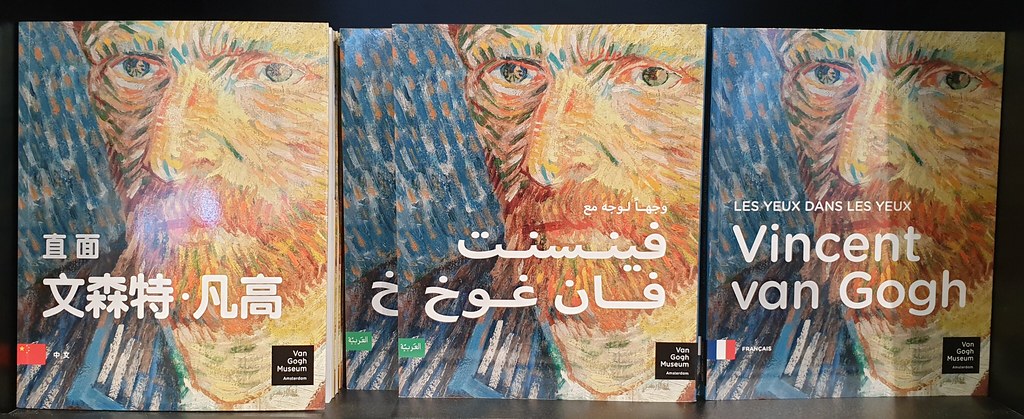
Vincent Van Gogh written is different scripts. Courtesy:Creative Commons
The whole world opens up in the realm of ideas that have existed wafting and bridging across time and space. Sometimes they find conduits to come to the fore, even though they find expression in different languages, under varied cultural milieus. One way of connecting these ideas is to translate them into a single language. And that is what many have started to do. Celebrating writers and translators who have connected us with these ideas across boundaries of time and place, we bring to you translated writings in English from twenty eight languages on the International Translation Day, from some of the most iconic thinkers as well as from contemporary voices.
Prose
Tagore’s short story, Aparichita, has been translated from Bengali as The Stranger by Aruna Chakravarti. Click hereto read.
Nadir Ali’s The Kabbadi Player has been translated from Punjabi by Amna Ali. Click here to read.
Kamaleswar Barua’s Uehara by has been translated from Assamese and introduced by Bikash K. Bhattacharya. Click here to read.
S Ramakrishnan’s Muhammad Ali’s Singnature has been S. Ramakrishnan, translated from Tamil by Dr B. Chandramouli. Click here to read.
PF Mathews’Mercy, has been translated from Malayalam by Ram Anantharaman. Click here to read.
Road to Nowhere, an unusual story about a man who heads for suicide, translated from Odiya by the author, Satya Misra. Click here to read.
An excerpt from A Handful of Sesame by Shrinivas Vaidya, translated from Kannada by Maithreyi Karnoor. Click hereto read.
Writings from Pandies’ Cornerhighlight the ongoing struggle against debilitating rigid boundaries drawn by societal norms. Each piece is written in Hindustani and then translated by a volunteer from Pandies’ in English. Clickhere to read.
Rakhamaninov’s Sonata, a short story by Sherzod Artikov, translated from Uzbeki by Nigora Mukhammad. Click hereto read.
Of Days and Seasons, a parable by the eminent Dutch writer, Louis Couperus (1863-1923), translated by Chaitali Sengupta. Click here to read.
The Faithful Wife, a folktale translated from Balochi by Fazal Baloch. Click hereto read.
An excerpt from Ramy Al-Asheq’sEver Since I Did Not Die, translated from Arabic by Isis Nusair, edited by Levi Thompson. The author was born in a refugee camp. Click here to read.
Poetry
Two songs byTagore written originally in Brajabuli, a literary language developed essentially for poetry in the sixteenth century, has been translated by Radha Chakravarty. Click here to read.
Rebel or ‘Bidrohi’, Nazrul’s signature poem, ‘Bidrohi‘, translated from Bengali by Professor Fakrul Alam. Click here to read.
Banlata Sen, Jibananada Das’s iconic poem, translated from Bengali by Professor Fakrul Alam. Click here to read.
In conversation with Isa Kamari, a celebrated writer from Singapore, with focus on his latest book, Maladies of the Soul. Click here to read.
Translations
A Hunger for Stories, a poem by Quazi Johirul Islam, has been translated by Professor Fakrul Alam. Click here to read.
A Hand Mill, a story by Ammina Srinivasaraju, has been translated from Telugu by Johny Takkedasila. Click here to read.
Kiyya and Sadu, a part of this long ballad on the legendary lovers from Balochistan, has been translated from Balochi by Fazal Baloch. Click hereto read.
In Tintin in India, Rhys Hughes traces the allusions to India in these iconic creations of Hergé while commenting on Tintin’s popularity in the subcontinent. Click hereto read.
Meredith Stephens shares the response of some of the Californian community to healing after the 2020 forest fires with a narrative and photographs. Click hereto read.
No, they whisper. You own nothing.
You were a visitor, time after time
climbing the hill, planting the flag, proclaiming.
We never belonged to you.
You never found us.
It was always the other way round.

‘Moment’ by Margaret Atwood
With an unmanned mission reaching the moon — that moon that was chipped off the Earth’s surface when Theia bashed into the newly evolving planet — many feel mankind is en route to finding alternate biomes and perhaps, a solution to its housing needs. Will we also call moon our ‘Homeland’ and plant flags on it as we do on Earth? Does the Earth — or the moon — really belong to our species. Do we have proprietary rights on these because of lines drawn by powerbrokers who say that the land belongs to them?
These are questions Margaret Atwood addresses in her writings which often fall into a genre called cli-fi. This is gaining in popularity as climate has become uncertain now with changes that are wringing fear in our hearts. Not all fear it. Some refuse to acknowledge it. While this is not a phenomenon that is fully understood by all of us, it’s impact is being experienced by majority of the world — harsh stormy weather, typhoons, warmer temperatures which scorch life and rising water levels that will eventually swallow lands that some regard as their homeland. Despite all these prognostications, wars continue to pollute the air as much as do human practices, including conflicts using weapons. Did ‘climbing a hill’ and ‘planting the flag’ as Atwood suggests, ever give us the rights over land, nature or climate? Do we have a right to pollute it with our lifestyle, trade or wars — all three being human constructs?
In a recent essay, Tom Engelhardt, a writer and an editor, contended, “Vladimir Putin’s greatest crime wasn’t simply against the Ukrainians, but against humanity. It was another way to ensure that the global war of terror would grow fiercer and that the Lahainas of the future would burn more intensely.” And that is true of any war… Chemical and biological weapons impacted the environment in Europe and parts of Afghanistan. Atom bombs polluted not only the cities they were dropped in, but they also wreaked such havoc so that the second generation’s well-being continues impacted by events that took place more than seven decades ago. Yet another nuclear war would destroy the Earth, our planet that is already reeling under the impact of human-induced climate change. Flooding, forest fires and global warming are just the first indications that tell us not only do we need to adapt to living in changed times but also, we need to change our lifestyles, perhaps even turn pacifist to survive in a world evolving into an altered one.
Critiquing the darker trends in our species which leads to disasters is a book by an eminent Singaporean writer, Isa Kamari, called Maladies of the Soul. He too looks for panacea in a world where the basic needs of humans have been satiated and they have moved on towards overindulgence that can lead to redundancy. In a conversation, he tells us how he hopes his writings can help towards making a more hopeful future.
This hope is echoed in the palliative poems of Sanket Mhatre from his book, A City full of Sirens, excerpted and reviewed by Basudhara Roy. Bhaskar Parichha’s review of Samragngi Roy’s The Wizard of Festival Lighting: The Incredible Story of Srid, is a tribute also from a granddaughter to her grandfather celebrating human achievements. Somdatta Mandal’s discussion of fiction based on history, Begum Hazrat Mahal: Warrior Queen of Awadhby Malathi Ramachandran not only reflects the tenacity of a woman’s courage but also explores the historicity of the events. Exploring bits of history and the past with a soupcon of humour is our book excerpt from Syed Mujtaba Ali’s Tales of a Voyager (Joley Dangay[1]), translated from Bengali by Nazes Afroz. Though the narrative of the translation is set about ninety years ago, a little after the times of Hazrat Mahal (1820 –1879), the excerpt is an brilliant introduction to the persona of Tagore’s student, Syed Mujtaba Ali (1904-1974), by a translator who describes him almost with the maestro’s unique style. Perhaps, Afroz’s writing bears these traces as he had earlier translated a legendary work by the same writer, In a Land Far from Home: A Bengali in Afghanistan. Afroz starts with a startling question: “What will you call someone who puts down his profession as ‘quitting job regularly’ while applying for his passport?”
In non-fiction, we have Devraj Singh Kalsi’s funny retelling of his adventures with a barber while Hughes‘ essay on the hugely popular Tintin makes us smile. The patriarchal past is reflected in an essay by G Venkatesh, whereas Suzanne Kamata from Japan talks of women attempting to move out of invisibility. Meredith Stephens and Candice Louisa Daquin both carry on the conversation on climate change. Stephens explores the impact of Californian forest fires with photographs and first-hand narrative. Vela Noble draws solace and strength from nature in Kangaroo Island and shares a beautiful painting with us. Madhulika Vajjhala and Saumya Dwivedi discuss concepts of home.
Two touching tributes along with a poem to recently deceased poet, Jayanta Mahapatra, add to the richness of our oeuvre. Dikshya Samantrai, a researcher on the poet, has bid a touching adieu to him stating, “his legacy will continue to inspire and resonate and Jayanta Mahapatra’s name will forever remain etched in the annals of literature, a testament to the enduring power of the poet’s voice.”
Our translations this time reflect a diverse collection of mainly poetry with one short story by Telugu writer, Ammina Srinivasaraju, translated by Johny Takkedasila. Professor Fakrul Alam has introduced us to an upcoming voice in Bengali poetry, Quazi Johirul Islam. Ihlwha Choi has translated his own poetry from Korean and brought to us a fragment of his own culture. Fazal Baloch has familiarised us with a Balochi ballad based on a love story that is well known in his region, Kiyya and Sadu. Our Tagore translation has attempted to bring to you the poet’s description of early autumn or Sharat in Bengal, a season that starts in September. Sohana Manzoor has painted the scene depicted by Tagore for all of us to visualise. Huge thanks to her for her wonderful artwork, which invariably livens our journal.
Profound thanks to the whole team at Borderless for their support and especially to Hughes and Parichha for helping us source wonderful writings… some of which have not been mentioned here. Pause by our content’s page to savour all of it. And we remain forever beholden to our wonderful contributors without who the journal would not exist and our loyal readers who make our existence relevant. Thank you all.
Autumn expresses itself in Bengal as Sharat (early autumn) and Hemonto (late autumn). The Tagore pantheon of literature has much of seasons in it. This poem, Sharat, was part of his poetry collection Kalpana, published in 1900.
Sharat by Sohana Manzoor.
Autumn

I see your beauteous form
        In this autumnal dawn,
Oh! Mother Bengal, your green figure
          Is resplendent with radiance.

The river cannot be contained in its bed.
         The fields are overflowing with paddy.
Robins chant and koels sing
        In your graceful gardens.
Amidst this dawn of sharat,
        O Mother, you stand poised.

Mother, the breeze chimes
       An auspicious onset —
Grains of new rice crops
        Fill homes with festivities.
You have no respite anymore.
        Sheafs of paddy move in bulk
Along rural paths wafting
          Their perfume in the draft.
Mother, the zephyr sends you
          An intimation of the seasonal onset.

The skies paint clouds
      to welcome the season.
Dewdrops have sprinkled
       Coolness on the green earth.
The flute seems to play a melody that
        Wafts through the land, water and air.
Boats come crowding to your doorway
          From all directions.
The sky is clear and blue.
          The earth, soft and cool.

The breeze starts to chill
       Refreshing tired bodies.
Every hut is filled with new hope,
         With the advent of new life.
All over, Mother, abound events
           Organised by joyous faces.
People grab fistfuls of happiness
            From your overflowing granaries.
The breeze rushes with anchals*
           Full of new life.

Come, come, wherever you are,
            Come running all of you —
Our Mother has opened her granary.
          Our grains are overflowing.
Come by boat from the other bank,
           Mothers and daughters come.
Who cries in hunger under maternal care?
           Come running all of you.
Our mother has opened her granary.
            Our grains are overflowing.

Our Mother wears a garland of shefali.
      Floral perfumes scent the earth.
White, creamy cirrus clouds
         Seem to stud her veil.
Crowned with a golden halo,
       Sweet, glorious, green and resplendent,
With feet dressed in blooms,
        My mother stands poised.
The whole world smiles at her illuminated
       With dewdrops, flowers and crops.


*Anchal is the loose end of a sari
Author: Syed Mujtaba Ali, translated from Bengali by Nazes Afroz
Publisher: Speaking Tiger Books
Translator’s Introduction
What will you call someone who puts down his profession as ‘quitting job regularly’ while applying for his passport? The short answer is Syed Mujtaba Ali. Even though written in jest, this succinct phrase describes him perfectly—his wicked sense of humour, his peripatetic life, his ability of making fun of himself, his propensity of not settling down in one place or a job—everything can be packed into that phrase. And when these traits are gifted with a razor-sharp brain that masters a dozen languages and absorbs tomes on philosophy, history and knowledge from the four corners of the world, you get a Syed Mujtaba Ali. Only a few such unique persons are born in a century.
It was not a coincidence that a born rebel and non-conformist young Ali would be attracted to the greatest writer and philosopher of his time, Rabindranath Tagore. Refusing to go to a university run by the British rulers, he chose Visva-Bharati in Shantiniketan, founded by Tagore. Under Tagore’s tutelage, the cocoon flourished into a dazzling butterfly. The teachings of Shantiniketan set the life course for Ali as Tagore remained his pole star.
Imbibing his guru’s deep-seated ideals of freethinking humanism and internationalism, Ali as a twenty-three-year-old fresh graduate, would set out to explore the world. Starting as a teacher in Kabul in 1927, he went on to completing his PhD in comparative religion as a Humboldt scholar from Bonn, Germany, in 1932. After returning home briefly, Ali went to do his postdoctoral studies at one of the oldest universities in the world, Al-Azhar in Cairo in 1934. The ruler of Baroda state, Maharaja Sayaji Rao was hugely impressed by this young scholar when he met Ali during his visit to Cairo in 1935. The Maharaja invited him to head the government college in Baroda. Accepting the post, Ali moved to Baroda in 1936 and remained there till 1944.
Following the death of Sayaji Rao, Ali left Baroda and returned to Kolkata. He did not take up any jobs for a few years, concentrating on finishing his first book, Deshe Bideshe,* his memoir of his time in Kabul between 1927 and 1929. Serialized in 1948 in Desh, the most-read literary magazine in Kolkata, it was published as a book in 1949. The book attained an instant cult status and Bengali readers were swept off their feet by Ali’s prose, wit, gripping storytelling, ability to create a cast of most fascinating characters, and his multilingual and multicultural erudition.
Ali went through another life-altering event around this time. In the wake of the partition of Bengal, Ali moved to East Pakistan, which was his birthplace and joined the government college in Bogura in 1949 as the principal. But his stay in Pakistan was rather a short one. This was the time when Pakistani rulers were trying to impose Urdu as the national language over the majority Bengali population in East Pakistan. It was impossible for a freethinker like Ali who took a huge pride in his Bengali heritage and identity to subscribe to such a policy. He penned a short yet scathing critique of the government’s attempt to colonize the Bengalis with another language. Pakistani authorities promptly issued an arrest warrant against him after the essay came out in a journal in Kolkata. Ali’s elder brother, who happened to be a district administrator at the time, warned him about his impending arrest and overnight he left Pakistan forever. He returned to Kolkata and lived in India as an Indian citizen for the rest of his life.
Shortly after returning to India, the first Education Minister of India, Maulana Abul Kalam Azad, invited Ali to head the newly founded Indian Council for Cultural Relations or the ICCR* as its first Secretary and the editor of its Arabic journal, Thaqafat-ul-Hind. He took up the assignment in 1950 before joining the All India Radio in Delhi in 1952. He went on to be the Station Director of All India Radio in Cuttack and Patna. Finally, he joined his alma mater, Visva-Bharati in Shantiniketan in 1958 first as a professor of the German language and then of Islamic Culture. After his retirement in 1964, as a full-time writer he lived between Shantiniketan and Kolkata.
As a man who led such an unorthodox life, his family life could not be otherwise. He married, late in his life (1951, at the age of forty-six), Rabeya Khatun, who worked for the education department in East Pakistan. They had two sons, born in 1952 and 1953. While he continued living in India as an Indian, his wife and sons lived in East Pakistan. After the freedom struggle and the war of independence of 1971 when East Pakistan became an independent country as Bangladesh, Ali started spending more time with his family in Bangladesh. He died in Dhaka in 1974 during one of such visits and was interred there.
(Extracted from Tales of a Voyager (Joley Dangay) by Syed Mujtaba Ali, translated by Nazes Afroz. Published by Speaking Tiger Books, 2023.)
About the Book
Some time between the two World Wars, Syed Mujtaba Ali set out on ship from India to travel to Europe. Leaving Sri Lanka behind, sailing in the Arabian Sea and then along the coast of Africa, he crossed the Horn of Africa, until the ship reached Suez Port. Along the way, Ali collected a bunch of stories—about his new young friends Paul and Percy, who became his loyal acolytes; and the eccentric Abul Asfia Noor Uddin Muhammad Abdul Karim Siddiqi, who carried toffees, a gold cigarette case, and other sundry items in his capacious overcoat pocket and who had the answer to all problems though he barely spoke a word ever.
As the ship makes its way, Mujtaba Ali tells stories of the island of Socrota with its pirates in search of treasure. He dives into history and recounts how the giraffe went to China via India from Africa. And when the friends get off at Suez, in order to see the pyramids of Giza, he provides a deeply entertaining and perceptive description of Egypt—from its taxi drivers and café owners, to pharaohs and tomb hunters.
Erudite but light-hearted, brimming with laughter and with many moments of tenderness, Tales of a Voyager is a gem of a travelogue from the author who wrote the immensely popular travel account of Afghanistan, In a Land Far from Home (Deshe Bideshe).
‘Syed Mujtaba Ali knows how to perform magic through his writing! One moment his humour and wit will make you break out in roaring laughter and the next you find yourself buried in deep thought being touched by the poignance in his satire.’—Dhaka Tribune
About the Author
Born in 1904, Syed Mujtaba Ali was a prominent literary figure in Bengali literature. A polyglot, a scholar of Islamic studies and a traveller, Mujtaba Ali taught in Baroda and at Visva-Bharati University in Shantiniketan. By the time he died in 1974, he had more than two dozen books—fiction and non-fiction—to his credit.
About the Translator
A journalist for over three decades, Nazes Afroz has worked in both print and broadcasting in Kolkata and London. He joined the BBC in London in 1998 and spent close to fifteen years with the organization. He has visited Afghanistan, Central Asia and West Asia regularly for over a decade. He currently writes in English and Bengali for various newspapers and magazines.
Poem by Quazi Johirul Islam, translated from Bengali by Professor Fakrul Alam
Quazi Johirul Islam
As a boy I heard the same story from my father again and again:
My grandfather hadn’t left behind for his son any kind of plot
Where seeds could be planted that would yield a garden full of yummy stories.
In the same vein, a hunger for stories engrossed me in my childhood and teens.

I know that all ye still to be born children
Will cry glumly like I once had, hungry for stories.
That is why I’d braved cresting, roaring waves,
Cooked soups of stories on immigrant cookers on wintry nights;
Diving to the bottom of the sea, I’d seen how marine species
Dance to the rhythm of hidden waves,
And write on whale bodies of the sea!
From empty spaces, I captured wild African stories of desert bisons;
Standing in the chilling North Pole blizzards,
I was able to divine stories of stormy nights;
From Gibraltar, I fetched the bright light of new stories
Which I then strewed on Casablanca’s ancient eyes!

Out of my sweat and blood, I create endless stories for coming generations
For I know that even though all other causes of hunger may die,
What will only survive in the dark is the hunger for more and more stories.

From wintry prairies to grey Savannahs,
And in all pathways of the world,
I’ve been sowing seeds of new stories every day.
Climbing down from the lap of juicy fruit-filled gardens,
Seated on the soft mat that is earth,
They keep developing the craving for new stories endlessly.
Endlessly, the hunger for untold stories
Vibrate all sleepy pathways of the world!
Quazi Johirul Islam has been writing for over 3 decades. He has published more than 90 books, 39 of them are collections of poetry. His travelogues are very popular. He has been with United Nations, has traveled all over the world, worked in conflict zones, his bag is full of colourful experiences. In 2023, Quazi was awarded Peace Run Torch Bearer Award by Sri Chinmoy Centre, New York. He has also received many awards and honors in Bangladesh, India and abroad.









 Borderless