Categories
Slices from Life

The Pearl of the Indian Ocean

By Ravi Shankar

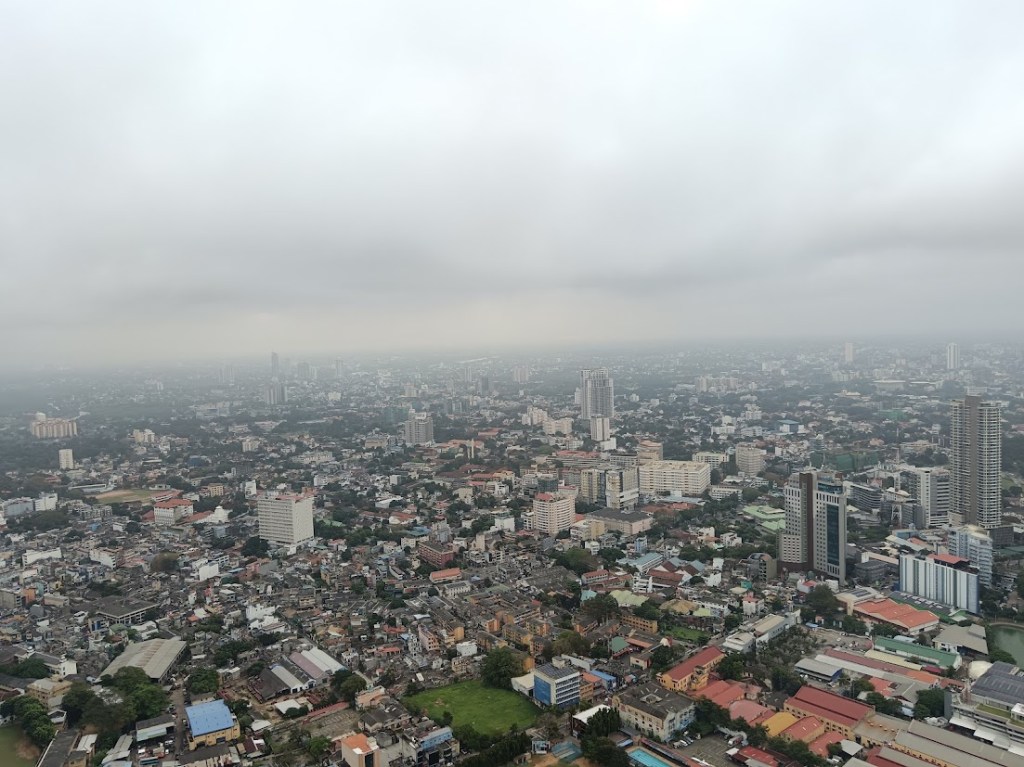
A panoramic view of Colombo. Photo courtesy: Ravi Shankar

My impressions of Colombo and Sri Lanka were positive. I was aware of the high human development indicators of the island nation, progress in access to essential medicines and the civil war. Sri Lanka shares many similarities with the state of Kerala in Indian in terms of topography, culture, food habits, high human development, outmigration, militant trade unions and a passion for egalitarian development. I also remembered the recent violent uprising against the former president and the image of the public frolicking in the pool at the presidential palace.

I was happy to receive an invitation to travel to Colombo in July 2023. I was invited to The Colombo Medical School, which was established by the British in 1870 and is one of the older schools in South Asia. It is the premier medical school of the country, and a new tower block has been constructed. The twenty-story tower is spacious and houses various departments. the humanities. The school was the first to start a Department of Medical Humanities (using art in the education of doctors) in South Asia. The physiology department has created a museum consisting of old instruments and apparatus that are no longer used. This is an excellent idea, and you remain in touch with the history of medicine.

The hotel where I stayed was located on Galle Face Road with the beach and the Galle Face green on the other side of the road. The beach was clean, and the park was originally laid out in 1859 by the British Governor General Sir Henry Ward. The Dutch had placed the cannons facing the ocean as a defence against the Portuguese. Sri Lanka had changed hands multiple times among the different colonial powers.

One of the striking features of Colombo is its cleanliness. The buses may be old and crowded but they are colourful. There are also rickshaws in a variety of colours, mainly green and red though yellow ones were less common. The kittul jaggery harvested from the fishtail palm or the jaggery palm is famous and I loved the gingelly rolls made with this jaggery. My second visit was in early January this year. The apartment where I stayed was attached to an old Sri Lankan house. The location was near to all conveniences but away from the noise and traffic.

I visited the Sri Lankan national museum, the largest in the country. It was established by Sir Gregory, the British governor of Ceylon (as Sri Lanka was then called) in 1877. The museum is housed in a white, neo-Baroque building and offers a fascinating glimpse into Sri Lanka’s past. The museum is well maintained though it is not air conditioned. The humidity is a constant presence in Colombo. The collection of antiques at the museum is extraordinary.
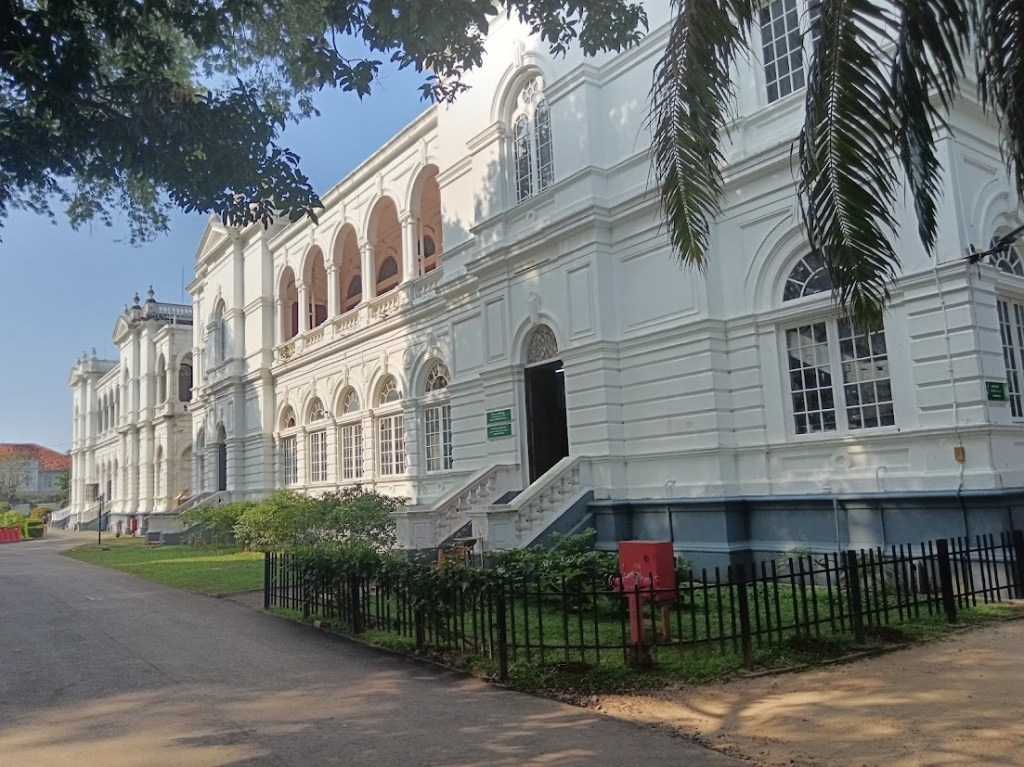
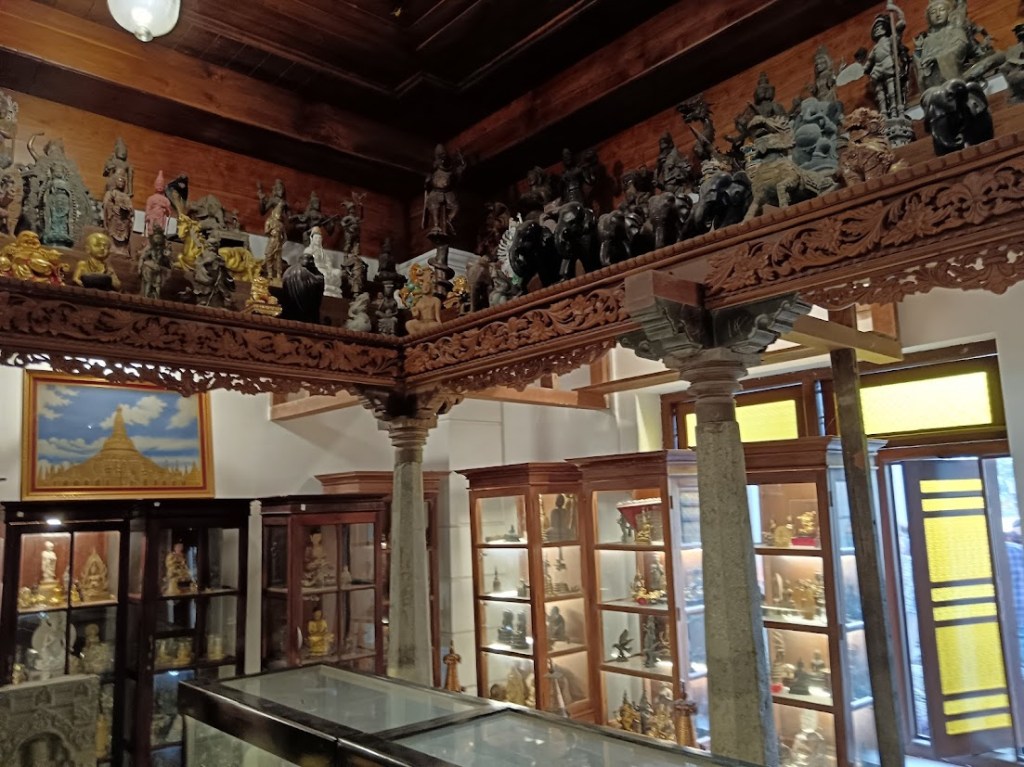
On my last evening in Colombo, I did some sightseeing. We went to the Gangaramaya temple, the most important one in Colombo. The architecture is a mix of Sri Lankan, Indian, Thai, and Chinese styles. The temple was started by the famous scholar monk Hikkaduwe Sri Sumangala Nayaka Thera in the late 19th Century. The temple has a rich collection of Buddha statues and huge collections of ivory that must be worth millions if not billions. Our next stop was the Lotus tower at 351.5 metres, the largest self-supported structure in South Asia. The lotus is a symbol of purity. view of Colombo city from the observation tower at the top is excellent. I could see the Galle Face Road where I had stayed during my last visit. We could see the Sri Lankan railway depots and stations.

Colombo is a fascinating city. There is plenty to see and do. Recent economic events have hit the island hard. During my subsequent visit I plan to explore other parts of this magical country. Serendip/Serendib was the ancient Persian/Arab name for the country. The name is believed to be derived from the Sanskrit Simhaladwipa (dwelling place of Lion’s Island). The lion occupies a prominent place on the Sri Lankan flag.

The three princes of Serendip in an ancient story had the knack of making unexpected discoveries and is the root of the word serendipity in English. Visit Colombo and Sri Lanka, who knows what serendipitous discoveries await you?
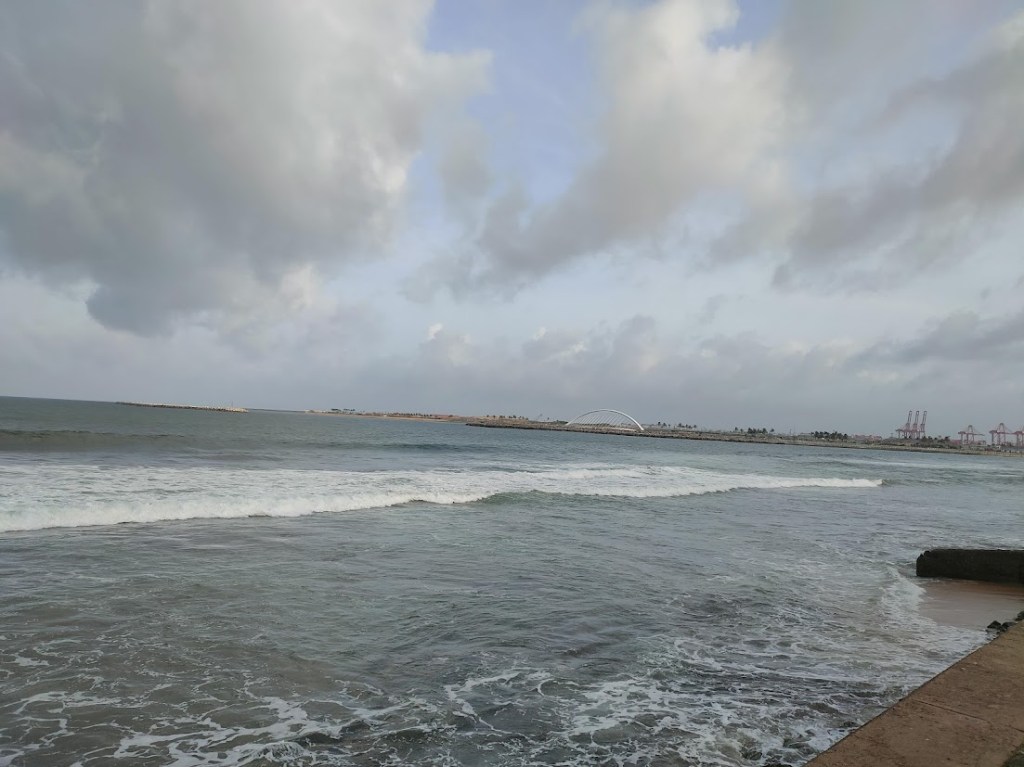
Photo Courtesy: Ravi Shankar

Dr. P Ravi Shankar is a faculty member at the IMU Centre for Education (ICE), International Medical University, Kuala Lumpur, Malaysia. He enjoys traveling and is a creative writer and photographer.

.

PLEASE NOTE: ARTICLES CAN ONLY BE REPRODUCED IN OTHER SITES WITH DUE ACKNOWLEDGEMENT TO BORDERLESS JOURNAL

Click here to access the Borderless anthology, Monalisa No Longer Smiles

Click here to access Monalisa No Longer Smiles on Kindle Amazon International

Categories
Conversation

‘Home has been a Process of Lifelong Search’

In Conversation with Kirpal Singh

Dr Kirpal Singh

 “Singapore is intimately linked with home and, yet for me, home has always been a process of lifelong search. Partly because of the early months of my birth. The record says I was born in March 1949, but the time was not certain as I do not have a birth certificate. My father forgot to register my birth,” reminisces Dr Kirpal Singh, an internationally recognised scholar. Born in the Straits Settlement of Singapore, before the island emerged as an independent entity, he has lived through much of history. He tells a story of multi-racial, multi-cultural growth that the island afforded him.  

His father, he tells us, was “well known throughout Malaya — Jeswant Singh nicknamed as ‘Just One’ — a boxer who would knock people down with his left hook. In 1954, he left boxing when he killed someone during a match.” His mother, a Jewish Scot who he cannot recollect, he tells us, “ might have been David Marshall’s sister according to my stepsister but no one else has said that.”  Marshall[1] was the first Chief Minister of Singapore from 1955 to 1956 and then Singapore’s Ambassador to France, Portugal, Spain, and Switzerland 1978 to 1993. He is the founder of the Worker’s Party. His parents had emigrated from Baghdad to Singapore in 1908 according to current resources.

How did Singh’s parents come to be in Singapore? Were they immigrants or colonials?

He responds with what he knows: “My grandfather and grandmother came to Singapore on board a ship in 1900. They left Jullunder, Punjab, in 1899. By the time they reached Singapore, it was the end of 1900. They left to seek their fortune. They were from the farming community. My grandfather was only sixteen and my grandmother was about twelve. They were in transit in Penang for six months. They came to Singapore in 1901. Actually, it was all Malaya — Singapore was part of the Straits Settlement. They came to Singapore by train. Trains were just starting out. It was around August 1901.

Trains in Malaya

“My uncle was conceived during this journey. They halted in Singapore for only two or three weeks. My grandfather’s cousin was in Perak[2], in Malaya. So, he wanted to be with his cousin. His cousin had cattle. Most of the Sikhs were cattle farmers. They settled in Pahang[3], an area which eventually became a nuclear dump[4] for Australia. It is closed to public now. There was a stone that proclaimed the land was a nuclear dump when I went with my son a few years ago.

“My father moved to Singapore as his prospects were better here as a boxer. This is where he met my mother. I was born here. He actually met mum because my mother’s two brothers had invited her to come from Glasgow. My mother is Scottish, from an industrial background. Her brothers came to the Far East to make money.  She finished her school leaving exams and came to visit her brothers during her vacation. She would go with her bothers to watch boxing, where she saw my father, the champ. She was only fifteen or sixteen. The next thing the brothers knew was she was pregnant with me.”

Jeswant Singh was popular with colonials. Kirpal Singh tells us: “Some Europeans saw him box and offered him a job then in the Base Ordinance Depot. This was the British Military camps in the Far East. There were three bases in Singapore: the naval base, Kranji and one in the South. He worked there for thirty years and retired after that. In 1972[5], after the final British withdrawal from Singapore, dad’s formal employment status ended. After that he just did odd jobs, ending up as a security guard, looking after the factories in Jurong, earning about two to three hundred dollars a month.”

Kirpal Singh spent his childhood with his grandmother and uncle. Before he started schooling, his father left him with his grandmother and divorced his mother in favour of a new bride. Dr Singh tells us the story of how he returned to Singapore: “I was basically in Perak with my grandmother. My uncle, who was the first Sikh to become a Christian in Southeast Asia, left home because his father gave him a beating for changing his religion. My uncle was an Anglican. His conversion saved him from the Great Depression as the clergy was very well looked after. From 1929 to 1933, the church looked after him because he was the priest in Seramban. My father was still young. My uncle was born in 1911 and my dad in 1923. My grandmother bore eighteen children. Five of the infants passed away before they were one month old. But thirteen survived. She passed away at 95… I knew when I left for my doctorate programme in Adelaide that that was the last time I would see her. I had a hunch and was crying on the plane. Six weeks later, I got a letter with the news of her death.”

He adds: “Dad was in not in a position to look after me. The responsibility fell on his brother William. His full name was William Massa Singh s/o Deva Singh. He had studied at the Ipoh Chinese school, topped the school, eventually worked as an insurance agent. He was very good in English. The principal of his school, a New Zealander, arranged for my uncle to move to Singapore. Then my father moved there too. Singapore was the metropolis even then. It was the centre of English education. Penang was the other one. In 1956, I was sent to Singapore from Perak on a train — a one-and-a-half-day journey to my uncle.”

His grandmother joined them within a few months as his uncle was, he says, “more interested in aiding Lee Kuan Yew get rid of the colonials. Lee Kuan Yew was a self-made man. He met Goh Keng Swee[6] and Rajaratnam[7] as students in England. They became buddies and wanted to move out of colonial rule and be independent.”

Then, how did a young child survive? Dr Singh tells us: “I used to earn my pocket money from age five six by watering gardens. I have had very interesting experiences. When I was in primary two, I used to give tuition to primary one students. With enough gumption, you can survive in this world.”

“I grew up with my uncle’s wards, who were brought home to be educated. There was even one who was a Chinese-Japanese mix. So, I grew up being familiar cross-cultural marriages and in a multicultural home. I grew up in the kampong with a Chinese boy and we became friends from the age of seven-and-a-half when we were in primary two. His name is Tan Jwee Song — I call him Jwee, ‘my good saint’.  He told me after O-levels he would support me to study further and took to teaching. At that time, you could become a teacher after completing your O level. I joined Raffles late during my time in high school because it was too expensive for me. I taught in night classes started by Lee Kuan Yew and studied. I owed Jwee $80,000 dollars and I wanted to pay his widow back — but she would not accept it. When I graduated in 1973 with an honours’ degree, I was $44 thousand in debt. Then, I was given a scholarship.”

And slowly, Kirpal Singh came to his own. When television came into being, he tells us: “I was often on TV in 1970s — days of early television — debates and interviews as a guest.” Kirpal Singh grew into an intellectual of repute as he worked and studied with the support of the many races and many people who, often like him, were migrants to Singapore.

As time moves forward, these stories — that are almost as natural as the sand, the wind and the sea — ask to be caught in words and stored for posterity, stories from life that show how narrow borders drawn by human constructs cannot come in the way of those with ‘gumption’.

(Written by Mitali Chakravarty based on a face to face conversation with Kirpal Singh. Published with permission of Kirpal Singh)

[1] https://www.roots.gov.sg/stories-landing/stories/david-marshall/story

[2] Now in Malaysia

[3] Now in Malaysia

[4] https://buletinonlines.net/v7/index.php/lynas-radioactive-waste-to-be-dumped-in-pahang-tax-free-while-australia-gets-a18-million-in-taxes-2/

[5] The British armed forces were scheduled to withdraw from Singapore by 1971. https://eresources.nlb.gov.sg/infopedia/articles/SIP_1001_2009-02-10.html#:~:text=On%2018%20July%201967%2C%20Britain,Singapore%27s%20defence%20and%20economic%20security.

[6] Deputy Prime Minister of Singapore, 1973-1980, one of the founding members of the ruling PAP (People’s Action Party) https://www.roots.gov.sg/stories-landing/stories/goh-keng-swee/story

[7] Deputy Prime Minister of Singapore from 1980 to 1985, one of the founding members of the ruling PAP https://www.roots.gov.sg/stories-landing/stories/sinnathamby-rajaratnam/story

PLEASE NOTE: ARTICLES CAN ONLY BE REPRODUCED IN OTHER SITES WITH DUE ACKNOWLEDGEMENT TO BORDERLESS JOURNAL. 

Click here to access the Borderless anthology, Monalisa No Longer Smiles

Click here to access Monalisa No Longer Smiles on Kindle Amazon Internation


Categories
Essay

My Love Affair with (Printed) Books

By Ravi Shankar

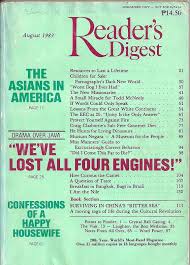
The last two years have been especially sad ones for printed books and magazines. Toward the end of 2023, the iconic magazine, National Geographic stopped selling its print issues. And in April 2024, Reader’s Digest stopped publishing. Many other print magazines have also downed their shutters though the online version continues.

I grew up with the Reader’s Digest. My father subscribed to the magazine and each month a copy wrapped in a brown envelope arrived at our door. The envelope partially covered the magazine inside, and you could see the top and bottom of the magazine. The size was small, and this made for easy handling. Reader’s Digest was a magazine you could read comfortably in bed. During the festival of Diwali, there was a special wrapping for the magazine. We had several magazines in our house when I was growing up. My mother used to read many magazines in Malayalam (our mother tongue).

Reader’s Digest provided shortened versions of stories and articles that had been published elsewhere. Their skill was in condensing the material while still retaining the interest. There was a rich collection of reading material. There were also advertisements for other books published by Reader’s Digest. Unfortunately, these were beyond our family budget. I wanted to purchase these when I grew up and became financially stronger. My neighbour who was a scientist had some of these books that I occasionally borrowed.

Another favourite of mine was the National Geographic. My father was a faculty member at a banker’s training college in Mumbai and their library subscribed to National Geographic. He often brought the magazine home. I was mesmerised by the articles and the photos in the magazine. The artistic quality of the photos was superb. The magazine had only three or four articles in an issue but addressed these at great depth. I travelled to faraway places, to the bottom of the ocean, to within the human body and to outer space with the magazine. Later, National Geographic started a television channel, and I would watch the documentaries in the nineties.

We also subscribed to the Illustrated Weekly of India. This was in a large format and again had very good photographs. I still remember the column by the journalist Khushwant Singh titled ‘With malice towards one and all’. I was also a fan of the comics section of the magazine. I had a huge collection of comics and my father purchased both Amar Chitra Katha and Indrajal Comics. Amar Chitra Katha introduced me to the rich history of India. Indrajal comics had superheroes like Phantom, Mandrake, and Flash Gordon. I used to eagerly await new issues. Most of my comics were lost when we shifted houses.   

When the news magazine, India today, made an appearance, we subscribed to it and to Outlook and The week (Indian news magazines). During my school days in May, I used to eagerly await the new textbooks and notebooks for the next class following the results. I used to go with my mother to purchase these from a stationery store near the railway station. The smell of the new paper and the fresh ink was mesmerising. I loved to read some of the easier chapters in these books. Covering the notebooks with brown paper was another major activity. Our school year started with the rains in June.  

My good friend, Sanjay Mhatre had a good library and loved to collect books. I loved to borrow from his vast collection. His collection on physics and cosmology were extensive. In those days, the erstwhile Soviet Union used to have cheap books of high quality for Indian readers. I remember the publishers Mir and Progress and I had several of their collections on science. The Soviet publishers used to hold exhibitions in our college. For twenty or thirty rupees, you could purchase high quality hard bound books. My introduction to quantum mechanics and to chemistry was through one such book.

At Thrissur in Kerala most of our medical textbooks were western and predominantly from the United Kingdom. There used to be an English Language Book Society (ELBS) that published cheaper versions of textbooks for developing countries. With our limited resources purchasing textbooks was a challenge. The two major textbooks published from the United States were those of Anatomy and Pathology. Those days we did not have online textbooks and online sources and were limited to the printed word.   

I used to write for our medical college magazine and eagerly waited for the annual issue to be published. During my residency days at PGI, Chandigarh I was the literary secretary and was very involved in bringing out the annual magazine, The Resident. We also introduced a newsletter, ARDent Voice, with ARD standing for the Association of Resident Doctors.

At Pokhara, Nepal the college library had a good collection of general books and novels in addition to medical books. I used to read a lot of novels and the author, Frederick Forsyth was one of my favourites. His meticulous research blurred the lines between fact and fiction. Sidney Sheldon was another bestselling author. Novels enabled me to travel vicariously to different places and through varied situations.

Today reading has become less common among the younger generation. Reading strengthens creativity and the imagination as you must imagine in your mind’s eye the situation the author is creating. Is it not magical that the author can communicate with you, the reader through squiggles on a page across the boundaries of space and time?

I started writing during my MBBS days. I still remember the versification competition I took part in and won the first prize. I used to participate in different literary events at my college. In Nepal, I combined my triple loves of writing, photography and hiking with articles for the newly started newspaper, The Himalayan Times. I met my writing guru, Don through the magazine, ECS Nepal. Don was the editor of the magazine and a powerful writer with a deep knowledge of Nepal. I learned a lot from his comments and suggestions and the workshops he conducted. I also used to write a medical column for ECS Nepal. ECS Nepal was a beautifully produced magazine with great photographs. Unfortunately, it stopped publishing around the beginning of the pandemic.

Other travel and lifestyle magazines were also published from Nepal but could not sustain themselves. In the Caribbean Island of Aruba, I used to write off and on for a daily newspaper published in English. Again, the newspaper ceased publishing. During the last two decades several print magazines have ceased to exist. I feel it is a great loss.

I do not read much on paper these days. Most of my reading is done online on computers, laptops and tablets. I also have a Kindle reader. Kindle screen mimics the appearance of paper closely, but it is not the same as reading a printed page. You can no longer feel the smoothness of glazed paper, the smell of fresh ink and the vivid colours of photographs. With the closure of the print version of Reader’s Digest, an era in print publishing has ended. The demise was sadly expected. Without printed books, our (my) world may never be the same again!

.

Dr. P Ravi Shankar is a faculty member at the IMU Centre for Education (ICE), International Medical University, Kuala Lumpur, Malaysia. He enjoys traveling and is a creative writer and photographer.

.

PLEASE NOTE: ARTICLES CAN ONLY BE REPRODUCED IN OTHER SITES WITH DUE ACKNOWLEDGEMENT TO BORDERLESS JOURNAL

Click here to access the Borderless anthology, Monalisa No Longer Smiles

Click here to access Monalisa No Longer Smiles on Kindle Amazon International
Categories
Editorial

Though I Sang in my Chains like the Sea…

      Time held me green and dying
Though I sang in my chains like the sea.

Fern Hill by Dylan Thomas (1914-1953)

Perhaps when Dylan Thomas wrote these lines, he did not know how relevant they would sound in context of the world as it is with so many young dying in wars, more than seven decades after he passed on. No poet does. Neither did he. As the world observes Dylan Thomas Day today — the day his play, Under the Milkwood, was read on stage in New York a few months before he died in 1953 — we have a part humorous poem as tribute to the poet and his play by Stuart McFarlane and a tribute from our own Welsh poet, Rhys Hughes, describing a fey incident around Thomas in prose leading up to a poem.

May seems to be a month when we celebrate birthdays of many writers, Tagore, Nazrul and Ruskin Bond. Tagore’s birthday was in the early part of May in 1861 and we celebrated with a special edition on him. Bond, who turns a grand ninety this year, continues to dazzle his readers with fantastic writings from the hills, narratives which reflect the joie de vivre of existence, of compassion and of love for humanity and most importantly his own world view. His books have the rare quality of being infused with an incredible sense of humour and his unique ability to make fun of himself and laugh with all of us. 

Nazrul, on the other hand, dreamt, hoped and wrote for an ideal world in the last century. The commonality among all these writers, seemingly so diverse in their outlooks and styles, is the affection they express for humanity. Celebrating the writings of Nazrul, we have one of his fiery speeches translated from Bengali by Radha Chakravarty and a review of her Selected Essays: Kazi Nazrul Islam by Somdatta Mandal. An essay from Niaz Zaman dwells on the feminist side of Nazrul while bringing in Begum Roquiah. Zaman has also shared translations of his poetry. Professor Fakrul Alam, who had earlier translated Nazrul’s iconic ‘Bidrohi or Rebel‘, has given us a beautiful rendition of his song ‘Projapoti or Butterfly’ in English.  Also in translation, is a poem by Tagore on the process of writing poetry. Balochi poetry by Manzur Bismil on human nature has been rendered into English by Fazal Baloch and yet another poem from Korean to English by Ilwha Choi.

Reflecting on the concept of a paradise is poetry from Michael Burch. Issues like climate, women, humanity, mourning, aging and more have been addressed in poetry by Shamik Banerjee, Ryan Quinn Flanagan, Milan Mondal, Kirpal Singh, Craig Kirchner, George Freek, Michael Lee Johnson and many more. Hughes brings in a dollop of humour with his response to a signpost in verse. Irony is woven into our non-fiction section by Devraj Singh Kalsi’s musing on writers and assailants. Ravi Shankar explores his passion for computers in a light vein. Snigdha Agrawal gives us a poignant story about a young child from the less privileged classes in India. Suzanne Kamata writes to tell us about the environment friendly Green Day in Japan.

Ratnottama Sengupta this month converses with a dancer who tries to build bridges with the tinkling of her bells, Sohini Roychowdhury. Gita Viswanthan travels to Khiva in Uzbekistan, historically located on the Silk Route, with words and camera.  An essay on Akbar Barakzai by Hazran Rahim Dad and another looking into literature around maladies by Satyarth Pandita add zest to our non-fiction section. Though these seem to be a heterogeneous collection of themes, they are all tied together with the underlying idea of creating links to build towards a better future.

Our stories travel from Malaysia to France and India. Farouk Gulsara sets his in futuristic Malaysia, again exploring the theme of utopia as did his earlier musing. Paul Mirabile creates a story where a child tries to create his own idyllic paradise while Kalsi writes of fiction centring around a property tussle. The book reviews feature a couple of non-fiction. Other than Kazi Nazrul Islam’s essays, Bhaskar Parichha reviews Will Cockrell’s Everest, Inc. The Renegades and Rogues Who Built an Industry at the Top of the World. Ajanta Paul discusses Bitan Chakraborty’s The Blight and Seven Short Stories, translated from Bengali by Malati Mukherjee. Malashri Lal has written on Lakshmi Kannan’s Nadistuti: Poems, poems dedicated to Jayanta Mahapatra who the poet reflects lives on with his verses. And that is so true, considering this issue is full of poets who continue in our lives eternally because of their words. That is why perhaps, we recreate their lives as has Aruna Chakravarti in Jorasanko.

In focus this time is a writer whose prose is almost akin to poetry, Rajat Chaudhuri. A proponent of solarpunk, his novel, Spellcasters, takes us to fictitious cities modelled on Delhi and Kolkata. In his interview, Chaudhuri tells us: “The path to utopia is not necessarily through dystopia. We can start hoping and acting today before things get really bad. Which is the locus of the whole solarpunk movement with which I am closely associated as an editor and creator…”

On that note, I would like to end with a couple of lines from Nazrul, who reiterates how the old gives way to new in Proloyullash (The Frenzy of Destruction, translated by Alam): “Why fear destruction? / It’s the gateway to creation!” Will destruction be the turning point for creation of a new world? And should the destruction be of human constructs that hurt humanity (like wars and weapons) or of humanity and the planet Earth? As the solarpunk movement emphasises, we need to act to move towards a better world. And how would one act? Perhaps, by getting in touch with the best in themselves and using it to act for the betterment of humankind? These are all points to ponder… if you have any ideas that need a forum on such themes, do share with us.

We have more content which has not been woven into this piece for the sheer variety of themes they encompass. Do pause by our content’s page and browse on all our pieces.

With warm thanks to our wonderful team at Borderless — especially Sohana Manzoor for her fabulous art — I would like to express gratitude to all our contributors, without who we could not create this journal. We would also like to thank our readers for making it worth our while to write — for all of our words look to be read, savoured and mulled, and maybe, some will evolve into treasured wines.

Thank you all.

Mitali Chakravarty

borderlessjournal.com

Click here to access the content’s page for the May, 2024 Issue

.

READ THE LATEST UPDATES ON THE FIRST BORDERLESS ANTHOLOGY, MONALISA NO LONGER SMILES, BY CLICKING ON THIS LINK.

Categories
Stories

Don Quixote’s Paradise

By Farouk Gulsara

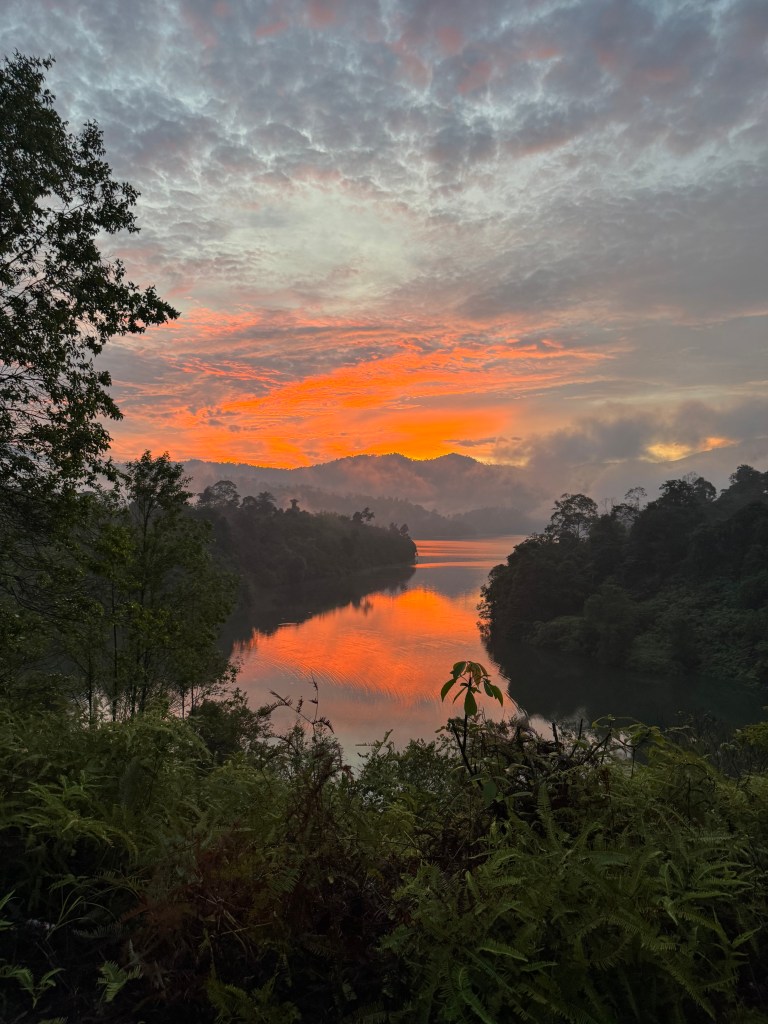
 A new dawn or the sunset of better times? Photo Courtesy: Farouk Gulsara

It is the year 2074. Yes, the world is still around, and so is the human race. It has been over a century since Malaysia received its mandate to self-rule. Technically, we should be in a utopia with so much sunlight throughout the year and a chirpy tropical climate devoid of depressing, chilling winters or debilitating natural calamities. A potpourri of food options is available 24/7 at our fingertips and delivered to our doorsteps with easy-access drone servers. We should be the happiest people in the world. In reality, however…

Teenagers growing up in the formative years of Malaysia in the 1980s, not too long after the 1969 racial riots, were given a promissory note. They were told that if they followed the dotted line, they were assured of a utopia. They would be ushered into a land of milk and honey, oozing with order and tranquility. A land where brothers and sisters of all strata would be walking, holding hands, and singing one song of camaraderie and unity. Peace would be seen seeping from every pore. Smiles and cheery images of bright yellow sunflowers were immortalised in their vision of the future.

Coincidentally, massive oil reserves were discovered off their shores around that time, multiplying their euphoria. Money started flowing freely. The government made it their God-given duty to make millionaires out of their sycophants and display them as the nation’s success story. 

They were so confident that the good times would roll forever that they felt a pressing need to increase the population and strengthen their vote bank. They wanted their 17 million population in 1990 to snowball to 70 million by 2020!

Maybe it was their subconscious intention to exhibit their patriarchal prowess. Soon, the urban skyline was brimming with phallic-like skyscrapers. The Petronas Twin Tower became the pride of the nation. Detractors said it was a waste of taxpayers’ money, but the Government insisted it was a private venture of Petronas, the private-public partnership that struck black gold. 

Like the Tower of Babel, grand towers sprouted here and there, giving the illusion of wealth and prosperity. The government asserted that the promised ‘Vision 2020’ would have citizens speak one language of love for each other and would be knowledgeable and mindful. 

To facilitate foreign investors’ seamless flying in and out of the country, a world-class airport sprung out of the lush greenery at the expense of its natural fauna and flora. 

Like the fate of the Tower of Babel, with the sky being the limit but short on foundation, the idea of uninterrupted progress came tumbling down. The thought of people speaking one language was only on paper. Doublespeak was not only the domain of the leaders. The average citizen gave little back to Malaysia. Many saw little hope in their motherland. They grew wings to fly away to faraway shores. 

Trying times came in droves—first, repeated economic downturns and other black swan events that only the anti-fragile could weather. Then, a global pandemic hit the world. Rather than scrambling to save the economy, leaders were content undercutting and downplaying opponents to grasp the helm of administration. Instead of utilising science to fight rumours, they looked at religious texts for answers. That is when the penny dropped. Citizens realised the country had reached the point of no return. 

Now, in 2074, what we have is a country of economic migrants who sponge on the nation and use Malaysia as a transit point to hopscotch to greener pastures. The descendants of the first wave of workers whom the colonial masters brought in to build the nation are all but long gone. Draconian laws that rewarded mediocrity and championed race and religion successfully converted its subjects to a bunch of zombies, unflinching to the changes to the environment, but one with a one-track mind to satisfy the voices of his master. Religious bigotry ruled the land. Rather than speeding forward to the 22nd century, citizens were hellbent on returning to the 7th, their perceived golden era.

The latest election, the 25th election, went on without a glitch. Of course, there were no untoward incidences. All the opposition leaders have either been forced to retire or behind bars. Voters have been cowed to submission. Years of indoctrination have made the youths of today a bunch of unthinking yeomen. As they have been doing in the past ten elections, the ruling party won more than half of the election seats, uncontested. 

The propaganda machine ensures that people only receive pleasant news. In its infancy, the Internet promised the democratisation of information. Soon, everyone realised that people were not competent enough to filter news. The herd is easily swayed and falls prey to popular clickbait. Hence, the government had to play nanny to alleviate undue anxiety among its citizens. 

Our education system, which used to be at par with any other country, took a slow plunge. One by one, politicians scrapped examinations to garner popularity. Automatic promotions finally produced young adults who left high school without essential reading, writing, or arithmetic skills. People are inebriated by regular freebies and the periodic intoxicating religious cocktails churned out by government-appointed holy men. When they mentioned everyone using the same language and way of thinking, they meant mass conversion. Plurality and multiculturalism had gone out of the proverbial window long ago.

Under the guise of national security, press freedom is a legacy of the past. Policing the public meant monitoring what netizens uttered online and even the thoughts they shared on their social media posts. The lush tropical forests have mysteriously been denuded over the years. All the public protests fell to the deaf ears of the forest department. Files were closed when no one could be zeroed in to be responsible for the crime to nature. Everyone knows whose hand is in the cookie jar, but the leaders conveniently condemn it to global warming. The blame goes back to the public for being irresponsible in disposing of their garbage!

Outside the country, the three world wars that rocked the world to the brink of extinction never woke humans from their slumber. The Nuremberg trials failed to impress us that no one race is superior to the other and that in wars, nobody wins except arms dealers.

The imagined world free from wars and climate crises remains an unfulfilled dream. Whether 2074 or 2704, the world is fated not to learn from its past and is cursed to repeat the same mistake that it never learnt from its history. Humanity can only appreciate the beautiful world it once was on augmented reality screens. A once-promising roaring Asian tiger called Malaysia has now morphed into a toothless and tattered paper tiger. The best it can do is be a cautionary tale for other nations about what not to do in nation-building. 

.

Farouk Gulsara is a daytime healer and a writer by night. After developing his left side of his brain almost half his lifetime, this johnny-come-lately decided to stimulate the non-dominant part of his remaining half. An author of two non-fiction books, Inside the twisted mind of Rifle Range Boy and Real Lessons from Reel Life, he writes regularly in his blog, Rifle Range Boy.

.

PLEASE NOTE: ARTICLES CAN ONLY BE REPRODUCED IN OTHER SITES WITH DUE ACKNOWLEDGEMENT TO BORDERLESS JOURNAL

Click here to access the Borderless anthology, Monalisa No Longer Smiles

Click here to access Monalisa No Longer Smiles on Kindle Amazon International

Categories
Slices from Life

Hooked for Life and Beyond…

By Ravi Shankar

I was hooked! It was my first exposure to a computer though I had read about these in the newspapers and seen them on television. I think it was a Spectrum personal computer popular in the 1980s. My friend, Sanjay and I did a few simple tasks and played a few games on the computer. The games of the 80’s were slow and clunky by today’s standards. In those days however they were interesting and enticing. BASIC was the most popular computer language then. We also had COBOL and a few others. My good friend, Sanjay Mhatre was a bibliophile and a free thinker, and I often used to visit his place and borrow from his vast book collection. However, even in the 1980s there was uneasiness and opposition to computers and the fear that it would replace people and lead to mass unemployment was often mentioned.

The rise of information technology (IT) and the important role to be played by Indian companies was still in the future. I expect artificial intelligence (AI) will also open new jobs in the future. At my medical college in Thrissur, Kerala, India computers were still rare. Communist Kerala had a love-hate relationship with computers and technology. Maharashtra (a western Indian state) was an early adopter of computers, and my tenth- and twelfth-mark sheets were computerised while my MBBS ones were handwritten. During my postgraduation at Chandigarh, computers gained prominence in our conversations. Our head of the department was gracious enough to offer the services of his secretary for typing our research manuscripts when she was free. The only other option was to pay for the service from outside providers. In those days WordStar and WordPerfect dominated word processing. 

Creating slides for presentations was a challenge. LCD projectors were not available, and we had to create physical slides with cardboard mounting. The slides were created on early versions of PowerPoint and photographed using a camera to create the physical ones. My co-guide, Dr Anil Grover (then a cardiologist) at Postgraduate Institute (PGI), Chandigarh mentioned how computers will become increasingly common and encouraged me to learn the Microsoft package of Word, PowerPoint, and Excel. PGI also started offering email facility on a limited basis. You had to write down the details of your email and take it to the IT section who will send your message. We had modems then, which took a while to connect and made a series of sounds with flashing lights while connecting to the internet.

In Pokhara, Nepal at the beginning of the twenty-first century, internet was still a luxury. Manipal College of Medical Sciences used to charge 10 Nepalese rupees to send a message. Faculty could type their message in Outlook and twice a day, the IT person would send and receive messages. In those days, a floppy disk was the most common external storage device, and I soon had a large and colourful collection of floppies. Floppies were not always reliable and sometimes the data on them could not be read. CD-ROMs were another storage device, but CD writers never became commonplace. At Mahendra Pul in the heart of Pokhara, a new cybercafé came up in the early 2000s offering internet browsing at 150 Nepalese rupees per hour. Compared to what we were previously paying, this was a steal!

The college also had an LCD projector though it was not commonly used by faculty members for teaching-learning. This was a large and clunky device. Earlier versions often had compatibility issues. You create your slides and hope for the best. These may or may not open on the laptop and may or may not be projected. One had to have a backup of the lecture on overhead projector (OHP) transparencies, just in case. We did not yet have easy access to computers or laptops. This came only later when the United States Pharmacopeia (USP) set up a drug information and pharmacovigilance centre at the teaching hospital. We got two excellent Dell computers, and the hospital provided us with internet.

The early computers were slow with a big, bulky, and heavy cathode ray screen. They had a blinking cursor and words appeared slowly after typing. The Hollywood movie, You’ve Got Mail (1998), follows the romance between Meg Ryan and Tom Hanks developed through email. The movie is a good introduction to the early days of the internet.  

We had purchased a home desktop computer in 2001 or 2002. This purchase was a financial disaster. The computer required frequent repairs and drained our finances. Google launched its beta version of email, Gmail in 2004, and I was one of the early adapters. I became a fan of Gmail right from the start. It offered significant advantages over the then dominant Hotmail, Yahoo mail and Rediff mail. The storage was larger and there was no need to delete your old emails. Kist Medical College in Lalitpur, Nepal had purchased Dell desktop computers, and these were among the best ones I had used. Fast and responsive with good memory and speed. These had LCD monitors and looked sleek and modern.  

Computer technology has made significant advances. I read that if cars had made similar advances to computers we could drive to the moon and back on a litre of gasoline. Chips started getting smaller and more powerful and are today fought over by the global technology superpowers. A variety of online applications started making their appearance with the spread of the internet. Some of these eventually became the internet giants of today. In India, internet became widely available, and the costs dropped significantly. Mobile technology also made dramatic advances. In India most people access the internet and carry out online tasks using their mobile phones. For around 12000 Indian rupees today you can get a decent mid-range phone. Today mobiles in the palm of your hands have greater processing power than the giants of the 1950s and 1960s. I remember reading a comic strip where a visitor from the future time travels to the present. He laughs on seeing the supercomputer, the most powerful one on earth. When asked why he shows a small ball and introduces it as a computer from his time with much greater processing power than the humungous supercomputer.

One of the major advances has been cloud computing and cloud services. We have Chromebooks that work on web-based applications and needs the internet to do things. Both Google and Microsoft offer a range of services including storage, meetings, messaging, and applications for text, presentations, and calculations. AI is now an integral part of applications. PowerPoint offers the designer option for slides and creates stunning backgrounds. I recently attended a workshop on Copilot, the AI support software from Microsoft that is fully integrated into all their applications. I like the transcribing option for interviews and focus groups offered by Teams and later by Zoom and this makes my life as a researcher easier.

Star Trek, Futuristic computing

When I was growing up, I had no clue about what would soon become commonplace. The world wide web, the ability to browse libraries and art collections, video conferencing, online work processes, applying for government and other services online, online fund transfer and remittance are now at our fingertips. The COVID pandemic shifted a lot of learning and even assessment online. Presently we mainly interact with computers using a keyboard. I am a fan of the sci-fi series, Star Trek, where people interact with computers mainly using their voice. Voice commands are already available and  steadily improving.

I was slow getting into social media. Their judicious use is to be recommended. Facebook keeps me updated on what my friends, acquaintances and former students are doing. LinkedIn is the professional face I present to the world, Twitter (now X) is a concise way to stay connected and YouTube is a major source of entertainment. Computers have changed our life for ever. At a basic level these are based on the flow of electrons through circuits and on the pioneering work in atomic physics done at the start of the twentieth century.

The last three decades have seen developments and changes at unimaginable speed. Who knows what the next three will bring? Will progress continue at an ever-accelerating pace or will we eventually hit a roadblock? We may have to wait for Father Time to provide the answers!

Dr. P Ravi Shankar is a faculty member at the IMU Centre for Education (ICE), International Medical University, Kuala Lumpur, Malaysia. He enjoys traveling and is a creative writer and photographer.

.

PLEASE NOTE: ARTICLES CAN ONLY BE REPRODUCED IN OTHER SITES WITH DUE ACKNOWLEDGEMENT TO BORDERLESS JOURNAL

Click here to access the Borderless anthology, Monalisa No Longer Smiles

Click here to access Monalisa No Longer Smiles on Kindle Amazon International
Categories
Slices from Life

No Film? No Problem

By Ravi Shankar

The studio room was ill ventilated. The bright lights were making things hotter! We were at a photo studio in Bhandup, Mumbai, trying to take a family photograph. The photographer was trying his best to arrange us in a pleasing and photogenic composition. The process was however, taking longer than expected and my youngest brother was getting scared. He was beginning to cry and soon was bawling his head off. My mother has a knack of soothing and calming crying children, but this time even her efforts were not successful.

I was reminiscing on this episode recently and was thinking on how easy it has now become to capture photographs and video. For a long time, you had to use film to capture photographs. Photography was an expensive proposition then. Initially, you only had black and white films. Later colour films became widely available. The cost of films, of processing and printing photographs all added up.

Films were also only invented in only 1889, but they were highly flammable. ‘Safety films’ were introduces only in the last century in 1908. Before 1889, photographers had to lug around heavy glass photographic plates. The process of capturing images on film also took a long time. When taking portraits people had to stay still for minutes at a time. The older generation of cameras were bulky and heavy and difficult to carry around. Photography was a significant advance in human history. Before 1802, we had to depend on painters and portraitures to depict everyday scenes and special occasions.

The Eastman Kodak company invented flexible film to capture photographs and for several decades the company was a world leader in photography. Unfortunately, they were not able to fully adapt to the change to a digital format and after filing for bankruptcy the company is now back with commercial printing, film stills and movie production. The Japanese were the world leaders in cameras for several decades. Yashica, Minolta, Nikon, Canon, Pentax, Olympus are legendary names. For a long time during my student days and early medical career photography was an expensive hobby to indulge in. My first purchase was an Olympus. A small and compact camera that captured great images. The camera came with a remote and a timer. Olympus made great cameras and usually the lens was integrated into the body and could not be removed and changed.

My good friend, Sanjay Mhatre in Mumbai, is an architect with wide-ranging interests. He was the one who informed me about large format cameras and the Hasselblad series. Large format is especially important in architecture. Another major German brand was Leica. These were very expensive. Dr Unnikrishnan PS was my batch mate and hostel mate during the MBBS course. He had a keen interest in painting and has now switched to photography. Recently he has opened a museum dedicated to photography, Photomuse (https://photomuse.in/) in Thrissur district in Kerala. This is India’s first museum dedicated to photography.

My first single lens reflex (SLR) camera was a Pentax. I had purchased this from New Road in Kathmandu in 2000. A SLR is a camera that has a mirror in front of the film and when the shutter is clicked the mirror moves up and the film is exposed. The mirror otherwise helps photographers see what they are about to click through the view finder. The view finder was very important as you did not have screens that showed you what you were about to click. These came much later. With the advent of screens showing the scene in front of you, view finders began becoming less common.  

Himalayas — shot using the Pentax, Photo courtesy: Ravi Shankar

Kathmandu is a very photogenic city with ancient monuments and temples, and I tested out my new buy under a variety of conditions. I had to wait to get the film developed before I could see how my photos turned out. One had to be creative and resourceful as immediate feedback was lacking. I also invested in a polarizing filter, and this was very useful in highlighting the contrast between the snow-clad mountains and the deep blue sky.   

The camera was heavy and weighed around 1.2 kg but came with its own bag making it easier to carry. The camera accompanied me on most of my treks in Nepal. I was able to capture great images of the spectacular country. While hiking the hills, you had to stop, take the camera out of the bag, focus it, adjust the polarizer, compose the scene, and then click. Someone said that photography provided the sahibs with an excuse to rest and catch their breath during steep hikes. Karna Shakya is a famous Nepalese traveller and photographer who later he founded the Kathmandu Guest House in Thamel, Kathmandu. He has written about photography during his treks (in his books and articles) and the difficulty he faced while looking for colour films and developing the same in the 1970s in Kathmandu.

The cameras on mobile phones started becoming better from 2010 onwards. I had a Samsung mobile phone with me in Aruba that took good pictures. Aruba is a picturesque place with nice beaches and turquoise blue waters.

Aruba Coastline — shot using a Samsung Mobile. Photo courtesy: Ravi Shankar

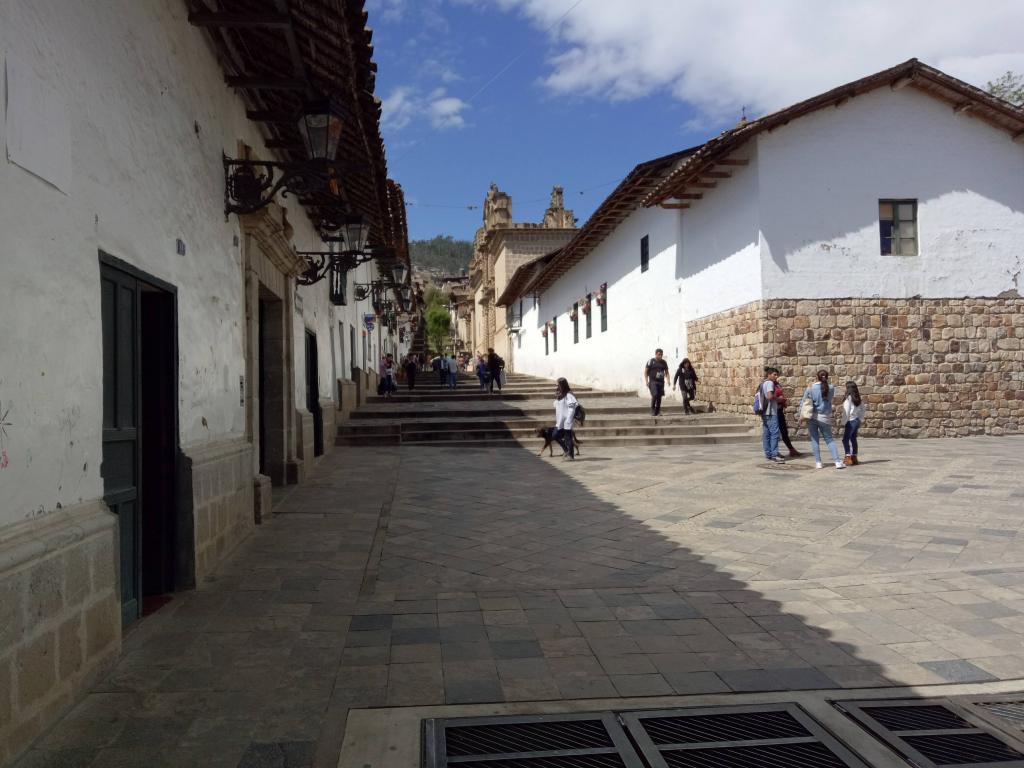
I eventually graduated to an Oppo smart phone with a better camera. This smart phone accompanied me on my travels in Peru. In late 2019, Realme introduced a new smart phone with a 64 Megapixel sensor.  

Cusco Peru – Shot using an Oppo. Photo courtesy: Ravi Shankar

Mobile phone manufacturers are constantly upgrading their cameras. The mobile camera war is hotting up. The image sensors started getting larger and cheaper. Samsung and Sony started investing in sensor research and development. Some mobile manufacturers collaborated with camera makers like Hasselblad and Leica to bring these cameras to mobiles. Around late 2023, I was looking to upgrade my smart phone and wanted a more powerful camera. There was a wide choice available. 200 MP sensors were available on some phones while others had 120 and 100 MP cameras. I did some research and found that most phones only shoot images of around 32 MP at the maximum. Usual photos are taken at a much lower resolution.

I eventually purchased an Honor phone with a 100 MP camera. I have used this widely during my travels and gives excellent results especially in good lighting conditions. Mobile phones are lighter and less obtrusive compared to a SLR. Most SLRs have also now shifted to digital sensors rather than film. With a mobile phone it may be easier to capture people in their natural situations. The trend today is to have one device that can do it all. Play videos, check emails, make online bookings, call, chat, capture images and video.

Capturing video has also become easier and many phones have image stabilisation and allow you to shoot in HD and 4K formats. There are a variety of software that integrate images from different sources and can edit and polish a video. Taking a photograph is no longer regarded as something special. Taking a video and posting it on social media is also very common. Many people earn their livelihoods through creating and posting videos on platforms like YouTube and TikTok. We have come a long way from dressing up in our best formals and going to a studio to get our photographs taken to capturing images, selfies and videos using our mobile phones. Only a very brave person can predict what the next hundred years will bring!

Dr. P Ravi Shankar is a faculty member at the IMU Centre for Education (ICE), International Medical University, Kuala Lumpur, Malaysia. He enjoys traveling and is a creative writer and photographer.

.

PLEASE NOTE: ARTICLES CAN ONLY BE REPRODUCED IN OTHER SITES WITH DUE ACKNOWLEDGEMENT TO BORDERLESS JOURNAL

Click here to access the Borderless anthology, Monalisa No Longer Smiles

Click here to access Monalisa No Longer Smiles on Kindle Amazon International

Categories
Contents

Borderless, March 2024

Art by Sohana Manzoor

Editorial

‘If Winter Comes, Can Spring be Far Behind…’ Click here to read.

Translations

Travels of Debendranath Tagore are narratives translated from Bengali by Somdatta Mandal. Click here to read.

The Yellow Flower, a narrative by Haneef Sharif, has been translated by Fazal Baloch from Balochi. Click here to read.

Ye Shao-weng’s poetry ( 1100-1150) has been translated from Mandarin by Rex Tan. Click here to read.

Nazrul’s Amamai Nahi Go Bhalobashleo (Even if you don’t love me) has been translated by Professor Fakrul Alam from Bengali. Click here to read.

Rough Stone by Ihlwha Choi has been translated from Korean to English by the poet himself. Click here to read.

Phalgun or Spring by Rabindranath Tagore has been translated from Bengali by Mitali Chakravarty. Click here to read.

Conversations

A discussion with Radha Chakravarty on her new book, Subliminal, and a brief review of the book. Click here to read.

Jagari Mukherjee interviews Rajorshi Patranabis, discussing his new book, Checklist Anomaly and Wiccan philosophy. Click here to read.

Poetry

Click on the names to read the poems

Rhys Hughes, Alpana, Ron Pickett, Shamik Banerjee, Stuart McFarlean, Baisali Chatterjee Dutt, John Grey, Shahalam Tariq, Jim Murdoch, Kumar Ghimire, Peter Magliocco, Saranyan BV, Rex Tan, Samina Tahreem, Luis Cuauhtémoc Berriozábal

Poets, Poetry & Rhys Hughes

In Lines for Loons, Loonies and Such-like, Rhys Hughes shares a rare treat. Click here to read.

Musings/Slices from Life

The Elusive Utopia?

Farouk Gulsara discusses the ideal of a perfect world. Click here to read.

Serenading Sri Lanka

Mohul Bhowmick backpacks in Sri Lanka with a camera. Click here to read.

Musings of a Copywriter

In A Conversation with God, Devraj Singh Kalsi has a bargaining chip. Click here to read.

Notes from Japan

In Cherry Blossom Forecast, Suzanne Kamata brings the Japanese ritual of cherry blossom viewing to our pages with her camera and words. Click here to read.

Stories

Prison Break

C.J.Anderson-Wu gives a poignant flash fiction. Click here to read.

Terrace

Rakhi Pande relates a strange tale from Goa. Click here to read.

The Temple-going Snake

Devraj Singh Kalsi almost creates a fable but not quite. Click here to read.

Monsoon Arc

K.S. Subramaniam shows the human spirit pitched against the harshness of monsoon storms. Click here to read.

Felipe Jimenez’s Quest of the Unheard

Paul Mirabile travels to Spain of Goya’s times with an imaginary friend who takes after perhaps, Don Quixote? Click here to read.

Essays

Where the Rice is Blue and Dinosaurs Roar…

Ravi Shankar takes us on a tour of a Malaysian town. Click here to read.

Conquering Fears: Bowing to the Mountains 

Keith Lyons tells us of his challenging hike in New Zealand. Click here to read.

Book Excerpts

An excerpt from Out of Sri Lanka: Tamil, Sinhala and English Poetry from Sri Lanka and its Diasporas edited by Vidyan Ravinthiran, Seni Seneviratne and Shash Trevett. Click here to read.

An excerpt from Rajat Chaudhuri’s Spellcasters. Click here to read.

Book Reviews

Somdatta Mandal reviews Ilse Kohler-Rollefson’s Camel Karma: Twenty Years Among India’s Camel Nomads. Click here to read.

Rakhi Dalal reviews Anuradha Kumar’s The Kidnapping of Mark Twain: A Bombay Mystery. Click here to read.

Bhaskar Parichha reviews Mafia Raj: The Rule of Bosses in South Asia by Lucia Michelutti, Ashraf Hoque, Nicolas Martin, David Picherit, Paul Rollier, Clarinda Still. Click here to read.

.

Click here to access the Borderless anthology, Monalisa No Longer Smiles

Click here to access Monalisa No Longer Smiles on Amazon International

Categories
Editorial

‘If Winter Comes, Can Spring be Far Behind…’

Where the mind is without fear

Where the world has not been broken up into fragments

Where the clear stream of reason has not lost its way

Where the mind is led forward by thee
Into ever-widening thought and action…

— ‘Where the Mind is without Fear’ (1910), by Rabindranath Tagore

As we complete the fourth year of our virtual existence in the clouds and across borders, the world has undergone many changes around us, and it’s not only climate change (which is a huge challenge) but much more. We started around the time of the pandemic — in March 2020 — as human interactions moved from face-to-face non-virtual interactions to virtual communication. When the pandemic ended, we had thought humanity would enter a new age where new etiquettes redefining our social norms would make human existence as pandemic proof as possible. But before we could define new norms in the global context, takeovers and conflicts seem to have reft countries, regions and communities apart. Perhaps, this is a time when Borderless Journal can give a voice to all those who want to continue living as part of a single species in this world — where we can rise above our differences to find commonalities that make us human and part of the larger stream of humanity, that has been visualised by visionaries like Tagore or John Lennon — widely different cultural milieus but looking for the same things — humankind living together in harmony and moving towards a world without violence, without hate, without rancour and steeped in goodwill and love.  

Talking of positive values does not make sense in a world that seems to be veering towards darkness… Many say that humankind is intrinsically given to feelings of anger, hate, division, lust, shame and violence. But then we are just as much inclined towards happiness, fun, love, being respectful and peaceful. Otherwise, would we be writing about these? These are inherited values that have also come down to us from our forefathers and some have been evolving towards embalming or healing with resilience, with kindness and with an open mind.  

If you wake up before sunrise, you will notice the sky is really an unredeemable dark. Then, it turns a soft grey till the vibrant colours of the sun paint the horizon and beyond, dousing with not just lively shades but also with a variety of sounds announcing the start of a new day. The darkest hours give way to light. Light is as much a truth as darkness. Both exist. They come in phases in the natural world, and we cannot choose but live with the choices that have been pre-made for us. But there are things we can choose — we can choose to love or hate. We can choose resilience or weakness. We can choose our friends. We can choose our thoughts, our ideas. In Borderless, we have a forum which invites you to choose to be part of a world that has the courage to dream, to imagine. We hope to ignite the torch to carry on this conversation which is probably as old as humanity. We look forward to finding new voices that are willing to move in quest of an impractical world, a utopia, a vision — from which perhaps will emerge systems that will give way to a better future for our progeny.

In the last four years, we are happy to say we have hosted writers from more than forty different nationalities and our readers stretch across almost the whole map of the world. We had our first anthology published less than one and a half years ago, focussing more on writing from established pens. Discussions are afoot to bring out more anthologies in hardcopy with more variety of writers.

In our fourth anniversary issue, we not only host translations by Professor Fakrul Alam of Nazrul, by Somdatta Mandal of Tagore’s father, Debendranath Tagore, but also our first Mandarin translation of a twelfth century Southern Song Dynasty poet, Ye Shao-weng, by Rex Tan, a journalist and writer from Malaysia. From other parts of Asia, Dr Haneef Sharif’s Balochi writing has been rendered into English by Fazal Baloch and Ihlwha Choi has transcreated his own poetry from Korean to English. Tagore’s Phalgun or Spring, describing the current season in Bengal, adds to the variety in our translated oeuvre.

An eminent translator who has brought out her debut poetry book, Radha Chakravarty, has conversed about her poetry and told us among other things, how translating to English varies from writing for oneself. A brief overview of her book, Subliminal, has been provided. Our other interviewee, Rajorshi Patranabis — interviewed by Jagari Mukherjee — has written poetry from a Wiccan perspective — poetry on love — for he is a Wiccan. We have poetry by Luis Cuauhtémoc Berriozábal, Jim Murdoch, Alpana, Baisali Chatterjee Dutt, John Grey, Shahalam Tariq, Saranyan BV, Rex Tan, Ron Pickett with poetry on the season and many more. Humour is brought into poetry with verses woven around a funny sign by Rhys Hughes . His column this month hosts a series of shorter poems — typically in Hughes’ own unique style.

Devraj Singh Kalsi has explored darker shades of humour in his conversation with God while Suzanne Kamata has ushered in the Japanese spring ritual of gazing at cherry blossoms in her column with photographs and narrative. Keith Lyons takes us to the beautiful Fiordlands of New Zealand, Ravi Shankar to Malaysia and Mohul Bhowmick trapezes from place to place in Sri Lanka. Farouk Gulsara has discussed the elusiveness of utopia — an interesting perspective given that we look upto ideals like these in Borderless. I would urge more of you to join this conversation and tell us what you think. We did have Wendy Jones Nakashini start a discussion along these lines in an earlier issue.

We have stories from around the world: C.J.Anderson-Wu from Taiwan, Paul Mirabile from France, Rakhi Pande, Kalsi and K.S. Subramaniam from India. Our book excerpts are from Out of Sri Lanka: Tamil, Sinhala and English Poetry from Sri Lanka and its Diasporas edited by Vidyan Ravinthiran, Seni Seneviratne and Shash Trevett and a Cli-fi book that is making waves, Rajat Chaudhauri’s Spellcasters. Mandal has also reviewed for us Ilse Kohler-Rollefson’s Camel Karma: Twenty Years Among India’s Camel Nomads. Bhaskar Parichha has discussed Mafia Raj: The Rule of Bosses in South Asia by Lucia Michelutti, Ashraf Hoque, Nicolas Martin, David Picherit, Paul Rollier, Clarinda Still — a book written jointly by multiple academics. Rakhi Dalal in her review of Anuradha Kumar’s The Kidnapping of Mark Twain: A Bombay Mystery has compared the novel to an Agatha Christie mystery!

I would want to thank our dedicated team from the bottom of my heart. Without them, we could not have brought out two issues within three weeks for we were late with our February issue. A huge thanks to them for their writing and to Sohana Manzoor for her art too. Thanks to our wonderful reviewers who have been with us for a number of years, to all our mentors and contributors without who this journal could not exist. Huge thanks to all our fabulous loyal readers. Devoid of their patronage these words would dangle meaninglessly and unread. Thank you all.

Wish you a wonderful spring as Borderless Journal starts out on the fifth year of its virtual existence! We hope you will be part of our journey throughout…

Enjoy the reads in this special anniversary issue with more content than highlighted here, and each piece is a wonderful addition to our oeuvre!

Mitali Chakravarty

borderlessjournal.com

Click here to access the content page for the March 2024 Issue.

.

READ THE LATEST UPDATES ON THE FIRST BORDERLESS ANTHOLOGY, MONALISA NO LONGER SMILES, BY CLICKING ON THIS LINK.

Categories
Musings

The Elusive Utopia?

By Farouk Gulsara

When I was growing up, the radio was the musical score constantly playing in the background. Blaring between Tamil movie songs and radio dramas were news of the hour and current issue discussions. The things that got imprinted on my impressionable mind as I was transforming from a teenager to a young adult were about violence, wars and bombings. I remember about the war in Vietnam as it was close to home. For every peace talk and the end of war announcement, there would pop up another bombing and a barrage of casualties. My simple mind wondered when the war would end, but it never did. It went on for so long that they had a Tamil film in 1970 named Vietnam Veedu (House of Vietnam), referring to a household forever in family feuds and turmoil. 

Along with the war in Vietnam, people came by boat to the shores of Malaysia. The then leaders, in the late 1970s, dealing with a poor economic climate as they were reeling from a devastating racial riot, were not so cordial with their arrival. Malaysia went into the bad books of the international arena when the Marines were issued a ‘shoot-at-sight’ order on Vietnamese boat people by the then Deputy Prime Minister, Mahathir Muhammad. The refugees were eventually placed in barb-wired concentration camps-like holding centres. The last of the boat people left Malaysia in 2005. Even today, many former refugees who had started life anew elsewhere return to Pulau Bidong to perform ancestral worship or to remind themselves and their descendants of the hell they escaped.

Just as I thought Malaysia had seen the last of the people displaced from their homes gracing their shores, Malaysia had to play host to economic refugees from Myanmar, the ethnic Myanmarese and the Rohingyas. And the cycle of not wanting to spend the country’s precious resources and accepting them on humanitarian grounds continues to date.  

My ever optimist friend is dreaming of a utopia on Earth. Her idea of utopia is one where people are kind to each other, not hurling grenades or aiming intercontinental missiles at each other and accepting each other’s citizens with open arms. In fact, in her world, there would be borders. She dreams of a world where people are happy, able to enjoy the fruit of their existence, a world where there is no destruction of Mother Earth and none of the species of plants and animals go extinct. She envisages a space where everyone communicates with one another with kindness without hurting their psyche. The search is still on, where people do not look at each other with scorn and suspicion and are willing to accept another as a fellow sibling from a common mother. She dreams of a borderless world where heart, mind and territories are a continual flow of ideas and messages for the betterment of humankind. Unfortunately, despite all the strides the world has seemingly made, she remains unhappy and is getting more discontent by the day. 

“Why is there so much hate? Why is there war after all the wisdom we have supposedly learnt as evidenced by our scientific advancements?” she asks. “Are we just developing creative ways to annihilate each other until the whole race reaches the point of no return?” 

I see our newspapers and digital media. I became convinced that humans are evil and anthropocentric. They do not bother about other living beings. They are only interested in fending for themselves, fattening themselves, usurping treasures and fattening their coffers, and rapaciously wanting to leave a legacy for their descendants to savour to eternity. In typical situations, the world can accommodate all of Man’s needs, but not their greed. 

Innately, I reminisce about the times when I was young, trees were tall, the air was clean, and adults were trustworthy. We long to go back to those innocent days. 

Upon closer scrutiny, we realise we were presented with a false image of serenity. Beneath the surface of sobriety, even then, trenches were built to gun down brothers and chemical factories to neutralise them biologically. We think we are in the worst of times, but historians differ. Our current era is the most peaceful and safest throughout our existence. The chance of an average man in the current time, unlike his ancestors, to be directly involved or affected physically by wars is quite remote. 

Our ancestors did not need the media to know the world’s plight because it often happened at their doorstep. The swords carved out people’s fate line, not consensus or democracy. 

Life is cyclical. Peace and chaos have alternated all through our history. Like a phoenix, we keep rising from the rubble of destruction only to be broken to smithereens. Torrents of events around us bear testimony to this fact. It has been like this since time immemorial.

There was a time when Angkor Wat was the talk of travellers who could not stop praising man’s colossal achievement. With mind-binding engineering marvels, it testified to what the human mind could think next. Then, it got lost in the folly of human activities, only to be discovered as an ancient relic by passing foreigners. 

Isfahan, an essential stop along the Silk Road, was once hailed as heaven on Earth with the highest level of culture. People with exquisite taste for art, literature, music and architecture made it their second home. Babur, who established the Mughal Dynasty, never synced with India as he felt the Indians were less cultured than the Persians because of what he was exposed to in the Safavid capital. Isfahan’s own glory brought its destruction. 

All through Man’s sojourn on Earth, it has been anything but peaceful. The funny thing is that, amid all the destruction, we still managed to bring up our humanity and the science that would save us from extinction. In spite and amidst all the mayhem, we kept famine at bay, found cures for many infectious diseases and sent rockets to the moon and beyond. Paradoxically, the science that saved us becomes a thorn in our progress. From muskets to rifles to intercontinental missiles to the press of a red button, it is becoming easier to plan out our destruction. 

So, the world has never been peaceful, and humans have not been kind. What can we do about it? Do you brood at our shortsightedness, or are we like Sisyphus? Knowing pretty well that, Sisyphus destined for life with the punishment of pushing a boulder up a hill only to see it roll down and for him to repeat the whole exercise again and again, he can take two paths. He can perform the task without thinking, like an automaton, go mad and die, or the alternative is finding simple pleasures in the seemingly mundane task. He could challenge himself to do it faster, explore newer routes to roll the boulder or experiment with various tools to aid in his task. 

We continue doing our bit for humanity, knowing very well that it is just a drop in the ocean. Our efforts to promote peace and brotherhood will trigger small pockets of change and hopefully snowball into something earth-shattering for a good reason.

War, hardship and tragedy are bound to continue. It is too intertwined in our DNA. Many are even convinced that for seismic changes to occur, we need jolts and uncertainties. All these wars may be part of our search for a perfect system to pave Earth’s peace. A war to end all wars? Now, where have we heard that one before?

All through its existence, the Universe has seen it all before. If one were to believe Graham Hancock, the documentary maker or a pseudo-historian as some may call him, then one would be convinced that the world has experienced all these and even greater things before, only to lose everything because of human greed. Some other belief systems are confident that time does not go in a linear fashion but rather in a cyclical fashion. All that is happening today gives the Universe a deja vu.

.

Farouk Gulsara is a daytime healer and a writer by night. After developing his left side of his brain almost half his lifetime, this johnny-come-lately decided to stimulate the non-dominant part of his remaining half. An author of two non-fiction books, Inside the twisted mind of Rifle Range Boy and Real Lessons from Reel Life, he writes regularly in his blog, Rifle Range Boy.

.

PLEASE NOTE: ARTICLES CAN ONLY BE REPRODUCED IN OTHER SITES WITH DUE ACKNOWLEDGEMENT TO BORDERLESS JOURNAL

Click here to access the Borderless anthology, Monalisa No Longer Smiles

Click here to access Monalisa No Longer Smiles on Kindle Amazon International