Categories
Interview

“Words became my dwelling place”

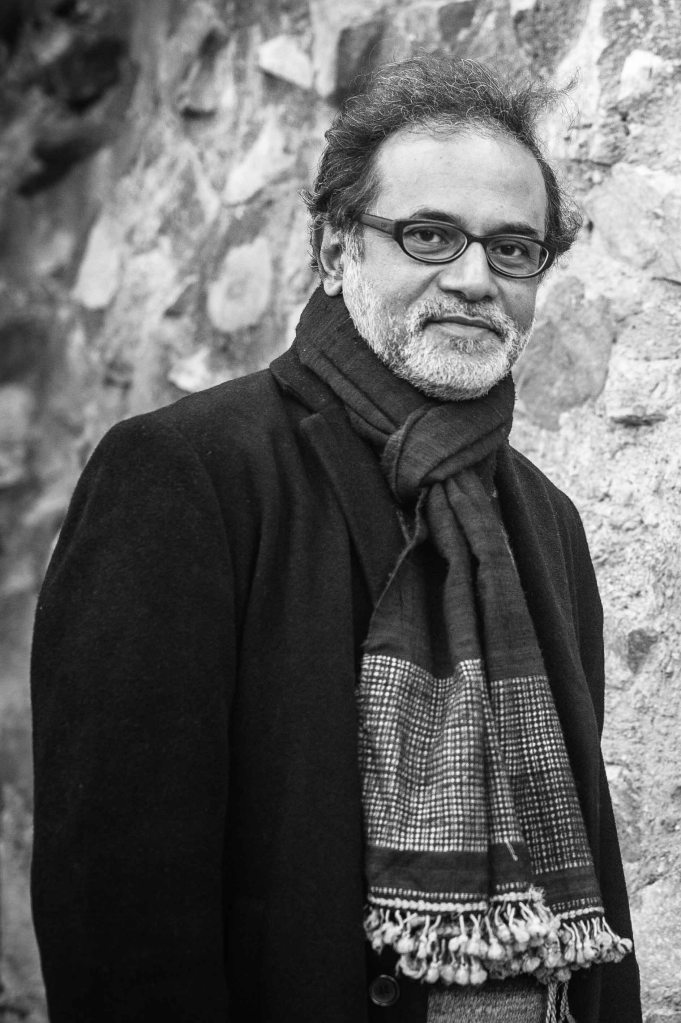
A conversation with Neeman Sobhan
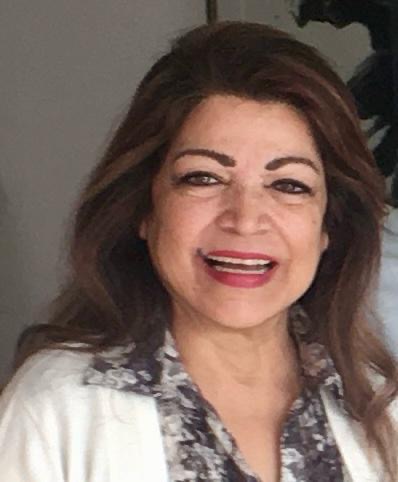
Neeman Sobhan: A Global Nomad?

Neeman Sobhan, born in the West Pakistan of Pre-1971, continues a citizen of both her cultural home, Bangladesh, and her adopted home, Italy. Her journey took her to US for five years but the majority of times she has lived in Italy – from 1978. What does that make her?

She writes of her compatriots by culture – Bangladeshis — but living often in foreign locales. Her non-fiction, An Abiding City, gives us glimpses of Rome. These musings were written for Daily Star and then made into a book in 2002. Her short stories talk often of the conflicting cultures and the commonality of human emotions that stretch across borders. And yet after living in Rome for 47 years – the longest she has lived in any country – her dilemma as she tells us in this interview – is that she doesn’t know where she belongs, though her heart tugs her towards Bangladesh as she grows older. In this candid interview, Neeman Sobhan shares her life, her dreams and her aspirations.

Where were you born? And where did you grow up? 

I was born in Pakistan, rather in the undivided Pakistan of pre-1971: the strange land we had inherited from our grandparents’ and parents’ generation when British colonial India was partitioned in 1947 down the Radcliffe line, creating an entity of two wings positioned a thousand miles apart on either side of India! The eastern wing, or East Pakistan was formerly East Bengal, and my cultural roots are in this part of the region because I come from a Bengali Muslim family. But I was born not there but in West Pakistan, which is culturally and linguistically distinct from Bengal, comprising the regions of Western Punjab, Sindh, Baluchistan and the NWFP (North-West Frontier Provinces, bordering Afghanistan), where the official language is Urdu.

So, my birthplace was the cantonment town of Bannu in the NWFP, (now KPK or Khyber Pakhtunkhwa).

Perhaps my life as the eternal migrant, living outside expected geographical boundaries started right there, at birth. 

My father’s government job meant being posted in both wings of Pakistan. So, I grew up all over West Pakistan, and in Dhaka, whenever he was posted back to East Pakistan. Much of my childhood and girlhood were spent in Karachi (Sindh), Multan and Kharian (Punjab) and Quetta (Balochistan).

How many years did you spend in Pakistan?

The total number of years I spent in undivided Pakistan (West Pakistan, now Pakistan, and East Pakistan, now Bangladesh) is about two decades, or one year short of twenty years. From my birth in 1954, my growing years, till I left the newly independent Bangladesh in 1973 when I got married and came to the US at the age of nineteen.

What are your memories about your childhood in West Pakistan? I have read your piece where you mention your interactions with fruit pickers in Quetta. Tell us some more about your childhood back there. 

I have wonderful memories of growing up in West Pakistan, in Karachi, Multan and Kharian of the late 50’s and early 60’s (despite the era of Martial Law under Field Marshall Ayub Khan, and later his military-controlled civilian government). However, the political environment is invisible and irrelevant to a child’s memories that center around family, school and playmates, till he reaches the teen years and becomes aware of the world of adults. Since, my father’ job entailed us going back and forth between West and East Pakistan, by the time we arrived in Quetta in late 1967, it ended up being my father’s last posting, because by then Ayub Khan’s regime was tottering under protests in both wings of Pakistan; and by the time (I should say in the nick of time) we left for Dhaka, it was already the turbulent year of 1970, which turned Pakistan upside down with General Yahya Khan becoming the new Marshall Law administrator. When we returned to Dhaka, it was the beginning of the end for Pakistan, with preparations for the first democratic general elections, and the blood soaked nine months war of independence for Bangladesh about to be staged.

But as a child, growing up in a Pakistan that was till then my own country, what remains in my treasure trove of memories are only the joys of everyday life, and the friendships (with those whom I never saw again, except one school friend from Quetta with whom I reunited in our middle age in Toronto, Canada!)

Also precious are the road trips with my five siblings and our adventurous mother, as we always accompanied our father on his official tours, across the length and breadth of West Pakistan.

But if I start to recount all my precious memories, I will need to write a thick memoir. And that is exactly what I have been doing over the years: jotting down my recollections of my past in Pakistan, for my book, a novel that is a cross between fact and fiction. The happy parts are all true, but the sad ones relating to the war that my generation underwent in 1971 as teenagers is best dealt with from the distance of fiction.

What I can offer is a kaleidoscopic view of some random memories: the red colonial brick residence of my family in the 60’s in Multan, one of the hottest cities of Punjab, known for its aandhi — dust storms — that would suddenly blow into the courtyard of the inner garden in the middle of the night as my sister and I slept on charpoys laid out in the cool lawn under a starlit sky, and being bundled up in our parents’ arms and rushed indoors; tasting the sweetest plums left to chill in bowls of ice; being cycled to school by the turbaned chowkidar weaving us through colourful bazars to the Parsi run ‘Madam Chahla’s Kindergarten School’ or on horse drawn tanga (carriages); learning to write Urdu calligraphic letters on the wooden takhta (board) with weed Qalam(pens) and a freshly mixed ink from dawaat (ink pots); and to balance this, my mother helping us to write letters in Bengali to grandparents back in East Pakistan on sky-blue letter pads, our tongues lolling as pencils tried to control the Brahmic alphabet-spiders from escaping the page.

In Karachi, returning home on foot from school with friends under a darkening sky that turned out to be swarms of locusts. Learning later that these grain eating insects were harmful only to crops not humans (and Sindhis actually eat them like fried chicken wings) does not take away the thrill of our adventure filled with exaggerated, bloodcurdling shrieks to vie with the screen victims of Hitchcock’s The Birds, viewed later as adults in some US campus. Picnics and camel rides on the seabeaches of Clifton, Sandspit, or Paradise Point. Near our home, standing along Drigh Road (the colonial name later changed to Shahrah-e-Faisal after King Faisal of Arabia, I later heard) waving at the motorcade of Queen Elizabeth II passing by with Ayub Khan beside her in a convertible with its roof down. That was in the 60’s. Later in 1970, embarking with my family on the elegant HMV Shams passenger ship at Karachi port for our memorable week long journey back to Dhaka across the Arabian Sea and the Indian Ocean, with a port of call at Colombo in what was still Ceylon, to disembark at Chittagong port, not knowing then that we were waving goodbye not just to the Karachi of our childhood but a part of our own country that would soon become the ‘enemy’ through its marauding army.

But I reset my memories and bring back the beauty and innocence of childhood with images of my family’s first sight of snowfall in Quetta, the garden silently filling with pristine layers of snowflakes piling into a cloudy kingdom under the freshly tufted pine trees, as we sipped hot sweet ‘kahwa’ tea, and cracked piles of the best chilgoza pine-nuts and dried fruits from Kabul. And since Quetta was our last home in Pakistan, I leave my reminiscences here.
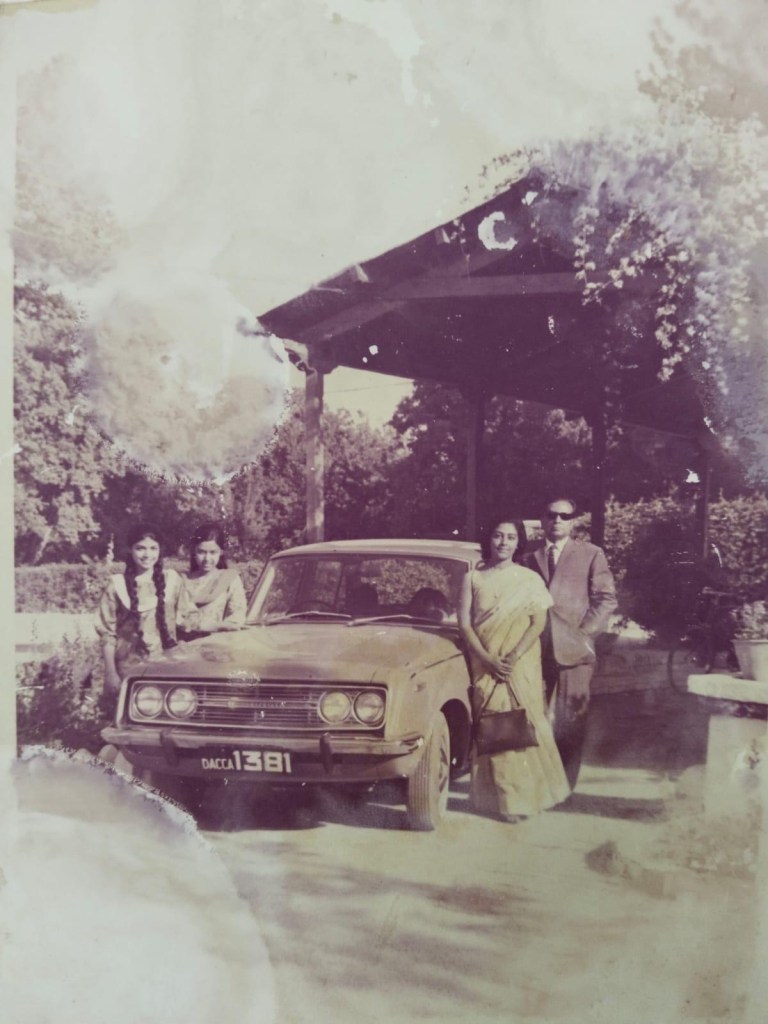
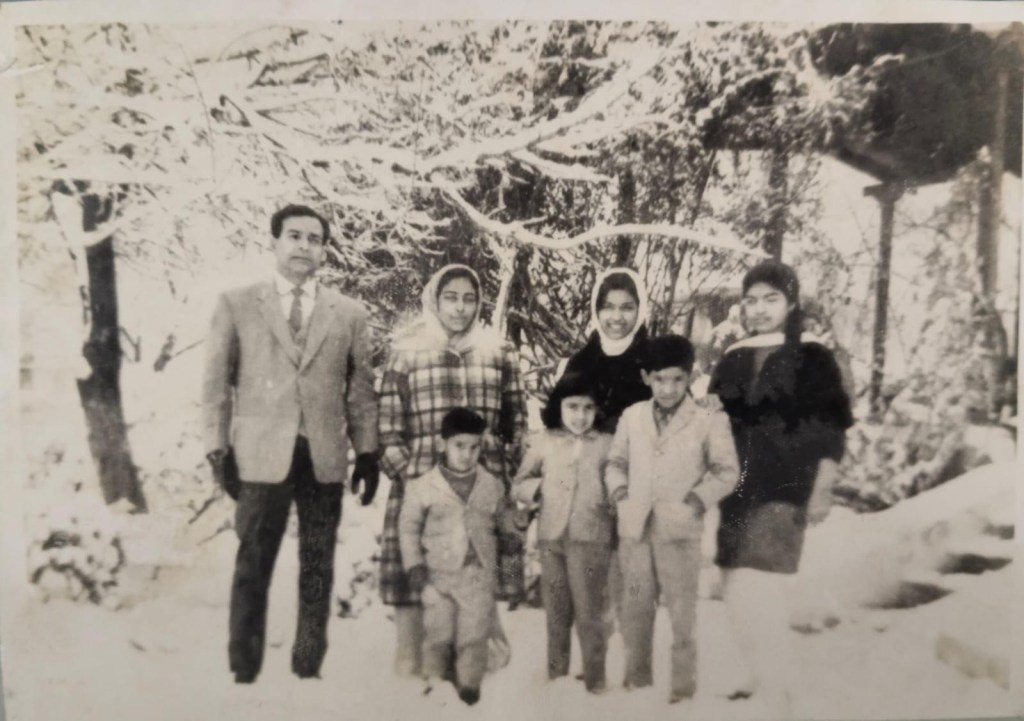
There are so many ways to enter the past. Photographs in albums discolor after a time, but words keep our lived lives protected and intact to be accessible to the next generation. I hope my novel-memoir will provide this.

How many countries have you lived in? Where do you feel you belong — Bangladesh, Pakistan, US or Italy — since you have lived in all four countries? Do you see yourself a migrant to one country or do you see yourself torn between many? 

I have indeed lived in four countries, for varying lengths of time. In the sense of belonging, each country and stage of my life has left its unique impact. But I have still not figured out where I belong.

Although I lived in Pakistan and Bangladesh from birth till I was nineteen, these were the formative years of my life, and I feel they have coloured who I am fundamentally. The culture and languages of the subcontinent is fundamental to me as a human being. Also, having shared my parent’s experience of being almost foreigners and expats in their own country, trying to speak Urdu to create a Bengali lifestyle at home in a culturally diverse world of Punjabis, Sindhis, Baluchis or Pathans, I know it made them (and us as a family), different from our compatriots in East Pakistan who never left their region and had only superficial understanding of the West Pakistanis. My introduction to a migrant’s life and its homesickness started there, observing my parents’ life.

When I moved to the US after my marriage in 1973, it was to follow my husband Iqbal, to the Washington-Maryland area, where he had moved earlier as a PhD student after giving up, in 1971, his position in the Pakistani central government where he was an officer of the CSP (Civil Service of Pakistan) cadre. These were the days of being newly married and setting up our first home, albeit in a tiny student’s apartment, because more than as a home maker, I spent 5 years attending the University of Maryland as an undergraduate and then a graduate student. We thought our future might be here in the US, he working as an economist for a UN agency, and I teaching at a university. A classic version of the upwardly mobile American immigrant life.

But before we settled down, we decided to pursue a short adventure, and Iqbal and I came to Italy in 1978, from the US, on a short-term assignment with FAO, a Rome based agency of the UN. The mutual decision was to move here, temporarily! We would keep our options open for returning to the US if we did not like our life in Italy.

Well, that never happened! And given the fact that since then, we have spent the last 47 years in Italy, the Italian phase of my life is the longest period I have ever spent in any country in the last 71 years!

Meanwhile, we slowly disengaged ourselves from the US and it was clear that if we had to choose between two countries as our final homes, it would be between Bangladesh, our original home country, and Italy our adopted home.

Still, living away from ones’ original land, whether as an expatriate or an immigrant, is never easy. Immigrants from the subcontinent to anglophone countries like the US, UK, Canada, Australia etc, do not face the hurdles that migrants to Italy do in mastering the Italian language. I am still constantly trying to improve my language skills. Plus, there is the daily struggle to create a new identity of cultural fusion within the dominant and pervasive culture of a foreign land

So, in all these years, though I love Italy and my Roman home, I do not feel completely Italian even if my lifestyle incorporates much of the Italian way of life. For example, after a week of eating too much pasta and Mediterranean cuisine my husband and I yearn for and indulge in our Bengali comfort food. Although I enjoy the freedom and casual elegance of Italian clothes, I look forward to occasions to drape a sari, feeling my personality transform subtly, softly.

Yet, I cannot conceive of choosing one lifestyle over the other. The liberty to veer between different ways to live one’s life is the gift of living between two or more worlds.

The only incurable malaise, though, is the chronic nostalgia, especially during festivals and special occasions. For example, when Eid falls on a weekday, and one has to organise the celebration a few days later over a weekend, it takes away the spontaneous joy of connecting with one’s community, forcing one instead to spend the actual day as if it were an ordinary one. I miss breaking my fasts during the month of Ramadan with friends and family over the elaborate Iftar parties with special food back in Dhaka or celebrating Pohela Boishakh (Bengali new year) or Ekushey February (21st February, mother language day) in an Italian world that carries on with its everyday business, unaware of your homesickness for your Bengali world. Over the years, when my sons were in school, I made extra efforts for. But you know you cannot celebrate in authentic ways.

Of course, these are minor matters. And I am aware that by virtue of the fact that I have dual nationality (I’m both an Italian citizen, and a Bangladeshi), I cannot consider myself a true and brave immigrant — someone who leaves his familiar world and migrates  to another land because he has no other options nor the means to return; rather, I feel lucky to be an ex-patriate and a circumstantial migrant — someone who chooses to make a foreign country her home, with the luxury of being able to revisit her original land, and, perhaps, move back one day.

Meanwhile, I feel equally at home in Italy and in Bangladesh because we are lucky to be able to make annual trips to Dhaka in winter.

Whether I am considered by others to be an Italo-Bangladeshi or a Bangladeshi-Italian, I consider myself to be a writer without borders, a global citizen. I feel, I belong everywhere. My home is wherever I am, wherever my husband and my family are. My roots are not in any soil, but in relationships.

I often quote a line by the Mexican poet Octavio Paz. “Words became my dwelling place.” It resonates with me because for me often, it is neither a tract of land, nor even people, but language, literature and my own writings that are my true sanctuary, my homeland. I feel blessed to have the gift of expressing myself in words and shaping my world through language. My home is etched on the written or printed page. My books are my country. It’s a safe world without borders and limits.

Maybe it’s the conceit of a writer and a migrant, nomadic soul, but I think our inner worlds are more substantial than our external ones.                

When I read your writing, I find a world where differences do not seem to exist among people in terms of nationality, economic classes, race or religion. Is it not far removed from the realities of the world we see around us? How do you reconcile the different worlds? 

I believe and trust in our common humanity, not the narrowness of nationality, race or religion. Nationality particularly is limiting, dependent on land, and boundaries that can shift due to physical or political exigencies. Nationality by conferring membership also necessarily excludes on the basis of manmade criteria, while humanity is boundless, all encompassing, and inclusive, based on shared natural, biological, and spiritual traits. 

In my case, I consider the whole world my family. I say this not just as idealistic hyperbole and wishful thinking, but from the fact that I have a multi-cultural, multi-racial family. Only my husband and I are a homogenous unit being Bengali Muslims by origin, but both my sons are married outside our culture, race and religion. One of my daughters in law is Chinese, the other has an English-French father and a Thai mother. So, through my grandchildren, who are a veritable cocktail, yet my flesh and blood, I am related to so many races. How can I bear malice to any people on the globe? The whole world is my tribe, my backyard, where we share festivals and food and rituals and languages. We celebrate unity in diversity.                 

Kindness and caring for others are values I hold dear in myself and others. I believe in sharing my good fortune with others, and in peaceful co-existence with my neighbours, wherever I live. I believe in living with responsibility as a good citizen wherever I find myself. And so far, the world that I see around me, perhaps narrow, is peopled with those who invariably reflect my own sense of fraternity. Maybe I am foolish, but I believe in the essential goodness of humanity, and I have rarely been disappointed. Of course, there are exceptions and negative encounters, but then something else happens that restores ones faith.        

Love is more powerful than hate and generates goodness and cooperation. Change can happen at the micro level if more people spread awareness where needed. Peace can snowball and conquer violence. The human will is a potent spiritual tool. As is the power of the word, of language.       

Literature is about connections, communications, bridges. It can bring the experiences and worlds of others from the margins of silence and unspoken, unexpressed thoughts and emotions into the centre of our attention. It brings people who live in the periphery within our compassionate gaze. Language is one of the most effective tools for healing and building trust. Responsible writers can persuasively break down barriers and make the world a safe home and haven for everyone, every creature.

You have a book of essays on Rome, short stories and poems set in Rome. Yet you call yourself a Bangladeshi writer. You have in my perception written more of Rome than Bangladesh. So which place moves your muse? 

Any place on God’s beautiful earth can move my muse. Still, the perception is not completely accurate that I have written more of Rome than Bangladesh. It is true that many of my columns, short fiction or poems are set in Rome, but they are not necessarily just about Italy and Italians. In fact, my columns and poems were written from the perspective of a global citizen, who celebrates whichever place she finds herself in.

Poetry, in any case, is never just about any place or thing, but a point of departure. It always goes beyond the visual and the immediate and transcends the particular to the philosophical. The sight of a Roman ruin may jumpstart the poem, but what lifts it into the stratosphere of meaningful poetry is the universal, the human. For example, even when my poem speaks of a certain balcony in Verona, the protagonist is not a girl called Juliet but the innocence of first love, in any city, in any era.

My book of short stories, even when located in Rome, actually concern characters that are mostly Bangladeshi. In fact, it is my fiction that makes me a Bangladeshi writer, because my stories are ways for me to preserve my memories of the Bengali world of my past and an ephemeral present. I write to root myself. I often feel that I should write more about the new Italians, the Bangladeshi immigrants generation, rather than the expats of my generation, but my writing stubbornly follows its own compass.

Regarding my book of essays, my original columns for the Daily Star were written about many other cities I travelled to, including Dhaka and places in Bangladesh, and encounters with people in various countries not just Italy. Constrained to select columns from two decades of weekly writing, for a slim volume to be published, I narrowed the field of topics to Italy and Rome. But I had many essays and travel pieces concerning China, Russia, Vietnam, Egypt, Brazil, Spain, Netherlands and many other European cities and Asian capitals. In the end, a handful of columns about Italy became my book An Abiding City: Ruminations from Rome.
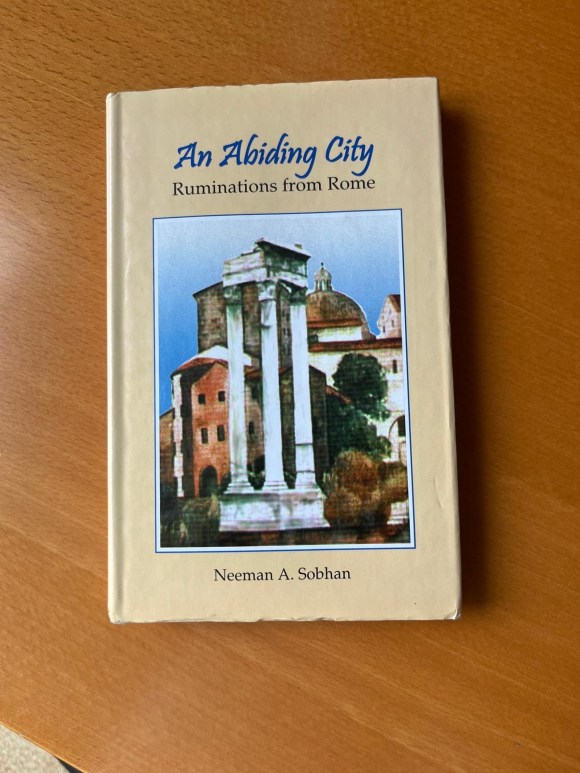
However, in the preface I said: “I must remind that the scope of the book, as suggested in the title, is ‘Ruminations FROM Rome’ not ‘Ruminations ON Rome’ with a tacit emphasis on ‘from’ because the writing relates to matters not just concerning ROME but also encompasses reflections of a more general kind. This is a collection of writings from a columnist who, within her journey through the Eternal City, also attempts to share with her readers her passage through life. I wish my fellow travellers a smooth sojourn into my abiding city, the one WITHIN and WITHOUT.”

I know that had I not lived in Rome but, say, Timbuctoo, I would find something to inspire me to write about. Of course, I am privileged to have lived in Rome and Italy, but nature is beautiful everywhere, in its own way, and there are other civilisations with rich cultures, histories, arts, cuisines, poetry and philosophy that can inspire the sensitive observer and writer.

My elder son lives in Jakarta, my younger son in Bangkok and in all the years of visiting them, I am blown away by the culture and beauty of the Indonesian and Thai worlds, and I have a notebook full of unwritten essays. And there is still so much of the world I have not seen, yet every part of this wondrous earth including my backyard is a chapter in the book of human knowledge. So, had I never left Bangladesh I would still have written. Perhaps “Doodlings from Dhaka!”

What inspires you to write?        

Many things. A face at a window, a whiff of a familiar perfume, an overheard conversation, a memory, a sublime view…. anything can set the creative machine running. Plus, if I’m angry or sad or joyous or confused, I write. It could become a poem, fiction, or a column.

The writer in me is my inner twin that defines my essential self. I am a contented wife of 52 years of marriage, a mother of two sons, and a grandmother of four grandsons (aged 8-7-6-5). These roles give me joy and help me grow as a human being. But my writer-self continues on its solitary journey of self-actualisation. 

Yet, I write not just for myself, I write to communicate with others. I write to transmit the nuances of my Bengali culture and its complex history to my non-Bengali and foreign readers and students, but more importantly to my own sons, born and brought up in Italy, and my grandchildren, whose mothers (my daughters-in-law) are from multi-cultural backgrounds, one a Chinese, and the other a combination of English, French and Thai. I write also for the younger generation of Bengalis, born or raised abroad, who understand and even speak Bangla, but often cannot read the language, yet are curious about their parents’ world and their own cultural heritage.

What started you on your writerly journey? When did you start writing? 

I have always written. As an adolescent, I wrote mostly poetry, and also kept a journal, which I enjoyed reading later. It created out of my own life a story, in which I was a character enacting my every day. It clarified my life for me. Interpreted my emotions, explained my fears and joys, reinforced my hopes and desires. Writing about myself helped me grow. 

My columnist avatar is connected to this kind of self-referral writing, but in real life it emerged by accident when I was invited to write by the editor of the Daily Star. The act of producing a weekly column was a learning experience, teaching me creative discipline and the ability to marshal my life experiences for an audience. I learnt to sift the relevant from the irrelevant and to edit reality. What better training for fiction writing? For almost two decades my experience as a columnist was invaluable to my writer’s identity.

Soon I concentrated on fiction, especially short stories that were published in various anthologies edited by others in Bangladesh, Pakistan and India. I now realised that while column writing was about my life in the present tense and about the daily world around me, my fiction could finally involve the past. The result was my collection of short stories: Piazza Bangladesh.

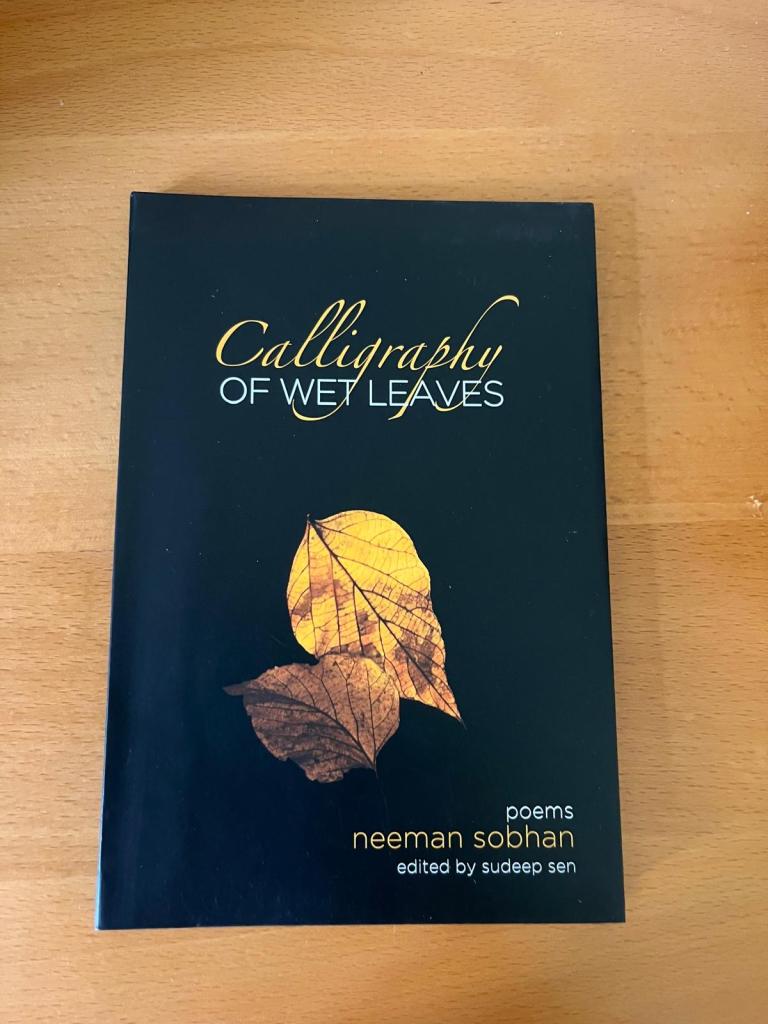
Ironically, it was my book of poems, Calligraphy of Wet Leaves that was the last to be published.

Your short stories were recently translated to Italian. Have you found acceptance in Rome as a writer? Or do you have a stronger reader base in Bangladesh? Please elaborate. 

Without a doubt, as an anglophone writer, my reader base is better not just in Bangladesh, but wherever there is an English readership. However, books today are sold not in bookshops but online, so these days readers live not in particular cities or countries but in cyberspace.      

But living in Italy as a writer of English has not been easy. The problem in Italy is that English is still a foreign and not a global language, so very few people read books in the original English. Every important or best-selling writer is read in translation. This is unlike the Indian subcontinent where most educated people, apart from reading in their mother tongues, read books, magazines and newspapers in English as well.   

This is why I was thrilled to finally have at least one of my books translated into Italian, and published by the well-known publishing house, Armando Curcio, who have made my book available at all the important Italian bookstore chains, like Mondadori or Feltrinelli. Also, through reviews and social media promotion by agents and friends, and exposure through book events and literary festivals in Rome, including a well-known book festival in Lucca, it has gained a fair readership.

That’s all I wish for all my books, for all my writing, that they be read. For me, writing or being published is not about earning money or fame but about reaching readers. In that sense, I am so happy that now finally, most of my Italian friends and colleagues understand this important aspect of my life.

 You were teaching too in Rome? Tell us a bit about your experience. Have you taught elsewhere. Are the cultures similar or different in the academic circles of different countries? 

I taught Bengali and English for almost a decade at the Institute of Oriental Studies of the University of Rome, La Sapienza., till I retired, and it was an enriching experience.

I studied for a year at the University of Dhaka before I got married and came to the US in 1973, where I continued my studies at the University of Maryland, earning my B.A in Comparative Literature and M.A in English Literature. I mention this because these experiences gave me the basis to compare the academic cultures in the Bangladeshi, American and Italian contexts.

I discovered more in common between the Bangladeshi and Italian academic worlds, especially regarding the deferential attitudes of students towards their teachers. In Italy, a teacher is always an object of reverence. In contrast, I recall my shock at the casual relationships in the American context, with students smoking in front of their teachers, or stretching their leg over the desk, shoes facing the professor. Of course, there was positivity in the informality and camaraderie too, between student and teacher. But with our eastern upbringing we cannot disregard our traditional veneration of the Guru and Master by the pupil.

In Italy it was rewarding for me to have received respect as a ‘Professoressa’ while teaching, and even now whenever I meet my old students. However, some of the negative aspects of the academic world in Italy linked to the political policies that affect the way old institutions are run, cause students to take longer to graduate than at universities in the UK or US for example.

Are you planning more books? What’s on the card next? 

I have a novel in the pipeline, a fusion of fiction and memoir, that has been in gestation for more than a decade. Provisionally titled ‘The Hidden Names of Things’, it’s about Bangladesh, an interweaving of personal and national history. It’s almost done, and I hope to be looking for a publisher for it soon. Perhaps, it has taken so long to write it because over the years while the human story did not change much, the political history of the country, which is still evolving through political crises kept shifting its goal posts, impacting the plot.

Most of my writings illustrate, consciously or inadvertently, my belief that as against political history our shared humanity provides the most satisfying themes for literature.

To share my stories with a readership beyond the anglophone one, my collection of stories ‘Piazza Bangladesh’ was translated into Italian and published recently in Italy, as ‘Cuore a Metà’ (A Heart in Half) which underlines the dilemma of modern-day global citizens pulled between two worlds, or multiple homes.

Meanwhile, my short stories, poems and columns will be translated into Bengali to be published in Dhaka, hopefully, in time for the famous book fair in February, Ekushey Boimela. Then my journey as an itinerant Italian-Bangladeshi writer will come full circle and return home.

(This online interview is by Mitali Chakravarty)

Click here to read an excerpt from An Abiding City: Ruminations from Rome

PLEASE NOTE: ARTICLES CAN ONLY BE REPRODUCED IN OTHER SITES WITH DUE ACKNOWLEDGEMENT TO BORDERLESS JOURNAL

Click here to access the Borderless anthology, Monalisa No Longer Smiles

Click here to access Monalisa No Longer Smiles on Kindle Amazon International
Categories
Excerpt

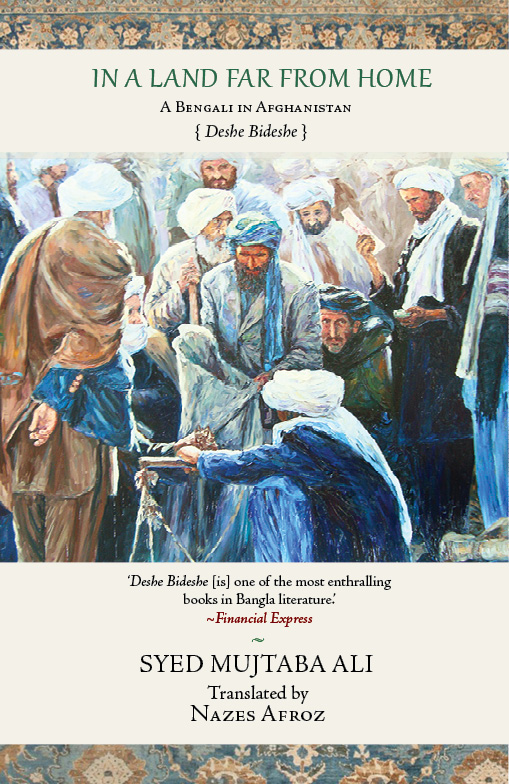
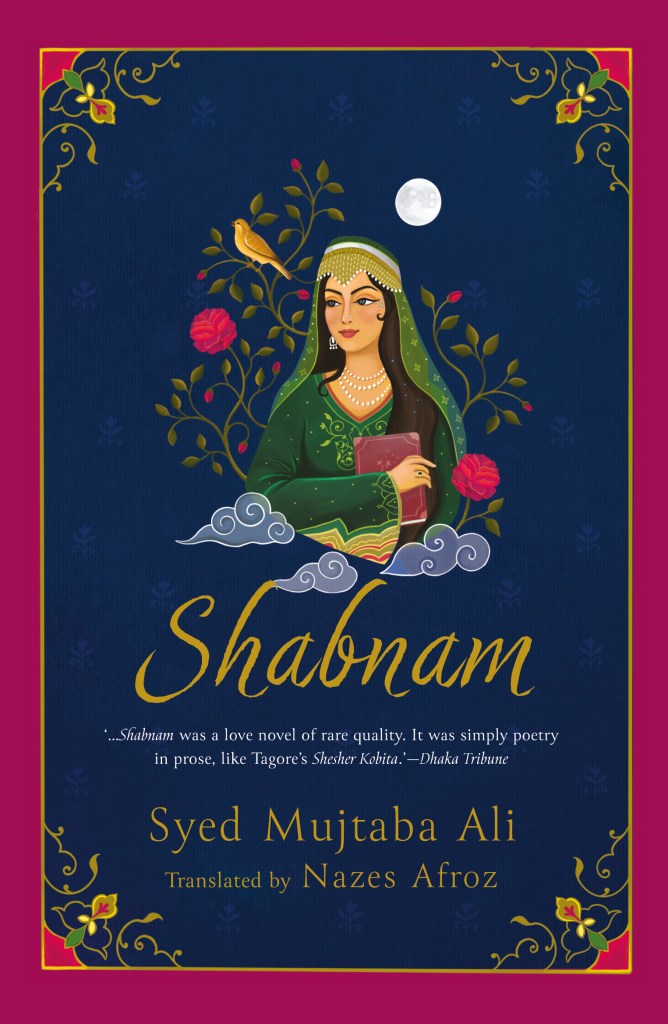
Shabnam: A Novel by Syed Mujtaba Ali

Title: Shabnam

Author: Syed Mujtaba Ali

Translated from Bengali by Nazes Afroz

Publisher: Speaking Tiger Books

Badshah Amanullah was surely off his rocker. Or else why would he hold a ball-dance in an ultra-conservative country like Afghanistan? On the occasion of Independence Day, Afghanistan’s first ball-dance would be held.

We, the foreigners, were not that bothered. But there was a buzz of restlessness among the mullahs and their followers—the water carriers, tailors, grocers, and the servants. My servant, Abdur Rahman, while serving the morning tea, muttered, ‘Nothing is left of religious decency.’

I did not pay much heed to Abdur Rahman. I was no messiah like Krishna. The task of saving ‘religious decency’ had not been bestowed upon me.

‘Those hulking men will prance around the dance floor holding on to shameless women.’

I asked, ‘Where? In films?’

After that there was no stopping Abdur Rahman. The ancient Roman wild orgies would have sounded like child’s play compared to the juicy imageries of the upcoming dance event that he described. Finally, he concluded, ‘Then they switch off the lights at midnight. I don’t know what happens after that.’

I said, ‘What’s that to you, you mindless babbler?’

Abdur Rahman went mum. Whenever I called him a blathering prattler, he understood that his master was in a bad mood. I would use the Bengali slang word for it and being a seasoned man, though Abdur Rahman did not know the language, he would be able to read my mood.

I was out in the mild evening. Electric lamps lit up the bushes of Pagman. The tarmacked road was spotlessly clean. I was meandering absentmindedly, thinking it was the month of Bhadra and Sri Krishna’s birthday had been celebrated the previous day. My birthday too, according to Ma. It must be raining heavily in Sylhet, my home. Ma was possibly sitting in the north veranda. Her adoptive daughter Champa was massaging her feet and asking her, ‘When will young brother come home?’

The monsoon season is the most difficult one for me in this foreign land. There is no monsoon in Kabul, Kandahar, Jerusalem or Berlin. Meanwhile in Sylhet, Ma is flustered with the nonstop rain. Her wet sari refuses to dry; she is in a tizzy from the smoke of the wet wood of the oven. Even from here I can see the sudden pouring of rain and the sun that comes out after a while. There are glitters of happiness on the rose plants in the courtyard, the night jasmine at the corner of the kitchen, and on the leaves of the palm tree in the backyard.

There was no such verdant beauty here.

Look at that! I had lost my way. Nine at night. Not a soul on the street. Who could I ask for directions?

A band was playing dance numbers in the big mansion to the right.

Oh! This was the dance-hall as described by Abdur Rahman. The waiters and bearers of the building would surely be able to direct me to my hotel. I needed to go to the service doors at the back of the building.

I approached.

Right at that moment, a young woman marched out.

I first saw her forehead. It was like the three-day-old young moon. The only difference was the moon would be off-white—cream coloured—but her forehead was as white as the snow peaks of the Pagman mountains. You have not seen it? Then I would say it was like undiluted milk. You have not seen that either. Then I can say it was like the petals of the wild jasmine. No adulteration of it is possible as yet.

Her nose was like a tiny flute. How was it possible to have two holes in such a small flute? The tip of the nose was quivering. Her cheeks were as red as the ripe apples of Kabul; yet they were of a shade that made it abundantly clear it was not the work of any rouge. I could not figure out if her eyes were blue or green. She was adorned in a well-tailored gown and was wearing high-heeled shoes.

Like a princess she ordered, ‘Call Sardar Aurangzeb Khan’s motor.’

Attempting to say something, I fumbled.

She, by then, looked properly at me and figured out that I was not a servant of the hotel. She also understood that I was a foreigner. First, she spoke in French, ‘Je veux demand pardon, monsieur—forgive me—’ Then she said it in Farsi.

In my broken Farsi I said, ‘Let me look for the driver.’

She said, ‘Let’s go.’

Smart girl. She would be hardly eighteen or nineteen.

Before reaching the parking lot, she said, ‘No, our car isn’t here.’

‘Let me see if I can arrange another one,’ I said.

Raising her nose an inch or so, in rustic Farsi she said, ‘Everyone is peeping to see what debauchery is taking place inside. Where will you find a driver?’

I involuntarily exclaimed, ‘What debauchery?’

Turning around in a flash, the girl faced me and took my measure from head to toe. Then she said, ‘If you’re not in a hurry, walk me to my house.’

‘Sure, sure,’ I joined her.

The girl was sharp.

Soon she asked, ‘For how long have you been living in this country? Pardon—my French teacher has said one shouldn’t put such questions to a stranger.’

‘Mine too, but I don’t listen.’

Whirling around she faced me again and said, ‘Exactment—rightly said. If anyone asks, say I’m going with you, or say Daddy introduced me to you. And don’t you ask me any question like I’m a nobody. And I will not ask anything as if you have no country or no home. In our land not asking prying questions is akin to the height of rudeness.’

I replied, ‘Same in my land too.’

She quipped, ‘Which country?’

I said, ‘Isn’t it apparent that I’m an Indian?’

‘How come? Indians can’t speak French.’

I said, ‘As if the Kabulis can!’

She burst out laughing. It seemed in the fit of laughter she suddenly twisted her ankle. ‘Can’t walk any longer. I’m not used to walking in such high heels. Let’s go to the tennis court; there are benches there.’

Dense darkness. The electric lamps were glowing far away. We needed to reach the tennis court through a narrow path. I said, ‘Pardon,’ as I touched her arm inadvertently.

Her laughter had no limits. She said, ‘Your French is strange, so is your Farsi.’

My young ego was hurt. ‘Mademoiselle!’

‘My name is Shabnam.’

(Extracted from Shabnam by Syed Mujtaba Ali, translated by Nazes Afroz. Published by Speaking Tiger Books, 2024)

About the Book

Afghanistan in the 1920s. A country on the cusp of change. And somewhere in it, a young man and woman meet and fall in love.

Shabnam is an Afghan woman, as beautiful as she is intelligent. Majnun is an Indian man, working in the country as a teacher. Theirs is an unlikely love story, but it flowers nonetheless. Breaking the barriers of culture and language, the two souls meet. Shabnam is poetry personified—she knows the literary works of Farsi poets of different eras. Majnun is steeped in the language and thoughts of Bengal. Together, they find love in immortal words and in the wisdom of the ages.

As the country hurtles towards yet another cataclysmic change, and the ruling king flees into exile, Shabnam is in danger from those who covet her for her famous beauty. Can she save herself and her Indian lover and husband from them?

Shabnam has been hailed as one of the most beautiful love stories written in Bengali. Lyrical and tragic, this pathbreaking novel appears in English for the first time in an elegant translation by the translator of Syed Mujtaba Ali’s famous travelogue Deshe Bideshe (In a Land Far from Home).

About the Author

Born in 1904, Syed Mujtaba Ali was a prominent literary figure in Bengali literature. A polyglot, a scholar of Islamic studies and a traveller, Mujtaba Ali taught in Baroda and at Visva-Bharati University in Shantiniketan. Deshe Bideshe was his first published book (1948). By the time he died in 1974, he had more than two dozen books—fiction and non-fiction—to his credit.

About the Translator

A journalist for over four decades, Nazes Afroz has worked in both print and broadcasting in Kolkata and in London. He joined the BBC in London in 1998 and spent close to fifteen years with the organization. He has visited Afghanistan, Central Asia and West Asia regularly for over a decade. He currently writes in English and Bengali for various newspapers and magazines and is working on a number of photography projects.

PLEASE NOTE: ARTICLES CAN ONLY BE REPRODUCED IN OTHER SITES WITH DUE ACKNOWLEDGEMENT TO BORDERLESS JOURNAL

Categories
Essay

 Bottled Memories, Inherited Stories

By Ranu Bhattacharyya

I hear the scents whisper. Familiar fragrances of clove and cinnamon, imbued with spicy notes of pepper and eucalyptus beckon and tease. Elusive murmurs of mysterious oils and herbs tinge the air as I walk along a narrow-paved lane in Old Dhaka, overshadowed by looming walls on either side. I ignore the press of prying eyes and inquisitive bodies that accompany my passage. The call of the scents is irresistible, and I feel strangely unafraid of what lies before the next turn in the path ahead. These were the scents of my childhood — of summer afternoons spent secretly exploring the forbidden depths of my grandmother’s closet, the kaancher almarih[1] where her medicines were stored in shiny glass bottles with peeling labels.

The narrow lane spills into a small courtyard hemmed by buildings on three sides. Everything is closed because it is Friday, the day of prayer in Bangladesh. Peering through grimy windows, I see gigantic iron cauldrons, cavernous kansa kadhais[2], their gold gleaming in glimpses amidst sooty splatters, huge ladles and enormous tongs. Some vessels perch on hand-crafted mud stoves, their sides smoothened and baked by fires. Wooden logs are stacked in the corner along with bulging sacks of coal. Nearby, some large pieces of cloth, perhaps used for straining, are hung out to dry. In the shadowy recesses, shelves stacked with glass bottles glisten with reflected light. It seems almost staged, like a theatrical representation of a medieval kitchen and yet the evidence of daily use is undeniable.

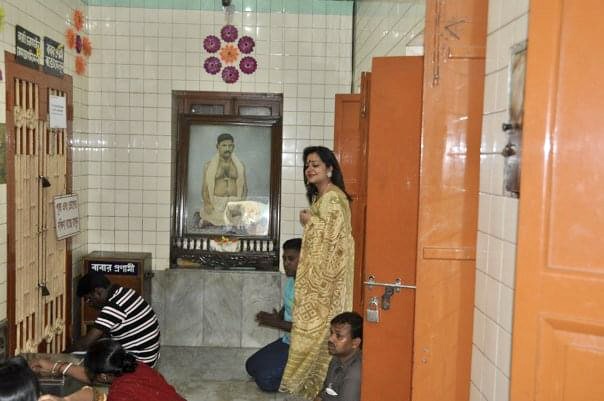
The fourth side of the courtyard has an open doorway. A sudden urge, an inexplicable pull, lures me towards it. I feel I know what lies beyond its brink. Yet how could that be? In this alien city, situated in a land scarred by a brutal Partition, from where does this knowing come? Concentrating on lifting the edge of my saree as I step across the threshold, it takes me a moment to lift my eyes to see what lies ahead. A painting of a pot-bellied man seated cross legged on an asana[3], a sacred thread adorning the vast expanse of his chest, looks solemnly back at me. Before me was the same face I’d seen on countless bottles in that medicine cupboard of my childhood — the same glossy hair, oiled and parted with precision, the same curled moustache, the same narrow bordered white dhoti[4].

The author with her great grandfather’s portrait in Dhaka. Photo Courtesy: Ranu Bhattacharyya

I find myself before a life-size portrait of my great grandfather, Mathura Mohan Chakraborty, founder of Shakti Aushadhalaya, the Ayurvedic pharmacy famed in the streets of Dhaka, Calcutta, Patna, Benaras and Rangoon at the turn of the 19th century. The kitchen behind me was the pharmacy’s karkhana[5] to prepare medicines of his formulations. His portrait hung before the inner sanctum of the temple he had dedicated to the revered Bengali saint, Lokenath Baba. Legend claimed that the mystic had whispered the recipe of the first medicinal formulation to his most faithful disciple — my great grandfather.

Ever since I arrived in Dhaka as an expat, I had been searching for the Shakti Aushadhalaya premises. Everyone knew of the company; yet nobody seemed to know where it was located. I was introduced everywhere as a young scion of the family. And though whispers followed me at gatherings and smiles broadened on hearing I was the great granddaughter of Mathurababu, my questions regarding the whereabouts of the company drew blank stares and confused responses. In horticulture, the word scion, refers to the detached living part of a plant that is cut to be grafted onto another plant. The sundering of this particular scion had been so complete, over so many generations, through such a series of violent events that it seemed my search for the original plant would remain elusive.

It was only through persistent enquiry that I found myself in Swamibagh Road in Old Dhaka where the manufacturing unit of Shakti Aushadhalaya was located. Mathurababu had founded the company in Patuatuli, Dhaka, in 1901. Family lore suggests Lokenath Baba inspired him to venture far from his origins as a schoolteacher in Bikrampur. The ascetic recognised his potential, unusual in those times, as a graduate versed in three languages — Bengali, Sanskrit and English. Starting from humble beginnings in the family kitchen, peddling hair oil and tooth powder in his neighbourhood, Mathurababu’s prescient business acumen saw his enterprise flourish. The company produced and supplied quality Ayurvedic medicines at low prices. Mathurababu also established an Ayurvedic institute, attached to his manufacturing unit to popularise Ayurvedic knowledge. The institute taught Ayurveda and philosophy in Sanskrit. Students were offered free tuition, boarding, and lodging.

Ayurveda, considered the oldest existing health science in the world, is believed to have originated in India 5000 years ago. The journey of Ayurveda from ancient times to its present incarnation is a fascinating story that follows several simultaneous trajectories, embracing geopolitics and history, trade and commerce, science and industry, technology and travel.

It is with a sense of wonder that I encounter my great grandfather’s name in journals and books that describe the history of Ayurveda in India. He was among the earliest entrepreneurs to transition towards production of Ayurvedic drugs for the market. Directly involved in all aspects of his company, Mathurbabu immersed himself in the study of Ayurveda and had an extensive library of rare treatises on ancient Indian medical traditions, including a prized copy of Susruta Sanhita[6].

He noticed that Western medicines advertised their products in newspapers and journals. Following this model, he embraced a similar practice for his own company. An advertisement published in Muhammadi in February 1940 included endorsements from freedom fighter Chittaranjan Das, Lord Lytton, the Viceroy of India, and Lord Ronaldshay, the Governor General of Bengal. In the vintage advertisement, Lord Lytton wrote: “I was very interested to see this remarkable factory which owes its success to the energy and enthusiasm of its proprietor Babu Mathura Mohan Chakravarty B.A. The preparation of indigenous drugs on so large a scale is a very great achievement. The factory appeared to me to be exceedingly well managed and well equipped &c. &c.” In the same advertisement, in Bengali, Chittaranjan Das endorsed that nothing could surpass the production processes for medicines at Shakti Aushadhalaya.

Since the mid-19th century, several eminent leaders of the Indian freedom struggle visited Mathurbabu’s factory in Dhaka. On June 6, 1939, in the company’s visitor’s book, Subhash Chandra Bose wrote, “I visited the Sakti Oushadhalaya[7], Dacca, today and was very kindly shown around the premises. Indigenous medicines are prepared here on a large scale and in accordance with Ayurvedic principles. The institution reflects great credit on Babu Mathura Mohan Chakravarty, whose enterprise has brought Ayurvedic medicines within the reach of the poor. I wish him all success to the institution which he has built up after so much enterprise and hard labour for a long period. The success of Sakti Oushadhalaya, Dacca, means the popularity of Ayurveda throughout the country and this in its turn means the relief of suffering humanity.”

When my parents visited us in Dhaka a year after our arrival, we went back to Swamibagh Road. Our visit included a trip to the shop where the medicines of Shakti Aushadhalaya were sold.

Despite being taken over by the Pakistan government in 1971 and subsequently acquired by a private entrepreneur, the company remains operational in Bangladesh to this day with 37 branches nationwide. Though Mathurababu’s portrait is no longer on the medicine bottles in the shop, the names of the formulations inscribed, are still recognised by my mother.  As we browse through the offerings, a crowd begins to form around her, hailed and welcomed as Mathurababu’s direct descendant. Much to my mother’s delight, the crowd guided her to his house, a now derelict mansion hidden in the by-lanes of Old Dhaka.

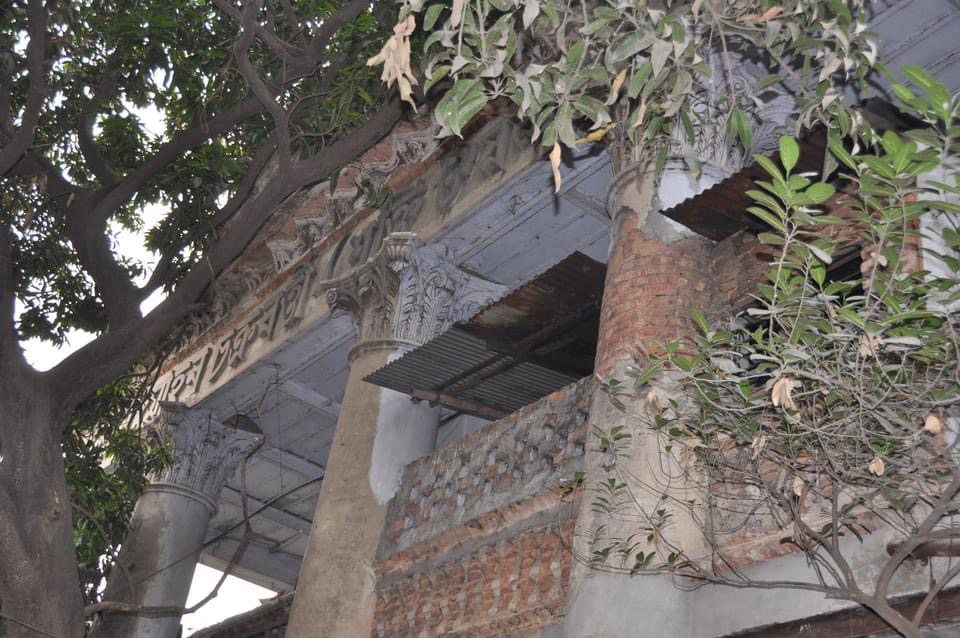
We entered the property through an ornamented gatehouse that opened to a large courtyard. On one side was the Baithakghar, the public receiving room with the Nat Mandir, the family temple in front of us. On the other side was the majestic mansion with tall columns, topped with ornate capitals. Next to the Nat Mandir was a small doorway that led to a shaded courtyard with a well, meant for the family’s private use. Beyond was yet another courtyard, enclosed with buildings on three sides.

As I climbed the stairs leading to the second floor, I had a feeling of déjà vu. I felt I had been here before through my grandmother’s stories. Her small feet must have climbed these stairs. There was the arched windows she had said she gazed out of, and the vast veranda with colonnades, where she played with her eight siblings. Wandering through the rooms, I hear her voice narrating tales of her childhood — kite races on the terrace, indolent boat rides on the Padma, and the indulgence of choosing sarees from the weavers who came all the way from Benaras.

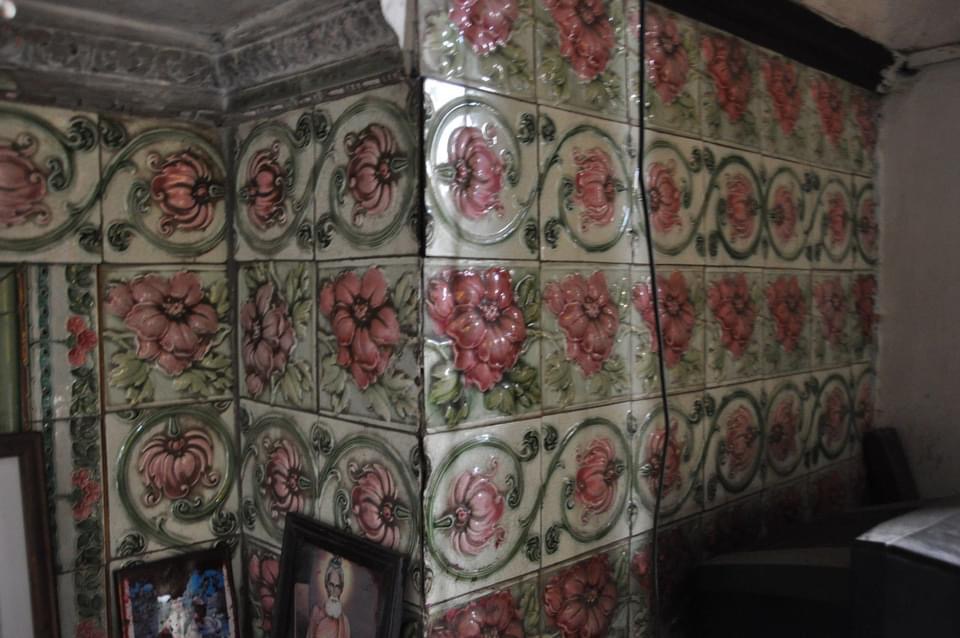
The house is now home to several families who regard our arrival with wary welcome. “Where are the Italian painted tiles?” I ask eagerly. The story of the tiles imported by her father from Italy were amongst the kaleidoscope of stories that my grandmother had shared with me. Whisperings and murmurings ensue amidst the crowd and then a hefty cupboard was pushed aside to reveal the tiles in all their faded glory.

Slowly it dawns upon me that the silent bottle in my grandmother’s cupboard had encoded stories that belied its seemingly mundane materiality. To uncover these lost stories, I embark on a renewed search for those old medicine bottles of my childhood. Their fragrance lingers at the edges of my memory, offering tantalising glimpses to fragments of knowledge. The sense of smell is our oldest sense. My memories of stories narrated by my grandmother were inextricably connected to the scents locked in that bottle. Would holding the bottle in my hand peel back the layers of my memory, answer some unanswered questions about my grandmother’s roots, help me map the route of our family’s journey? But alas! Those bottles are lost to time. My grandmother’s generation is gone and I search among Mathurababu’s scattered grandchildren and great grandchildren to no avail.

My grandmother left Dhaka in 1936, never to return. Mathurbabu’s house on Calcutta’s Central Street was completed that year, and it is there he moved with his wife and three youngest unwed daughters, including my grandmother. His older son remained in Dhaka to oversee the factory and drug production, while Mathurbabu focused on controlling the distribution from a central office in Calcutta. Till his death in 1942, despite his ailing health and flagging energy, he visited the company’s distribution centres spread across Calcutta everyday, accompanied by his faithful retainer Nathu. Probing for reasons for this abrupt migration, my uncle gave me a solitary clue. He recalled that my great grandfather had felt his family was unsafe in Dhaka. With this obscure clue in hand, I delved into history books for elaboration. I read about the rise of communal tensions in Bengal from the mid-1920’s. The Dhaka riots of 1930 targeted several well-established businessmen and involved loot and arson of their business and personal properties.

In 1947, there was yet another wave of migrations far more existential and grimmer. After the borders were drawn between the newly formed nations of India and Pakistan, the remaining family fled Dhaka overnight, leaving behind the factory, the mansion, in fact, all their material possessions in a land suddenly hostile to their continued habitation. Unable to exercise control over their properties in East Pakistan, there was an initial attempt by Mathurbabu’s heirs to establish a factory in Chandernagore. Without my great grandfather at the helm, this nascent enterprise floundered and ultimately sank. Cut from its moorings in Dhaka, Mathurbabu’s inheritors could not keep the business afloat in India. Slowly his legacy dissipated. The Shakti Aushadhalaya head office in Calcutta’s Beadon Street closed and the shops in Calcutta, Karachi, Kabul, and Colombo lowered their shutters.

Through generations of migration and resettlement, we are left with only scattered memories and fragmented stories. These intangible remains are my inheritance today. These intangibles are bound neither by form, nor by time. Instead, they offer limitless possibilities for exploration, crafting and archiving. Memory, nourished by the repeated telling of stories, provides continuity. These intangible wisps of legacy — a remembered glimpse of a peeling label, the stories heard from my grandmother, the whispered whiff of a familiar fragrance, open a door to the past and invite me to connect it to the present. “Listen to us,” the scents call. “Let us tell you our story.”

[1] Glass cupboard

[2] Bronze woks

[3] A rug for prayers

[4] A cloth wrap for the lower half of the body

[5] Workshop

[6] Ancient Sanskrit text on medicine, dated to 12th-13th century

[7] Pharmacy

Ranu Bhattacharyya, author of The Castle in the Classroom: Story as a Springboard for Early Literacy, Stenhouse, 2010, is an educator and writer who has lived and worked across the world, exploring and archiving narratives that connect people and cultures.

.

PLEASE NOTE: ARTICLES CAN ONLY BE REPRODUCED IN OTHER SITES WITH DUE ACKNOWLEDGEMENT TO BORDERLESS JOURNAL

Click here to access the Borderless anthology, Monalisa No Longer Smiles

Click here to access Monalisa No Longer Smiles on Kindle Amazon International
Categories
Poetry

Poems by David Mellor

David Mellor
                    THERE

                  I’m not there
               And neither are you

         But we have all danced at festivals 
             Walked down the streets 
             Cooked food in our homes 

                  I’m not there 
             And neither are they now… 

 
LOVED

Death is 
R
O
P
P
I
N
G

From the skies 

     L  lies  lifeless
     O on
 E  V ery 
Str E et


Death is 
R
O
P
P
I
N
G
From the sky

Bodies mount up 
1.500 here…
1.500 there…


L
	O
		V
			E
			   Lies in ruins… 
			   No one utters her name 


JUST SOME BODY 
(a child refugee)

I heard the shots, I did 
And my siblings being dragged screaming
Out the door 

My father ran, carrying me like a football
Up into the hills and miles away
Terror in his eyes, “Which way now?”
	
Into the truck, freezing at night 
Dumped on the shore
There was no need to ask 
“Are they coming too?”
As I knew…
They were no more


The boat with a hundred frightened faces came ashore, 
We were taken to the airport and told… 
“Get back home!”
My father desperately pleaded, but to no avail 

We landed in Kabul 
He was tortured and murdered 
      And I followed suit

David Mellor has been published and performed widely from the BBC, The Tate, galleries and pubs and everything in between. Now, resident in Turkey he has continued his literary career with his work appearing in journals including a weekly column in Canakkale Gündem about his observations of Turkish life. His poems and writings are autobiographical, others topical and several his take on life. 

.

PLEASE NOTE: ARTICLES CAN ONLY BE REPRODUCED IN OTHER SITES WITH DUE ACKNOWLEDGEMENT TO BORDERLESS JOURNAL. 

Click here to access the Borderless anthology, Monalisa No Longer Smiles

Click here to access Monalisa No Longer Smiles on Kindle Amazon International
Categories
Slices from Life

Mister, They’re Coming Anyway

Narrative by Timothy Jay Smith

Memories of Lesbos, 2016.

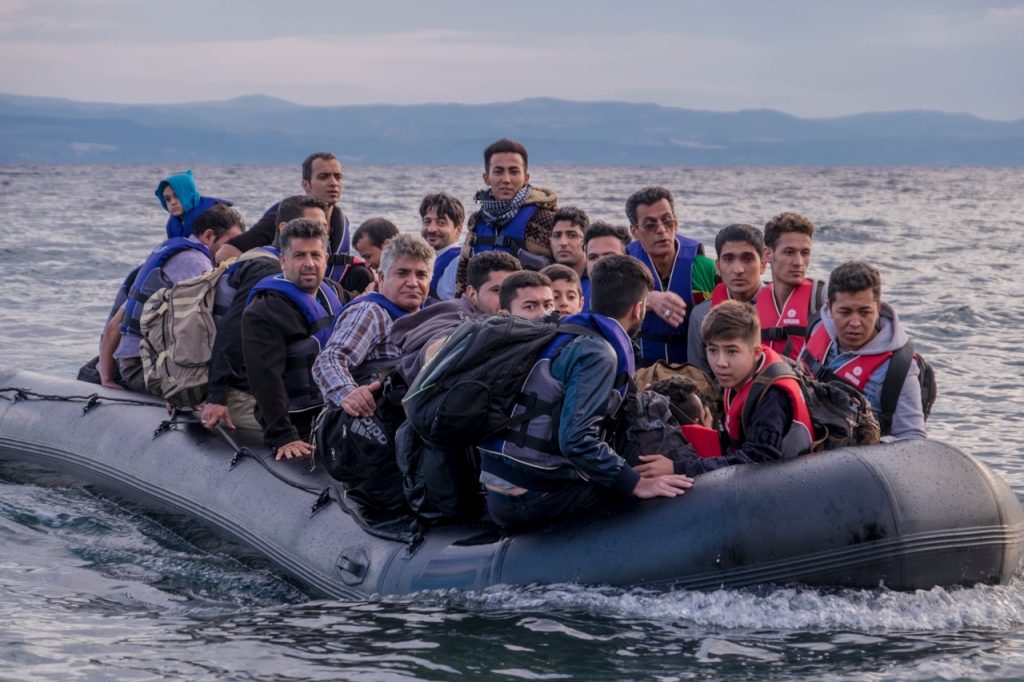
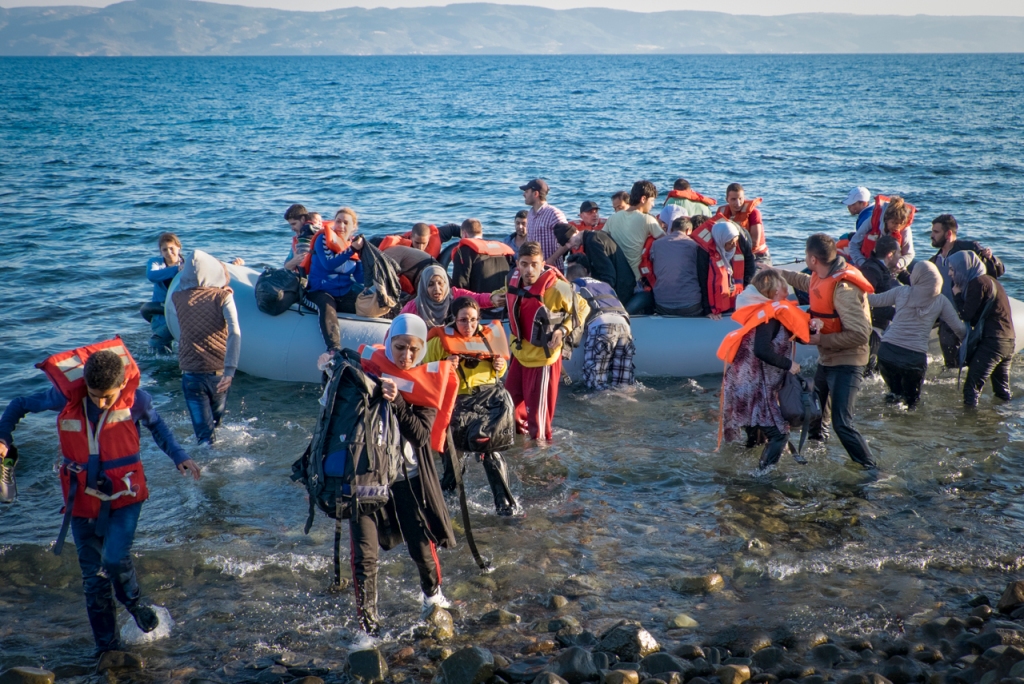
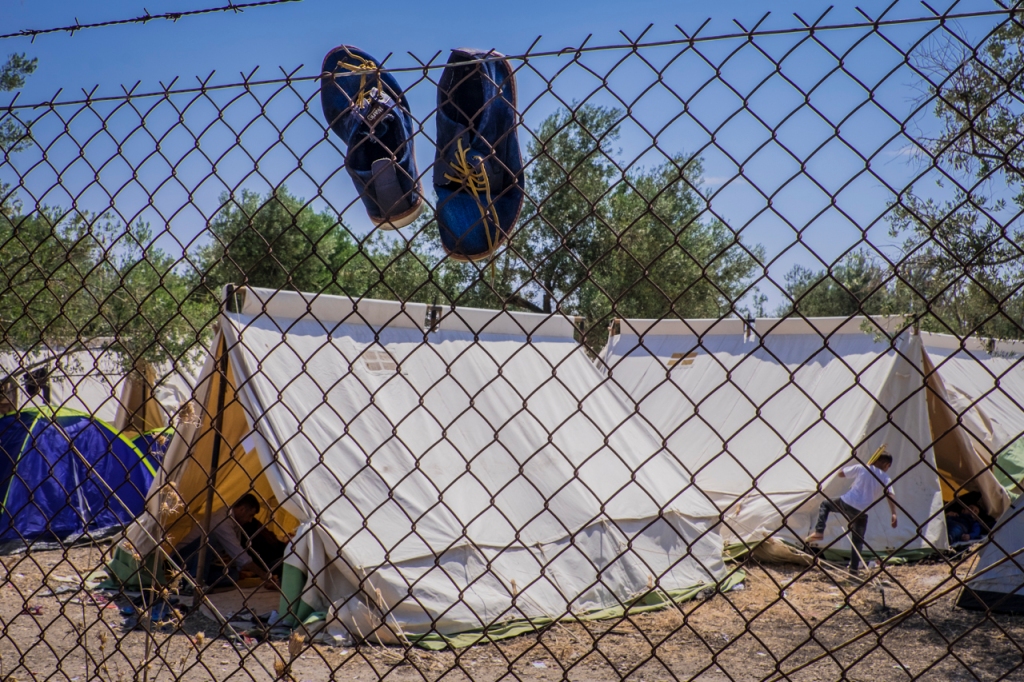
Sunrise over the Mediterranean. The island’s hills brighten as the chug of boat engines can be heard over the lapping waves. These aren’t your typical Greek fishing boats returning from a night at sea, but a flotilla of black rafts, nine total carrying some 400 refugees to land on the north coast of Lesbos Island. Under five miles off the Turkish coast, Lesbos has become a beachhead for a flood of refugees that has come as unannounced as a tsunami, and for which local communities are even less prepared.

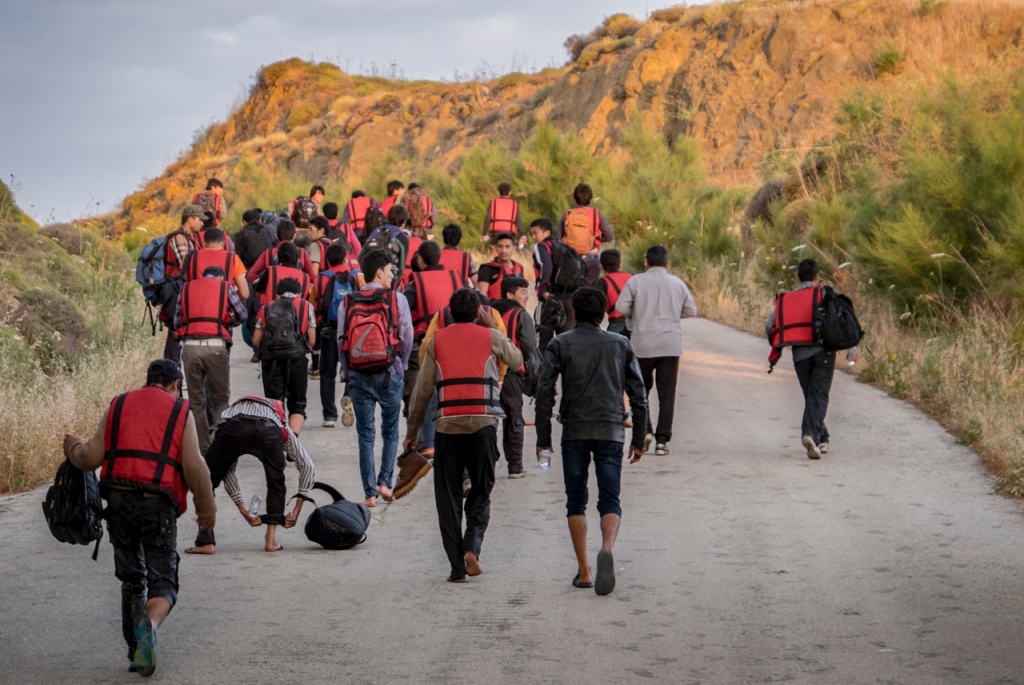
There has always been a trickle of refugees across the narrow channel. In the ten years that I have been coming here, every week I would find one or two rafts abandoned on the beach with ten or so life jackets or paddles. Until recently, most had been young men from Afghanistan and Iraq, escaping wars they didn’t want to fight, who would later be spotted on a road walking the forty miles or so to the island’s capital, Mytilini, to be processed and transferred to a camp in Athens. In the whole country, the number of such migrants has increased five-fold over the same period last year; but for the islands offshore Turkey, the numbers have risen far more dramatically. On Lesbos, the count has gone from a few dozen a month to over two thousand in one three-day period alone.

A surge in Taliban-led violence in Afghanistan, the rapid spread of the barbaric Islamic state in Iraq, and Syria’s devastating civil war have sent millions fleeing for their lives. Over half of the Syrian population has been displaced, and now accounts for half or more of the new arrivals. Often members of the middle class—teachers, IT specialists and engineers—more often Syrians come as families, forced to leave when their children’s school was bombed; or if from Aleppo, when their neighbourhood was razed. On the whole, Syrians have more money than others, but that doesn’t mean much when they have nothing else but the clothes they are wearing.

Some Afghani refugees have walked from as far as Kabul, taking weeks to hike over Iran’s mountains and cross the length of Turkey to its west coast. The odd Syrian has flown to Istanbul, and taken buses to where, even if he or she has money, still has to hide in forests, waiting for days until his turn for the ‘trafficker’ to bundle him aboard a rubber raft. With the craft’s captain (usually one of the refugees) given an hour of training, they are launched for Greece with nothing more precise nautically than a pointed finger.

It’s a harrowing journey for everyone, not the least because of the real risk of capsizing their overloaded rafts even in light seas—sometimes purposefully. The traffickers instruct them to slash their pontoons if the Greek Coast Guard approaches to keep from being turned back to Turkey, which inevitably tosses forty-some non-swimmers into the sea with a crew of only four frantically trying to save them. Ironically, the Coast Guard’s mission is not to turn them back, but to ensure their safe arrival.

Ahead of them, the journey will still be hard. They don’t know it yet. Their dream—their safety—is their first footstep in Europe. It’s only one step in a perilous journey that will take them to processing centers, overcrowded camps, and force them into the hands of other traffickers, more malevolent than anyone else they have met on their way, who, for extortionist prices, promise to get them to Germany or Austria—the current popular destinations.

That emotional first step on European soil can’t be overestimated. As their rafts slide ashore, it’s a celebration. The journey has ended and they have arrived safely. Regardless of their wariness of what’s next, they scramble ashore, some feeling the need to run a short distance from the water; but others, overcome with their first sense of security in years, weep, embrace each other, believing—rightfully—that they have made it to a better place. Certainly a safer one.

It’s different, too, from what they imagined. There is little officialdom at this northern point of the island. No police to register them, no information other than the latest rumours that their rescuers—sometimes the Coast Guard, sometimes local volunteers—can pass on. Frequently they don’t know where they landed, only that they need to register with the police to get in the long line to be processed.

Where are the police?

Seventy kilometers away.

Will there be a bus?

Maybe.

Maybe?

Probably not. But maybe. It changes daily.

What do we do?

Walk.

Walk? My wife is pregnant. My boy is three years old.

I’m sorry. Walk.

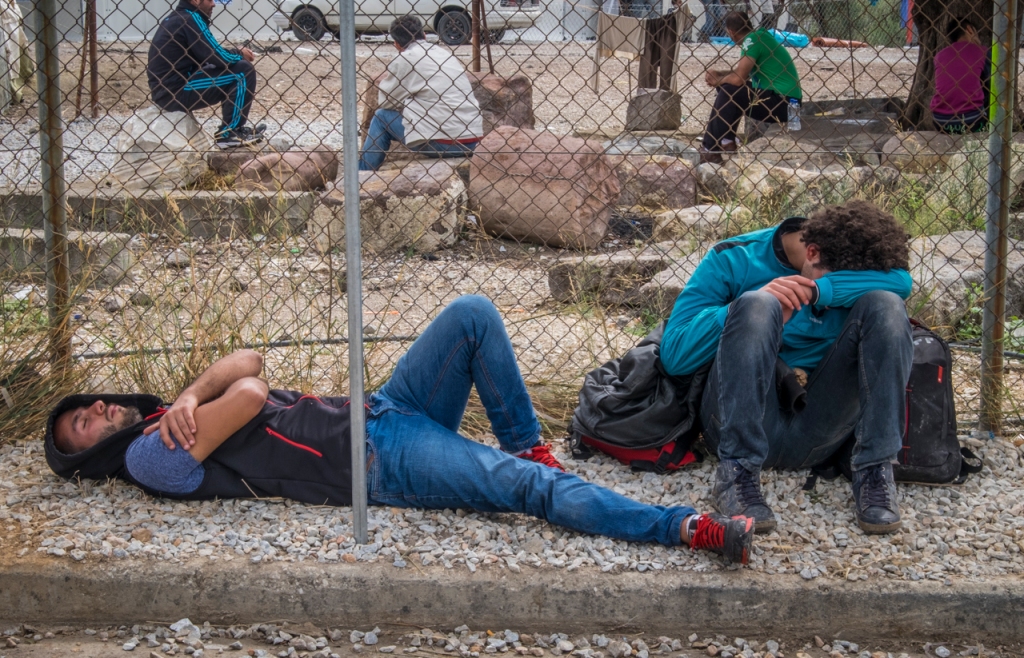
The rules, and the probability of a bus, change daily. It’s not because of some great inefficiency by Lesbos’ government, though the elimination a few years ago of village mayors to create a central authority in Mytilini has complicated providing services as essential as portable johns at the bus park where people are often stranded for several days. Earlier this week, that meant thirty persons crowded into a bus shelter on a chilly and rainy night; among them, eight children and five women—two of them pregnant.

While it was foreseeable that the Syrians would mass in camps just over the border in Turkey, it was far less predictable that they would become such a massive wave of refugees headed for the West. If someone saw it coming, that message never got to frontline Lesbos. It might not have mattered if it did. The country is bankrupt. Local officials can hardly provide basic services, let alone cope with an explosion of refugees. International NGOs haven’t caught up with the crisis either.

Local volunteers are making extraordinary efforts to meet the rafts on arrival, and ensure that they have food, water, clothing, shoes, and even Pampers because there are so many infants. Of course, not everyone agrees on what assistance, if any, should be provided.

Most refugees don’t plan to stay in Greece. Some will, of course, but the locals, seeing first-hand the dimension of what is happening, are starting to ask the bigger picture questions: What does it mean for Europe? Who are these people, coming from war-torn countries, possibly armed because in war zones people have weapons? How many refugees can be absorbed before fundamentally changing the culture of Europe itself?

Closer to home, the concerns take on an economic aspect. What if tourists stop coming because they don’t want to be confronted with the plight of refugees, as some reports suggest has started to happen on other islands? No one denies they need water and food, but what beyond that might actually encourage the next groups to make Molyvos their destination? Tents? Toilets? The worry is that if the refugees, using their cell phones, report back to those following in their footsteps that they are being helped, even more people will come here.

The refugees expect to be met and confronted in some way. The lack of even one policeman in my village, or the absence of a bus to take them to Mytilini, puzzles them. A couple of days ago, a few staged a sit-in, blocking traffic on the road in the village, demanding to be arrested and taken to Mytilini. It lasted only as long as it took to convince them that there really was no one in authority who could arrest them.

One of the young men asked me why not a policeman? Why not a bus? I told him that Greece was a poor country, but he didn’t buy it. His was poorer.

I tried the argument: There are too many of you. The village can’t cope. You are sending messages back that here you get water, food, and until a few days ago, we had a small camp where you could sleep. Now too many people are coming.

He shook his head sadly at my obtuseness.

Mister, they’re coming anyway.

Photograph by Michael Honegger

Timothy Jay Smith, writer, wanderer and philanthropist, has traveled around the world many times collecting stories for his novels, screenplays and stage plays. 

.

PLEASE NOTE: ARTICLES CAN ONLY BE REPRODUCED IN OTHER SITES WITH DUE ACKNOWLEDGEMENT TO BORDERLESS JOURNAL

Click here to access the Borderless anthology, Monalisa No Longer Smiles

Click here to access Monalisa No Longer Smiles on Kindle Amazon International
Categories
Excerpt

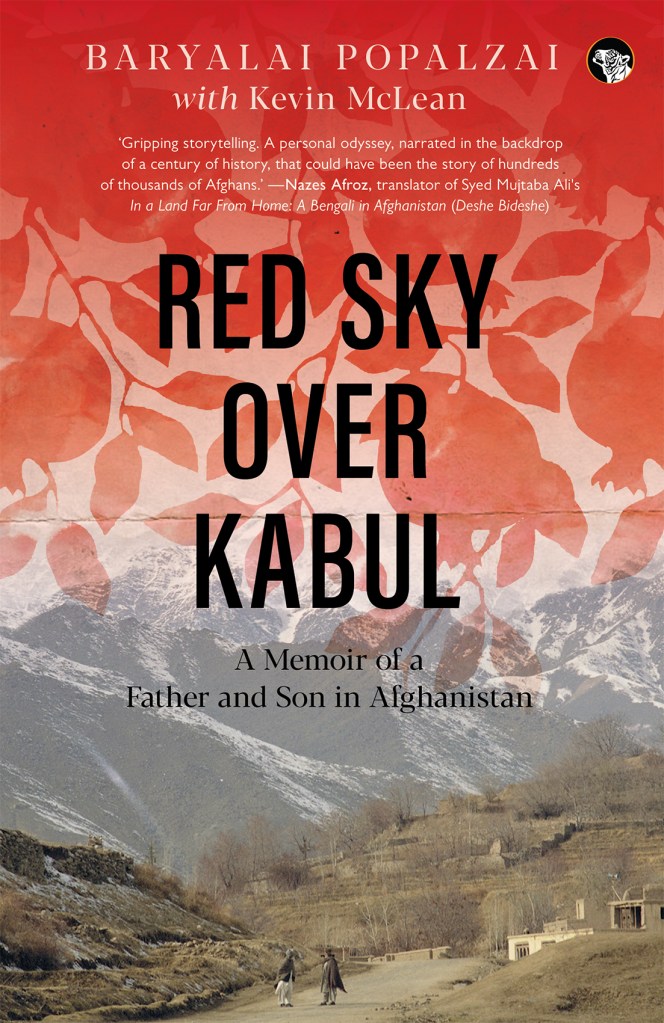
Red Sky Over Kabul

Title: Red Sky Over Kabul: A Memoir of a Father and Son in Afghanistan

Authors: Baryalai Popalzai and Kevin McLean

Publisher: Speaking Tiger Books

One
Kabul, Afghanistan, 4 October 1980

On a breezy October day, a kite-flying day, my cousin Kader surprised me with a visit. He looked much older than I remembered, his hair thinner, his once smooth face now lined with worry. He was a well-known political writer who had worked for the Ministry of Education before the Spring Revolution. He was also known for his short stories.

For generations, his family had been one of the most important families in Kabul. Kader looked at me with his deep-set black eyes and spoke in a frantic voice, ‘Bar, you must leave immediately. The National Security and Russian soldiers are now searching house to house. They’ve already searched half of your neighbourhood and they won’t stop. You must come to my house immediately. It’s the only place that will be safe for you now.’

I did not know what to think. Things were so bad now, I wondered if I could trust my own cousin. He could have given in to the Communists; or he could be telling me this because they were holding someone in his family hostage.

I hated the Russians for making me doubt him, and I hated myself for doubting him.

Tashakor (Thank you). I’ll be okay,’ I assured him. ‘I have a hiding place that the National Security will never find.’

But he was adamant. ‘You must come to my house. It’s the only place that will be safe for you now.’

‘I need time to think,’ I said, deflecting his request.

‘There’s no time!’ he said.

I told him, ‘I have to think of my wife and children, my father and mother. I’m the only one who can take care of them.’

‘You won’t be much use to them dead,’ he said.

‘That is true, Kader. But before I leave my family and go to your house, I must speak with my father.’

Kader just sighed. ‘God be with you.’

That night I lay on the floor, unable to sleep. I could hear the National Security guards in the street outside my house shouting at people, ‘What is the password for tonight?’ If there was no response, there would be the sound of gunfire and I would flinch as if the bullet had ripped through me.

As soon as the sun appeared, I went up to my father’s bedroom where he spent most of his time since losing his leg years before. I told him about Kader’s visit. ‘Things have changed,’ I said. ‘Every house is being searched now. They will even search the general’s house. I can no longer hide from these crazy people.’

‘So, you think you should go stay with Kader?’ Baba asked.

‘We don’t know who’s honest anymore,’ I replied. Then the words I had dreaded saying for so long escaped my lips.

‘The time has come for me to leave.’

Baba didn’t say anything at first. This unsettled me because my father was never at a loss for words. When he finally did speak, his voice was weak. ‘I was afraid it might come to this,’ he said. ‘I’ve spoken with Abbas. He agreed that when the time comes, he would go with you. I will get word to him. You can leave tomorrow at first light.’

When I told my mother, who I called Babu, her body shuddered, but her lips were silent. My mother had a habit of never sitting still when she was nervous. First, she paced back and forth in the room. Then she walked from one room to the other. Then from one house in our compound to another.

She returned to our living room and continued pacing back and forth until I could take it no longer.

‘Sit!’ I told her. But she never sat. My wife Afsana was asleep in another room with our two children. I couldn’t find the tongue to tell her. But I knew I must.

‘Afsana?’ I called, waking her.

Baleh? (Yes?)’

‘It’s not safe for me here anymore…I must leave tomorrow.’

‘What do you mean?’ she asked, panic rising in her voice.

‘Kader came to see me. Things have become too dangerous now. Abbas is coming for me in the morning. He’ll make sure I get out safely. I’ll send for you and the children as soon as I can.’

A painful silence followed. Afsana started to speak, but stopped. She knew there was nothing she could say or do now. We both lay awake all night.

As dawn approached, I went to say goodbye to my father.

He was sitting up in bed staring at nothing, his books and newspaper lying next to him, unread.

‘Ah, the time has come,’ he said. He seemed to be searching for something else to say; some last words of wisdom, some final advice from father to son. When he finally spoke, he spoke slowly, the words sticking in his throat, ‘Take care of yourself.’

I could not do this. ‘I won’t leave without taking you and Babu. I can’t leave without Afsana and the children,’ I said.

‘We’ll all go together!’

He was silent for a moment, his eyes never leaving my face. ‘Nay, you know that’s not possible,’ he said.

‘I can get friends to help us. They can take all your things. We’ll go to Jalalabad. Everything will be all right.’

‘Nay, Bar. It is not practical. I’m too old and weak to be moved. The Russians won’t bother Babu, or Afsana, or the children. We’ll be safe here. If we try to leave, none of us will survive. Things are very bad, but I still have my house and my writings. But it is true, you are no longer safe here, so you must leave to save yourself. Let’s pray that in a few months, things will change.’

‘If that is your wish,’ I gave in.

‘Say goodbye to me now,’ Baba said. ‘I’m afraid you won’t see me again.’

‘How can you say that?’ I protested, feeling the pain of those words as though he were already dead.

Extracted from Red Sky Over Kabul: A Memoir of a Father and Son in Afghanistan by Baryalai Popalzai and Kevin McLean. Published by Speaking Tiger Books, 2023.

ABOUT THE BOOK

 Red Sky Over Kabul is the deeply personal, moving and dramatic story of a royal Pashtun family—the Popalzais—intimately connected with Afghanistan’s history from the 1800s. After the Soviet invasion in 1980, the narrator, Baryalai—Bar—is forced to leave his beloved country as National Security guards carry out a house-to-house search for young men who refuse to fight for the Russians against their fellow Afghans. He flees to Pakistan, where he is imprisoned as a spy, eventually making his way to the US, to make a new life for himself. He returns twenty years later, to reclaim his family homes in Kabul and Jalalabad, only to find them occupied by drug dealers and warlords.

This memoir is as much a story of Bar as it is a story of Afghanistan: Bar’s father, Rahman, was tutor to Zahir Shah, who would become the last king of the country after the assassination of his father in 1933; Rahman Popalzai continued to serve Zahir as his advisor and confidant for 40 years. At the heart of this book is the relationship between a father and son—Rahman and Bar— who share a fierce love for their homeland, but whose paths diverge.

Red Sky Over Kabul is also a vivid portrait of a vanished Afghanistan—a world of kite flying, duck hunting and sitar lessons; a world lost to unending, horrific violence. But even in loss and tragedy, the human spirit finds hope and resilience—which is Afghanistan’s triumph, as it is Bar’s.

ABOUT THE AUTHORS

 Baryalai Popalzai was born in Kabul, Afghanistan in 1952. After the Russian invasion in 1980, he fled the country and eventually settled in San Diego. When the Taliban were ousted in 2002, Bar returned to Kabul for the first time in twenty years and has been returning a few times every year since then.

Kevin McLean received his JD from Boston University School of Law and practised law for many years in Boston and San Diego. He is the author of Crossing the River Kabul (2017).

PLEASE NOTE: ARTICLES CAN ONLY BE REPRODUCED IN OTHER SITES WITH DUE ACKNOWLEDGEMENT TO BORDERLESS JOURNAL

Categories
Nazrul Translations Tribute

Hena: A Short Story by Nazrul

First published in the collection titled Baethar Daan (Offerings of Pain, 1922), Kazi Nazrul Islam’s short story, Hena, is set against the backdrop of the First World War where the writer himself had fought as a young soldier (1917-1919). It has been translated by Sohana Manzoor and brought out to commemorate Nazrul’s 124th Birth Anniversary.

A trench in Verdun, France

This must be what they call rain of fire! And the sounds! The roaring sound of the artillery! Not a speck of blue sky can be seen– as if the whole sky has been set on fire. The thick rain of fire that pours down from the exploding cannonballs and bombs is so intense that if those were real raindrops trickling out of the blue eyes of the sky, the entire world would have been flooded just in a day. And if these sounds that were louder and more intense than any thunderstorm, would continue like this, people’s eardrums would split, turning them deaf. Today, we the soldiers could only recall the song that is sung during Holi celebrations:

“We will play holi with swords today,
All the soldiers of the world are gathered here
Shields playing the trumpets, cannon balls the squirt pumps
Ammunitions are colourful, the battle is intense.”

It is very true that the ammunition has caused the sky and ground to turn completely red. The reddest are the congealed blood on the bayonetted chests of the unfortunate ones! No other colour but red! As soldiers fall one by one, each one a martyr, they lie on the ground, dressed in red like bridegrooms!

Agh! The worst of all is the smoky smell. It is enough to turn your stomach. Are not human beings the best of all creations? Then why have them killed in such ugly and terrifying ways?  When the inanimate lead bullets, hit someone’s bones, they explode with a horrid force and tear through the flesh.

If human beings used their intelligence in more productive ways, they could have claimed a place close to the angels. Oh, and this heart-rending thirst! The friend lying next to you, his rifle slipping from his hand, cannot be awakened even if a thousand cannons roar by his ear. No general can ever make him obey his orders. After fighting for seven days at a stretch in this muddy trench he has finally fallen asleep. He is finally at peace!  A rare touch of soothing contentment lingers on his cold and dry lips.

But I feel so thirsty. Let me take the water-bottle from his waist and take a sip! I haven’t had a drop since yesterday. No one cared to offer me a drink. Aah…! This one sip feels so sweet! My Lewis gun doesn’t work anymore. It grew tired after days of continuous shooting. I will take the gun of my deceased friend then. If his mother, sister or wife were present here, they would surely have taken his broken skull on their laps and cry their hearts out! Well, I guess, in a few minutes, a heavy shell will land in front of the trench and bury the two of us!  It won’t be too bad actually!

It is really funny as I think of the women crying. All of us will die one day, what is there to weep? Death is an eternal truth — why should one grieve over something that is so normal and inevitable?  

I am going through so much pain, after receiving so many wounds, but my heart is filled with a demonic joy! I cannot sketch this feeling with this wooden pencil! There is often a joy that lies asleep at the heart of extreme pain which we can’t really feel! And is this habit of writing something bad? I have been swimming in fire, with scores of dead bodies under my feet and bombs dropped from aircraft bursting over my head, artillery shells are exploding and rifle and machinegun bullets are zooming past, still, deep inside, I feel restless because I couldn’t write down my innermost thoughts in the past seven days! But today, I feel relieved that I could start writing again!

Let me rest for a while, leaning against my dead friend. Ah, it feels so good!…

An unknown young girl of this distant land across the sea gave me some pickles and two slices of bread with butter which I haven’t had time to eat… The women of this country look at us with affection and pity! . . . . Ha ha ha, look at the bread here—these are dry and seem roasted! Let’s see if the bread is tougher than my teeth. I have no other option but to eat these — I am so hungry. The pickle is still quite fresh though!

That girl who was thirteen or fourteen (in our country, she would be wedded by now, if not already a mother), put her hands around my neck and kissed me. She said, “Brother, you must drive the enemy out with full force.”  I broke into a pure, sad smile.

Ah! I can finally see the sky. A strip of blue sky can be seen behind the mass of heavy clouds. It is so beautiful– like a pair of blue eyes filled with tears! Anyway, I will write down my other thoughts later. The spirit of my dead friend must be mad at me by now. What, my friend, you want a drop of water? See, how he is staring at me! No, my friend, I tell you your beloved is waiting for you with a glass of lemonade in the other world. I would not want to disappoint her, would I?

Ah, I seem to remember so many things today. But no! There’s nothing to remember! These are all lies. Let me pick up the Lewis gun and start shooting. I see some of those who are helping me have stolen a nap!  

But there, I can hear the sound of footsteps. They are all marching– left-right-left. That sound is so melodious! Are they coming to relieve us from duty?

Ouch! A moment of distraction has allowed a bullet to bruise my arm! Let me dress it. I hate those nurses. If a woman cares for me without loving me, why should I accept it? Ah! A war shows how killing others can be addictive.

The man who has fallen beside me is far stronger and healthier than me! But I have also seen how one’s mind has more strength than one’s body.

This Lewis gun is shooting about six to seven hundred rounds per minute. If only I could know how many I have killed!   But the two Lewis guns here are keeping the enemies confined to their position. You can hear the loud groans of the enemies as they die in droves! The beauty of such youthful deaths is boundless!

A tent at the river Seine, France

I slept for all forty-eight hours of the last two days. And now I have to get dressed for battle and go out to destroy God’s creatures once again. The killing game is the right kind of activity for stone-hearted person like me.

Today that kind girl took me to visit her house… How clean and pretty are the houses here! The girl has clearly fallen in love with me. And I, too, have begun to love her… In our country, people would have said that the girl has gone bad… They would not have liked to see a young girl going out with a young man of twenty or twenty-one.

People look at love in such ugly ways these days! Are these human beings, or vultures? There is so much sin in the world! How did the people become so petty? The sky above is so vast and blue, but beneath the same sky human beings are so mean and narrow-minded!

Fire, you keep raining down!  Let the curse of God float downward like frozen chunks of ice… Oh the horn of Israfil[1]! Do blow and immobilize the world! Oh, the thunder of destruction, strike inside the human brains, like the bombs and the artillery shells. And let the entire sky fall on the heads of those people who slander love, and blight the flowers…

If I could dress up one of my countrymen the way I am dressed now, and pushed him down, I am sure he wouldn’t be able to get up, no matter how hard he tried. I am highly amused at my bulky and sluggish appearance.

A ‘wicked’ friend once commented “What pleasing looks!” What a weird adjective!  And another one is supposed have said, “The bullock looks like a katla fish!”

A thick forest near Paris, France

All on a sudden, we were sent to this dense forest yesterday. I have no clue why we had to fall back. This is the beauty of military life—an order is given and you are told “Get it done!” You can never ask “Why do I have to do this,” or ask for an explanation. It’s an order –that’s all!”

If I say, “I am going to die,” a stern voice will reply, “As long as you breathe, keep on doing what you are doing, if you fall dead on your right foot while you are marching, let your left foot keep up the pace!”

There is a strange beauty in obeying orders with blind obedience! What tenderness it is that lies at the heart of a thunder! If the entire world could come under one (and only) such military regime, then it would turn out so beautiful that even calling it a heaven on earth would not be enough.

The British nation is so great now because of the discipline they exercise on everything they do. They walk so tall that we can never see the crown of their heads no matter how hard we crane our necks — and let our headgears fall off while doing that! To speak frankly, their empire is like a huge clock that is always correct and faultless. Its two hands run in precision. The clock is oiled every day so there is no speck of rust anywhere.

We were the ones who chased the Germans to the Hindenburg Line and then we had to retreat so far! Only the maker of the clock knows which hand has to move at what pace, but the hands don’t know anything about it. But the hands have to keep ticking because these are continuously driven by a spring from the rear.

We badly need a disciplined, clockwork system like this. This reckless nation of ours really needs to be tied up and disciplined; otherwise, there is no hope of it rising anytime in future!  If everybody wants to be the leader, who will do the work?

Oh, the artillery shells raining on us even at this distance! This is really uncanny… The war is being fought so far away but cannon-balls are dropping on us in the forest!  

Well, an elephant might think that it is the biggest animal in the world. But even a mosquito can cause it enough trouble through a single bite in its head.

It’s cool in this shady darkness here. How my heart had been yearning for this solace in darkness.

Alas! Darkness seems to trigger in my mind so many fond memories! But, no, let me just climb up the tree and see if any enemy is hiding nearby.

How charming that distant ice-covered river looks from the tree! But there are also some big houses around which shells have torn through, leaving ugly gaping holes! This game of destruction reminds me of my childhood when we used to build clay doll’s houses. After we were done with our play, we used to crush them with our feet and sing:

“We made them gleefully with our hands
We broke them gleefully with our feet!”

The cannon-balls are flying through the air and dropping on distant planes, and from my vantage point, they look like falling stars.

And the sound these fighter planes are making! Oh! The way they are climbing and diving– it looks as if an expert kite flier is maneuvering his fighter-kite to hurtle through the sky in search of a rival. That plane is ours! The German zeppelins look from a distant more like big, flying caterpillars.

Anyway, let me get a bit of pickle out of my haversack. That foreign girl is so far away from me today but the pickle seems to retain her touch! Hell! What am I doing?  Why do I keep on thinking of all this gibberish? I don’t need the pain that arises from nowhere and tortures me!

Well, well! What do I see there? A friend of mine is trying to take a nap on that tree. See, he has tied himself with his belt to a branch quite tightly. If he somehow falls in the water below, it will be quite a hassle for him! But then why not? Oh God, let him fall!

Should I shoot a bullet past his ear?  Ah, no! Poor thing! Let him sleep awhile. Nobody except me has such hapless eyes that sleep never touches, or a blasted mind like mine which gets sick thinking about the goings on in the world. It’s night – quite deep into the night, I guess!  I will have to stay here in this crouching position till dawn…. Perhaps when I am old (if I live that long), the trials I am going through will turn into sweet memories.

The light of the moon, which will turn into a full moon tomorrow night, is creating patterns of light and shadow in the forest below, which make the forest look like a giant cheetah! The heavy, dark clouds over my head are slowly drifting towards some unknown destination. A few drops of cool water fall on my head. Ah, how sad these drops feel! Ah!

The moon is now hidden by a cloud, and now it shoots out and hides behind another cloud! It seems like a game of peekaboo played by beauties living in the glass palace of a king. Who is running in the sky now? The clouds or the moon? I would say the clouds but a simple child might say the moon. Who is right? Aha! How lovely is the play of light and shadow!

What’s that bird cooing in the distance? The delicate tones of the bird songs of this country seem to evoke a sweet laziness… I find them intoxicating.

In this light and shadow, I remember so many things! But the memory is so full of pain.

I recall telling her, “I love you so much, Hena.”

Hena shook her raven black silky hair and replied, “But Sohrab, I haven’t been able to love you.”  

That day, the bright saffron flowers seemed to be playing a game to welcome the new day in the garden of Balochistan. Unmindfully, I broke a branch of walnut and collected some flowers from the deodar tree and threw them at her feet.

A few drops of tears trickled down her dark eyes lined with Istanbul kohl! Her face turned redder than her henna dyed hands!

I picked up a bunch of raw plums and threw them at the nightingale sitting in bush of screw pine flowers. The birds stopped singing and few away.  

What Human beings think is the closest turns out to be the farthest from them! This is indeed a profound mystery! Hena! Oh Hena! There’s just so much regret…!

Hindenburg Line

Oh! What is this place? I cannot believe that this is an underground land of fairies and monsters!  Can a trench built during the wartimes be really as huge as a city full of houses? Who could have imagined this? What a gigantic venture so deep down underground! This is indeed another wonder of the world! One can live as luxuriously as the Nabobs of Bengal in this place!

But I did not come here for the peace it offers! I did not ask for comfort. I only wanted pain and suffering. I am not made for enjoyment and comfort!  I would have to seek out another path then. It seems like I found a house under the tamarind tree in trying to escape from tasting sour things.

No, I need to be active. I want to drown myself in work. But this life of comfort here is embarrassing!

I heard that iron turns into steel when it burns in fire. What about human beings? Only ‘baptised’?

Being freed of restraints, my mind has fled again to that room full of grapes and pomegranates!  I recall those days again!

“Hena, I’m about to jump into the fire that burns in a free country. I am burning inside, so let my body burn too! Maybe, I will never return. But what means do I have? How do I find travel expenses? How will I live in the foreign land?”

Hena’s henna-dyed fingers trembled like young shoots in my hands. She replied in a clear voice, “But that’s not how your life becomes meaningful, Sohrab!  This is only the hot-headed youthfulness!  You’re clinging to a lie! There is still time for you to get the message!…  See I’ve not been able to love you yet.”

All is empty. Nothing remains. A gusty wind blew through the thick tamarisk trees and cried, “Ah!… Ah!… Ah! When the first battalion of our Baloch Regiment 127 started off for this country from Quetta, one of my friends, a young Bengali doctor, sang while sitting under a pear tree:

“How will you make him return
The one you bade farewell in tears.
In this languid air
At night in the garden
Have you recalled him under the bakul tree?
How will you make him return!
The honeymoon of the full moon
Returns from time to time,
But the one who has gone, does not come back!
Now how will you make him return?”

How weak I am! No wonder I did not want to come to this place. What would I do in this palatial life?  Fellows of my regiment think there is no one as carefree and happy as I am. It’s because I laugh a lot. Does anybody know how much blood is hidden in the heart of the henna leaves?

I played “Home sweet home” on the piano and sang along so beautifully that the French were amazed!  It was as if we are not human beings and so we cannot do anything as well as  them!  We have to break such preconceived notions.

Hindenburg Line

What else can I do if there’s no work? I have to find something to do. So last night I crawled for about a couple of miles and cut through much of their wires. Nobody seemed to notice.

My commanding officer said, “You’ll be rewarded for this.”

So, I became a corporal today.

The other day, I met that foreign girl too. She has grown much prettier in these two years! She told me directly that if I had no objection, she would like to have me as her partner! I told her, “That’s impossible!”

I said to myself, “A blind man loses his staff only once. Again? No way. I have had enough.”

The way her blue eyes filled with tears and her bosom heaved made a stone-hearted person like me cry!

She controlled herself and said, “But you’ll allow me to love you?  Like a brother at least…?”

I am just a god forsaken wayfarer.  So, I showed a lot of interest and replied, “Of course.” Then she left bidding me adieu. She never came back!  I can only recall that line, “But the one who has gone does not come back.” Oh!

Anyway, the day was well-spent with the Gurkhas. These Gurkhas were really like big babies. I would not have believed that grown men could be so naive and innocent. These Gurkhas and their brothers-in-law, the Garwhals– both turn into killing machines in the battle field!  Each of them turns into a tiger, a “Sher-e-Babbar.” Even the Germans throw away their rifles and run off at the sight of their kukri knives. If these two fighter groups did not exist, we would never be able to achieve this much. Only a handful of them are still alive. Entire regiments of them have perished. Yet, the few of them that are still alive are so full of life, as if nothing has happened!

Nobody can make them understand what great feat they have achieved. And those tall and sturdy Sikhs—what betrayers they have turned out to be! Some shot themselves in the arm and ended up at the hospital.

Look there! There is a battalion ‘march’ going on in the trench. We are marching at the beat of a French band!  Left- right-left. A thousand people are all marching at the same pace– all at once. How amazing!

Balochistan

My cottage in Quetta

In the grapevine garden

What happened? I am trying to find out an answer to the question, sitting in this walnut and pear garden. All our Indian soldiers have returned home, and so have I. But how happily did those two years pass by!

I am looking at the blue sky washed by rain, which reminds me of the wide blue eyes of the young French woman. Looking at the mountain-yaks I remember her silky curly hair. And those ripe grapes– aren’t they exactly like the sparkling tears of her eyes?

After becoming an ‘officer’ I also received the title “Sardar Bahadur.” My boss would not let go of me. How could I make him understand that I was not there to form a permanent bond? I did not cross the seas with any high ideals. I only went to purify myself in fire — to hide myself too.

And I never thought I would return here of all places. But I had to– it seems I am tied to this land!

I have no one, I have nothing. And yet I feel, everything is here. Who am I trying to comfort?

I have not hurt anybody; nobody hurt me. Then why was I reluctant to come here? But that’s a matter of unspeakable agony. I can’t articulate it well enough. Hena! Oh! There’s nobody around, still the wind carries the broken echo “na…na”. “No” it is then!  

The brook still flows through the hill; only the girl Hena, whose footprints are still etched  on the stone-steps, is no longer there. There are so many things lying around that remind me of her soft touch.

Hena! Hena! Hena! Again that echo! Na –Na- Na!

***

I have found her! She is — here. Hena! My Hena! I saw you here today, here in Peshawar! Why do you keep hiding the truth behind those lies? She watched me from a distance and cried. She did not utter a word; she only looked at me and shed tears.

In such meetings, tears are the most articulate language of the heart. She told me again that she could not bring herself to love me. The moment she uttered the word “no” she cried so dejectedly that even the morning air became mournful!

The biggest puzzle in this world is the mind of a woman!

Kabul

Dakka camp

When I heard that the great man Ameer Habibullah Khan had been martyred, I felt that the top of the Hindukush had collapsed! And Suleiman Mountain must have been torn out of its base!

And I wondered what I should do. For ten days, I kept on thinking. It was no easy task!

I decided that I would fight for Ameer. Why? Well, there’s no answer to that question. But let me say candidly that I do not consider the British as my enemy. I have always thought of them as my best friends. But even if I say the reason for my joining the war this time was to protect the weak, even if it meant sacrificing my life, it won’t be quite the right answer.  Even I do not understand my own whims!

That morning, someone seemed to have set fire to the pomegranates. They looked bright red! That was perhaps the blood from the hearts of many like me!

The vast sky had just paused after crying incessantly. Its eyes are still misty, so it would start crying again.  A broken-hearted cuckoo had also been weeping somewhere, turning its eyes red and its voice rang through the damp winds of the autumnal morning. Someone on the other side of the dried river was playing the Asawari raga[2]on the shehnai. Its notes echoed the doleful cries of a lonely heart. I felt the sadness more than anyone else. The strong smell of henna flowers intoxicated me.

I said, “Hena, I am going to war again, to fight for the Ameer. I won’t come back. Even if I live, I won’t come back.”

Hena buried herself in my chest and cried, “Sohrab, my love! Yes, go wherever you will. Now is the time to tell you how much I love you. I won’t hide the truth anymore. I won’t cause my love further pain….”

I understood. She was a warrior-woman, a daughter of the Afghans. Even though being an Afghan myself I have spent my entire life fighting, she had wanted me to sacrifice my life at the feet of our country. She wanted me to sacrifice my life for our land.

O, the heart of a woman! How could you hide yourself like this? What perseverance! How could such a soft-hearted woman be so tough at the same time?

                                                                                                            Kabul

My body has taken five bullets. But until the moment I lost consciousness, I had defended my soldiers with all my strength!

O my God!  If protecting my country with my blood makes me a martyr, then I am a martyr.  

I came back. Hena followed me like a shadow. How could she hold back so much love that flowed like a rapid tumbling uncontrollably down the mountain with her fragile ribcage!

The Ameer has given me a place in his court. I am one of the commanders of his army.

And Hena? There is Hena, sleeping by my side, clinging to my chest…. Her heart is still fluttering with some unknown fear. Her sighs are still pervading the winds with some dissatisfaction.

The poor girl has also been badly wounded like me! Let her sleep. No, we’ll sleep together. O God — don’t give us any more pain by waking us up from this pleasurable sleep! Hena! Hena! –na—na—Ah!

.

[1] The angel who blows the trumpet on the day of judgement in Islam.

[2] A morning raga or melodic composition in the Hindustani classical tradition.

.

Kazi Nazrul Islam (1899-1976) was born in united Bengal, long before the Partition. Known as the  Bidrohi Kobi, or “rebel poet”. Nazrul is now regarded as the national poet of Bangladesh though he continues a revered name in the Indian subcontinent. In addition to his prose and poetry, Nazrul wrote about 4000 songs.

Sohana Manzoor is an Associate Professor at the Department of English and Humanities at ULAB, a short story writer, a translator, an essayist and an artist.

PLEASE NOTE: ARTICLES CAN ONLY BE REPRODUCED IN OTHER SITES WITH DUE ACKNOWLEDGEMENT TO BORDERLESS JOURNAL

Click here to access the Borderless anthology, Monalisa No Longer Smiles

Click here to access Monalisa No Longer Smiles on Kindle Amazon International

Categories
Editorial

And Wilderness is Paradise Enow…

Hope in Winter(2020) by Srijani Dutta
“Here with a Loaf of Bread beneath the Bough,
A Flask of Wine, a Book of Verse -- and Thou
Beside me singing in the Wilderness --
And Wilderness is Paradise enow.”

― Omar Khayyám (1048-1131); translation from Persian by Edward Fitzgerald (Rubaiyat, 1859)

I wonder why Khayyam wrote these lines — was it to redefine paradise or just to woo his beloved? I like to imagine it was a bit of both. The need not to look for a paradise after death but to create one on Earth might well make an impact on humankind. Maybe, they would stop warring over an invisible force that they call God or by some other given name, some ‘ism’. Other than tens of thousands dying in natural disasters like the recent earthquake at the border of Turkiye and Syria, many have been killed by wars that continue to perpetrate divides created by human constructs. This month houses the second anniversary of the military junta rule in Myanmar and the first anniversary of the Ukrainian-Russian war that continues to decimate people, towns, natural reserves, humanity, economics relentlessly, polluting the environment with weapons of mass destruction, be it bombs or missiles. The more weapons we use, the more we destroy the environment of our own home planet. 

Sometimes, the world cries for a change. It asks to be upended.

We rethink, reinvent to move forward as a species or a single race. We relook at concepts like life and death and the way we run our lives. Redefining paradise or finding paradise on Earth, redefining ‘isms’ we have been living with for the past few hundred years — ‘isms’ that are being used to hurt others of our own species, to create exclusivity and divisions where none should exist — might well be a requisite for the continuance of our race.

Voices of change-pleaders rang out in the last century with visionaries like Tagore, Gandhi, Nazrul, Satyajit Ray urging for a more accepting and less war-bound world. This month, Ratnottama Sengupta has written on Ray’s legendary 1969 film, Goopy Gyne, Bagha Byne: “The message he sent out loud and with laughter: ‘When people have palatable food to fill their belly and music to fill their soul, the world will bid goodbye to wars.’” Shantanu Ray Chaudhuri has given an essay on one of the greatest pacifists, Gandhi, and his attitudes to films as well as his depiction in movies. What was amazing is Gandhi condemned films and never saw their worth as a mass media influencer! The other interesting thing is his repeated depiction as an ethereal spirit in recent movies which ask for changes in modern day perceptions and reforms. In fact, both these essays deal with ghosts who come back from the past to urge for changes towards a better future.

Delving deeper into the supernatural is our interviewee, Abhirup Dhar, an upcoming writer whose ghost stories are being adapted by Bollywood. While he does investigative stories linked to supernatural lore, our other interviewee, Andrew Quilty, a renowned journalist who has won encomiums for his coverage on Afghanistan where he spent eight years, shows in his book, August in Kabul: America’s Last Days in Afghanistan and the Return of the Taliban, what clinging to past lores can do to a people, especially women. Where does one strike the balance? We also have an excerpt from his book to give a flavour of his exclusive journalistic coverage on the plight of Afghans as an eyewitness who flew back to the country not only to report but to be with his friends — Afghans and foreigners — as others fled out of Kabul on August 14 th 2021. While culturally, Afghans should have been closer to Khayyam, does their repressive outlook really embrace the past, especially with the Taliban dating back to about only three decades?

The books in our review section have a focus on the past and history too. Meenakshi Malhotra’s review of Priyadarshini Thakur Khayal’s Padmini of Malwa: The Autobiography of Rani Rupmati, again focusses on how the author resurrects a medieval queen through visitations in a dream (could it be her spirit that visited him?). Somdatta Mandal writes of a book of history too — but this time the past and the people are resurrected through objects in Sudeshna Guha’s A history of India through 75 Objects. Bhaskar Parichha has also reviewed a history book by culinary writer-turned-historian Colleen Taylor Sen, Ashoka and The Maurya Dynasty: The History and Legacy of Ancient India’s Greatest Empire.

This intermingling of life and death and the past is brought to life in our fiction section by Sreelekha Chatterjee and Anjana Krishnan. Aditi Yadav creates a link between the past and our need to travel in her musing, which is reminiscent of Anthony Sattin’s description of asabiyya, a concept of brotherhood that thrived in medieval times. In consonance with wanderlust expressed in Yadav’s essay, we have a number of stories that explore travel highlighting various issues. Meredith Stephens travels to explore the need to have nature undisturbed by external interferences in pockets like Kangaroo Island in a semi-humorous undertone. While Ravi Shankar travels to the land’s end of India to voice candid concerns on conditions within Kerala, a place that both Keith Lyons and Rhys Hughes had written on with love and a sense of fun. It is interesting to see the contrasting perspectives on Southern India.

Hughes of course brings in dollops of humour with his travel to Adam’s Peak in Sri Lanka as does Devraj Singh Kalsi who writes about camel rides in Chandigarh, a place I known for its gardens, town planning and verdure. Suzanne Kamata colours Japan with humour as she writes of how candies can save the day there! Sengupta continues to travel to the past delving into the history of the last century.

Poetry that evokes laughter is rare but none the less the forte of Hughes as pensive but beautiful heartfelt poetry is that of Asad Latif. This February, the edition features poetry by Ryan Quinn Flanagan that borders on wry humour and on poignancy by George Freek. More poems by Pragya Bajpai, Sanjukta Dasgupta, Chad Norman, John Grey, Amit Parmessur, Sister Lou Ella Hickman, Saranyan BV and many more bring in varied emotions collected and honed to convey varieties that flavour our world.

Professor Fakrul Alam has also translated poetry where a contemporary Bengali writer, Masud Khan, cogitates on history while Ihlwha Choi has translated his own poem from Korean. A translation of Tagore’s poem on the ocean tries to capture the vastness and the eternal restlessness that can be interpreted as whispers carried through eons of history. Fazal Baloch has also shared a poem by one of the most revered modern Balochi voices, that of Atta Shad. Our pièce de resistance is a translation of Premchand’s Balak or the Child by Anurag Sharma.

This vibrant edition would not have been possible without all the wonderful translators, writers, photographers and artists who trust us with their work. My heartfelt thanks to all of you, especially, Srijani Dutta for her beautiful painting, ‘Hope in Winter’, and Sohana for her amazing artwork. My heartfelt thanks to the team at Borderless Journal, to our loyal readers some of whom have evolved into fabulous contributors. Thank you.

Do write in telling us what you think of the journal. We look forward to feedback from all of you as we head for the completion of our third year this March.

Best wishes,

Mitali Chakravarty

borderlessjournal.com

Click here to access the Borderless anthology, Monalisa No Longer Smiles

Categories
Interview Review

Unveiling Afghanistan: In Conversation with Nazes Afroz

 Cry, My Beloved Country (1948) reflected the plight of Africans and the deep divides that created schisms between different groups in South Africa. The book won the author, Alan Paton, a Nobel prize. Another remarkable book that was published in the same year was a non-fiction written by a student of Tagore called Syed Mujtaba Ali. Mujtaba Ali wrote Deshe Bideshe in Bengali. This has been translated in recent times by the former BBC editor, Nazes Afroz, as In a Land Far from Home: A Bengali in Afghanistan. It is an outstanding memoir that demystifies and explains what led to the issues that are being faced by a country repeatedly jostled by varied regimes, a country that seems to be so steeped in problems that worrying about the pandemic remains a far cry for the common inhabitants.

For many decades this book had been feted by only a small group of readers, though the book is no lesser than Paton’s in crying out against injustices, terrors of violence and starvation, because it was written in Bengali. It was so witty and flavourful that people were afraid to translate it for the fear of losing the nuances of the original. As Afroz tells us in this interview, he had similar reservations. A book written by a scholar, it peppers history and political issues with lucidity and humour, making it an enjoyable experience for the lay reader. The author has a way of turning the mundane or intellectual into an amusing anecdote. During a conversation at an embassy party, the author through the voice of a fellow professor, makes a hilarious observation – but also, one that does convey much about Afghanistan despite its attempts at liberalisation.

Madame Vorvechievichi argued, ‘But there are mullahs in this country.’

“Dost Muhammad said reassuringly, ‘No need to worry, Madame. I know these mullahs very well. Their knowledge of religion is very little and I can teach you all of it in three days. However, a woman can’t be a mullah.’

Madame Vorvechievichi said angrily, ‘Why not?’

“With a deep sigh Dost Muhammad said, ‘Because she can’t grow a beard.’”

The book is speckled with multiple such instances. Along with these witticisms, the pathos of the country, the plight of the people is well captured by poignant observations:

“The real history of the country was buried beneath the soil, much like the way that Indian history was hidden in its Puranas, Mahabharata-Ramayana. Afghanistan is a poor country; Afghans do not have the time or the resources for archaeological excavations to write their own history.”

The writer, Syed Mujtaba Ali (1904-1974) a polyglot, scholar, traveller and humanitarian did just that – he recorded the history of the time he spent in Afghanistan, a time when a swift takeover from the liberal king Amanullah (1892-1960) was staged by Bacha-ye-Saqao (1891-1929) during the Afghan Civil War (1928-29).  Does this sound familiar, reminding one of the recent August 2021 takeover by Taliban?

A Humboldt scholar, Mujtaba Ali was conversant in fourteen languages, lived in five countries, including Afghanistan, where he had gone to teach. That his erudition never interfered but enhanced without marring the simplicity of rendition is what makes the book an attractive read for all lay persons. His astute observations are laced with wit and realism. The residue of the book lingers as the vibrant narrative flows — vicariously bringing to life, with humour and empathy, a culture that is distinct and yet warm in its uniqueness. His style is reflective of an in depth understanding of the situation and a sense of empathy for the common people with who he interacted daily – like his man Friday and the colleagues he mentions. For the author, everyone, from an uneducated villager to the crown prince (who invited him to play tennis), seemed to grow effortlessly into a rounded persona of a friend. All these have been transmitted by Afroz in the translation too. Translating two cultures across borders in a language that does not have all the words to capture the intimate nuances is not an easy feat, but it has fruited into an unusual and captivating read.

Nazes Afroz

Afroz’s maiden venture at translation was shortlisted for the Raymond Crossword Book Award. Afroz himself has spent a long stretch of time in Afghanistan. He joined the BBC in London in 1998. He was a senior editor in charge of South and Central Asia for a number of years. He has visited Afghanistan, Central Asia and West Asia regularly for over a decade. In 2013, he moved back to India. A passionate photographer, he writes in English and Bengali for various newspapers and magazines. In recent articles, he has been voicing his own concerns about developments in Afghanistan. In this interview, he reflects on what led him to translate the book, the situation as it was then and as it is now.  He dwells not only on the historic civil war as captured in the book but also on current day politics and the Taliban takeover.

You are a journalist. What got you interested in translating a Bengali classic from the last century?

I became a journalist five years after I read Deshe Bideshe. I was still a teenager when I picked up the book from a library rack. Reading Mujtaba Ali at that age had a profound impact on me. The erudition, the smooth sailing between multitude of cultures and languages, the gripping storytelling in his writing mesmerised me. I had never read anything like that in Bangla. Every Bengali reader of Syed Mujtaba Ali had felt the same way as I did. As a child I had the uncontrollable urge for travels and seeing the world. In Mujtaba Ali I found a role model. Deshe Bideshe stayed with me since then. It was one book that I would read two to three times a year from my teenage. So, by the time I decided to translate Deshe Bideshe more than thirty years after I first laid my hands on the book, I had read it for more than a hundred times! I knew its each page, I knew its each story and Afghanistan had seeped inside me permanently as I could relate to all the characters of the book.

While working for the BBC World Service in London, I had the opportunity to go to Afghanistan in 2002 soon after the Taliban were dislodged from power in a short war towards the end of 2001. I visited the country a number of the times in the following few years. As I travelled more, I befriended my BBC colleagues there and met other journalists and people on various walks of life. Some of them became good friends as well. I used to refer to events from the times of King Amanullah while discussing Afghanistan. They were surprised to hear all the details that I mentioned from a time that they said, ‘Even we don’t know!’ So, I mentioned how a Bengali scholar came from Kolkata to Kabul in 1927 and taught here, was a participant of the modernisation project of Amanullah by teaching English and French, played tennis with the crown prince Inyatullah (1888-1946) became an eyewitness of the rebellion against the king, got caught in the anarchy in the winters of 1928-29, and nearly perished starving before managing to go back to India. Hearing my story, they asked if there was any English translation of the book as they were keen to read. I told them that there was none as it was untranslatable!

As years went by and more and more of my Afghan friends got to know about Deshe Bideshe, they demanded that I did the translation. But I had my doubts. Would I be able to capture Mujtaba Ali’s unique language? Would I be able to transpose his wicked sense of humour? Would I be able to convey his erudition?

Eventually in 2011, I had already made up my mind to quit the BBC and move back to India. At that point my day-to-day workload in the BBC was significantly reduced. As I had ample time in hand, I thought I would attempt the translation. At that point I didn’t think of any publication; I wanted to do it just for fun and for my Afghan and non-Afghan friends who knew about the book and were keen to read it. I thought I would give them a taste of Mujtaba Ali’s writing by doing a few chapters. So, I did the first few chapters and shared them with a few friends. After reading those chapters they wanted to read more. I felt encouraged and I carried on with the translation for the following few months. Eventually the whole book was complete in about a year. After completing the translation, I let it sit for a few months before picking it up again and reread it as new text without looking at the original text. That exercise went on several times over the following one year till the final manuscript shaped up.

How many countries have you worked from? You were also in Afghanistan for several years I believe. Can you share your experiences?

My work has taken me to a dozen country or so. But as an intrepid traveller, I have visited more than 40 countries so far across four continents. Apart from my regular visits to Afghanistan, I spent months at a stretch on several occasions. Working in Afghanistan was certainly a unique experience. It wasn’t a country where one could travel and roam around freely. There were always the security alerts. One needed to negotiate security barriers everywhere. The accommodations – hotels, guesthouses were guarded by armed men. In the early years – in 2002 to 2004, there weren’t so much security in the hotels or guesthouses we stayed in. But that started to change from 2010 onwards as the Taliban had at that time started to regroup, and they made their presence felt in the country and in Kabul. Even at that time, cities like Mazar-e-Sharif and Herat were considered lot safer than Kabul. With increased and unpredictable attacks by the Taliban, the country became more and more edgy.

What was it about the book that drew you to it?

As I mentioned earlier, the uniqueness of Mujtaba Ali was that his erudition wasn’t frightening. He penned Deshe Bideshe almost twenty years after he left Kabul. By then, he had completed his PhD in comparative religion from Germany as a Humboldt scholar, did his post-doctoral research from al-Azhar university in Cairo, learned more than a dozen languages, and travelled extensively in Europe. So, even though his narrative of Afghanistan was drawn from what he had witnessed in his mid-twenties while teaching there, when he decided to write the book, he had acquired profound knowledge in philosophy, literature, culture and history of the world in many languages. The multilingual and multicultural references with an oblique yet gripping story-telling style infused with a wicked sense of humour that came in his writing, had been drawing ardent followers, including me, since 1948 when Deshe Bideshe was first published.

The book highlighted a growing divide between the minority with liberal education and the majority without education. Is that true still? Would you call the book relevant to the present-day crisis?

Yes, that divide between the educated and the not educated that Mujtaba Ali elicited in Deshe Bideshe is still there. But the gap has certainly reduced. The years between 1929 to 1978 had been relatively stable and peaceful in Afghanistan. Modern education had spread but without giving a jolt to the conservative society and keeping the clergy more or less content. In Kabul and other major cities, girls and women were getting more and more education; they were also seen in public life more. Following the coup through which the communists – the People’s Democratic Party of Afghanistan or PDPA came to power in 1978, there was a big push for universal education. This created a much bigger educated class. Women were the biggest beneficiary of that time in terms of acquiring knowledge and finding jobs. Women were joining the police and military as well. Following the capitulation of the PDPA government in 1992, the modern education system collapsed during the Mujahideen civil war years until 1996 and then after the takeover of virtually the whole of the country by the Taliban.

A large number of Afghans – almost a quarter of the population became refugees in neighbouring countries or elsewhere. When the American led international forces ousted the Taliban from power in 2001 following the 9/11 attacks in the USA, the population got a fresh chance to get education. Schools opened again. Both girls and boys went back to school. Internationally there were many programmes to give scholarships to Afghan women and men who were seeking higher education. As a country with a very young population (the average age of Afghanis is 18), a large number of students joined the public and private universities. So, tens of thousands of young women and men are now educated holding masters or even PhD degrees in the country. But the rural areas lagged behind. So, the gap is more of the city and rural areas.

Do you find similarities between the Afghanistan of then and of now?

The way the Afghan society works, based on its ethnic and tribal identities as witnessed by Mujtaba Ali, still exist. The stranglehold that the clergy had on the uneducated mass about a century ago has possibly changed; it’s been replaced with more political interpretation of their religion. The ethnic divisions have sharpened for multitude reasons – primarily due to the outside interference and the way ethnic groups have been used in the larger geo-political game of the world powers.

One of the issues that tussles through the book is that people were basically poor and lacked education. Syed Mustaba Ali spoke of the vicious cycles of poverty, how much has it changed from what he wrote and what you experienced? Please elaborate.

Mujtaba Ali talked about how poverty contributed to the cycle of unrest in Afghan history. Yes, that poverty still exists but with that, a toxic potion of religio-politics has been added to the cauldron. The conflict of the past four decades is more due to the global religio-political dynamics rather that its own poverty.

Did/ do you find parallels in the political situation where Amanullah and his brother escaped from the invading hardliner, Bacha-ye-Saqao? Would you see Bacha as a precursor of Taliban?

The only parallel that one can draw between 1929 when Amanullah and his brother Inayetullah fled and now in 2021 is that the suddenness of the events. Amanullah’s fall happened in months and Bacha took over Kabul in matter of days – almost the same way the Taliban took control of the country.

I don’t think Bacha-ye-Saqao or Habibullah Kalakani as he called himself, was a precursor of the Taliban. Bacha was more of an opportunist; he grabbed the opportunity that came his way. But the Taliban are more of an organised religio-political force what was the product of the geo-politics of the last decade of the Cold War. So, they two are not comparable.

Did the American or Russian intrusions into Afghanistan serve any purpose? Did they actually help the Afghans?

The short answer is no. Both the superpowers came to achieve their own strategic and foreign policy objectives. The Soviets came to expand their sphere of influence beyond their borders in Central Asia. In the process they were badly bruised and had to retreat. The Americans came to get hold of Osama-bin-Laden and dismantle the al-Qaeda infrastructure. It was never about helping a nation that had been devastated by decades of conflict in which they had no role. They just became pawns in the greater game of geopolitics.

By the descriptions in the book, Afghans seem to be fairly open as humans and yet, they have a distinct identity borne of their culture, their ethos — very different from any other. Was that undermined in any way by the attempts at modernisation?

Like many other rural, traditional and old societies, Afghans are hospitable and warm people. They are bound and governed by their age-old custom and codes of conduct.

Even when they are outside of their own land – in the West too, they extend their hospitality to strangers the same way they would in their own country and their behaviour would not differ much. It is not the question, if modernisation has or will undermine their tradition. They have had encounters with modernisation – the way modernisation is understood from the Western prism. Did that change the people who had experienced that modernisation in the time of Amanullah? Mujtaba Ali saw that the ‘so called’ modern people did not lose their Afghan-ness. The same can be said now. As a people they have largely remained unchanged despite connecting with the outside world like never before.

In the book, the international community was practically chased off Afghanistan. As the US troops left, one felt the same way. Do you feel intervention from the international community is necessary in Afghanistan? Why?

The backdrops of 1929 and the present are not identical. In 1929, the rebellion was against the king who had lost the support of the clergy. The king did not come to power with foreign intervention. So, the international community was not chased out in 1929. The Europeans left because of the chaos and the violence. The rebels didn’t fight with the foreigners. Yes, there was an armed opposition to the presence of the USA since the war in 2001, but that opposition wasn’t big enough to send the USA packing.

The USA left because they had achieved their goals in Afghanistan, and it was becoming hugely expensive for them to stay on. Many are also drawing parallels of the US’s departure from Afghanistan with their hasty retreat from Vietnam in 1975. But they were again not identical. In Vietnam, the USA visibly lost the war. But in Afghanistan they did not lose. They could have stayed on if they wanted but it made no sense to them to spend tens of billions of dollars each year. Hence, they left. They had been talking about withdrawing from Afghanistan since 2012, a year after they killed Osama bin Laden in Pakistan.

The intervention that the Afghans had been experiencing since 1979 – first by the Soviets, then Pakistan and finally the US led Western nations, devastated the country and the ordinary Afghans had been paying for it with all they had. No external intervention is beneficial for any country. It’s not desirable to have; certainly not the way the global powers had been intervening for the past 40 odd years in various corners of the world. But the question is, if unspeakable atrocities are committed on certain sections of a country or society, what does the international community do? Should the international community intervene? The world powers have unfortunately always used these as pretexts to intervene to further and achieve their own objectives not only in Afghanistan but in other countries too.

In the book, only foreigners with work seemed to be in Afghanistan. Is/ Was it possible for tourists to visit Afghanistan, even before the Taliban took over?

In the last twenty years, Afghanistan had been unstable. Violent incidents kept happening. So, it was not advisable for tourist to go there. But the country always issued tourist visa for short visits! For a few years, Japanese tourist used to come to visit the ancient Buddhist sites like Bamiyan. That too waned due to the escalating conflict.

Thank you for this wonderful interview and also for the flawless translation of a classic memoir.

Click here to read a book excerpt from In a Land Far from Home: A Bengali in Afghanistan.

(This is an online interview/review by Mitali Chakravarty.)

PLEASE NOTE: ARTICLES CAN ONLY BE REPRODUCED IN OTHER SITES WITH DUE ACKNOWLEDGEMENT TO BORDERLESS JOURNAL

Categories
Excerpt

In a Land Far From Home: A Bengali in Afghanistan

Title: In a Land Far From Home: A Bengali in Afghanistan

Author: Syed Mujtaba Ali

Translator: Nazes Afroz

Publisher: Speaking Tiger Books

Over the noise, you could hear the shout that ‘Bacha-e- Saqao is coming, Bacha-e-Saqao has arrived.’ Then we heard the bang of a rifle and the crowd lost all sense of reason. Throwing aside everything they were carrying, people started running for their lives, some landed in the roadside ditch, some slipped time and again while trying to run over the ice on the Kabul river. The blind beggar who used to sit by the road, stood up trying to find his way with his hands in the air.

I somehow managed to leave the road, crossed the ditch and stood on the front porch of a shop. I decided that I would rather die from the bullet on which my name was written rather than be trampled by mad horses or in the stampede of the crowd.

Within a minute another man appeared and stood next to me. An Italian colonello or colonel, aged about sixty, with a long corrugated beard.

He was the first person whom I could ask something cogently. I said to him, ‘I heard that the bandit leader Bacha-e-Saqao was coming to fight for Amanullah. But what is really happening?’

The colonello said, ‘Seems like wrong news. He’s coming to take over the city.’

If that was the case, then why were Amanullah’s soldiers not going to the north of the city to fight him? How did Bacha-e-Saqao arrive in Kabul so suddenly? How many men did he have? Were they carrying only rifles or did they have cannons? The colonello could not answer these questions; he only kept saying, ‘What an odd experience!’

I said, ‘I can understand why the ordinary Kabulis are afraid, but why have the foreigners joined them? Where are they going?’

The colonello replied, ‘To their own embassies or legations—for shelter.’

The sound of rifle shots was drawing closer. By then the crowd was moving in waves rather than in a stream. In between two such waves I told the colonello, ‘Let’s go home.’ He said he would not leave without seeing the last act. Military whim—there was no point in arguing.

Abdur Rahman was waiting for me at the door. His worries disappeared at the sight of me. As soon as I entered the house, he closed the door and started to fortify it with heavy rocks. Intelligent man. He had made all the arrangements for fortification when I was out. I asked, ‘Where is Benoit?’ Abdur Rahman informed me that Benoit had left for the French Legation in a tonga carrying only one suitcase.

By that time the sound of the gunfire had been overpowered by the heavy sound of machine guns. Abdur Rahman brought tea. Listening to the sounds carefully, he said, ‘The king’s soldiers have now attacked. From where would Bacha have gotten hold of machine guns?’

I asked him, ‘The king’s soldiers are facing Bacha this late? How could he reach Kabul so easily?’

Abdur Rahman said, ‘I asked many people while waiting for you at the door, but nobody could say anything clearly. It seems he has arrived without any resistance. He comes from the north of the country; my place is also in the north—Panjshir. I would have got some news of troop mobilisation in that region from my fellow Panjshiris in the bazaar, but there was none. The king’s troops have gone to the east under the command of Ali Ahmad Khan to fight the Shinwaris.’

The exchange of fire continued. Abdur Rahman served me dinner early that evening and then he sat down to tend to the fire in the fireplace. From our chat I could make out that he was worried about my well-being in case Bacha won, which would be followed by anarchy and looting. But clearly he was highly excited and curious—much like a small child when the circus came to town.

But who was this Bacha-e-Saqao? I did not have to ask Abdur Rahman, he told me many stories about him of his own accord. I realised that Abdur Rahman had many qualities—a jeweller of snow, a doctor of frostbite, chef-decuisine—but he certainly was no Boswell. You could have constructed an image of a Robin Hood from what he said about Bacha, but much of it was certainly a figment of imagination and myth.

After filtering through all the stories carefully, I had a glimpse of the life of Bacha; he was the leader of a gang of about three hundred bandits; lived in Kohistan, north of Kabul; he looted the rich and distributed a portion of his booty to the poor. When Amanullah was away in Europe, he became so powerful that he started to collect tax from the traders of Kohistan. After coming back, Amanullah proclaimed a price on his head, ‘Five hundred rupees reward on the head of bandit Bacha-e-Saqao.’ Bacha removed all the posters and put up his own proclamation, ‘One thousand rupees reward on the head of Kafir Amanullah.’

Abdur Rahman asked me, ‘But Sahib, help me solve a riddle. The colonel’s son asked me, if I cut off Bacha’s head and my brother cuts off Amanullah’s, then how much money would we make together? I said, one and a half thousand. He nearly rolled on the floor with laughter; he said, “You won’t get a penny.” Please Sahib, explain why wouldn’t we get any money?’

I consoled him, ‘Because neither of them will be alive to give you the rewards. But you can tell the colonel’s son that the throne of Afghanistan will then be bestowed upon your family.’

I had also heard that only a few days earlier Bacha suddenly turned up in front of some high-ranking officials and swore his allegiance to the king in the fights against the Shinwaris by touching the Koran. By doing so he managed to get hold of about a hundred rifles and then disappeared.

Did he turn those rifles against Amanullah?

About the Book

An intrepid traveller and a true cosmopolitan, the legendary Bengali writer Syed Mujtaba Ali from Sylhet (in erstwhile East Bengal, now Bangladesh) spent a year and a half teaching in Kabul from 1927 to 1929. Drawing on this experience, he later wrote Deshe Bideshe which was published in 1948. Ali’s young mind was curious to explore the Afghan society of the time and, with his impressive language skills, he had access to a cross-section of Kabul’s population, whose ideas and experiences he chronicles with a keen eye and a wicked sense of humour. His account provides a fascinating first-hand insight into events at a critical point in Afghanistan’s history, when the reformist King Amanullah tried to steer his country towards modernity by encouraging education for girls and giving them the choice of removing the burqa. Branded a ‘kafir’, Amanullah was overthrown by the bandit leader Bacha-e-Saqao. Deshe Bideshe is the only published eyewitness account of that tumultuous period by a non-Afghan, brought to life by the contact that Ali enjoyed with a colourful cast of characters at all levels of society—from the garrulous Pathan Dost Muhammed and the gentle Russian giant Bolshov, to his servant, Abdur Rahman and his partner in tennis, the Crown Prince Enayatullah.

About the Author

Born in 1904, Syed Mujtaba Ali was a prominent literary figure in Bengali literature. A polyglot, a scholar of Islamic studies and a traveller, Mujtaba Ali taught in Baroda and at Visva-Bharati University in Shantiniketan. Deshe Bideshe was his first published book (1948). By the time he died in 1974, he had more than two dozen books—fiction and non-fiction—to his credit.

About the Translator

A journalist for over three decades, Nazes Afroz has worked in both print and broadcasting in Kolkata and in London. He joined the BBC in London in 1998 and spent close to fifteen years with the organisation. As a senior editor in the BBC, Nazes was in charge of South and Central Asia for a number of years. He has visited Afghanistan, Central Asia and West Asia regularly for over a decade. A passionate photographer and a compulsive traveller, Nazes quit his job in the BBC and moved back to India in 2013 where he is based in Delhi. Currently he writes in English and Bengali for various newspapers and magazines and is working on a few photography projects.

(Excerpted from In a Land Far From Home: A Bengali in Afghanistan by Syed Mujtaba Ali, translated by Nazes Afroz. Published by Speaking Tiger Books)

Click here to read the review / interview with the translator

.

PLEASE NOTE: ARTICLES CAN ONLY BE REPRODUCED IN OTHER SITES WITH DUE ACKNOWLEDGEMENT TO BORDERLESS JOURNAL