Categories
Essay

A Different Persuasion: On Jane Austen’s Novels & their Adaptations

By Deepa Onkar

Recently, a realisation dawned – it has been over a year since I have watched an adaptation of a Jane Austen novel as a film or television series. My earliest memories of watching them go back to 1995, when the BBC’s version of Pride and Prejudice was released – I would watch the DVDs, or episodes on YouTube, with some enthusiasm. Over the years, I didn’t lose a chance to watch others: Sense and Sensibility, (film), Emma (BBC television series) Pride and Prejudice (film) and so many others. Looking at the comments on YouTube, it was evident that the Jane Austen adaptation fandom was large, and on a global scale. The seamless way in which the adaptations were consumed in so many Indian homes, including mine, puzzled me. I was familiar with the novels, as I had been a student of English literature in postcolonial departments in India, but that could not be true of so many others.

I fretted about the fact that my literary moorings were not so much in my own mother-tongues, but in English. Middle-class India was forgetting its own languages. English has crept in slowly, unnoticed. We could of course, think like Chinua Achebe, the Nigerian novelist, for whom writing about our own cultural contexts, our histories, landscapes, and memories in English, changes the texture of that language, and diminishes its colonizing weight. It is also the attitude, conscious or unconscious, of so many Indian writers in English. Curiously not many Indian producers have picked up on the idea of serializing the novels of these writers – either in English or in an Indian translation – which should be easy to do. It was the BBC that first produced an Indian novel – Vikram Seth’s novel, A Suitable Boy as a television series (for a global audience).  

The Kenyan writer Ngugi wa Thiong’o has a much more radical perspective than Achebe – that it is not enough for people in previously colonised cultures to write in English, nor to claim it as their own. The very process by which English was acquired was violent and repressive. “(So) wherever you look at modern colonialism, the acquisition of the language of the coloniser was based on the death of the languages of the colonised. So it is a war zone.” Unless previously colonised cultures begin to train to think in their mother tongues again, he says, we will never really be able to shake off the mantle of colonisation.

This is a compelling, if daunting prospect – the work of decolonizing our minds perhaps begins within the education system which, in India, shows little inclination to change – it continues to lie in the shadows of the Anglo-American system, as it has for centuries. I draw comfort from Achebe’s attitude to English, which is the reality of many Indians. I don’t have to give up on Austen. But how do we rescue ourselves, and Austen? A critical and self-aware engagement with Austen – both the novels and the adaptations – seems to be a good place to begin. Reading Austen is arduous for those not born into English: I could hear my mother tongues tiptoe away as I read her. Reading is a solitary activity that connects us with the worlds of others, through the imagination. Watching an adaptation, on the other hand, can be solitary, or not. The visual text communicates through the senses rather than the imagination, although it does not mean it is not involved here.

It was not difficult to identify signs of England’s colonial links in either Austen’s novels, or the adaptations. Distant colonies such as the Caribbean and India were mentioned not infrequently in the novels: much of the income of the vast estates owned by the gentry was obtained from the colonies. Watching BBC’s Pride and Prejudice – and not for the first time – I spotted the tea, drunk in fine cups, the cigars that the men smoked, the cotton print dresses that women wore. I mentioned to a friend that some of the fabrics looked like the double-shaded handloom weaves from Andhra Pradesh, or Tamil Nadu. She agreed. Sometimes, the dresses also had paisley designs – these hugely popular prints were adaptations of Mughal mango motifs on textile. We, the global audience, need to train our gaze to the material roots of the English imagination, and be critical of it, rather than unreflectively consume its creations. Scenes of opulent country manors would appear repeatedly in many of the adaptations, and it was hard not to notice a kind of nostalgia for the glories of Empire. So much of the popularity of the adaptations seemed to be the result of clever packaging of Regency era settings and countryside.

Even as the lavish settings seemed to engulf Austen’s ingenious stories at times, a great deal of effort went into modernizing them. When Colin Firth came striding out of the lake in dripping wet shirt in 1995, the scene seemed to set the tone for other serials and films to become more inventive – as long as it created a stir. Almost every adaptation slipped in new scenes to suit their own narrative. They brought about a kind of visual cohesiveness to the series or films. Informal and relaxed body language, and facial expressions, and the manner in which emotions were expressed were adopted – rather than the stiff, stylized ways of the past. What we watched on screen was a hybrid text. I had no problem with this, unlike many die-hard Jane-ites the world over, who are perhaps purists at heart. Modern informality is, after all, a sign that the boundaries of class have become less rigid.  

When Austen’s world in the novel became too distant, and removed from my own, I would turn to the adaptations. They became relatable on screen. Besides, the adaptations were open to emotional expressiveness, where in the novels, emotions are sub-textual: I have lost count of the number of times I watched Elizabeth Bennett’s (Jennifer Ehle) fiery rejection of Darcy (Colin Firth) in Pride and Prejudice (1995, mini-series) or Elinor Dashwood (Emma Thomson) fall in love with Edward Ferras (Hugh Grant) in Sense and Sensibility (1995, film).

One of the main features of modernisation is the highlighting of the romantic plot. Love, is of course, central to Austen’s concerns, but on screen, it is difficult to see the larger moral order of which it was a part. Often, the biggest obstacle on the individual’s path to win over the object of their love is a moral flaw within themselves. Instead of Austen’s ironic, witty voice showing us the complexities of the individual, and of their interactions with society, we have to rely a lot on dialogue, and the point of view of the main character. Rather than the multiple layers of narrative in a novel, we have a linear effect in an adaptation. Everything is propelled towards a rather sentimental ‘happily ever after,’ which is not necessarily the point of a Jane Austen novel.

We do not – perhaps cannot – get to know the thoughts of Elizabeth Bennett or Elinor Dashwood on screen, independently of others. If emotions were more readily expressed on screen, we also had to contend with the loss of inner worlds, which a reader has access to. Action is all-important in an adaptation. The expression of physicality was thought to be enough to drive it, making up for our inability to know anything else. This seems to be the view of Andrew Davies, one of the most prolific adapters of Austen to the television screen. According to him, sexuality was already a major driver of the novels – his only task was to flesh it out. “Don’t be afraid (to represent) physicality… these are young people full of hormones and they are bursting with energy,” he says, when asked for pointers on adaptation.

In the novels, we also see how a character is separated from, or unable to communicate with the object of their love, until a morally satisfying solution is found. In Pride and Prejudice, Mr. Wickham’s true character had to be exposed, and Elizabeth could overcome her pride, and could accept that Mr. Darcy was right. In Emma, the eponymous heroine had much to learn in order to fully grow up: to be more self-aware and free from vanity, and realize she loved Mr. Knightley. Austen’s dislike of melodrama and writing that was overly invested in emotion is well-known. And so, it seems logical to think that she would not have liked mere ‘feel-good’ romanticism in the productions of her writings.

Morality as a force was more vivid on the page rather than the screen. It was arguably, an imaginatively constructed entity that was contemporaneous with the white man’s burden of colonization. Austen’s depictions of the world she lived in make her a ‘quintessentially English’ writer that is difficult for others to understand. But over the years, I learnt to understand her from my vantage point in post coloniality – the world is constituted of multiple identities and historical contexts, and being curious and open about others is a reasonable way of engaging with my own existential and sociological identities. 

Austen was an insider to her world – she deferred to the fact that women were very dependent on male approval and protection in order to survive. Most of the women in her novels were teenagers when they began their rounds of courtship, and often subjected to severe scrutiny by the world at large. But her women also used wit and rationality to make themselves seen and heard. Elizabeth Bennett (Pride and Prejudice) and Emma Woodhouse, (Emma) for example, challenged the existing model of the ‘superior,’ rational man.

Within the psychological worlds of men and women, Austen sought to describe the play of feeling, will and reason. Post-feminist critiques of Austen have been critical of her acceptance of these opposites and their implied gendered roles. Many adaptations exist, such as Lost in Austen, Pride and Prejudice Zombies, that satirize and parody Austen to a degree that ‘faithful’ adaptations do not aspire to. The comparisons and defenses could go on.

After years of reading Austen, my sympathies have recently begun to shift, imperceptibly – from the ‘wild and rational’ women of Austen’s novels, as Mary Wollestonecraft might have described them, to the quiet and introspective ones – more precisely, to Anne of Persuasion. Austen’s final novel seems to have achieved an introspective appeal that the other novels lacked. Anne’s deeply reflective and melancholic acceptance of her situation – a single woman stranded amidst a family that often exploited her situation – is the culmination of all of Austen’s literary prowess, and she herself seems to be on new ground as she explored Anne’s silences. A little into the novel, when she meets Captain Wentworth after eight years, there is some halting dialogue, as Anne comes to terms with her lost love, perhaps for the millionth time. Through these silences and halting dialogues, Austen seems to be testing the waters of what it means to be deeply self-aware. I’ve also read the dialogues to be a way in which words could be used to establish equality between them. It is through friendship that an egalitarianism of sorts is reached, that grows only gradually in strength.

The 2007 film adaptation of Persuasion portrayed the silences and the hesitant relationship between Anne and Wentworth admirably. It is difficult to portray interior worlds effectively on screen, and Sally Hawkins played the brooding, inconsolable Anne sensitively, particularly in the early scenes. Rupert Penry-Jones was striking as the embittered Captain Wentworth, seeking love elsewhere. The tension in their silences was palpably thick.

The letter Wentworth writes to Anne — “I am half-agony, half hope” — is a study in vulnerability: he is the flawed man who has to let go of his own stubborn refusal to acknowledge his feelings. The letter also indicates the difficulty of speech between them; writing is his only recourse. Men’s points of view are rarely presented in the novels. The adaptations turned this around – nearly all of the men have moments of vulnerability. This is a major breakthrough in modernization. Women all over the globe suddenly came upon visible evidence formen’s struggles with their feelings. This single factor alone, may be the reason for the huge popularity of the adaptations – men suddenly, were human and relatable.

When I learnt in 2022 of Netflix’s release of a new version of Persuasion, I began to watch it excitedly. But only a few moments in, I was sorely disappointed. The character of Anne (played by Dakota Johnson) was nothing like Austen’s – she was talkative and answered back. The key shortcoming of the film was the loss of Anne’s interior world.  When Anne and Wentworth (played by Cosmo Jarvis) meet, in the film, they engage in banter, from their very first meeting. Nothing much is left unsaid.  The absence of speech between Anne and Wentworth, which gives rise to one of the main tensions of the novel, and the earlier adaptation, is completely missing. They have finished saying a lot to each other in the very beginning. We cannot help wishing they hadn’t. Many of the characters were changed beyond recognition, and the sense of many scenes changed.

We know, early on, what the end is going to be. Austen plays words out in the final letter not coldly, but without a trace of extra emotion — that Wentworth’s maudlin show of tears were not for her. Perhaps, that was the final straw that drove me away from the film. I have not gone back to watching a film or adaptation after that. Something within me had died.

References

Language is a ‘war zone’: Conversation with Ngugi wa Thiong’o, The Nation, Rohit Inani, March 9, 2018

Adapting Emma for the 21st century:  An Emma no one will like; Laurie Kaplan, Jane Austen Society of North America (JASNA) V.30, no.1, (Winter 2009)

How to adapt Jane Austen to the screen, with Andrew Davies: Guardian Culture, YouTube, 2018

.

Deepa Onkar has degrees in English Literature from the Universities of Madras and Hyderabad, India. She was a teacher at Krishnamurti schools in Bangalore and Chennai, India, and a journalist at The Hindu. Her articles and poems have appeared in The Hindu, Punch magazine, The Bombay Literary Magazine, and The Lake, among others. 

.

PLEASE NOTE: ARTICLES CAN ONLY BE REPRODUCED IN OTHER SITES WITH DUE ACKNOWLEDGEMENT TO BORDERLESS JOURNAL

Click here to access the Borderless anthology, Monalisa No Longer Smiles

Click here to access Monalisa No Longer Smiles on Kindle Amazon International

Categories
Editorial

Dancing in May?

Courtesy: Creative Commons
“May is pretty, May is mild,
Dances like a happy child…”

Annette Wynne (Early twentieth century)

Each month is expressed in a different form by nature in various parts of the world. In the tropics, May is sweltering and hot — peak summer. In the Southern hemisphere, it is cold. However, with climate change setting in, the patterns are changing, and the temperatures are swinging to extremes. Sometimes, one wonders if this is a reflection of human minds, which seem to swing like pendulums to create dissensions and conflicts in the current world. Nothing seems constant and the winds of change have taken on a menacing appearance. If we go by Nazrul’s outlook, destruction is a part of creating a new way of life as he contends in his poem, ‘Ring Bells of Victory’ — “Why fear destruction? It’s the gateway to creation!” Is this how we will move towards ‘dancing like a happy child’?

Mitra Phukan addresses this need for change in her novel, What Will People Say — not with intensity of Nazrul nor in poetry but with a light feathery wand, more in the tradition of Jane Austen. Her narrative reflects on change at various levels to explore the destruction of old customs giving way to new that are more accepting and kinder to inclusivity, addressing issues like widow remarriage in conservative Hindu frameworks, female fellowship and ageing as Phukan tells us in her interview. Upcoming voice, Prerna Gill, lauded by names like Arundhathi Subramaniam and Chitra Divakaruni, has also been in conversation with Shantanu Ray Choudhuri on her book of verses, Meanwhile. She has refreshing perspectives on life and literature.

Poetry in Borderless means variety and diaspora. Peter Cashorali’s poem addresses changes that quite literally upend the sky and the Earth! Michael Burch reflects on a change that continues to evolve – climate change. Ryan Quinn Flanagan explores societal irritants with irony. Seasons are explored by KV Raghupathi and Ashok Suri. Wilda Morris brings in humour with universal truths. William Miller explores crime and punishment. Lakshmi Kannan and Shahriyer Hossain Shetu weave words around mythical lore. We have passionate poetry from Md Mujib Ullah and Urmi Chakravorty. It is difficult to go into each poem with their diverse colours but Rhys Hughes has brought in wry humour with his long poem on eighteen goblins… or is the count nineteen? In his column, Hughes has dwelt on tall tales he heard about India during his childhood in a light tone, stories that sound truly fantastic…

Devraj Singh Kalsi has written a nostalgic piece that hovers between irony and perhaps, a reformatory urge… I am not quite sure, but it is as enjoyable and compelling as Meredith Stephen’s narrative on her conservation efforts in Kangaroo Island in the Southern hemisphere and fantastic animals she meets, livened further by her photography. Ravi Shankar talks of his night hikes in the Northern hemisphere, more accurately, in the Himalayas. While trekking at night seems a risky task, trying to recreate dishes from the past is no less daunting, as Suzanne Kamata tells us in her Notes from Japan.

May hosts the birthday of a number of greats, including Tagore and Satyajit Ray. Ratnottama Sengupta’s piece on Ray’s birth anniversary celebrations with actress Jaya Bachchan recounting her experience while working for Ray in Mahanagar (Big City), a film that has been restored and was part of celebrations for the filmmaker’s 102nd Birth anniversary captures the nostalgia of a famous actress on the greatest filmmakers of our times. She has also given us an essay on Tagore and cinema in memory of the great soul, who was just sixty years older to Ray and impacted the filmmaker too. Ray had a year-long sojourn in Santiniketan during his youth.

Eulogising Rabindrasangeet and its lyrics is an essay by Professor Fakrul Alam on Tagore. Professor Alam has translated number of his songs for the essay as he has, a powerful poem from Bengali by Masud Khan. A transcreation of Tagore’s first birthday poem , a wonderful translation of Balochi poetry by Fazal Baloch of Munir Momin’s verses, another one from Korean by Ihlwha Choi rounds up the translated poetry in this edition. Stories that reach out with their poignant telling include Nadir Ali’s narrative, translated from Punjabi by his daughter, Amna Ali, and Aruna Chakravarti’s translation of a short story by Tagore. We have more stories from around the world with Julian Gallo exploring addiction, Abdullah Rayhan with a poignant narrative from Bangladesh, Sreelekha Chatterjee with a short funny tale and Paul Mirabile exploring the supernatural and horror, a sequel to ‘The Book Hunter‘, published in the April issue.

All the genres we host seem to be topped with a sprinkling of pieces on Tagore as this is his birth month. A book excerpt from Chakravarti’s Daughters of Jorasanko narrates her well-researched version of Tagore’s last birthday celebration and carries her translation of the last birthday song by the giant of Bengali literature. The other book excerpt is from Bhubaneswar@75 – Perspectives, edited by Bhaskar Parichha/ Charudutta Panigrahi. Parichha has also reviewed Journey After Midnight – A Punjabi Life: From India to Canada by Ujjal Dosanjh, a book that starts in pre-independent India and travels with the writer to Canada via UK. Again to commemorate the maestro’s birth anniversary, Meenakshi Malhotra has revisited Radha Chakravarty’s translation of Tagore’s Farewell Song. Somdatta Mandal has critiqued KR Meera’s Jezebeltranslated from Malayalam by Abhirami Girija Sriram and K. S. Bijukuma. Lakshmi Kannan has introduced to us Jaydeep Sarangi’s collection of poems, letters in lower case.

There are pieces that still reach out to be mentioned. Do visit our content page for May. I would like to thank Sohana Manzoor for her fantastic artwork and continued editorial support for the Tagore translations and the whole team for helping me put together this issue. Thank you. A huge thanks to our loyal readers and contributors who continue to bring in vibrant content, photography and artwork. Without you all, we would not be where we are today.

Wish you a lovely month.

Mitali Chakravarty

borderlessjournal.com

Categories
Interview Review

Is Mitra Phukan a Modern-Day Jane Austen?

In Conversation with Mitra Phukan about her latest novel, What Will People Say? A Novel , published by Speaking Tiger Books, March 2023

What will people Say? A Novel by Mitra Phukan, a well-known writer from Assam, plays out like a sonata with fugues introducing complexities into the narrative. It concludes in a crescendo of hope with an acceptance of love. At the end, Phukan writes: “It was love. A love great enough to conquer all the ‘What Will People Says’.”

What is remarkable about the novel is the light touch with which it deals with major issues like communal tensions, acceptance of love across divisive human constructs and questioning of social norms. She elucidates: “I have written What Will People Say in a conversational, everyday style, sprinkled liberally with humour, even though the themes are very serious.”

Phukan’s novel moves towards a more accepting world where social norms adapt to changing needs — perhaps an attitude we would all do well to emulate, given the need for a change in mindsets to broach not only divisive societal practices but the advancing climate crises which calls for unconventional, untried steps to create cohesive bonds among humanity.

The story is set in a small town in Assam called Tinigaon. Where the protagonist, Mihika, a widow and a professor, upends accepted social norms with her budding romance to a Muslim expat, a friend of her deceased husband. She has strong supporters among her family and friends but faces devastating social criticism and even some ostracisation. This makes her think of giving up the relationship that drew her out of the darkness of widowhood.

Suffering during widowhood is a topic that has been broached by many Indian writers ranging from Tagore, Sunil Gangopadhyay to many more. Before the advent of these writers, in 1856, the Hindu Widows’ Remarriage Act was brought into play by the efforts of Ishwar Chandra Vidyasagar, who had also written on the issue. But despite the law, has it as yet been accepted by conventional society? And how would such a society which bases its perceptions on rituals and traditions respond further to a relationship that discards marriage as a norm? These are questions that Phukan deals with not only in her novel but in the conversation that follows.

The plot showcases an interesting interplay of different perspectives. In certain senses, it has the delightful touch of a Jane Austen novel, except it is set in India in the twenty first century, where relationships are impacted by even social media. Phukan, herself, sees “ageism” and female bonding and friendship” as major issues addressed in the novel. She says that women’s bonding is a theme that “has not been focused on enough, at least in Assamese writing”, even though, it is a fact that this has been the focus in other literature like, Jane Austen’s novels written in the nineteenth century and in subsequent modern-day take-offs on her novels, like the The Jane Austen Book Club by Karen Joy Fowler, published in 2004. In the sub-continent, Begum Rokeya described a full woman’s utopia in Sultana’s Dream (1905), though Rokeya’s story is essentially a feminist sci-fi. Unlike Rokeya’s book, Phukan’s is not an intense feminist novel. The protagonist, Mihika, has men well-wishers and men friends-cum-colleagues too. The tone is lighter and makes for a fabulous read, like Austen’s novels.

As if rising in a fugue to Mihika’s romance are two more relationships of a similar nature. One is between her daughter and a young boy from a traditional, respected, conventional home. The other, which I found more interesting, and I wish Phukan had explored a bit more, is a relationship between Mihika’s Bihari beautician, Sita, and a tribal boy. While the girl is from a traditional vegetarian strictly Hindu family, the boy is an orphan, a tribal. It is a romance that is outside the conventional affluent, middle-class circle. And is used as a contrast to Mihika’s and her daughter’s experiences. Sita’s narrative highlights how the conventional finally accept the unconventionality of a romance that in the past might have been completely rejected.

The novel rises above victimhood by looking for resolutions outside the accepted norms subtly. The plot weaves the triangular interplay of relationships with notes of harmony. The story, devoid of gender biases and darker shades of drama, delves into serious themes with a feathery touch.

The structuring of the novel arrests the reader with its seeming simplicity but each is fitted into the composition to create a fiction that touches your heart and leaves you pining for a bit more… like the strains of a composition that has the deftness and neatness of a Jane Austen novel, written in the context of twenty first century Assam.

Phukan herself is a trained vocalist in Indian classical, a columnist, a translator and a writer. In this conversation, she reveals more about the making and intent of her novel and her journey as a writer.

You wear a number of hats — that of an Indian classical vocalist, a columnist, a children’s writer, a translator and so much more. How does this impact your work as a novelist?

I feel everything is related; everything flows seamlessly into the other aspects. Yes, I am a trained Shastriya Sangeet[1]vocalist, though I have retired from performances now. But at one time that was my life…even now, I write extensively about music through essays and reviews. And I’m always listening to music, of many genres.

I began writing, hesitantly comparatively late, though I always enjoyed it, getting prizes in school and college. Later, I began to write stories, etc, for magazines such as Femina, Eve’s Weekly. Mainly though it was the paper The Sentinel and its editor D N Bezboruah which gave me a platform through middles, short fiction, essays and other genres. My children were very young at the time, and somehow the children’s stories came to me at that point. Now that they are grown up, those stories don’t come any more…and I regret that.

Translation happened because two stalwarts of Assamese literature, Jnanpith awardee Dr Indira Goswami and Sahitya Akdami awardee poet Dr Nirmal Prova Bordoloi encouraged me to try my hand at it by translating their work. I found I enjoyed it …and the journey continues!

Writing fiction, especially novels, needs the writer to have a wide view of life, I feel.  I love storytelling. I write from observation, but also, I learn a lot about the literature of the place I come from, Assam, through the works of the greats in Assamese.

Do your other passions, especially music, impact your writing?                   

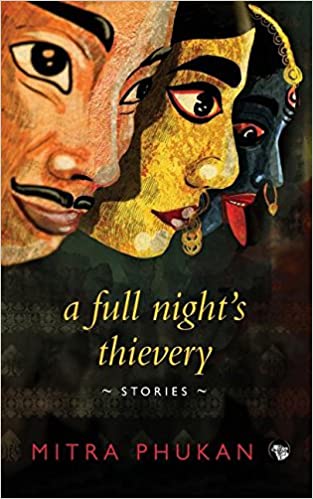
Music, definitely. In What Will People Say, for instance, there are so many references to songs and music, to concerts and musicians. There is an entire chapter devoted to songs in Hindi and Assamese where the theme is music. Besides, my novel A Monsoon of Music is about the lives of four practicing musicians. Many of my short stories from A Full Night’s Thievery have music as a theme …’The Tabla Player’, ‘The Choice’, ‘Spring Song’, and so on.

Also, musical metaphors seem to creep in, unbidden, to my writing…

Among the other passions that are reflected to a greater or lesser degree in my writing are gardening, and of course food!

What led you to write What Will People Say?

My stories, whether long or short, are always triggered by events, people, that I see around me. Sometimes it could even be a sentence I overhear while waiting at an airport, or maybe an expression on somebody’s face. They are based on reality, though they are fictionalised as they pass through the prism of my mind, my imagination.

What Will People Say was triggered by the fact that I see so many older women who have lost their spouses spend their lives in loneliness and sometimes despondency. Yes, their children may be caring, they may have women friends, a profession, but that is not enough. Love, finding a romantic partner, even companionship, is very unusual as a senior. There are so many unwritten codes, so many taboos and restrictions, especially in the small, peri-urban places.

And yet I find that change is coming. After all, people are exposed to other cultures, where going in for a second relationship is not seen as a betrayal of the dead husband, as it tends to be here.

The need for social change and a questioning of norms is part of the journey you take your readers through in your novel. Were these consciously woven into the story or did the story just happen? Please tell us about the journey of the novel.

This was the theme I have had in my mind for a while now. It was a conscious decision, and not always an easy one to implement, because of the binaries involved. 

The place where I live, the larger society, prides itself on being “liberal”. And it is, compared to some other places on the planet, or in the country. But in the twenty first century, we are aware that there is much more that needs to be done, a much longer path to be traversed. The theme came first. After which I began to think of the storyline, the characters, the incidents that would make the theme come alive, all in a fictional way, of course.

What Will People Say, the line, is a kind of whip used to keep “straying” members of society, usually young people, within the fold. But here I have inverted it …it is the older members, those who are supposed to uphold the status quo, who are doing what, for many, would be the unthinkable.

Do you still see widow remarriage as an issue? Is it still an issue in Northeast India as your book shows?

Assam is a multi-ethnic, multi-lingual, multi-cultural and multi-religious society.

The community I am describing is what is known as the “caste Hindu” society, in which, traditionally, widow remarriage is not “allowed”. Even now, even in urban Assamese society, it is uncommon. There are unspoken taboos, unwritten codes of conduct. The extreme strictness of the past has lessened no doubt, but also a lot depends on the economic and social status of the woman. I never, for instance, saw my grandmother, a staunch Brahmin, wear anything but stark white after she was widowed. Her vegetarian kitchen was separate from the main kitchen …leave aside meat or fish, even onions, garlic were not allowed there. My mother wanted to follow the same route after my father passed away, but her doctor forbade her from doing that, while her children insisted, she wear colour. Today, my generation of women wear colour and eat non-vegetarian after the demise of their husbands, so things are slowly changing. But a second marriage, or a romantic relationship, in middle age is still very rare indeed.

Your book describes middle class liberals, conservatives as well as immigrants and tribals. What kind of impact have tribals and immigrants had in Assam over time?

There have been many waves of migration into this fertile valley of the Brahmaputra. As a result, it is a rich cultural and linguistic mosaic. Different influences are at play all the time, communities that live in proximity to each other are definitely influenced. But it is a slow process, naturally. And usually takes place over generations.

You have hinted that tribals are more liberal and out of the framework of Hindu rituals. Is that a fact?

Many tribes are, in general, indeed more liberal when it comes to widow remarriage, as are the large Muslim and also the Christian communities. It is the “caste Hindus”, especially those from the “top” of the caste pyramid, who mostly have these taboos. The original inhabitants of these valleys were different ethnic groups, which, because of the riverine, heavily forested aspects of the region, tended to remain in isolation from each other. As a result, cultural practices were unique to each one. Different waves of immigrants from both the East of the region, from Southeast Asia and beyond, and from the rest of India in the west brought in different influences, which were absorbed slowly. We see this in the food practices, the music, the weaves and clothes that we traditionally wear, and religious and social practices, among other things.  

How do your characters evolve? Out of fact or are they just a figment of your imagination?

All are creations of my mind, my imagination. But I try to keep them as real as possible. It is all fiction. I love adding layers to them as I go along, till they have their own individuality, their own body language, their own ways of thinking, speaking, their food preferences, everything. By the end, they are “real” to me, though they actually exist only within the pages of a book.

What writers/ musicians/art impact you as a writer? Is there any writer who you feel impacts you more than others?

My music gurus have impacted me in many ways, beyond music. Guru Birendra Kumar Phukan, especially, taught me …through his music …what it means to be steeped in spirituality, and how to aspire higher through Shastriya music, which, to him, and sometimes to me, too, was and is prayer.

As for writers, there are so many I admire deeply. Among the Assamese writers are the scholar and creative writer of the 15th-16th Century, the Saint Srimanta Sankardev, Jnanpith awardees Birendra Kumar Bhattacharyya and Indira Goswami. I am always deeply moved by their humanity. Their works, their characters, are drenched in it.

Among writers that I have read in English are the obvious ones, so many of them …but for style and humour, I think nobody can beat P G Wodehouse, and for irony, Jane Austen.  And my Go To book during the pandemic was Three Men in a Boat by Jerome K Jerome, for an instant lifting of spirits.

You have written a lot of children’s stories and written columns. Have these impacted you as a novelist? How is writing a novel different from doing a fantasy-based children’s story or writing a column?

I have written biographies, short stories and essays too. Basically, I see myself as a storyteller, though I write non-fiction too.  The children’s stories came from my observations of the child’s world at one time, the way they thought and reacted. My columns are commentaries on society, couched in different “rasas”, including the humorous, but are sometimes a narration in the form of a story. The practice of writing, whatever the genre, and the habit of observation, have all helped me in the marathon task of writing novels!

What can we look forward to from you next? Are you working on a new novel?

Yes. I do have a novel in the pipeline, am giving it some final touches now. But what is due to be published next is a biography of Dr Bhupen Hazarika, a monograph really. He is a musical icon and so much else for us. It is being published by Sahitya Akademi. And then there is a translation of a novella by Sahitya Akademi Awardee Dr Dhrubjyoti Borah, to be published later this year by Om Books. And then of course there are the columns which I really enjoy doing, since the paper that I write for, The Assam Tribune, reaches the deepest areas of rural Assam. Many of the readers of this column, ‘All Things Considered’ are first generation literates, and that makes me really happy.

Thank you so much for these lovely questions.

Thanks for giving us your time.

.

[1] Classical Indian music

Click here to read the book excerpt of What Will People Say?

(The book review and the online interview conducted through emails are by Mitali Chakravarty)

PLEASE NOTE: ARTICLES CAN ONLY BE REPRODUCED IN OTHER SITES WITH DUE ACKNOWLEDGEMENT TO BORDERLESS JOURNAL. 

Click here to access the Borderless anthology, Monalisa No Longer Smiles

Click here to access Monalisa No Longer Smiles on Kindle Amazon International

Categories
Poetry

Epistle to Ms Austen by Phil Wood

Phil Wood
EPISTLE TO MS AUSTEN 

Dear Jane, although I do not have your mind,
A mind that makes a moral choice so clear,
Now clear enough for me to right my wrongs,
The wrongs that take refuge in daily muddles,
For muddles marinade in solitude;
Yet solitude gives thought for humankind,
A humankind in which we both belong,
Belong because we live not for our puzzles,
Those puzzles are a solace only for fears,
For fears will offer no solicitude.
I learn solicitude from you dear Jane.

Phil Wood was born in Wales. He studied English Literature at Aberystwyth University. His writing can be found in various places, including recently : Ink Sweat and Tears, Noon Journal of the Short Poem, and a collaboration with John Winder at Abergavenny Small Press.

PLEASE NOTE: ARTICLES CAN ONLY BE REPRODUCED IN OTHER SITES WITH DUE ACKNOWLEDGEMENT TO BORDERLESS JOURNAL

Click here to access the Borderless anthology, Monalisa No Longer Smiles

Categories
Essay

My Favourite Book by Fakrul Alam

Professor Fakrul Alam

My favourite book? Over the years, I have had many favourite books, and have been totally captivated by at least one of them at any one period of time. Indeed, once I began to take literature in English seriously, I was completely swept away by one book or the other that I came across at the University of Dhaka B. A. (Hons.) and M. A. English department syllabuses year after year. In my first year as an undergraduate, for instance, I read D. H. Lawrence’s Sons and Lovers (1913)compulsively, finding in its protagonist Paul Morel’s growing up into a young man’s storyline parallels with mine—although he was a miner’s son in Nottingham in the early twentieth century and I a boy growing up in Dhaka in the 1950s and 60s and the son of middle-class parents. A couple of years later, it was Jane Austen’s Pride and Prejudice(1813), for the story of the Bingley girls and their marriage encounters sounded familiar to me, for I too had four sisters whose marriages had become central to my parents’ thinking in all kinds of ways. And in my M. A. I read a book which harpooned me fully for many a decade—this was Melville’s Moby Dick (1851)—a whale of a book, I’m sure many of you in the virtual audience will agree. In all three cases, I read not only the novels I mentioned but almost everything by Lawrence, Austen and Melville I came across. Indeed, Melville’s fiction became the subject of my M. A. dissertation at Simon Fraser University.

But in the 1990s, I began to pay attention to Bangla writing seriously —something I had neglected for long, thanks first to an English medium education exclusively geared to the “O” levels that scanted our own literature and then my specialisation in literature in English afterwards. I began to read Bangla poetry intensively for the first time in this decade, although I had read some fiction in the language over the years. And it was sometime in the middle of the 1990s that I came across Jibanananda Das’s verse in an edition of his selected poems by the Bangladeshi poet-critic Abdul Mannan Syed. I would like to stress that this poet was born in 1899 in Borishal, a very green district crisscrossed by innumerable rivers all heading ultimately for the nearby Bay of Bengal; he died in what seemed to be an accidental death in Kolkata in the mid-1950s. Das’s verse possessed me completely, leaving me, who had till then read only some Bangla poetry but had concentrated mostly in fiction and non-fictional prose in English, with the urge to translate his verse into English. For the next three years, I kept going back to Das’s poems for their beauty, for the way they immortalised in verse the beauty of Bengal, and for the way they made me the poet’s intimate, for it is only when one translates intensely, all caught up in the source text, that one comes closest to the mind speech as well as the deep emotional life of the poet.

Having translated Jibanananda Das—surely the greatest modern Bengali poet—I felt I had to try to translate Rabindranath Tagore’s poetry—the greatest poet and literary personality Bengal has produced. Even though in the 1960s and 1970s, I had only paid sustained attention to poetry, fictional and nonfictional prose and plays in English, how could I have escaped Tagore then? He was everywhere in the Dhaka I experienced and very much part of the mindscape of us Bangladeshis as we moved towards becoming citizens of Bangladesh. His work was championed in the media; his songs were sung in events such as the Bangla new year festivities in mid-April; cultural events everywhere spurred by nationalism highlighted him in one way or the other. Besides, my father was addicted to Rabindranath’s songs and listened to him on the radio whenever he could, making us share his delight in the melodies then. My mother, for her part, quoted him all the time to give her children a sense of what we should be emulating and where we were going wrong.

In other words, Rabindranath was very much part of my consciousness, although I had occluded him till now. As I began to read him in the turn of the decade after translating Jibanananda, I felt I had to read as much of his works as I could. Inevitably, I began to translate many of his poems. By the time his sesquicentenary came up in 2011, I was invited to co-edit an anthology of his works and that led to the extensive reading of the myriad-minded writer’ work and increasing familiarity with this wonderful personality as well as writer.

And this is how I came to my favourite book of the last decade or so—Tagore’s Gitabitan. It is a book that is always on my study cum desktop computer table’s shelf over ten years now. It is something I resort to every time I listen to a Rabindranath song on YouTube in my desktop’s audio system. Sung melodiously and passionately by a favourite singer, a song by Tagore so allures me into rendering its spirit in another language that I feel I have to come as close to it as possible by translating it to the best of my ability. This means not only listening to the song again and again but also reading it on the printed page repeatedly, word by word, line by line, and stanza by stanza, time after time, till I feel I have been able to capture every aspect of it nuanced by Tagore by blending the tune and the song lyric as well as I could in the English language. In the end, of course, I fail to do so after a point, but the fascination of what is so appealing when heard, even if in the last analysis the task is an impossible one, induces me to render it into an alien language system after repeated readings and attempts to come up with a version that is close to the original in every way. I hope thereby to come to the heart of the song and am content to spend an hour or so on a few lines so that I can make its meaning clear to myself and then to others.                

Truly, there is a magical quality in the songs collected in my favorite book of this time—Tagore’s Gitabitan. It is a book that has also kindled the imagination of quite a few people—singers, musicians and translators— over eighty years now, making them represent the song-lyrics either as songs to be sung or as translations meant for foreign and even Bengal language speakers who might otherwise listen to a song swept away by the tune and opening lines without bothering with the later lines or making no attempt to understand its content.  The net result at the end of a few hours spent first reading many of the song closely, then reading my own translation again and again, is the satisfaction that I have been able to capture its essence in English through my translations. After all, and as Tagore himself has said, “the essence of a song is universal, even if its dress is local and national” (77). Why should I as a translator then not attempt to translate his songs for the world at large as well as myself even if their loveliness is uncatchable in the last analysis? He himself had led the way, and had learnt lessons along the process that were worth considering for later translators. I am hoping to bring out my own collection of translations of 350 plus songs by Tagore by the beginning of next year.

Let me point out that the title Tagore gave to the volume indicates that Gitabitan is meant to invite readers and musical devotees of the poet-composers to his “garden of songs.”  In all, the volume contains over 2,300 songs, nearly 1800 of whose tunes can be found in the musician-poet’s Swarabitan with their musical notations. In fact, there are sites now that you can google and access where you can find the Bengali words, some English translations, and notations, and even brief histories of the origins of the most commonly heard songs.

Let me point out too that Gitabitan itself is divided into six sections—songs of devotion, love, the six seasons of Bengal, patriotic songs, songs for festive and miscellaneous occasions, songs written for his plays and other publications. In their final form, the Gitabitan was published in 1941—the year the poet died. By now it has been reprinted, with new inclusions from scattered sources, innumerable times.

To conclude, why is Rabindranath Tagore’s Gitabitan my favourite book? He had himself said to Bengalis in 1939, “You can forget me, but how can you forget my songs?” Tagore’s collection of songs connects me to him endlessly, becoming a way of linking me as well with the universe and the Supreme Being and even my departed parents. They stir my patriotic side and make me one with the seasons of my country and its landscape and whatever is still romantic in me. And as I head towards the Great Unknown, they console me that there are possibilities of communion after we depart from this world as well!   

Fakrul Alam is Supernumerary Professor of English at the University of Dhaka

Click here to access the Borderless anthology, Monalisa No Longer Smiles

PLEASE NOTE: ARTICLES CAN ONLY BE REPRODUCED IN OTHER SITES WITH DUE ACKNOWLEDGEMENT TO BORDERLESS JOURNAL.

Categories
Interview

At Home Across Continents

In Conversation with Neeman Sobhan

Neeman Sobhan is an expat who shuttles between Italy and Bangladesh and writes. She has a knack of making herself at home in all cultures and all spheres. Having grown up partly in Pakistan (prior to the Liberation War in 1971), Bangladesh and completed her studies in United States, she has good words about time spent in all places. Her background has been and continues to be one of privilege as are that of many Anglophone writers across Asia. Her stories have been part of collections brought out to celebrate the fiftieth anniversary of Bangladesh.

One of her most memorable stories from her short story collection Piazza Bangladesh, located around the 1971 war takes on an unusual angle, where the personal seems to sweep the reader away from the historic amplitude of the event into the heart-rending cries of women at having lost their loved ones in a way that it transcends all borders of politics, anger and hate. The emotional trajectory finds home in a real-world event in the current war. The fate of innocent youngsters dying while not being entrenched in the hatred and violence wrings hearts as reports of such events do even now. I find parallels in the situation with the young Russian soldier whose mother did not know he was in Ukraine and who was killed while WhatsApping his mother his own distress at being there. And yet her stories stay within certain echelons which, as she tells us in the interview, are the spheres that move her muse.

When and how did you pick up a pen to write?

I have always written. The written word has always held a powerful fascination for me, which has not dimmed at all. From my childhood through my teens, I was a voracious and precociously advanced reader, as well as a passionate writer of poetry, and a keeper of a daily journal. My poetry was regularly published in The Pakistan Observer’s Junior page.  I don’t dare look at them now to even assess whether they were embarrassingly bad or surprisingly good enough to be salvaged and resurrected now! I preserved them as the earliest evidence of my continuing evolution as a writer and a poet today.

During those early days, I also won the first prize in a national essay writing competition sponsored by the newspaper. The Pear’s Encyclopedia I won still holds a precious place on my bookshelf.

English was my favourite subject in school and college, and I knew I would study English literature at university. I started out at Dhaka University in 1972 but by some perverse logic, I actually enrolled in the newly opened International Relations department and not the English Department (in which I had applied and been accepted). The reason, I now recall is because the English department was over-flowing with students, while the International Relations department was something exclusive and admitted a handful of students. However, after a few months I realised I had made a disastrous choice.

Meantime, my marriage was arranged, and I was whisked away to Marlyland, U.S. My husband, Iqbal, an ex-CSP officer (the Civil Service of Pakistan) was a Ph.d student of Economics at the University of Maryland, and in no time I enrolled as an undergraduate student and blissfully went on to study English and Comparative Literature, graduating eventually with a Masters in English Literature.

That I was going to be a writer was for me, even as a teenager, like a pre-ordained and much desired fate. I never wanted to pursue any other vocation.

What gets your muse going? 

Anything, and everything.  A view, a scent, an overheard conversation, a line of poetry, a memory……If I’m angry and seething, I write; if I’m sad or grieving, I write; if I’m joyous or ecstatic, I write; if I feel aa surge of spiritual bliss, I write; if I’m confused, I write. What form that writing takes is unpredictable. It could become a poem, or a paragraph in my notebook, which later could be part of my fiction, or a column. I wrote a regular column for the Daily Star of Bangladesh.

Writing is my food and nourishment, my therapy, my best friend, my passion. The writer-Me is the twin that lives inside me. It’s my muse and guide that defines my essential self. I am a contented wife of almost 50 years of marriage, a mother of two sons, and a grandmother of four grandsons (aged 5-4-3 & 2). These gratifying roles nourish my spirit, give me joy and inspiration, teach me lessons that help me grow as a human being. But my writer-self exists in its own orbit, proceeding on its solitary journey of self-actualisation, following its inner muse.

You have written of Italy, US and Bangladesh. How many countries have you lived in? 

Yes, I have lived in Italy, US and Bangladesh, which makes 3 countries. But, in fact, I have lived in 4 countries.

Remember that I was born not just in the undivided Pakistan of pre-71, when present day Bangladesh was East Pakistan, but I was actually born in West Pakistan, present day Pakistan, in the cantonment town of Bannu, near the borders of the Khyber Pass and Afghanistan, (formerly, the NWFP or NorthWest Frontier Province, presently KPK or Khyber Pakhtun-Khwa). Although my parents were Bengalis from Dhaka, my father’s government job (not in the army but under the Defence department, ‘Military Lands and Cantonments Services’) meant being posted in both wings of the then Pakistan. So, during my childhood and girlhood, I grew up in Karachi (Sindh), Multan and Kharian (Punjab) and Quetta (Balochistan). As a family of five siblings and our adventurous mother, we always accompanied our father on his official tours, by car or train, over the length and breadth of that country.

In the English medium school I was enrolled in, I had to choose Urdu as the vernacular subject, since Bengali was not taught in West Pakistani schools, though the opposite was not true! Anyway, I have no regrets. I am proficient in both Urdu and my mother tongue Bangla/Bengali, which I learnt at home from my mother, who in Quetta actually set up a small Bengali learning school for Bengali Army officers’ children. I am proud of the fact that I carried my mother’s tradition when I taught Bengali to Italians at the University of Rome, many decades later!   

What is it like being an immigrant writer? Which part of the world makes you feel most at home? Why? 

To start with, and to be honest, I do not really consider myself a true immigrant — someone who bravely and definitively leaves his familiar world and migrates  to another land because he has no other options nor the chance or means to return; rather, I feel lucky to be an ex-patriate — someone who chooses to make a foreign country her home, with the luxury of being able to revisit her original land, and, perhaps, move back one day. In fact, I have dual nationality, and am both an Italian citizen, and continue to hold a Bangladeshi passport. I might be considered to be an Italian-Bangladeshi writer. I consider myself a writer without borders.

I feel equally at home in Italy and in Bangladesh. Before the pandemic, my husband and I would make an annual trip to Dhaka for two months from December to February end, since my classes started in early March. Presently, I am back in Dhaka, after two almost apocalyptic years.

Despite the continuing hurdles of mastering the Italian language and trying to improve it constantly, we love our Roman home as much as our Dhaka home. Still, living away from ones’ original land, whether as an expatriate or an immigrant, is never easy, beset by nostalgia for what was left behind and the struggle to create a new identity of cultural fusion within the dominant and pervasive culture of a foreign land. But in this global age, it’s quite usual to live in a mix of cultures and live in a borderless world where ones national or cultural identity is not so clear cut. (I have a daughter-in-law who is Chinese, and another who is half-English, half-Thai! And my grandchildren are the heirs to a cornucopia of cultures and are true global citizens). Nevertheless, in the four and a half decades of my living away from Bangladesh, the eternal quest for that illusory place called home has shaped the sensibility that nourishes my creativity and compels me to write. Often, it’s the pervasive and underlying theme in my columns, stories and poetry. There is a poem of mine, “False Homecoming” which underlines the poignant sense of displacement a person can feel, not in a foreign land but in ones’ own motherland, or the version from the past. After all, many people who live away, exist in a time-warp.So, no matter which part of the world you feel at home in, it’s temporary. For me, as a writer between countries and homes, it is an external and internal odyssey.

It is the endless journey of a writer in constant evolution.

Tell us a bit about your journey. 

I realised early on that our real world being increasingly borderless, it’s not a tract of land that makes me feel at home. It’s my writing. The Mexican poet Octavio Paz once said, “Words became my dwelling place.” This has always resonated deeply with me, because for me, too, language and literature have been my sanctuary and true homeland. I have lived in that comfort zone at the heart of my creativity, imagination and writing: my dwelling place of words.

Of course, there are as many shapes to the sheltering place of language as there are literary forms. My nest of words was also feathered by my particular exigencies, followed a particular route and journey.

Though I speak various languages, my mother tongue is Poetry. For as far back as I can remember I have always written poetry, like writing in a journal, considering it to be the shorthand of my heart, a secret language. I am a reticent person, and there are writers like me who are content to use writing, whether poetry or prose, as a tool for self-exploration, self-knowledge, self-definition, with no thought of being published. At least, not my personal poems.

Yet with poetic irony, despite being a private person, my career as a writer started when I was jettisoned into that most public form of literary expression: the world of weekly column writing. At the urging of a friend, the editor of the Bangladeshi national daily The Daily Star, I turned into a public chronicler of the minutiae of my world, my life and times. Now I discovered my professional language, my father tongue if you will, the language of prose and my journey as a writer started.

When one reads your writing, it is steeped in a number of cultures. Which culture is most comfortable for you while writing and which one for living? 

There’s no place as beautiful and pleasurable to live in as Italy. Except for two or three months of winter, the climate during the rest of the year is perfect; the natural beauty and historical and artistic richness are unsurpassable, the food is delectable whether it’s based on nature’s bounty or the simple elegance of its distinctive cuisine. But for a writer who is also a housewife, the most comfortable country to write in, for me, is Bangladesh. With the culture of household helps abounding, I often get more writing done in two months of living in my Dhaka apartment than a whole year in Rome. My domestic staff are like family to us, and valued parts of our life. They sustain us and we sustain them, helping them educate their children to stand on their own feet. I miss this support network in Italy.

What are your favourite themes and your favourite genre? Expand on that a bit. 

My favourite genre to both read and write is the short story, poetry, humorous essays, travel writing and insightful book reviews. I read fewer novels now, and I have been writing and struggling to finish my first novel for years. I suspect, this is because I am temperamentally more attuned to the short sprint dash of producing a discrete work of imagination than the long-distance run of a lengthy work. But I am determined to conclude this opus before it becomes an unfinished relic.

I never approach fiction-writing through themes. But in non-fiction prose writings, like essays and articles for columns, I love to write about certain topics, or about books, places, and people, from all walks of life. I also love to write about nature, food, history and traditions, about how to improve our world, our lives and our relationships; and the happy, hopeful moments of life. As far as reading goes, I love reading about travel, love and friendship, human compassion, and anything with a happy ending.

You seem to have centred much of your work on people who are affluent. What about the rest — especially the huge population who serve the affluent? Have you written on them? Tell us why or why not.

That is an incomplete picture, and a wrong perception of my writing. To start with, as a writer I am more interested in the richness of the inner lives of human beings, and less so in the outward, economic and class differences. To me, no one is merely affluent or poor, but human and worthy of a compassionate gaze. The diversity and motivations of characters, whichever strata of society they belong to moves my imagination. I do not write to either preach or disseminate ideas of social justice or to right wrongs, but to explore and present the world we live in, in all its complexities and subtleties, the joys and ugliness, the small dreams and grand passions, the disappointments and triumphs of individuals and generations. I like to delve into the psychological or political motivations of human behaviour, especially within the domestic sphere, the family, an ethnic community.

I have many stories about those who serve or are not from privileged classes. My story ‘A Sprig of Jasmine’ is about a sweeper woman at a school in Bangladesh. Then there is the story ‘The Farewell Party’ about a temporary domestic help in a Bangladeshi home in Rome, suspected of stealing. I also have a sequel to that which explores the life of the same Bengali help now working as a nurse-companion to an old Italian woman.  These and many more are awaiting to be published soon in another collection.

But I never consciously choose a subject or set out specifically to tell the story of an under-privileged, oppressed, or marginalised person. It can happen that the story turns out to be about them, but for me a story reveals itself randomly, through an image or scent or a view or an overheard conversation, once I witnessed a slap being delivered, etc, and I follow its trail till it leads me to an interesting bend where it starts to shape into a story. I never know how a story will start or end. It grows in organic but unpredictable way. That is the challenge, and adventure of writing a story.

For example, one of my most newest stories, titled ‘The Untold Story’, (published in a recent anthology for Bangladesh’s 50th anniversary, When the Mango Tree Blossomed, edited by Niaz Zaman), is two parallel tales of two Birangonas (‘war heroines’ or raped victims during the Bangladesh liberation war ), but it came to me more as a way to explore the craft of storytelling, which is something that always engages me: how a story is narrated, as much as what the narrative is about.

By and large, I like to write stories about the world I know, and the people in my own milieu because no one writes about the expat society of Europe. I like to write about my world in all its details and extrapolate from its larger truths about humanity in general.

Jane Austen wrote about the landed gentry and her corner of England, but the stories ultimately reach our hearts not merely as stories of the affluent but of human foibles. John Updike wrote about his American suburban world. Annie Proulx writes about Wyoming. Alice Munro about the middle-class world of her neck of the Canadian world. Henry James focused on American aristocrats. But what is human and vulnerable, or worthy or unworthy, transcends class barriers. People are interesting, subtle, unpredictable, noble or wicked, no matter whether they are affluent or of straitened means. Tagore’s tales of women trapped in their roles in rich households are just as moving as those among the poor and underprivileged.

There are plenty of writers with a sociologist’s background who can chronicle the lives of the downtrodden whom they meet. I applaud them. My younger son works with the Rohingyas; my brother-in-law, a doctor worked for years with children of addicts. They have their stories to tell. I have mine. I’m interested in humanity, wherever I find them.

In the little I have read of your stories, Bangladesh is depicted in a darker light in your narratives — that it is backward in values, in lifestyles etc. Why? 

I don’t know which particular story or stories you have in mind where you felt that this impression was consciously created. Unless the story was indeed about a backward area, like the dingy alleys and neighbourhoods of old Dhaka in the 60’s and 70’s. Or, the murky values resulting from the explosion of wealth and the rise of corruption, undermining civic and ethical values in the rampantly urbanised zones.

In which case, it’s an unavoidable fact and not a depiction.

However, since I write more in a nostalgic light about Dhaka past rather than the reality of the present, I actually have not really written about the darker sides of the country; and which country or society does not have its seamy side. A good question would have been why I have not depicted Bangladesh in a darker light as contemporary writers of Bengali fiction do, dealing courageously with sinister aspects of politics and corrupt moral values at every level of society.

There is much in the Bangladeshi culture that we are proud of, beautiful traditions, and so much beauty in our natural world. I like to weave these into my narrative. So, I’m surprised that you found my stories to be dark.

 What are your future plans?

One of my most urgent projects is to get my novel-in-progress published.

I’m also planning to come out with another collection of stories, and a collection of my columns on travel, and an Italian and Bengali translation of my fiction.

So far, my three published books, and all the stories that have appeared in various anthologies are just a few milestones but do not define my journey as a writer. Daily I grapple with the insecurities of a writer, and daily I learn new things that help me grow towards being the writer I aspire to be. It’s still a long way to a full flowering, but each passing day I dabble in words, I feel the creative petals unfolding, slowly but surely.

Thank you for your time.

(This is an online interview conducted by Mitali Chakravarty.)

PLEASE NOTE: ARTICLES CAN ONLY BE REPRODUCED IN OTHER SITES WITH DUE ACKNOWLEDGEMENT TO BORDERLESS JOURNAL

Categories
Editorial

Making a Grecian Urn

“Beauty is truth, truth beauty — that is all
                Ye know on earth, and all ye need to know.”  
  
John Keats (1795-1821), Ode to a Grecian Urn
‘Beauty is Truth’ : The Potato Eaters(1885) by Vincent van Gogh (1853-1890). Courtesy: Creative Commons

What makes for great literature? To me, great literature states the truth — the truth that touches your heart with its poignancy, preciseness, sadness, gentleness, vibrancy, or humour.  If Khayyam, Rumi, Keats, Tagore, Frost or Whitman had no truths to state, their poetry would have failed to mesmerise time and woo readers across ages. Their truths – which can be seen as eternal ones — touch all human hearts with empathetic beauty. Lalon Fakir rose from an uneducated illiterate mendicant to a poet because he had the courage to sing the truth about mankind — to put social norms and barriers aside and versify his truth, which was ours and still is. This can be applied to all genres. Short stories by Saki, O’ Henry or plays and essays by Bernard Shaw — what typifies them? The truth they speak with perhaps a sprinkle of humour. Alan Paton spoke the truth about violence and its arbitrariness while writing of South Africa — made the characters so empathetic that Cry, My Beloved Country (1948) is to me one of the best fictions describing divides in the world, and the same divides persist today. The truth is eternal as in George Orwell’s 1984 (1949) or Suskind’s Perfume (1985). We love laughter from Gerald Durrell or PG Wodehouse too because they reflect larger truths that touch mankind as does the sentimentality of Dickens or the poignancy of Hardy or the societal questioning of the Bronte sisters, George Eliot, and Jane Austen. The list of greats in this tradition would be a very long one.

 Our focus this time is on a fearless essayist in a similar tradition, one who unveiled truths rising above the mundane, lacing them with humour to make them easily digestible for laymen – a writer and a polyglot who knew fourteen languages by the name of Syed Mujtaba Ali (1904-1974). He was Tagore’s student, a Humboldt scholar who lived across six countries, including Afghanistan and spoke of the things he saw around him. Cherished as a celebrated writer among Bengali readers, he wrote for journals and published more than two dozen books that remained untranslated because his witticisms were so entrenched by cultural traditions that no translator dared pick up their pen. Many decades down the line, while in Afghanistan, a BBC editor for South and Central Asia, Nazes Afroz, translated bits of Mujtaba Ali’s non-fiction for his curious friends till he had completed the whole of the travelogue.

The translation named In a Land Far from Home: A Bengali in Afghanistan was published and nominated for the Crossword Awards. This month, we not only run an excerpt from the translated essays but also have an interview with the former BBC journalist, Afroz, who tells us not only about the book but also of the current situation in ravaged Afghanistan based on his own first-hand experiences. Nazes himself has travelled to forty countries, much like our other interviewee, Sybil Pretious, who has travelled to forty and lived in six. She had been writing for us till she left to complete her memoirs — which would cover much of history from currently non-existent country Rhodesia to apartheid and the first democratic election in South Africa. These would be valuable records shared with the world from a personal account of a pacifist who loves humanity.

We have more on travel — an essay by Tagore describing with wry humour vacations in company of his niece and nephew and letters written by the maestro during his trips, some laced with hilarity and the more serious ones excerpted from Kobi and Rani, all translated by Somdatta Mandal. We have also indulged our taste for Tagore’s poetry by translating a song heralding the start of the Durga Puja season. Durga Puja is an autumnal festival celebrated in India. An essay by Meenakshi Malhotra explains the songs of homecoming during this festival. It is interesting that the songs express the mother’s views as highlighted by Malhotra, but one notices, never that of the Goddess, who, mythology has it, gave up her life when the husband of her own choosing, Shiva, was perceived by her family as ‘uncouth’ and was insulted in her parent’s home.

In spirit of this festival highlighting women power and on the other hand her role in society, we have a review by Somdatta of T. Janakiraman’s Wooden Cow, translated from Tamil by Lakshmi Kannan, where the protagonist upends all traditional values ascribed to women. Another book which is flavourful with food and would be a real fit on every festive occasion is Mohana Kanjilal’s A Taste of Time: A Food History of Calcutta. Bhaskar Parichha tells us in his review, “In the thriving universe of Indian food books, this clearly stands out.”

Aruna Chakravarti’s review of Shazia Omar’s Golden Bangladesh at Fifty also stands out embracing the colours of Bengal. It traces the title back to history and their national anthem — a Tagore song called ‘Amaar Sonar Bangla – My Golden Bengal’. Gracy Samjetsabam’s review of Suzanne Kamata’s The Baseball Widow, a cross cultural novel with an unusual ending that shuttles between America and Japan, winds up our review section this time.

As Kamata’s book travels across two continents in a pre-covid world, Sunil Sharma in reality moved home from one continent to another crossing multiple national borders during the pandemic. He has written an eye-opening account of his move along with his amazing short story on Gandhi. Another unusual story creating a new legend with wonderful photographs and the narrative woven around them can be relished in Nature’s Musings by Penny Wilkes. This time we have fiction from India, Malaysia, Bangladesh and America. Steve Davidson has given a story based partly on Tibetan lore and has said much in a light-hearted fashion, especially as the Llama resumes his travels at the end of the story. Keeping in step with light humour and travel is Devraj Singh Kalsi’s account of a pony ride up a hill, except it made me laugh more.

The tone of Rhys Hughes cogitations about the identity of two poets across borders in ‘Pessoa and Cavafy: What’s in a Name?’ reminds me of Puck  or Narada! Of course, he has given humour in verses with a funny story poem which again — I am not quite sure — has a Welsh king who resisted Roman invasion or is it someone else? Michael Burch has limericks on animals, along with his moving poem on Martin Luther King Junior. We have much poetry crossing borders, including a translation of Akbar Barakzai’s fabulous Balochi poetry by Fazal Baloch and Sahitya Akademi winning Manipuri poet, Thangjam Ibopishak, translated by Robin S Ngangom. A Nazrul song which quests for a spiritual home has been translated from Bengali by no less than Professor Fakrul Alam, a winner of both the SAARC award and Bangla Academy Literary Award.

Former Arts Editor of Times of India, Ratnottama Sengupta, has shared an essay on how kantha (hand embroidered rug) became a tool to pass on information during the struggle against colonial occupation. The piece reminded me of the narrative of passing messages through mooncakes among Chinese. During the fourteenth century, the filling was of messages to organise a rebellion which replaced the Yuan dynasty (1271-1368) with the Ming (1368-1644). Now the filling is delicious lotus paste, chocolates or other edible delicacies. Women were heavily involved in all these movements. Sameer Arshad Khatlani has highlighted how women writers of the early twentieth century writing in Urdu, like Ismat Chughtai, created revolutionary literature and inspired even legendary writers, like Simone de Beauvoir. There is much more in our content — not all of which has been discussed here for again this time we have spilled over to near fifty pieces.

We have another delightful surprise for our readers – a cover photo of a painting by Sohana Manzoor depicting the season titled ‘Ode to Autumn’. Do pause by and take a look at this month’s issue. We thank our writers and readers for their continued support. And I would personally like to give a huge thanks to the team which makes it possible for me to put these delectable offerings before the world. Thank you all.

Wish you a wonderful month full of festivities!

Mitali Chakravarty,

Borderless Journal